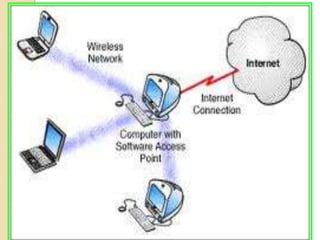
 Wireless   Internet provides an
  always-on connection which can
  be accessed from anywhere.
 It is typically more expensive
  and mainly available in
  metropolitan areas.
 It uses radio frequencies to
  connect to the internet.
2>.WI-FI CONNECTION


 Wi-Fi is the standard way computers
  connect to wireless networks.
 Many mobile devices, and other
  standalone devices also include Wi-Fi
  capability, enabling them to connect to
  wireless networks in range of 100 meters.
3>.SATELLITE CONNECTION
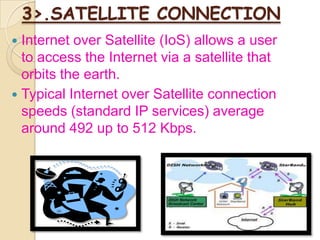
 Internet over Satellite (IoS) allows a user
  to access the Internet via a satellite that
  orbits the earth.
 Typical Internet over Satellite connection
  speeds (standard IP services) average
  around 492 up to 512 Kbps.
4>.CABLE CONNECTION
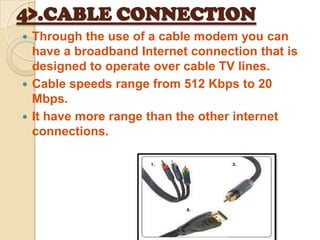
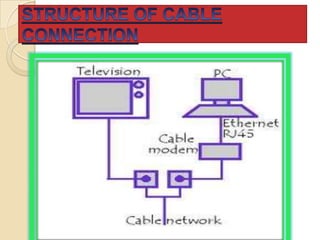
 Through the use of a cable modem you can
  have a broadband Internet connection that is
  designed to operate over cable TV lines.
 Cable speeds range from 512 Kbps to 20
  Mbps.
 It have more range than the other internet
  connections.
 This may be the best option if you
  are on a tight budget.
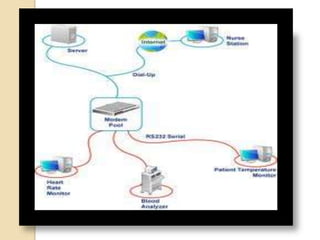
 Dial-up access uses a modem
  and a telephone line to connect to
  the Internet.
 The drawbacks of using this
  option are that data is typically
  transmitted at a slow rate and it
  blocks the telephone line.
6>.DIGITAL SUBSCRIBER LINE
(DSL)
 DSL is also called an always on
  connection because it uses
          .
 There is no need to dial-in to your ISP
  as DSL is always on.
 Its speeds ranges from 128kpbs to 8
  mbps.
CREATED BY :-
Internet connection

Internet connection

  • 3.
     Wireless Internet provides an always-on connection which can be accessed from anywhere.  It is typically more expensive and mainly available in metropolitan areas.  It uses radio frequencies to connect to the internet.
  • 5.
    2>.WI-FI CONNECTION  Wi-Fiis the standard way computers connect to wireless networks.  Many mobile devices, and other standalone devices also include Wi-Fi capability, enabling them to connect to wireless networks in range of 100 meters.
  • 6.
    3>.SATELLITE CONNECTION  Internetover Satellite (IoS) allows a user to access the Internet via a satellite that orbits the earth.  Typical Internet over Satellite connection speeds (standard IP services) average around 492 up to 512 Kbps.
  • 7.
    4>.CABLE CONNECTION  Throughthe use of a cable modem you can have a broadband Internet connection that is designed to operate over cable TV lines.  Cable speeds range from 512 Kbps to 20 Mbps.  It have more range than the other internet connections.
  • 9.
     This maybe the best option if you are on a tight budget.  Dial-up access uses a modem and a telephone line to connect to the Internet.  The drawbacks of using this option are that data is typically transmitted at a slow rate and it blocks the telephone line.
  • 11.
    6>.DIGITAL SUBSCRIBER LINE (DSL) DSL is also called an always on connection because it uses .  There is no need to dial-in to your ISP as DSL is always on.  Its speeds ranges from 128kpbs to 8 mbps.
  • 12.