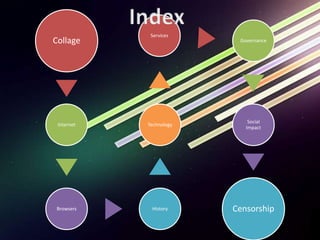
Collage
Internet
Browsers History
Technology
Services
Governance
Social
Impact
Censorship
The Internet is a global
system of
interconnected computer
networks that use the
standard Internet protocol
suite (TCP/IP) to link several
billion devices worldwide. It
is a network of
networks that consists of
millions of private, public,
academic, business, and
government networks, of
local to global scope, that
are linked by a broad array
of electronic, wireless, and
optical networking
technologies.
There are many browsers
Maxthon
Chrome , Opera etc.
Konqueror
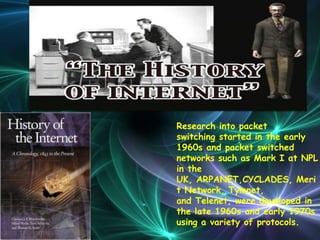
Research into packet
switching started in the early
1960s and packet switched
networks such as Mark I at NPL
in the
UK, ARPANET,CYCLADES, Meri
t Network, Tymnet,
and Telenet, were developed in
the late 1960s and early 1970s
using a variety of protocols.
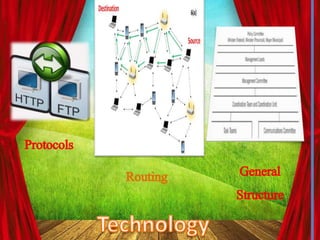
Routing
Protocols
General
Structure
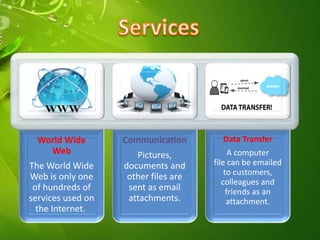
World Wide
Web
The World Wide
Web is only one
of hundreds of
services used on
the Internet.
Communication
Pictures,
documents and
other files are
sent as email
attachments.
Data Transfer
A computer
file can be emailed
to customers,
colleagues and
friends as an
attachment.
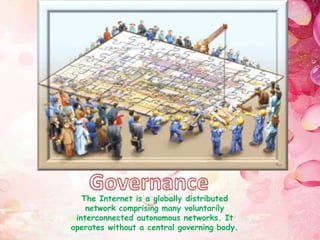
The Internet is a globally distributed
network comprising many voluntarily
interconnected autonomous networks. It
operates without a central governing body.
Social
networking websites
such
as Facebook, Twitter
, and MySpace have
created new ways to
socialize and
interact.
Electronic business
(E-business)
involves business
processes
spanning the
entire value chain.
Remote work is
facilitated by tools
such
as groupware, virtu
al private networks
, and Voice over IP
(VOIP).
Crowdsourcing
systems are used to
accomplish a variety
of tasks. For example,
the crowd may be
invited to develop a
new technology etc.
A popular twist on
Internet-based
philanthropy is the
use of peer-to-peer
lending for charitable
purposes.
The vast majority of
computer
surveillance involves
the monitoring
of data and traffic on
the Internet.
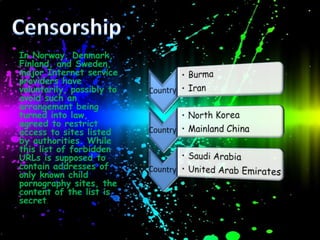
In Norway, Denmark,
Finland, and Sweden,
major Internet service
providers have
voluntarily, possibly to
avoid such an
arrangement being
turned into law,
agreed to restrict
access to sites listed
by authorities. While
this list of forbidden
URLs is supposed to
contain addresses of
only known child
pornography sites, the
content of the list is
secret.
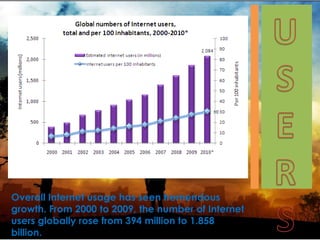
Overall Internet usage has seen tremendous
growth. From 2000 to 2009, the number of Internet
users globally rose from 394 million to 1.858
billion.
Internet

Internet

  • 2.
  • 4.
    The Internet isa global system of interconnected computer networks that use the standard Internet protocol suite (TCP/IP) to link several billion devices worldwide. It is a network of networks that consists of millions of private, public, academic, business, and government networks, of local to global scope, that are linked by a broad array of electronic, wireless, and optical networking technologies.
  • 5.
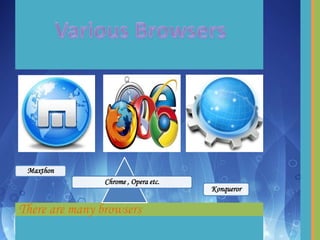
    There are manybrowsers Maxthon Chrome , Opera etc. Konqueror
  • 6.
    Research into packet switchingstarted in the early 1960s and packet switched networks such as Mark I at NPL in the UK, ARPANET,CYCLADES, Meri t Network, Tymnet, and Telenet, were developed in the late 1960s and early 1970s using a variety of protocols.
  • 7.
  • 8.
    World Wide Web The WorldWide Web is only one of hundreds of services used on the Internet. Communication Pictures, documents and other files are sent as email attachments. Data Transfer A computer file can be emailed to customers, colleagues and friends as an attachment.
  • 9.
    The Internet isa globally distributed network comprising many voluntarily interconnected autonomous networks. It operates without a central governing body.
  • 11.
    Social networking websites such as Facebook,Twitter , and MySpace have created new ways to socialize and interact. Electronic business (E-business) involves business processes spanning the entire value chain. Remote work is facilitated by tools such as groupware, virtu al private networks , and Voice over IP (VOIP).
  • 12.
    Crowdsourcing systems are usedto accomplish a variety of tasks. For example, the crowd may be invited to develop a new technology etc. A popular twist on Internet-based philanthropy is the use of peer-to-peer lending for charitable purposes. The vast majority of computer surveillance involves the monitoring of data and traffic on the Internet.
  • 13.
    In Norway, Denmark, Finland,and Sweden, major Internet service providers have voluntarily, possibly to avoid such an arrangement being turned into law, agreed to restrict access to sites listed by authorities. While this list of forbidden URLs is supposed to contain addresses of only known child pornography sites, the content of the list is secret.
  • 14.
    Overall Internet usagehas seen tremendous growth. From 2000 to 2009, the number of Internet users globally rose from 394 million to 1.858 billion.