Anatomy of financial
crises

February 2014
Dieter Guffens
KBC Chief Economist Department
Overview
 Part I: Crises are more than ‘volatility’

 Part II: Crises are inevitable

 Part III: History repeats itself

 Part IV: Lessons can be learned

 Part V: Takeaways
2
Overview
 Part I: Crises are more than ‘volatility’

3
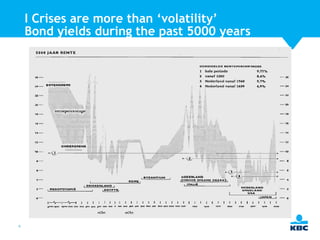
I Crises are more than ‘volatility’
Bond yields during the past 5000 years

4
I Crises are more than ‘volatility’
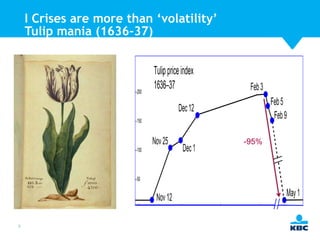
Tulip mania (1636-37)

-95%

5
I Crises are more than ‘volatility’
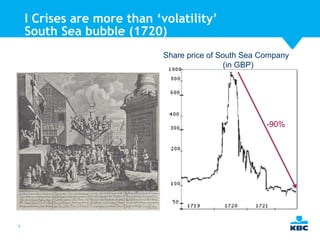
South Sea bubble (1720)
Share price of South Sea Company
(in GBP)

-90%

6
I Crises are more than ‘volatility’
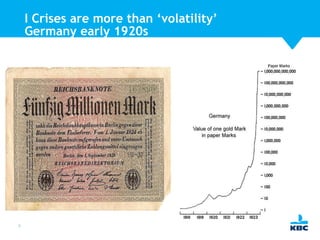
Germany early 1920s

7
I Crises are more than ‘volatility’
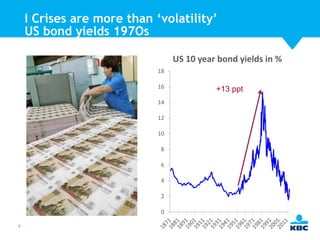
US bond yields 197Os
US 10 year bond yields in %
18
16
14
12
10
8
6

4
2
0
8

+13 ppt
I Crises are more than ‘volatility’
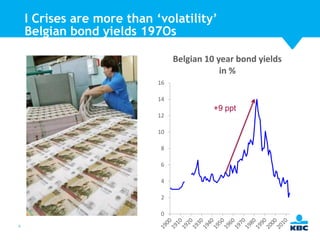
Belgian bond yields 197Os
Belgian 10 year bond yields
in %
16
14

+9 ppt
12
10
8
6
4
2
0
9
I Crises are more than ‘volatility’
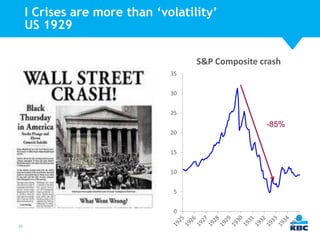
US 1929
S&P Composite crash
35
30
25

-85%
20
15
10

5
0
10
I Crises are more than ‘volatility’

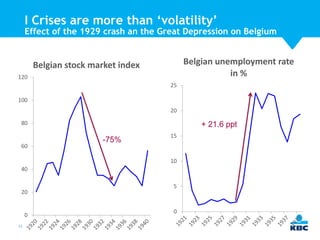
Effect of the 1929 crash an the Great Depression on Belgium

Belgian unemployment rate
in %

Belgian stock market index
120
25
100
20
80

60

+ 21.6 ppt
-75%

15

10
40

20

0
11

5

0
I Crises are more than ‘volatility’

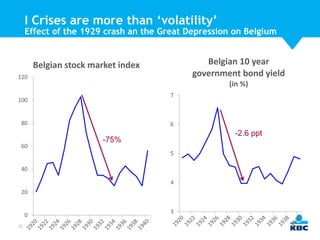
Effect of the 1929 crash an the Great Depression on Belgium

Belgian 10 year
government bond yield

Belgian stock market index
120

(in %)
7

100

80

60

6

-2.6 ppt

-75%
5

40
4
20

0
12

3
I Crises are more than ‘volatility’

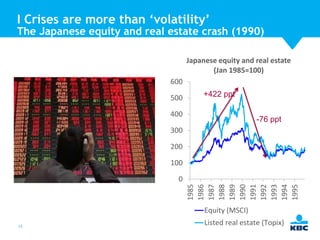
The Japanese equity and real estate crash (1990)
Japanese equity and real estate
(Jan 1985=100)
600
500

+422 ppt

400

-76 ppt

300
200
100
1985
1986
1987
1988
1989
1990
1991
1992
1993
1994
1995

0

Equity (MSCI)
13

Listed real estate (Topix)
I Crises are more than ‘volatility’

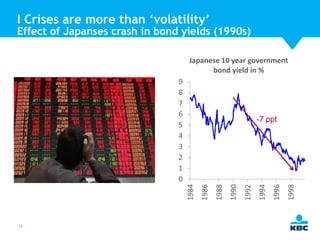
Effect of Japanses crash in bond yields (1990s)
Japanese 10 year government
bond yield in %
9
8
7
6
5
4
3
2
1
0

14

1998

1996

1994

1992

1990

1988

1986

1984

-7 ppt
I Crises are more than ‘volatility’
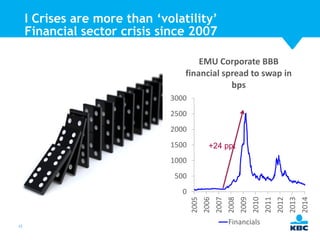
Financial sector crisis since 2007
EMU Corporate BBB
financial spread to swap in
bps
3000
2500
2000
1500

+24 ppt

1000
500

15

Financials

2014

2013

2012

2011

2010

2009

2008

2007

2006

2005

0
Overview
 Part I: Crises are more than ‘volatility’

 Part II: Crises are inevitable

16
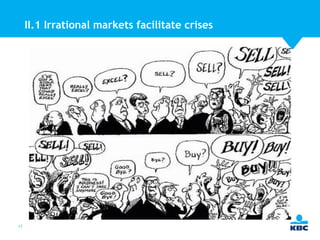
II.1 Irrational markets facilitate crises

17
II.2 Bubbles are possible because of market
irrationality

 In efficient markets, irrational exaggerations are highly unlikely
 However, grounds for market inefficiency and irrationality include
 “The limits of arbitrage” (Shleifer and Vishny, 1997): there are cost of arbitration,
e.g. the fate of LTCM in 1998
 Keynes’ “greater fool” game
 Psychological biases (Daniel Kahnemann, “Prospect theory”): investors’ utility is
reference based, e.g. on the profits earned by others

 Multiple equilibria exist, dependent on expectations. Changes are often
triggered by expectation ‘shifts’ (Kindleberger’s ‘displacements’)
 Exaggeration cycles are inherent in market economies
18
II.3 Bubbles are possible because of the
‘debt nature’ of our money
 Our ‘money’ is a debt certificate of the state or a private economic agent

 Coins and bills are debt certificates of the state
 They are legal tender,…
 … in particular they can be used to settle tax debt towards the state

 All other money (deposits, accounts, etc…) are debt instruments of private
agents, mostly banks
 Since our monetary system is based on debt and credit, occasional crises
are not avoidable

19
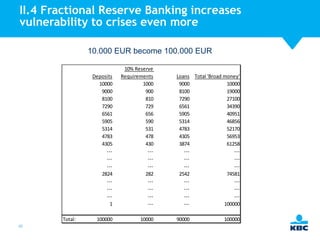
II.4 Fractional Reserve Banking increases
vulnerability to crises even more
10.000 EUR become 100.000 EUR
Deposits
10000
9000
8100
7290
6561
5905
5314
4783
4305
------2824
------1
Total:
20

10% Reserve
Requirements
1000
900
810
729
656
590
531
478
430
------282
---------

100000

10000

Loans Total 'Broad money'
9000
10000
8100
19000
7290
27100
6561
34390
5905
40951
5314
46856
4783
52170
4305
56953
3874
61258
------------2542
74581
--------------100000
90000

100000
II.4 Fractional Reserve Banking

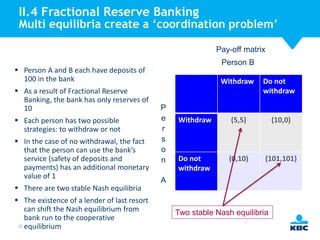
Multi equilibria create a ‘coordination problem’
Pay-off matrix
Person B

 Person A and B each have deposits of
100 in the bank
 As a result of Fractional Reserve
Banking, the bank has only reserves of
10

 Each person has two possible
strategies: to withdraw or not
 In the case of no withdrawal, the fact
that the person can use the bank’s
service (safety of deposits and
payments) has an additional monetary
value of 1
 There are two stable Nash equilibria
 The existence of a lender of last resort
can shift the Nash equilibrium from
bank run to the cooperative
21 equilibrium

Withdraw
P
e
r
s
o
n

Do not
withdraw

Withdraw

(5,5)

(10,0)

Do not
withdraw

(0,10)

(101,101)

A

Two stable Nash equilibria
II.4 Fractional Reserve Banking increases
vulnerability to crises
 Defining property: not all deposits covered by reserves
 This makes the system vulnerable to bank runs
 Instability is NOT caused by the nature of fiat money, it applies to gold
standard as well
 One way to avoid bank runs would be a system of Full Reserve or 100%
Reserve Banking (Milton Friedman)
 Problem: liquidity provision, banking sector cannot play its role of financial
intermediation, leading to credit crunch
 Not currently practiced as a system

22
II. 5 Saving for the future also requires debt accumulation

 Saving in fixed income asset = creating a claim
on future output

 But: someone must promise to give up that
part of future output, i.e. incur debt
 Implication: saving and debt are two sides of
the same coin: one’s savings are someone else’s
debt
 Savings are only possible to the extent that
someone else is prepared to incur debt for the
same amount
 If literarily all debts are repaid, all money would
disappear and our monetary system would
23 collapse: back to barter trade
Overview
 Part I: Crises are more than ‘volatility’

 Part II: Crises are inevitable

 Part III: History repeats itself

24
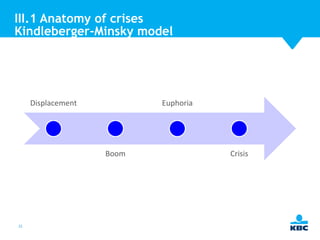
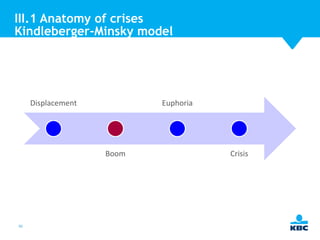
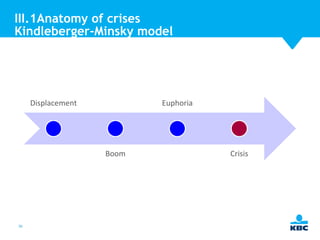
III.1 Anatomy of crises
Kindleberger-Minsky model

Displacement

Euphoria

Boom

25

Crisis
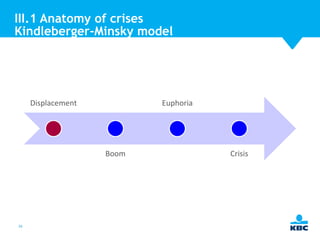
III.1 Anatomy of crises
Kindleberger-Minsky model

Displacement

Euphoria

Boom

26

Crisis
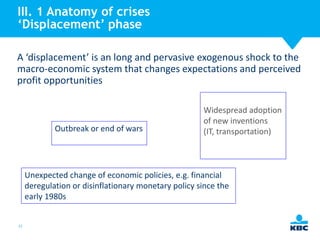
III. 1 Anatomy of crises
‘Displacement’ phase
A ‘displacement’ is an long and pervasive exogenous shock to the
macro-economic system that changes expectations and perceived
profit opportunities

Outbreak or end of wars

Widespread adoption
of new inventions
(IT, transportation)

Unexpected change of economic policies, e.g. financial
deregulation or disinflationary monetary policy since the
early 1980s

27
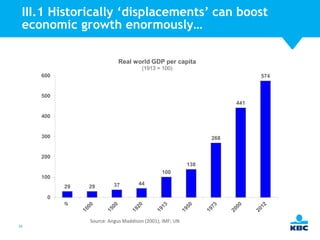
III.1 Historically ‘displacements’ can boost
economic growth enormously…
Real world GDP per capita
(1913 = 100)
600

574

500
441
400

300

268

200
138
100

100

29

29

37

44

0

Source: Angus Maddison (2001); IMF; UN
28
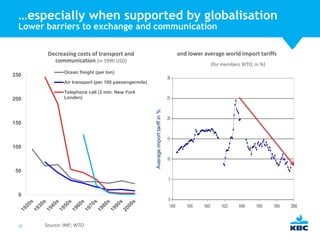
…especially when supported by globalisation
Lower barriers to exchange and communication

and lower average world import tariffs

Decreasing costs of transport and
communication (in 1990 USD)
250

(for members WTO, in %)

Ocean freight (per ton)
Air transport (per 100 passengermile)

Average import tariff in %

200

Telephone call (3 min. New York
Londen)

150

100

50

0

29

Source: IMF; WTO
III.1 Anatomy of crises
Kindleberger-Minsky model

Displacement

Euphoria

Boom

30

Crisis
III.1 Anatomy of crises
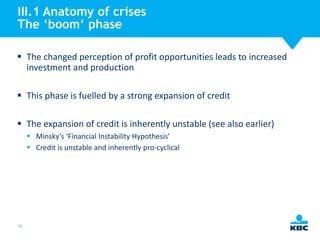
The ‘boom‘ phase
 The changed perception of profit opportunities leads to increased
investment and production
 This phase is fuelled by a strong expansion of credit

 The expansion of credit is inherently unstable (see also earlier)
 Minsky’s ‘Financial Instability Hypothesis’
 Credit is unstable and inherently pro-cyclical

31
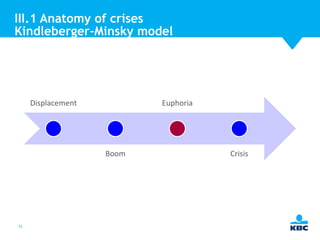
III.1 Anatomy of crises
Kindleberger-Minsky model

Displacement

Euphoria

Boom

32

Crisis
III.1 Anatomy of crises
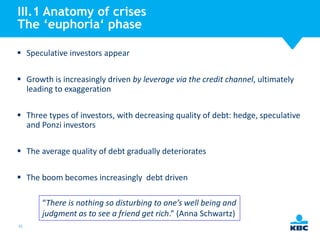
The ‘euphoria‘ phase
 Speculative investors appear
 Growth is increasingly driven by leverage via the credit channel, ultimately
leading to exaggeration
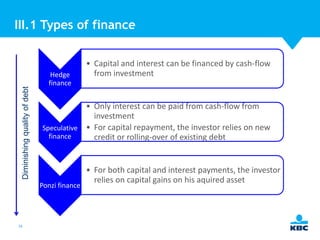
 Three types of investors, with decreasing quality of debt: hedge, speculative
and Ponzi investors
 The average quality of debt gradually deteriorates
 The boom becomes increasingly debt driven
“There is nothing so disturbing to one’s well being and
judgment as to see a friend get rich.” (Anna Schwartz)
33
Diminishing quality of debt

III.1 Types of finance

Hedge
finance

• Only interest can be paid from cash-flow from
investment
Speculative • For capital repayment, the investor relies on new
finance
credit or rolling-over of existing debt

Ponzi finance

34

• Capital and interest can be financed by cash-flow
from investment

• For both capital and interest payments, the investor
relies on capital gains on his aquired asset
III.1 Innovation in the financial sector plays an
ambiguous role in the ‘euphoria’ phase

• Warren Buffet (2003) : “Credit default swaps are financial weapons of mass
destruction”

• Paul Volcker (2009): “The only real innovation of the past decades in the
financial industry is the ATM”

35
III.1Anatomy of crises
Kindleberger-Minsky model

Displacement

Euphoria

Boom

36

Crisis
III.1 Anatomy of crises
The ‘crisis‘ phase
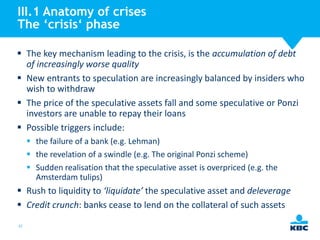
 The key mechanism leading to the crisis, is the accumulation of debt
of increasingly worse quality
 New entrants to speculation are increasingly balanced by insiders who
wish to withdraw
 The price of the speculative assets fall and some speculative or Ponzi
investors are unable to repay their loans
 Possible triggers include:
 the failure of a bank (e.g. Lehman)
 the revelation of a swindle (e.g. The original Ponzi scheme)
 Sudden realisation that the speculative asset is overpriced (e.g. the
Amsterdam tulips)

 Rush to liquidity to ‘liquidate’ the speculative asset and deleverage
 Credit crunch: banks cease to lend on the collateral of such assets
37
III.1 Anatomy of crises
The ‘crisis‘ phase
 Like speculation, the ‘liquidation’ process is feeding on itself

 The process stops when
 either asset prices have fallen so much, that some investors are willing to
invest in the less liquid asset again;
 or trade is cut off or suspended;
 or sufficient liquidity is provided to meet the demand for cash
- the need for a ‘lender of last resort’

38
III.2 Historical examples

The Amsterdam
Tulip mania
(1636-37)
Displacement

Boom in war
against Spain

Treaty of Utrecht Treaty of
1713: British
Versailles
(slave) trade
with South
America

Speculative
asset

Tulip bulbs,
among other
things

South Sea
Company shares

German FX debt
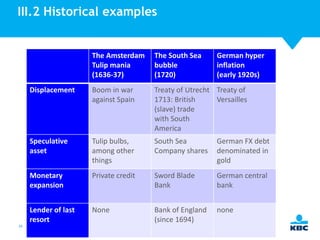
denominated in
gold

Monetary
expansion

Private credit

Sword Blade
Bank

German central
bank

Lender of last
resort
39

The South Sea
bubble
(1720)

German hyper
inflation
(early 1920s)

None

Bank of England
(since 1694)

none
III.2 Historical examples

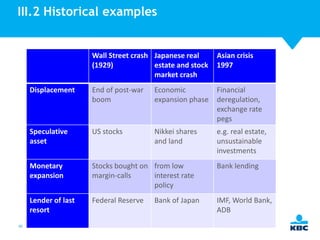
Wall Street crash Japanese real
(1929)
estate and stock
market crash
Displacement

End of post-war
boom

Economic
expansion phase

Financial
deregulation,
exchange rate
pegs

Speculative
asset

US stocks

Nikkei shares
and land

e.g. real estate,
unsustainable
investments

Monetary
expansion

Stocks bought on from low
margin-calls
interest rate
policy

Bank lending

Lender of last
resort
40

Asian crisis
1997

Federal Reserve

IMF, World Bank,
ADB

Bank of Japan
III.2 Historical examples
Sharp rise US
bond yields
(late 1960s and
70s)

EMU Sovereign
debt crisis
(2010-)

Displacement

Transition from
Bretton Woods
system to pure
fiat money

Financial
deregulation,
idea of
‘ownership
society’

Creation of
EMU, leading to
artificially low
interest rates

Speculative
asset

Overly
US real estate
expansive
economic policy

Rising Sovereign
debt

Monetary
expansion

Via current
account deficits

Bank credit,
Originate-anddistribute
model

International
capital markets

Lender of last
resort
41

US sub-prime
crisis
(2008)

Rest of the
world and
Federal Reserve

Federal Reserve

ECB to some
extent (OMTs)
Overview
 Part I: Crises are more than ‘volatility’

 Part II: Crises are inevitable

 Part III: History repeats itself

 Part IV: Lessons can be learned

42
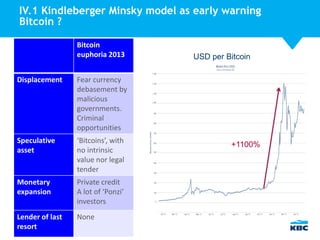
IV.1 Kindleberger Minsky model as early warning
Bitcoin ?
Bitcoin
euphoria 2013
Displacement

Fear currency
debasement by
malicious
governments.
Criminal
opportunities

Speculative
asset

‘Bitcoins’, with
no intrinsic
value nor legal
tender

Monetary
expansion

Private credit
A lot of ‘Ponzi’
investors

Lender of last
43
resort

None

USD per Bitcoin

+1100%
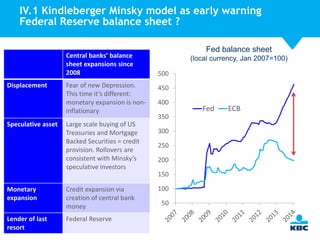
IV.1 Kindleberger Minsky model as early warning
Federal Reserve balance sheet ?
Central banks’ balance
sheet expansions since
2008
Displacement

Speculative asset

Fear of new Depression.
This time it’s different:
monetary expansion is noninflationary
Large scale buying of US
Treasuries and Mortgage
Backed Securities = credit
provision. Rollovers are
consistent with Minsky’s
speculative investors

Fed balance sheet
(local currency, Jan 2007=100)
500
450
400

350
300
250
200
150

Monetary
expansion

Credit expansion via
creation of central bank
money

Lender of last
44
resort

Federal Reserve

100
50

Fed

ECB
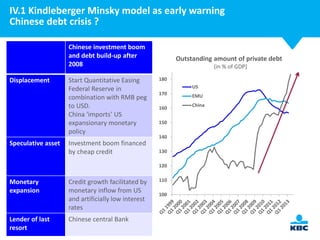
IV.1 Kindleberger Minsky model as early warning
Chinese debt crisis ?
Chinese investment boom
and debt build-up after
2008
Displacement

Speculative asset

Start Quantitative Easing
Federal Reserve in
combination with RMB peg
to USD.
China ‘imports’ US
expansionary monetary
policy

Investment boom financed
by cheap credit

Outstanding amount of private debt
(in % of GDP)
180
US
170
160
150
140
130
120

Monetary
expansion

Credit growth facilitated by
monetary inflow from US
and artificially low interest
rates

Lender of last
45
resort

Chinese central Bank

110
100

EMU
China
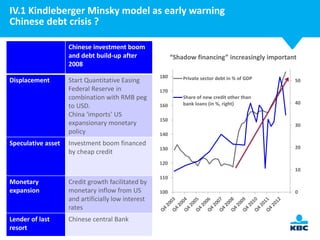
IV.1 Kindleberger Minsky model as early warning
Chinese debt crisis ?
Chinese investment boom
and debt build-up after
2008
Displacement

Speculative asset

Start Quantitative Easing
Federal Reserve in
combination with RMB peg
to USD.
China ‘imports’ US
expansionary monetary
policy

Investment boom financed
by cheap credit

“Shadow financing” increasingly important
180

Private sector debt in % of GDP

50

Share of new credit other than
bank loans (in %, right)

40

170
160
150

30

140
130

20

120
10

Monetary
expansion

Credit growth facilitated by
monetary inflow from US
and artificially low interest
rates

Lender of last
46
resort

Chinese central Bank

110
100

0
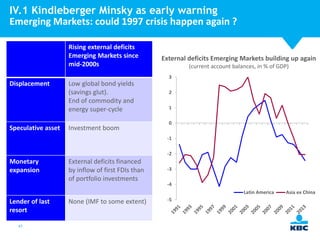
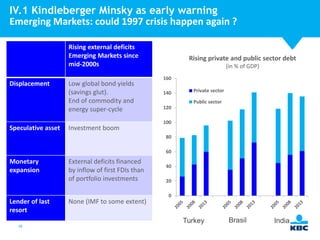
IV.1 Kindleberger Minsky as early warning
Emerging Markets: could 1997 crisis happen again ?
Rising external deficits
Emerging Markets since
mid-2000s

External deficits Emerging Markets building up again
(current account balances, in % of GDP)
3

Displacement

Speculative asset

Low global bond yields
(savings glut).
End of commodity and
energy super-cycle
Investment boom

2
1
0
-1
-2

Monetary
expansion

External deficits financed
by inflow of first FDIs than
of portfolio investments

-3
-4
Latin America

Lender of last
resort
47

None (IMF to some extent)

-5

Asia ex China
IV.1 Kindleberger Minsky as early warning
Emerging Markets: could 1997 crisis happen again ?
Rising external deficits
Emerging Markets since
mid-2000s
Displacement

Speculative asset

Low global bond yields
(savings glut).
End of commodity and
energy super-cycle
Investment boom

Rising private and public sector debt
(in % of GDP)
160
140

Private sector
Public sector

120
100
80
60

Monetary
expansion

Lender of last
resort

External deficits financed
by inflow of first FDIs than
of portfolio investments
None (IMF to some extent)

40
20
0

Turkey
48

Brasil

India
IV.2 Lessons can be learned: regulation and
policy
 Regulation and policy institutions can help to avoid crises…
 e.g. by fulfilling the role of Lender of Last Resort
 Regulation to make credit growth less pro-cyclical (e.g. Basel III: counter cyclical
capital buffers)
 Expectation shift by creation of OMTs by the ECB
- The ECB promises to do ‘whatever it takes’ (i.e. buy potentially unlimited amounts of
sovereign bonds) to prevent a forced EMU exit of member states

49
IV.2 Lessons to be learned: regulation and
policy

 … or cause them
 Example 1: “regulation” creating destructive incentives:
- Role of rating agencies partly based on regulatory definition of risk weighted assets
- Stress test in financial sector leading to further deleveraging

 Example 2: the Tulip mania in the Netherlands in 1620s
- Change in legislation with respect to tulip futures and options contracts

 Example 3: financial deregulation after the ‘80s
- E.g. originate and distribute model via financial engineering (packaging and selling risk)
- Volcker: ‘The only useful financial innovation in the past 30 years was the Automated
Teller Machine (ATM)’
50
IV.3 Lessons for quantitative risk
management: the illusion of safety
 Black Swans: an event with a digital probability distribution is virtually
unmanageable
 “Fat tail” risks can be addressed by using appropriate alternative
distributions
 However, statistical distributions are not stable (invariant) over time





51

Are “fragile” under stress (Taleb Nassim)
Correlations in crisis times tend to rise
What was thought to be unlikely, is not unlikely at all
Probability distributions tend to change just at the time they are needed
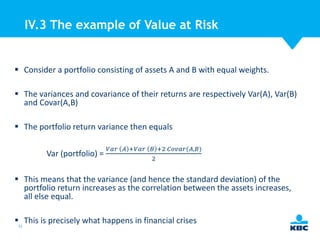
IV.3 The example of Value at Risk

 Consider a portfolio consisting of assets A and B with equal weights.
 The variances and covariance of their returns are respectively Var(A), Var(B)
and Covar(A,B)
 The portfolio return variance then equals
Var (portfolio) =

𝑉𝑎𝑟 𝐴 +𝑉𝑎𝑟

𝐵 +2 𝐶𝑜𝑣𝑎𝑟(𝐴,𝐵)
2

 This means that the variance (and hence the standard deviation) of the
portfolio return increases as the correlation between the assets increases,
all else equal.
52 This is precisely what happens in financial crises
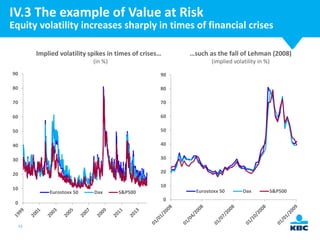
IV.3 The example of Value at Risk
Equity volatility increases sharply in times of financial crises
Implied volatility spikes in times of crises…

…such as the fall of Lehman (2008)

(in %)

(implied volatility in %)

90

90

80

80

70

70

60

60

50

50

40

40

30

30

20

20

10

10

Eurostoxx 50

Dax

Eurostoxx 50

S&P500
0

0

53

Dax

S&P500
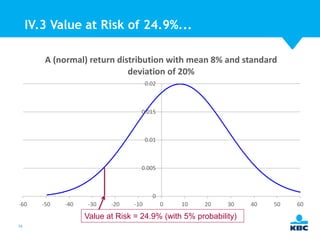
IV.3 Value at Risk of 24.9%...
A (normal) return distribution with mean 8% and standard
deviation of 20%
0.02

0.015

0.01

0.005

0
-60

-50

-40

-30

-20

-10

0

10

20

30

Value at Risk = 24.9% (with 5% probability)
54

40

50

60
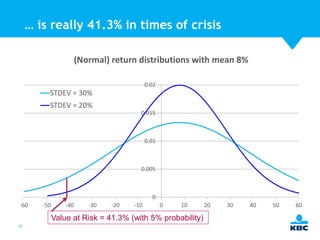
… is really 41.3% in times of crisis
(Normal) return distributions with mean 8%
0.02

STDEV = 30%
STDEV = 20%
0.015

0.01

0.005

0
-60

-50

-40

-30

-20

-10

0

10

Value at Risk = 41.3% (with 5% probability)
55

20

30

40

50

60
IV.3 Lesson for quantitative risk modelling

 Time dependency of correlation data creates an illusion of safety

 “In complex systems, such as financial systems, correlations are not
constant but vary in time. [...] The average correlation among stocks
scales linearly with market stress. [...] Consequently, the diversification
effect which should protect a portfolio melts away in times of market loss,
just when it would most urgently be needed.” (Preis et al. (2012))

 One way to address time-dependency of risk models could be using statedependent correlation data, i.e. conditional (state dependent) instead of
unconditional correlations

56
Overview
 Part I: Crises are more than ‘volatility’

 Part II: Crises are inevitable

 Part III: History repeats itself

 Part IV: Lessons can be learned

 Part V: Takeaways
57
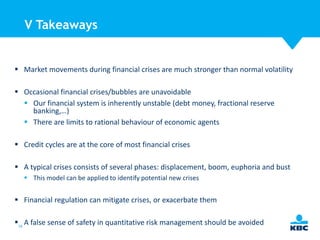
V Takeaways

 Market movements during financial crises are much stronger than normal volatility
 Occasional financial crises/bubbles are unavoidable
 Our financial system is inherently unstable (debt money, fractional reserve
banking,…)
 There are limits to rational behaviour of economic agents
 Credit cycles are at the core of most financial crises
 A typical crises consists of several phases: displacement, boom, euphoria and bust
 This model can be applied to identify potential new crises

 Financial regulation can mitigate crises, or exacerbate them
58 A false sense of safety in quantitative risk management should be avoided

Anatomy of financial crises

  • 1.
    Anatomy of financial crises February2014 Dieter Guffens KBC Chief Economist Department
  • 2.
    Overview  Part I:Crises are more than ‘volatility’  Part II: Crises are inevitable  Part III: History repeats itself  Part IV: Lessons can be learned  Part V: Takeaways 2
  • 3.
    Overview  Part I:Crises are more than ‘volatility’ 3
  • 4.
    I Crises aremore than ‘volatility’ Bond yields during the past 5000 years 4
  • 5.
    I Crises aremore than ‘volatility’ Tulip mania (1636-37) -95% 5
  • 6.
    I Crises aremore than ‘volatility’ South Sea bubble (1720) Share price of South Sea Company (in GBP) -90% 6
  • 7.
    I Crises aremore than ‘volatility’ Germany early 1920s 7
  • 8.
    I Crises aremore than ‘volatility’ US bond yields 197Os US 10 year bond yields in % 18 16 14 12 10 8 6 4 2 0 8 +13 ppt
  • 9.
    I Crises aremore than ‘volatility’ Belgian bond yields 197Os Belgian 10 year bond yields in % 16 14 +9 ppt 12 10 8 6 4 2 0 9
  • 10.
    I Crises aremore than ‘volatility’ US 1929 S&P Composite crash 35 30 25 -85% 20 15 10 5 0 10
  • 11.
    I Crises aremore than ‘volatility’ Effect of the 1929 crash an the Great Depression on Belgium Belgian unemployment rate in % Belgian stock market index 120 25 100 20 80 60 + 21.6 ppt -75% 15 10 40 20 0 11 5 0
  • 12.
    I Crises aremore than ‘volatility’ Effect of the 1929 crash an the Great Depression on Belgium Belgian 10 year government bond yield Belgian stock market index 120 (in %) 7 100 80 60 6 -2.6 ppt -75% 5 40 4 20 0 12 3
  • 13.
    I Crises aremore than ‘volatility’ The Japanese equity and real estate crash (1990) Japanese equity and real estate (Jan 1985=100) 600 500 +422 ppt 400 -76 ppt 300 200 100 1985 1986 1987 1988 1989 1990 1991 1992 1993 1994 1995 0 Equity (MSCI) 13 Listed real estate (Topix)
  • 14.
    I Crises aremore than ‘volatility’ Effect of Japanses crash in bond yields (1990s) Japanese 10 year government bond yield in % 9 8 7 6 5 4 3 2 1 0 14 1998 1996 1994 1992 1990 1988 1986 1984 -7 ppt
  • 15.
    I Crises aremore than ‘volatility’ Financial sector crisis since 2007 EMU Corporate BBB financial spread to swap in bps 3000 2500 2000 1500 +24 ppt 1000 500 15 Financials 2014 2013 2012 2011 2010 2009 2008 2007 2006 2005 0
  • 16.
    Overview  Part I:Crises are more than ‘volatility’  Part II: Crises are inevitable 16
  • 17.
    II.1 Irrational marketsfacilitate crises 17
  • 18.
    II.2 Bubbles arepossible because of market irrationality  In efficient markets, irrational exaggerations are highly unlikely  However, grounds for market inefficiency and irrationality include  “The limits of arbitrage” (Shleifer and Vishny, 1997): there are cost of arbitration, e.g. the fate of LTCM in 1998  Keynes’ “greater fool” game  Psychological biases (Daniel Kahnemann, “Prospect theory”): investors’ utility is reference based, e.g. on the profits earned by others  Multiple equilibria exist, dependent on expectations. Changes are often triggered by expectation ‘shifts’ (Kindleberger’s ‘displacements’)  Exaggeration cycles are inherent in market economies 18
  • 19.
    II.3 Bubbles arepossible because of the ‘debt nature’ of our money  Our ‘money’ is a debt certificate of the state or a private economic agent  Coins and bills are debt certificates of the state  They are legal tender,…  … in particular they can be used to settle tax debt towards the state  All other money (deposits, accounts, etc…) are debt instruments of private agents, mostly banks  Since our monetary system is based on debt and credit, occasional crises are not avoidable 19
  • 20.
    II.4 Fractional ReserveBanking increases vulnerability to crises even more 10.000 EUR become 100.000 EUR Deposits 10000 9000 8100 7290 6561 5905 5314 4783 4305 ------2824 ------1 Total: 20 10% Reserve Requirements 1000 900 810 729 656 590 531 478 430 ------282 --------- 100000 10000 Loans Total 'Broad money' 9000 10000 8100 19000 7290 27100 6561 34390 5905 40951 5314 46856 4783 52170 4305 56953 3874 61258 ------------2542 74581 --------------100000 90000 100000
  • 21.
    II.4 Fractional ReserveBanking Multi equilibria create a ‘coordination problem’ Pay-off matrix Person B  Person A and B each have deposits of 100 in the bank  As a result of Fractional Reserve Banking, the bank has only reserves of 10  Each person has two possible strategies: to withdraw or not  In the case of no withdrawal, the fact that the person can use the bank’s service (safety of deposits and payments) has an additional monetary value of 1  There are two stable Nash equilibria  The existence of a lender of last resort can shift the Nash equilibrium from bank run to the cooperative 21 equilibrium Withdraw P e r s o n Do not withdraw Withdraw (5,5) (10,0) Do not withdraw (0,10) (101,101) A Two stable Nash equilibria
  • 22.
    II.4 Fractional ReserveBanking increases vulnerability to crises  Defining property: not all deposits covered by reserves  This makes the system vulnerable to bank runs  Instability is NOT caused by the nature of fiat money, it applies to gold standard as well  One way to avoid bank runs would be a system of Full Reserve or 100% Reserve Banking (Milton Friedman)  Problem: liquidity provision, banking sector cannot play its role of financial intermediation, leading to credit crunch  Not currently practiced as a system 22
  • 23.
    II. 5 Savingfor the future also requires debt accumulation  Saving in fixed income asset = creating a claim on future output  But: someone must promise to give up that part of future output, i.e. incur debt  Implication: saving and debt are two sides of the same coin: one’s savings are someone else’s debt  Savings are only possible to the extent that someone else is prepared to incur debt for the same amount  If literarily all debts are repaid, all money would disappear and our monetary system would 23 collapse: back to barter trade
  • 24.
    Overview  Part I:Crises are more than ‘volatility’  Part II: Crises are inevitable  Part III: History repeats itself 24
  • 25.
    III.1 Anatomy ofcrises Kindleberger-Minsky model Displacement Euphoria Boom 25 Crisis
  • 26.
    III.1 Anatomy ofcrises Kindleberger-Minsky model Displacement Euphoria Boom 26 Crisis
  • 27.
    III. 1 Anatomyof crises ‘Displacement’ phase A ‘displacement’ is an long and pervasive exogenous shock to the macro-economic system that changes expectations and perceived profit opportunities Outbreak or end of wars Widespread adoption of new inventions (IT, transportation) Unexpected change of economic policies, e.g. financial deregulation or disinflationary monetary policy since the early 1980s 27
  • 28.
    III.1 Historically ‘displacements’can boost economic growth enormously… Real world GDP per capita (1913 = 100) 600 574 500 441 400 300 268 200 138 100 100 29 29 37 44 0 Source: Angus Maddison (2001); IMF; UN 28
  • 29.
    …especially when supportedby globalisation Lower barriers to exchange and communication and lower average world import tariffs Decreasing costs of transport and communication (in 1990 USD) 250 (for members WTO, in %) Ocean freight (per ton) Air transport (per 100 passengermile) Average import tariff in % 200 Telephone call (3 min. New York Londen) 150 100 50 0 29 Source: IMF; WTO
  • 30.
    III.1 Anatomy ofcrises Kindleberger-Minsky model Displacement Euphoria Boom 30 Crisis
  • 31.
    III.1 Anatomy ofcrises The ‘boom‘ phase  The changed perception of profit opportunities leads to increased investment and production  This phase is fuelled by a strong expansion of credit  The expansion of credit is inherently unstable (see also earlier)  Minsky’s ‘Financial Instability Hypothesis’  Credit is unstable and inherently pro-cyclical 31
  • 32.
    III.1 Anatomy ofcrises Kindleberger-Minsky model Displacement Euphoria Boom 32 Crisis
  • 33.
    III.1 Anatomy ofcrises The ‘euphoria‘ phase  Speculative investors appear  Growth is increasingly driven by leverage via the credit channel, ultimately leading to exaggeration  Three types of investors, with decreasing quality of debt: hedge, speculative and Ponzi investors  The average quality of debt gradually deteriorates  The boom becomes increasingly debt driven “There is nothing so disturbing to one’s well being and judgment as to see a friend get rich.” (Anna Schwartz) 33
  • 34.
    Diminishing quality ofdebt III.1 Types of finance Hedge finance • Only interest can be paid from cash-flow from investment Speculative • For capital repayment, the investor relies on new finance credit or rolling-over of existing debt Ponzi finance 34 • Capital and interest can be financed by cash-flow from investment • For both capital and interest payments, the investor relies on capital gains on his aquired asset
  • 35.
    III.1 Innovation inthe financial sector plays an ambiguous role in the ‘euphoria’ phase • Warren Buffet (2003) : “Credit default swaps are financial weapons of mass destruction” • Paul Volcker (2009): “The only real innovation of the past decades in the financial industry is the ATM” 35
  • 36.
    III.1Anatomy of crises Kindleberger-Minskymodel Displacement Euphoria Boom 36 Crisis
  • 37.
    III.1 Anatomy ofcrises The ‘crisis‘ phase  The key mechanism leading to the crisis, is the accumulation of debt of increasingly worse quality  New entrants to speculation are increasingly balanced by insiders who wish to withdraw  The price of the speculative assets fall and some speculative or Ponzi investors are unable to repay their loans  Possible triggers include:  the failure of a bank (e.g. Lehman)  the revelation of a swindle (e.g. The original Ponzi scheme)  Sudden realisation that the speculative asset is overpriced (e.g. the Amsterdam tulips)  Rush to liquidity to ‘liquidate’ the speculative asset and deleverage  Credit crunch: banks cease to lend on the collateral of such assets 37
  • 38.
    III.1 Anatomy ofcrises The ‘crisis‘ phase  Like speculation, the ‘liquidation’ process is feeding on itself  The process stops when  either asset prices have fallen so much, that some investors are willing to invest in the less liquid asset again;  or trade is cut off or suspended;  or sufficient liquidity is provided to meet the demand for cash - the need for a ‘lender of last resort’ 38
  • 39.
    III.2 Historical examples TheAmsterdam Tulip mania (1636-37) Displacement Boom in war against Spain Treaty of Utrecht Treaty of 1713: British Versailles (slave) trade with South America Speculative asset Tulip bulbs, among other things South Sea Company shares German FX debt denominated in gold Monetary expansion Private credit Sword Blade Bank German central bank Lender of last resort 39 The South Sea bubble (1720) German hyper inflation (early 1920s) None Bank of England (since 1694) none
  • 40.
    III.2 Historical examples WallStreet crash Japanese real (1929) estate and stock market crash Displacement End of post-war boom Economic expansion phase Financial deregulation, exchange rate pegs Speculative asset US stocks Nikkei shares and land e.g. real estate, unsustainable investments Monetary expansion Stocks bought on from low margin-calls interest rate policy Bank lending Lender of last resort 40 Asian crisis 1997 Federal Reserve IMF, World Bank, ADB Bank of Japan
  • 41.
    III.2 Historical examples Sharprise US bond yields (late 1960s and 70s) EMU Sovereign debt crisis (2010-) Displacement Transition from Bretton Woods system to pure fiat money Financial deregulation, idea of ‘ownership society’ Creation of EMU, leading to artificially low interest rates Speculative asset Overly US real estate expansive economic policy Rising Sovereign debt Monetary expansion Via current account deficits Bank credit, Originate-anddistribute model International capital markets Lender of last resort 41 US sub-prime crisis (2008) Rest of the world and Federal Reserve Federal Reserve ECB to some extent (OMTs)
  • 42.
    Overview  Part I:Crises are more than ‘volatility’  Part II: Crises are inevitable  Part III: History repeats itself  Part IV: Lessons can be learned 42
  • 43.
    IV.1 Kindleberger Minskymodel as early warning Bitcoin ? Bitcoin euphoria 2013 Displacement Fear currency debasement by malicious governments. Criminal opportunities Speculative asset ‘Bitcoins’, with no intrinsic value nor legal tender Monetary expansion Private credit A lot of ‘Ponzi’ investors Lender of last 43 resort None USD per Bitcoin +1100%
  • 44.
    IV.1 Kindleberger Minskymodel as early warning Federal Reserve balance sheet ? Central banks’ balance sheet expansions since 2008 Displacement Speculative asset Fear of new Depression. This time it’s different: monetary expansion is noninflationary Large scale buying of US Treasuries and Mortgage Backed Securities = credit provision. Rollovers are consistent with Minsky’s speculative investors Fed balance sheet (local currency, Jan 2007=100) 500 450 400 350 300 250 200 150 Monetary expansion Credit expansion via creation of central bank money Lender of last 44 resort Federal Reserve 100 50 Fed ECB
  • 45.
    IV.1 Kindleberger Minskymodel as early warning Chinese debt crisis ? Chinese investment boom and debt build-up after 2008 Displacement Speculative asset Start Quantitative Easing Federal Reserve in combination with RMB peg to USD. China ‘imports’ US expansionary monetary policy Investment boom financed by cheap credit Outstanding amount of private debt (in % of GDP) 180 US 170 160 150 140 130 120 Monetary expansion Credit growth facilitated by monetary inflow from US and artificially low interest rates Lender of last 45 resort Chinese central Bank 110 100 EMU China
  • 46.
    IV.1 Kindleberger Minskymodel as early warning Chinese debt crisis ? Chinese investment boom and debt build-up after 2008 Displacement Speculative asset Start Quantitative Easing Federal Reserve in combination with RMB peg to USD. China ‘imports’ US expansionary monetary policy Investment boom financed by cheap credit “Shadow financing” increasingly important 180 Private sector debt in % of GDP 50 Share of new credit other than bank loans (in %, right) 40 170 160 150 30 140 130 20 120 10 Monetary expansion Credit growth facilitated by monetary inflow from US and artificially low interest rates Lender of last 46 resort Chinese central Bank 110 100 0
  • 47.
    IV.1 Kindleberger Minskyas early warning Emerging Markets: could 1997 crisis happen again ? Rising external deficits Emerging Markets since mid-2000s External deficits Emerging Markets building up again (current account balances, in % of GDP) 3 Displacement Speculative asset Low global bond yields (savings glut). End of commodity and energy super-cycle Investment boom 2 1 0 -1 -2 Monetary expansion External deficits financed by inflow of first FDIs than of portfolio investments -3 -4 Latin America Lender of last resort 47 None (IMF to some extent) -5 Asia ex China
  • 48.
    IV.1 Kindleberger Minskyas early warning Emerging Markets: could 1997 crisis happen again ? Rising external deficits Emerging Markets since mid-2000s Displacement Speculative asset Low global bond yields (savings glut). End of commodity and energy super-cycle Investment boom Rising private and public sector debt (in % of GDP) 160 140 Private sector Public sector 120 100 80 60 Monetary expansion Lender of last resort External deficits financed by inflow of first FDIs than of portfolio investments None (IMF to some extent) 40 20 0 Turkey 48 Brasil India
  • 49.
    IV.2 Lessons canbe learned: regulation and policy  Regulation and policy institutions can help to avoid crises…  e.g. by fulfilling the role of Lender of Last Resort  Regulation to make credit growth less pro-cyclical (e.g. Basel III: counter cyclical capital buffers)  Expectation shift by creation of OMTs by the ECB - The ECB promises to do ‘whatever it takes’ (i.e. buy potentially unlimited amounts of sovereign bonds) to prevent a forced EMU exit of member states 49
  • 50.
    IV.2 Lessons tobe learned: regulation and policy  … or cause them  Example 1: “regulation” creating destructive incentives: - Role of rating agencies partly based on regulatory definition of risk weighted assets - Stress test in financial sector leading to further deleveraging  Example 2: the Tulip mania in the Netherlands in 1620s - Change in legislation with respect to tulip futures and options contracts  Example 3: financial deregulation after the ‘80s - E.g. originate and distribute model via financial engineering (packaging and selling risk) - Volcker: ‘The only useful financial innovation in the past 30 years was the Automated Teller Machine (ATM)’ 50
  • 51.
    IV.3 Lessons forquantitative risk management: the illusion of safety  Black Swans: an event with a digital probability distribution is virtually unmanageable  “Fat tail” risks can be addressed by using appropriate alternative distributions  However, statistical distributions are not stable (invariant) over time     51 Are “fragile” under stress (Taleb Nassim) Correlations in crisis times tend to rise What was thought to be unlikely, is not unlikely at all Probability distributions tend to change just at the time they are needed
  • 52.
    IV.3 The exampleof Value at Risk  Consider a portfolio consisting of assets A and B with equal weights.  The variances and covariance of their returns are respectively Var(A), Var(B) and Covar(A,B)  The portfolio return variance then equals Var (portfolio) = 𝑉𝑎𝑟 𝐴 +𝑉𝑎𝑟 𝐵 +2 𝐶𝑜𝑣𝑎𝑟(𝐴,𝐵) 2  This means that the variance (and hence the standard deviation) of the portfolio return increases as the correlation between the assets increases, all else equal. 52 This is precisely what happens in financial crises
  • 53.
    IV.3 The exampleof Value at Risk Equity volatility increases sharply in times of financial crises Implied volatility spikes in times of crises… …such as the fall of Lehman (2008) (in %) (implied volatility in %) 90 90 80 80 70 70 60 60 50 50 40 40 30 30 20 20 10 10 Eurostoxx 50 Dax Eurostoxx 50 S&P500 0 0 53 Dax S&P500
  • 54.
    IV.3 Value atRisk of 24.9%... A (normal) return distribution with mean 8% and standard deviation of 20% 0.02 0.015 0.01 0.005 0 -60 -50 -40 -30 -20 -10 0 10 20 30 Value at Risk = 24.9% (with 5% probability) 54 40 50 60
  • 55.
    … is really41.3% in times of crisis (Normal) return distributions with mean 8% 0.02 STDEV = 30% STDEV = 20% 0.015 0.01 0.005 0 -60 -50 -40 -30 -20 -10 0 10 Value at Risk = 41.3% (with 5% probability) 55 20 30 40 50 60
  • 56.
    IV.3 Lesson forquantitative risk modelling  Time dependency of correlation data creates an illusion of safety  “In complex systems, such as financial systems, correlations are not constant but vary in time. [...] The average correlation among stocks scales linearly with market stress. [...] Consequently, the diversification effect which should protect a portfolio melts away in times of market loss, just when it would most urgently be needed.” (Preis et al. (2012))  One way to address time-dependency of risk models could be using statedependent correlation data, i.e. conditional (state dependent) instead of unconditional correlations 56
  • 57.
    Overview  Part I:Crises are more than ‘volatility’  Part II: Crises are inevitable  Part III: History repeats itself  Part IV: Lessons can be learned  Part V: Takeaways 57
  • 58.
    V Takeaways  Marketmovements during financial crises are much stronger than normal volatility  Occasional financial crises/bubbles are unavoidable  Our financial system is inherently unstable (debt money, fractional reserve banking,…)  There are limits to rational behaviour of economic agents  Credit cycles are at the core of most financial crises  A typical crises consists of several phases: displacement, boom, euphoria and bust  This model can be applied to identify potential new crises  Financial regulation can mitigate crises, or exacerbate them 58 A false sense of safety in quantitative risk management should be avoided