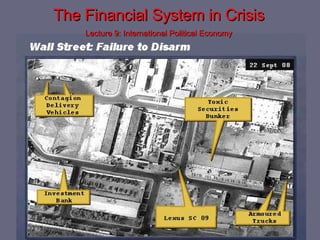
The Financial System in Crisis Lecture 9: International Political Economy
Financial crises Debt crisis (1980s) Asian crisis (1997-98) Subprime crisis (current) Financial Crises IPE Discussion Group
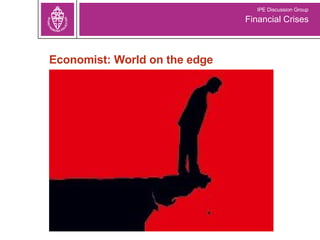
Economist: World on the edge  Financial Crises IPE Discussion Group


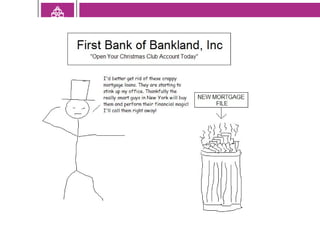
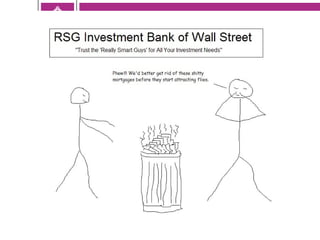
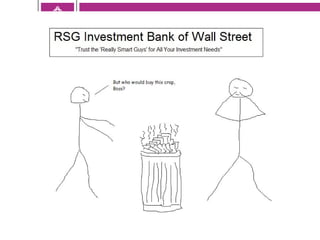
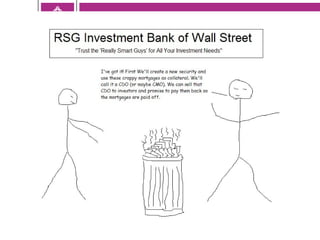
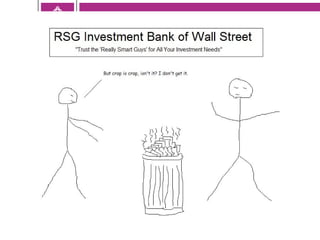
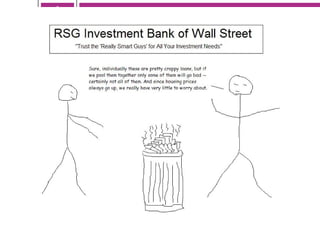
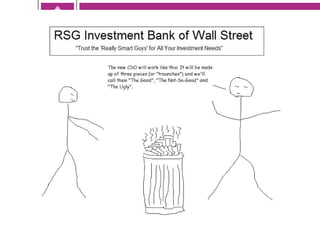
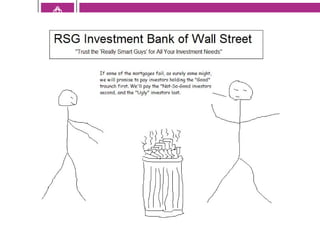
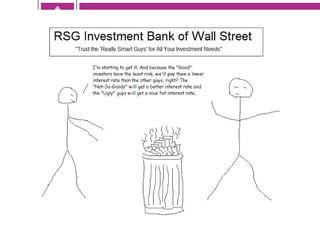
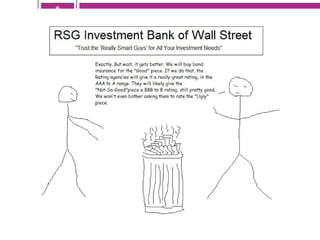
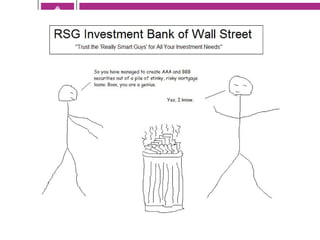
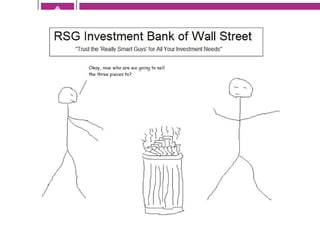
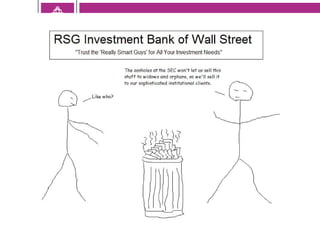
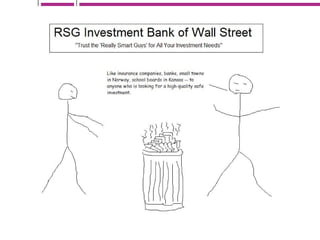
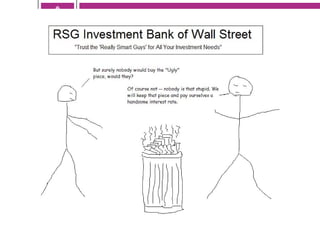
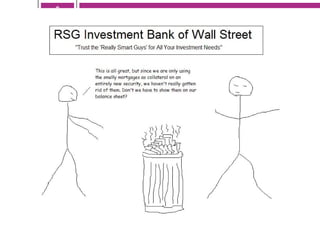
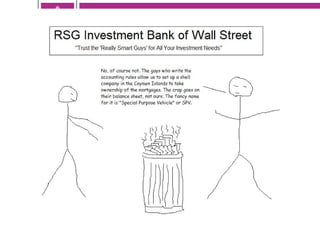
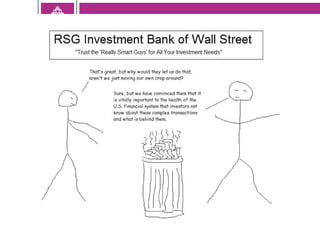
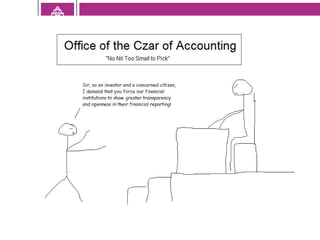
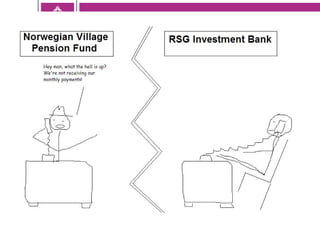
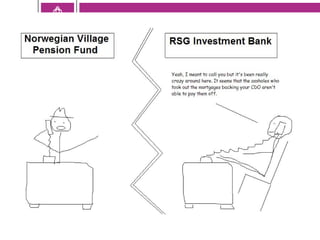
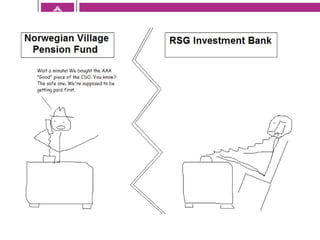
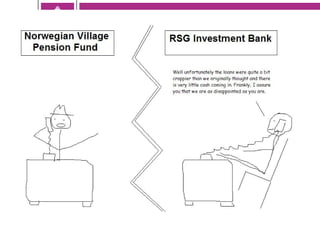
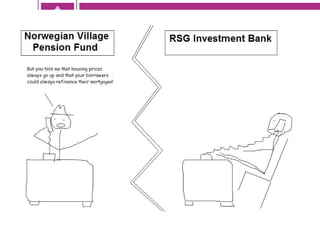
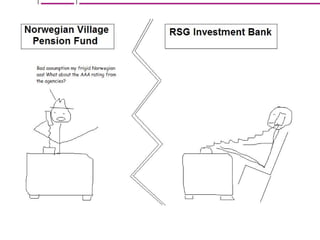
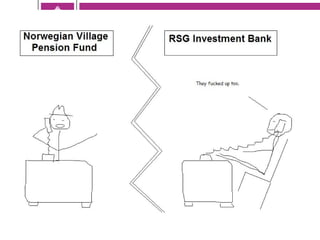
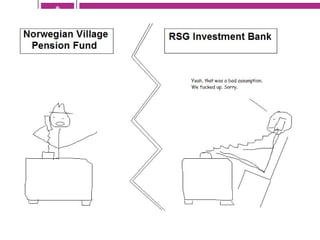
Subprime crisis Lenders have spread risk over many investors Too much lending, too much risk Mortgage takers fail to repay Unexpected insolvencies: banks short of funds Financial Crises International Political Economy
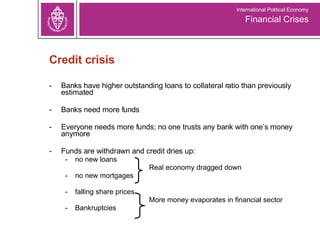
Banks have higher outstanding loans to collateral ratio than previously estimated Banks need more funds  Everyone needs more funds; no one trusts any bank with one’s money anymore Funds are withdrawn and credit dries up:  no new loans   Real economy dragged down no new mortgages  falling share prices   More money evaporates in financial sector Bankruptcies Credit crisis Financial Crises International Political Economy
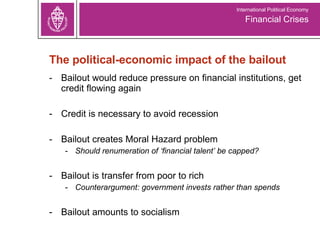
The political-economic impact of the bailout Bailout would reduce pressure on financial institutions, get credit flowing again Credit is necessary to avoid recession Bailout creates Moral Hazard problem Should renumeration of ‘financial talent’ be capped? Bailout is transfer from poor to rich Counterargument: government invests rather than spends Bailout amounts to socialism Financial Crises International Political Economy
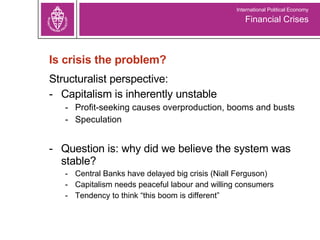
Is crisis the problem? Structuralist perspective:  -  Capitalism is inherently unstable Profit-seeking causes overproduction, booms and busts Speculation Question is: why did we believe the system was stable? Central Banks have delayed big crisis (Niall Ferguson) Capitalism needs peaceful labour and willing consumers Tendency to think “this boom is different” Financial Crises International Political Economy
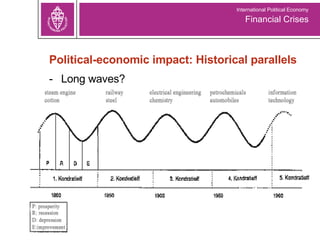
Political-economic impact: Historical parallels Long waves?  Financial Crises International Political Economy
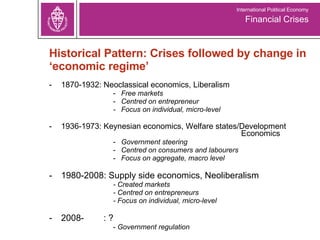
Historical Pattern: Crises followed by change in ‘economic regime’ 1870-1932: Neoclassical economics, Liberalism Free markets Centred on entrepreneur -  Focus on individual, micro-level 1936-1973: Keynesian economics, Welfare states/Development  Economics  Government steering Centred on consumers and labourers Focus on aggregate, macro level 1980-2008: Supply side economics, Neoliberalism - Created markets  - Centred on entrepreneurs - Focus on individual, micro-level 2008-  : ? -  Government regulation Financial Crises International Political Economy
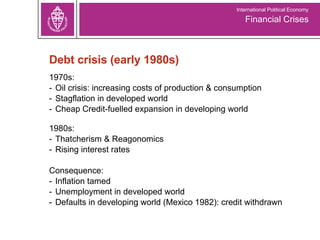
Debt crisis (early 1980s) 1970s:  Oil crisis: increasing costs of production & consumption Stagflation in developed world Cheap Credit-fuelled expansion in developing world 1980s:  Thatcherism & Reagonomics Rising interest rates Consequence:  Inflation tamed Unemployment in developed world Defaults in developing world (Mexico 1982): credit withdrawn Financial Crises International Political Economy
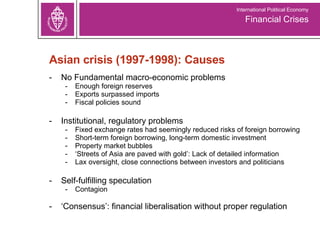
Asian crisis (1997-1998): Causes No Fundamental macro-economic problems Enough foreign reserves Exports surpassed imports Fiscal policies sound  Institutional, regulatory problems Fixed exchange rates had seemingly reduced risks of foreign borrowing Short-term foreign borrowing, long-term domestic investment Property market bubbles ‘ Streets of Asia are paved with gold’: Lack of detailed information Lax oversight, close connections between investors and politicians Self-fulfilling speculation Contagion ‘ Consensus’: financial liberalisation without proper regulation Financial Crises International Political Economy
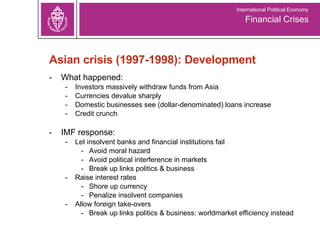
Asian crisis (1997-1998): Development What happened: Investors massively withdraw funds from Asia Currencies devalue sharply Domestic businesses see (dollar-denominated) loans increase Credit crunch IMF response:  Let insolvent banks and financial institutions fail  Avoid moral hazard Avoid political interference in markets Break up links politics & business Raise interest rates  Shore up currency Penalize insolvent companies Allow foreign take-overs -  Break up links politics & business: worldmarket efficiency instead Financial Crises International Political Economy
Asian crisis (1997-1998): Consequences Political upheaval  Malaysia: DPM Anwar Ibrahim jailed for corruption and ‘sodomy’ Indonesia: fall of Suharto Major recession Took about 8 years to reach pre-1997 income levels again, Indonesia even longer Alternative reactions? Malaysia did not turn to IMF Imposed capital controls Came off relatively easy Financial Crises International Political Economy
Questions What way now for capitalism? Financial systems and Capital flows: should they be regulated and limited? Who was gaining from previous situation? How were they making sure situation persisted? Has crisis caused a shift in power, making a change of regime likely? Financial Crises International Political Economy

Financial Crises - the core

  • 1.
    The Financial Systemin Crisis Lecture 9: International Political Economy
  • 2.
    Financial crises Debtcrisis (1980s) Asian crisis (1997-98) Subprime crisis (current) Financial Crises IPE Discussion Group
  • 3.
    Economist: World onthe edge Financial Crises IPE Discussion Group
  • 4.
  • 5.
  • 6.
  • 7.
  • 8.
  • 9.
  • 10.
  • 11.
  • 12.
  • 13.
  • 14.
  • 15.
  • 16.
  • 17.
  • 18.
  • 19.
  • 20.
  • 21.
  • 22.
  • 23.
  • 24.
  • 25.
  • 26.
  • 27.
  • 28.
  • 29.
  • 30.
  • 31.
  • 32.
  • 33.
  • 34.
  • 35.
  • 36.
  • 37.
  • 38.
  • 39.
  • 40.
  • 41.
  • 42.
  • 43.
  • 44.
  • 45.
  • 46.
  • 47.
  • 48.
  • 49.
    Subprime crisis Lendershave spread risk over many investors Too much lending, too much risk Mortgage takers fail to repay Unexpected insolvencies: banks short of funds Financial Crises International Political Economy
  • 50.
    Banks have higheroutstanding loans to collateral ratio than previously estimated Banks need more funds Everyone needs more funds; no one trusts any bank with one’s money anymore Funds are withdrawn and credit dries up: no new loans Real economy dragged down no new mortgages falling share prices More money evaporates in financial sector Bankruptcies Credit crisis Financial Crises International Political Economy
  • 51.
    The political-economic impactof the bailout Bailout would reduce pressure on financial institutions, get credit flowing again Credit is necessary to avoid recession Bailout creates Moral Hazard problem Should renumeration of ‘financial talent’ be capped? Bailout is transfer from poor to rich Counterargument: government invests rather than spends Bailout amounts to socialism Financial Crises International Political Economy
  • 52.
    Is crisis theproblem? Structuralist perspective: - Capitalism is inherently unstable Profit-seeking causes overproduction, booms and busts Speculation Question is: why did we believe the system was stable? Central Banks have delayed big crisis (Niall Ferguson) Capitalism needs peaceful labour and willing consumers Tendency to think “this boom is different” Financial Crises International Political Economy
  • 53.
    Political-economic impact: Historicalparallels Long waves? Financial Crises International Political Economy
  • 54.
    Historical Pattern: Crisesfollowed by change in ‘economic regime’ 1870-1932: Neoclassical economics, Liberalism Free markets Centred on entrepreneur - Focus on individual, micro-level 1936-1973: Keynesian economics, Welfare states/Development Economics Government steering Centred on consumers and labourers Focus on aggregate, macro level 1980-2008: Supply side economics, Neoliberalism - Created markets - Centred on entrepreneurs - Focus on individual, micro-level 2008- : ? - Government regulation Financial Crises International Political Economy
  • 55.
    Debt crisis (early1980s) 1970s: Oil crisis: increasing costs of production & consumption Stagflation in developed world Cheap Credit-fuelled expansion in developing world 1980s: Thatcherism & Reagonomics Rising interest rates Consequence: Inflation tamed Unemployment in developed world Defaults in developing world (Mexico 1982): credit withdrawn Financial Crises International Political Economy
  • 56.
    Asian crisis (1997-1998):Causes No Fundamental macro-economic problems Enough foreign reserves Exports surpassed imports Fiscal policies sound Institutional, regulatory problems Fixed exchange rates had seemingly reduced risks of foreign borrowing Short-term foreign borrowing, long-term domestic investment Property market bubbles ‘ Streets of Asia are paved with gold’: Lack of detailed information Lax oversight, close connections between investors and politicians Self-fulfilling speculation Contagion ‘ Consensus’: financial liberalisation without proper regulation Financial Crises International Political Economy
  • 57.
    Asian crisis (1997-1998):Development What happened: Investors massively withdraw funds from Asia Currencies devalue sharply Domestic businesses see (dollar-denominated) loans increase Credit crunch IMF response: Let insolvent banks and financial institutions fail Avoid moral hazard Avoid political interference in markets Break up links politics & business Raise interest rates Shore up currency Penalize insolvent companies Allow foreign take-overs - Break up links politics & business: worldmarket efficiency instead Financial Crises International Political Economy
  • 58.
    Asian crisis (1997-1998):Consequences Political upheaval Malaysia: DPM Anwar Ibrahim jailed for corruption and ‘sodomy’ Indonesia: fall of Suharto Major recession Took about 8 years to reach pre-1997 income levels again, Indonesia even longer Alternative reactions? Malaysia did not turn to IMF Imposed capital controls Came off relatively easy Financial Crises International Political Economy
  • 59.
    Questions What waynow for capitalism? Financial systems and Capital flows: should they be regulated and limited? Who was gaining from previous situation? How were they making sure situation persisted? Has crisis caused a shift in power, making a change of regime likely? Financial Crises International Political Economy