

Political Economy of International Trade
IntroductionWhile many nations are nominally committed to free trade, they tend to intervene in international trade
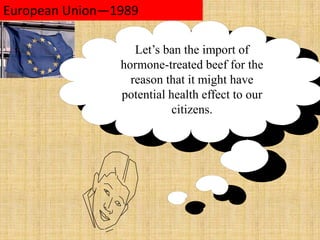
to protect the interests of politically important groups European Union—1989 Let’s ban the import of hormone-treated beef for the reason that it might have potential health effect to our citizens.
 In the 1970’s US scientist discovered a synthesize certain hormones and use them to promote growth of livestock of animals, reduce fat content of meat, and increase milk production. Bovine Somatotropin (BST), a growth hormone produced by beef cattle which is to be injected to supplement an animal’s own hormone production and increase its growth rate.
IntroductionExamine the political reality of international tradeThe political, economic reasons for government interventionThe range of policy instrumentsThe emergence of the modern international trading system.
The political, economic reason for government interventionWhen governments intervene, they often do so by restricting imports of goods and services into their nation while adopting policies that promote exports.  Normally, their motives for intervention are to protect domestic producers and jobs from foreign competition while increase the foreign market of domestic products.
Example The decision of the EU to ban import of hormone treated beef was a political response to social concern about the health consequences.
The range of policy This is followed by a detailed review of the political and economic motives that government have for intervention. The emergence of the modern international trade The General Agreement of Tariffs and Trade (GATT) and its successor the World Trade Organization (WTO).
 The GATT and WTO are the creations of a series of treaties of multinational treaties.
The purpose of this treaties has been to lower barriers to the free flow of goods and services between nations.Are you still ok?
Does Current Account Deficit matter ? A current account deficitMoney flows to other countriesThese countries can use the money to purchase assets in the deficit country.The US runs a trade deficit with China The Chinese use the money To purchase US assetsStocks, bonds, real estate, whole corporationsA deficit on the current accountFinanced by selling assets to other countries
Does Current Account Deficit matter ? The persistent US current account deficitFinanced by a steady sale of US assets to other countriesNet debtorThe US must deliver a stream of interest payments to foreign bondholdersRents to foreign landownersDividends to foreign stockholdersDrain resources from a country and limit the funds available for investments within the country ?
Implications of trade deficits ?Investment within a countryNecessary to stimulate economic growthA persistent current account deficit canChoke off a country’s future economic growth ?Opposite argumentCurrent account deficit is not that bad after all ?
Is Current Account Deficit that bad ? In global capital marketsMoney is efficiently directed toward its highest value usesOver the last quarter of a centuryMany of the highest value uses of capital Have been in the US.Capital is flowing out of the US In the form of payments to foreigners Much of that capital comes back to the USTo fund productive investments in the USNOT clear whether the current account deficit chokes off US economic growth.
The US economic growth and FDI in the USFor the last 25 yearsThe US had grown at impressive rateBecauseForeigners reinvest much of the income earned from the US assetsFrom exports to the US, right back into the USWhat if foreign investors lose appetite for US assets ?Instead of reinvesting earning from the USSell dollars for another currencyInvest in euro-, yen- denominated assets.A fall in the value of the dollar on foreign exchange marketsIncrease in the price of imports,Lower the price of US exportsMaking them more competitiveReduce the overall level of the current account deficit.
Instruments of Trade PolicyQuestion: How do governments intervene in international trade?There are seven main instruments of trade policy  Tariffs  Subsidies Import quotas Voluntary export restraints Local content requirements  Antidumping policies  Administrative policies
TariffsA tariff is a tax levied on imports raises the cost of imported products relative to domestic products  Specific tariffsa fixed charge for each unit of a good imported Ad valorem tariffsa proportion of the value of the imported good
TariffsQuestion: Why do governments impose tariffs?Tariffs increase government revenuesprovide protection to domestic producers against foreign competitors by increasing the cost of imported foreign goodsforce consumers to pay more for certain importsSo, tariffs are unambiguously pro-producer and anti-consumer, reduce the overall efficiency of the world economy
Who gain and who lose from Tariff policy ?WinnersDomestic producers : protectionIncreased cost for foreign producers LosersConsumersPay more for import goodsUS – ad valorem tariff of 8%-30% on foreign steel. To protect domestic steel producersRaised the price of steel products in the US by 30-35%Carmakers, appliance makers lostTheir costs of production increased Less competitiveLed to job loss in these industries
Effective tariff policy ? March 2002 In the steel case,The losses to steel consumers outweighedThe gains to steel producersThe gain vs. the loss depends on the amount of the tariffThe importance of the imported good to domestic consumersThe number of jobs saved in the protected industryThe number of jobs lost in other industries.The WTO declared the US tariff policy for steel industryA violation of the WTO treatyThe US removed them in December.
Japanese economist calculatedTariffs on import of food stuffs, cosmetics, chemicalsCost the average Japanese consumer about$890 per year in the form of higher prices. Impose significant costs on domestic consumersHigher pricesTariffs reduce overall efficiency of the world economy encourage domestic firms To produce products at homeCould be produced more efficiently elsewhere.Inefficient utilization of resources
Korea’s rice policyTariffs on the importation of ricean increase in rice production Rice farming is an unproductive use of landMake more sense to purchase rice from lower cost foreign producersTo utilize the land in other waysProduce foodstuffs that can not be produced more efficiently elsewhereOr use for residential and industrial purposes.
To raise revenue for governmentTo reduce export from a sector for political reasons. In 2004, China imposed tariff on textile exportsto moderate the growth in exports of textiles from China. Alleviate tensions with other trading nations.Export Tariff
A subsidyis a government payment to a domestic producerCash grants, low interest loans, tax breaksGovernment equity participation in domestic firms  Subsidies help domestic producers  Lower production costscompete against low-cost foreign importsgain export markets Increase international competitivenessConsumers typically absorb the costs of subsidiesSubsidies
WTO estimatesIn the mid-2000sCountries spent  $300 billion on subsidies $250 billion of which spent by 21 developed nations.Agriculture One of the largest beneficiaries of subsidiesThe EU was paying around euro 44 billion annually to farm subsidies.May 2002, the president Bush signed a bill $180 billion payment for US farmers over 10 years. In 2007, a farm bill contained $286 billion payment for next 10 yearsJapan paid to farmers substantial subsidies for many years
Agricultural subsidiesAllow inefficient farmers to stay in businessEncourage countries to overproduce heavily subsidized productsEncourage countries to produce products that could be grown more efficiently elsewhere and imported.Reduce international trade in agricultural productsIf abandoned subsidies to farmersGlobal trade in agriculture50% higherThe world as a whole would be better off by $160 billion.
Other sectorsSubsidies given to Boeing and AirbusTo lower the cost of developing new commercial jet aircraft. BoeingIn the form of tax credits for R&D spendingOr Pentagon money was used to develop military technologyThen transferred to civil aviation projects. AirbusSubsidies in the form of Government loans at below-market interest rates.
Import Quotas and Voluntary Export RestraintsAn import quotaa direct restriction on the quantity of some good Issue import licenses to firmsThe US has a quota on cheese importsThe only firms allowed to import cheese –certain trading companiesAllocated quota shareIn the USSugar, textile imports are under quota management.Tariff rate quotasare a hybrid of a quota and a tariff where a lower tariff is applied to imports within the quota than to those over the quota
Tariff rate quota (TRQ)Rice import in South Korea10% ad valorem tariff on rice import of 1 million tonsBeyond this import80% of out of quota rate is applied. If import 2 million rice to Korea1 million tons of rice at a 10 % tariff rateAnother 1 million tons of rice at an 80% tariff.TRQ is common in agricultureTo limit imports over quota. Japan applied TRQ to wheat importsTo protect inefficient Japanese wheat farmers from foreign competition.
Voluntary Export RestraintsVoluntary export restraints are quotas on trade imposed by the exporting country, typically at the request of the importing country’s governmentForeign producers agree to VERs becauseThey fear more damaging punitive tariffs or import quotas    A quota rentisthe extra profit that producers make when supply is artificially limited by an import quotaThe US Sugar industry  A TRQ limited the amount foreign suppliers can sell to the US market. Raised the price of sugar in the US up to 40% greater than the world price. Higher price transferred to US sugar producers as greater profits.
VER exampleThe limitation on auto exports to the US by Japan in 1981A response to direct pressure from the US governmentLimited Japanese imports to no more than 1.68 million car per year.VER costs US consumers about $1 billion per year for 1981-1985In the form of higher priceAgreement revised in 1984 To allow 1.85 million Japanese car per yearImport quota and VER Benefit domestic producers by limiting import competition. Don’t benefit consumersRaise the domestic price due to limited foreign supply.
Local Content RequirementsA local content requirementdemands that some specific fraction of a good be produced domesticallyThe requirement can be in physical terms or in value termsLocal content requirements benefit domestic producers and jobs, but consumers face higher prices
LC exampleThe Buy America ActGovernment must give preference to American products When putting contracts for equipment out to bidUnless foreign producers have significant price advantages. A product as “American” If 51% of the materials by value are produced domestically.This needs to be ensured to have preference from the US government.
Administrative PoliciesAdministrative trade policies are bureaucratic rules designed to make it difficult for imports to enter a country  These polices hurt consumers by denying access to possibly superior foreign products.
Administrative Policies exampleJapan regulations on tulip bulbsCustoms inspectors check on every tulip bulb By cutting it vertically down the middleSo could not put them back together. Netherland, the world largest tulip bulb exporter, sold it to everywhere else except Japan at one point of time.Federal Express had tough time in Japan initiallyJapanese customs inspectors insist on Opening a large proportion of express parcels to check for pornographyDelayed an ‘express’ package for days.
Administrative PoliciesDumpingis selling goods in a foreign market below their cost of production, or selling goods in a foreign market at below their “fair” market value  It can be a way for firms to unload excess production in foreign markets  Some dumping may be predatory behavior, with producers using substantial profits from their home markets to subsidize prices in a foreign market
with a view to driving indigenous competitors out of that market,
later raising prices and earning substantial profits   Administrative PoliciesAntidumping policiesto punish foreign firms that engage in dumping The goal is to protect domestic producers from “unfair” foreign competitionU.S. firms that believe a foreign firm is dumping can file a complaint with the governmentIf the complaint has merit, antidumping duties, or countervailing duties may be imposed
Antidumping case1997, Korean semiconductor manufacturersLG SemiconHyundai ElectronicsAccused of DRAMs in the US at below production costs. The world market – oversupplied at that time.Alleged the firms were trying to unload excess production in the US. US manufacturer-Micron Technology filed the petition to The Commerce DepartmentThe International Trade CommissionImpose an antidumping duty (countervailing duty) of 9% on the offending foreign imports (LG and Hyundai)Special tariff.
Are you sure you’re ok?
The Case for Government InterventionQuestion: Why do governments intervene in trade?There are two types of argumentsPolitical arguments are concerned with protecting the interests of certain groups within a nation (normally producers), often at the expense of other groups (normally consumers)  Economic arguments are typically concerned with boosting the overall wealth of a nation (to the benefit of all, both producers and consumers)
Political Arguments for InterventionPolitical arguments for government intervention includeprotecting jobsprotecting industries deemed important for national securityretaliating to unfair foreign competitionprotecting consumers from “dangerous” productsfurthering the goals of foreign policyprotecting the human rights of individuals in exporting countries
Political Arguments for Intervention1. Protecting jobs and industriesthe most common political reason for trade restrictions   the result of political pressures by unions or industries that are "threatened" by more efficient foreign producers, have more political clout than the consumers who will eventually pay the costs
Political Arguments for Intervention2.  National SecurityGovernments sometimes protect certain industries such as aerospace or advanced electronics because they are important for national securityThis argument is less common today than in the past
National Security exampleFederal funding for supporting SematechA consortium of 14 US semiconductor companiesAccount for 90 % of the US industry’s revenuesTo conduct joint research into manufacturing techniquesUS government considered it critical Sematech was protected from antirust laws. Provided $100 million in subsidiesLasted until 1994.
Political Arguments for Intervention3. RetaliationWhen governments take, or threaten to take, specific actions, other countries may remove trade barriersThis can be a risky strategyIf threatened governments don’t back down, tensions can escalate and new trade barriers may be enacted
Retaliation exampleThe US government  used the threat of punitive trade sanctions To get Chinese government to enforce its intellectual property lawsIn china, massive copyright infringements Costing US companies, MS hundreds of millions of $ per yearThe threat : to impose 100% tariffs on a range of Chinese imports. Chinese government agreed to tighter enforcement of IP regulations.
Political Arguments for Intervention4. Protecting ConsumersProtecting consumers from unsafe productsThis often involves limiting or banning the import of certain products
Consumer protection exampleThe US government in 1998Permanently banned imports of 58 types of military style assault weapons.To increase public safetyThe EU in 1989Banned the sale and importation of hormone-treated beef To protect European consumers from food safety risk. Banned imports of GM foods and grains. Monsanto- global food supplier wants to expand the global market for GM foodsGermany, Switzerland strongly against consumption of such products.WTO drawn into the conflict between these two parities.
Political Arguments for Intervention5. Furthering Foreign Policy ObjectivesTrade policy can be used to support foreign policy objectivesPreferential trade terms can be granted to countries a government wants to build strong relations with  Pressure or punish “Rogue states” that do not abide by international laws or normsit might cause other countries to undermine unilateral trade sanctionsUS governments has trade sanctions againstIraq, Cuba, Libya, Iran
Political Arguments for Intervention6. Protecting Human RightsGovernments can use trade policy to improve the human rights policies of trading partners  Unless a large number of countries choose to take such action, however, it is unlikely to prove successful Some critics have argued that the best way to change the internal human rights of a country is to engage it in international tradeThe decision to grant China MFN status in 1999 was based on this philosophy
Human right issueThe US grant Most Favored Nation (MFN) status to China MFN are allowed to export goods to the US under favorable terms. The average tariff on Chinese goods was 8%Without the MFN status, tariffs would have been 40%.WTO members mostly receive MFN status. China joined WTO in 2001China had a poor human rights record. The 1989 Tiananmen square massacreSubjugation of Tibet Critics argue it is wrong for the US to grant MFN status to China.
Economic Arguments for InterventionEconomic arguments for government intervention in international trade include The infant industry argumentStrategic trade policy
Economic Arguments for Intervention1. The infant industry argumentan industry should be protected until it can develop and be viable and competitive internationally
a justification for temporary trade restrictions under the WTOthis argument has been criticized because useless it makes the industry more efficientProtection Foster the development of inefficient industriesLittle hope of ever competing in the world market.Given efficient global capital market, the only industries that require government protections areThe ones that are not worthwhile.
Economic Arguments for Intervention2. Strategic Trade Policywhere there may be important first mover advantages, governments can help firms from their countries attain these advantages  governments can help firms overcome barriers to entry into industries where foreign firms have an initial advantage
The Revised Case for Free TradeNew trade theorists believe government intervention in international trade is justified Classic trade theorists disagreeSome new trade theorists believe while strategic trade theory is appealing in theory, it may not be workable in practice they suggest a revised case for free trade Two situations where restrictions on trade may be inappropriateRetaliationDomestic Policies
Retaliation and WarKrugman argues that strategic trade policies aimed at establishing domestic firms in a dominant position in a global industry beggar-thy-neighbor policies boost national income at the expense of other countriesA country that attempts to use such policies probably provoke retaliationA trade war could leave both countries worse off
Beggar thy neighbor policy exampleThe US government response to EU policyEU provide Airbus subsidy US provide subsidies to Boeing The result : cancel each other outBoth European & American taxpayers support an expensive trade warEU and the US worse offThe danger of a strategic trade policy Leading to a trade war.How to respond when one’s competitors are already being supported by government subsidies ?How should Boeing and the US respond to the subsidization of Airbus ? Not to engage in retaliatory actionto help establish rules of the game – minimize the use of trade distorting subsidies ( WTO objectives)
Domestic PoliciesGovernments can be influenced by special interest Consequently, a government’s decision to intervene in a market may appease a certain group, but not necessarily the support the interests of the country as a whole
Domestic Policy exampleThe EU support for the Common Agriculture Policy (CAP)Due to the political power of French and German farmersThe CAP benefitsInefficient farmersThe politicians who relies on farmers’ voteNOT consumers in the EU – pay more for their foodstuffs. Not a good strategic trade policy
Development of the World Trading System Since World War II, an international trading framework has evolved to govern world tradeIn its first fifty years, the framework was known as the General Agreement on Tariffs and Trade (GATT)Since 1995, the framework has been known as the World Trade Organization (WTO)
1947-1979: GATT, Trade Liberalization, and Economic GrowthAfter WWII, the U.S. and other nations realized the value of freer trade, and established the GATT in 1947The approach of GATT (a multilateral agreement to liberalize trade) was to gradually eliminate barriers to tradeGATT’s membership grew from 19 to more than 120 nationsTariff reduction was spread over eight rounds of negotiationGATT regulations were enforce by a mutual monitoring system
1980-1993: Protectionist TrendsThe world trading system came under strain during the 1980s and early 1990s becauseJapan’s economic success strained what had been more equal trading patternsPersistent trade deficits by the U.S caused significant problems in some industries and political problems for the governmentMany countries found that although GATT limited the use of tariffs, there were many other forms of intervention had the same effect that did not technically violate GATT
The Uruguay Round and the World Trade OrganizationThe Uruguay Round (1986) focused on1. Services and Intellectual PropertyTrade issues related to services and intellectual property and agriculture were emphasized2. The World Trade OrganizationThe WTO was established as a more effective policeman of the global trade rulesThe WTO encompassed GATT and the General Agreement on Trade in Services (GATS) the Agreement on Trade Related Aspects of Intellectual Property Rights (TRIPS)
WTO Experience to DateSince its establishment, the WTO has emerged as an effective advocate and facilitator of future trade deals, particularly in such areas as services So far, most countries have adopted WTO recommendations for trade disputes The WTO has brokered negotiations to reform the global telecommunications and financial services industries  The 1999 meeting of the WTO in Seattle demonstrated that issues surrounding free trade have become mainstream, and dependent on popular opinion
The Future of the WTO: Unresolved Issues and the Doha RoundThe WTO is currently focusing on  1. Anti-dumping policiesThe WTO is encouraging members to strengthen the regulations governing the imposition of antidumping duties2. Protectionism in agricultureThe WTO is concerned with the high level of tariffs and subsidies in the agricultural sector of many economies3. Protecting intellectual propertyMembers believe that the protection of intellectual property rights is essential to the international trading systemTRIPS obliges WTO members to grant and enforce patents lasting at least 20 years copyrights lasting 50 years
The Future of the WTO: Unresolved Issues and the Doha Round4. Market access for nonagricultural goods and servicesThe WTO would like to bring down tariff rates on nonagricultural goods and services, reduce the scope for the selective use of high tariff rates5. A new round of talks: DohaThe WTO launched a new round of talks in 2001 to focus on cutting tariffs on industrial goods and servicesphasing out subsidies to agricultural producersreducing barriers to cross-border investmentlimiting the use of anti-dumping laws
Implications for ManagersQuestion: Why should international managers care about the political economy of free trade or about the relative merits of arguments for free trade and protectionism?Trade barriers impact firm strategyFirms can play a role in promoting free trade or trade barriers
Trade Barriers and Firm StrategyTrade theory suggests why dispersing production activities globally can be beneficial However, trade barriers may limit a firm’s ability to do soTrade barriers raise the cost of exporting Quotas limit exportsFirms may have to locate production activities within a country to meet local content regulations The threat of future trade barriers can influence firm strategyAll of these can raise costs above what they may have been in a world of free trade

International Trade Theories (Revised)

  • 1.
    Political Economy ofInternational Trade
  • 2.
    IntroductionWhile many nationsare nominally committed to free trade, they tend to intervene in international trade
  • 3.
    to protect theinterests of politically important groups European Union—1989 Let’s ban the import of hormone-treated beef for the reason that it might have potential health effect to our citizens.
  • 4.
    In the1970’s US scientist discovered a synthesize certain hormones and use them to promote growth of livestock of animals, reduce fat content of meat, and increase milk production. Bovine Somatotropin (BST), a growth hormone produced by beef cattle which is to be injected to supplement an animal’s own hormone production and increase its growth rate.
  • 5.
    IntroductionExamine the politicalreality of international tradeThe political, economic reasons for government interventionThe range of policy instrumentsThe emergence of the modern international trading system.
  • 6.
    The political, economicreason for government interventionWhen governments intervene, they often do so by restricting imports of goods and services into their nation while adopting policies that promote exports. Normally, their motives for intervention are to protect domestic producers and jobs from foreign competition while increase the foreign market of domestic products.
  • 7.
    Example The decisionof the EU to ban import of hormone treated beef was a political response to social concern about the health consequences.
  • 8.
    The range ofpolicy This is followed by a detailed review of the political and economic motives that government have for intervention. The emergence of the modern international trade The General Agreement of Tariffs and Trade (GATT) and its successor the World Trade Organization (WTO).
  • 9.
    The GATTand WTO are the creations of a series of treaties of multinational treaties.
  • 10.
    The purpose ofthis treaties has been to lower barriers to the free flow of goods and services between nations.Are you still ok?
  • 11.
    Does Current AccountDeficit matter ? A current account deficitMoney flows to other countriesThese countries can use the money to purchase assets in the deficit country.The US runs a trade deficit with China The Chinese use the money To purchase US assetsStocks, bonds, real estate, whole corporationsA deficit on the current accountFinanced by selling assets to other countries
  • 12.
    Does Current AccountDeficit matter ? The persistent US current account deficitFinanced by a steady sale of US assets to other countriesNet debtorThe US must deliver a stream of interest payments to foreign bondholdersRents to foreign landownersDividends to foreign stockholdersDrain resources from a country and limit the funds available for investments within the country ?
  • 13.
    Implications of tradedeficits ?Investment within a countryNecessary to stimulate economic growthA persistent current account deficit canChoke off a country’s future economic growth ?Opposite argumentCurrent account deficit is not that bad after all ?
  • 14.
    Is Current AccountDeficit that bad ? In global capital marketsMoney is efficiently directed toward its highest value usesOver the last quarter of a centuryMany of the highest value uses of capital Have been in the US.Capital is flowing out of the US In the form of payments to foreigners Much of that capital comes back to the USTo fund productive investments in the USNOT clear whether the current account deficit chokes off US economic growth.
  • 15.
    The US economicgrowth and FDI in the USFor the last 25 yearsThe US had grown at impressive rateBecauseForeigners reinvest much of the income earned from the US assetsFrom exports to the US, right back into the USWhat if foreign investors lose appetite for US assets ?Instead of reinvesting earning from the USSell dollars for another currencyInvest in euro-, yen- denominated assets.A fall in the value of the dollar on foreign exchange marketsIncrease in the price of imports,Lower the price of US exportsMaking them more competitiveReduce the overall level of the current account deficit.
  • 16.
    Instruments of TradePolicyQuestion: How do governments intervene in international trade?There are seven main instruments of trade policy Tariffs Subsidies Import quotas Voluntary export restraints Local content requirements Antidumping policies Administrative policies
  • 17.
    TariffsA tariff isa tax levied on imports raises the cost of imported products relative to domestic products Specific tariffsa fixed charge for each unit of a good imported Ad valorem tariffsa proportion of the value of the imported good
  • 18.
    TariffsQuestion: Why dogovernments impose tariffs?Tariffs increase government revenuesprovide protection to domestic producers against foreign competitors by increasing the cost of imported foreign goodsforce consumers to pay more for certain importsSo, tariffs are unambiguously pro-producer and anti-consumer, reduce the overall efficiency of the world economy
  • 19.
    Who gain andwho lose from Tariff policy ?WinnersDomestic producers : protectionIncreased cost for foreign producers LosersConsumersPay more for import goodsUS – ad valorem tariff of 8%-30% on foreign steel. To protect domestic steel producersRaised the price of steel products in the US by 30-35%Carmakers, appliance makers lostTheir costs of production increased Less competitiveLed to job loss in these industries
  • 20.
    Effective tariff policy? March 2002 In the steel case,The losses to steel consumers outweighedThe gains to steel producersThe gain vs. the loss depends on the amount of the tariffThe importance of the imported good to domestic consumersThe number of jobs saved in the protected industryThe number of jobs lost in other industries.The WTO declared the US tariff policy for steel industryA violation of the WTO treatyThe US removed them in December.
  • 21.
    Japanese economist calculatedTariffson import of food stuffs, cosmetics, chemicalsCost the average Japanese consumer about$890 per year in the form of higher prices. Impose significant costs on domestic consumersHigher pricesTariffs reduce overall efficiency of the world economy encourage domestic firms To produce products at homeCould be produced more efficiently elsewhere.Inefficient utilization of resources
  • 22.
    Korea’s rice policyTariffson the importation of ricean increase in rice production Rice farming is an unproductive use of landMake more sense to purchase rice from lower cost foreign producersTo utilize the land in other waysProduce foodstuffs that can not be produced more efficiently elsewhereOr use for residential and industrial purposes.
  • 23.
    To raise revenuefor governmentTo reduce export from a sector for political reasons. In 2004, China imposed tariff on textile exportsto moderate the growth in exports of textiles from China. Alleviate tensions with other trading nations.Export Tariff
  • 24.
    A subsidyis agovernment payment to a domestic producerCash grants, low interest loans, tax breaksGovernment equity participation in domestic firms Subsidies help domestic producers Lower production costscompete against low-cost foreign importsgain export markets Increase international competitivenessConsumers typically absorb the costs of subsidiesSubsidies
  • 25.
    WTO estimatesIn themid-2000sCountries spent $300 billion on subsidies $250 billion of which spent by 21 developed nations.Agriculture One of the largest beneficiaries of subsidiesThe EU was paying around euro 44 billion annually to farm subsidies.May 2002, the president Bush signed a bill $180 billion payment for US farmers over 10 years. In 2007, a farm bill contained $286 billion payment for next 10 yearsJapan paid to farmers substantial subsidies for many years
  • 26.
    Agricultural subsidiesAllow inefficientfarmers to stay in businessEncourage countries to overproduce heavily subsidized productsEncourage countries to produce products that could be grown more efficiently elsewhere and imported.Reduce international trade in agricultural productsIf abandoned subsidies to farmersGlobal trade in agriculture50% higherThe world as a whole would be better off by $160 billion.
  • 27.
    Other sectorsSubsidies givento Boeing and AirbusTo lower the cost of developing new commercial jet aircraft. BoeingIn the form of tax credits for R&D spendingOr Pentagon money was used to develop military technologyThen transferred to civil aviation projects. AirbusSubsidies in the form of Government loans at below-market interest rates.
  • 28.
    Import Quotas andVoluntary Export RestraintsAn import quotaa direct restriction on the quantity of some good Issue import licenses to firmsThe US has a quota on cheese importsThe only firms allowed to import cheese –certain trading companiesAllocated quota shareIn the USSugar, textile imports are under quota management.Tariff rate quotasare a hybrid of a quota and a tariff where a lower tariff is applied to imports within the quota than to those over the quota
  • 29.
    Tariff rate quota(TRQ)Rice import in South Korea10% ad valorem tariff on rice import of 1 million tonsBeyond this import80% of out of quota rate is applied. If import 2 million rice to Korea1 million tons of rice at a 10 % tariff rateAnother 1 million tons of rice at an 80% tariff.TRQ is common in agricultureTo limit imports over quota. Japan applied TRQ to wheat importsTo protect inefficient Japanese wheat farmers from foreign competition.
  • 30.
    Voluntary Export RestraintsVoluntaryexport restraints are quotas on trade imposed by the exporting country, typically at the request of the importing country’s governmentForeign producers agree to VERs becauseThey fear more damaging punitive tariffs or import quotas A quota rentisthe extra profit that producers make when supply is artificially limited by an import quotaThe US Sugar industry A TRQ limited the amount foreign suppliers can sell to the US market. Raised the price of sugar in the US up to 40% greater than the world price. Higher price transferred to US sugar producers as greater profits.
  • 31.
    VER exampleThe limitationon auto exports to the US by Japan in 1981A response to direct pressure from the US governmentLimited Japanese imports to no more than 1.68 million car per year.VER costs US consumers about $1 billion per year for 1981-1985In the form of higher priceAgreement revised in 1984 To allow 1.85 million Japanese car per yearImport quota and VER Benefit domestic producers by limiting import competition. Don’t benefit consumersRaise the domestic price due to limited foreign supply.
  • 32.
    Local Content RequirementsAlocal content requirementdemands that some specific fraction of a good be produced domesticallyThe requirement can be in physical terms or in value termsLocal content requirements benefit domestic producers and jobs, but consumers face higher prices
  • 33.
    LC exampleThe BuyAmerica ActGovernment must give preference to American products When putting contracts for equipment out to bidUnless foreign producers have significant price advantages. A product as “American” If 51% of the materials by value are produced domestically.This needs to be ensured to have preference from the US government.
  • 34.
    Administrative PoliciesAdministrative tradepolicies are bureaucratic rules designed to make it difficult for imports to enter a country These polices hurt consumers by denying access to possibly superior foreign products.
  • 35.
    Administrative Policies exampleJapanregulations on tulip bulbsCustoms inspectors check on every tulip bulb By cutting it vertically down the middleSo could not put them back together. Netherland, the world largest tulip bulb exporter, sold it to everywhere else except Japan at one point of time.Federal Express had tough time in Japan initiallyJapanese customs inspectors insist on Opening a large proportion of express parcels to check for pornographyDelayed an ‘express’ package for days.
  • 36.
    Administrative PoliciesDumpingis sellinggoods in a foreign market below their cost of production, or selling goods in a foreign market at below their “fair” market value It can be a way for firms to unload excess production in foreign markets Some dumping may be predatory behavior, with producers using substantial profits from their home markets to subsidize prices in a foreign market
  • 37.
    with a viewto driving indigenous competitors out of that market,
  • 38.
    later raising pricesand earning substantial profits Administrative PoliciesAntidumping policiesto punish foreign firms that engage in dumping The goal is to protect domestic producers from “unfair” foreign competitionU.S. firms that believe a foreign firm is dumping can file a complaint with the governmentIf the complaint has merit, antidumping duties, or countervailing duties may be imposed
  • 39.
    Antidumping case1997, Koreansemiconductor manufacturersLG SemiconHyundai ElectronicsAccused of DRAMs in the US at below production costs. The world market – oversupplied at that time.Alleged the firms were trying to unload excess production in the US. US manufacturer-Micron Technology filed the petition to The Commerce DepartmentThe International Trade CommissionImpose an antidumping duty (countervailing duty) of 9% on the offending foreign imports (LG and Hyundai)Special tariff.
  • 40.
    Are you sureyou’re ok?
  • 41.
    The Case forGovernment InterventionQuestion: Why do governments intervene in trade?There are two types of argumentsPolitical arguments are concerned with protecting the interests of certain groups within a nation (normally producers), often at the expense of other groups (normally consumers) Economic arguments are typically concerned with boosting the overall wealth of a nation (to the benefit of all, both producers and consumers)
  • 42.
    Political Arguments forInterventionPolitical arguments for government intervention includeprotecting jobsprotecting industries deemed important for national securityretaliating to unfair foreign competitionprotecting consumers from “dangerous” productsfurthering the goals of foreign policyprotecting the human rights of individuals in exporting countries
  • 43.
    Political Arguments forIntervention1. Protecting jobs and industriesthe most common political reason for trade restrictions the result of political pressures by unions or industries that are "threatened" by more efficient foreign producers, have more political clout than the consumers who will eventually pay the costs
  • 44.
    Political Arguments forIntervention2. National SecurityGovernments sometimes protect certain industries such as aerospace or advanced electronics because they are important for national securityThis argument is less common today than in the past
  • 45.
    National Security exampleFederalfunding for supporting SematechA consortium of 14 US semiconductor companiesAccount for 90 % of the US industry’s revenuesTo conduct joint research into manufacturing techniquesUS government considered it critical Sematech was protected from antirust laws. Provided $100 million in subsidiesLasted until 1994.
  • 46.
    Political Arguments forIntervention3. RetaliationWhen governments take, or threaten to take, specific actions, other countries may remove trade barriersThis can be a risky strategyIf threatened governments don’t back down, tensions can escalate and new trade barriers may be enacted
  • 47.
    Retaliation exampleThe USgovernment used the threat of punitive trade sanctions To get Chinese government to enforce its intellectual property lawsIn china, massive copyright infringements Costing US companies, MS hundreds of millions of $ per yearThe threat : to impose 100% tariffs on a range of Chinese imports. Chinese government agreed to tighter enforcement of IP regulations.
  • 48.
    Political Arguments forIntervention4. Protecting ConsumersProtecting consumers from unsafe productsThis often involves limiting or banning the import of certain products
  • 49.
    Consumer protection exampleTheUS government in 1998Permanently banned imports of 58 types of military style assault weapons.To increase public safetyThe EU in 1989Banned the sale and importation of hormone-treated beef To protect European consumers from food safety risk. Banned imports of GM foods and grains. Monsanto- global food supplier wants to expand the global market for GM foodsGermany, Switzerland strongly against consumption of such products.WTO drawn into the conflict between these two parities.
  • 50.
    Political Arguments forIntervention5. Furthering Foreign Policy ObjectivesTrade policy can be used to support foreign policy objectivesPreferential trade terms can be granted to countries a government wants to build strong relations with Pressure or punish “Rogue states” that do not abide by international laws or normsit might cause other countries to undermine unilateral trade sanctionsUS governments has trade sanctions againstIraq, Cuba, Libya, Iran
  • 51.
    Political Arguments forIntervention6. Protecting Human RightsGovernments can use trade policy to improve the human rights policies of trading partners Unless a large number of countries choose to take such action, however, it is unlikely to prove successful Some critics have argued that the best way to change the internal human rights of a country is to engage it in international tradeThe decision to grant China MFN status in 1999 was based on this philosophy
  • 52.
    Human right issueTheUS grant Most Favored Nation (MFN) status to China MFN are allowed to export goods to the US under favorable terms. The average tariff on Chinese goods was 8%Without the MFN status, tariffs would have been 40%.WTO members mostly receive MFN status. China joined WTO in 2001China had a poor human rights record. The 1989 Tiananmen square massacreSubjugation of Tibet Critics argue it is wrong for the US to grant MFN status to China.
  • 53.
    Economic Arguments forInterventionEconomic arguments for government intervention in international trade include The infant industry argumentStrategic trade policy
  • 54.
    Economic Arguments forIntervention1. The infant industry argumentan industry should be protected until it can develop and be viable and competitive internationally
  • 55.
    a justification fortemporary trade restrictions under the WTOthis argument has been criticized because useless it makes the industry more efficientProtection Foster the development of inefficient industriesLittle hope of ever competing in the world market.Given efficient global capital market, the only industries that require government protections areThe ones that are not worthwhile.
  • 56.
    Economic Arguments forIntervention2. Strategic Trade Policywhere there may be important first mover advantages, governments can help firms from their countries attain these advantages governments can help firms overcome barriers to entry into industries where foreign firms have an initial advantage
  • 57.
    The Revised Casefor Free TradeNew trade theorists believe government intervention in international trade is justified Classic trade theorists disagreeSome new trade theorists believe while strategic trade theory is appealing in theory, it may not be workable in practice they suggest a revised case for free trade Two situations where restrictions on trade may be inappropriateRetaliationDomestic Policies
  • 58.
    Retaliation and WarKrugmanargues that strategic trade policies aimed at establishing domestic firms in a dominant position in a global industry beggar-thy-neighbor policies boost national income at the expense of other countriesA country that attempts to use such policies probably provoke retaliationA trade war could leave both countries worse off
  • 59.
    Beggar thy neighborpolicy exampleThe US government response to EU policyEU provide Airbus subsidy US provide subsidies to Boeing The result : cancel each other outBoth European & American taxpayers support an expensive trade warEU and the US worse offThe danger of a strategic trade policy Leading to a trade war.How to respond when one’s competitors are already being supported by government subsidies ?How should Boeing and the US respond to the subsidization of Airbus ? Not to engage in retaliatory actionto help establish rules of the game – minimize the use of trade distorting subsidies ( WTO objectives)
  • 60.
    Domestic PoliciesGovernments canbe influenced by special interest Consequently, a government’s decision to intervene in a market may appease a certain group, but not necessarily the support the interests of the country as a whole
  • 61.
    Domestic Policy exampleTheEU support for the Common Agriculture Policy (CAP)Due to the political power of French and German farmersThe CAP benefitsInefficient farmersThe politicians who relies on farmers’ voteNOT consumers in the EU – pay more for their foodstuffs. Not a good strategic trade policy
  • 62.
    Development of theWorld Trading System Since World War II, an international trading framework has evolved to govern world tradeIn its first fifty years, the framework was known as the General Agreement on Tariffs and Trade (GATT)Since 1995, the framework has been known as the World Trade Organization (WTO)
  • 63.
    1947-1979: GATT, TradeLiberalization, and Economic GrowthAfter WWII, the U.S. and other nations realized the value of freer trade, and established the GATT in 1947The approach of GATT (a multilateral agreement to liberalize trade) was to gradually eliminate barriers to tradeGATT’s membership grew from 19 to more than 120 nationsTariff reduction was spread over eight rounds of negotiationGATT regulations were enforce by a mutual monitoring system
  • 64.
    1980-1993: Protectionist TrendsTheworld trading system came under strain during the 1980s and early 1990s becauseJapan’s economic success strained what had been more equal trading patternsPersistent trade deficits by the U.S caused significant problems in some industries and political problems for the governmentMany countries found that although GATT limited the use of tariffs, there were many other forms of intervention had the same effect that did not technically violate GATT
  • 65.
    The Uruguay Roundand the World Trade OrganizationThe Uruguay Round (1986) focused on1. Services and Intellectual PropertyTrade issues related to services and intellectual property and agriculture were emphasized2. The World Trade OrganizationThe WTO was established as a more effective policeman of the global trade rulesThe WTO encompassed GATT and the General Agreement on Trade in Services (GATS) the Agreement on Trade Related Aspects of Intellectual Property Rights (TRIPS)
  • 66.
    WTO Experience toDateSince its establishment, the WTO has emerged as an effective advocate and facilitator of future trade deals, particularly in such areas as services So far, most countries have adopted WTO recommendations for trade disputes The WTO has brokered negotiations to reform the global telecommunications and financial services industries The 1999 meeting of the WTO in Seattle demonstrated that issues surrounding free trade have become mainstream, and dependent on popular opinion
  • 67.
    The Future ofthe WTO: Unresolved Issues and the Doha RoundThe WTO is currently focusing on 1. Anti-dumping policiesThe WTO is encouraging members to strengthen the regulations governing the imposition of antidumping duties2. Protectionism in agricultureThe WTO is concerned with the high level of tariffs and subsidies in the agricultural sector of many economies3. Protecting intellectual propertyMembers believe that the protection of intellectual property rights is essential to the international trading systemTRIPS obliges WTO members to grant and enforce patents lasting at least 20 years copyrights lasting 50 years
  • 68.
    The Future ofthe WTO: Unresolved Issues and the Doha Round4. Market access for nonagricultural goods and servicesThe WTO would like to bring down tariff rates on nonagricultural goods and services, reduce the scope for the selective use of high tariff rates5. A new round of talks: DohaThe WTO launched a new round of talks in 2001 to focus on cutting tariffs on industrial goods and servicesphasing out subsidies to agricultural producersreducing barriers to cross-border investmentlimiting the use of anti-dumping laws
  • 69.
    Implications for ManagersQuestion:Why should international managers care about the political economy of free trade or about the relative merits of arguments for free trade and protectionism?Trade barriers impact firm strategyFirms can play a role in promoting free trade or trade barriers
  • 70.
    Trade Barriers andFirm StrategyTrade theory suggests why dispersing production activities globally can be beneficial However, trade barriers may limit a firm’s ability to do soTrade barriers raise the cost of exporting Quotas limit exportsFirms may have to locate production activities within a country to meet local content regulations The threat of future trade barriers can influence firm strategyAll of these can raise costs above what they may have been in a world of free trade