Ritu Jain
Basis and Need for International
Trade
1) Primary Effect of Natural Resources
A recent study by the WTO finds that export policy,
rather than import restrictions, dominates natural
resources trade (WTO 2010)
FUELS
MINING PRODUCTS
FORESTRY PRODUCTS
FISH
Natural Resources – Distinctive
Features
 Uneven geographical distribution
 Exhaustibility (hence the large rents associated to their
scarcity)
 Environmental externalities deriving from their extraction
and consumption
 Dominance in some economies, and high price
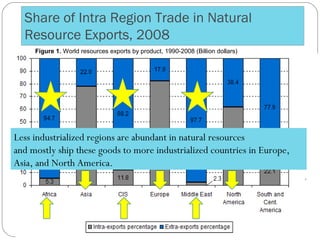
Share of Intra Region Trade in Natural
Resource Exports, 2008
Figure 1. World resources exports by product, 1990-2008 (Billion dollars)
Less industrialized regions are abundant in natural resources
and mostly ship these goods to more industrialized countries in Europe,
Asia, and North America.
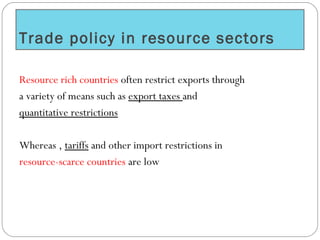
Trade policy in resource sectors
Resource rich countries often restrict exports through
a variety of means such as export taxes and
quantitative restrictions
Whereas , tariffs and other import restrictions in
resource-scarce countries are low
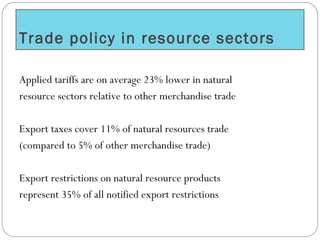
Trade policy in resource sectors
Applied tariffs are on average 23% lower in natural
resource sectors relative to other merchandise trade
Export taxes cover 11% of natural resources trade
(compared to 5% of other merchandise trade)
Export restrictions on natural resource products
represent 35% of all notified export restrictions
2) Supply and Demand
International Trade arises because a country
specializes in the production of certain goods and
services and thus produces more than enough to
supply the domestic demand
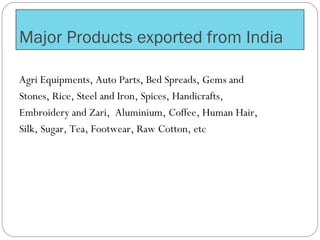
Major Products exported from India
Agri Equipments, Auto Parts, Bed Spreads, Gems and
Stones, Rice, Steel and Iron, Spices, Handicrafts,
Embroidery and Zari, Aluminium, Coffee, Human Hair,
Silk, Sugar, Tea, Footwear, Raw Cotton, etc
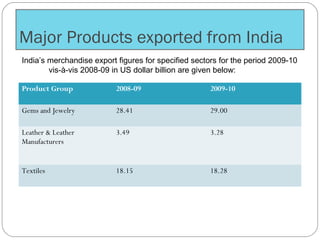
Major Products exported from India
India’s merchandise export figures for specified sectors for the period 2009-10
vis-à-vis 2008-09 in US dollar billion are given below:
Product Group 2008-09 2009-10
Gems and Jewelry 28.41 29.00
Leather & Leather
Manufacturers
3.49 3.28
Textiles 18.15 18.28
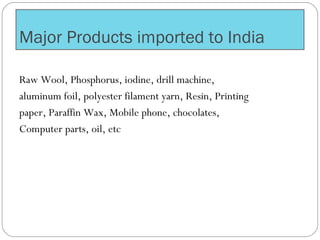
Major Products imported to India
Raw Wool, Phosphorus, iodine, drill machine,
aluminum foil, polyester filament yarn, Resin, Printing
paper, Paraffin Wax, Mobile phone, chocolates,
Computer parts, oil, etc
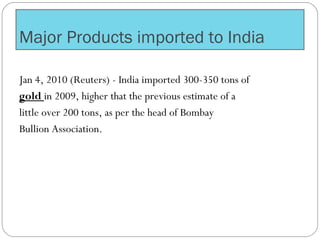
Major Products imported to India
Jan 4, 2010 (Reuters) - India imported 300-350 tons of
gold in 2009, higher that the previous estimate of a
little over 200 tons, as per the head of Bombay
Bullion Association.
Major Products imported to India
Jan 7,2010 (Reuters) - India, the world's top consumer
of sugar and the biggest producer behind Brazil,
allowed tax-free imports of the sweetener in 2009 to
bridge a shortfall. In the year up to September 2009,
importers received 2.3 million tons of raws
and 225,000 tons of whites
3) Difference in Government policies
(e.g. Taxes)
 “International trade law" includes the appropriate rules and
customs for handling trade between countries
 Whereas "International Commercial Law" deals with transactions
between companies and individuals.
3) Difference in Government policies
A variety of policies can be used such as the economic
policies of restraining trade between states :
A. TARIFFS
Tariffs or taxes are imposed on imported goods.
Tariff rates usually vary according to the type of goods
imported.
Import tariffs will increase the cost to importers, and
increase the price of imported goods in the local
markets, thus lowering the quantity of goods imported.
B. IMPORT QUOTAS
To reduce the quantity and therefore increase the
market price of imported goods.
This creates scarcity of the goods hence increasing
the cost.
C. ADMINISTRATIVE BARRIERS
Countries are sometimes accused of using their
various administrative rules (eg. regarding food safety,
environmental standards, electrical safety, etc.) as a
way to introduce barriers to imports.
D. ANTI DUMPING LEGISLATION
Supporters of anti-dumping laws argue that they
prevent "dumping" of cheaper foreign goods that
would cause local firms to close down.
However, in practice, anti-dumping laws are usually
used to impose trade tariffs on foreign exporters.
E. DIRECT SUBSIDIES
Government subsidies (in the form of lump-sum
payments or cheap loans) are sometimes given to
local firms that cannot compete well against foreign
imports.
These subsidies have the objective to "protect" local
jobs, and to help local firms adjust to the world
markets.
F. EXPORT SUBSIDIES
Export subsidies are often used by governments to
increase exports.
Export subsidies are the opposite of export tariffs,
exporters are paid a percentage of the value of their
exports.
Export subsidies increase the amount of trade.
G. EXCHANGE RATE MANIPULATION
A government may intervene in the foreign exchange
market to lower the value of its currency by selling its
currency in the foreign exchange market.
Doing so will raise the cost of imports and lower the
cost of exports, leading to an improvement in its trade
balance.
However, such a policy is only effective in the short run, as
it will most likely lead to inflation in the country, which will in
turn raise the cost of exports, and reduce the relative price
of imports.
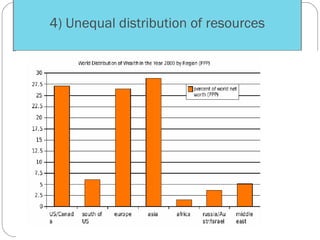
4) Unequal distribution of resources
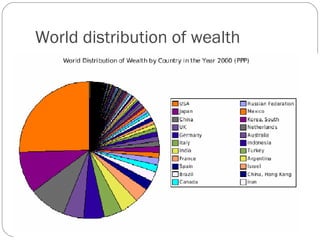
World distribution of wealth

Basis and Need for International Trade

  • 1.
    Ritu Jain Basis andNeed for International Trade
  • 2.
    1) Primary Effectof Natural Resources A recent study by the WTO finds that export policy, rather than import restrictions, dominates natural resources trade (WTO 2010) FUELS MINING PRODUCTS FORESTRY PRODUCTS FISH
  • 3.
    Natural Resources –Distinctive Features  Uneven geographical distribution  Exhaustibility (hence the large rents associated to their scarcity)  Environmental externalities deriving from their extraction and consumption  Dominance in some economies, and high price
  • 4.
    Share of IntraRegion Trade in Natural Resource Exports, 2008 Figure 1. World resources exports by product, 1990-2008 (Billion dollars) Less industrialized regions are abundant in natural resources and mostly ship these goods to more industrialized countries in Europe, Asia, and North America.
  • 5.
    Trade policy inresource sectors Resource rich countries often restrict exports through a variety of means such as export taxes and quantitative restrictions Whereas , tariffs and other import restrictions in resource-scarce countries are low
  • 6.
    Trade policy inresource sectors Applied tariffs are on average 23% lower in natural resource sectors relative to other merchandise trade Export taxes cover 11% of natural resources trade (compared to 5% of other merchandise trade) Export restrictions on natural resource products represent 35% of all notified export restrictions
  • 7.
    2) Supply andDemand International Trade arises because a country specializes in the production of certain goods and services and thus produces more than enough to supply the domestic demand
  • 8.
    Major Products exportedfrom India Agri Equipments, Auto Parts, Bed Spreads, Gems and Stones, Rice, Steel and Iron, Spices, Handicrafts, Embroidery and Zari, Aluminium, Coffee, Human Hair, Silk, Sugar, Tea, Footwear, Raw Cotton, etc
  • 9.
    Major Products exportedfrom India India’s merchandise export figures for specified sectors for the period 2009-10 vis-à-vis 2008-09 in US dollar billion are given below: Product Group 2008-09 2009-10 Gems and Jewelry 28.41 29.00 Leather & Leather Manufacturers 3.49 3.28 Textiles 18.15 18.28
  • 10.
    Major Products importedto India Raw Wool, Phosphorus, iodine, drill machine, aluminum foil, polyester filament yarn, Resin, Printing paper, Paraffin Wax, Mobile phone, chocolates, Computer parts, oil, etc
  • 11.
    Major Products importedto India Jan 4, 2010 (Reuters) - India imported 300-350 tons of gold in 2009, higher that the previous estimate of a little over 200 tons, as per the head of Bombay Bullion Association.
  • 12.
    Major Products importedto India Jan 7,2010 (Reuters) - India, the world's top consumer of sugar and the biggest producer behind Brazil, allowed tax-free imports of the sweetener in 2009 to bridge a shortfall. In the year up to September 2009, importers received 2.3 million tons of raws and 225,000 tons of whites
  • 13.
    3) Difference inGovernment policies (e.g. Taxes)  “International trade law" includes the appropriate rules and customs for handling trade between countries  Whereas "International Commercial Law" deals with transactions between companies and individuals.
  • 14.
    3) Difference inGovernment policies A variety of policies can be used such as the economic policies of restraining trade between states :
  • 15.
    A. TARIFFS Tariffs ortaxes are imposed on imported goods. Tariff rates usually vary according to the type of goods imported. Import tariffs will increase the cost to importers, and increase the price of imported goods in the local markets, thus lowering the quantity of goods imported.
  • 16.
    B. IMPORT QUOTAS Toreduce the quantity and therefore increase the market price of imported goods. This creates scarcity of the goods hence increasing the cost.
  • 17.
    C. ADMINISTRATIVE BARRIERS Countriesare sometimes accused of using their various administrative rules (eg. regarding food safety, environmental standards, electrical safety, etc.) as a way to introduce barriers to imports.
  • 18.
    D. ANTI DUMPINGLEGISLATION Supporters of anti-dumping laws argue that they prevent "dumping" of cheaper foreign goods that would cause local firms to close down. However, in practice, anti-dumping laws are usually used to impose trade tariffs on foreign exporters.
  • 19.
    E. DIRECT SUBSIDIES Governmentsubsidies (in the form of lump-sum payments or cheap loans) are sometimes given to local firms that cannot compete well against foreign imports. These subsidies have the objective to "protect" local jobs, and to help local firms adjust to the world markets.
  • 20.
    F. EXPORT SUBSIDIES Exportsubsidies are often used by governments to increase exports. Export subsidies are the opposite of export tariffs, exporters are paid a percentage of the value of their exports. Export subsidies increase the amount of trade.
  • 21.
    G. EXCHANGE RATEMANIPULATION A government may intervene in the foreign exchange market to lower the value of its currency by selling its currency in the foreign exchange market. Doing so will raise the cost of imports and lower the cost of exports, leading to an improvement in its trade balance. However, such a policy is only effective in the short run, as it will most likely lead to inflation in the country, which will in turn raise the cost of exports, and reduce the relative price of imports.
  • 22.
  • 23.