International Technology Adoption
& Workforce Issues Study
Summary for Brazil
About this Research
CompTIA’s International Technology Adoption and Workforce Issues study was conducted to collect and share information on technology adoption and
workforce trends across several countries. The objectives of this research include:
• Explore business and information technology (IT) priorities among organizations
• Examine the usage of key technologies/solutions and IT services such as security and cloud computing
• Identify which IT skills are most important to employers and if there are any skills gap issues or staffing concerns
• Evaluate professional development practices such as training and certification
The data for this study was collected via a quantitative online survey conducted February 22 to March 23, 2013 among 1,256 IT and business executives
directly involved in setting or executing information technology policies and processes within their organizations. The 10 countries covered in this study
include:
Brazil (n=125); Canada (n=125); France (n=125); Germany (n=131); India (n=125); Japan (n=125); Mexico (n=125); Middle East Subset (Oman, Saudi
Arabia, United Arab Emirates) (n=125); Thailand (n=125); United Kingdom (n=125)
Surveys were localized and translated to allow respondents to participate in their native language. Additionally, precautions were taken to minimize
misinterpretations of questions. However, research has shown, cultural differences exist and can affect responses to certain question types, such as 5-
point satisfaction rating questions. Viewers of this report should keep that in mind when comparing results across countries.
The margin of sampling error at 95% confidence for aggregate results is +/- 2.8 percentage points. Sampling error is larger for subgroups of the data,
such as individual countries where it is +/- 8.9 percentage points. As with any survey, sampling error is only one source of possible error. While non-
sampling error cannot be accurately calculated, precautionary steps were taken in all phases of the survey design, collection and processing of the data
to minimize its influence. Note: because data collection occurred via an online survey, in countries where Internet penetration is lower among
businesses, the non-sampling error could be higher.
CompTIA is responsible for all content contained in this series. Any questions regarding the study should be directed to CompTIA Market Research staff
at research@comptia.org.
CompTIA is a member of the Marketing Research Association (MRA) and adheres to the MRA’s Code of Market Research Ethics and Standards.
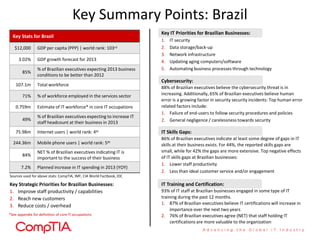
Key IT Priorities for Brazilian Businesses:
1. IT security
2. Data storage/back-up
3. Network infrastructure
4. Updating aging computers/software
5. Automating business processes through technology
Key Summary Points: Brazil
Key Stats for Brazil
$12,000 GDP per capita (PPP) | world rank: 103rd
3.02% GDP growth forecast for 2013
85%
% of Brazilian executives expecting 2013 business
conditions to be better than 2012
107.1m Total workforce
71% % of workforce employed in the services sector
0.759m Estimate of IT workforce* in core IT occupations
49%
% of Brazilian executives expecting to increase IT
staff headcount at their business in 2013
75.98m Internet users | world rank: 4th
244.36m Mobile phone users | world rank: 5th
84%
NET % of Brazilian executives indicating IT is
important to the success of their business
7.2% Planned increase in IT spending in 2013 (YOY)
Key Strategic Priorities for Brazilian Businesses:
1. Improve staff productivity / capabilities
2. Reach new customers
3. Reduce costs / overhead
Cybersecurity:
88% of Brazilian executives believe the cybersecurity threat is in
increasing. Additionally, 65% of Brazilian executives believe human
error is a growing factor in security security incidents: Top human error
related factors include:
1. Failure of end-users to follow security procedures and policies
2. General negligence / carelessness towards security
IT Skills Gaps:
86% of Brazilian executives indicate at least some degree of gaps in IT
skills at their business exists. For 44%, the reported skills gaps are
small, while for 42% the gaps are more extensive. Top negative effects
of IT skills gaps at Brazilian businesses:
1. Lower staff productivity
2. Less than ideal customer service and/or engagement
IT Training and Certification:
93% of IT staff at Brazilian businesses engaged in some type of IT
training during the past 12 months.
1. 87% of Brazilian executives believe IT certifications will increase in
importance over the next two years
2. 76% of Brazilian executives agree (NET) that staff holding IT
certifications are more valuable to the organization
Sources used for above stats: CompTIA, IMF, CIA World Factbook, IDC
*See appendix for definition of core IT occupations
Detailed Findings: Business
and Technology Issues
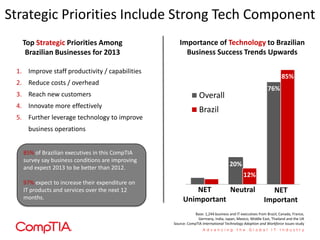
Strategic Priorities Include Strong Tech Component
Base: 1,244 business and IT executives from Brazil, Canada, France,
Germany, India, Japan, Mexico, Middle East, Thailand and the UK
Source: CompTIA International Technology Adoption and Workforce Issues study
20%
76%
12%
85%
Overall
Brazil
Top Strategic Priorities Among
Brazilian Businesses for 2013
NET
Unimportant
NET
Important
Neutral
1. Improve staff productivity / capabilities
2. Reduce costs / overhead
3. Reach new customers
4. Innovate more effectively
5. Further leverage technology to improve
business operations
85% of Brazilian executives in this CompTIA
survey say business conditions are improving
and expect 2013 to be better than 2012.
97% expect to increase their expenditure on
IT products and services over the next 12
months.
Importance of Technology to Brazilian
Business Success Trends Upwards
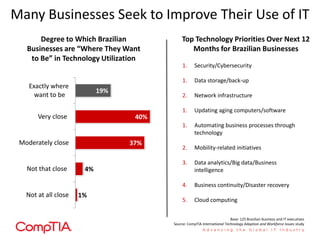
Many Businesses Seek to Improve Their Use of IT
1%
4%
37%
40%
19%
Not at all close
Not that close
Moderately close
Very close
Exactly where
want to be
Degree to Which Brazilian
Businesses are “Where They Want
to Be” in Technology Utilization
1. Security/Cybersecurity
1. Data storage/back-up
2. Network infrastructure
1. Updating aging computers/software
1. Automating business processes through
technology
2. Mobility-related initiatives
3. Data analytics/Big data/Business
intelligence
4. Business continuity/Disaster recovery
5. Cloud computing
Top Technology Priorities Over Next 12
Months for Brazilian Businesses
Base: 125 Brazilian business and IT executives
Source: CompTIA International Technology Adoption and Workforce Issues study
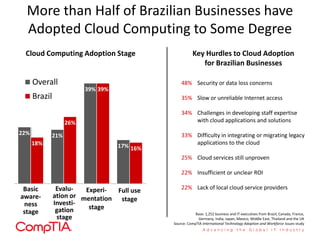
More than Half of Brazilian Businesses have
Adopted Cloud Computing to Some Degree
22% 21%
39%
17%18%
26%
39%
16%
Overall
Brazil
Key Hurdles to Cloud Adoption
for Brazilian Businesses
Cloud Computing Adoption Stage
Full use
stage
Experi-
mentation
stage
Evalu-
ation or
Investi-
gation
stage
Basic
aware-
ness
stage
48% Security or data loss concerns
35% Slow or unreliable Internet access
34% Challenges in developing staff expertise
with cloud applications and solutions
33% Difficulty in integrating or migrating legacy
applications to the cloud
25% Cloud services still unproven
22% Insufficient or unclear ROI
22% Lack of local cloud service providers
Base: 1,252 business and IT executives from Brazil, Canada, France,
Germany, India, Japan, Mexico, Middle East, Thailand and the UK
Source: CompTIA International Technology Adoption and Workforce Issues study
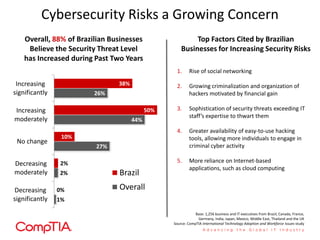
Cybersecurity Risks a Growing Concern
1%
2%
27%
44%
26%
0%
2%
10%
50%
38%
Decreasing
significantly
Decreasing
moderately
No change
Increasing
moderately
Increasing
significantly
Brazil
Overall
Overall, 88% of Brazilian Businesses
Believe the Security Threat Level
has Increased during Past Two Years
1. Rise of social networking
2. Growing criminalization and organization of
hackers motivated by financial gain
3. Sophistication of security threats exceeding IT
staff’s expertise to thwart them
4. Greater availability of easy-to-use hacking
tools, allowing more individuals to engage in
criminal cyber activity
5. More reliance on Internet-based
applications, such as cloud computing
Top Factors Cited by Brazilian
Businesses for Increasing Security Risks
Base: 1,256 business and IT executives from Brazil, Canada, France,
Germany, India, Japan, Mexico, Middle East, Thailand and the UK
Source: CompTIA International Technology Adoption and Workforce Issues study
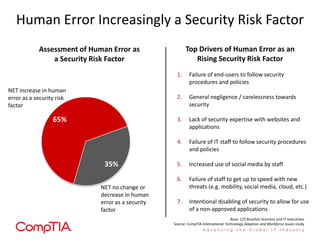
Human Error Increasingly a Security Risk Factor
35%
65%
NET increase in human
error as a security risk
factor
NET no change or
decrease in human
error as a security
factor
Top Drivers of Human Error as an
Rising Security Risk Factor
Assessment of Human Error as
a Security Risk Factor
1. Failure of end-users to follow security
procedures and policies
2. General negligence / carelessness towards
security
3. Lack of security expertise with websites and
applications
4. Failure of IT staff to follow security procedures
and policies
5. Increased use of social media by staff
6. Failure of staff to get up to speed with new
threats (e.g. mobility, social media, cloud, etc.)
7. Intentional disabling of security to allow for use
of a non-approved applications
Base: 125 Brazilian business and IT executives
Source: CompTIA International Technology Adoption and Workforce Issues study
Detailed Findings: IT Training
and Certification Issues
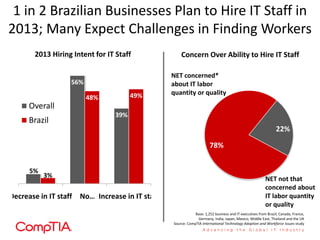
1 in 2 Brazilian Businesses Plan to Hire IT Staff in
2013; Many Expect Challenges in Finding Workers
5%
56%
39%
3%
48% 49%
Decrease in IT staff No… Increase in IT staff
Overall
Brazil
22%
78%
NET concerned*
about IT labor
quantity or quality
NET not that
concerned about
IT labor quantity
or quality
Concern Over Ability to Hire IT Staff2013 Hiring Intent for IT Staff
Base: 1,252 business and IT executives from Brazil, Canada, France,
Germany, India, Japan, Mexico, Middle East, Thailand and the UK
Source: CompTIA International Technology Adoption and Workforce Issues study
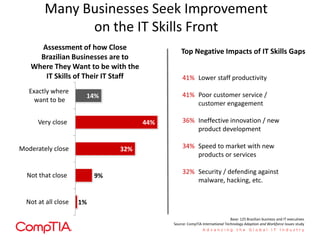
Many Businesses Seek Improvement
on the IT Skills Front
1%
9%
32%
44%
14%
Not at all close
Not that close
Moderately close
Very close
Exactly where
want to be
Assessment of how Close
Brazilian Businesses are to
Where They Want to be with the
IT Skills of Their IT Staff 41% Lower staff productivity
41% Poor customer service /
customer engagement
36% Ineffective innovation / new
product development
34% Speed to market with new
products or services
32% Security / defending against
malware, hacking, etc.
Top Negative Impacts of IT Skills Gaps
Base: 125 Brazilian business and IT executives
Source: CompTIA International Technology Adoption and Workforce Issues study
IT Skills Rating Among Brazilian Businesses
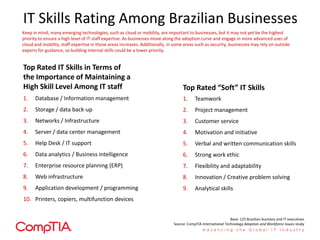
1. Teamwork
2. Project management
3. Customer service
4. Motivation and initiative
5. Verbal and written communication skills
6. Strong work ethic
7. Flexibility and adaptability
8. Innovation / Creative problem solving
9. Analytical skills
Top Rated “Soft” IT Skills
1. Database / Information management
2. Storage / data back-up
3. Networks / Infrastructure
4. Server / data center management
5. Help Desk / IT support
6. Data analytics / Business intelligence
7. Enterprise resource planning (ERP)
8. Web infrastructure
9. Application development / programming
10. Printers, copiers, multifunction devices
Top Rated IT Skills in Terms of
the Importance of Maintaining a
High Skill Level Among IT staff
Keep in mind, many emerging technologies, such as cloud or mobility, are important to businesses, but it may not yet be the highest
priority to ensure a high level of IT staff expertise. As businesses move along the adoption curve and engage in more advanced uses of
cloud and mobility, staff expertise in those areas increases. Additionally, in some areas such as security, businesses may rely on outside
experts for guidance, so building internal skills could be a lower priority.
Base: 125 Brazilian business and IT executives
Source: CompTIA International Technology Adoption and Workforce Issues study
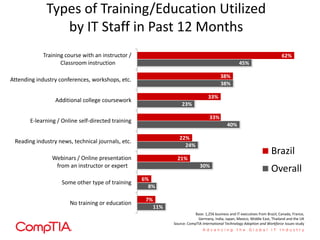
Types of Training/Education Utilized
by IT Staff in Past 12 Months
11%
8%
30%
24%
40%
23%
38%
45%
7%
6%
21%
22%
33%
33%
38%
62%
No training or education
Some other type of training
Webinars / Online presentation
from an instructor or expert
Reading industry news, technical journals, etc.
E-learning / Online self-directed training
Additional college coursework
Attending industry conferences, workshops, etc.
Training course with an instructor /
Classroom instruction
Brazil
Overall
Base: 1,256 business and IT executives from Brazil, Canada, France,
Germany, India, Japan, Mexico, Middle East, Thailand and the UK
Source: CompTIA International Technology Adoption and Workforce Issues study
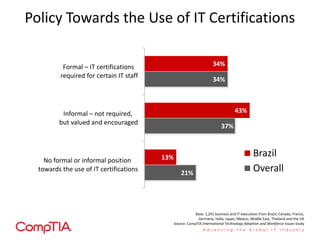
Policy Towards the Use of IT Certifications
21%
37%
34%
13%
43%
34%
No formal or informal position
towards the use of IT certifications
Informal – not required,
but valued and encouraged
Formal – IT certifications
required for certain IT staff
Brazil
Overall
Base: 1,241 business and IT executives from Brazil, Canada, France,
Germany, India, Japan, Mexico, Middle East, Thailand and the UK
Source: CompTIA International Technology Adoption and Workforce Issues study
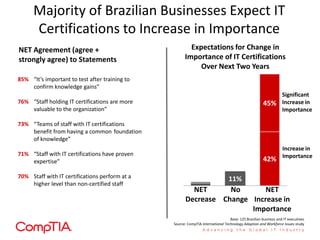
Majority of Brazilian Businesses Expect IT
Certifications to Increase in Importance
11%
42%
45%
Significant
Increase in
Importance
Increase in
Importance
NET
Decrease
NET
Increase in
Importance
No
Change
85% “It’s important to test after training to
confirm knowledge gains”
76% “Staff holding IT certifications are more
valuable to the organization”
73% “Teams of staff with IT certifications
benefit from having a common foundation
of knowledge”
71% “Staff with IT certifications have proven
expertise”
70% Staff with IT certifications perform at a
higher level than non-certified staff
NET Agreement (agree +
strongly agree) to Statements
Expectations for Change in
Importance of IT Certifications
Over Next Two Years
Base: 125 Brazilian business and IT executives
Source: CompTIA International Technology Adoption and Workforce Issues study
Appendix
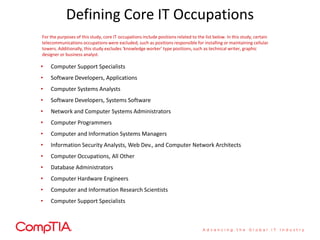
Defining Core IT Occupations
• Computer Support Specialists
• Software Developers, Applications
• Computer Systems Analysts
• Software Developers, Systems Software
• Network and Computer Systems Administrators
• Computer Programmers
• Computer and Information Systems Managers
• Information Security Analysts, Web Dev., and Computer Network Architects
• Computer Occupations, All Other
• Database Administrators
• Computer Hardware Engineers
• Computer and Information Research Scientists
• Computer Support Specialists
For the purposes of this study, core IT occupations include positions related to the list below. In this study, certain
telecommunications occupations were excluded, such as positions responsible for installing or maintaining cellular
towers. Additionally, this study excludes ‘knowledge worker’ type positions, such as technical writer, graphic
designer or business analyst.
comptia.org
Want to know more?
As the voice of the IT industry, CompTIA has hundreds
of tools, market intelligence reports and business
training programs to help IT organizations grow through
education, certification, advocacy and philanthropy.
Check it out at www.comptia.org.
Want to know about our research on the IT workforce?
Visit http://www.comptia.org/research/it-workforce.aspx.

International Technology Adoption & Workforce Issues Study - Brazilian Summary

  • 1.
    International Technology Adoption &Workforce Issues Study Summary for Brazil
  • 2.
    About this Research CompTIA’sInternational Technology Adoption and Workforce Issues study was conducted to collect and share information on technology adoption and workforce trends across several countries. The objectives of this research include: • Explore business and information technology (IT) priorities among organizations • Examine the usage of key technologies/solutions and IT services such as security and cloud computing • Identify which IT skills are most important to employers and if there are any skills gap issues or staffing concerns • Evaluate professional development practices such as training and certification The data for this study was collected via a quantitative online survey conducted February 22 to March 23, 2013 among 1,256 IT and business executives directly involved in setting or executing information technology policies and processes within their organizations. The 10 countries covered in this study include: Brazil (n=125); Canada (n=125); France (n=125); Germany (n=131); India (n=125); Japan (n=125); Mexico (n=125); Middle East Subset (Oman, Saudi Arabia, United Arab Emirates) (n=125); Thailand (n=125); United Kingdom (n=125) Surveys were localized and translated to allow respondents to participate in their native language. Additionally, precautions were taken to minimize misinterpretations of questions. However, research has shown, cultural differences exist and can affect responses to certain question types, such as 5- point satisfaction rating questions. Viewers of this report should keep that in mind when comparing results across countries. The margin of sampling error at 95% confidence for aggregate results is +/- 2.8 percentage points. Sampling error is larger for subgroups of the data, such as individual countries where it is +/- 8.9 percentage points. As with any survey, sampling error is only one source of possible error. While non- sampling error cannot be accurately calculated, precautionary steps were taken in all phases of the survey design, collection and processing of the data to minimize its influence. Note: because data collection occurred via an online survey, in countries where Internet penetration is lower among businesses, the non-sampling error could be higher. CompTIA is responsible for all content contained in this series. Any questions regarding the study should be directed to CompTIA Market Research staff at research@comptia.org. CompTIA is a member of the Marketing Research Association (MRA) and adheres to the MRA’s Code of Market Research Ethics and Standards.
  • 3.
    Key IT Prioritiesfor Brazilian Businesses: 1. IT security 2. Data storage/back-up 3. Network infrastructure 4. Updating aging computers/software 5. Automating business processes through technology Key Summary Points: Brazil Key Stats for Brazil $12,000 GDP per capita (PPP) | world rank: 103rd 3.02% GDP growth forecast for 2013 85% % of Brazilian executives expecting 2013 business conditions to be better than 2012 107.1m Total workforce 71% % of workforce employed in the services sector 0.759m Estimate of IT workforce* in core IT occupations 49% % of Brazilian executives expecting to increase IT staff headcount at their business in 2013 75.98m Internet users | world rank: 4th 244.36m Mobile phone users | world rank: 5th 84% NET % of Brazilian executives indicating IT is important to the success of their business 7.2% Planned increase in IT spending in 2013 (YOY) Key Strategic Priorities for Brazilian Businesses: 1. Improve staff productivity / capabilities 2. Reach new customers 3. Reduce costs / overhead Cybersecurity: 88% of Brazilian executives believe the cybersecurity threat is in increasing. Additionally, 65% of Brazilian executives believe human error is a growing factor in security security incidents: Top human error related factors include: 1. Failure of end-users to follow security procedures and policies 2. General negligence / carelessness towards security IT Skills Gaps: 86% of Brazilian executives indicate at least some degree of gaps in IT skills at their business exists. For 44%, the reported skills gaps are small, while for 42% the gaps are more extensive. Top negative effects of IT skills gaps at Brazilian businesses: 1. Lower staff productivity 2. Less than ideal customer service and/or engagement IT Training and Certification: 93% of IT staff at Brazilian businesses engaged in some type of IT training during the past 12 months. 1. 87% of Brazilian executives believe IT certifications will increase in importance over the next two years 2. 76% of Brazilian executives agree (NET) that staff holding IT certifications are more valuable to the organization Sources used for above stats: CompTIA, IMF, CIA World Factbook, IDC *See appendix for definition of core IT occupations
  • 4.
  • 5.
    Strategic Priorities IncludeStrong Tech Component Base: 1,244 business and IT executives from Brazil, Canada, France, Germany, India, Japan, Mexico, Middle East, Thailand and the UK Source: CompTIA International Technology Adoption and Workforce Issues study 20% 76% 12% 85% Overall Brazil Top Strategic Priorities Among Brazilian Businesses for 2013 NET Unimportant NET Important Neutral 1. Improve staff productivity / capabilities 2. Reduce costs / overhead 3. Reach new customers 4. Innovate more effectively 5. Further leverage technology to improve business operations 85% of Brazilian executives in this CompTIA survey say business conditions are improving and expect 2013 to be better than 2012. 97% expect to increase their expenditure on IT products and services over the next 12 months. Importance of Technology to Brazilian Business Success Trends Upwards
  • 6.
    Many Businesses Seekto Improve Their Use of IT 1% 4% 37% 40% 19% Not at all close Not that close Moderately close Very close Exactly where want to be Degree to Which Brazilian Businesses are “Where They Want to Be” in Technology Utilization 1. Security/Cybersecurity 1. Data storage/back-up 2. Network infrastructure 1. Updating aging computers/software 1. Automating business processes through technology 2. Mobility-related initiatives 3. Data analytics/Big data/Business intelligence 4. Business continuity/Disaster recovery 5. Cloud computing Top Technology Priorities Over Next 12 Months for Brazilian Businesses Base: 125 Brazilian business and IT executives Source: CompTIA International Technology Adoption and Workforce Issues study
  • 7.
    More than Halfof Brazilian Businesses have Adopted Cloud Computing to Some Degree 22% 21% 39% 17%18% 26% 39% 16% Overall Brazil Key Hurdles to Cloud Adoption for Brazilian Businesses Cloud Computing Adoption Stage Full use stage Experi- mentation stage Evalu- ation or Investi- gation stage Basic aware- ness stage 48% Security or data loss concerns 35% Slow or unreliable Internet access 34% Challenges in developing staff expertise with cloud applications and solutions 33% Difficulty in integrating or migrating legacy applications to the cloud 25% Cloud services still unproven 22% Insufficient or unclear ROI 22% Lack of local cloud service providers Base: 1,252 business and IT executives from Brazil, Canada, France, Germany, India, Japan, Mexico, Middle East, Thailand and the UK Source: CompTIA International Technology Adoption and Workforce Issues study
  • 8.
    Cybersecurity Risks aGrowing Concern 1% 2% 27% 44% 26% 0% 2% 10% 50% 38% Decreasing significantly Decreasing moderately No change Increasing moderately Increasing significantly Brazil Overall Overall, 88% of Brazilian Businesses Believe the Security Threat Level has Increased during Past Two Years 1. Rise of social networking 2. Growing criminalization and organization of hackers motivated by financial gain 3. Sophistication of security threats exceeding IT staff’s expertise to thwart them 4. Greater availability of easy-to-use hacking tools, allowing more individuals to engage in criminal cyber activity 5. More reliance on Internet-based applications, such as cloud computing Top Factors Cited by Brazilian Businesses for Increasing Security Risks Base: 1,256 business and IT executives from Brazil, Canada, France, Germany, India, Japan, Mexico, Middle East, Thailand and the UK Source: CompTIA International Technology Adoption and Workforce Issues study
  • 9.
    Human Error Increasinglya Security Risk Factor 35% 65% NET increase in human error as a security risk factor NET no change or decrease in human error as a security factor Top Drivers of Human Error as an Rising Security Risk Factor Assessment of Human Error as a Security Risk Factor 1. Failure of end-users to follow security procedures and policies 2. General negligence / carelessness towards security 3. Lack of security expertise with websites and applications 4. Failure of IT staff to follow security procedures and policies 5. Increased use of social media by staff 6. Failure of staff to get up to speed with new threats (e.g. mobility, social media, cloud, etc.) 7. Intentional disabling of security to allow for use of a non-approved applications Base: 125 Brazilian business and IT executives Source: CompTIA International Technology Adoption and Workforce Issues study
  • 10.
    Detailed Findings: ITTraining and Certification Issues
  • 11.
    1 in 2Brazilian Businesses Plan to Hire IT Staff in 2013; Many Expect Challenges in Finding Workers 5% 56% 39% 3% 48% 49% Decrease in IT staff No… Increase in IT staff Overall Brazil 22% 78% NET concerned* about IT labor quantity or quality NET not that concerned about IT labor quantity or quality Concern Over Ability to Hire IT Staff2013 Hiring Intent for IT Staff Base: 1,252 business and IT executives from Brazil, Canada, France, Germany, India, Japan, Mexico, Middle East, Thailand and the UK Source: CompTIA International Technology Adoption and Workforce Issues study
  • 12.
    Many Businesses SeekImprovement on the IT Skills Front 1% 9% 32% 44% 14% Not at all close Not that close Moderately close Very close Exactly where want to be Assessment of how Close Brazilian Businesses are to Where They Want to be with the IT Skills of Their IT Staff 41% Lower staff productivity 41% Poor customer service / customer engagement 36% Ineffective innovation / new product development 34% Speed to market with new products or services 32% Security / defending against malware, hacking, etc. Top Negative Impacts of IT Skills Gaps Base: 125 Brazilian business and IT executives Source: CompTIA International Technology Adoption and Workforce Issues study
  • 13.
    IT Skills RatingAmong Brazilian Businesses 1. Teamwork 2. Project management 3. Customer service 4. Motivation and initiative 5. Verbal and written communication skills 6. Strong work ethic 7. Flexibility and adaptability 8. Innovation / Creative problem solving 9. Analytical skills Top Rated “Soft” IT Skills 1. Database / Information management 2. Storage / data back-up 3. Networks / Infrastructure 4. Server / data center management 5. Help Desk / IT support 6. Data analytics / Business intelligence 7. Enterprise resource planning (ERP) 8. Web infrastructure 9. Application development / programming 10. Printers, copiers, multifunction devices Top Rated IT Skills in Terms of the Importance of Maintaining a High Skill Level Among IT staff Keep in mind, many emerging technologies, such as cloud or mobility, are important to businesses, but it may not yet be the highest priority to ensure a high level of IT staff expertise. As businesses move along the adoption curve and engage in more advanced uses of cloud and mobility, staff expertise in those areas increases. Additionally, in some areas such as security, businesses may rely on outside experts for guidance, so building internal skills could be a lower priority. Base: 125 Brazilian business and IT executives Source: CompTIA International Technology Adoption and Workforce Issues study
  • 14.
    Types of Training/EducationUtilized by IT Staff in Past 12 Months 11% 8% 30% 24% 40% 23% 38% 45% 7% 6% 21% 22% 33% 33% 38% 62% No training or education Some other type of training Webinars / Online presentation from an instructor or expert Reading industry news, technical journals, etc. E-learning / Online self-directed training Additional college coursework Attending industry conferences, workshops, etc. Training course with an instructor / Classroom instruction Brazil Overall Base: 1,256 business and IT executives from Brazil, Canada, France, Germany, India, Japan, Mexico, Middle East, Thailand and the UK Source: CompTIA International Technology Adoption and Workforce Issues study
  • 15.
    Policy Towards theUse of IT Certifications 21% 37% 34% 13% 43% 34% No formal or informal position towards the use of IT certifications Informal – not required, but valued and encouraged Formal – IT certifications required for certain IT staff Brazil Overall Base: 1,241 business and IT executives from Brazil, Canada, France, Germany, India, Japan, Mexico, Middle East, Thailand and the UK Source: CompTIA International Technology Adoption and Workforce Issues study
  • 16.
    Majority of BrazilianBusinesses Expect IT Certifications to Increase in Importance 11% 42% 45% Significant Increase in Importance Increase in Importance NET Decrease NET Increase in Importance No Change 85% “It’s important to test after training to confirm knowledge gains” 76% “Staff holding IT certifications are more valuable to the organization” 73% “Teams of staff with IT certifications benefit from having a common foundation of knowledge” 71% “Staff with IT certifications have proven expertise” 70% Staff with IT certifications perform at a higher level than non-certified staff NET Agreement (agree + strongly agree) to Statements Expectations for Change in Importance of IT Certifications Over Next Two Years Base: 125 Brazilian business and IT executives Source: CompTIA International Technology Adoption and Workforce Issues study
  • 17.
  • 18.
    Defining Core ITOccupations • Computer Support Specialists • Software Developers, Applications • Computer Systems Analysts • Software Developers, Systems Software • Network and Computer Systems Administrators • Computer Programmers • Computer and Information Systems Managers • Information Security Analysts, Web Dev., and Computer Network Architects • Computer Occupations, All Other • Database Administrators • Computer Hardware Engineers • Computer and Information Research Scientists • Computer Support Specialists For the purposes of this study, core IT occupations include positions related to the list below. In this study, certain telecommunications occupations were excluded, such as positions responsible for installing or maintaining cellular towers. Additionally, this study excludes ‘knowledge worker’ type positions, such as technical writer, graphic designer or business analyst.
  • 19.
    comptia.org Want to knowmore? As the voice of the IT industry, CompTIA has hundreds of tools, market intelligence reports and business training programs to help IT organizations grow through education, certification, advocacy and philanthropy. Check it out at www.comptia.org. Want to know about our research on the IT workforce? Visit http://www.comptia.org/research/it-workforce.aspx.

Editor's Notes

  • #16 8% Don’t know - Overall10% Don’t know - Brazil