Globalization of Higher Education and
International Student Mobility
United Nations Expert Group Meeting on New Trends in
Migration: Demographic Aspects
Population Division
3 December 2012

Mary M. Kritz
Department of Development Sociology
Cornell University
Ithaca, NY
mmk5@cornell.edu
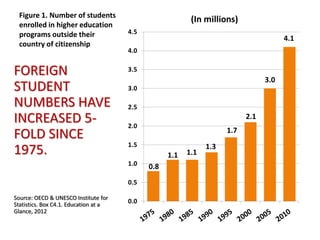
Figure 1. Number of students
enrolled in higher education
programs outside their
country of citizenship

FOREIGN
STUDENT
NUMBERS HAVE
INCREASED 5FOLD SINCE
1975.

Source: OECD & UNESCO Institute for
Statistics. Box C4.1. Education at a
Glance, 2012
Mobile Students –
definitions and data
UNESCO & OECD asks
countries to give them
data annually on their
numbers of international
students.
- Not all destinations submit
data but compliance is
improving
- Country definitions of
mobile students vary
- Data are limited to
students’ origin country,
study field, sex
- Tertiary education is
equivalent of higher
education in USA

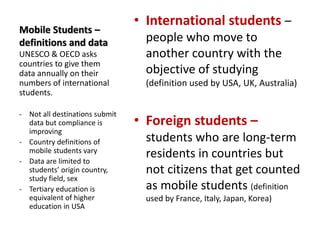
• International students –
people who move to
another country with the
objective of studying
(definition used by USA, UK, Australia)

• Foreign students –
students who are long-term
residents in countries but
not citizens that get counted
as mobile students (definition
used by France, Italy, Japan, Korea)
4 Questions
1. Where do most international students do their
studies and where do they come from?
2. Why tertiary outbound mobility rates (TOMRs) are
important as well as student numbers, and why do
TOMRs vary across countries?
3. How do trends in tertiary education enrollments
differ across world regions and connect to student
mobility?
4. How can international student mobility complement
national development efforts?
Non-OECD

North America
Tertiary Outbound Mobility Rates are
important as well as student numbers – TOMRs
• Need rate that is not affected by country
population size, tertiary age cohort, or tertiary
enrollment ratios.
• TOMR = Tertiary Outbound Mobility Ratio

• Measured as % of country’s total enrolled
students (home and abroad), who are studying
abroad.
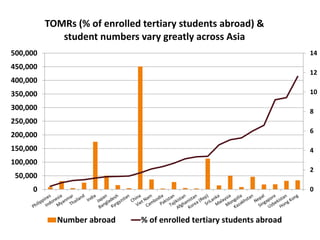
TOMRs (% of enrolled tertiary students abroad) &
student numbers vary greatly across Asia
500,000

14

450,000

12

400,000
350,000

10

300,000

8

250,000
200,000

6

150,000

4

100,000
2

50,000
0

0

Number abroad

% of enrolled tertiary students abroad
Two theories about outbound student
mobility
1. Constrained-domestic schooling:
students leave because of lack of study
opportunities.
2.

Migration-for-employment: students leave
to obtain higher wages abroad after they
complete their studies
Sending Country Correlates of the % of
students abroad
Variables

Significant Relationships

Tertiary education Supply

negative

Population size

negative

Global South country (= 1)

negative

Small country (under 2m) (=1)

positive

Tertiary education Demand

positive

GDP per capita, PPP

positive
N. America/Europe
Gross Tertiary Enrollment Ratios (GERs) are rising at different
rates across regions but still highest in N. America & W. Europe
80
N.America/Europe

enrollment ratio

70
60

C. & E. Europe

50
40

Latin America & Caribe

30
20

S. & W. Asia

E. Asia/Pacific
C. Asia
Middle East

10
Sub-Saharan Africa

0
Higher education is changing
Benefits of Cross-border higher education
programs (CBHEs)
• Benefits to Global North universities:
– generate revenue
– Able to deploy faculty resources more efficiently
– Enhances international profile & creates opportunities for
nationals
– Advances mutual understanding between countries
– Able to recruit highly skilled immigrants

• Benefits to Global South countries:
– Cost effective means to expand education system
– Increase courses/programs in fields where local human
resources are limited
– Reduce high non-return rates
– Become a regional supplier of higher education and
generate revenue from international students.
Growth of CBHEs have implications for
international student flows
1.

2.

3.

Nationals of CBHE host countries can study
at home rather than going abroad.
Students from other Global South countries
can study in CBHE host countries
Students from Global North countries will be
attracted to these new centers of excellence
% of international students changing visa status and
staying on varies across %selected OECD countries
%

35
30
25
20
15
10
5
0

Note: Unless specified otherwise, students stocks come from permit sources. For European countries, covers only students from outside
the European Economic Area.
Data for Canada include changes from student to other temporary statuses.
* Year of reference 2008.
Source: OECD, 2011 International Migration Outlook.
Summing up & Unanswered
Questions

• Do what extent should countries sponsor
nationals for study abroad in order to improve
their higher education systems?
– Brazil – STEM fields & sandwich programs
– Thailand – work commitment to return

• Will students who study within their own
regions have lower “stay” rates?
• How to use scientific diasporas to strengthen
higher education capacity?
Following slides were not used in
presentation
International Student Mobility

International Student Mobility

  • 1.
    Globalization of HigherEducation and International Student Mobility United Nations Expert Group Meeting on New Trends in Migration: Demographic Aspects Population Division 3 December 2012 Mary M. Kritz Department of Development Sociology Cornell University Ithaca, NY mmk5@cornell.edu
  • 2.
    Figure 1. Numberof students enrolled in higher education programs outside their country of citizenship FOREIGN STUDENT NUMBERS HAVE INCREASED 5FOLD SINCE 1975. Source: OECD & UNESCO Institute for Statistics. Box C4.1. Education at a Glance, 2012
  • 3.
    Mobile Students – definitionsand data UNESCO & OECD asks countries to give them data annually on their numbers of international students. - Not all destinations submit data but compliance is improving - Country definitions of mobile students vary - Data are limited to students’ origin country, study field, sex - Tertiary education is equivalent of higher education in USA • International students – people who move to another country with the objective of studying (definition used by USA, UK, Australia) • Foreign students – students who are long-term residents in countries but not citizens that get counted as mobile students (definition used by France, Italy, Japan, Korea)
  • 4.
    4 Questions 1. Wheredo most international students do their studies and where do they come from? 2. Why tertiary outbound mobility rates (TOMRs) are important as well as student numbers, and why do TOMRs vary across countries? 3. How do trends in tertiary education enrollments differ across world regions and connect to student mobility? 4. How can international student mobility complement national development efforts?
  • 5.
  • 8.
    Tertiary Outbound MobilityRates are important as well as student numbers – TOMRs • Need rate that is not affected by country population size, tertiary age cohort, or tertiary enrollment ratios. • TOMR = Tertiary Outbound Mobility Ratio • Measured as % of country’s total enrolled students (home and abroad), who are studying abroad.
  • 9.
    TOMRs (% ofenrolled tertiary students abroad) & student numbers vary greatly across Asia 500,000 14 450,000 12 400,000 350,000 10 300,000 8 250,000 200,000 6 150,000 4 100,000 2 50,000 0 0 Number abroad % of enrolled tertiary students abroad
  • 10.
    Two theories aboutoutbound student mobility 1. Constrained-domestic schooling: students leave because of lack of study opportunities. 2. Migration-for-employment: students leave to obtain higher wages abroad after they complete their studies
  • 11.
    Sending Country Correlatesof the % of students abroad Variables Significant Relationships Tertiary education Supply negative Population size negative Global South country (= 1) negative Small country (under 2m) (=1) positive Tertiary education Demand positive GDP per capita, PPP positive
  • 12.
  • 13.
    Gross Tertiary EnrollmentRatios (GERs) are rising at different rates across regions but still highest in N. America & W. Europe 80 N.America/Europe enrollment ratio 70 60 C. & E. Europe 50 40 Latin America & Caribe 30 20 S. & W. Asia E. Asia/Pacific C. Asia Middle East 10 Sub-Saharan Africa 0
  • 14.
  • 15.
    Benefits of Cross-borderhigher education programs (CBHEs) • Benefits to Global North universities: – generate revenue – Able to deploy faculty resources more efficiently – Enhances international profile & creates opportunities for nationals – Advances mutual understanding between countries – Able to recruit highly skilled immigrants • Benefits to Global South countries: – Cost effective means to expand education system – Increase courses/programs in fields where local human resources are limited – Reduce high non-return rates – Become a regional supplier of higher education and generate revenue from international students.
  • 16.
    Growth of CBHEshave implications for international student flows 1. 2. 3. Nationals of CBHE host countries can study at home rather than going abroad. Students from other Global South countries can study in CBHE host countries Students from Global North countries will be attracted to these new centers of excellence
  • 17.
    % of internationalstudents changing visa status and staying on varies across %selected OECD countries % 35 30 25 20 15 10 5 0 Note: Unless specified otherwise, students stocks come from permit sources. For European countries, covers only students from outside the European Economic Area. Data for Canada include changes from student to other temporary statuses. * Year of reference 2008. Source: OECD, 2011 International Migration Outlook.
  • 18.
    Summing up &Unanswered Questions • Do what extent should countries sponsor nationals for study abroad in order to improve their higher education systems? – Brazil – STEM fields & sandwich programs – Thailand – work commitment to return • Will students who study within their own regions have lower “stay” rates? • How to use scientific diasporas to strengthen higher education capacity?
  • 19.
    Following slides werenot used in presentation