INTERNATIONAL BUSINESS
An Overview & Modes
U. Ramesh Babu
Asst. Prof. of MBA
Annai College of Arts & Science
Kovilacheri, Kumbakonam.
• The exchange of Goods & Services, Resources, Knowledge, & Skills,
among individuals & businesses in two or more countries.
• Transaction that are carried out across national borders to satisfy the
objectives of individuals and organization
• All Commercial transactions that take place between two or more
countries.
1. Private & Government
2. Sales
3. Investments
4. Logistics
5. Transportation
What is International Business ?
• Accurate Information & timely
• The size of the international business
• Market segmentation
• International markets have more potential than domestic markets
Nature
• International Marketing
• International Finance and Investments
• Foreign Exchange
• Global HR
Scope
• Large scale operations
• Integration of economies
• Dominated by developed countries and MNCs
• Benefits to participating countries
• Keen competition
• Special role of science and technology
• International restrictions
Features
1. Earn foreign exchange
2. Optimum utilization of resources
3. Achieve its objectives
4. To spread business risks
5. Improve organization's efficiency
6. Get benefits from Government
7. Expand and diversify
8. Increase competitive capacity
Importance
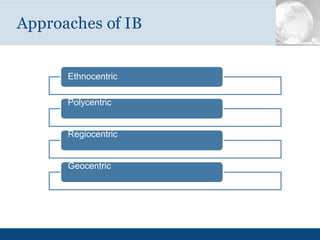
Ethnocentric
Polycentric
Regiocentric
Geocentric
Approaches of IB
Ethnocentric approach
• Under this approach, target market is own country , Excessive
production will export due to change in customer taste, preferences
IB Approaches
Polycentric approach
• Under this approach, the companies customizes the marketing mix to
meet the taste, performance and needs of the customers of each
international market.
IB Approaches
Regiocentric approach
• Under this approach, the company operating successfully in a
foreign country thinks of exporting other neighboring countries of the
host country.
• At this stage, the concerned subsidiary considers the regional
environment ( such as laws, culture, policies etc.) for formulating the
policies & strategies.
IB Approaches
Geocentric approach
• Under this approach, the company analyses the tastes,
preference and needs of the customers in all foreign markets
and then adopts a standardized marketing mix for all the
foreign markets.
IB Approaches
• Political factors
• High foreign investments and high cost
• Exchange instability
• Entry requirements
• Tariffs, quota etc.
• Corruption and bureaucracy
• Technological policy
• Quality Management
Problems
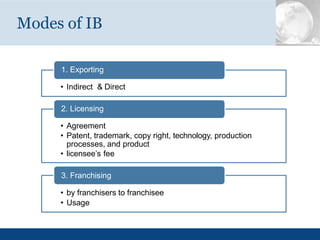
Modes of IB
1. Exporting
• Indirect & Direct
2. Licensing
• Agreement
• Patent, trademark, copy right, technology, production
processes, and product
• licensee’s fee
3. Franchising
• by franchisers to franchisee
• Usage
Modes of IB
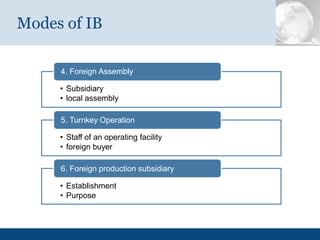
4. Foreign Assembly
• Subsidiary
• local assembly
5. Turnkey Operation
• Staff of an operating facility
• foreign buyer
6. Foreign production subsidiary
• Establishment
• Purpose
Modes of IB
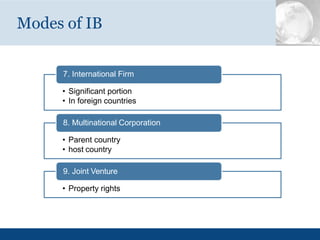
7. International Firm
• Significant portion
• In foreign countries
8. Multinational Corporation
• Parent country
• host country
9. Joint Venture
• Property rights
Modes of IB
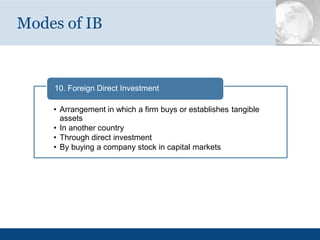
10. Foreign Direct Investment
• Arrangement in which a firm buys or establishes tangible
assets
• In another country
• Through direct investment
• By buying a company stock in capital markets
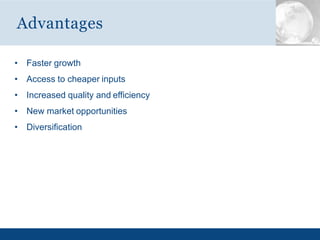
• Faster growth
• Access to cheaper inputs
• Increased quality and efficiency
• New market opportunities
• Diversification
Advantages
• Increased costs
• Foreign regulations and standards
• Delays in payments
• Complex organizational structure
Disadvantages
1. Expansion of technology
2. Business is becoming more global because
• Transportation is quicker
• Communications enable control from afar
• Transportation and communications costs are more conducive for
international operations
3. Liberalization of cross-border movements
• Lower Governmental barriers to the movement of goods, services,
and resources enable Companies to take better advantage of
international opportunities
Reason for recent growth in IB
General agreement on Tariff and trade
(GATT)
• An international organization formed to reduce or
eliminate tariff and other barrier to international
trade
• An international financial organization that lend
money to countries in conducting international
trade
International Monetary Fund (IMF)
Reason for recent growth in IB
World Bank
• An international financial organization that lend
money to underdeveloped and developing
countries for development
Economic Communities
• World Trade Organization (WTO)
• European Community (EC)
• North American Free Trade Agreement(NAFTA)
• Asian Free Trade Agreement (AFTA)
Thank You!

International business overview & modes

  • 1.
    INTERNATIONAL BUSINESS An Overview& Modes U. Ramesh Babu Asst. Prof. of MBA Annai College of Arts & Science Kovilacheri, Kumbakonam.
  • 2.
    • The exchangeof Goods & Services, Resources, Knowledge, & Skills, among individuals & businesses in two or more countries. • Transaction that are carried out across national borders to satisfy the objectives of individuals and organization • All Commercial transactions that take place between two or more countries. 1. Private & Government 2. Sales 3. Investments 4. Logistics 5. Transportation What is International Business ?
  • 3.
    • Accurate Information& timely • The size of the international business • Market segmentation • International markets have more potential than domestic markets Nature
  • 4.
    • International Marketing •International Finance and Investments • Foreign Exchange • Global HR Scope
  • 5.
    • Large scaleoperations • Integration of economies • Dominated by developed countries and MNCs • Benefits to participating countries • Keen competition • Special role of science and technology • International restrictions Features
  • 6.
    1. Earn foreignexchange 2. Optimum utilization of resources 3. Achieve its objectives 4. To spread business risks 5. Improve organization's efficiency 6. Get benefits from Government 7. Expand and diversify 8. Increase competitive capacity Importance
  • 7.
  • 8.
    Ethnocentric approach • Underthis approach, target market is own country , Excessive production will export due to change in customer taste, preferences IB Approaches
  • 9.
    Polycentric approach • Underthis approach, the companies customizes the marketing mix to meet the taste, performance and needs of the customers of each international market. IB Approaches
  • 10.
    Regiocentric approach • Underthis approach, the company operating successfully in a foreign country thinks of exporting other neighboring countries of the host country. • At this stage, the concerned subsidiary considers the regional environment ( such as laws, culture, policies etc.) for formulating the policies & strategies. IB Approaches
  • 11.
    Geocentric approach • Underthis approach, the company analyses the tastes, preference and needs of the customers in all foreign markets and then adopts a standardized marketing mix for all the foreign markets. IB Approaches
  • 12.
    • Political factors •High foreign investments and high cost • Exchange instability • Entry requirements • Tariffs, quota etc. • Corruption and bureaucracy • Technological policy • Quality Management Problems
  • 13.
    Modes of IB 1.Exporting • Indirect & Direct 2. Licensing • Agreement • Patent, trademark, copy right, technology, production processes, and product • licensee’s fee 3. Franchising • by franchisers to franchisee • Usage
  • 14.
    Modes of IB 4.Foreign Assembly • Subsidiary • local assembly 5. Turnkey Operation • Staff of an operating facility • foreign buyer 6. Foreign production subsidiary • Establishment • Purpose
  • 15.
    Modes of IB 7.International Firm • Significant portion • In foreign countries 8. Multinational Corporation • Parent country • host country 9. Joint Venture • Property rights
  • 16.
    Modes of IB 10.Foreign Direct Investment • Arrangement in which a firm buys or establishes tangible assets • In another country • Through direct investment • By buying a company stock in capital markets
  • 17.
    • Faster growth •Access to cheaper inputs • Increased quality and efficiency • New market opportunities • Diversification Advantages
  • 18.
    • Increased costs •Foreign regulations and standards • Delays in payments • Complex organizational structure Disadvantages
  • 19.
    1. Expansion oftechnology 2. Business is becoming more global because • Transportation is quicker • Communications enable control from afar • Transportation and communications costs are more conducive for international operations 3. Liberalization of cross-border movements • Lower Governmental barriers to the movement of goods, services, and resources enable Companies to take better advantage of international opportunities Reason for recent growth in IB
  • 20.
    Reason for recentgrowth in IB General agreement on Tariff and trade (GATT) • An international organization formed to reduce or eliminate tariff and other barrier to international trade • An international financial organization that lend money to countries in conducting international trade International Monetary Fund (IMF)
  • 21.
    Reason for recentgrowth in IB World Bank • An international financial organization that lend money to underdeveloped and developing countries for development Economic Communities • World Trade Organization (WTO) • European Community (EC) • North American Free Trade Agreement(NAFTA) • Asian Free Trade Agreement (AFTA)
  • 22.