PREPARED BY :-SANAGAMESH UPPAR
LECTURER IN COMMERCE
9740522622
 The concept of international business a
broader concept relating to the integration of
economies and societies dates back to the 19th
century
 The first phase of globalisation began around
1870
 Establishment of IMF,IBRD WTO
 International trade-international marketing-
international business
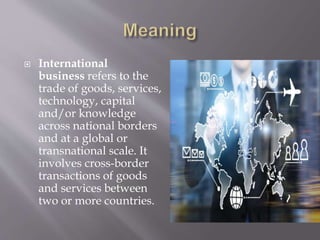
 International
business refers to the
trade of goods, services,
technology, capital
and/or knowledge
across national borders
and at a global or
transnational scale. It
involves cross-border
transactions of goods
and services between
two or more countries.
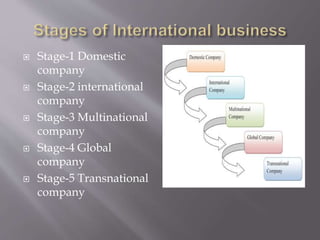
 Stage-1 Domestic
company
 Stage-2 international
company
 Stage-3 Multinational
company
 Stage-4 Global
company
 Stage-5 Transnational
company
 Globalization
 Impact of Inflation
 Impact of National Income
 Impact of Government Policies
 Subsidies for Exporters
 Environment factors
 Political factors
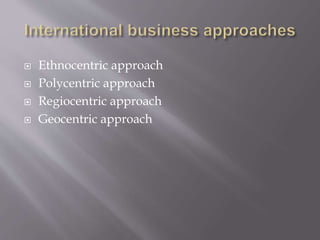
 Ethnocentric approach
 Polycentric approach
 Regiocentric approach
 Geocentric approach
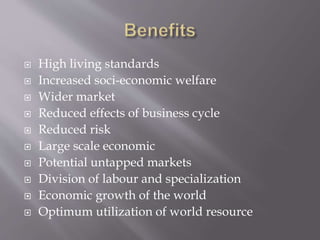
 High living standards
 Increased soci-economic welfare
 Wider market
 Reduced effects of business cycle
 Reduced risk
 Large scale economic
 Potential untapped markets
 Division of labour and specialization
 Economic growth of the world
 Optimum utilization of world resource
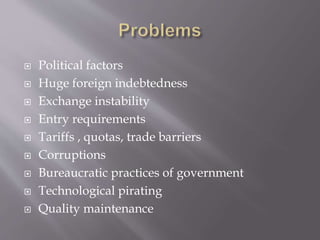
 Political factors
 Huge foreign indebtedness
 Exchange instability
 Entry requirements
 Tariffs , quotas, trade barriers
 Corruptions
 Bureaucratic practices of government
 Technological pirating
 Quality maintenance
Thank you

International business

  • 1.
    PREPARED BY :-SANAGAMESHUPPAR LECTURER IN COMMERCE 9740522622
  • 2.
     The conceptof international business a broader concept relating to the integration of economies and societies dates back to the 19th century  The first phase of globalisation began around 1870  Establishment of IMF,IBRD WTO  International trade-international marketing- international business
  • 3.
     International business refersto the trade of goods, services, technology, capital and/or knowledge across national borders and at a global or transnational scale. It involves cross-border transactions of goods and services between two or more countries.
  • 4.
     Stage-1 Domestic company Stage-2 international company  Stage-3 Multinational company  Stage-4 Global company  Stage-5 Transnational company
  • 5.
     Globalization  Impactof Inflation  Impact of National Income  Impact of Government Policies  Subsidies for Exporters  Environment factors  Political factors
  • 7.
     Ethnocentric approach Polycentric approach  Regiocentric approach  Geocentric approach
  • 8.
     High livingstandards  Increased soci-economic welfare  Wider market  Reduced effects of business cycle  Reduced risk  Large scale economic  Potential untapped markets  Division of labour and specialization  Economic growth of the world  Optimum utilization of world resource
  • 9.
     Political factors Huge foreign indebtedness  Exchange instability  Entry requirements  Tariffs , quotas, trade barriers  Corruptions  Bureaucratic practices of government  Technological pirating  Quality maintenance
  • 10.