INTERNAL CONTROL and
Its ENVIRONMENT
sony
Concepts of Internal Control
 Definition - set of policies and
procedures adopted by a firm in order to
provide reasonable assurance that their
objectives will be met. Consequently, it is
considered to be a means of providing
assurance that errors and irregularities
will be prevented, detected and
corrected on a timely manner by
employees of the company.
Subdivisions of Internal Control
 Accounting controls
• Those policies and procedures which aim to
safeguard company’s assets and to ensure
reliability of accounting records.
 Administrative controls
• Policies and procedures to encourage
adherence to mgt. policies and to promote
operational efficiency.
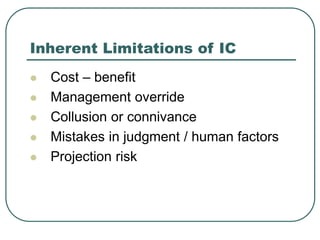
Inherent Limitations of IC
 Cost – benefit
 Management override
 Collusion or connivance
 Mistakes in judgment / human factors
 Projection risk
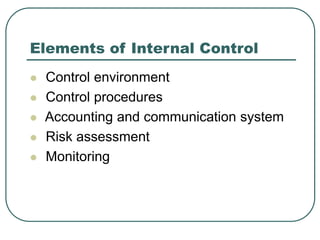
Elements of Internal Control
 Control environment
 Control procedures
 Accounting and communication system
 Risk assessment
 Monitoring
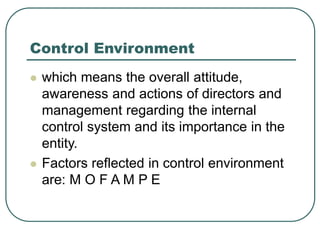
Control Environment
 which means the overall attitude,
awareness and actions of directors and
management regarding the internal
control system and its importance in the
entity.
 Factors reflected in control environment
are: M O F A M P E
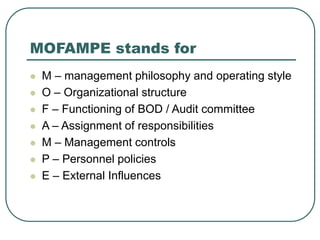
MOFAMPE stands for
 M – management philosophy and operating style
 O – Organizational structure
 F – Functioning of BOD / Audit committee
 A – Assignment of responsibilities
 M – Management controls
 P – Personnel policies
 E – External Influences
Control Procedures
 which means those policies and
procedures in addition to the control
environment which management has
established to achieve the entity’s
specific objectives.
 Fundamental principles of controls -
ASDAR
ASDAR stands for
 A – Authorization ( Specific and General)
 S – Segregation (CARE)
 D – Documentation
 A – Access
 R – Reviews
Accounting and Communication
System
 Interrelated set of components which
aims to convert data into meaningful
information and providing such
information to authorized users.
Risk Assessment
 Ability of management to take actions in
response to business risks and providing
solutions to identified problems.
 Capability of management to find out
root-cause of problems and formulating
appropriate solutions thereon.
Monitoring
 To provide reasonable assurance that
the other elements of internal control are
being applied as prescribed. Normally
performed by internal audit department.
Responsibility of Parties
 Management and those in-charge of
Governance – primary party responsible
in designing and implementing internal
controls.
 Employees – entrusted with the PDC of
internal controls.
 Auditor – understanding IC for planning
purposes.
Reasons for understanding
internal control
 identify the types of potential material
misstatements that could occur in the
financial statements;
 consider factors that affect the risk of
material misstatements; and
 design appropriate audit procedures.
Things to be considered by
Auditor
 understanding the design of internal
control whether they are placed in
operation
 Assessment of risks ( inherent and
control )
 Documentation
Assessment level and
Documentation
 Maximum level – no tests of controls, document
understanding of the design and document the
conclusion of assessment.
 Below Maximum level – identify controls likely
to be effective; perform tests of controls;
document understanding of the design;
document conclusion of assessment; and
document basis for conclusion
Techniques of documentation
 Narrative description
 Flowcharts
 Checklists
 Internal Control Questionnaire
Other Concerns
 Tests of Controls
 Reportable Conditions
 Communication of results
SMILE JAPON
end

INTERNAL CONTROL and Its ENVIRONMENT.ppt

  • 1.
    INTERNAL CONTROL and ItsENVIRONMENT sony
  • 2.
    Concepts of InternalControl  Definition - set of policies and procedures adopted by a firm in order to provide reasonable assurance that their objectives will be met. Consequently, it is considered to be a means of providing assurance that errors and irregularities will be prevented, detected and corrected on a timely manner by employees of the company.
  • 3.
    Subdivisions of InternalControl  Accounting controls • Those policies and procedures which aim to safeguard company’s assets and to ensure reliability of accounting records.  Administrative controls • Policies and procedures to encourage adherence to mgt. policies and to promote operational efficiency.
  • 4.
    Inherent Limitations ofIC  Cost – benefit  Management override  Collusion or connivance  Mistakes in judgment / human factors  Projection risk
  • 5.
    Elements of InternalControl  Control environment  Control procedures  Accounting and communication system  Risk assessment  Monitoring
  • 6.
    Control Environment  whichmeans the overall attitude, awareness and actions of directors and management regarding the internal control system and its importance in the entity.  Factors reflected in control environment are: M O F A M P E
  • 7.
    MOFAMPE stands for M – management philosophy and operating style  O – Organizational structure  F – Functioning of BOD / Audit committee  A – Assignment of responsibilities  M – Management controls  P – Personnel policies  E – External Influences
  • 8.
    Control Procedures  whichmeans those policies and procedures in addition to the control environment which management has established to achieve the entity’s specific objectives.  Fundamental principles of controls - ASDAR
  • 9.
    ASDAR stands for A – Authorization ( Specific and General)  S – Segregation (CARE)  D – Documentation  A – Access  R – Reviews
  • 10.
    Accounting and Communication System Interrelated set of components which aims to convert data into meaningful information and providing such information to authorized users.
  • 11.
    Risk Assessment  Abilityof management to take actions in response to business risks and providing solutions to identified problems.  Capability of management to find out root-cause of problems and formulating appropriate solutions thereon.
  • 12.
    Monitoring  To providereasonable assurance that the other elements of internal control are being applied as prescribed. Normally performed by internal audit department.
  • 13.
    Responsibility of Parties Management and those in-charge of Governance – primary party responsible in designing and implementing internal controls.  Employees – entrusted with the PDC of internal controls.  Auditor – understanding IC for planning purposes.
  • 14.
    Reasons for understanding internalcontrol  identify the types of potential material misstatements that could occur in the financial statements;  consider factors that affect the risk of material misstatements; and  design appropriate audit procedures.
  • 15.
    Things to beconsidered by Auditor  understanding the design of internal control whether they are placed in operation  Assessment of risks ( inherent and control )  Documentation
  • 16.
    Assessment level and Documentation Maximum level – no tests of controls, document understanding of the design and document the conclusion of assessment.  Below Maximum level – identify controls likely to be effective; perform tests of controls; document understanding of the design; document conclusion of assessment; and document basis for conclusion
  • 17.
    Techniques of documentation Narrative description  Flowcharts  Checklists  Internal Control Questionnaire
  • 18.
    Other Concerns  Testsof Controls  Reportable Conditions  Communication of results
  • 19.