THINKING beyond the canopy
Inter-disciplinarity and securing global
biodiversity: breaking down the barriers
Terry Sunderland¹, Kerry Waylen² & Daniel Walker³
Panel on “Securing global biodiversity: a human imperative for a
sustainable planet,”
Planet under Pressure, London, March 26th
, 2012
¹Centre for International Forestry Research; Indonesia; ²James Hutton
Institute, UK; ³CSIRO, Australia
THINKING beyond the canopy
The problem
• Biodiversity conservation cannot be undertaken
without the support and participation of local people,
and that livelihood concerns and future socio-
economic development goals need to be at the centre
of any viable conservation strategy
• However, conservation biology and social sciences
have often lacked meaningful engagement, with PA’s,
and other processes, commonly at the centre of the
debate
• Despite scores of publications supporting different
view points, the discussion continues to be highly
dichotomous, with repeated cycles of ‘irresistible
dialectic’ (Redford & Painter 2006)
THINKING beyond the canopy
An example: Conservation refugees in
Central Africa?
• [National governments and
conservation organizations have
willfully dispossessed] “upwards of
120,000 conservation refugees,
plan to re-settle 170,000 more due
to the increase of the number and
extent of protected areas in the
region and that 250,000 people will
have to host these refugees in
Central Africa” (Schmidt-Soltau
2005)
THINKING beyond the canopy
Or not?
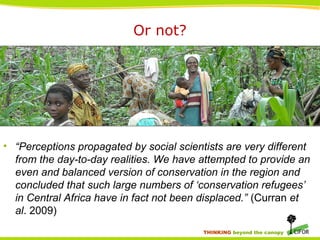
• “Perceptions propagated by social scientists are very different
from the day-to-day realities. We have attempted to provide an
even and balanced version of conservation in the region and
concluded that such large numbers of ‘conservation refugees’
in Central Africa have in fact not been displaced.” (Curran et
al. 2009)
THINKING beyond the canopy
• Dominance of biological sciences
in conservation practice
• Graduate courses tend not to
integrate inter/multi-disciplinarity
• Yet most field practitioners work in
complex human-dominated
landscapes
• Better integration of human,
socio-economic, legal, & policy
issues into conservation much
needed, especially with market-
based incentives coming to the
fore
• Food security and the absolute
need for interdisciplinarity
Embracing inter-disciplinarity?
THINKING beyond the canopy
Whose innovations? What concepts?
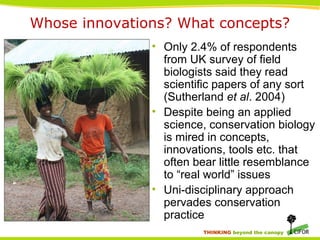
• Only 2.4% of respondents
from UK survey of field
biologists said they read
scientific papers of any sort
(Sutherland et al. 2004)
• Despite being an applied
science, conservation biology
is mired in concepts,
innovations, tools etc. that
often bear little resemblance
to “real world” issues
• Uni-disciplinary approach
pervades conservation
practice
THINKING beyond the canopy
Access to scientific literature: what
scope for inter-disciplinarity?
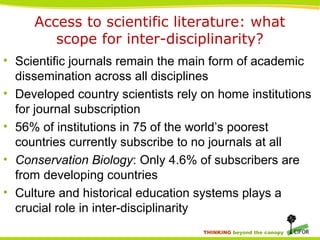
• Scientific journals remain the main form of academic
dissemination across all disciplines
• Developed country scientists rely on home institutions
for journal subscription
• 56% of institutions in 75 of the world’s poorest
countries currently subscribe to no journals at all
• Conservation Biology: Only 4.6% of subscribers are
from developing countries
• Culture and historical education systems plays a
crucial role in inter-disciplinarity
THINKING beyond the canopy
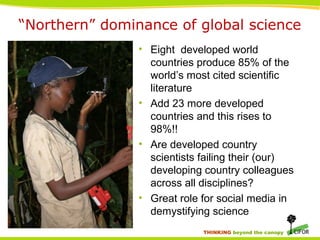
• Eight developed world
countries produce 85% of the
world’s most cited scientific
literature
• Add 23 more developed
countries and this rises to
98%!!
• Are developed country
scientists failing their (our)
developing country colleagues
across all disciplines?
• Great role for social media in
demystifying science
“Northern” dominance of global science
THINKING beyond the canopy
Things are slowly changing…
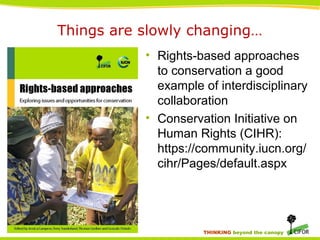
• Rights-based approaches
to conservation a good
example of interdisciplinary
collaboration
• Conservation Initiative on
Human Rights (CIHR):
https://community.iucn.org/
cihr/Pages/default.aspx
THINKING beyond the canopy
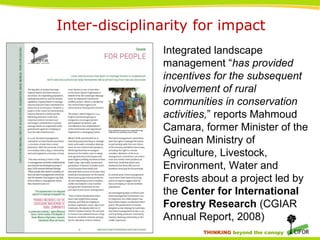
Inter-disciplinarity for impact
Integrated landscape
management “has provided
incentives for the subsequent
involvement of rural
communities in conservation
activities,” reports Mahmoud
Camara, former Minister of the
Guinean Ministry of
Agriculture, Livestock,
Environment, Water and
Forests about a project led by
the Center for International
Forestry Research (CGIAR
Annual Report, 2008)
THINKING beyond the canopy
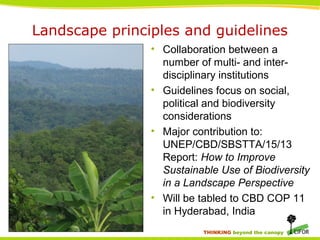
Landscape principles and guidelines
• Collaboration between a
number of multi- and inter-
disciplinary institutions
• Guidelines focus on social,
political and biodiversity
considerations
• Major contribution to:
UNEP/CBD/SBSTTA/15/13
Report: How to Improve
Sustainable Use of Biodiversity
in a Landscape Perspective
• Will be tabled to CBD COP 11
in Hyderabad, India
THINKING beyond the canopy
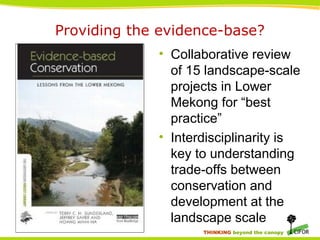
Providing the evidence-base?
• Collaborative review
of 15 landscape-scale
projects in Lower
Mekong for “best
practice”
• Interdisciplinarity is
key to understanding
trade-offs between
conservation and
development at the
landscape scale
THINKING beyond the canopy
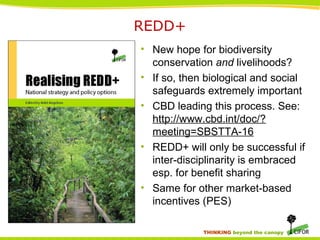
REDD+
• New hope for biodiversity
conservation and livelihoods?
• If so, then biological and social
safeguards extremely important
• CBD leading this process. See:
http://www.cbd.int/doc/?
meeting=SBSTTA-16
• REDD+ will only be successful if
inter-disciplinarity is embraced
esp. for benefit sharing
• Same for other market-based
incentives (PES)
THINKING beyond the canopy
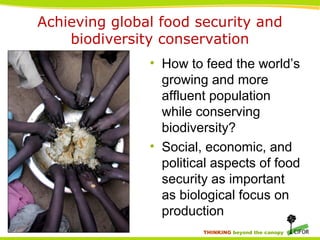
Achieving global food security and
biodiversity conservation
• How to feed the world’s
growing and more
affluent population
while conserving
biodiversity?
• Social, economic, and
political aspects of food
security as important
as biological focus on
production
THINKING beyond the canopy
Useful initiatives in interdisciplinarity
• Centre for Integrative Conservation Research
led by Pete Brosius: http://www.cicr.uga.edu/
• Advancing Conservation in a Social Context,
led by Tom McShane et al:
http://www.tradeoffs.org/static/contact.php
• Disseminate field experiences (both good
and bad) via the Centre for Evidence-Based
Conservation http://www.cebc.bangor.ac.uk/
• Redford, K. H. (2011). Misreading the
conservation landscape, Oryx, 45(3), 324-
330 (special issue)
THINKING beyond the canopy
A final word… (perhaps)
• “With multi-disciplinary and wide-ranging contributions, more
effective conservation should be based on more solid common
ground. It is only simultaneously considering these dimensions,
that the costs and benefits, losers and winners, and the trade-
offs of particular conservation approaches can be made explicit
and more honestly negotiated in academia and in conservation
and social development practice” (Sunderland et al. 2008)
THINKING beyond the canopy
The Center for International Forestry Research (CIFOR)
is one of the 15 centres supported by the Consultative
Group on International Agricultural Research (CGIAR)
Thank you! www.cifor.cgiar.org

Inter-disciplinarity and securing global biodiversity: breaking down the barriers

  • 1.
    THINKING beyond thecanopy THINKING beyond the canopy Inter-disciplinarity and securing global biodiversity: breaking down the barriers Terry Sunderland¹, Kerry Waylen² & Daniel Walker³ Panel on “Securing global biodiversity: a human imperative for a sustainable planet,” Planet under Pressure, London, March 26th , 2012 ¹Centre for International Forestry Research; Indonesia; ²James Hutton Institute, UK; ³CSIRO, Australia
  • 2.
    THINKING beyond thecanopy The problem • Biodiversity conservation cannot be undertaken without the support and participation of local people, and that livelihood concerns and future socio- economic development goals need to be at the centre of any viable conservation strategy • However, conservation biology and social sciences have often lacked meaningful engagement, with PA’s, and other processes, commonly at the centre of the debate • Despite scores of publications supporting different view points, the discussion continues to be highly dichotomous, with repeated cycles of ‘irresistible dialectic’ (Redford & Painter 2006)
  • 3.
    THINKING beyond thecanopy An example: Conservation refugees in Central Africa? • [National governments and conservation organizations have willfully dispossessed] “upwards of 120,000 conservation refugees, plan to re-settle 170,000 more due to the increase of the number and extent of protected areas in the region and that 250,000 people will have to host these refugees in Central Africa” (Schmidt-Soltau 2005)
  • 4.
    THINKING beyond thecanopy Or not? • “Perceptions propagated by social scientists are very different from the day-to-day realities. We have attempted to provide an even and balanced version of conservation in the region and concluded that such large numbers of ‘conservation refugees’ in Central Africa have in fact not been displaced.” (Curran et al. 2009)
  • 5.
    THINKING beyond thecanopy • Dominance of biological sciences in conservation practice • Graduate courses tend not to integrate inter/multi-disciplinarity • Yet most field practitioners work in complex human-dominated landscapes • Better integration of human, socio-economic, legal, & policy issues into conservation much needed, especially with market- based incentives coming to the fore • Food security and the absolute need for interdisciplinarity Embracing inter-disciplinarity?
  • 6.
    THINKING beyond thecanopy Whose innovations? What concepts? • Only 2.4% of respondents from UK survey of field biologists said they read scientific papers of any sort (Sutherland et al. 2004) • Despite being an applied science, conservation biology is mired in concepts, innovations, tools etc. that often bear little resemblance to “real world” issues • Uni-disciplinary approach pervades conservation practice
  • 7.
    THINKING beyond thecanopy Access to scientific literature: what scope for inter-disciplinarity? • Scientific journals remain the main form of academic dissemination across all disciplines • Developed country scientists rely on home institutions for journal subscription • 56% of institutions in 75 of the world’s poorest countries currently subscribe to no journals at all • Conservation Biology: Only 4.6% of subscribers are from developing countries • Culture and historical education systems plays a crucial role in inter-disciplinarity
  • 8.
    THINKING beyond thecanopy • Eight developed world countries produce 85% of the world’s most cited scientific literature • Add 23 more developed countries and this rises to 98%!! • Are developed country scientists failing their (our) developing country colleagues across all disciplines? • Great role for social media in demystifying science “Northern” dominance of global science
  • 9.
    THINKING beyond thecanopy Things are slowly changing… • Rights-based approaches to conservation a good example of interdisciplinary collaboration • Conservation Initiative on Human Rights (CIHR): https://community.iucn.org/ cihr/Pages/default.aspx
  • 10.
    THINKING beyond thecanopy Inter-disciplinarity for impact Integrated landscape management “has provided incentives for the subsequent involvement of rural communities in conservation activities,” reports Mahmoud Camara, former Minister of the Guinean Ministry of Agriculture, Livestock, Environment, Water and Forests about a project led by the Center for International Forestry Research (CGIAR Annual Report, 2008)
  • 11.
    THINKING beyond thecanopy Landscape principles and guidelines • Collaboration between a number of multi- and inter- disciplinary institutions • Guidelines focus on social, political and biodiversity considerations • Major contribution to: UNEP/CBD/SBSTTA/15/13 Report: How to Improve Sustainable Use of Biodiversity in a Landscape Perspective • Will be tabled to CBD COP 11 in Hyderabad, India
  • 12.
    THINKING beyond thecanopy Providing the evidence-base? • Collaborative review of 15 landscape-scale projects in Lower Mekong for “best practice” • Interdisciplinarity is key to understanding trade-offs between conservation and development at the landscape scale
  • 13.
    THINKING beyond thecanopy REDD+ • New hope for biodiversity conservation and livelihoods? • If so, then biological and social safeguards extremely important • CBD leading this process. See: http://www.cbd.int/doc/? meeting=SBSTTA-16 • REDD+ will only be successful if inter-disciplinarity is embraced esp. for benefit sharing • Same for other market-based incentives (PES)
  • 14.
    THINKING beyond thecanopy Achieving global food security and biodiversity conservation • How to feed the world’s growing and more affluent population while conserving biodiversity? • Social, economic, and political aspects of food security as important as biological focus on production
  • 15.
    THINKING beyond thecanopy Useful initiatives in interdisciplinarity • Centre for Integrative Conservation Research led by Pete Brosius: http://www.cicr.uga.edu/ • Advancing Conservation in a Social Context, led by Tom McShane et al: http://www.tradeoffs.org/static/contact.php • Disseminate field experiences (both good and bad) via the Centre for Evidence-Based Conservation http://www.cebc.bangor.ac.uk/ • Redford, K. H. (2011). Misreading the conservation landscape, Oryx, 45(3), 324- 330 (special issue)
  • 16.
    THINKING beyond thecanopy A final word… (perhaps) • “With multi-disciplinary and wide-ranging contributions, more effective conservation should be based on more solid common ground. It is only simultaneously considering these dimensions, that the costs and benefits, losers and winners, and the trade- offs of particular conservation approaches can be made explicit and more honestly negotiated in academia and in conservation and social development practice” (Sunderland et al. 2008)
  • 17.
    THINKING beyond thecanopy THINKING beyond the canopy The Center for International Forestry Research (CIFOR) is one of the 15 centres supported by the Consultative Group on International Agricultural Research (CGIAR) Thank you! www.cifor.cgiar.org