Biodiversity Management in the Mining 
© Hatfield Consultants. All Rights Reserved. 
Sector 
By: 
BAMBANG TRI SASONGKO ADI & KENICHI SHONO 
November13, 2012
Objective of Presentation 
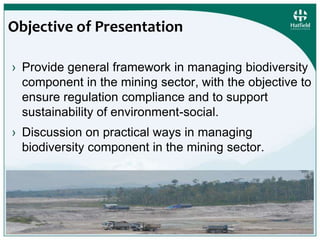
› Provide general framework in managing biodiversity 
component in the mining sector, with the objective to 
ensure regulation compliance and to support 
sustainability of environment-social. 
› Discussion on practical ways in managing 
biodiversity component in the mining sector. 
© Hatfield Consultants. All Rights Reserved. 2
Biodiversity Richness 
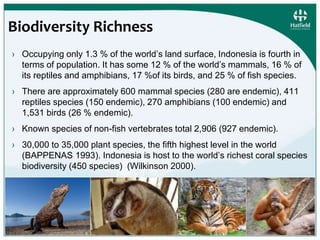
› Occupying only 1.3 % of the world’s land surface, Indonesia is fourth in 
terms of population. It has some 12 % of the world’s mammals, 16 % of 
its reptiles and amphibians, 17 %of its birds, and 25 % of fish species. 
› There are approximately 600 mammal species (280 are endemic), 411 
reptiles species (150 endemic), 270 amphibians (100 endemic) and 
1,531 birds (26 % endemic). 
› Known species of non-fish vertebrates total 2,906 (927 endemic). 
› 30,000 to 35,000 plant species, the fifth highest level in the world 
(BAPPENAS 1993). Indonesia is host to the world’s richest coral species 
biodiversity (450 species) (Wilkinson 2000). 
© Hatfield Consultants. All Rights Reserved. 3
Indonesian Regulation 
› The main acts: Biodiversity Conservation (1990), Spatial Planning 
(1992), and Environmental Protection and Management (2009) 
and in the Basic Forestry Law (1999); 
› In addition, involvement of international donors in nature 
conservation require the GOI to abide by the conditions of loan 
agreements (e.g., Development of a Park Zonation and Boundary 
Plan, 1998) 
› The principal agency in charge is the DG of Protection and Nature 
Conservation from the MOF. Ministry of Environmental acts as a 
coordinating agency and has prepared together with BAPPENAS, 
the Biodiversity Action Plan in Indonesia. 
© Hatfield Consultants. All Rights Reserved. 4
International Framework 
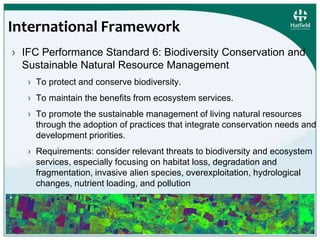
› IFC Performance Standard 6: Biodiversity Conservation and 
Sustainable Natural Resource Management 
› To protect and conserve biodiversity. 
› To maintain the benefits from ecosystem services. 
› To promote the sustainable management of living natural resources 
through the adoption of practices that integrate conservation needs and 
development priorities. 
› Requirements: consider relevant threats to biodiversity and ecosystem 
services, especially focusing on habitat loss, degradation and 
fragmentation, invasive alien species, overexploitation, hydrological 
changes, nutrient loading, and pollution 
© Hatfield Consultants. All Rights Reserved. 5
International Framework 
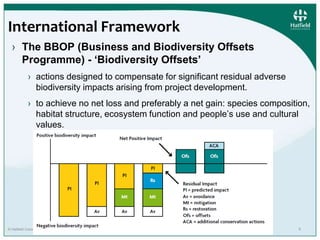
› The BBOP (Business and Biodiversity Offsets 
Programme) - ‘Biodiversity Offsets’ 
› actions designed to compensate for significant residual adverse 
biodiversity impacts arising from project development. 
› to achieve no net loss and preferably a net gain: species composition, 
habitat structure, ecosystem function and people’s use and cultural 
values. 
© Hatfield Consultants. All Rights Reserved. 6
International Framework 
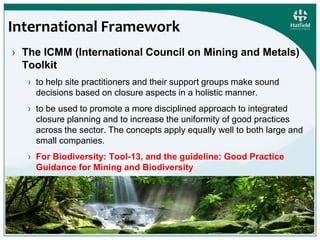
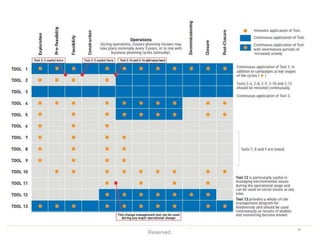
› The ICMM (International Council on Mining and Metals) 
Toolkit 
› to help site practitioners and their support groups make sound 
decisions based on closure aspects in a holistic manner. 
› to be used to promote a more disciplined approach to integrated 
closure planning and to increase the uniformity of good practices 
across the sector. The concepts apply equally well to both large and 
small companies. 
› For Biodiversity: Tool-13, and the guideline: Good Practice 
Guidance for Mining and Biodiversity 
© Hatfield Consultants. All Rights Reserved. 7
© Hatfield Consultants. All Rights 
Reserved. 
8
Mining and Protected Areas 
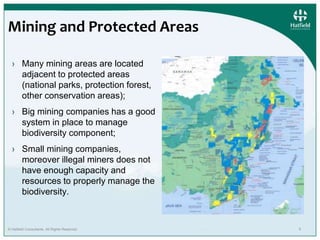
› Many mining areas are located 
adjacent to protected areas 
(national parks, protection forest, 
other conservation areas); 
› Big mining companies has a good 
system in place to manage 
biodiversity component; 
› Small mining companies, 
moreover illegal miners does not 
have enough capacity and 
resources to properly manage the 
biodiversity. 
© Hatfield Consultants. All Rights Reserved. 9
Issues Related with Mining in 
Indonesia – on the news 
› Illegal gold mining in Bukit Baka National Park (August 27, 2012). Sumber: 
http://www.mongabay.co.id/2012/08/27 
› Terancam Tambang, 10 Ribu Warga Berencana Duduki Kantor Bupati 
Belitung (October 16, 2012). Sumber : http://www.mongabay.co.id/2012/10/16/; 
› Kasus Tambang G Resources, Warga Batang Toru Lapor ke KLH dan 
Komnas HAM (November 9, 2012). Sumber : 
http://www.mongabay.co.id/2012/11/09/; 
› Collaboration in Management of Conservation Area in Indonesia. Burung 
Indonesia. Source: http://orangutansumatra.files.wordpress.com/2009/01 
› Membangun Kolaborasi di Ranah Konservasi - Tribun Kaltim - Kamis, 25 
Oktober 2012. Source: http://kaltim.tribunnews.com/2012/10 
© Hatfield Consultants. All Rights Reserved. 10
© Hatfield Consultants. All Rights 
Reserved. 
11 
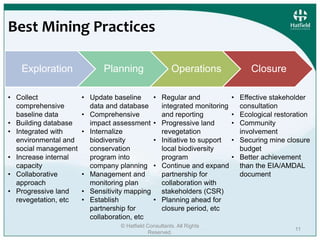
Best Mining Practices 
Exploration Planning Operations Closure 
• Collect 
comprehensive 
baseline data 
• Building database 
• Integrated with 
environmental and 
social management 
• Increase internal 
capacity 
• Collaborative 
approach 
• Progressive land 
revegetation, etc 
• Update baseline 
data and database 
• Comprehensive 
impact assessment 
• Internalize 
biodiversity 
conservation 
program into 
company planning 
• Management and 
monitoring plan 
• Sensitivity mapping 
• Establish 
partnership for 
collaboration, etc 
• Regular and 
integrated monitoring 
and reporting 
• Progressive land 
revegetation 
• Initiative to support 
local biodiversity 
program 
• Continue and expand 
partnership for 
collaboration with 
stakeholders (CSR) 
• Planning ahead for 
closure period, etc 
• Effective stakeholder 
consultation 
• Ecological restoration 
• Community 
involvement 
• Securing mine closure 
budget 
• Better achievement 
than the EIA/AMDAL 
document
THANK YOU! 
For more information, please contact: 
BAMBANG TRI SASONGKO ADI 
PT HATFIELD INDONESIA 
LIPI Building 3rd Floor, Jl. Ir. H Juanda 18 
Bogor 16122 - Ph. 0251-8324487 
© Hatfield Consultants. All Rights Reserved. 12

Biodiversty management sustainable mining workshop v02

  • 1.
    Biodiversity Management inthe Mining © Hatfield Consultants. All Rights Reserved. Sector By: BAMBANG TRI SASONGKO ADI & KENICHI SHONO November13, 2012
  • 2.
    Objective of Presentation › Provide general framework in managing biodiversity component in the mining sector, with the objective to ensure regulation compliance and to support sustainability of environment-social. › Discussion on practical ways in managing biodiversity component in the mining sector. © Hatfield Consultants. All Rights Reserved. 2
  • 3.
    Biodiversity Richness ›Occupying only 1.3 % of the world’s land surface, Indonesia is fourth in terms of population. It has some 12 % of the world’s mammals, 16 % of its reptiles and amphibians, 17 %of its birds, and 25 % of fish species. › There are approximately 600 mammal species (280 are endemic), 411 reptiles species (150 endemic), 270 amphibians (100 endemic) and 1,531 birds (26 % endemic). › Known species of non-fish vertebrates total 2,906 (927 endemic). › 30,000 to 35,000 plant species, the fifth highest level in the world (BAPPENAS 1993). Indonesia is host to the world’s richest coral species biodiversity (450 species) (Wilkinson 2000). © Hatfield Consultants. All Rights Reserved. 3
  • 4.
    Indonesian Regulation ›The main acts: Biodiversity Conservation (1990), Spatial Planning (1992), and Environmental Protection and Management (2009) and in the Basic Forestry Law (1999); › In addition, involvement of international donors in nature conservation require the GOI to abide by the conditions of loan agreements (e.g., Development of a Park Zonation and Boundary Plan, 1998) › The principal agency in charge is the DG of Protection and Nature Conservation from the MOF. Ministry of Environmental acts as a coordinating agency and has prepared together with BAPPENAS, the Biodiversity Action Plan in Indonesia. © Hatfield Consultants. All Rights Reserved. 4
  • 5.
    International Framework ›IFC Performance Standard 6: Biodiversity Conservation and Sustainable Natural Resource Management › To protect and conserve biodiversity. › To maintain the benefits from ecosystem services. › To promote the sustainable management of living natural resources through the adoption of practices that integrate conservation needs and development priorities. › Requirements: consider relevant threats to biodiversity and ecosystem services, especially focusing on habitat loss, degradation and fragmentation, invasive alien species, overexploitation, hydrological changes, nutrient loading, and pollution © Hatfield Consultants. All Rights Reserved. 5
  • 6.
    International Framework ›The BBOP (Business and Biodiversity Offsets Programme) - ‘Biodiversity Offsets’ › actions designed to compensate for significant residual adverse biodiversity impacts arising from project development. › to achieve no net loss and preferably a net gain: species composition, habitat structure, ecosystem function and people’s use and cultural values. © Hatfield Consultants. All Rights Reserved. 6
  • 7.
    International Framework ›The ICMM (International Council on Mining and Metals) Toolkit › to help site practitioners and their support groups make sound decisions based on closure aspects in a holistic manner. › to be used to promote a more disciplined approach to integrated closure planning and to increase the uniformity of good practices across the sector. The concepts apply equally well to both large and small companies. › For Biodiversity: Tool-13, and the guideline: Good Practice Guidance for Mining and Biodiversity © Hatfield Consultants. All Rights Reserved. 7
  • 8.
    © Hatfield Consultants.All Rights Reserved. 8
  • 9.
    Mining and ProtectedAreas › Many mining areas are located adjacent to protected areas (national parks, protection forest, other conservation areas); › Big mining companies has a good system in place to manage biodiversity component; › Small mining companies, moreover illegal miners does not have enough capacity and resources to properly manage the biodiversity. © Hatfield Consultants. All Rights Reserved. 9
  • 10.
    Issues Related withMining in Indonesia – on the news › Illegal gold mining in Bukit Baka National Park (August 27, 2012). Sumber: http://www.mongabay.co.id/2012/08/27 › Terancam Tambang, 10 Ribu Warga Berencana Duduki Kantor Bupati Belitung (October 16, 2012). Sumber : http://www.mongabay.co.id/2012/10/16/; › Kasus Tambang G Resources, Warga Batang Toru Lapor ke KLH dan Komnas HAM (November 9, 2012). Sumber : http://www.mongabay.co.id/2012/11/09/; › Collaboration in Management of Conservation Area in Indonesia. Burung Indonesia. Source: http://orangutansumatra.files.wordpress.com/2009/01 › Membangun Kolaborasi di Ranah Konservasi - Tribun Kaltim - Kamis, 25 Oktober 2012. Source: http://kaltim.tribunnews.com/2012/10 © Hatfield Consultants. All Rights Reserved. 10
  • 11.
    © Hatfield Consultants.All Rights Reserved. 11 Best Mining Practices Exploration Planning Operations Closure • Collect comprehensive baseline data • Building database • Integrated with environmental and social management • Increase internal capacity • Collaborative approach • Progressive land revegetation, etc • Update baseline data and database • Comprehensive impact assessment • Internalize biodiversity conservation program into company planning • Management and monitoring plan • Sensitivity mapping • Establish partnership for collaboration, etc • Regular and integrated monitoring and reporting • Progressive land revegetation • Initiative to support local biodiversity program • Continue and expand partnership for collaboration with stakeholders (CSR) • Planning ahead for closure period, etc • Effective stakeholder consultation • Ecological restoration • Community involvement • Securing mine closure budget • Better achievement than the EIA/AMDAL document
  • 12.
    THANK YOU! Formore information, please contact: BAMBANG TRI SASONGKO ADI PT HATFIELD INDONESIA LIPI Building 3rd Floor, Jl. Ir. H Juanda 18 Bogor 16122 - Ph. 0251-8324487 © Hatfield Consultants. All Rights Reserved. 12

Editor's Notes

  • #3 73 Financial Institutions in 27 countries have signed on.
  • #4 73 Financial Institutions in 27 countries have signed on.
  • #6 73 Financial Institutions in 27 countries have signed on.
  • #7 73 Financial Institutions in 27 countries have signed on.
  • #8 73 Financial Institutions in 27 countries have signed on.
  • #10 - EP document provides list of potential issues that should be addressed.