It refers to communication between
people whose cultural perceptions and
symbol systems are distinct enough to
alter the communication event.
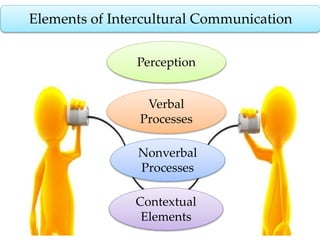
Elements of Intercultural Communication
Perception
Verbal
Processes
Nonverbal
Processes
Contextual
Elements
Perception
Verbal Processes
Ways in which cultures employ symbols
to portray things and experiences.
Nonverbal Processes
Shared thoughts
and feelings of
bodily behavior,
time and space.
Contextual Elements
Why do we study
Intercultural
Communication ?
Increases
Self-Awareness
Demographic
changes
Workplace and
Economic
Globalization
Creative
Problem Solving
Global
and
Intrapersonal
Peace Respect
Importance of Intercultural
Communication
Successful educators are effective
communicators and thus culturally
competent in cross-cultural encounters.
(Rouz 2002)
Communication is a prerequisite of
effective transfer of knowledge in schools.
(Linds 1997)
COMMUNICATION
AND LANGUAGE
Throughout the world,
human beings use
thousands of language to
communicate with one
another.
Communication is far more
than speech and writing.
Is the language of gestures,
expressions and postures.
PARALANGUAGE
Paralanguage is often more
important in communication
than what is actually being
said orally.
The most common form of
paralanguage is body
language or kinesics.
As we all know from
experience, the spoken word
does not communicate all
that we know about a social
institution.
Intercultural-Communication.pptx

Intercultural-Communication.pptx