Best
Global
Brands
2013
The New Rules of Brand
Leadership
2
Best Global Brands 2013
10
Creative Leadership
70
China’s New Brand Leaders
74
Corporate Citizenship 2.0
78
From Information to Intelligence
82
Sector Leadership
86
Methodology
120
Contributors
126
Table of Contents
Leadershipisevolving.
Itmustnowbeshared.
CEOs,CMOs,andconsumers
allhavethepowerto
drivebrandvalue.
Brandsarewherebusiness
strategymeetsreality.
JEZ GINNI
MARK
BISH
CHIEKO
Best Global Brands 2013
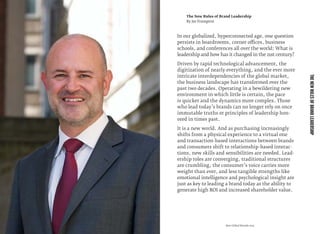
The New Rules of Brand Leadership
By Jez Frampton
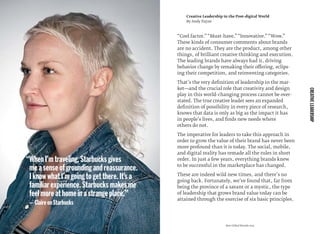
In our globalized, hyperconnected age, one question
persists in boardrooms, corner offices, business
schools, and conferences all over the world: What is
leadership and how has it changed in the 21st century?
Driven by rapid technological advancement, the
digitization of nearly everything, and the ever more
intricate interdependencies of the global market,
the business landscape has transformed over the
past two decades. Operating in a bewildering new
environment in which little is certain, the pace
is quicker and the dynamics more complex. Those
who lead today’s brands can no longer rely on once
immutable truths or principles of leadership hon-
ored in times past.
It is a new world. And as purchasing increasingly
shifts from a physical experience to a virtual one
and transaction-based interactions between brands
and consumers shift to relationship-based interac-
tions, new skills and sensibilities are needed. Lead-
ership roles are converging, traditional structures
are crumbling, the consumer’s voice carries more
weight than ever, and less tangible strengths like
emotional intelligence and psychological insight are
just as key to leading a brand today as the ability to
generate high ROI and increased shareholder value.
THENEWRULESOFBRANDLEADERSHIP
Best Global Brands 2013
You can’t control the
conversation—so join it
In the brave new world of social media,
your brand is increasingly being shaped
by consumer opinion and demand—and
is decreasingly under your control. As
many brands discovered (the hard way),
something as seemingly insignificant as
an ill-timed tweet can stir up a firestorm
of negative publicity. While keeping
communication to a minimum might
seem the best way to avoid trouble
online, sitting out of the conversation
may be more risky.
If you’re not doing what you say you’re
doing or a mishap occurs, consumers are
eventually going to find out. But being
exposed doesn’t have to be a PR disaster—
it can be an opportunity to open your doors,
clear the air, and forge a deeper connection.
Consumers can become valuable allies if
brands address concerns—whether it’s
about labor practices, product ingredi-
ents, or a controversial ad—instead of
dodging issues or attempting to spin
them. By opening up a space for real
dialogue and actually listening to con-
sumers, you can learn more about what
people really want, crowdsource ideas or
gather insights that could help improve
products and user experience.
Don’t wait—innovate
While some brands stay focused on re-
fining their products and moving tech-
nology forward that is relevant to their
industry, other brands take things fur-
ther. Google, for example, has engineers
and developers at its extreme innovation
lab, Google[x], working on futuristic
technologies such as its self-driving car
and Project Loon, an internet service
via balloons in the stratosphere. There
is plenty of room for wild ideas and
fresh approaches—especially those that
just might work. However, whether
it’s a subtle refinement or a category
breakthrough, the important thing to
remember about innovation is that
when it hits the mark, it’s because a
company has satisfied an unmet need.
Another thing to remember about inno-
vation is that just because you’ve been
successful at something historically
doesn’t mean you have to do it forever.
To be truly innovative, you sometimes
have to be willing to disrupt yourself.
Amazon excels at this. The online behe-
moth disrupted book publishing, shook
up all of retail and later the market it
had come to dominate—books—by creat-
ing the Kindle.
Lead through design
Design-savvy brands appreciate the value
of aesthetics and realize that consumers
are just as drawn by a product’s visual
appeal and functional elegance as they
are by its specs and capabilities. Apple
re-educated people on the importance
of design. As a result, consumers in-
creasingly judge the quality of products
on the basis of appearance—the design,
packaging, and interface. In the auto
industry, research has revealed that
while consumers traditionally assessed
a brand’s level of innovation on the basis
of technology like GPS systems, they
now take cues about innovation from
exterior styling as smart features have
become standard across the industry.
Simply put, design matters, and today’s
brands are increasingly aware that con-
sumers want products to be“pretty” and
well-designed. It’s not a huge leap to
then assume that aesthetics and superior
functionality will soon be demanded
in all categories. Similarly, brands
themselves will have to evolve their
look and feel—from updated logos and
richer websites to retail spaces that
are not only stylish, but also stream-
THENEWRULESOFBRANDLEADERSHIP
As such, some brand leaders, under-
standably, feel overwhelmed or worry
that they don’t know everything they
need to know to stay on top. All are grap-
pling with today’s volatile environment
in different ways, but all are looking to
understand the landscape and master
whatever skills are needed to excel and,
more importantly, to connect and co-
create with consumers in today’s more
collaborative marketplace. To shed light
on the leadership challenge before us—
and the evolving nature of leadership
itself—we have identified a few areas
where brands must pay particular atten-
tion in order to lead effectively in these
tumultuous and exciting times.
Imagine and advance a vision
Leadership only exists in the eye of the
beholder—the follower. People purchase,
pursue employment with, and recom-
mend brands they believe in, so if you
want brand fans, loyalists, and ambassa-
dors, you must have a vision of the future
that inspires—and you must communicate
it. What story will unlock your employees’
potential or move consumers to identify
with your brand and accept your offer
enthusiastically?
Look at the marketplace and try to under-
stand how it is changing. Peek beyond the
visible horizon and imagine where the
world might be, not just next quarter, but
5, 10, or 20 years from now. Also, consider
surveying employees and consumers—
their feedback might help you shape
a vision that is timely, relevant, and
speaks powerfully to a collective need.
In recent years, many companies have
been so focused on survival that they
neglected to consider what their brands
mean—or could mean—to people. Locked
in austerity mode, they’ve been hunker-
ing down, reducing costs, increasing
margins, and expecting low growth. But
if brands really want to harness the power
and potential of markets, big visions
have to come back into the game.
Today’sleadersfaceextraordinary
newchallengesandmustlearntothink
differentlyabouttheirroleandhow
tofulfillit.Thosewhodomayhave
anopportunitytochangetheworld
inwaystheirpredecessorsnever
imagined.
4
LEAD
Best Global Brands 2013
the only way to avoid confusion and
improve efficiency—which explains why
companies that operate as a collection
of silos tend to underperform.
Whether collaborating across silos in your
own organization, partnering with other
organizations or NGOs, or co-creating
with consumers—it is crucial for brands
to get collaboration right. As the way
we work continues to change, this fun-
damentally social activity, founded on
generosity and openness, will be the
glue that binds disparate people and
keeps things running smoothly.
Make CSR strategic—and make
a real difference
Another area ripe for leadership is Cor-
porate Citizenship. With commodity
prices rising, resource scarcity becoming
a reality, and climate change advancing,
sustainability is no longer just a money-
saving add-on, it’s a key way to future-
proof your business. Addressing social
issues—from poverty to revitalizing public
spaces—presents opportunities for your
business to demonstrate core competen-
cies and show the world how innovative
and compassionate your organization
really is. This not only boosts reputation,
but also shines a spotlight on what your
company does best. Doing good, in other
words, is simply good business.
The truth is, if you’re going to maintain
the ability to attract investment and tal-
ent, lead your industry in innovation,
and inspire consumers with your unique
approach to building a better world,
sustainability and corporate social
responsibility will increasingly have to
be at the heart of your business, not on
the periphery. Rather than supporting a
cause, especially one that is unrelated to
your core business, consider becoming a
cause. There are many problems in the
world—how can you use the power of
your brand and your company’s special-
ized skills to solve them? What role can
consumers play?
We are all leaders
Long before the advent of the internet,
in another tumultuous time in history,
Martin Luther King Jr. spoke eloquently
of the“inescapable networks of mutu-
ality” and reminded us that we are all,
regardless of our position,“tied together
in a single garment of destiny.” Consum-
ers and brands, too, are now connected in
unprecedented ways.
In a very real sense, brands and consum-
ers aren’t just“doing business”—we are
knitting the fabric of global civilization.
The progress of the world depends on the
strength of each person’s willingness
to participate, listen, learn, and share.
As each of us develops our leadership
capabilities, the power of our actions,
thoughts, and example is transmitted to
others. In turn, they are better able to un-
lock their own potential to serve. In this
way, consumers and brands, working in
tandem, can have a far-reaching impact.
Today’s leaders face extraordinary new
challenges and must learn to think differ-
ently about their role and how to fulfill it.
Those who do may have an opportunity to
change the world in ways their predeces-
sors never imagined.
— Jez Frampton
Global Chief Executive Officer
Interbrand
THENEWRULESOFBRANDLEADERSHIP
line the shopping experience through
technology. Dazzling consumers, dif-
ferentiating your brand, strengthening
your image, and nurturing a culture of
innovation—design makes it all possible.
Invest in people
There’s an old proverb that says:“If
you are planning for one year, plant
rice. If you are planning for 10 years,
plant trees. If you are planning for 100
years, plant people.” If you’re going to
stay ahead, you’ve got to have the best
people—and you’ve got to know how to
retain them. To attract talent, partic-
ularly Millennials, you’ve got to know
what they’re looking for and how they
judge companies, and then cultivate
that kind of culture.
With more“digital natives” joining your
ranks, providing an internal infrastruc-
ture that feels like the world they love
outside of work is one way to keep them
happy and turn them into brand ambas-
sadors. Internally, do away with outdated
workflow technology and give employees
the digital tools they are already using.
From flexible hours and daycare services
to special perks and continuing education,
the most admired companies put thought
into creating a place where people want to
work and take the time to nurture talent
that will keep their organization strong
for years to come.
Get comfortable with Big Data
Trendsetters like Apple, our new #1 Best
Global Brand this year, and sectors that
specialize in delivering extraordinary
service such as hospitality, are con-
stantly raising the bar for customer
satisfaction. What is the role of
leadership when it comes to creating
fantastic brand experiences? Today, it is
absolutely essential to gather insights
and information that shed light on
what customers want.
The catch is that nearly every major brand
is collecting structural data, which
attempts to paint a picture of consumers
based on transactional behavior. This
can tell companies where people spend
their money, but it doesn’t reveal a whole
lot about what they think and feel, or
why they really buy what they buy.
Going forward, the big challenge will be
parsing through unstructured data. This
will involve combing social media data
for deeper insights about customer pref-
erences—how wide their social groups
are, what their interests are, what colors
they prefer, and so forth. As collecting
massive amounts of data becomes the
norm, the brands that will lead in the
years ahead will be those that can glean
meaning from that data and devise
actionable strategies to surprise and
delight customers at every touchpoint.
Don’t dominate, co-create
Collaborative leadership is a crucial,
yet poorly understood, new form of
leadership.
As organizations slowly diffuse across
time zones and work becomes more
virtual, the old corporate ladder is being
replaced by a corporate lattice that allows
information, development, and recogni-
tion to flow along horizontal, vertical,
and diagonal paths. The lattice model
makes it possible to structure work,
build careers, and foster participation in
more collaborative and customized ways.
The fact is, organizations are more
complex than they used to be. Getting
any product or service into the market
involves more people and processes than
ever before. With so many moving parts,
collaboration across an organization is
6
LEAD
Best
Global
Brands
2013
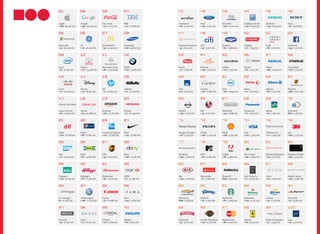
Accenture
+ 8% 9,471 $m
41
Goldman Sachs
+ 12% 8,536 $m
44
Ford
+ 15% 9,181 $m
42
Hyundai
+ 20% 9,004 $m
43
Thomson Reuters
– 4% 8,103 $m
47
Colgate
+ 2% 7,833 $m
50
Citi
+ 5% 7,973 $m
48
Danone
+ 6% 7,968 $m
49
Heinz
– 1% 7,648 $m
53
Nestlé
+ 9% 7,527 $m
56
Hermès
+ 23% 7,616 $m
54
adidas
+ 12% 7,535 $m
55
AXA
+ 5% 7,096 $m
59
Xerox
+ 1% 6,779 $m
62
Cartier
+ 26% 6,897 $m
60
Dell
– 10% 6,845 $m
61
Nissan
+ 25% 6,203 $m
65
Panasonic
+ 1% 5,821 $m
68
KFC
+ 3% 6,192 $m
66
Nintendo
– 14% 6,086 $m
67
Morgan Stanley
– 21% 5,724 $m
71
Visa
+ 11% 5,465 $m
74
Prada
+ 30% 5,570 $m
72
Shell
+ 16% 5,535 $m
73
Burberry
+ 20% 5,189 $m
77
John Deere
+15% 4,865 $m
80
MTV
– 12% 4,980 $m
78
Adobe
+ 8% 4,899 $m
79
Kia
+ 15% 4,708 $m
83
Jack Daniel's
+ 7% 4,642 $m
86
Santander
– 2% 4,660 $m
84
Duracell
New 4,645 $m
85
Chevrolet
New 4,578 $m
89
Heineken
+ 10% 4,331 $m
92
Kleenex
+ 2% 4,428 $m
90
Starbucks
+ 8% 4,399 $m
91
Smirnoff
+ 5% 4,262 $m
95
Ferrari
+ 6% 4,013 $m
98
Harley-Davidson
+ 10% 4,230 $m
96
MasterCard
+ 8% 4,206 $m
97
Sony
– 8% 8,408 $m
46
Siemens
+ 13% 8,503 $m
45
Facebook
+ 43% 7,732 $m
52
Audi
+ 8% 7,767 $m
51
Caterpillar
+ 13% 7,125 $m
58
Nokia
– 65% 7,444 $m
57
Porsche
+ 26% 6,471 $m
64
Allianz
+ 8% 6,710 $m
63
Discovery
New 5,756 $m
70
Sprite
+ 2% 5,811 $m
69
3M
+ 16% 5,413 $m
76
Tiffany & Co.
+ 5% 5,440 $m
75
Johnnie Walker
+10% 4,745 $m
82
Johnson&Johnson
+ 9% 4,777 $m
81
Ralph Lauren
+ 14% 4,584 $m
88
Avon
– 11% 4,610 $m
87
Pizza Hut
+ 2% 4,269 $m
94
Corona
+ 5% 4,276 $m
93
Gap
+ 5% 3,920 $m
100
Moët & Chandon
+ 3% 3,943 $m
99
Apple
+ 28% 98,316 $m
01
Microsoft
+ 3% 59,546 $m
04
Google
+ 34% 93,291 $m
02
Coca-Cola
+ 2% 79,213 $m
03
IBM
+ 4% 78,808 $m
05
Samsung
+ 20% 39,610 $m
08
GE
+ 7% 46,947 $m
06
McDonald’s
+ 5% 41,992 $m
07
Intel
– 5% 37,257 $m
09
BMW
+ 10% 31,839 $m
12
Toyota
+ 17% 35,346 $m
10
Mercedes-Benz
+ 6% 31,904 $m
11
Cisco
+ 7% 29,053 $m
13
Gillette
+ 1% 25,105 $m
16
Disney
+ 3% 28,147 $m
14
HP
– 1% 25,843 $m
15
Louis Vuitton
+ 6% 24,893 $m
17
Honda
+ 7% 18,490 $m
20
Oracle
+ 9% 24,088 $m
18
Amazon
+ 27% 23,620 $m
19
H&M
+ 10% 18,168 $m
21
SAP
+ 7% 16,676 $m
24
Pepsi
+ 8% 17,892 $m
22
American Express
+ 12% 17,646 $m
23
Nike
+ 13% 17,085 $m
25
eBay
+ 20% 13,162 $m
28
IKEA
+ 8% 13,818 $m
26
UPS
+ 5% 13,763 $m
27
Pampers
+ 15% 13,035 $m
29
HSBC
+ 7% 12,183 $m
32
Kellogg’s
+ 8% 12,987 $m
30
Budweiser
+ 6% 12,614 $m
31
J.P. Morgan
0% 11,456 $m
33
Zara
+ 14% 10,821 $m
36
Volkswagen
+ 20% 11,120 $m
34
Canon
– 9% 10,989 $m
35
Nescafé
– 4% 10,651 $m
37
Philips
+ 8% 9,813 $m
40
Gucci
+ 7% 10,151 $m
38
L’Oréal
+ 12% 9,874 $m
39
®
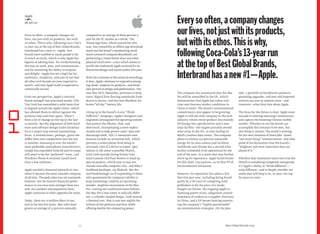
Everysooften,acompanychanges
ourlives,notjustwithitsproducts,
butwithitsethos.Thisiswhy,
followingCoca-Cola’s13-yearrun
atthetopofBestGlobalBrands,
Interbrandhasanew#1—Apple.
Best Global Brands 2013
The company has announced that the Mac
Pro will be assembled in the US, which
demonstrates that Apple has taken criti-
cism over Foxconn worker conditions in
China to heart. The brand’s environmental
commitments also appear to be growing:
Apple is still the only company in the tech
industry whose entire product line exceeds
US Energy Star specifications and a new
solar facility—the largest privately owned
solar array in the US—is now fueling its
North Carolina data center. The company
plans to achieve 100 percent renewable
energy for its data centers and facilities
worldwide and already has a second solar
facility scheduled to be operational by the
end of the year. In a move that may further
shore up its reputation, Apple hired former
US EPA chief, Lisa Jackson, as its first VP of
Environmental Initiatives.
However, its reputation has taken a few
hits this past year, including being found
guilty by a US court of conspiring with
publishers to fix the price of e-books
bought via iTunes; the ongoing Apple vs.
Samsung patent trials; allegations around
treatment of workers at a supplier (Foxconn)
in China; and a US Senate hearing examin-
ing the company’s “highly questionable”
tax minimization strategies. On the plus
side, a portfolio of blockbuster products,
promising upgrades, and new and improved
services are sure to remind users—and
investors—what they love about Apple.
The focus for the future is clear: Apple must
succeed in slowing Samsung’s momentum
and capture the booming Chinese mobile
market. Whether or not the brand can
accomplish this remains to be seen, but
one thing is certain: The world is waiting
for the next iteration of Steve Jobs’ classic
“one more thing” announcement, and clear
proof of his declaration that the brand’s
“brightest and most innovative days are
ahead of it.”
Whether that innovation turns out to be the
iWatch or something completely unexpected,
it’s Apple’s ability to“think different”—
truly different—and to deeply consider our
needs that will keep it on, or near, the top
for years to come.
12
Every so often, a company changes our
lives, not just with its products, but with
its ethos. This is why, following Coca-Cola’s
13-year run at the top of Best Global Brands,
Interbrand has a new #1—Apple. Few
brands have enabled so many people to do
so much so easily, which is why Apple has
legions of adoring fans. For revolutionizing
the way we work, play, and communicate—
and for mastering the ability to surprise
and delight—Apple has set a high bar for
aesthetics, simplicity, and ease of use that
all other tech brands are now expected to
match, and that Apple itself is expected to
continually exceed.
From our perspective, Apple’s internal
brand strength has remained steady. CEO
Tim Cook has assembled a solid team that
is aligned around the Apple vision, which
has allowed them to deliver against the
promise time and time again. There’s
been a lot of change at the top in the last
12 months, but the alignment of both hard-
ware and software design under Jonathan
Ive is a major step toward maintaining
focus. A shrewd move, perhaps, given the
stiffer than ever competition over the last
12 months: Samsung is now the world’s
most profitable smartphone manufacturer,
Google has expanded Android and its maps
still seem to be the “preferred” route, and
Windows Phone 8 certainly raised more
than a few eyebrows.
Apple reached a financial pinnacle in 2012
when it became the most valuable company
of all time. The peak value was not sustained,
however, but the brand’s financial perfor-
mance in 2012 was even stronger than 2011
and, on a product and popularity basis,
Apple continues to whet appetites for more.
Today, there are 72 million Macs in use,
and in the last five years, Mac sales have
grown an average of 15 percent annually,
compared to an average of three percent a
year for the PC market as a whole. The
iTunes App Store, which turned five this
year, has crossed the 50 billion app download
mark and the brand’s trendsetting retail
stores (research company RetailSails) are
performing 17 times better than any other
physical retail store—a fact which seems to
justify the trademark Apple received for its
distinctive design and layout earlier this year.
With the customer at the nexus of everything
it does, Apple continues to respond to emerg-
ing needs, improve its products, and break
new ground in design and performance. The
next Mac OS X, Mavericks, promises to keep
users’ digital lives flowing seamlessly from
device to device, and the new MacBook Air
boasts “all day” battery life.
Living up to the brand’s iconic“Think
Different” campaign, Apple’s designers and
engineers reimagined the operating system
that powers the iPhone, iPad, and
iPod touch. Incorporating a more sophis-
ticated tool to help protect users’ data and
discourage theft, iOS 7’s innovative new
features include an activation lock, which
prevents a stolen phone from being re-
activated, even if a device is wiped. Spec-
ulation is rife about a possible iWatch,
with Cook recently hiring former Yves
Saint Laurent CEO Paul Deneve to head up
special projects, which may or may not
include wearable computer chic, and Nike’s
FuelBand developer, Jay Blahnik. But the
real breakthrough (as if responding to those
who questioned the company’s ability to
keep innovating) could be an upcoming
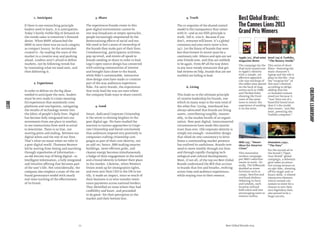
smaller, mightier incarnation of the Mac
Pro. Leaving the traditional tower behind,
the Mac Pro’s new tower is radically differ-
ent: a cylinder-shaped design, built around
a thermal core, that is just one-eighth the
volume of the previous machine while
offering double the computing power.
Apple
+28%
98,316 $m
0
1
Despite a contraction in revenue, IBM
still delivered record earnings per share,
margins, and cash flow through 2012 and
into early 2013. The brand continues to set
records in innovation, generating 6,478
patents in 2012, the most US patents for the
20th year in a row. Aggressively growing its
presence in emerging markets, IBM opened
144 offices in those regions in 2012. It fur-
ther evolved the Smarter Planet platform,
including targeted offerings such as Smarter
Transportation and Smarter Finance,
all leading to Smarter Cities. Looking to
get ahead of the IT industry paradigm
shift, it’s also packaging its computing
capabilities and offerings to build a Smarter
Computing platform that will be designed
for Big Data, all while being open and col-
laborative to further foster innovation. This
new approach is already paying dividends
in the form of IBM’s Watson super-
computer. IBM, with New York’s Memorial
Sloan Kettering hospital, announced that
Watson had completed its“education” on
historical cancer cases and would now be
used as a decision support tool for deter-
mining the optimal cancer treatment in
patients. Additionally, Watson demonstrates
the flexibility of Smarter Computing, using
its Big Data analytics capabilities to provide
real-time customer relationship manage-
ment insights for IBM’s clients. While IBM’s
revenue performance continues to be a
point of concern, the brand is hard at work
solidifying its brand position as a purveyor of
business innovation in the 21st century.
Though the soft drink giant slips to #3 this
year, Coca-Cola has enjoyed a long and illus-
trious reign as our #1 Best Global Brand for
good reason. An enduring classic that has
evolved over its 127 years, Coca-Cola remains
the most recognizable—and one of the most
valuable—brands in the world. Guided by
its 2020 Vision goals around innovation,
focus, and creativity, Coca-Cola achieves
impressive global presence through stand-
out ad campaigns, bold design, digital
savvy, and a simple, universally relevant
theme that weaves throughout the brand’s
communications: happiness. In a nod to
its creative legacy, Coca-Cola was named
Creative Marketer of the Year at the 2013
Cannes Lions International Festival of
Creativity. During the past year, much
of its marketing focused on the global,
music-driven“Move to the Beat” campaign
for the London Olympic Games, but the
creative output didn’t stop there. Coca-Cola
not only effectively spread its“Open Hap-
piness” message in more than 200 markets
around the world, it also created moments
of happiness through the award-winning
“Share a Coke” campaign that puts consum-
ers’ names on bottles and cans, and the
madcap Coca-Cola Zero“Unlock the 007 in
You” stunt that cross-promoted the James
Bond Skyfall movie release in the UK.
Coca-Cola’s innovation pipeline also
extends to its sustainability platform and
packaging, promoting healthy living, and
reinventing self-serve beverage dispensers
with the Coca-Cola Freestyle dispenser.
IBM
+4%
78,808 $m
Coca-Cola
+2%
79,213 $m
If Google’s stream of innovation is anything
to go by, there’s clearly something in the
water in Mountain View, California. From
making noise for its self-driving cars to
taking advantage of Apple’s Maps fumble to
releasing the straight-out-of-Star Trek Google
Glass, the company once described as a
search engine has found its voice as a true
leader of the technology age. Tech-savvy or
not, anyone who has continuous, or even
intermittent, access to the internet is aware
of the brand, and likely a user of at least
one of its numerous offerings. Whether
through phone, tablet, computer, or car,
the brand is ever-present. As powerful as
it is ubiquitous, Google controls about one-
third of all online advertising spending,
according to eMarketer research. At the
same time, evolutionary changes in core
offerings like search, Android (mobile
operating systems), and Gmail continue
to keep Google ahead of the pack, ensur-
ing that users who are“one click away”
from the competition never stray. Google’s
relentless adaptation attests to the fact that
the brand tries to anticipate and fulfill the
needs of its consumers across a variety of
areas. The company is constantly assess-
ing its products, phasing out services and
offerings that are no longer relevant or are
simply unprofitable, and introducing new
ones. This responsive behavior suggests
that Google pays attention to what consum-
ers like and don’t like—a big reason why
overall sentiment for the brand is positive.
However, the year hasn’t been perfect for
the company, with anti-trust questions
being raised in the US and Europe, and its
involvement in the PRISM scandal flying
in the face of its“don’t be evil” corporate
motto. That said, Google’s search engine is
still outperforming those of rivals Yahoo!
and Microsoft, and experimental efforts
like Project Loon, which aims to deliver 3G
internet to remote areas via solar-powered
balloons in the stratosphere, continue
to remind us that Google is more than a
search engine. The company also remains
one of the world’s best places to work,
with employees enjoying a range of perks,
programs to help them do their jobs better,
and encouragement to explore innovative
ideas. Though some are disappointed to see
an end to Google Reader and iGoogle, new
acquisitions such as Channel Intelligence,
an e-commerce optimization site, promise
to bolster Google Shopping and bring the
company closer to direct competition with
Amazon. With ad spending as a percentage
of revenue now almost on par with rival
technology companies, Google continues to
work hard on gaining market share in areas
beyond search. Yet, these forays lead to
significant fragmentation in terms of brand
and marketing decisions, and consumers
don’t seem to understand how Google’s
vast array of products actually tie back to
search or any unifying theme beyond inno-
vation for innovation’s sake. While some
confusion still exists between the various
brands that make up Google’s portfolio
(e.g., YouTube, Android, and Motorola
Mobility) and the “always be in beta”
mindset may be a bit lost on lay end-users,
big bets on innovations that will change
how the world lives with technology will
continue to be what sets Google apart from
its competitors.
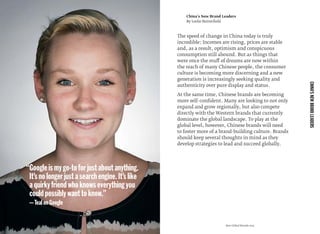
Google, the company
once described as a
search engine, has
found its voice as a
true leader of the
technology age.
Google
+34%
93,291 $m
Best Global Brands 201314
0
3
0
2
0
4
Samsung is a category leader in mobile,
surpassing Apple in smartphone sales,
grabbing 30.3 percent market share of
smartphone shipments and making USD
$5.2 billion on handsets in the second
quarter. Thanks to innovative products such
as the Galaxy S4 and Galaxy Note II and a
massive marketing spend of more than
USD $4 billion in 2012 (four times Apple’s
budget), the brand continues to strengthen
its position globally. With focus on being
an aspirational brand to its target audience
of young consumers, Samsung is wooing
Millennials with high-profile partnerships
with celebrities like Alexander Wang,
LeBron James, Usher, and Jay Z. Samsung
continues to focus on connectivity across
its portfolio including home appliances,
digital cameras, and TVs in a bid to differ-
entiate its brand in an age when consumers
are demanding sharing and accessibility.
The Galaxy S4, marketed as a “life com-
panion,” includes features like navigating
without touching the screen and built-in
health monitoring. Its tech-savvy refrigera-
tors track what’s in consumers’ fridges and
suggest recipes, while its Smart TV suggests
what to watch and operates with voice
commands. Samsung is evolving its brand
to stand for more than just innovation and
strives to live up to its internal ambition
of enhancing the lives of its consumers.
It’s demonstrating how its products lead to
a better life, making good on its vision to
“inspire the world, create the future.”
In the wake of its first global sales decline
in nine years, McDonald’s took drastic
steps to reaffirm its strong reputation for
consumer responsiveness and adaptability.
President and CEO Don Thompson replaced
US President Jan Fields in November 2012
with Jeff Stranton and named Kevin Newell
McDonald’s first US Chief Brand Officer in
February 2013, the first such role to steer its
American brand strategy. Two months later,
Steve Easterbrook was rehired as Global
Brand Officer. Despite a year of change, the
golden arches remains highly relevant to
69 million daily consumers through local-
ized menu items, consistent global brand
expression, and customer experience.
Menu additions, including the Egg White
Delight and Premium Chicken Wraps,
were introduced in response to obesity con-
cerns and the explosive growth of healthy
quick-service eateries. With the modern
redesign of its locations, McDonald’s
repositioned itself to stretch into the more
upscale quick-service restaurant space while
returning to its original pricing strategy
with “Dollar Menu & More,” focusing on
offering a wide variety of menu items at lower
price points. Its efforts in sustainability
were also praised, notably its eco-friendly
London 2012 restaurant during the Olympic
and Special Olympic Games. Growing to
34,000 restaurants globally, McDonald’s
continues to focus on Asia, where it must
find the product sweet spot for consumers
across the region, a key to successful expan-
sion and relevancy in the market.
Samsung
+20%
39,610 $m
McDonald’s
+5%
41,992 $m
As Big Data has become the main frontier
for innovation and growth in the market-
place, GE has stepped up to lead the charge.
This year CEO Jeff Immelt announced a
commitment to the industrial internet:
a bold vision of using GE intelligence and
technology to converge machines with
intelligent data. The brand has invested
USD $1.5 billion toward connecting its
machines to its enterprise software and the
internet. Building capabilities in predictive
software products, Big Data and analytics,
and advanced manufacturing, the GE brand
is stretching into new territories. Its 2013
“Brilliant Machines” campaign demon-
strates this move to merge“big iron” with
Big Data. Seemingly a winning strategy
for the organization, the brand has been
experiencing slow but steady growth this
year. In 2012, GE’s industrial segment earn-
ings grew 10 percent to USD $15.5 billion.
Additionally, GE continues to leverage its
highly regarded sustainability-focused
ecomagination campaign to drive the
conversation around Corporate Citizenship,
making it the number 25 brand on our Best
Global Green Brands 2013 report. Overall,
the organization’s revenue has increased to
USD $241.66 billion from USD $196.24 billion
in 2011, a sign that the GE business and the
brand are evolving.
GE
+7%
46,947 $m
Microsoft has made significant strides in
streamlining and integrating its broad
portfolio, announcing in July 2013 its“One
Microsoft” corporate restructuring that
embraces a holistic brand approach across
product lines. While CEO Steve Ballmer had
talked retirement in 2017 or so, he surprised
market watchers, announcing in August
2013 that he plans to retire within the next
year. Anticipation is high, yet questions
remain as the brand shifts from a software
to hardware business. As it continues to
move forward with One Microsoft and its
commitment to innovation with category-
topping R&D spend, its efforts may help
in recovery from lackluster reception of
Windows 8 and its companion Surface
tablet. The brand struggles as consumer
demand evolves past traditional PCs, but
bold retail strategies like creating more
than 600 Windows store experiences within
Best Buy locations and price adjustments
for Surface were deployed to help accelerate
interest and adoption. Despite the brand’s
challenges, demand is nonetheless increas-
ing for Microsoft’s products and services
with business audiences. Its Server and
Tools division showed strong performance
and Microsoft hopes to challenge Amazon
in the enterprise cloud and managed infra-
structure segments. It’s also making a
bigger bet on mobile, with its USD $7.2
billion acquisition of Nokia’s cellphone
business. As Microsoft continues to push on
multiple fronts, the brand’s responsiveness
to the sometimes conflicting needs of the PC
ecosystem and the shifting mobile landscape
will be critical for shaping its future.
Microsoft
+3%
59,546 $m
Best Global Brands 201316
0
7
0
5
0
8
0
6
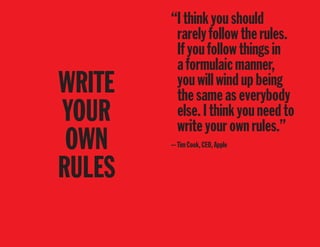
WRITE
YOUR
OWN
RULES
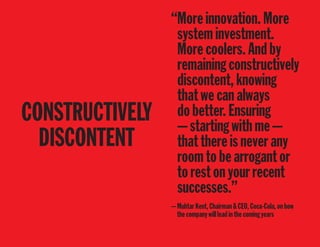
“Ithinkyoushould
rarelyfollowtherules.
Ifyoufollowthingsin
aformulaicmanner,
youwillwindupbeing
thesameaseverybody
else.Ithinkyouneedto
writeyourownrules.”
—TimCook,CEO,Apple
With an enduring reputation for excellence
in engineering, performance, and styling,
it’s no surprise Mercedes is the number one
luxury brand in the US and Germany and
is gaining ground in China and Russia.
Part of the secret of its success, exemplified
by the new S-class, is its ability to strike
a balance between its traditional position
and forward-looking ideas around mobility.
Mercedes has done just as well in the com-
pact segment with the A-class line as it has
in the premium segment. Continuing to
respond to a market that is quickly shifting
in favor of green technologies, BlueTEC and
hybrid engines will play an important role
in future generations of cars. In addition
to its impressive strides in sustainability,
Mercedes is making a push to reconfigure
its sales force to connect with a broader
audience. Particularly focused on younger
drivers, 2012’s A-class launch campaign
featured humorous TV spots, the“A-Rock”
concert series with British rock band,
Placebo, and print ads with a QR code
leading directly to an online hub where
visitors could check out vehicle highlights,
concert clips, and even arrange a test drive.
With its 2020 growth initiative focused on
building the best customer experience, and
with the introduction of new models under
the theme“heartbeat of a new generation,”
Mercedes is deftly keeping up with contem-
porary sensibilities while still embodying
timeless luxury.
Best Global Brands 2013
Mercedes-Benz
+6%
31,904 $m
Toyota not only distanced itself from the
challenges of 2010 and 2011 this year, but
also reclaimed its global sales leadership
position. Although much of the rebound
occurred in the US, there is a renewed
sense of energy around the world. Design
is playing a much bigger role, and its new
tagline,“Let’s Go Places,” ties together
the joy and adventure of physically going
somewhere while infusing innovation with
an optimistic outlook, crystallizing
the brand’s direction. Toyota’s engagement
with customers also continues to pay off,
which is evident in a number of key category
rankings and studies. The brand not only
scored well with customers, but has led the
entire automotive segment nearly every
time. Adding to the list of achievements,
Prius sales pushed boldly past the three
million mark. The Prius continues to create
a powerful halo effect for the brand while
the flagship mid-cycle Camry can still drive
sales, albeit with increasingly more incen-
tives and support. Add in a sleeker Avalon
and a completely redesigned Corolla, and
Toyota should soar into 2014. The brand,
which topped Interbrand’s Best Global
Green Brands 2013, is a fuel economy leader
and continues to demonstrate strength in
driving customers to dealerships. For many
brands, the challenges Toyota experienced
could have been catastrophic, but the
brand’s speedy recovery is a testament to
its resilience, leadership position, and the
enduring appeal of its offer.
Toyota
+17%
35,346 $m
While Intel is a clear leader in both the PC
and server processor markets, the world’s
leading semiconductor company (posting
USD $53.3 billion in sales last year) has
made significant headway in categories
beyond its core businesses. Through strate-
gic relationships with powerhouse brands
like Microsoft, which made headlines for
adapting Windows to run on less power-
ful and less expensive processors, Intel is
integrated in devices such as Microsoft’s
Surface Pro tablet. An increasing number of
Intel-powered smartphones is transforming
lives in new markets such as Africa, where
Yolo, a low-cost Android smartphone from
Kenya’s Safaricom, marks a first for the
brand and the continent. Catching many
off-guard, a leadership shake-up ensued
when CEO Paul Otellini stepped down in
May. The new leadership team—company
veterans Brian Krzanich as CEO and Renee
James as president—has already reorgan-
ized key business groups and is now
exploring non-traditional lines of business
with the creation of a New Devices division
to focus on emerging trends. This will
expose Intel to new competitors, but with
its deep heritage in innovation and as a
driver of trust for consumers, Intel will be
competing from a solid brand footing. As
tablets and smartphones gain ascendancy,
the big question for Intel in the years ahead
is: Can having“Intel inside” be as strong a
consumer driver in tomorrow’s world as it
was in the era of the PC?
Intel
–5%
37,257 $m
’09’09 ’10’10 ’11’11 ’12’12 ’13’13
01 Apple
$15.4b
$31.9b
$68.7b
$60.2b
$56.6b
$47.7b
$30.6b
$31.3b
$32.2b
$17.5b
$21.1b
$43.5b
$70.4b
$64.7b
$60.8b
$42.8b
$32.0b
$26.1b
$33.5b
$19.4b
$33.4b
$55.3b
$71.8b
$69.9b
$59.0b
$42.8b
$35.2b
$27.7b
$35.5b
$23.4b
$76.5b
$69.7b
$77.8b
$75.5b
$57.8b
$43.6b
$39.3b
$30.2b
$40.0b
$32.8b
$98.3b
$93.2b
$79.2b
$78.8b
$59.5b
$46.9b
$37.2b
$35.3b
$41.9b
$39.6b
06 GE
07 McDonald’s
08 Samsung
09 Intel
10 Toyota
02 Google
03 Coca-Cola
04 IBM
05 Microsoft
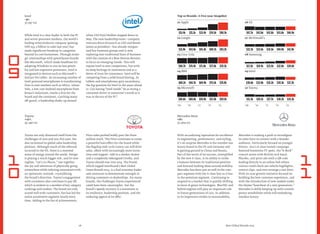
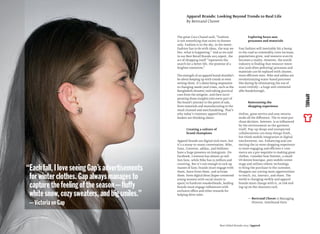
Top 10 Brands: A Five-year Snapshot
18
0
9
1
1
1
0
Best Global Brands 2013
Cisco continues to focus on growing its
presence in the B2B space, building on
shifts it experienced last year. Under the
guidance of CMO Blair Christie, Cisco, a
brand that only a few years ago was known
for using its“Human Network” campaign
to straddle both the corporate and consumer
worlds, has managed to reposition into
what seems to be a more comfortable role
as the network enabler of businesses large
and small. To help businesses monetize
“the data in motion” in their networks,
Cisco launched several mobile solutions
earlier this year, including Cisco Quantum,
enabling greater network programmability.
Cisco describes data in motion as“real-time
and near real-time data generated by mobile
and fixed connections between people,
things, and processes.” The result of more
than USD $1.5 billion in acquisitions, Cisco
Quantum is part of a broad acquisition
strategy for the brand, including areas such
as security and virtualization. The company
is successfully setting itself up to be a go-to
for IT leaders looking to make the most out
of the new era of interconnected devices,
data, and systems. Cisco’s recent shift to
a brand platform focused on“The Internet
of Everything” suggests that this move isn’t
just a short-term reaction to immediate
requirements, but a bigger, longer-term bet
that the world will continue to need a com-
pany to guide us through the increasingly
complex connected world of tomorrow.
HP, one of the world’s largest technology
organizations, is refocusing on cloud, mo-
bility, Big Data, and a new style of IT. In
June 2013, HP announced a partnership with
Google to offer small- and medium-sized
businesses “IT in a Box”—a one-stop-shop
technology solution—as well as launching
HAVEn, a Big Data analytics platform. In
recent years, the brand has undergone
significant changes in both visual identity
and tagline—from “Invent” to “Let’s Do
Amazing,” to the current “Make It Matter.”
Hopefully, HP can stick to this idea and
make it last; these rapid changes create
the appearance of uncertainty when the
company most needs to demonstrate
stability and resolve. On the consumer
product front, HP continues to blur the
lines between desktop, laptop, and tablet
with mobile all-in-ones (e.g., HP ENVY
Rove), tablets with attachable keyboards
(HP ENVY x2), and touchscreen desktops
that recline. As the PC category contin-
ues its decline, HP will once again enter
the smartphone market, perhaps before
the end of 2013. HP has failed here in the
past with the acquisition and subsequent
shutdown of Palm, so industry pundits see
the resurrection of a mobile division as a
critical moment in HP’s turnaround story.
With the business focused, now is the time
to ensure that the brand clearly brings HP
to life across every experience.
Cisco
+7%
29,053 $m
HP
–1%
25,843 $m
2012 was the most successful year in the
history of the BMW brand. The brand
topped US luxury auto sales for the year,
and increased car sales 40 percent in the
Chinese market. Sustainability and urban
mobility are a huge focus for the brand,
which is evident in the upcoming launch
of the BMW i3 model. Mobile apps are
supporting its vision for urban mobility,
including Chargepoint, which shares
information on electric vehicle charging
stations. Its flagship London showroom for
its i series of electric and hybrid vehicles,
located on the city’s exclusive Park Lane,
underlines how BMW is positioning its new
range at the premium end of the market.
BMW projects that the US and China will
be its largest markets for electric vehicle
sales, followed by Europe. Much depends,
however, on how quickly China’s govern-
ment can provide an infrastructure for EVs.
BMW enjoyed a halo effect from sponsoring
the London 2012 Summer Olympic Games,
paving the way for its 2013“Designed for
Driving Pleasure” campaign. BMW’s
360-degree Olympics platform included
providing vehicles and bicycles, first-time
sponsorship of Team USA, and an on-site
brand pavilion—a significant commitment
that helped lead to the brand’s biggest year
to date. As pure driving pleasure and car
ownership become less of a demand driver,
BMW must meet consumers’ evolving-
needs while fending off traditional com-
petitors and new entrants such as Tesla.
Disney continues its multichannel
approach to building branded franchises
that can stretch across the many facets of
family entertainment. With both strong
horizontal and vertical integration across
all parts of the Disney-branded empire, the
brand still has a unique ability to take a core
idea, develop it through film and televi-
sion, then extend the property into toys and
merchandising, theme parks and resorts,
DVD sales, and video games. Challenges
remain, however, particularly around its
continued reliance on blockbuster movie
titles to drive value throughout the ecosys-
tem. As The Lone Ranger’s recent disappoint-
ing opening illustrates, Disney’s studio
arm can no longer count on box-office hits,
even though solid performers such as Brave
continue to fuel a slew of merchandising
opportunities from toys to rides. Disney
garnered significant buzz among gamers for
its long-anticipated Disney Infinity video
game platform that debuted August 18, 2013
with its Toy Story in Space Play Set. Bridging
the gap between action figures and gaming,
bringing characters from Disney and Pixar
into a single environment, it’s a prime
example of Disney’s ability to find ways to
dig deep into its catalog to engage a new
generation. As long as Disney can continue
to evolve how its core brand delivers against
the ideas that have made it relevant for
generations, the company will continue to
be one of the world’s most valuable enter-
tainment and media powerhouses for the
foreseeable future.
BMW
+10%
31,839 $m
Disney
+3%
28,147 $m
20
1
4
1
2
1
5
1
3
Oracle continues to be a leading provider of
business hardware and software systems.
In February 2013, Oracle’s purchase of
Acme Packet for USD $2.1 billion not only
enhanced its communications product
offering, but also signified its expansion
into the networking equipment market.
In June 2013, Oracle announced that it had
formed a partnership with Dell, and later
that same month, a partnership with
Microsoft was announced that would
enable Java developers to use Oracle tools.
Days later, Oracle formed alliances with
both Salesforce.com and NetSuite, two of
the fastest growing companies in cloud
computing. More recently, Oracle empow-
ered Java and aspiring developers world-
wide, introducing a series of programs to
“Make the Future Java.” The programs allow
developers to share their enthusiasm for
Java, expand their technical skills, feel a
sense of community, and be active partici-
pants in developing the next generation
of Java innovation. Going forward, Oracle
will need to focus on improving its image.
A recent New YorkTimes article noted,“Oracle
is battling an image not of growing up,
but of growing old.” As brands with loyal
users, such as Google, continue to play a
leading role in the technology sector,
Oracle must ramp up its brand messag-
ing efforts and initiatives, establishing
stronger emotional connections with
consumers. Doing so will ensure Oracle
remains relevant and will firmly position
the company as an innovative leader in a
constantly evolving industry.
Oracle
+9%
24,088 $m
Continually improving the customer expe-
rience, Amazon aims to deliver the widest
selection of products at the lowest prices
with minimal hassle. The e-commerce
innovator differentiates itself from rivals
with initiatives such as Amazon Appstore,
providing a comprehensive mobile experi-
ence. Preinstalled on Kindle and compatible
with Android devices, the Appstore makes
recommendations based on past purchases
and offers“coins” to US customers as digital
currency. The brand also expanded into new
businesses such as TV set-top boxes, online
advertising, original programming via
Amazon Studios for its Emmy award-
winning Prime Instant Video service, and
3-D smartphones. With customers buying an
estimated 3.5 billion items last year, Amazon
is targeting a wider audience, offering
luxury goods, social game platforms, and
digital music via Autorip. The strategic acqui-
sition of Goodreads, a social book recom-
mendation site, builds on Amazon’s well-
established online book retailing expertise,
fostering a community of bibliophiles.
The brand has thus successfully built an
intimate relationship with its customers
without being perceived as intrusive.
However, the issue of tax avoidance in the
UK demonstrates that Amazon’s expansion
plans must be checked with responsibility
and prudence, or it faces risks to its brand
reputation. Looking ahead, CEO Jeff Bezos
(who raised eyebrows with his personal sur-
prise purchase of The Washington Post) and his
leadership team must be mindful of local
needs to deliver a consistent Amazon brand
experience to a global audience.
Amazon
+27%
23,620 $m
Gillette maintains its leadership position
thanks to the brand’s internal clarity, ensur-
ing consumers have a distinct understand-
ing of what the Procter & Gamble-owned
brand has to offer. P&G commands a whop-
ping 70 percent share of the global razors
and blades market, with Gillette at the
heart of that success. The brand continues
to benefit from an increase in demand for
men’s grooming products in fast-develop-
ing markets, especially in India. One way
Gillette drives this demand is through its
longstanding strategy of tying its market-
ing efforts to sports partnerships. Strategic
social marketing generated roughly 870,000
views of its Facebook page, where, for
example, runners could enter their race bib
number and be instantly tagged in photos
during the Malta Marathon. Additionally,
Gillette sponsors sporting events such as
the Gillette Future Champs tournament in
Saudi Arabia, and is also featuring McLaren
Racing in ads during the Formula One
season. A sexy integrated marketing
campaign,“What Women Want,” created
significant buzz, featuring Kate Upton,
Genesis Rodriguez, and Hannah Simone.
On the Corporate Citizenship front, Gillette’s
Boston headquarters is one of 45 P&G
facilities worldwide to achieve zero waste
to landfill status, while a UK factory is
composting waste generated from the
production of the brand’s shaving foam.
Its commitment to sustainability extends
beyond renewable energy to greener pack-
age design that has reduced the weight
of its packaging 20 percent and the amount
of plastic used by 57 percent.
LVMH Moët Hennessy CEO Bernard Arnault
recently told the FinancialTimes,“What
interests me is that in 15 years’ time, Louis
Vuitton is still the leading luxury brand.”
Louis Vuitton has been reinforcing its posi-
tion within the high-end segment of the
luxury market and balancing its massive
global presence with the objective of lever-
aging luxury and exclusivity. To prevent
the risk of overexposure, the brand is con-
centrating on limiting its own visibility.
The monogrammed product that has helped
Louis Vuitton to attain its strong status with
global consumers is becoming synonymous
with accessible luxury. The 2013 LVMH “Les
Journées Particulières” event allowed the
Louis Vuitton brand to highlight its crafts-
manship. The brand has also been focusing
on satisfying consumers’ desire for customi-
zation and has succeeded in expanding its
position in the fast-growing timepieces
market and jewelry. It plans to launch its
exclusive LV fragrance from Master Perfumer
Jacques Cavallier-Belletrud next year, as
well as new stores, with openings limited
to key countries. Additionally, Louis Vuitton
has opened two new iconic stores. One is
dedicated exclusively to luxury jewels and
is located in Place Vendôme and the second
is its first“Cabinet d’Écriture” on the Place
Saint-Germain-des-Prés in Paris, constructing
deeper and more substantive engagement
and storytelling around the art of writing.
The brand recorded outstanding results
because of its ability to move into a more
high-end segment of the luxury market.
22
Gillette
+1%
25,105 $m
Louis Vuitton
+6%
24,893 $m
1
8
1
6
1
9
1
7
In spite of economic challenges and weaker
than expected financial performance in the
first half of 2013, H&M continues to offer
“fashion and quality at the best price.”
High-profile partnerships, historically
a successful strategy for the brand, have
continued with guest designer collabora-
tions and celebrity endorsements from style
icons such as Beyoncé, David Beckham,
and Kanye West. The brand’s debut at Paris
Fashion Week in February aimed to“sur-
prise and inspire customers.” It’s also build-
ing credibility in sports apparel, appealing
to sports buffs with tie-ins in the last year
such as the Swedish Olympic and Paralympic
teams, tennis star Thomas Berdych,
and a special collection of sustainable
urban cycling wear with London’s Brick
Lane Bike. These strategic alliances not
only help in marketing, but also influence
H&M’s product development. As the world’s
largest user of organic cotton, H&M has
furthered its sustainability efforts,
joining forces with the World Wildlife
Foundation (WWF) in a three-year commit-
ment to improve stewardship of its global
water supply. Shoring up its ethical sourcing
commitment, H&M signed the Bangladesh
Factory Safety Agreement in May of this
year. The brand is expanding its e-commerce
operations, launching its much-anticipated
US web store in August 2013, as well as its
physical footprint, planning 325 new stores.
H&M must remain relevant and responsive.
Appealing to its global audience, emotionally
and in terms of form, fashion, and function,
will keep H&M at the top of its game.
Best Global Brands 2013
H&M
+10%
18,168 $m
Honda’s reach comprises motorcycles, power
products, aviation, and robotics, but it
shines in the automotive segment. At the
start of 2013, Honda was one of only four
brands that sold more than five million
vehicles. Building on its core volume mod-
els—the Accord, Civic, C-RV, and Odyssey—
Honda launched a hybrid Accord and priced
it significantly higher than competitors’
conventional models. Honda has a long
history of innovation and its reputation
for more robust fuel-efficiency technology
helps support the premium while connect-
ing with consumers that have stronger
environmental awareness. But the brand
also continues to rack up resale value
awards and rankings, further fueling a
high customer retention rate. In fact, in
nearly all of the most critical studies, the
Honda brand is rated significantly higher
than the average category retention rate.
In Honda’s case this translates into record
sales numbers that are not driven by fleet
sales nor incentives. The 2013 incentive-free
Civic exemplifies the Honda brand at its
best, but going forward Honda cannot just
rely on the loyalty producing high-quality,
reliable vehicles generates. The playing
field continues to get more competitive and
parity among auto makers will continue to
strengthen. With four major car launches
out of the way, Honda will need to build
even closer relationships with its customers
and continue to do what it takes to hold the
resale values of the vehicles it produces.
Honda
+7%
18,490 $m
“IwearH&MbecauseIlikemoregender-
neutralclothing.H&Mofferssmallersizes
anddifferentstylesthatfitmybodytype
andmakemefeelcomfortable—both
physicallyandmentally.”—KristenonH&M
2
0
2
1
Nike continues to cement its reputation as
the world’s leading innovator in sports-
wear, footwear, and sporting goods. The
brand returned to growth in the past year
with revenue increasing across every cate-
gory and region, up 16 percent to USD $24.1
billion, the highest rate in 15 years. Fast
Company recognized Nike’s groundbreaking
initiatives, calling it the most innovative
company of 2013. The“Flyknit” racer, a shoe
created from a single piece of thread rather
than layers of fabric, is a revolutionary
sustainable approach to manufacturing that
shows Nike is still at the forefront in sporting
apparel. Additionally, the game-changing
Nike+ FuelBand, a wearable technology
that records, connects, and inspires the
wearer to “just do it,” is one of the most
impressive consumer releases of the past two
years. It’s a clear signal that Nike has moved
beyond conventional category boundaries
toward creating a true lifestyle brand. Nike
continued partnering with the world’s elite
athletes, including Rafael Nadal and LeBron
James, but the brand also experienced the
risk of celebrity endorsements, cutting ties
with Lance Armstrong after his high-profile
doping scandal. Looking to 2014, the FIFA
World Cup presents a real opportunity to
challenge adidas’s football supremacy, given
Nike’s sponsorship of host nation Brazil.
Nike’s enduring dominance, “always on
the offense,” lies in the strength of, and
commitment to, its brand, a mythology it
continues to evolve, develop and communi-
cate in every interaction with consumers.
As the role of Big Data and use of mobile
grow exponentially, and at a time when
63 percent of global transaction revenue
touches an SAP system, the brand is evolving
and expanding its business. SAP experi-
enced robust growth, with a 17 percent
increase in revenue from 2011 to 2012, and
continued strong growth in the first half
of 2013. Its focus on two key areas, Big Data
analytics and cloud-based solutions, has
paid dividends. Through its SAP HANA
platform, the brand is bringing its Big Data
analytics expertise to bear, allowing for
real-time analysis of both CRM and ERP
data, all with cloud infrastructure to reduce
the burden on its clients. Not only is SAP
keenly focused on helping clients more
effectively address efficiency, motivate
and engage employees, and gain real-time
insights, but it’s also committed to making
its own business more environmentally
sustainable. It’s also strengthening its
human capital and making its workforce
more diverse. Renewable sources made up
60 percent of the energy SAP consumed
last year and in the brand’s 2012 Annual
Report, it committed to increasing
employee engagement to 82 percent. Earlier
this year, SAP announced that by 2020, one
percent of its 65,000 global workforce will
be individuals on the Autism spectrum,
leveraging and celebrating their analytical
and computational skills and perspective.
By continuing to focus on innovation, inter-
nal brand engagement, and stewardship,
SAP’s success will also continue.
Nike
+13%
17,085 $m
SAP
+7%
16,676 $m
American Express may have been founded in
1850, but this hasn’t stopped the credit card
company from finding fresh ways to build
relevance and anticipate future needs for its
consumer and business clients. Amex has
continued to invest in meaningful social
and digital experiences, including partner-
ing with Twitter to enable cardholders to
make purchases with a hashtag. As part
of its digital and mobile commitment, the
brand has made strategic investments in
upgrading its technology platforms and re-
aligning operations to improve productivity
and service quality, while building capabil-
ities for the future. These investments are
already helping drive higher average spend
and growth in its cardmember base. The
iconic brand also continued addressing the
needs of small business owners via its OPEN
platform. Its third annual Small Business
Saturday last November saw a record turn-
out, while OPEN is now helping women
entrepreneurs better compete for gov-
ernment contracts via the ChallengeHER
partnership with the US Small Business
Administration. Amex has downsized its
Corporate Travel division while bringing in
new customers with its first prepaid card,
Bluebird, in partnership with Walmart.
Despite these successes, Amex’s reputation
took a hit when it was fined in October for
violating consumer protection laws. Despite
this setback, Amex strives to live up to its
mission to be“the world’s most respected
service brand,” and has been recognized
as J.D. Powers’ top US credit card company
since 2007.
American Express
+12%
17,646 $m
Pepsi is progressing on its reset effort after
several challenging years. Pepsi’s first global
campaign,“Live for Now,” has helped
define its purpose, bringing its core values
to life. A stronger overall focus on the con-
sumer experience is elevating Pepsi’s con-
nections with consumers. The brand hired
its first Chief Design Officer, Mauro Porcini,
to drive appeal and elicit consumer interest
through innovation and design. Ongoing
consumer engagement with key celebrity
integrations, such as making Beyoncé the
brand’s Creative Director, have revived and
amplified its role as a pop culture icon.
Viral hits like the“Uncle Drew” videos and
the“Wheel of Levy” microsite are winning
fans, while Pepsi Pulse provides consumers
with real-time, sharable content, allowing
for more intimate engagement with the
brand. Though the cola category faces
challenges, Pepsi has responded positively
and proactively. In March 2013, the brand
unveiled a new single-serve bottle for its
Pepsi trademark portfolio, marking its
first design update since 1996. The brand is
addressing key consumer concerns, such
as sugar content, via the lower calorie
version of its flagship beverage, Pepsi Next.
Building a reputation for its environmental
efforts, Pepsi was awarded the 2012 Stockholm
Industry Water Award for reducing its
water consumption. Delivering a holistic
expression of its brand and continuing to
engage millions of people around the world
through music and digital platforms, Pepsi
is making a comeback.
Pepsi
+8%
17,892 $m
26
2
4
2
2
2
5
2
3
Pampers is Procter & Gamble’s first USD
$10 billion mega-brand, serving more
than 25 million babies in more than 100
countries. Having invented the disposable
diaper/nappy category, it endures and
dominates its market, focusing on offer-
ing parents support and connecting with
consumers on an emotional level that goes
deeper than its product line. With more
than 1.7 million likes on its Facebook page,
the brand offers advice from mothers and
encourages followers to share stories about
their babies and families, personalizing the
experience with Pampers through social
media engagement. In the summer of 2013
the brand launched a campaign inviting
parents to share photos on Facebook of
how their babies experience love, sleep,
and play. Pampers was the first brand to
bring“mommy bloggers” to P&G headquar-
ters to share tips with parents around the
world. Support and advice is also featured
on the brand’s website, which has an entire
section of helpful insights on parenting
topics including baby names, breastfeed-
ing, and diaper rash. In 2012, Pampers
teamed up with Jennifer Hudson, who
recorded a rendition of Lullaby and Goodnight
that was available for free download on
its Facebook page. Not only does Pampers
connect with parents of young children,
it also offers a week-by-week pregnancy
guide. Connecting across touchpoints, the
iconic brand continues to earn loyalty with
the world’s consumers.
As CEO John Donah0e puts it,“We are
no longer just an e-commerce company.”
Aggressively moving beyond its legacy as
the web’s communal auction house, eBay is
pursuing an ambitious vision. A new logo
and visual identity shows a re-energized
brand on the offensive, setting its sights
beyond its traditional space. The brand is
already a leader in e-commerce, an industry
expected to grow to USD $40 billion this
year, and where it’s facing competition
from the likes of Square, Google, Apple, and
Visa. As its pop-up interactive storefronts in
New York with Kate Spade Saturday recently
demonstrated, the eBay Now mobile app
allows customers to shop from local retailers
for items that can be delivered within an
hour. Following additional tests of the eBay
Now app with retail partners including
Macy’s, Home Depot, and Walgreens, the
brand is planning to launch the same-day
delivery option across the US by the end of
this year. In a bid to take on Amazon, the
service will be available to buyers and sellers
in the same area for ebay.com transactions
valued at least USD $25. Responding to the
reputational threat of vendors misusing
its platforms, eBay proactively supports
legitimate sellers with its Seller Protection
Policy and team. Its zeal for innovation is
only one part of the story, however, as eBay
must communicate the emotional aspect
of the brand across all touchpoints to its
120 million active users if it really wants
its big bets to pay off.
Pampers
+15%
13,035 $m
eBay
+20%
13,162 $m
Though it may not have gone as UPS
expected, with the company’s withdrawal
of its highly publicized nearly USD $7 billion
bid for Netherlands-based TNT Express in
January, the past year brought the brand
strong financial performance and expan-
sion. The company acquired CEMELOG,
a Hungarian pharmaceutical logistics
company, and Kiala S.A., a Belgium-based
alternative delivery location platform that
will re-launch in the US and UK as Access
Point. Both of these acquisitions will help
UPS amplify its global presence, the first
while expanding capabilities in its already
strong healthcare vertical, the second while
better serving consumers. UPS My Choice,
a home delivery service that lets consumers
choose when and where their packages are
delivered, further demonstrates the brand’s
commitment to the consumer audience.
UPS also differentiates with its focus on
sustainability. It was awarded the highest
score in the 2012 Carbon Disclosure Project’s
Leadership Index, and is a consistent top
performer on the Climate Count scorecard,
ranking first in the consumer shipping
category for the fourth consecutive year
and tying for second overall from the 2012-
2013 results. These efforts are reflected in
the company’s recent leap in Interbrand’s
Best Global Green Brands report from #43
in 2012 to #32 in 2013. As UPS continues to
make strategic acquisitions to expand its
footprint while elevating relationships
with consumers, the brand is poised to
continue to meet the evolving expectations
of customers around the world.
UPS
+5%
13,763 $m
With an intense focus on customer
experience and value, IKEA reported an
outstanding 9.5 percent sales growth and
introduced 2,000 new products to its stores
in 2012. Working to maintain a relevant in-
store experience, IKEA enhanced delivery,
assembly, and installation options and
opened 11 stores in nine countries, includ-
ing its first South American store in the
Dominican Republic, and released plans
to open at least 200 stores within the next
eight years. Now operating in 40 countries,
notably gaining presence in Asia and the
Middle East, the brand also became one of
the few businesses to experience growth in
Europe in 2012. The brand moved fast in the
face of scandal when a supplier was found
using prison labor and horsemeat that
forced meatballs off shelves in more than
25 countries. Identifying a weak point in its
online presence, IKEA has announced plans
to expand its e-commerce availability beyond
the 10 countries where it is currently avail-
able. In addition to engaging customers
digitally, IKEA is addressing internal brand
engagement with plans for a new“people
strategy” for its 139,000 employees, build-
ing on its values, clearly explaining the
brand’s objectives and introducing key
performance indicators. With Millennials
making first-home purchases and housing
markets rebounding in key territories like
the US and UK, IKEA has a great opportunity
to continue to increase loyalty and brand
value, remembering its mission to provide
a“better everyday life.”
IKEA
+8%
13,818 $m
28 Best Global Brands 2013
2
8
2
6
2
9
2
7
Overcoming any past disconnect between its
unified communications messaging and the
inconsistencies of its internal culture, mul-
tinational banking leader HSBC is shoring
up its“world’s local bank” platform, empha-
sizing its strong global roots and unrivaled
network and expertise, specifically in
emerging markets. Since coming out of the
financial crisis comparatively unscathed,
HSBC has focused on higher wealth-creating
markets and a strategy of consolidation.
The approach has proven successful as the
brand posted robust profits throughout
2013. However, 2013 has not been a year
without drama. HSBC experienced rounds
of layoffs, as well as a much-publicized
money laundering scandal in Mexico. While
communicating its values of respect and
responsiveness, it increasingly celebrates
the progressive changes sweeping the globe.
Positioned as a straight-shooting, guiding
pioneer, HSBC helps investors and small
business owners alike explore and navi-
gate opportunities. Through its focus on
the future convergence of local and global
needs, and its role as the connector across
them, the brand comes across as human
and inspirational. This year’s“In the
future” global campaign highlights HSBC’s
optimism about young entrepreneurs and
its multinational business support across
six continents.“In the future, age will be
no barrier to ambition,” it states, showing
children as small business heroes.“There’s
a new world emerging. Be part of it.” With
its clear brand messaging, communicating
its progressive edge and traditional values,
HSBC is positioning itself for the future.
Best Global Brands 2013
HSBC
+7%
12,183 $m
Despite ongoing investigations, J.P. Morgan
made a record USD $21.3 billion in profit in
2012. The brand has worked to overcome
the stigma of “too big to fail,” trading
losses that exceeded USD $6 billion after
“The London Whale” fiasco was revealed in
May 2012, and US Senate hearings citing
top executives as the reason for the losses.
Chairman and CEO Jamie Dimon addressed
“The London Whale” in a recent letter to
shareholders, writing:“The London Whale
was the stupidest and most embarrassing
situation I have ever been a part of... I also
want our shareholders to know that I take
personal responsibility for what happened.”
While Dimon’s efforts earned continued
board support, many investors urged a split
of the chairman and CEO positions, citing a
conflict of interest and a need for oversight.
The UK’s FCA and the US’s SEC continue in-
vestigating and, at the time of this writing,
sanctions are expected and the brand could
be forced to secure internal controls. The
US DOJ and FBI have also been investigating
and reports indicate federal prosecutors are
preparing to file criminal charges against
two former employees. The former trader at
the heart of the scandal, Bruno Iksil, nick-
named“The London Whale” because of the
size of his holdings, is reportedly working
with authorities and is not expected to face
charges. The next year will be a critical time
for the brand.
J.P. Morgan
0%
11,456 $m
Kellogg’s remains committed to what it
does best—focusing on strengthening its
product offering in cereal, warm break-
fasts, snacks, and protein beverages. In
the latter half of 2012, Kellogg’s invested
significantly in brand-building efforts
and it’s paying off. Consumers continue
to choose the brand without price-cutting
despite difficult economic times, under-
scoring the brand’s presence and relevance.
However, while Kellogg’s is certainly a
leader, it is second to General Mills in cereal
sales, which as a category has seen a decline
this year. Demonstrating responsiveness to
consumer demand for healthier food, the
brand has introduced several products, such
as a Special K hot cereal with quinoa. The
brand prides itself on its“K-values” of
integrity, accountability, passion, humility,
simplicity, and results. These tenets guide
and shape the culture and business at
Kellogg’s. The brand launched its biggest
campaign ever during the 2012 London
Olympics with its first national TV spot in
the US during NBC’s coverage of the Games’
Opening Ceremonies. The culmination of
its“From Great Starts Come Great Things”
campaign, the ads focused on the journey’s
start. In addition to aggressive growth
through acquisitions, Kellogg’s strategy for
2013 builds on its fundamental strengths,
encouraging product innovation within the
categories it dominates and leveraging of
relationships to deepen offerings and capa-
bilities in fast-developing markets. With
signs of continued momentum, Kellogg’s
continues to be a force in food around
the world.
Despite its all-American appeal, slumping
US sales have forced Budweiser to look
abroad for growth. In fact, parent company
Anheuser-Busch InBev aims to turn
Budweiser into the first truly global, large-
scale beer. The brand has aggressively
expanded overseas production and secured
distribution in about 90 countries, with
noteworthy launches in Brazil and Russia.
It’s now focused on China, the world’s big-
gest beer market, and one with an aston-
ishing 40 percent growth rate. Beer is a no-
toriously local product, with both consumer
habits and distribution challenges favoring
native brews. Though Budweiser spent USD
$1.4 billion expanding breweries in China
in the last two years, it’s yet to gain sig-
nificant share. In the US, meanwhile, the
brand’s sluggish growth could benefit from
fresh ideas. Budweiser evoked its heritage
with a Super Bowl spot featuring its iconic
Clydesdales, but Oreo’s quick-twitted social
response to the game’s power failure over-
shadowed Budweiser’s messaging story. It
also launched the premium Black Crown
line, aiming at beer connoisseurs in order
to broaden Budweiser’s customer base.
While some say this strategy runs the risk
of creating confusion regarding the brand’s
core promise, it is at least a bold move to
leverage the brand’s rich history. It remains
to be seen if Budweiser’s attempts at global
domination will pay off, particularly in
China, but its leadership team is clearly not
resting on the brand’s laurels, or its iconic
gold crown.
30
Budweiser
+6%
12,614 $m
Kellogg’s
+8%
12,987 $m
®
3
2
3
0
3
3
3
1
Despite the yen’s volatility, the leadership
of returning President Fujio Mitarai helped
keep Canon steady through challenging
times. This past year has seen a heady
schedule of product launches, entry into
new markets, and expansion of sales and
manufacturing bases outside Japan. Since
launching an entry-level digital SLR in
2003, Canon has become synonymous with
the camera category. The high-end market
continues growing, but the global market
for compact digital cameras has collapsed as
smartphones have become commonplace.
Canon continues to innovate with products
like the EOS M, employing a non-reflex
operating system, as well as new additions
to the PowerShot lineup and high-end,
high-definition video cameras. The brand is
also advancing into online photo manage-
ment with Project 1709, a cloud-based
service that promises deep social and
product integration. To expand the imag-
ing systems business domain, Canon also
recently entered the growing retail photo
printing business with DreamLabo 5000. In
its core office business, Canon sees signifi-
cant potential from the integration of Océ,
made a wholly owned subsidiary this year,
helping it become a leader in the printing
industry. High-profile marketing campaigns
and sports sponsorships, such as becoming
the official partner of the IAAF World
Athletics Series, help keep the brand top
of mind with consumers. Still, with its
core markets changing fast as technology
advances and consumer behaviors evolve,
Canon will need to increase its pace of
innovation even more.
32
Canon
–9%
10,989 $m
The“people’s car” continues to establish
clear value for the customer: affordability,
reliability, and German engineering. Long
before fuel economy was a big selling
point, Volkswagen encouraged drivers to
“Think Small.” As a result of its success-
ful and long-running (yet ever-refreshed)
communications campaign, the brand has
carved a unique niche and won the loyalty
of millions. Even with a wide model range,
Volkswagen has always been able to express
its values through its products. The brand
consistently integrates its“Think Blue”
sustainability platform into nearly every
product line, most recently exemplified by
the XL1, an uber-efficient plug-in diesel
hybrid—a milestone for its green technol-
ogy commitment. Going from strength to
strength, Volkswagen’s most successful
product line, the Golf subcompact, won
World Car of the Year 2013. Also a big winner
at the 2013 Cannes Lions International
Festival of Creativity, its 20 awards included
two Gold Lions, one for a print campaign
in Brazil and another for“The People’s
Car Project” in China. Ramping up its
efforts to engage enthusiasts on social
media and mobile, Volkswagen proves
that it’s once again“thinking small”—on
the one-to-one, human level. Certainly,
the continued evolution of the brand has
contributed to its success in the lower- and
mid-size segments. But with the extension
of its product portfolio in upper segments,
Volkswagen will have to prove its expertise
in building cars that can compete with the
most established luxury auto brands.
Volkswagen
+20%
11,120 $m
Zara continues to expand its empire
with sales increasing 18 percent in 2012.
New store openings in emerging markets
and development of its digital strategy
have driven growth. It opened 120 new
stores—reaching 1,925 retail venues in
86 markets—and announced the launch
of its e-commerce platform across high-
potential markets such as China, Russia,
and Canada. Zara now operates online in
21 countries. Though it is not known to
be ad-driven, the Inditex-owned brand
is evolving its visual communications
image to express a more sophisticated and
aspirational brand image based on four key
pillars: beauty, clarity, functionality, and
sustainability. Signature stores such as New
York, London, and Madrid have revealed
the great effort that the brand is investing
toward reinventing the brand in order to
maintain its relevance and position in the
market. Environmental and social welfare
issues have represented a risk to the fashion
industry and Zara has not been immune to
these challenges. Sustainability will play
a key role in building Zara’s credibility,
reducing risks for the brand in the future
and a strong strategy on this front is key.
It obtained LEED Gold certification for its
Melbourne store in June 2012 for a 37 percent
reduction in water usage and the adoption
of a lighting system that saves 10 percent
on energy expenditure. Zara was also new
to Interbrand’s Best Global Green Brands
report this year.
Best Global Brands 2013
Zara
+14%
10,821 $m
Nescafé continues to expand, investing
in Nescafé Dolce Gusto and the recently
launched Nescafé Milano, working to
fortify its reputation as the world’s leading
coffee brand. Both Dolce Gusto and Milano
target the fast-growing single-cup coffee
segment. The Nestlé-owned brand has
invested heavily in European production
facilities in Germany and the UK as it cap-
italizes on the growing popularity of Dolce
Gusto. Achieving profitability in its last fis-
cal year, coupled with double-digit top-line
growth, the strength of the brand has been
clearly demonstrated. Despite its success
in Europe, Dolce Gusto has struggled to
gain traction in the US marketplace. It is
too early to make any declaration on the
Nescafé Milano brand and its impact on the
market, however. Early adoption rates and
consumer feedback are positive while Nestlé
appears happy with the early results. The
brand’s“Really Friends” social campaign
in France created a successful narrative
around authentic connections over coffee,
arming a charming gentleman, Arnaud,
with Nescafé coffee, two mugs, and a video.
Arnaud introduces the series that captures
meetings with some of his 1,200 Facebook
friends,“Moi c’est Arnaud. Je suis allé
vérifier si mes amis Facebook sont vraiment
mes amis dans la vie!” (I’m Arnaud. I’m
going to see if my Facebook friends are truly
my friends in real life!) The videos garnered
up to 500,000 views each, celebrating great
moments with friends over coffee.
Nescafé
–4%
10,651 $m
3
4
3
5
3
6
3
7
HAVEA
MEANINGFUL
IMPACT
“Myjobasaleaderisto
makesureeverybody
inthecompanyhas
greatopportunitiesand
thattheyfeeltheyare
havingameaningful
impactandare
contributingtothe
goodofsociety.”
—LarryPage,CEO&Co-Founder,Google
Philips is an example of a brand commit-
ted to aligning its business priorities with
its brand strategy. The brand’s Accelerate!
program continued to drive operational
excellence, increased speed to market, and
decreased innovation turnaround time
while making the brand more responsive to
customer needs. Leadership is focusing on
the brand itself as a unique strength of its
business system, aligning strategy with a
mission to deliver meaningful innovation to
customers. Last year’s move to transfer its
television business into TP Vision, a joint
venture with Hong Kong’s TPV Technology,
freed Philips to, as CEO Frans van Houten
noted,“focus on expanding market lead-
ership positions across our Healthcare,
Consumer Lifestyle, and Lighting sectors.”
Philips also sold its Lifestyle Entertainment
division to Japan’s Funai Electric Co. earlier
this year, which had purchased Philips’
North American TV and DVD operations
in 2008. Philips is thus building on its
strong brand equity to generate important
licensing revenues. As the brand divests its
home entertainment business, shifts its
Consumer Lifestyle segment toward health,
and increases its focus on B2B initiatives,
the question for the future remains how
Philips will ensure a consistent brand experi-
ence and customer understanding across
more than 30 diverse product categories and
more than 100 countries, which is no trivial
task. It remains to be seen how Philips will
balance conflicting pulls to diversify and to
specialize in its highly competitive industry.
Best Global Brands 2013
This year has been one of little change
for the Accenture brand. It continues to
see success from the global advertising
campaign it launched in 2011 after the quick
cancellation of its long-running campaign
featuring Tiger Woods. This new campaign
features success stories and proof points
of Accenture’s ability to continuously and
seamlessly deliver on its tagline,“High
performance. Delivered.” across industries
and geographies. The brand continues to
explore new ways to deliver high per-
formance to its clients in ways that are
meaningful to them, and the integration
of digital agency Fjord into Accenture
Interactive in early 2013 marks another step
toward digital expertise. Accenture further
expanded that digital expertise through a
recent strategic investment and expansion
of its relationship with Apigee, providers
of an enterprise-grade API management
platform, forming a global alliance to de-
liver solutions that help clients more easily
build mobile applications and connect
enterprise systems. The brand has also
demonstrated commitment in its Corporate
Citizenship efforts, doubling its 2012“Skills
to Succeed” goal of equipping 250,000 people
globally with the skills to get a job or build a
business to 500,000 in 2013. Ever delivering
against its tagline, the mission of“Skills to
Succeed” is to give people around the world
the opportunity to deliver high performance
in their own right, showing why Accenture
remains one of the world’s leading manage-
ment consulting organizations.
Accenture
+8%
9,471 $m
Philips
+8%
9,813 $m
For more than 100 years, L’Oréal has main-
tained a tenacious focus on pushing the
boundaries of beauty innovation. Carrying
out its mission of beauty for all, it leverages
diversity, staying relevant to a variety of
markets. For the first time ever, L’Oréal’s
New Markets division is the company’s
number one sales zone, now representing
about 40 percent of total cosmetics sales.
The brand opened offices in the Middle East
and Africa and plans to open the L’Oréal
Professional African Salon Institute in
South Africa later this year, following the
opening of facilities in India, China, and
Brazil. The focus on innovation was evident
in 2012 through a USD $1.05 billion R&D
investment and 611 registered patents with
a focus on customizing products in tune
with local markets. Viego ranked the brand
among the world’s most responsible, a
clear sign of L’Oréal’s commitment to global
sustainability. The UNESCO/L’Oréal prize
“For Women in Science” is also a relevant
illustration of its commitment to Corporate
Citizenship. L’Oréal has stayed true to its
mission throughout the years of offering all
women and men across the globe the best
of cosmetics innovation in terms of quality,
efficacy, and safety. The outlook for L’Oréal
seems strong with growth continuing in
the New Markets division. The future will
tell how the brand will continue to leverage
all these innovations, building on its
heritage and global presence expansion.
L’Oréal
+12%
9,874 $m
“Made to measure, managed for good”
effectively sums up the last year for Gucci.
Following Spring/Summer Men’s Fashion
Week 2013, Gucci’s first menswear flagship,
a 500-square-meter Made-to-Measure
retail store, focusing on tailored suits and
made-to-order shoes, opened in Milan’s
historic Brera district. Traditionally, Gucci
has focused on strategic alliances with ce-
lebrities as both brand ambassadors and in
support of its Corporate Citizenship efforts.
The brand worked with actor James Franco,
who first served as a spokesman for Gucci
cologne in 2008. In 2011, Nathaniel Goldberg
filmed the“All the World’s a Stage” campaign
at Rome’s Cinecittà film studio, featuring
Franco as spokesperson for Gucci’s custom
suits. Launching late summer 2013, Franco
is featured in legends Mert Alas and Marcus
Piggot’s photography promoting Gucci eye-
wear. This past June, Gucci underwrote the
Chime for Change concert event, featuring
Beyoncé, Jay Z, Mary J. Blige, Timbaland,
and more performing in London. The suc-
cessful event brought the message to an au-
dience of more than one billion people and
inspired Beyoncé, Salma Hayek, and Frida
Giannini to launch the Chime for Change
Foundation, promoting education, health,
and justice for women across the world.
Gucci is also successfully growing its“no-
logo” offering as a means to reclaim rarity
as a sale driver. The brand is working to
weave one strong, consistent global story
with local relevance everywhere from
quickly maturing emerging markets to
increasingly sophisticated competitive
battlegrounds.
Gucci
+7%
10,151 $m
34
4
0
3
8
4
1
3
9
Best Global Brands 2013
Goldman Sachs continues to rise to the top
of league tables in a variety of areas and to
show Year Over Year (YOY) growth in reve-
nue and stock price. While Goldman Sachs
remains highly relevant in the financial
community, trust remains an issue in the
post-crisis world. Continuing to wrestle
with negative public sentiment, the brand
has been criticized for leveraging tax policy
loopholes in The Volker Rule, which was
designed to prevent proprietary trading at
large federally insured banks, and has come
under fire with some financial law experts
for relying too much on banks’ own self-
reporting and self-regulation. In 2011, the
brand became synonymous with Occupy
Wall Street and is still a specific target for
public frustration. While Goldman Sachs’
business appears strong, the brand contin-
ues on its downward trend with a decrease
in brand strength with some analysts
contending the brand has made business
decisions in conflict with its brand values
of integrity, fair dealing, transparency,
professional excellence, confidentiality,
clarity, and respect. The brand will need to
manage its reputation carefully to avoid fur-
ther damage. Public perception poses a par-
ticular risk as policy makers become more
in tune with constituents’ perceptions. Poor
public perception has also impacted the once
golden image the Goldman Sachs brand
carries as an employer, potentially creating
problems in recruiting future top talent, par-
ticularly Millennials, something the brand
currently uses as a differentiating point.
Siemens is one of the world’s most recog-
nized integrated technology companies, but
the global economy and internal challenges
forced Siemens to lower its revenue outlook
for 2013. To meet its goal of saving six
billion euros in the next two years, Europe’s
largest engineering company has been
selling off underperforming parts of the
company and refocusing on more profit-
able areas. Unwinding the Nokia Siemens
Networks joint venture and moving out of
the solar business, it’s strengthening the
wind and hydroelectric power segments of
its renewable energy business and looking
for opportunities with the German
Energiewende. In the wake of its second
profit warning for 2013, the company re-
placed its CEO with CFO Joe Kaeser in July
2013. The brand consistently performs well
in Interbrand’s Best Global Green Brands
report and was named the world’s most
sustainable industrial company in the Dow
Jones Sustainability Index 2012. Siemens
increased its“green revenue,” or products
and services in the fields of energy efficiency,
renewable energies, and environmental
technologies, to USD $44 billion. The
brand’s newly launched Infrastructure
& Cities division was selected to provide
solutions for the Confederations Cup in
2013 and the World Cup in 2014. With its
“One Siemens” initiative designed to pave a
“path to sustainable value creation,” and its
“Answers campaign,” the brand strength-
ened its position as a pioneer addressing the
world’s key energy and consumption issues
with forward-looking solutions.
Siemens
+13%
8,503 $m
Goldman Sachs
+12%
8,536 $m
With a growing track record of building vehi-
cles with style, design, and performance
in mind, the Hyundai brand continues to
strengthen its image and collect loyal fans.
With a curvy design language that has
driven success over the past few years, the
Hyundai brand has amassed a healthy line-
up of vehicles. Not only has Hyundai been
working hard at retaining customers, it
has also fared well with acquisitions; with
the Azera, for example, about two-thirds of
buyers are new to the brand. Its European
strategy is also paying off, with the brand
doubling its share in five years. While
market conditions may have helped Hyundai
gain market share from more established
volume players, its leadership team under-
stands that to reach its target of five percent
European growth, the Hyundai brand will
have to work much harder. To help con-
nect with a global consumer, Hyundai is
investing nearly USD $400 million in the
World Rally Championships in addition to
the brand’s strong visibility in UEFA and
FIFA football sponsorships. The industry
is also taking notice of models such as the
aspirational luxury Genesis concept car,
unveiled at the 2013 Detroit Motor Show,
and the sporty 2012 Veloster, which retains
82 percent of its MSRP retail value. Ongoing
investment and continuous refinements
to its lineups have put Hyundai in a solid
position to continue to achieve significant
market share in the next few years.
Even in difficult market conditions, Ford
was the number two brand in Europe for
the fifth straight year and its loyal fan base
in the US remains strong, with one in six
new car buyers reporting they will consider
the brand when purchasing. Ford continues
to sustain significant power, despite some
customer frustrations with the MyTouch
user experience. With so many technical
changes happening at once, quality scores
are suffering in the short term. But Ford’s
global“Go Further” tagline is a strong indi-
cation of the brand’s desire to engage a new
generation of consumers and its commit-
ment to democratizing technology in order
to accelerate the brand’s responsiveness to
marketplace needs. The voice activation
and smartphone-like touchscreens in the
infotainment systems, for example, now
incorporate knobs for functions like volume
control. Ford is also focused on global
expansion. In China, where only 58 out of
every 1,000 people own cars, Ford believes
its market share can grow to six percent by
2015. It is investing nearly USD $5 billion in
local assembly, engine, and transmission
plants in China, hoping to catch up to GM
and Volkswagen. With the next-generation
Mustang hitting the road in 2014 (its 50th
anniversary), a strong product lineup, and
a respected, recognized brand, Ford is in
a solid position to grow its loyal base of
customers and gain share in an aggressively
competitive global marketplace.
36
Hyundai
+20%
9,004 $m
Ford
+15%
9,181 $m
4
4
4
2
4
5
4
3
Best Global Brands 2013
“Sonyistop-of-the-line.IhavemanySony
products.IevenhaveaSony400-disc
changer.AsacollectorofDVDs,Ifindthis
producttobeamazing.Itkeepsmymovies
safeandsavesmelotsofstoragespace.”
—ChrisonSony
Sony Chairman Howard Stringer retired
in June, following the handoff in late 2012
of the CEO position to Kazuo Hirai. Now
firmly under Hirai’s leadership, Sony con-
tinues working to unify and revitalize its
businesses.“One Sony” symbolizes its ded-
ication to cohesive management and rapid
decision-making, reaping rewards as Sony
announced its first annual net profit in five
years. Decisive actions—such as the sale
of the company’s US headquarters in New
York, widescale restructuring, the upcom-
ing launch of PlayStation 4, and the acquisi-
tion of GaiKai, a US cloud gaming company
to boost game streaming services—and a
push to deliver products living up to the
“make.believe” tagline, all demonstrate
awareness of the need to adapt. Sony has
already launched its third-generation wear-
able device, SmartWatch 2, and a great deal
is riding on the success of its Xperia prod-
ucts. The brand has advanced into medical
technology with its joint venture Sony
Olympus Medical Solutions in a bid to cap-
ture share in the surgical endoscope market
with products offering 4K and 3-D picture
quality. The challenge remains that Sony
still relies on its financial services business
and, to a lesser extent, its entertainment
(television, movie and music) divisions.
The test for ongoing success for Sony will
be returning the consumer electronics
business to profit and generating sustained
demand across all its business units.
Changes in leadership and inconsistent
performance marked a challenging period
for Thomson Reuters, driving efforts to
reconsolidate its position in the market and
return to its roots. CEO Jim Smith is leading
this charge, refocusing on core offerings
and achieving efficiencies of global reorga-
nizations. Above all, the brand reaffirmed
its commitment to putting customers first
and is uncovering new ways to address
evolving needs. These initiatives include
strategic expansion into markets such as
India and Brazil, product development, and
acquisitions that enable it to serve clients
more holistically. Senior management is
focusing on improving and enhancing the
customer experience, particularly that of
Thomson Reuters Eikon, the previously
struggling financial flagship product that is
now gaining traction against market leader
Bloomberg. Thomson Reuters is beginning
to redefine and share its story externally,
launching successful campaigns in its Legal
and Financial & Risk businesses that elevate
the brand’s role in both the market and its
customers’ work. Yet, Thomson Reuters has
not fully found its larger voice. Leveraging
the gains the brand has made internally,
a key next step will be to globally deliver a
compelling and connected story across its
business of diverse products and services,
emphasizing the brand’s unique strengths,
forward momentum, and future vision.
With unified and effective brand messag-
ing, Thomson Reuters will be positioned
to improve customer understanding and
solidify its role as a global leader.
Thomson Reuters
–4%
8,103 $m
Sony
–8%
8,408 $m
4
6
4
7
Sporty, progressive, sophisticated—the
Audi brand fuses advanced technology and
design innovation with the aim of bonding
with customers. Following another record-
setting sales year, the automaker’s 2013
theme reinforces that emotional bonding
with the tagline,“My Audi—Pure Passion.”
Already the number one luxury brand in
consumer consideration in the US (based
on GfK research), it’s even bigger in key
markets like China, where it’s expanding
its dealership network and fueling desire
for the brand. Indeed, China is now Audi’s
single largest country market, where it
recently delivered its two millionth vehicle
and saw a 30 percent sales increase in 2012
(representing 28 percent of its total global
sales). The influential premium brand has
been investing with the goal of setting the
industry standard for tech innovation via
advances such as its LED technology, Audi
e-Sound system, and lightweight construc-
tion. While its all-electric R8 e-tron concept
car, which set a Nürburgring record last
year, won’t be publicly available, the
Volkswagen-owned brand is responding to
the demand for smaller and more efficient
cars with the introduction of its A1 car line
in 2012, and its A6 and A8 hybrid models.
Its design leadership in the luxury auto sector
also plays well to modern consumer percep-
tions of innovation, while the Audi Urban
Future Initiative continues to serve as a
forum to engage customers and spark
cutting-edge ideas about mobility, sustain-
ability, and megacities.
Colgate did a great deal right in the past
year, localizing its offerings to individual
markets’ needs, increasing advertising,
rolling out clearly articulated in-store dis-
plays, and continuing its breakneck pace
of product innovation. Despite its active
endeavors, the brand continued to tread
water in an intensely competitive environ-
ment. In oral care, product proliferation
makes brand differentiation and commu-
nicating relevance to consumers difficult.
It has a solid foundation of brand strength
from which to encourage brand loyalty, but
must create new dynamics of consumer
behavior to truly spur growth. Each year, the
brand reaffirms its dedication to all things
dental with innovation streams that expand
its clinical products, such as PreviDent’s
addition of a paste that improves re-mineral-
ization of cavity-prone teeth. It continues its
“Bright Smiles, Bright Futures” program to
provide oral care hygiene in fast-developing
nations and innovated with its Slim Soft
line of toothbrushes, answering market
feedback. Colgate strengthened its relation-
ship with dental care professionals, ranking
as the top recommended brand in Brazil. The
brand must solve communication challenges,
exploring new ways to connect more effec-
tively with consumers through social media
engagement, to better deliver on its promise
to improve consumers’ lives. A recent PR
disaster occurred in the UK when Colgate
encountered unexpected turnout at an
electric toothbrush swap promotion for the
new USD $256 ProClinical A1500 product—an
incident that shows there’s a strong need to
better meet consumers’ expectations.
Audi
+8%
7,767 $m
Colgate
+2%
7,833 $m
Citi continues to make strides in regain-
ing consumer and investor trust after the
financial crisis, which the brand states is
its number one priority in the year ahead.
To grow and respond to shifting customer
needs, Citi is focusing on three dominant
trends: globalization, urbanization, and
digitization. Broadening the conversation
about urban relevance, the brand has
established its “Citi for Cities” initiative
to position itself as the conduit between
government, citizens, and business at the
market and city level. A prime example
is its“e-payment gateway” in Mumbai
to improve the tax collection and receipt
process. The brand is also rethinking how
digital solutions can improve business,
consumer, and employee experiences
through more than just cosmetic mobile
and web enhancements. Evaluating how its
entire system can deliver a smart banking
experience, the brand is creating seamless
integration across front- and back-office
platforms. Citi also continues to pursue
high-profile brand-building activities, such
as committing to sponsor the 2014 and 2016
Olympic games, while exploring unique
and relevant local partnerships. Citibike,
a wildly popular bike-sharing program
in New York City, is creating positive and
relevant press for the brand. As population
and share of GDP produced in cities steadily
increase, Citi can leverage its extensive
global network, long-standing presence
in fast-developing markets, and strategic
initiatives to grow its prominence in more
than 150 cities to authentically deliver on
evolving future financial needs.
Danone leads its category, positioning
itself as a brand synonymous with healthy
lifestyles. Concentrating its portfolio and
growth squarely in the yogurt segment,
the brand listens to the needs and wants
of consumers in different markets, tailor-
ing its product innovations to appeal to
local trends around the world and earning
a best-selling product in each. Compet-
itors have followed Danone’s example,
positioning various products to appeal to
health-conscious consumers. Store brands
have also grown in the yogurt space in the
last year and consumer interest in healthy
and environmentally sustainable options
has opened the door to new forms of com-
petition, with some producers of dairy
alternatives doubling revenue in the last
year. Struggling to differentiate, Danone
saw a 10 percent decrease in sales in Europe.
Working to create strategic opportunities,
Danone is teaming up with Starbucks to
exclusively distribute Evolution Fresh,
Inspired by Dannon, in Starbucks’ retail
locations and in grocery stores, offering
branded ready-to-eat parfait Greek yogurt.
The rollout is set to take place in the US
throughout 2014 and 2015 and then expand
globally. Both Starbucks and Danone also
announced plans to leverage this oppor-
tunity to create other products in markets
around the world. With Starbucks’ signifi-
cant customer base and the popularity of its
Evolution Fresh line, this multi-year agree-
ment has the potential to create significant
new market opportunities for Danone in
the future.
Danone
+6%
7,968 $m
Citi
+5%
7,973 $m
Best Global Brands 201340
5
0
4
8
5
1
4
9
Famous for signature products such as
its iconic scarves and the Birkin and Kelly
bags, Maison Hermès is an enduring lux-
ury brand famous for its craftsmanship, el-
egance, and storytelling. Hermès achieved
outstanding financial results, with a record
profit increase of 26.4 percent in 2012 and
12.8 percent (at constant exchange rates)
in the first quarter. The brand’s concerted
commitment to its craftsmanship was fur-
ther asserted this year in the acquisition of
one of its suppliers, Tannerie d’Annonay, a
French company specializing in“box leather.”
Two leather goods ateliers are scheduled to
open by 2016 and will be home to teams of
around 600 craftspeople. Hermès, confident
in its connection to the brand, looked to
expand its reach through the unusual
decision to debut on Harper’s Bazaar’s
e-commerce site and sell its products on a
website other than its own. Responding
to an evolving customer profile, this year
Hermès updated some of its product lines,
embracing heritage and modernity in a
collaboration with Japanese designer Rei
Kawakubo. In the last year, LVMH aggres-
sively acquired 22.6 percent ownership of
Hermès. This followed on the heels of the
Hermès family’s move to return leadership
to a member of the family, Axel Dumas,
set to succeed Patrick Thomas, who will be
retiring at the end 2013. Staying true to its
core and its unique savoir-faire will serve
Hermès going forward.
The adidas brand is successfully building
on its “All In” global campaign, which
launched ahead of the London 2012 Summer
Olympic Games with an integrated market-
ing push. Continuing to “Take the Stage”
with endorsements from athletes and
pop icons, the sports giant is effectively
communicating its brand values: diversity,
athleticism, performance, and healthy
lifestyles. Those efforts have helped adidas
strengthen its position as a leader in its
sector. The brand has experienced sustain-
able growth with the launch of NEO, a line
of colorful sneakers targeting tweens and
teens with ads featuring celebrities (pop
stars Justin Bieber and Selena Gomez)
and Boost!, its new high-tech shoe that
aims to revolutionize marathon running.
Although Q1 2013 results reported a slight
decrease in revenue, gross margin in-
creased 2.4 percentage points to a record
level of 50.1 percent. The upcoming FIFA
World Cup in Brazil is a major focus, with
high hopes for a range of innovative foot-
ball products to achieve record category
sales. Well-targeted pricing and meeting
consumer needs have made the brand suc-
cessful both from a business performance
and brand-building perspective. It appears
adidas is closing the gap in innovation
with its competitors and is benefiting
in terms of consumer perceptions of the
brand. Internally, the brand is recognized
as a key element for sustainable growth.
Externally, consumers are embracing adi-
das’ product development, investment in
new technologies, and digital presence.
adidas
+12%
7,535 $m
Hermès
+23%
7,616 $m
Despite rapidly changing consumer
behavior and an ever-evolving retail land-
scape, Heinz continues to be the number
one ketchup brand globally and second in
sauces, generating sales of nearly USD $4.5
billion. Heinz is expanding in large, emerg-
ing markets, acquiring leading brands such
as Quero in Brazil and Foodstar in China. As
it expands, the brand is working to adapt
to local consumer consumption habits and
preferences like smaller, more portable
options. An example of the brand’s commit-
ment to consumer needs is its dual-function
“Dip and Squeeze” Ketchup package. Heinz
leads the American Consumer Satisfaction
Index for Food Manufacturing, scoring well
above the industry average. The brand sold
more than one billion units to foodservice
outlets throughout the year, creating buzz
throughout the industry. It continues to
innovate in environmentally sustainable
packaging with plant-based bottles and
lighter, easier to open cans, benefiting
both the consumer and environment. It
also replaced shrink-wrap with paper sleeves
for infant food jars in China. In June 2013,
Warren Buffett’s Berkshire Hathaway, along
with 3G Capital, completed the acquisition
of brand owner H.J. Heinz Co. for USD $28
billion. Known for cost-cutting at all levels,
it will likely face a challenging internal
landscape over the next few years. Heinz
continues to strike a smart balance between
being an iconic American brand focusing on
its crown jewels and a passionate, growing,
forward-thinking, always innovating
global company.
Facebook is the biggest riser in this year’s
Best Global Brands report. In spite of the
optimism following its 2012 IPO, the brand
experienced a tumultuous year with falling
stock prices and critics scrutinizing its
business model. However, after a 53 percent
revenue bump in Q2 2013 far exceeded
expectations, its stock price rallied more
than 30 percent. While fear of decreased en-
gagement and questions over its ad model
concerned analysts, they are now shifting
their view in light of its recent success in
mobile, with users increasing 51 percent
in Q2 2013 and mobile ad revenue rising.
CEO Mark Zuckerberg used the Q2 earnings
call to discuss an ambitious long-term plan.
With more than one billion users, following
steady growth of 45-50 million new users
every quarter since Q3 2011, it plans to con-
nect an additional five billion users world-
wide. Facebook also named its first CMO,
hiring Gary Briggs from Google. The acqui-
sition of Instagram, the incorporation of
hashtags, and the launch of Graph Search
demonstrate its commitment to dominat-
ing social media. High expectations present
their own challenges, though, with poor
adoption of its Home app and the disap-
pointing launch of its first smartphone,
HTC First. A backlash in December 2012
against Instagram’s terms of service shows
the fine line the brand walks with respect to
privacy. Ultimately, the success of Facebook
depends on balancing users’ expectations of
privacy and utility with the ad-driven lure
of exploiting user data.
Heinz
–1%
7,648 $m
Facebook
+43%
7,732 $m
42
5
4
5
2
5
5
5
3
Best Global Brands 2013
Caterpillar, manufacturer of construction
and mining equipment, diesel and natural
gas engines, and diesel-electric locomo-
tives, dominates its industry globally,
as clearly evidenced in its 2012 financial
performance data. The brand achieved
record sales, revenues, and profits despite
the uncertainty and dramatic shifts in the
global marketplace. Caterpillar remains
focused on long-term growth opportunities,
encouraging its engineers and technologists
to develop products and services that not
only meet customers’ needs today, but also
anticipate and address needs of the future.
That initiative allowed Caterpillar to invest
USD $2.5 billion into research and develop-
ment in 2012, a new high for the company.
Caterpillar also understands the role it plays
in helping to create, build, and expand
communities internationally. The brand
invested USD $60 million in its communi-
ties through The Caterpillar Foundation. It
has also developed a strong voice on issues
that affect the brand and customers: trade,
energy, infrastructure, and taxes. To ensure
that strong voice is as influential as possible,
Caterpillar repositioned its global engage-
ment strategy and created a new division,
Global Government & Corporate Affairs, to
ensure it’s even better positioned to make a
positive difference around the world. Despite
the early challenges of 2013, Caterpillar
remains focused on the long-term and be-
lieves focusing on its brand (even making
a cameo appearance in Skyfall, last year’s
hit James Bond film) can help ensure it
effectively communicates its story and
builds sustainable success.
AXA, a world leader in insurance and
asset management, continues to be strong
globally. A recent survey revealed that
75 percent of the brand’s employees are
engaged, demonstrating a strong focus on
internal brand engagement. This has had
an external impact on the brand’s per-
ception and business success, with sales
up four percent across all business units.
Divestitures, acquisitions, and expansions
in emerging markets have all contributed
to a solid financial performance. A greater
commitment to core competencies that are
more closely connected to the brand also
boosted performance. AXA has increased its
digital acumen and presence, developing
a new digital protection product line and
executing an interactive and customized
annual report. Additional initiatives are
underway to provide customers with greater
access to digital tools that support an im-
proved customer experience and relevance.
Corporate Citizenship is another area of
strength for the brand. Always a priority
for AXA, this year the brand particularly
focused its efforts on employee social respon-
sibility. AXA exemplifies a brand that is act-
ing with responsibility across diverse areas
of Corporate Citizenship. Looking beyond
“green,” AXA understands the connection
and responsibility to employees, customers,
government, suppliers, and its commu-
nities. AXA will continue to thrive on the
global stage if it sustains its momentum,
continues to focus on evolving its relation-
ship with customers and employees, and
maintains strategic focus on core competen-
cies that directly support the brand.
AXA
+5%
7,096 $m
Caterpillar
+13%
7,125 $m
Nokia CEO Stephen Elop hoped for a
turnaround this past year, counting on the
Lumia to renew the brand and the Asha
line to drive sales of lower-end products—
a big bet that didn’t pay off, and led to
Microsoft’s USD $7.2 billion acquisition of
Nokia’s cellphone business. While Nokia’s
hardware designs earned positive reviews,
its software tended to fall short of expec-
tations, which was problematic at a time
when competitors are stepping up their
game in this area. Though Nokia’s exclusive
tie-up with the Windows Phone operating
system differentiated it from most other
manufacturers that went with Android, the
“third ecosystem” integrated less than a
quarter of the apps offered by rivals Apple
and Google, including popular ones like
Instagram. Indeed, a steep drop in handset
sales, down 32 percent in Q2 2013 compared
to the same quarter in 2012, suggests that
the operating system lacks relevance for
consumers. Since many smartphone buyers
tend to follow the pack, the fact that just
three percent of buyers are purchasing
Windows Phones poses a big challenge
for Nokia and Microsoft. As the industry’s
leader in sustainability, the Finnish giant
could have benefitted from making“green”
a key purchase driver. Now that Nokia is
getting out of the phone business, perhaps
sisu (a driving indomitable spirit that is key
to Finnish culture) will help transform its
new owner.
Nestlé faced a tough environment in 2013
with the economic downturn in Europe
and softening of emerging markets, but
its investment in brand-building activities
allowed it to weather the storm. In fact,
Nestlé reported an increase in brand spend
this year, supporting its positioning around
“good food, good life.” The brand placed
significant focus around sustainability
and improving global wellness this year,
advancing the science behind food and
nutrition and working to help families
meet nutritional needs through tools and
education. These commitments not only
reinforced its brand positioning, but also
strengthened the company’s relationship
with consumers through this established
trust and reputation. Nestlé has leveraged
the strength of its product brands, leaning
on innovation to maintain its position in
the market. In June 2013, Nestlé Waters
North America launched a premium bottled
water, resource, with a bottle made from
50 percent recycled plastic. The brand also
continues to build its Nestlé Health Science
division. Getting people to think about
nutrient-based products as a tool in the
management of health and disease will
undoubtedly be a hurdle, but the gravitas
that the Nestlé brand carries—along with
its quality, heritage, and R&D expertise—is
providing target audiences with a reason to
believe in the division’s work. With addi-
tional investments in R&D demonstrating
its commitment to innovation, the brand
is poised to continue its growth in new
markets and product areas.
44
Nokia
–65%
7,444 $m
Nestlé
+9%
7,527 $m
5
8
5
6
5
9
5
7
Once known for its speed to market and
customization capabilities in the consumer
PC space, Dell is transforming into a
different brand, one focused on bringing
powerful and efficient end-to-end scalable
solutions to enterprise customers rather
than consumers. While it is focusing on
“practical innovation” and efficient and
affordable products and technology to
become a leader in the B2B space, it has
historically had a stronger foothold in the
(declining) consumer PC space and faces
stiff competition from HP in networking,
storage, and micro-servers. Attempting to
be all things to all customers has contrib-
uted to public perception issues. Even with
solid acquisitions in the solutions space and
a campaign that talks about the brand’s
“Power to Do More,” the focus and brand
story isn’t yet translating successfully to
the external world. Dell is at a pivotal time
in its journey. With the USD $25 billion
buyout offer from founder Michael Dell and
private equity company Silver Lake in flux
at the time of this writing, many questions
remain about the future of the brand. Pos-
sible privatization of the company could
afford the brand a unique opportunity to
take risks, to invest in building the brand,
and help customers see a new Dell—one
that is powerful, capable, and differentiated.
This much is clear: After several years of
disappointments and sliding sales and
market share, the time for change is now.
Best Global Brands 2013
Xerox
+1%
6,779 $m
Dell
–10%
6,845 $m
Three years since the acquisition of ACS,
Xerox represents a prime example of a
brand in transition. The business strategy
of growing services and maintaining a
leadership position in technology is fueling
a shift in the fundamentals of its business;
for the first time in the brand’s history,
revenue from services now makes up a
bigger piece of the pie than the document
technology business. It is fitting, then,
that in a year of landmark paradigm shifts
for Xerox, the company is celebrating the
75th anniversary of patent attorney Chester
Carlson’s 1938 invention, xerography, which
was a technology created to simplify the
painstaking process of manually copying
patents. The spirit of Carlson’s ground-
breaking achievement is evident in the way
CEO Ursula Burns has incisively connected
the two sides of the Xerox brand through
the idea of “simplifying the way work gets
done.” Xerox is poised to deliver against
this brand mission, helping customers
from small businesses to global enterprises.
Advantageous positions in growing segments
like healthcare afford the brand a valuable
messaging opportunity to tell a compelling
story around how it is, in fact, simplify-
ing the overly complex. Armed with an
ever-evolving visual identity, CMO Christa
Carone is spearheading an increased focus
on marketing and social media engagement
for the brand. Xerox is leveraging a great
opportunity to apply its existing equity and
consumer trust to its future growth.
Continuing to push the boundaries of the
industry, balancing a magnificent history
with an eye to the future, Cartier endures as
the luxury house that is“known by many,
owned by few, and dreamt about by all.”
Exceeding analysts’ expectations, it suc-
cessfully faced market changes and slow-
downs with USD $2.65 billion in annual
profits, remaining relevant to customers.
Striking the right balance between heritage
and modernity is key to Cartier’s success.
It understands how to not only get the
balance right in product, but also in the
experience it creates around the brand.
Building on the launch of L’Odyssée de Cartier,
a 2012 film featuring the work of film
director Bruno Aveillan and composer Pierre
Adenot, the brand has incorporated the
video into immersive experiences paired
with displays of iconic pieces and new
creations. This unique experience took
over Selfridge’s Wonder Room in London
in August 2013. The launch of its Paris
Nouvelle Vague, which leverages the strong
Parisian history and elegance of Cartier,
but presents the collection through the idea
of seven moods of Parisian women, also
incorporated both physical and digital ele-
ments. Launch events include seven videos
representing each of these moods. Embrac-
ing digital with a new e-catalog, the brand
reaches customers and tells its rich story
in a contemporary way. The brand’s strong
allure, coupled with its modern viewpoint,
establishes a strong platform for the future.
46
Cartier
+26%
6,897 $m
Strikingtherightbalancebetween
heritageandmodernityiskeyto
Cartier’ssuccess.Itunderstandshow
tonotonlygetthebalancerightin
product,butalsointheexperienceit
createsaroundthebrand.
6
1
6
2
6
0
Best Global Brands 2013
KFC
+3%
6,192 $m
Nissan
+25%
6,203 $m
It was a tough year for KFC, despite being
the second-largest restaurant chain on the
planet. The brand came off a strong 2012
thanks to the performance of its franchises
in China, which account for around 40
percent of its revenue. The gloss has come
off the brand for many Chinese consumers,
however, following a major food scandal
involving the processing of chicken that
damaged consumer confidence in its food
quality. Unfortunately, this was reinforced
with a China Central Television (CCTV)
investigation that exposed unsafe levels
of bacteria in KFC’s ice cubes. Avian flu
outbreaks and slowing growth in the
Chinese economy have also been setbacks,
although they have not dampened the
brand’s enthusiasm for growing its interna-
tional footprint. In addition to expanding
in China, the Yum! Brands-owned chain is
making a concerted push into Africa. Part
of the success of KFC has been its ability to
translate the brand concept using locally
relevant menu adaptations, complementing
original recipes with variations like Spicy
Szechuan. It’s also experienced recent
success in the US with its boneless chicken
and special kids meals. Yet, despite this,
KFC has to work hard to avoid being left
behind in developed markets where an
increased focus on quality and a shift toward
healthier gourmet food is driving the success
of smaller rivals, which are taking an
increasing share of the quick-serve market.
A strong brand is a necessity when setting
bold goals such as doubling US sales and
achieving a record 10 percent share of the
US market. Nissan reported a 14 percent
rise in profits in Q2 2013 and is building
sales momentum with its redesigned
Altima, while reinforcing the brand’s DNA
of innovation. With the highly anticipated
new generation of the Nissan Qashqai
in Europe, and a series of upcoming new
model releases around the world, the brand
resonates with a broad range of global
consumers. Staying true to its brand,
Nissan is boosting its performance focus
with a broader focus on the NISMO motor-
sport program. In addition to sponsoring
racing circuit events, the brand plans to roll
out NISMO-badged cars around the world,
starting with the Nissan Juke model. By
taking a global, multi-channel approach,
Executive Vice President Andy Palmer is
elevating marketing to a“science” to deliver
the consistent, distinct position around
innovation that differentiates Nissan.
A fine example of that innovation, the
Nissan LEAF, has been a hit with early
adopters and demand continues to grow
with the next wave of consumers. Making
strides as a sustainable brand, Nissan was
a top riser in Interbrand’s Best Global Green
Brands 2013 report, jumping 16 spots to
#5. A stronger yen and stronger consumer
engagement will help Nissan achieve
aggressive business targets, build loyalty,
and energize new audiences.
For a small car company, Porsche has a
big presence and, in the minds of many,
it endures as an automotive icon. Though
enthusiasts revere Porsche for the purity
of its design and the caliber of its racing
machines, the brand has pushed to
stay relevant to a broader audience by
introducing vehicles like the Cayenne,
Panamera, and the new Macan, which fills
a gap in the SUV segment. Purists were
skeptical about this diversification, but
the strategy seems to have been a success:
In 2012, the brand enjoyed record revenue
and delivered more cars than ever before.
Though some critics feared Porsche’s
identity would be diluted after becoming
subsumed into the larger VW Group, the
brand retains its distinctiveness within
the parent company’s portfolio. Still
celebrating its heritage, this year Porsche
commemorated the 911’s 50th birthday
with a special exhibition at the Porsche
Museum. Given its track record for great
design and efficient drive systems for
maximum performance and minimum
fuel consumption, it’s likely Porsche will
continue to enhance the authenticity of its
brand by taking advantage of the synergies
of an integrated automotive group. With
the debut of the new 911 at the 2013 Frankfurt
auto show, the upcoming launch of the
918 supercar hybrid, the rebirth of Porsche
prototype racing, and an ever-widening
product line, Porsche is still top in auto-
motive performance, true to its core, and
always evolving.
Allianz, the leading international property
and casualty insurer and one of the top
integrated financial service providers
worldwide, had a financially solid 2012.
Allianz increased its revenue and boosted
its operating profit despite the intensified
Eurozone crisis that deteriorated the gen-
eral economic situation in key markets in
Western and Southern Europe. Maintaining
a globally consistent brand is a priority,
as this past year the company rebranded
several acquisitions to fall under the Allianz
name. As part of its strategy,“Building the
strongest financial community,” it puts
people and digital technology at the center
of its interests and aims to“enable people to
move on and up.” Leadership understands
the brand is a key element in maintaining
these customer partnerships and sustaining
potential business growth in the future.
The active management of its brand and
the emphasis on creating a digitally-
enhanced experience helped Allianz further
advance the ever-important digitization of
its products and platforms with the estab-
lishment of its Allianz Digital Lab, which
“invites early-stage companies, students,
and innovators to respond to an open call
for proposals in four categories: Big Data,
Mobile, Social Media, and Sponsorships.”
The brand’s efforts to develop new and
innovative approaches to collaborate with
clients and prospects assists it in fostering
a consistent brand experience across its
different markets and product offerings,
helping to build trust among different
stakeholder groups and build value.
48
Porsche
+26%
6,471 $m
Allianz
+8%
6,710 $m
6
5
6
3
6
6
6
4
CONSTRUCTIVELY
DISCONTENT
“Moreinnovation.More
systeminvestment.
Morecoolers.Andby
remainingconstructively
discontent,knowing
thatwecanalways
dobetter.Ensuring
—startingwithme—
thatthereisneverany
roomtobearrogantor
torestonyourrecent
successes.”
—MuhtarKent,Chairman&CEO,Coca-Cola,onhow
thecompanywillleadinthecomingyears
Against the backdrop of financial uncer-
tainty, yen volatility, and disappointing
results, Panasonic embarked on a bold
turnaround plan this year. The focus is
on products and services that enrich lives
around the world, creating real value for
customers, and driving improved profit-
ability for the company. New President
Kazuhiro Tsuga’s keynote speech at CES
2013, his first major public presentation
since taking office, unveiled a strategic shift
to higher-margin business customers. This
underlines a drive to transform perceptions
and raise brand awareness, particularly
outside Japan. Panasonic offers batteries for
Tesla vehicles, industry-leading HIT solar
panels,home energy management systems,
ultra-energy efficient ECO NAVI appliances,
in-flight entertainment systems, and is
developing a solar lantern that doubles as a
charger; but perceptions still tend to focus
on high-profile consumer products like the
LUMIX range of cameras and 4K OLED TV
panels. The company ranked fourth overall
in Interbrand’s Best Global Green Brands
2013, making it the leading technology and
electronics brand in the report. Reinforcing
its Corporate Citizenship commitment, the
company participated in the 2012 Rio +20
conference, sponsored Fortune Brainstorm
Green, and continues a strategic alliance
with UNESCO. With an inspiring vision
and a portfolio ranging well beyond home
entertainment, Panasonic has a great deal
of potential to unlock. Its key issue remains
achieving synergy across business units
and delivering an offering that captures the
imagination of its global target audience.
Nintendo is determined to stay true to its
roots, focusing on “gaming population
expansion” while strategizing forward-
thinking approaches to get ahead of its indus-
try’s current struggles. All-in-one devices,
such as smartphones and tablets, have
stolen much of the game sector’s thunder;
new business models like free-to-play have
emerged; and competitors have announced
high-powered next generation systems.
Its new generation Wii U received mixed
reviews, and without a strong cast of
compelling games it did not perform as
well as anticipated. The Nintendo 3DS may
be the leading platform in Japan, but the
success has not yet been replicated overseas.
Its short-term outlook rests on the titles it
offers and the brand hopes that a slew of new
releases will drive sales outside Japan. While
adopting some of the changing paradigms
of the market, like advanced communi-
cation features and downloaded software
delivery, it has been reluctant to make any
dramatic changes to its previously successful
business model (although Nintendo has
announced an experimental entry into the
free-to-play market). CEO Satoru Iwata has
also mentioned the possibility of integrating
e-payment systems such as Suica (East Japan
Railway’s e-money card) to allow payments
for products and services, add-on content
for games, or pay-per-view options in VOD
(Video on Demand) services. Only time will
tell if this is enough as the traditional console
industry faces an era of transition.
Best Global Brands 2013
Panasonic
+1%
5,821 $m
Nintendo
–14%
6,086 $m
“IboughtmyfirstPanasonicstereosystem
inVietnamin1967andit’sstillworking
today.”—EddieonPanasonic
6
7
6
8
Best Global Brands 2013
Morgan Stanley’s identity and role in the
post-recession world is still unfolding
despite the firm’s strong Q2 2013 earnings
and plans to repurchase USD $500 million
worth of its own stock. Since the economic
crisis, the brand’s decision to transform
its business model by downsizing its trad-
ing and wealth management businesses
has led to poor performance and raised
questions among investors. After some
missteps, Morgan Stanley is beginning
to better manage expectations of external
stakeholders and deliver on its key strategic
priorities. In June 2013, the firm received
US regulatory approval to buy its remaining
stake in the Morgan Stanley Smith Barney
joint venture. With full ownership of its
wealth management business, Morgan
Stanley hopes to assuage shareholders’
concerns and deliver higher profit margins.
Discussions between Morgan Stanley and
Japan’s Mitsubishi UFJ Financial Group,
the country’s largest bank by market
value, indicate the brand’s commitment to
strengthen its Global Wealth Management
business and increase its presence in Asia.
Moreover, the firm’s decision to hire former
White House and Treasury official Michele
Davis as its Global Head of Corporate Affairs
indicates how Morgan Stanley plans to
navigate new regulations, manage external
communications, and ultimately strength-
en brand perception. Whether the firm can
truly accomplish all that while consistently
achieving higher shareholder returns is yet
to be determined, but Morgan Stanley is
steadily making progress to establish itself
as the global leader it once was.
“Moving beyond” seems to be the recur-
ring theme for Prada, a brand celebrating
the centennial of its first store this year.
While the brand’s heritage would allow
for a safe bet on its past, Prada chooses to
constantly redefine its present with a con-
fident, unorthodox attitude. To celebrate
its anniversary in Milan’s Galleria Vittorio
Emanuele II, Prada is planning a dramatic
expansion with a flexible layout to house
retail, events, and the brand’s headquar-
ters. Working with OMA/Rem Koolhaas,
Prada is also involved in the transformation
of historic industrial buildings and the con-
struction of a tower in Largo Isarco in Milan
that will serve as a new art center complex
for Fondazione Prada. The brand’s rela-
tionship with the arts is the natural result
of its values. From Prada Journal, a literary
contest metaphorically inspired by eyewear
as a lens filtering reality, to the widely
endorsed Small Utopia: Ars Multiplicata
exhibition in Venice, featuring the likes of
Warhol, Oldenburg, and Duchamp, to the
Dress Gatsby collaboration with Catherine
Martin for Baz Luhrmann’s film adaptation
of the classic Fitzgerald novel, Prada can
credibly claim to have shifted its strategy
from traditional campaigns to full-fledged
projects. The brand is working to effectively
integrate digital and physical touchpoints,
better engaging with its consumers. With
fresh designs and more than 460 stores
stirring desire across markets and cultures,
Prada continues to grow its presence globally.
Prada
+30%
5,570 $m
Morgan Stanley
–21%
5,724 $m
Global concern with health and the
alarming rise in obesity have stimulated
anxiety over the consumption of soda.
Soft drink companies have been widely
criticized for focusing messaging toward
young people, accused of capitalizing on
youths’ affinity for these types of beverages.
As a result, soda sales have declined in
first-world markets, prompting Sprite to
retool its brand strategy and messaging.
Sprite UK launched a “Rediscover Sprite”
campaign to introduce a new formulation
with Stevia sugar substitute and one-third
less calories. While this reformulation is
currently only available in the UK, it shows
the brand’s responsiveness to customers.
In the US, its 27-year partnership with the
NBA created close associations between
Sprite and basketball, but the brand is also
attempting to broaden its target. Sprite has
worked, for example, to engage skate-
boarding and music fans, as well. Sprite
also launched a US-wide contest to produce
an original short film for a USD $30,000
contract to work on a Coca-Cola project. Its
new global campaign,“Obey You,” encour-
ages teens to follow their personal truths,
forging connections to the brand perception
of fun and youthfulness, but also follows the
controversial strategy of targeting a younger
demographic. Despite its messaging issues,
Sprite delivered a solid four percent growth
for the year and remained the number one
soda brand in China, but will need to further
expand its strategy to address health and
marketing concerns.
The Discovery brand makes its debut in
Best Global Brands after a record-breaking
2012 and a strong first quarter. The Discovery
Channel began 2013 with its best January
ever and a 20 percent increase in US viewer-
ship. Discovery also aims to grow its current
international base of 551 million subscribers.
With high levels of viewer engagement,
thanks to hit series and franchises such as
Shark Week, it’s experiencing double-digit
growth across nearly every region. The Inves-
tigation Discovery channel, also a standout,
delivered 45 consecutive months of prime-
time TV gains in its key demographic. With
new programming in development and 35
successful series returning in 2013, Inves-
tigation Discovery increased 20 percent across
all its key demographics. The Discovery Fit
& Health network also recorded gains in
2012 among households in general and
female viewers in particular. Discovery
ensures the consistent experience of its
brand across touchpoints including
Discovery Commerce, which offers a range
of brand-right merchandise and an e-com-
merce channel, and Discovery Digital.
Discovery’s public affairs initiatives have
included“Discover Your Skills” to help the
unemployed obtain marketable job skills,
“Discover Your Impact Day” to promote vol-
unteerism, and Discovery Education, which
aims to inspire students and support educa-
tors with streaming video and digital text-
books. With a commitment to producing
even more original and engaging content
for TV, online, and mobile, Discovery will
effectively steward its brand globally,
positioning it for success in the future.
Discovery
New
5,756 $m
Sprite
+2%
5,811 $m
52
7
1
6
9
7
2
7
0
Best Global Brands 2013
It has been an active year for Visa, as it has
expanded its core products and services
business, invested in new payment tech-
nologies, and named a new CEO, only its
second in the brand’s history. CEO Charles
Scharf, appointed in November 2012, has
led the charge to help Visa become a more
flexible brand. The brand’s“digital wallet”
service, a payment platform for online and
mobile transactions, V.me, seems to be
finally gaining traction. Targeting growth
opportunities in e-commerce, Visa aims
to put V.me in the hands of more than
50 million consumers. With its“Currency
of Progress” mission that aims to extend
the benefits of electronic payments glo-
bally, Visa is working with governments
and organizations to supply e-payments
“For everyone, everywhere.” The brand
had a strong presence at the London 2012
Olympic Games, working with almost
1,000 financial institution clients and retail
merchants. While its overall Olympic
campaign was deemed a success, Visa did
not achieve its “contactless revolution”
goals, with less than one percent of con-
tactless credit cards in circulation resulting
in payments using wave pay technology.
The brand also received some negative
press over Games attendees having to use
Visa cards to purchase tickets and make pur-
chases at Olympic venues. Visa continues
to struggle to strongly differentiate from its
competitors, but its brand is gaining momen-
tum with innovative digital technology and
increased presence globally.
3M continues to be a pioneer across a
wide range of industries and a leader in
diversified manufacturing and services.
Its leadership team has worked hard in
the past year to shore up the core values of
trust, leadership, quality, and innovation
together with an ongoing commitment to
Corporate Citizenship, for which it earned
United Way’s highest US honor. Delivering
a clear understanding of the 3M corporate
brand has been a challenge, although its
brand strength and brand value both grew
in the past year via improved performance
in commitment, protection, presence, and
consistency. In addition to savvy social
media marketing, 3M has better aligned
its brand with its sustainability efforts and
evolved its visual identity to drive consis-
tency and cohesion with the recent appoint-
ment of a new Chief Design Officer. There
is also a continued pursuit of marketing
excellence, bringing together functions
from across the business. Making strides
with customers, it’s delivering locally com-
pelling experiences around the world, while
employee engagement remains high with
time off for staff to pursue eureka moments
(a practice that, famously, led to its Post-it
brand) and mentoring. Moving forward,
3M needs to continue to clarify its brand
while evolving the customer experience.
This will help drive credibility for the brand
long-term and create a pull-through effect,
especially in fast-developing markets,
which constituted 34 percent of its sales in
2012 and should continue to grow.
Shell was one of 50 innovation leaders
worldwide identified in the prestigious MIT
Technology Review and the brand’s“Let’s Go”
initiative looks to broaden its mix of energy
sources. It has invested USD $1.3 billion in
R&D and formed Sirius Well Manufactur-
ing Services as a joint venture with CNPC,
advancing techniques to standardize well
design and automate drilling, becoming
more logistically efficient while reducing its
environmental footprint. The brand slipped
six places on Interbrand’s Best Global Green
Brands 2013 report, and continues to face
sustainability challenges. Shell is dealing
with fallout from a 2012 maritime inci-
dent off the coast of Alaska that severely
damaged its drilling rig, protests over
drilling in the Arctic, and controversy for
bringing hydraulic fracturing, or fracking,
to China’s Sichuan region, an earthquake
hotbed. Its plans to invest USD $1 billion in
China’s shale industry, and its focus on an
area that saw a devastating earthquake in
2008, is coming under fire with environ-
mental groups that contend fracking causes
earthquakes. As part of its efforts to address
sustainability, Shell teams with environ-
mental NGOs, including the International
Union for Conservation of Nature, advis-
ing the brand on the impact of extraction
on World Heritage sites, and The Nature
Conservancy to use artificially engineered
oyster reefs to reduce erosion. A transparent
approach will help balance its reputation
and improve customer confidence in
the brand.
Tiffany & Co. celebrated its 175th year in 2012
with new collections, global expansion, and
early 2013 performance exceeding expecta-
tions. Creating the Jazz Age collection for
Baz Luhrmann’s The Great Gatsby 3-D motion
picture, it revived classic designs with a mod-
ern twist. Tiffany also renewed its 20-year col-
laboration with Italian designer Elsa Peretti
and introduced the Ziegfeld collection, the
Harmony engagement ring, and a reinterpre-
tation of its iconic Atlas collection. The brand
also expanded in growth markets, opening
28 stores in Brazil, the Czech Republic, and
China. Preparations are now underway for
the 2014 opening of its largest European
boutique, a multi-story, 10,000 square-foot
flagship store on Paris’ Champs-Élysées.
Tiffany & Co. shares are performing well,
with Forbes declaring in a recent headline:
“Tiffany Looks Like a Jewel for the Bulls.” This
year the brand filed a trademark infringe-
ment lawsuit against Costco regarding di-
amond rings resembling the Tiffany setting.
Tiffany continues to lead the conversation
with the mining industry, NGOs, and local
communities on responsible operating stan-
dards. The brand was listed in the FTSE4Good
Index for its environmental sustainability,
human rights, and supply chain labor stan-
dards. Tiffany faces a tough balancing act as
the brand continues to expand its global foot-
print, product offerings, and consumer base.
While a strong silver offering broadens the
brand’s consumer base, representing higher
margins, it could also dilute its luxury image
and cause consumer confusion.
54
Visa
+11%
5,465 $m
3M
+16%
5,413 $m
Shell
+16%
5,535 $m
Tiffany & Co.
+5%
5,440 $m
7
5
7
3
7
6
7
4
Whiletheeconomic
slowdowninChinahas
impactedbrandsacross
theboard,digitalleader-
shiphashelpedBurberry
staystrong.
MTV’s gradual evolution from non-stop
music video channel to youth content brand
isn’t a new story, but it reflects a shift to its
audience’s interests all while remaining
true to its innovative, experimental, and
culturally relevant roots. A strategy that
kicked off with the success of Gen X hit The
Real World, its original programming has
continued to evolve through reality shows
like Punk’d, Jersey Shore, and The Valleys. As
the Viacom-owned brand focuses on the
second wave of Millennials, teens 13-17,
MTV is broadening its focus to include
grittier material for a generation growing
up on stories like The Hunger Games, and
experimenting with shows like Catfish and
Washington Heights. It’s also continuing to
innovate on mobile with its new “MTV
Everywhere” app giving US viewers video
content whenever and wherever they want,
with greater interactivity and social features
than previous apps. Beyond TV, it’s experi-
menting with“MTV Other,” a new digital
content lab promoting emerging talent
and serving as a showcase for ad-supported
shortform programming for the iPhone,
iPad, and online. Another noteworthy
strategic maneuver for the brand in 2013
was MTV’s announcement of a “Music
Independence Day” on America’s July 4th
holiday, linking a 12-hour on-air music
programming marathon to a download-and-
merchandise platform. If not a return to its
roots, this served as a reminder that MTV
retains a strong interest in music as a key
pillar to relating to youth culture.
Best Global Brands 2013
MTV
–12%
4,980 $m
Adobe announced at its 2013 MAX Confer-
ence in May that it will no longer release
new versions of its boxed Creative Suite
desktop software and will only sell its
products and services as a cloud-based
online subscription. This bold move gar-
nered a multitude of headlines and forum
discussions. For consumers, this means
faster product updates and releases; and
for Adobe, the ability to combat piracy, a
longstanding issue. Now it will require a
software check with Adobe to ensure the
subscription has been paid, ultimately
making it more difficult to pirate its prod-
ucts. Adobe’s shift is reflective of its com-
mitment and focus to delivering end-to-end
solutions for creating, publishing, market-
ing, and optimizing content. It’s been ac-
quiring companies like TypeKit, PhoneGap,
and most notably, the Behance portfolio
website to expand its capabilities. Under-
standing the constant evolution of digital
experiences and today’s consumers who are
increasingly mobile, Adobe is evolving and
changing the process for content creators
and marketers alike, creating what Adobe
calls the“creative graph” and winning kudos
for its humorous campaign debunking
marketing myths. It’s an end-to-end work
environment with all the tools customers
need to create and optimize digital content,
allowing sharing and collaborating with
others. While time will tell how customers
will adapt—and Adobe will need to con-
tinue innovating and showcasing its end
value to users, the future looks bright with
early adoption of Creative Cloud already
exceeding expectations.
Adobe
+8%
4,899 $m
Expanding Burberry’s signature retail pres-
ence, with a cascade of flagship openings
in London, Chicago, Hong Kong, and Milan
and another 25 stores set to open in 2014,
the brand is strengthening its position-
ing as a global luxury leader. Retail space
increased 13 percent on average over the
year, with retail revenue achieving 12 per-
cent growth. Continuing investment and
innovation in digital, from RFID-enabled
personalized content via the A/W13 runway
show to the interactive retail theater of
Burberry World Live, incorporating Burberry
Acoustic, the brand excels in its immer-
sive and seamless melding of online with
offline. The FinancialTimes heralded Burberry
as“the most connected brand in luxury.”
While the economic slowdown in China
has impacted brands across the board,
digital leadership has helped Burberry stay
strong, with Chinese website traffic up 70
percent and increased digital integration
in its stores. Ongoing elevation of product
offerings has seen asserted investment in
the Prorsum and London labels and control
exerted over fragrance and beauty, moving
from a licensed model to a directly operated
business, with beauty highlighted firmly
as a key growth platform. We continue to
see Burberry embrace the new with the
brand’s first-ever watch, The Britain, while
celebrating its heritage by returning the
menswear show to London for the first time
in a decade. It is this marriage of tradition
and innovation that will continue to serve
the brand well.
56
Burberry
+20%
5,189 $m
7
8
7
9
7
7
Best Global Brands 2013
In the last year, Johnson & Johnson has
undertaken several initiatives reflecting
its mission of“Caring for the world, one
person at a time.” Responding to Hurricane
Sandy in the US, it donated 20,000 first aid
kits and USD $5 million. Understanding
the importance of communicating the link
between work and brand values, the brand
created Stories of Caring, digital testimoni-
als that bring to life the impact of its work
on the health of the individual. The brand
focused on the launch of its innovation
centers around the world this year. These
centers represent a new approach to R&D,
promoting early innovation and reinforcing
its position as a transformative force in the
healthcare industry. The biggest challenge
facing the brand continues to be manag-
ing fallout from manufacturing issues
uncovered a few years ago in the consumer
division. Rather than sell the division,
the organization recommitted to its iconic
product lines, including Band-Aid and
Tylenol, which helped establish the essence
of the Johnson & Johnson brand, allowing
consumers to connect with it. Leveraging
its strong brand idea, it embarked on the
“For All You Love” campaign, featuring
some of these product brands. This is the
first time in ten years that the company is
launching a brand campaign, estimated
to cost USD $20-$30 million this year. The
campaign, centered on people, relation-
ships, and caring, is an important step in
rebuilding trust.
Kia is a rising star among global automotive
brands. Successfully repositioning away
from its former value-driven identity, the
brand is targeting more discerning custom-
ers with a fresh, vibrant identity that prom-
ises “the power to surprise.” This dynamic
image and the affordability of Kia models
make the brand particularly attractive for
younger and first-time buyers, especially
Millennials. Strengthening that relation-
ship in Canada, the brand is introducing a
car-sharing service that will allow students
to experience Kia’s new line-up firsthand
(on and off campus) and promote respon-
sible driving. Sales performance remained
strong over the last year, with the brand
finding success in both mature and fast-
developing markets. Kia had particularly
impressive results in financially challenged
markets such as Europe, but must work to
raise awareness in lucrative markets like
Brazil. In the wake of rising oil prices, Kia’s
sales success is partly due to a growing
demand for the brand’s core competencies
in compact design and fuel economy. Cred-
ibility in this area was challenged in the
US market, however, when the fuel effi-
ciency of some models was overstated in
late 2012. Though Kia is still building its
identity, it has managed to distinguish
itself from its sister brand, Hyundai, which
may be the most vital matter for the rela-
tively young brand. Profitable, eco-friendly,
and moving from value-orientation to de-
sign leadership—all are signals pointing to
a very strong future for Kia.
58
Johnson & Johnson
+9%
4,777 $m
Kia
+15%
4,708 $m
John Deere’s ability to balance global expan-
sion, launch new products, and strengthen
its business portfolio demonstrates how
a 176-year-old brand can stay true to its
heritage and simultaneously adapt to
rapidly evolving demographic and market
trends. Cognizant of an increasing global
population and a declining rural workforce,
John Deere is working toward generating
half of its total revenues from outside North
America by 2018. With its Agricultural and
Turf division, the brand has already made
significant inroads in Brazil and China,
opening new offices and extending its
dealer network. To address increasing cus-
tomer demand, John Deere plans to build
seven factories in global markets critical to
its future growth over the next two years.
Last year, John Deere launched several new
products to meet customers’ demand not
only for enhanced performance and un-
compromising durability, but also reduced
emissions and increased comfort. From the
design of its Final Tier 4 diesel engine to
the launch of its Gator off-roading vehicle,
John Deere continues to demonstrate its
commitment to building leading products
for those“linked to the land.” The brand’s
commitment to environmental sustainabil-
ity initiatives, strategic focus, and organi-
zational realignment and strengthening
of its forestry and construction business
exemplifies how a Moline, Illinois-based
company, most commonly associated with
tractors and farm equipment, can continue
to deliver on growth targets while broaden-
ing public perception of what it means to
“Run Like a Deere.”
Johnnie Walker had another exceptional
year, expanding globally while main-
taining a strong level of consistency and
commitment to its core values. The annual
Top Performing Spirits Brands report rated
Johnnie Walker as the clear leader on the
international stage. The brand posted 15
percent net sales growth for 2012, and its
premium products alone grew 28 percent,
experiencing significant growth in North
America, thanks to the launch of new Blue
Label packaging and a successful digital
rich media advertising campaign enabling
custom bottle engraving orders. While
protecting its leadership position in the
higher price range, Johnnie Walker has also
seen great success with the development of
its House Beijing and Shanghai properties
in China, brand experiences dubbed“the
world’s largest embassy for luxury Scotch
whisky” outside of Scotland. It did, how-
ever, stir up controversy in China for fea-
turing a CGI Bruce Lee in a campaign that
debuted in July, almost 40 years to the day
of the martial artist’s (and teetotaler’s)
death. Ongoing marketing investment in
its global“Walk with Giants” and“Step
Inside the Circuit” campaigns and Grand
Prix sponsorships have helped drive growth
and visibility. In addition, restoration of its
almost century-old Annandale Distillery
in southern Scotland is underway, demon-
strating commitment to its heritage. Despite
ongoing global expansion, Johnnie Walker
continues to develop award-winning adver-
tising and design, while maintaining visual
consistency and its premium, quality posi-
tioning in the market.
John Deere
+15%
4,865 $m
Johnnie Walker
+10%
4,745 $m
8
2
8
0
8
3
8
1
Duracell, the“Trusted Everywhere” battery
brand, has been meeting global battery
needs for decades, dating back to the first
alkaline batteries. The Procter & Gamble-
owned brand owns 25 percent of the global
battery market share and is regarded as one
of P&G’s “Leadership Brands.” The brand
faces a big challenge maintaining that
leadership position, however. Smart-
phones, tablets, MP3 players, and other
consumer electronics tend to run on their
own rechargeable batteries, causing the
battery market to decline in recent years.
To stem declines, the iconic Copper Top
battery maker expanded its product mix
with products like the Duracell Powermat,
a convenient tool to recharge any gadget.
The company recently launched Quantum,
a premium sub-brand that it’s calling its
most powerful battery to date. Innovation
in complementary categories has enabled
Duracell to maintain its marketplace
presence and remain relevant, including
OEM global sales and consulting services.
Trust in the brand remains high thanks
to key marketing partnerships, including
serving as the official battery of the NFL.
On social media, Duracell’s community
growth exceeds that of its competitors
with 4.1 million Facebook likes. Duracell
strengthened its emotional connection
with consumers through ad campaigns
featuring firefighters and other first re-
sponders. A related Duracell Power Relief
Corporate Citizenship effort has dispatched
trucks and trailers to distribute more
than 250,000 free batteries to hurricane,
blizzard, and other disaster sites.
Best Global Brands 2013
Duracell
New
4,645 $m
The past year has been difficult for Banco
Santander, as it faced serious complaints
from UK customers over poor customer
service and increased interest rates on mort-
gages, forcing the brand to contact more
than 270,000 clients at the request of the
Financial Conduct Authority. Volatility in
two of its main markets, Brazil and Spain,
has also impacted the group. In response,
Santander took a step forward, reorganiz-
ing globally and naming Javier Marin its
new CEO. The brand is betting once again
on markets such as Colombia, reinforc-
ing its position in Mexico, and launching
products like the Santander 123 Credit Card
in different regions. The brand is also
investing in the integration of Banesto,
Banif, and Sovereign Bank, rebranding
them to Santander in the coming year.
While maintaining internal employee
alignment, it’s also renewing its commit-
ment to customers through its “Santander,
a bank for your ideas” program. The brand
is expanding its digital efforts as well, for
example with iZettle, a mobile app that
facilitates credit card payments aimed at
European small businesses and shops.
Santander continues key sponsorships such
as Copa Grand Prix and Ferrari F1 team, and
working in key countries with important
brand ambassadors such as Neymar, Rory
McIlroy, and Jenson Button. Santander has
unique internal clarity, but must continue
to work on rebuilding relationships with
customers going forward.
Santander
–2%
4,660 $m
“IampassionateaboutDuracellbecauseit
directlyimpactseverymomentofmyday.
Duracellbatteriespowermyhearing,which
ultimatelypowersmyabilitytoexcelat
workandinsocialsettings.”
—SamanthaonDuracell
8
4
8
5
Once defined as“The Heartbeat of America,”
Chevrolet accounts for roughly 70 percent
of all vehicles GM sells. The brand can be
found in more than 140 countries around
the world, with 60 percent of Chevrolet-
branded vehicles now sold outside of the
US. Following a couple of years of intense
competition in the US, it’s aggressively roll-
ing out new products and seeing an uptick
in transaction prices at dealerships to help
build momentum. While the US trend is
moving in the right direction, the brand
is also focused on boosting sales in China,
India, and Thailand. As it continues to ex-
pand its global operations, it’s aligning its
engineering, design, and retail operations
behind a single vision and communications
platform:“Find New Roads.” Embracing
Chevrolet’s spirit of ingenuity, the concept
will help the brand connect with consum-
ers on a more emotional basis. Adding
two years of free maintenance to new car
purchases and its top 10 showing in the 2013
J.D. Power Initial Quality Study should also
help drive consumers to showrooms. Chev-
rolet must continue to meaningfully appeal
to customers, including new generations
of drivers around the world, and charge up
sales of its Volt. If it can create sustainable
growth, penetrate fast developing markets,
and see die-hard customers (like Silverado
owners) come back for more, Chevrolet will
have enough steam to build the next chap-
ter of its storied history.
Best Global Brands 2013
Ralph Lauren is one of the most famous
premium lifestyle brands in the world,
largely based on its ability to create a
unified brand universe and craft a com-
pelling narrative. The brand continues to
improve its position, with 2012 performance
recorded at USD $6.9 billion and a 27 percent
increase in profit. A push to maintain
relevance has meant boosting its social and
digital strategy, including overhauling its
regional e-commerce operations, produc-
ing the RL web magazine as a storytelling
platform, and enabling online customi-
zation. It even invited customers to vote
on designs from its vaults via a Bring It
Back program that saw the return of its
infamous Polo Bear Sweater. The brand
is growing globally thanks to its strong
heritage, along with ever-improving mobile
and e-commerce functionality and strategic
product expansion, including a wider range
of accessories and extending the Polo brand
to women. Key markets include Brazil and
Asia, where it’s reopening once-franchised
stores as flagship brand experiences, such
as its new men’s boutique in Hong Kong.
Prioritizing branded stores over wholesale
relationships, it’s boosting its bottom
line while reinforcing its brand family. To
that end, Ralph Lauren is opening more
flagship retail stores, such as the planned
35,000-square foot store on New York’s Fifth
Avenue that, in 2014, will bring its first
restaurant to the Big Apple, a concept that
is already successful in Paris and Chicago.
Ralph Lauren
+14%
4,584 $m
62
In response to disappointing financial
results in 2012, Avon is in the midst of an
aggressive turnaround plan to scale back
and restructure its business. CEO Sheri
McCoy, at the helm for a year and a half,
is confident she can pull it off. As others
expand in fast-developing markets (and
analysts see promise in direct selling there),
Avon’s makeover will include exiting the
Vietnamese, South Korean, and Irish
markets, cutting 1,500 jobs, and curbing
spending. It also announced the sale of
its Silpada jewelry home party business,
which it purchased three years ago, selling
it back to the founders at a steep discount.
As a result, Avon aims to reach single-digit
percentage revenue growth by 2016. As long
as McCoy and her leadership team stay true
to the brand’s core values and heritage,
Avon has the potential to regain its hold
on the global beauty and direct selling
market. Even while in cost-cutting mode,
it’s strategically investing in technology,
providing digital tools to its six million rep-
resentatives worldwide, as well as creating
mobile apps and more opportunities for
customers and representatives to connect
through social media. Although Avon has
been suffering financially, consumers still
appreciate its values, philanthropic work,
and commitment to empowering women.
With some investors predicting Avon will
disappear completely, and others predicting
a comeback, the next few years will be a
crucial test for the 126-year-old brand.
Avon
–11%
4,610 $m
Jack Daniel’s set records in 60 countries and
grew 32 percent in Latin America in 2012.
An increasing brand value clearly demon-
strates the brand is resonating with con-
sumers globally. Its tried-and-true process
keeps the brand consistent in product qual-
ity, differentiation, and distinctiveness,
exemplified in the success of its Tennessee
Honey Whiskey. With its broad appeal,
this new offering has brought more diverse
demographics, such as women and Millen-
nials, to the brand, earned it one million
likes on Facebook, and won two awards
from the Australian Liquor Society in its
first year. Jack Daniel’s also launched two
limited editions: Sinatra Select honoring
Frank Sinatra, one of the first celebrity en-
dorsers of the brand, and Unaged Tennessee
Rye, the first time since before Prohibition
that the distillery used a new grain recipe.
Product innovation is expected to continue
in the coming year. Like its products, the
brand’s new campaigns,“The Order of
Gentleman,” the first campaign for
Gentleman Jack, and“Legend,” celebrating
the brand’s place in rock and roll history,
reinforce the brand’s authenticity and
iconic status. It will be interesting to see if
these campaigns spark deeper dialogue in
social media about how the brand’s values
and characteristics link to and enhance
one’s image. Thanks to consistently up-
holding its values throughout the entire
brand experience, Jack Daniel’s continues
to maintain its position as a worldwide
leader in its industry.
Jack Daniel’s
+7%
4,642 $m
Chevrolet
New
4,578 $m
8
8
8
6
8
9
8
7
64
For a brand that’s synonymous with coffee,
Starbucks is venturing well beyond its coffee
shop model. Key investments this past year
include a USD $100 million acquisition of
San Francisco-based artisanal baking chain
La Boulange, an attempt to improve its food
offering and take on rivals encroaching on
its coffee business. The brand also paid USD
$620 million for the US-based Teavana chain
in November 2012, expanding its tea line-
up beyond its Tazo brand. Starbucks also
successfully launched its K-Cup (Keurig’s
popular system) single-serve tea and coffee
for the at-home market in a bid to take on
Nestlé’s Nespresso brand. Whether these
strategies will have an impact outside the
US remains to be seen, especially given the
brand’s ambition to grow its store footprint
in the Asia Pacific region. Having added
516 new stores in Asia Pacific in the past year
and revenue up 22 percent, the strategy ap-
pears to be paying off. The most checked-in
brand in the world according to Facebook,
Starbucks fans are particularly engaged
in Indonesia and the Philippines. In the
hot seat over corporate taxes in the UK, it
remains to be seen whether this will have
a long-term impact on the brand. All eyes
will be on recently appointed CMO Sharon
Rothstein to see how Starbucks responds to
these challenges and opportunities, partic-
ularly as the brand seeks to further roll out
its customer experience worldwide.
Starbucks
+8%
4,399 $m
The Kleenex brand continues to face a
struggle both domestically and interna-
tionally. As tough economic conditions
persist, consumers have grown increasingly
price sensitive and Kleenex continues to
lose market share to generic products.
Despite challenges, Kleenex has held its
brand steady and continues to outspend its
competitors on advertising. The brand
continued to emphasize the disease preven-
tion strategy it introduced in 2012, although
the brand misstepped when it attempted
to broaden Kleenex from facial tissue,
introducing Luxury Foam Hand Sanitizer.
It’s hard to say whether consumers would
have embraced it because the product was
quickly recalled over bacterial contamina-
tion. Kleenex has continued to consistently
promote the brand as the softest facial
tissue in the market, and has also tried to
drive consumers’ emotional associations
with a“Gesture of Care” promotion that
had celebrities delivering Kleenex prod-
ucts to unsuspecting consumers in need.
Despite its struggles to beat back the gains
store brands have made, Kleenex is still a
global leader in the facial tissue category it
created almost 100 years ago. Kleenex is sold
in more than 175 countries and continues
to hold the top leadership spot in more
than 80 of them. Severe allergy, cold, and
flu seasons are bad news for sufferers, but
boosted sales for the brand, leading it to
lift its forecast for the whole year. Kleenex
continues to be there for customers, one
sneeze at a time.
Kleenex
+2%
4,428 $m
Thanks to consistent messaging, Corona
is building universal global appeal. It’s the
top-selling imported premium beer in the
US and in more than 15 countries across
continents including Asia, Africa, and
Oceania. Anheuser-Busch InBev’s acqui-
sition of the remaining stake in Mexico’s
Grupo Modelo for approximately USD $20.1
billion concluded this year. While Corona’s
new parent company recently released
disappointing financials, the agreement in-
creases the brand’s global presence, making
it part of a combined company that has the
beer industry’s fourth-largest profit pool.
With its Taylor Steele-directed video,“On
Mexico Time—From Where You’d Rather
Be,” a shift in the brand’s global posi-
tioning can be seen as it works to conquer
international markets. The ad communi-
cates a“take the beach with you” lifestyle
and captures Corona’s spirit of enjoying
the moment, relaxing, and connecting.
Connecting its brand image and brand
values, Corona has focused its strengthened
Corporate Citizenship efforts on its“Save
the Beach” initiative. Corona, working with
celebrities such as Bar Refaeli and Custo
Dalmau (of Custo Barcelona), continues
to revitalize beaches across Europe. It has
also focused on sports sponsorships such as
#coronalondon, a beach volleyball tour-
nament featuring Olympic athletes at a
temporary court in Covent Garden one year
after the sport’s first games at London 2012.
Teams at the 2013 event competed for a trip
to Mexico.
Best Global Brands 2013
Leading up to its 140th birthday this year,
Heineken created many opportunities to say
“cheers.” Rolling out its new Star green bot-
tle in key markets as part of the celebrations
has helped create a distinct visual identity
for the brand. Innovative marketing and
aggressive global expansion has helped
Heineken to once again outperform the
overall beer market and international
premium segments with a solid 5.3 percent
organic growth in 2012 and double-digit
growth in fast-developing markets. The
brand’s innovative approach to marketing
won it a record number of awards from the
Cannes Lions Festival of Creativity 2013, in-
cluding its first ever Grand Prix in Creative
Effectiveness for its“Open Your World”
campaign. Its“The Express” campaign
promoted the brand’s product integration
partnership with the most successful James
Bond movie yet, Skyfall, in which Bond’s
character was seen, for the first time ever,
holding a Heineken on screen. Increasing
its global visibility and solidifying its posi-
tion as a premium global beer, the iconic
Dutch beer brand completed its acquisition
of Singapore-based Asia Pacific Breweries
for USD $4.6 billion earlier this year. This
acquisition will help Heineken build an
even stronger platform for expansion across
Asia, a key market for growth, and to ex-
tend last year’s USD $6.4 billion deal to buy
the remaining shares of APB’s Tiger beer
brand. Strong growth and messaging strat-
egies are clearly paying off for Heineken.
Corona
+5%
4,276 $m
Heineken
+10%
4,331 $m
9
0
9
1
9
2
9
3
ARCS
OF
CHANGE
“Mostofushave
workforcesthatare
verybright,very
intelligentandwantto
beengagedinabroad
way.Thisideaofa
strategicbeliefisthat
youcanagreeamongst
thefirmonsomereally
bigarcsofchange.”
—GinniRometty,CEO,IBM
PizzaHutcontinuestouse
socialmarketinginsmart
andstrategicwaysthat
empoweritscustomers.
Harley-Davidson continues to expand its
relevance to new audiences, yet stay firmly
rooted in its heritage. This year, Harley-
Davidson celebrates its 110th anniversary
with epic events around the world high-
lighting the brand’s time-tested commit-
ment to creating unparalleled experiences.
With its traditional US customer base
on the decline, Harley-Davidson has put
greater emphasis on growing its appeal
across demographics and in new global
markets. There are signs that this is paying
off. In 2012, nearly four in ten sales of new
Harley-Davidson motorcycles in the US were
to customers who are new to the brand.
Nearly six in ten sales worldwide were to
customers outside its usual demographic.
While new Harley-Davidson motorcycle
sales increased overall outside the US,
growth in Europe continues to be a struggle
with motorcycle revenue falling in Europe
six percent last year and an additional 13
percent in the first quarter of 2013. Asia,
Latin America, and other regions will be
critical to the brand’s success down the
road as it expects international retail sales
of new Harley-Davidson motorcycles to
exceed 40 percent of total unit sales by
2014. Balancing Harley-Davidson’s heritage
story while expanding its presence globally
is both a great opportunity and a challenge
for the brand. Keeping the rider’s experi-
ence at the heart of everything it does will
continue to strengthen Harley-Davidson
as it charts new territories.
Smirnoff, which dates back to the 1800s, is
working to find the proper balance between
a heritage story and keeping pace with
seemingly endless upstarts in the vodka
category. The world’s largest vodka brand
(controlling 6.5 percent of the global vodka
market, ahead of Absolut at #2 with 2.6
percent) announced a shake-up of its own
this year. The brand hired 72andSunny as
its new global creative agency of record in
August. It remains to be seen where a new
creative and marketing direction will take a
brand that has seen steady results continue
into 2013 behind promotional vehicles like
VH1’s Smirnoff Master of the Mix reality show
and its art- and social media-fueled “Mid-
night Circus” global tour. Parent company
Diageo’s promotion of Innovation Director
Syl Saller to CMO indicates that innovation
remains a priority for the Smirnoff brand,
which has been launching new variations
globally (such as Honey and Coconut in
Australia, or Kissed Caramel and Iced Cake
in the US) to meet consumer demand for
flavored vodkas. By promoting vodka as an
experience and not just an ingredient, the
brand will continue to expand its appeal
across users and regions, even touching the
emerging global middle class with Smirnoff
1818. With fresh creative thinking in the
works, the Smirnoff brand must continue
to grow and deliver to stay ahead of the
increasingly competitive vodka market.
Harley-Davidson
+10%
4,230 $m
Smirnoff
+5%
4,262 $m
In June 2013, Pizza Hut celebrated its 55th
anniversary, offering large one-topping
pizzas for USD $5.55. The promotion, driven
through TV, digital media, and social
media, demonstrates Pizza Hut’s ongoing
commitment to rolling out fully-integrated
campaigns. Widely considered to be adven-
turous with product innovation, the Yum!
Brands-owned chain recently launched new
pizza variations in the Middle East, Nor-
way, Canada, Japan, and the UK, keeping
local tastes and preferences top-of-mind.
Pizza Hut continues to use social marketing
in smart and strategic ways that empower
its customers. In February 2013, Pizza Hut
launched its successful“Hut. Hut. Hut!”
social campaign in the US, collecting user-
generated videos for its Super Bowl ad.
Pizza Hut has also used Instagram to pro-
mote special offers and encourage custom-
ers to develop new pizza creations. Perhaps
its most exciting innovation in this area
is its Xbox app, which allows customers
to order pizza while playing games. Pizza
Hut operates more than 10,000 restaurants
in more than 90 countries and is growing
steadily in the US. It has strengthened its
global presence, with more than 900 restau-
rants in China and almost 300 in India. The
biggest challenge for Pizza Hut is the rise of
artisanal, organic pizza chains. To remain a
category leader, Pizza Hut must leverage its
product innovation skills to not only remain
relevant to health-conscious customers, but
also to appeal to the more refined palates of
aging diners.
Pizza Hut
+2%
4,269 $m
Best Global Brands 2013
9
5
9
6
9
4
Moët & Chandon has devoted itself to
consolidating its position as the world
leader in champagne, focusing on
continued expansion in emerging markets,
strong performance in Japan and Australia,
as well as a reaffirmed value-creation
strategy in the United States. This strategy
is aimed at increasing prices and moving
the product mix further upmarket,
enhancing the reputation and desirability
of the Moët & Chandon brand. There has
also been an aggressive investment in
marketing in order to push the brand
forward. First, the brand replaced actress
Scarlett Johansson as its global ambassador
with tennis superstar Roger Federer. He
epitomizes the“glamour of achievement,
dedicated generosity, and tremendous
style values” that have been key to the
270-year-old brand throughout its long
history. Additionally, the brand has made
a significant investment in digital media
this past year in launching three new
mobile applications for different occasions:
Valentine’s Day’s Declare Your Love by
Moët & Chandon Rosé Impérial; New Year’s
Day’s Moët & Chandon Brut Impérial; and
Moët Ice Impérial for a daytime getaway.
The investment seems to be paying off
with 22 percent of consumers talking about
champagne online, specifically discussing
Moët & Chandon. Recently, the brand
continued to push for relevance through
its sponsorship of The Great Gatsby. These
innovations in marketing, coupled with
global sponsorships, will help reestablish
Moët & Chandon as the world leader
in champagne.
Gap Inc.’s flagship brand is on track to be
in 54 countries by year-end as the company
builds a global runway. The Gap brand is
the cornerstone of the company’s China
strategy, wooing the nation’s youthful
“golden generation” with 80 Gap stores this
year, seven outlet stores, and e-commerce.
Eyeing nimbler rivals H&M, Zara, and
Uniqlo, Gap is addressing inventory man-
agement through tighter relationships with
supply chain partners. It’s also moving to
rapid-response manufacturing to navigate
fashion, color, and design trends, which
will improve speed to market, minimize
risks with assortment, and make it easier
to restock merchandise and increase orders
of popular items. Looking to differentiate
with consistently great products, compel-
ling marketing (its“Back to Blue” campaign
is its biggest to date), and a seamless cus-
tomer experience, Gap is working toward
an integrated omnichannel experience and
true personalization. For instance, its San
Francisco and Chicago locations are testing
a“reserve in store” feature for shoppers,
while Gap’s Styld.by co-creation platform
for fashion, music, and lifestyle bloggers is
going global. In the not too distant future,
shoppers will scan jeans with a smartphone
for in-store suggestions to complete an out-
fit. Gap has seen financial growth this year,
but in a critical time for retailers, the brand
must work to overcome its challenges,
which in the wake of the factory collapse
in Bangladesh, includes keeping vigilant
watch over its supply chain.
Gap
+5%
3,920 $m
Moët & Chandon
+3%
3,943 $m
When a European automaker in choppy
market conditions increases sales five
percent, revenue eight percent, and
operating profit 12 percent, management
usually congratulates employees and
immediately increases sales projections.
Not Ferrari. The legendary sports car
maker wants to pull back from record
global sales of 7,318 units to just under
7,000. Ferrari recognizes that to protect the
brand’s exclusivity and business model it
cannot rely solely on perception. Its 2013
Geneva Motor Show reveal of LaFerrari at
the same event of its rival F1 competitor’s
car created a lot of drama even though the
hyper hybrid sold out before the show even
started. With a one million-plus euro price
tag, 700 requests were made but only 499
fulfilled. Internal clarity plays a critical
role in unlocking the value of the Ferrari
brand, an institutional discipline that
helped LaFerrari become the first vehicle
designed in-house and extended the halo
to its parent company’s portfolio of brands.
In fact, the Ferrari-managed Maserati is
helping both brands take on competitors.
The brand achieves consistency across
its touchpoints, including its Formula 1
team, 50 retail stores worldwide—even a
Ferrari amusement park in Abu Dhabi. If
its leadership team can continue to globally
execute in a disciplined manner, Ferrari
would be a textbook case of how a brand,
and what stands behind it, can grow the
business and deliver higher revenues
and margins.
True to its vision of delivering “A world
beyond cash,” MasterCard introduced
MasterPass earlier this year as the next
evolution of PayPass. A digital wallet
simplifying checkouts, the service will also
offer loyalty rewards and real-time account
alerts that boost the customer experience.
MasterPass will allow merchants and re-
tailers the flexibility to deliver a seamless,
omnichannel shopping experience of the
future, including rolling out its own brand-
ed digital wallets. MasterCard also contin-
ues to win new partnerships, striking deals
with Bank of America, Citibank, Capital
One, and HSBC across a number of indus-
tries in this past quarter. The brand has
demonstrated its commitment to a cashless
future, launching nine programs of finan-
cial inclusion across emerging markets,
providing financial access and education to
350 million people. The world’s second-larg-
est payment network, MasterCard has
gained share in the US debit card market
since last year, but lost to Visa in the credit
card business. In July, MasterCard report-
ed a strong Q2 2013 thanks to growth in
credit and debit card spending despite slow
economic growth globally. While the brand
has had a good year, consumers have yet
to really notice its innovative products and
community efforts. As MasterCard con-
tinues to build momentum and with new
CMO Raja Rajamannar in place, it must
share its story and advance its messaging to
stand out from its competition.
Ferrari
+6%
4,013 $m
MasterCard
+8%
4,206 $m
Best Global Brands 2013
9
9
9
7
1
0
0
9
8
Creative Leadership in the Post-digital World
By Andy Payne
CREATIVELEADERSHIP
“Cool factor.”“Must-have.”“Innovative.”“Wow.”
These kinds of consumer comments about brands
are no accident. They are the product, among other
things, of brilliant creative thinking and execution.
The leading brands have always had it, driving
behavior change by remaking their offering, eclips-
ing their competition, and reinventing categories.
That’s the very definition of leadership in the mar-
ket—and the crucial role that creativity and design
play in this world-changing process cannot be over-
stated. The true creative leader sees an expanded
definition of possibility in every piece of research,
knows that data is only as big as the impact it has
in people’s lives, and finds new needs where
others do not.
The imperative for leaders to take this approach in
order to grow the value of their brand has never been
more profound than it is today. The social, mobile,
and digital reality has remade all the rules in short
order. In just a few years, everything brands knew
to be successful in the marketplace has changed.
These are indeed wild new times, and there’s no
going back. Fortunately, we’ve found that, far from
being the province of a savant or a mystic, the type
of leadership that grows brand value today can be
attained through the exercise of six basic principles.
“WhenI’mtraveling,Starbucksgives
measenseofgroundingandreassurance.
IknowwhatI’mgoingtogetthere.It’sa
familiarexperience.Starbucksmakesme
feelmoreathomeinastrangeplace.”
—ClaireonStarbucks
Best Global Brands 2013
5. Truth
The co-requisite of the shared control
model is the transparency that comes
with it—and so our fifth principle is
truth. Tell it. Live it. Because if you
don’t, everyone will know. It’s a global
commons and your every move is live,
24/7. Let the litany of brands that were
less than honest in recent years be a
cautionary tale: Silence and spin are not
your friends now, and they are unlikely
to be again. From BP all the way down
to any once-trendy restaurant that got
bad reviews on Yelp, brands that are not
truthful are failing to lead.
6. Living
This leads us to the ultimate principle
of creative leadership for brands, one
which in many ways is the sum total of
the other five: Living. Interbrand has
always advocated that brands are living
assets, contributing tangibly, measur-
ably, to the market health of an organi-
zation. Now post-digital, interconnected
circumstances have made this maxim
truer than ever. Old corporate identity is
simply not enough—monolithic design
that relied on rote consistency to drive
home a commanding market presence
has outlived its usefulness. Brands now
need to move nimbly through our lives
and through rapidly changing tech-
nological and cultural developments.
Most, if not all, of the top 100 Best Global
Brands understand the ROI that accrues
to brands that live and breathe, evolving
across time and audience experiences,
while staying true to their essence.
CREATIVELEADERSHIP
Best Global Brands:
The Cannes Lions 2013
Grand Prix Winners
Intel (#9) & Toshiba,
“The Beauty Inside”
This series of short
films—featuring the
main character’s
laptop and the role it
plays in his life—was
the “surprise hit” of
this year’s festival,
according to Ad Age,
adding that the
co-branded content
stood out because it
“was ‘born out of a
beautiful brand trust
that it’s the inside
that counts,’ just like
Intel, powering the
Toshiba computer.”
IBM (#4), “Smart
Ideas for Smarter
Cities”
This innovative
outdoor campaign
put IBM’s advertise-
ments to work—lit-
erally. The billboards
doubled as street
furniture such as
ramps, benches and
overhead shelters.
Debuting in Paris
and London, each
location utilized
bold colors and text
encouraging users to
interact online.
Apple (#1), iPad mini
magazine demo
The campaign for the
iPad mini stayed true
to Apple’s identity
with a simple, yet
effective approach.
Life-size mockups of
the tablet were placed
on the back of mag-
azines such as TIME
and The New Yorker,
showing the front
cover of the same
issue to mimic the
experience of reading
it on the mini.
Heineken (#92),
“The Date”
For the second ad in
the brand’s “Open
Your World” global
campaign, a debonair
gent takes an attrac-
tive young woman on
an epic date, showing
off his magic and cu-
linary skills. A related
interactive element,
which invited con-
sumers to enter for a
chance to win their
own legendary date,
also proved to be a
huge success.
1. Anticipate
If there is one overarching principle
leaders need to learn, it is anticipation.
Today’s barely visible blip of demand on
the trends radar is tomorrow’s frenzied
desire. When BMW relaunched the
MINI in 2000 there was no such category
as compact luxury. So the automaker
created it—by reading the stars of the
market in a creative way and pushing
ahead. Leaders aren’t afraid to define
markets, not by following trends but
by innovating what we need next, and
then delivering it.
2. Experience
In order to deliver on the big ideas
needed to anticipate the next, leaders
must be ever ready to create meaning-
ful experiences that seamlessly cross
platforms and touchpoints, navigating
the swaths of technology woven into
the fabric of people’s daily lives. Digital
has become fully integrated into our
movements from one place to another,
in our interactions from work to social
to downtime. There is no line, nor
starting point and ending, between our
digital selves and the rest of our lives.
That’s what we mean when we refer to
a post-digital world. Thomson Reuters
led by moving from listing and searching
through repositories of information—
an old dotcom way of being digital—to
Intelligent Information, a fully integrated
and intuitive offering that becomes part
of the user’s life. Not coincidentally, the
company also employs a state-of-the-art
brand governance model with nearly
real-time tracking of the effectiveness
of its brand.
3. Share
The experiences brands create in this
post-digital environment cannot be
one-way broadcasts or empty spectacles;
people increasingly empowered by the
democratizing effects of social and mo-
bile need to feel a sense of ownership of
the brands they make part of their lives.
Crowdsourcing, participatory activities,
pop-up retail, and events all speak to
brands needing to share in order to lead.
Lego’s open-source design has connected
with existing communities of interest
and brought fans closer to the brand,
while Nike’s customizable, interactive
shoe design sites have made co-creation
part of the way audiences experience
Nike. For savvy brands, the experiences
that truly lead the way are ones where
the company finds ways to share control.
4. Good
Smart, dedicated Corporate Citizenship
is the secret to shining brighter in the
post-digital age. We have studied the
reaction to various approaches to Corpo-
rate Citizenship and found conclusively
that audiences respond very positively to
companies crafting citizenship cam-
paigns as part of their core identity, not
an add-on; hence, IBM making smarter
buildings, more efficient grids, and
cleaner energy becomes simultaneously
a badge of their engagement in the world
and a brand identity to bolster their place
in the market. Likewise, when Western
Union stood up for immigration rights,
and even sent their CEO to the UN to tes-
tify, it made an impact, since so much of
their business is in wire transfer remit-
tance payments across national borders.
They identified an issue where they had
credibility and heart, and proceeded
to do good—for their perception in the
market and their bottom line.
72 Best Global Brands 2013
LEAD
The speed of change in China today is truly
incredible: Incomes are rising, prices are stable
and, as a result, optimism and conspicuous
consumption still abound. But as things that
were once the stuff of dreams are now within
the reach of many Chinese people, the consumer
culture is becoming more discerning and a new
generation is increasingly seeking quality and
authenticity over pure display and status.
At the same time, Chinese brands are becoming
more self-confident. Many are looking to not only
expand and grow regionally, but also compete
directly with the Western brands that currently
dominate the global landscape. To play at the
global level, however, Chinese brands will need
to foster more of a brand-building culture. Brands
should keep several thoughts in mind as they
develop strategies to lead and succeed globally.
China’s New Brand Leaders
By Leslie Butterfield
“Googleismygo-toforjustaboutanything.
It’snolongerjustasearchengine.It’slike
aquirkyfriendwhoknowseverythingyou
couldpossiblywanttoknow.”
—TealonGoogle
Best Global Brands 2013
LEAD
CHINA’SNEWBRANDLEADERS
promise and speak to real human needs
is the reason Ping An continues to thrive,
even when the rest of the insurance
industry is struggling.
Digital must be front
and center
Since e-commerce, mobile, and social
media are growing rapidly in China, any
brand strategy that doesn’t embrace digi-
tal is not a smart strategy. Digital is re-
defining and reshaping absolutely every-
thing: consumer choices and behaviors,
customer experience, and how brands
react to and relate to customers. As
online activities become integrated into
every aspect of Chinese life, from photo
sharing and mobile payments to flight
and hotel reservations, the brands that
best respond to evolving user needs and
behaviors will be the ones that succeed.
Sustainability is a must
While China is making efforts to adopt
renewable sources and improve energy
efficiency, the country, according to the
International Energy Agency (IEA), is
still the biggest emitter of CO2 emissions
in the world. Many reports have drawn
attention to the country’s deteriorating
environment and the problems this
causes, from air pollution in major cities
to natural disasters perhaps exacerbated
by climate change. As such, responsible
green business practices will increasingly
be a pre-condition for China’s domestic
stability, its moral mandate as an emerg-
ing super-power, and a path to a more
sustainable economy.
Despite significant challenges, the rise
of a new generation of aspiring business
and management professionals bodes
well for China. This country will soon
have the best business-trained work-
force in the world. Defined by a spirit
of inventiveness and an appreciation
for authenticity, these progressive and
digitally-savvy young executives will
surely accelerate the modernization of
China’s corporate culture. From embrac-
ing brand-building and imbuing brands
with a human touch to advancing sus-
tainable business, Chinese companies
that harness the power of their brands
will survive the tests of adversity and
increasingly make their mark on the
world as the 21st century unfolds.
Chinesebrandswithglobalaspirations
cantakeimportantcuesfromothers,
buttotrulysucceed,theymust
findtheirownwayforwardthrough
innovationandsoundbrandstrategy.
Leaders lead, they don’t follow
China is moving from imitation to inno-
vation. Rather than simply looking at
what other brands are producing and fig-
uring out how to make the same for less,
more Chinese brands are putting effort
into producing a better version of those
brands. Chinese brands with global
aspirations can take important cues from
others, but to truly succeed, they must
find their own way forward through
innovation and sound brand strategy.
Leaders listen
China is getting better at listening
to consumers, and digital research is
growing. Companies like K-Matrix are
doing what Sysomos (a social media lis-
tening firm) has done for North America.
As conversations online increasingly
influence consumer perceptions, using
tools that track and measure what peo-
ple are saying about your organization
in the social media landscape is essen-
tial. Tomorrow’s leading brands will
be those that listen closely and actively
manage impressions across all channels
of communication.
Leaders are responsive
Once brand leaders and marketing teams
really understand how their brand is
perceived, they can influence the way
the market views their organization.
Responding to social feedback, both
positive and negative, is a great way
to set the record straight or steer the
conversation. Western brands have a
head start in this regard, but Chinese
brands are beginning to catch up. For all
brands, understanding the opportuni-
ties that result from website or product
improvements and getting a handle on
how consumers are reacting to online
storytelling or overall brand messaging
is critical to making changes that will
keep a brand relevant and differentiated.
Great brands start from within
While the discipline of internal brand
engagement is still in its infancy in
China, Chinese companies that put effort
into getting employees on brand and on
message are creating a stronger internal
corporate culture and building closer
relationships with customers. Home
electronics giant, Haier, is one such ex-
ample. Despite slow growth in the home
appliance industry, Haier’s 2012 perfor-
mance surpassed the whole market. Its
secret? Haier actively promotes a spirit
of innovation and entrepreneurship
among employees. The brand shifted its
mindset from selling products to selling
services and encouraged employees to
face the market directly. In doing so, it
fulfilled its consumers’ needs for custom-
ization and personal attention. Leaders
like Haier realize employees are among
the most significant assets of a corporate
brand, as they are the ones who inter-
act with customers and really bring the
service-profit chain to life.
Great brands combine
scale and intimacy
“Bigger is better” is still a common
mindset in China, but volume and
scale can only get a brand so far. As
customers become more discerning and
expectations increase, Chinese brands
need to focus more on creating inti-
macy—recognizing and responding to
emotional needs. Ping An, now one of
the best-known financial services brands
in China, owes much of its success to
this factor. Recognizing that consumers
are struggling with complex financial
products, the Ping An brand promises
to make managing finances easier. The
company’s ability to clarify its brand
76 Best Global Brands 2013
Best Global Brands 2013
From climate change and water scarcity to labor
abuses and economic disparity, even those with
only a rudimentary grasp of the issues at play rec-
ognize that the challenges we face today are seri-
ous and complex. Feeling pressure to accelerate
the pace of change from consumers, employees,
and other stakeholders, leading brands are real-
izing that reprioritization is necessary. Whether
it’s about future-proofing your business or meet-
ing consumer expectations, Corporate Citizenship
isn’t just about“being good” anymore—21st century
brands have to step up to solve hard problems.
The new approach involves restoring dynamic bal-
ance to the system—and a new business paradigm
that puts Corporate Citizenship, not on the periph-
ery, but at the center of business. The ethos of this
new paradigm is one of“enlightened self-interest”
and shared values. It is a paradigm in which labor
and resources are utilized ethically and responsibly,
growth is achieved in smarter, more efficient
ways, and both resources and communities are
replenished, rather than continually depleted.
Corporate Citizenship 2.0: Leading the
Way to a Skill-sharing Economy
By Tom Zara
CORPORATECITIZENSHIP2.0
“IuseMicrosoftproductsatschool.We’re
learningprogrammingandIwaseven
awardedan‘excellenceincomputing’
medal.Thispastyear,Ibuiltareallycool
PowerPointpresentationonmustangs
becauseIlovehorses.”—TeaganonMicrosoft
Best Global Brands 2013
Brands are the agents of change
At Interbrand we talk about the power
of brands and the potential of brands to
change the world. To fully appreciate
this potential, we have to examine the
context within which a brand sits: soci-
ety. Each business in the marketplace
can be thought of as one cell of produc-
tion in a larger social organism; together,
global industries constitute a mega-
machine of production. Like a pump of
gigantic dimensions, the collective acti-
vity of brands sets flows of energy and
money into motion that course through
the veins of the economic system. When
the economic machine accelerates or runs
out of control, it consumes more energy,
more material, more knowledge—and
more waste products are deposited in
the surrounding environment. The
task of the New Corporate Citizen is to
stabilize this flow of energy and manage
the impact on people and the planet
wherever possible.
While the new purpose of business is to
keep the flow of money, goods, and ser-
vices flowing in a responsible manner,
the purpose of brands involves the same
but also has other dimensions. Brands
act on the psyche. Brands influence.
Brands educate. Brands change behav-
ior. Brands inspire. Brands focus energy.
A business, elevated by the power and
purpose of its brand, can bring together
various economic factors, resources, and
skill sets, organize them, and use them
to not only maximize profit, but to bring
the world back into balance.
CORPORATECITIZENSHIP2.0
Corporationsneedtounderstand
thattheypossessagift,a
powerfulpotentialcreatedby
theirentireworkforcethatcanbe
redeployedinawaythatmakesa
differenceandeffectivelychanges
thingsforthebetter.
LEAD
The pressures of competition, the need
to mitigate supply chain risks, and the
desire to streamline operations initially
fueled Corporate Citizenship’s first
wave. But sobering future probabilities,
the demands and shifting preferences
of consumers, the expectations of in-
vestors, and the scrutiny of regulators
have mobilized numerous brands to put
greater effort into addressing their social
and environmental impacts. However,
the next wave of Corporate Citizenship
will require brands to go further, taking
a more conscious role in the shaping and
transformation of society.
Where there’s a will and
skills—there’s a way
In the past, Corporate Citizenship was
typically a quiet commitment. If you
didn’t know about it, then it didn’t
exist—and, therefore it couldn’t be
scrutinized. However, now that consum-
ers and prospective employees are using
CSR as an indicator of an organization’s
moral fiber and commitment to purpose,
companies are realizing Corporate
Citizenship is not just about a glossy
report, but something that can be seen
and experienced.
What brands must achieve today is an
impact everyone can feel. Writing a check
to support the arts is wonderful, but how
many actually feel that impact? On the
other hand, nearly 800 million people in
the world do not have access to safe drink-
ing water. Now that is an area where a
brand can make an enormous impact.
The problem is, when we think about a
challenge that big, there is a tendency to
get overwhelmed, to think that the issue
is so daunting it’s beyond resolution. But
then, there are others who are saying,“I
wish I knew how to solve that problem,”
and that’s when companies should step
in and take action—the will is there and
so are the skills.
Brands are a tremendous resource. Cor-
porations have incredible skills they’ve
used to evolve their own businesses.
Whether the skills are technological,
creative, logistical, or financial, the way
you democratize prosperity is by sharing
those skills. To solve the world’s greatest
problems, you’ve got to do more than just
fund NGOs. You’ve got to provide new
financial models, operational models,
and new HR payment systems so that the
organizations on the ground can more
effectively deliver outcome and impact.
The organizations that embrace this idea
are the ones that will have a much more
compelling Corporate Citizenship story to
tell because they’re not only working to
solve a problem, they’re also leveraging
the thing that made them successful—
for the benefit of others.
Traditionally, when we think of a compa-
ny’s success, we think in terms of perfor-
mance metrics, but success and prosper-
ity can be bigger than that. It can extend
beyond the walls of your own institution
and touch others. Corporations need to
understand that they possess a gift, a
powerful potential created by their entire
workforce that can be redeployed in a way
that makes a difference and effectively
changes things for the better.
Right now, there is an army of people
out there—people working to sequester
carbon, feed the hungry, save imperiled
species—but many of them don’t have
MBAs or access to MIT technology.
Caring, compassionate people find
their way to rural parts of Africa and
Asia, ready to save lives, but they’re
often not connected to the business
skills and creative talent that would
make them even more successful at
what they do. Corporations today have
an opportunity to deploy their unique
talents, skills, and resources in a way
that builds and fortifies the resources
that are already being put in place to
create positive change.
80
STRENGTHEN
AND
SUBSTANTIATE
“Newtechnologiescome
andgo.Thisissimplythe
natureofourbusiness.
TheSamsungbrand
istheonlyassetthat
willliveonbeyondour
products.Toensure
thebrandsucceeds
inthelongterm,we
needtostrengthenand
substantiateit.”
—SueShim,GlobalCMO,Samsung
From Information to Intelligence:
Unlocking the Promise of Big Data
By Emma Hrustic
FROMINFORMATIONTOINTELLIGENCE
Today’s CMOs have access to unprecedented quantities
and types of data. But in order to effectively lead, they
must solve how to move from data to intelligence;
from reacting to a set of numbers to a strategic
approach that a) understands what the numbers add
up to, and b) enables them to take the right actions
based on the insights gleaned.
Across sectors and industries, from smaller startups
to established multinationals, marketers need a
framework that converts information to usable
insight, which is why we’ve developed Brand
Intelligence. Where marketers are generally using
information tactically—and reactively—Brand
Intelligence is designed to deliver systematic
aggregation, analysis, and activation of myriad
data on brands to build a strategic roadmap and
identify tactical actions to pave the way.
Brand Strength: Herding the numbers
Making numbers mean more is a little like herding
stray animals. It all starts with Brand Strength,
our brand valuation methodology. Rooted in
the knowledge from decades of experience that
great brands start from within, Brand Strength
measures four critical internal factors: Clarity,
Commitment, Protection, and Responsiveness.
“ThesmartuseofBigDatahasbeenhugely
successfulforFacebook.Facebookhas
beenabletoconvertrandomclicksinto
meaningfulandprofitablestrategiesforits
advertisers.”—BishonFacebook
Best Global Brands 2013
The emphasis on the internal well-being
of a brand immediately differentiates the
way we understand and interpret data,
and causes us to ask different questions
of different stakeholders—the answers
to which will help us understand how to
best activate a brand externally.
Next, the Brand Strength model tracks six
key external factors: Authenticity, Rele-
vance, Differentiation, Consistency, Pres-
ence, and Understanding. In tandem with
the internal factors, these metrics begin to
yield a more complete picture of a brand in
action, revealing areas for improvement as
well as strengths; the data starts to signify
something larger, and the types of ques-
tions we need to ask and numbers we need
to examine become clearer as a result.
We integrate existing brand data and
add in primary research. Every new piece
of information informs what types of
questions we ask next and what sort of
research will be relevant. Because we are
solving business challenges and thinking
strategically, the numbers begin to tell us
a story—of challenges and opportunities
to drive choice, build loyalty, command a
premium, and ultimately grow the kind
of halo that forms around the world’s
greatest brands.
Brand Navigator:
Mapping success
In order to figure out the best way to move
forward, CMOs need a broader, clearer
picture of where their brand sits now.
That’s why we start by assessing the lay of
the land: We leverage existing data—from
brand tracking to employee engagement
and customer satisfaction information—
and measure findings against our Brand
Strength factors to get a full picture of a
brand’s internal and external strengths
and weaknesses.
Once a brand’s current positioning is
mapped, it becomes possible to identify
both near-term and long-term priorities
and develop a data-driven action plan
that puts that brand on a path to long-
term success.
Where we’re heading:
CMO rising, brand rising
As we get further down the road of Big
Data, tactical and incremental marketing
is being revealed as the dead-end detour it
is. To stay on a path to Brand Strength, it’s
not just about the numbers; it’s about the
meaning we derive from those numbers,
and how they’ll help us solve the business
challenges that small-bore tactics will
never successfully address.
Big Data has put a new onus on CMOs and
their teams to lead—to build actionable
insights on the shifting sand of metrics.
CMOs are staying in their roles twice as
long as they were a decade ago—almost
four years on average now vs. 23 months as
measured in 2004. Their increased primacy
represents an acknowledgment of some-
thing we’ve long held true: that system-
atic, strategic attention to brand is in fact
the single most determinative factor in the
success of an organization over time.
CMOs, therefore, are uniquely positioned
to provide the overarching leadership
needed to make meaning out of the
numbers, and to marshal organizational
resources across business units, teams,
and silos. By finding wisdom in the data,
creating a culture of success internally,
and then turning that power on the mar-
ket, it is the CMOs and their brand teams
who can advance the methods of Brand
Intelligence and navigate their organiza-
tions to the top.
— See page 120 for more on Interbrand’s
Brand Strength methodology.
84
LEAD
Turbulence is a constant for the avia-
tion industry. Airlines remain beset
with huge capital requirements, high
operating costs, restrictive government
policies, differing tax regimes, few manu-
facturers, a reliance on ground operat-
ing systems, strict aviation regulations,
strong labor unions, pressure from
environmental groups, intense compe-
tition, and of course, the weather! It’s
difficult to think of a more challenging
business sector in which to build and
maintain success. The good news is more
and more people just love, or need, to fly.
Within 20 years, it’s expected that approx-
imately five billion people will be middle
class, due to growth in fast-developing
markets. This new audience is key for
airline brands that want to thrive in the
coming years. To capture them, airlines
need to make these offerings a priority:
Pre-boarding engagement
Fueled by changing consumer behavior,
we continue to see more partnerships,
co-branding, social media, and digital
engagement, as well as more innovative
efforts in enhancing the travel experi-
ence. KLM, well known for its embrace
of digital and social media, has launched
a series of mobile apps, such as Passport,
which lets users record their journeys
and share their experiences via Facebook.
Another mobile app lets passengers give
real-time feedback on their experiences
at the airport. Its recent foray into
mobile gaming, Aviation Empire, even
puts customers (virtually) in charge of
the airline.
A holistic view
Influencing choice on a sustained basis
requires a genuine integration between
the online and offline experience. Success-
ful airlines must create and maintain a
holistic vision for the brand that drives
all experiences. For example, Virgin
Atlantic’s #FITFOO campaign (Flying in
the Face of the Ordinary) is not just a
digital campaign, but also an expression
of the brand, where fun is a key ele-
ment. Using social media, Virgin looked
for those having a dreary, grey day,
and set out to make special deliveries to
brighten their lives.
A more customized journey
Consumers are increasingly diverse,
wise, and demanding, from gourmet
menus to in-flight showers. There is a
greater connection between the way
people live on the ground, and the ex-
periences they desire when they travel.
There will always be a place for the pre-
mium and budget ends of the spectrum.
That said, the future will be more about
customization throughout the journey.
Put simply, successful airline brands will
relate to the lifestyles of their custom-
ers, and be a better reflection of their
interests. This means more strategic
partnerships and co-branding as airline
owners build customer journey ecosys-
tems, of which the airline brand is but
one important entity.
— Stuart Green is Chief
Executive Officer, Interbrand
Asia Pacific
Airline Brands: Putting Passengers in the Captain’s Seat
By Stuart Green
Best Global Brands 2013 / Airlines
“Iberiaprovidesastrongsenseofbelonging
fortheSpanishpublic.AsaSpaniard,flying
withIberiaalwaysmakesmefeelrightat
home.”—AngelaonIberia
AIRLINES
The great Coco Chanel said, “Fashion
is not something that exists in dresses
only. Fashion is in the sky, in the street.
Fashion has to do with ideas, the way we
live, what is happening.” And as we said
in our Best Retail Brands 2013 report, the
act of shopping itself “represents the
search for a better life, the promise of a
brighter tomorrow.”
The strength of an apparel brand shouldn’t
be about keeping up with trends or even
setting them. It’s about being responsive
to changing needs (and crises, such as the
Bangladesh disaster) and taking practical
cues from the zeitgeist, and then incor-
porating those insights into every part of
the brand’s journey to the point of sale,
from materials and manufacturing to the
retail channel and merchandising. That’s
why today’s visionary apparel brand
leaders are thinking about:
Creating a culture of
brand champions
Apparel brands are digital rock stars, but
it’s a many-to-many conversation. Nike,
Vans, Converse, adidas, and Hollister
have a huge presence on Instagram. On
Facebook, Converse has almost 40 mil-
lion fans, while Nike has 15 million and
counting. But it’s not enough to rack up
masses of fans; brands must engage with
them, learn from them, and activate
them. From digital divas (hyper-connected
young women with social moxie to
spare) to hardcore sneakerheads, leading
brands must engage influencers with
exclusive offers and other rewards for
helping drive sales.
Exploring brave new
processes and materials
Fast fashion will inevitably hit a bump
in the road as commodity costs increase,
populations grow, and resource scarcity
becomes a reality. However, the textile
industry is finding that resource-inten-
sive (and often polluting) processes and
materials can be replaced with cleaner,
more efficient ones. Nike and adidas are
revolutionizing water-based processes
like dyeing by eliminating the use of
water entirely—a huge and commend-
able breakthrough.
Reinventing the
shopping experience
Online, great service and easy returns
make all the difference. The in-store pur-
chase decision, however, is as influenced
by the environment as the garment
itself. Pop-up shops and unexpected
collaborations can keep things fresh,
but think mobile integration or digital
touchscreens, too. Enhancing and con-
necting the in-store shopping experience
to more engaging and efficient e-com-
merce are a pre-requisite to making great
clothes. Consider how Hointer, a small
US denim boutique, puts mobile center
stage and utilizes robotic technology
to bring the purchase to the customer.
Shoppers are craving more opportunities
to touch, try, interact, and share. The
world is changing swiftly and apparel
brands must change with it, or risk end-
ing up on the clearance rack.
— Bertrand Chovet is Managing
Director, Interbrand Paris
Best Global Brands 2013 /Apparel
“Eachfall,IloveseeingGap’sadvertisements
forwinterclothes.Gapalwaysmanagesto
capturethefeelingoftheseason—fluffy
whitesnow,cozysweaters,andbigsmiles.”
—VictoriaonGap
Apparel Brands: Looking Beyond Trends to Real Life
By Bertrand Chovet
APPAREL
Automakers are grappling with the mo-
bility needs of tomorrow, changing their
strategies according to customer needs
worldwide. Consumers want value for
money at all price points, with traditional
notions of ownership evolving. High-
growth markets still value the vehicle as
a status symbol with many of these car
buyers participating for the very first time.
In more mature markets, the growth in
actual miles driven per person is declin-
ing and alternatives such as car-sharing
options and the adoption of more flexible
models are prevalent.
These trends are industrywide. Urban
youths across markets are seeking
car-sharing options. Customization,
innovation, and sustainability are key,
along with in-car connectivity and smart
features. The auto sector is evolving,
weighing tech must-haves versus nice-to-
haves. Many global automakers are now
embedding technologies that would have
launched with their premium brands
first but have opted to directly offer in
their high-volume vehicles. Other consid-
erations shaping auto brands’ outlook:
Shifting populations
The recent influx of people into big cities
has compelled brand owners to take
urban mobility concepts seriously. Demo-
graphic trends such as the“down-aging”
of older but more active and plugged-in
consumers are forcing brands to ask
themselves: How can brands actively
connect with the younger end of the
spectrum while remaining desirable for
the youthful older generation?
The evolution of luxury
Consumption is changing, too, as quality
of life begins to outweigh (in some mar-
kets) status and luxury. On the one hand,
there’s a desire for the exceptional and
the exclusive; on the other, a disdain for
excess and waste. As time spent enjoying
the sensual pleasures of the driving expe-
rience becomes a luxury in and of itself,
car brands must address the diverging
needs of consumers, especially those truly
seeking the luxury automotive experi-
ence—not to mention luxury car buyers
in fast-moving markets. Everything must
be re-evaluated—the choice/purchase pro-
cess, the range of services offered, supply
chain and sustainability metrics, partner-
ships, managing the brand experience,
and digital and social marketing.
A new kind of brand leader
The successful auto brand leader must
inspire employees, sales partners, manu-
facturers, partners, stakeholders—and, of
course, customers. The automobile indus-
try is undergoing a transformation, and
the CEO and the CMO must point to the
horizon in 2023. That’s where the opportu-
nities lie, and it’s also where the greatest
rewards will be reaped. That is where each
brand must go to ensure it stays relevant
in its sector.
— Michel Gabriel is Managing
Director, Interbrand Zürich
Andrew Martschenko is
Senior Director, Strategy,
Interbrand New York
Shifting Gears: How Consumers are
Steering Auto Brands’ Future
By Michel Gabriel and Andrew Martschenko
Best Global Brands 2013 /Automotive
“Ifanyonebrandisgoingtocapturethe
trifectaofautomotivemanufacturing—
design,performance,andeconomy—
it’sFord.Theseelementsarecarried
throughoutFord’sproductline.”
—AlexonFord
AUTOMOTIVE
Yes, global marketplaces are turbulent;
businesses need consultants to help
navigate them, brand is a major driver
for businesses—and business services
brands are really hard to build, lead, and
manage. It’s not an impossible task; it
just requires some fresh thinking.
Cultivating good habits
You could say that the process for build-
ing strong business services brands is
akin to quitting smoking, or other bad
habits. As Charles Duhigg writes in
his book, The Power of Habit,“Change
might not be fast and it isn’t always
easy. But with time and effort, almost
any habit can be reshaped.” This think-
ing can also transform business services
brands. With intangible products and
minimal direct brand-building (e.g.
advertising), they’re fundamentally
an extension of their people. Companies
like McKinsey construct cultures using
a cue-behavior-reward infrastructure to
nurture successful employees and build
unbreakable brands.
Higher purpose
Even the most highly motivated busi-
ness service organizations struggle to
align their people’s motivations, as
high-powered partners and top-shelf
talent are often reluctant to subli-
mate their points of view to a common
objective. That’s where purpose comes
in. If employees are to be engaged in the
cue-behavior-reward loop, they need to
be pulled by a belief system that appeals
to their better selves. Where lofty mis-
sion statements falter, a well-articulated
purpose has the power to forge shared
beliefs and, in the words of Margaret
Mead, stir “a small group of thought-
ful, committed citizens (to) change the
world.” The good news is that purpose
is essentially free. One simply needs to
identify it, and claim it.
Strategic content
Following a shift in behavioral mindset,
the number two driver for business ser-
vices brands is intellectual property and
content. Conferences, white papers,
proprietary studies—even when they’re
well-written, they often fail to look and
sound like they come from the same
organization. In these cases, and it’s
a symptom that plagues nearly every
business services brand, whatever clarity
of purpose and endemic cultural values
exist are lost through a farrago of smart
but disconnected content.
A cohesive content strategy solves this
problem. It orchestrates the many voices
of the organization around a strategic
platform of thought leadership, and
harmonizes them through a common
voice. The stronger the content strategy,
the lower the volume of content required
to achieve higher returns to brand
strength. The upshot: Less content is
more. Less effort is required. And the
organization’s people give more of their
best thinking and efforts.
— Josh Feldmeth is Chief
Executive Officer, Interbrand
New York, San Francisco &
Toronto
Best Global Brands 2013 /Business Services
“XeroxisoneofthoseiconicbrandsthatI
rememberfrommychildhood.Now,asa
professional,Ican’timagineabusiness
settingwithoutXeroxmachines,software,
orworkflowsolutionscloseathand.”
—MarkonXerox
Making Business Services Brands Unbreakable
By Josh Feldmeth
BUSINESSSERVICES
CONSUMERBRANDS
Everyone needs soap to keep things clean,
bandages to cover cuts, and sweets to
enjoy every now and then. Consumer
brands bank on their unique versions
of these products to generate and grow
value. But as soon as one brand patents a
technology, competitors (and the retailer
that sells it) race to copy it, one-up it, or
make it in strawberry flavor. The advan-
tage that technology brings to a brand is
only as valuable as the window of time
that the brand controls the manufactur-
ing and access to it. For consumer brands,
that window is narrow. Given that 3-D
printers are churning out guns and body
parts, how long before consumers will be
able to download steaks, cola, and toilet
paper—and what’s a brand to do?
Think planned relevance
(not obsolescence)
Imagine you could go back to 1971 when
Blue Ribbon Sports changed its name to
Nike, and you knew the impact that lit-
tle company was going to have over the
coming decades. How would you make
sure your competing brand remained
at top relevance? If it were up to me, I’d
make sure that we stood for something
clearly defined and inspiring, a core
idea driving products and features—not
tethered to (or limited by) them. We
would understand how that idea fit into
people’s lives and then deliver through
products, brand expression, and total
experience. We would have a brand that
people could believe in and line up for,
despite changing landscapes, cheaper
copies, or parity choices. In short, exactly
what Nike did.
Stand for this, not that
The challenge is that standing for
something means you have to reject the
opposite. This notion of exclusion is
really scary for consumer brands. But the
alternative is not standing for anything.
U by Kotex did a great job in standing for
giving girls the straight facts about their
changing bodies. It took a stand against
decades of category norms and took
command of an eternal pipeline of new
brand loyalists: teens forming new life
rituals. The brand is delivering timely
products and experiences that live by a
clear, timeless standard that connects.
You’ve got to believe
Technology, R&D, operational excel-
lence, process efficiency, and consumer-
driven product insights are pillars for a
successful brand, but they are not the
ownable magic that generates queues
and YouTube posts. That lies in the
brand belief and behaviors. What gives
Nike the right and means to successfully
deliver connected biometric bracelets?
What gives the brand the ability to
maintain leadership in a segment that
should be owned by device manufactur-
ers? It stands for something timeless and
resonant, and it lives by that stance by
acting on emergent values. Nike’s brand
leaders define technology and products
through the lens of their brand, and they
don’t let themselves be defined by it.
— Elan Cole is Global Executive
Creative Director, Consumer
Brands, Interbrand
Best Global Brands 2013 /Consumer Brands
“IlovethesweetsmellofJohnson’sBaby
Shampoo.IthinkI’vebeenusingitallof
mylife.ThebestpartisthatIdon’thaveto
closemyeyesintheshower.”
—ChiekoonJohnson&Johnson
Consumer Brands: Seeking Value That Outlasts Products
By Elan Cole
“IuseAmazonbecauseitofferssecond-
handpricingoptionsandgreatdealson
shipping.Iamalsoexcitedaboutitsmove
intothepublishingworld.”
—DanielleonAmazon
Best Global Brands 2013 / Digital
Now that people can connect with
brands through multiple channels any-
time, anywhere—and leave their opinion
with the click of a button—brands have
had to become more proactive, respon-
sive, and co-creative with customers.
Most companies recognize how power-
fully digital is influencing consumer
choice—even the way businesses are
structured, organized, and managed.
We’re seeing forward-looking companies
making digital a seamless part of both
business and brand strategy to bring cus-
tomers into the C-suite—and executives
into the real world. The keys:
Understand people
Use digital tools to find out what con-
sumers want and how to deliver it in
a smart, convenient way. One caveat:
Many companies collect data but miss
out when it comes to applying the
insights effectively. Oftentimes siloed
legacy systems prevent the application
of collected insights across different
brand touchpoints. As consumers grow
increasingly demanding, it is more crit-
ical for brands to provide seamless cross-
or omnichannel shopping and service
experiences. Those who don’t prioritize
this now stand to lose market share.
Personalize and harmonize
Provide relevant, intuitive insights and
value with the help of Big Data. Person-
alized experiences will continue to drive
brand relevancy in the future. People are
increasingly comfortable with brands
tracking their browsing histories, social
media likes, and brand preferences, as
long as this knowledge is used to make
things more convenient and tailored
to their interests. From Amazon’s “you
might also like” feature to Uber’s one-
tap payments, consumers are used to
a whole new level of convenience and
personalization. Today, targeted com-
munications get results.
While targeted communications are
key, brands that can surprise and delight
customers will best establish loyalty.
Smarter, automated suggestion algo-
rithms, micro-level trend analysis, and
the creative intuition of a savvy market-
ing team help future-proof digital strategy.
Develop a compelling brand
personality, especially in digital
Infuse all communications, not just
the big TV ads, with a human tone of
voice and character to bring your brand
to life. Loyalty is created when people
connect on an emotional level, when
they come to appreciate the character of
a brand, in addition to the utility and
usability it provides through its prod-
ucts. That is what makes the MINI car
brand so strong and its customers so
happy. And it is what makes ordering
business cards from online print service
MOO.com a surprisingly pleasant pro-
cess. These products don’t just fulfill a
need, but let us connect with a personal-
ity behind the product.
— Dominik von Jan is Senior
Director of Strategy-Digital,
Interbrand New York
How Digital-savvy Brands Bring Customers into the C-Suite
By Dominik von Jan
DIGITAL
DRIVE
CHANGE
“BMWisproviding
answerstotheeconomic
andenvironmental
challengesofachanging
world.Withourclear
focusonpremium,
sustainablemobility,
we,asacompany,
drivechangeandare
providinginnovative
solutions.”
—StevenAlthaus,DirectorofBrandManagement&
MarketingServices,BMW
In the years ahead, energy brands must
meet the rising demands of a growing
world population, democratize access, and
ensure an affordable, abundant supply for
all—without putting undue pressures on
the environment. Can the energy sector
become a meaningful and participatory
force in the lives of individuals and com-
munities, creating a stronger corporate
image, but also a real social benefit? Here
are some ways the biggest players on the
energy stage can lead the way forward:
Tell a heroic story—
and act accordingly
Energy brands are heavily scrutinized
by investors, activists, the media, and
consumers alike. However, instead of
succumbing to criticism and controversy
as an inevitable consequence of doing
business, brand leaders must be proac-
tive. Employees are your brand’s first
responders and, if authentically engaged,
will wave the flag of commitment and
conviction. Similarly, consumers can be-
come allies if energy brands address con-
cerns like natural resource depletion and
pollution instead of ducking or attempt-
ing to“spin” them. Involving consumers
in a collective campaign to embrace ener-
gy efficiency as a positive social norm, not
simply as a cost-containment strategy,
will help earn their trust.
Collaborate to find
ingenious solutions
Energy denied to one deprives us all—
everyone suffers the consequences of
scarcity, whether that means higher
prices at the pump or increased threats
to the security of nations. Energy brands
must innovate to ensure greater access
and to extend the benefits of social,
political, and economic stability, which
could very well foster a new era of global
economic growth and shared prosperity.
As research into renewables advances,
energy brands can collaborate with aca-
demia and governments to share knowl-
edge and remain relevant and competi-
tive. In doing so, energy companies can
maximize their return on their invest-
ment in R&D. Further, when commerce
and public institutions join forces, the
ability to revolutionize methods of ex-
traction, conversion, and distribution at
this critical juncture will only accelerate.
Customers must be part of these conver-
sations, too, with the brand’s Corporate
Citizenship platform creating a forum for
discussion and external engagement.
Expand your sphere of influence
Energy brands can evolve into a beacon
of hope and a source of inspiration to cus-
tomers and partners in the quest for ener-
gy sustainability. In the face of daunting
conditions, change is contingent on the
coordination of like-minded individuals
invested in capitalizing on the opportu-
nities of the future. For energy brands, a
greater capacity to invite customers, part-
ners, and competitors to combat common
challenges will increase the probability of
achieving outcomes that benefit all.
— Tom Zara is Executive Director
of Strategy, Interbrand
New York, and Global Practice
Leader for Corporate
Citizenship
Energy Brands: Finding the Courage to
Lead, the Humility to Partner
By Tom Zara
Energy
“Shellhasbeenutilizingcleanerdrilling
techniquesandalternativetechnologies,
whichIfindlaudable.Inthefuture,Ihope
Shellfocusesoneliminatinghydrofracking
anddiscoveringnon-oilsourcesofenergy.”
—NickonShell
ENERGY
As memories of 2008 recede, the finan-
cial services landscape is settling into a
“new normal.” Maintaining margins in
today’s financial marketplace requires
more creativity than ever due to
increased regulations and heightened
public scrutiny. Only a handful of truly
global players have had the scale and
operational proficiency to navigate the
choppy waters of the crisis and remain
profitable, with brands like J.P. Morgan
Chase and Goldman Sachs continuing to
retain top talent and clients. Regional
players, on the other hand, are scaling
back to their core strengths and repri-
oritizing key markets that show a clear
need for their specialized expertise.
Back to basics in
the reset economy
As market players are refocusing their
offerings to ensure that their financial
performance meet investors’ expec-
tations, each firm has to review how
to best position its brand in the reset
marketplace. While many firms have
reached out to investors declaring
“rebuilding trust” as a primary goal
moving forward, studies confirm that
the industry as a whole may be well on
its way. As of May 2013, the Chicago
Booth/Kellogg School Financial Trust
Index found Americans’ trust in the
sector rose 13 percent since a year earli-
er. In order to continue strengthening
relationships with key constituencies,
financial services leaders must focus on
clearly identifying their competitive ad-
vantages while ensuring transparency
and consistency in their operations and
interactions with stakeholders.
Scale back to grow smart
Efforts to drive profitability and create a
clear positioning will require financial
services brands to rethink previous aspi-
rations of becoming financial supermar-
kets. As banks continue to retrench from
unsuccessful foreign expansions and
shed unprofitable units, they must do so
with a clear understanding and articu-
lation of their unique capabilities and
differentiating value. On the Main Street
banking side, this is perhaps even more
pressing, as future competition may
increasingly come from non-traditional
financial services providers and retailers
such as Sam’s Club or peer-to-peer lend-
ers such as UpStart.
Embrace digital, learn from
non-traditional brands
More agile social and digital startups ne-
cessitate new ways to stay relevant with
target audiences. Whereas homogeneity
currently defines the industry, finan-
cial services brand leaders must draw
inspiration from outside of their category.
Brands such as Nike and Amazon offer
rich examples for brands looking to inno-
vate around customers’ changing digital
needs. Recent in-category successes such
as Chase Quick Pay and Barclays Family
Springboard illustrate how brands must
tailor their efforts to meet customers’ mo-
bile and geographic needs. Brands aiming
solely for one-size-fits-all innovation will
miss out on the storytelling and loyalty
that more customized relevance can yield.
— Carola Jain is Senior Director,
Strategy, Interbrand New York
Financial Services: Moving Towards a New “New Normal”
By Carola Jain
Best Global Brands 2013 /Financial Services
“TheCitibikeprogramworkswellforour
family.Weevenpurchasedabikeshare
passforourbabysitter.”—MystrionCiti
FINANCIALSERVICES
Scientists and behavioral economists
believe we are unaware of what drives
most of our decisions. Combine that no-
tion with the unprecedented abundance
of food in the developed world, and
negative consequences surface. Lifestyle
choices, particularly diet, are blamed
for obesity, diabetes, heart disease, and
cancer. Food and beverage brands are
under increasing scrutiny regarding
how demand for their products is creat-
ed and where their products are distrib-
uted. Some food for thought:
The politics of food matters
The mechanisms of hunger and the sen-
sorial triggers that stimulate our appe-
tites reside far from our conscious con-
trol. Behaviors we cannot control, some
argue, need to be regulated by govern-
ments to protect us. The politicization
of appetite is a major challenge facing
food and beverage brands this decade.
It does not require much imagination
to envision a future where calorie-rich,
nutritionally poor foods and beverages
are considered toxic (even addictive) and
subjected to the same fate as tobacco;
social stigma, a period of lively debate
about personal rights, and ultimately,
legislated regulation. The timing of this
scenario may accelerate as the Millen-
nials get older and more aware of their
mortality. Having grown up in the age
of social media, they will likely sprint
through the debate and we will see
regulation come more quickly than
was the case with tobacco and alcohol.
The power to be the change
The potential areas of control are most
likely to start with distribution and
accessibility (including size and pack-
aging) of the most politically conspic-
uous products. Recently, New York City
failed to limit portion sizes of dispensed
carbonated beverages. Although the soft
drink companies responded with an
aggressive PR campaign, it was the court
that ultimately struck down the law.
More limits and rules are inevitable,
impacting campaigns, packaging, media
platforms, and retail display. Big brands
must respond by attracting consumers
via social involvement and not just appe-
tite appeal; being instruments of posi-
tive social changes that deliver meaning-
ful results against obesity and diabetes.
Emotionalize smart choices
The abundance of choice and access we
see today is not universal or sustainable.
Food and water are resources that will
be stressed as giant developing markets
mature. Increasing costs of ingredients
and distribution will drive up consumer
cost and likely reframe how consumers
choose in addition to healthfulness alone.
Brands that move the emotional position-
ing of core products to healthier alterna-
tives in their portfolio will be pleasing
a more discerning future consumer and
securing their leadership position.
— Bill Chidley is Senior Vice
President & Executive
Consultant, Interbrand
Design Forum
Logic, Emotion, and Appetite: Food & Beverage
Brands’ Ingredients for Success
By Bill Chidley
Best Global Brands 2013 / Food & Beverage
“Coca-Colaalwaysmakesmethinkof
mychildhood—endlesssummersand
backyardparties.”—JasononCoca-Cola
FOOD&BEVERAGE
Healthcare is in the midst of unprece-
dented change. As consumers become
increasingly involved in making their
own healthcare decisions and regulatory
uncertainty continues, a redefined eco-
system has evolved. Healthcare compa-
nies can no longer rely on the efficacy
and safety of their products. They must
connect with customers in a more mean-
ingful way. This can be accomplished by
investing in one of their most under-lev-
eraged assets—their brands.
Healthcare leaders who fail to leverage
their brands can expect to lose investor
support and grapple with even tighter
margins. Those healthcare companies
taking a brand-first approach, however,
will leap ahead of the pack. Here are
three steps to follow:
Treat your brand as
a business asset
A brand is more than just a logo. It de-
fines the perception that consumers, pay-
ers, providers, investors, and employees
have of a company, product, or service.
It is instrumental in driving differentia-
tion, preference, and loyalty.
Focus on consumer benefits
Oftentimes, healthcare brands fail to show
consumers“this is our role in your world.”
Today’s strongest healthcare brands
tell stories about their impact on con-
sumers. How does your brand improve
the lives of your customers? What role
does your brand play in their world?
How does your brand connect more
authentically with consumers?
When healthcare brands connect with con-
sumers on an emotional level, they estab-
lish an instant competitive advantage.
Cigna’s“GO YOU” positioning, for exam-
ple, inspires and celebrates individuality.
Rather than focusing on its functional of-
fering, Cigna builds an emotional connec-
tion with consumers by supporting good
physical and mental health—and positively
impacts its bottom line in the process.
Make the brand an experience
Since consumers flock to the web and so-
cial media for healthcare advice, a brand’s
presence must span multiple audiences
and platforms. By thinking of brands as
experiences and considering the ecosys-
tems in which they are experienced, brand
leaders can help shape where, when,
and how they are used. Healthcare brand
leaders should ask themselves: Should our
product brands behave more like service
brands? How does our brand affect the way
our sales force engages users? How does it
affect our choice of strategic partners?
The healthcare leaders who will be most
successful in the coming decade will be
those who examine their brands’ jour-
neys carefully. This new era in healthcare
will require industry leaders to ensure
their brands are positively impacting
consumers on an emotional level—all
while driving economic revenue.
— Jane Parker is Chief Executive
Officer, InterbrandHealth
Wes Wilkes is Executive
Director of Global Strategy,
InterbrandHealth
Healthcare Brands: A Prescription for
Leadership and Innovation
By Jane Parker & Wes Wilkes
Best Global Brands 2013 / Healthcare
“GE’sportableultrasounddevicemakes
diagnosespossibleinremoteplaceswhere
individualshavelittleaccesstomedical
care.Asamedicalstudent,IadmireGE’s
effortstoadvancethehealthcareindustry
innewandinnovativeways.”—ErikonGE
HEALTHCARE
In the last decade, the role of brand in
the hospitality sector has changed as a
result of the proliferation of new hotel
brands and the repositioning of exist-
ing brands. Some argue that the role of
brand has declined through this period,
because without meaningful differentia-
tion, the experience has become com-
moditized. The counter-argument: with
more choice and fewer points of differ-
entiation, the buying decision becomes
more emotionally driven, and more
easily influenced by brand.
Excellent service is
always in style
In an effort to differentiate and attract
guests, luxury and budget brands alike
have focused their efforts on the physical
appearance of the hotel, specifically de-
sign and amenities, but at what cost to a
critical differentiator—service? Whether
by word of mouth or online reviews, ser-
vice is the first and foremost impression
customers recall and plays the greatest
influence on a traveler’s likelihood to
return and to recommend.
Don’t copy, lead
The world’s top hotel brands understand
that leadership in design and amenities
is fleeting. Brands, across the broad
hotel landscape, have chosen to take a
“me too” strategy with a new brand- or
design-driven refresh. In doing so, they
sit back and allow the segment-leading
brand to truly lead, innovate, and work
out the early challenges—then they
replicate the leading brand’s approach.
Service-led brands’ commitment to stay-
ing grounded in the fundamentals of the
service industry helps ensure they create
and maintain their brands’ long-term
value and differentiation.
Checking in with employees
Hoteliers and brand managers face two
diverging strategic paths into the future.
One is constant renovation. The brand’s
decision-makers are banking on their
ability to always be the new shiny penny.
The connection they create with cus-
tomers is only as lasting as the current
technology. Annual capital expenditures
soar, while differentiation sinks.
The alternate path puts people first and
fosters a culture of service that embodies
the brand’s essence. It is service first.
On this path, brand owners are com-
mitted to developing a team with a deep
understanding of what their brand is all
about, why it matters to guests—and,
most importantly—how they create and
deliver on-brand experiences through
ordinary interaction and extraordinary
events alike. The hotel brand forges
a meaningful, emotional bond that
engenders loyalty with guests, wherever
they travel, often wherever their friends,
colleagues, or followers travel. Both paths
are challenging and not for the faint-of-
heart. But only one provides significant
long-term value to the business and its
guests. Which path will you follow?
— Nicholas Lakas is Director of
Strategy, Interbrand Toronto
Hospitality Brands: Checking in with Consumers
By Nicholas Lakas
Hospitality
“IlovethatStarwoodHotelsoffersawide
rangeofpricepoints.IfIwereaStarwood
executive,IwouldgrowtheStarwood
PreferredGuestprogram.Iwoulddevelop
additionalpartnershipssoguestscould
enjoyevenmorediningandentertainment
perks.”—AnneonStarwoodHotels
HOSPITALITY
Luxury brands once sought discerning
customers in the so-called mature mar-
kets while being sought after themselves
as objects of desire for status-seeking con-
sumers. It was a game of hide-and-seek,
with a need to be as subtle as possible for
the sophisticated elites, and as visible as
necessary for the icon-thirsty masses at
the borders of these brands’ empires.
How times have changed. Recent luke-
warm results by some major luxury
brands indicate that, even in fast-devel-
oping markets, the relationship between
exposure and desire is no longer a sky-
rocketing straight line, but a declin-
ing curve. The gradual transition from
showing to knowing (or from status
to substance), once waved off by some
as being a purely European concern, is
now beginning to impact more brands’
bottom lines.
Strategic contraction
While there will always be demand for
logo-laden fare, the global sweet spot
for luxury brands will be subtlety in
approach and rarity in manifestation.
And this won’t be just a question of
taste in product design, but will also
affect volume growth and retail network
expansion. Finding a place in people’s
hearts will increasingly become a ques-
tion of absence rather than presence,
and the number of directly operated
stores may have to be reconsidered.
Status update
The desire for less-conspicuous forms
of luxury may seem like a passing fad.
But increasingly, the global social and
political debate will center on wealth
distribution, not creation, making the
use and marketing of brands as status
symbols out of step with the spirit of
the times. Consumption will therefore
no longer be a viable paradigm for these
brands. Focusing on uncompromising
product excellence, not merely quality,
will become more critical than ever.
The curatorial concierge
Many luxury brands think of“expe-
rience” as the ceremony leading to a
purchase, transforming individuals into
customers. The new pattern will reverse
this, with purchase being the starting
point of an experience transforming a
customer into a unique individual. Lead-
ing luxury brands will need to be more
than a skilled master. A global luxury
brand will have to serve as a ubiquitous
concierge, providing exclusive products,
services, and counsel that are consistent
with the distinctive lens of its own char-
acteristic heritage and focus.
How this role can be engineered into a
viable business model should not spur
a revival of the defunct brand extension
model of the nineties. Rather, luxury
brands must build an ecosystem of
talent around themselves, tapping into
the insights, craft, and technology of
completely different industries and
like-minded partners.
— Manfredi Ricca is Managing
Director, Interbrand Milan
Luxury Brands: From Masters to Concierges
By Manfredi Ricca
Best Global Brands 2013 /Luxury
“ItreasuremyCartierlovebracelet.It’sa
partofmenow.Itnevercomesoff.Tome,
itrepresentslove.Wearingthebracelet
remindsmetolovemyself,tolovethose
aroundmeandtotreasurealloflife’s
specialmoments.”—KatonCartier
LUXURY
Until recently, media sector observers saw
“free” and“user-generated” as incompat-
ible with“profitable” and“reliable,” and
predicted the demise of media companies
that were focused on generating paid-
for content. Today we see major media
brands around the world asking consum-
ers to pay for content—and consumers
willingly accepting this change as they
seek content across devices. Just as con-
sumers forced media companies to adjust
their business models and become more
flexible, so have media brands compelled
consumers to adopt new behaviors.
Think mobile first
Billions of new consumers will go online
in the coming years using mobile devices
in search of content, creating a dynamic
where universal access, immediacy, and
constant freshness of content will be
paramount to success. Consumers will
spend more time interacting with their
mobile devices than anything else—in-
cluding other people. Everything will
need to be optimized for on-the-go-any-
time experiences.“Where I want, when
I want, and how I want” will become
more prevalent behavioral norms. Media
brands must understand this and em-
brace this. Those that continue to opti-
mize for the big screen will realize too
late that the small screen dominates.
Create a seamless experience
With consumers’ attention spans getting
shorter, brands that are able to grab
consumers quickly will have a fighting
chance at success. But to create a lasting
and meaningful connection it will also
have to be simple. It will become criti-
cally important that consumers expe-
rience seamlessness across devices. An
integrated, channel-agnostic customer
experience sounds simple but will
require significant investments and,
most importantly, a committed senior
management team. Only with guidance
from the top will media brands be able
to transform themselves from content
brands into true experience brands.
Future consumers will accept no less.
On the go, localized insights
Media brands’ growth is coming from
fast-developing markets, where cus-
tomers will no longer accept repurposed
or recycled content as their purchasing
power and connectivity grow. They will
place a premium on unique and locally
relevant content that gives credence to
the role they play on the world stage.
This requires a true commitment to in-
vest in local resources and build a brand
that has the locally relevant substance
and insights that consumers so crave.
The local dynamic will also influence
how business-to-business media brands
behave. Local, trusted insights will
become more valuable as the amount of
available data increases. The target audi-
ence of professionals, always on the go,
will expect the same high-quality experi-
ence. Delivering this in an authentic and
fresh fashion will require media brands
to adopt consumer-oriented practices.
— Cassidy Morgan is Chief
Executive Officer, Interbrand
Central & Eastern Europe
Media Brands and Consumers: A New Dynamic Emerges
By Cassidy Morgan
Best Global Brands 2013 /Media
“MTVinspiredmetobecomeasongwriter.
Icanremembergettinglostinthevisuals
andsoundsofthemusicvideos.Youcan
imaginehowexcitingitwasformeto
recentlyhaveamusicvideoIdirectedend
uponMTV’ssisterchannelLOGOandon
MTV.com.”—JayonMTV
MEDIA
Retail brands are in a more competitive
environment than ever before, with
e-commerce giants able to outmaneuver
them and undercut pricing, and more
agile digital and mobile startups also
taking aim. With Amazon and eBay both
seeing their brand value grow 20 percent
or more in this year’s Best Global Brands
report, it’s clear that retail is no longer
all about the physical store. E-commerce
retailers offer seemingly endless variety
and in-stock positioning, easy 24-7 access,
and free and fast shopping, all with lower
overhead and fewer employees.
Given the incredible pressure on the
retail sector, we are rapidly moving
toward a future where brick-and-mortar
retailers could become irrelevant. Yet,
the physical store can be a great asset—if
looked at through a new lens. Retailers
that reinvent themselves by creating
demand, versus accommodating demand,
will see the physical store as a formida-
ble weapon against e-commerce rivals.
Digital may have been the destabilizing
force, but two significant facts remain
that will re-center the retail world
around physical stores: People are
analog and digital is portable.
It’s all just shopping
The line between shopping online and
in-store is no longer a line at all; it has
blended into just shopping. Stores are not
obsolete, but the business model that fu-
eled the current retail landscape faces that
danger. Retail has presumed demand and
been merely the means of supply. This is
accommodating demand and is the realm
of merchants, not brands. In contrast,
brands generate demand by creating value
beyond price and convenience.
Rethink the physical store
E-commerce brands use data to create a
one-on-one relationship with shoppers
that can scale through technology. This
model must translate to physical stores,
and blend together into an omnichannel
experience with the brand as the consis-
tent thread. Linking shoppers’ adoption
of mobile devices with the physical store
to create a unified, branded experience
will be critical to fueling innovation for
the next five years.
Ask why shoppers should care
The retail revolution isn’t just digital;
it’s a commitment to treating shoppers
as individuals (yes, segmentation is
dead). Digital can be tailored to shop-
pers’ individual needs and preferences.
It’s the key platform to partner with
shoppers—but it isn’t a panacea. What
retailers do with a digitally enabled cus-
tomer relationship, and why shoppers
should care, is the real work and oppor-
tunity. Retailers who embrace brand
realize that the experience isn’t a place;
it is an idea that can re-energize the
relationship and drive traffic in its own
right, not just fulfill the shopping list.
— Lee Carpenter is Chief
Executive Officer, Interbrand
North America
Retail Brands: What’s in Store,
and Why Shoppers Should Care
By Lee Carpenter
Best Global Brands 2013 /Retail
“Tome,IKEAmeansanadventurousdayof
shopping,acheapbreakfast,andlooking
forwardtoputtingeverythingtogetheronce
Igethome.”—NateonIKEA
RETAIL
PERFECT
BALANCE
“Today,morethan
ever,Gucci’sbrand
valueisreflectedin
theperfectbalance
betweenitsFlorentine
andItalianheritage
anditsreputationas
afashionleader.”
—RobertL.Triefus,CMO,Gucci
Driven by a burgeoning middle class and
new technologies, sport properties face
immense challenges yet ample oppor-
tunities to increase the value of their
brands. Competition is certainly fierce.
All of the major professional leagues—
from the NFL, NBA, and MLB in North
America to the top European football
leagues—are vying for the hearts and
wallets of billions of new fans across the
world, including Latin America, Africa,
and Asia.
It’s a global playing field
Fueled by the financial ambitions of
the leagues/clubs themselves and the
adoption of smart technologies that give
millions of fans access to their favorite
teams, the sports industry has truly
embraced globalization. During the 2013
summer season, top Premier League
clubs Arsenal, Chelsea, Liverpool, and
Manchester United organized over-
seas tours in an effort to expand their
reach. There is now a push to introduce
American football into India with the
introduction of the Elite Football League.
The F1 season now has six Asian circuits
in Japan, China, Korea, Singapore,
Malaysia, and India, while the NBA is
set to launch its most comprehensive
overseas schedule to date.
Leveraging digital to
differentiate
Social media continues to allow brands
to deliver richer fan experiences before,
during, and after a game. Teams in the
NBA, NFL, and NHL have started to focus
on“game day experiences” by building
social media command hubs that elevate
pre-selected fans—a smart move, as
they know what other fans want, they
know the chants and rituals, and they
know what the expectations are. MLB
has built fan engagement using crowd-
sourcing techniques through its “Pulse”
line graph where it tracks the volume of
tweets by fans during a match. Peaks in
the graph naturally represent the most
exciting parts of the game and allow
fans to quickly check in and re-watch
the highlights provided by MLB. Clearly,
those brands that are best able to lever-
age this technology will be in the best
position to create incremental value.
What would Alex Ferguson do?
This year saw the retirement of
Manchester United’s longest-serving
manager—Sir Alex Ferguson. Since
taking charge in 1986, Ferguson trans-
formed Man U into one of the world’s
most valuable sports franchises. By
institutionalizing its values, codifying a
distinct working culture, and introduc-
ing elite training methods and squad
rotation, he laid the foundation for
enduring success by building the brand
from the inside out. Ferguson’s willing-
ness to embrace change makes him not
just one of the most successful coaches
in history, but also an incredibly savvy
(and inspirational) brand builder.
— Jonathan Bernstein is
Executive Director of Strategy,
Interbrand Singapore
Sports Brands: How to Compete on a Global Playing Field
By Jonathan Bernstein
Best Global Brands 2013 /Sports
“IuseNikeproductswhenIplaybasketball
becauseIfindtheygivemecomfortand
thatextraedgeIneedtowin.”
—MarkonNike
SPORTS
The technology brand spectrum is vast,
encompassing consumer electronics,
computers, software, and services. At
one end of the spectrum are companies
that build amazing things, but can’t
seem to build a strong connection with
consumers. At the other end, visionary
brands that make us imagine the unim-
aginable, but lack substance and staying
power. It’s a world of bathroom mirrors
that tell us the latest headlines, brace-
lets that upload our vital statistics to
physicians, and cars that drive us to our
destinations. Tech brand leaders, how-
ever, are masters of compelling visions
leading to impressive products, with the
benefits to the customer clearly apparent
and articulated. What’s more, they also:
Strive for consistent wins
What puts some companies on our collec-
tive radar, causing envy among peers
and convincing customers to camp out
overnight to get the next iteration of
their phone, is their ability to do this
day in and day out. These aren’t one-hit
wonders that solve a problem and then
rest on their laurels. In the spirit of Steve
Jobs’ classic“And one more thing” prod-
uct reveals, these consistent innovators
are always seeking to identify tomor-
row’s problems and solutions today.
Find big problems. Solve them.
Repeat.
That’s essentially what the tech sector
is about: finding real problems, solving
them, and then repeating the process.
It’s why Apple, Samsung, Google, and
Facebook (among others) are Best Global
Brands. It’s why Microsoft’s efforts to
reimagine Windows for a new world and
its shift towards integrating hardware,
software, and services intrigue us. And
it’s why companies like Pebble, Nest,
and Tesla hold so much potential for the
future. Each one has used its brand as a
point of view for solving a steady stream
of challenges. What’s more, we expect
such brands to do this, and we become
frustrated when they don’t.
Make your brand a reflection of
where you’re going
Brands can clear the path forward, giving
companies permission to innovate, but
ultimately it’s up to the entire company
to deliver on the promise. The respon-
sibility for this doesn’t rest within the
marketing team, however, but should
be championed as the great aligner,
the articulation of the vision that sets
the context for everything the company
does—from product and service devel-
opment to specific goals. From creating
workplace environments that encourage
on-brand interactions to communi-
cations that enhance the relationship
between the company and its customers,
a more holistic type of thinking will be
the hallmark of tech brand leaders in the
years ahead.
— Nirm Shanbhag is Managing
Director, Interbrand
San Francisco
Best Global Brands 2013 /Technology
“Appleisabigpartofmyday.IusetheiPad
whenIwanttolearnaboutcoolstufflike
beinganarchitectwhenIgrowup.
Ihopetherearemorearchitectureapps
soon.”—CurranonApple
Tech Brands’ Mantra: Find Big Problems. Solve. Repeat.
By Nirm Shanbhag
TECHNOLOGY
The telecom sector no longer exists
squarely in its traditional space, as the
business model continues to evolve. In
less than five years the industry has
flipped its focus from minutes to data.
And now, with the growth of data mov-
ing well beyond the smartphone, the
big challenge for telecom brands is how
to grow and stay relevant over the long
term. For telecom leaders to thrive, they
must devote attention to three key areas:
Understand customers more
than ever before
People can’t leave home without their
mobile devices. They are increasingly de-
manding constant connection, smooth
movement, and interconnectedness as
they go about their day. It’s an essen-
tial tool. For teens, who are chatting,
texting, sharing, and snapping pics like
never before—and with no knowledge of
how it used to be—it’s a lifeline. More
than 212 million people globally have
used some form of mobile payment, 21
percent of Americans now use digital
self-trackers to monitor their health,
and the global home automation and
security category is predicted to expand
to become a USD $35.6 billion industry in
the next three years, more than double
where it was in 2011. Entrepreneurs are
flocking to mobile payments services like
Square, which grew 400 percent in 2012
to USD $5 billion. If telecom brands don’t
get ahead of mobile customers’ changing
behaviors, they’ll be left behind.
Diversify expertise in other
industries
Today’s landscape is rapidly shaping
up to be about co-innovation and joint
ventures as telecoms collaborate to serve
customers in new ways. People expect
seamless integration of their technology,
and telecoms’ path to the future is in
infusing network capabilities by part-
nering with (and yes, disrupting) other
industries, including health, security,
education, and banking. In the auto-
motive sector, networked features are
transforming car buyers’ expectations,
as in-car integration is about to become
pervasive. To be truly credible, telecom
leaders must demonstrate expertise from
the assembly line to the showroom floor.
Foster cultural transformation
Becoming more innovative, open,
interoperable, and easier to work with
than ever before demands a cultural
change. As the preferred platform for
how people conduct business and go
about their day-to-day lives, telecom
leaders must collaborate internally be-
fore they can do so externally. Corporate
silos, splintered focus, lack of consumer
understanding, or lack of cross-industry
expertise will hold back some telecom
brands. Employees across the board must
be part of the renewed energy within
each company if it is to not only embrace,
but also help broaden the definition of
what business telecoms are in today—
and will be in tomorrow.
— Kevin Perlmutter is
Senior Director, Strategy,
Interbrand New York
The Big Picture for Telecom Brands?
It’s Bigger than Telecom
By Kevin Perlmutter
Best Global Brands 2013 /Telecom
“IwatchedtheAT&TstoreonChicago’s
MagnificentMilecometolife.Whatan
excitingnewspaceforexploring,learning,
interacting,andhavingfun.Itisunlikeany
AT&TexperiencethatIhaveeverknown.”
—LaurenonAT&T
TELECOM
LEAD
Criteria for inclusion
Since Best Global Brands launched in 2000,
this annual look at the world’s most valuable
brands has been one of Interbrand’s most
important commitments to the promotion of
brands as key value creators for business and
society. In 2010, our brand valuation method-
ology was the first to be certified as compliant
with the requirements of the ISO 10668 inter-
national standard for monetary requirements
for brand valuation.
There are several criteria for inclusion in
Interbrand’s annual Best Global Brands report.
The brand must be truly global and needs to
have successfully transcended geographic and
cultural boundaries. It must have expanded
across the established economic centers of the
world, and be establishing a presence in the
major markets of the future. In measurable
terms, this requires that:
• At least 30 percent of revenues must come
from outside the brand’s home region
• It must have a presence in at least three major
continents, as well as broad geographic cover-
age in emerging markets
• There must be sufficient publicly available
data on the brand’s financial performance
• Economic profit must be expected to be positive
over the longer term, delivering a return above
the brand’s operating and financing costs
• The brand must have a public profile and aware-
ness above and beyond its own marketplace
These requirements—that a brand be global,
visible, and relatively transparent in finan-
cial results—lead to the exclusion of some
well-known brands that might otherwise be
expected to appear in the ranking. The Mars
and BBC brands, for example, are privately held
and do not have publicly available financial
data. Walmart, although it does business in
international markets, often does so under a
variety of brands and, therefore, does not meet
Interbrand’s global requirements.
For similar reasons, brands in several sectors
have been excluded. Telecommunications, for
example, tends to be strongly oriented to na-
tional markets and faces awareness challenges
outside of home markets. The airline indus-
try is highly capital intensive and, typically,
operates on narrow margins. This means that
airline brands struggle to achieve positive
economic profits over the long term. Major
pharmaceutical companies, while valuable
businesses, are also omitted. This is because
consumers tend to build a relationship with the
product brands rather than with the corporate
brand owner, and there is insufficient publicly
disclosed financial data on pharmaceutical
product brands to meet Interbrand’s criteria.
Best Global Brands 2013 / Methodology120
Best Global Brands: Our Methodology
1. Financial analysis
This measures the overall financial return to an
organization’s investors, or its“economic profit.”
Economic profit is the after-tax operating profit
of the brand, minus a charge for the capital
used to generate the brand’s revenues and
margins. A brand can only exist and, therefore,
create value, if it has a platform on which to do
so. Depending on the brand, this platform may
include, for example, manufacturing facilities,
distribution channels, and working capital.
Interbrand, therefore, allows for a fair return
on this capital before determining that the
brand itself is creating value for its owner.
We build a set of financial forecasts over five
years for the business, starting with revenues
and ending with economic profit, which then
forms the foundation of the brand valuation
model. A terminal value is also created, based
on the brand’s expected financial performance
beyond the explicit forecast period. The capital
charge rate is determined by reference to the
industry weighted average cost of capital.
2. Role of Brand
Role of Brand analysis is about understanding
purchase behavior—the brand’s influence on
the generation of demand through choice. It
measures the portion of the decision to pur-
chase that is attributable to the brand, relative
to other factors (for example, purchase drivers
like price, convenience, or product features).
The Role of Brand Index (RBI) quantifies this as
a percentage. Customers rely more on brands
to guide their choice when competing prod-
ucts or services cannot be easily compared or
contrasted, and trust is deferred to the brand
(e.g., computer chips), or where their needs are
emotional, such as making a statement about
their personality (e.g., luxury brands). RBI
tends to fall within a category-driven range,
but there remain significant opportunities for
brands to increase their influence on choice
within those boundaries, or even extend the
category range where the brand can change
consumer behavior. RBI determinations for this
study derive, depending on the brand, from
Interbrand’s valuation methodology enables you to articulate the contribution of your brand to
business results. It brings together market, brand, competitor, and financial data into a single
framework within which a brand’s performance can be assessed, a roadmap for improvement
identified, and the financial impact of investing in your brand quantified.
One component of the methodology is our Brand Strength framework. This is a diagnostic tool
that delivers actionable insights, letting you know what to do next, rather than providing a
rear-view mirror of past performance. Additionally, by addressing the strength of your brand
inside your organization as well as externally, we provide a more holistic assessment of your
brand performance.
Finally, we combine these powerful tools with diverse skills and experience. By bringing
Interbrand’s unique combination of strategic, creative, analytical, and financial skills to our
valuations, together with our experience of working with world-leading brands, we generate
rich and varied insight from the valuation process, truly delivering on our mission to create
and manage brand value.
Brand Valuation: Our Approach
4. Brand Value: Net present value of brand earnings
Brand Risk (Discount Rate)
Note: Interbrand was the first company to have its methodology certified as compliant with the requirements of ISO
10668—requirements for monetary brand valuation, as well as playing a key role in the development of the standard itself.
Economic Profit
1. Financial Analysis
Brand Earnings
Brand Strength Score (BSS)
3. Competitive Analysis
Role of Brand Index (RBI)
2. Demand Analysis
We believe that a strong brand, regardless of the market in which it operates, drives improved
business performance. It does this through its ability to influence customer choice and engender
loyalty; to attract, retain, and motivate talent; and to lower the cost of financing. Our approach
explicitly takes these factors into consideration.
There are three key components in all of our valuations: analyses of the competitive strength of
the brand, the role the brand plays in the purchase decision, and the financial performance of the
branded products or services.
Best Global Brands 2013 / Methodology122
one of three methods: primary research, a re-
view of historical roles of brand for companies
in that industry, or expert panel assessment.
RBI is multiplied by the economic profit of the
branded products or services to determine the
earnings attributable to the brand (brand earn-
ings) that contribute to the valuation total.
3. Brand Strength
Brand Strength measures the ability of the
brand to create loyalty and, therefore, to keep
generating demand and profit into the future.
In doing this, it considers internal (manage-
ment and employee) and external (customer)
factors. Brand Strength is scored on a 0–100
scale, based on an evaluation across 10 key
factors that Interbrand believes make a strong
brand. Performance on these factors is judged
relative to other brands in the industry and rel-
ative to other world-class brands. The strength
of the brand is inversely related to the level of
risk associated with the brand’s financial fore-
casts. A proprietary formula is used to connect
the Brand Strength Score to a brand-specific
discount rate. In turn, that rate is used to dis-
count brand earnings back to a present value,
reflecting the likelihood that the brand will
be able to withstand challenges and generate
sustainable returns into the future.
A versatile strategic tool:
Applications for brand valuation
It is quite possible that you believe that your
brand could be (or is) a significant source of
competitive advantage for your business, but
you are unsure of how a brand valuation exer-
cise could help you.
The business applications for brand valuation
can be broadly categorized into three areas:
◆ Brand Management
◆ Strategy/Business Case Development
◆ Financial
1. Brand management applications
Ultimately, everything we do as brand managers
should be considered through a value creation
lens. Considerable investments are made in
brands and, ultimately, it is important to de-
termine if these actions are creating value for
your customers and, in turn, your shareholders.
Interbrand’s brand valuation methodology
seeks to determine, in both customer and
financial terms, the contribution of the brand
to business results.
A strategic tool for ongoing brand management,
brand valuation brings together market, brand,
competitor, and financial data into a single,
value-based framework within which the
performance of the brand can be assessed, areas
for improvement identified, and the financial
impact of investing in the brand quantified.
Role of Brand analysis lets us know where
investment in (and focus on) brand improve-
ments will have the biggest impact. It can be
thought of as a measure of “brand leverage.”
Brand Strength is the key diagnostic tool with
which we can measure brand performance and
better understand the reasons behind a brand’s
strengths and weaknesses, both internally and
externally. It supports strategic brand manage-
ment by prioritizing areas of highest impact for
managers.
Typical deliverables from a Brand Strength
analysis are:
—A heat map indicating areas of strong
and weak performance for the brand (this
can be across geographies, products, or
customer groups).
—Drill-down analysis into specific segments
of the portfolio to identify reasons for
over- and under-performance.
—Recommendations for improvement
on Brand Strength factors, together
with a cost/benefit analysis to
inform prioritization.
The core benefits of Brand Strength analysis
are that it:
—Enables constructive dialogue about the
brand between different parts of the busi-
ness by creating a common language for
discussion of brand performance.
—Provides global and local managers
with an actionable tool to make informed
marketing decisions—empowering
management with insights to implement
brand strategy.
—Allows responsibility for performance
on the ten Brand Strength factors to be
allocated to functions across the business,
building engagement and a sense of
responsibility for the brand across
the organization.
Finally, when the Role of Brand and Brand
Strength analyses are connected to the finan-
cial model, they provide a framework for
resource allocation and prioritization based on
the opportunities to enhance brand perfor-
mance that are expected to have the greatest
impact on brand and business value.
2. Strategy/Business case applications
From time to time, businesses need to eval-
uate significant changes in brand strategy,
whether it be repositioning, brand architec-
ture, brand extension, or even a complete
rebrand. These kinds of changes typically
involve significant financial outlay upfront,
along with a high degree of uncertainty over
when, or whether, a positive return will be
made on that investment.
Some CEOs are willing to make these critical
brand strategy decisions based on qualitative
strategic analysis and intuition. The majority,
however, are looking for a business case that
goes further. They want to understand the
likely overall financial impact on the business
over time, covering a range of alternative
scenarios. In addition to a detailed breakdown
of the expected costs to deliver, a rounded
business case will also quantify the expected
impact on the top line through the modeling
of key revenue drivers (these will vary based
on the business, but could include customer
acquisition, churn, price premiums, share of
wallet, frequency of purchase/visit, average
basket size, and so on), and on profit margins
from any operational changes required to
deliver the new strategy. Finally, sophisticated
techniques such as Monte Carlo simulation
may be employed, running thousands of
possible permutations in order to estimate the
most likely outcome.
Brand valuation applications
Brand Management
Strategy/Business
Case Development
Financial
Applications • Brand performance
management
• Brand portfolio
management
• Resource allocation
• Brand tracking/
dashboards
• Return on Investment
analysis
• Sponsorship evaluations
• Senior management KPIs
• Brand positioning
• Brand architectures
• Brand extension
• Business case for brand
investment
• Co-branding/joint venture
analysis
• Investor relations
• Mergers & acquisitions
• Licensing/royalty rate
setting
• Tax planning/transfer
pricing
• Balance sheet valuations
Typical Frequency Recurring One-off One-off
Primary Objective Ongoing brand manage-
ment leading to insights
and recommendations to
grow brand value
Business case connecting
brand change/investment to
projected financial results
A robust value with
supporting analysis
METHODOLOGY
LEAD
Best Global Brands 2013 / Methodology124
By bringing together market, brand, compet-
itor, and financial data, the brand valuation
model is the ideal framework within which
such business case modeling can be conducted.
3. Financial applications
Increasingly, CEOs are placing greater emphasis
on their companies’ brands in investor com-
munications. Many more annual reports these
days dedicate space to discussing an organiza-
tion’s commitment to its brand, from the CEO
down. Numerous companies take their brands
seriously enough to report on their value over
time to investors.
Brands also continue to be a key driver of acqui-
sition premiums in mergers & acquisitions.
Often, it is the latent potential of the brand
that is driving this premium through its ability
to enter new markets and extend into adjacent
categories. A broad skill set, combining market
research, brand, and business strategy, togeth-
er with business case modeling, is required to
quantify the latent financial potential of the
target brand.
Interbrand’s brand valuation methodology
can also be used to complement other more
traditional techniques for setting royalty rates
for brands. By identifying the value created
by a brand for its business, combined with an
evaluation of the relative bargaining power of
the parties involved, we are able to advise on
the proportion of brand value that should be
paid out as a royalty rate in return for the right
to exploit the brand.
As global competition becomes tougher and
many competitive advantages, such as tech-
nology, become more short-lived, the brand’s
contribution to shareholder value will only
increase. Brands are one of the few
business assets that can provide long-term
competitive advantage.
Companies as diverse as Samsung, Philips,
Hyundai, and AXA, among many others, have
used brand valuation to help them refocus
their businesses on their brands, motivate
management, create an economic rationale
for branding decisions and investments, and
make the business case for change.
Although many brand metrics are available,
few can link the brand to long-term financial
value creation and this, along with its many
other applications, makes brand valuation a
versatile strategic tool for your business.
— Mike Rocha
Global Director, Brand Valuation,
Interbrand
Brandvaluationprovidesacommonlanguagefor
brandperformancearoundwhichacompanycanbe
galvanizedandorganized.ResponsibilityforBrand
Strengthfactorscanbeallocatedtofunctions,building
engagementandasenseofresponsibilityforthebrand
acrosstheorganization. Internal factors
Clarity
Clarity internally about what the brand stands
for and its values, positioning, and proposition.
Clarity, too, about target audiences, customer
insights, and drivers. Because so much hinges
on this, it is vital that these are articulated and
shared across the organization.
Commitment
Internal commitment to brand, and a belief
internally in the importance of brand. The
extent to which the brand receives support in
terms of time, influence, and investment.
Protection
How secure the brand is across a number of
dimensions: legal protection, proprietary ingre-
dients or design, scale, or geographical spread.
Responsiveness
The ability to respond to market changes, chal-
lenges, and opportunities. The brand should have
a sense of leadership internally, and a desire and
ability to constantly evolve and renew itself.
External factors
Authenticity
The brand is soundly based on an internal truth
and capability. It has a defined heritage and a
well-grounded value set. It can deliver against
the (high) expectations that customers have of it.
Relevance
The fit with customer/consumer needs, desires,
and decision criteria across all relevant demo-
graphics and geographies.
Differentiation
The degree to which customers/consumers
perceive the brand to have a differentiated posi-
tioning distinctive from the competition.
Consistency
The degree to which a brand is experienced
without fail across all touchpoints or formats.
Presence
The degree to which a brand feels omnipresent
and is talked about positively by consumers,
customers, and opinion formers in both tradi-
tional and social media.
Understanding
The brand is not only recognized by customers,
but there is also an in-depth knowledge and un-
derstanding of its distinctive qualities and char-
acteristics. (Where relevant, this will extend to
consumer understanding of the company that
owns the brand.)
Brand Strength
Our experience and knowledge show that brands in the ideal position to keep generating demand for
the future are those performing strongly (i.e.,“showing strength” versus the competition across a
set of 10 factors that are outlined below). Four of these factors are more internally driven, and reflect
the fact that great brands start from within. The remaining six factors are more visible externally,
acknowledging the fact that great brands change their world. The higher the Brand Strength Score,
the stronger the brand’s advantage.
METHODOLOGY
LEAD
Contributors
- Jonathan Bernstein
Executive Director of
Strategy, Interbrand
Singapore
- Borja Borrero
Executive Creative Director,
Interbrand Madrid
- Leslie Butterfield
Global Chief Strategy Officer,
Interbrand
- Chris Campbell
Executive Creative Director,
Interbrand North America
- Lee Carpenter
Chief Executive Officer,
Interbrand North America
- Bill Chidley
Senior Vice President &
Executive Consultant,
Interbrand Design Forum
- Bertrand Chovet
Managing Director,
Interbrand Paris
- Elan Cole
Global Executive Creative
Director, Consumer Brands,
Interbrand
- Josh Feldmeth
Chief Executive Officer,
Interbrand New York,
San Francisco & Toronto
- Jez Frampton
Global Chief Executive
Officer, Interbrand
- Michel Gabriel
Managing Director,
Interbrand Zürich
- Stuart Green
Chief Executive Officer,
Interbrand Asia Pacific
- Emma Hrustic
Global Director, Brand
Intelligence, Interbrand
- Carola Jain
Senior Director of Strategy,
Interbrand New York
- Nicholas Lakas
Director of Strategy,
Interbrand Toronto
- Andrew Martschenko
Senior Director of Strategy,
Interbrand New York
- Sean Mead
Senior Director of Analytics,
Interbrand Design Forum
- Cassidy Morgan
Chief Executive Officer,
Interbrand Central & Eastern
Europe
- Jane Parker
Chief Executive Officer,
InterbrandHealth
- Andy Payne
Global Creative Director,
Interbrand
- Kevin Perlmutter
Senior Director of Strategy,
Interbrand New York
- Manfredi Ricca
Managing Director,
Interbrand Milan
- Rebecca Robins
Business Development
Director, Interbrand EMEA
and Latin America
- Mike Rocha
Global Director of Brand
Valuation, Interbrand
- Nirm Shanbhag
Managing Director,
Interbrand San Francisco
- Dominik von Jan
Senior Director of Strategy–
Digital, Interbrand New York
- Wes Wilkes
Executive Director of Global
Strategy, InterbrandHealth
- Tom Zara
Executive Director of
Strategy, Interbrand New
York & Global Practice Leader
of Corporate Citizenship
Global Marketing
Lindsay Beltzer, John
Fennessy, Lauren Gallo, Emily
Gross, Kristin Reagan
Editorial
Shirley Brady, Peter Cenedella,
Amy Edel-Vaughn, Jamie
Salek, Erica Velis
Design
Chris Campbell, Steve Harkin,
Michele Lee, Andy Payne,
Matt van Leeuwen, Forest
Young
Photography
Ross Clugston, Nao Okawa
Valuation
Caitlin Collins, Amy Cooke-
Hurle, Sean Mead, Paula
Oliveira, Cristiana Pearson,
Mike Rocha
Implementation
Mark Collom, Russell
DeHaven, Terry Kerr, Melissa
Pike, Miguel Rivera, Cristina
Russo, Samantha Schulman
Video & Animation
Chris DiMaggio, David Hong,
Cavan Huang, Bommy Kim,
Nicholas Schiarizzi
Website
Manuel Baptista, Johnny
Trinh, Michael Waltzer
Best Global Brands 2013
Special Thanks
Deanna Amann, Yosuke Amano, Luca Ambri, Masahiko Aoyama, Rebeca Arbona, Ryan Arshad,
Robert Ausdenmoore, Vandana Ayyar, Heather Baillie, Tom Barnes, Julian Barrans, Fernando
Barrenechea, Ramiro Barua, Margaret Baughman, Floortje Beemsterboer, Isabel Blasco, Michael
Bloom, John Breen, Ariën Bruenis, Laura Bzdek, Carla Caprile, Erica Chan, Christina Chen,
Kaiyue Chen, Alicia Ciccone, Russel Clark, Graham Cox, Megan Crowley, Anna Cziborra, Milou
Daniëls, Andii Davis, Nick Davis, Janet Deaton, Mudi Diejomaoh, Steffen Dold, Margaret
Donovan, Marie-Noelle Dumas, Cameron Dunnet, Alfred DuPuy, Myra El-Bayoumi, Brian
Erdman, Alexander Feld, Marcelo Ferrarini, Charlotte Fessou, Carolyn Fields, Asher Fink,
Darlene Fitzsimmons, Chloe Frank, Meghann Fraser, Kelly Gall, Eve Gao, Mark Garland, Kalina
Gondevksa, Emily Grant, Lidi Grimaldi, Jessica Grisak, Graham Hales, Jason Hargis, Ryuichi
Hayashi, Rebecca Hellerman, Calin Hertioga, Jason Higgins, Megan Hovious, Sophia Huang,
Cindi Jones, Guillame Jonglez, Alan Kamberdiev, Victoria Kayden, Rachel Kessman, Sandra
KÖhler, Chris Koller, Sarah Kornblum, Vicki Lai, Nicholas Lakas, Anne Lau, Yasmine Le Guyader,
So Young Lee, Alex Leopold, Rebecca Lester, Theresa Levin, Caroline Lewis, Blair Ligelis, Beth
Ling, Tim Loftus, Annie Ly, Lerato Madondo-Matona, Amalia Martino, Andre Matias, Pam
Mazzocco, Kelly McCoy, Jerome McDonnell, Jessica McHie, Alan McLane, Sabine Menz, Alexandra
Meyer, Rob Meyerson, Taylorann Miller, Philipp Mokrohs, Katie Monteith, Aarif Morbi, Eric
Morrison, Kenji Mukai, Amanda Munilla, Jennifer Murphy, Alex Murray, Yamato Nakamura,
Doug Nash, Darcy Newell, Michelina Nigro, Franziska Oesch, Moe Omara, Sunjoo Park, Alli
Parlins, Marci Pasenello, Shayla Persaud, Jerry Preyss, Anthony Quigley, Pablo Ramos, Sarah
Rascona, Lisa Raylesberg, Jonathan Redman, Mike Rigby, Angela Rodrigo, Mark Rose, David
Santos, Christine Sech, Smruti Shah, Alexandros Skaris, Jennifer Smith, Sarah Springer, Patrick
Stal, Theo Stamoulis, Jessica Steiner, Gareth Stewart, Robin Stiskin, Marieke Stoffels, Andrea
Sullivan, Meghan Talbot, Bosco Torres, Jacque Tracy, Renata Trezza, Stephanie Tu, Monica
Turner, Nao Uemura, David Vales, Chris Vallina, Peter Waltenberger, Brittany Waterson, Olivia
Weldon, Sarah White, Caren Williams, Olivia Woodruff, Shi Yan Ang, Jenny Young, Always
Express, Riverview Press ... and to the many other Interbrand employees who shared their
insights, creativity and time.
Founded in 1974, Interbrand is the world’s leading
brand consultancy. With nearly 40 offices in 27
countries, Interbrand’s combination of rigorous
strategy, analytics, and world-class design enables
it to assist clients in creating and managing brand
value effectively—across all touchpoints, in all
market dynamics.
Interbrand is widely recognized for its annual Best
Global Brands report, the definitive guide to the
world’s most valuable brands, as well as its Best
Global Green Brands report, which identifies the
gap between customer perception and a brand’s
performance relative to sustainability. It is also
known for having created brandchannel.com, the
award-winning resource for brand marketing.
For more information on Interbrand, visit:
interbrand.com
For more information on this year’s
Best Global Brands, visit:
bestglobalbrands.com
Follow us:
facebook.com/interbrand
twitter.com/Interbrand (#BGB2013)
Contact us:
Jez Frampton
Global Chief Executive Officer, Interbrand
UK Phone +44.(0).20.7554.1183
US Phone +1.212.798.7777
jez.frampton@interbrand.com
Andrea Sullivan
Executive Director, Client Services,
Interbrand North America
US Phone +1.212.798.7510
andrea.sullivan@interbrand.com
If you are a member of the media or would like to
receive reprint permission, please contact:
Lindsay Beltzer
Senior Associate,
Global Marketing & Communications, Interbrand
US Phone +1.212.798.7786
lindsay.beltzer@interbrand.com
128
CURRAN
MYSTRITEAL
ERIKMUHTAR
Visitbestglobalbrands.com
formoreexclusivecontent
andvideos.
Jointheconversation
at#BGB2013
Interbrand-Best-Global-Brands-2013

Interbrand-Best-Global-Brands-2013

  • 1.
  • 2.
    The New Rulesof Brand Leadership 2 Best Global Brands 2013 10 Creative Leadership 70 China’s New Brand Leaders 74 Corporate Citizenship 2.0 78 From Information to Intelligence 82 Sector Leadership 86 Methodology 120 Contributors 126 Table of Contents Leadershipisevolving. Itmustnowbeshared. CEOs,CMOs,andconsumers allhavethepowerto drivebrandvalue. Brandsarewherebusiness strategymeetsreality. JEZ GINNI MARK BISH CHIEKO
  • 3.
    Best Global Brands2013 The New Rules of Brand Leadership By Jez Frampton In our globalized, hyperconnected age, one question persists in boardrooms, corner offices, business schools, and conferences all over the world: What is leadership and how has it changed in the 21st century? Driven by rapid technological advancement, the digitization of nearly everything, and the ever more intricate interdependencies of the global market, the business landscape has transformed over the past two decades. Operating in a bewildering new environment in which little is certain, the pace is quicker and the dynamics more complex. Those who lead today’s brands can no longer rely on once immutable truths or principles of leadership hon- ored in times past. It is a new world. And as purchasing increasingly shifts from a physical experience to a virtual one and transaction-based interactions between brands and consumers shift to relationship-based interac- tions, new skills and sensibilities are needed. Lead- ership roles are converging, traditional structures are crumbling, the consumer’s voice carries more weight than ever, and less tangible strengths like emotional intelligence and psychological insight are just as key to leading a brand today as the ability to generate high ROI and increased shareholder value. THENEWRULESOFBRANDLEADERSHIP
  • 4.
    Best Global Brands2013 You can’t control the conversation—so join it In the brave new world of social media, your brand is increasingly being shaped by consumer opinion and demand—and is decreasingly under your control. As many brands discovered (the hard way), something as seemingly insignificant as an ill-timed tweet can stir up a firestorm of negative publicity. While keeping communication to a minimum might seem the best way to avoid trouble online, sitting out of the conversation may be more risky. If you’re not doing what you say you’re doing or a mishap occurs, consumers are eventually going to find out. But being exposed doesn’t have to be a PR disaster— it can be an opportunity to open your doors, clear the air, and forge a deeper connection. Consumers can become valuable allies if brands address concerns—whether it’s about labor practices, product ingredi- ents, or a controversial ad—instead of dodging issues or attempting to spin them. By opening up a space for real dialogue and actually listening to con- sumers, you can learn more about what people really want, crowdsource ideas or gather insights that could help improve products and user experience. Don’t wait—innovate While some brands stay focused on re- fining their products and moving tech- nology forward that is relevant to their industry, other brands take things fur- ther. Google, for example, has engineers and developers at its extreme innovation lab, Google[x], working on futuristic technologies such as its self-driving car and Project Loon, an internet service via balloons in the stratosphere. There is plenty of room for wild ideas and fresh approaches—especially those that just might work. However, whether it’s a subtle refinement or a category breakthrough, the important thing to remember about innovation is that when it hits the mark, it’s because a company has satisfied an unmet need. Another thing to remember about inno- vation is that just because you’ve been successful at something historically doesn’t mean you have to do it forever. To be truly innovative, you sometimes have to be willing to disrupt yourself. Amazon excels at this. The online behe- moth disrupted book publishing, shook up all of retail and later the market it had come to dominate—books—by creat- ing the Kindle. Lead through design Design-savvy brands appreciate the value of aesthetics and realize that consumers are just as drawn by a product’s visual appeal and functional elegance as they are by its specs and capabilities. Apple re-educated people on the importance of design. As a result, consumers in- creasingly judge the quality of products on the basis of appearance—the design, packaging, and interface. In the auto industry, research has revealed that while consumers traditionally assessed a brand’s level of innovation on the basis of technology like GPS systems, they now take cues about innovation from exterior styling as smart features have become standard across the industry. Simply put, design matters, and today’s brands are increasingly aware that con- sumers want products to be“pretty” and well-designed. It’s not a huge leap to then assume that aesthetics and superior functionality will soon be demanded in all categories. Similarly, brands themselves will have to evolve their look and feel—from updated logos and richer websites to retail spaces that are not only stylish, but also stream- THENEWRULESOFBRANDLEADERSHIP As such, some brand leaders, under- standably, feel overwhelmed or worry that they don’t know everything they need to know to stay on top. All are grap- pling with today’s volatile environment in different ways, but all are looking to understand the landscape and master whatever skills are needed to excel and, more importantly, to connect and co- create with consumers in today’s more collaborative marketplace. To shed light on the leadership challenge before us— and the evolving nature of leadership itself—we have identified a few areas where brands must pay particular atten- tion in order to lead effectively in these tumultuous and exciting times. Imagine and advance a vision Leadership only exists in the eye of the beholder—the follower. People purchase, pursue employment with, and recom- mend brands they believe in, so if you want brand fans, loyalists, and ambassa- dors, you must have a vision of the future that inspires—and you must communicate it. What story will unlock your employees’ potential or move consumers to identify with your brand and accept your offer enthusiastically? Look at the marketplace and try to under- stand how it is changing. Peek beyond the visible horizon and imagine where the world might be, not just next quarter, but 5, 10, or 20 years from now. Also, consider surveying employees and consumers— their feedback might help you shape a vision that is timely, relevant, and speaks powerfully to a collective need. In recent years, many companies have been so focused on survival that they neglected to consider what their brands mean—or could mean—to people. Locked in austerity mode, they’ve been hunker- ing down, reducing costs, increasing margins, and expecting low growth. But if brands really want to harness the power and potential of markets, big visions have to come back into the game. Today’sleadersfaceextraordinary newchallengesandmustlearntothink differentlyabouttheirroleandhow tofulfillit.Thosewhodomayhave anopportunitytochangetheworld inwaystheirpredecessorsnever imagined. 4 LEAD
  • 5.
    Best Global Brands2013 the only way to avoid confusion and improve efficiency—which explains why companies that operate as a collection of silos tend to underperform. Whether collaborating across silos in your own organization, partnering with other organizations or NGOs, or co-creating with consumers—it is crucial for brands to get collaboration right. As the way we work continues to change, this fun- damentally social activity, founded on generosity and openness, will be the glue that binds disparate people and keeps things running smoothly. Make CSR strategic—and make a real difference Another area ripe for leadership is Cor- porate Citizenship. With commodity prices rising, resource scarcity becoming a reality, and climate change advancing, sustainability is no longer just a money- saving add-on, it’s a key way to future- proof your business. Addressing social issues—from poverty to revitalizing public spaces—presents opportunities for your business to demonstrate core competen- cies and show the world how innovative and compassionate your organization really is. This not only boosts reputation, but also shines a spotlight on what your company does best. Doing good, in other words, is simply good business. The truth is, if you’re going to maintain the ability to attract investment and tal- ent, lead your industry in innovation, and inspire consumers with your unique approach to building a better world, sustainability and corporate social responsibility will increasingly have to be at the heart of your business, not on the periphery. Rather than supporting a cause, especially one that is unrelated to your core business, consider becoming a cause. There are many problems in the world—how can you use the power of your brand and your company’s special- ized skills to solve them? What role can consumers play? We are all leaders Long before the advent of the internet, in another tumultuous time in history, Martin Luther King Jr. spoke eloquently of the“inescapable networks of mutu- ality” and reminded us that we are all, regardless of our position,“tied together in a single garment of destiny.” Consum- ers and brands, too, are now connected in unprecedented ways. In a very real sense, brands and consum- ers aren’t just“doing business”—we are knitting the fabric of global civilization. The progress of the world depends on the strength of each person’s willingness to participate, listen, learn, and share. As each of us develops our leadership capabilities, the power of our actions, thoughts, and example is transmitted to others. In turn, they are better able to un- lock their own potential to serve. In this way, consumers and brands, working in tandem, can have a far-reaching impact. Today’s leaders face extraordinary new challenges and must learn to think differ- ently about their role and how to fulfill it. Those who do may have an opportunity to change the world in ways their predeces- sors never imagined. — Jez Frampton Global Chief Executive Officer Interbrand THENEWRULESOFBRANDLEADERSHIP line the shopping experience through technology. Dazzling consumers, dif- ferentiating your brand, strengthening your image, and nurturing a culture of innovation—design makes it all possible. Invest in people There’s an old proverb that says:“If you are planning for one year, plant rice. If you are planning for 10 years, plant trees. If you are planning for 100 years, plant people.” If you’re going to stay ahead, you’ve got to have the best people—and you’ve got to know how to retain them. To attract talent, partic- ularly Millennials, you’ve got to know what they’re looking for and how they judge companies, and then cultivate that kind of culture. With more“digital natives” joining your ranks, providing an internal infrastruc- ture that feels like the world they love outside of work is one way to keep them happy and turn them into brand ambas- sadors. Internally, do away with outdated workflow technology and give employees the digital tools they are already using. From flexible hours and daycare services to special perks and continuing education, the most admired companies put thought into creating a place where people want to work and take the time to nurture talent that will keep their organization strong for years to come. Get comfortable with Big Data Trendsetters like Apple, our new #1 Best Global Brand this year, and sectors that specialize in delivering extraordinary service such as hospitality, are con- stantly raising the bar for customer satisfaction. What is the role of leadership when it comes to creating fantastic brand experiences? Today, it is absolutely essential to gather insights and information that shed light on what customers want. The catch is that nearly every major brand is collecting structural data, which attempts to paint a picture of consumers based on transactional behavior. This can tell companies where people spend their money, but it doesn’t reveal a whole lot about what they think and feel, or why they really buy what they buy. Going forward, the big challenge will be parsing through unstructured data. This will involve combing social media data for deeper insights about customer pref- erences—how wide their social groups are, what their interests are, what colors they prefer, and so forth. As collecting massive amounts of data becomes the norm, the brands that will lead in the years ahead will be those that can glean meaning from that data and devise actionable strategies to surprise and delight customers at every touchpoint. Don’t dominate, co-create Collaborative leadership is a crucial, yet poorly understood, new form of leadership. As organizations slowly diffuse across time zones and work becomes more virtual, the old corporate ladder is being replaced by a corporate lattice that allows information, development, and recogni- tion to flow along horizontal, vertical, and diagonal paths. The lattice model makes it possible to structure work, build careers, and foster participation in more collaborative and customized ways. The fact is, organizations are more complex than they used to be. Getting any product or service into the market involves more people and processes than ever before. With so many moving parts, collaboration across an organization is 6 LEAD
  • 6.
  • 7.
    Accenture + 8% 9,471$m 41 Goldman Sachs + 12% 8,536 $m 44 Ford + 15% 9,181 $m 42 Hyundai + 20% 9,004 $m 43 Thomson Reuters – 4% 8,103 $m 47 Colgate + 2% 7,833 $m 50 Citi + 5% 7,973 $m 48 Danone + 6% 7,968 $m 49 Heinz – 1% 7,648 $m 53 Nestlé + 9% 7,527 $m 56 Hermès + 23% 7,616 $m 54 adidas + 12% 7,535 $m 55 AXA + 5% 7,096 $m 59 Xerox + 1% 6,779 $m 62 Cartier + 26% 6,897 $m 60 Dell – 10% 6,845 $m 61 Nissan + 25% 6,203 $m 65 Panasonic + 1% 5,821 $m 68 KFC + 3% 6,192 $m 66 Nintendo – 14% 6,086 $m 67 Morgan Stanley – 21% 5,724 $m 71 Visa + 11% 5,465 $m 74 Prada + 30% 5,570 $m 72 Shell + 16% 5,535 $m 73 Burberry + 20% 5,189 $m 77 John Deere +15% 4,865 $m 80 MTV – 12% 4,980 $m 78 Adobe + 8% 4,899 $m 79 Kia + 15% 4,708 $m 83 Jack Daniel's + 7% 4,642 $m 86 Santander – 2% 4,660 $m 84 Duracell New 4,645 $m 85 Chevrolet New 4,578 $m 89 Heineken + 10% 4,331 $m 92 Kleenex + 2% 4,428 $m 90 Starbucks + 8% 4,399 $m 91 Smirnoff + 5% 4,262 $m 95 Ferrari + 6% 4,013 $m 98 Harley-Davidson + 10% 4,230 $m 96 MasterCard + 8% 4,206 $m 97 Sony – 8% 8,408 $m 46 Siemens + 13% 8,503 $m 45 Facebook + 43% 7,732 $m 52 Audi + 8% 7,767 $m 51 Caterpillar + 13% 7,125 $m 58 Nokia – 65% 7,444 $m 57 Porsche + 26% 6,471 $m 64 Allianz + 8% 6,710 $m 63 Discovery New 5,756 $m 70 Sprite + 2% 5,811 $m 69 3M + 16% 5,413 $m 76 Tiffany & Co. + 5% 5,440 $m 75 Johnnie Walker +10% 4,745 $m 82 Johnson&Johnson + 9% 4,777 $m 81 Ralph Lauren + 14% 4,584 $m 88 Avon – 11% 4,610 $m 87 Pizza Hut + 2% 4,269 $m 94 Corona + 5% 4,276 $m 93 Gap + 5% 3,920 $m 100 Moët & Chandon + 3% 3,943 $m 99 Apple + 28% 98,316 $m 01 Microsoft + 3% 59,546 $m 04 Google + 34% 93,291 $m 02 Coca-Cola + 2% 79,213 $m 03 IBM + 4% 78,808 $m 05 Samsung + 20% 39,610 $m 08 GE + 7% 46,947 $m 06 McDonald’s + 5% 41,992 $m 07 Intel – 5% 37,257 $m 09 BMW + 10% 31,839 $m 12 Toyota + 17% 35,346 $m 10 Mercedes-Benz + 6% 31,904 $m 11 Cisco + 7% 29,053 $m 13 Gillette + 1% 25,105 $m 16 Disney + 3% 28,147 $m 14 HP – 1% 25,843 $m 15 Louis Vuitton + 6% 24,893 $m 17 Honda + 7% 18,490 $m 20 Oracle + 9% 24,088 $m 18 Amazon + 27% 23,620 $m 19 H&M + 10% 18,168 $m 21 SAP + 7% 16,676 $m 24 Pepsi + 8% 17,892 $m 22 American Express + 12% 17,646 $m 23 Nike + 13% 17,085 $m 25 eBay + 20% 13,162 $m 28 IKEA + 8% 13,818 $m 26 UPS + 5% 13,763 $m 27 Pampers + 15% 13,035 $m 29 HSBC + 7% 12,183 $m 32 Kellogg’s + 8% 12,987 $m 30 Budweiser + 6% 12,614 $m 31 J.P. Morgan 0% 11,456 $m 33 Zara + 14% 10,821 $m 36 Volkswagen + 20% 11,120 $m 34 Canon – 9% 10,989 $m 35 Nescafé – 4% 10,651 $m 37 Philips + 8% 9,813 $m 40 Gucci + 7% 10,151 $m 38 L’Oréal + 12% 9,874 $m 39 ®
  • 8.
    Everysooften,acompanychanges ourlives,notjustwithitsproducts, butwithitsethos.Thisiswhy, followingCoca-Cola’s13-yearrun atthetopofBestGlobalBrands, Interbrandhasanew#1—Apple. Best Global Brands2013 The company has announced that the Mac Pro will be assembled in the US, which demonstrates that Apple has taken criti- cism over Foxconn worker conditions in China to heart. The brand’s environmental commitments also appear to be growing: Apple is still the only company in the tech industry whose entire product line exceeds US Energy Star specifications and a new solar facility—the largest privately owned solar array in the US—is now fueling its North Carolina data center. The company plans to achieve 100 percent renewable energy for its data centers and facilities worldwide and already has a second solar facility scheduled to be operational by the end of the year. In a move that may further shore up its reputation, Apple hired former US EPA chief, Lisa Jackson, as its first VP of Environmental Initiatives. However, its reputation has taken a few hits this past year, including being found guilty by a US court of conspiring with publishers to fix the price of e-books bought via iTunes; the ongoing Apple vs. Samsung patent trials; allegations around treatment of workers at a supplier (Foxconn) in China; and a US Senate hearing examin- ing the company’s “highly questionable” tax minimization strategies. On the plus side, a portfolio of blockbuster products, promising upgrades, and new and improved services are sure to remind users—and investors—what they love about Apple. The focus for the future is clear: Apple must succeed in slowing Samsung’s momentum and capture the booming Chinese mobile market. Whether or not the brand can accomplish this remains to be seen, but one thing is certain: The world is waiting for the next iteration of Steve Jobs’ classic “one more thing” announcement, and clear proof of his declaration that the brand’s “brightest and most innovative days are ahead of it.” Whether that innovation turns out to be the iWatch or something completely unexpected, it’s Apple’s ability to“think different”— truly different—and to deeply consider our needs that will keep it on, or near, the top for years to come. 12 Every so often, a company changes our lives, not just with its products, but with its ethos. This is why, following Coca-Cola’s 13-year run at the top of Best Global Brands, Interbrand has a new #1—Apple. Few brands have enabled so many people to do so much so easily, which is why Apple has legions of adoring fans. For revolutionizing the way we work, play, and communicate— and for mastering the ability to surprise and delight—Apple has set a high bar for aesthetics, simplicity, and ease of use that all other tech brands are now expected to match, and that Apple itself is expected to continually exceed. From our perspective, Apple’s internal brand strength has remained steady. CEO Tim Cook has assembled a solid team that is aligned around the Apple vision, which has allowed them to deliver against the promise time and time again. There’s been a lot of change at the top in the last 12 months, but the alignment of both hard- ware and software design under Jonathan Ive is a major step toward maintaining focus. A shrewd move, perhaps, given the stiffer than ever competition over the last 12 months: Samsung is now the world’s most profitable smartphone manufacturer, Google has expanded Android and its maps still seem to be the “preferred” route, and Windows Phone 8 certainly raised more than a few eyebrows. Apple reached a financial pinnacle in 2012 when it became the most valuable company of all time. The peak value was not sustained, however, but the brand’s financial perfor- mance in 2012 was even stronger than 2011 and, on a product and popularity basis, Apple continues to whet appetites for more. Today, there are 72 million Macs in use, and in the last five years, Mac sales have grown an average of 15 percent annually, compared to an average of three percent a year for the PC market as a whole. The iTunes App Store, which turned five this year, has crossed the 50 billion app download mark and the brand’s trendsetting retail stores (research company RetailSails) are performing 17 times better than any other physical retail store—a fact which seems to justify the trademark Apple received for its distinctive design and layout earlier this year. With the customer at the nexus of everything it does, Apple continues to respond to emerg- ing needs, improve its products, and break new ground in design and performance. The next Mac OS X, Mavericks, promises to keep users’ digital lives flowing seamlessly from device to device, and the new MacBook Air boasts “all day” battery life. Living up to the brand’s iconic“Think Different” campaign, Apple’s designers and engineers reimagined the operating system that powers the iPhone, iPad, and iPod touch. Incorporating a more sophis- ticated tool to help protect users’ data and discourage theft, iOS 7’s innovative new features include an activation lock, which prevents a stolen phone from being re- activated, even if a device is wiped. Spec- ulation is rife about a possible iWatch, with Cook recently hiring former Yves Saint Laurent CEO Paul Deneve to head up special projects, which may or may not include wearable computer chic, and Nike’s FuelBand developer, Jay Blahnik. But the real breakthrough (as if responding to those who questioned the company’s ability to keep innovating) could be an upcoming smaller, mightier incarnation of the Mac Pro. Leaving the traditional tower behind, the Mac Pro’s new tower is radically differ- ent: a cylinder-shaped design, built around a thermal core, that is just one-eighth the volume of the previous machine while offering double the computing power. Apple +28% 98,316 $m 0 1
  • 9.
    Despite a contractionin revenue, IBM still delivered record earnings per share, margins, and cash flow through 2012 and into early 2013. The brand continues to set records in innovation, generating 6,478 patents in 2012, the most US patents for the 20th year in a row. Aggressively growing its presence in emerging markets, IBM opened 144 offices in those regions in 2012. It fur- ther evolved the Smarter Planet platform, including targeted offerings such as Smarter Transportation and Smarter Finance, all leading to Smarter Cities. Looking to get ahead of the IT industry paradigm shift, it’s also packaging its computing capabilities and offerings to build a Smarter Computing platform that will be designed for Big Data, all while being open and col- laborative to further foster innovation. This new approach is already paying dividends in the form of IBM’s Watson super- computer. IBM, with New York’s Memorial Sloan Kettering hospital, announced that Watson had completed its“education” on historical cancer cases and would now be used as a decision support tool for deter- mining the optimal cancer treatment in patients. Additionally, Watson demonstrates the flexibility of Smarter Computing, using its Big Data analytics capabilities to provide real-time customer relationship manage- ment insights for IBM’s clients. While IBM’s revenue performance continues to be a point of concern, the brand is hard at work solidifying its brand position as a purveyor of business innovation in the 21st century. Though the soft drink giant slips to #3 this year, Coca-Cola has enjoyed a long and illus- trious reign as our #1 Best Global Brand for good reason. An enduring classic that has evolved over its 127 years, Coca-Cola remains the most recognizable—and one of the most valuable—brands in the world. Guided by its 2020 Vision goals around innovation, focus, and creativity, Coca-Cola achieves impressive global presence through stand- out ad campaigns, bold design, digital savvy, and a simple, universally relevant theme that weaves throughout the brand’s communications: happiness. In a nod to its creative legacy, Coca-Cola was named Creative Marketer of the Year at the 2013 Cannes Lions International Festival of Creativity. During the past year, much of its marketing focused on the global, music-driven“Move to the Beat” campaign for the London Olympic Games, but the creative output didn’t stop there. Coca-Cola not only effectively spread its“Open Hap- piness” message in more than 200 markets around the world, it also created moments of happiness through the award-winning “Share a Coke” campaign that puts consum- ers’ names on bottles and cans, and the madcap Coca-Cola Zero“Unlock the 007 in You” stunt that cross-promoted the James Bond Skyfall movie release in the UK. Coca-Cola’s innovation pipeline also extends to its sustainability platform and packaging, promoting healthy living, and reinventing self-serve beverage dispensers with the Coca-Cola Freestyle dispenser. IBM +4% 78,808 $m Coca-Cola +2% 79,213 $m If Google’s stream of innovation is anything to go by, there’s clearly something in the water in Mountain View, California. From making noise for its self-driving cars to taking advantage of Apple’s Maps fumble to releasing the straight-out-of-Star Trek Google Glass, the company once described as a search engine has found its voice as a true leader of the technology age. Tech-savvy or not, anyone who has continuous, or even intermittent, access to the internet is aware of the brand, and likely a user of at least one of its numerous offerings. Whether through phone, tablet, computer, or car, the brand is ever-present. As powerful as it is ubiquitous, Google controls about one- third of all online advertising spending, according to eMarketer research. At the same time, evolutionary changes in core offerings like search, Android (mobile operating systems), and Gmail continue to keep Google ahead of the pack, ensur- ing that users who are“one click away” from the competition never stray. Google’s relentless adaptation attests to the fact that the brand tries to anticipate and fulfill the needs of its consumers across a variety of areas. The company is constantly assess- ing its products, phasing out services and offerings that are no longer relevant or are simply unprofitable, and introducing new ones. This responsive behavior suggests that Google pays attention to what consum- ers like and don’t like—a big reason why overall sentiment for the brand is positive. However, the year hasn’t been perfect for the company, with anti-trust questions being raised in the US and Europe, and its involvement in the PRISM scandal flying in the face of its“don’t be evil” corporate motto. That said, Google’s search engine is still outperforming those of rivals Yahoo! and Microsoft, and experimental efforts like Project Loon, which aims to deliver 3G internet to remote areas via solar-powered balloons in the stratosphere, continue to remind us that Google is more than a search engine. The company also remains one of the world’s best places to work, with employees enjoying a range of perks, programs to help them do their jobs better, and encouragement to explore innovative ideas. Though some are disappointed to see an end to Google Reader and iGoogle, new acquisitions such as Channel Intelligence, an e-commerce optimization site, promise to bolster Google Shopping and bring the company closer to direct competition with Amazon. With ad spending as a percentage of revenue now almost on par with rival technology companies, Google continues to work hard on gaining market share in areas beyond search. Yet, these forays lead to significant fragmentation in terms of brand and marketing decisions, and consumers don’t seem to understand how Google’s vast array of products actually tie back to search or any unifying theme beyond inno- vation for innovation’s sake. While some confusion still exists between the various brands that make up Google’s portfolio (e.g., YouTube, Android, and Motorola Mobility) and the “always be in beta” mindset may be a bit lost on lay end-users, big bets on innovations that will change how the world lives with technology will continue to be what sets Google apart from its competitors. Google, the company once described as a search engine, has found its voice as a true leader of the technology age. Google +34% 93,291 $m Best Global Brands 201314 0 3 0 2 0 4
  • 10.
    Samsung is acategory leader in mobile, surpassing Apple in smartphone sales, grabbing 30.3 percent market share of smartphone shipments and making USD $5.2 billion on handsets in the second quarter. Thanks to innovative products such as the Galaxy S4 and Galaxy Note II and a massive marketing spend of more than USD $4 billion in 2012 (four times Apple’s budget), the brand continues to strengthen its position globally. With focus on being an aspirational brand to its target audience of young consumers, Samsung is wooing Millennials with high-profile partnerships with celebrities like Alexander Wang, LeBron James, Usher, and Jay Z. Samsung continues to focus on connectivity across its portfolio including home appliances, digital cameras, and TVs in a bid to differ- entiate its brand in an age when consumers are demanding sharing and accessibility. The Galaxy S4, marketed as a “life com- panion,” includes features like navigating without touching the screen and built-in health monitoring. Its tech-savvy refrigera- tors track what’s in consumers’ fridges and suggest recipes, while its Smart TV suggests what to watch and operates with voice commands. Samsung is evolving its brand to stand for more than just innovation and strives to live up to its internal ambition of enhancing the lives of its consumers. It’s demonstrating how its products lead to a better life, making good on its vision to “inspire the world, create the future.” In the wake of its first global sales decline in nine years, McDonald’s took drastic steps to reaffirm its strong reputation for consumer responsiveness and adaptability. President and CEO Don Thompson replaced US President Jan Fields in November 2012 with Jeff Stranton and named Kevin Newell McDonald’s first US Chief Brand Officer in February 2013, the first such role to steer its American brand strategy. Two months later, Steve Easterbrook was rehired as Global Brand Officer. Despite a year of change, the golden arches remains highly relevant to 69 million daily consumers through local- ized menu items, consistent global brand expression, and customer experience. Menu additions, including the Egg White Delight and Premium Chicken Wraps, were introduced in response to obesity con- cerns and the explosive growth of healthy quick-service eateries. With the modern redesign of its locations, McDonald’s repositioned itself to stretch into the more upscale quick-service restaurant space while returning to its original pricing strategy with “Dollar Menu & More,” focusing on offering a wide variety of menu items at lower price points. Its efforts in sustainability were also praised, notably its eco-friendly London 2012 restaurant during the Olympic and Special Olympic Games. Growing to 34,000 restaurants globally, McDonald’s continues to focus on Asia, where it must find the product sweet spot for consumers across the region, a key to successful expan- sion and relevancy in the market. Samsung +20% 39,610 $m McDonald’s +5% 41,992 $m As Big Data has become the main frontier for innovation and growth in the market- place, GE has stepped up to lead the charge. This year CEO Jeff Immelt announced a commitment to the industrial internet: a bold vision of using GE intelligence and technology to converge machines with intelligent data. The brand has invested USD $1.5 billion toward connecting its machines to its enterprise software and the internet. Building capabilities in predictive software products, Big Data and analytics, and advanced manufacturing, the GE brand is stretching into new territories. Its 2013 “Brilliant Machines” campaign demon- strates this move to merge“big iron” with Big Data. Seemingly a winning strategy for the organization, the brand has been experiencing slow but steady growth this year. In 2012, GE’s industrial segment earn- ings grew 10 percent to USD $15.5 billion. Additionally, GE continues to leverage its highly regarded sustainability-focused ecomagination campaign to drive the conversation around Corporate Citizenship, making it the number 25 brand on our Best Global Green Brands 2013 report. Overall, the organization’s revenue has increased to USD $241.66 billion from USD $196.24 billion in 2011, a sign that the GE business and the brand are evolving. GE +7% 46,947 $m Microsoft has made significant strides in streamlining and integrating its broad portfolio, announcing in July 2013 its“One Microsoft” corporate restructuring that embraces a holistic brand approach across product lines. While CEO Steve Ballmer had talked retirement in 2017 or so, he surprised market watchers, announcing in August 2013 that he plans to retire within the next year. Anticipation is high, yet questions remain as the brand shifts from a software to hardware business. As it continues to move forward with One Microsoft and its commitment to innovation with category- topping R&D spend, its efforts may help in recovery from lackluster reception of Windows 8 and its companion Surface tablet. The brand struggles as consumer demand evolves past traditional PCs, but bold retail strategies like creating more than 600 Windows store experiences within Best Buy locations and price adjustments for Surface were deployed to help accelerate interest and adoption. Despite the brand’s challenges, demand is nonetheless increas- ing for Microsoft’s products and services with business audiences. Its Server and Tools division showed strong performance and Microsoft hopes to challenge Amazon in the enterprise cloud and managed infra- structure segments. It’s also making a bigger bet on mobile, with its USD $7.2 billion acquisition of Nokia’s cellphone business. As Microsoft continues to push on multiple fronts, the brand’s responsiveness to the sometimes conflicting needs of the PC ecosystem and the shifting mobile landscape will be critical for shaping its future. Microsoft +3% 59,546 $m Best Global Brands 201316 0 7 0 5 0 8 0 6
  • 11.
  • 12.
    With an enduringreputation for excellence in engineering, performance, and styling, it’s no surprise Mercedes is the number one luxury brand in the US and Germany and is gaining ground in China and Russia. Part of the secret of its success, exemplified by the new S-class, is its ability to strike a balance between its traditional position and forward-looking ideas around mobility. Mercedes has done just as well in the com- pact segment with the A-class line as it has in the premium segment. Continuing to respond to a market that is quickly shifting in favor of green technologies, BlueTEC and hybrid engines will play an important role in future generations of cars. In addition to its impressive strides in sustainability, Mercedes is making a push to reconfigure its sales force to connect with a broader audience. Particularly focused on younger drivers, 2012’s A-class launch campaign featured humorous TV spots, the“A-Rock” concert series with British rock band, Placebo, and print ads with a QR code leading directly to an online hub where visitors could check out vehicle highlights, concert clips, and even arrange a test drive. With its 2020 growth initiative focused on building the best customer experience, and with the introduction of new models under the theme“heartbeat of a new generation,” Mercedes is deftly keeping up with contem- porary sensibilities while still embodying timeless luxury. Best Global Brands 2013 Mercedes-Benz +6% 31,904 $m Toyota not only distanced itself from the challenges of 2010 and 2011 this year, but also reclaimed its global sales leadership position. Although much of the rebound occurred in the US, there is a renewed sense of energy around the world. Design is playing a much bigger role, and its new tagline,“Let’s Go Places,” ties together the joy and adventure of physically going somewhere while infusing innovation with an optimistic outlook, crystallizing the brand’s direction. Toyota’s engagement with customers also continues to pay off, which is evident in a number of key category rankings and studies. The brand not only scored well with customers, but has led the entire automotive segment nearly every time. Adding to the list of achievements, Prius sales pushed boldly past the three million mark. The Prius continues to create a powerful halo effect for the brand while the flagship mid-cycle Camry can still drive sales, albeit with increasingly more incen- tives and support. Add in a sleeker Avalon and a completely redesigned Corolla, and Toyota should soar into 2014. The brand, which topped Interbrand’s Best Global Green Brands 2013, is a fuel economy leader and continues to demonstrate strength in driving customers to dealerships. For many brands, the challenges Toyota experienced could have been catastrophic, but the brand’s speedy recovery is a testament to its resilience, leadership position, and the enduring appeal of its offer. Toyota +17% 35,346 $m While Intel is a clear leader in both the PC and server processor markets, the world’s leading semiconductor company (posting USD $53.3 billion in sales last year) has made significant headway in categories beyond its core businesses. Through strate- gic relationships with powerhouse brands like Microsoft, which made headlines for adapting Windows to run on less power- ful and less expensive processors, Intel is integrated in devices such as Microsoft’s Surface Pro tablet. An increasing number of Intel-powered smartphones is transforming lives in new markets such as Africa, where Yolo, a low-cost Android smartphone from Kenya’s Safaricom, marks a first for the brand and the continent. Catching many off-guard, a leadership shake-up ensued when CEO Paul Otellini stepped down in May. The new leadership team—company veterans Brian Krzanich as CEO and Renee James as president—has already reorgan- ized key business groups and is now exploring non-traditional lines of business with the creation of a New Devices division to focus on emerging trends. This will expose Intel to new competitors, but with its deep heritage in innovation and as a driver of trust for consumers, Intel will be competing from a solid brand footing. As tablets and smartphones gain ascendancy, the big question for Intel in the years ahead is: Can having“Intel inside” be as strong a consumer driver in tomorrow’s world as it was in the era of the PC? Intel –5% 37,257 $m ’09’09 ’10’10 ’11’11 ’12’12 ’13’13 01 Apple $15.4b $31.9b $68.7b $60.2b $56.6b $47.7b $30.6b $31.3b $32.2b $17.5b $21.1b $43.5b $70.4b $64.7b $60.8b $42.8b $32.0b $26.1b $33.5b $19.4b $33.4b $55.3b $71.8b $69.9b $59.0b $42.8b $35.2b $27.7b $35.5b $23.4b $76.5b $69.7b $77.8b $75.5b $57.8b $43.6b $39.3b $30.2b $40.0b $32.8b $98.3b $93.2b $79.2b $78.8b $59.5b $46.9b $37.2b $35.3b $41.9b $39.6b 06 GE 07 McDonald’s 08 Samsung 09 Intel 10 Toyota 02 Google 03 Coca-Cola 04 IBM 05 Microsoft Top 10 Brands: A Five-year Snapshot 18 0 9 1 1 1 0
  • 13.
    Best Global Brands2013 Cisco continues to focus on growing its presence in the B2B space, building on shifts it experienced last year. Under the guidance of CMO Blair Christie, Cisco, a brand that only a few years ago was known for using its“Human Network” campaign to straddle both the corporate and consumer worlds, has managed to reposition into what seems to be a more comfortable role as the network enabler of businesses large and small. To help businesses monetize “the data in motion” in their networks, Cisco launched several mobile solutions earlier this year, including Cisco Quantum, enabling greater network programmability. Cisco describes data in motion as“real-time and near real-time data generated by mobile and fixed connections between people, things, and processes.” The result of more than USD $1.5 billion in acquisitions, Cisco Quantum is part of a broad acquisition strategy for the brand, including areas such as security and virtualization. The company is successfully setting itself up to be a go-to for IT leaders looking to make the most out of the new era of interconnected devices, data, and systems. Cisco’s recent shift to a brand platform focused on“The Internet of Everything” suggests that this move isn’t just a short-term reaction to immediate requirements, but a bigger, longer-term bet that the world will continue to need a com- pany to guide us through the increasingly complex connected world of tomorrow. HP, one of the world’s largest technology organizations, is refocusing on cloud, mo- bility, Big Data, and a new style of IT. In June 2013, HP announced a partnership with Google to offer small- and medium-sized businesses “IT in a Box”—a one-stop-shop technology solution—as well as launching HAVEn, a Big Data analytics platform. In recent years, the brand has undergone significant changes in both visual identity and tagline—from “Invent” to “Let’s Do Amazing,” to the current “Make It Matter.” Hopefully, HP can stick to this idea and make it last; these rapid changes create the appearance of uncertainty when the company most needs to demonstrate stability and resolve. On the consumer product front, HP continues to blur the lines between desktop, laptop, and tablet with mobile all-in-ones (e.g., HP ENVY Rove), tablets with attachable keyboards (HP ENVY x2), and touchscreen desktops that recline. As the PC category contin- ues its decline, HP will once again enter the smartphone market, perhaps before the end of 2013. HP has failed here in the past with the acquisition and subsequent shutdown of Palm, so industry pundits see the resurrection of a mobile division as a critical moment in HP’s turnaround story. With the business focused, now is the time to ensure that the brand clearly brings HP to life across every experience. Cisco +7% 29,053 $m HP –1% 25,843 $m 2012 was the most successful year in the history of the BMW brand. The brand topped US luxury auto sales for the year, and increased car sales 40 percent in the Chinese market. Sustainability and urban mobility are a huge focus for the brand, which is evident in the upcoming launch of the BMW i3 model. Mobile apps are supporting its vision for urban mobility, including Chargepoint, which shares information on electric vehicle charging stations. Its flagship London showroom for its i series of electric and hybrid vehicles, located on the city’s exclusive Park Lane, underlines how BMW is positioning its new range at the premium end of the market. BMW projects that the US and China will be its largest markets for electric vehicle sales, followed by Europe. Much depends, however, on how quickly China’s govern- ment can provide an infrastructure for EVs. BMW enjoyed a halo effect from sponsoring the London 2012 Summer Olympic Games, paving the way for its 2013“Designed for Driving Pleasure” campaign. BMW’s 360-degree Olympics platform included providing vehicles and bicycles, first-time sponsorship of Team USA, and an on-site brand pavilion—a significant commitment that helped lead to the brand’s biggest year to date. As pure driving pleasure and car ownership become less of a demand driver, BMW must meet consumers’ evolving- needs while fending off traditional com- petitors and new entrants such as Tesla. Disney continues its multichannel approach to building branded franchises that can stretch across the many facets of family entertainment. With both strong horizontal and vertical integration across all parts of the Disney-branded empire, the brand still has a unique ability to take a core idea, develop it through film and televi- sion, then extend the property into toys and merchandising, theme parks and resorts, DVD sales, and video games. Challenges remain, however, particularly around its continued reliance on blockbuster movie titles to drive value throughout the ecosys- tem. As The Lone Ranger’s recent disappoint- ing opening illustrates, Disney’s studio arm can no longer count on box-office hits, even though solid performers such as Brave continue to fuel a slew of merchandising opportunities from toys to rides. Disney garnered significant buzz among gamers for its long-anticipated Disney Infinity video game platform that debuted August 18, 2013 with its Toy Story in Space Play Set. Bridging the gap between action figures and gaming, bringing characters from Disney and Pixar into a single environment, it’s a prime example of Disney’s ability to find ways to dig deep into its catalog to engage a new generation. As long as Disney can continue to evolve how its core brand delivers against the ideas that have made it relevant for generations, the company will continue to be one of the world’s most valuable enter- tainment and media powerhouses for the foreseeable future. BMW +10% 31,839 $m Disney +3% 28,147 $m 20 1 4 1 2 1 5 1 3
  • 14.
    Oracle continues tobe a leading provider of business hardware and software systems. In February 2013, Oracle’s purchase of Acme Packet for USD $2.1 billion not only enhanced its communications product offering, but also signified its expansion into the networking equipment market. In June 2013, Oracle announced that it had formed a partnership with Dell, and later that same month, a partnership with Microsoft was announced that would enable Java developers to use Oracle tools. Days later, Oracle formed alliances with both Salesforce.com and NetSuite, two of the fastest growing companies in cloud computing. More recently, Oracle empow- ered Java and aspiring developers world- wide, introducing a series of programs to “Make the Future Java.” The programs allow developers to share their enthusiasm for Java, expand their technical skills, feel a sense of community, and be active partici- pants in developing the next generation of Java innovation. Going forward, Oracle will need to focus on improving its image. A recent New YorkTimes article noted,“Oracle is battling an image not of growing up, but of growing old.” As brands with loyal users, such as Google, continue to play a leading role in the technology sector, Oracle must ramp up its brand messag- ing efforts and initiatives, establishing stronger emotional connections with consumers. Doing so will ensure Oracle remains relevant and will firmly position the company as an innovative leader in a constantly evolving industry. Oracle +9% 24,088 $m Continually improving the customer expe- rience, Amazon aims to deliver the widest selection of products at the lowest prices with minimal hassle. The e-commerce innovator differentiates itself from rivals with initiatives such as Amazon Appstore, providing a comprehensive mobile experi- ence. Preinstalled on Kindle and compatible with Android devices, the Appstore makes recommendations based on past purchases and offers“coins” to US customers as digital currency. The brand also expanded into new businesses such as TV set-top boxes, online advertising, original programming via Amazon Studios for its Emmy award- winning Prime Instant Video service, and 3-D smartphones. With customers buying an estimated 3.5 billion items last year, Amazon is targeting a wider audience, offering luxury goods, social game platforms, and digital music via Autorip. The strategic acqui- sition of Goodreads, a social book recom- mendation site, builds on Amazon’s well- established online book retailing expertise, fostering a community of bibliophiles. The brand has thus successfully built an intimate relationship with its customers without being perceived as intrusive. However, the issue of tax avoidance in the UK demonstrates that Amazon’s expansion plans must be checked with responsibility and prudence, or it faces risks to its brand reputation. Looking ahead, CEO Jeff Bezos (who raised eyebrows with his personal sur- prise purchase of The Washington Post) and his leadership team must be mindful of local needs to deliver a consistent Amazon brand experience to a global audience. Amazon +27% 23,620 $m Gillette maintains its leadership position thanks to the brand’s internal clarity, ensur- ing consumers have a distinct understand- ing of what the Procter & Gamble-owned brand has to offer. P&G commands a whop- ping 70 percent share of the global razors and blades market, with Gillette at the heart of that success. The brand continues to benefit from an increase in demand for men’s grooming products in fast-develop- ing markets, especially in India. One way Gillette drives this demand is through its longstanding strategy of tying its market- ing efforts to sports partnerships. Strategic social marketing generated roughly 870,000 views of its Facebook page, where, for example, runners could enter their race bib number and be instantly tagged in photos during the Malta Marathon. Additionally, Gillette sponsors sporting events such as the Gillette Future Champs tournament in Saudi Arabia, and is also featuring McLaren Racing in ads during the Formula One season. A sexy integrated marketing campaign,“What Women Want,” created significant buzz, featuring Kate Upton, Genesis Rodriguez, and Hannah Simone. On the Corporate Citizenship front, Gillette’s Boston headquarters is one of 45 P&G facilities worldwide to achieve zero waste to landfill status, while a UK factory is composting waste generated from the production of the brand’s shaving foam. Its commitment to sustainability extends beyond renewable energy to greener pack- age design that has reduced the weight of its packaging 20 percent and the amount of plastic used by 57 percent. LVMH Moët Hennessy CEO Bernard Arnault recently told the FinancialTimes,“What interests me is that in 15 years’ time, Louis Vuitton is still the leading luxury brand.” Louis Vuitton has been reinforcing its posi- tion within the high-end segment of the luxury market and balancing its massive global presence with the objective of lever- aging luxury and exclusivity. To prevent the risk of overexposure, the brand is con- centrating on limiting its own visibility. The monogrammed product that has helped Louis Vuitton to attain its strong status with global consumers is becoming synonymous with accessible luxury. The 2013 LVMH “Les Journées Particulières” event allowed the Louis Vuitton brand to highlight its crafts- manship. The brand has also been focusing on satisfying consumers’ desire for customi- zation and has succeeded in expanding its position in the fast-growing timepieces market and jewelry. It plans to launch its exclusive LV fragrance from Master Perfumer Jacques Cavallier-Belletrud next year, as well as new stores, with openings limited to key countries. Additionally, Louis Vuitton has opened two new iconic stores. One is dedicated exclusively to luxury jewels and is located in Place Vendôme and the second is its first“Cabinet d’Écriture” on the Place Saint-Germain-des-Prés in Paris, constructing deeper and more substantive engagement and storytelling around the art of writing. The brand recorded outstanding results because of its ability to move into a more high-end segment of the luxury market. 22 Gillette +1% 25,105 $m Louis Vuitton +6% 24,893 $m 1 8 1 6 1 9 1 7
  • 15.
    In spite ofeconomic challenges and weaker than expected financial performance in the first half of 2013, H&M continues to offer “fashion and quality at the best price.” High-profile partnerships, historically a successful strategy for the brand, have continued with guest designer collabora- tions and celebrity endorsements from style icons such as Beyoncé, David Beckham, and Kanye West. The brand’s debut at Paris Fashion Week in February aimed to“sur- prise and inspire customers.” It’s also build- ing credibility in sports apparel, appealing to sports buffs with tie-ins in the last year such as the Swedish Olympic and Paralympic teams, tennis star Thomas Berdych, and a special collection of sustainable urban cycling wear with London’s Brick Lane Bike. These strategic alliances not only help in marketing, but also influence H&M’s product development. As the world’s largest user of organic cotton, H&M has furthered its sustainability efforts, joining forces with the World Wildlife Foundation (WWF) in a three-year commit- ment to improve stewardship of its global water supply. Shoring up its ethical sourcing commitment, H&M signed the Bangladesh Factory Safety Agreement in May of this year. The brand is expanding its e-commerce operations, launching its much-anticipated US web store in August 2013, as well as its physical footprint, planning 325 new stores. H&M must remain relevant and responsive. Appealing to its global audience, emotionally and in terms of form, fashion, and function, will keep H&M at the top of its game. Best Global Brands 2013 H&M +10% 18,168 $m Honda’s reach comprises motorcycles, power products, aviation, and robotics, but it shines in the automotive segment. At the start of 2013, Honda was one of only four brands that sold more than five million vehicles. Building on its core volume mod- els—the Accord, Civic, C-RV, and Odyssey— Honda launched a hybrid Accord and priced it significantly higher than competitors’ conventional models. Honda has a long history of innovation and its reputation for more robust fuel-efficiency technology helps support the premium while connect- ing with consumers that have stronger environmental awareness. But the brand also continues to rack up resale value awards and rankings, further fueling a high customer retention rate. In fact, in nearly all of the most critical studies, the Honda brand is rated significantly higher than the average category retention rate. In Honda’s case this translates into record sales numbers that are not driven by fleet sales nor incentives. The 2013 incentive-free Civic exemplifies the Honda brand at its best, but going forward Honda cannot just rely on the loyalty producing high-quality, reliable vehicles generates. The playing field continues to get more competitive and parity among auto makers will continue to strengthen. With four major car launches out of the way, Honda will need to build even closer relationships with its customers and continue to do what it takes to hold the resale values of the vehicles it produces. Honda +7% 18,490 $m “IwearH&MbecauseIlikemoregender- neutralclothing.H&Mofferssmallersizes anddifferentstylesthatfitmybodytype andmakemefeelcomfortable—both physicallyandmentally.”—KristenonH&M 2 0 2 1
  • 16.
    Nike continues tocement its reputation as the world’s leading innovator in sports- wear, footwear, and sporting goods. The brand returned to growth in the past year with revenue increasing across every cate- gory and region, up 16 percent to USD $24.1 billion, the highest rate in 15 years. Fast Company recognized Nike’s groundbreaking initiatives, calling it the most innovative company of 2013. The“Flyknit” racer, a shoe created from a single piece of thread rather than layers of fabric, is a revolutionary sustainable approach to manufacturing that shows Nike is still at the forefront in sporting apparel. Additionally, the game-changing Nike+ FuelBand, a wearable technology that records, connects, and inspires the wearer to “just do it,” is one of the most impressive consumer releases of the past two years. It’s a clear signal that Nike has moved beyond conventional category boundaries toward creating a true lifestyle brand. Nike continued partnering with the world’s elite athletes, including Rafael Nadal and LeBron James, but the brand also experienced the risk of celebrity endorsements, cutting ties with Lance Armstrong after his high-profile doping scandal. Looking to 2014, the FIFA World Cup presents a real opportunity to challenge adidas’s football supremacy, given Nike’s sponsorship of host nation Brazil. Nike’s enduring dominance, “always on the offense,” lies in the strength of, and commitment to, its brand, a mythology it continues to evolve, develop and communi- cate in every interaction with consumers. As the role of Big Data and use of mobile grow exponentially, and at a time when 63 percent of global transaction revenue touches an SAP system, the brand is evolving and expanding its business. SAP experi- enced robust growth, with a 17 percent increase in revenue from 2011 to 2012, and continued strong growth in the first half of 2013. Its focus on two key areas, Big Data analytics and cloud-based solutions, has paid dividends. Through its SAP HANA platform, the brand is bringing its Big Data analytics expertise to bear, allowing for real-time analysis of both CRM and ERP data, all with cloud infrastructure to reduce the burden on its clients. Not only is SAP keenly focused on helping clients more effectively address efficiency, motivate and engage employees, and gain real-time insights, but it’s also committed to making its own business more environmentally sustainable. It’s also strengthening its human capital and making its workforce more diverse. Renewable sources made up 60 percent of the energy SAP consumed last year and in the brand’s 2012 Annual Report, it committed to increasing employee engagement to 82 percent. Earlier this year, SAP announced that by 2020, one percent of its 65,000 global workforce will be individuals on the Autism spectrum, leveraging and celebrating their analytical and computational skills and perspective. By continuing to focus on innovation, inter- nal brand engagement, and stewardship, SAP’s success will also continue. Nike +13% 17,085 $m SAP +7% 16,676 $m American Express may have been founded in 1850, but this hasn’t stopped the credit card company from finding fresh ways to build relevance and anticipate future needs for its consumer and business clients. Amex has continued to invest in meaningful social and digital experiences, including partner- ing with Twitter to enable cardholders to make purchases with a hashtag. As part of its digital and mobile commitment, the brand has made strategic investments in upgrading its technology platforms and re- aligning operations to improve productivity and service quality, while building capabil- ities for the future. These investments are already helping drive higher average spend and growth in its cardmember base. The iconic brand also continued addressing the needs of small business owners via its OPEN platform. Its third annual Small Business Saturday last November saw a record turn- out, while OPEN is now helping women entrepreneurs better compete for gov- ernment contracts via the ChallengeHER partnership with the US Small Business Administration. Amex has downsized its Corporate Travel division while bringing in new customers with its first prepaid card, Bluebird, in partnership with Walmart. Despite these successes, Amex’s reputation took a hit when it was fined in October for violating consumer protection laws. Despite this setback, Amex strives to live up to its mission to be“the world’s most respected service brand,” and has been recognized as J.D. Powers’ top US credit card company since 2007. American Express +12% 17,646 $m Pepsi is progressing on its reset effort after several challenging years. Pepsi’s first global campaign,“Live for Now,” has helped define its purpose, bringing its core values to life. A stronger overall focus on the con- sumer experience is elevating Pepsi’s con- nections with consumers. The brand hired its first Chief Design Officer, Mauro Porcini, to drive appeal and elicit consumer interest through innovation and design. Ongoing consumer engagement with key celebrity integrations, such as making Beyoncé the brand’s Creative Director, have revived and amplified its role as a pop culture icon. Viral hits like the“Uncle Drew” videos and the“Wheel of Levy” microsite are winning fans, while Pepsi Pulse provides consumers with real-time, sharable content, allowing for more intimate engagement with the brand. Though the cola category faces challenges, Pepsi has responded positively and proactively. In March 2013, the brand unveiled a new single-serve bottle for its Pepsi trademark portfolio, marking its first design update since 1996. The brand is addressing key consumer concerns, such as sugar content, via the lower calorie version of its flagship beverage, Pepsi Next. Building a reputation for its environmental efforts, Pepsi was awarded the 2012 Stockholm Industry Water Award for reducing its water consumption. Delivering a holistic expression of its brand and continuing to engage millions of people around the world through music and digital platforms, Pepsi is making a comeback. Pepsi +8% 17,892 $m 26 2 4 2 2 2 5 2 3
  • 17.
    Pampers is Procter& Gamble’s first USD $10 billion mega-brand, serving more than 25 million babies in more than 100 countries. Having invented the disposable diaper/nappy category, it endures and dominates its market, focusing on offer- ing parents support and connecting with consumers on an emotional level that goes deeper than its product line. With more than 1.7 million likes on its Facebook page, the brand offers advice from mothers and encourages followers to share stories about their babies and families, personalizing the experience with Pampers through social media engagement. In the summer of 2013 the brand launched a campaign inviting parents to share photos on Facebook of how their babies experience love, sleep, and play. Pampers was the first brand to bring“mommy bloggers” to P&G headquar- ters to share tips with parents around the world. Support and advice is also featured on the brand’s website, which has an entire section of helpful insights on parenting topics including baby names, breastfeed- ing, and diaper rash. In 2012, Pampers teamed up with Jennifer Hudson, who recorded a rendition of Lullaby and Goodnight that was available for free download on its Facebook page. Not only does Pampers connect with parents of young children, it also offers a week-by-week pregnancy guide. Connecting across touchpoints, the iconic brand continues to earn loyalty with the world’s consumers. As CEO John Donah0e puts it,“We are no longer just an e-commerce company.” Aggressively moving beyond its legacy as the web’s communal auction house, eBay is pursuing an ambitious vision. A new logo and visual identity shows a re-energized brand on the offensive, setting its sights beyond its traditional space. The brand is already a leader in e-commerce, an industry expected to grow to USD $40 billion this year, and where it’s facing competition from the likes of Square, Google, Apple, and Visa. As its pop-up interactive storefronts in New York with Kate Spade Saturday recently demonstrated, the eBay Now mobile app allows customers to shop from local retailers for items that can be delivered within an hour. Following additional tests of the eBay Now app with retail partners including Macy’s, Home Depot, and Walgreens, the brand is planning to launch the same-day delivery option across the US by the end of this year. In a bid to take on Amazon, the service will be available to buyers and sellers in the same area for ebay.com transactions valued at least USD $25. Responding to the reputational threat of vendors misusing its platforms, eBay proactively supports legitimate sellers with its Seller Protection Policy and team. Its zeal for innovation is only one part of the story, however, as eBay must communicate the emotional aspect of the brand across all touchpoints to its 120 million active users if it really wants its big bets to pay off. Pampers +15% 13,035 $m eBay +20% 13,162 $m Though it may not have gone as UPS expected, with the company’s withdrawal of its highly publicized nearly USD $7 billion bid for Netherlands-based TNT Express in January, the past year brought the brand strong financial performance and expan- sion. The company acquired CEMELOG, a Hungarian pharmaceutical logistics company, and Kiala S.A., a Belgium-based alternative delivery location platform that will re-launch in the US and UK as Access Point. Both of these acquisitions will help UPS amplify its global presence, the first while expanding capabilities in its already strong healthcare vertical, the second while better serving consumers. UPS My Choice, a home delivery service that lets consumers choose when and where their packages are delivered, further demonstrates the brand’s commitment to the consumer audience. UPS also differentiates with its focus on sustainability. It was awarded the highest score in the 2012 Carbon Disclosure Project’s Leadership Index, and is a consistent top performer on the Climate Count scorecard, ranking first in the consumer shipping category for the fourth consecutive year and tying for second overall from the 2012- 2013 results. These efforts are reflected in the company’s recent leap in Interbrand’s Best Global Green Brands report from #43 in 2012 to #32 in 2013. As UPS continues to make strategic acquisitions to expand its footprint while elevating relationships with consumers, the brand is poised to continue to meet the evolving expectations of customers around the world. UPS +5% 13,763 $m With an intense focus on customer experience and value, IKEA reported an outstanding 9.5 percent sales growth and introduced 2,000 new products to its stores in 2012. Working to maintain a relevant in- store experience, IKEA enhanced delivery, assembly, and installation options and opened 11 stores in nine countries, includ- ing its first South American store in the Dominican Republic, and released plans to open at least 200 stores within the next eight years. Now operating in 40 countries, notably gaining presence in Asia and the Middle East, the brand also became one of the few businesses to experience growth in Europe in 2012. The brand moved fast in the face of scandal when a supplier was found using prison labor and horsemeat that forced meatballs off shelves in more than 25 countries. Identifying a weak point in its online presence, IKEA has announced plans to expand its e-commerce availability beyond the 10 countries where it is currently avail- able. In addition to engaging customers digitally, IKEA is addressing internal brand engagement with plans for a new“people strategy” for its 139,000 employees, build- ing on its values, clearly explaining the brand’s objectives and introducing key performance indicators. With Millennials making first-home purchases and housing markets rebounding in key territories like the US and UK, IKEA has a great opportunity to continue to increase loyalty and brand value, remembering its mission to provide a“better everyday life.” IKEA +8% 13,818 $m 28 Best Global Brands 2013 2 8 2 6 2 9 2 7
  • 18.
    Overcoming any pastdisconnect between its unified communications messaging and the inconsistencies of its internal culture, mul- tinational banking leader HSBC is shoring up its“world’s local bank” platform, empha- sizing its strong global roots and unrivaled network and expertise, specifically in emerging markets. Since coming out of the financial crisis comparatively unscathed, HSBC has focused on higher wealth-creating markets and a strategy of consolidation. The approach has proven successful as the brand posted robust profits throughout 2013. However, 2013 has not been a year without drama. HSBC experienced rounds of layoffs, as well as a much-publicized money laundering scandal in Mexico. While communicating its values of respect and responsiveness, it increasingly celebrates the progressive changes sweeping the globe. Positioned as a straight-shooting, guiding pioneer, HSBC helps investors and small business owners alike explore and navi- gate opportunities. Through its focus on the future convergence of local and global needs, and its role as the connector across them, the brand comes across as human and inspirational. This year’s“In the future” global campaign highlights HSBC’s optimism about young entrepreneurs and its multinational business support across six continents.“In the future, age will be no barrier to ambition,” it states, showing children as small business heroes.“There’s a new world emerging. Be part of it.” With its clear brand messaging, communicating its progressive edge and traditional values, HSBC is positioning itself for the future. Best Global Brands 2013 HSBC +7% 12,183 $m Despite ongoing investigations, J.P. Morgan made a record USD $21.3 billion in profit in 2012. The brand has worked to overcome the stigma of “too big to fail,” trading losses that exceeded USD $6 billion after “The London Whale” fiasco was revealed in May 2012, and US Senate hearings citing top executives as the reason for the losses. Chairman and CEO Jamie Dimon addressed “The London Whale” in a recent letter to shareholders, writing:“The London Whale was the stupidest and most embarrassing situation I have ever been a part of... I also want our shareholders to know that I take personal responsibility for what happened.” While Dimon’s efforts earned continued board support, many investors urged a split of the chairman and CEO positions, citing a conflict of interest and a need for oversight. The UK’s FCA and the US’s SEC continue in- vestigating and, at the time of this writing, sanctions are expected and the brand could be forced to secure internal controls. The US DOJ and FBI have also been investigating and reports indicate federal prosecutors are preparing to file criminal charges against two former employees. The former trader at the heart of the scandal, Bruno Iksil, nick- named“The London Whale” because of the size of his holdings, is reportedly working with authorities and is not expected to face charges. The next year will be a critical time for the brand. J.P. Morgan 0% 11,456 $m Kellogg’s remains committed to what it does best—focusing on strengthening its product offering in cereal, warm break- fasts, snacks, and protein beverages. In the latter half of 2012, Kellogg’s invested significantly in brand-building efforts and it’s paying off. Consumers continue to choose the brand without price-cutting despite difficult economic times, under- scoring the brand’s presence and relevance. However, while Kellogg’s is certainly a leader, it is second to General Mills in cereal sales, which as a category has seen a decline this year. Demonstrating responsiveness to consumer demand for healthier food, the brand has introduced several products, such as a Special K hot cereal with quinoa. The brand prides itself on its“K-values” of integrity, accountability, passion, humility, simplicity, and results. These tenets guide and shape the culture and business at Kellogg’s. The brand launched its biggest campaign ever during the 2012 London Olympics with its first national TV spot in the US during NBC’s coverage of the Games’ Opening Ceremonies. The culmination of its“From Great Starts Come Great Things” campaign, the ads focused on the journey’s start. In addition to aggressive growth through acquisitions, Kellogg’s strategy for 2013 builds on its fundamental strengths, encouraging product innovation within the categories it dominates and leveraging of relationships to deepen offerings and capa- bilities in fast-developing markets. With signs of continued momentum, Kellogg’s continues to be a force in food around the world. Despite its all-American appeal, slumping US sales have forced Budweiser to look abroad for growth. In fact, parent company Anheuser-Busch InBev aims to turn Budweiser into the first truly global, large- scale beer. The brand has aggressively expanded overseas production and secured distribution in about 90 countries, with noteworthy launches in Brazil and Russia. It’s now focused on China, the world’s big- gest beer market, and one with an aston- ishing 40 percent growth rate. Beer is a no- toriously local product, with both consumer habits and distribution challenges favoring native brews. Though Budweiser spent USD $1.4 billion expanding breweries in China in the last two years, it’s yet to gain sig- nificant share. In the US, meanwhile, the brand’s sluggish growth could benefit from fresh ideas. Budweiser evoked its heritage with a Super Bowl spot featuring its iconic Clydesdales, but Oreo’s quick-twitted social response to the game’s power failure over- shadowed Budweiser’s messaging story. It also launched the premium Black Crown line, aiming at beer connoisseurs in order to broaden Budweiser’s customer base. While some say this strategy runs the risk of creating confusion regarding the brand’s core promise, it is at least a bold move to leverage the brand’s rich history. It remains to be seen if Budweiser’s attempts at global domination will pay off, particularly in China, but its leadership team is clearly not resting on the brand’s laurels, or its iconic gold crown. 30 Budweiser +6% 12,614 $m Kellogg’s +8% 12,987 $m ® 3 2 3 0 3 3 3 1
  • 19.
    Despite the yen’svolatility, the leadership of returning President Fujio Mitarai helped keep Canon steady through challenging times. This past year has seen a heady schedule of product launches, entry into new markets, and expansion of sales and manufacturing bases outside Japan. Since launching an entry-level digital SLR in 2003, Canon has become synonymous with the camera category. The high-end market continues growing, but the global market for compact digital cameras has collapsed as smartphones have become commonplace. Canon continues to innovate with products like the EOS M, employing a non-reflex operating system, as well as new additions to the PowerShot lineup and high-end, high-definition video cameras. The brand is also advancing into online photo manage- ment with Project 1709, a cloud-based service that promises deep social and product integration. To expand the imag- ing systems business domain, Canon also recently entered the growing retail photo printing business with DreamLabo 5000. In its core office business, Canon sees signifi- cant potential from the integration of Océ, made a wholly owned subsidiary this year, helping it become a leader in the printing industry. High-profile marketing campaigns and sports sponsorships, such as becoming the official partner of the IAAF World Athletics Series, help keep the brand top of mind with consumers. Still, with its core markets changing fast as technology advances and consumer behaviors evolve, Canon will need to increase its pace of innovation even more. 32 Canon –9% 10,989 $m The“people’s car” continues to establish clear value for the customer: affordability, reliability, and German engineering. Long before fuel economy was a big selling point, Volkswagen encouraged drivers to “Think Small.” As a result of its success- ful and long-running (yet ever-refreshed) communications campaign, the brand has carved a unique niche and won the loyalty of millions. Even with a wide model range, Volkswagen has always been able to express its values through its products. The brand consistently integrates its“Think Blue” sustainability platform into nearly every product line, most recently exemplified by the XL1, an uber-efficient plug-in diesel hybrid—a milestone for its green technol- ogy commitment. Going from strength to strength, Volkswagen’s most successful product line, the Golf subcompact, won World Car of the Year 2013. Also a big winner at the 2013 Cannes Lions International Festival of Creativity, its 20 awards included two Gold Lions, one for a print campaign in Brazil and another for“The People’s Car Project” in China. Ramping up its efforts to engage enthusiasts on social media and mobile, Volkswagen proves that it’s once again“thinking small”—on the one-to-one, human level. Certainly, the continued evolution of the brand has contributed to its success in the lower- and mid-size segments. But with the extension of its product portfolio in upper segments, Volkswagen will have to prove its expertise in building cars that can compete with the most established luxury auto brands. Volkswagen +20% 11,120 $m Zara continues to expand its empire with sales increasing 18 percent in 2012. New store openings in emerging markets and development of its digital strategy have driven growth. It opened 120 new stores—reaching 1,925 retail venues in 86 markets—and announced the launch of its e-commerce platform across high- potential markets such as China, Russia, and Canada. Zara now operates online in 21 countries. Though it is not known to be ad-driven, the Inditex-owned brand is evolving its visual communications image to express a more sophisticated and aspirational brand image based on four key pillars: beauty, clarity, functionality, and sustainability. Signature stores such as New York, London, and Madrid have revealed the great effort that the brand is investing toward reinventing the brand in order to maintain its relevance and position in the market. Environmental and social welfare issues have represented a risk to the fashion industry and Zara has not been immune to these challenges. Sustainability will play a key role in building Zara’s credibility, reducing risks for the brand in the future and a strong strategy on this front is key. It obtained LEED Gold certification for its Melbourne store in June 2012 for a 37 percent reduction in water usage and the adoption of a lighting system that saves 10 percent on energy expenditure. Zara was also new to Interbrand’s Best Global Green Brands report this year. Best Global Brands 2013 Zara +14% 10,821 $m Nescafé continues to expand, investing in Nescafé Dolce Gusto and the recently launched Nescafé Milano, working to fortify its reputation as the world’s leading coffee brand. Both Dolce Gusto and Milano target the fast-growing single-cup coffee segment. The Nestlé-owned brand has invested heavily in European production facilities in Germany and the UK as it cap- italizes on the growing popularity of Dolce Gusto. Achieving profitability in its last fis- cal year, coupled with double-digit top-line growth, the strength of the brand has been clearly demonstrated. Despite its success in Europe, Dolce Gusto has struggled to gain traction in the US marketplace. It is too early to make any declaration on the Nescafé Milano brand and its impact on the market, however. Early adoption rates and consumer feedback are positive while Nestlé appears happy with the early results. The brand’s“Really Friends” social campaign in France created a successful narrative around authentic connections over coffee, arming a charming gentleman, Arnaud, with Nescafé coffee, two mugs, and a video. Arnaud introduces the series that captures meetings with some of his 1,200 Facebook friends,“Moi c’est Arnaud. Je suis allé vérifier si mes amis Facebook sont vraiment mes amis dans la vie!” (I’m Arnaud. I’m going to see if my Facebook friends are truly my friends in real life!) The videos garnered up to 500,000 views each, celebrating great moments with friends over coffee. Nescafé –4% 10,651 $m 3 4 3 5 3 6 3 7
  • 20.
  • 21.
    Philips is anexample of a brand commit- ted to aligning its business priorities with its brand strategy. The brand’s Accelerate! program continued to drive operational excellence, increased speed to market, and decreased innovation turnaround time while making the brand more responsive to customer needs. Leadership is focusing on the brand itself as a unique strength of its business system, aligning strategy with a mission to deliver meaningful innovation to customers. Last year’s move to transfer its television business into TP Vision, a joint venture with Hong Kong’s TPV Technology, freed Philips to, as CEO Frans van Houten noted,“focus on expanding market lead- ership positions across our Healthcare, Consumer Lifestyle, and Lighting sectors.” Philips also sold its Lifestyle Entertainment division to Japan’s Funai Electric Co. earlier this year, which had purchased Philips’ North American TV and DVD operations in 2008. Philips is thus building on its strong brand equity to generate important licensing revenues. As the brand divests its home entertainment business, shifts its Consumer Lifestyle segment toward health, and increases its focus on B2B initiatives, the question for the future remains how Philips will ensure a consistent brand experi- ence and customer understanding across more than 30 diverse product categories and more than 100 countries, which is no trivial task. It remains to be seen how Philips will balance conflicting pulls to diversify and to specialize in its highly competitive industry. Best Global Brands 2013 This year has been one of little change for the Accenture brand. It continues to see success from the global advertising campaign it launched in 2011 after the quick cancellation of its long-running campaign featuring Tiger Woods. This new campaign features success stories and proof points of Accenture’s ability to continuously and seamlessly deliver on its tagline,“High performance. Delivered.” across industries and geographies. The brand continues to explore new ways to deliver high per- formance to its clients in ways that are meaningful to them, and the integration of digital agency Fjord into Accenture Interactive in early 2013 marks another step toward digital expertise. Accenture further expanded that digital expertise through a recent strategic investment and expansion of its relationship with Apigee, providers of an enterprise-grade API management platform, forming a global alliance to de- liver solutions that help clients more easily build mobile applications and connect enterprise systems. The brand has also demonstrated commitment in its Corporate Citizenship efforts, doubling its 2012“Skills to Succeed” goal of equipping 250,000 people globally with the skills to get a job or build a business to 500,000 in 2013. Ever delivering against its tagline, the mission of“Skills to Succeed” is to give people around the world the opportunity to deliver high performance in their own right, showing why Accenture remains one of the world’s leading manage- ment consulting organizations. Accenture +8% 9,471 $m Philips +8% 9,813 $m For more than 100 years, L’Oréal has main- tained a tenacious focus on pushing the boundaries of beauty innovation. Carrying out its mission of beauty for all, it leverages diversity, staying relevant to a variety of markets. For the first time ever, L’Oréal’s New Markets division is the company’s number one sales zone, now representing about 40 percent of total cosmetics sales. The brand opened offices in the Middle East and Africa and plans to open the L’Oréal Professional African Salon Institute in South Africa later this year, following the opening of facilities in India, China, and Brazil. The focus on innovation was evident in 2012 through a USD $1.05 billion R&D investment and 611 registered patents with a focus on customizing products in tune with local markets. Viego ranked the brand among the world’s most responsible, a clear sign of L’Oréal’s commitment to global sustainability. The UNESCO/L’Oréal prize “For Women in Science” is also a relevant illustration of its commitment to Corporate Citizenship. L’Oréal has stayed true to its mission throughout the years of offering all women and men across the globe the best of cosmetics innovation in terms of quality, efficacy, and safety. The outlook for L’Oréal seems strong with growth continuing in the New Markets division. The future will tell how the brand will continue to leverage all these innovations, building on its heritage and global presence expansion. L’Oréal +12% 9,874 $m “Made to measure, managed for good” effectively sums up the last year for Gucci. Following Spring/Summer Men’s Fashion Week 2013, Gucci’s first menswear flagship, a 500-square-meter Made-to-Measure retail store, focusing on tailored suits and made-to-order shoes, opened in Milan’s historic Brera district. Traditionally, Gucci has focused on strategic alliances with ce- lebrities as both brand ambassadors and in support of its Corporate Citizenship efforts. The brand worked with actor James Franco, who first served as a spokesman for Gucci cologne in 2008. In 2011, Nathaniel Goldberg filmed the“All the World’s a Stage” campaign at Rome’s Cinecittà film studio, featuring Franco as spokesperson for Gucci’s custom suits. Launching late summer 2013, Franco is featured in legends Mert Alas and Marcus Piggot’s photography promoting Gucci eye- wear. This past June, Gucci underwrote the Chime for Change concert event, featuring Beyoncé, Jay Z, Mary J. Blige, Timbaland, and more performing in London. The suc- cessful event brought the message to an au- dience of more than one billion people and inspired Beyoncé, Salma Hayek, and Frida Giannini to launch the Chime for Change Foundation, promoting education, health, and justice for women across the world. Gucci is also successfully growing its“no- logo” offering as a means to reclaim rarity as a sale driver. The brand is working to weave one strong, consistent global story with local relevance everywhere from quickly maturing emerging markets to increasingly sophisticated competitive battlegrounds. Gucci +7% 10,151 $m 34 4 0 3 8 4 1 3 9
  • 22.
    Best Global Brands2013 Goldman Sachs continues to rise to the top of league tables in a variety of areas and to show Year Over Year (YOY) growth in reve- nue and stock price. While Goldman Sachs remains highly relevant in the financial community, trust remains an issue in the post-crisis world. Continuing to wrestle with negative public sentiment, the brand has been criticized for leveraging tax policy loopholes in The Volker Rule, which was designed to prevent proprietary trading at large federally insured banks, and has come under fire with some financial law experts for relying too much on banks’ own self- reporting and self-regulation. In 2011, the brand became synonymous with Occupy Wall Street and is still a specific target for public frustration. While Goldman Sachs’ business appears strong, the brand contin- ues on its downward trend with a decrease in brand strength with some analysts contending the brand has made business decisions in conflict with its brand values of integrity, fair dealing, transparency, professional excellence, confidentiality, clarity, and respect. The brand will need to manage its reputation carefully to avoid fur- ther damage. Public perception poses a par- ticular risk as policy makers become more in tune with constituents’ perceptions. Poor public perception has also impacted the once golden image the Goldman Sachs brand carries as an employer, potentially creating problems in recruiting future top talent, par- ticularly Millennials, something the brand currently uses as a differentiating point. Siemens is one of the world’s most recog- nized integrated technology companies, but the global economy and internal challenges forced Siemens to lower its revenue outlook for 2013. To meet its goal of saving six billion euros in the next two years, Europe’s largest engineering company has been selling off underperforming parts of the company and refocusing on more profit- able areas. Unwinding the Nokia Siemens Networks joint venture and moving out of the solar business, it’s strengthening the wind and hydroelectric power segments of its renewable energy business and looking for opportunities with the German Energiewende. In the wake of its second profit warning for 2013, the company re- placed its CEO with CFO Joe Kaeser in July 2013. The brand consistently performs well in Interbrand’s Best Global Green Brands report and was named the world’s most sustainable industrial company in the Dow Jones Sustainability Index 2012. Siemens increased its“green revenue,” or products and services in the fields of energy efficiency, renewable energies, and environmental technologies, to USD $44 billion. The brand’s newly launched Infrastructure & Cities division was selected to provide solutions for the Confederations Cup in 2013 and the World Cup in 2014. With its “One Siemens” initiative designed to pave a “path to sustainable value creation,” and its “Answers campaign,” the brand strength- ened its position as a pioneer addressing the world’s key energy and consumption issues with forward-looking solutions. Siemens +13% 8,503 $m Goldman Sachs +12% 8,536 $m With a growing track record of building vehi- cles with style, design, and performance in mind, the Hyundai brand continues to strengthen its image and collect loyal fans. With a curvy design language that has driven success over the past few years, the Hyundai brand has amassed a healthy line- up of vehicles. Not only has Hyundai been working hard at retaining customers, it has also fared well with acquisitions; with the Azera, for example, about two-thirds of buyers are new to the brand. Its European strategy is also paying off, with the brand doubling its share in five years. While market conditions may have helped Hyundai gain market share from more established volume players, its leadership team under- stands that to reach its target of five percent European growth, the Hyundai brand will have to work much harder. To help con- nect with a global consumer, Hyundai is investing nearly USD $400 million in the World Rally Championships in addition to the brand’s strong visibility in UEFA and FIFA football sponsorships. The industry is also taking notice of models such as the aspirational luxury Genesis concept car, unveiled at the 2013 Detroit Motor Show, and the sporty 2012 Veloster, which retains 82 percent of its MSRP retail value. Ongoing investment and continuous refinements to its lineups have put Hyundai in a solid position to continue to achieve significant market share in the next few years. Even in difficult market conditions, Ford was the number two brand in Europe for the fifth straight year and its loyal fan base in the US remains strong, with one in six new car buyers reporting they will consider the brand when purchasing. Ford continues to sustain significant power, despite some customer frustrations with the MyTouch user experience. With so many technical changes happening at once, quality scores are suffering in the short term. But Ford’s global“Go Further” tagline is a strong indi- cation of the brand’s desire to engage a new generation of consumers and its commit- ment to democratizing technology in order to accelerate the brand’s responsiveness to marketplace needs. The voice activation and smartphone-like touchscreens in the infotainment systems, for example, now incorporate knobs for functions like volume control. Ford is also focused on global expansion. In China, where only 58 out of every 1,000 people own cars, Ford believes its market share can grow to six percent by 2015. It is investing nearly USD $5 billion in local assembly, engine, and transmission plants in China, hoping to catch up to GM and Volkswagen. With the next-generation Mustang hitting the road in 2014 (its 50th anniversary), a strong product lineup, and a respected, recognized brand, Ford is in a solid position to grow its loyal base of customers and gain share in an aggressively competitive global marketplace. 36 Hyundai +20% 9,004 $m Ford +15% 9,181 $m 4 4 4 2 4 5 4 3
  • 23.
    Best Global Brands2013 “Sonyistop-of-the-line.IhavemanySony products.IevenhaveaSony400-disc changer.AsacollectorofDVDs,Ifindthis producttobeamazing.Itkeepsmymovies safeandsavesmelotsofstoragespace.” —ChrisonSony Sony Chairman Howard Stringer retired in June, following the handoff in late 2012 of the CEO position to Kazuo Hirai. Now firmly under Hirai’s leadership, Sony con- tinues working to unify and revitalize its businesses.“One Sony” symbolizes its ded- ication to cohesive management and rapid decision-making, reaping rewards as Sony announced its first annual net profit in five years. Decisive actions—such as the sale of the company’s US headquarters in New York, widescale restructuring, the upcom- ing launch of PlayStation 4, and the acquisi- tion of GaiKai, a US cloud gaming company to boost game streaming services—and a push to deliver products living up to the “make.believe” tagline, all demonstrate awareness of the need to adapt. Sony has already launched its third-generation wear- able device, SmartWatch 2, and a great deal is riding on the success of its Xperia prod- ucts. The brand has advanced into medical technology with its joint venture Sony Olympus Medical Solutions in a bid to cap- ture share in the surgical endoscope market with products offering 4K and 3-D picture quality. The challenge remains that Sony still relies on its financial services business and, to a lesser extent, its entertainment (television, movie and music) divisions. The test for ongoing success for Sony will be returning the consumer electronics business to profit and generating sustained demand across all its business units. Changes in leadership and inconsistent performance marked a challenging period for Thomson Reuters, driving efforts to reconsolidate its position in the market and return to its roots. CEO Jim Smith is leading this charge, refocusing on core offerings and achieving efficiencies of global reorga- nizations. Above all, the brand reaffirmed its commitment to putting customers first and is uncovering new ways to address evolving needs. These initiatives include strategic expansion into markets such as India and Brazil, product development, and acquisitions that enable it to serve clients more holistically. Senior management is focusing on improving and enhancing the customer experience, particularly that of Thomson Reuters Eikon, the previously struggling financial flagship product that is now gaining traction against market leader Bloomberg. Thomson Reuters is beginning to redefine and share its story externally, launching successful campaigns in its Legal and Financial & Risk businesses that elevate the brand’s role in both the market and its customers’ work. Yet, Thomson Reuters has not fully found its larger voice. Leveraging the gains the brand has made internally, a key next step will be to globally deliver a compelling and connected story across its business of diverse products and services, emphasizing the brand’s unique strengths, forward momentum, and future vision. With unified and effective brand messag- ing, Thomson Reuters will be positioned to improve customer understanding and solidify its role as a global leader. Thomson Reuters –4% 8,103 $m Sony –8% 8,408 $m 4 6 4 7
  • 24.
    Sporty, progressive, sophisticated—the Audibrand fuses advanced technology and design innovation with the aim of bonding with customers. Following another record- setting sales year, the automaker’s 2013 theme reinforces that emotional bonding with the tagline,“My Audi—Pure Passion.” Already the number one luxury brand in consumer consideration in the US (based on GfK research), it’s even bigger in key markets like China, where it’s expanding its dealership network and fueling desire for the brand. Indeed, China is now Audi’s single largest country market, where it recently delivered its two millionth vehicle and saw a 30 percent sales increase in 2012 (representing 28 percent of its total global sales). The influential premium brand has been investing with the goal of setting the industry standard for tech innovation via advances such as its LED technology, Audi e-Sound system, and lightweight construc- tion. While its all-electric R8 e-tron concept car, which set a Nürburgring record last year, won’t be publicly available, the Volkswagen-owned brand is responding to the demand for smaller and more efficient cars with the introduction of its A1 car line in 2012, and its A6 and A8 hybrid models. Its design leadership in the luxury auto sector also plays well to modern consumer percep- tions of innovation, while the Audi Urban Future Initiative continues to serve as a forum to engage customers and spark cutting-edge ideas about mobility, sustain- ability, and megacities. Colgate did a great deal right in the past year, localizing its offerings to individual markets’ needs, increasing advertising, rolling out clearly articulated in-store dis- plays, and continuing its breakneck pace of product innovation. Despite its active endeavors, the brand continued to tread water in an intensely competitive environ- ment. In oral care, product proliferation makes brand differentiation and commu- nicating relevance to consumers difficult. It has a solid foundation of brand strength from which to encourage brand loyalty, but must create new dynamics of consumer behavior to truly spur growth. Each year, the brand reaffirms its dedication to all things dental with innovation streams that expand its clinical products, such as PreviDent’s addition of a paste that improves re-mineral- ization of cavity-prone teeth. It continues its “Bright Smiles, Bright Futures” program to provide oral care hygiene in fast-developing nations and innovated with its Slim Soft line of toothbrushes, answering market feedback. Colgate strengthened its relation- ship with dental care professionals, ranking as the top recommended brand in Brazil. The brand must solve communication challenges, exploring new ways to connect more effec- tively with consumers through social media engagement, to better deliver on its promise to improve consumers’ lives. A recent PR disaster occurred in the UK when Colgate encountered unexpected turnout at an electric toothbrush swap promotion for the new USD $256 ProClinical A1500 product—an incident that shows there’s a strong need to better meet consumers’ expectations. Audi +8% 7,767 $m Colgate +2% 7,833 $m Citi continues to make strides in regain- ing consumer and investor trust after the financial crisis, which the brand states is its number one priority in the year ahead. To grow and respond to shifting customer needs, Citi is focusing on three dominant trends: globalization, urbanization, and digitization. Broadening the conversation about urban relevance, the brand has established its “Citi for Cities” initiative to position itself as the conduit between government, citizens, and business at the market and city level. A prime example is its“e-payment gateway” in Mumbai to improve the tax collection and receipt process. The brand is also rethinking how digital solutions can improve business, consumer, and employee experiences through more than just cosmetic mobile and web enhancements. Evaluating how its entire system can deliver a smart banking experience, the brand is creating seamless integration across front- and back-office platforms. Citi also continues to pursue high-profile brand-building activities, such as committing to sponsor the 2014 and 2016 Olympic games, while exploring unique and relevant local partnerships. Citibike, a wildly popular bike-sharing program in New York City, is creating positive and relevant press for the brand. As population and share of GDP produced in cities steadily increase, Citi can leverage its extensive global network, long-standing presence in fast-developing markets, and strategic initiatives to grow its prominence in more than 150 cities to authentically deliver on evolving future financial needs. Danone leads its category, positioning itself as a brand synonymous with healthy lifestyles. Concentrating its portfolio and growth squarely in the yogurt segment, the brand listens to the needs and wants of consumers in different markets, tailor- ing its product innovations to appeal to local trends around the world and earning a best-selling product in each. Compet- itors have followed Danone’s example, positioning various products to appeal to health-conscious consumers. Store brands have also grown in the yogurt space in the last year and consumer interest in healthy and environmentally sustainable options has opened the door to new forms of com- petition, with some producers of dairy alternatives doubling revenue in the last year. Struggling to differentiate, Danone saw a 10 percent decrease in sales in Europe. Working to create strategic opportunities, Danone is teaming up with Starbucks to exclusively distribute Evolution Fresh, Inspired by Dannon, in Starbucks’ retail locations and in grocery stores, offering branded ready-to-eat parfait Greek yogurt. The rollout is set to take place in the US throughout 2014 and 2015 and then expand globally. Both Starbucks and Danone also announced plans to leverage this oppor- tunity to create other products in markets around the world. With Starbucks’ signifi- cant customer base and the popularity of its Evolution Fresh line, this multi-year agree- ment has the potential to create significant new market opportunities for Danone in the future. Danone +6% 7,968 $m Citi +5% 7,973 $m Best Global Brands 201340 5 0 4 8 5 1 4 9
  • 25.
    Famous for signatureproducts such as its iconic scarves and the Birkin and Kelly bags, Maison Hermès is an enduring lux- ury brand famous for its craftsmanship, el- egance, and storytelling. Hermès achieved outstanding financial results, with a record profit increase of 26.4 percent in 2012 and 12.8 percent (at constant exchange rates) in the first quarter. The brand’s concerted commitment to its craftsmanship was fur- ther asserted this year in the acquisition of one of its suppliers, Tannerie d’Annonay, a French company specializing in“box leather.” Two leather goods ateliers are scheduled to open by 2016 and will be home to teams of around 600 craftspeople. Hermès, confident in its connection to the brand, looked to expand its reach through the unusual decision to debut on Harper’s Bazaar’s e-commerce site and sell its products on a website other than its own. Responding to an evolving customer profile, this year Hermès updated some of its product lines, embracing heritage and modernity in a collaboration with Japanese designer Rei Kawakubo. In the last year, LVMH aggres- sively acquired 22.6 percent ownership of Hermès. This followed on the heels of the Hermès family’s move to return leadership to a member of the family, Axel Dumas, set to succeed Patrick Thomas, who will be retiring at the end 2013. Staying true to its core and its unique savoir-faire will serve Hermès going forward. The adidas brand is successfully building on its “All In” global campaign, which launched ahead of the London 2012 Summer Olympic Games with an integrated market- ing push. Continuing to “Take the Stage” with endorsements from athletes and pop icons, the sports giant is effectively communicating its brand values: diversity, athleticism, performance, and healthy lifestyles. Those efforts have helped adidas strengthen its position as a leader in its sector. The brand has experienced sustain- able growth with the launch of NEO, a line of colorful sneakers targeting tweens and teens with ads featuring celebrities (pop stars Justin Bieber and Selena Gomez) and Boost!, its new high-tech shoe that aims to revolutionize marathon running. Although Q1 2013 results reported a slight decrease in revenue, gross margin in- creased 2.4 percentage points to a record level of 50.1 percent. The upcoming FIFA World Cup in Brazil is a major focus, with high hopes for a range of innovative foot- ball products to achieve record category sales. Well-targeted pricing and meeting consumer needs have made the brand suc- cessful both from a business performance and brand-building perspective. It appears adidas is closing the gap in innovation with its competitors and is benefiting in terms of consumer perceptions of the brand. Internally, the brand is recognized as a key element for sustainable growth. Externally, consumers are embracing adi- das’ product development, investment in new technologies, and digital presence. adidas +12% 7,535 $m Hermès +23% 7,616 $m Despite rapidly changing consumer behavior and an ever-evolving retail land- scape, Heinz continues to be the number one ketchup brand globally and second in sauces, generating sales of nearly USD $4.5 billion. Heinz is expanding in large, emerg- ing markets, acquiring leading brands such as Quero in Brazil and Foodstar in China. As it expands, the brand is working to adapt to local consumer consumption habits and preferences like smaller, more portable options. An example of the brand’s commit- ment to consumer needs is its dual-function “Dip and Squeeze” Ketchup package. Heinz leads the American Consumer Satisfaction Index for Food Manufacturing, scoring well above the industry average. The brand sold more than one billion units to foodservice outlets throughout the year, creating buzz throughout the industry. It continues to innovate in environmentally sustainable packaging with plant-based bottles and lighter, easier to open cans, benefiting both the consumer and environment. It also replaced shrink-wrap with paper sleeves for infant food jars in China. In June 2013, Warren Buffett’s Berkshire Hathaway, along with 3G Capital, completed the acquisition of brand owner H.J. Heinz Co. for USD $28 billion. Known for cost-cutting at all levels, it will likely face a challenging internal landscape over the next few years. Heinz continues to strike a smart balance between being an iconic American brand focusing on its crown jewels and a passionate, growing, forward-thinking, always innovating global company. Facebook is the biggest riser in this year’s Best Global Brands report. In spite of the optimism following its 2012 IPO, the brand experienced a tumultuous year with falling stock prices and critics scrutinizing its business model. However, after a 53 percent revenue bump in Q2 2013 far exceeded expectations, its stock price rallied more than 30 percent. While fear of decreased en- gagement and questions over its ad model concerned analysts, they are now shifting their view in light of its recent success in mobile, with users increasing 51 percent in Q2 2013 and mobile ad revenue rising. CEO Mark Zuckerberg used the Q2 earnings call to discuss an ambitious long-term plan. With more than one billion users, following steady growth of 45-50 million new users every quarter since Q3 2011, it plans to con- nect an additional five billion users world- wide. Facebook also named its first CMO, hiring Gary Briggs from Google. The acqui- sition of Instagram, the incorporation of hashtags, and the launch of Graph Search demonstrate its commitment to dominat- ing social media. High expectations present their own challenges, though, with poor adoption of its Home app and the disap- pointing launch of its first smartphone, HTC First. A backlash in December 2012 against Instagram’s terms of service shows the fine line the brand walks with respect to privacy. Ultimately, the success of Facebook depends on balancing users’ expectations of privacy and utility with the ad-driven lure of exploiting user data. Heinz –1% 7,648 $m Facebook +43% 7,732 $m 42 5 4 5 2 5 5 5 3
  • 26.
    Best Global Brands2013 Caterpillar, manufacturer of construction and mining equipment, diesel and natural gas engines, and diesel-electric locomo- tives, dominates its industry globally, as clearly evidenced in its 2012 financial performance data. The brand achieved record sales, revenues, and profits despite the uncertainty and dramatic shifts in the global marketplace. Caterpillar remains focused on long-term growth opportunities, encouraging its engineers and technologists to develop products and services that not only meet customers’ needs today, but also anticipate and address needs of the future. That initiative allowed Caterpillar to invest USD $2.5 billion into research and develop- ment in 2012, a new high for the company. Caterpillar also understands the role it plays in helping to create, build, and expand communities internationally. The brand invested USD $60 million in its communi- ties through The Caterpillar Foundation. It has also developed a strong voice on issues that affect the brand and customers: trade, energy, infrastructure, and taxes. To ensure that strong voice is as influential as possible, Caterpillar repositioned its global engage- ment strategy and created a new division, Global Government & Corporate Affairs, to ensure it’s even better positioned to make a positive difference around the world. Despite the early challenges of 2013, Caterpillar remains focused on the long-term and be- lieves focusing on its brand (even making a cameo appearance in Skyfall, last year’s hit James Bond film) can help ensure it effectively communicates its story and builds sustainable success. AXA, a world leader in insurance and asset management, continues to be strong globally. A recent survey revealed that 75 percent of the brand’s employees are engaged, demonstrating a strong focus on internal brand engagement. This has had an external impact on the brand’s per- ception and business success, with sales up four percent across all business units. Divestitures, acquisitions, and expansions in emerging markets have all contributed to a solid financial performance. A greater commitment to core competencies that are more closely connected to the brand also boosted performance. AXA has increased its digital acumen and presence, developing a new digital protection product line and executing an interactive and customized annual report. Additional initiatives are underway to provide customers with greater access to digital tools that support an im- proved customer experience and relevance. Corporate Citizenship is another area of strength for the brand. Always a priority for AXA, this year the brand particularly focused its efforts on employee social respon- sibility. AXA exemplifies a brand that is act- ing with responsibility across diverse areas of Corporate Citizenship. Looking beyond “green,” AXA understands the connection and responsibility to employees, customers, government, suppliers, and its commu- nities. AXA will continue to thrive on the global stage if it sustains its momentum, continues to focus on evolving its relation- ship with customers and employees, and maintains strategic focus on core competen- cies that directly support the brand. AXA +5% 7,096 $m Caterpillar +13% 7,125 $m Nokia CEO Stephen Elop hoped for a turnaround this past year, counting on the Lumia to renew the brand and the Asha line to drive sales of lower-end products— a big bet that didn’t pay off, and led to Microsoft’s USD $7.2 billion acquisition of Nokia’s cellphone business. While Nokia’s hardware designs earned positive reviews, its software tended to fall short of expec- tations, which was problematic at a time when competitors are stepping up their game in this area. Though Nokia’s exclusive tie-up with the Windows Phone operating system differentiated it from most other manufacturers that went with Android, the “third ecosystem” integrated less than a quarter of the apps offered by rivals Apple and Google, including popular ones like Instagram. Indeed, a steep drop in handset sales, down 32 percent in Q2 2013 compared to the same quarter in 2012, suggests that the operating system lacks relevance for consumers. Since many smartphone buyers tend to follow the pack, the fact that just three percent of buyers are purchasing Windows Phones poses a big challenge for Nokia and Microsoft. As the industry’s leader in sustainability, the Finnish giant could have benefitted from making“green” a key purchase driver. Now that Nokia is getting out of the phone business, perhaps sisu (a driving indomitable spirit that is key to Finnish culture) will help transform its new owner. Nestlé faced a tough environment in 2013 with the economic downturn in Europe and softening of emerging markets, but its investment in brand-building activities allowed it to weather the storm. In fact, Nestlé reported an increase in brand spend this year, supporting its positioning around “good food, good life.” The brand placed significant focus around sustainability and improving global wellness this year, advancing the science behind food and nutrition and working to help families meet nutritional needs through tools and education. These commitments not only reinforced its brand positioning, but also strengthened the company’s relationship with consumers through this established trust and reputation. Nestlé has leveraged the strength of its product brands, leaning on innovation to maintain its position in the market. In June 2013, Nestlé Waters North America launched a premium bottled water, resource, with a bottle made from 50 percent recycled plastic. The brand also continues to build its Nestlé Health Science division. Getting people to think about nutrient-based products as a tool in the management of health and disease will undoubtedly be a hurdle, but the gravitas that the Nestlé brand carries—along with its quality, heritage, and R&D expertise—is providing target audiences with a reason to believe in the division’s work. With addi- tional investments in R&D demonstrating its commitment to innovation, the brand is poised to continue its growth in new markets and product areas. 44 Nokia –65% 7,444 $m Nestlé +9% 7,527 $m 5 8 5 6 5 9 5 7
  • 27.
    Once known forits speed to market and customization capabilities in the consumer PC space, Dell is transforming into a different brand, one focused on bringing powerful and efficient end-to-end scalable solutions to enterprise customers rather than consumers. While it is focusing on “practical innovation” and efficient and affordable products and technology to become a leader in the B2B space, it has historically had a stronger foothold in the (declining) consumer PC space and faces stiff competition from HP in networking, storage, and micro-servers. Attempting to be all things to all customers has contrib- uted to public perception issues. Even with solid acquisitions in the solutions space and a campaign that talks about the brand’s “Power to Do More,” the focus and brand story isn’t yet translating successfully to the external world. Dell is at a pivotal time in its journey. With the USD $25 billion buyout offer from founder Michael Dell and private equity company Silver Lake in flux at the time of this writing, many questions remain about the future of the brand. Pos- sible privatization of the company could afford the brand a unique opportunity to take risks, to invest in building the brand, and help customers see a new Dell—one that is powerful, capable, and differentiated. This much is clear: After several years of disappointments and sliding sales and market share, the time for change is now. Best Global Brands 2013 Xerox +1% 6,779 $m Dell –10% 6,845 $m Three years since the acquisition of ACS, Xerox represents a prime example of a brand in transition. The business strategy of growing services and maintaining a leadership position in technology is fueling a shift in the fundamentals of its business; for the first time in the brand’s history, revenue from services now makes up a bigger piece of the pie than the document technology business. It is fitting, then, that in a year of landmark paradigm shifts for Xerox, the company is celebrating the 75th anniversary of patent attorney Chester Carlson’s 1938 invention, xerography, which was a technology created to simplify the painstaking process of manually copying patents. The spirit of Carlson’s ground- breaking achievement is evident in the way CEO Ursula Burns has incisively connected the two sides of the Xerox brand through the idea of “simplifying the way work gets done.” Xerox is poised to deliver against this brand mission, helping customers from small businesses to global enterprises. Advantageous positions in growing segments like healthcare afford the brand a valuable messaging opportunity to tell a compelling story around how it is, in fact, simplify- ing the overly complex. Armed with an ever-evolving visual identity, CMO Christa Carone is spearheading an increased focus on marketing and social media engagement for the brand. Xerox is leveraging a great opportunity to apply its existing equity and consumer trust to its future growth. Continuing to push the boundaries of the industry, balancing a magnificent history with an eye to the future, Cartier endures as the luxury house that is“known by many, owned by few, and dreamt about by all.” Exceeding analysts’ expectations, it suc- cessfully faced market changes and slow- downs with USD $2.65 billion in annual profits, remaining relevant to customers. Striking the right balance between heritage and modernity is key to Cartier’s success. It understands how to not only get the balance right in product, but also in the experience it creates around the brand. Building on the launch of L’Odyssée de Cartier, a 2012 film featuring the work of film director Bruno Aveillan and composer Pierre Adenot, the brand has incorporated the video into immersive experiences paired with displays of iconic pieces and new creations. This unique experience took over Selfridge’s Wonder Room in London in August 2013. The launch of its Paris Nouvelle Vague, which leverages the strong Parisian history and elegance of Cartier, but presents the collection through the idea of seven moods of Parisian women, also incorporated both physical and digital ele- ments. Launch events include seven videos representing each of these moods. Embrac- ing digital with a new e-catalog, the brand reaches customers and tells its rich story in a contemporary way. The brand’s strong allure, coupled with its modern viewpoint, establishes a strong platform for the future. 46 Cartier +26% 6,897 $m Strikingtherightbalancebetween heritageandmodernityiskeyto Cartier’ssuccess.Itunderstandshow tonotonlygetthebalancerightin product,butalsointheexperienceit createsaroundthebrand. 6 1 6 2 6 0
  • 28.
    Best Global Brands2013 KFC +3% 6,192 $m Nissan +25% 6,203 $m It was a tough year for KFC, despite being the second-largest restaurant chain on the planet. The brand came off a strong 2012 thanks to the performance of its franchises in China, which account for around 40 percent of its revenue. The gloss has come off the brand for many Chinese consumers, however, following a major food scandal involving the processing of chicken that damaged consumer confidence in its food quality. Unfortunately, this was reinforced with a China Central Television (CCTV) investigation that exposed unsafe levels of bacteria in KFC’s ice cubes. Avian flu outbreaks and slowing growth in the Chinese economy have also been setbacks, although they have not dampened the brand’s enthusiasm for growing its interna- tional footprint. In addition to expanding in China, the Yum! Brands-owned chain is making a concerted push into Africa. Part of the success of KFC has been its ability to translate the brand concept using locally relevant menu adaptations, complementing original recipes with variations like Spicy Szechuan. It’s also experienced recent success in the US with its boneless chicken and special kids meals. Yet, despite this, KFC has to work hard to avoid being left behind in developed markets where an increased focus on quality and a shift toward healthier gourmet food is driving the success of smaller rivals, which are taking an increasing share of the quick-serve market. A strong brand is a necessity when setting bold goals such as doubling US sales and achieving a record 10 percent share of the US market. Nissan reported a 14 percent rise in profits in Q2 2013 and is building sales momentum with its redesigned Altima, while reinforcing the brand’s DNA of innovation. With the highly anticipated new generation of the Nissan Qashqai in Europe, and a series of upcoming new model releases around the world, the brand resonates with a broad range of global consumers. Staying true to its brand, Nissan is boosting its performance focus with a broader focus on the NISMO motor- sport program. In addition to sponsoring racing circuit events, the brand plans to roll out NISMO-badged cars around the world, starting with the Nissan Juke model. By taking a global, multi-channel approach, Executive Vice President Andy Palmer is elevating marketing to a“science” to deliver the consistent, distinct position around innovation that differentiates Nissan. A fine example of that innovation, the Nissan LEAF, has been a hit with early adopters and demand continues to grow with the next wave of consumers. Making strides as a sustainable brand, Nissan was a top riser in Interbrand’s Best Global Green Brands 2013 report, jumping 16 spots to #5. A stronger yen and stronger consumer engagement will help Nissan achieve aggressive business targets, build loyalty, and energize new audiences. For a small car company, Porsche has a big presence and, in the minds of many, it endures as an automotive icon. Though enthusiasts revere Porsche for the purity of its design and the caliber of its racing machines, the brand has pushed to stay relevant to a broader audience by introducing vehicles like the Cayenne, Panamera, and the new Macan, which fills a gap in the SUV segment. Purists were skeptical about this diversification, but the strategy seems to have been a success: In 2012, the brand enjoyed record revenue and delivered more cars than ever before. Though some critics feared Porsche’s identity would be diluted after becoming subsumed into the larger VW Group, the brand retains its distinctiveness within the parent company’s portfolio. Still celebrating its heritage, this year Porsche commemorated the 911’s 50th birthday with a special exhibition at the Porsche Museum. Given its track record for great design and efficient drive systems for maximum performance and minimum fuel consumption, it’s likely Porsche will continue to enhance the authenticity of its brand by taking advantage of the synergies of an integrated automotive group. With the debut of the new 911 at the 2013 Frankfurt auto show, the upcoming launch of the 918 supercar hybrid, the rebirth of Porsche prototype racing, and an ever-widening product line, Porsche is still top in auto- motive performance, true to its core, and always evolving. Allianz, the leading international property and casualty insurer and one of the top integrated financial service providers worldwide, had a financially solid 2012. Allianz increased its revenue and boosted its operating profit despite the intensified Eurozone crisis that deteriorated the gen- eral economic situation in key markets in Western and Southern Europe. Maintaining a globally consistent brand is a priority, as this past year the company rebranded several acquisitions to fall under the Allianz name. As part of its strategy,“Building the strongest financial community,” it puts people and digital technology at the center of its interests and aims to“enable people to move on and up.” Leadership understands the brand is a key element in maintaining these customer partnerships and sustaining potential business growth in the future. The active management of its brand and the emphasis on creating a digitally- enhanced experience helped Allianz further advance the ever-important digitization of its products and platforms with the estab- lishment of its Allianz Digital Lab, which “invites early-stage companies, students, and innovators to respond to an open call for proposals in four categories: Big Data, Mobile, Social Media, and Sponsorships.” The brand’s efforts to develop new and innovative approaches to collaborate with clients and prospects assists it in fostering a consistent brand experience across its different markets and product offerings, helping to build trust among different stakeholder groups and build value. 48 Porsche +26% 6,471 $m Allianz +8% 6,710 $m 6 5 6 3 6 6 6 4
  • 29.
  • 30.
    Against the backdropof financial uncer- tainty, yen volatility, and disappointing results, Panasonic embarked on a bold turnaround plan this year. The focus is on products and services that enrich lives around the world, creating real value for customers, and driving improved profit- ability for the company. New President Kazuhiro Tsuga’s keynote speech at CES 2013, his first major public presentation since taking office, unveiled a strategic shift to higher-margin business customers. This underlines a drive to transform perceptions and raise brand awareness, particularly outside Japan. Panasonic offers batteries for Tesla vehicles, industry-leading HIT solar panels,home energy management systems, ultra-energy efficient ECO NAVI appliances, in-flight entertainment systems, and is developing a solar lantern that doubles as a charger; but perceptions still tend to focus on high-profile consumer products like the LUMIX range of cameras and 4K OLED TV panels. The company ranked fourth overall in Interbrand’s Best Global Green Brands 2013, making it the leading technology and electronics brand in the report. Reinforcing its Corporate Citizenship commitment, the company participated in the 2012 Rio +20 conference, sponsored Fortune Brainstorm Green, and continues a strategic alliance with UNESCO. With an inspiring vision and a portfolio ranging well beyond home entertainment, Panasonic has a great deal of potential to unlock. Its key issue remains achieving synergy across business units and delivering an offering that captures the imagination of its global target audience. Nintendo is determined to stay true to its roots, focusing on “gaming population expansion” while strategizing forward- thinking approaches to get ahead of its indus- try’s current struggles. All-in-one devices, such as smartphones and tablets, have stolen much of the game sector’s thunder; new business models like free-to-play have emerged; and competitors have announced high-powered next generation systems. Its new generation Wii U received mixed reviews, and without a strong cast of compelling games it did not perform as well as anticipated. The Nintendo 3DS may be the leading platform in Japan, but the success has not yet been replicated overseas. Its short-term outlook rests on the titles it offers and the brand hopes that a slew of new releases will drive sales outside Japan. While adopting some of the changing paradigms of the market, like advanced communi- cation features and downloaded software delivery, it has been reluctant to make any dramatic changes to its previously successful business model (although Nintendo has announced an experimental entry into the free-to-play market). CEO Satoru Iwata has also mentioned the possibility of integrating e-payment systems such as Suica (East Japan Railway’s e-money card) to allow payments for products and services, add-on content for games, or pay-per-view options in VOD (Video on Demand) services. Only time will tell if this is enough as the traditional console industry faces an era of transition. Best Global Brands 2013 Panasonic +1% 5,821 $m Nintendo –14% 6,086 $m “IboughtmyfirstPanasonicstereosystem inVietnamin1967andit’sstillworking today.”—EddieonPanasonic 6 7 6 8
  • 31.
    Best Global Brands2013 Morgan Stanley’s identity and role in the post-recession world is still unfolding despite the firm’s strong Q2 2013 earnings and plans to repurchase USD $500 million worth of its own stock. Since the economic crisis, the brand’s decision to transform its business model by downsizing its trad- ing and wealth management businesses has led to poor performance and raised questions among investors. After some missteps, Morgan Stanley is beginning to better manage expectations of external stakeholders and deliver on its key strategic priorities. In June 2013, the firm received US regulatory approval to buy its remaining stake in the Morgan Stanley Smith Barney joint venture. With full ownership of its wealth management business, Morgan Stanley hopes to assuage shareholders’ concerns and deliver higher profit margins. Discussions between Morgan Stanley and Japan’s Mitsubishi UFJ Financial Group, the country’s largest bank by market value, indicate the brand’s commitment to strengthen its Global Wealth Management business and increase its presence in Asia. Moreover, the firm’s decision to hire former White House and Treasury official Michele Davis as its Global Head of Corporate Affairs indicates how Morgan Stanley plans to navigate new regulations, manage external communications, and ultimately strength- en brand perception. Whether the firm can truly accomplish all that while consistently achieving higher shareholder returns is yet to be determined, but Morgan Stanley is steadily making progress to establish itself as the global leader it once was. “Moving beyond” seems to be the recur- ring theme for Prada, a brand celebrating the centennial of its first store this year. While the brand’s heritage would allow for a safe bet on its past, Prada chooses to constantly redefine its present with a con- fident, unorthodox attitude. To celebrate its anniversary in Milan’s Galleria Vittorio Emanuele II, Prada is planning a dramatic expansion with a flexible layout to house retail, events, and the brand’s headquar- ters. Working with OMA/Rem Koolhaas, Prada is also involved in the transformation of historic industrial buildings and the con- struction of a tower in Largo Isarco in Milan that will serve as a new art center complex for Fondazione Prada. The brand’s rela- tionship with the arts is the natural result of its values. From Prada Journal, a literary contest metaphorically inspired by eyewear as a lens filtering reality, to the widely endorsed Small Utopia: Ars Multiplicata exhibition in Venice, featuring the likes of Warhol, Oldenburg, and Duchamp, to the Dress Gatsby collaboration with Catherine Martin for Baz Luhrmann’s film adaptation of the classic Fitzgerald novel, Prada can credibly claim to have shifted its strategy from traditional campaigns to full-fledged projects. The brand is working to effectively integrate digital and physical touchpoints, better engaging with its consumers. With fresh designs and more than 460 stores stirring desire across markets and cultures, Prada continues to grow its presence globally. Prada +30% 5,570 $m Morgan Stanley –21% 5,724 $m Global concern with health and the alarming rise in obesity have stimulated anxiety over the consumption of soda. Soft drink companies have been widely criticized for focusing messaging toward young people, accused of capitalizing on youths’ affinity for these types of beverages. As a result, soda sales have declined in first-world markets, prompting Sprite to retool its brand strategy and messaging. Sprite UK launched a “Rediscover Sprite” campaign to introduce a new formulation with Stevia sugar substitute and one-third less calories. While this reformulation is currently only available in the UK, it shows the brand’s responsiveness to customers. In the US, its 27-year partnership with the NBA created close associations between Sprite and basketball, but the brand is also attempting to broaden its target. Sprite has worked, for example, to engage skate- boarding and music fans, as well. Sprite also launched a US-wide contest to produce an original short film for a USD $30,000 contract to work on a Coca-Cola project. Its new global campaign,“Obey You,” encour- ages teens to follow their personal truths, forging connections to the brand perception of fun and youthfulness, but also follows the controversial strategy of targeting a younger demographic. Despite its messaging issues, Sprite delivered a solid four percent growth for the year and remained the number one soda brand in China, but will need to further expand its strategy to address health and marketing concerns. The Discovery brand makes its debut in Best Global Brands after a record-breaking 2012 and a strong first quarter. The Discovery Channel began 2013 with its best January ever and a 20 percent increase in US viewer- ship. Discovery also aims to grow its current international base of 551 million subscribers. With high levels of viewer engagement, thanks to hit series and franchises such as Shark Week, it’s experiencing double-digit growth across nearly every region. The Inves- tigation Discovery channel, also a standout, delivered 45 consecutive months of prime- time TV gains in its key demographic. With new programming in development and 35 successful series returning in 2013, Inves- tigation Discovery increased 20 percent across all its key demographics. The Discovery Fit & Health network also recorded gains in 2012 among households in general and female viewers in particular. Discovery ensures the consistent experience of its brand across touchpoints including Discovery Commerce, which offers a range of brand-right merchandise and an e-com- merce channel, and Discovery Digital. Discovery’s public affairs initiatives have included“Discover Your Skills” to help the unemployed obtain marketable job skills, “Discover Your Impact Day” to promote vol- unteerism, and Discovery Education, which aims to inspire students and support educa- tors with streaming video and digital text- books. With a commitment to producing even more original and engaging content for TV, online, and mobile, Discovery will effectively steward its brand globally, positioning it for success in the future. Discovery New 5,756 $m Sprite +2% 5,811 $m 52 7 1 6 9 7 2 7 0
  • 32.
    Best Global Brands2013 It has been an active year for Visa, as it has expanded its core products and services business, invested in new payment tech- nologies, and named a new CEO, only its second in the brand’s history. CEO Charles Scharf, appointed in November 2012, has led the charge to help Visa become a more flexible brand. The brand’s“digital wallet” service, a payment platform for online and mobile transactions, V.me, seems to be finally gaining traction. Targeting growth opportunities in e-commerce, Visa aims to put V.me in the hands of more than 50 million consumers. With its“Currency of Progress” mission that aims to extend the benefits of electronic payments glo- bally, Visa is working with governments and organizations to supply e-payments “For everyone, everywhere.” The brand had a strong presence at the London 2012 Olympic Games, working with almost 1,000 financial institution clients and retail merchants. While its overall Olympic campaign was deemed a success, Visa did not achieve its “contactless revolution” goals, with less than one percent of con- tactless credit cards in circulation resulting in payments using wave pay technology. The brand also received some negative press over Games attendees having to use Visa cards to purchase tickets and make pur- chases at Olympic venues. Visa continues to struggle to strongly differentiate from its competitors, but its brand is gaining momen- tum with innovative digital technology and increased presence globally. 3M continues to be a pioneer across a wide range of industries and a leader in diversified manufacturing and services. Its leadership team has worked hard in the past year to shore up the core values of trust, leadership, quality, and innovation together with an ongoing commitment to Corporate Citizenship, for which it earned United Way’s highest US honor. Delivering a clear understanding of the 3M corporate brand has been a challenge, although its brand strength and brand value both grew in the past year via improved performance in commitment, protection, presence, and consistency. In addition to savvy social media marketing, 3M has better aligned its brand with its sustainability efforts and evolved its visual identity to drive consis- tency and cohesion with the recent appoint- ment of a new Chief Design Officer. There is also a continued pursuit of marketing excellence, bringing together functions from across the business. Making strides with customers, it’s delivering locally com- pelling experiences around the world, while employee engagement remains high with time off for staff to pursue eureka moments (a practice that, famously, led to its Post-it brand) and mentoring. Moving forward, 3M needs to continue to clarify its brand while evolving the customer experience. This will help drive credibility for the brand long-term and create a pull-through effect, especially in fast-developing markets, which constituted 34 percent of its sales in 2012 and should continue to grow. Shell was one of 50 innovation leaders worldwide identified in the prestigious MIT Technology Review and the brand’s“Let’s Go” initiative looks to broaden its mix of energy sources. It has invested USD $1.3 billion in R&D and formed Sirius Well Manufactur- ing Services as a joint venture with CNPC, advancing techniques to standardize well design and automate drilling, becoming more logistically efficient while reducing its environmental footprint. The brand slipped six places on Interbrand’s Best Global Green Brands 2013 report, and continues to face sustainability challenges. Shell is dealing with fallout from a 2012 maritime inci- dent off the coast of Alaska that severely damaged its drilling rig, protests over drilling in the Arctic, and controversy for bringing hydraulic fracturing, or fracking, to China’s Sichuan region, an earthquake hotbed. Its plans to invest USD $1 billion in China’s shale industry, and its focus on an area that saw a devastating earthquake in 2008, is coming under fire with environ- mental groups that contend fracking causes earthquakes. As part of its efforts to address sustainability, Shell teams with environ- mental NGOs, including the International Union for Conservation of Nature, advis- ing the brand on the impact of extraction on World Heritage sites, and The Nature Conservancy to use artificially engineered oyster reefs to reduce erosion. A transparent approach will help balance its reputation and improve customer confidence in the brand. Tiffany & Co. celebrated its 175th year in 2012 with new collections, global expansion, and early 2013 performance exceeding expecta- tions. Creating the Jazz Age collection for Baz Luhrmann’s The Great Gatsby 3-D motion picture, it revived classic designs with a mod- ern twist. Tiffany also renewed its 20-year col- laboration with Italian designer Elsa Peretti and introduced the Ziegfeld collection, the Harmony engagement ring, and a reinterpre- tation of its iconic Atlas collection. The brand also expanded in growth markets, opening 28 stores in Brazil, the Czech Republic, and China. Preparations are now underway for the 2014 opening of its largest European boutique, a multi-story, 10,000 square-foot flagship store on Paris’ Champs-Élysées. Tiffany & Co. shares are performing well, with Forbes declaring in a recent headline: “Tiffany Looks Like a Jewel for the Bulls.” This year the brand filed a trademark infringe- ment lawsuit against Costco regarding di- amond rings resembling the Tiffany setting. Tiffany continues to lead the conversation with the mining industry, NGOs, and local communities on responsible operating stan- dards. The brand was listed in the FTSE4Good Index for its environmental sustainability, human rights, and supply chain labor stan- dards. Tiffany faces a tough balancing act as the brand continues to expand its global foot- print, product offerings, and consumer base. While a strong silver offering broadens the brand’s consumer base, representing higher margins, it could also dilute its luxury image and cause consumer confusion. 54 Visa +11% 5,465 $m 3M +16% 5,413 $m Shell +16% 5,535 $m Tiffany & Co. +5% 5,440 $m 7 5 7 3 7 6 7 4
  • 33.
    Whiletheeconomic slowdowninChinahas impactedbrandsacross theboard,digitalleader- shiphashelpedBurberry staystrong. MTV’s gradual evolutionfrom non-stop music video channel to youth content brand isn’t a new story, but it reflects a shift to its audience’s interests all while remaining true to its innovative, experimental, and culturally relevant roots. A strategy that kicked off with the success of Gen X hit The Real World, its original programming has continued to evolve through reality shows like Punk’d, Jersey Shore, and The Valleys. As the Viacom-owned brand focuses on the second wave of Millennials, teens 13-17, MTV is broadening its focus to include grittier material for a generation growing up on stories like The Hunger Games, and experimenting with shows like Catfish and Washington Heights. It’s also continuing to innovate on mobile with its new “MTV Everywhere” app giving US viewers video content whenever and wherever they want, with greater interactivity and social features than previous apps. Beyond TV, it’s experi- menting with“MTV Other,” a new digital content lab promoting emerging talent and serving as a showcase for ad-supported shortform programming for the iPhone, iPad, and online. Another noteworthy strategic maneuver for the brand in 2013 was MTV’s announcement of a “Music Independence Day” on America’s July 4th holiday, linking a 12-hour on-air music programming marathon to a download-and- merchandise platform. If not a return to its roots, this served as a reminder that MTV retains a strong interest in music as a key pillar to relating to youth culture. Best Global Brands 2013 MTV –12% 4,980 $m Adobe announced at its 2013 MAX Confer- ence in May that it will no longer release new versions of its boxed Creative Suite desktop software and will only sell its products and services as a cloud-based online subscription. This bold move gar- nered a multitude of headlines and forum discussions. For consumers, this means faster product updates and releases; and for Adobe, the ability to combat piracy, a longstanding issue. Now it will require a software check with Adobe to ensure the subscription has been paid, ultimately making it more difficult to pirate its prod- ucts. Adobe’s shift is reflective of its com- mitment and focus to delivering end-to-end solutions for creating, publishing, market- ing, and optimizing content. It’s been ac- quiring companies like TypeKit, PhoneGap, and most notably, the Behance portfolio website to expand its capabilities. Under- standing the constant evolution of digital experiences and today’s consumers who are increasingly mobile, Adobe is evolving and changing the process for content creators and marketers alike, creating what Adobe calls the“creative graph” and winning kudos for its humorous campaign debunking marketing myths. It’s an end-to-end work environment with all the tools customers need to create and optimize digital content, allowing sharing and collaborating with others. While time will tell how customers will adapt—and Adobe will need to con- tinue innovating and showcasing its end value to users, the future looks bright with early adoption of Creative Cloud already exceeding expectations. Adobe +8% 4,899 $m Expanding Burberry’s signature retail pres- ence, with a cascade of flagship openings in London, Chicago, Hong Kong, and Milan and another 25 stores set to open in 2014, the brand is strengthening its position- ing as a global luxury leader. Retail space increased 13 percent on average over the year, with retail revenue achieving 12 per- cent growth. Continuing investment and innovation in digital, from RFID-enabled personalized content via the A/W13 runway show to the interactive retail theater of Burberry World Live, incorporating Burberry Acoustic, the brand excels in its immer- sive and seamless melding of online with offline. The FinancialTimes heralded Burberry as“the most connected brand in luxury.” While the economic slowdown in China has impacted brands across the board, digital leadership has helped Burberry stay strong, with Chinese website traffic up 70 percent and increased digital integration in its stores. Ongoing elevation of product offerings has seen asserted investment in the Prorsum and London labels and control exerted over fragrance and beauty, moving from a licensed model to a directly operated business, with beauty highlighted firmly as a key growth platform. We continue to see Burberry embrace the new with the brand’s first-ever watch, The Britain, while celebrating its heritage by returning the menswear show to London for the first time in a decade. It is this marriage of tradition and innovation that will continue to serve the brand well. 56 Burberry +20% 5,189 $m 7 8 7 9 7 7
  • 34.
    Best Global Brands2013 In the last year, Johnson & Johnson has undertaken several initiatives reflecting its mission of“Caring for the world, one person at a time.” Responding to Hurricane Sandy in the US, it donated 20,000 first aid kits and USD $5 million. Understanding the importance of communicating the link between work and brand values, the brand created Stories of Caring, digital testimoni- als that bring to life the impact of its work on the health of the individual. The brand focused on the launch of its innovation centers around the world this year. These centers represent a new approach to R&D, promoting early innovation and reinforcing its position as a transformative force in the healthcare industry. The biggest challenge facing the brand continues to be manag- ing fallout from manufacturing issues uncovered a few years ago in the consumer division. Rather than sell the division, the organization recommitted to its iconic product lines, including Band-Aid and Tylenol, which helped establish the essence of the Johnson & Johnson brand, allowing consumers to connect with it. Leveraging its strong brand idea, it embarked on the “For All You Love” campaign, featuring some of these product brands. This is the first time in ten years that the company is launching a brand campaign, estimated to cost USD $20-$30 million this year. The campaign, centered on people, relation- ships, and caring, is an important step in rebuilding trust. Kia is a rising star among global automotive brands. Successfully repositioning away from its former value-driven identity, the brand is targeting more discerning custom- ers with a fresh, vibrant identity that prom- ises “the power to surprise.” This dynamic image and the affordability of Kia models make the brand particularly attractive for younger and first-time buyers, especially Millennials. Strengthening that relation- ship in Canada, the brand is introducing a car-sharing service that will allow students to experience Kia’s new line-up firsthand (on and off campus) and promote respon- sible driving. Sales performance remained strong over the last year, with the brand finding success in both mature and fast- developing markets. Kia had particularly impressive results in financially challenged markets such as Europe, but must work to raise awareness in lucrative markets like Brazil. In the wake of rising oil prices, Kia’s sales success is partly due to a growing demand for the brand’s core competencies in compact design and fuel economy. Cred- ibility in this area was challenged in the US market, however, when the fuel effi- ciency of some models was overstated in late 2012. Though Kia is still building its identity, it has managed to distinguish itself from its sister brand, Hyundai, which may be the most vital matter for the rela- tively young brand. Profitable, eco-friendly, and moving from value-orientation to de- sign leadership—all are signals pointing to a very strong future for Kia. 58 Johnson & Johnson +9% 4,777 $m Kia +15% 4,708 $m John Deere’s ability to balance global expan- sion, launch new products, and strengthen its business portfolio demonstrates how a 176-year-old brand can stay true to its heritage and simultaneously adapt to rapidly evolving demographic and market trends. Cognizant of an increasing global population and a declining rural workforce, John Deere is working toward generating half of its total revenues from outside North America by 2018. With its Agricultural and Turf division, the brand has already made significant inroads in Brazil and China, opening new offices and extending its dealer network. To address increasing cus- tomer demand, John Deere plans to build seven factories in global markets critical to its future growth over the next two years. Last year, John Deere launched several new products to meet customers’ demand not only for enhanced performance and un- compromising durability, but also reduced emissions and increased comfort. From the design of its Final Tier 4 diesel engine to the launch of its Gator off-roading vehicle, John Deere continues to demonstrate its commitment to building leading products for those“linked to the land.” The brand’s commitment to environmental sustainabil- ity initiatives, strategic focus, and organi- zational realignment and strengthening of its forestry and construction business exemplifies how a Moline, Illinois-based company, most commonly associated with tractors and farm equipment, can continue to deliver on growth targets while broaden- ing public perception of what it means to “Run Like a Deere.” Johnnie Walker had another exceptional year, expanding globally while main- taining a strong level of consistency and commitment to its core values. The annual Top Performing Spirits Brands report rated Johnnie Walker as the clear leader on the international stage. The brand posted 15 percent net sales growth for 2012, and its premium products alone grew 28 percent, experiencing significant growth in North America, thanks to the launch of new Blue Label packaging and a successful digital rich media advertising campaign enabling custom bottle engraving orders. While protecting its leadership position in the higher price range, Johnnie Walker has also seen great success with the development of its House Beijing and Shanghai properties in China, brand experiences dubbed“the world’s largest embassy for luxury Scotch whisky” outside of Scotland. It did, how- ever, stir up controversy in China for fea- turing a CGI Bruce Lee in a campaign that debuted in July, almost 40 years to the day of the martial artist’s (and teetotaler’s) death. Ongoing marketing investment in its global“Walk with Giants” and“Step Inside the Circuit” campaigns and Grand Prix sponsorships have helped drive growth and visibility. In addition, restoration of its almost century-old Annandale Distillery in southern Scotland is underway, demon- strating commitment to its heritage. Despite ongoing global expansion, Johnnie Walker continues to develop award-winning adver- tising and design, while maintaining visual consistency and its premium, quality posi- tioning in the market. John Deere +15% 4,865 $m Johnnie Walker +10% 4,745 $m 8 2 8 0 8 3 8 1
  • 35.
    Duracell, the“Trusted Everywhere”battery brand, has been meeting global battery needs for decades, dating back to the first alkaline batteries. The Procter & Gamble- owned brand owns 25 percent of the global battery market share and is regarded as one of P&G’s “Leadership Brands.” The brand faces a big challenge maintaining that leadership position, however. Smart- phones, tablets, MP3 players, and other consumer electronics tend to run on their own rechargeable batteries, causing the battery market to decline in recent years. To stem declines, the iconic Copper Top battery maker expanded its product mix with products like the Duracell Powermat, a convenient tool to recharge any gadget. The company recently launched Quantum, a premium sub-brand that it’s calling its most powerful battery to date. Innovation in complementary categories has enabled Duracell to maintain its marketplace presence and remain relevant, including OEM global sales and consulting services. Trust in the brand remains high thanks to key marketing partnerships, including serving as the official battery of the NFL. On social media, Duracell’s community growth exceeds that of its competitors with 4.1 million Facebook likes. Duracell strengthened its emotional connection with consumers through ad campaigns featuring firefighters and other first re- sponders. A related Duracell Power Relief Corporate Citizenship effort has dispatched trucks and trailers to distribute more than 250,000 free batteries to hurricane, blizzard, and other disaster sites. Best Global Brands 2013 Duracell New 4,645 $m The past year has been difficult for Banco Santander, as it faced serious complaints from UK customers over poor customer service and increased interest rates on mort- gages, forcing the brand to contact more than 270,000 clients at the request of the Financial Conduct Authority. Volatility in two of its main markets, Brazil and Spain, has also impacted the group. In response, Santander took a step forward, reorganiz- ing globally and naming Javier Marin its new CEO. The brand is betting once again on markets such as Colombia, reinforc- ing its position in Mexico, and launching products like the Santander 123 Credit Card in different regions. The brand is also investing in the integration of Banesto, Banif, and Sovereign Bank, rebranding them to Santander in the coming year. While maintaining internal employee alignment, it’s also renewing its commit- ment to customers through its “Santander, a bank for your ideas” program. The brand is expanding its digital efforts as well, for example with iZettle, a mobile app that facilitates credit card payments aimed at European small businesses and shops. Santander continues key sponsorships such as Copa Grand Prix and Ferrari F1 team, and working in key countries with important brand ambassadors such as Neymar, Rory McIlroy, and Jenson Button. Santander has unique internal clarity, but must continue to work on rebuilding relationships with customers going forward. Santander –2% 4,660 $m “IampassionateaboutDuracellbecauseit directlyimpactseverymomentofmyday. Duracellbatteriespowermyhearing,which ultimatelypowersmyabilitytoexcelat workandinsocialsettings.” —SamanthaonDuracell 8 4 8 5
  • 36.
    Once defined as“TheHeartbeat of America,” Chevrolet accounts for roughly 70 percent of all vehicles GM sells. The brand can be found in more than 140 countries around the world, with 60 percent of Chevrolet- branded vehicles now sold outside of the US. Following a couple of years of intense competition in the US, it’s aggressively roll- ing out new products and seeing an uptick in transaction prices at dealerships to help build momentum. While the US trend is moving in the right direction, the brand is also focused on boosting sales in China, India, and Thailand. As it continues to ex- pand its global operations, it’s aligning its engineering, design, and retail operations behind a single vision and communications platform:“Find New Roads.” Embracing Chevrolet’s spirit of ingenuity, the concept will help the brand connect with consum- ers on a more emotional basis. Adding two years of free maintenance to new car purchases and its top 10 showing in the 2013 J.D. Power Initial Quality Study should also help drive consumers to showrooms. Chev- rolet must continue to meaningfully appeal to customers, including new generations of drivers around the world, and charge up sales of its Volt. If it can create sustainable growth, penetrate fast developing markets, and see die-hard customers (like Silverado owners) come back for more, Chevrolet will have enough steam to build the next chap- ter of its storied history. Best Global Brands 2013 Ralph Lauren is one of the most famous premium lifestyle brands in the world, largely based on its ability to create a unified brand universe and craft a com- pelling narrative. The brand continues to improve its position, with 2012 performance recorded at USD $6.9 billion and a 27 percent increase in profit. A push to maintain relevance has meant boosting its social and digital strategy, including overhauling its regional e-commerce operations, produc- ing the RL web magazine as a storytelling platform, and enabling online customi- zation. It even invited customers to vote on designs from its vaults via a Bring It Back program that saw the return of its infamous Polo Bear Sweater. The brand is growing globally thanks to its strong heritage, along with ever-improving mobile and e-commerce functionality and strategic product expansion, including a wider range of accessories and extending the Polo brand to women. Key markets include Brazil and Asia, where it’s reopening once-franchised stores as flagship brand experiences, such as its new men’s boutique in Hong Kong. Prioritizing branded stores over wholesale relationships, it’s boosting its bottom line while reinforcing its brand family. To that end, Ralph Lauren is opening more flagship retail stores, such as the planned 35,000-square foot store on New York’s Fifth Avenue that, in 2014, will bring its first restaurant to the Big Apple, a concept that is already successful in Paris and Chicago. Ralph Lauren +14% 4,584 $m 62 In response to disappointing financial results in 2012, Avon is in the midst of an aggressive turnaround plan to scale back and restructure its business. CEO Sheri McCoy, at the helm for a year and a half, is confident she can pull it off. As others expand in fast-developing markets (and analysts see promise in direct selling there), Avon’s makeover will include exiting the Vietnamese, South Korean, and Irish markets, cutting 1,500 jobs, and curbing spending. It also announced the sale of its Silpada jewelry home party business, which it purchased three years ago, selling it back to the founders at a steep discount. As a result, Avon aims to reach single-digit percentage revenue growth by 2016. As long as McCoy and her leadership team stay true to the brand’s core values and heritage, Avon has the potential to regain its hold on the global beauty and direct selling market. Even while in cost-cutting mode, it’s strategically investing in technology, providing digital tools to its six million rep- resentatives worldwide, as well as creating mobile apps and more opportunities for customers and representatives to connect through social media. Although Avon has been suffering financially, consumers still appreciate its values, philanthropic work, and commitment to empowering women. With some investors predicting Avon will disappear completely, and others predicting a comeback, the next few years will be a crucial test for the 126-year-old brand. Avon –11% 4,610 $m Jack Daniel’s set records in 60 countries and grew 32 percent in Latin America in 2012. An increasing brand value clearly demon- strates the brand is resonating with con- sumers globally. Its tried-and-true process keeps the brand consistent in product qual- ity, differentiation, and distinctiveness, exemplified in the success of its Tennessee Honey Whiskey. With its broad appeal, this new offering has brought more diverse demographics, such as women and Millen- nials, to the brand, earned it one million likes on Facebook, and won two awards from the Australian Liquor Society in its first year. Jack Daniel’s also launched two limited editions: Sinatra Select honoring Frank Sinatra, one of the first celebrity en- dorsers of the brand, and Unaged Tennessee Rye, the first time since before Prohibition that the distillery used a new grain recipe. Product innovation is expected to continue in the coming year. Like its products, the brand’s new campaigns,“The Order of Gentleman,” the first campaign for Gentleman Jack, and“Legend,” celebrating the brand’s place in rock and roll history, reinforce the brand’s authenticity and iconic status. It will be interesting to see if these campaigns spark deeper dialogue in social media about how the brand’s values and characteristics link to and enhance one’s image. Thanks to consistently up- holding its values throughout the entire brand experience, Jack Daniel’s continues to maintain its position as a worldwide leader in its industry. Jack Daniel’s +7% 4,642 $m Chevrolet New 4,578 $m 8 8 8 6 8 9 8 7
  • 37.
    64 For a brandthat’s synonymous with coffee, Starbucks is venturing well beyond its coffee shop model. Key investments this past year include a USD $100 million acquisition of San Francisco-based artisanal baking chain La Boulange, an attempt to improve its food offering and take on rivals encroaching on its coffee business. The brand also paid USD $620 million for the US-based Teavana chain in November 2012, expanding its tea line- up beyond its Tazo brand. Starbucks also successfully launched its K-Cup (Keurig’s popular system) single-serve tea and coffee for the at-home market in a bid to take on Nestlé’s Nespresso brand. Whether these strategies will have an impact outside the US remains to be seen, especially given the brand’s ambition to grow its store footprint in the Asia Pacific region. Having added 516 new stores in Asia Pacific in the past year and revenue up 22 percent, the strategy ap- pears to be paying off. The most checked-in brand in the world according to Facebook, Starbucks fans are particularly engaged in Indonesia and the Philippines. In the hot seat over corporate taxes in the UK, it remains to be seen whether this will have a long-term impact on the brand. All eyes will be on recently appointed CMO Sharon Rothstein to see how Starbucks responds to these challenges and opportunities, partic- ularly as the brand seeks to further roll out its customer experience worldwide. Starbucks +8% 4,399 $m The Kleenex brand continues to face a struggle both domestically and interna- tionally. As tough economic conditions persist, consumers have grown increasingly price sensitive and Kleenex continues to lose market share to generic products. Despite challenges, Kleenex has held its brand steady and continues to outspend its competitors on advertising. The brand continued to emphasize the disease preven- tion strategy it introduced in 2012, although the brand misstepped when it attempted to broaden Kleenex from facial tissue, introducing Luxury Foam Hand Sanitizer. It’s hard to say whether consumers would have embraced it because the product was quickly recalled over bacterial contamina- tion. Kleenex has continued to consistently promote the brand as the softest facial tissue in the market, and has also tried to drive consumers’ emotional associations with a“Gesture of Care” promotion that had celebrities delivering Kleenex prod- ucts to unsuspecting consumers in need. Despite its struggles to beat back the gains store brands have made, Kleenex is still a global leader in the facial tissue category it created almost 100 years ago. Kleenex is sold in more than 175 countries and continues to hold the top leadership spot in more than 80 of them. Severe allergy, cold, and flu seasons are bad news for sufferers, but boosted sales for the brand, leading it to lift its forecast for the whole year. Kleenex continues to be there for customers, one sneeze at a time. Kleenex +2% 4,428 $m Thanks to consistent messaging, Corona is building universal global appeal. It’s the top-selling imported premium beer in the US and in more than 15 countries across continents including Asia, Africa, and Oceania. Anheuser-Busch InBev’s acqui- sition of the remaining stake in Mexico’s Grupo Modelo for approximately USD $20.1 billion concluded this year. While Corona’s new parent company recently released disappointing financials, the agreement in- creases the brand’s global presence, making it part of a combined company that has the beer industry’s fourth-largest profit pool. With its Taylor Steele-directed video,“On Mexico Time—From Where You’d Rather Be,” a shift in the brand’s global posi- tioning can be seen as it works to conquer international markets. The ad communi- cates a“take the beach with you” lifestyle and captures Corona’s spirit of enjoying the moment, relaxing, and connecting. Connecting its brand image and brand values, Corona has focused its strengthened Corporate Citizenship efforts on its“Save the Beach” initiative. Corona, working with celebrities such as Bar Refaeli and Custo Dalmau (of Custo Barcelona), continues to revitalize beaches across Europe. It has also focused on sports sponsorships such as #coronalondon, a beach volleyball tour- nament featuring Olympic athletes at a temporary court in Covent Garden one year after the sport’s first games at London 2012. Teams at the 2013 event competed for a trip to Mexico. Best Global Brands 2013 Leading up to its 140th birthday this year, Heineken created many opportunities to say “cheers.” Rolling out its new Star green bot- tle in key markets as part of the celebrations has helped create a distinct visual identity for the brand. Innovative marketing and aggressive global expansion has helped Heineken to once again outperform the overall beer market and international premium segments with a solid 5.3 percent organic growth in 2012 and double-digit growth in fast-developing markets. The brand’s innovative approach to marketing won it a record number of awards from the Cannes Lions Festival of Creativity 2013, in- cluding its first ever Grand Prix in Creative Effectiveness for its“Open Your World” campaign. Its“The Express” campaign promoted the brand’s product integration partnership with the most successful James Bond movie yet, Skyfall, in which Bond’s character was seen, for the first time ever, holding a Heineken on screen. Increasing its global visibility and solidifying its posi- tion as a premium global beer, the iconic Dutch beer brand completed its acquisition of Singapore-based Asia Pacific Breweries for USD $4.6 billion earlier this year. This acquisition will help Heineken build an even stronger platform for expansion across Asia, a key market for growth, and to ex- tend last year’s USD $6.4 billion deal to buy the remaining shares of APB’s Tiger beer brand. Strong growth and messaging strat- egies are clearly paying off for Heineken. Corona +5% 4,276 $m Heineken +10% 4,331 $m 9 0 9 1 9 2 9 3
  • 38.
  • 39.
    PizzaHutcontinuestouse socialmarketinginsmart andstrategicwaysthat empoweritscustomers. Harley-Davidson continues toexpand its relevance to new audiences, yet stay firmly rooted in its heritage. This year, Harley- Davidson celebrates its 110th anniversary with epic events around the world high- lighting the brand’s time-tested commit- ment to creating unparalleled experiences. With its traditional US customer base on the decline, Harley-Davidson has put greater emphasis on growing its appeal across demographics and in new global markets. There are signs that this is paying off. In 2012, nearly four in ten sales of new Harley-Davidson motorcycles in the US were to customers who are new to the brand. Nearly six in ten sales worldwide were to customers outside its usual demographic. While new Harley-Davidson motorcycle sales increased overall outside the US, growth in Europe continues to be a struggle with motorcycle revenue falling in Europe six percent last year and an additional 13 percent in the first quarter of 2013. Asia, Latin America, and other regions will be critical to the brand’s success down the road as it expects international retail sales of new Harley-Davidson motorcycles to exceed 40 percent of total unit sales by 2014. Balancing Harley-Davidson’s heritage story while expanding its presence globally is both a great opportunity and a challenge for the brand. Keeping the rider’s experi- ence at the heart of everything it does will continue to strengthen Harley-Davidson as it charts new territories. Smirnoff, which dates back to the 1800s, is working to find the proper balance between a heritage story and keeping pace with seemingly endless upstarts in the vodka category. The world’s largest vodka brand (controlling 6.5 percent of the global vodka market, ahead of Absolut at #2 with 2.6 percent) announced a shake-up of its own this year. The brand hired 72andSunny as its new global creative agency of record in August. It remains to be seen where a new creative and marketing direction will take a brand that has seen steady results continue into 2013 behind promotional vehicles like VH1’s Smirnoff Master of the Mix reality show and its art- and social media-fueled “Mid- night Circus” global tour. Parent company Diageo’s promotion of Innovation Director Syl Saller to CMO indicates that innovation remains a priority for the Smirnoff brand, which has been launching new variations globally (such as Honey and Coconut in Australia, or Kissed Caramel and Iced Cake in the US) to meet consumer demand for flavored vodkas. By promoting vodka as an experience and not just an ingredient, the brand will continue to expand its appeal across users and regions, even touching the emerging global middle class with Smirnoff 1818. With fresh creative thinking in the works, the Smirnoff brand must continue to grow and deliver to stay ahead of the increasingly competitive vodka market. Harley-Davidson +10% 4,230 $m Smirnoff +5% 4,262 $m In June 2013, Pizza Hut celebrated its 55th anniversary, offering large one-topping pizzas for USD $5.55. The promotion, driven through TV, digital media, and social media, demonstrates Pizza Hut’s ongoing commitment to rolling out fully-integrated campaigns. Widely considered to be adven- turous with product innovation, the Yum! Brands-owned chain recently launched new pizza variations in the Middle East, Nor- way, Canada, Japan, and the UK, keeping local tastes and preferences top-of-mind. Pizza Hut continues to use social marketing in smart and strategic ways that empower its customers. In February 2013, Pizza Hut launched its successful“Hut. Hut. Hut!” social campaign in the US, collecting user- generated videos for its Super Bowl ad. Pizza Hut has also used Instagram to pro- mote special offers and encourage custom- ers to develop new pizza creations. Perhaps its most exciting innovation in this area is its Xbox app, which allows customers to order pizza while playing games. Pizza Hut operates more than 10,000 restaurants in more than 90 countries and is growing steadily in the US. It has strengthened its global presence, with more than 900 restau- rants in China and almost 300 in India. The biggest challenge for Pizza Hut is the rise of artisanal, organic pizza chains. To remain a category leader, Pizza Hut must leverage its product innovation skills to not only remain relevant to health-conscious customers, but also to appeal to the more refined palates of aging diners. Pizza Hut +2% 4,269 $m Best Global Brands 2013 9 5 9 6 9 4
  • 40.
    Moët & Chandonhas devoted itself to consolidating its position as the world leader in champagne, focusing on continued expansion in emerging markets, strong performance in Japan and Australia, as well as a reaffirmed value-creation strategy in the United States. This strategy is aimed at increasing prices and moving the product mix further upmarket, enhancing the reputation and desirability of the Moët & Chandon brand. There has also been an aggressive investment in marketing in order to push the brand forward. First, the brand replaced actress Scarlett Johansson as its global ambassador with tennis superstar Roger Federer. He epitomizes the“glamour of achievement, dedicated generosity, and tremendous style values” that have been key to the 270-year-old brand throughout its long history. Additionally, the brand has made a significant investment in digital media this past year in launching three new mobile applications for different occasions: Valentine’s Day’s Declare Your Love by Moët & Chandon Rosé Impérial; New Year’s Day’s Moët & Chandon Brut Impérial; and Moët Ice Impérial for a daytime getaway. The investment seems to be paying off with 22 percent of consumers talking about champagne online, specifically discussing Moët & Chandon. Recently, the brand continued to push for relevance through its sponsorship of The Great Gatsby. These innovations in marketing, coupled with global sponsorships, will help reestablish Moët & Chandon as the world leader in champagne. Gap Inc.’s flagship brand is on track to be in 54 countries by year-end as the company builds a global runway. The Gap brand is the cornerstone of the company’s China strategy, wooing the nation’s youthful “golden generation” with 80 Gap stores this year, seven outlet stores, and e-commerce. Eyeing nimbler rivals H&M, Zara, and Uniqlo, Gap is addressing inventory man- agement through tighter relationships with supply chain partners. It’s also moving to rapid-response manufacturing to navigate fashion, color, and design trends, which will improve speed to market, minimize risks with assortment, and make it easier to restock merchandise and increase orders of popular items. Looking to differentiate with consistently great products, compel- ling marketing (its“Back to Blue” campaign is its biggest to date), and a seamless cus- tomer experience, Gap is working toward an integrated omnichannel experience and true personalization. For instance, its San Francisco and Chicago locations are testing a“reserve in store” feature for shoppers, while Gap’s Styld.by co-creation platform for fashion, music, and lifestyle bloggers is going global. In the not too distant future, shoppers will scan jeans with a smartphone for in-store suggestions to complete an out- fit. Gap has seen financial growth this year, but in a critical time for retailers, the brand must work to overcome its challenges, which in the wake of the factory collapse in Bangladesh, includes keeping vigilant watch over its supply chain. Gap +5% 3,920 $m Moët & Chandon +3% 3,943 $m When a European automaker in choppy market conditions increases sales five percent, revenue eight percent, and operating profit 12 percent, management usually congratulates employees and immediately increases sales projections. Not Ferrari. The legendary sports car maker wants to pull back from record global sales of 7,318 units to just under 7,000. Ferrari recognizes that to protect the brand’s exclusivity and business model it cannot rely solely on perception. Its 2013 Geneva Motor Show reveal of LaFerrari at the same event of its rival F1 competitor’s car created a lot of drama even though the hyper hybrid sold out before the show even started. With a one million-plus euro price tag, 700 requests were made but only 499 fulfilled. Internal clarity plays a critical role in unlocking the value of the Ferrari brand, an institutional discipline that helped LaFerrari become the first vehicle designed in-house and extended the halo to its parent company’s portfolio of brands. In fact, the Ferrari-managed Maserati is helping both brands take on competitors. The brand achieves consistency across its touchpoints, including its Formula 1 team, 50 retail stores worldwide—even a Ferrari amusement park in Abu Dhabi. If its leadership team can continue to globally execute in a disciplined manner, Ferrari would be a textbook case of how a brand, and what stands behind it, can grow the business and deliver higher revenues and margins. True to its vision of delivering “A world beyond cash,” MasterCard introduced MasterPass earlier this year as the next evolution of PayPass. A digital wallet simplifying checkouts, the service will also offer loyalty rewards and real-time account alerts that boost the customer experience. MasterPass will allow merchants and re- tailers the flexibility to deliver a seamless, omnichannel shopping experience of the future, including rolling out its own brand- ed digital wallets. MasterCard also contin- ues to win new partnerships, striking deals with Bank of America, Citibank, Capital One, and HSBC across a number of indus- tries in this past quarter. The brand has demonstrated its commitment to a cashless future, launching nine programs of finan- cial inclusion across emerging markets, providing financial access and education to 350 million people. The world’s second-larg- est payment network, MasterCard has gained share in the US debit card market since last year, but lost to Visa in the credit card business. In July, MasterCard report- ed a strong Q2 2013 thanks to growth in credit and debit card spending despite slow economic growth globally. While the brand has had a good year, consumers have yet to really notice its innovative products and community efforts. As MasterCard con- tinues to build momentum and with new CMO Raja Rajamannar in place, it must share its story and advance its messaging to stand out from its competition. Ferrari +6% 4,013 $m MasterCard +8% 4,206 $m Best Global Brands 2013 9 9 9 7 1 0 0 9 8
  • 41.
    Creative Leadership inthe Post-digital World By Andy Payne CREATIVELEADERSHIP “Cool factor.”“Must-have.”“Innovative.”“Wow.” These kinds of consumer comments about brands are no accident. They are the product, among other things, of brilliant creative thinking and execution. The leading brands have always had it, driving behavior change by remaking their offering, eclips- ing their competition, and reinventing categories. That’s the very definition of leadership in the mar- ket—and the crucial role that creativity and design play in this world-changing process cannot be over- stated. The true creative leader sees an expanded definition of possibility in every piece of research, knows that data is only as big as the impact it has in people’s lives, and finds new needs where others do not. The imperative for leaders to take this approach in order to grow the value of their brand has never been more profound than it is today. The social, mobile, and digital reality has remade all the rules in short order. In just a few years, everything brands knew to be successful in the marketplace has changed. These are indeed wild new times, and there’s no going back. Fortunately, we’ve found that, far from being the province of a savant or a mystic, the type of leadership that grows brand value today can be attained through the exercise of six basic principles. “WhenI’mtraveling,Starbucksgives measenseofgroundingandreassurance. IknowwhatI’mgoingtogetthere.It’sa familiarexperience.Starbucksmakesme feelmoreathomeinastrangeplace.” —ClaireonStarbucks Best Global Brands 2013
  • 42.
    5. Truth The co-requisiteof the shared control model is the transparency that comes with it—and so our fifth principle is truth. Tell it. Live it. Because if you don’t, everyone will know. It’s a global commons and your every move is live, 24/7. Let the litany of brands that were less than honest in recent years be a cautionary tale: Silence and spin are not your friends now, and they are unlikely to be again. From BP all the way down to any once-trendy restaurant that got bad reviews on Yelp, brands that are not truthful are failing to lead. 6. Living This leads us to the ultimate principle of creative leadership for brands, one which in many ways is the sum total of the other five: Living. Interbrand has always advocated that brands are living assets, contributing tangibly, measur- ably, to the market health of an organi- zation. Now post-digital, interconnected circumstances have made this maxim truer than ever. Old corporate identity is simply not enough—monolithic design that relied on rote consistency to drive home a commanding market presence has outlived its usefulness. Brands now need to move nimbly through our lives and through rapidly changing tech- nological and cultural developments. Most, if not all, of the top 100 Best Global Brands understand the ROI that accrues to brands that live and breathe, evolving across time and audience experiences, while staying true to their essence. CREATIVELEADERSHIP Best Global Brands: The Cannes Lions 2013 Grand Prix Winners Intel (#9) & Toshiba, “The Beauty Inside” This series of short films—featuring the main character’s laptop and the role it plays in his life—was the “surprise hit” of this year’s festival, according to Ad Age, adding that the co-branded content stood out because it “was ‘born out of a beautiful brand trust that it’s the inside that counts,’ just like Intel, powering the Toshiba computer.” IBM (#4), “Smart Ideas for Smarter Cities” This innovative outdoor campaign put IBM’s advertise- ments to work—lit- erally. The billboards doubled as street furniture such as ramps, benches and overhead shelters. Debuting in Paris and London, each location utilized bold colors and text encouraging users to interact online. Apple (#1), iPad mini magazine demo The campaign for the iPad mini stayed true to Apple’s identity with a simple, yet effective approach. Life-size mockups of the tablet were placed on the back of mag- azines such as TIME and The New Yorker, showing the front cover of the same issue to mimic the experience of reading it on the mini. Heineken (#92), “The Date” For the second ad in the brand’s “Open Your World” global campaign, a debonair gent takes an attrac- tive young woman on an epic date, showing off his magic and cu- linary skills. A related interactive element, which invited con- sumers to enter for a chance to win their own legendary date, also proved to be a huge success. 1. Anticipate If there is one overarching principle leaders need to learn, it is anticipation. Today’s barely visible blip of demand on the trends radar is tomorrow’s frenzied desire. When BMW relaunched the MINI in 2000 there was no such category as compact luxury. So the automaker created it—by reading the stars of the market in a creative way and pushing ahead. Leaders aren’t afraid to define markets, not by following trends but by innovating what we need next, and then delivering it. 2. Experience In order to deliver on the big ideas needed to anticipate the next, leaders must be ever ready to create meaning- ful experiences that seamlessly cross platforms and touchpoints, navigating the swaths of technology woven into the fabric of people’s daily lives. Digital has become fully integrated into our movements from one place to another, in our interactions from work to social to downtime. There is no line, nor starting point and ending, between our digital selves and the rest of our lives. That’s what we mean when we refer to a post-digital world. Thomson Reuters led by moving from listing and searching through repositories of information— an old dotcom way of being digital—to Intelligent Information, a fully integrated and intuitive offering that becomes part of the user’s life. Not coincidentally, the company also employs a state-of-the-art brand governance model with nearly real-time tracking of the effectiveness of its brand. 3. Share The experiences brands create in this post-digital environment cannot be one-way broadcasts or empty spectacles; people increasingly empowered by the democratizing effects of social and mo- bile need to feel a sense of ownership of the brands they make part of their lives. Crowdsourcing, participatory activities, pop-up retail, and events all speak to brands needing to share in order to lead. Lego’s open-source design has connected with existing communities of interest and brought fans closer to the brand, while Nike’s customizable, interactive shoe design sites have made co-creation part of the way audiences experience Nike. For savvy brands, the experiences that truly lead the way are ones where the company finds ways to share control. 4. Good Smart, dedicated Corporate Citizenship is the secret to shining brighter in the post-digital age. We have studied the reaction to various approaches to Corpo- rate Citizenship and found conclusively that audiences respond very positively to companies crafting citizenship cam- paigns as part of their core identity, not an add-on; hence, IBM making smarter buildings, more efficient grids, and cleaner energy becomes simultaneously a badge of their engagement in the world and a brand identity to bolster their place in the market. Likewise, when Western Union stood up for immigration rights, and even sent their CEO to the UN to tes- tify, it made an impact, since so much of their business is in wire transfer remit- tance payments across national borders. They identified an issue where they had credibility and heart, and proceeded to do good—for their perception in the market and their bottom line. 72 Best Global Brands 2013 LEAD
  • 43.
    The speed ofchange in China today is truly incredible: Incomes are rising, prices are stable and, as a result, optimism and conspicuous consumption still abound. But as things that were once the stuff of dreams are now within the reach of many Chinese people, the consumer culture is becoming more discerning and a new generation is increasingly seeking quality and authenticity over pure display and status. At the same time, Chinese brands are becoming more self-confident. Many are looking to not only expand and grow regionally, but also compete directly with the Western brands that currently dominate the global landscape. To play at the global level, however, Chinese brands will need to foster more of a brand-building culture. Brands should keep several thoughts in mind as they develop strategies to lead and succeed globally. China’s New Brand Leaders By Leslie Butterfield “Googleismygo-toforjustaboutanything. It’snolongerjustasearchengine.It’slike aquirkyfriendwhoknowseverythingyou couldpossiblywanttoknow.” —TealonGoogle Best Global Brands 2013
  • 44.
    LEAD CHINA’SNEWBRANDLEADERS promise and speakto real human needs is the reason Ping An continues to thrive, even when the rest of the insurance industry is struggling. Digital must be front and center Since e-commerce, mobile, and social media are growing rapidly in China, any brand strategy that doesn’t embrace digi- tal is not a smart strategy. Digital is re- defining and reshaping absolutely every- thing: consumer choices and behaviors, customer experience, and how brands react to and relate to customers. As online activities become integrated into every aspect of Chinese life, from photo sharing and mobile payments to flight and hotel reservations, the brands that best respond to evolving user needs and behaviors will be the ones that succeed. Sustainability is a must While China is making efforts to adopt renewable sources and improve energy efficiency, the country, according to the International Energy Agency (IEA), is still the biggest emitter of CO2 emissions in the world. Many reports have drawn attention to the country’s deteriorating environment and the problems this causes, from air pollution in major cities to natural disasters perhaps exacerbated by climate change. As such, responsible green business practices will increasingly be a pre-condition for China’s domestic stability, its moral mandate as an emerg- ing super-power, and a path to a more sustainable economy. Despite significant challenges, the rise of a new generation of aspiring business and management professionals bodes well for China. This country will soon have the best business-trained work- force in the world. Defined by a spirit of inventiveness and an appreciation for authenticity, these progressive and digitally-savvy young executives will surely accelerate the modernization of China’s corporate culture. From embrac- ing brand-building and imbuing brands with a human touch to advancing sus- tainable business, Chinese companies that harness the power of their brands will survive the tests of adversity and increasingly make their mark on the world as the 21st century unfolds. Chinesebrandswithglobalaspirations cantakeimportantcuesfromothers, buttotrulysucceed,theymust findtheirownwayforwardthrough innovationandsoundbrandstrategy. Leaders lead, they don’t follow China is moving from imitation to inno- vation. Rather than simply looking at what other brands are producing and fig- uring out how to make the same for less, more Chinese brands are putting effort into producing a better version of those brands. Chinese brands with global aspirations can take important cues from others, but to truly succeed, they must find their own way forward through innovation and sound brand strategy. Leaders listen China is getting better at listening to consumers, and digital research is growing. Companies like K-Matrix are doing what Sysomos (a social media lis- tening firm) has done for North America. As conversations online increasingly influence consumer perceptions, using tools that track and measure what peo- ple are saying about your organization in the social media landscape is essen- tial. Tomorrow’s leading brands will be those that listen closely and actively manage impressions across all channels of communication. Leaders are responsive Once brand leaders and marketing teams really understand how their brand is perceived, they can influence the way the market views their organization. Responding to social feedback, both positive and negative, is a great way to set the record straight or steer the conversation. Western brands have a head start in this regard, but Chinese brands are beginning to catch up. For all brands, understanding the opportuni- ties that result from website or product improvements and getting a handle on how consumers are reacting to online storytelling or overall brand messaging is critical to making changes that will keep a brand relevant and differentiated. Great brands start from within While the discipline of internal brand engagement is still in its infancy in China, Chinese companies that put effort into getting employees on brand and on message are creating a stronger internal corporate culture and building closer relationships with customers. Home electronics giant, Haier, is one such ex- ample. Despite slow growth in the home appliance industry, Haier’s 2012 perfor- mance surpassed the whole market. Its secret? Haier actively promotes a spirit of innovation and entrepreneurship among employees. The brand shifted its mindset from selling products to selling services and encouraged employees to face the market directly. In doing so, it fulfilled its consumers’ needs for custom- ization and personal attention. Leaders like Haier realize employees are among the most significant assets of a corporate brand, as they are the ones who inter- act with customers and really bring the service-profit chain to life. Great brands combine scale and intimacy “Bigger is better” is still a common mindset in China, but volume and scale can only get a brand so far. As customers become more discerning and expectations increase, Chinese brands need to focus more on creating inti- macy—recognizing and responding to emotional needs. Ping An, now one of the best-known financial services brands in China, owes much of its success to this factor. Recognizing that consumers are struggling with complex financial products, the Ping An brand promises to make managing finances easier. The company’s ability to clarify its brand 76 Best Global Brands 2013
  • 45.
    Best Global Brands2013 From climate change and water scarcity to labor abuses and economic disparity, even those with only a rudimentary grasp of the issues at play rec- ognize that the challenges we face today are seri- ous and complex. Feeling pressure to accelerate the pace of change from consumers, employees, and other stakeholders, leading brands are real- izing that reprioritization is necessary. Whether it’s about future-proofing your business or meet- ing consumer expectations, Corporate Citizenship isn’t just about“being good” anymore—21st century brands have to step up to solve hard problems. The new approach involves restoring dynamic bal- ance to the system—and a new business paradigm that puts Corporate Citizenship, not on the periph- ery, but at the center of business. The ethos of this new paradigm is one of“enlightened self-interest” and shared values. It is a paradigm in which labor and resources are utilized ethically and responsibly, growth is achieved in smarter, more efficient ways, and both resources and communities are replenished, rather than continually depleted. Corporate Citizenship 2.0: Leading the Way to a Skill-sharing Economy By Tom Zara CORPORATECITIZENSHIP2.0 “IuseMicrosoftproductsatschool.We’re learningprogrammingandIwaseven awardedan‘excellenceincomputing’ medal.Thispastyear,Ibuiltareallycool PowerPointpresentationonmustangs becauseIlovehorses.”—TeaganonMicrosoft
  • 46.
    Best Global Brands2013 Brands are the agents of change At Interbrand we talk about the power of brands and the potential of brands to change the world. To fully appreciate this potential, we have to examine the context within which a brand sits: soci- ety. Each business in the marketplace can be thought of as one cell of produc- tion in a larger social organism; together, global industries constitute a mega- machine of production. Like a pump of gigantic dimensions, the collective acti- vity of brands sets flows of energy and money into motion that course through the veins of the economic system. When the economic machine accelerates or runs out of control, it consumes more energy, more material, more knowledge—and more waste products are deposited in the surrounding environment. The task of the New Corporate Citizen is to stabilize this flow of energy and manage the impact on people and the planet wherever possible. While the new purpose of business is to keep the flow of money, goods, and ser- vices flowing in a responsible manner, the purpose of brands involves the same but also has other dimensions. Brands act on the psyche. Brands influence. Brands educate. Brands change behav- ior. Brands inspire. Brands focus energy. A business, elevated by the power and purpose of its brand, can bring together various economic factors, resources, and skill sets, organize them, and use them to not only maximize profit, but to bring the world back into balance. CORPORATECITIZENSHIP2.0 Corporationsneedtounderstand thattheypossessagift,a powerfulpotentialcreatedby theirentireworkforcethatcanbe redeployedinawaythatmakesa differenceandeffectivelychanges thingsforthebetter. LEAD The pressures of competition, the need to mitigate supply chain risks, and the desire to streamline operations initially fueled Corporate Citizenship’s first wave. But sobering future probabilities, the demands and shifting preferences of consumers, the expectations of in- vestors, and the scrutiny of regulators have mobilized numerous brands to put greater effort into addressing their social and environmental impacts. However, the next wave of Corporate Citizenship will require brands to go further, taking a more conscious role in the shaping and transformation of society. Where there’s a will and skills—there’s a way In the past, Corporate Citizenship was typically a quiet commitment. If you didn’t know about it, then it didn’t exist—and, therefore it couldn’t be scrutinized. However, now that consum- ers and prospective employees are using CSR as an indicator of an organization’s moral fiber and commitment to purpose, companies are realizing Corporate Citizenship is not just about a glossy report, but something that can be seen and experienced. What brands must achieve today is an impact everyone can feel. Writing a check to support the arts is wonderful, but how many actually feel that impact? On the other hand, nearly 800 million people in the world do not have access to safe drink- ing water. Now that is an area where a brand can make an enormous impact. The problem is, when we think about a challenge that big, there is a tendency to get overwhelmed, to think that the issue is so daunting it’s beyond resolution. But then, there are others who are saying,“I wish I knew how to solve that problem,” and that’s when companies should step in and take action—the will is there and so are the skills. Brands are a tremendous resource. Cor- porations have incredible skills they’ve used to evolve their own businesses. Whether the skills are technological, creative, logistical, or financial, the way you democratize prosperity is by sharing those skills. To solve the world’s greatest problems, you’ve got to do more than just fund NGOs. You’ve got to provide new financial models, operational models, and new HR payment systems so that the organizations on the ground can more effectively deliver outcome and impact. The organizations that embrace this idea are the ones that will have a much more compelling Corporate Citizenship story to tell because they’re not only working to solve a problem, they’re also leveraging the thing that made them successful— for the benefit of others. Traditionally, when we think of a compa- ny’s success, we think in terms of perfor- mance metrics, but success and prosper- ity can be bigger than that. It can extend beyond the walls of your own institution and touch others. Corporations need to understand that they possess a gift, a powerful potential created by their entire workforce that can be redeployed in a way that makes a difference and effectively changes things for the better. Right now, there is an army of people out there—people working to sequester carbon, feed the hungry, save imperiled species—but many of them don’t have MBAs or access to MIT technology. Caring, compassionate people find their way to rural parts of Africa and Asia, ready to save lives, but they’re often not connected to the business skills and creative talent that would make them even more successful at what they do. Corporations today have an opportunity to deploy their unique talents, skills, and resources in a way that builds and fortifies the resources that are already being put in place to create positive change. 80
  • 47.
  • 48.
    From Information toIntelligence: Unlocking the Promise of Big Data By Emma Hrustic FROMINFORMATIONTOINTELLIGENCE Today’s CMOs have access to unprecedented quantities and types of data. But in order to effectively lead, they must solve how to move from data to intelligence; from reacting to a set of numbers to a strategic approach that a) understands what the numbers add up to, and b) enables them to take the right actions based on the insights gleaned. Across sectors and industries, from smaller startups to established multinationals, marketers need a framework that converts information to usable insight, which is why we’ve developed Brand Intelligence. Where marketers are generally using information tactically—and reactively—Brand Intelligence is designed to deliver systematic aggregation, analysis, and activation of myriad data on brands to build a strategic roadmap and identify tactical actions to pave the way. Brand Strength: Herding the numbers Making numbers mean more is a little like herding stray animals. It all starts with Brand Strength, our brand valuation methodology. Rooted in the knowledge from decades of experience that great brands start from within, Brand Strength measures four critical internal factors: Clarity, Commitment, Protection, and Responsiveness. “ThesmartuseofBigDatahasbeenhugely successfulforFacebook.Facebookhas beenabletoconvertrandomclicksinto meaningfulandprofitablestrategiesforits advertisers.”—BishonFacebook Best Global Brands 2013
  • 49.
    The emphasis onthe internal well-being of a brand immediately differentiates the way we understand and interpret data, and causes us to ask different questions of different stakeholders—the answers to which will help us understand how to best activate a brand externally. Next, the Brand Strength model tracks six key external factors: Authenticity, Rele- vance, Differentiation, Consistency, Pres- ence, and Understanding. In tandem with the internal factors, these metrics begin to yield a more complete picture of a brand in action, revealing areas for improvement as well as strengths; the data starts to signify something larger, and the types of ques- tions we need to ask and numbers we need to examine become clearer as a result. We integrate existing brand data and add in primary research. Every new piece of information informs what types of questions we ask next and what sort of research will be relevant. Because we are solving business challenges and thinking strategically, the numbers begin to tell us a story—of challenges and opportunities to drive choice, build loyalty, command a premium, and ultimately grow the kind of halo that forms around the world’s greatest brands. Brand Navigator: Mapping success In order to figure out the best way to move forward, CMOs need a broader, clearer picture of where their brand sits now. That’s why we start by assessing the lay of the land: We leverage existing data—from brand tracking to employee engagement and customer satisfaction information— and measure findings against our Brand Strength factors to get a full picture of a brand’s internal and external strengths and weaknesses. Once a brand’s current positioning is mapped, it becomes possible to identify both near-term and long-term priorities and develop a data-driven action plan that puts that brand on a path to long- term success. Where we’re heading: CMO rising, brand rising As we get further down the road of Big Data, tactical and incremental marketing is being revealed as the dead-end detour it is. To stay on a path to Brand Strength, it’s not just about the numbers; it’s about the meaning we derive from those numbers, and how they’ll help us solve the business challenges that small-bore tactics will never successfully address. Big Data has put a new onus on CMOs and their teams to lead—to build actionable insights on the shifting sand of metrics. CMOs are staying in their roles twice as long as they were a decade ago—almost four years on average now vs. 23 months as measured in 2004. Their increased primacy represents an acknowledgment of some- thing we’ve long held true: that system- atic, strategic attention to brand is in fact the single most determinative factor in the success of an organization over time. CMOs, therefore, are uniquely positioned to provide the overarching leadership needed to make meaning out of the numbers, and to marshal organizational resources across business units, teams, and silos. By finding wisdom in the data, creating a culture of success internally, and then turning that power on the mar- ket, it is the CMOs and their brand teams who can advance the methods of Brand Intelligence and navigate their organiza- tions to the top. — See page 120 for more on Interbrand’s Brand Strength methodology. 84 LEAD
  • 50.
    Turbulence is aconstant for the avia- tion industry. Airlines remain beset with huge capital requirements, high operating costs, restrictive government policies, differing tax regimes, few manu- facturers, a reliance on ground operat- ing systems, strict aviation regulations, strong labor unions, pressure from environmental groups, intense compe- tition, and of course, the weather! It’s difficult to think of a more challenging business sector in which to build and maintain success. The good news is more and more people just love, or need, to fly. Within 20 years, it’s expected that approx- imately five billion people will be middle class, due to growth in fast-developing markets. This new audience is key for airline brands that want to thrive in the coming years. To capture them, airlines need to make these offerings a priority: Pre-boarding engagement Fueled by changing consumer behavior, we continue to see more partnerships, co-branding, social media, and digital engagement, as well as more innovative efforts in enhancing the travel experi- ence. KLM, well known for its embrace of digital and social media, has launched a series of mobile apps, such as Passport, which lets users record their journeys and share their experiences via Facebook. Another mobile app lets passengers give real-time feedback on their experiences at the airport. Its recent foray into mobile gaming, Aviation Empire, even puts customers (virtually) in charge of the airline. A holistic view Influencing choice on a sustained basis requires a genuine integration between the online and offline experience. Success- ful airlines must create and maintain a holistic vision for the brand that drives all experiences. For example, Virgin Atlantic’s #FITFOO campaign (Flying in the Face of the Ordinary) is not just a digital campaign, but also an expression of the brand, where fun is a key ele- ment. Using social media, Virgin looked for those having a dreary, grey day, and set out to make special deliveries to brighten their lives. A more customized journey Consumers are increasingly diverse, wise, and demanding, from gourmet menus to in-flight showers. There is a greater connection between the way people live on the ground, and the ex- periences they desire when they travel. There will always be a place for the pre- mium and budget ends of the spectrum. That said, the future will be more about customization throughout the journey. Put simply, successful airline brands will relate to the lifestyles of their custom- ers, and be a better reflection of their interests. This means more strategic partnerships and co-branding as airline owners build customer journey ecosys- tems, of which the airline brand is but one important entity. — Stuart Green is Chief Executive Officer, Interbrand Asia Pacific Airline Brands: Putting Passengers in the Captain’s Seat By Stuart Green Best Global Brands 2013 / Airlines “Iberiaprovidesastrongsenseofbelonging fortheSpanishpublic.AsaSpaniard,flying withIberiaalwaysmakesmefeelrightat home.”—AngelaonIberia AIRLINES
  • 51.
    The great CocoChanel said, “Fashion is not something that exists in dresses only. Fashion is in the sky, in the street. Fashion has to do with ideas, the way we live, what is happening.” And as we said in our Best Retail Brands 2013 report, the act of shopping itself “represents the search for a better life, the promise of a brighter tomorrow.” The strength of an apparel brand shouldn’t be about keeping up with trends or even setting them. It’s about being responsive to changing needs (and crises, such as the Bangladesh disaster) and taking practical cues from the zeitgeist, and then incor- porating those insights into every part of the brand’s journey to the point of sale, from materials and manufacturing to the retail channel and merchandising. That’s why today’s visionary apparel brand leaders are thinking about: Creating a culture of brand champions Apparel brands are digital rock stars, but it’s a many-to-many conversation. Nike, Vans, Converse, adidas, and Hollister have a huge presence on Instagram. On Facebook, Converse has almost 40 mil- lion fans, while Nike has 15 million and counting. But it’s not enough to rack up masses of fans; brands must engage with them, learn from them, and activate them. From digital divas (hyper-connected young women with social moxie to spare) to hardcore sneakerheads, leading brands must engage influencers with exclusive offers and other rewards for helping drive sales. Exploring brave new processes and materials Fast fashion will inevitably hit a bump in the road as commodity costs increase, populations grow, and resource scarcity becomes a reality. However, the textile industry is finding that resource-inten- sive (and often polluting) processes and materials can be replaced with cleaner, more efficient ones. Nike and adidas are revolutionizing water-based processes like dyeing by eliminating the use of water entirely—a huge and commend- able breakthrough. Reinventing the shopping experience Online, great service and easy returns make all the difference. The in-store pur- chase decision, however, is as influenced by the environment as the garment itself. Pop-up shops and unexpected collaborations can keep things fresh, but think mobile integration or digital touchscreens, too. Enhancing and con- necting the in-store shopping experience to more engaging and efficient e-com- merce are a pre-requisite to making great clothes. Consider how Hointer, a small US denim boutique, puts mobile center stage and utilizes robotic technology to bring the purchase to the customer. Shoppers are craving more opportunities to touch, try, interact, and share. The world is changing swiftly and apparel brands must change with it, or risk end- ing up on the clearance rack. — Bertrand Chovet is Managing Director, Interbrand Paris Best Global Brands 2013 /Apparel “Eachfall,IloveseeingGap’sadvertisements forwinterclothes.Gapalwaysmanagesto capturethefeelingoftheseason—fluffy whitesnow,cozysweaters,andbigsmiles.” —VictoriaonGap Apparel Brands: Looking Beyond Trends to Real Life By Bertrand Chovet APPAREL
  • 52.
    Automakers are grapplingwith the mo- bility needs of tomorrow, changing their strategies according to customer needs worldwide. Consumers want value for money at all price points, with traditional notions of ownership evolving. High- growth markets still value the vehicle as a status symbol with many of these car buyers participating for the very first time. In more mature markets, the growth in actual miles driven per person is declin- ing and alternatives such as car-sharing options and the adoption of more flexible models are prevalent. These trends are industrywide. Urban youths across markets are seeking car-sharing options. Customization, innovation, and sustainability are key, along with in-car connectivity and smart features. The auto sector is evolving, weighing tech must-haves versus nice-to- haves. Many global automakers are now embedding technologies that would have launched with their premium brands first but have opted to directly offer in their high-volume vehicles. Other consid- erations shaping auto brands’ outlook: Shifting populations The recent influx of people into big cities has compelled brand owners to take urban mobility concepts seriously. Demo- graphic trends such as the“down-aging” of older but more active and plugged-in consumers are forcing brands to ask themselves: How can brands actively connect with the younger end of the spectrum while remaining desirable for the youthful older generation? The evolution of luxury Consumption is changing, too, as quality of life begins to outweigh (in some mar- kets) status and luxury. On the one hand, there’s a desire for the exceptional and the exclusive; on the other, a disdain for excess and waste. As time spent enjoying the sensual pleasures of the driving expe- rience becomes a luxury in and of itself, car brands must address the diverging needs of consumers, especially those truly seeking the luxury automotive experi- ence—not to mention luxury car buyers in fast-moving markets. Everything must be re-evaluated—the choice/purchase pro- cess, the range of services offered, supply chain and sustainability metrics, partner- ships, managing the brand experience, and digital and social marketing. A new kind of brand leader The successful auto brand leader must inspire employees, sales partners, manu- facturers, partners, stakeholders—and, of course, customers. The automobile indus- try is undergoing a transformation, and the CEO and the CMO must point to the horizon in 2023. That’s where the opportu- nities lie, and it’s also where the greatest rewards will be reaped. That is where each brand must go to ensure it stays relevant in its sector. — Michel Gabriel is Managing Director, Interbrand Zürich Andrew Martschenko is Senior Director, Strategy, Interbrand New York Shifting Gears: How Consumers are Steering Auto Brands’ Future By Michel Gabriel and Andrew Martschenko Best Global Brands 2013 /Automotive “Ifanyonebrandisgoingtocapturethe trifectaofautomotivemanufacturing— design,performance,andeconomy— it’sFord.Theseelementsarecarried throughoutFord’sproductline.” —AlexonFord AUTOMOTIVE
  • 53.
    Yes, global marketplacesare turbulent; businesses need consultants to help navigate them, brand is a major driver for businesses—and business services brands are really hard to build, lead, and manage. It’s not an impossible task; it just requires some fresh thinking. Cultivating good habits You could say that the process for build- ing strong business services brands is akin to quitting smoking, or other bad habits. As Charles Duhigg writes in his book, The Power of Habit,“Change might not be fast and it isn’t always easy. But with time and effort, almost any habit can be reshaped.” This think- ing can also transform business services brands. With intangible products and minimal direct brand-building (e.g. advertising), they’re fundamentally an extension of their people. Companies like McKinsey construct cultures using a cue-behavior-reward infrastructure to nurture successful employees and build unbreakable brands. Higher purpose Even the most highly motivated busi- ness service organizations struggle to align their people’s motivations, as high-powered partners and top-shelf talent are often reluctant to subli- mate their points of view to a common objective. That’s where purpose comes in. If employees are to be engaged in the cue-behavior-reward loop, they need to be pulled by a belief system that appeals to their better selves. Where lofty mis- sion statements falter, a well-articulated purpose has the power to forge shared beliefs and, in the words of Margaret Mead, stir “a small group of thought- ful, committed citizens (to) change the world.” The good news is that purpose is essentially free. One simply needs to identify it, and claim it. Strategic content Following a shift in behavioral mindset, the number two driver for business ser- vices brands is intellectual property and content. Conferences, white papers, proprietary studies—even when they’re well-written, they often fail to look and sound like they come from the same organization. In these cases, and it’s a symptom that plagues nearly every business services brand, whatever clarity of purpose and endemic cultural values exist are lost through a farrago of smart but disconnected content. A cohesive content strategy solves this problem. It orchestrates the many voices of the organization around a strategic platform of thought leadership, and harmonizes them through a common voice. The stronger the content strategy, the lower the volume of content required to achieve higher returns to brand strength. The upshot: Less content is more. Less effort is required. And the organization’s people give more of their best thinking and efforts. — Josh Feldmeth is Chief Executive Officer, Interbrand New York, San Francisco & Toronto Best Global Brands 2013 /Business Services “XeroxisoneofthoseiconicbrandsthatI rememberfrommychildhood.Now,asa professional,Ican’timagineabusiness settingwithoutXeroxmachines,software, orworkflowsolutionscloseathand.” —MarkonXerox Making Business Services Brands Unbreakable By Josh Feldmeth BUSINESSSERVICES
  • 54.
    CONSUMERBRANDS Everyone needs soapto keep things clean, bandages to cover cuts, and sweets to enjoy every now and then. Consumer brands bank on their unique versions of these products to generate and grow value. But as soon as one brand patents a technology, competitors (and the retailer that sells it) race to copy it, one-up it, or make it in strawberry flavor. The advan- tage that technology brings to a brand is only as valuable as the window of time that the brand controls the manufactur- ing and access to it. For consumer brands, that window is narrow. Given that 3-D printers are churning out guns and body parts, how long before consumers will be able to download steaks, cola, and toilet paper—and what’s a brand to do? Think planned relevance (not obsolescence) Imagine you could go back to 1971 when Blue Ribbon Sports changed its name to Nike, and you knew the impact that lit- tle company was going to have over the coming decades. How would you make sure your competing brand remained at top relevance? If it were up to me, I’d make sure that we stood for something clearly defined and inspiring, a core idea driving products and features—not tethered to (or limited by) them. We would understand how that idea fit into people’s lives and then deliver through products, brand expression, and total experience. We would have a brand that people could believe in and line up for, despite changing landscapes, cheaper copies, or parity choices. In short, exactly what Nike did. Stand for this, not that The challenge is that standing for something means you have to reject the opposite. This notion of exclusion is really scary for consumer brands. But the alternative is not standing for anything. U by Kotex did a great job in standing for giving girls the straight facts about their changing bodies. It took a stand against decades of category norms and took command of an eternal pipeline of new brand loyalists: teens forming new life rituals. The brand is delivering timely products and experiences that live by a clear, timeless standard that connects. You’ve got to believe Technology, R&D, operational excel- lence, process efficiency, and consumer- driven product insights are pillars for a successful brand, but they are not the ownable magic that generates queues and YouTube posts. That lies in the brand belief and behaviors. What gives Nike the right and means to successfully deliver connected biometric bracelets? What gives the brand the ability to maintain leadership in a segment that should be owned by device manufactur- ers? It stands for something timeless and resonant, and it lives by that stance by acting on emergent values. Nike’s brand leaders define technology and products through the lens of their brand, and they don’t let themselves be defined by it. — Elan Cole is Global Executive Creative Director, Consumer Brands, Interbrand Best Global Brands 2013 /Consumer Brands “IlovethesweetsmellofJohnson’sBaby Shampoo.IthinkI’vebeenusingitallof mylife.ThebestpartisthatIdon’thaveto closemyeyesintheshower.” —ChiekoonJohnson&Johnson Consumer Brands: Seeking Value That Outlasts Products By Elan Cole
  • 55.
    “IuseAmazonbecauseitofferssecond- handpricingoptionsandgreatdealson shipping.Iamalsoexcitedaboutitsmove intothepublishingworld.” —DanielleonAmazon Best Global Brands2013 / Digital Now that people can connect with brands through multiple channels any- time, anywhere—and leave their opinion with the click of a button—brands have had to become more proactive, respon- sive, and co-creative with customers. Most companies recognize how power- fully digital is influencing consumer choice—even the way businesses are structured, organized, and managed. We’re seeing forward-looking companies making digital a seamless part of both business and brand strategy to bring cus- tomers into the C-suite—and executives into the real world. The keys: Understand people Use digital tools to find out what con- sumers want and how to deliver it in a smart, convenient way. One caveat: Many companies collect data but miss out when it comes to applying the insights effectively. Oftentimes siloed legacy systems prevent the application of collected insights across different brand touchpoints. As consumers grow increasingly demanding, it is more crit- ical for brands to provide seamless cross- or omnichannel shopping and service experiences. Those who don’t prioritize this now stand to lose market share. Personalize and harmonize Provide relevant, intuitive insights and value with the help of Big Data. Person- alized experiences will continue to drive brand relevancy in the future. People are increasingly comfortable with brands tracking their browsing histories, social media likes, and brand preferences, as long as this knowledge is used to make things more convenient and tailored to their interests. From Amazon’s “you might also like” feature to Uber’s one- tap payments, consumers are used to a whole new level of convenience and personalization. Today, targeted com- munications get results. While targeted communications are key, brands that can surprise and delight customers will best establish loyalty. Smarter, automated suggestion algo- rithms, micro-level trend analysis, and the creative intuition of a savvy market- ing team help future-proof digital strategy. Develop a compelling brand personality, especially in digital Infuse all communications, not just the big TV ads, with a human tone of voice and character to bring your brand to life. Loyalty is created when people connect on an emotional level, when they come to appreciate the character of a brand, in addition to the utility and usability it provides through its prod- ucts. That is what makes the MINI car brand so strong and its customers so happy. And it is what makes ordering business cards from online print service MOO.com a surprisingly pleasant pro- cess. These products don’t just fulfill a need, but let us connect with a personal- ity behind the product. — Dominik von Jan is Senior Director of Strategy-Digital, Interbrand New York How Digital-savvy Brands Bring Customers into the C-Suite By Dominik von Jan DIGITAL
  • 56.
  • 57.
    In the yearsahead, energy brands must meet the rising demands of a growing world population, democratize access, and ensure an affordable, abundant supply for all—without putting undue pressures on the environment. Can the energy sector become a meaningful and participatory force in the lives of individuals and com- munities, creating a stronger corporate image, but also a real social benefit? Here are some ways the biggest players on the energy stage can lead the way forward: Tell a heroic story— and act accordingly Energy brands are heavily scrutinized by investors, activists, the media, and consumers alike. However, instead of succumbing to criticism and controversy as an inevitable consequence of doing business, brand leaders must be proac- tive. Employees are your brand’s first responders and, if authentically engaged, will wave the flag of commitment and conviction. Similarly, consumers can be- come allies if energy brands address con- cerns like natural resource depletion and pollution instead of ducking or attempt- ing to“spin” them. Involving consumers in a collective campaign to embrace ener- gy efficiency as a positive social norm, not simply as a cost-containment strategy, will help earn their trust. Collaborate to find ingenious solutions Energy denied to one deprives us all— everyone suffers the consequences of scarcity, whether that means higher prices at the pump or increased threats to the security of nations. Energy brands must innovate to ensure greater access and to extend the benefits of social, political, and economic stability, which could very well foster a new era of global economic growth and shared prosperity. As research into renewables advances, energy brands can collaborate with aca- demia and governments to share knowl- edge and remain relevant and competi- tive. In doing so, energy companies can maximize their return on their invest- ment in R&D. Further, when commerce and public institutions join forces, the ability to revolutionize methods of ex- traction, conversion, and distribution at this critical juncture will only accelerate. Customers must be part of these conver- sations, too, with the brand’s Corporate Citizenship platform creating a forum for discussion and external engagement. Expand your sphere of influence Energy brands can evolve into a beacon of hope and a source of inspiration to cus- tomers and partners in the quest for ener- gy sustainability. In the face of daunting conditions, change is contingent on the coordination of like-minded individuals invested in capitalizing on the opportu- nities of the future. For energy brands, a greater capacity to invite customers, part- ners, and competitors to combat common challenges will increase the probability of achieving outcomes that benefit all. — Tom Zara is Executive Director of Strategy, Interbrand New York, and Global Practice Leader for Corporate Citizenship Energy Brands: Finding the Courage to Lead, the Humility to Partner By Tom Zara Energy “Shellhasbeenutilizingcleanerdrilling techniquesandalternativetechnologies, whichIfindlaudable.Inthefuture,Ihope Shellfocusesoneliminatinghydrofracking anddiscoveringnon-oilsourcesofenergy.” —NickonShell ENERGY
  • 58.
    As memories of2008 recede, the finan- cial services landscape is settling into a “new normal.” Maintaining margins in today’s financial marketplace requires more creativity than ever due to increased regulations and heightened public scrutiny. Only a handful of truly global players have had the scale and operational proficiency to navigate the choppy waters of the crisis and remain profitable, with brands like J.P. Morgan Chase and Goldman Sachs continuing to retain top talent and clients. Regional players, on the other hand, are scaling back to their core strengths and repri- oritizing key markets that show a clear need for their specialized expertise. Back to basics in the reset economy As market players are refocusing their offerings to ensure that their financial performance meet investors’ expec- tations, each firm has to review how to best position its brand in the reset marketplace. While many firms have reached out to investors declaring “rebuilding trust” as a primary goal moving forward, studies confirm that the industry as a whole may be well on its way. As of May 2013, the Chicago Booth/Kellogg School Financial Trust Index found Americans’ trust in the sector rose 13 percent since a year earli- er. In order to continue strengthening relationships with key constituencies, financial services leaders must focus on clearly identifying their competitive ad- vantages while ensuring transparency and consistency in their operations and interactions with stakeholders. Scale back to grow smart Efforts to drive profitability and create a clear positioning will require financial services brands to rethink previous aspi- rations of becoming financial supermar- kets. As banks continue to retrench from unsuccessful foreign expansions and shed unprofitable units, they must do so with a clear understanding and articu- lation of their unique capabilities and differentiating value. On the Main Street banking side, this is perhaps even more pressing, as future competition may increasingly come from non-traditional financial services providers and retailers such as Sam’s Club or peer-to-peer lend- ers such as UpStart. Embrace digital, learn from non-traditional brands More agile social and digital startups ne- cessitate new ways to stay relevant with target audiences. Whereas homogeneity currently defines the industry, finan- cial services brand leaders must draw inspiration from outside of their category. Brands such as Nike and Amazon offer rich examples for brands looking to inno- vate around customers’ changing digital needs. Recent in-category successes such as Chase Quick Pay and Barclays Family Springboard illustrate how brands must tailor their efforts to meet customers’ mo- bile and geographic needs. Brands aiming solely for one-size-fits-all innovation will miss out on the storytelling and loyalty that more customized relevance can yield. — Carola Jain is Senior Director, Strategy, Interbrand New York Financial Services: Moving Towards a New “New Normal” By Carola Jain Best Global Brands 2013 /Financial Services “TheCitibikeprogramworkswellforour family.Weevenpurchasedabikeshare passforourbabysitter.”—MystrionCiti FINANCIALSERVICES
  • 59.
    Scientists and behavioraleconomists believe we are unaware of what drives most of our decisions. Combine that no- tion with the unprecedented abundance of food in the developed world, and negative consequences surface. Lifestyle choices, particularly diet, are blamed for obesity, diabetes, heart disease, and cancer. Food and beverage brands are under increasing scrutiny regarding how demand for their products is creat- ed and where their products are distrib- uted. Some food for thought: The politics of food matters The mechanisms of hunger and the sen- sorial triggers that stimulate our appe- tites reside far from our conscious con- trol. Behaviors we cannot control, some argue, need to be regulated by govern- ments to protect us. The politicization of appetite is a major challenge facing food and beverage brands this decade. It does not require much imagination to envision a future where calorie-rich, nutritionally poor foods and beverages are considered toxic (even addictive) and subjected to the same fate as tobacco; social stigma, a period of lively debate about personal rights, and ultimately, legislated regulation. The timing of this scenario may accelerate as the Millen- nials get older and more aware of their mortality. Having grown up in the age of social media, they will likely sprint through the debate and we will see regulation come more quickly than was the case with tobacco and alcohol. The power to be the change The potential areas of control are most likely to start with distribution and accessibility (including size and pack- aging) of the most politically conspic- uous products. Recently, New York City failed to limit portion sizes of dispensed carbonated beverages. Although the soft drink companies responded with an aggressive PR campaign, it was the court that ultimately struck down the law. More limits and rules are inevitable, impacting campaigns, packaging, media platforms, and retail display. Big brands must respond by attracting consumers via social involvement and not just appe- tite appeal; being instruments of posi- tive social changes that deliver meaning- ful results against obesity and diabetes. Emotionalize smart choices The abundance of choice and access we see today is not universal or sustainable. Food and water are resources that will be stressed as giant developing markets mature. Increasing costs of ingredients and distribution will drive up consumer cost and likely reframe how consumers choose in addition to healthfulness alone. Brands that move the emotional position- ing of core products to healthier alterna- tives in their portfolio will be pleasing a more discerning future consumer and securing their leadership position. — Bill Chidley is Senior Vice President & Executive Consultant, Interbrand Design Forum Logic, Emotion, and Appetite: Food & Beverage Brands’ Ingredients for Success By Bill Chidley Best Global Brands 2013 / Food & Beverage “Coca-Colaalwaysmakesmethinkof mychildhood—endlesssummersand backyardparties.”—JasononCoca-Cola FOOD&BEVERAGE
  • 60.
    Healthcare is inthe midst of unprece- dented change. As consumers become increasingly involved in making their own healthcare decisions and regulatory uncertainty continues, a redefined eco- system has evolved. Healthcare compa- nies can no longer rely on the efficacy and safety of their products. They must connect with customers in a more mean- ingful way. This can be accomplished by investing in one of their most under-lev- eraged assets—their brands. Healthcare leaders who fail to leverage their brands can expect to lose investor support and grapple with even tighter margins. Those healthcare companies taking a brand-first approach, however, will leap ahead of the pack. Here are three steps to follow: Treat your brand as a business asset A brand is more than just a logo. It de- fines the perception that consumers, pay- ers, providers, investors, and employees have of a company, product, or service. It is instrumental in driving differentia- tion, preference, and loyalty. Focus on consumer benefits Oftentimes, healthcare brands fail to show consumers“this is our role in your world.” Today’s strongest healthcare brands tell stories about their impact on con- sumers. How does your brand improve the lives of your customers? What role does your brand play in their world? How does your brand connect more authentically with consumers? When healthcare brands connect with con- sumers on an emotional level, they estab- lish an instant competitive advantage. Cigna’s“GO YOU” positioning, for exam- ple, inspires and celebrates individuality. Rather than focusing on its functional of- fering, Cigna builds an emotional connec- tion with consumers by supporting good physical and mental health—and positively impacts its bottom line in the process. Make the brand an experience Since consumers flock to the web and so- cial media for healthcare advice, a brand’s presence must span multiple audiences and platforms. By thinking of brands as experiences and considering the ecosys- tems in which they are experienced, brand leaders can help shape where, when, and how they are used. Healthcare brand leaders should ask themselves: Should our product brands behave more like service brands? How does our brand affect the way our sales force engages users? How does it affect our choice of strategic partners? The healthcare leaders who will be most successful in the coming decade will be those who examine their brands’ jour- neys carefully. This new era in healthcare will require industry leaders to ensure their brands are positively impacting consumers on an emotional level—all while driving economic revenue. — Jane Parker is Chief Executive Officer, InterbrandHealth Wes Wilkes is Executive Director of Global Strategy, InterbrandHealth Healthcare Brands: A Prescription for Leadership and Innovation By Jane Parker & Wes Wilkes Best Global Brands 2013 / Healthcare “GE’sportableultrasounddevicemakes diagnosespossibleinremoteplaceswhere individualshavelittleaccesstomedical care.Asamedicalstudent,IadmireGE’s effortstoadvancethehealthcareindustry innewandinnovativeways.”—ErikonGE HEALTHCARE
  • 61.
    In the lastdecade, the role of brand in the hospitality sector has changed as a result of the proliferation of new hotel brands and the repositioning of exist- ing brands. Some argue that the role of brand has declined through this period, because without meaningful differentia- tion, the experience has become com- moditized. The counter-argument: with more choice and fewer points of differ- entiation, the buying decision becomes more emotionally driven, and more easily influenced by brand. Excellent service is always in style In an effort to differentiate and attract guests, luxury and budget brands alike have focused their efforts on the physical appearance of the hotel, specifically de- sign and amenities, but at what cost to a critical differentiator—service? Whether by word of mouth or online reviews, ser- vice is the first and foremost impression customers recall and plays the greatest influence on a traveler’s likelihood to return and to recommend. Don’t copy, lead The world’s top hotel brands understand that leadership in design and amenities is fleeting. Brands, across the broad hotel landscape, have chosen to take a “me too” strategy with a new brand- or design-driven refresh. In doing so, they sit back and allow the segment-leading brand to truly lead, innovate, and work out the early challenges—then they replicate the leading brand’s approach. Service-led brands’ commitment to stay- ing grounded in the fundamentals of the service industry helps ensure they create and maintain their brands’ long-term value and differentiation. Checking in with employees Hoteliers and brand managers face two diverging strategic paths into the future. One is constant renovation. The brand’s decision-makers are banking on their ability to always be the new shiny penny. The connection they create with cus- tomers is only as lasting as the current technology. Annual capital expenditures soar, while differentiation sinks. The alternate path puts people first and fosters a culture of service that embodies the brand’s essence. It is service first. On this path, brand owners are com- mitted to developing a team with a deep understanding of what their brand is all about, why it matters to guests—and, most importantly—how they create and deliver on-brand experiences through ordinary interaction and extraordinary events alike. The hotel brand forges a meaningful, emotional bond that engenders loyalty with guests, wherever they travel, often wherever their friends, colleagues, or followers travel. Both paths are challenging and not for the faint-of- heart. But only one provides significant long-term value to the business and its guests. Which path will you follow? — Nicholas Lakas is Director of Strategy, Interbrand Toronto Hospitality Brands: Checking in with Consumers By Nicholas Lakas Hospitality “IlovethatStarwoodHotelsoffersawide rangeofpricepoints.IfIwereaStarwood executive,IwouldgrowtheStarwood PreferredGuestprogram.Iwoulddevelop additionalpartnershipssoguestscould enjoyevenmorediningandentertainment perks.”—AnneonStarwoodHotels HOSPITALITY
  • 62.
    Luxury brands oncesought discerning customers in the so-called mature mar- kets while being sought after themselves as objects of desire for status-seeking con- sumers. It was a game of hide-and-seek, with a need to be as subtle as possible for the sophisticated elites, and as visible as necessary for the icon-thirsty masses at the borders of these brands’ empires. How times have changed. Recent luke- warm results by some major luxury brands indicate that, even in fast-devel- oping markets, the relationship between exposure and desire is no longer a sky- rocketing straight line, but a declin- ing curve. The gradual transition from showing to knowing (or from status to substance), once waved off by some as being a purely European concern, is now beginning to impact more brands’ bottom lines. Strategic contraction While there will always be demand for logo-laden fare, the global sweet spot for luxury brands will be subtlety in approach and rarity in manifestation. And this won’t be just a question of taste in product design, but will also affect volume growth and retail network expansion. Finding a place in people’s hearts will increasingly become a ques- tion of absence rather than presence, and the number of directly operated stores may have to be reconsidered. Status update The desire for less-conspicuous forms of luxury may seem like a passing fad. But increasingly, the global social and political debate will center on wealth distribution, not creation, making the use and marketing of brands as status symbols out of step with the spirit of the times. Consumption will therefore no longer be a viable paradigm for these brands. Focusing on uncompromising product excellence, not merely quality, will become more critical than ever. The curatorial concierge Many luxury brands think of“expe- rience” as the ceremony leading to a purchase, transforming individuals into customers. The new pattern will reverse this, with purchase being the starting point of an experience transforming a customer into a unique individual. Lead- ing luxury brands will need to be more than a skilled master. A global luxury brand will have to serve as a ubiquitous concierge, providing exclusive products, services, and counsel that are consistent with the distinctive lens of its own char- acteristic heritage and focus. How this role can be engineered into a viable business model should not spur a revival of the defunct brand extension model of the nineties. Rather, luxury brands must build an ecosystem of talent around themselves, tapping into the insights, craft, and technology of completely different industries and like-minded partners. — Manfredi Ricca is Managing Director, Interbrand Milan Luxury Brands: From Masters to Concierges By Manfredi Ricca Best Global Brands 2013 /Luxury “ItreasuremyCartierlovebracelet.It’sa partofmenow.Itnevercomesoff.Tome, itrepresentslove.Wearingthebracelet remindsmetolovemyself,tolovethose aroundmeandtotreasurealloflife’s specialmoments.”—KatonCartier LUXURY
  • 63.
    Until recently, mediasector observers saw “free” and“user-generated” as incompat- ible with“profitable” and“reliable,” and predicted the demise of media companies that were focused on generating paid- for content. Today we see major media brands around the world asking consum- ers to pay for content—and consumers willingly accepting this change as they seek content across devices. Just as con- sumers forced media companies to adjust their business models and become more flexible, so have media brands compelled consumers to adopt new behaviors. Think mobile first Billions of new consumers will go online in the coming years using mobile devices in search of content, creating a dynamic where universal access, immediacy, and constant freshness of content will be paramount to success. Consumers will spend more time interacting with their mobile devices than anything else—in- cluding other people. Everything will need to be optimized for on-the-go-any- time experiences.“Where I want, when I want, and how I want” will become more prevalent behavioral norms. Media brands must understand this and em- brace this. Those that continue to opti- mize for the big screen will realize too late that the small screen dominates. Create a seamless experience With consumers’ attention spans getting shorter, brands that are able to grab consumers quickly will have a fighting chance at success. But to create a lasting and meaningful connection it will also have to be simple. It will become criti- cally important that consumers expe- rience seamlessness across devices. An integrated, channel-agnostic customer experience sounds simple but will require significant investments and, most importantly, a committed senior management team. Only with guidance from the top will media brands be able to transform themselves from content brands into true experience brands. Future consumers will accept no less. On the go, localized insights Media brands’ growth is coming from fast-developing markets, where cus- tomers will no longer accept repurposed or recycled content as their purchasing power and connectivity grow. They will place a premium on unique and locally relevant content that gives credence to the role they play on the world stage. This requires a true commitment to in- vest in local resources and build a brand that has the locally relevant substance and insights that consumers so crave. The local dynamic will also influence how business-to-business media brands behave. Local, trusted insights will become more valuable as the amount of available data increases. The target audi- ence of professionals, always on the go, will expect the same high-quality experi- ence. Delivering this in an authentic and fresh fashion will require media brands to adopt consumer-oriented practices. — Cassidy Morgan is Chief Executive Officer, Interbrand Central & Eastern Europe Media Brands and Consumers: A New Dynamic Emerges By Cassidy Morgan Best Global Brands 2013 /Media “MTVinspiredmetobecomeasongwriter. Icanremembergettinglostinthevisuals andsoundsofthemusicvideos.Youcan imaginehowexcitingitwasformeto recentlyhaveamusicvideoIdirectedend uponMTV’ssisterchannelLOGOandon MTV.com.”—JayonMTV MEDIA
  • 64.
    Retail brands arein a more competitive environment than ever before, with e-commerce giants able to outmaneuver them and undercut pricing, and more agile digital and mobile startups also taking aim. With Amazon and eBay both seeing their brand value grow 20 percent or more in this year’s Best Global Brands report, it’s clear that retail is no longer all about the physical store. E-commerce retailers offer seemingly endless variety and in-stock positioning, easy 24-7 access, and free and fast shopping, all with lower overhead and fewer employees. Given the incredible pressure on the retail sector, we are rapidly moving toward a future where brick-and-mortar retailers could become irrelevant. Yet, the physical store can be a great asset—if looked at through a new lens. Retailers that reinvent themselves by creating demand, versus accommodating demand, will see the physical store as a formida- ble weapon against e-commerce rivals. Digital may have been the destabilizing force, but two significant facts remain that will re-center the retail world around physical stores: People are analog and digital is portable. It’s all just shopping The line between shopping online and in-store is no longer a line at all; it has blended into just shopping. Stores are not obsolete, but the business model that fu- eled the current retail landscape faces that danger. Retail has presumed demand and been merely the means of supply. This is accommodating demand and is the realm of merchants, not brands. In contrast, brands generate demand by creating value beyond price and convenience. Rethink the physical store E-commerce brands use data to create a one-on-one relationship with shoppers that can scale through technology. This model must translate to physical stores, and blend together into an omnichannel experience with the brand as the consis- tent thread. Linking shoppers’ adoption of mobile devices with the physical store to create a unified, branded experience will be critical to fueling innovation for the next five years. Ask why shoppers should care The retail revolution isn’t just digital; it’s a commitment to treating shoppers as individuals (yes, segmentation is dead). Digital can be tailored to shop- pers’ individual needs and preferences. It’s the key platform to partner with shoppers—but it isn’t a panacea. What retailers do with a digitally enabled cus- tomer relationship, and why shoppers should care, is the real work and oppor- tunity. Retailers who embrace brand realize that the experience isn’t a place; it is an idea that can re-energize the relationship and drive traffic in its own right, not just fulfill the shopping list. — Lee Carpenter is Chief Executive Officer, Interbrand North America Retail Brands: What’s in Store, and Why Shoppers Should Care By Lee Carpenter Best Global Brands 2013 /Retail “Tome,IKEAmeansanadventurousdayof shopping,acheapbreakfast,andlooking forwardtoputtingeverythingtogetheronce Igethome.”—NateonIKEA RETAIL
  • 65.
  • 66.
    Driven by aburgeoning middle class and new technologies, sport properties face immense challenges yet ample oppor- tunities to increase the value of their brands. Competition is certainly fierce. All of the major professional leagues— from the NFL, NBA, and MLB in North America to the top European football leagues—are vying for the hearts and wallets of billions of new fans across the world, including Latin America, Africa, and Asia. It’s a global playing field Fueled by the financial ambitions of the leagues/clubs themselves and the adoption of smart technologies that give millions of fans access to their favorite teams, the sports industry has truly embraced globalization. During the 2013 summer season, top Premier League clubs Arsenal, Chelsea, Liverpool, and Manchester United organized over- seas tours in an effort to expand their reach. There is now a push to introduce American football into India with the introduction of the Elite Football League. The F1 season now has six Asian circuits in Japan, China, Korea, Singapore, Malaysia, and India, while the NBA is set to launch its most comprehensive overseas schedule to date. Leveraging digital to differentiate Social media continues to allow brands to deliver richer fan experiences before, during, and after a game. Teams in the NBA, NFL, and NHL have started to focus on“game day experiences” by building social media command hubs that elevate pre-selected fans—a smart move, as they know what other fans want, they know the chants and rituals, and they know what the expectations are. MLB has built fan engagement using crowd- sourcing techniques through its “Pulse” line graph where it tracks the volume of tweets by fans during a match. Peaks in the graph naturally represent the most exciting parts of the game and allow fans to quickly check in and re-watch the highlights provided by MLB. Clearly, those brands that are best able to lever- age this technology will be in the best position to create incremental value. What would Alex Ferguson do? This year saw the retirement of Manchester United’s longest-serving manager—Sir Alex Ferguson. Since taking charge in 1986, Ferguson trans- formed Man U into one of the world’s most valuable sports franchises. By institutionalizing its values, codifying a distinct working culture, and introduc- ing elite training methods and squad rotation, he laid the foundation for enduring success by building the brand from the inside out. Ferguson’s willing- ness to embrace change makes him not just one of the most successful coaches in history, but also an incredibly savvy (and inspirational) brand builder. — Jonathan Bernstein is Executive Director of Strategy, Interbrand Singapore Sports Brands: How to Compete on a Global Playing Field By Jonathan Bernstein Best Global Brands 2013 /Sports “IuseNikeproductswhenIplaybasketball becauseIfindtheygivemecomfortand thatextraedgeIneedtowin.” —MarkonNike SPORTS
  • 67.
    The technology brandspectrum is vast, encompassing consumer electronics, computers, software, and services. At one end of the spectrum are companies that build amazing things, but can’t seem to build a strong connection with consumers. At the other end, visionary brands that make us imagine the unim- aginable, but lack substance and staying power. It’s a world of bathroom mirrors that tell us the latest headlines, brace- lets that upload our vital statistics to physicians, and cars that drive us to our destinations. Tech brand leaders, how- ever, are masters of compelling visions leading to impressive products, with the benefits to the customer clearly apparent and articulated. What’s more, they also: Strive for consistent wins What puts some companies on our collec- tive radar, causing envy among peers and convincing customers to camp out overnight to get the next iteration of their phone, is their ability to do this day in and day out. These aren’t one-hit wonders that solve a problem and then rest on their laurels. In the spirit of Steve Jobs’ classic“And one more thing” prod- uct reveals, these consistent innovators are always seeking to identify tomor- row’s problems and solutions today. Find big problems. Solve them. Repeat. That’s essentially what the tech sector is about: finding real problems, solving them, and then repeating the process. It’s why Apple, Samsung, Google, and Facebook (among others) are Best Global Brands. It’s why Microsoft’s efforts to reimagine Windows for a new world and its shift towards integrating hardware, software, and services intrigue us. And it’s why companies like Pebble, Nest, and Tesla hold so much potential for the future. Each one has used its brand as a point of view for solving a steady stream of challenges. What’s more, we expect such brands to do this, and we become frustrated when they don’t. Make your brand a reflection of where you’re going Brands can clear the path forward, giving companies permission to innovate, but ultimately it’s up to the entire company to deliver on the promise. The respon- sibility for this doesn’t rest within the marketing team, however, but should be championed as the great aligner, the articulation of the vision that sets the context for everything the company does—from product and service devel- opment to specific goals. From creating workplace environments that encourage on-brand interactions to communi- cations that enhance the relationship between the company and its customers, a more holistic type of thinking will be the hallmark of tech brand leaders in the years ahead. — Nirm Shanbhag is Managing Director, Interbrand San Francisco Best Global Brands 2013 /Technology “Appleisabigpartofmyday.IusetheiPad whenIwanttolearnaboutcoolstufflike beinganarchitectwhenIgrowup. Ihopetherearemorearchitectureapps soon.”—CurranonApple Tech Brands’ Mantra: Find Big Problems. Solve. Repeat. By Nirm Shanbhag TECHNOLOGY
  • 68.
    The telecom sectorno longer exists squarely in its traditional space, as the business model continues to evolve. In less than five years the industry has flipped its focus from minutes to data. And now, with the growth of data mov- ing well beyond the smartphone, the big challenge for telecom brands is how to grow and stay relevant over the long term. For telecom leaders to thrive, they must devote attention to three key areas: Understand customers more than ever before People can’t leave home without their mobile devices. They are increasingly de- manding constant connection, smooth movement, and interconnectedness as they go about their day. It’s an essen- tial tool. For teens, who are chatting, texting, sharing, and snapping pics like never before—and with no knowledge of how it used to be—it’s a lifeline. More than 212 million people globally have used some form of mobile payment, 21 percent of Americans now use digital self-trackers to monitor their health, and the global home automation and security category is predicted to expand to become a USD $35.6 billion industry in the next three years, more than double where it was in 2011. Entrepreneurs are flocking to mobile payments services like Square, which grew 400 percent in 2012 to USD $5 billion. If telecom brands don’t get ahead of mobile customers’ changing behaviors, they’ll be left behind. Diversify expertise in other industries Today’s landscape is rapidly shaping up to be about co-innovation and joint ventures as telecoms collaborate to serve customers in new ways. People expect seamless integration of their technology, and telecoms’ path to the future is in infusing network capabilities by part- nering with (and yes, disrupting) other industries, including health, security, education, and banking. In the auto- motive sector, networked features are transforming car buyers’ expectations, as in-car integration is about to become pervasive. To be truly credible, telecom leaders must demonstrate expertise from the assembly line to the showroom floor. Foster cultural transformation Becoming more innovative, open, interoperable, and easier to work with than ever before demands a cultural change. As the preferred platform for how people conduct business and go about their day-to-day lives, telecom leaders must collaborate internally be- fore they can do so externally. Corporate silos, splintered focus, lack of consumer understanding, or lack of cross-industry expertise will hold back some telecom brands. Employees across the board must be part of the renewed energy within each company if it is to not only embrace, but also help broaden the definition of what business telecoms are in today— and will be in tomorrow. — Kevin Perlmutter is Senior Director, Strategy, Interbrand New York The Big Picture for Telecom Brands? It’s Bigger than Telecom By Kevin Perlmutter Best Global Brands 2013 /Telecom “IwatchedtheAT&TstoreonChicago’s MagnificentMilecometolife.Whatan excitingnewspaceforexploring,learning, interacting,andhavingfun.Itisunlikeany AT&TexperiencethatIhaveeverknown.” —LaurenonAT&T TELECOM
  • 69.
    LEAD Criteria for inclusion SinceBest Global Brands launched in 2000, this annual look at the world’s most valuable brands has been one of Interbrand’s most important commitments to the promotion of brands as key value creators for business and society. In 2010, our brand valuation method- ology was the first to be certified as compliant with the requirements of the ISO 10668 inter- national standard for monetary requirements for brand valuation. There are several criteria for inclusion in Interbrand’s annual Best Global Brands report. The brand must be truly global and needs to have successfully transcended geographic and cultural boundaries. It must have expanded across the established economic centers of the world, and be establishing a presence in the major markets of the future. In measurable terms, this requires that: • At least 30 percent of revenues must come from outside the brand’s home region • It must have a presence in at least three major continents, as well as broad geographic cover- age in emerging markets • There must be sufficient publicly available data on the brand’s financial performance • Economic profit must be expected to be positive over the longer term, delivering a return above the brand’s operating and financing costs • The brand must have a public profile and aware- ness above and beyond its own marketplace These requirements—that a brand be global, visible, and relatively transparent in finan- cial results—lead to the exclusion of some well-known brands that might otherwise be expected to appear in the ranking. The Mars and BBC brands, for example, are privately held and do not have publicly available financial data. Walmart, although it does business in international markets, often does so under a variety of brands and, therefore, does not meet Interbrand’s global requirements. For similar reasons, brands in several sectors have been excluded. Telecommunications, for example, tends to be strongly oriented to na- tional markets and faces awareness challenges outside of home markets. The airline indus- try is highly capital intensive and, typically, operates on narrow margins. This means that airline brands struggle to achieve positive economic profits over the long term. Major pharmaceutical companies, while valuable businesses, are also omitted. This is because consumers tend to build a relationship with the product brands rather than with the corporate brand owner, and there is insufficient publicly disclosed financial data on pharmaceutical product brands to meet Interbrand’s criteria. Best Global Brands 2013 / Methodology120 Best Global Brands: Our Methodology 1. Financial analysis This measures the overall financial return to an organization’s investors, or its“economic profit.” Economic profit is the after-tax operating profit of the brand, minus a charge for the capital used to generate the brand’s revenues and margins. A brand can only exist and, therefore, create value, if it has a platform on which to do so. Depending on the brand, this platform may include, for example, manufacturing facilities, distribution channels, and working capital. Interbrand, therefore, allows for a fair return on this capital before determining that the brand itself is creating value for its owner. We build a set of financial forecasts over five years for the business, starting with revenues and ending with economic profit, which then forms the foundation of the brand valuation model. A terminal value is also created, based on the brand’s expected financial performance beyond the explicit forecast period. The capital charge rate is determined by reference to the industry weighted average cost of capital. 2. Role of Brand Role of Brand analysis is about understanding purchase behavior—the brand’s influence on the generation of demand through choice. It measures the portion of the decision to pur- chase that is attributable to the brand, relative to other factors (for example, purchase drivers like price, convenience, or product features). The Role of Brand Index (RBI) quantifies this as a percentage. Customers rely more on brands to guide their choice when competing prod- ucts or services cannot be easily compared or contrasted, and trust is deferred to the brand (e.g., computer chips), or where their needs are emotional, such as making a statement about their personality (e.g., luxury brands). RBI tends to fall within a category-driven range, but there remain significant opportunities for brands to increase their influence on choice within those boundaries, or even extend the category range where the brand can change consumer behavior. RBI determinations for this study derive, depending on the brand, from Interbrand’s valuation methodology enables you to articulate the contribution of your brand to business results. It brings together market, brand, competitor, and financial data into a single framework within which a brand’s performance can be assessed, a roadmap for improvement identified, and the financial impact of investing in your brand quantified. One component of the methodology is our Brand Strength framework. This is a diagnostic tool that delivers actionable insights, letting you know what to do next, rather than providing a rear-view mirror of past performance. Additionally, by addressing the strength of your brand inside your organization as well as externally, we provide a more holistic assessment of your brand performance. Finally, we combine these powerful tools with diverse skills and experience. By bringing Interbrand’s unique combination of strategic, creative, analytical, and financial skills to our valuations, together with our experience of working with world-leading brands, we generate rich and varied insight from the valuation process, truly delivering on our mission to create and manage brand value. Brand Valuation: Our Approach 4. Brand Value: Net present value of brand earnings Brand Risk (Discount Rate) Note: Interbrand was the first company to have its methodology certified as compliant with the requirements of ISO 10668—requirements for monetary brand valuation, as well as playing a key role in the development of the standard itself. Economic Profit 1. Financial Analysis Brand Earnings Brand Strength Score (BSS) 3. Competitive Analysis Role of Brand Index (RBI) 2. Demand Analysis We believe that a strong brand, regardless of the market in which it operates, drives improved business performance. It does this through its ability to influence customer choice and engender loyalty; to attract, retain, and motivate talent; and to lower the cost of financing. Our approach explicitly takes these factors into consideration. There are three key components in all of our valuations: analyses of the competitive strength of the brand, the role the brand plays in the purchase decision, and the financial performance of the branded products or services.
  • 70.
    Best Global Brands2013 / Methodology122 one of three methods: primary research, a re- view of historical roles of brand for companies in that industry, or expert panel assessment. RBI is multiplied by the economic profit of the branded products or services to determine the earnings attributable to the brand (brand earn- ings) that contribute to the valuation total. 3. Brand Strength Brand Strength measures the ability of the brand to create loyalty and, therefore, to keep generating demand and profit into the future. In doing this, it considers internal (manage- ment and employee) and external (customer) factors. Brand Strength is scored on a 0–100 scale, based on an evaluation across 10 key factors that Interbrand believes make a strong brand. Performance on these factors is judged relative to other brands in the industry and rel- ative to other world-class brands. The strength of the brand is inversely related to the level of risk associated with the brand’s financial fore- casts. A proprietary formula is used to connect the Brand Strength Score to a brand-specific discount rate. In turn, that rate is used to dis- count brand earnings back to a present value, reflecting the likelihood that the brand will be able to withstand challenges and generate sustainable returns into the future. A versatile strategic tool: Applications for brand valuation It is quite possible that you believe that your brand could be (or is) a significant source of competitive advantage for your business, but you are unsure of how a brand valuation exer- cise could help you. The business applications for brand valuation can be broadly categorized into three areas: ◆ Brand Management ◆ Strategy/Business Case Development ◆ Financial 1. Brand management applications Ultimately, everything we do as brand managers should be considered through a value creation lens. Considerable investments are made in brands and, ultimately, it is important to de- termine if these actions are creating value for your customers and, in turn, your shareholders. Interbrand’s brand valuation methodology seeks to determine, in both customer and financial terms, the contribution of the brand to business results. A strategic tool for ongoing brand management, brand valuation brings together market, brand, competitor, and financial data into a single, value-based framework within which the performance of the brand can be assessed, areas for improvement identified, and the financial impact of investing in the brand quantified. Role of Brand analysis lets us know where investment in (and focus on) brand improve- ments will have the biggest impact. It can be thought of as a measure of “brand leverage.” Brand Strength is the key diagnostic tool with which we can measure brand performance and better understand the reasons behind a brand’s strengths and weaknesses, both internally and externally. It supports strategic brand manage- ment by prioritizing areas of highest impact for managers. Typical deliverables from a Brand Strength analysis are: —A heat map indicating areas of strong and weak performance for the brand (this can be across geographies, products, or customer groups). —Drill-down analysis into specific segments of the portfolio to identify reasons for over- and under-performance. —Recommendations for improvement on Brand Strength factors, together with a cost/benefit analysis to inform prioritization. The core benefits of Brand Strength analysis are that it: —Enables constructive dialogue about the brand between different parts of the busi- ness by creating a common language for discussion of brand performance. —Provides global and local managers with an actionable tool to make informed marketing decisions—empowering management with insights to implement brand strategy. —Allows responsibility for performance on the ten Brand Strength factors to be allocated to functions across the business, building engagement and a sense of responsibility for the brand across the organization. Finally, when the Role of Brand and Brand Strength analyses are connected to the finan- cial model, they provide a framework for resource allocation and prioritization based on the opportunities to enhance brand perfor- mance that are expected to have the greatest impact on brand and business value. 2. Strategy/Business case applications From time to time, businesses need to eval- uate significant changes in brand strategy, whether it be repositioning, brand architec- ture, brand extension, or even a complete rebrand. These kinds of changes typically involve significant financial outlay upfront, along with a high degree of uncertainty over when, or whether, a positive return will be made on that investment. Some CEOs are willing to make these critical brand strategy decisions based on qualitative strategic analysis and intuition. The majority, however, are looking for a business case that goes further. They want to understand the likely overall financial impact on the business over time, covering a range of alternative scenarios. In addition to a detailed breakdown of the expected costs to deliver, a rounded business case will also quantify the expected impact on the top line through the modeling of key revenue drivers (these will vary based on the business, but could include customer acquisition, churn, price premiums, share of wallet, frequency of purchase/visit, average basket size, and so on), and on profit margins from any operational changes required to deliver the new strategy. Finally, sophisticated techniques such as Monte Carlo simulation may be employed, running thousands of possible permutations in order to estimate the most likely outcome. Brand valuation applications Brand Management Strategy/Business Case Development Financial Applications • Brand performance management • Brand portfolio management • Resource allocation • Brand tracking/ dashboards • Return on Investment analysis • Sponsorship evaluations • Senior management KPIs • Brand positioning • Brand architectures • Brand extension • Business case for brand investment • Co-branding/joint venture analysis • Investor relations • Mergers & acquisitions • Licensing/royalty rate setting • Tax planning/transfer pricing • Balance sheet valuations Typical Frequency Recurring One-off One-off Primary Objective Ongoing brand manage- ment leading to insights and recommendations to grow brand value Business case connecting brand change/investment to projected financial results A robust value with supporting analysis METHODOLOGY LEAD
  • 71.
    Best Global Brands2013 / Methodology124 By bringing together market, brand, compet- itor, and financial data, the brand valuation model is the ideal framework within which such business case modeling can be conducted. 3. Financial applications Increasingly, CEOs are placing greater emphasis on their companies’ brands in investor com- munications. Many more annual reports these days dedicate space to discussing an organiza- tion’s commitment to its brand, from the CEO down. Numerous companies take their brands seriously enough to report on their value over time to investors. Brands also continue to be a key driver of acqui- sition premiums in mergers & acquisitions. Often, it is the latent potential of the brand that is driving this premium through its ability to enter new markets and extend into adjacent categories. A broad skill set, combining market research, brand, and business strategy, togeth- er with business case modeling, is required to quantify the latent financial potential of the target brand. Interbrand’s brand valuation methodology can also be used to complement other more traditional techniques for setting royalty rates for brands. By identifying the value created by a brand for its business, combined with an evaluation of the relative bargaining power of the parties involved, we are able to advise on the proportion of brand value that should be paid out as a royalty rate in return for the right to exploit the brand. As global competition becomes tougher and many competitive advantages, such as tech- nology, become more short-lived, the brand’s contribution to shareholder value will only increase. Brands are one of the few business assets that can provide long-term competitive advantage. Companies as diverse as Samsung, Philips, Hyundai, and AXA, among many others, have used brand valuation to help them refocus their businesses on their brands, motivate management, create an economic rationale for branding decisions and investments, and make the business case for change. Although many brand metrics are available, few can link the brand to long-term financial value creation and this, along with its many other applications, makes brand valuation a versatile strategic tool for your business. — Mike Rocha Global Director, Brand Valuation, Interbrand Brandvaluationprovidesacommonlanguagefor brandperformancearoundwhichacompanycanbe galvanizedandorganized.ResponsibilityforBrand Strengthfactorscanbeallocatedtofunctions,building engagementandasenseofresponsibilityforthebrand acrosstheorganization. Internal factors Clarity Clarity internally about what the brand stands for and its values, positioning, and proposition. Clarity, too, about target audiences, customer insights, and drivers. Because so much hinges on this, it is vital that these are articulated and shared across the organization. Commitment Internal commitment to brand, and a belief internally in the importance of brand. The extent to which the brand receives support in terms of time, influence, and investment. Protection How secure the brand is across a number of dimensions: legal protection, proprietary ingre- dients or design, scale, or geographical spread. Responsiveness The ability to respond to market changes, chal- lenges, and opportunities. The brand should have a sense of leadership internally, and a desire and ability to constantly evolve and renew itself. External factors Authenticity The brand is soundly based on an internal truth and capability. It has a defined heritage and a well-grounded value set. It can deliver against the (high) expectations that customers have of it. Relevance The fit with customer/consumer needs, desires, and decision criteria across all relevant demo- graphics and geographies. Differentiation The degree to which customers/consumers perceive the brand to have a differentiated posi- tioning distinctive from the competition. Consistency The degree to which a brand is experienced without fail across all touchpoints or formats. Presence The degree to which a brand feels omnipresent and is talked about positively by consumers, customers, and opinion formers in both tradi- tional and social media. Understanding The brand is not only recognized by customers, but there is also an in-depth knowledge and un- derstanding of its distinctive qualities and char- acteristics. (Where relevant, this will extend to consumer understanding of the company that owns the brand.) Brand Strength Our experience and knowledge show that brands in the ideal position to keep generating demand for the future are those performing strongly (i.e.,“showing strength” versus the competition across a set of 10 factors that are outlined below). Four of these factors are more internally driven, and reflect the fact that great brands start from within. The remaining six factors are more visible externally, acknowledging the fact that great brands change their world. The higher the Brand Strength Score, the stronger the brand’s advantage. METHODOLOGY LEAD
  • 72.
    Contributors - Jonathan Bernstein ExecutiveDirector of Strategy, Interbrand Singapore - Borja Borrero Executive Creative Director, Interbrand Madrid - Leslie Butterfield Global Chief Strategy Officer, Interbrand - Chris Campbell Executive Creative Director, Interbrand North America - Lee Carpenter Chief Executive Officer, Interbrand North America - Bill Chidley Senior Vice President & Executive Consultant, Interbrand Design Forum - Bertrand Chovet Managing Director, Interbrand Paris - Elan Cole Global Executive Creative Director, Consumer Brands, Interbrand - Josh Feldmeth Chief Executive Officer, Interbrand New York, San Francisco & Toronto - Jez Frampton Global Chief Executive Officer, Interbrand - Michel Gabriel Managing Director, Interbrand Zürich - Stuart Green Chief Executive Officer, Interbrand Asia Pacific - Emma Hrustic Global Director, Brand Intelligence, Interbrand - Carola Jain Senior Director of Strategy, Interbrand New York - Nicholas Lakas Director of Strategy, Interbrand Toronto - Andrew Martschenko Senior Director of Strategy, Interbrand New York - Sean Mead Senior Director of Analytics, Interbrand Design Forum - Cassidy Morgan Chief Executive Officer, Interbrand Central & Eastern Europe - Jane Parker Chief Executive Officer, InterbrandHealth - Andy Payne Global Creative Director, Interbrand - Kevin Perlmutter Senior Director of Strategy, Interbrand New York - Manfredi Ricca Managing Director, Interbrand Milan - Rebecca Robins Business Development Director, Interbrand EMEA and Latin America - Mike Rocha Global Director of Brand Valuation, Interbrand - Nirm Shanbhag Managing Director, Interbrand San Francisco - Dominik von Jan Senior Director of Strategy– Digital, Interbrand New York - Wes Wilkes Executive Director of Global Strategy, InterbrandHealth - Tom Zara Executive Director of Strategy, Interbrand New York & Global Practice Leader of Corporate Citizenship Global Marketing Lindsay Beltzer, John Fennessy, Lauren Gallo, Emily Gross, Kristin Reagan Editorial Shirley Brady, Peter Cenedella, Amy Edel-Vaughn, Jamie Salek, Erica Velis Design Chris Campbell, Steve Harkin, Michele Lee, Andy Payne, Matt van Leeuwen, Forest Young Photography Ross Clugston, Nao Okawa Valuation Caitlin Collins, Amy Cooke- Hurle, Sean Mead, Paula Oliveira, Cristiana Pearson, Mike Rocha Implementation Mark Collom, Russell DeHaven, Terry Kerr, Melissa Pike, Miguel Rivera, Cristina Russo, Samantha Schulman Video & Animation Chris DiMaggio, David Hong, Cavan Huang, Bommy Kim, Nicholas Schiarizzi Website Manuel Baptista, Johnny Trinh, Michael Waltzer Best Global Brands 2013
  • 73.
    Special Thanks Deanna Amann,Yosuke Amano, Luca Ambri, Masahiko Aoyama, Rebeca Arbona, Ryan Arshad, Robert Ausdenmoore, Vandana Ayyar, Heather Baillie, Tom Barnes, Julian Barrans, Fernando Barrenechea, Ramiro Barua, Margaret Baughman, Floortje Beemsterboer, Isabel Blasco, Michael Bloom, John Breen, Ariën Bruenis, Laura Bzdek, Carla Caprile, Erica Chan, Christina Chen, Kaiyue Chen, Alicia Ciccone, Russel Clark, Graham Cox, Megan Crowley, Anna Cziborra, Milou Daniëls, Andii Davis, Nick Davis, Janet Deaton, Mudi Diejomaoh, Steffen Dold, Margaret Donovan, Marie-Noelle Dumas, Cameron Dunnet, Alfred DuPuy, Myra El-Bayoumi, Brian Erdman, Alexander Feld, Marcelo Ferrarini, Charlotte Fessou, Carolyn Fields, Asher Fink, Darlene Fitzsimmons, Chloe Frank, Meghann Fraser, Kelly Gall, Eve Gao, Mark Garland, Kalina Gondevksa, Emily Grant, Lidi Grimaldi, Jessica Grisak, Graham Hales, Jason Hargis, Ryuichi Hayashi, Rebecca Hellerman, Calin Hertioga, Jason Higgins, Megan Hovious, Sophia Huang, Cindi Jones, Guillame Jonglez, Alan Kamberdiev, Victoria Kayden, Rachel Kessman, Sandra KÖhler, Chris Koller, Sarah Kornblum, Vicki Lai, Nicholas Lakas, Anne Lau, Yasmine Le Guyader, So Young Lee, Alex Leopold, Rebecca Lester, Theresa Levin, Caroline Lewis, Blair Ligelis, Beth Ling, Tim Loftus, Annie Ly, Lerato Madondo-Matona, Amalia Martino, Andre Matias, Pam Mazzocco, Kelly McCoy, Jerome McDonnell, Jessica McHie, Alan McLane, Sabine Menz, Alexandra Meyer, Rob Meyerson, Taylorann Miller, Philipp Mokrohs, Katie Monteith, Aarif Morbi, Eric Morrison, Kenji Mukai, Amanda Munilla, Jennifer Murphy, Alex Murray, Yamato Nakamura, Doug Nash, Darcy Newell, Michelina Nigro, Franziska Oesch, Moe Omara, Sunjoo Park, Alli Parlins, Marci Pasenello, Shayla Persaud, Jerry Preyss, Anthony Quigley, Pablo Ramos, Sarah Rascona, Lisa Raylesberg, Jonathan Redman, Mike Rigby, Angela Rodrigo, Mark Rose, David Santos, Christine Sech, Smruti Shah, Alexandros Skaris, Jennifer Smith, Sarah Springer, Patrick Stal, Theo Stamoulis, Jessica Steiner, Gareth Stewart, Robin Stiskin, Marieke Stoffels, Andrea Sullivan, Meghan Talbot, Bosco Torres, Jacque Tracy, Renata Trezza, Stephanie Tu, Monica Turner, Nao Uemura, David Vales, Chris Vallina, Peter Waltenberger, Brittany Waterson, Olivia Weldon, Sarah White, Caren Williams, Olivia Woodruff, Shi Yan Ang, Jenny Young, Always Express, Riverview Press ... and to the many other Interbrand employees who shared their insights, creativity and time. Founded in 1974, Interbrand is the world’s leading brand consultancy. With nearly 40 offices in 27 countries, Interbrand’s combination of rigorous strategy, analytics, and world-class design enables it to assist clients in creating and managing brand value effectively—across all touchpoints, in all market dynamics. Interbrand is widely recognized for its annual Best Global Brands report, the definitive guide to the world’s most valuable brands, as well as its Best Global Green Brands report, which identifies the gap between customer perception and a brand’s performance relative to sustainability. It is also known for having created brandchannel.com, the award-winning resource for brand marketing. For more information on Interbrand, visit: interbrand.com For more information on this year’s Best Global Brands, visit: bestglobalbrands.com Follow us: facebook.com/interbrand twitter.com/Interbrand (#BGB2013) Contact us: Jez Frampton Global Chief Executive Officer, Interbrand UK Phone +44.(0).20.7554.1183 US Phone +1.212.798.7777 jez.frampton@interbrand.com Andrea Sullivan Executive Director, Client Services, Interbrand North America US Phone +1.212.798.7510 andrea.sullivan@interbrand.com If you are a member of the media or would like to receive reprint permission, please contact: Lindsay Beltzer Senior Associate, Global Marketing & Communications, Interbrand US Phone +1.212.798.7786 lindsay.beltzer@interbrand.com 128 CURRAN MYSTRITEAL ERIKMUHTAR Visitbestglobalbrands.com formoreexclusivecontent andvideos. Jointheconversation at#BGB2013