BEST GLOBAL
BRANDS 2015
BRANDS AT THE
SPEED OF LIFE
2 3bestglobalbrands.com #BGB2015
Better choices, richer
experiences, more meaningful
narratives, new form factors,
and individualized attention.
Today’s Best Global Brands are
meeting rising expectations—
and moving at the speed of
people’s lives.
4 5bestglobalbrands.com #BGB2015
It’s why we hold brands to such high
expectations—for better choices, richer
experiences, meaningful narratives,
one-on-one attention, new form factors.
As data and technology have helped
optimize every experience, as GAFA
brands (Google, Apple, Facebook and
Amazon) have changed the definition
of service and connectivity, as people
have gained access to greater and more
nuanced choices, our expectations have
been fundamentally retrained. Brands
are now expected to move at the speed
of people’s demands—at the speed of
their lives.
Brands in Micro Moments
But to move at the speed of people’s
lives, brands have to understand that
they are experienced in micro moments.
No matter how unified a brand’s
ecosystem, no matter how holistic its
experience, people’s connections with
brands are fragmented—they move
from one to the next, interacting with
thousands upon thousands a day.
But those micro moments are critical,
because in each, people judge a brand
as a whole—every micro moment is
evaluated against significant macro
expectations.
That means the most successful
brands—the ones with the most
presence in a person’s life—are
designed to live in moments, even as
they scale, try new things, and push
boundaries. They often stand out by
blending in, because people measure
the entire experience by how much
it adds to their lives and how little it
disrupts it. They empathize with an
individual’s priorities, figuring out how
to meet people exactly where they are,
and when they want it, and tailor to how
people move through their worlds.
Designing Mecosystems
And that’s how we define mecosystems:
a select set of brands that create
customized experiences around a
single individual, where every brand
in consideration slots in seamlessly,
and where the most valuable micro
moments are curated, connected, and
choreographed. As people shape their
mecosystems—as they explore and, just
as importantly, edit—they are constantly
being redefined, meaning that brands
need to earn the right to stay in this set
every minute of every day.
Brands at the Speed of Life
By Jez Frampton, Global CEO
The Age of You began with an age-
old truth: people want to be in control
of their lives and, specifically, to
personally design the life they want to
live. And people are using brands to
do it, because brands are the vehicles
through which things happen.
6 7bestglobalbrands.com #BGB2015
So how does a brand earn a lasting
role in this all-important mecosystem?
By anticipating and evolving along with
people’s personal expectations. Droves
of digital data, refined analytics, and
real-time, multi-platform interactions
help brands discover what people
want—even before they do—and cater
to them quickly, reorganizing around
these insights, because, in the Age of
You, people are the bottom line.
Business Moving at the Speed of Life
For brands to truly move at the speed
of life, it means completely rethinking
what speed means within an enterprise.
It’s not about forward movement,
but holistic evolution. It means
understanding that data is not just about
insight, but a marketable commodity
that will change the definition of
trading. It’s running highly focused and
integrated businesses that explore
and attract unexpected partnerships,
seamlessly crossing existing and
emerging platforms. It’s elevating design
as the most valuable enterprise tool
to build truly connected experiences.
And it’s engaging with a new breed of
customers and consumers that are
more than just co-creators, but editors
and producers.
As businesses adapt to this new age,
as mecosystems give people greater
opportunity to design their lives,
we start to see an interesting white
space emerge. People can use their
mecosystem to reimagine their time,
how they spend it, and how that makes
room for the pursuit of their passions.
What brands can help people imagine—
and make real—with this time is what
will ultimately shape and define this new
age. And this is what has the potential to
make the Age of You the most creatively
satisfying of all our times.
Jez Frampton
Global Chief Executive Officer
jez.frampton@interbrand.com
8 9bestglobalbrands.com #BGB2015
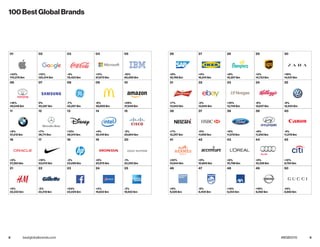
100 Best Global Brands
01
+43%
170,276 $m
26
+8%
18,768 $m
11
+9%
37,212 $m
36
+7%
12,257 $m
06
+16%
49,048 $m
31
+7%
13,943 $m
16
+5%
27,283 $m
41
+22%
10,944 $m
21
+5%
22,222 $m
46
+9%
9,526 $m
02
+12%
120,314 $m
27
+4%
16,541 $m
12
+7%
36,711 $m
37
-11%
11,656 $m
07
0%
45,297 $m
32
-3%
13,940 $m
17
+16%
23,070 $m
42
+9%
10,800 $m
22
-3%
22,218 $m
47
-8%
9,400 $m
03
-4%
78,423 $m
28
+8%
15,267 $m
13
+13%
36,514 $m
38
+6%
11,578 $m
08
-7%
42,267 $m
33
+10%
13,749 $m
18
-3%
23,056 $m
43
+6%
10,798 $m
23
+54%
22,029 $m
48
+14%
9,254 $m
04
+11%
67,670 $m
29
+2%
14,723 $m
14
+4%
35,415 $m
39
+8%
11,293 $m
09
-6%
39,809 $m
34
-6%
12,637 $m
19
+6%
22,975 $m
44
+5%
10,328 $m
24
+3%
19,622 $m
49
+19%
9,082 $m
05
-10%
65,095 $m
30
+16%
14,031 $m
15
-3%
29,854 $m
40
-4%
11,278 $m
10
+29%
37,948 $m
35
-9%
12,545 $m
20
-1%
22,250 $m
45
+12%
9,784 $m
25
-3%
18,922 $m
50
-14%
8,882 $m
10 11bestglobalbrands.com #BGB2015
51
+5%
8,632 $m
76
+17%
5,551 $m
61
+15%
6,870 $m
86
+16%
5,130 $m
56
+12%
8,055 $m
81
-5%
5,365 $m
66
+6%
6,306 $m
91
-7%
4,629 $m
71
-9%
6,033 $m
96
+3%
4,270 $m
52
+7%
8,588 $m
77
+7%
5,533 $m
62
-8%
6,811 $m
87
+14%
5,109 $m
57
+6%
7,924 $m
82
New
5,362 $m
67
+16%
6,266 $m
92
-6%
4,540 $m
72
-12%
5,976 $m
97
New
4,251 $m
53
-1%
8,553 $m
78
-12%
5,530 $m
63
-12%
6,583 $m
88
+15%
4,952 $m
58
-5%
7,702 $m
83
+2%
5,208 $m
68
+17%
6,257 $m
93
+2%
4,456 $m
73
+5%
5,873 $m
98
New
4,243 $m
54
+10%
8,498 $m
79
+14%
5,460 $m
64
+6%
6,509 $m
89
+14%
4,822 $m
59
+17%
7,243 $m
84
+6%
5,161 $m
69
+4%
6,222 $m
94
-4%
4,407 $m
74
+5%
5,666 $m
99
New
4,131 $m
55
+3%
8,464 $m
80
+6%
5,391 $m
65
+2%
6,436 $m
90
-7%
4,763 $m
60
+12%
7,083 $m
85
+2%
5,133 $m
70
+13%
6,097 $m
95
-7%
4,330 $m
75
-7%
5,639 $m
100
New
4,114 $m
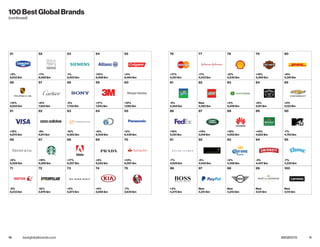
100 Best Global Brands
(continued)
12 13bestglobalbrands.com #BGB2015
Best
Global
Brands
2015
Insights
14 15bestglobalbrands.com #BGB2015
There are some clear, common
hallmarks among this year’s Top 100
that show what it takes to keep pace
with today’s consumers and secure a
place among the Best Global Brands.
Clarity of Strategy and Focus
on Structure
Clarity is a sure source of strength. In
order to be coherent, efficient, and meet
consumer expectations, top-performing
brands lean on an ambitious vision that
shapes both behaviors and structures.
Focus has been a driving force for top
riser Nissan, which has embarked on
ongoing integration efforts. Armed
with a clear vision for the brand,
disseminated by its Global Marketing
leaders, the company has united its
divisions and agency partners in order
to deliver on its product promise, while
designing business strategies to engage
contemporary consumers in global
markets.
Clarity doesn’t come just from within:
Today’s savvy brands benefit from
tapping into their consumers too. Top
riser 3M—known for everything from
Scotch tape to circuits—asked its
employees, as well as 15,000 customers
in 15 countries, to help define its new
brand platform, “3M Science. Applied
to Life.” It has driven clear growth
strategies: It’s focused on increasing
R&D spends, divesting lagging
businesses, and developing storied
content to create product-awareness
among its global, under-35 targets.
A central purpose is particularly crucial
for diversified companies. Microsoft’s
CEO Satya Nadella set a bold ambition
to “reinvent productivity to empower
every person and every organization
on the planet to do more and achieve
more.” Microsoft brought together its
Windows and devices organizations
to align its engineering structure to
its strategy, along with its commercial
cloud—a move that’s grown revenue by
88 percent, driven by Office 365, Azure,
and Dynamics CRM Online.
From strategy to structure, successful
brands are streamlining and integrating
their operations for greater agility
and focus.
Relentless Customer-Centricity
As brands gain focus, that focus is ever
more zeroed-in on the customer. For
perennial Top Ten brands like Apple,
Facebook, and Amazon, customer-
centricity is built into their DNA. But
many brands are continuing to evolve
by developing design-led strategies that
place customers at the core.
Hallmarks of the
2015 Best Global Brands
By Paola Norambuena, Chief Content Officer
Among this year’s Best Global
Brands, it’s those moving at the speed
of life that are accelerating. A review
of this year’s report reveals some
key insights—especially among new
entrants and top risers. Brands across
all categories are not only adopting
innovative technologies, but also
embracing holistic change in order
to become stronger, faster, and
more agile.
16 17bestglobalbrands.com #BGB2015
In its first year as an independent
entity, PayPal breaks into the Best
Global Brands report with the continued
mission of “powering the people
economy.” Simplicity, security, and ease
of use are priorities that have been
internalized because they are central
concerns for the company’s users—
particularly sellers. PayPal is investing in
seamless technologies like mobile and
contactless payments and acquiring
user-friendly platforms like Braintree
and Venmo. For PayPal, it’s not just
about meeting consumer needs, but
letting those needs power the
business strategy.
This outside-in approach is being
adopted by other breakthrough brands.
LEGO brand, which made its Best
Global Brands debut this year, taps
into a rising “maker” ethos, popularized
by tinkerers of all types. “LEGO Ideas”
invites LEGO brand enthusiasts to
create, document, and crowdshare their
own projects, with the chance of seeing
them on shelves. The platform is an
innovative tool for bringing customers
closer to the business—and gathering
valuable insights.
It’s these authentic interactions that
today’s savvier consumers seek as they
cull through the crowd of brands vying
for their attention. For heritage brands
like Hermès, which soared 22 percent
in brand value this year, authenticity
manifests in an unshakable devotion
to craftsmanship, quality, and enabling
customers to “indulge in moments
of pure lightness.” Hermès recently
appealed to a new digital generation by
partnering with the bastion of customer-
centricity, Apple, to unveil the Apple
Watch Hermès.
Tech-Powered Personalization
While technology paves the way for
innovation, brands across all industries
are harnessing its power to create
unprecedented, personal experiences.
Adobe has become a partner in
personalization by developing leading-
edge tools that empower brands to
create experiences tailored to their own
customers. Its Experience Manager
Screens and Adobe Target platforms
harness cloud connectivity and location-
targeting technologies to cater directly
to individuals as they move through the
buying funnel.
Technology is also proving a force for
cross-industry collaboration. Rising
brands in all categories are partnering
with tech giants to connect with
customers in groundbreaking ways.
Auto brand Toyota harnesses Google’s
powerful API to push city-specific
messaging into geo-targeted banner
ads. Toyota also extends its influence
from behind the wheel and into
drivers’ daily lives as it joins Panasonic
to develop its cloud-connected
Smart Center.
Technology isn’t just relegated to the
cloud. While many of the Top 100 brands
are tapping technologies to create
innovation, others are using technology
in innovative ways. Moët & Chandon
rises back onto the Best Global Brands
report, buoyed by efforts to keep its
image fresh. It reinforced its place in
the nightlife scene with “Bright Night,”
the first-ever luminous champagne
bottle, which demonstrates how even
the most distinctive brands can adopt
simple technologies to captivate and
delight consumers.
Clarity, customer-centricity, and
using technology to power personal
experiences—all hallmarks of the
brands that have made the most
impressive strides this year. As each
demonstrates, there is no singular
template for building a great brand, but
it’s enlightening to see how these broad
characteristics manifest as individual
brands evolve at the speed of life.
Paola Norambuena
Chief Content Officer
paola.norambuena@interbrand.com
18 19bestglobalbrands.com #BGB2015
Highlights: Top Risers User-centricity is Part
of Their DNA
This year’s fastest risers—Apple
(+43%), Facebook (+54%), Amazon
(+29%), and Adobe (+17%)—are brands
that have evolved around their users.
A deep understanding of how people
live, work, and interact is embedded
in their products, services, and brand
message. With user-centricity at the
core, these brands have been able
to grow their audiences quickly and
iterate their offerings based on
evolving demands.
Expanding Around a Core
Product or Service
The Top Risers’ burgeoning brand
value is tied to a specific type of
growth—one that starts with a strong
central offer and builds products or
services around that. Adobe (+17%) has
spawned software, cloud services, and
a suite of apps that all relate back to its
core creative platform. Premium coffee
purveyor Starbucks (+16%) is expanding
its brand and growing its global
footprint, with new offerings and menu
options that build upon its original café
experience. For all Top Risers, a strong
brand proposition has been grounds
for accelerated growth.
Creating Holistic Brand
Experiences
Brands climbing up the value chain
are those creating experiences that
reinforce the brand in multiple contexts.
The technology brands that dominate
the Top Risers list are naturals at
this—they have the scope, scale, and
capability to embed themselves in users’
daily lives. But even heritage brands
like Hermès—up a soaring 22 percent
from last year—are investing in out-of-
store experiences and emotion-driven
campaigns that invite customers to
engage with the brand.
20 21bestglobalbrands.com #BGB2015
Top riser Facebook, for example, has
succeeded in changing the way people
around the world connect and stay in
touch, while new entrant PayPal has
evolved the way people and businesses
transact. The ability to influence actions
relies not only on an innovative offer, but
on communicating the value or benefit
of that behavioral change to the market.
There are several factors at play, which
imbue the top technology brands with
significant sway over people’s behaviors.
1. Expansive Addressable Markets
The most formidable asset that top
technology brands possess is the
size of their addressable markets.
It’s predicted that 70 percent of
the world’s population will own
smartphones by the end of 2016,
for example. So whether you’re a
device maker, chip manufacturer,
or network facilitator, the market
potential is huge.
Many of the top technology brands
also benefit from a low barrier to
entry, especially in comparison to
sectors like automotive and luxury.
Anyone can get into a relationship
with Google, Apple, Facebook, or
Amazon for free—or close to it—
allowing these brands to grow their
user bases with relative ease.
The accessibility and reach of
technology brands on the consumer
side also fuel growth on the
enterprise side, as the number of
connected users contributes to the
burgeoning big data pool and the
ever-billowing cloud. Even long-
standing technology brands like
Intel, founded in 1968, have kept well
afloat in the face of waning PC sales
across the industry by refocusing on
data center innovations and cloud
computing.
2. Geared for Rapid Growth
Technology brands don’t only benefit
from broad markets, but an inherent
ability to evolve more rapidly than
other, more entrenched brands. The
resources that the top technology
brands have amassed, along with the
relative lack of industry regulation
(compared to the healthcare or auto
sectors, for example), allow them to
reinvent their products or services
with greater ease. Improvements
to software can happen quickly,
requiring minimal input from their
customer bases—testing and
iterating ideas is core to the ethos
of these brands.
Technology: The Game-
Changing Sector
By Antoine Veliz, Chief Experience Officer and
Forest Young, Senior Creative Director
The 13 technology brands in this
year’s Best Global Brands report
represent more than a third (33.5
percent) of the table’s USD $1.7
trillion total, making technology
this year’s leading sector by value.
Today’s top technology brands have
gone beyond the introduction of a
successful product or service—they
have delivered on the true measure
of innovation: the ability to change
the behaviors of the many.
22 23bestglobalbrands.com #BGB2015
Built-in agility gives technology
brands the advantage of being able
to pivot into different product or
service categories as they evolve
along with people’s needs and
expectations. This is illustrated
by successful startups like Uber,
which has evolved from a car hailing
app into a provider of multiple
services. Furthermore, these fast
moving technology brands are not
just catering to people’s needs but
raising the bar for what’s possible—
not just meeting but setting the
speed of life.
3. Seizing More Than the Moment
Technology brands are ones
with which we interact in multiple
contexts, many times per day. As
the top technology brands move
beyond their core product or service
and into our homes and vehicles,
they’re also partnering with larger
platform brands and developing
multitiered relationships with users
that span the ingredient, interface,
and infrastructure levels. These
relationships grant brands access
to much more than our phones.
Some of these brands work
as ingredient brands in select
contexts as well as master brands
commanding their own experiences.
The ability to do both demonstrates
the strength of the platforms and
propositions they have been able
to build. Top brands demonstrate
that their technology is no longer
something that exists simply on our
desktops and in our pockets—it’s the
thread that connects almost every
context of our lives.
Following the Tech Leaders
Organizations in any category can follow
the lead of Apple—number one for
the third year in a row—by developing
product strategies with a succinct brand
proposition to center their business.
Adobe’s understanding of how people
work, both across organizations and at
home, has lead to an expanded service
portfolio that goes up the value chain in
the enterprise sector and gets closer to
the user through a suite of mobile apps.
Few have leveraged their core service
platforms like Amazon, however. What
was created as a shopping platform
now powers content and entertainment
services, and the lessons learned in
building that platform gave way to a
successful cloud service business.
The success of these businesses and
the strength of their brands have driven
growth beyond the technology realm.
Brands in all sectors of this year’s report
are embracing technology brands as
business partners, platforms, or both.
Finance and retail brands, for example,
are placing their bets on technology
brands’ mobile payment solutions (e.g.,
Apple Pay, Android Pay, Samsung Pay),
while automakers are enhancing their
in-car experiences with connected
services like Apple’s CarPlay.
Pointing Toward the Future
Top technology brands have also
become the savviest of marketers by
harnessing the equity built into their
brands to hint at what lies beyond their
current products and services. Many
have seeded their next big bets publicly,
preparing audiences for what may
come next or positioning themselves as
visionaries.
As technology becomes more a mirror
of the self, developments will continue to
evolve around automation. New entrant
Lenovo, for example, has moved beyond
the PC world with a slew of new smart
products—from watches to shoes—
powered by the open-innovation cloud
platform that the brand itself is helping
to develop.
Automation extends to our very
thinking with advancements in artificial
intelligence (AI). The leading technology
brands are harnessing AI to develop
deeper interface dependencies—
Amazon with Alexa, Apple with Siri,
and Facebook with M. Emerging AI is
getting even smarter, more anticipatory,
and anthropomorphic, with the ability to
develop more intimate relationships
with users.
From human to superhuman—AI has the
potential to not just enhance individuals’
lives, but to advance the capabilities of
an enterprise, as we’ve seen with the
continued applications of IBM’s Watson.
The concept of “privacy exchange”—
trading personal information for
perceived value—may also have a
watershed effect on the amount of data
people expose, which will allow AI to
become more nuanced, while putting
pressure on more brands to develop
AI as part of their own ecosystems.
Locking the Top Spot
Four of the Top Risers in this year’s
Best Global Brands report illustrate the
acceleration of the technology sector:
Facebook spiked 54 percent, Apple
jumped 43 percent, Amazon rose 29
percent, and Adobe is up 17 percent.
It is difficult to imagine brands outside
of the tech sector enjoying the same
speed of growth and performance that
our top brands are. Their combination
of reach, culture, and integration –
along with their position as harbingers
of what’s to come – will keep the top
spot locked up for some time.
Contributors:
Antoine Veliz
Chief Experience Officer
antoine.veliz@interbrand.com
Forest Young
Senior Creative Director
forest.young@interbrand.com
24 25bestglobalbrands.com #BGB2015
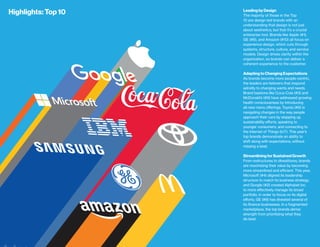
Highlights: Top 10 Leading by Design
The majority of those in the Top
10 are design-led brands with an
understanding that design is not just
about aesthetics, but that it’s a crucial
enterprise tool. Brands like Apple (#1),
GE (#8), and Amazon (#10) all focus on
experience design, which cuts through
systems, structure, culture, and service
models. Design drives clarity within the
organization, so brands can deliver a
coherent experience to the customer.
Adapting to Changing Expectations
As brands become more people-centric,
the leaders are listeners that respond
adroitly to changing wants and needs.
Brand bastions like Coca-Cola (#3) and
McDonald’s (#9) have addressed growing
health consciousness by introducing
all-new menu offerings. Toyota (#6) is
navigating changes in the way people
approach their cars by stepping up
sustainability efforts, speaking to
younger consumers, and connecting to
the Internet of Things (IoT). This year’s
top brands demonstrate an ability to
shift along with expectations, without
missing a beat.
Streamlining for Sustained Growth
From restructures to divestitures, brands
are maximizing their value by becoming
more streamlined and efficient. This year,
Microsoft (#4) aligned its leadership
structure to match its business strategy,
and Google (#2) created Alphabet Inc.
to more effectively manage its broad
portfolio. In order to focus on its digital
efforts, GE (#8) has divested several of
its finance businesses. In a fragmented
marketplace, the top brands derive
strength from prioritizing what they
do best.
26 27bestglobalbrands.com #BGB2015
These are significant stats for an
industry that is often seen as sluggish
and which faces major challenges
moving forward, due to evolving
customer expectations and the
changing role of driving.
	
An analysis of the 15 automotive brands
in this year’s Top 100 offers key insights
on why they’re holding strong—and
what they need to do to stay on top.
Auto Brands are Fueled by Broad
Markets and Vast Economic Impact
The auto industry is huge, with more
than 60 million (and counting) cars
sold this year, and is still cycling off
levels that predate the financial crisis.
For many buyers, cars are more than
a mode of transportation: they are
emotional investments, status symbols,
or even a source of livelihood.
Auto companies also serve an
increasingly large segment of the
world’s population. Generating high
returns and massive sales, they’ve
become the backbone of both global
and local economies. Though they are
being consolidated on the holding-
company level, giving them truly global
scope, there are still many major, distinct
brands, pulling millions of dollars in
sales each year.
In emerging markets, the ambition to
own a car is growing. A large part of
the world’s population has remained
carless, but as the middle class rises,
brands such as Nissan, Ford, and
General Motors are expanding into new
regions like India, China, and Brazil. In
these newly developing areas of the
world, automotive companies’ existing
business models will likely still be
relevant in 20 years, but in developed
countries, staying competitive will call
for significant evolution. Automotive
companies will need to continue to
invest in technological advancements
to keep up with new and existing drivers
who are preparing themselves for the
next phase of mobility.
Differentiation and Relevance
Will Drive Continued Success
for Auto Brands
As brands across the board become
more focused on individuals’ needs, the
auto sector—with its especially broad
market—faces two distinct challenges:
differentiation and relevance. Auto
brands used to be highly differentiated,
but now buyers are more interested
in individual models and how those
vehicles fit into their lives. With so
much information at consumers’
fingertips, brand awareness is not
enough—organizations need to not only
innovate products but to create a truly
differentiated brand experience.
Top Ten brand Toyota, for example,
Automotive: Making Inroads
Into Mobility’s Future
By Daniel Binns, Executive Director, Global Brand Engineer
Over the past few years, automotive
companies have made major strides
in terms of technology, innovation,
and sustainability. And with 15 brands
represented in this year’s Best Global
Brands report, auto is the dominant
sector by number. Together, auto
brands make up 13.7 percent (USD
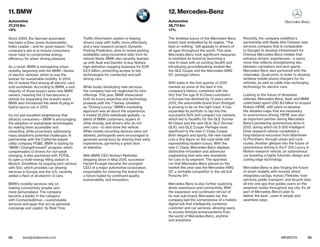
$234,439 million) of the table’s total
value, second only to the technology
sector in collective worth.
28 29bestglobalbrands.com #BGB2015
is tapping into smart technologies like
its Intelligent Transportation System
(ITS), which enables the real-time
exchange of data between vehicles
and infrastructures. And Korean brand
Hyundai is figuring out how to tailor
its brand message to diverse global
audiences by creating localized social
media experiences that enhance
individuals’ interactions with the brand.
As the average age of new car buyers
climbs to 51.7 (according to Auto News)
and the number of driver’s license
applications among millennials declines,
there is a concern about decreasing
relevance within the automotive sector.
In the race to increase their presence
in people’s lives, connectivity is key,
as carmakers integrate with customers’
devices, homes, and things. Relevance
also means rolling with changing
preferences—automotive brands must
learn how to harness new technologies
to anticipate the needs of diverse drivers.
The Future of the Auto Sector
Revolves Around Ownership
and Mobility
To do this, auto companies must shift
their focus from selling products to
delivering a service, as driving itself
begins to look different. As the current
car-buying generation begins to retire,
how will the behaviors of upcoming
generations of buyers change? Major
shifts in this sector will revolve around
two pillars: ownership and mobility.
Car ownership might not be as relevant
in the future as conversations evolve
around fractional (i.e., shared) ownership
models and ride-sharing grows with
increasing speed. Since its launch in
2010, for example, Uber’s staggering
statistics reveal that it now has more
than eight million users in over 290
cities around the world and is expected
to process USD $10.84 billion in
bookings in 2015. In its home city of
San Francisco, Uber is now tripling
the revenue of the local taxi market,
at about USD $500 million per year.
Major auto brands like Mercedes-Benz
and Ford are also beginning to enter and
experiment in the ride-sharing space.
Nissan likewise announced plans to
supply cars to college students through
a campus car-sharing venture with
Enterprise Rent-A-Car.
While many auto companies are
harnessing new vehicle technologies
to stay ahead of the curve, a true test
of innovation is whether or not these
advancements can actually change
driving behaviors. In an attempt to lead
the driverless-car revolution, Mercedes-
Benz, Audi, and BMW collectively
spent USD $3 billion to acquire Nokia’s
Here, a service comparable to Google
Maps. The auto sector also faces
the impending entry of nontraditional
car manufacturers—Apple’s Project
Titan and Google’s self-driving car
project both represent strategic
investments by technology giants in
autonomous driving’s future. While
increasingly feasible, the large-scale
adoption of autonomous driving rides
on major regulatory considerations and
customers’ behavioral shifts.
In the meantime, however, auto brands
are also working toward the future of
smart mobility. Mercedes-Benz, for
example, has adopted moovel, which
integrates car2go, mytaxi, Flinkster, train
services, public transport, and bicycle
data all into one simple app that guides
users on the smartest path through
any city.
In a letter to Business Life, economist
Ross Parker wrote, “I would not be
surprised if today’s car becomes
tomorrow’s horse: a recreational
pleasure, sporting discipline, and an
increasingly rare sight on the road.” This
prescient view underlines the changing
role of vehicles, as cars move away
from being functional necessities to
becoming tech-enabled extensions of
personality, shareable assets, or even
sources of entertainment. Powerful
automotive brands will have to take a
more holistic view of mobility to maintain
their stronghold and balance their
strategies to meet desires in diversified
markets that are moving at much
different speeds.
Contributors:
Daniel Binns
Executive Director,
Global Brand Engineer
daniel.binns@interbrand.com
Andrew Martschenko
Senior Director, Strategy
andrew.martschenko@interbrand.com
Calin Hertioga
Director, Brand Valuation
calin.hertioga@interbrand.com
Sabine Ruchty
Strategy Director
sabine.ruchty@interbrand.com
30 31bestglobalbrands.com #BGB2015
Highlights: New Entrants
Leveraging What They’re Loved For
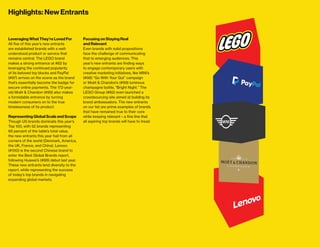
All five of this year’s new entrants
are established brands with a well-
understood product or service that
remains central. The LEGO brand
makes a strong entrance at #82 by
leveraging the continued popularity
of its beloved toy blocks and PayPal
(#97) arrives on the scene as the brand
that’s essentially become the badge for
secure online payments. The 172-year-
old Moët & Chandon (#99) also makes
a formidable entrance by turning
modern consumers on to the true
timelessness of its product.
Representing Global Scale and Scope
Though US brands dominate this year’s
Top 100, with 52 brands representing
66 percent of the table’s total value,
the new entrants this year hail from all
corners of the world (Denmark, America,
the UK, France, and China). Lenovo
(#100) is the second Chinese brand to
enter the Best Global Brands report,
following Huawei’s (#88) debut last year.
These new entrants lend diversity to the
report, while representing the success
of today’s top brands in navigating
expanding global markets.
Focusing on Staying Real
and Relevant
Even brands with solid propositions
face the challenge of communicating
that to emerging audiences. This
year’s new entrants are finding ways
to engage contemporary users with
creative marketing initiatives, like MINI’s
(#98) “Go With Your Gut” campaign
or Moët & Chandon’s (#99) luminous
champagne bottle, “Bright Night.” The
LEGO Group (#82) even launched a
crowdsourcing site aimed at building its
brand ambassadors. The new entrants
on our list are prime examples of brands
that have remained true to their core
while keeping relevant—a fine line that
all aspiring top brands will have to tread.
32 33bestglobalbrands.com #BGB2015
Legacy Brands: Keeping Long-
Standing Brands Relevant
in the Digital Age
By Rebecca Robins, Director of Marketing and
Business Development, EMEA & LatAm
The buzz around rising brands
and new entrants has focused on
the technology sector, where the
leading brands are characterized
by their relative youth and agility.
However, youth is by no means
the universal new pretender, and
agility is not the exclusive domain
of young brands. Long-standing
brands combine legacy and
customer focus to create real
resonance and relevance.
To illustrate, half of the Top 10 brands
on this year’s Best Global Brands report
are more than 50 years old—and three
of those are well past the century
mark (Coca-Cola, IBM, GE). Aside from
PayPal, which debuted after its break
from eBay this year, the report’s New
Entrants are all well established—most
notably Moët & Chandon, founded
in 1743.
In a recent op-ed published by The
Guardian, I explore the ways in which
some of the world’s top brands are
harnessing their rich heritage to
remain both prescient and timeless.
Legacy brands are back. In the
vernacular of luxury, you might say
they are the new black. When Apple
surpassed Coca-Cola three years ago
to take the #1 spot in Interbrand’s Best
Global Brands study, it triggered a
cascade of commentary on the rise of
brands born of a new and different age.
However, delve deeper into the study
and what’s fascinating is the ascent of
brands that have spanned generations.
New entrants this year feature 60s icon
MINI, revving in at #98; the LEGO brand,
an exemplar of creativity born from the
constraint of a depression, with an
awesome arrival at #82 and Moët &
Chandon, at #99, one of the oldest
brands in the LVMH portfolio which
dates back to the 18th century.
Moët & Chandon also tops the five
oldest brands in the list (accompanied
by Colgate, Citi, AXA and Hermès) which
span a combined legacy of over 1000
years. AXA breaks into the top 50 Best
Global Brands this year and Hermès,
one of the top five risers in the report,
increased its brand value by 22 percent.
The five youngest brands, by contrast,
(Facebook, Google, PayPal, eBay, and
Amazon) haven’t yet amassed a century
between them.
34 35bestglobalbrands.com #BGB2015
Interbrand’s 2015 Best Global Brands
report examines what it takes for brands
to succeed in a hyper-fragmented
world. As brand experiences that are
both immediate and personalised are
expected by consumers, business and
brands need to move fast in order to
keep pace. The success of a brand
has little to do with a brand’s age, but
everything to do with its ability to stay
relevant. The question is, what are these
legacy brands doing to stay relevant?
A common theme is that they have
user-centricity at their core. They are
using tech to connect with customers in
more meaningful ways. Ultimately they
are succeeding in providing ever more
integrated experiences for consumers,
and blurring the boundaries of traditional
sectors of business as they go.
Consider The LEGO brand. It’s a
truly great example of a brand whose
original vision from 1932 has stretched
beautifully into the 21st century. The
journey from toy brand to entertainment
brand has been driven by the LEGO
brand embedding innovation at its core
and its fusing of the physical and digital.
An even more fascinating movement
among the legacy brands is the
movement across brands—the “brand
tangos” that boost their reputations
through collaboration. Think the Apple
Watch Hermès cross-over. Legacy
brands are tapping into tech brands
to increase awareness and connect
with consumers. Tech brands are
tapping into legacy brands for their
heritage and exclusivity.
The resulting blurring of boundaries
increasingly calls into question whether
we will even be defining brands by sector
in years to come. Consider Apple’s reach
into the traditional domain of financial
services with Apple Pay.
Collaborations in various manifestations
will continue to rise, as brands look to
complementary capabilities to exert
their influence and desirability. Just this
week, the newly combined Yoox Net-A-
Porter climbed on its first listing on the
Milan stock exchange, and LVMH (owner
of Louis Vuitton and Moët & Chandon)
has asserted a serious commitment to
e-commerce. At the same time, Hugo
Boss is accelerating the cutting of its
e-commerce cloth and Condé Nast is
planning to enter the fray with the hotly
anticipated e-commerce venture Style.com.
The level of sophistication needed for a
brand to maintain its presence as one of
the world’s most highly valued is not to
be underestimated—but the principles of
success are fundamental. A brand needs
to evolve constantly to stay relevant but
it also needs a centre of gravity, a clear
vision and a commitment to stay true to
the core of its DNA. A brand still has to
find a place in our hearts and minds.*
*Re-printed from theguardian.com
The success of legacy brands also
points to a trend in consumers’ tastes:
As individuals’ ecosystems become
saturated, those seeking the brands
they can trust gravitate toward
authenticity. Legacy brands with a
strong identity, who consistently bring
the experience of their brand alive for
consumers, are poised to stand out. In
the Age of You, heritage that strikes the
right chords of resonance and relevance
can be a powerful asset.
Rebecca Robins
Director, Marketing and Business
Development, EMEA & LatAm
rebecca.robins@interbrand.com
@robins_rebecca
Rebecca is Interbrand’s expert on luxury,
and co-author of the book Meta-luxury:
Brands and the Culture of Excellence.
Citation
Rebecca Robins, “Keeping long-standing brands
relevant in the digital age,” The Guardian, 9
October 2015, http://www.theguardian.com/media-
network/2015/oct/09/brands-relevant-digital-age
36 37bestglobalbrands.com #BGB2015
Best
Global
Brands
2015
BrandProfiles
38 39bestglobalbrands.com #BGB2015
“If you don’t cannibalize yourself, someone
else will,” Steve Jobs once notably
remarked. In the past year, Apple has again
held true to this belief, as it continues to
outdo its existing products and launch all-
new ones. The Apple ecosystem expanded
exponentially throughout 2015, along with
its customer-centric focus, as reflected by
a 43 percent rise in brand value this year.
Apple’s ambition to be a part of all facets
of people’s lives has left few industries
untouched—it’s created a huge ecosystem
that keeps players big and small vying
for access. Apple continues to cultivate
partnerships—particularly in the auto
industry, for example, with its connected
CarPlay system—while staying ahead
of the pack. Its next (literal) big thing is
Project Titan: a fully connected electric
car, rumored for release in 2019.
The company doesn’t rest on its laurels
when it comes to new products and
innovation—its proved prolific with a list
of releases that include Apple Proactive,
Apple Pay, Home app, iOS9, OS X El
Capitan, Apple Watch, Live TV, 3D Touch,
iPhone financing, and Apple Music. The
new tvOS iteration of Apple TV stands
to change how people consume content,
and Apple is exploring the possibility of
creating original programming. Its personal
assistant, Siri—which continues to rival
Facebook’s M and Microsoft’s Cortana—
is about to acquire a sixth sense: Apple
Proactive will deliver super-personalized
services, tailored to users’ daily lives.
Apple’s relentless focus on the user is
embedded in its very core, while the
brand’s design sensibility runs across
every touchpoint. People have become
central to much of its marketing, as Apple
weaves its products into users’ personal
stories, exemplified by Apple Music’s
“Instant Boyfriend Mixtape” commercial
spot that aired during the 67th Primetime
Emmy Awards. In its recent iPhone spots,
“Loved” and “Hardware & Software,”
Apple speaks directly about the merits
of its product and its benefits to the user,
claiming “If it’s not an iPhone, it’s not an
iPhone.” Apple Stores will be getting a
radical overhaul under the direction of
Chief Design Officer Sir Jonathan Ive.
Apple also strives to make people feel
more secure. Its seamless mobile shopping
service, Apple Pay, features biometric
thumbprint technology that offers several
layers of security beyond a credit card.
The brand is also prioritizing users’
privacy as it innovates: Apple Proactive,
for example, gathers data from the phone
itself, rather than the cloud.
What keeps Apple so far ahead of its
rivals—and perhaps poised to become
the world’s first trillion-dollar brand—is its
instinct to constantly renew and challenge
convention. Apple understands what it
takes to accelerate to the top—and keep
its number one spot.
1. Apple
Technology
170,276 $m
+43%
40 41bestglobalbrands.com #BGB2015
Nearly two decades after hitting the Web,
Google has certainly diversified from its
original role as an Internet search engine.
In addition to products like Android,
Gmail, and Maps, which have enhanced
its core business, the company has taken
moonshots to heart, investing in driverless
cars, high-speed Internet, and home
gadgets—to name just a few.
While these efforts have garnered high
media attention, Google’s broad portfolio
has historically made it difficult for analysts
to figure out how the core business is
really doing, leading investors to express
concerns. Over the past year, it’s become
clear that the company is paying attention.
During July’s earnings news call, Wall
Street veteran Ruth Porat made her
public debut as the company’s new CFO,
fresh off a successful stint as CFO at
Morgan Stanley. The day after the call,
Google shares saw an approximate USD
$60 billion gain in market capitalization,
marking the biggest one-day rise in market
value for any company ever, and prompting
the New York Times to declare that
Google, which has long fostered an image
as the cool kid in the room, finally had
“adult supervision.”
One month later, Google again made
headlines when it announced a new
operating structure, which enables
Google’s many businesses to prosper
independently under strong, dedicated
leadership. Under Alphabet Inc., the
newly created holding company, Google
is the biggest subsidiary, representing
the brand’s core offerings—search,
Web advertising, Gmail, Android, Maps,
YouTube, and Chrome. Other businesses
owned by Alphabet include the company’s
more ambitious projects, such as Google
X, Calico, Nest Labs, Google Ventures,
and Google Fiber. Google cofounder Larry
Page will be in charge of Alphabet, while
Sundar Pichai, who was Page’s number
two, will take over the “new Google.”
This clarity around Google’s businesses is
expected to bolster the brand’s reputation
as much as it’s expected to boost financial
performance. A commitment to innovation
has made Google more than the accepted
verb for online search, but a name that
evokes technology’s potential to achieve
what once seemed impossible. Larry
Page and Sergey Brin don’t just want
to make cars and homes that can run
themselves, they want to help humans live
without disease and cheat death. That’s
a lot for one brand to take on. If they can
achieve even part of that dream, they’ll
cement Google’s place in history and
launch a whole new roster of offerings
that become integral to people’s lives.
2. Google
Technology
120,314 $m
+12%
42 43bestglobalbrands.com #BGB2015
When the celebrated TV series Mad Men
wrapped up earlier this year, viewers were
left with an iconic moment of marketing
genius: Coca-Cola’s “Hilltop” ad. The 1971
commercial, which features a multicultural
mix of youths singing “I’d like to buy the
world a Coke,” speaks to a simpler time
for America—and for the brand.
Now, the world’s biggest beverage
brand is trying to recapture that magic
for millennials through its “Share a Coke”
campaign, a global marketing initiative
that began in Australia in 2011. The
personalized bottles were so successful
in the U.S. in 2014 that the campaign was
expanded this year. In September 2015,
Coca-Cola teamed up with Twitter to
create a custom emoji—two Coke
bottles clinking—that appeared in tweets
bearing the hashtag #ShareaCoke. The
result: a record 170,500 mentions over
a 24-hour period.
Few companies can harness the emotional
horsepower that Coca-Cola can. The
challenge, instead, for the 129-year-
old beverage giant is that sales of cola
and its carbonated cousins have been
declining over the past decade amid health
concerns. As a result, the company has
broadened its array of lower-calorie and
lower-sugar sodas, introduced smaller
container sizes, and added healthier
beverages to its brand portfolio, ranging
from iced tea to coconut water.
Coca-Cola also spent almost USD $120
million over the past five years to fund
health and wellness programs—as well
as on research that drew criticism for
downplaying the role of sugary drinks in
causing obesity. Coca-Cola’s commitment
to corporate citizenship and sustainability
has earned praise, especially for its
leadership in water conservation. Coca-
Cola and its bottlers at Coca-Cola
Enterprises say they will reach their 2020
goal of replenishing 100 percent of the
water they use by the end of this year—
five years early. The initiative helped Coca-
Cola Enterprises earn its first spot in the
Dow Jones Sustainability Index this year.
Despite its slight decline in brand value
in this year’s report, Coca-Cola stands
firm at number three—a true marketing
juggernaut and a favored global brand.
3. Coca-Cola
Beverages
78,423 $m
-4%
44 45bestglobalbrands.com #BGB2015
Few leaders appreciate the difference
between size and influence like Microsoft
CEO, Satya Nadella. Since taking over
the top job in February 2014, Nadella has
brought a new direction and mindset—and
an increase of 11 percent, to USD $67.7
billion, in this year’s Best Global Brands
ranking.
This new Microsoft has partnered
with the likes Apple and Salesforce to
leverage each other’s strengths, putting
its own executives on stage at their big
events. The new Windows 10 platform
lets developers make apps that work
across different devices and migrate
what they’ve built for Android or Apple
devices into Windows with relative ease.
To make its ecosystem more desirable,
Microsoft is generating real excitement
with developments like its HoloLens 3-D
headset, which brings holograms to life
through Windows, and has teamed up with
Facebook-owned Oculus to let fans play
Minecraft on a virtual reality headset.
For its Windows 10 launch, Microsoft
adopted the theme of “Do great things.”
Reinventing the experience shows its
understanding of today’s digital lifestyle—
using technology to help the people
alongside it achieve everything from the
simple to the progressive. It celebrated the
five million fans that helped test the OS by
hosting events in cities around the world,
and partnered with retailers like Best Buy
to help users transition to the new OS.
Microsoft speaks to the future of humanity
via a brand campaign that features babies
and prompts people to imagine what the
future might be for them, given that they
will “grow up with Windows 10.”
Since Microsoft launched its new, aligned
identity, it has continued to drive greater
cohesion across the many Microsoft
experiences—and restructuring has
been a big part of this. Microsoft brought
together its Windows and devices
organizations in an attempt to align its
engineering structure to its strategy as
it began its 2016 fiscal year, resulting in
some leadership shifts. On the commercial
side, it’s bringing together its commercial
businesses with a focus on the cloud—a
move that’s grown revenue by 88 percent,
driven by Office 365, Azure, and Dynamics
CRM Online.
Nadella’s goal: to “Empower every person
and every organization on the planet to
achieve more.”
4. Microsoft
Technology
67,670 $m
+11%
46 47bestglobalbrands.com #BGB2015
IBM has remained an iconic leader at the
intersection of business and technology
for more than a century by continuously
reinventing itself. In doing so, it has
been guided by clarity about its role as
an enterprise innovation company. This
clarity–embedded in its business strategy,
culture, and brand message–has kept IBM
on the Top Ten list of Interbrand’s Best
Global Brands every year.
As the world’s leading business-to-
business brand, IBM has remained in
the Top Ten, but its position has fallen
a couple of notches, reflecting the
company’s struggles during its latest
major transition. Over the last few years,
IBM has transitioned its focus to data/
analytics, cloud computing, mobile, social,
and security. Although these strategic
imperatives have grown rapidly, they do
not yet represent the lion’s share of the
company’s profit, leading to 14 straight
quarters of declining revenue.
As the company’s transformation
continues, it has introduced a new,
branded point of view on the future of
technology and business, which it calls
Cognitive Business, featuring IBM’s
“Jeopardy!”-winning system, Watson. IBM
has pioneered perspectives on the future
of technology, about once every decade.
With the rise of the Web in the mid-1990s,
for example, IBM said that the Internet
would be about business, not browsing,
and its e-business strategy proved
prescient. In 2008, as devices proliferated
and computing became extended to
all manner of things, IBM presented its
vision of a Smarter Planet, empowered by
information and connectivity. Now, with the
emergence of artificial intelligence with
real-world applications, IBM introduces
what it calls the third age of information
technology: the cognitive era.
IBM sees cognitive computing as the
engine propelling the organization back to
the forefront of technology and business
innovation. Watson is, some believe, the
most humanlike computer ever built,
and its capacity to make sense of the
vast stores of “dark” data—80 percent
of what we are now generating—could
revolutionize entire industries. The first—
and arguably most important—industry
that Watson is tackling is healthcare. IBM
recently launched the Watson Health
business unit, and has systematically made
acquisitions, hired top talent, and formed
key partnerships to build this division.
IBM and CVS announced a partnership
in mid-2015 that could change the way
patients, practitioners, and pharmacists
give and receive care. The company
has also partnered with major oncology
researchers—from Memorial Sloan
Kettering Cancer Center, to MD Anderson,
to Cleveland Clinic, to the New York
Genome Center—to tackle the lofty goal
of curing cancer.
The technology behind Watson is
enhancing IBM’s capabilities across
the organization. Three cloud-based
services announced in 2014—IBM Watson
Discovery Advisor, Watson Analytics, and
Watson Explorer—have contributed to
a 70 percent revenue increase in cloud
computing in the first half of fiscal year
2015. IBM’s robust data and analytics
capabilities—along with partnerships with
companies like Apple, Twitter, Facebook,
and more—are helping the brand to
reassert its prowess.
For IBM, Watson may be the key
differentiator—the defining technology that
sets the global brand apart from a myriad
of competing innovators.
5. IBM
Business Services
65,095 $m
-10%
48 49bestglobalbrands.com #BGB2015
6. Toyota
Automotive
49,048 $m
+16%
With the launch of its Global Vision, Toyota
marked its evolution from a trusted,
high quality automotive brand to one
synonymous with innovation. Toyota aims
to lead the future of mobility through
product development, sustainability, and a
focus on people. Its value is up 16 percent
to $49 billion in this year’s Best Global
Brands ranking—impressive, especially
in the wake of a June airbag recall that
affected nearly 1.4 million of its vehicles.
Toyota has long been at the forefront of
environmental consciousness in the auto
sector. In 1997, it released the Prius, its
first mass produced gas-electric hybrid
car, and has since sold over eight million
hybrid vehicles, including 31 models
across the brand’s range. In September
2015, Toyota unveiled a sportier fourth-
generation Prius with standout features
to meet the demands of contemporary,
eco-conscious consumers: new automated
and intelligent safety packages, a more
comfortable and emotional design, and an
increase in target fuel efficiency, from 32.6
km/L to 40 km/L.
Looking towards the future of sustainable
mobility, Toyota focuses on super-efficient,
clean energy. Its zero-emissions Mirai
is the first hydrogen fuel cell electric
vehicle to top the 300-mile range. It’s
also attempting to bring fuel cell vehicles
(FCVs) to the broader market by granting
royalty-free use of approximately 5,680
of its globally held FCV-related patent
licenses, including pending applications.
To engage drivers, Toyota is tapping
into their universal sense of adventure.
Its global “Feeling the Street” campaign
allowed people to vote on their favorite
street musicians from around the world
and follow six winners on a New Zealand
road trip. It is also harnessing digital
platforms and geo-targeting technologies
to position its cars within the context of
peoples’ lives. In the U.S., for example,
Toyota targeted Los Angeles drivers with
videos launched in the “Live Story” feature
on Snapchat, and has partnered with
Google to customize ads in 15,000 U.S.
cities that inspire real-life, local adventures.
By embracing smart technologies, Toyota
is also making strides to both connect
and protect its customers. This year, it
will introduce an Intelligent Transportation
System (ITS) safety package to drivers
in Japan. ITS enables the real-time
exchange of data between vehicles and
infrastructures, which sensors don’t
pick up. Meanwhile, it’s partnering with
Panasonic to become a forerunner in
cloud-based connectivity. The Toyota
Smart Center will link people, cars, and
homes, with features like GPS-enabled
reminders to turn off your air conditioner.
This year, Toyota also joined the
autonomous driving race—with a focus on
technology that makes driving safer—by
funding new research centers at Stanford
University and the Massachusetts Institute
of Technology (MIT).
As the largest automobile company in the
world, Toyota’s pioneering initiatives could
have a significant impact on the ways in
which drivers experience their vehicles.
50 51bestglobalbrands.com #BGB2015
While the South Korean electronics giant
still dominates the global smartphone
market, Samsung has faced challenges
in the mobile sector this year. The brand
remains steady, supported by successes
in categories like semiconductors, Smart
TVs, and connected devices. Samsung
is moving forward with a focus on
creating products that define whole
new categories, and taking advantage
of B2B opportunities.
With increased competition from Apple
and lower-cost competitors in Asia,
Samsung’s mobile division profits fell 37.6
percent in the second quarter, compared
to the previous year. However, preliminary
Q3 reports predict an uptick for the
company, with overall revenues predicted
to rise 7.5 percent year-over-year, ending
its two-year decline. Samsung is also
enjoying the success of its semiconductor
unit, with second quarter profits at 3.4
trillion won, compared to 1.86 trillion won
last year. Samsung is now using its chips
in its own smartphones and supplying big
businesses like Apple, which will reportedly
tap Samsung to make chips for the next-
generation iPhone.
Samsung strives to stay competitive in
the mobile market with its Galaxy S6 and
S6 Edge smartphones—touting features
that rival the iPhone’s—and its phablets,
the Galaxy Note 5 and S6 Plus. It’s also
jumping on mobile payments with the
worldwide release of Samsung Pay, which
has an advantage over Apple Pay, as the
new Galaxy phones work with old-school
credit card readers, making the technology
more universal.
But for Samsung, newness is the key to
maintaining brand momentum for. Its global
“Next is Now” campaign built anticipation
around the launch of its Galaxy phones by
previewing its innovative features.
Ads aired during the 2015 Oscars
put a human spin on the cutting edge
technologies behind Samsung’s Galaxy
Note 5 and the SUHD TV—its highest-
definition set yet—highlighting how the
products fuel creative processes and
conversations. The ads align with a
company-wide commitment to proving that
digital innovation can enrich peoples’ lives.
Its ongoing “Launching People” campaign,
which shares the stories of people who
use Samsung products to turn their visions
not a reality, won seven awards at this
year’s Cannes festival.
Samsung is also tapping into the software
market through its Open Innovation Center,
with offices in South Korea, California, and
New York. The centers are hubs where
employees can scout start-ups to invest
in, team with, or acquire—Samsung is
the sole investor in start-ups that join its
accelerators. The brand is also angling
to become a leader in the expanding
Internet of Things. At the 2015 CES, it
pledged that 90 percent of all devices it
creates, including televisions and mobile
devices, will be Internet-enabled by 2017.
It’s proving a key player with launches
like the Gear S2, its seventh smartwatch,
AddWash, an Internet-connected washing
machine, SleepSense, a sleep tracker
that you slip under your mattress, and the
second-generation SmartThings home
automation hub and sensors.
By creating products that empower
people and broadening its business focus,
Samsung is looking towards a future that
goes well beyond smartphones.
7. Samsung
Technology
45,297 $m
0%
52 53bestglobalbrands.com #BGB2015
Over the past year, GE has remained
committed to extraordinary transformation,
shifting from a diversified conglomerate
with a large percentage of profits derived
from financial services, to a more focused
company, able to concentrate on defining
itself for a new age by becoming a “digital
industrial company.”
This focus is evident: Earlier this year, GE
strengthened its alliance with AT&T and
received extensive press coverage over
the USD $26.5 billion sale of real estate
assets in April 2015. In late June 2015,
the company entered an agreement to
sell a large portion of its fleet-financing
business to Element Financial Corporation
for USD $6.9 billion and, in August, sold
its U.S. Sponsor Finance business and
bank loan portfolio for USD $11 billion. In
a deal that marks the largest acquisition
in its history, GE also gained regulatory
approval to acquire Alstom’s power
business. Once final, the deal will extend
GE’s global leadership in electrical utilities
with generating equipment and power-grid
distribution systems.
While the company’s portfolio continues
to evolve, so has GE’s ambition to
ensure a top position in the market.
As it transforms into a digital industrial
company, it’s announced key leadership
changes. In May 2015, Kate Johnson,
GE’s Chief Commercial Officer, took on an
additional role as CEO of GE’s Intelligent
Platforms division. In September 2015,
Beth Comstock, the leader of GE Business
Innovations, was named Vice Chair—the
first woman in GE’s history to hold such a
position—and Linda Boff was named CMO.
To match its ambitions, GE’s marketing
efforts have focused on new storytelling
platforms. With some 35–40 percent of
its marketing budget allocated to digital
media, the company is tapping into
platforms like Wattpad, Vine, Instagram,
and Snapchat to spark conversations
with audiences and solve real business
problems, both by curating new ideas
and pushing industry-leading content. For
example, GE invites Instagram influencers
to tour the GE facilities, encouraging them
to share this rare look behind the scenes
using the hashtag #GEInstaWalk. GE
has also introduced distinctly imaginative
content that marketing executives hope
will paint the brand as “human, quirky, and
a little bit unexpected.” A brilliant example
is the deliberately over-the-top infomercial
parody that promotes GE Link light bulbs,
featuring American Actor Jeff Goldblum.
GE is also working to maintain
transparency as it transforms. Just
recently, it rolled out a series of
commercials with the tagline “The Digital
Company. That’s Also an Industrial
Company.” The commercials have served
to remind key GE stakeholders—especially
millennial job seekers—that hiring software
engineers is now a top priority.
The 123-year-old brand is redefining what
it means to be an industrial company—
and what it means to be a part of GE—
as it creates and shapes the next
Industrial Age.
8. GE
Diversified
42,267 $m
-7%
54 55bestglobalbrands.com #BGB2015
McDonald’s has turned on the charm for a
complete brand transformation—a journey
that is about thoughtfully changing the
conversation and changing relationships,
instead of a complete overhaul. It’s getting
back to basics in an effort to better serve
its customers and become the “modern,
progressive burger company” that its
new CEO, Steve Easterbrook, envisions—
including a reorganization of the company
to accelerate consumer-driven actions.
Familiar in the U.S., McDonald’s is reigniting
its decade-old tagline, “I’m lovin’ it,” which
continues to resonate, as it associates
the experience of eating McDonald’s with
familiar, positive, and rewarding emotions.
This new brand transformation can be
seen everywhere—from its social media
mega-hit during the Super Bowl to the
largest single-day activation in the brand’s
history: “imlovinit24: 24 gifts of joy. In 24
cities. Over 24 hours. #imlovinit.”
The company opened up a line of
dialogue by expanding its “Our food.
Your questions.” initiative, a social
media campaign that aims to answer all
customer questions transparently. U.S.
CMO Deborah Wahl is telling customers,
“we hear you”—and pivoting the brand’s
mantra from “billions served” to “billions
heard,” making sure that the company
always keeps its customers at the center
of everything it does.
Dealing with a much more health-
conscious generation, McDonald’s has
elevated its efforts to find a way of making
healthy food affordable—and affordable
food healthy. Several efforts made by
the company included adding fresh fruit
and yogurt in Happy Meals and testing a
kale breakfast bowl at select Southern
California locations. In this age of personal
preference and desires for customization,
McDonald’s has also been testing its
“Create Your Taste” concept around the
world, which allows hungry patrons to build
their own meals from a series of options.
Additionally, McDonald’s has started to
streamline menu offerings and highlight
classics like the Big Mac in order to reduce
clutter, fuel simplicity, and keep its service
fast—and continue to live up to its
promise to listen.
9. Mc Donald’s
Restaurants
39,809 $m
-6%
56 57bestglobalbrands.com #BGB2015
In the fast-growing world of e-commerce,
there’s Amazon and then there’s everyone
else. The Seattle-based company, which
Jeff Bezos launched as “Earth’s Biggest
Bookstore” in 1995, has become a digital
innovator that’s left virtually no industry
untouched. In addition to all the stuff it
will deliver to your door, Amazon is now
a leader in cloud services, publishing,
payments, and entertainment.
Through Amazon Marketplace, it’s also
created a vast village green where users
can buy and sell items without ever leaving
the site. With Amazon Home Services,
people can now find babysitters, tutors,
and 900 other services as well. It’s this
breadth that has inspired customer loyalty
that’s unparalleled amongst major retailers
and increased Amazon’s brand value 29
percent, to $37.9 billion, in this year’s Best
Global Brands ranking.
This all stems from Bezos’ vision for
creating what he calls the “world’s most
consumer-centric company.” And nothing
captures that vision quite like Amazon
Prime. What began as a loyalty program,
offering members free two-day shipping on
select products, has expanded to include
services like streaming video, music, cloud
storage, and an e-book lending library—
and Amazon continues to test and launch
new services including Prime Pantry and
Prime Now.
Prime hit fever pitch during its July 2015
event, Prime Day. This highly successful
marketing ploy helped the brand beat
its record 2014 Black Friday sales,
exponentially increasing traffic, and, most
importantly, customer acquisition, with
some hundreds of thousands signing up
to take advantage of the day’s bargains.
It even benefited competitors like Walmart,
which took advantage of the flood of
online shoppers by announcing its own
sale. While Amazon doesn’t disclose its
Prime membership status, RBC Capital
Markets estimates the number is around
50 million in the U.S. and up to 80 million
worldwide. The bulk of those members
spend at least $800 per year on the site.
In July, The Wall Street Journal reported
that Amazon, known for sacrificing
short-term profits in order to pursue
long-term investments, had posted
“surprising profits,” crediting operational
efficiencies and even the use of robotics
to lower costs.
With new innovations like the hands-free,
always ready Amazon Echo, and the Dash
Button that reorders frequently-used
consumables with the touch of a button,
a move into meal delivery, and an ever-
expanding roster of streamed content,
there doesn’t seem much that Amazon
isn’t poised to take on.
10. Amazon
Retail
37,948 $m
+29%
58 59bestglobalbrands.com #BGB2015
Since 2005, the German automaker
has been a Dow Jones Sustainability
Index Leader—and for good reason. The
company’s aim is to ensure consumers
never have to compromise energy
efficiency for sheer driving pleasure.
As a result, BMW is reimagining urban
mobility, beginning with the BMW i Series
of electric vehicles, which is now the
banner for sustainable mobility. In 2014,
the i3 ranked third among all-electric cars
sold worldwide. According to BMW, a vast
majority of those buyers were new BMW
owners, meaning the i3 has become a
vehicle for expanding the brand’s reach.
BMW also introduced the sleek i8 plug-in
hybrid sports car in 2015.
It’s not just excellent engineering that
attracts consumers—BMW is encouraging
the adoption of sustainable technologies
by making them accessible and
rewarding, while proactively addressing
mass adoption’s potential challenges. In
partnership with the California-based
utility company PG&E, BMW is testing its
“BMW i ChargeForward” program, which
compensates i3 drivers for non-peak
charging. It also partnered with TOTAL
to open a multi-energy filling station in
Munich. DriveNow, its ongoing joint venture
with Sixt, which provides car-sharing
services in Europe and the U.S., recently
added a fleet of all-electric i3 cars.
BMW’s mobility services rely on
making connectivity simpler and
more personalized. The company
became a leader in the category
with ConnectedDrive—customizable
services and apps that act as personal
concierge and copilot. Its Real Time
Traffic Information system is helping
drivers cope with traffic more effectively,
and a new research project, Dynamic
Parking Prediction, aims to reveal parking
availability using movement data from its
vehicle fleets. BMW also recently teamed
up with Audi and Daimler to buy Nokia’s
high-definition mapping business for EUR
€2.5 billion, protecting access to key
technologies for connected and self-
driving cars.
While busily developing new services,
the company has not neglected its core
offerings. This year, BMW showcased
both its luxury expertise and technology
prowess with the 7 Series. Unveiled
as “Driving Luxury,” BMW’s marketing
approach was all about the experience.
It invited 25,000 individuals globally—a
blend of BMW customers, buyers of
other brands, and drivers who do not
own cars—to test-drive the vehicle.
While mobile recording devices were not
allowed, participants were encouraged to
generate social buzz by sharing their early
experiences, garnering a great deal
of attention.
With BMW CEO Norbert Reithofer
stepping down in May 2015, successor
Harald Krueger became the youngest
CEO of a major automotive corporation,
responsible for steering the brand into
a future fueled by continued quality,
sustainability, and innovation.
The timeless luxury of the Mercedes-Benz
brand, best embodied by its tagline, “The
best or nothing,” still appeals to drivers of
all ages throughout the world. This year,
Mercedes-Benz took significant measures
to revitalize its brand by launching a
new A-class with an exciting facelift and
introducing groundbreaking models like
the GLE Coupe and the Mercedes-AMG
GT, amongst others.
With sales in the first quarter of 2015
marked as some of the best in the
company’s history, combined with the
fact that the age of A-Class customers
in Europe has declined by 13 years since
2012, the automobile brand from Stuttgart
is proving to be on the right track. It has
expanded its portfolio to tap into the
successful SUV and compact car markets,
which led to facelifts for the GLE (former
M-Class) and the new GLA, GLC (former
GLK), and GLE Coupe. Perhaps most
significant is the new C-Class Coupe:
Both elegant and sporty, the new model
cuts a fine figure on the road while still
representing modern luxury. With the
new C-Class, Mercedes-Benz displays
distinctive innovation and advanced
engineering that sets new standards
for cars in its segment. The sportiest
car that Mercedes-Benz placed on the
market this year was the Mercedes-AMG
GT, a veritable competitor to the old bull
Porsche 911.
Mercedes-Benz is also further exploring
driver assistance and connectivity. With
the expansion and continued roll-out of
its new sub-brand, Mercedes me, the
company laid the cornerstones of a holistic
digital hub that intelligently combines
customer and car services, allowing users
to access lifestyle-enhancements from
the world of Mercedes-Benz, anytime
and anywhere.
Recently, the company solidified a
partnership with Baidu (the Chinese web
services company that is comparable
to Google) to develop infotainment for
Chinese Mercedes-Benz models that
enhance drivers’ experiences—a savvy
move that reflects strengthening ties
between carmakers and tech giants.
Mercedes-Benz also partnered with the
chipmaker, Qualcomm, in order to develop
wireless mobile phone chargers for its
vehicles, as well as cable-free recharging
technology for electric cars.
Looking to the future of driverless
vehicles, Mercedes-Benz, Audi, and BMW
collectively spent USD $3 billion to acquire
Nokia’s HERE, with plans to develop
the detailed maps that are necessary
to autonomous driving. HERE was also
an important partner during Mercedes-
Benz’s pioneering autonomous drive in
2013, during which its S 500 Intelligent
Drive research vehicle completed a
long-distance excursion from Mannheim
to Pforzheim, through urban and rural
routes. Another glimpse into the future of
autonomous driving is the F 015 Luxury in
Motion research vehicle, an autonomous
car boasting a highly futuristic design and
cutting edge technology.
Mercedes-Benz is also forging the future
of smart mobility with moovel, which
integrates car2go, mytaxi, Flinkster, train
services, public transport, and bicycle data
all into one app that guides users on the
smartest routes throughout any city. It’s all
part of Mercedes-Benz’s plan to
deliver the best—even in simple and
seamless ways.
11. BMW
Automotive
37,212 $m
+9%
12. Mercedes-Benz
Automotive
36,711 $m
+7%
60 61bestglobalbrands.com #BGB2015
Few companies combine content,
commerce, and technology quite like
Disney. The key to Disney’s success is
focus. The company thoroughly analyzes
the appetite for new ideas before placing
its strategic bets.
Although the staggeringly popular Frozen
has left theaters, Disney has kept the
film’s franchise growing with new theme
park attractions, video games, an ice
show, more than 300 types of toys, an
upcoming Broadway musical, frozen food,
and a sequel in the works However, Frozen
is just one of the things that the brand
is doing right. The only thing that might
exceed Elsa’s shelf space, it seems, is
an invader from Disney’s Star Wars: The
Force Awakens movie, which is set to
hit theaters in December 2015. With the
recent announcement of two new Star
Wars–themed “lands” at its California
and Florida parks (the largest single-
themed expansion in history), the brand’s
commitment to making fans’ dreams a
reality is unmistakable.
Under CEO Bob Iger, the entertainment
giant has become a master at betting on
properties that can delight both customers
and shareholders. Each one of those
properties, from Avengers to Toy Story,
is managed as a multinational franchise
with multiple revenue streams, across
Disney properties and beyond. That’s
meant fewer, but bigger bets—with almost
a dozen names now generating more
than USD $1 billion in branded products
annually. Disney has doubled down on its
brick-and-mortar and rollercoaster worlds,
especially in Asia, where it has opened
a store in Shanghai and will soon open a
USD $5 billion theme park.
Disney understands that the most valuable
content can be marketed in multiple
ways and demonstrates a commitment to
delivering personalized experiences. Its
MagicBands, RFID-embedded wristbands
that serve as Walt Disney World visitors’
ticket media and hotel keys and also link
to preferences and payment information,
were a USD $1 billion investment that
proved a strong success. Disney Movies
Anywhere, the Disney studio’s cloud-based
movie service, recently expanded through
partnerships with Microsoft and Amazon.
The company is also launching a digital
membership service in the U.K. called
DisneyLife, which allows viewers to access
the biggest collection of Disney movies,
books, and music at home, on tablets, and
on mobile phones. These offerings expand
Disney’s own ecosystem, and ensure
consumers get more of the Disney they
love, whenever and wherever they want it.
According to CEO Brian Krzanich, Intel
is an “innovation engine.” While facing
flatlining PC sales, the world’s largest
maker of semiconductors is tackling lively
new markets like 3-D imaging, wearables,
and the Internet of Things (IoT). While
expanding its core offerings and investing
in new, people-centric technologies, Intel
has also revamped and relaunched its
brand globally. As a result, the company
pulled fourth-quarter earnings that beat
expectations—even its PC sector gained 3
percent year over year—and earned a USD
$1.2 billion increase in brand value in 2015.
Intel is tapping into the excitement around
emerging technologies by helping to build
the buzz. It’s teamed with reality tycoon
Mark Burnett to produce a TV show about
the rising maker movement. At the 2015
International Developer Conference, it
inspired audiences by showcasing its
RealSense technology’s potential to power
everything from robots to drones. Intel
also sent responsive garments down the
catwalk during New York Fashion Week
2015, proving itself a leader in technology
that’s not just wearable, but fashionable.
While pursing new developments, Intel
is building partnerships to grow its core
offerings. It teamed with Dell, HP, Lenovo,
and Microsoft on the joint “PC Does
What” campaign that touts the ability of
next-generation computers to offer truly
personal experiences. On the enterprise
side, Intel proved its performance prowess
with the release of the Intel SSD DC
P3608 solid-state drive and further
invested in its data center business by
agreeing to buy Altera Corp. for USD
$16.7 billion in June 2015. As part of its
“Cloud for All” initiative, Intel launched
the OpenStack Innovation Center with
Rackspace, inviting the world’s largest
developer cloud to help make cloud
computing better for businesses. Intel has
also gained market share for PC chips,
holding 99 percent of the market for
servers built on PC chips.
A people-centric approach is integral to
the company: In January, Intel announced
that its microprocessors are now 100
percent conflict-free, with plans of making
all products conflict-free by 2016. Intel
is also a champion of diversity in its
supply chain—and in the tech industry at
large. Over six months, the Silicon Valley
company doubled the number of women
and under-represented minorities hired
domestically, according to a mid-year
diversity report, and plans to reach full
representation by 2020.
While a progressive approach keeps Intel
on the rise, the competition from other
tech companies that are chasing emerging
technologies and the ballooning big-data
market continues to rise. But with the
development of a whole new kind memory,
3D XPoint, for example, Intel shows its
commitment to gaining an edge through
innovation.
13. Disney
Media
36,514 $m
+13%
14. Intel
Technology
35,415 $m
+4%
62 63bestglobalbrands.com #BGB2015
Cisco, the Silicon Valley–based technology
company, is racing towards its goal of
becoming the business partner for all
executives and organizations seeking to
digitize their operations and capture the
opportunities presented by the Internet
of Things (IoT). It is evolving its own
operations in order to better serve its
customers’ increasingly complex needs,
while preparing for the next wave of
innovation by streamlining its services.
Given that much of the early IoT traffic will
run through its systems, Cisco is poised
to be a critical IoT player. Its credibility
in this emerging space is making Cisco
a sought-after partner—particularly for
those businesses that are looking to bring
new systems online and do more with the
data those systems create.
With new leadership in place, capitalizing
on this opportunity seems possible.
Chuck Robbins, former SVP of Worldwide
Operations, took over for 20-year CEO
John Chambers in July 2015 and has
imparted a fresh focus on simplicity and
speed. And a company like Cisco must be
nimble in order to be quick, so Robbins has
introduced new management and smaller
teams to invite diverse perspectives—all
of which allow Cisco to react faster to
customers’ needs. As part of his efforts
to streamline, Robbins sold off the
company’s video set-top box hardware line
to Technicolor for USD $600 million and
discontinued Invicta, its flash storage line.
Cisco continues to invest in developing
new generations of networking hardware,
betting that it can stay ahead of cheaper,
off-the-shelf “white box” offerings by
providing higher performance and more
capable systems, powered by its in-house
chip development team.
Meanwhile, the company is diversifying
beyond its hardware businesses, adding
new cloud-based services that increase
the value it delivers to business customers.
It’s becoming the go-to solution for
businesses looking to go fully digital,
with the creation of hyperdistributed
technology architectures that encompass
automation, data analytics, security, and
collaboration, as well as communications
tools and applications.
True customer care comes from within,
according to Cisco’s new CEO. Robbins
promotes a company culture rooted in
clear communications and mutual respect.
“We treat our customers the way we
would like to be treated and it creates a
high degree of value in our relationships,”
he recently stated. He also noted that he
wants “customers believing that [Cisco
is] the partner that helps them build their
digital strategy.”
In 2015 alone, Oracle CEOs Mark Hurd and
Safra Catz are investing USD $5 billion in
research and development (R&D) as they
execute founder Larry Ellison’s vision: turn
the 38-year-old technology leader into the
number one cloud company in the world.
Oracle’s R&D commitment is laser focused
on driving new innovations across its cloud
portfolio as customers are increasingly
adopting software as a service (SaaS),
platform as a service (PaaS), and
infrastructure as a service (IaaS) solutions.
Additionally, Oracle is actively recruiting
and hiring top engineering and sales talent
around the world.
At Oracle OpenWorld 2015, Ellison, who
is Oracle’s current Executive Chairman of
the Board and Chief Technology Officer,
shared how the company is building its
cloud services with open standards so that
customers can choose where they run a
given workload—on Oracle’s cloud, in a
company’s own data center, or even on a
rival cloud.
The company’s strategy is working—
Oracle competes in all three layers
of the cloud: software, platform, and
infrastructure, and claims more cloud
applications than any other company.
Virtually its entire software portfolio is now
offered as cloud services, which include
apps for ERP, enterprise performance
management, human capital management,
marketing, sales, service, commerce,
supply chain, and more. This focus on
accelerating growth in the expanding
cloud sector has fueled the rise of
Oracle’s brand.
15. Cisco
Technology
29,854 $m
-3%
16. Oracle
Technology
27,283 $m
+5%
64 65bestglobalbrands.com #BGB2015
Some brands strive to win favor with
fashionistas; others cultivate credibility
among sports enthusiasts. And then
there’s Nike—the company that
established its name among athletes now
hosts runway shows, collaborates with
top designers, and is the most-mentioned
fashion brand on Instagram. It’s invested
years of research in creating a new sports
bra, a woven-yarn running shoe, and a
soccer cleat that rises above the ankle.
Now, it’s turning up the focus on the
female market.
While the sportswear giant has long
made women’s apparel, brands like Under
Armour (UA) and Lululemon have been far
more vocal in their courtship of women. To
woo new women buyers, Nike cast 27 top
female athletes in a runway show, recently
opened its first women’s-only retail store,
and launched its biggest-ever female-
focused advertising push with the “Better
for It” campaign. The company predicts
that its women’s line could add USD $2
billion in additional sales by 2017.
Nike has announced that fiscal 2015
marked its most profitable year ever in
North America. It’s also made inroads in
China—where it had previously struggled
with unsold inventory and tame reception
to product launches. Compared to its
brand positioning in the U.S. and Europe,
Nike has cultivated a more premium
brand in China by reducing inventory and
repositioning its stores. Nike’s second
women’s-only retail store is slated to
open in Shanghai soon.
Nike continues to adapt its message
of personal empowerment for a new
generation. In addition to “Better for It,”
there was the whimsical World Cup–
themed “Winner Stays On,” a tribute to
LeBron James following his NBA defeat,
and an ode to the last-place marathon
finisher. The brand also created variations
of the iconic “Just Do It” tagline for
countries like South Korea, China,
and Turkey.
Change is in the air for Nike. Earlier this
year, cofounder Phil Knight announced
plans to retire in 2016. The man who
made “Just Do It” a household phrase
has long claimed to be in the business of
entertainment, a statement he’s backed
with eye-catching media blitzes like the
pop-up LED-screen “Zoom City Arena” in
NYC, built to display customized content
and interactive training programs during
the NBA All-Star Weekend. New CEO
Mark Parker is expected to continue
Knight’s legacy.
Since announcement in late 2014, the
most significant news surrounding Hewlett
Packard (HP) is the largest division in
its corporate history, resulting in the
establishment of two new, publicly traded
companies: Hewlett Packard Enterprise
and HP Inc.
The separation is intended to provide each
new company with the focus, financial
resources, and flexibility to adapt quickly
to changing market demands. “Today,
I’m more convinced than ever that this
separation will create two compelling
companies well positioned to win in the
marketplace and to drive value for our
stockholders,” stated CEO Meg Whitman.
Hewlett Packard Enterprise—which
emerged with a distinct brand identity—
focuses on technology infrastructure,
software, and services, targeting high-
growth categories like mobility, cloud
computing, data, and security: markets
with increasing competition. Led by
Whitman (who will also chair the board
of directors for HP Inc.) and current
CMO Henry Gomez, Hewlett Packard
Enterprise currently owns 27 percent of
the world’s server market, and brought in
USD $3.9 billion in fourth-quarter revenue
in 2014. With the recent acquisition of
Aruba Networks, it has expanded its
leadership in enterprise mobility. The
company continues to innovate, and its
most ambitious research effort is The
Machine, which reinvents the fundamental
architecture of computers to enable a
quantum leap in performance, power
efficiency, and security. Hewlett Packard
Enterprise is also investing in innovation
through Hewlett Packard Ventures, which
partners with start-ups tackling trends
such as big data, cloud and data centers,
and security.
HP Inc., a global leader in printing and
personal systems, believes that technology
should make life better for everyone,
everywhere. HP Inc. is led by new CEO
and President, Dion Weisler—who was
Executive Vice President of Printing and
Personal Systems at HP—with recent
hire, Antonio Lucio, formerly of Visa,
stepping into the role of Chief Marketing
Officer. While it’s retaining the HP logo,
HP Inc. will adopt a new brand strategy:
“Keep Reinventing.” In an ever-changing,
connected world, HP Inc. keeps reinventing
itself, its technologies, and what tomorrow
holds so that industries, communities, and
individuals can keep reinventing how they
operate, ideate, and create what matters
the most to them. Operating with the heart
and energy of a start-up and the brain,
muscle, and determination of a Fortune
100 corporation, the company will use this
unique combination to compete vigorously
in its core markets, pursue growth in
natural adjacencies, and create new
categories in 3-D printing and immersive
computing.
Not just embracing new opportunities,
but leading innovation in their respective
sectors, these newly streamlined HP
companies are prepared to compete with
greater focus in dynamic markets.
17. Nike
Sporting Goods
23,070 $m
+16%
18. HP
Technology
23,056 $m
-3%
66 67bestglobalbrands.com #BGB2015
Following the resignation CEO Takanobu
Ito, and in the midst of a difficult year,
newly appointed CEO Takahiro Hachigo
has promised to pursue the development
of products unique to the brand, and
Honda has continued to innovate in and
outside of the automotive sector.
In 2015, the company launched the
Honda Jet—a business jet 30 years in the
making—as well as the Honda Walk Assist,
a device for supporting human movement.
As for automotive innovations, Honda
is launching an all-new MY 16 Civic and
Accord that form the bedrock of its
U.S. business.
However, Honda’s HR-V, has seen
exceptional movement. This new
crossover SUV sold 14,141 units in a matter
of weeks, triple what any other automaker
has managed in the first month with a new
model in the segment. And the HR-V did
not cannibalize its larger sibling—in fact,
sales of the CR-V, the longtime best-selling
SUV in America, rose 3 percent in the
same period. James Jenkins, manager
of light truck product planning at Honda
North America, promised that the HR-V will
eventually lead the small SUV segment.
On the marketing side, Honda launched a
campaign known as “The Endless Road,”
which features a remarkably creative
“never-ending” YouTube video that is
bespoke to its audience—seamlessly
personalized using real-time location data.
From launch, the video runs constantly,
visually representing the time of day and
weather of the user’s particular location.
Honda is employing new products and
novel marketing efforts to demonstrate
innovation and progress.
Grands Classiques (a French term for
“coveted icons”) are new, innovative, and
sometimes shocking when introduced,
but over time they become classics. The
idea of Grands Classiques is something
Nicolas Ghesquière, Louis Vuitton’s Artistic
Director, aimed to capture this year, albeit
with a signature focus on simplicity. Louis
Vuitton is a brand characterized by iconic
innovation—a deep reverence for its
heritage constantly informs new designs
and fresh ideas for the future.
A focus on retail and sales networks, along
with a continued emphasis on creativity
and quality, characterize the company’s
strategy this year. It continues to develop
two iconic new handbag styles: the
Capucines, launched in 2013, named after
the Rue des Capucines in Paris, where
Louis Vuitton opened its first store in 1854;
and the Petite Malle, created by Nicolas
Ghesquière in 2014, which reflects the
fashion house’s trunkmaking heritage.
Unfortunately, the brand has been affected
by a market slow down in China, which
has impacted the luxury sector as a
whole. With Louis Vuitton affected, which
accounts for one-third of total LVMH
group sales, Ghesquière is bringing the
brand back with what he describes as
its three-word philosophy: timelessness,
authenticity, and innovation.
Louis Vuitton has harnessed these values
for strong creative momentum. This
past year has seen the unveiling of the
Fondation Louis Vuitton, designed by
Frank Gehry, the opening of La Fabrique
du Temps, a watchmaking factory in
Switzerland, and a bold celebration of the
Monogram in collaboration with an array of
visionaries, from Karl Lagerfeld to
Marc Newson.
With a heritage rooted in travel and the
spirit of adventure, the brand placed
a strong emphasis on travel pieces
throughout its collections. “Don’t believe
in borders,” and “dare to new frontiers”
are just a few of the sentiments from “The
Spirit of Travel,” Louis Vuitton’s campaign
film, which values the experience of the
journey as much as the destination. The
video acts as both campaign film and
travel brochure, reminding consumers to
return to a time when the journey—and the
brand you experienced it with—was the
adventure itself.
A combined focus on product, innovation,
and the retail experience continues to
be key for Louis Vuitton. As the brand’s
beautifully immersive Series 3 exhibition
arrives in London, it is a timely framing
of the conversation around accessibility
and exclusivity.
19. Honda
Automotive
22,975 $m
+6%
20. Louis Vuitton
Luxury
22,250 $m
-1%
68 69bestglobalbrands.com #BGB2015
A global retail phenomenon—with more
than 3,500 stores in 61 countries—H&M
makes fashion accessible to all. The brand
is fueled by a new business focus on
delivering high quality at the best prices,
while prioritizing sustainable practices. As
a leader in product and process innovation,
H&M has built a successful model for “fast
fashion” through smarter forecasting and
a responsive retail system that accounts
for real-time buying preferences and
regional tastes.
With increasing pressure from rivals such
as Primark and Forever 21, H&M continues
to stay ahead by meeting customers’
demands for a “total look.” Most recently,
it launched one such extension, a beauty
range featuring some 700 products with
high-margin potential—a play to increase
basket size and purchase frequency.
It is also continuing its renowned
collaborations with exclusive, high-
end designers, with legendary fashion
house Balmain slated next. And on the
advertising front, it’s tapping celebrities
like Katy Perry, David Beckham, and Kevin
Hart, all set to star in 2015 campaigns.
The brand is also responding to the louder
demands for sustainable and responsible
practices. Given the brand’s goal of new
and diverse items hitting the shelves daily,
it has responded to labor concerns—
taking strides to meet the demands of fair
trade and sustainability, and launching an
initiative to create a fair wage policy for its
suppliers around the world. In partnership
with UNICEF, it also created Unicoin, the
first currency system dedicated to doing
good. The H&M Conscious Foundation
champions real changes to create a
better fashion future, focusing on areas
such as sustainable materials, water,
wages, labor conditions, and animal
welfare, with a recent EUR €1 million grant
announced for pioneering ideas to close
the loop for fashion.
Through these initiatives, H&M continues
to garner positive results. The company’s
sales increased by 14 percent, and
expansion plans include the opening of
400 new stores in 2015, predominantly
in China and the U.S. To meet the
increasing demand for online shopping
via smartphones and tablets, it continues
to invest in and operate a fully mobile-
adapted and easily navigable digital store
that’s currently available in 21 markets.
With a mysterious new brand reportedly in
the works, it’s clear that H&M will continue
to appeal to more diverse tastes and be a
global hub for customers of every style.
Adapting to both digital and stylistic
consumer trends, Gillette—a division of the
consumer packaged goods giant Procter
& Gamble—is focusing on new, innovative
ventures and wooing a more contemporary
demographic in order to sustain growth
worldwide, in the face of declining shaving
rates and emerging competitors.
With more than 100 years of product
innovation and USD $7.9 billion in global
sales last year, Gillette remains a dominant
force. However, while Gillette controls
more than 70 percent of the razor retail
market, it has cornered just a fifth of
the growing online market. With several
new subscription-based models growing
in popularity, Gillette launched its own
successful subscription service and
rewards program, Gillette Shave Club, in
June 2015.
To combat lower shave rates, Gillette
continues to deliver innovative products
and cultivate new engagement tactics. In
April 2014, Gillette launched the Fusion
ProGlide with FlexBall Technology, a
handle that swivels in response to a man’s
facial contours, delivering an ultra-close
and thorough shave. The company reports
that more than 25 million men around
the world have already switched to the
innovative ProGlide razor.
Over the past year, Gillette has also taken
a number of steps to attract and retain
a younger male audience. It launched
the “First vs. First Real” campaign, which
cleverly juxtaposes first-time experiences
and high-quality experiences, calling
upon various real-life scenarios (e.g.,
First Girlfriend vs. First Real Girlfriend). In
addition to its hallmark sports marketing
initiatives, Gillette has also partnered with
blockbuster entertainment properties
including the recent Avengers: Age of
Ultron and James Bond: Spectre movies.
Gillette’s commitment to customer-
driven developments also characterizes
its approach to the female market. Its
Venus brand—the world leader in female
shaving—is now connecting even more
meaningfully with customers through its
moving “Use Your And” campaign. The
campaign encourages women to defy
expectations, and one-dimensional labels,
by embracing “and” instead of “or” (i.e.,
pretty AND smart, not pretty OR smart).
On the innovation end, Gillette launched
the Venus Swirl early in 2015—a razor with
a unique pivoting handle and contouring
blades, which took five years to develop
and represents the first major change to
Venus’ line in a decade.
As shavers’ expectations evolve, Gillette
continues to differentiate itself in the
worldwide market through cutting edge
quality and precision engineering.
21. H&M
Apparel
22,222 $m
+5%
22. Gillette
FMCG
22,218 $m
-3%
70 71bestglobalbrands.com #BGB2015
Facebook is using its immense scale and
global reach to improve communication
and connectivity, creating better ways
to integrate its many platforms into
individuals’ everyday lives.
As the world’s leading social media
platform, Facebook is using its position
to enter new industries, increase its
civic engagement, and innovate new
communication techniques across the
globe. With the aim of making information
more readily available and enabling
constructive collaboration and sharing, the
brand is working with media outlets like
The New York Times to publish content
directly to mobile phones. And the brand
continues investing in Fbstart, which
provides more than USD $100 million in
financial and technical support to 3,800
mobile-app developers.
The company’s investments in mobile
technology—e.g., Facebook Messenger,
WhatsApp, and Instagram—are not only
fiscally intelligent, they are also improving
global communication pathways. The
brand continues to create new and
better ways to stay connected, including
Safety Check, a means to ensure the
safety of loved ones during moments
of global disaster and crisis, Mentions,
a platform that allows public figures to
engage with fans, and Moments, an app
where friends can share photos privately.
Its new advertising campaign, hailed as
humble and gritty, highlights the emotional
benefits of friendship, rather than focusing
exclusively on the technology that
individuals use to stay connected.
Facebook is also addressing needs in
emerging markets—and having a greater
social impact as a result. It is tackling
inadequate Internet access via the mobile
app, internet.org, which allows customers
in 17 countries to search for information
through cell coverage without accruing
data charges. It also helped facilitate
wildly successful campaigns like the ALS
Ice Bucket Challenge, and played an
active role in securing millions of dollars
in donations for victims of the Nepal
earthquake and West Africa Ebola.
In more direct revenue realms, the recent
Facebook at Work platform could help
the brand counter its reputation as “a
distraction” and help it dig deeper into
the B2B space. Peer-to-peer payment
functionality (users no longer need to
leave Facebook to use Venmo and PayPal)
has also made Facebook more commerce
friendly—and all the more attractive to
advertisers.
Additionally, the launch of M (Facebook’s
personal-assistant rival to Siri and
Cortana) has positioned it to reveal social
microtribes to advertisers, providing them
with unprecedented contextual data and
the ability to analyze consumer sentiments.
Such information enables Facebook
to cater its content and create a more
personalized experience.
This year, Pepsi celebrated the 40th
anniversary of the Pepsi Challenge, its
legendary marketing campaign. What
began as a simple taste test in 1975 has
evolved into a global integrated marketing
campaign targeting social media savvy
consumers.
The Pepsi Challenge of today has been
“reinterpreted for a new generation.” Less
focused on Coke comparisons, Pepsi is
now homing in on a new breed of Pepsi
fan. Long gone are blind taste tests—the
new Pepsi Challenge takes on real-
life trials that resonate deeply with the
millennial generation.
Pepsi is relying on a trait that has helped
it stay relevant for the past 50 years:
innovation. In an increasingly health-
conscious market, Pepsi is addressing
growing concerns over aspartame. In
August 2015, it created a new Diet Pepsi
formula, swapping aspartame for the
less-contentious sucralose. There’s also
Pepsi True, a low-calorie cola sweetened
with cane sugar and stevia that’s sold
exclusively through Amazon. Pepsi is also
experimenting with different flavors and
has even partnered with SodaStream to
let people craft their own Pepsi beverages
at home.
These efforts address a major brand
challenge: building a new Pepsi generation.
The brand is engaging new consumers
with campaigns that reinforce both social
good and pure enjoyment. For every
mention of the #pepsichallenge on social
media, for example, Pepsi has pledged
to give USD $1 to a group called Liter of
Light, which creates, among other things,
low-cost solar lamps from old soda bottles.
Pepsi is also sponsoring the hit Fox TV
series Empire and recently replaced Coke
as the official soft drink of concert giant
Live Nation.
The Pepsi brand also benefits from the
sustainability initiatives of its parent
company, PepsiCo, which have earned
the company widespread social clout,
along with significant financial returns.
PepsiCo’s environmental sustainability
programs, across all brands, have saved
the company more than USD $375 million
since 2010, supporting its commitment to
“Performance with Purpose.” PepsiCo’s
continued progress on water, energy,
packaging, and waste-reduction initiatives
have delivered a twofold of business
benefits: double-digit net revenue and
operating profit growth. Indra Nooyi,
Chairman and CEO—who ranked second
on Fortune’s Most Powerful Women list
in 2015—states, “by continuing to apply
our scale and capabilities to address
shared societal challenges, we will
further strengthen our company and the
communities where we operate.”
Pepsi has continued to build momentum
(its brand value rose 3 percent on this
year’s Best Global Brands report) for
a number of reasons, but the clearest
reason of all lies in Pepsi’s ability to
prove its relevance among younger and
more connected as well as more socially
conscious and health-savvy consumers.
23. Facebook
Technology
22,029 $m
+54%
24. Pepsi
Beverages
19,622 $m
+3%
72 73bestglobalbrands.com #BGB2015
While American Express has never
shied away from highlighting the cache
its members can expect, the company
has focused its more recent marketing
efforts on redefining exclusivity to be more
inclusive and appealing to a broader cross-
section of audiences.
Since the 2012 launch of “The Membership
Effect” brand campaign, American Express
has been underscoring its power to
connect consumers and businesses to
benefits, experiences, and possibilities
that simplify their lives. In February of this
year, “The Journey Never Stops” campaign
profiled inspiring people on their paths
to success, and positioned American
Express’ products and services as tools
that enabled them to realize their dreams.
Customer-focused efforts, like the newly-
revamped Amex Mobile app featuring
Touch ID, serve as proof points for the
company’s continued dedication
to lifestyle simplifications and
customer-service.
While all of these efforts have contributed
to American Express’ shift from traditional
payment services to being a platform that
facilitates commerce more broadly, it’s
also continuing to democratize its position
in the market. Earlier this year, it joined
companies like AT&T, Macy’s, Rite Aid, and
ExxonMobil to launch the first U.S.-based
coalition loyalty program that rewards
consumers, regardless of payment
method. The program, called Plenti,
is expected to benefit from American
Express’ experience operating multi-
partner global programs like Payback,
which manages coalition programs in
Germany, Italy, Poland, India, and Mexico.
2015 has not been without notable
challenges. The emergence of mobile
wallet technologies like Apple Pay and
Samsung Pay, and the loss of partners like
Costco and JetBlue, have undoubtedly
contributed to recent earnings slips.
However, looking ahead, American
Express is creating new ways for people
to experience the brand on its terms, and
according to their lifestyles.
SAP’s vision is to help the world run
better and improve people’s lives—and
with 74 percent of all worldwide business
transactions touching an SAP system,
the brand is on track to deliver. In 2015,
SAP launched “Run Simple,” its largest
multiplatform global advertising campaign
yet, which positions the company’s flagship
technology, SAP HANA, as the hero
of simplicity. Expanding from its highly
successful “The Best-Run Businesses Run
SAP” campaign, SAP continues to execute
on its vision by helping businesses
“Run Simple.”
SAP empowers people and organizations
to work together more efficiently, generate
business insights more effectively, and
innovate their business models to stay
ahead of the competition. With more
than 296,000 customers in over 190
countries, SAP is the world’s leading
enterprise application and analytics
software provider and the fastest-growing
enterprise company at scale in the cloud.
The company’s customers represent
98 percent of the world’s top brands,
as valued by Forbes, and it enables the
world’s largest business network of more
than 1.5 million trading partners.
In 2010, SAP began a major
transformation, embarking on a journey
to become the cloud company powered
by SAP HANA. The acquisitions of
Ariba, Concur, Fieldglass, hybris, and
SuccessFactors, each a premier player in
their respective niches, have enabled SAP
to advance aggressively into the cloud
business. These innovations—coupled
with the company’s flagship product, SAP
HANA, a platform for in-memory, real-time
computing, as well as SAP S/4HANA,
the next-generation suite designed for
a company’s digital core—enable SAP’s
customers to become truly
digital businesses.
In 2015, the company’s annual business
conference, SAPPHIRE NOW, was
recognized once again by BizBash as
one of the most innovative meetings
of the year. One of the key innovations
at SAPPHIRE NOW is the use of data
to improve the customer experience,
either by soliciting and applying attendee
feedback or by gathering input on every
aspect of the experience from a customer
advisory council.
SAP produces engaging content that
presents bold views on how companies
of all sizes can create and capture new
value in the digital economy. Its Digitalist
Magazine, available online and on mobile
devices, reaches more than a million
readers annually.
SAP is also committed to further
engaging users with the brand by bringing
consumer-grade design and compelling
user experiences to its applications and
platforms—earning the company two Red
Dot Awards in 2015.
With ambitious targets for its future, SAP
continues to expand and evolve with the
needs of businesses, increasing in brand
value by 8 percent this year.
25. American Express
Financial Services
18,922 $m
-3%
26. SAP
Technology
18,768 $m
+8%
74 75bestglobalbrands.com #BGB2015
From its start, IKEA has understood the
power of democratic design. The Swedish
brand has set itself apart by offering a
wide variety of affordable furniture, and by
making impressive strides in sustainability.
With IKEA’s offerings, people around
the world (often those living in smaller,
compact homes) can afford to design
their spaces more functionally,
responsibly, and creatively.
According to IKEA, it’s not just about
producing furniture; it is about making
people’s lives better. This goal drives
IKEA’s destination retail experience—
though its user-friendly e-commerce
platform is also noteworthy. IKEA is
dedicated to understanding its customers
through extensive market research.
By learning how people live their lives
at home, IKEA meets people’s needs,
anticipates trends, and learns how to
best market to its core constituency.
The IKEA catalog—with some 200
million copies printed in more than 30
languages—continues to be a vehicle
for widespread visibility.
The company’s marketing initiatives
manifest in unexpected places—from
designing and building an apartment in
a train station to installing a bathroom
on a busy street. IKEA also engages
consumers through the IKEA Catalogue
app, which uses augmented reality to
let customers view 3-D renderings of
IKEA furniture in their own homes. These
unique, experiential initiatives demonstrate
how much one can do with a small space.
IKEA also proves itself sophisticated on
the social media stage—its U.S. Instagram
account reaches some 424,000 followers.
IKEA’s mission of making people’s lives
better extends to the development of
more processes—its goal is to become
100 percent energy and resource
independent by 2020. In June of 2015,
the company announced its allocation of
EUR €1 billion toward renewable energy
and climate action. In July, it purchased an
83,000-acre forest in Romania in order
to sustainably control wood resources
and keep costs low. IKEA also installed
150,000 solar panels and committed to 87
new wind turbines during 2014, producing
a total of 1,810 GWh of renewable
energy—27 percent more than in 2013.
IKEA is growing its brand by design,
developing deep insights into the way
the world lives and an eye toward the
environment we all inhabit.
Since its first disposable diaper arrived in
1961, Pampers has built its brand around
parents’ number one concern: the comfort
of their little ones.
Pampers actively engages consumers in
order to engineer more perfect products,
provide useful content, and build emotional
bonds. Its poignant and instantly resonant
#BetterForBaby campaign in North
America offers pledges to parents that
mirror the promises that they themselves
make to their newborns. The campaign,
inspired by conversations with moms
across the country, encourages customers
to do what most new parents can’t resist:
share how their babies make their lives
better on social media.
Through research and engagement,
Pampers taps into the needs of real
babies. In North America alone, the
company conducts two dozen studies
and interviews 9,000 mothers every year.
The new Pampers Cruisers are based on
a survey of over 500 U.S. mothers, which
found that over 80 percent of these moms
were bothered by diaper sag. Researchers
at five global baby-care centers spend
hours studying the ways babies move
to inform product innovation. Pampers’
regional teams work to understand cultural
differences and preferences in the 130
countries it serves—it essentially created
the market for disposable diapers in China.
Continued real-world social initiatives and
environmental actions also endear today’s
more conscious consumers. Pampers’
global One Pack=One Vaccine partnership
with UNICEF— which just celebrated its
10th anniversary—has eliminated neonatal
Tetanus from 17 countries since 2006,
preventing the deaths of about 500,000
babies. Because caring for babies means
caring for the world they grow up in,
Pampers strives to reduce materials
used in its products and manufacturing.
Over the past five years, the company
has reduced manufacturing waste by 78
percent, CO2 emissions by 9 percent,
energy consumption by 8 percent, and
water consumption by 4 percent. In the
past two decades, Pampers has also
decreased the weight and packaging
of its diapers by half.
Pampers is dedicated to helping parents
at each stage of their babies’ development.
Pampers.com was created to gather
insights about babies’ progress that allows
it to remarket to users with hyper-relevant
content, thus building trust and authority.
“I expect all diapers to deliver on this in
2015,” writes an enthusiastic advertiser
(and happy dad).
Creating actual value for customers
translates in the market: Valued at USD
$11.1 billion in May 2015, Pampers is P&G’s
best-selling brand in the world.
27. IKEA
Retail
16,541 $m
+4%
28. Pampers
FMCG
15,267 $m
+8%
76 77bestglobalbrands.com #BGB2015
For the better part of this century, UPS
has been out to prove to the world that
it stands for much more than shipping.
From its 2002 “What can Brown do you
for you?” campaign to “We love logistics,”
the 108-year-old Atlanta-based company
has steadily positioned itself as a B2B
solutions partner for global companies
whose needs extend beyond a package
pickup or drop-off. Its latest integrated
campaign drives this mission home
via the clever new tagline, “United
Problem Solvers.”
This global campaign reveals how UPS
works behind the scenes, across many
industries, to serve greater goals—saving
lives, for example, by making sure critical
medicines are transported at the correct
temperatures. The concept behind “United
Problem Solvers” is also guiding how UPS
thinks about its business strategy and
portfolio development. For instance, in
July of this year, the company acquired
Coyote Logistics for USD $1.8 billion, a
move that significantly expands its freight
brokerage business and will improve
holiday-season shipping performance. The
deal merges UPS’ fleet of 100,000 brown
package vans and other vehicles with
Coyote’s experience linking customers to
a network of 35,000 trucking companies.
The partnership will help reduce the
number of trips UPS drivers make without
generating a return. With clients ranging
from food and drink companies to retailers
and industrial firms, Coyote should be able
to help fill empty UPS trailers (that have
completed their deliveries) with
customers’ goods.
Internally, the company remains focused
on increasing the capacity of its global
network while improving efficiencies
through innovations like ORION, its
proprietary route-optimization software.
In recent years, UPS has also set its sights
on expanding its network and capabilities
in global growth markets and has honed
in on fast-growing industries, such as
healthcare and e-commerce.
A focus on expansion, innovation, and
holistic solutions has paid off. Following
a drop in fourth quarter profits last year,
due to high costs incurred during the
holiday season, UPS rallied in the second
quarter of 2015, buoyed by gains in
international business.
Zara is trending upwards—it closed
Q3 of 2015 boasting 18 percent year-
over-year sales growth. This growth is
indicative of an increasing demand for fast
fashion—largely driven by access to the
upper echelons. High fashion, which used
to be an invite-only community, is now
widely accessible through live-blogged
runway shows, and via models who share
their lives on Instagram (both on and off
duty). With unparalleled visibility into this
once-exclusive world, more shoppers are
seeking haute-inspired couture that they
can own.
Zara reinforces its position in the market
through its online and retail shopping
experiences. All of Zara’s 2,000-plus
global retail locations are strategically
placed in shopping locations that cultivate
associations between Zara and labels like
Valentino, The Row, and Stella McCartney.
The display windows in these marquee
stores are also designed and dressed
to be as provocative as the windows at
Barney’s or Saks Fifth Avenue.
In addition, Zara’s online platform—
available in 27 markets—takes on an
editorial angle with lookbooks, diaries,
and stylized photography. This makes
the experience of visiting Zara.com
feel like flipping through one’s favorite
fashion magazine.
Some challenges have emerged in the
past quarter, however, including a USD
$40 million dollar lawsuit that was filed
against Zara, accusing the company
of discrimination. This fueled growing
conversation around social issues in the
fast fashion industry at large. But, as it has
in the past, Zara continues to be proactive
in reinforcing its commitment to respect
and diversity within its doors, and reaching
individual fashion fans around the world.
29. UPS
Transportation
14,723 $m
+2%
30. Zara
Apparel
14,031 $m
+16%
78 79bestglobalbrands.com #BGB2015
Originally conceived as America’s
first national beer brand, Budweiser
has burgeoned internationally: global
volume grew 5.9 percent in 2014, with
consumption outside the U.S. representing
more than half of worldwide volumes. Last
year, Budweiser also enjoyed a successful
launch in Peru, double-digit growth in the
U.K., and remained the number one beer
brand in Canada—it even earned the
position of number one premium beer
in China.
As Budweiser expands its global influence,
it has faced challenges in the U.S. due in
part to rising competition from small-batch
craft brewers. However, the brand’s U.S.
sales have been on the upswing in 2015,
with share and volume trends at their
highest in over a decade. Budweiser is
connecting with customers using bold,
confident messaging that celebrates its
long and storied history as an American
heritage brand. In 2014, Budweiser
revealed the five ingredients—barley, hops,
rice, yeast, and water—that give its brew
a “crisp, smooth finish.” For the holidays,
the company is distributing 60,000 vintage
wooden crates filled with beer (following
last year’s shipment of 10,000), each
handmade to mirror the crates that were
distributed by Budweiser Clydesdales in
1933, following the end of Prohibition in
the U.S.
While Budweiser continues to tout
its American heritage, the brand also
embraces diverse cultures. In 2015, for
example, Budweiser celebrated the
Chinese New Year with “Toast to Dreams”
events in ten cities throughout the China,
during which it released a massive
Budweiser dream balloon along with
thousands of lanterns into the sky over
Haixinsha, Guangzhou.
The brand is also finding fresh ways to
highlight its core values for contemporary
consumers. In late 2014, it launched the
#HolidayBuds campaign, inviting webcam
users to offer “shout outs” to the people
that they’d like to share a beer with over
the holidays. Budweiser’s revamped
packaging is also attracting a new
generation of drinkers: in 2015, the brand
redesigned its label, released limited-
edition, patriotic cans featuring Lady
Liberty, and won a Graphis Platinum
award for its new aluminum bottles.
A strong brand position and a beloved
product, combined with innovations
designed to broaden its appeal across
generations, have kept the American-born
brew a reigning “King of Beers,” both at
home and abroad.
Having celebrated its 20th birthday in
September, eBay enters its third decade
in business—without PayPal by its side.
This year, the online marketplace spun off
the powerful digital payments system that
it bought back in 2002, enabling both to
pursue different paths.
eBay is looking ahead with a clear
strategy, something that’s vital given
growing competition from rivals like
Amazon, Alibaba, Craigslist, and Etsy,
while it moves past challenges like the
2014 cyber attack, and a shift in Google’s
algorithm that made eBay listings fall
significantly in search results. For CEO
Devin Wening, the strategy is simple:
while retailers focus on—and love to talk
about—consumers, eBay is placing its
primary focus firmly on sellers.
With a growing number of platforms
from which to choose, seller satisfaction
is critical to eBay’s future success. The
company is investing in new systems and
sharing detailed data analytics to help
eBay sellers maximize their reach and be
more effective at moving product. It has
also introduced more merchant-friendly
standards that rate sellers on two criteria:
on-time shipping and a product’s defect
rate. Buyer feedback and consumer votes
no longer affect how a seller is ranked. It’s
part of a deliberate strategy to position
eBay as the technology company that
empowers people to sell on the Web. It
also recently added venerable international
auction house Phillips as a partner for live
auctions, following a similar partnership
with Sotheby’s that was announced earlier
in the year.
eBay recently launched an unexpected
new campaign that creates clever interplay
between music, design, and products.
The simple and catchy spots feature
songs from the likes of Ke$ha and Billy
Joel, as products that match the lyrics
pop up in rapid succession. Through the
campaign, eBay is creatively curating
“collections” to show just how varied, vast,
and surprising the offerings on the website
can be.
The path is clear for this online
marketplace pioneer, as it empowers
merchants who, in turn, understand their
consumers and the marketplace—and will
help define the future of e-commerce.
31. Budweiser
Alcohol
13,943 $m
+7%
32. eBay
Retail
13,940 $m
-3%
80 81bestglobalbrands.com #BGB2015
While the past few years have not been
short of challenges, J.P. Morgan has
proven adept at regaining positive favor
among both customers and investors. J.P.
Morgan continues to be a leader in the
industry, earning a record USD $21.8 billion
in net income on revenue of USD $97.9
billion in 2014.
The bank has found stability and growth
in its CEO, Jamie Dimon, who continues
to lead the company following a decade-
long tenure. Mr. Dimon is optimistic about
moving forward. In his most recent letter to
shareholders, he noted, “We have endured
an unprecedented economic, political, and
social storm. … What is most striking to
me, in spite of all the turmoil, is that our
company became safer and stronger.”
Even as it announced the closing of
300 branches by 2016, the bank has
demonstrated a firm commitment to
corporate citizenship activities. One
example: New Skills at Work, a USD
$250 million initiative, has sent high-
performing employees to Detroit,
Michigan, for the next five years to help
the nonprofit community build sustainable
businesses. To assist organizations like
Oxfam and Save the Children in providing
humanitarian relief in Europe, J.P. Morgan
will also donate up to USD $2 million in aid,
half of which will be driven by an employee
match program.
The bank’s commitment to protecting
customers also remains firmly in place.
J.P. Morgan plans on doubling its spend on
cybersecurity this year. J.P. Morgan also
seems poised to continue reinforcing its
position on the importance of integrity and
transparency. Through increased digital
capabilities—with a particular focus on
Chase Bank’s microchip technology—
J.P. Morgan is setting the standard for
the industry.
Such efforts have helped J.P. Morgan’s
brand value to surge an impressive 10
percent in the past year.
Kellogg’s wants to hear from its
consumers: It wants to connect with them
and discover how they start their days.
This is a particular priority within the
rapidly changing and increasingly health-
conscious food landscape.
Kellogg’s has taken a proactive approach,
for example, with its “Open for Breakfast”
forum, which invites people to ask
questions and share their concerns about
Kellogg’s foods and how they’re made. It
also provides an avenue for Kellogg’s to
interact and respond to these concerns
by posting content of its own. “Open
for Breakfast” shows that Kellogg’s is
responding to conscious consumers
who expect companies to care about the
things that truly matter in their lives: from
nutrition to sustainability to caring for their
families and communities. The campaign
also marks a concerted effort to cultivate
transparency—and create loyal brand
ambassadors along the way.
The company’s product strategy reflects
wider food concerns. Kellogg’s is actively
working to remove all artificial colors and
flavors from its products by 2018. With the
introduction of reduced-sugar options of
favorites like Froot Loops, to the launch of
new products like Origins with simpler and
richer ingredients, it’s recasting itself with
a healthier glow by giving customers more
of what they need (i.e., fiber and protein)
and less of what they don’t. It’s a race
against time for the brand, as new market
entrants are becoming household names
in their own right.
It’s not only healthier options, but healthier
lifestyle, that Kellogg’s is leveraging to
change perceptions. It recently launched
a campaign that recasts Special K from
a diet breakfast cereal to a catalyst for
healthy living and self-empowerment, while
introducing extensions like Special K and
Eggo breakfast sandwiches. Kellogg’s
advertising spots encourage people to
think of its cereals not only as a morning
ritual, but also as a healthy night-time
snack. It’s accelerating sales efforts in
emerging markets with the acquisition
of Egypt’s leading cereal company, Mass
Food Group, which owns locally popular
brands and exports to more than 30
markets, including Europe, East Asia, and
Africa. It also partnered with the consumer
products company, Tolaram Africa, to
fuel growth in the rapidly expanding West
African market. On the operational end,
Kellogg’s is combatting lagging sales
and profits with the implementation of
Project K, a global, multi-year growth and
efficiency program that has allowed the
company to invest savings in rebranding
efforts and set itself up for longer
term growth.
From the breakfast table to broader world,
Kellogg’s continues to strengthen its role
as an integral part of people’s days. In
a letter to investors, CEO John Bryant
made it clear that the brand will continue
to focus on its core offerings, even as it
responds to new market demands.
33. J.P. Morgan
Financial Services
13,749 $m
+10%
34. Kellogg’s
FMCG
12,637 $m
-6%
82 83bestglobalbrands.com #BGB2015
Volkswagen (VW) is one of the most
successful automotive manufacturers
worldwide— operating in 14 countries
and more than 150 markets, with a record
6.1 million vehicles delivered in 2014.
“Das Auto” has stood for high quality,
affordability, reliability, innovation, and
sustainability—and has also played a
significant role in VW’s witty advertising
and marketing campaigns.
Then came September 2015: News broke
about the manipulation of emission test
results for widely used diesel engines—
an event with yet unknown consequences
on the entire automotive market. What
matters most now is how VW manages a
turnaround—how quickly and genuinely
the brand acknowledges its actions, how
swiftly and transparently it corrects these
issues, and how it sustains these changes
in order to earn back its credibility.
This has hit the brand at its core: its
authenticity—the honest and earnest
“what you see is what you get” value
proposition that has been central to the
brand’s long term success. Undoubtedly
there is still some capital of trust left with
certain consumers and stakeholders,
and VW will need to prove that this trust
is well deserved. But strong brands can
prove to be resilient assets, and VW
remains true to its goal: to achieve the
highest customer satisfaction while being
the most innovative and sustainable
volume carmaker in the automotive
world. The aim is backed by its ambition
to “democratize” automotive innovations
and environmentally friendly technologies
made available through its Think Blue
initiative, as well as creating future mobility
solutions that are more intelligent
and connected.
Among German brands, VW has a large
range of electric and electro-hybrid
models, positioning it well in the race for
sustainable automotive mobility. Together
with other carmakers (BMW, Chevrolet,
and Cadillac), VW joined ChargePoint in
an initiative to build a network of fast-
charging stations by the end of 2015. In
late 2014 it launched Volkswagen e-load-
up, a fully electrical vehicle targeted at
urban small delivery service companies,
and also launched its first plug-in hybrid
model: the Golf GTE, winner of the
2014 Grünes Lenkrad award for
environmental innovation.
VW is also proving that it has one of the
highest R&D investment rates worldwide.
At CES in January 2015, it unveiled its Golf
R Touch show car, which demonstrates the
company’s vision for future communication
between drivers and machines—users
control the car’s features through
gestures and touch, using a 3D-camera.
The Connected Golf shows VW’s current
development status. The online-based
functionalities brought together under
Car-net will enable car users to connect
via app to three systems: Mirror link,
Android Auto, and Car-Play. Other
concepts include the Media Control
infotainment app for the integration of
tablets and smart watches, a parking
guide, and a digital key.
Chairman of Porsche AG, Matthias Müller
Has been tapped as the new CEO of
Volkswagen Group, to lead the turnaround
and leverage the brand equity VW has
retained to guide it through. In Müller’s
words: “My most urgent task is to win
back trust for the Volkswagen Group…
If we manage to achieve that then the
Volkswagen Group with its innovative
strength, its strong brands, and above all
its competent and highly motivated team
has the opportunity to emerge from this
crisis stronger than before.”
The world’s biggest coffee brand, Nescafé,
continues to find new opportunities to
connect with consumers at all t­ouchpoints.
The Nestlé-owned brand is introducing
new products and cultivating experiences
around the lives of today’s consumers, all
grounded in the message of its ongoing
global brand platform, “It all starts with
a Nescafé.”
The RedVolution continues for Nescafé
with a strengthened brand and refreshed
image to pique the palettes of younger
consumers, a move that Sean Murphy,
Head of Global Strategic Marketing and
Communication, believes has contributed
to the brand’s leading position in key
markets like China. In 2015, Nescafé
became the first (and biggest) brand to
transfer its website to Tumblr’s social-
friendly platform, which Nescafé believes
will start conversations with a new wave
of consumers. Using Tumblr as its primary
platform for both communications and
e-commerce, Nescafé can collate positive
mentions of its brand, push them out on
other social networks, and host content
uploaded by the Tumblr community—the
new website serves as a prime source for
connection and co-creation.
While Nescafé maintains a 44 percent hold
on the instant-coffee market worldwide,
the brand is building its cachet by tapping
into the growing “coffee culture.” In Japan
and South Korea, Nescafé has recently
launched flagship coffee shops to attract
out-of-home coffee consumers. The
company is also concentrating on creating
a “café-style” experience at home by
focusing on its sweet spot: the Nescafé
Dolce Gusto line, which was the fastest-
growing coffee system in the world at the
end of 2014.
While pushing its premium products,
Nescafé is also pioneering innovations,
including a new liquid coffee essence—an
extra-convenient option for consumers to
make their own iced coffee on the go.
On the social stage, Nescafé is turning
the spotlight from the product to people
with campaigns that invite digitally
saturated consumers to indulge in
something they crave as much as their
coffee: real connections. “The Hello
Experiment” launched in Italy, scientifically
demonstrated how sharing a cup of coffee
with strangers can instantly break down
walls and create bonds.
As part of the “It all starts with a Nescafé”
brand platform, the award-winning “Really
Friends” campaign that was launched in
France continues to create social buzz
via rollouts in Chile and Turkey, with more
markets planned for 2016.
On the sustainability front, the Nescafé
Plan supports and trains coffee farmers.
Through a USD $350 million investment
and lofty goals set for 2020—with
progress already made—the challenge
for the brand now is to communicate
the achievements.
35. Volkswagen
Automotive
12,545 $m
-9%
36. Nescafé
Beverages
12,257 $m
+7%
84 85bestglobalbrands.com #BGB2015
HSBC is getting its house in order by
embarking on a corporate restructure
and strategic reboot. The global bank,
which has weathered some significant
challenges that saw pre-tax profits drop 17
percent in 2013-14, the company keeps a
reform-eye focused on new opportunities
and its global clientele.
They chose to rename their UK Bank as
part of the overall ring-fencing process
and chose “HSBC UK,” citing customer
feedback indicating that the name
“represents strength and connectivity.”
In attempt to align itself with new
developments in mobile accessibility and
security, HSBC became one of the first
British bank to introduce Apple Pay.
HSBC attempts to endear both personal
and business clients with pathos-driven
advertising campaigns. “Never Just
Business” features a story that tells the
40-year tale of one executive through
scenes played out in an elevator. The
emotional campaign highlights the
personal ups-and-down at the heart of
every enterprise. HSBC also released a
global integrated campaign to support
the June re-launch of the HSBC Premier
wealth management service, featuring a
documentary series that includes personal
interviews with affluent clients around the
globe. The tagline, “Personalized support,
for your personal economy,” touts HSBC’s
commitment to the individual needs of its
high net worth customers.
Cost saving initiatives contributed to an
18 percent uptick in pre-tax profits in
Q2 2015. In March, HSBC announced it
will move its UK personal and business
headquarters to Birmingham by 2019, and
recently announced the sale of its Brazilian
business to Banco Bradesco SA for USD
$5.2 billion. The bank looks forward to
future growth in Asia as it prepares to hire
4,000 employees across Asia in support of
initiatives in areas such as the expansion
in the Pearl River Delta China. A review
is also underway to look at moving its
headquarters out of the UK.
New organizational initiatives and a
personalized approach prepare the global
financial institution for future brand growth.
Ford is taking on initiatives that transcend
traditional car ownership and driver
experience, evolving from its position as a
leading automotive company to a mobility
and technology organization for the future.
Ford has refocused its efforts on
becoming more than just an automotive
manufacturer—the company is changing
the way the world moves. Ford’s team
of researchers has been hard at
work exploring alternative modes of
transportation, and even car-sharing, to
see what best suits the needs of urban
movers. This shift has led to a greater
focus on technological innovation, as
signaled by the company’s January 2015
opening of an even larger Research
and Innovation Center Palo Alto in
Silicon Valley.
In Mark Fields’ first CES keynote speech
as Ford’s CEO, he announced Ford Smart
Mobility, a “plan to use innovation to take
[Ford] to the next level in connectivity,
mobility, autonomous vehicles, the
customer experience, and big data.” Fields
also announced more than 25 experiments
designed to test new ideas and address
increasing transportation challenges.
The company launched several additional
experiments throughout the year and said
mid-year that it will target future mobility
innovations in two key areas—flexible
use and ownership, and multimodal urban
travel solutions.
Ford is also aggressively rolling out new
technologies and innovations for its
vehicles. The company has successfully
launched its best-selling F-150 pickup
trucks, bringing to market the toughest,
smartest, and most capable F-150.
Upgraded with a lightweight aluminum
alloy body and high-strength steel frame,
the new truck offers better mileage as well
as more towing and hauling capability. It
was a risky move that involved the costly
closing of its Dearborn and Kansas City
assembly plants. But the F-150 contributed
to a 13 percent year-over-year rise in
overall U.S. sales for Ford in October 2015.
Fast-paced innovation and a commitment
to the impact of its long-term R&D
investments affected profitability in
2014. At a time when manufacturing in
the U.S. has become significantly more
expensive—particularly for hybrid and
fuel-efficient cars—Ford is aggressively
growing its global operations. As an
American original, deeply rooted in the
early days of automotive history, Ford
continues to balance its rich heritage
with a technology-fueled approach and
stronger global positioning.
37. HSBC
Financial Services
11,656 $m
-11%
38. Ford
Automotive
11,578 $m
+6%
86 87bestglobalbrands.com #BGB2015
Amid rising competition in major global
markets, the Hyundai brand continues to
flourish with focus on three core areas:
design, performance, and experience.
Since 2012, Hyundai has reinvested in the
“basics” in order to build its reputation as
an affinity brand. To place the first stone
of trust in its “modern premium” story,
Hyundai launched Hyundai Motorsports
Gmbh, which has become a leader in
quality, with especially high marks for the
Hyundai Genesis sedan (a Top Safety Pick
in 2014). In November 2015, the company
announced plans to turn its Genesis line
into a new-luxury nameplate, with the
impending release of the flagship
Genesis G90 sedan.
Hyundai has also been recognized as
a leader in the alternative fuel sector
since becoming the first commercial
manufacturer and seller of Fuel Cell
Electric Vehicles (FCEV). Merging
innovative efforts in both sustainability
and mobility, the company has begun to
test autonomous driving features on its
Tucson ix35 FCEV.
Hyundai’s visual identity also continues
to evolve—one of the first mass-
produced auto brands to adapt a “family
look,” it launched its new Fluidic Sculpture
2.0 design philosophy in 2014. Fluidic
Sculpture 2.0 has created an instantly
recognizable brand halo, while offering
a more intuitive and customized design
approach that reflects Hyundai’s core
values of simplicity, creativity, and caring.
In an effort to bring its brand proposition
to life, Hyundai has focused on developing
unique branded experiences. With the
introduction Motor Studio and Motor
Studio Digital, as well as the roll-out of its
Global Dealership Space Identity, Hyundai
offers customers more personalized
experiences while disseminating a
coherent message. Applying its “modern
premium” approach not just to cars, but
to lifestyle, Hyundai elevates its efforts
to become more relevant and engaging
to consumers.
Becoming one of the fastest growing auto
brands, in both volume and scale, has not
been without challenges. Hyundai’s ability
to sustain growth in the world’s largest
automotive markets—the U.S. and China—
is in question, due to the proliferation
of Chinese manufacturers as well as
Hyundai’s limited portfolio of trucks and
SUV’s, which threaten to erode market
share in those countries.
Despite these roadblocks, Hyundai
remains committed to simplicity and
customization—the hallmarks of what
modern consumers crave as they continue
to take charge of their own ecosystems.
Thus, Hyundai is well positioned to grow
its brand by creating unprecedented
value for individuals.
Following a string of recent acquisitions—
which include the open-platform video
company, Milestone, and security camera
maker, Axis AB—Canon continues to build
an arsenal of intellectual property around
optical sensors and image processing
technology, responding to opportunities
in the B2B sector. This strategic shift is
20 years in the making, driven by Canon’s
Excellent Global Corporation Plan, which
calls for staying number one in its core
categories while expanding its peripheral
businesses. While the company has rallied
internally, Canon is still most recognizable
to the public as a camera brand.
With the continued contraction of the
camera market, Canon wants to show
off all it can do. It has supported its core
camera business in Europe with the
2014 “Come and See” campaign, which
promotes the power of photography to
tell resonant stories. In the U.S., Canon
launched the 2014 “See Impossible”
campaign, which shows how its
various products can power peoples’
imaginations—although it was perceived
by critics as just a campaign, rather than
a portent of product innovation or
brand evolution.
However, at the 2015 launch of its global
quinquennial Expo in New York City,
Canon had the opportunity to dedicate
over 100,000 square feet of space to its
innovative imaging solutions. Categories
such as surveillance, film, and medical
took center stage. Of the eleven topics
featured at the Expo, Canon only devoted
one to the compact camera, focusing
on new networked advances—a strong
indicator of Canon’s new product strategy.
Experiences like the Expo seem to confirm
Canon’s commitment to a new approach,
cementing its shift from camera company
to innovation leader.
39. Hyundai
Automotive
11,293 $m
+8%
40. Canon
Electronics
11,278 $m
-4%
88 89bestglobalbrands.com #BGB2015
“Fine craftsmanship” has been Hermès’
founding principle since 1837. Today, this
dedication to quality continues to influence
every decision—from its meticulous,
handcrafted production process to a
“slow-but-steady” sales approach that
favors supply over demand. This ongoing
commitment to exceptional craftsmanship
is clearly paying off—Hermès’ brand value
has increased an impressive 22 percent,
and 2015 third-quarter sales were up
9.5 percent in Europe and 19.1 percent in
Japan. It is Hermès’ timeless designs—still
popular more than a century later—that
allow the aspirational brand to maintain
quality and integrity, while strengthening
its relevance and resonance for new
generations.
Hermès is a true house of heritage:
expansive in reach and influence, but
rooted in tradition and also human by
nature. Its collections are made in a
network of workshops across France by
craftspeople trained over a number of
years in the ways of Hermès’ savoir faire.
The design and functionality of the object
are paramount, and though Hermès could
simply repurpose signature pieces, this
house chooses to reinvent and refresh its
designs in unique and inspiring ways.
While Hermès is serious about
craftsmanship, its creations are intended
to inspire a dreamy lightness—and its
communications strategy follows suit.
The current theme is “Flâneur Forever,”
which inspires customers to engage in
more playful ways with the company and
look at the world through a slower, more
thoughtful lens. The Wanderland exhibition
that traveled through London and Paris
was a fine example—Hermès offered
a fresh and memorable experience for
visitors by opening up its own heart
and soul.
Hermès’ stock, like its brand value, has
experienced significant growth, rising 125
percent over the past five years. Such
growth demonstrates how a high-end
heritage brand can be bold, relevant,
innovative, and unequivocally itself—
even 178 years after it was created.
Accenture maintains a prominent and
consistent presence amongst global
professional services companies. Its
revenue growth in fiscal year 2015
significantly outpaced the market. The
company is invested in building and
enhancing its leadership position within its
Accenture Strategy, Accenture Consulting,
Accenture Digital, Accenture Technology,
and Accenture Operations divisions.
For each of these businesses, the
company has launched major integrated
marketing campaigns, directing significant
investments towards global campaigns
that appeared in print, digital, and airport
media across 25 countries.
As part of its digital content strategy,
designed to solidify its distinctive position,
Accenture completed a multi-year, multi-
million dollar investment in a new digital
platform for accenture.com. Boasting a
leading-edge user experience, the platform
offers fresh and engaging content, with
integrated digital and social channels that
play key roles in amplifying that content
across LinkedIn, Twitter, Facebook,
Instagram, Google+, and YouTube.
Accenture showcased its digital savvy
and dynamic expertise during the 2015
World Economic Forum (WEF) in Davos.
It presented a bold, multi-dimensional
program that included Chairman and CEO
Pierre Nanterme’s participation in a panel
discussion on “The New Digital Context”,
as well as proprietary research and joint
studies conducted with the WEF. Its global
media relations efforts garnered the
highest level of engagement ever achieved
at the forum, enhancing Accenture’s
positioning as a leader at the intersection
of business and technology.
In order to differentiate itself and stay
competitive in the market, Accenture
continues to make significant
investments—in strategic acquisitions,
in assets and offerings, in branding and
thought leadership, and in attracting and
developing talent. In fiscal year 2015, the
company invested approximately USD
$850 million in the acquisition of 18 new
companies, including Agilex, Javelin Group,
FusionX, Pacific Link, and more recently,
Cloud Sherpas.
Accenture serves more than 80 percent
of the Fortune Global 500, including 94
of the top 100 and continues to enjoy
strong brand loyalty—97 of its top 100
clients have been clients for over 10 years.
Over the last five fiscal years, Accenture’s
compound annual return to shareholders
of 24 percent has outpaced the S&P 500
by 8 percentage points. Smart investments
in its future have proven a benefit to
Accenture’s clients, stakeholders, and
burgeoning brand.
41. Hermès
Luxury
10,944 $m
+22%
42. Accenture
Business Services
10,800 $m
+9%
90 91bestglobalbrands.com #BGB2015
By continually driving innovation, L’Oréal
has maintained its position as a global
beauty leader for the past 106 years.
A strong commitment to research and
development enables L’Oréal to deliver
breakthrough products and technologies
across its portfolio of more than 30 iconic
brands, which include its flagship brands,
L’Oréal Paris and L’Oréal Professional,
as well as an array of beauty bastions
like Garnier, Kiehl’s, Lancôme, Matrix,
Maybelline New York, Redken, and more.
L’Oréal is engaging consumers through
interactive tactics that invite conversation
and offer useful, accessible content, while
using digital methodologies to address
individual customers’ needs.
L’Oréal is putting digital at the center of
the business: its digital efforts contributed
to a 40 percent growth in e-commerce
sales in the first half of 2015, which rose
to over USD $1 billion. L’Oréal launched
its U.S.-based Technology Incubator
in 2012, an addition to the company’s
research division dedicated entirely to
technological innovation and digital beauty
experiences. After unveiling its
first project, the breakthrough virtual
reality app, Makeup Genius, L’Oréal
launched the California Research Center
(CRC), a West Coast extension of its
incubator, dedicated to partnering with
startups and experts in academia.
In addition to exploring new virtual
territory, L’Oréal is set on creating
experiences that seamlessly bridge
shoppers’ physical and digital worlds,
with plans to develop scan-to-shop
mobile apps. Proving a true tech-disruptor
in the beauty industry, L’Oréal became
the only beauty company named to
Fast Company’s “50 Most Innovative
Companies” list in 2015.
By embracing innovation and robust
research tactics, L’Oréal isn’t just moving
into uncharted technological territory
for a beauty brand, it’s also raising the
standard of beauty products for individual
consumers. L’Oréal focuses on proprietary
active ingredients and expertise in
formulation and evaluation, ensuring that
its products are safe and scientifically
effective. With six innovation hubs around
the world, L’Oréal researchers hone in
on diverse customer needs and develop
strategies tailored to the beauty rituals of
differing nationalities. Last spring, L’Oréal
forged a groundbreaking partnership with
the San Diego-based Bioprinting company,
Organovo, to 3D fabricate skin tissue for
product evaluation and innovation. The
initiative builds upon L’Oréal’s work in the
research and application of reconstructed
skin for the past 30 years.
Sustainability and social causes are also
core to L’Oréal’s mission. Its “Sharing
Beauty With All” program is a global
commitment to produce, develop, and
innovate sustainably so that 100 percent of
L’Oréal’s products will offer environmental
or social benefit. The initiative covers the
entire value chain—by the year 2020,
the company will have reduced carbon
emissions, water consumption and waste
by 60 percent. Global CEO of the L’Oréal
Group, Jean-Paul Agon explains that
the company want to use its insights
and influence to “reach the next billion
consumers, while making a positive impact
on the world, and sharing our growth with
people around us.”
With ambitions of increasing accessibility
and adapting to every consumer’s needs,
L’Oréal is leading the global beauty
industry and building its global brand.
Having announced its intent of becoming
the number one premium auto brand,
Audi has introduced 12 new models with
impressive upgrades. This year marked
an exceptional leap forward as the brand
attempts to make headway against
competing premium automakers.
Of course, while technological innovations,
comfort, and efficiency are intended
to drive Audi into the upper echelons
of automakers, the September 2015
emissions scandal surrounding its parent
company, Volkswagen, has threatened
to stall progress. 2.1 million diesel-
powered Audis were outfitted with the
test-manipulating software and will likely
be recalled. But Audi is weathering the
challenge—sales in September actually
rose 16.2 percent in the U.S., a key market
for the German company. Audi has also
launched website features that lets
customers check whether their models
are affected.
Audi has become the top premium
brand in the SUV segment and is making
substantial gains in the compact car
category as well. While design, interior
quality, innovative safety, and ease-of-use
features endear existing drivers, Audi’s
vision for the future of the industry is what
will set the brand apart. Audi’s autonomous
A7, Jack, stole the limelight at the 2015
Consumer Electronics Show (CES), where
journalists took a self-driven journey from
Palo Alto to Las Vegas. The e-tron quattro
concept, a battery-powered SUV slated
for launch in 2018, could compete with the
Tesla Model X and repair Audi’s eco-image
by demonstrating the brand’s commitment
to alternative fuel.
On the global front, Audi continues to face
fierce competition in its quest to be the
number one premium automaker. A focus
on growth markets like China and Latin
America is integral to that ambition, even
though reliance on a huge market like
China may come with uncertainties. With a
new factory opened in Curitiba, Brazil and
a plant slated to open in San José Chiapa,
Mexico in 2016, Audi is expanding access
and trade relations worldwide and making
strategic strides in the right direction.
43. L’Oréal
FMCG
10,798 $m
+6%
44. Audi
Automotive
10,328 $m
+5%
92 93bestglobalbrands.com #BGB2015
Having passed the Federal Reserve’s
annual stress test and achieved growing
profits this year, Citigroup Inc.’s (or Citi)
CEO Michael Corbat has worked to put
the legacy of the financial crisis behind it,
investing in new partnerships and services
while continuing to cultivate greater
transparency with customers. As a result,
Citi emerged in March 2015 with top marks
amongst its Wall Street peers—and a
12 percent rise in brand value this year,
reaching USD $9.8 billion.
While there are still many challenges
to overcome, Citi’s commitment to
change is apparent in everything from
its partnerships to its dedication to
customers. Citi teamed up with Apple at
the end of 2014 to integrate its credit and
debit cards with Apple Pay. Starting in
2016, Citi will become the exclusive issuer
of Costco-branded credit cards, which
will be accepted at 474 warehouse stores
throughout the U.S.
Perhaps inspired by the positive return on
investments in its own health, Citi is also
encouraging healthy behavior amongst
customers. A founding sponsor of Citi Bike,
New York City’s burgeoning bike-sharing
program, Citi has continued to support
expanding ridership while enhancing
relationships with local residents. Citi also
introduced the Citi Double Cash Card,
which reinforces good credit behavior by
rewarding customers twice: one percent
cash back on the amount spent on
purchases and another one percent cash
back when the bill is successfully paid.
Citi’s commitment to financial health
extends to efforts like the Citi Foundation’s
“Pathways to Progress,” which provides
low-income youth the opportunity to
develop workplace and leadership skills—
a three-year, USD $50 million U.S. initiative.
The foundation is also active globally,
promoting economic progress in low-
income communities around the world.
As it focuses on being a catalyst to help
customers gain financial and personal
wellness, Citi is seeing new sentiments
manifest in the marketplace—notably
demonstrated by Euromoney’s recognition
of Citi as the “Best Global Bank” for 2015.
As technology becomes synonymous
with innovation, Goldman Sachs is
positioning itself on the cutting edge
by strengthening ties to the industry.
The 146-year-old banking bastion has
invested heavily in Silicon Valley’s top-
risers like Dropbox, Uber, and Pinterest,
and competes with startups and tech
companies to bring talent through its
own doors. Goldman employs over 9,000
engineers—more than Facebook, Twitter,
or LinkedIn—who now represent nearly
a third of the firm’s staff globally.
“Technology is a core competency of
ours,” CEO Lloyd Blankfein said in a 2015
podcast that underscores technology’s
impact on the finance industry. According
to a July 2015 Bloomberg report based
on data from CB Insights, Goldman has
participated in 132 fund-raising rounds in
private technology companies since 2009,
with 77 of those deals made in the past 2.5
years alone. For one of the biggest banks
in the U.S., the financial returns won’t be
hugely significant, but Goldman stands to
gain big on insights.
Understanding that organizations must
learn to operate in a fast-moving, forward-
thinking digital environment, Goldman has
demonstrated its ability to embrace and
even build its own disruptive technology.
It contributed the codebase and built a
consortium with other leading financial
institutions to acquire the Palo Alto startup
Perzo in order to establish Symphony, a
super-secure financial communications
platform. Goldman is further diversifying
its business by expanding beyond its
institutional clientele for the first time.
In August, the company purchased
approximately USD $16 billion worth of
deposits from GE Capital Bank, with plans
to enter the retail banking space as an
online lender of small loans.
Goldman Sachs is investing in the future
of industry—while focused on technology,
it also touts a forward-thinking view in
the clean energy field, having pledged to
convert to 100% green energy by 2020.
The banking powerhouse is shaping up to
prove to the world that it has an eye for
both innovation and responsibility.
45. Citi
Financial Services
9,784 $m
+12%
46. Goldman Sachs
Financial Services
9,526 $m
+9%
94 95bestglobalbrands.com #BGB2015
Transformation takes discipline and
dedication—something Philips CEO Frans
van Houten understands. Since stepping
into the top job in 2011, he’s concentrated
on making the company more nimble and
more focused.
In the last few years, Philips has continued
to actively reshape and consolidate its vast
portfolio. Despite a series of divestitures,
van Houten believes continued
streamlining is in order, after a century
of diversification that broadened its
offerings. This strategy is part of its 5-year
Accelerate! program and focuses on key
areas: making healthcare more affordable
and accessible, improving health and
well being through consumer appliances,
and making the world more sustainable
through lighting solutions.
The resulting launch of buzz-worthy
products has made the 124-year-old
Dutch electronics giant appear more
energized and innovative to its global
audience. At the 2014 IFA in Berlin, it
debuted new digital consumer innovations
for connected devices, including air
purifiers and baby monitors, and smart
apps for everything from shaving advice to
managing chronic pain in order to support
a more active lifestyle.
Philips continues to invest in “Innovation
and You,” a platform that highlights how
innovation can always find a way to make
life better—setting an ambitious goal
to improve the lives of 3 billion people
per year by 2025. Thus, it’s focusing on
defining and actively sharing just how
great an impact it has in the world. That
includes creating a “Methodology to
measure Lives Improved,” using market
intelligence and statistical data. This
innovation focus is also central to the
brand’s content and storytelling initiatives.
For example, in a recent partnership with
The Telegraph in the U.K., it created an
interactive hub for its integrated marketing
campaign, “100 days of life changing
innovations.” The Telegraph published
100 original stories in 100 days that tell
individual tales of life-changing innovation,
some submitted by leading celebrities
and journalists.
Philips understands that keeping up with
significant macro trends such as an aging
population, the importance of sustainable
practices, and a transition to a circular
economy may require a “systems-level
shift.” With that knowledge, Philips’
commitment to make life better means
as much for the brand as it does for
the world.
In the final year of its current five-year
plan, AXA has set new growth targets for
2020, and shows no signs of slowing as
it strives to become the leading digital
and multi-access insurer. In the past year,
AXA has stood out in its traditional, and
typically conservative, financial services
and insurance sectors by forming new
strategic relationships with enviable
partners and harnessing new tools to
reach audiences.
These efforts range from working with
Google’s Niantic labs to “integrate the
global brand into Ingress, the interactive
‘real world’ mobile game,” to jointly
creating first-of-its-kind ridesharing
insurance products with rising rideshare
platform, BlaBlacar, while launching AXA
Drive on IOS and Android. AXA clearly
shows that it understands that attracting
new customers—especially millennials—
requires a fresh and non-traditional
approach, an insight that will forward its
goal of attaining 100 million clients
by 2030.
There is no question that AXA is serious
about leading in its category—In
February 2015, it launched AXA Strategic
Ventures, a €200M venture capital
fund dedicated to investing in budding
strategic innovations in the insurance,
asset management, financial technology,
and healthcare service industries. This
initiative, in connection with AXA Labs
and data innovation centers, has proven
to be instrumental in AXA’s cultural
transformation and key to cementing its
position as the digital leader in insurance.
Its newest strategic venture hub and AXA
Lab will be based in Asia, where customer
acquisition is a key goal.
Despite all that AXA is doing to transform
its business model, one thing remains
constant: protection. The mission of
everyone in the organization is to better
protect people—and prevention is a
key focus. AXA People Protectors, the
Facebook community started in 2011, now
boasts 1.7 million fans and their “likes” have
helped plant trees, fight obesity, provide
clean water, and protect children.
By partnering with out-of-category
partners, seeking new and innovative
ways to connect with its consumers, and
focusing on growth in regions like Asia,
AXA is effectively meeting its consumers
where they are.
47. Philips
Electronics
9,400 $m
-8%
48. AXA
Financial Services
9,254 $m
+14%
96 97bestglobalbrands.com #BGB2015
As millennials enter the auto market,
Nissan is meeting their demands by
continuing to innovate. With a combined
emphasis on fuel efficiency, practicality,
connectivity, and cutting-edge design,
the automaker is also looking to lead
in emerging sectors like electric and
driverless vehicles. Driven by a new
set of customer expectations, Nissan
remains focused around a clear set
of brand priorities.
Nissan is tapping into sponsorship
opportunities to engage with the passion
points of its younger customers. It
sponsored the UEFA Champions League
final in June 2015 as well as two seasons
of NBC’s The Voice, and will back the
2016 Summer Olympic Games in Rio de
Janeiro. The brand’s strategic partnerships
also signal that it’s preparing for the road
ahead. In January 2015, for example,
Nissan announced a five-year partnership
with NASA to advance autonomous vehicle
technologies and explore their commercial
applications. In August 2015, Nissan also
revealed plans to supply cars to college
students through a campus car-sharing
venture with Enterprise Rent-A-Car.
To expand brand awareness, Nissan is
spreading its message across multiple
media channels. At the 2015 New York
International Auto Show, for example,
Nissan experimented with the Twitter-
owned app Periscope by live streaming
the unveiling of its 2016 Nissan Maxima.
While Nissan’s Global Head of Marketing
& Brand Strategy, Roel de Vries, maintains
that traditional media will not be forgotten,
the brand is looking for creative ways to
engage consumers at all touchpoints.
The success of popular vehicles like the
Qashqai, Rogue, and X-Trail has been
the driving force of Nissan’s growth.
Nissan is also looking to lead the not-so-
distant future market with plans to put
autonomous cars on the road by 2020,
equipped with intelligent mobility features
capable of negotiating heavy traffic.
It’s also changing current perceptions
of the brand with innovative models
like its sporty, dynamic Juke, as well as
its newest Maxima sedan and Murano
crossover. Nissan’s LEAF, the first mass-
manufactured all-electric vehicle on the
market, remains the world’s best-selling
electric car, with more than 200,000 sold
worldwide since its 2010 debut. Nissan
is also focused on building up battery
power—according to CEO Carlos Ghosn,
Nissan will release an electric car with a
range of 500 kilometers by 2018.
Understanding that individualization is
important to contemporary customers,
Nissan created the Juke Color Studio in
November 2014, which allows buyers to
“design a custom Nissan Juke that’s 100%
original, 100% you.” It also pioneered all-
new ownership schemes with LEAF buyers
in Europe—enabling them to swap their
all-electric cars for SUVs for a number
of weeks.
For Gucci, this last year has been one
of reinvention and disruption. New CEO
Marco Bizzarri—appointed by Gucci parent
Kering—was tasked with reenergizing the
brand. Under his leadership, Gucci
is undergoing what many are referring to
as a complete overhaul. Bizzarri boasts
a track record of strong growth at
brands such as Stella McCartney and
Bottega Veneta.
Amid slowing growth across the fashion
industry, Gucci faced some difficult years.
In particular, following its hugely influential
Tom Ford era, persistent concerns
emerged over the design direction of
new Creative Director Frida Giannini.
So, in a series of critical moves, Bizzarri
overhauled management, and, in January
2015, surprised the industry by appointing
Alessandro Michele—previous Associate
Creative Director and an accessories
designer dating back to Ford’s tenure—
as Gucci’s new Creative Director. Despite
initial industry skepticism, Michele ’s new
contemporary vision for the brand has
risen to the challenge. His first menswear
collection, produced in just five days,
was critically acclaimed. Fashion insiders
have embraced his lively and unexpected
collections and have hailed his work as a
fresh new direction for Gucci—never trying
to mimic Ford’s collections, but instead
molding the Gucci legacy into a new style
and aesthetic.
Gucci has started a new chapter in its
history. There was a need to change
perspective by recapturing the spirit
of innovation and by concentrating on
the present and future of the brand. In
becoming contemporary once again, it
can reclaim its status as one of the world’s
most influential fashion and luxury brands.
At the most recent Milan Fashion
Week, Michele’s still-new tenure met
with resounding success as he debuted
his 2016 collection. In what the Wall
Street Journal called a “fashion frenzy
that hasn’t been seen in decades” and a
Gucci “reborn,” fans flocked to its stores.
There was even a resurgence of interest
in vintage Gucci, especially from the
Ford era.
The reinvention is not confined to just
the catwalk. The new team is updating
its boutiques, adding specialty store
accounts, reimagining advertising
campaigns, and launching new packaging.
Collaborating again with photographer
Glen Luchford for its 2016 resort
campaign, Gucci’s print and digital
advertising captures Michele’s fresh
vision and eccentric style.
Despite these highly promising signs,
Gucci dropped 14 percent in brand value
on this year’s report, but increasing
attention, conversation, and consideration
may create the platform for more than just
a creative resurgence.
49. Nissan
Automotive
9,082 $m
+19%
50. Gucci
Luxury
8,882 $m
-14%
98 99bestglobalbrands.com #BGB2015
With consumers far more aware of how
their choices affect their health, as well as
less-privileged communities, Danone has
made worldwide health its priority—deeply
committed to its strategy to create a global
presence, be 100 percent health driven,
contribute to a sustainable food chain,
and provide access to their products to
everyone, everywhere.
Danone’s latest efforts demonstrate this
pledge, attracting major global partners
seeking to promote healthier living. Earlier
this year, the brand teamed with Mars,
Inc. to establish the Livelihoods Fund for
Family Farming, an investment fund that
supports small farms in Africa, Asia, and
Latin America and teaches companies
how to source sustainably. Danone also
partnered with McDonald’s to make a
kid-friendly version of its yogurt available
in Happy Meals in more than 35 countries.
And the brand’s focus on promoting
better health has attracted celebrity
endorsements, including one from Shakira,
who partnered with Activia to create a
music video for the 2014 FIFA World Cup
Brazil to benefit the World
Food Programme.
And with bottled water poised to outsell
soda in countries like the U.S.—and
environmental forecasts advising
that demand for water is expected to
rise 40 percent by 2013—Danone’s
continued efforts around sustainability
are key. In 2014, Volvic’s pioneering “1L
for 10L” program, to provide access to
safe drinking water to people in Africa,
celebrated its 10th anniversary. This year,
Danone also celebrated the success of
its five-year socioeconomic initiative,
Ecosystem, through which it created a
EUR €100 million general-interest fund and
partnered with 40-plus NGOs on programs
that benefited 31,000 of Danone’s small
economic partners worldwide.
But perhaps the biggest news for Danone
was 18-year CEO Franck Riboud’s
dissociation from his role in 2014. The
company’s second in command, Emmanuel
Faber, took over as CEO, at a time when
Danone was recovering from a 25 percent
stake purchase of Yashili International (a
Chinese milk powder manufacturer), which
was affected by a health scare.
Danone, however, closed out 2014 with
positive growth in the European market for
the first time in years, and rose 5 percent
in brand value this year.
For Nestlé, the world’s largest food
company by revenue, “Good Food, Good
Life” is about building trust through
authentic storytelling, connecting with
people on a personal level, and supporting
health and holistic wellness.
In the face of multiple industry mergers
and increasing competition, Nestlé has
made proactive decisions to divest
underperforming brands—including
PowerBar and Juicy Juice in 2014—in
order to sharpen its focus. Nestlé’s
growth is derived from innovation and
new developments that are as varied as
its portfolio. Demonstrating willingness
to embrace different social and digital
platforms, one Nestlé brand, Nescafé,
became the first (and biggest) brand to
completely refresh the concept, execution,
and experience of its website by adopting
the Tumblr platform. In another innovative
feat, Nestlé’s Drumstick became the first
brand to feature sponsored social video
clips on Twitter-owned Periscope.
Nestlé’s commitment to offline
experiences serves to expand awareness
globally. At 145 Nestlé Toll House Café
by Chip stores throughout the U.S.,
Canada, and the Middle East—franchised
by Crest Foods, Inc.—60 percent of the
ingredients are Nestlé’s, from condensed
milk to branded water. These physical
locations are important touchpoints, where
people can interact with the brand and its
products. Nestlé also revealed a sense of
humor while promoting its Coffee-mate
product, Natural Bliss: It staffed a staged
coffee shop with apparently nude
baristas and provided free coffee to
the surprised patrons.
Health and wellness is a key initiative
for Nestlé. “Feed Your Phenomenal,”
a Lean Cuisine campaign, flouted
traditional weight-loss marketing in favor
of focusing on people’s lives. The brand
also addressed growing health concerns
about soda by investing millions in the
development of new water products for
the U.S. market. It also announced plans
in February to remove artificial colors
and flavors from all of its chocolate
candy products by the end of 2015. It
even removed added sugar and artificial
ingredients from popular Nesquik
powdered formulas. While some of the
new ingredients will be more expensive
for Nestlé, Doreen Ida, President of Nestlé
USA Confections & Snacks, says that the
updated candy products will not rise in
price. A continued commitment to food
security earned Nestlé the number one
rank on Oxfam’s 2014 scorecard,
Behind the Brands.
While Nestlé hopes to be known for so
much more than chocolate, it’s preparing
to compete with upmarket competitors in
the “super-premium” chocolate category
by introducing its 200-year-old Swiss
chocolate brand, Cailler, to buyers in the
U.S., U.K., and Germany by launching
sales on Amazon.
Numbers show that Nestlé’s new moves
are paying off. In the first half of 2015,
Nestlé’s organic growth was 4.5 percent—
with 1.7 percent real internal growth and
2.8 percent pricing. In 2015, Nestlé was
also named one of Fortune magazine’s
World’s Most Admired Companies.
51. Danone
FMCG
8,623 $m
+5%
52. Nestlé
FMCG
8,588 $m
+7%
100 101bestglobalbrands.com #BGB2015
In pursuing its Vision 2020, Siemens
continues to streamline operations while
prioritizing movement into areas that
promise sustained growth.
Since 2014, the German engineering
giant has been refining and focusing on
core activities such as electrification,
automation, and digitalization. This enables
Siemens to deliver on its aspiration to
make real what matters—solving people’s
most pressing technological needs by
more pointedly allocating resources.
Siemens has proven especially deft at
reinforcing the relevancy of its offers in
an ever-evolving technological landscape.
The latest tactic: innovative partnerships.
Collaborating with FreeWire Technologies,
Siemens is developing flexible car-
charging solutions for parking lots.
The company is also working with Booz
Allen and Power Analytics Partners to help
New York communities identify micro-
grid needs in line with Governor Cuomo’s
energy initiative. Ideas like these give
people the chance to experience
the brand as part of their daily lives,
reminding them how integral Siemens
is to modern society.
To realize the technological feats mapped
out in its Vision 2020, Siemens is doubling
down on people. To help its employees
accelerate the business strategy, Siemens
is investing more than USD $280 million
every year in continuing education, as
well as dual education programs that
give young employees the opportunity
to go to school while learning on the job.
By fostering an ownership culture, CEO
Joe Kaeser hopes to inspire even more
employees to become shareholders.
Siemens is also taking responsibility for
the impact of its ambitions on the world
by enhancing its reputation as a corporate
citizen. It plans to cut its carbon dioxide
emissions in half by 2020 and become the
first leading industrial company to claim
a net-zero carbon footprint by 2030.
Harnessing its existing strengths and
entrepreneurial spirit to tackle new
opportunities, sustain its core business,
and outpace its competitors in terms
of efficiency and performance, Siemens
is engineering a strategy for long-
term growth.
At 125 years, Allianz continues its growth
path by truly focusing on the customer,
and seeks to further cement its position
as a leading financial services provider
with the 2015 launch of its “Renewal
Agenda.” By leveraging its skills into
scale advantages, expanding digital and
technical expertise, and engaging both
employees and customers, Allianz plans
to stay ahead of the curve in an
increasingly competitive market.
Recognizing the central importance of
digitization to deliver an excellent and
caring customer journey going forward,
Allianz is innovating its processes and
solutions offering across all business
lines. For example, its Fast Quote model,
pioneered in Italy, France, and Germany,
was adopted in 14 more countries this
year. The online platform generates instant
motor, home, life, and health insurance
quotes using very few data points (e.g.,
for a motor insurance quote, customers
only need to submit a license plate number
and birth date).
A new modular approach, “Allianz 1,”
allows clients to personalize their
insurance coverage depending on
individual needs. Allianz has further
partnered with Panasonic to provide
smart home solutions, starting in
Germany, which merge Panasonic’s home
monitoring system with home protection
and assistance services from Allianz.
Open interactions with customers are a
priority for the brand, which is built on a
foundation of client trust. Committed to
constant improvement, Allianz encourages
customers to provide real-time feedback
on their interactions with the brand
(following an insurance claim, for example).
Customer satisfaction and employee
engagement are proven correlates
for the company. The company’s
focus on collaborative leadership,
excellence, entrepreneurship, and
integrity amongst employees, earned
Allianz a spot on Fortune’s 100 Best
Workplaces for Millennials in 2015. The
brand also won APRIORI’s Best Social
Recruitment Channel and Apprenticeship
Communication award last year.
To improve productivity and efficiency and
expand its brand, Allianz is putting energy
behind its strongest businesses while
scaling smaller, high-performing entities
worldwide. While solid performance goals
pave a clear path to success, a superior
customer experience is Allianz’s top
priority. Allianz is targeting to become
a loyalty leader in 75 percent of its
businesses while achieving an average
earnings per share (EPS) increase of 5
percent annually, and a total return on
equity (ROE) of 13 percent by 2018.
As the world’s number one insurer and
a top five leader in asset management,
Allianz has built strong foundations to
remain a forerunning financial brand
well into the future.
53. Siemens
Diversified
8,553 $m
-1%
54. Allianz
Financial Services
8,498 $m
+10%
102 103bestglobalbrands.com #BGB2015
Porsche, a beloved global brand,
announced in October 2014 that it would
“meet its goal of selling 50,000 vehicles in
the U.S. in 2015—three years earlier than
originally envisioned.” Its strong brand and
a good performance year are important as
it faces unexpected scrutiny.
In September 2015, Volkswagen, Porsche’s
parent company, admitted to rigging diesel
emissions tests. As part of an ongoing
investigation, the Environmental Protection
Agency (EPA) will also look into Porsche
and its best-selling Cayenne model.
This comes at a time when Porsche
had begun to expand its definition of
high-performance automobiles—which
for Porsche included “nonautomotive
attributes such as ecological awareness
and social acceptance.” The release
of the Mission E is proof of Porsche’s
commitment to testing new roads. The
Mission E, a concept car that features
600 horsepower, a 0–62 mph time of 3.2
seconds, and 80 percent battery recharge
in 15 minutes, was unveiled at the Frankfurt
Motor Show in September 2015. As a Robb
Report headline recently stated: “The
Porsche Mission E Concept Puts Every
Other Electric Car to Shame.”
Promoted under the tagline “Ever ahead.,”
the new 911 Carrera and Carrera S will be
available to Porsche enthusiasts beginning
in March 2016. While the new 911 Carrera
will deliver 20 more horsepower and be
almost 12 percent more fuel efficient,
perhaps its greatest feature will be its
Porsche Communication Management
(PCM) system. The system enables
911 Carrera drivers to sync with Apple
CarPlay and Google Earth. A willingness
to innovate, test new boundaries, and
welcome tech titans into the interiors of
its vehicles has built great brand equity
for Porsche.
And it’s such brand equity that the newly
appointed CEO of Porsche, Oliver Blume,
will be able to count as a vital asset for
the company, and for Porsche lovers and
loyalists around the world.
Colgate, a sub-brand of Colgate-
Palmolive, is an oral hygiene product line
that includes toothpastes, toothbrushes,
mouthwashes, and dental floss. Colgate
toothpaste was first sold by the company
in 1873.
55. Colgate
FMCG
8,464 $m
+3%
56. Porsche
Automotive
8,055 $m
+12%
104 105bestglobalbrands.com #BGB2015
Cartier distinguishes itself as the
embodiment of artisan workmanship,
built upon the principles of timeless luxury.
Although the brand has been affected by
the global luxury market slowdown, it has
maintained solid growth by looking beyond
the “fleeting fashions of the day” and
forging its own path, grounded in its rich
heritage and unparalleled craftsmanship.
This year marked the 100th anniversary
of the brand’s iconic panther, celebrated
in a collection of 56 new jewels. The
Panthère collection is the stunning
result of Cartier melding its history with
innovation, using cutting-edge technology
in the creations that bring to life a century
of unique achievement.
The emphasis on innovation and
creativity was also evident at this year’s
Salon International de la Haute Horlogerie
in Geneva, where Cartier presented more
than 100 new creations (compared to
around 20 for most of the other Maisons).
It was a clear demonstration of the brand’s
leadership and desire to do something new.
Having launched its e-commerce platform
in 2013, Cartier’s leadership continues
to uncover new ways to invite customers
into the brand—from rich and emotive
storytelling through video to producing
apps that place an emphasis on the
passion that underpins the brand’s craft.
In its latest campaign, “Going the
Distance,” Cartier partnered with the New
York Times’ content arm, T Brand Studio,
to target its ideal male customer.
With a network of 300-plus boutiques,
Cartier’s retail environment is a top priority.
Cartier’s brand leaders recognize that
allowing customers to be fully immersed
within the Cartier world drives both loyalty
and demand. Cartier also continues to
demonstrate its rarity, history, and artistry
by opening unique windows into its living
heritage through exhibitions.
2015 was another difficult year for Sony—
from a costly cyber attack to criticism over
the decision to not screen The Interview
and a drop in revenue in its entertainment
and mobile businesses. However, the
company is showing clear signs of righting
its course.
Sony’s poetic “Be Moved” campaign
supports its more prosaic mission: being
“a company that inspires and fulfills
your curiosity.” To deliver that promise
to its consumer businesses, starting
in October 2015, CEO Kazuo Hirai will
oversee continued streamlining and
the restructuring of key areas it has
identified as growth drivers for the next
three years: Devices, Game & Network
Services, Pictures, and Music. With a plan
to introduce greater accountability and
profitability, the goal is to boost income
to USD $4.2 billion by 2018. Hirai will also
directly influence the brand strategy as
Sony defines its value to the consumers
of tomorrow.
Sony’s new mission has ushered in a
return to its roots: The intention of using
technology to contribute to Japanese
culture through technology and a spirit of
“doing what has never been done before.”
With this spirit in mind, it launched First
Flight, a Japanese-only crowdfunding
website that is an extension of its Seed
Acceleration Program. As well, its New
Business Creation department now holds
“idea auctions” every three months.
Earlier in the year, Sony made headlines
not only with the refashioning of the
iconic Walkman, but also with plans to
spin it and audio devices into a separate
company. The product—now positioned
as a premium product and targeted at
audiophiles—sells for around USD $1,200.
With the creation of a separate company
for such devices, it is apparent that Sony
plans to create greater accountability,
focus, and freedom.
But it’s the PlayStation 4 (PS4) that’s
proving to be Sony’s 2015 success story.
It’s on course to outsell the celebrated
PS2, and the gaming division turned a
healthy profit. Now with a dedicated
ecosystem of cloud-based games
(PlayStation Now), TV (PlayStation Vue),
and music (Spotify on PlayStation Music),
along with a virtual reality headset in the
pipeline (Project Morpheus), the PS4 will
offer more. Connecting these services to
the console positions the brand to own a
greater share of consumers’ entertainment
choices.
57. Cartier
Luxury
7,924 $m
+6%
58. Sony
Electronics
7,702 $m
-5%
106 107bestglobalbrands.com #BGB2015
With more than 50,000 products on the
market—from Post-it® Notes and Scotch®
tape to automotive and construction
mainstays for businesses—3M
understands the need to articulate
the common thread that ties its
brand together.
3M was awarded 3,342 patents in 2014,
and 33 percent of its sales in 2014 came
from products developed in the past five
years. The company even has an executive
panel in place, which meets quarterly, to
award increased budgets to “disruptive”
technologies.
At its core, the new corporate brand
platform, “3M Science. Applied to Life.™”
seeks to humanize 3M’s scientific
capabilities, especially among the
millennial generation. The new brand
platform brings to life the DNA of the
company, which is rooted in a culture
of scientific curiosity, collaboration, and
solving problems. It is a worldwide brand
initiative that brings forward the unique
culture of 3M with a powerful new visual
and verbal identity, digital media
approach, and messaging.
3M kicked off its global launch in the U.S.
at SXSW, where 3M scientists shared
the story behind the new brand platform.
Festivalgoers were invited to tour the 3M
LifeLab, an interactive experience housed
in a structure built almost entirely of 3M
products. It was an opportunity for people
to be surprised and delighted by 3M and
the products they make.
Despite the success of the platform
launch, 3M was forced to revise its annual
outlook due to a challenging economic
growth environment. Still, the company
plans to continue pursuing a multiyear
strategy to raise R&D spending to about 6
percent of total sales by 2017. 3M is also
streamlining by strengthening and focusing
its business portfolio. It is building on a
strong acquisition strategy, completing
USD $3.5 billion in acquisitions in 2015
alone. Also in 2015, it announced a new
10-year sustainability initiative that
includes doubling its pipeline for diverse
talent and achieving “zero-landfill” status
at 30 percent of its manufacturing plants.
3M also donated more than USD $80
million in cash and products in 2014.
3M has a promising year ahead with a
growth strategy firmly rooted in science
and disruptive innovation.
Over the past year, Morgan Stanley made
bold moves to strengthen its brand and
empower its customers—all in an effort to
position itself as an organization with
a vision for progress.
Led by new CMO Mandell Crawley,
“Capital Creates” is a positioning and a
brand marketing campaign that reinforces
the role that Morgan Stanley can play in its
customers’ lives: creating the capital that
serves as the means for turning seemingly
lofty goals into distinct realities. “Capital
Creates” has also shaped a new narrative
for the brand. It’s provided a platform
where Morgan Stanley can highlight its
role in creating and assisting some of
the biggest innovators in their respective
industries—from underwriting the largest
IPO in history with Alibaba to assisting
Netflix in “writing its financial script.”
“Capital Creates” has also reinvigorated
Morgan Stanley’s recruiting strategy—it
resonates strongly with prospective talent
attracted to the firm’s positive “impact on
culture, technology and infrastructure.”
Morgan Stanley’s renewed focus has also
manifested in the form of its new website.
The enhanced, user-friendly website was
redesigned with employees’ feedback
kept top-of-mind. Morgan Stanley has
succeeded in creating a digital experience
that “highlights not the company itself,
but the people behind it.” The new website
reaffirms that Morgan Stanley is a service
organization that focuses not just on
financial capital, but on creating
human value.
“Capital Creates” has resonated with
customers through Morgan Stanley’s
website, advertising campaigns, and in its
executives’ interactions with the media.
The impact that this new platform has
had on Morgan Stanley’s bottom line is
undeniable: In July 2015, CEO James
Gorman reported that Morgan Stanley
had its most profitable quarter since the
financial crisis, and Morgan Stanley’s
brand value has increased 12 percent in
this year’s Best Global Brands ranking.
59. 3M
Diversified
7,243 $m
+17%
60. Morgan Stanley
Financial Services
7,083 $m
+12%
108 109bestglobalbrands.com #BGB2015
Visa, long known as a payment services
brand, is investing in products and services
that create easier, safer, and more
innovative transaction experiences. Such
efforts are not only helping to reposition
Visa as a global payment technology
brand, but have also driven its brand value
upward by 15 percent.
As it strives to establish itself as the
leading global payments technology
company, Visa has worked with mobile
payment entrants such as Apple Pay,
Samsung Pay, and Android Pay—helping
to ensure the best experience for partners
and consumers. Since launching in July
2014, Visa Checkout, a digital payment
service designed to simplify checkout
experiences, has accrued more than
seven million registered users, more
than 470 financial institution partners,
and over 250,000 registered merchants
throughout 16 countries. Visa Checkout is
also featured in Visa’s proof-of-concept
connected car. At the Mobile World
Congress Barcelona in March 2015,
Visa announced plans to partner with
Accenture and Pizza Hut “to develop a
proof-of-concept connected car to test
mobile and online purchases on the go.”
But Visa isn’t focused only on mobility.
It is also making significant investments
in real estate and employees to reflect
its repositioning. Its 112,000-square-
foot innovation center in San Francisco,
California, for example, is attracting
Bay Area techies and, in an effort
to strengthen its global technology
resources, Visa opened a Technology
Center of Excellence in Bangalore in
August 2015. This innovation hub in India
is expected to be fully staffed with more
than 1,000 developers by early 2017 and
signals Visa’s commitment to transform its
global processing network into an open
commerce platform. The company has
also brought on senior talent to lead its
Visa Research Labs and plans to make an
additional 2,000 full-time tech hires.
In keeping with its tagline, “Everywhere
you want to be,” Visa has continued to
make strategic endorsements to reflect
the experiences that it can bring to
consumers. In March 2015, Visa renewed
its longstanding contract with the NFL for
another five years and announced plans
to incorporate new exclusive services for
fans. In September 2015, Visa, a longtime
sponsor of the Olympics, unveiled its Team
Visa Rio program, which supports more
than 30 Olympic and Paralympic athletes.
Additionally, Visa (alongside Citibank) is
set to replace American Express as the
sole credit card accepted at all Costco
locations. These initiatives have reinforced
Visa’s prevalence in diverse users’ lives
and kept its brand on the rise.
After experiencing a drop in U.S. sales
in 2014, due to its lagging golf segment,
the adidas Group made building upon its
strong soccer roots a top priority. Through
partnerships with teams (Real Madrid,
Bayern Munich) and key players, as well as
a FIFA World Cup sponsorship, the adidas
logo became pervasive on the soccer field
and beyond. It even managed to secure
contacts with Juventus (EUR €139.5
million) and Manchester United (USD $1.3
billion) after each ended their kit deals with
Nike. Despite slowed growth for the Group
last year, adidas brand sales spiked a
currency-neutral 11 percent year over year
in Q3 2015.
The uptick in sales may be credited to
recent collaborations and innovation
efforts. The brand has partnered with top
talent like Pharrell Williams, Kanye West,
Rita Ora, and Selena Gomez, as well as
designers like Yohji Yamamoto, Stella
McCartney, Jeremy Scott, and Nigo. It’s all
part of adidas’ Sport Style division, which
is aimed at attracting “style-adopting
youth”—and it’s working. By broadening
and diversifying its portfolio, adidas has
been able to reach different targets while
responding quickly to market changes.
Innovations like the Smart Run watch
(developed with Spotify and RunKeeper),
the superlight adizero 99g soccer cleat,
and Primeknit 2.0 keep adidas at pace
with—and ahead of—competitors. The
new Futurecraft 3D, a customizable
3-D-printed running shoe midsole, breaks
all new design ground while offering unique
user personalization.
In fact, “creating the new” is what adidas
aims to achieve with its new strategic
business plan. Put in place to accelerate
growth through 2020, the plan focuses
on three main points: speed, cities, and
open source, which means it will be
working toward increasing in-season
creation; implementing growth in key cities
like Los Angeles, New York, London, Paris,
and Tokyo; and strengthening engagement
with customers, athletes, retailers,
and partners.
The brand is quickly becoming a
forerunner of sustainability in the
sportswear sector—and beyond. It’s
leading the cross-industry Sports
Infinity project, aimed at developing new,
recyclable materials for the production of
easily customizable sporting goods. In a
groundbreaking partnership with Parley for
the Oceans, adidas introduced the world’s
first shoe with an upper made entirely
from recycled ocean plastics. Including
plans to reduce the distribution of plastic
bags, adidas’ initiatives have earned it third
place in the Global 100 Most Sustainable
Corporations in the World index.
By continuing to develop clout among
sports fans as well as innovation-savvy
and socially conscious customers, adidas
is picking up speed as it pursues its new
growth goals.
61. Visa
Financial Services
6,870 $m
+15%
62. adidas
Sporting Goods
6,811 $m
-8%
110 111bestglobalbrands.com #BGB2015
Declining revenues made 2015 a
challenging year for Thomson Reuters.
The company has articulated plans to
transform and streamline its business
and drive growth, but these efforts have
yet to spur a significant turnaround in its
financial performance, which is reflected in
consensus analyst estimates.
This financial forecast is compounded
by the headwinds of change faced by
Thomson Reuters and its competitors
in information solutions and media.
New entrants and disruptors continue
to emerge, ready to deploy large pools
of capital to pry open old, high-margin
models with digital-first solutions. At the
same time, Thomson Reuters continues
to remain relatively quiet in the market,
perpetuating a lack of understanding
about the value it provides. These
challenges have created a steep climb
to sustainable success for the company,
and have put significant pressure on the
brand’s valuation.
But Thomson Reuters has a long history of
evolution and growth. Though it has only
existed as a unified organization for seven
years, the company’s roots date back to
1851 (Reuters) and 1934 (Thomson). It
has, since then, continued to thoughtfully
develop and acquire new capabilities to
build a global presence and expertise
that’s unrivaled in many of its industries.
Recent efforts show that the company is
planning for the future by finding new ways
to meet customer needs and expectations.
From internally transforming in order to
go to market as a connected enterprise to
targeting emerging markets and industries
to bringing discrete offerings into
integrated solutions, Thomson Reuters is
looking—and moving—forward.
To turn forward momentum into financial
performance, the company will need to
execute these efforts seamlessly, quantify
their value, and, once and for all, find its
voice in the global marketplace. If it can
accomplish this, Thomson Reuters is
positioned to disrupt analysts’ forecasts—
and industries, as well.
Facing consolidation in the cable
business and an industry-wide shift
toward streaming content, Discovery
Communications recognizes that quality
content is the linchpin that will draw
ratings and drive sustainable advertising
revenues. As a top media brand, Discovery
believes it can meet the need for
compelling nonfiction programming in
its mission to “satisfy curiosity.”
Discovery works to expand its viewership
while continuing to cater to its core male
audience at Discovery Channel and its
passionate superfans across the brand
portfolio. The company’s global content
engine produces programming that
appeals to audiences around the world,
bringing networks such as Discovery
Channel, TLC, Animal Planet, Science
Channel, Investigation Discovery, and
Velocity/Turbo to viewers in more than
220 countries and territories.
The company has also launched
localized content strategies to appeal
specifically to European, female, and
millennial audiences. For instance, in
Europe, Discovery owns Eurosport and
is leveraging two direct-to-consumer
products: the over-the-top (OTT) video
service Dplay, launched in select markets
across Europe, as well as the live and on-
demand subscription service Eurosport
Player. Rounding out Discovery’s
European expansion, the International
Olympic Committee awarded Discovery
and Eurosport all TV and multi-platform
broadcast rights in Europe for the four
Olympic Games to be held between 2018
and 2024.
Discovery is also experimenting with
co-viewing strategies. During the 2015
season of its highly popular Shark Week,
Discovery expanded the connected TV
campaign to Twitter to test out the new
“Buy Now” functionality, which lets brands
and media companies embed buy buttons
directly within their tweets. Discovery
Communications also dove headfirst into
virtual reality with the launch of Discovery
VR this past August. The engaging
experiences available on the platform
immerse fans in a wide variety of visceral
adventures.
Discovery Destinations, which introduces
customers to a variety of unique vacation
experiences, is a recent addition to the
brand portfolio. Soon, Discovery will also
have its first adventure park in China.
Such initiatives reinforce Discovery’s spirit
of exploring and embracing adventure—
and extend the brand into relevant and
distinctive new spaces.
Despite a recent slowdown in performance
and a drop in stock price last year—which
is expected to recover by late 2015—
Discovery remains an established player
in the media realm, with three billion
cumulative subscribers worldwide.
63. Thomson Reuters
Media
6,583 $m
-12%
64. Discovery
Media
6,509 $m
+6%
112 113bestglobalbrands.com #BGB2015
This year, as part of its promise to create
“A Better Life, A Better World,” Panasonic
shifted its focus from consumer products
to the spaces that people thrive in,
organizing its strategy around three B2B
markets: home and living, business, and
automotive.
To accelerate the shift to B2B, Panasonic
focuses on building its presence in the
Internet of Things. It has made a point of
merging its existing abilities with those of
high-profile partners. In tandem with its
Fujisawa Sustainable Smart Town initiative,
it announced the development of a “Smart
City” in Yokohama, a high-tech, eco-
friendly complex that will house Apple’s
new research and development center.
Panasonic also introduced advanced
technologies to support connected
vehicles at the 2014 Intelligent Transport
Systems World Congress (ITS) in Detroit
and is developing a cloud service in
partnership with Toyota that links cars
to home appliances. Panasonic is also
big on wearables—its new robotic suit is
designed to help workers do heavy lifting.
Robot porters and wearable translation
devices are also in the brand’s plans for its
2020 Olympics sponsorship.
While focusing on business partnerships,
the brand remains connected to its
consumer market. It plans to introduce
a “Japan Premium” brand in the ASEAN
region and create new high-value products
aimed at China’s wealthy class. In 2014,
Panasonic relaunched its defunct audio
brand, Technics, and recently announced
the revival of its signature turntables. With
the goal of delivering a high-impact audio
experience to listeners, the brand also
plans to leverage Technics technology in
its automotive endeavors.
People—and partnerships—fueled
Panasonic’s recent marketing efforts.
Panasonic tapped big names like
Scholastic, Meredith Digital, AARP,
Grandparents.com, and SheKnows
Media—as well as its own employee
ambassadors—to promote HomeTeam,
a cloud-based service designed to
connect long-distance grandparents
and their grandchildren. The brand also
linked its social initiatives to its social
media efforts with the interactive “Cut
Out the Darkness” campaign. Website
visitors can learn about the plight of global
communities lacking electricity, and are
encouraged to create, share, and vote
on their own LED lantern designs.
Panasonic is powered by unceasing
momentum and a broad array of strengths.
The continued execution of a “Cross-Value
Innovation 2015” strategic plan and the
restructuring of unprofitable business
sectors have driven operating profit up
by 25 percent this year.
The 178-year-old luxury brand has relied
on its rich heritage to cultivate lasting
relationships. But with net sales recently
soft in the U.S., Tiffany & Co. is eyeing
growth markets abroad while expanding its
core jewelry lines. CEO Frederic Cumenal,
who took over in April 2015, brings with
him a wealth of experience managing Asia,
Japan, Europe, and emerging markets.
As a former LVMH executive, Cumenal
understands the importance of upholding
the brand’s heritage while modernizing it
for a new generation.
Tiffany & Co. put a contemporary sheen
on its classic engagement line with the
socially progressive “Will You?” campaign,
which portrays moments of emotional
engagement. Launched in January 2015,
the ads celebrated modern love by
featuring real-life, same-sex and interracial
couples. On the product side, Tiffany &
Co. is furthering the innovative legacy
of former chairman Henry B. Platt, who
passed this year—the man responsible
for embracing now-iconic designers
like Elsa Peretti and Paloma Picasso.
Francesca Amfitheatrof, who became
Tiffany & Co.’s first female design director
in 2013, introduced Tiffany T, a modern line
designed for the global daily wear market.
Tiffany & Co. also continues to open
strategic storefronts, under the guidance
of its new CEO. In 2015, the company
opened its first stores in New Zealand
and Chile and added two more to its 30
existing shops in China, which boasts
the fastest growing luxury market. New
markets also pose new challenges for
the brand—in China, Tiffany & Co. faces
anticorruption laws that threaten the
luxury sector, and the devaluation of
the yuan.
As it expands its brand globally, Tiffany
& Co. continues to keep its sparkling
reputation—and its signature elements—
protected. In September 2015, the
company won a trademark case against
Costco, which threatened to devalue the
brand by selling lower-cost rings under
the “Tiffany” name. Authenticity is Tiffany
& Co.’s keystone. Despite the potential
of lab-grown diamonds to disrupt the
industry, Tiffany & Co. is committed to
sourcing real diamonds—sustainably,
by working to advance global mining
standards through the Initiative for
Responsible Mining Assurance (IRMA)
and sourcing diamonds strictly from
countries that participate in the Kimberley
Process Certification Scheme (KPCS).
In April, 2015, Cumenal named Anisa
Kamadoli Costa the company’s first-ever
Chief Sustainability Officer, representing
a commitment to becoming a “leader in
sustainable luxury.”
Committed to classic values like quality,
authenticity, and responsibility, while
focusing on contemporary markets,
Tiffany & Co. continues to shine on the
global luxury stage.
65. Panasonic
Electronics
6,436 $m
+2%
66. Tiffany & Co.
Luxury
6,306 $m
+6%
114 115bestglobalbrands.com #BGB2015
Starbucks’ growth trajectory is based
on a decidedly ambitious five-year plan,
announced in 2014—one that involves
plans for global expansion, new retail
offerings, and innovation demonstrated
through new products and experiences.
Starting with its product strategy,
Starbucks is investing is some key areas—
from the expansion of core products to
the exploration of new ones. This includes
the development of a premium sub-brand
Starbucks Reserve coffee and its Teavana
tea line, the continued segmentation of
retail stores, and ongoing partnerships
with the likes of Dannon and PepsiCo.
Access and availability are equally
important to Starbucks. The company
continues to explore new retail formats,
like its recent New York City trial of
an express, or “espresso shot,” store.
Designed for speed and convenience,
the store builds on Starbucks’ success
with drive-through formats and joins
the company’s portfolio of diverse sales
approaches, which also includes immersive
experiences like that of the Starbucks
Reserve Roastery & Tasting Room,
neighborhood cafés, roadside stores,
and—going a step further—a delivery
app, as it considers breaking into food
and beverage delivery.
With the national rollout of a new Mobile
Order & Pay feature for its app, Starbucks
engages with consumers even before
they’re through the door. The app has also
become a broader publishing platform
for the company, as Starbucks forges
partnerships with digital music and media
companies like Spotify and The New York
Times. A customer loyalty feature built into
the app offers Starbucks greater insights
into customer habits and preferences,
so that it can in turn deliver more
personalized offers.
Starbucks continues to grow globally,
with the goal of increasing its store count
to 30,000 by 2019. On the heels of a
European turnaround, it’s setting its sights
on Asia, with plans to double its store
count in China to 3,000 by 2019 and to
acquire the remaining portion of Starbucks
Japan, in order to expand into markets
where tea and coffee culture is rich. The
brand is also enhancing its role as a
casual community gathering place with
the introduction of its Evenings menus,
which offer a curated selection of wine,
craft beer, and shareable small plates. The
new venture represents an opportunity for
Starbucks to bring in an incremental USD
$1 billion by fiscal year 2019, with 2,000
planned Evening stores making up 20-to-
25 percent of the company’s U.S. portfolio.
Starbucks is committed to delivering
the innovation, execution, and elevated
customer experience necessary to
remain one of the world’s most trusted
consumer brands.
Diversified software company Adobe is
becoming increasingly competitive as
an end-to-end creative and marketing
solution. It continues to expand its
creative offering, while capitalizing on
new opportunities in digital marketing,
optimization, document management,
and publishing. With its brand value
experiencing a sharp rise this year,
such bets are clearly paying off.
A clear sign of Adobe’s responsiveness
to market trends is its development and
rollout of mobile apps to complement
its Creative Cloud suite. Such apps
allow users to easily create and share
content back and forth between mobile
and desktop apps. The company is also
making some of Photoshop’s best features
available to outside app developers at
no cost—a strategic move meant to
keep the brand’s tools recognized and
relevant among both enterprise and
individual customers. Such evolutions in its
business model underscore the company’s
aggressive push to advance its creative
legacy, a strategy embedded in its recent
communications, including the creative
“Make It” campaign. In August 2015, Adobe
evolved the campaign to demonstrate how
Adobe tools enable expression anywhere,
at any time, via mobile capture apps.
Artists in remote locations were invited to
use Shape, Brush, Color, and Comp CC
to capture and create what inspires them,
and their work is being showcased in
Adobe’s marketing. The campaign is also
informing partnerships—most recently
with the antihunger organization FEED.
Adobe and FEED’s “Make It Challenge”
invites creatives to compete to design
FEED’s 2015 holiday campaign.
Positioning itself as the leader in
digital marketing and publishing, Adobe
introduced Adobe Experience Manager
Screens and Adobe Target, both of which
use the Internet of Things and intelligent
location technology to allow marketers
to create more personalized experiences
in stores, hotels, and elsewhere. From
a capabilities perspective, Adobe’s
partnership with Microsoft Dynamics
CRM uses data to inform better
customer experiences—reinforcing
Adobe’s commitment to helping
enterprise customers drive measurable
business results.
Rounding out its cloud offering, this year
the company also introduced Adobe
Document Cloud, a solution for managing
documents, aimed at addressing the
waste and inefficiencies associated
with document processes. As part of
this offering, Adobe is seeking to bring
e-signatures into the mainstream by
delivering free e-signing as part of an
integrated solution.
Adobe’s flexible, business-driven approach
is proving to be successful. Within the
last five years, Adobe’s stock price has
tripled, its subscriber count has reached
more than 4 million, and it surpassed
first-quarter Fiscal Year 2015 goals for
new customer acquisition. Driven by this
momentum, Adobe’s brand value has
increased 17 percent in the past year.
67. Starbucks
Restaurants
6,266 $m
+16%
68. Adobe
Technology
6,257 $m
+17%
116 117bestglobalbrands.com #BGB2015
Innovation and uncompromised quality
have historically driven brand success for
Prada. These continue to be invaluable
assets as customers’ awareness, both in
established and new markets, increases
together with their quest for excellence.
In the face of current market challenges,
the luxury fashion house has taken time to
regroup and refocus. It’s prioritizing same-
store sales—therefore delaying some of
the new openings scheduled for 2015
and 2016—and strengthening its retail
operations, while rationalizing its wholesale
network. Prada’s current strategy also
foresees the optimization of new product
flow and mix in stores, as well as an
enhanced focus on customer care and a
strong push on product innovation.
Innovation also applies to the
communication of the brand’s strong
identity. Prada has prioritized projects
which, every year, strengthen awareness
and convey the brand’s DNA, vision, and
history. The Pradasphere exhibition, for
example, immerses visitors in an aesthetic
history of the brand, while the Iconoclasts
series presents interpretations of Prada
collections by celebrated costume
designers, such as Academy laureate
Milena Canonero, who created enchanting
scenes for store windows in Paris this
year. The Postman Dreams, a series of
unconventional short movies by American
director Autumn de Wilde, “stars” Prada’s
popular Galleria Bag. All of these bold
initiatives are part of Prada’s broad and
ever-evolving design.
While unconnected to the business, the
recent opening of the Rem Koolhaas-
designed Fondazione Prada in Milan also
highly contributed to brand awareness.
The 19,000-square-meter exhibition space
attracted visitors from all over the world
and added an internationally recognized
asset to the city.
Prada enjoys the luxury of a long-standing
and resilient brand, rooted in a history
of sophistication and elegance. While
2014 represented a year of pause in its
trajectory—with a flat growth in sales and
a decline in profits—market specialists
have predicted a recovery based on
Prada’s shift in strategy. Emphasizing
quality and innovation, Prada continues
to create not only unique pieces, but also
exceptional experiences.
2015 marked a year of transformation for
the Spanish banking giant. Santander’s
new Executive Chairman Ana Botín’s
leadership has been defined by a renewed
emphasis on customer satisfaction and
affinity. “The best bank isn’t necessarily
the largest,” she said during a press
conference. “Earning the loyalty of our
customers, that’s our top priority.” Since
taking over for the former Chairman, Ms.
Botín has undertaken several initiatives to
reposition the brand for the future.
Chief among those is the restructuring of
Santander’s top management and board
of directors, whom critics said were too
aligned with her predecessor’s strategy
of acquisition-driven growth. In late 2014,
she appointed CFO and confidante José
Antonio Álvarez to the position of CEO,
and increased the diversity of the board
of directors. Botín also cut Santander’s
annual dividend from EUR €0.60 to EUR
€0.20, signaling a shift toward capital
discipline and financial sustainability.
Santander is also deeply committed
to innovation in the organization and in
the financial sector. Recruiting top tech
talent is a priority and critical to helping
the company compete against emerging
financial start-ups. To promote agility
and innovative thinking throughout the
organization, some 600 top managers
participated in a start-up pitch process.
And its innovation fund, InnoVentures,
invested GBP £33 million in U.K. mobile
payments company Monitise “to drive
growth in the mobile money ecosystem.”
Santander is even experimenting with
bitcoin’s blockchain technology in order
to lower infrastructure costs and increase
transaction speeds.
Despite the optimism regarding
Santander’s newly “Simple, Personal
and Fair” corporate culture, it is unclear
how large of an impact this will ultimately
have on Santander’s future. Shifting
the internal culture, strengthening its
authenticity among customers, and staying
abreast of a rapidly evolving industry will
be Santander’s major challenges in the
coming year.
69. Prada
Luxury
6,222 $m
+4%
70. Santander
Financial Services
6,097 $m
+13%
118 119bestglobalbrands.com #BGB2015
With increasing business complexity—
including the demand for companies to
integrate their business systems and to
process and interface with new sets of
data—Xerox is helping businesses work
better. In the last few years, Xerox has
gone from a company focused primarily
on document and information management
to one that supports critical business
processes for enterprises of all sizes in
a wide spectrum of industries. Business
services now make up about two-thirds
of Xerox’s nearly USD $20 billion
annual revenue.
This is evident in its most recent B2B
brand campaign. Xerox launched “Work
Can Work Better,” a new brand platform
that describes what’s possible when
business solutions are designed around
both new technology and human insights.
The effort features new advertising
and digital campaigns with initial spots
describing how Xerox works behind
the scenes to improve how work gets
done, and will move into specific industry
issues regarding customer care, human
resources, healthcare, and transportation.
It has also invested heavily within its
business, with USD $577 million going to
RD&E in four focus areas: usable analytics,
turning inert data into actionable insights;
agile enterprise technology, concentrated
on automated processes and cloud-
based software; personalization at scale,
improving efficiency and relevancy of
products; and sustainable enterprise and
society. And as it pushes toward becoming
a more service-oriented business,
Xerox has acquired companies such as
Intrepid Learning, which features cloud-
based learning technology that offers
organizations a way to train at scale at
a reasonable cost, and RSA Medical, a
leading provider of health assessment
and risk management for health and life
insurance companies.
Xerox also redesigned Xerox.com to
be content and social driven, enabling
engagement from any device. It
includes shareable stories that highlight
Xerox clients and their industries in a
personalized and user-centric way. This
is on the heels of efforts to embrace a
fresh content strategy approach, including
the “30 Seconds to Know” partnership
with NBCUniversal, launched in 2014,
that explains complex topics in quick
30-second snapshots. This, together
with other publishing initiatives, shows
how Xerox is finding new ways to
engage—and reiterate its transformation—
with its audiences.
In spite of a challenging environment
for heavy equipment brands—and at a
time when the operational focus for the
organization has meant cost reductions
and job cuts in response to falling global
demand—industry veteran Caterpillar
is attempting a fundamental change.
It continues to take a friendlier and
slightly unexpected approach with its
“Built For It” campaign, which was first
launched in 2013 as a means to focus the
brand’s efforts and expand the scope of
customers it reaches.
This year, “Built For It” was expanded
further via the digital campaign “Built
For It Trials,” a series of videos designed
to take more of an offensive stance
against competitors, showing Caterpillar
equipment taking on big jobs with
precision and high performance—as well
as warmth. The initial video in the series,
“Stack”—which featured construction
machines playing a giant game of Jenga—
went viral within days, garnering more than
2.6 million views. Recent videos include
the visually arresting “Lantern Festival,”
featuring generators powering a remote
village in China, and “Driving Range,”
challenging pro golfers to hit a hole-in-one
on a portable, moving green.
Historically a highly siloed organization,
Caterpillar used separate taglines and
strategies for each business unit, which
resulted in a fragmented marketing
approach. However, the ongoing
campaign is enabling far more integrated
and consistent communications, covering
its breadth of offerings, with a focus
on developing markets under a single
narrative. This focus is also vital for the
company’s internal culture, as it recovers
from cuts and aims to both retain and
attract great talent.
Within the business, Caterpillar launched
a new division that will focus on data
analytics to make the most of the vast
amounts of data it collects through
its machines and engines. By doing
so, Caterpillar can add value and build
stronger relationships with customers,
helping them to fully utilize their assets
and optimize their activities.
71. Xerox
Business Services
6,033 $m
-9%
72. Caterpillar
Diversified
5,976 $m
-12%
120 121bestglobalbrands.com #BGB2015
Amid tough times in the luxury fashion
industry, Burberry’s Chief Creative and
Chief Executive Officer, Christopher Bailey,
has upheld the strength of the brand
by promoting its British luxury heritage
through innovative digital content.
A top global luxury brand with a
reputation for craftsmanship and
innovation, the new challenge for Burberry
is leading the charge against an overall
slowdown in global luxury sales. Despite
market challenges, the brand posted an
11 percent revenue increase, up to £2.5
billion, for the 2014/2015 fiscal year ending
in March—thanks largely to the popularity
of its British-made trench coats and
cashmere scarves.
While rooted in heritage, Burberry has
forged a reputation for digital innovation
in the fashion sector. Last year, Burberry
became the first luxury brand to use
Twitter’s “Buy Now” function, letting
followers purchase right from the runway
by clicking on products featured in
Tweets. Burberry has been livestreaming
its runway shows since 2010 and, this
year, launched a series of platform firsts
in collaboration with social media leaders
like Snapchat, LINE, Kakao, and Periscope,
amongst others. It created the Snapchat
Show, inviting the platform’s 100 million
users to preview Burberry’s Spring/
Summer 2016 womenswear collection the
day before launch and also released live
images from its latest advertising photo
shoot on the platform. With a history of
collaborating with British musical talent,
Burberry became the first branded
channel to launch on Apple Music. This
series of digital initiatives has garnered
the brand a massive following of 36 million
social media users.
With a constant eye on enhancing its
brand experience, Burberry continues
to fuel awareness and recognition. “My
Burberry”—the brand’s most personalized
and most successful campaign to
date—has been lauded and received
numerous awards. Global events like
“London in Los Angeles,” which garnered
a record amount of press coverage and
social media engagement, promote the
brand’s heritage worldwide. Burberry also
celebrates the universality of its pieces
on its own digital properties. Its Art of
the Trench social platform, for example,
showcases the classic coat being modeled
in various settings around the world, and
has attracted more than 25 million page
views in over 221 countries since launching
in 2009. Burberry is also expanding its
personalization efforts with the launch
of the “Scarf Bar,” in-store and online,
offering monogramming options for more
than 30 variations of the brand’s iconic
Scottish-made scarf.
As e-commerce grows ever more relevant
in luxury fashion, Burberry is in a strong
position, with a refined presence in the
digital sphere.
Kia, South Korea’s second-largest
automobile manufacturer, had yet another
strong year, winning accolades, including
two coveted Red Dots for the Kia Soul EV
and the Kia Sorento, as well as Vincentric’s
Best Value in America award in the
Electric/Plug-in Hybrid Category, also for
the Kia Soul EV.
In combination with strong annual sales,
this recognition validates Kia’s decision to
focus on creating affordable, well-designed
cars. In the words of Design Chief Peter
Schreyer, “Kia is a brand underpinned by
quality and reliability. Now on top of that
comes this emotional element of distinct
design.” Kia prioritized this design focus in
the global rollout of its “Re:Design” brand
campaign—designed for every moment
that people spend with their cars.
That focus was reinforced in its dual-
design cars like the Optima K5, special
editions of select models, and sales and
service programs customized for specific
target audiences. With a wide portfolio—
ranging from the funky Soul to the luxury
K900—this thinking will be important
to creating consistency and coherence
across its broad set of customers.
Customization has extended to localized
communications, aimed at reflecting the
preferences of the many regions the
company serves. In the U.S., for example,
Kia rolled out a new iteration of its popular
“Animals” campaign, featuring animated
hamsters, this time in a tech lab for the
Kia Soul EV. Whereas in China, where Kia
positions itself as a premium and reliable
automotive brand, its tone is far less
playful and instead features a middle-
aged man in a suit. And its high-profile
sponsorships of lifestyle and sporting
events continued, with presences at the
FIFA World Cup and the Australian Open.
Kia also joined a roster of digital and
technology companies like Twitter and
Panasonic at VidCon, a conference for
online video.
Given the growing importance of customer
experience in the automotive sector, Kia
also ramped up employee and dealership
training programs, culminating in its
largest-ever gathering of global dealers in
Seoul, with more than 260 representatives
from 110 countries. Its twin investments
in Kia University in the U.S. and the BIS
training program in Europe were further
manifestations of the brand’s employee-
engagement efforts. In a similar vein,
initiatives like My Sales (for salespeople)
and My Kia (for dealership owners) proved
to be fresh, digital-first platforms that
strengthened bonds with the brand.
73. Burberry
Luxury
5,873 $m
+5%
74. Kia
Automotive
5,666 $m
+5%
122 123bestglobalbrands.com #BGB2015
KFC has long been the leader in fast
food fried chicken. However, the growing
Chick-fil-A chain is proving to be serious
domestic competition, surpassing KFC in
2014 to become the number one chicken
chain in the U.S. by sales, with just a
fraction of the number of stores. With
lagging relevance amongst millennials—
research suggests that some 60 percent
of this audience has never eaten KFC—
and a challenging year behind it, KFC is
rebooting its brand by returning to
its roots.
KFC celebrated its 75th birthday by
bringing back the Colonel Sanders
mascot, who had a widely positive appeal
and strong association with quality,
according to the company’s research.
Announcing the Colonel’s return on
Twitter in May, KFC launched a series of
humorous, vintage-inspired ads in which
the Colonel, played by Saturday Night Live
alum Darrell Hammond, claimed that he
was back to ensure that his chicken was
just as “finger lickin’ good” as he left it. The
campaign was polarizing, but drew a huge
spike in sales in the four weeks following
its launch. KFC revived the buzz in
August with new ads featuring a different
Colonel—this time played by another SNL
alum, comedian Norm Macdonald. In a
comic twist, Macdonald’s Sanders claimed
that the previous Colonel was an impostor.
Part of KFC’s efforts included reclaiming
its full name, Kentucky Fried Chicken,
and the brand is refurbishing its stores
by incorporating classic décor, red-and-
white striped packaging, and old-timey
uniforms to accompany its updated menu.
In April, parent company, Yum! Brands,
announced a USD $185 million investment
to support the store makeovers, update
restaurant equipment, and drive additional
advertising. A turnaround is well underway
in the U.S., where KFC just closed its fifth
consecutive quarter of growth in same-
store sales and transactions.
However, KFC has faced its greatest
challenge in China, where it is the largest
restaurant chain, with more than 4,500
locations. Yum! Brands was amongst the
many companies affected by the country’s
widespread meat contamination scandal.
KFC suffered a steep drop in Chinese
sales, which fell 14 percent in the third
quarter of 2014. A turnaround in China has
been sluggish—in September 2015, same-
store sales rose a modest 3 percent from
the previous quarter. To manage a slower-
than-expected recovery, Yum! Brands
recently spun off its Chinese businesses
into the new franchise, Yum! China, which
is “working with urgency” to improve sales
for all brands.
Meanwhile, KFC itself has been working
hard to earn back the trust of consumers.
In an attempt to do so, each KFC will
display the regional farm where its chicken
is sourced, and it has added new items like
rice bowls to its menu. By returning to its
“original recipe” of quality, and engaging
consumers, KFC hopes to regain its
number one spot in the U.S. and remain
a finger lickin’ favorite around the world.
The brand that pioneered a people-centric
approach in one word, “Priceless,” is
now catering to a new wave of users. A
Top Riser among this year’s Best Global
Brands, MasterCard has focused on
becoming an integral part of people’s
experiences by expanding its “Priceless”
campaign into a more holistic platform for
engagement. Championing safety, utility,
and ubiquity, MasterCard continues to
evolve along with CEO Ajay Banga’s vision
of a global, cash-free economy that is both
personal and inclusive.
Positioning itself as a leader in innovation,
MasterCard is fostering mutually beneficial
partnerships with digital commerce
start-ups through its Start Path Global
program. It’s also joining with smartphone
companies to test biometric technologies
that let users verify mobile payments with
the tap of a finger or the (literal) blink of
an eye. These slick security measures
replace clumsy password authentications
and appeal to younger users—who are no
strangers to snapping selfies in a store.
MasterCard has also become an integral
player in the expanding mobile payments
market with its MasterCard Digital
Enablement Service API (MDES). The
proprietary technology fuels Apple Pay,
Samsung Pay, and Google’s Android
Pay, as well as MasterCard’s own mobile
wallet, MasterPass. Samsung and Android
have also signed on for the new Digital
Enablement Express service, which makes
digital payment even more efficient.
Now in its 18th year, “Priceless” has
evolved from a brand promise into a
platform for delivering unique experiences.
The brand’s 160 marketing platforms
have been consolidated into just four:
“Priceless Surprises,” “Priceless Causes,”
“Priceless Cities,” and “Priceless Specials.”
MasterCard has earned unprecedented
engagement with “Priceless Surprises,”
which cultivates shareable stories through
experience-driven giveaways. In May 2015,
as part of “Priceless Cities,” MasterCard
launched its first cashless pop-up
restaurant on a rooftop in Milan, Italy,
causing significant buzz among customers
and consumers in Europe. The brand is
also redefining its cause-based marketing
by banding with its customers to support
laudable partners like Stand Up To Cancer,
World Food Program, and Best Buddies.
While pursuing a lofty global vision,
MasterCard stays focused on engaging
the individuals it serves. Security,
seamlessness, and a legacy of
understanding people’s values are strong
assets in today’s expectant market. In
fact, for the fast-rising MasterCard brand,
they’re priceless.
75. KFC
Restaurants
5,639 $m
-7%
76. MasterCard
Financial Services
5,551 $m
+17%
124 125bestglobalbrands.com #BGB2015
Johnson & Johnson has long been the
brand that evokes some of the most
cherished childhood experiences. A staple
in baby care and beyond, the Johnson &
Johnson portfolio includes recognizable
sub-brands like BAND-AID, Neutrogena,
and Listerine, whose products have
become constants in people’s daily lives.
Johnson & Johnson understands the
power of connection and champions
those who provide care. The Campaign
for Nursing’s Future was established
more than a decade ago to address a
profound shortage of nurses in the U.S.—
particularly pressing as the baby boomer
generation ages. The campaign elevates
the profession in the public eye and serves
to recruit new nurses, while retaining
those currently in the laudable line of
duty. A 2015 campaign documentary,
Nurses: Their Vital Role in Transforming
Healthcare, highlights the importance of
nurses to families, communities, and the
U.S. healthcare system. With the aim of
generating more conversations around
the positive influence of love and care,
Johnson & Johnson launched the global
“For All You Love” campaign in 2013.
Its 2014 film Distinctly Dad is a moving
exploration of the impact that fathers
have on their children’s development.
The company infuses an ethos of care
throughout its business, with initiatives
that promote wellness, protect children,
and celebrate caregivers. It continues to
invest in partnerships and programs that
burnish the brand on the ground where
people live. Johnson & Johnson worked
with Walgreens, for example, to integrate
the Johnson & Johnson Official 7 Minute
Workout App into the store’s Balance
Rewards for healthy choices program.
In Brazil, the company sponsored the
2014 Caring Tour, one of the country’s
largest blood drives, which exceeded a
goal of 20,000 donations. Expanding
its partnership with Save the Children,
Johnson & Johnson recently announced a
USD $1.75 million donation to aid children
affected by the Syrian refugee crisis.
These collective efforts have helped the
129-year-old company build a foundation
of goodwill that has kept the brand
resilient in the face of product recalls and
regulatory scrutiny—which has supported
a 7 percent rise in brand value this past
year. For CEO Alex Gorsky, continued
resilience comes down to decades of
cultivating trust among consumers as
well as patients, doctors, and nurses
around the world.
With the recent divestiture of its Splenda
brand, speculation has arisen around the
M&A strategy for the Johnson & Johnson
consumer businesses, with strategic
deals that provide scale and innovative
technologies expected. Bolstered
by general recovery in the consumer
segment, and unwavering dedication to
children and their families, Johnson &
Johnson will continue to feel the brand
love in return.
77. Johnson & Johnson
FMCG
5,533 $m
+7%
As the world’s population continues
to grow, Royal Dutch Shell faces the
challenge of an impending energy crisis.
With this in mind, the organization is
focusing on developing a future energy
system that will drive economic progress
in a sustainable way.
Most recently, Shell chairman Chad
Holliday, alongside leaders from Statoil
and RWE, was amongst a list of
commissioners acting in a personal
capacity to advise governments on how
to change their energy markets without
damaging the environment. This comes
on the heels of the push by energy firms,
including Shell, to become more proactive
on climate issues.
This also arrives on the heels of Shell’s
estimated $70 billion acquisition of BG
Group, the most aggressive step yet in the
competition to be the world’s dominant
supplier of liquefied natural gas (LNG).
The acquisition, projected to be complete
by early 2016, still requires regulatory
clearances from all of the countries in
which BG operates. Once complete, it will
place Shell far ahead of rivals in the race
to build market share for LNG—a fuel with
a fast-growing and increasingly global
market. It’s a strong bet on China, India,
and other developing countries that are
moving toward cleaner burning fuels amid
growing pressure to curb emissions.
And Shell is also improving its social
strategy. In 2014 it began ramping up
its social game, buying ads on Swarm/
Foursquare, Facebook, and Twitter. And
its loyalty-based effort with Influenster—
a platform that connects brands with
consumers who are active influencers in
their social networks—helped increase
social media mentions for its Fuel Rewards
Network program by 385 percent.
These efforts are important as Shell
experiences a stock price decline,
attributed to slow oil price recovery: The oil
industry anticipates a prolonged downturn
due to plummeting prices. While car
owners may be rejoicing at the pump, this
means Shell will be cutting its workforce
and reducing capital investment. With
the oil price downturn potentially lasting
several years, Shell estimates gradual
recovery in the next five.
78. Shell
Energy
5,530 $m
-12%
126 127bestglobalbrands.com #BGB2015
In May 2015, Matt Levatich, a 20-year
veteran of Harley-Davidson, assumed
leadership of the 112-year-old motorcycle
brand. With a new CEO in place, the
company seems all the more ready to
expand beyond its core demographic
and attract more riders. By focusing
on accessibility and innovation, Harley-
Davidson is tapping into the young adult
marketplace on a global scale and the
results are telling: Harley-Davidson’s brand
value rose 14 percent this year.
Many of Harley-Davidson’s leaders and
employees operate with the brand’s
core tenet in mind: Anyone can fulfill the
desire for personal freedom on a Harley.
This fundamental belief has proven to
be true as ridership continues to surge
across various demographics—women,
young adults, African-Americans, and
international riders. Harley-Davidson’s
recent “Roll Your Own” campaign actively
breaks down motorcycle stereotypes even
further by showcasing the ways in which
all kinds of riders enjoy their Harleys.
Social initiatives, strategic partnerships,
and smart product placement are driving
awareness across new and existing
audiences. A longtime champion of
freedom, Harley-Davidson launched
Mission Open Road in 2015, providing free
rider training to active U.S. Military and
veterans. It also aligned itself with more
youthful, sporty brands like Under Armour
and the NFL in support of the Wounded
Warriors Project (WWP). As well, the
brand is responding to emerging eco-
consciousness with its “Renew the Ride”
initiative. The goal? To plant 50 million
trees by 2025 in partnership with The
Nature Conservancy.
By carefully selecting which products are
placed in the spotlight (and where), Harley-
Davidson has been able to showcase its
bikes from the past and present—and
even bikes of the future. For example, in
this year’s summer blockbuster Avengers
2, Chris Evans, playing Captain America,
rode a Street 750. The bike is part of
Harley’s Dark Custom lineup, inspired by
dirt bikes and drag racers and marketed to
modern, budget-savvy consumers. Scarlett
Johansson, meanwhile, represented the
brand’s rising female ridership in Captain
America—as the Black Widow, she rode
Project Livewire: the company’s first
electric prototype.
Harley-Davidson’s internal mantra, “We ride
with you,” not only signifies a commitment
to its customers, but also suggests that
Harley-Davidson considers them fellow
riders. The fact that Harley-Davidson
still possesses such a consumer-centric
philosophy is perhaps what continues to
inspire deep loyalty among consumers
worldwide.
By focusing on innovation and a customer-
centric strategy of business excellence,
DHL is using “The Power of Global Trade”
for the greater good—demonstrating that
businesses crossing borders can impact
opportunity, prosperity, and optimism.
This is the focus of DHL’s global brand
campaign. With print and online ads,
as well as TV spots shot by the award-
winning director Frederic Planchon, DHL
tells the story of how logistics power
global trade and enrich people’s lives. The
campaign underscores DHL’s ability to
connect, from its Global Connectedness
Index to its Disaster Response Team—
which was in Nepal 48 hours after the
devastating April 2015 earthquake.
With this new purpose and ambition in
mind, DHL is increasing efforts to ensure
that its existing infrastructure can meet the
ever-increasing demands of international
e-commerce and global trade. It’s investing
hundreds of millions of dollars in utilizing
faster, more efficient aircraft; expanding
the capabilities of its American, European,
and Asian hubs; establishing a new South
East Asian hub in Singapore; and launching
an expansion program in the Middle East
and North Africa. Through these initiatives,
DHL seeks to bolster its image as the
leading international logistics brand.
As the world’s largest logistics specialist,
however, DHL knows its efforts to stay
innovative and relevant will be futile if it
doesn’t prioritize sustainability. That’s why
the company’s GoGreen program works to
improve its carbon footprint, for example
through the exploration of alternative
fuels. DHL’s commitment to a sustainable
future means that business doesn’t stop
at the corporate balance sheet or, for
that matter, with green initiatives. DHL
is also committed to helping employees
give back. In 2014, more than 108,000
employees in 117 countries participated in
the brand’s annual Global Volunteer Day
initiative, and the company encourages
year-round volunteer activities as well.
Innovation has proven vital for DHL, as
the brand works diligently to expand in
this area, with recent experiments from
drone delivery trials of urgently needed
medication and goods to delivering
packages into the trunks of cars in
cooperation with Amazon and Audi. By
rethinking what it means to be where its
customers are, DHL is building the global
strength of its brand.
79. Harley-Davidson
Automotive
5,460 $m
+14%
80. DHL
Transportation
5,391 $m
+6%
128 129bestglobalbrands.com #BGB2015
Sprite is reviving its historic partnerships
with hip-hop and basketball stars in order
to create a cohesive brand identity. With
the shift of its creative business in the
U.S. to a new agency for the third time in
four years, the brand is focusing on what
matters most to its audiences when they
“obey their thirst.”
Sprite is proving its potential by creating
authentic campaigns that are relevant
to—and successful with—a young target
audience, devoted to music and sports
culture. The brand is strengthening its
historic relationship with hip-hop artists
and celebrating its place as one of the first
mainstream brands to acknowledge the
genre’s social and political impact. Sprite’s
#ObeyYourVerse campaign highlights
inspirational lyrics from talent like Drake,
Nas, Rakim, and the late Notorious B.I.G.,
which are printed across Sprite cans.
Sprite is also working to nurture its
longer-term partnerships in the world of
basketball. In 2014, LeBron James teamed
up with Sprite to create Sprite 6 Mix by
LeBron James, and the limited-edition
flavor returned for a time this summer
as Sprite LeBron’s Mix. The brand’s
collaboration with LeBron has allowed it
to create experiences that no other brand
can offer. Building on the success of that
partnership, Sprite is finding even more
creative ways to leverage its association
with the basketball star, which include the
new Nike LeBron Zoom Soldier 9 “Sprite”
sneakers. The shoes, which feature the
brand’s standard green, blue, and white
coloring, are designed to turn the heads
of basketball fans, shoe enthusiasts, and
lovers of the classic Sprite drink.
While Sprite is forging ahead with
cohesion and clarity, some consumers are
pushing back—more and more people are
cutting soda out of their diets in an effort
to improve their health. The backlash is
creating a struggle for the entire industry,
including Sprite’s parent company,
Coca-Cola, causing a decline in soda
consumption for the 10th year in a row.
Sprite, however, forges ahead with health-
conscious releases like its no-calorie
Sprite Zero and its smaller-sized mini cans.
The classic beverage brand continues
to appeal to individuals’ tastes, through
music, style, creativity, and the pursuit
of self-expression.
Earlier this year, the LEGO brand was
deservingly named the “greatest toy of
all time” by executives from toy companies
in the U.K. The company has experienced
an impressive rise—from its humble
1930s Danish origins to its modern-day
global presence.
A philosophy of “good quality play” has
defined the LEGO Group’s business
operations since it was founded. With its
meticulously quality-controlled building
bricks, the brand has continued to
provide creative play through hands-on
building experiences. With technology
as a new powerful enabler, the LEGO
Group is taking the continued pursuit
of its philosophy into unexplored digital
realms as well. Still, the company’s core
contribution to society is the classic
LEGO brick.
The spirit of innovation is embodied in the
LEGO Group, best demonstrated by the
company’s ability to launch new, creative
products frequently, with which children
all over the world love to play. The LEGO
Group’s trendsetting instinct is largely
responsible for the company’s integration
of rapidly evolving digital technologies
into its real-life products. However, it
remains to be seen whether the new digital
initiatives will prove to be as lucrative as
the brand hopes.
The LEGO Group’s strong commitment
to innovation goes far beyond product
expansion. The company that made more
than 60 billion elements in 2014 recently
announced plans to replace the oil-based
raw materials used for manufacturing
LEGO bricks with a more sustainable
substance within 15 years—an investment
of approximately DKK kr1 billion.
Its ability to harness crowdsourcing to
provide a platform for fans to showcase
their creativity with LEGO bricks is also of
note. In February 2015, the LEGO Group
launched “LEGO Ideas,” a crowdsourcing
website where LEGO users can submit
ideas for the company to consider.
The LEGO brick has been hailed the
greatest toy of all time, but that is not the
only recognition the LEGO Group is being
accorded: This year, the LEGO brand
became a new entrant on the Best Global
Brands report, debuting at #82.
LEGO and the LEGO Logo are registered
trademarks owned by the LEGO Group
and used here by special permission.
81. Sprite
Beverages
5,365 $m
-5%
82. LEGO
FMCG
5,362 $m
New
130 131bestglobalbrands.com #BGB2015
With the launch of its Intelligent Solutions
Group (ISG) in 2010, John Deere
reinforced its commitment to developing
advanced products that, at a glance, are
more Silicon Valley than farming heartland.
Equipped with intuitive crop-management
tools and logistic systems, John Deere
customers can now sit in a self-driving
combine and sift through real-time data
that is analyzed to enhance next
season’s planting.
The unveiling of an integrated technology
strategy during its 2014 investor road show
demonstrated John Deere’s commitment
to customers in its innovation pipeline.
As more customers need complete
systems instead of individual pieces of
equipment, John Deere is extending a
brand synonymous with performance,
durability, and reliability to one that delivers
integrated analysis, proactive planning, and
user-friendly design.
Even as the brand finds new relevance
through technological advancement in
developed markets, John Deere must
fight heavy competition in emerging
markets from heritage brands with long-
standing connections to customers. Core
equipment offerings in both agriculture
and construction better address the needs
of these customers, including those who
are switching from non-mechanized to
mechanized approaches to farming.
Despite decreases in sales and a recent
shutdown of their plant near the Chinese
port of Tainjin, due to an explosion,
Chairman and CEO Samuel Allen remains
optimistic that these markets will catch
up to the brand. In his 2015 third-quarter
earnings report, he said: “In our view,
favorable trends based on a growing, more
affluent, and increasingly mobile population
have ample staying power. For all these
reasons, we have confidence in the
company’s present course and its ability to
deliver significant value to customers and
investors in the years ahead.”
With tastes changing, and the global
demand for whiskey and whiskey-based
spirits on the rise, Jack Daniel’s has
continued to extend its offerings to a
growing customer base by aligning its
portfolio to their desires.
While remaining loyal to its heritage,
Jack Daniel’s is working to better reflect
consumer trends and interests across its
new whiskey products—as evidenced by
its recent release of Tennessee Fire, a
cinnamon-flavored whiskey-based liqueur.
Positioned to compete against Sazerac’s
wildly popular Fireball Cinnamon Whisky,
it built upon the successful release of its
Tennessee Honey Whiskey in 2011, which,
in a few short years, earned the rarefied air
of being one of the few spirits to sell one
million cases a year. These innovations
have provided significant incremental
growth without disrupting the sales of its
more traditional products. In June 2015,
it was reported that the Jack Daniel’s
family of brands grew underlying net
sales by 8 percent and hit the 12 million
case milestone in sales of its signature
Tennessee Whiskey.
Jack Daniel’s has also been optimizing
its digital strategy and engagement
techniques. The brand, known for
storytelling, makes this the core of
its digital efforts. Its online content
highlights stories from the brand’s home
base in Lynchburg, Tennessee, while
also tapping into its consumers’ core
passions, particularly music. In its global
communications, Jack Daniel’s still
underscores the brand’s emphasis on
craftsmanship and its humble roots, but
acknowledges its provenance more subtly,
in contrast with more overt American-
based spirit brands.
Jack Daniel’s is maintaining momentum
by capitalizing on flavored whiskey’s
increasing prestige and the general
perception of whiskey as an aspirational
drink—a status symbol connoting
socioeconomic prosperity. Recent data
suggests that flavored whiskey is moving
toward a premium position worldwide,
encouraging higher prices for new
and unusual variations that appeal to a
wider and more sophisticated consumer
demographic.
The development of new flavors is
enabling Jack Daniel’s to continue
expanding its reach, while its strong brand
identity and storytelling style enable it to
both engage new consumers and remain
connected to its roots.
83. John Deere
Diversified
5,208 $m
+2%
84. Jack Daniel’s
Alcohol
5,161 $m
+6%
132 133bestglobalbrands.com #BGB2015
Over the past five years, the 104-year-old
Chevrolet has made significant strides in
updating its image and positioning itself
as a pioneer.
One of this year’s big reveals was the
announcement of an all-new 2016 Cruze
that will build upon the car’s position as
Chevrolet’s global best seller. Following
up on the expansion of its small-car
portfolio, Chevrolet also took the Toyota
Tacoma head-on in the underserved
midsized pickup market. In another move
to keep one if its midsize classics current,
Chevrolet updated the Malibu, which it
first introduced in 1964. The roomier,
upscale 2016 Malibu is longer, lighter, and
has a wider wheelbase. And thanks to its
Volt-inspired power train, the new Malibu
Hybrid offers about 48 mpg, thereby
posing a formidable threat to
its competitors.
With these changes and additions,
including the launch of the Colorado
in 2015, Chevrolet has addressed the
market’s desire for a smaller vehicle
with cargo practicality. In doing so, it
has demonstrated its ability to respond
quickly to evolving consumer demands,
all while invigorating its icons. Its efforts
have also extended into personalization
and keeping people connected. In
2015, Chevrolet became the first car
manufacturer to roll out connected cars,
trucks, and crossovers with high-speed
4G LTE wireless connectivity. OnStar with
4G LTE—the in-vehicle service powered
by AT&T—along with a big investment
in app development, is further proof
that Chevrolet is focused on helping its
customers “Find New Roads.”
Looking ahead, Chevrolet announced
that the Bolt EV is on track to roll out
by 2017. Touted as the future of electric
vehicles, with an estimated electric range
of 200 miles and a price tag of around
USD $30,000, the Bolt could pose serious
competition to the Tesla Model 3, the
Nissan LEAF, and the BMW i3.
This year, Chevrolet also kicked off a new
advertising and social media campaign
to get consumers to rethink the brand.
The “Real People, Not Actors,” the
“Best Day Ever” YouTube livestream,
and partnerships with the likes of the
American Cancer Society, United Way,
and Manchester United have let the world
know that Chevrolet is back in a big way.
In an ongoing bid to increase its reach,
FedEx continues to widen its scope
around the globe, expanding services to
new global markets through its pending
USD $4.8 billion acquisition of Dutch
packaging delivery firm TNT Express—
just two years after the E.U. moved to
block UPS from taking over TNT.
With TNT, FedEx now has access to an
extensive system of European distributors,
as well as a significant foothold in the
U.K. and French markets. To amplify its
new acquisition and signal an increased
presence across Europe, FedEx will
sponsor the UEFA Europa League, a
major football competition that involves
54 teams. Meanwhile, FedEx has also
positioned itself as a partner with easy
access to the global marketplace by
supporting small businesses, such as
small hot-pepper sauce maker Llewellyn
Clarke in the Caribbean. FedEx has also
recognized the impact of its carbon
footprint: It recently purchased 100
Boeing 767 Freighters in a distinct effort
to improve its fuel efficiency.
The company is also expanding its
investment in customer-centric technology.
With the development of Workbench
(FedEx’s IT solution that revolutionizes
aircraft maintenance) and its acquisition
of GENCO (the largest third-party logistics
provider in North America), FedEx is
gearing up to attract customers looking
for logistics solutions and faster product
delivery—including more consumer and
small businesses.
With competitors like UPS and DHL
also increasing their footprints, focusing
on social responsibility, and pursuing
innovation around e-commerce and digital
platforms/services, FedEx is focusing all
the more intently on differentiation, as it
continues to expand at its present pace.
85. Chevrolet
Automotive
5,133 $m
+2%
86. FedEx
Transportation
5,130 $m
+16%
134 135bestglobalbrands.com #BGB2015
With its updated Range Rover and Range
Rover Sport models delivering strong
sales performances last year, the heart of
the Land Rover brand was beating strong
in 2015. Land Rover continues to define
the luxury 4x4 segment and remains a
benchmark for the rest of the industry.
Despite slowing business in China, Land
Rover launched a partnership with Chinese
manufacturer Chery Automobile Co. and
hired Mark Bishop, previous Managing
Director for Porsche China, as its new
head of sales.
As competitors ramp up their
environmental commitments in
response to increasing concern about
the environmental effects of CO2 and
greenhouse gas emissions, Land Rover’s
investment in sustainability stood out
this year. Jaguar Land Rover—the
combined entity under which both U.K.
auto brands operate—has reduced
CO2 emissions 25 percent since 2007
and received the Queen’s Award for
Enterprise in Sustainable Development
in 2015. Land Rover’s Ingenium diesel
engine also became an unlikely symbol of
that sustainability effort, with lower fuel
consumption and reduced emissions. Land
Rover has displayed a commitment to
growth despite environmental regulation,
uneven global markets, and technological
innovation.
A Life Extraordinary, a documentary
film focused on extraordinary individuals
from the world of music, sport, design
tech, and conservation, brought Land
Rover’s innovative spirit to life, as did its
#FeelWimbledon social media campaign,
which used cutting-edge sensors to
analyze the spectrum of unique emotions
generated at the legendary tennis
tournament.
With the launch of justDrive, a voice
activated in-car app integrator, and the
development of a new attention sensing
technology intended to prevent accidents
caused by distracted or drowsy drivers,
Land Rover’s commitment to continually
improving drivers’ experiences is clear.
Furthermore, Jaguar Land Rover is set
to invest GBP £3 billion in its product and
facilities in Fiscal 2015/16 and plans to
develop a National Automotive Innovation
Centre, set to open in 2017.
These investments are paying off: Jaguar
Land Rover’s global employee headcount
has doubled over the past few years to
nearly 34,000, sales have more than
doubled since 2009, and plans have been
made to expand production into Brazil
and Slovakia. The Land Rover brand
continues to rise with continued product
innovation and laudable efforts to keep
its environmental impact in check, while
growing its footprint globally.
A global telecommunications powerhouse,
Huawei is also the only Fortune 500
Chinese company to earn more revenue
abroad than in China. After debuting in
2014 as the Best Global Brand’s first
Chinese entrant, Huawei has risen 15
percent in rank this year. Cutting-edge
technology, a customer-centric approach,
and partnerships designed to enhance
its capabilities have expanded Huawei’s
influence among both business and
consumer clients worldwide.
Huawei is striving to advance connectivity,
not just in terms of its own services,
but across the greater ICT industry. It’s
partnered with fellow innovators focusing
on 5G, network functions virtualization
(NFV), software-defined networking
(SDN), big data, and cloud computing
technologies. Huawei is creating a robust,
cloud-based ecosystem that includes
infrastructure providers, channel partners,
application developers, integrators, and
independent software vendors. While
positioning itself for growth, it is attracting
enterprise customers through proactive
efforts to offer them the greatest value
going forward.
The company’s carrier business has
also seen significant growth due to
strong investments in 4G technology and
the expansion of its network capacity.
This success is further supported
by a commitment to the research
and development of fixed broadband
technologies.
In the consumer sector, Huawei is
setting itself up for sustained growth
by competing in the mid- to high-range
smartphone market with releases like its
P8, Mate7, Mate S, and Honor phones.
It partnered with Google to launch the
all-aluminum Nexus 6P, which is attracting
new and existing Nexus users with its
impressive speed, security, and seamless
Google integration. The mobile devices
are making a mark globally—as of Q3
2015, Huawei had surpassed Xiamomi,
its main smartphone competitor in China,
and become the third-largest smartphone
manufacturer worldwide, with 26.5 million
shipped—up 60.9 percent from last year.
With plans for a new user experience
design studio in the U.S., Huawei will
continue to pioneer new design concepts.
Huawei’s customer focus is inherent in
both its integrated services offerings
and its experience-oriented product
design. The telecom giant is also in the
midst of creating emotionally resonant
ad campaigns that demonstrate a true
commitment to its customers. Engaging
customers on a personal level is important
in order for Huawei to remain competitive
in consumer markets where it’s still gaining
global recognition, and to allay security
concerns that exist in certain markets
like the U.S., surrounding the company’s
enterprise businesses.
With annual revenue at USD $46.5 billion
in 2014, Huawei announced plans to reach
USD $100 billion in five years. The brand
is cultivating a focus on creating value to
match its financial ambitions as it seizes
opportunities for growth.
87. Land Rover
Automotive
5,109 $m
+14%
88. Huawei
Technology
4,952 $m
+15%
136 137bestglobalbrands.com #BGB2015
The HEINEKEN company is the world’s
most international brewer, with more
than 250 brands in over 70 countries. Its
flagship beer brand, Heineken—along
with its competitors—faces the challenge
of competing in a category that’s mature
and overcrowded in certain markets, while
engaging a highly expectant audience. In
spite of challenges, Heineken’s brand value
has risen 14 percent this year.
Creativity is one of the HEINEKEN
company’s founding principles. The
communication challenges that Heineken
faces as a global alcohol brand inspire
more innovative thinking. This was
demonstrated at the Cannes Lions in
2015, where HEINEKEN became only
the second company to be awarded the
Creative Marketer of the Year award twice.
The Heineken brand is centered on
innovation, smart marketing, and
knowledge of consumers’ needs.
According to research, Heineken
consumers typically exhibit two personality
types: quiet and introspective or outgoing
and adventurous. With this in mind,
Heineken focuses on enabling its target
audiences to cross their own borders and
experience new adventures. Heineken
also focuses on those who appreciate
all-new beer experiences, aiming for 6
percent of its sales to be derived from
innovative products and services by 2020.
It launched the Innovators Brewhouse
platform in 2012 and, most recently,
Frontier, which calls for “pioneers of
innovative technology and services to
expand and emerge on a global scale,
through a partnership with Heineken.”
The Dutch brewer has also experimented
with new bar design concepts through its
Pop-up City Lounge, and released THE
SUB, a premium draught-beer system
designed to do for at-home home beer
drinking what Nespresso did for domestic
coffee consumption.
Heineken is also a front-runner in
adaptive, digital marketing strategies and
partnerships. Data from its 2014 UEFA
Champions League marketing campaign
led to a five-year sponsorship deal with
U.S. Major League Soccer (MLS). Building
on an 18-year partnership with the James
Bond franchise, Heineken’s “Spectre”
campaign became the brand’s largest
global marketing platform of 2015. Along
with a TV spot, social content, and limited-
edition products, the campaign will feature
“Spyfie,” the world’s first selfie from space,
created in partnership with Urthecast.
HEINEKEN uses its leading beer brand
to advocate responsible consumption.
Its globally successful “Enjoy Heineken
Responsibly” campaigns include “TALENT
LAB: Moderation,” which gives creatives
in five countries the chance to work
with the brand on a new responsible
drinking activation. A commitment to
the livelihood of both people and their
environments informs the brand’s recent
digital campaign, Legendary 7, featuring
seven farmers who supply the barley
and hops used to brew Heineken beer.
The campaign highlights Heineken’s
ingredients and sustainability efforts—the
company plans to obtain 50 percent of its
raw materials from sustainable sources
by 2020. Having announced a recent
organizational restructuring, with a focus
on becoming more agile and embracing
growth opportunities, the company is
poised to empower its namesake brand
and remain competitive in the global
beer market.
89. Heineken
Alcohol
4,822 $m
+14%
With today’s young audiences looking
for new kinds of content served to them
across new channels—and in an effort to
adjust to lower ratings and viewership—
MTV is focusing on mobile and streaming
video while making strides to relate to
audiences across platforms and cultures.
International audiences are being offered
greater control over how and when they
get their MTV. Brand-new mobile apps
MTV Play and MTV Trax, both released
in Europe, let smartphone users play the
network’s most popular shows and stream
curated music playlists. As part of an
international rebrand, the “I Want My MTV”
slogan officially became “I Am My MTV.”
This audience-centric initiative coincides
with #MTVBump, which attempts to merge
digital and traditional broadcast by pushing
user-generated social content onto the
airwaves and across all outlets.
Its content strategy is informed by
market research, which reveals that
today’s teens are edgier, more selective,
and more socially aware. Recent shows
like Scream contain more complex plot
lines, while the network’s new YouTube
channel, MTV Braless, probes gender and
sexuality issues, and Pulitzer Prize–winning
journalist Jose Antonio Vargas explored
race in the network’s documentary White
People. MTV also debuted its Video
With a Social Message category at the
2015 Video Music Awards, bringing real-
world relevance to the program. Though
viewership was down 18 percent for the
keystone event, video streams were up
55 percent over last year and MTV app
streams rose 643 percent—evidence of
where audiences are truly engaging.
Following Viacom’s recent restructuring
efforts, MTV continues to position itself as
“the world’s premier youth entertainment
brand,” with new programming, platforms,
and social initiatives.
90. MTV
Media
4,763 $m
-7%
138 139bestglobalbrands.com #BGB2015
The brand that has represented classic
American style for nearly 50 years is
striving to expand its global presence.
Ralph Lauren, the founder and CEO of
the eponymous fashion empire, recently
announced that he will hand over the title
of CEO to Stefan Larsson—President of
Old Navy and a former H&M executive—in
November 2015. While Mr. Lauren remains
as Executive Chairman and Chief Creative
Officer, driving all aspects of design, the
addition of Mr. Larson, a fast-fashion
expert, is intended to bring a “fresh and
exciting global perspective,” one that
will help the luxury label flourish among
today’s fast-paced, worldwide consumers.
In an effort to integrate its multi-label
fashion house, Ralph Lauren is adopting
a new global brand management
business model. In April 2015, former EVP
Christopher H. Peterson stepped into the
newly created position of President, Global
Brands. The Ralph Lauren veteran—who
helped unite Procter & Gamble’s regional
organizations—will play a central role in
the transformation. Ralph Lauren hopes
its restructuring efforts will reap savings,
especially given a 44 percent drop in
shares this year, while positioning the
company to maximize its potential in
global markets.
As the brand makes positive changes
within, its also keeping the evolving
wants of today’s customers top-of-mind.
Ralph Lauren became an innovator in the
wearable technology sector with PoloTech,
which was developed in partnership
with the biometric smartwear company
OMsignal and made its retail debut this
August. Ralph Lauren touted the shirt at
the 2014 US Open as “the first item of
tech apparel introduced by a mainstream
fashion label.” Conductive silver threads
subtly woven into a nylon Polo shirt
measure an athlete’s heart rate and track
his or her performance. This refined
effort to make technology more personal
is just one of the ways Ralph Lauren is
attempting to win over tech-savvy
early adopters.
Weaving its way into consumers’ lives
remains a priority for Ralph Lauren, as
evidenced by the opening of its Polo
Bar Restaurant in New York City and the
release of its Ralph’s Coffee brand. With
a fast-fashion veteran poised to take over
and a new global brand-management
business model taking shape, Ralph
Lauren appears prepared to offer new
brand experiences—while remaining
true to its classic American heritage.
Sold in more than 180 markets globally,
Johnnie Walker is the world’s largest
whisky brand and in 2014 surpassed
sales of 20 million cases for the first
time. Johnnie Walker celebrated in 2015
with its largest global campaign yet,
adding “joy” to its long-running “Keep
Walking” campaign.
The new campaign, “Joy Will Take You
Further. Keep Walking,” highlighted a
key move for the brand in its support
of individuals’ aspirations, shifting the
focus of its message from hard work
and perseverance to promoting joy as
an impetus for progress. Guy Escolme,
Global Brand Director for Johnnie Walker,
told Ad Age that the campaign is meant
to convey the idea “that if you start from
a place of happiness, optimism, and joy,
it is a big accelerator of people’s progress
and success in their lives.”
This new position has come at a time
when overall sales have slowed, owing
largely to challenges in emerging markets,
such as fluctuating currencies, stocks,
and consumer demand. In 2014, sales
in the U.S. were partly boosted by the
successful launches of two innovative
products: Johnnie Walker Platinum and
Gold Label Reserve.
Recently, Johnnie Walker has been
experimenting with technology to captivate
consumers. Its parent company, Diageo,
unveiled a “smart bottle” with electronic
stickers that enable its whisky bottles to
communicate with users’ smartphones.
Johnnie Walker also introduced a new
drinking glass that uses bone conduction
technology to transmit sound to the inner
ear, allowing drinkers to hear a tune that
emits from the glass itself as they sip.
Whether “The Boldest Glass” is eventually
deemed gimmicky or cutting-edge, it
represents the company’s openness to
exploring new technological experiences.
The company is also fostering some
interesting partnerships, like “Join the
Pact” in the U.K. with Uber, which offers
free rides to people who make a pledge
never to drink and drive.
To address its presence in East Asia,
the company opened up brand embassy
houses in Shanghai, Beijing, Seoul, and
Chengdu—luxurious tasting centers where
key opinion leaders go to sample and learn
about whisky. Some 10,000 influencers
have already visited the houses, which tap
into Asian luxury consumers’ aspirations
for global travel and learning. And in
Singapore, the company built an interactive
website and tablet app that offer millennial
consumers at high-end bars and tasting
events both entertainment and information
about the whisky and the brand. The effort
rolls out globally in late 2015 to target a
new generation of whisky drinkers.
Johnnie Walker remains strong, despite
short-term challenges, with a resonant
new campaign that aims to secure the
brand’s position within the global pantheon
of beloved spirits, for years to come.
91. Ralph Lauren
Apparel
4,629 $m
-7%
92. Johnnie Walker
Alcohol
4,540 $m
-6%
140 141bestglobalbrands.com #BGB2015
Corona Extra, which has maintained its
position as the top-selling beer import
in the U.S., continues to communicate
a consistent message around carefree
enjoyment and the beach state of mind.
Recently, Corona has begun to target
a broader, more diverse audience by
expanding those laid-back experiences
beyond the beach.
Corona, the star brand of AB InBev, has
become a patriotic Mexican icon and the
symbol of a leisurely lifestyle. Corona
continued to expand upon its “Find Your
Beach” campaign this year, bringing to
life the emotional benefit of the brand in a
manner that only Corona Extra can deliver.
The brand’s advertising highlighted a
variety of occasions where consumers
can shed their worries and responsibilities
and enjoy a lighthearted moment.
The brand’s increasingly strong
connection with consumers has relied
heavily on engaging experiential
campaigns—all based on people’s shared
affinity for the beach, music, and sports.
In Mexico, for example, Corona sponsors
Copa MX, a popular football competition
involving some of the best teams in the
country. In the U.S., Corona focuses on
boxing and sponsors a number of major
fights throughout the year. Corona also
continues to sponsor the Corona Capital
music festival, a summer event in Mexico
City that attracts close to 170,000 fans. It
also backs a music-driven series of beach
festivals, Corona SunSets, which inspire
people to unplug, unite, and celebrate the
energy and spirit of sunsets.
One of the challenges that the brand
will face going forward is keeping up
with projected beer market growth,
especially in developing regions like Latin
America and the Middle East. That’s
why, in 2014, Corona was launched in
Brazil and reintroduced in Argentina,
as well as in Canada and China. While
the brand continues to be a favorite in
Australia, Chile, and Western Europe,
Corona can stay competitive by exploring
further expansion opportunities in
growing markets. In the U.S., Corona
saw the opportunity to grow its business
by relaunching the Corona can, which
is under-indexed versus the beer
category. In March 2015, the brand
introduced redesigned packaging, which
was supported by a robust marketing
campaign, including dedicated TV and
digital advertising.
By expanding its brand presence and
appealing to universal desires, Corona
is furthering its status as a beloved
beer and lifestyle icon worldwide.
Nightlife culture is traditionally surrounded
by allure and exclusivity. Smirnoff, however,
aims to dismantle this perception with
the claim that it’s a drink for “czars, stars,
and thirsty grandmas.” This message
undergirds its 2014 “Exclusively for
Everybody” U.S. campaign featuring a
three-minute video, broken up into a series
of 30-second spots, that parodies VIP
and mixology pretensions and promotes
Smirnoff’s greater accessibility.
Smirnoff’s democratic approach also
extends to its digital presence. Picking up
on key insights from its global marketing
team, Smirnoff focuses on being present—
at the right place and the right time.
Avoiding platforms like Snapchat, where
sponsored ads potentially interrupt what
people are choosing to engage with,
the brand instead favors its own video
platforms and promotes a less invasive
approach to storytelling, tailored to the
cultures and subcultures it wants to reach.
Through a partnership with Live Nation,
for example, Smirnoff is sponsoring 26
musical festivals around the world that
highlight EDM (electronic dance music),
which Smirnoff sees as a highly inclusive,
global style that resonates with millennials.
The Smirnoff Sound Collective is a
program designed to bring music fans
closer to their favorite artists, launched
in partnership with Spotify Australia.
It’s also backing up its Formula One
(F1) sponsorship of the Sahara Force
India team with a comedic Web series,
#BeyondTheGrid, aimed at breaking down
the elitism behind F1, while reaching more
racing fans.
The 150-year-old brand stays relevant
by crafting campaigns that respond to
contemporary global issues in real time.
In 2015, Smirnoff launched the “We’re
Open” campaign in the U.K., a direct
response to global LGBT discussions
and legislation. The campaign combats
prejudice with feel-good messaging—
highlighting a universal desire to simply
have a good time that spans age,
orientation, gender, race, and creed.
Engagement is key as Smirnoff faces
increased competition and changing
trends in vodka consumption, which led
to a slight dip in U.S. sales in early 2015.
However, Smirnoff No. 21 Red Label
gained U.S. shares this year following the
launch of the “Exclusively for Everybody”
campaign, the introduction of new
packaging, and targeted price promotions.
Smirnoff also grew net sales in European
countries like the U.K. with the launch of
the “We’re Open” campaign. Net sales
were also up in Latin America, most
notably in Brazil, and Smirnoff had a
very strong year in South Africa.
With a focus on inclusivity, engagement,
and universal good times, Smirnoff
maintains its position as the world’s best-
selling vodka brand.
93. Corona
Alcohol
4,456 $m
+2%
94. Smirnoff
Alcohol
4,407 $m
-4%
142 143bestglobalbrands.com #BGB2015
Since Kleenex introduced the facial tissue
more than 90 years ago as a convenient
way to remove cold cream, the brand has
prided itself on continued innovation and
domination in the category it created. Most
recently, however, innovations in personal
care and the increasing commoditization
of the category have led the company to
reexamine its functional messaging and
infuse stronger emotion into the brand.
The new direction is based on a Kleenex
study, in which some 50 percent of
people in the U.S. reported that they’ve
missed opportunities to show someone
they care, especially when it comes to
everyday moments. Based on this insight,
Kleenex shifted the brand to stand for a
gesture of care—a tool for forging greater
connections between people that can be
associated with the Kleenex product.
This led Kleenex to revamp its website
to include “messages of care,” making it
a place where visitors can send a loved
one a Kleenex-branded message and view
videos of others’ dedications. In June of
2015, this alone garnered approximately
six times the level of Kleenex’s average
social media engagement. To appeal to
millennial consumers, Kleenex worked
with designers like Betsey Johnson in
the U.S. to bring new package designs to
market. On the product innovation side, the
brand launched something new for finicky
noses: Kleenex Sensitive. Its favorable
reception helped Kleenex maintain its
position as the number one tissue brand
in the U.K.
At a time when brands across categories
are striving to be perceived as more
human, Kleenex is absorbing user insights
to merge utility and emotional resonance.
95. Kleenex
FMCG
4,330 $m
-7%
Hugo Boss’ precise tailoring and crisp
aesthetic has fueled decades of success
in European and North American
menswear. The company’s expansion
beyond just classic menswear and its
ability to retain impressive, steady growth
in the retail space position the brand as a
true fashion force and lifestyle brand with
staying power.
In late 2014, Hugo Boss announced
ambitious growth targets in its Growth
Strategy 2020. This includes a concerted
push into womenswear, the expansion
of omnichannel offerings, realigning its
business model with the requirements
of its own retail business, and achieving
greater regional balance with a strong
focus on under-penetrated markets
outside of Europe.
Womenswear, which long constituted a
weak spot in Hugo Boss’ offerings, has
reemerged as a strong sub-brand under
the BOSS core brand following the hiring
of designer Jason Wu as Art Director in
2013. Wu has pushed toward a unified
brand aesthetic by channeling the spirit
of the brand’s menswear into a modern,
feminine women’s line, which reported
10 percent growth over the first three
quarters of 2015. The company’s new
focus on womenswear reflects a desire
to expand its offerings and become
more luxurious.
Hugo Boss has also developed into
a global player with a more balanced
footprint. Europe remains the largest
business overall, yet the U.S. has now
become its single biggest market. Asia,
China in particular, has also become a key
contributor to Hugo Boss’ success story.
The company’s own retail store network
grew to 1,105 in 2015, with flagships in all
metropoles like New York, Los Angeles,
Paris, London, Beijing, Shanghai, and
Hong Kong. As a result of expansion and
improvements in sales productivity, the
share of its own retail grew to 57 percent
of HUGO BOSS Group sales in 2014—a
level that is expected to further increase
in the years to come.
Together, these efforts are helping to
generate the impressive growth seen in
the first three quarters of 2015. Sales
for Hugo Boss’ retail business (including
outlets and online stores) are up by 8
percent while its online channel showed
the strongest surge, up 22 percent.
96. Hugo Boss
Apparel
4,270 $m
+3%
144 145bestglobalbrands.com #BGB2015
PayPal, the pioneer of digital payments,
has split from eBay and is forging a new
future built on a long-standing reputation.
With 160 million active accounts worldwide,
PayPal facilitated about four billion
payments last year. It’s now free to pursue
partnerships with eBay rivals like Alibaba,
which could accelerate growth.
In 2014, PayPal debuted its first-ever global
brand campaign, “Powering the People
Economy.” Its “We the People” ad, printed
in the New York Times around the release
of Apple Pay, positioned PayPal as safer
than its competitor. The larger campaign
highlighted real people—and their real
need for security—to deepen awareness
of the things PayPal can actually deliver,
under the simple tagline “People Rule.”
And people will be vital in order for PayPal
to retain its edge as consumers switch
from shopping on their computers to
mobile commerce, which makes up almost
a third of PayPal’s business. It’s a world
populated by big players like Apple, Google,
and Samsung, as well as new services like
Square and Stripe. It also faces a whole
new sector of businesses that provide
methods to authenticate and secure
payments, as well as financial institutions
and banks that are working to keep up.
Not to mention what crypto currencies like
Bitcoin may—or may not—mean for the
way people think about money in
the future.
PayPal is adeptly positioning itself
to compete in mobile payments with
acquisitions like Braintree and Venmo.
It also launched One Touch, a mobile
checkout service that activates payments
with a single click. With its recent purchase
of Xoom, PayPal is also poised to become a
force in the global remittance market, now
dominated by Western Union. Next up, it’s
planning a PayPal chip card reader that will
also accept contactless mobile payments,
including Android Pay and Apple Pay. For
PayPal CEO Dan Schulman, it’s all part
of a broader mission to “democratize the
movement and management of money”
and become a full-service operating
system for commerce.
MINI owes much of its incredible longevity
and success to the quirky and timeless
appeal of its iconic outline. Since joining
the BMW Group in 1994, the brand has
steadily evolved from a niche vehicle
for “enthusiasts” to become far more
mainstream—all the while gaining a
reputation for creating eye-catching
guerrilla marketing and offbeat campaigns.
The brand is set on solidifying a reputation
that goes beyond buzzworthy marketing,
and has been hard at work to ensure that
it remains relevant. In the first nine months
of the year, BMW sold more than 246,426
MINI vehicles globally, and in the U.S.
alone, year-to-date MINI sales were up
14.8 percent from 2014. But the brand isn’t
done yet. Earlier this summer, it unveiled
the 2016 MINI Clubman, a six-door estate
that marks its entry into the premium
compact segment, an area predicted to
grow to make up 27 percent of global car
sales by 2020. The Clubman signals its
realigned strategy for MINI to “concentrate
on five core models with strong
characters.” To that end, a redesigned and
simplified logo was rolled out midsummer,
and two of the brand’s models—the Coupe
and the Roadster—were retired.
To support the Clubman launch, MINI
rolled out a new campaign called “Go
with Your Gut.” Consisting of a series of
shorts that examine the inspirations and
processes of notable creatives, MINI is
telling buyers to “defy convention and
logic” and live life—and purchase their
next car—not based on reason, but
instinct. Meanwhile, for its Countryman
model, the brand launched a more
mainstream national TV spot featuring
Tony Hawk, whose previous collaborations
with the brand had been focused on
videos and events.
The brand is finding steady footing
between its niche roots and its
mainstream aspirations, staying focused
on a streamlined portfolio of well-defined
models that tell a cohesive story while it
attracts different audiences.
97. PayPal
Financial Services
4,251 $m
New
98. Mini
Automotive
4,243 $m
New
146 147bestglobalbrands.com #BGB2015
More than 308 million bottles of
champagne were sold in 2014, the second
highest number on record. And Moët
& Chandon, one of the most beloved
champagnes in the world, has further
reason to celebrate as it makes its return
to the Top 100 Best Global Brands 2015.
According to parent company LVMH,
across the Moët Hennessy portfolio,
champagne volume was up by 3 percent
in June 2015.
Moët & Chandon turned some heads in
2013 when it named tennis star Roger
Federer as its global brand ambassador—
a disciplined athlete and reserved family
man. For the 273-year-old brand, that
was the point. It wanted to connect with
millennial consumers who reward brands
that feel authentic and celebrate genuine
achievement.
Since then, Moët & Chandon is embracing
its heritage of excellence, boldness, and
daring spirit. It has spurred innovation
that’s led to new products and new ways
to engage consumers. It reinforced its
place in the nightlife scene with “Bright
Night,” the first-ever luminous champagne
bottle. Arnaud de Saignes, International
Director of Marketing and Communications
for Moët & Chandon states it is “the
luminously innovative new side of Moët &
Chandon’s signature night atmosphere.”
In June 2014, it unveiled its first artistic
collaboration with Milan-based Marcelo
Burlon. The Argentinean “cultural
wanderer,” who is at once a creative
director, fashion designer, DJ, and social
media maestro, designed limited-edition
masterpiece bottles for Moët & Chandon
Nectar Imperial Rose: the Tiger Collection.
And then of course there’s the highly
anticipated launch of its new high-end
bubbly dubbed the MCIII, a hybrid creation
that combines several vintage wines
matured in three different universes: steel,
oak, and glass. After more than a decade
of development, the company describes
MCIII as “an unprecedented champagne
concept,” and “a champagne experience
that represents the third millennium,” and
describes a brand new chapter in its story.
As Moët & Chandon continues to expand
its sales in markets outside of France, this
new chapter is marked by its continued
pioneering spirit, and by connecting with
people in every #MoetMoment.
99. Moët & Chandon
Alcohol
4,131 $m
New
In a constantly shifting tech marketplace,
Lenovo’s brand transformation has
centered on its message to “Never
stand still.” The global technology leader
unveiled a new brand platform in 2015, a
signal of its renewed energy and updated
positioning in a post-PC world.
Lenovo has built itself into a USD $46
billion diversified technology company.
As of August 2015, Lenovo was number
one in worldwide PC sales, holding a
record 20.6 percent share of the PC
market. It also held the number three spot
in global tablet sales, with a 5.6 percent
market share. As of September 2015, the
company had become the world’s fourth-
largest smartphone company, rising on
the strength of its own emerging markets
business, as well as that of Motorola
Mobility, which it acquired last year.
Lenovo also boasts one of the industry’s
best R&D departments, with locations
throughout North Carolina in the U.S.,
Yokohama in Japan, and Beijing in China
(making up what the company calls its
global “Research Triangle”). A commitment
to innovation, combined with enhanced
credibility in the enterprise server market
following the acquisition of Big Blue’s x86
server business, put Lenovo in a strong
position to compete aggressively.
Despite a recent decline in profits and
the continued contraction of the global
PC market, Lenovo is moving forward
with its current bet: connectivity. Lenovo
is aiming to become the company at the
heart of uniting devices and communities.
This includes a concentrated foray into
the broader Internet of Things (IoT);
building infrastructure; integrating
hardware, software, and cloud services;
and facilitating reliable and ubiquitous
connections that make people’s
experiences with their devices richer and
more intuitive.
Through an array of acquisitions, Lenovo
has actively invested in its white spaces.
Its newly established subsidiary, ShenQi,
for example, represents a push to bolster
its mobile Internet standing, primarily in
China, by focusing on the new Internet
business model there. Lenovo is also
organizing its brands (ThinkPad, Motorola,
System X, Medion, and NEC, to name a
few) to ensure that its investments are all
well aligned under the Lenovo brand.
With unmatched diversity of businesses
in the global tech market—and a
unifying brand identity that speaks to
entrepreneurialism and constantly testing
boundaries—Lenovo has earned a position
in Interbrand’s Best Global Brands ranking
for the first time in its history.
100. Lenovo
Technology
4,114 $m
New
148 149bestglobalbrands.com #BGB2015
Best
Global
Brands
2015
Methodology
150 151bestglobalbrands.com #BGB2015
Interbrand’s brand valuation
methodology seeks to provide a rich
and insightful analysis of your brand,
providing a clear picture of how your
brand is contributing to business results
today, together with a road map of
activities to ensure that it is delivering
even more tomorrow.
The brand valuation model also
provides a framework within which
one-off business case modeling
can be conducted to evaluate brand
strategy options—such as positioning,
architecture, and extension—and make
the business case for brand change.
Finally, when Interbrand conducts
valuations for financial reasons,
we provide strategic branding
recommendations, in addition to
delivering a rigorously analyzed and
defendable valuation number. This
delivers value to the business—beyond
the knowledge of the valuation amount.
Best Global Brands Criteria
for Inclusion
To be included in Best Global Brands
a brand must be truly global, having
successfully transcended geographic
and cultural boundaries. It will have
expanded across the established
economic centers of the world and have
entered the major markets of the future.
In measurable terms, this requires that:
• At least 30 percent of revenue
must come from outside the brand’s
home region.
• It must have a significant presence in
Asia, Europe, and North America, as
well as broad geographic coverage in
emerging markets.
• There must be sufficient publicly
available data on the brand’s financial
performance.
• Economic profit must be expected
to be positive over the longer term,
delivering a return above the brand’s
cost of capital.
• The brand must have a public profile
and awareness across the major
economies of the world.
These requirements—that a brand be
global, visible, and relatively transparent
with financial results—lead to the
exclusion of some well-known brands
that might otherwise be expected to
appear in the ranking.
Methodology
Having pioneered brand valuation in
1988, we have a deep understanding of
the impact of strong brands on the key
stakeholder groups that influence the
performance of your business, namely
(current and prospective) customers,
employees, and investors. Strong brands
influence customer choice and create
loyalty; attract, retain and motivate
talent; and lower the cost of financing,
and our brand valuation methodology
has been specifically designed to take
all of these factors into account.
A strategic tool for ongoing brand
management, valuation brings together
market, brand, competitor, and financial
data into a single framework within
which the performance of the brand
can be assessed, areas for improvement
identified, and the financial impact of
investing in the brand quantified.
Interbrand was the first company to
have its methodology certified as
compliant with the requirements of
ISO 10668 (requirements for monetary
brand valuation) and has played a key
role in the development of the
standard itself.
There are three key components in
all of our valuations: an analysis of the
financial performance of the branded
products or services, of the role the
brand plays in purchase decisions, and
of the brand’s competitive strength.
Financial Analysis
This measures the overall financial
return to an organization’s investors, or
its “economic profit.” Economic profit
is the after-tax operating profit of the
brand minus a charge for the capital
used to generate the brand’s revenue
and margins.
Role of Brand
Role of Brand measures the portion
of the purchase decision attributable
to the brand, as opposed to other
factors (for example, purchase drivers
like price, convenience, or product
features). The Role of Brand Index (RBI)
quantifies this as a percentage. RBI
determinations for Best Global Brands
derive, depending on the brand, from
one of three methods: primary research,
a review of historical roles of brands for
companies in that industry, or expert
panel assessment.
Brand Strength
Brand Strength measures the ability
of the brand to create loyalty and,
therefore, sustainable demand and profit
into the future. Brand Strength analysis
is based on an evaluation across 10
factors that Interbrand believes make
a strong brand. Performance on these
factors is judged relative to other brands
in the industry and relative to other
world-class brands. The Brand Strength
analysis delivers an insightful snapshot
of the strengths and weaknesses of the
brand and is used to generate a road
map of activity to enhance the strength
and value of the brand in the future.
Data Sources
We believe that a robust brand valuation
requires a holistic assessment that
incorporates a wide range of information
sources. In addition to our extensive
desk research and expert panel
assessment, the following data feeds
are incorporated into our valuation
models:
Financial data: Thomson Reuters and
company annual reports
Consumer goods data: Datamonitor
(brand volumes and values)
Social media signal: Twitter
Contacts
Andrea Sullivan
Chief Marketing Officer
asullivan@interbrand.com
Paola Norambuena
Chief Content Officer
paola.norambuena@interbrand.com
For more information on Best Global
Brands, please visit:
bestglobalbrands.com
For more information on Interbrand,
please visit:
Interbrand.com
InterbandDesignForum.com
InterbrandHealth.com
brandchannel.com
Please join the Best Global Brands
conversation on social media by using
#BGB2015.

Best Globalbrands 2015 (C)Interbrand

  • 1.
    BEST GLOBAL BRANDS 2015 BRANDSAT THE SPEED OF LIFE
  • 2.
    2 3bestglobalbrands.com #BGB2015 Betterchoices, richer experiences, more meaningful narratives, new form factors, and individualized attention. Today’s Best Global Brands are meeting rising expectations— and moving at the speed of people’s lives.
  • 3.
    4 5bestglobalbrands.com #BGB2015 It’swhy we hold brands to such high expectations—for better choices, richer experiences, meaningful narratives, one-on-one attention, new form factors. As data and technology have helped optimize every experience, as GAFA brands (Google, Apple, Facebook and Amazon) have changed the definition of service and connectivity, as people have gained access to greater and more nuanced choices, our expectations have been fundamentally retrained. Brands are now expected to move at the speed of people’s demands—at the speed of their lives. Brands in Micro Moments But to move at the speed of people’s lives, brands have to understand that they are experienced in micro moments. No matter how unified a brand’s ecosystem, no matter how holistic its experience, people’s connections with brands are fragmented—they move from one to the next, interacting with thousands upon thousands a day. But those micro moments are critical, because in each, people judge a brand as a whole—every micro moment is evaluated against significant macro expectations. That means the most successful brands—the ones with the most presence in a person’s life—are designed to live in moments, even as they scale, try new things, and push boundaries. They often stand out by blending in, because people measure the entire experience by how much it adds to their lives and how little it disrupts it. They empathize with an individual’s priorities, figuring out how to meet people exactly where they are, and when they want it, and tailor to how people move through their worlds. Designing Mecosystems And that’s how we define mecosystems: a select set of brands that create customized experiences around a single individual, where every brand in consideration slots in seamlessly, and where the most valuable micro moments are curated, connected, and choreographed. As people shape their mecosystems—as they explore and, just as importantly, edit—they are constantly being redefined, meaning that brands need to earn the right to stay in this set every minute of every day. Brands at the Speed of Life By Jez Frampton, Global CEO The Age of You began with an age- old truth: people want to be in control of their lives and, specifically, to personally design the life they want to live. And people are using brands to do it, because brands are the vehicles through which things happen.
  • 4.
    6 7bestglobalbrands.com #BGB2015 Sohow does a brand earn a lasting role in this all-important mecosystem? By anticipating and evolving along with people’s personal expectations. Droves of digital data, refined analytics, and real-time, multi-platform interactions help brands discover what people want—even before they do—and cater to them quickly, reorganizing around these insights, because, in the Age of You, people are the bottom line. Business Moving at the Speed of Life For brands to truly move at the speed of life, it means completely rethinking what speed means within an enterprise. It’s not about forward movement, but holistic evolution. It means understanding that data is not just about insight, but a marketable commodity that will change the definition of trading. It’s running highly focused and integrated businesses that explore and attract unexpected partnerships, seamlessly crossing existing and emerging platforms. It’s elevating design as the most valuable enterprise tool to build truly connected experiences. And it’s engaging with a new breed of customers and consumers that are more than just co-creators, but editors and producers. As businesses adapt to this new age, as mecosystems give people greater opportunity to design their lives, we start to see an interesting white space emerge. People can use their mecosystem to reimagine their time, how they spend it, and how that makes room for the pursuit of their passions. What brands can help people imagine— and make real—with this time is what will ultimately shape and define this new age. And this is what has the potential to make the Age of You the most creatively satisfying of all our times. Jez Frampton Global Chief Executive Officer jez.frampton@interbrand.com
  • 5.
    8 9bestglobalbrands.com #BGB2015 100Best Global Brands 01 +43% 170,276 $m 26 +8% 18,768 $m 11 +9% 37,212 $m 36 +7% 12,257 $m 06 +16% 49,048 $m 31 +7% 13,943 $m 16 +5% 27,283 $m 41 +22% 10,944 $m 21 +5% 22,222 $m 46 +9% 9,526 $m 02 +12% 120,314 $m 27 +4% 16,541 $m 12 +7% 36,711 $m 37 -11% 11,656 $m 07 0% 45,297 $m 32 -3% 13,940 $m 17 +16% 23,070 $m 42 +9% 10,800 $m 22 -3% 22,218 $m 47 -8% 9,400 $m 03 -4% 78,423 $m 28 +8% 15,267 $m 13 +13% 36,514 $m 38 +6% 11,578 $m 08 -7% 42,267 $m 33 +10% 13,749 $m 18 -3% 23,056 $m 43 +6% 10,798 $m 23 +54% 22,029 $m 48 +14% 9,254 $m 04 +11% 67,670 $m 29 +2% 14,723 $m 14 +4% 35,415 $m 39 +8% 11,293 $m 09 -6% 39,809 $m 34 -6% 12,637 $m 19 +6% 22,975 $m 44 +5% 10,328 $m 24 +3% 19,622 $m 49 +19% 9,082 $m 05 -10% 65,095 $m 30 +16% 14,031 $m 15 -3% 29,854 $m 40 -4% 11,278 $m 10 +29% 37,948 $m 35 -9% 12,545 $m 20 -1% 22,250 $m 45 +12% 9,784 $m 25 -3% 18,922 $m 50 -14% 8,882 $m
  • 6.
    10 11bestglobalbrands.com #BGB2015 51 +5% 8,632$m 76 +17% 5,551 $m 61 +15% 6,870 $m 86 +16% 5,130 $m 56 +12% 8,055 $m 81 -5% 5,365 $m 66 +6% 6,306 $m 91 -7% 4,629 $m 71 -9% 6,033 $m 96 +3% 4,270 $m 52 +7% 8,588 $m 77 +7% 5,533 $m 62 -8% 6,811 $m 87 +14% 5,109 $m 57 +6% 7,924 $m 82 New 5,362 $m 67 +16% 6,266 $m 92 -6% 4,540 $m 72 -12% 5,976 $m 97 New 4,251 $m 53 -1% 8,553 $m 78 -12% 5,530 $m 63 -12% 6,583 $m 88 +15% 4,952 $m 58 -5% 7,702 $m 83 +2% 5,208 $m 68 +17% 6,257 $m 93 +2% 4,456 $m 73 +5% 5,873 $m 98 New 4,243 $m 54 +10% 8,498 $m 79 +14% 5,460 $m 64 +6% 6,509 $m 89 +14% 4,822 $m 59 +17% 7,243 $m 84 +6% 5,161 $m 69 +4% 6,222 $m 94 -4% 4,407 $m 74 +5% 5,666 $m 99 New 4,131 $m 55 +3% 8,464 $m 80 +6% 5,391 $m 65 +2% 6,436 $m 90 -7% 4,763 $m 60 +12% 7,083 $m 85 +2% 5,133 $m 70 +13% 6,097 $m 95 -7% 4,330 $m 75 -7% 5,639 $m 100 New 4,114 $m 100 Best Global Brands (continued)
  • 7.
  • 8.
    14 15bestglobalbrands.com #BGB2015 Thereare some clear, common hallmarks among this year’s Top 100 that show what it takes to keep pace with today’s consumers and secure a place among the Best Global Brands. Clarity of Strategy and Focus on Structure Clarity is a sure source of strength. In order to be coherent, efficient, and meet consumer expectations, top-performing brands lean on an ambitious vision that shapes both behaviors and structures. Focus has been a driving force for top riser Nissan, which has embarked on ongoing integration efforts. Armed with a clear vision for the brand, disseminated by its Global Marketing leaders, the company has united its divisions and agency partners in order to deliver on its product promise, while designing business strategies to engage contemporary consumers in global markets. Clarity doesn’t come just from within: Today’s savvy brands benefit from tapping into their consumers too. Top riser 3M—known for everything from Scotch tape to circuits—asked its employees, as well as 15,000 customers in 15 countries, to help define its new brand platform, “3M Science. Applied to Life.” It has driven clear growth strategies: It’s focused on increasing R&D spends, divesting lagging businesses, and developing storied content to create product-awareness among its global, under-35 targets. A central purpose is particularly crucial for diversified companies. Microsoft’s CEO Satya Nadella set a bold ambition to “reinvent productivity to empower every person and every organization on the planet to do more and achieve more.” Microsoft brought together its Windows and devices organizations to align its engineering structure to its strategy, along with its commercial cloud—a move that’s grown revenue by 88 percent, driven by Office 365, Azure, and Dynamics CRM Online. From strategy to structure, successful brands are streamlining and integrating their operations for greater agility and focus. Relentless Customer-Centricity As brands gain focus, that focus is ever more zeroed-in on the customer. For perennial Top Ten brands like Apple, Facebook, and Amazon, customer- centricity is built into their DNA. But many brands are continuing to evolve by developing design-led strategies that place customers at the core. Hallmarks of the 2015 Best Global Brands By Paola Norambuena, Chief Content Officer Among this year’s Best Global Brands, it’s those moving at the speed of life that are accelerating. A review of this year’s report reveals some key insights—especially among new entrants and top risers. Brands across all categories are not only adopting innovative technologies, but also embracing holistic change in order to become stronger, faster, and more agile.
  • 9.
    16 17bestglobalbrands.com #BGB2015 Inits first year as an independent entity, PayPal breaks into the Best Global Brands report with the continued mission of “powering the people economy.” Simplicity, security, and ease of use are priorities that have been internalized because they are central concerns for the company’s users— particularly sellers. PayPal is investing in seamless technologies like mobile and contactless payments and acquiring user-friendly platforms like Braintree and Venmo. For PayPal, it’s not just about meeting consumer needs, but letting those needs power the business strategy. This outside-in approach is being adopted by other breakthrough brands. LEGO brand, which made its Best Global Brands debut this year, taps into a rising “maker” ethos, popularized by tinkerers of all types. “LEGO Ideas” invites LEGO brand enthusiasts to create, document, and crowdshare their own projects, with the chance of seeing them on shelves. The platform is an innovative tool for bringing customers closer to the business—and gathering valuable insights. It’s these authentic interactions that today’s savvier consumers seek as they cull through the crowd of brands vying for their attention. For heritage brands like Hermès, which soared 22 percent in brand value this year, authenticity manifests in an unshakable devotion to craftsmanship, quality, and enabling customers to “indulge in moments of pure lightness.” Hermès recently appealed to a new digital generation by partnering with the bastion of customer- centricity, Apple, to unveil the Apple Watch Hermès. Tech-Powered Personalization While technology paves the way for innovation, brands across all industries are harnessing its power to create unprecedented, personal experiences. Adobe has become a partner in personalization by developing leading- edge tools that empower brands to create experiences tailored to their own customers. Its Experience Manager Screens and Adobe Target platforms harness cloud connectivity and location- targeting technologies to cater directly to individuals as they move through the buying funnel. Technology is also proving a force for cross-industry collaboration. Rising brands in all categories are partnering with tech giants to connect with customers in groundbreaking ways. Auto brand Toyota harnesses Google’s powerful API to push city-specific messaging into geo-targeted banner ads. Toyota also extends its influence from behind the wheel and into drivers’ daily lives as it joins Panasonic to develop its cloud-connected Smart Center. Technology isn’t just relegated to the cloud. While many of the Top 100 brands are tapping technologies to create innovation, others are using technology in innovative ways. Moët & Chandon rises back onto the Best Global Brands report, buoyed by efforts to keep its image fresh. It reinforced its place in the nightlife scene with “Bright Night,” the first-ever luminous champagne bottle, which demonstrates how even the most distinctive brands can adopt simple technologies to captivate and delight consumers. Clarity, customer-centricity, and using technology to power personal experiences—all hallmarks of the brands that have made the most impressive strides this year. As each demonstrates, there is no singular template for building a great brand, but it’s enlightening to see how these broad characteristics manifest as individual brands evolve at the speed of life. Paola Norambuena Chief Content Officer paola.norambuena@interbrand.com
  • 10.
    18 19bestglobalbrands.com #BGB2015 Highlights:Top Risers User-centricity is Part of Their DNA This year’s fastest risers—Apple (+43%), Facebook (+54%), Amazon (+29%), and Adobe (+17%)—are brands that have evolved around their users. A deep understanding of how people live, work, and interact is embedded in their products, services, and brand message. With user-centricity at the core, these brands have been able to grow their audiences quickly and iterate their offerings based on evolving demands. Expanding Around a Core Product or Service The Top Risers’ burgeoning brand value is tied to a specific type of growth—one that starts with a strong central offer and builds products or services around that. Adobe (+17%) has spawned software, cloud services, and a suite of apps that all relate back to its core creative platform. Premium coffee purveyor Starbucks (+16%) is expanding its brand and growing its global footprint, with new offerings and menu options that build upon its original café experience. For all Top Risers, a strong brand proposition has been grounds for accelerated growth. Creating Holistic Brand Experiences Brands climbing up the value chain are those creating experiences that reinforce the brand in multiple contexts. The technology brands that dominate the Top Risers list are naturals at this—they have the scope, scale, and capability to embed themselves in users’ daily lives. But even heritage brands like Hermès—up a soaring 22 percent from last year—are investing in out-of- store experiences and emotion-driven campaigns that invite customers to engage with the brand.
  • 11.
    20 21bestglobalbrands.com #BGB2015 Topriser Facebook, for example, has succeeded in changing the way people around the world connect and stay in touch, while new entrant PayPal has evolved the way people and businesses transact. The ability to influence actions relies not only on an innovative offer, but on communicating the value or benefit of that behavioral change to the market. There are several factors at play, which imbue the top technology brands with significant sway over people’s behaviors. 1. Expansive Addressable Markets The most formidable asset that top technology brands possess is the size of their addressable markets. It’s predicted that 70 percent of the world’s population will own smartphones by the end of 2016, for example. So whether you’re a device maker, chip manufacturer, or network facilitator, the market potential is huge. Many of the top technology brands also benefit from a low barrier to entry, especially in comparison to sectors like automotive and luxury. Anyone can get into a relationship with Google, Apple, Facebook, or Amazon for free—or close to it— allowing these brands to grow their user bases with relative ease. The accessibility and reach of technology brands on the consumer side also fuel growth on the enterprise side, as the number of connected users contributes to the burgeoning big data pool and the ever-billowing cloud. Even long- standing technology brands like Intel, founded in 1968, have kept well afloat in the face of waning PC sales across the industry by refocusing on data center innovations and cloud computing. 2. Geared for Rapid Growth Technology brands don’t only benefit from broad markets, but an inherent ability to evolve more rapidly than other, more entrenched brands. The resources that the top technology brands have amassed, along with the relative lack of industry regulation (compared to the healthcare or auto sectors, for example), allow them to reinvent their products or services with greater ease. Improvements to software can happen quickly, requiring minimal input from their customer bases—testing and iterating ideas is core to the ethos of these brands. Technology: The Game- Changing Sector By Antoine Veliz, Chief Experience Officer and Forest Young, Senior Creative Director The 13 technology brands in this year’s Best Global Brands report represent more than a third (33.5 percent) of the table’s USD $1.7 trillion total, making technology this year’s leading sector by value. Today’s top technology brands have gone beyond the introduction of a successful product or service—they have delivered on the true measure of innovation: the ability to change the behaviors of the many.
  • 12.
    22 23bestglobalbrands.com #BGB2015 Built-inagility gives technology brands the advantage of being able to pivot into different product or service categories as they evolve along with people’s needs and expectations. This is illustrated by successful startups like Uber, which has evolved from a car hailing app into a provider of multiple services. Furthermore, these fast moving technology brands are not just catering to people’s needs but raising the bar for what’s possible— not just meeting but setting the speed of life. 3. Seizing More Than the Moment Technology brands are ones with which we interact in multiple contexts, many times per day. As the top technology brands move beyond their core product or service and into our homes and vehicles, they’re also partnering with larger platform brands and developing multitiered relationships with users that span the ingredient, interface, and infrastructure levels. These relationships grant brands access to much more than our phones. Some of these brands work as ingredient brands in select contexts as well as master brands commanding their own experiences. The ability to do both demonstrates the strength of the platforms and propositions they have been able to build. Top brands demonstrate that their technology is no longer something that exists simply on our desktops and in our pockets—it’s the thread that connects almost every context of our lives. Following the Tech Leaders Organizations in any category can follow the lead of Apple—number one for the third year in a row—by developing product strategies with a succinct brand proposition to center their business. Adobe’s understanding of how people work, both across organizations and at home, has lead to an expanded service portfolio that goes up the value chain in the enterprise sector and gets closer to the user through a suite of mobile apps. Few have leveraged their core service platforms like Amazon, however. What was created as a shopping platform now powers content and entertainment services, and the lessons learned in building that platform gave way to a successful cloud service business. The success of these businesses and the strength of their brands have driven growth beyond the technology realm. Brands in all sectors of this year’s report are embracing technology brands as business partners, platforms, or both. Finance and retail brands, for example, are placing their bets on technology brands’ mobile payment solutions (e.g., Apple Pay, Android Pay, Samsung Pay), while automakers are enhancing their in-car experiences with connected services like Apple’s CarPlay. Pointing Toward the Future Top technology brands have also become the savviest of marketers by harnessing the equity built into their brands to hint at what lies beyond their current products and services. Many have seeded their next big bets publicly, preparing audiences for what may come next or positioning themselves as visionaries. As technology becomes more a mirror of the self, developments will continue to evolve around automation. New entrant Lenovo, for example, has moved beyond the PC world with a slew of new smart products—from watches to shoes— powered by the open-innovation cloud platform that the brand itself is helping to develop. Automation extends to our very thinking with advancements in artificial intelligence (AI). The leading technology brands are harnessing AI to develop deeper interface dependencies— Amazon with Alexa, Apple with Siri, and Facebook with M. Emerging AI is getting even smarter, more anticipatory, and anthropomorphic, with the ability to develop more intimate relationships with users. From human to superhuman—AI has the potential to not just enhance individuals’ lives, but to advance the capabilities of an enterprise, as we’ve seen with the continued applications of IBM’s Watson. The concept of “privacy exchange”— trading personal information for perceived value—may also have a watershed effect on the amount of data people expose, which will allow AI to become more nuanced, while putting pressure on more brands to develop AI as part of their own ecosystems. Locking the Top Spot Four of the Top Risers in this year’s Best Global Brands report illustrate the acceleration of the technology sector: Facebook spiked 54 percent, Apple jumped 43 percent, Amazon rose 29 percent, and Adobe is up 17 percent. It is difficult to imagine brands outside of the tech sector enjoying the same speed of growth and performance that our top brands are. Their combination of reach, culture, and integration – along with their position as harbingers of what’s to come – will keep the top spot locked up for some time. Contributors: Antoine Veliz Chief Experience Officer antoine.veliz@interbrand.com Forest Young Senior Creative Director forest.young@interbrand.com
  • 13.
    24 25bestglobalbrands.com #BGB2015 Highlights:Top 10 Leading by Design The majority of those in the Top 10 are design-led brands with an understanding that design is not just about aesthetics, but that it’s a crucial enterprise tool. Brands like Apple (#1), GE (#8), and Amazon (#10) all focus on experience design, which cuts through systems, structure, culture, and service models. Design drives clarity within the organization, so brands can deliver a coherent experience to the customer. Adapting to Changing Expectations As brands become more people-centric, the leaders are listeners that respond adroitly to changing wants and needs. Brand bastions like Coca-Cola (#3) and McDonald’s (#9) have addressed growing health consciousness by introducing all-new menu offerings. Toyota (#6) is navigating changes in the way people approach their cars by stepping up sustainability efforts, speaking to younger consumers, and connecting to the Internet of Things (IoT). This year’s top brands demonstrate an ability to shift along with expectations, without missing a beat. Streamlining for Sustained Growth From restructures to divestitures, brands are maximizing their value by becoming more streamlined and efficient. This year, Microsoft (#4) aligned its leadership structure to match its business strategy, and Google (#2) created Alphabet Inc. to more effectively manage its broad portfolio. In order to focus on its digital efforts, GE (#8) has divested several of its finance businesses. In a fragmented marketplace, the top brands derive strength from prioritizing what they do best.
  • 14.
    26 27bestglobalbrands.com #BGB2015 Theseare significant stats for an industry that is often seen as sluggish and which faces major challenges moving forward, due to evolving customer expectations and the changing role of driving. An analysis of the 15 automotive brands in this year’s Top 100 offers key insights on why they’re holding strong—and what they need to do to stay on top. Auto Brands are Fueled by Broad Markets and Vast Economic Impact The auto industry is huge, with more than 60 million (and counting) cars sold this year, and is still cycling off levels that predate the financial crisis. For many buyers, cars are more than a mode of transportation: they are emotional investments, status symbols, or even a source of livelihood. Auto companies also serve an increasingly large segment of the world’s population. Generating high returns and massive sales, they’ve become the backbone of both global and local economies. Though they are being consolidated on the holding- company level, giving them truly global scope, there are still many major, distinct brands, pulling millions of dollars in sales each year. In emerging markets, the ambition to own a car is growing. A large part of the world’s population has remained carless, but as the middle class rises, brands such as Nissan, Ford, and General Motors are expanding into new regions like India, China, and Brazil. In these newly developing areas of the world, automotive companies’ existing business models will likely still be relevant in 20 years, but in developed countries, staying competitive will call for significant evolution. Automotive companies will need to continue to invest in technological advancements to keep up with new and existing drivers who are preparing themselves for the next phase of mobility. Differentiation and Relevance Will Drive Continued Success for Auto Brands As brands across the board become more focused on individuals’ needs, the auto sector—with its especially broad market—faces two distinct challenges: differentiation and relevance. Auto brands used to be highly differentiated, but now buyers are more interested in individual models and how those vehicles fit into their lives. With so much information at consumers’ fingertips, brand awareness is not enough—organizations need to not only innovate products but to create a truly differentiated brand experience. Top Ten brand Toyota, for example, Automotive: Making Inroads Into Mobility’s Future By Daniel Binns, Executive Director, Global Brand Engineer Over the past few years, automotive companies have made major strides in terms of technology, innovation, and sustainability. And with 15 brands represented in this year’s Best Global Brands report, auto is the dominant sector by number. Together, auto brands make up 13.7 percent (USD $234,439 million) of the table’s total value, second only to the technology sector in collective worth.
  • 15.
    28 29bestglobalbrands.com #BGB2015 istapping into smart technologies like its Intelligent Transportation System (ITS), which enables the real-time exchange of data between vehicles and infrastructures. And Korean brand Hyundai is figuring out how to tailor its brand message to diverse global audiences by creating localized social media experiences that enhance individuals’ interactions with the brand. As the average age of new car buyers climbs to 51.7 (according to Auto News) and the number of driver’s license applications among millennials declines, there is a concern about decreasing relevance within the automotive sector. In the race to increase their presence in people’s lives, connectivity is key, as carmakers integrate with customers’ devices, homes, and things. Relevance also means rolling with changing preferences—automotive brands must learn how to harness new technologies to anticipate the needs of diverse drivers. The Future of the Auto Sector Revolves Around Ownership and Mobility To do this, auto companies must shift their focus from selling products to delivering a service, as driving itself begins to look different. As the current car-buying generation begins to retire, how will the behaviors of upcoming generations of buyers change? Major shifts in this sector will revolve around two pillars: ownership and mobility. Car ownership might not be as relevant in the future as conversations evolve around fractional (i.e., shared) ownership models and ride-sharing grows with increasing speed. Since its launch in 2010, for example, Uber’s staggering statistics reveal that it now has more than eight million users in over 290 cities around the world and is expected to process USD $10.84 billion in bookings in 2015. In its home city of San Francisco, Uber is now tripling the revenue of the local taxi market, at about USD $500 million per year. Major auto brands like Mercedes-Benz and Ford are also beginning to enter and experiment in the ride-sharing space. Nissan likewise announced plans to supply cars to college students through a campus car-sharing venture with Enterprise Rent-A-Car. While many auto companies are harnessing new vehicle technologies to stay ahead of the curve, a true test of innovation is whether or not these advancements can actually change driving behaviors. In an attempt to lead the driverless-car revolution, Mercedes- Benz, Audi, and BMW collectively spent USD $3 billion to acquire Nokia’s Here, a service comparable to Google Maps. The auto sector also faces the impending entry of nontraditional car manufacturers—Apple’s Project Titan and Google’s self-driving car project both represent strategic investments by technology giants in autonomous driving’s future. While increasingly feasible, the large-scale adoption of autonomous driving rides on major regulatory considerations and customers’ behavioral shifts. In the meantime, however, auto brands are also working toward the future of smart mobility. Mercedes-Benz, for example, has adopted moovel, which integrates car2go, mytaxi, Flinkster, train services, public transport, and bicycle data all into one simple app that guides users on the smartest path through any city. In a letter to Business Life, economist Ross Parker wrote, “I would not be surprised if today’s car becomes tomorrow’s horse: a recreational pleasure, sporting discipline, and an increasingly rare sight on the road.” This prescient view underlines the changing role of vehicles, as cars move away from being functional necessities to becoming tech-enabled extensions of personality, shareable assets, or even sources of entertainment. Powerful automotive brands will have to take a more holistic view of mobility to maintain their stronghold and balance their strategies to meet desires in diversified markets that are moving at much different speeds. Contributors: Daniel Binns Executive Director, Global Brand Engineer daniel.binns@interbrand.com Andrew Martschenko Senior Director, Strategy andrew.martschenko@interbrand.com Calin Hertioga Director, Brand Valuation calin.hertioga@interbrand.com Sabine Ruchty Strategy Director sabine.ruchty@interbrand.com
  • 16.
    30 31bestglobalbrands.com #BGB2015 Highlights:New Entrants Leveraging What They’re Loved For All five of this year’s new entrants are established brands with a well- understood product or service that remains central. The LEGO brand makes a strong entrance at #82 by leveraging the continued popularity of its beloved toy blocks and PayPal (#97) arrives on the scene as the brand that’s essentially become the badge for secure online payments. The 172-year- old Moët & Chandon (#99) also makes a formidable entrance by turning modern consumers on to the true timelessness of its product. Representing Global Scale and Scope Though US brands dominate this year’s Top 100, with 52 brands representing 66 percent of the table’s total value, the new entrants this year hail from all corners of the world (Denmark, America, the UK, France, and China). Lenovo (#100) is the second Chinese brand to enter the Best Global Brands report, following Huawei’s (#88) debut last year. These new entrants lend diversity to the report, while representing the success of today’s top brands in navigating expanding global markets. Focusing on Staying Real and Relevant Even brands with solid propositions face the challenge of communicating that to emerging audiences. This year’s new entrants are finding ways to engage contemporary users with creative marketing initiatives, like MINI’s (#98) “Go With Your Gut” campaign or Moët & Chandon’s (#99) luminous champagne bottle, “Bright Night.” The LEGO Group (#82) even launched a crowdsourcing site aimed at building its brand ambassadors. The new entrants on our list are prime examples of brands that have remained true to their core while keeping relevant—a fine line that all aspiring top brands will have to tread.
  • 17.
    32 33bestglobalbrands.com #BGB2015 LegacyBrands: Keeping Long- Standing Brands Relevant in the Digital Age By Rebecca Robins, Director of Marketing and Business Development, EMEA & LatAm The buzz around rising brands and new entrants has focused on the technology sector, where the leading brands are characterized by their relative youth and agility. However, youth is by no means the universal new pretender, and agility is not the exclusive domain of young brands. Long-standing brands combine legacy and customer focus to create real resonance and relevance. To illustrate, half of the Top 10 brands on this year’s Best Global Brands report are more than 50 years old—and three of those are well past the century mark (Coca-Cola, IBM, GE). Aside from PayPal, which debuted after its break from eBay this year, the report’s New Entrants are all well established—most notably Moët & Chandon, founded in 1743. In a recent op-ed published by The Guardian, I explore the ways in which some of the world’s top brands are harnessing their rich heritage to remain both prescient and timeless. Legacy brands are back. In the vernacular of luxury, you might say they are the new black. When Apple surpassed Coca-Cola three years ago to take the #1 spot in Interbrand’s Best Global Brands study, it triggered a cascade of commentary on the rise of brands born of a new and different age. However, delve deeper into the study and what’s fascinating is the ascent of brands that have spanned generations. New entrants this year feature 60s icon MINI, revving in at #98; the LEGO brand, an exemplar of creativity born from the constraint of a depression, with an awesome arrival at #82 and Moët & Chandon, at #99, one of the oldest brands in the LVMH portfolio which dates back to the 18th century. Moët & Chandon also tops the five oldest brands in the list (accompanied by Colgate, Citi, AXA and Hermès) which span a combined legacy of over 1000 years. AXA breaks into the top 50 Best Global Brands this year and Hermès, one of the top five risers in the report, increased its brand value by 22 percent. The five youngest brands, by contrast, (Facebook, Google, PayPal, eBay, and Amazon) haven’t yet amassed a century between them.
  • 18.
    34 35bestglobalbrands.com #BGB2015 Interbrand’s2015 Best Global Brands report examines what it takes for brands to succeed in a hyper-fragmented world. As brand experiences that are both immediate and personalised are expected by consumers, business and brands need to move fast in order to keep pace. The success of a brand has little to do with a brand’s age, but everything to do with its ability to stay relevant. The question is, what are these legacy brands doing to stay relevant? A common theme is that they have user-centricity at their core. They are using tech to connect with customers in more meaningful ways. Ultimately they are succeeding in providing ever more integrated experiences for consumers, and blurring the boundaries of traditional sectors of business as they go. Consider The LEGO brand. It’s a truly great example of a brand whose original vision from 1932 has stretched beautifully into the 21st century. The journey from toy brand to entertainment brand has been driven by the LEGO brand embedding innovation at its core and its fusing of the physical and digital. An even more fascinating movement among the legacy brands is the movement across brands—the “brand tangos” that boost their reputations through collaboration. Think the Apple Watch Hermès cross-over. Legacy brands are tapping into tech brands to increase awareness and connect with consumers. Tech brands are tapping into legacy brands for their heritage and exclusivity. The resulting blurring of boundaries increasingly calls into question whether we will even be defining brands by sector in years to come. Consider Apple’s reach into the traditional domain of financial services with Apple Pay. Collaborations in various manifestations will continue to rise, as brands look to complementary capabilities to exert their influence and desirability. Just this week, the newly combined Yoox Net-A- Porter climbed on its first listing on the Milan stock exchange, and LVMH (owner of Louis Vuitton and Moët & Chandon) has asserted a serious commitment to e-commerce. At the same time, Hugo Boss is accelerating the cutting of its e-commerce cloth and Condé Nast is planning to enter the fray with the hotly anticipated e-commerce venture Style.com. The level of sophistication needed for a brand to maintain its presence as one of the world’s most highly valued is not to be underestimated—but the principles of success are fundamental. A brand needs to evolve constantly to stay relevant but it also needs a centre of gravity, a clear vision and a commitment to stay true to the core of its DNA. A brand still has to find a place in our hearts and minds.* *Re-printed from theguardian.com The success of legacy brands also points to a trend in consumers’ tastes: As individuals’ ecosystems become saturated, those seeking the brands they can trust gravitate toward authenticity. Legacy brands with a strong identity, who consistently bring the experience of their brand alive for consumers, are poised to stand out. In the Age of You, heritage that strikes the right chords of resonance and relevance can be a powerful asset. Rebecca Robins Director, Marketing and Business Development, EMEA & LatAm rebecca.robins@interbrand.com @robins_rebecca Rebecca is Interbrand’s expert on luxury, and co-author of the book Meta-luxury: Brands and the Culture of Excellence. Citation Rebecca Robins, “Keeping long-standing brands relevant in the digital age,” The Guardian, 9 October 2015, http://www.theguardian.com/media- network/2015/oct/09/brands-relevant-digital-age
  • 19.
  • 20.
    38 39bestglobalbrands.com #BGB2015 “Ifyou don’t cannibalize yourself, someone else will,” Steve Jobs once notably remarked. In the past year, Apple has again held true to this belief, as it continues to outdo its existing products and launch all- new ones. The Apple ecosystem expanded exponentially throughout 2015, along with its customer-centric focus, as reflected by a 43 percent rise in brand value this year. Apple’s ambition to be a part of all facets of people’s lives has left few industries untouched—it’s created a huge ecosystem that keeps players big and small vying for access. Apple continues to cultivate partnerships—particularly in the auto industry, for example, with its connected CarPlay system—while staying ahead of the pack. Its next (literal) big thing is Project Titan: a fully connected electric car, rumored for release in 2019. The company doesn’t rest on its laurels when it comes to new products and innovation—its proved prolific with a list of releases that include Apple Proactive, Apple Pay, Home app, iOS9, OS X El Capitan, Apple Watch, Live TV, 3D Touch, iPhone financing, and Apple Music. The new tvOS iteration of Apple TV stands to change how people consume content, and Apple is exploring the possibility of creating original programming. Its personal assistant, Siri—which continues to rival Facebook’s M and Microsoft’s Cortana— is about to acquire a sixth sense: Apple Proactive will deliver super-personalized services, tailored to users’ daily lives. Apple’s relentless focus on the user is embedded in its very core, while the brand’s design sensibility runs across every touchpoint. People have become central to much of its marketing, as Apple weaves its products into users’ personal stories, exemplified by Apple Music’s “Instant Boyfriend Mixtape” commercial spot that aired during the 67th Primetime Emmy Awards. In its recent iPhone spots, “Loved” and “Hardware & Software,” Apple speaks directly about the merits of its product and its benefits to the user, claiming “If it’s not an iPhone, it’s not an iPhone.” Apple Stores will be getting a radical overhaul under the direction of Chief Design Officer Sir Jonathan Ive. Apple also strives to make people feel more secure. Its seamless mobile shopping service, Apple Pay, features biometric thumbprint technology that offers several layers of security beyond a credit card. The brand is also prioritizing users’ privacy as it innovates: Apple Proactive, for example, gathers data from the phone itself, rather than the cloud. What keeps Apple so far ahead of its rivals—and perhaps poised to become the world’s first trillion-dollar brand—is its instinct to constantly renew and challenge convention. Apple understands what it takes to accelerate to the top—and keep its number one spot. 1. Apple Technology 170,276 $m +43%
  • 21.
    40 41bestglobalbrands.com #BGB2015 Nearlytwo decades after hitting the Web, Google has certainly diversified from its original role as an Internet search engine. In addition to products like Android, Gmail, and Maps, which have enhanced its core business, the company has taken moonshots to heart, investing in driverless cars, high-speed Internet, and home gadgets—to name just a few. While these efforts have garnered high media attention, Google’s broad portfolio has historically made it difficult for analysts to figure out how the core business is really doing, leading investors to express concerns. Over the past year, it’s become clear that the company is paying attention. During July’s earnings news call, Wall Street veteran Ruth Porat made her public debut as the company’s new CFO, fresh off a successful stint as CFO at Morgan Stanley. The day after the call, Google shares saw an approximate USD $60 billion gain in market capitalization, marking the biggest one-day rise in market value for any company ever, and prompting the New York Times to declare that Google, which has long fostered an image as the cool kid in the room, finally had “adult supervision.” One month later, Google again made headlines when it announced a new operating structure, which enables Google’s many businesses to prosper independently under strong, dedicated leadership. Under Alphabet Inc., the newly created holding company, Google is the biggest subsidiary, representing the brand’s core offerings—search, Web advertising, Gmail, Android, Maps, YouTube, and Chrome. Other businesses owned by Alphabet include the company’s more ambitious projects, such as Google X, Calico, Nest Labs, Google Ventures, and Google Fiber. Google cofounder Larry Page will be in charge of Alphabet, while Sundar Pichai, who was Page’s number two, will take over the “new Google.” This clarity around Google’s businesses is expected to bolster the brand’s reputation as much as it’s expected to boost financial performance. A commitment to innovation has made Google more than the accepted verb for online search, but a name that evokes technology’s potential to achieve what once seemed impossible. Larry Page and Sergey Brin don’t just want to make cars and homes that can run themselves, they want to help humans live without disease and cheat death. That’s a lot for one brand to take on. If they can achieve even part of that dream, they’ll cement Google’s place in history and launch a whole new roster of offerings that become integral to people’s lives. 2. Google Technology 120,314 $m +12%
  • 22.
    42 43bestglobalbrands.com #BGB2015 Whenthe celebrated TV series Mad Men wrapped up earlier this year, viewers were left with an iconic moment of marketing genius: Coca-Cola’s “Hilltop” ad. The 1971 commercial, which features a multicultural mix of youths singing “I’d like to buy the world a Coke,” speaks to a simpler time for America—and for the brand. Now, the world’s biggest beverage brand is trying to recapture that magic for millennials through its “Share a Coke” campaign, a global marketing initiative that began in Australia in 2011. The personalized bottles were so successful in the U.S. in 2014 that the campaign was expanded this year. In September 2015, Coca-Cola teamed up with Twitter to create a custom emoji—two Coke bottles clinking—that appeared in tweets bearing the hashtag #ShareaCoke. The result: a record 170,500 mentions over a 24-hour period. Few companies can harness the emotional horsepower that Coca-Cola can. The challenge, instead, for the 129-year- old beverage giant is that sales of cola and its carbonated cousins have been declining over the past decade amid health concerns. As a result, the company has broadened its array of lower-calorie and lower-sugar sodas, introduced smaller container sizes, and added healthier beverages to its brand portfolio, ranging from iced tea to coconut water. Coca-Cola also spent almost USD $120 million over the past five years to fund health and wellness programs—as well as on research that drew criticism for downplaying the role of sugary drinks in causing obesity. Coca-Cola’s commitment to corporate citizenship and sustainability has earned praise, especially for its leadership in water conservation. Coca- Cola and its bottlers at Coca-Cola Enterprises say they will reach their 2020 goal of replenishing 100 percent of the water they use by the end of this year— five years early. The initiative helped Coca- Cola Enterprises earn its first spot in the Dow Jones Sustainability Index this year. Despite its slight decline in brand value in this year’s report, Coca-Cola stands firm at number three—a true marketing juggernaut and a favored global brand. 3. Coca-Cola Beverages 78,423 $m -4%
  • 23.
    44 45bestglobalbrands.com #BGB2015 Fewleaders appreciate the difference between size and influence like Microsoft CEO, Satya Nadella. Since taking over the top job in February 2014, Nadella has brought a new direction and mindset—and an increase of 11 percent, to USD $67.7 billion, in this year’s Best Global Brands ranking. This new Microsoft has partnered with the likes Apple and Salesforce to leverage each other’s strengths, putting its own executives on stage at their big events. The new Windows 10 platform lets developers make apps that work across different devices and migrate what they’ve built for Android or Apple devices into Windows with relative ease. To make its ecosystem more desirable, Microsoft is generating real excitement with developments like its HoloLens 3-D headset, which brings holograms to life through Windows, and has teamed up with Facebook-owned Oculus to let fans play Minecraft on a virtual reality headset. For its Windows 10 launch, Microsoft adopted the theme of “Do great things.” Reinventing the experience shows its understanding of today’s digital lifestyle— using technology to help the people alongside it achieve everything from the simple to the progressive. It celebrated the five million fans that helped test the OS by hosting events in cities around the world, and partnered with retailers like Best Buy to help users transition to the new OS. Microsoft speaks to the future of humanity via a brand campaign that features babies and prompts people to imagine what the future might be for them, given that they will “grow up with Windows 10.” Since Microsoft launched its new, aligned identity, it has continued to drive greater cohesion across the many Microsoft experiences—and restructuring has been a big part of this. Microsoft brought together its Windows and devices organizations in an attempt to align its engineering structure to its strategy as it began its 2016 fiscal year, resulting in some leadership shifts. On the commercial side, it’s bringing together its commercial businesses with a focus on the cloud—a move that’s grown revenue by 88 percent, driven by Office 365, Azure, and Dynamics CRM Online. Nadella’s goal: to “Empower every person and every organization on the planet to achieve more.” 4. Microsoft Technology 67,670 $m +11%
  • 24.
    46 47bestglobalbrands.com #BGB2015 IBMhas remained an iconic leader at the intersection of business and technology for more than a century by continuously reinventing itself. In doing so, it has been guided by clarity about its role as an enterprise innovation company. This clarity–embedded in its business strategy, culture, and brand message–has kept IBM on the Top Ten list of Interbrand’s Best Global Brands every year. As the world’s leading business-to- business brand, IBM has remained in the Top Ten, but its position has fallen a couple of notches, reflecting the company’s struggles during its latest major transition. Over the last few years, IBM has transitioned its focus to data/ analytics, cloud computing, mobile, social, and security. Although these strategic imperatives have grown rapidly, they do not yet represent the lion’s share of the company’s profit, leading to 14 straight quarters of declining revenue. As the company’s transformation continues, it has introduced a new, branded point of view on the future of technology and business, which it calls Cognitive Business, featuring IBM’s “Jeopardy!”-winning system, Watson. IBM has pioneered perspectives on the future of technology, about once every decade. With the rise of the Web in the mid-1990s, for example, IBM said that the Internet would be about business, not browsing, and its e-business strategy proved prescient. In 2008, as devices proliferated and computing became extended to all manner of things, IBM presented its vision of a Smarter Planet, empowered by information and connectivity. Now, with the emergence of artificial intelligence with real-world applications, IBM introduces what it calls the third age of information technology: the cognitive era. IBM sees cognitive computing as the engine propelling the organization back to the forefront of technology and business innovation. Watson is, some believe, the most humanlike computer ever built, and its capacity to make sense of the vast stores of “dark” data—80 percent of what we are now generating—could revolutionize entire industries. The first— and arguably most important—industry that Watson is tackling is healthcare. IBM recently launched the Watson Health business unit, and has systematically made acquisitions, hired top talent, and formed key partnerships to build this division. IBM and CVS announced a partnership in mid-2015 that could change the way patients, practitioners, and pharmacists give and receive care. The company has also partnered with major oncology researchers—from Memorial Sloan Kettering Cancer Center, to MD Anderson, to Cleveland Clinic, to the New York Genome Center—to tackle the lofty goal of curing cancer. The technology behind Watson is enhancing IBM’s capabilities across the organization. Three cloud-based services announced in 2014—IBM Watson Discovery Advisor, Watson Analytics, and Watson Explorer—have contributed to a 70 percent revenue increase in cloud computing in the first half of fiscal year 2015. IBM’s robust data and analytics capabilities—along with partnerships with companies like Apple, Twitter, Facebook, and more—are helping the brand to reassert its prowess. For IBM, Watson may be the key differentiator—the defining technology that sets the global brand apart from a myriad of competing innovators. 5. IBM Business Services 65,095 $m -10%
  • 25.
    48 49bestglobalbrands.com #BGB2015 6.Toyota Automotive 49,048 $m +16% With the launch of its Global Vision, Toyota marked its evolution from a trusted, high quality automotive brand to one synonymous with innovation. Toyota aims to lead the future of mobility through product development, sustainability, and a focus on people. Its value is up 16 percent to $49 billion in this year’s Best Global Brands ranking—impressive, especially in the wake of a June airbag recall that affected nearly 1.4 million of its vehicles. Toyota has long been at the forefront of environmental consciousness in the auto sector. In 1997, it released the Prius, its first mass produced gas-electric hybrid car, and has since sold over eight million hybrid vehicles, including 31 models across the brand’s range. In September 2015, Toyota unveiled a sportier fourth- generation Prius with standout features to meet the demands of contemporary, eco-conscious consumers: new automated and intelligent safety packages, a more comfortable and emotional design, and an increase in target fuel efficiency, from 32.6 km/L to 40 km/L. Looking towards the future of sustainable mobility, Toyota focuses on super-efficient, clean energy. Its zero-emissions Mirai is the first hydrogen fuel cell electric vehicle to top the 300-mile range. It’s also attempting to bring fuel cell vehicles (FCVs) to the broader market by granting royalty-free use of approximately 5,680 of its globally held FCV-related patent licenses, including pending applications. To engage drivers, Toyota is tapping into their universal sense of adventure. Its global “Feeling the Street” campaign allowed people to vote on their favorite street musicians from around the world and follow six winners on a New Zealand road trip. It is also harnessing digital platforms and geo-targeting technologies to position its cars within the context of peoples’ lives. In the U.S., for example, Toyota targeted Los Angeles drivers with videos launched in the “Live Story” feature on Snapchat, and has partnered with Google to customize ads in 15,000 U.S. cities that inspire real-life, local adventures. By embracing smart technologies, Toyota is also making strides to both connect and protect its customers. This year, it will introduce an Intelligent Transportation System (ITS) safety package to drivers in Japan. ITS enables the real-time exchange of data between vehicles and infrastructures, which sensors don’t pick up. Meanwhile, it’s partnering with Panasonic to become a forerunner in cloud-based connectivity. The Toyota Smart Center will link people, cars, and homes, with features like GPS-enabled reminders to turn off your air conditioner. This year, Toyota also joined the autonomous driving race—with a focus on technology that makes driving safer—by funding new research centers at Stanford University and the Massachusetts Institute of Technology (MIT). As the largest automobile company in the world, Toyota’s pioneering initiatives could have a significant impact on the ways in which drivers experience their vehicles.
  • 26.
    50 51bestglobalbrands.com #BGB2015 Whilethe South Korean electronics giant still dominates the global smartphone market, Samsung has faced challenges in the mobile sector this year. The brand remains steady, supported by successes in categories like semiconductors, Smart TVs, and connected devices. Samsung is moving forward with a focus on creating products that define whole new categories, and taking advantage of B2B opportunities. With increased competition from Apple and lower-cost competitors in Asia, Samsung’s mobile division profits fell 37.6 percent in the second quarter, compared to the previous year. However, preliminary Q3 reports predict an uptick for the company, with overall revenues predicted to rise 7.5 percent year-over-year, ending its two-year decline. Samsung is also enjoying the success of its semiconductor unit, with second quarter profits at 3.4 trillion won, compared to 1.86 trillion won last year. Samsung is now using its chips in its own smartphones and supplying big businesses like Apple, which will reportedly tap Samsung to make chips for the next- generation iPhone. Samsung strives to stay competitive in the mobile market with its Galaxy S6 and S6 Edge smartphones—touting features that rival the iPhone’s—and its phablets, the Galaxy Note 5 and S6 Plus. It’s also jumping on mobile payments with the worldwide release of Samsung Pay, which has an advantage over Apple Pay, as the new Galaxy phones work with old-school credit card readers, making the technology more universal. But for Samsung, newness is the key to maintaining brand momentum for. Its global “Next is Now” campaign built anticipation around the launch of its Galaxy phones by previewing its innovative features. Ads aired during the 2015 Oscars put a human spin on the cutting edge technologies behind Samsung’s Galaxy Note 5 and the SUHD TV—its highest- definition set yet—highlighting how the products fuel creative processes and conversations. The ads align with a company-wide commitment to proving that digital innovation can enrich peoples’ lives. Its ongoing “Launching People” campaign, which shares the stories of people who use Samsung products to turn their visions not a reality, won seven awards at this year’s Cannes festival. Samsung is also tapping into the software market through its Open Innovation Center, with offices in South Korea, California, and New York. The centers are hubs where employees can scout start-ups to invest in, team with, or acquire—Samsung is the sole investor in start-ups that join its accelerators. The brand is also angling to become a leader in the expanding Internet of Things. At the 2015 CES, it pledged that 90 percent of all devices it creates, including televisions and mobile devices, will be Internet-enabled by 2017. It’s proving a key player with launches like the Gear S2, its seventh smartwatch, AddWash, an Internet-connected washing machine, SleepSense, a sleep tracker that you slip under your mattress, and the second-generation SmartThings home automation hub and sensors. By creating products that empower people and broadening its business focus, Samsung is looking towards a future that goes well beyond smartphones. 7. Samsung Technology 45,297 $m 0%
  • 27.
    52 53bestglobalbrands.com #BGB2015 Overthe past year, GE has remained committed to extraordinary transformation, shifting from a diversified conglomerate with a large percentage of profits derived from financial services, to a more focused company, able to concentrate on defining itself for a new age by becoming a “digital industrial company.” This focus is evident: Earlier this year, GE strengthened its alliance with AT&T and received extensive press coverage over the USD $26.5 billion sale of real estate assets in April 2015. In late June 2015, the company entered an agreement to sell a large portion of its fleet-financing business to Element Financial Corporation for USD $6.9 billion and, in August, sold its U.S. Sponsor Finance business and bank loan portfolio for USD $11 billion. In a deal that marks the largest acquisition in its history, GE also gained regulatory approval to acquire Alstom’s power business. Once final, the deal will extend GE’s global leadership in electrical utilities with generating equipment and power-grid distribution systems. While the company’s portfolio continues to evolve, so has GE’s ambition to ensure a top position in the market. As it transforms into a digital industrial company, it’s announced key leadership changes. In May 2015, Kate Johnson, GE’s Chief Commercial Officer, took on an additional role as CEO of GE’s Intelligent Platforms division. In September 2015, Beth Comstock, the leader of GE Business Innovations, was named Vice Chair—the first woman in GE’s history to hold such a position—and Linda Boff was named CMO. To match its ambitions, GE’s marketing efforts have focused on new storytelling platforms. With some 35–40 percent of its marketing budget allocated to digital media, the company is tapping into platforms like Wattpad, Vine, Instagram, and Snapchat to spark conversations with audiences and solve real business problems, both by curating new ideas and pushing industry-leading content. For example, GE invites Instagram influencers to tour the GE facilities, encouraging them to share this rare look behind the scenes using the hashtag #GEInstaWalk. GE has also introduced distinctly imaginative content that marketing executives hope will paint the brand as “human, quirky, and a little bit unexpected.” A brilliant example is the deliberately over-the-top infomercial parody that promotes GE Link light bulbs, featuring American Actor Jeff Goldblum. GE is also working to maintain transparency as it transforms. Just recently, it rolled out a series of commercials with the tagline “The Digital Company. That’s Also an Industrial Company.” The commercials have served to remind key GE stakeholders—especially millennial job seekers—that hiring software engineers is now a top priority. The 123-year-old brand is redefining what it means to be an industrial company— and what it means to be a part of GE— as it creates and shapes the next Industrial Age. 8. GE Diversified 42,267 $m -7%
  • 28.
    54 55bestglobalbrands.com #BGB2015 McDonald’shas turned on the charm for a complete brand transformation—a journey that is about thoughtfully changing the conversation and changing relationships, instead of a complete overhaul. It’s getting back to basics in an effort to better serve its customers and become the “modern, progressive burger company” that its new CEO, Steve Easterbrook, envisions— including a reorganization of the company to accelerate consumer-driven actions. Familiar in the U.S., McDonald’s is reigniting its decade-old tagline, “I’m lovin’ it,” which continues to resonate, as it associates the experience of eating McDonald’s with familiar, positive, and rewarding emotions. This new brand transformation can be seen everywhere—from its social media mega-hit during the Super Bowl to the largest single-day activation in the brand’s history: “imlovinit24: 24 gifts of joy. In 24 cities. Over 24 hours. #imlovinit.” The company opened up a line of dialogue by expanding its “Our food. Your questions.” initiative, a social media campaign that aims to answer all customer questions transparently. U.S. CMO Deborah Wahl is telling customers, “we hear you”—and pivoting the brand’s mantra from “billions served” to “billions heard,” making sure that the company always keeps its customers at the center of everything it does. Dealing with a much more health- conscious generation, McDonald’s has elevated its efforts to find a way of making healthy food affordable—and affordable food healthy. Several efforts made by the company included adding fresh fruit and yogurt in Happy Meals and testing a kale breakfast bowl at select Southern California locations. In this age of personal preference and desires for customization, McDonald’s has also been testing its “Create Your Taste” concept around the world, which allows hungry patrons to build their own meals from a series of options. Additionally, McDonald’s has started to streamline menu offerings and highlight classics like the Big Mac in order to reduce clutter, fuel simplicity, and keep its service fast—and continue to live up to its promise to listen. 9. Mc Donald’s Restaurants 39,809 $m -6%
  • 29.
    56 57bestglobalbrands.com #BGB2015 Inthe fast-growing world of e-commerce, there’s Amazon and then there’s everyone else. The Seattle-based company, which Jeff Bezos launched as “Earth’s Biggest Bookstore” in 1995, has become a digital innovator that’s left virtually no industry untouched. In addition to all the stuff it will deliver to your door, Amazon is now a leader in cloud services, publishing, payments, and entertainment. Through Amazon Marketplace, it’s also created a vast village green where users can buy and sell items without ever leaving the site. With Amazon Home Services, people can now find babysitters, tutors, and 900 other services as well. It’s this breadth that has inspired customer loyalty that’s unparalleled amongst major retailers and increased Amazon’s brand value 29 percent, to $37.9 billion, in this year’s Best Global Brands ranking. This all stems from Bezos’ vision for creating what he calls the “world’s most consumer-centric company.” And nothing captures that vision quite like Amazon Prime. What began as a loyalty program, offering members free two-day shipping on select products, has expanded to include services like streaming video, music, cloud storage, and an e-book lending library— and Amazon continues to test and launch new services including Prime Pantry and Prime Now. Prime hit fever pitch during its July 2015 event, Prime Day. This highly successful marketing ploy helped the brand beat its record 2014 Black Friday sales, exponentially increasing traffic, and, most importantly, customer acquisition, with some hundreds of thousands signing up to take advantage of the day’s bargains. It even benefited competitors like Walmart, which took advantage of the flood of online shoppers by announcing its own sale. While Amazon doesn’t disclose its Prime membership status, RBC Capital Markets estimates the number is around 50 million in the U.S. and up to 80 million worldwide. The bulk of those members spend at least $800 per year on the site. In July, The Wall Street Journal reported that Amazon, known for sacrificing short-term profits in order to pursue long-term investments, had posted “surprising profits,” crediting operational efficiencies and even the use of robotics to lower costs. With new innovations like the hands-free, always ready Amazon Echo, and the Dash Button that reorders frequently-used consumables with the touch of a button, a move into meal delivery, and an ever- expanding roster of streamed content, there doesn’t seem much that Amazon isn’t poised to take on. 10. Amazon Retail 37,948 $m +29%
  • 30.
    58 59bestglobalbrands.com #BGB2015 Since2005, the German automaker has been a Dow Jones Sustainability Index Leader—and for good reason. The company’s aim is to ensure consumers never have to compromise energy efficiency for sheer driving pleasure. As a result, BMW is reimagining urban mobility, beginning with the BMW i Series of electric vehicles, which is now the banner for sustainable mobility. In 2014, the i3 ranked third among all-electric cars sold worldwide. According to BMW, a vast majority of those buyers were new BMW owners, meaning the i3 has become a vehicle for expanding the brand’s reach. BMW also introduced the sleek i8 plug-in hybrid sports car in 2015. It’s not just excellent engineering that attracts consumers—BMW is encouraging the adoption of sustainable technologies by making them accessible and rewarding, while proactively addressing mass adoption’s potential challenges. In partnership with the California-based utility company PG&E, BMW is testing its “BMW i ChargeForward” program, which compensates i3 drivers for non-peak charging. It also partnered with TOTAL to open a multi-energy filling station in Munich. DriveNow, its ongoing joint venture with Sixt, which provides car-sharing services in Europe and the U.S., recently added a fleet of all-electric i3 cars. BMW’s mobility services rely on making connectivity simpler and more personalized. The company became a leader in the category with ConnectedDrive—customizable services and apps that act as personal concierge and copilot. Its Real Time Traffic Information system is helping drivers cope with traffic more effectively, and a new research project, Dynamic Parking Prediction, aims to reveal parking availability using movement data from its vehicle fleets. BMW also recently teamed up with Audi and Daimler to buy Nokia’s high-definition mapping business for EUR €2.5 billion, protecting access to key technologies for connected and self- driving cars. While busily developing new services, the company has not neglected its core offerings. This year, BMW showcased both its luxury expertise and technology prowess with the 7 Series. Unveiled as “Driving Luxury,” BMW’s marketing approach was all about the experience. It invited 25,000 individuals globally—a blend of BMW customers, buyers of other brands, and drivers who do not own cars—to test-drive the vehicle. While mobile recording devices were not allowed, participants were encouraged to generate social buzz by sharing their early experiences, garnering a great deal of attention. With BMW CEO Norbert Reithofer stepping down in May 2015, successor Harald Krueger became the youngest CEO of a major automotive corporation, responsible for steering the brand into a future fueled by continued quality, sustainability, and innovation. The timeless luxury of the Mercedes-Benz brand, best embodied by its tagline, “The best or nothing,” still appeals to drivers of all ages throughout the world. This year, Mercedes-Benz took significant measures to revitalize its brand by launching a new A-class with an exciting facelift and introducing groundbreaking models like the GLE Coupe and the Mercedes-AMG GT, amongst others. With sales in the first quarter of 2015 marked as some of the best in the company’s history, combined with the fact that the age of A-Class customers in Europe has declined by 13 years since 2012, the automobile brand from Stuttgart is proving to be on the right track. It has expanded its portfolio to tap into the successful SUV and compact car markets, which led to facelifts for the GLE (former M-Class) and the new GLA, GLC (former GLK), and GLE Coupe. Perhaps most significant is the new C-Class Coupe: Both elegant and sporty, the new model cuts a fine figure on the road while still representing modern luxury. With the new C-Class, Mercedes-Benz displays distinctive innovation and advanced engineering that sets new standards for cars in its segment. The sportiest car that Mercedes-Benz placed on the market this year was the Mercedes-AMG GT, a veritable competitor to the old bull Porsche 911. Mercedes-Benz is also further exploring driver assistance and connectivity. With the expansion and continued roll-out of its new sub-brand, Mercedes me, the company laid the cornerstones of a holistic digital hub that intelligently combines customer and car services, allowing users to access lifestyle-enhancements from the world of Mercedes-Benz, anytime and anywhere. Recently, the company solidified a partnership with Baidu (the Chinese web services company that is comparable to Google) to develop infotainment for Chinese Mercedes-Benz models that enhance drivers’ experiences—a savvy move that reflects strengthening ties between carmakers and tech giants. Mercedes-Benz also partnered with the chipmaker, Qualcomm, in order to develop wireless mobile phone chargers for its vehicles, as well as cable-free recharging technology for electric cars. Looking to the future of driverless vehicles, Mercedes-Benz, Audi, and BMW collectively spent USD $3 billion to acquire Nokia’s HERE, with plans to develop the detailed maps that are necessary to autonomous driving. HERE was also an important partner during Mercedes- Benz’s pioneering autonomous drive in 2013, during which its S 500 Intelligent Drive research vehicle completed a long-distance excursion from Mannheim to Pforzheim, through urban and rural routes. Another glimpse into the future of autonomous driving is the F 015 Luxury in Motion research vehicle, an autonomous car boasting a highly futuristic design and cutting edge technology. Mercedes-Benz is also forging the future of smart mobility with moovel, which integrates car2go, mytaxi, Flinkster, train services, public transport, and bicycle data all into one app that guides users on the smartest routes throughout any city. It’s all part of Mercedes-Benz’s plan to deliver the best—even in simple and seamless ways. 11. BMW Automotive 37,212 $m +9% 12. Mercedes-Benz Automotive 36,711 $m +7%
  • 31.
    60 61bestglobalbrands.com #BGB2015 Fewcompanies combine content, commerce, and technology quite like Disney. The key to Disney’s success is focus. The company thoroughly analyzes the appetite for new ideas before placing its strategic bets. Although the staggeringly popular Frozen has left theaters, Disney has kept the film’s franchise growing with new theme park attractions, video games, an ice show, more than 300 types of toys, an upcoming Broadway musical, frozen food, and a sequel in the works However, Frozen is just one of the things that the brand is doing right. The only thing that might exceed Elsa’s shelf space, it seems, is an invader from Disney’s Star Wars: The Force Awakens movie, which is set to hit theaters in December 2015. With the recent announcement of two new Star Wars–themed “lands” at its California and Florida parks (the largest single- themed expansion in history), the brand’s commitment to making fans’ dreams a reality is unmistakable. Under CEO Bob Iger, the entertainment giant has become a master at betting on properties that can delight both customers and shareholders. Each one of those properties, from Avengers to Toy Story, is managed as a multinational franchise with multiple revenue streams, across Disney properties and beyond. That’s meant fewer, but bigger bets—with almost a dozen names now generating more than USD $1 billion in branded products annually. Disney has doubled down on its brick-and-mortar and rollercoaster worlds, especially in Asia, where it has opened a store in Shanghai and will soon open a USD $5 billion theme park. Disney understands that the most valuable content can be marketed in multiple ways and demonstrates a commitment to delivering personalized experiences. Its MagicBands, RFID-embedded wristbands that serve as Walt Disney World visitors’ ticket media and hotel keys and also link to preferences and payment information, were a USD $1 billion investment that proved a strong success. Disney Movies Anywhere, the Disney studio’s cloud-based movie service, recently expanded through partnerships with Microsoft and Amazon. The company is also launching a digital membership service in the U.K. called DisneyLife, which allows viewers to access the biggest collection of Disney movies, books, and music at home, on tablets, and on mobile phones. These offerings expand Disney’s own ecosystem, and ensure consumers get more of the Disney they love, whenever and wherever they want it. According to CEO Brian Krzanich, Intel is an “innovation engine.” While facing flatlining PC sales, the world’s largest maker of semiconductors is tackling lively new markets like 3-D imaging, wearables, and the Internet of Things (IoT). While expanding its core offerings and investing in new, people-centric technologies, Intel has also revamped and relaunched its brand globally. As a result, the company pulled fourth-quarter earnings that beat expectations—even its PC sector gained 3 percent year over year—and earned a USD $1.2 billion increase in brand value in 2015. Intel is tapping into the excitement around emerging technologies by helping to build the buzz. It’s teamed with reality tycoon Mark Burnett to produce a TV show about the rising maker movement. At the 2015 International Developer Conference, it inspired audiences by showcasing its RealSense technology’s potential to power everything from robots to drones. Intel also sent responsive garments down the catwalk during New York Fashion Week 2015, proving itself a leader in technology that’s not just wearable, but fashionable. While pursing new developments, Intel is building partnerships to grow its core offerings. It teamed with Dell, HP, Lenovo, and Microsoft on the joint “PC Does What” campaign that touts the ability of next-generation computers to offer truly personal experiences. On the enterprise side, Intel proved its performance prowess with the release of the Intel SSD DC P3608 solid-state drive and further invested in its data center business by agreeing to buy Altera Corp. for USD $16.7 billion in June 2015. As part of its “Cloud for All” initiative, Intel launched the OpenStack Innovation Center with Rackspace, inviting the world’s largest developer cloud to help make cloud computing better for businesses. Intel has also gained market share for PC chips, holding 99 percent of the market for servers built on PC chips. A people-centric approach is integral to the company: In January, Intel announced that its microprocessors are now 100 percent conflict-free, with plans of making all products conflict-free by 2016. Intel is also a champion of diversity in its supply chain—and in the tech industry at large. Over six months, the Silicon Valley company doubled the number of women and under-represented minorities hired domestically, according to a mid-year diversity report, and plans to reach full representation by 2020. While a progressive approach keeps Intel on the rise, the competition from other tech companies that are chasing emerging technologies and the ballooning big-data market continues to rise. But with the development of a whole new kind memory, 3D XPoint, for example, Intel shows its commitment to gaining an edge through innovation. 13. Disney Media 36,514 $m +13% 14. Intel Technology 35,415 $m +4%
  • 32.
    62 63bestglobalbrands.com #BGB2015 Cisco,the Silicon Valley–based technology company, is racing towards its goal of becoming the business partner for all executives and organizations seeking to digitize their operations and capture the opportunities presented by the Internet of Things (IoT). It is evolving its own operations in order to better serve its customers’ increasingly complex needs, while preparing for the next wave of innovation by streamlining its services. Given that much of the early IoT traffic will run through its systems, Cisco is poised to be a critical IoT player. Its credibility in this emerging space is making Cisco a sought-after partner—particularly for those businesses that are looking to bring new systems online and do more with the data those systems create. With new leadership in place, capitalizing on this opportunity seems possible. Chuck Robbins, former SVP of Worldwide Operations, took over for 20-year CEO John Chambers in July 2015 and has imparted a fresh focus on simplicity and speed. And a company like Cisco must be nimble in order to be quick, so Robbins has introduced new management and smaller teams to invite diverse perspectives—all of which allow Cisco to react faster to customers’ needs. As part of his efforts to streamline, Robbins sold off the company’s video set-top box hardware line to Technicolor for USD $600 million and discontinued Invicta, its flash storage line. Cisco continues to invest in developing new generations of networking hardware, betting that it can stay ahead of cheaper, off-the-shelf “white box” offerings by providing higher performance and more capable systems, powered by its in-house chip development team. Meanwhile, the company is diversifying beyond its hardware businesses, adding new cloud-based services that increase the value it delivers to business customers. It’s becoming the go-to solution for businesses looking to go fully digital, with the creation of hyperdistributed technology architectures that encompass automation, data analytics, security, and collaboration, as well as communications tools and applications. True customer care comes from within, according to Cisco’s new CEO. Robbins promotes a company culture rooted in clear communications and mutual respect. “We treat our customers the way we would like to be treated and it creates a high degree of value in our relationships,” he recently stated. He also noted that he wants “customers believing that [Cisco is] the partner that helps them build their digital strategy.” In 2015 alone, Oracle CEOs Mark Hurd and Safra Catz are investing USD $5 billion in research and development (R&D) as they execute founder Larry Ellison’s vision: turn the 38-year-old technology leader into the number one cloud company in the world. Oracle’s R&D commitment is laser focused on driving new innovations across its cloud portfolio as customers are increasingly adopting software as a service (SaaS), platform as a service (PaaS), and infrastructure as a service (IaaS) solutions. Additionally, Oracle is actively recruiting and hiring top engineering and sales talent around the world. At Oracle OpenWorld 2015, Ellison, who is Oracle’s current Executive Chairman of the Board and Chief Technology Officer, shared how the company is building its cloud services with open standards so that customers can choose where they run a given workload—on Oracle’s cloud, in a company’s own data center, or even on a rival cloud. The company’s strategy is working— Oracle competes in all three layers of the cloud: software, platform, and infrastructure, and claims more cloud applications than any other company. Virtually its entire software portfolio is now offered as cloud services, which include apps for ERP, enterprise performance management, human capital management, marketing, sales, service, commerce, supply chain, and more. This focus on accelerating growth in the expanding cloud sector has fueled the rise of Oracle’s brand. 15. Cisco Technology 29,854 $m -3% 16. Oracle Technology 27,283 $m +5%
  • 33.
    64 65bestglobalbrands.com #BGB2015 Somebrands strive to win favor with fashionistas; others cultivate credibility among sports enthusiasts. And then there’s Nike—the company that established its name among athletes now hosts runway shows, collaborates with top designers, and is the most-mentioned fashion brand on Instagram. It’s invested years of research in creating a new sports bra, a woven-yarn running shoe, and a soccer cleat that rises above the ankle. Now, it’s turning up the focus on the female market. While the sportswear giant has long made women’s apparel, brands like Under Armour (UA) and Lululemon have been far more vocal in their courtship of women. To woo new women buyers, Nike cast 27 top female athletes in a runway show, recently opened its first women’s-only retail store, and launched its biggest-ever female- focused advertising push with the “Better for It” campaign. The company predicts that its women’s line could add USD $2 billion in additional sales by 2017. Nike has announced that fiscal 2015 marked its most profitable year ever in North America. It’s also made inroads in China—where it had previously struggled with unsold inventory and tame reception to product launches. Compared to its brand positioning in the U.S. and Europe, Nike has cultivated a more premium brand in China by reducing inventory and repositioning its stores. Nike’s second women’s-only retail store is slated to open in Shanghai soon. Nike continues to adapt its message of personal empowerment for a new generation. In addition to “Better for It,” there was the whimsical World Cup– themed “Winner Stays On,” a tribute to LeBron James following his NBA defeat, and an ode to the last-place marathon finisher. The brand also created variations of the iconic “Just Do It” tagline for countries like South Korea, China, and Turkey. Change is in the air for Nike. Earlier this year, cofounder Phil Knight announced plans to retire in 2016. The man who made “Just Do It” a household phrase has long claimed to be in the business of entertainment, a statement he’s backed with eye-catching media blitzes like the pop-up LED-screen “Zoom City Arena” in NYC, built to display customized content and interactive training programs during the NBA All-Star Weekend. New CEO Mark Parker is expected to continue Knight’s legacy. Since announcement in late 2014, the most significant news surrounding Hewlett Packard (HP) is the largest division in its corporate history, resulting in the establishment of two new, publicly traded companies: Hewlett Packard Enterprise and HP Inc. The separation is intended to provide each new company with the focus, financial resources, and flexibility to adapt quickly to changing market demands. “Today, I’m more convinced than ever that this separation will create two compelling companies well positioned to win in the marketplace and to drive value for our stockholders,” stated CEO Meg Whitman. Hewlett Packard Enterprise—which emerged with a distinct brand identity— focuses on technology infrastructure, software, and services, targeting high- growth categories like mobility, cloud computing, data, and security: markets with increasing competition. Led by Whitman (who will also chair the board of directors for HP Inc.) and current CMO Henry Gomez, Hewlett Packard Enterprise currently owns 27 percent of the world’s server market, and brought in USD $3.9 billion in fourth-quarter revenue in 2014. With the recent acquisition of Aruba Networks, it has expanded its leadership in enterprise mobility. The company continues to innovate, and its most ambitious research effort is The Machine, which reinvents the fundamental architecture of computers to enable a quantum leap in performance, power efficiency, and security. Hewlett Packard Enterprise is also investing in innovation through Hewlett Packard Ventures, which partners with start-ups tackling trends such as big data, cloud and data centers, and security. HP Inc., a global leader in printing and personal systems, believes that technology should make life better for everyone, everywhere. HP Inc. is led by new CEO and President, Dion Weisler—who was Executive Vice President of Printing and Personal Systems at HP—with recent hire, Antonio Lucio, formerly of Visa, stepping into the role of Chief Marketing Officer. While it’s retaining the HP logo, HP Inc. will adopt a new brand strategy: “Keep Reinventing.” In an ever-changing, connected world, HP Inc. keeps reinventing itself, its technologies, and what tomorrow holds so that industries, communities, and individuals can keep reinventing how they operate, ideate, and create what matters the most to them. Operating with the heart and energy of a start-up and the brain, muscle, and determination of a Fortune 100 corporation, the company will use this unique combination to compete vigorously in its core markets, pursue growth in natural adjacencies, and create new categories in 3-D printing and immersive computing. Not just embracing new opportunities, but leading innovation in their respective sectors, these newly streamlined HP companies are prepared to compete with greater focus in dynamic markets. 17. Nike Sporting Goods 23,070 $m +16% 18. HP Technology 23,056 $m -3%
  • 34.
    66 67bestglobalbrands.com #BGB2015 Followingthe resignation CEO Takanobu Ito, and in the midst of a difficult year, newly appointed CEO Takahiro Hachigo has promised to pursue the development of products unique to the brand, and Honda has continued to innovate in and outside of the automotive sector. In 2015, the company launched the Honda Jet—a business jet 30 years in the making—as well as the Honda Walk Assist, a device for supporting human movement. As for automotive innovations, Honda is launching an all-new MY 16 Civic and Accord that form the bedrock of its U.S. business. However, Honda’s HR-V, has seen exceptional movement. This new crossover SUV sold 14,141 units in a matter of weeks, triple what any other automaker has managed in the first month with a new model in the segment. And the HR-V did not cannibalize its larger sibling—in fact, sales of the CR-V, the longtime best-selling SUV in America, rose 3 percent in the same period. James Jenkins, manager of light truck product planning at Honda North America, promised that the HR-V will eventually lead the small SUV segment. On the marketing side, Honda launched a campaign known as “The Endless Road,” which features a remarkably creative “never-ending” YouTube video that is bespoke to its audience—seamlessly personalized using real-time location data. From launch, the video runs constantly, visually representing the time of day and weather of the user’s particular location. Honda is employing new products and novel marketing efforts to demonstrate innovation and progress. Grands Classiques (a French term for “coveted icons”) are new, innovative, and sometimes shocking when introduced, but over time they become classics. The idea of Grands Classiques is something Nicolas Ghesquière, Louis Vuitton’s Artistic Director, aimed to capture this year, albeit with a signature focus on simplicity. Louis Vuitton is a brand characterized by iconic innovation—a deep reverence for its heritage constantly informs new designs and fresh ideas for the future. A focus on retail and sales networks, along with a continued emphasis on creativity and quality, characterize the company’s strategy this year. It continues to develop two iconic new handbag styles: the Capucines, launched in 2013, named after the Rue des Capucines in Paris, where Louis Vuitton opened its first store in 1854; and the Petite Malle, created by Nicolas Ghesquière in 2014, which reflects the fashion house’s trunkmaking heritage. Unfortunately, the brand has been affected by a market slow down in China, which has impacted the luxury sector as a whole. With Louis Vuitton affected, which accounts for one-third of total LVMH group sales, Ghesquière is bringing the brand back with what he describes as its three-word philosophy: timelessness, authenticity, and innovation. Louis Vuitton has harnessed these values for strong creative momentum. This past year has seen the unveiling of the Fondation Louis Vuitton, designed by Frank Gehry, the opening of La Fabrique du Temps, a watchmaking factory in Switzerland, and a bold celebration of the Monogram in collaboration with an array of visionaries, from Karl Lagerfeld to Marc Newson. With a heritage rooted in travel and the spirit of adventure, the brand placed a strong emphasis on travel pieces throughout its collections. “Don’t believe in borders,” and “dare to new frontiers” are just a few of the sentiments from “The Spirit of Travel,” Louis Vuitton’s campaign film, which values the experience of the journey as much as the destination. The video acts as both campaign film and travel brochure, reminding consumers to return to a time when the journey—and the brand you experienced it with—was the adventure itself. A combined focus on product, innovation, and the retail experience continues to be key for Louis Vuitton. As the brand’s beautifully immersive Series 3 exhibition arrives in London, it is a timely framing of the conversation around accessibility and exclusivity. 19. Honda Automotive 22,975 $m +6% 20. Louis Vuitton Luxury 22,250 $m -1%
  • 35.
    68 69bestglobalbrands.com #BGB2015 Aglobal retail phenomenon—with more than 3,500 stores in 61 countries—H&M makes fashion accessible to all. The brand is fueled by a new business focus on delivering high quality at the best prices, while prioritizing sustainable practices. As a leader in product and process innovation, H&M has built a successful model for “fast fashion” through smarter forecasting and a responsive retail system that accounts for real-time buying preferences and regional tastes. With increasing pressure from rivals such as Primark and Forever 21, H&M continues to stay ahead by meeting customers’ demands for a “total look.” Most recently, it launched one such extension, a beauty range featuring some 700 products with high-margin potential—a play to increase basket size and purchase frequency. It is also continuing its renowned collaborations with exclusive, high- end designers, with legendary fashion house Balmain slated next. And on the advertising front, it’s tapping celebrities like Katy Perry, David Beckham, and Kevin Hart, all set to star in 2015 campaigns. The brand is also responding to the louder demands for sustainable and responsible practices. Given the brand’s goal of new and diverse items hitting the shelves daily, it has responded to labor concerns— taking strides to meet the demands of fair trade and sustainability, and launching an initiative to create a fair wage policy for its suppliers around the world. In partnership with UNICEF, it also created Unicoin, the first currency system dedicated to doing good. The H&M Conscious Foundation champions real changes to create a better fashion future, focusing on areas such as sustainable materials, water, wages, labor conditions, and animal welfare, with a recent EUR €1 million grant announced for pioneering ideas to close the loop for fashion. Through these initiatives, H&M continues to garner positive results. The company’s sales increased by 14 percent, and expansion plans include the opening of 400 new stores in 2015, predominantly in China and the U.S. To meet the increasing demand for online shopping via smartphones and tablets, it continues to invest in and operate a fully mobile- adapted and easily navigable digital store that’s currently available in 21 markets. With a mysterious new brand reportedly in the works, it’s clear that H&M will continue to appeal to more diverse tastes and be a global hub for customers of every style. Adapting to both digital and stylistic consumer trends, Gillette—a division of the consumer packaged goods giant Procter & Gamble—is focusing on new, innovative ventures and wooing a more contemporary demographic in order to sustain growth worldwide, in the face of declining shaving rates and emerging competitors. With more than 100 years of product innovation and USD $7.9 billion in global sales last year, Gillette remains a dominant force. However, while Gillette controls more than 70 percent of the razor retail market, it has cornered just a fifth of the growing online market. With several new subscription-based models growing in popularity, Gillette launched its own successful subscription service and rewards program, Gillette Shave Club, in June 2015. To combat lower shave rates, Gillette continues to deliver innovative products and cultivate new engagement tactics. In April 2014, Gillette launched the Fusion ProGlide with FlexBall Technology, a handle that swivels in response to a man’s facial contours, delivering an ultra-close and thorough shave. The company reports that more than 25 million men around the world have already switched to the innovative ProGlide razor. Over the past year, Gillette has also taken a number of steps to attract and retain a younger male audience. It launched the “First vs. First Real” campaign, which cleverly juxtaposes first-time experiences and high-quality experiences, calling upon various real-life scenarios (e.g., First Girlfriend vs. First Real Girlfriend). In addition to its hallmark sports marketing initiatives, Gillette has also partnered with blockbuster entertainment properties including the recent Avengers: Age of Ultron and James Bond: Spectre movies. Gillette’s commitment to customer- driven developments also characterizes its approach to the female market. Its Venus brand—the world leader in female shaving—is now connecting even more meaningfully with customers through its moving “Use Your And” campaign. The campaign encourages women to defy expectations, and one-dimensional labels, by embracing “and” instead of “or” (i.e., pretty AND smart, not pretty OR smart). On the innovation end, Gillette launched the Venus Swirl early in 2015—a razor with a unique pivoting handle and contouring blades, which took five years to develop and represents the first major change to Venus’ line in a decade. As shavers’ expectations evolve, Gillette continues to differentiate itself in the worldwide market through cutting edge quality and precision engineering. 21. H&M Apparel 22,222 $m +5% 22. Gillette FMCG 22,218 $m -3%
  • 36.
    70 71bestglobalbrands.com #BGB2015 Facebookis using its immense scale and global reach to improve communication and connectivity, creating better ways to integrate its many platforms into individuals’ everyday lives. As the world’s leading social media platform, Facebook is using its position to enter new industries, increase its civic engagement, and innovate new communication techniques across the globe. With the aim of making information more readily available and enabling constructive collaboration and sharing, the brand is working with media outlets like The New York Times to publish content directly to mobile phones. And the brand continues investing in Fbstart, which provides more than USD $100 million in financial and technical support to 3,800 mobile-app developers. The company’s investments in mobile technology—e.g., Facebook Messenger, WhatsApp, and Instagram—are not only fiscally intelligent, they are also improving global communication pathways. The brand continues to create new and better ways to stay connected, including Safety Check, a means to ensure the safety of loved ones during moments of global disaster and crisis, Mentions, a platform that allows public figures to engage with fans, and Moments, an app where friends can share photos privately. Its new advertising campaign, hailed as humble and gritty, highlights the emotional benefits of friendship, rather than focusing exclusively on the technology that individuals use to stay connected. Facebook is also addressing needs in emerging markets—and having a greater social impact as a result. It is tackling inadequate Internet access via the mobile app, internet.org, which allows customers in 17 countries to search for information through cell coverage without accruing data charges. It also helped facilitate wildly successful campaigns like the ALS Ice Bucket Challenge, and played an active role in securing millions of dollars in donations for victims of the Nepal earthquake and West Africa Ebola. In more direct revenue realms, the recent Facebook at Work platform could help the brand counter its reputation as “a distraction” and help it dig deeper into the B2B space. Peer-to-peer payment functionality (users no longer need to leave Facebook to use Venmo and PayPal) has also made Facebook more commerce friendly—and all the more attractive to advertisers. Additionally, the launch of M (Facebook’s personal-assistant rival to Siri and Cortana) has positioned it to reveal social microtribes to advertisers, providing them with unprecedented contextual data and the ability to analyze consumer sentiments. Such information enables Facebook to cater its content and create a more personalized experience. This year, Pepsi celebrated the 40th anniversary of the Pepsi Challenge, its legendary marketing campaign. What began as a simple taste test in 1975 has evolved into a global integrated marketing campaign targeting social media savvy consumers. The Pepsi Challenge of today has been “reinterpreted for a new generation.” Less focused on Coke comparisons, Pepsi is now homing in on a new breed of Pepsi fan. Long gone are blind taste tests—the new Pepsi Challenge takes on real- life trials that resonate deeply with the millennial generation. Pepsi is relying on a trait that has helped it stay relevant for the past 50 years: innovation. In an increasingly health- conscious market, Pepsi is addressing growing concerns over aspartame. In August 2015, it created a new Diet Pepsi formula, swapping aspartame for the less-contentious sucralose. There’s also Pepsi True, a low-calorie cola sweetened with cane sugar and stevia that’s sold exclusively through Amazon. Pepsi is also experimenting with different flavors and has even partnered with SodaStream to let people craft their own Pepsi beverages at home. These efforts address a major brand challenge: building a new Pepsi generation. The brand is engaging new consumers with campaigns that reinforce both social good and pure enjoyment. For every mention of the #pepsichallenge on social media, for example, Pepsi has pledged to give USD $1 to a group called Liter of Light, which creates, among other things, low-cost solar lamps from old soda bottles. Pepsi is also sponsoring the hit Fox TV series Empire and recently replaced Coke as the official soft drink of concert giant Live Nation. The Pepsi brand also benefits from the sustainability initiatives of its parent company, PepsiCo, which have earned the company widespread social clout, along with significant financial returns. PepsiCo’s environmental sustainability programs, across all brands, have saved the company more than USD $375 million since 2010, supporting its commitment to “Performance with Purpose.” PepsiCo’s continued progress on water, energy, packaging, and waste-reduction initiatives have delivered a twofold of business benefits: double-digit net revenue and operating profit growth. Indra Nooyi, Chairman and CEO—who ranked second on Fortune’s Most Powerful Women list in 2015—states, “by continuing to apply our scale and capabilities to address shared societal challenges, we will further strengthen our company and the communities where we operate.” Pepsi has continued to build momentum (its brand value rose 3 percent on this year’s Best Global Brands report) for a number of reasons, but the clearest reason of all lies in Pepsi’s ability to prove its relevance among younger and more connected as well as more socially conscious and health-savvy consumers. 23. Facebook Technology 22,029 $m +54% 24. Pepsi Beverages 19,622 $m +3%
  • 37.
    72 73bestglobalbrands.com #BGB2015 WhileAmerican Express has never shied away from highlighting the cache its members can expect, the company has focused its more recent marketing efforts on redefining exclusivity to be more inclusive and appealing to a broader cross- section of audiences. Since the 2012 launch of “The Membership Effect” brand campaign, American Express has been underscoring its power to connect consumers and businesses to benefits, experiences, and possibilities that simplify their lives. In February of this year, “The Journey Never Stops” campaign profiled inspiring people on their paths to success, and positioned American Express’ products and services as tools that enabled them to realize their dreams. Customer-focused efforts, like the newly- revamped Amex Mobile app featuring Touch ID, serve as proof points for the company’s continued dedication to lifestyle simplifications and customer-service. While all of these efforts have contributed to American Express’ shift from traditional payment services to being a platform that facilitates commerce more broadly, it’s also continuing to democratize its position in the market. Earlier this year, it joined companies like AT&T, Macy’s, Rite Aid, and ExxonMobil to launch the first U.S.-based coalition loyalty program that rewards consumers, regardless of payment method. The program, called Plenti, is expected to benefit from American Express’ experience operating multi- partner global programs like Payback, which manages coalition programs in Germany, Italy, Poland, India, and Mexico. 2015 has not been without notable challenges. The emergence of mobile wallet technologies like Apple Pay and Samsung Pay, and the loss of partners like Costco and JetBlue, have undoubtedly contributed to recent earnings slips. However, looking ahead, American Express is creating new ways for people to experience the brand on its terms, and according to their lifestyles. SAP’s vision is to help the world run better and improve people’s lives—and with 74 percent of all worldwide business transactions touching an SAP system, the brand is on track to deliver. In 2015, SAP launched “Run Simple,” its largest multiplatform global advertising campaign yet, which positions the company’s flagship technology, SAP HANA, as the hero of simplicity. Expanding from its highly successful “The Best-Run Businesses Run SAP” campaign, SAP continues to execute on its vision by helping businesses “Run Simple.” SAP empowers people and organizations to work together more efficiently, generate business insights more effectively, and innovate their business models to stay ahead of the competition. With more than 296,000 customers in over 190 countries, SAP is the world’s leading enterprise application and analytics software provider and the fastest-growing enterprise company at scale in the cloud. The company’s customers represent 98 percent of the world’s top brands, as valued by Forbes, and it enables the world’s largest business network of more than 1.5 million trading partners. In 2010, SAP began a major transformation, embarking on a journey to become the cloud company powered by SAP HANA. The acquisitions of Ariba, Concur, Fieldglass, hybris, and SuccessFactors, each a premier player in their respective niches, have enabled SAP to advance aggressively into the cloud business. These innovations—coupled with the company’s flagship product, SAP HANA, a platform for in-memory, real-time computing, as well as SAP S/4HANA, the next-generation suite designed for a company’s digital core—enable SAP’s customers to become truly digital businesses. In 2015, the company’s annual business conference, SAPPHIRE NOW, was recognized once again by BizBash as one of the most innovative meetings of the year. One of the key innovations at SAPPHIRE NOW is the use of data to improve the customer experience, either by soliciting and applying attendee feedback or by gathering input on every aspect of the experience from a customer advisory council. SAP produces engaging content that presents bold views on how companies of all sizes can create and capture new value in the digital economy. Its Digitalist Magazine, available online and on mobile devices, reaches more than a million readers annually. SAP is also committed to further engaging users with the brand by bringing consumer-grade design and compelling user experiences to its applications and platforms—earning the company two Red Dot Awards in 2015. With ambitious targets for its future, SAP continues to expand and evolve with the needs of businesses, increasing in brand value by 8 percent this year. 25. American Express Financial Services 18,922 $m -3% 26. SAP Technology 18,768 $m +8%
  • 38.
    74 75bestglobalbrands.com #BGB2015 Fromits start, IKEA has understood the power of democratic design. The Swedish brand has set itself apart by offering a wide variety of affordable furniture, and by making impressive strides in sustainability. With IKEA’s offerings, people around the world (often those living in smaller, compact homes) can afford to design their spaces more functionally, responsibly, and creatively. According to IKEA, it’s not just about producing furniture; it is about making people’s lives better. This goal drives IKEA’s destination retail experience— though its user-friendly e-commerce platform is also noteworthy. IKEA is dedicated to understanding its customers through extensive market research. By learning how people live their lives at home, IKEA meets people’s needs, anticipates trends, and learns how to best market to its core constituency. The IKEA catalog—with some 200 million copies printed in more than 30 languages—continues to be a vehicle for widespread visibility. The company’s marketing initiatives manifest in unexpected places—from designing and building an apartment in a train station to installing a bathroom on a busy street. IKEA also engages consumers through the IKEA Catalogue app, which uses augmented reality to let customers view 3-D renderings of IKEA furniture in their own homes. These unique, experiential initiatives demonstrate how much one can do with a small space. IKEA also proves itself sophisticated on the social media stage—its U.S. Instagram account reaches some 424,000 followers. IKEA’s mission of making people’s lives better extends to the development of more processes—its goal is to become 100 percent energy and resource independent by 2020. In June of 2015, the company announced its allocation of EUR €1 billion toward renewable energy and climate action. In July, it purchased an 83,000-acre forest in Romania in order to sustainably control wood resources and keep costs low. IKEA also installed 150,000 solar panels and committed to 87 new wind turbines during 2014, producing a total of 1,810 GWh of renewable energy—27 percent more than in 2013. IKEA is growing its brand by design, developing deep insights into the way the world lives and an eye toward the environment we all inhabit. Since its first disposable diaper arrived in 1961, Pampers has built its brand around parents’ number one concern: the comfort of their little ones. Pampers actively engages consumers in order to engineer more perfect products, provide useful content, and build emotional bonds. Its poignant and instantly resonant #BetterForBaby campaign in North America offers pledges to parents that mirror the promises that they themselves make to their newborns. The campaign, inspired by conversations with moms across the country, encourages customers to do what most new parents can’t resist: share how their babies make their lives better on social media. Through research and engagement, Pampers taps into the needs of real babies. In North America alone, the company conducts two dozen studies and interviews 9,000 mothers every year. The new Pampers Cruisers are based on a survey of over 500 U.S. mothers, which found that over 80 percent of these moms were bothered by diaper sag. Researchers at five global baby-care centers spend hours studying the ways babies move to inform product innovation. Pampers’ regional teams work to understand cultural differences and preferences in the 130 countries it serves—it essentially created the market for disposable diapers in China. Continued real-world social initiatives and environmental actions also endear today’s more conscious consumers. Pampers’ global One Pack=One Vaccine partnership with UNICEF— which just celebrated its 10th anniversary—has eliminated neonatal Tetanus from 17 countries since 2006, preventing the deaths of about 500,000 babies. Because caring for babies means caring for the world they grow up in, Pampers strives to reduce materials used in its products and manufacturing. Over the past five years, the company has reduced manufacturing waste by 78 percent, CO2 emissions by 9 percent, energy consumption by 8 percent, and water consumption by 4 percent. In the past two decades, Pampers has also decreased the weight and packaging of its diapers by half. Pampers is dedicated to helping parents at each stage of their babies’ development. Pampers.com was created to gather insights about babies’ progress that allows it to remarket to users with hyper-relevant content, thus building trust and authority. “I expect all diapers to deliver on this in 2015,” writes an enthusiastic advertiser (and happy dad). Creating actual value for customers translates in the market: Valued at USD $11.1 billion in May 2015, Pampers is P&G’s best-selling brand in the world. 27. IKEA Retail 16,541 $m +4% 28. Pampers FMCG 15,267 $m +8%
  • 39.
    76 77bestglobalbrands.com #BGB2015 Forthe better part of this century, UPS has been out to prove to the world that it stands for much more than shipping. From its 2002 “What can Brown do you for you?” campaign to “We love logistics,” the 108-year-old Atlanta-based company has steadily positioned itself as a B2B solutions partner for global companies whose needs extend beyond a package pickup or drop-off. Its latest integrated campaign drives this mission home via the clever new tagline, “United Problem Solvers.” This global campaign reveals how UPS works behind the scenes, across many industries, to serve greater goals—saving lives, for example, by making sure critical medicines are transported at the correct temperatures. The concept behind “United Problem Solvers” is also guiding how UPS thinks about its business strategy and portfolio development. For instance, in July of this year, the company acquired Coyote Logistics for USD $1.8 billion, a move that significantly expands its freight brokerage business and will improve holiday-season shipping performance. The deal merges UPS’ fleet of 100,000 brown package vans and other vehicles with Coyote’s experience linking customers to a network of 35,000 trucking companies. The partnership will help reduce the number of trips UPS drivers make without generating a return. With clients ranging from food and drink companies to retailers and industrial firms, Coyote should be able to help fill empty UPS trailers (that have completed their deliveries) with customers’ goods. Internally, the company remains focused on increasing the capacity of its global network while improving efficiencies through innovations like ORION, its proprietary route-optimization software. In recent years, UPS has also set its sights on expanding its network and capabilities in global growth markets and has honed in on fast-growing industries, such as healthcare and e-commerce. A focus on expansion, innovation, and holistic solutions has paid off. Following a drop in fourth quarter profits last year, due to high costs incurred during the holiday season, UPS rallied in the second quarter of 2015, buoyed by gains in international business. Zara is trending upwards—it closed Q3 of 2015 boasting 18 percent year- over-year sales growth. This growth is indicative of an increasing demand for fast fashion—largely driven by access to the upper echelons. High fashion, which used to be an invite-only community, is now widely accessible through live-blogged runway shows, and via models who share their lives on Instagram (both on and off duty). With unparalleled visibility into this once-exclusive world, more shoppers are seeking haute-inspired couture that they can own. Zara reinforces its position in the market through its online and retail shopping experiences. All of Zara’s 2,000-plus global retail locations are strategically placed in shopping locations that cultivate associations between Zara and labels like Valentino, The Row, and Stella McCartney. The display windows in these marquee stores are also designed and dressed to be as provocative as the windows at Barney’s or Saks Fifth Avenue. In addition, Zara’s online platform— available in 27 markets—takes on an editorial angle with lookbooks, diaries, and stylized photography. This makes the experience of visiting Zara.com feel like flipping through one’s favorite fashion magazine. Some challenges have emerged in the past quarter, however, including a USD $40 million dollar lawsuit that was filed against Zara, accusing the company of discrimination. This fueled growing conversation around social issues in the fast fashion industry at large. But, as it has in the past, Zara continues to be proactive in reinforcing its commitment to respect and diversity within its doors, and reaching individual fashion fans around the world. 29. UPS Transportation 14,723 $m +2% 30. Zara Apparel 14,031 $m +16%
  • 40.
    78 79bestglobalbrands.com #BGB2015 Originallyconceived as America’s first national beer brand, Budweiser has burgeoned internationally: global volume grew 5.9 percent in 2014, with consumption outside the U.S. representing more than half of worldwide volumes. Last year, Budweiser also enjoyed a successful launch in Peru, double-digit growth in the U.K., and remained the number one beer brand in Canada—it even earned the position of number one premium beer in China. As Budweiser expands its global influence, it has faced challenges in the U.S. due in part to rising competition from small-batch craft brewers. However, the brand’s U.S. sales have been on the upswing in 2015, with share and volume trends at their highest in over a decade. Budweiser is connecting with customers using bold, confident messaging that celebrates its long and storied history as an American heritage brand. In 2014, Budweiser revealed the five ingredients—barley, hops, rice, yeast, and water—that give its brew a “crisp, smooth finish.” For the holidays, the company is distributing 60,000 vintage wooden crates filled with beer (following last year’s shipment of 10,000), each handmade to mirror the crates that were distributed by Budweiser Clydesdales in 1933, following the end of Prohibition in the U.S. While Budweiser continues to tout its American heritage, the brand also embraces diverse cultures. In 2015, for example, Budweiser celebrated the Chinese New Year with “Toast to Dreams” events in ten cities throughout the China, during which it released a massive Budweiser dream balloon along with thousands of lanterns into the sky over Haixinsha, Guangzhou. The brand is also finding fresh ways to highlight its core values for contemporary consumers. In late 2014, it launched the #HolidayBuds campaign, inviting webcam users to offer “shout outs” to the people that they’d like to share a beer with over the holidays. Budweiser’s revamped packaging is also attracting a new generation of drinkers: in 2015, the brand redesigned its label, released limited- edition, patriotic cans featuring Lady Liberty, and won a Graphis Platinum award for its new aluminum bottles. A strong brand position and a beloved product, combined with innovations designed to broaden its appeal across generations, have kept the American-born brew a reigning “King of Beers,” both at home and abroad. Having celebrated its 20th birthday in September, eBay enters its third decade in business—without PayPal by its side. This year, the online marketplace spun off the powerful digital payments system that it bought back in 2002, enabling both to pursue different paths. eBay is looking ahead with a clear strategy, something that’s vital given growing competition from rivals like Amazon, Alibaba, Craigslist, and Etsy, while it moves past challenges like the 2014 cyber attack, and a shift in Google’s algorithm that made eBay listings fall significantly in search results. For CEO Devin Wening, the strategy is simple: while retailers focus on—and love to talk about—consumers, eBay is placing its primary focus firmly on sellers. With a growing number of platforms from which to choose, seller satisfaction is critical to eBay’s future success. The company is investing in new systems and sharing detailed data analytics to help eBay sellers maximize their reach and be more effective at moving product. It has also introduced more merchant-friendly standards that rate sellers on two criteria: on-time shipping and a product’s defect rate. Buyer feedback and consumer votes no longer affect how a seller is ranked. It’s part of a deliberate strategy to position eBay as the technology company that empowers people to sell on the Web. It also recently added venerable international auction house Phillips as a partner for live auctions, following a similar partnership with Sotheby’s that was announced earlier in the year. eBay recently launched an unexpected new campaign that creates clever interplay between music, design, and products. The simple and catchy spots feature songs from the likes of Ke$ha and Billy Joel, as products that match the lyrics pop up in rapid succession. Through the campaign, eBay is creatively curating “collections” to show just how varied, vast, and surprising the offerings on the website can be. The path is clear for this online marketplace pioneer, as it empowers merchants who, in turn, understand their consumers and the marketplace—and will help define the future of e-commerce. 31. Budweiser Alcohol 13,943 $m +7% 32. eBay Retail 13,940 $m -3%
  • 41.
    80 81bestglobalbrands.com #BGB2015 Whilethe past few years have not been short of challenges, J.P. Morgan has proven adept at regaining positive favor among both customers and investors. J.P. Morgan continues to be a leader in the industry, earning a record USD $21.8 billion in net income on revenue of USD $97.9 billion in 2014. The bank has found stability and growth in its CEO, Jamie Dimon, who continues to lead the company following a decade- long tenure. Mr. Dimon is optimistic about moving forward. In his most recent letter to shareholders, he noted, “We have endured an unprecedented economic, political, and social storm. … What is most striking to me, in spite of all the turmoil, is that our company became safer and stronger.” Even as it announced the closing of 300 branches by 2016, the bank has demonstrated a firm commitment to corporate citizenship activities. One example: New Skills at Work, a USD $250 million initiative, has sent high- performing employees to Detroit, Michigan, for the next five years to help the nonprofit community build sustainable businesses. To assist organizations like Oxfam and Save the Children in providing humanitarian relief in Europe, J.P. Morgan will also donate up to USD $2 million in aid, half of which will be driven by an employee match program. The bank’s commitment to protecting customers also remains firmly in place. J.P. Morgan plans on doubling its spend on cybersecurity this year. J.P. Morgan also seems poised to continue reinforcing its position on the importance of integrity and transparency. Through increased digital capabilities—with a particular focus on Chase Bank’s microchip technology— J.P. Morgan is setting the standard for the industry. Such efforts have helped J.P. Morgan’s brand value to surge an impressive 10 percent in the past year. Kellogg’s wants to hear from its consumers: It wants to connect with them and discover how they start their days. This is a particular priority within the rapidly changing and increasingly health- conscious food landscape. Kellogg’s has taken a proactive approach, for example, with its “Open for Breakfast” forum, which invites people to ask questions and share their concerns about Kellogg’s foods and how they’re made. It also provides an avenue for Kellogg’s to interact and respond to these concerns by posting content of its own. “Open for Breakfast” shows that Kellogg’s is responding to conscious consumers who expect companies to care about the things that truly matter in their lives: from nutrition to sustainability to caring for their families and communities. The campaign also marks a concerted effort to cultivate transparency—and create loyal brand ambassadors along the way. The company’s product strategy reflects wider food concerns. Kellogg’s is actively working to remove all artificial colors and flavors from its products by 2018. With the introduction of reduced-sugar options of favorites like Froot Loops, to the launch of new products like Origins with simpler and richer ingredients, it’s recasting itself with a healthier glow by giving customers more of what they need (i.e., fiber and protein) and less of what they don’t. It’s a race against time for the brand, as new market entrants are becoming household names in their own right. It’s not only healthier options, but healthier lifestyle, that Kellogg’s is leveraging to change perceptions. It recently launched a campaign that recasts Special K from a diet breakfast cereal to a catalyst for healthy living and self-empowerment, while introducing extensions like Special K and Eggo breakfast sandwiches. Kellogg’s advertising spots encourage people to think of its cereals not only as a morning ritual, but also as a healthy night-time snack. It’s accelerating sales efforts in emerging markets with the acquisition of Egypt’s leading cereal company, Mass Food Group, which owns locally popular brands and exports to more than 30 markets, including Europe, East Asia, and Africa. It also partnered with the consumer products company, Tolaram Africa, to fuel growth in the rapidly expanding West African market. On the operational end, Kellogg’s is combatting lagging sales and profits with the implementation of Project K, a global, multi-year growth and efficiency program that has allowed the company to invest savings in rebranding efforts and set itself up for longer term growth. From the breakfast table to broader world, Kellogg’s continues to strengthen its role as an integral part of people’s days. In a letter to investors, CEO John Bryant made it clear that the brand will continue to focus on its core offerings, even as it responds to new market demands. 33. J.P. Morgan Financial Services 13,749 $m +10% 34. Kellogg’s FMCG 12,637 $m -6%
  • 42.
    82 83bestglobalbrands.com #BGB2015 Volkswagen(VW) is one of the most successful automotive manufacturers worldwide— operating in 14 countries and more than 150 markets, with a record 6.1 million vehicles delivered in 2014. “Das Auto” has stood for high quality, affordability, reliability, innovation, and sustainability—and has also played a significant role in VW’s witty advertising and marketing campaigns. Then came September 2015: News broke about the manipulation of emission test results for widely used diesel engines— an event with yet unknown consequences on the entire automotive market. What matters most now is how VW manages a turnaround—how quickly and genuinely the brand acknowledges its actions, how swiftly and transparently it corrects these issues, and how it sustains these changes in order to earn back its credibility. This has hit the brand at its core: its authenticity—the honest and earnest “what you see is what you get” value proposition that has been central to the brand’s long term success. Undoubtedly there is still some capital of trust left with certain consumers and stakeholders, and VW will need to prove that this trust is well deserved. But strong brands can prove to be resilient assets, and VW remains true to its goal: to achieve the highest customer satisfaction while being the most innovative and sustainable volume carmaker in the automotive world. The aim is backed by its ambition to “democratize” automotive innovations and environmentally friendly technologies made available through its Think Blue initiative, as well as creating future mobility solutions that are more intelligent and connected. Among German brands, VW has a large range of electric and electro-hybrid models, positioning it well in the race for sustainable automotive mobility. Together with other carmakers (BMW, Chevrolet, and Cadillac), VW joined ChargePoint in an initiative to build a network of fast- charging stations by the end of 2015. In late 2014 it launched Volkswagen e-load- up, a fully electrical vehicle targeted at urban small delivery service companies, and also launched its first plug-in hybrid model: the Golf GTE, winner of the 2014 Grünes Lenkrad award for environmental innovation. VW is also proving that it has one of the highest R&D investment rates worldwide. At CES in January 2015, it unveiled its Golf R Touch show car, which demonstrates the company’s vision for future communication between drivers and machines—users control the car’s features through gestures and touch, using a 3D-camera. The Connected Golf shows VW’s current development status. The online-based functionalities brought together under Car-net will enable car users to connect via app to three systems: Mirror link, Android Auto, and Car-Play. Other concepts include the Media Control infotainment app for the integration of tablets and smart watches, a parking guide, and a digital key. Chairman of Porsche AG, Matthias Müller Has been tapped as the new CEO of Volkswagen Group, to lead the turnaround and leverage the brand equity VW has retained to guide it through. In Müller’s words: “My most urgent task is to win back trust for the Volkswagen Group… If we manage to achieve that then the Volkswagen Group with its innovative strength, its strong brands, and above all its competent and highly motivated team has the opportunity to emerge from this crisis stronger than before.” The world’s biggest coffee brand, Nescafé, continues to find new opportunities to connect with consumers at all t­ouchpoints. The Nestlé-owned brand is introducing new products and cultivating experiences around the lives of today’s consumers, all grounded in the message of its ongoing global brand platform, “It all starts with a Nescafé.” The RedVolution continues for Nescafé with a strengthened brand and refreshed image to pique the palettes of younger consumers, a move that Sean Murphy, Head of Global Strategic Marketing and Communication, believes has contributed to the brand’s leading position in key markets like China. In 2015, Nescafé became the first (and biggest) brand to transfer its website to Tumblr’s social- friendly platform, which Nescafé believes will start conversations with a new wave of consumers. Using Tumblr as its primary platform for both communications and e-commerce, Nescafé can collate positive mentions of its brand, push them out on other social networks, and host content uploaded by the Tumblr community—the new website serves as a prime source for connection and co-creation. While Nescafé maintains a 44 percent hold on the instant-coffee market worldwide, the brand is building its cachet by tapping into the growing “coffee culture.” In Japan and South Korea, Nescafé has recently launched flagship coffee shops to attract out-of-home coffee consumers. The company is also concentrating on creating a “café-style” experience at home by focusing on its sweet spot: the Nescafé Dolce Gusto line, which was the fastest- growing coffee system in the world at the end of 2014. While pushing its premium products, Nescafé is also pioneering innovations, including a new liquid coffee essence—an extra-convenient option for consumers to make their own iced coffee on the go. On the social stage, Nescafé is turning the spotlight from the product to people with campaigns that invite digitally saturated consumers to indulge in something they crave as much as their coffee: real connections. “The Hello Experiment” launched in Italy, scientifically demonstrated how sharing a cup of coffee with strangers can instantly break down walls and create bonds. As part of the “It all starts with a Nescafé” brand platform, the award-winning “Really Friends” campaign that was launched in France continues to create social buzz via rollouts in Chile and Turkey, with more markets planned for 2016. On the sustainability front, the Nescafé Plan supports and trains coffee farmers. Through a USD $350 million investment and lofty goals set for 2020—with progress already made—the challenge for the brand now is to communicate the achievements. 35. Volkswagen Automotive 12,545 $m -9% 36. Nescafé Beverages 12,257 $m +7%
  • 43.
    84 85bestglobalbrands.com #BGB2015 HSBCis getting its house in order by embarking on a corporate restructure and strategic reboot. The global bank, which has weathered some significant challenges that saw pre-tax profits drop 17 percent in 2013-14, the company keeps a reform-eye focused on new opportunities and its global clientele. They chose to rename their UK Bank as part of the overall ring-fencing process and chose “HSBC UK,” citing customer feedback indicating that the name “represents strength and connectivity.” In attempt to align itself with new developments in mobile accessibility and security, HSBC became one of the first British bank to introduce Apple Pay. HSBC attempts to endear both personal and business clients with pathos-driven advertising campaigns. “Never Just Business” features a story that tells the 40-year tale of one executive through scenes played out in an elevator. The emotional campaign highlights the personal ups-and-down at the heart of every enterprise. HSBC also released a global integrated campaign to support the June re-launch of the HSBC Premier wealth management service, featuring a documentary series that includes personal interviews with affluent clients around the globe. The tagline, “Personalized support, for your personal economy,” touts HSBC’s commitment to the individual needs of its high net worth customers. Cost saving initiatives contributed to an 18 percent uptick in pre-tax profits in Q2 2015. In March, HSBC announced it will move its UK personal and business headquarters to Birmingham by 2019, and recently announced the sale of its Brazilian business to Banco Bradesco SA for USD $5.2 billion. The bank looks forward to future growth in Asia as it prepares to hire 4,000 employees across Asia in support of initiatives in areas such as the expansion in the Pearl River Delta China. A review is also underway to look at moving its headquarters out of the UK. New organizational initiatives and a personalized approach prepare the global financial institution for future brand growth. Ford is taking on initiatives that transcend traditional car ownership and driver experience, evolving from its position as a leading automotive company to a mobility and technology organization for the future. Ford has refocused its efforts on becoming more than just an automotive manufacturer—the company is changing the way the world moves. Ford’s team of researchers has been hard at work exploring alternative modes of transportation, and even car-sharing, to see what best suits the needs of urban movers. This shift has led to a greater focus on technological innovation, as signaled by the company’s January 2015 opening of an even larger Research and Innovation Center Palo Alto in Silicon Valley. In Mark Fields’ first CES keynote speech as Ford’s CEO, he announced Ford Smart Mobility, a “plan to use innovation to take [Ford] to the next level in connectivity, mobility, autonomous vehicles, the customer experience, and big data.” Fields also announced more than 25 experiments designed to test new ideas and address increasing transportation challenges. The company launched several additional experiments throughout the year and said mid-year that it will target future mobility innovations in two key areas—flexible use and ownership, and multimodal urban travel solutions. Ford is also aggressively rolling out new technologies and innovations for its vehicles. The company has successfully launched its best-selling F-150 pickup trucks, bringing to market the toughest, smartest, and most capable F-150. Upgraded with a lightweight aluminum alloy body and high-strength steel frame, the new truck offers better mileage as well as more towing and hauling capability. It was a risky move that involved the costly closing of its Dearborn and Kansas City assembly plants. But the F-150 contributed to a 13 percent year-over-year rise in overall U.S. sales for Ford in October 2015. Fast-paced innovation and a commitment to the impact of its long-term R&D investments affected profitability in 2014. At a time when manufacturing in the U.S. has become significantly more expensive—particularly for hybrid and fuel-efficient cars—Ford is aggressively growing its global operations. As an American original, deeply rooted in the early days of automotive history, Ford continues to balance its rich heritage with a technology-fueled approach and stronger global positioning. 37. HSBC Financial Services 11,656 $m -11% 38. Ford Automotive 11,578 $m +6%
  • 44.
    86 87bestglobalbrands.com #BGB2015 Amidrising competition in major global markets, the Hyundai brand continues to flourish with focus on three core areas: design, performance, and experience. Since 2012, Hyundai has reinvested in the “basics” in order to build its reputation as an affinity brand. To place the first stone of trust in its “modern premium” story, Hyundai launched Hyundai Motorsports Gmbh, which has become a leader in quality, with especially high marks for the Hyundai Genesis sedan (a Top Safety Pick in 2014). In November 2015, the company announced plans to turn its Genesis line into a new-luxury nameplate, with the impending release of the flagship Genesis G90 sedan. Hyundai has also been recognized as a leader in the alternative fuel sector since becoming the first commercial manufacturer and seller of Fuel Cell Electric Vehicles (FCEV). Merging innovative efforts in both sustainability and mobility, the company has begun to test autonomous driving features on its Tucson ix35 FCEV. Hyundai’s visual identity also continues to evolve—one of the first mass- produced auto brands to adapt a “family look,” it launched its new Fluidic Sculpture 2.0 design philosophy in 2014. Fluidic Sculpture 2.0 has created an instantly recognizable brand halo, while offering a more intuitive and customized design approach that reflects Hyundai’s core values of simplicity, creativity, and caring. In an effort to bring its brand proposition to life, Hyundai has focused on developing unique branded experiences. With the introduction Motor Studio and Motor Studio Digital, as well as the roll-out of its Global Dealership Space Identity, Hyundai offers customers more personalized experiences while disseminating a coherent message. Applying its “modern premium” approach not just to cars, but to lifestyle, Hyundai elevates its efforts to become more relevant and engaging to consumers. Becoming one of the fastest growing auto brands, in both volume and scale, has not been without challenges. Hyundai’s ability to sustain growth in the world’s largest automotive markets—the U.S. and China— is in question, due to the proliferation of Chinese manufacturers as well as Hyundai’s limited portfolio of trucks and SUV’s, which threaten to erode market share in those countries. Despite these roadblocks, Hyundai remains committed to simplicity and customization—the hallmarks of what modern consumers crave as they continue to take charge of their own ecosystems. Thus, Hyundai is well positioned to grow its brand by creating unprecedented value for individuals. Following a string of recent acquisitions— which include the open-platform video company, Milestone, and security camera maker, Axis AB—Canon continues to build an arsenal of intellectual property around optical sensors and image processing technology, responding to opportunities in the B2B sector. This strategic shift is 20 years in the making, driven by Canon’s Excellent Global Corporation Plan, which calls for staying number one in its core categories while expanding its peripheral businesses. While the company has rallied internally, Canon is still most recognizable to the public as a camera brand. With the continued contraction of the camera market, Canon wants to show off all it can do. It has supported its core camera business in Europe with the 2014 “Come and See” campaign, which promotes the power of photography to tell resonant stories. In the U.S., Canon launched the 2014 “See Impossible” campaign, which shows how its various products can power peoples’ imaginations—although it was perceived by critics as just a campaign, rather than a portent of product innovation or brand evolution. However, at the 2015 launch of its global quinquennial Expo in New York City, Canon had the opportunity to dedicate over 100,000 square feet of space to its innovative imaging solutions. Categories such as surveillance, film, and medical took center stage. Of the eleven topics featured at the Expo, Canon only devoted one to the compact camera, focusing on new networked advances—a strong indicator of Canon’s new product strategy. Experiences like the Expo seem to confirm Canon’s commitment to a new approach, cementing its shift from camera company to innovation leader. 39. Hyundai Automotive 11,293 $m +8% 40. Canon Electronics 11,278 $m -4%
  • 45.
    88 89bestglobalbrands.com #BGB2015 “Finecraftsmanship” has been Hermès’ founding principle since 1837. Today, this dedication to quality continues to influence every decision—from its meticulous, handcrafted production process to a “slow-but-steady” sales approach that favors supply over demand. This ongoing commitment to exceptional craftsmanship is clearly paying off—Hermès’ brand value has increased an impressive 22 percent, and 2015 third-quarter sales were up 9.5 percent in Europe and 19.1 percent in Japan. It is Hermès’ timeless designs—still popular more than a century later—that allow the aspirational brand to maintain quality and integrity, while strengthening its relevance and resonance for new generations. Hermès is a true house of heritage: expansive in reach and influence, but rooted in tradition and also human by nature. Its collections are made in a network of workshops across France by craftspeople trained over a number of years in the ways of Hermès’ savoir faire. The design and functionality of the object are paramount, and though Hermès could simply repurpose signature pieces, this house chooses to reinvent and refresh its designs in unique and inspiring ways. While Hermès is serious about craftsmanship, its creations are intended to inspire a dreamy lightness—and its communications strategy follows suit. The current theme is “Flâneur Forever,” which inspires customers to engage in more playful ways with the company and look at the world through a slower, more thoughtful lens. The Wanderland exhibition that traveled through London and Paris was a fine example—Hermès offered a fresh and memorable experience for visitors by opening up its own heart and soul. Hermès’ stock, like its brand value, has experienced significant growth, rising 125 percent over the past five years. Such growth demonstrates how a high-end heritage brand can be bold, relevant, innovative, and unequivocally itself— even 178 years after it was created. Accenture maintains a prominent and consistent presence amongst global professional services companies. Its revenue growth in fiscal year 2015 significantly outpaced the market. The company is invested in building and enhancing its leadership position within its Accenture Strategy, Accenture Consulting, Accenture Digital, Accenture Technology, and Accenture Operations divisions. For each of these businesses, the company has launched major integrated marketing campaigns, directing significant investments towards global campaigns that appeared in print, digital, and airport media across 25 countries. As part of its digital content strategy, designed to solidify its distinctive position, Accenture completed a multi-year, multi- million dollar investment in a new digital platform for accenture.com. Boasting a leading-edge user experience, the platform offers fresh and engaging content, with integrated digital and social channels that play key roles in amplifying that content across LinkedIn, Twitter, Facebook, Instagram, Google+, and YouTube. Accenture showcased its digital savvy and dynamic expertise during the 2015 World Economic Forum (WEF) in Davos. It presented a bold, multi-dimensional program that included Chairman and CEO Pierre Nanterme’s participation in a panel discussion on “The New Digital Context”, as well as proprietary research and joint studies conducted with the WEF. Its global media relations efforts garnered the highest level of engagement ever achieved at the forum, enhancing Accenture’s positioning as a leader at the intersection of business and technology. In order to differentiate itself and stay competitive in the market, Accenture continues to make significant investments—in strategic acquisitions, in assets and offerings, in branding and thought leadership, and in attracting and developing talent. In fiscal year 2015, the company invested approximately USD $850 million in the acquisition of 18 new companies, including Agilex, Javelin Group, FusionX, Pacific Link, and more recently, Cloud Sherpas. Accenture serves more than 80 percent of the Fortune Global 500, including 94 of the top 100 and continues to enjoy strong brand loyalty—97 of its top 100 clients have been clients for over 10 years. Over the last five fiscal years, Accenture’s compound annual return to shareholders of 24 percent has outpaced the S&P 500 by 8 percentage points. Smart investments in its future have proven a benefit to Accenture’s clients, stakeholders, and burgeoning brand. 41. Hermès Luxury 10,944 $m +22% 42. Accenture Business Services 10,800 $m +9%
  • 46.
    90 91bestglobalbrands.com #BGB2015 Bycontinually driving innovation, L’Oréal has maintained its position as a global beauty leader for the past 106 years. A strong commitment to research and development enables L’Oréal to deliver breakthrough products and technologies across its portfolio of more than 30 iconic brands, which include its flagship brands, L’Oréal Paris and L’Oréal Professional, as well as an array of beauty bastions like Garnier, Kiehl’s, Lancôme, Matrix, Maybelline New York, Redken, and more. L’Oréal is engaging consumers through interactive tactics that invite conversation and offer useful, accessible content, while using digital methodologies to address individual customers’ needs. L’Oréal is putting digital at the center of the business: its digital efforts contributed to a 40 percent growth in e-commerce sales in the first half of 2015, which rose to over USD $1 billion. L’Oréal launched its U.S.-based Technology Incubator in 2012, an addition to the company’s research division dedicated entirely to technological innovation and digital beauty experiences. After unveiling its first project, the breakthrough virtual reality app, Makeup Genius, L’Oréal launched the California Research Center (CRC), a West Coast extension of its incubator, dedicated to partnering with startups and experts in academia. In addition to exploring new virtual territory, L’Oréal is set on creating experiences that seamlessly bridge shoppers’ physical and digital worlds, with plans to develop scan-to-shop mobile apps. Proving a true tech-disruptor in the beauty industry, L’Oréal became the only beauty company named to Fast Company’s “50 Most Innovative Companies” list in 2015. By embracing innovation and robust research tactics, L’Oréal isn’t just moving into uncharted technological territory for a beauty brand, it’s also raising the standard of beauty products for individual consumers. L’Oréal focuses on proprietary active ingredients and expertise in formulation and evaluation, ensuring that its products are safe and scientifically effective. With six innovation hubs around the world, L’Oréal researchers hone in on diverse customer needs and develop strategies tailored to the beauty rituals of differing nationalities. Last spring, L’Oréal forged a groundbreaking partnership with the San Diego-based Bioprinting company, Organovo, to 3D fabricate skin tissue for product evaluation and innovation. The initiative builds upon L’Oréal’s work in the research and application of reconstructed skin for the past 30 years. Sustainability and social causes are also core to L’Oréal’s mission. Its “Sharing Beauty With All” program is a global commitment to produce, develop, and innovate sustainably so that 100 percent of L’Oréal’s products will offer environmental or social benefit. The initiative covers the entire value chain—by the year 2020, the company will have reduced carbon emissions, water consumption and waste by 60 percent. Global CEO of the L’Oréal Group, Jean-Paul Agon explains that the company want to use its insights and influence to “reach the next billion consumers, while making a positive impact on the world, and sharing our growth with people around us.” With ambitions of increasing accessibility and adapting to every consumer’s needs, L’Oréal is leading the global beauty industry and building its global brand. Having announced its intent of becoming the number one premium auto brand, Audi has introduced 12 new models with impressive upgrades. This year marked an exceptional leap forward as the brand attempts to make headway against competing premium automakers. Of course, while technological innovations, comfort, and efficiency are intended to drive Audi into the upper echelons of automakers, the September 2015 emissions scandal surrounding its parent company, Volkswagen, has threatened to stall progress. 2.1 million diesel- powered Audis were outfitted with the test-manipulating software and will likely be recalled. But Audi is weathering the challenge—sales in September actually rose 16.2 percent in the U.S., a key market for the German company. Audi has also launched website features that lets customers check whether their models are affected. Audi has become the top premium brand in the SUV segment and is making substantial gains in the compact car category as well. While design, interior quality, innovative safety, and ease-of-use features endear existing drivers, Audi’s vision for the future of the industry is what will set the brand apart. Audi’s autonomous A7, Jack, stole the limelight at the 2015 Consumer Electronics Show (CES), where journalists took a self-driven journey from Palo Alto to Las Vegas. The e-tron quattro concept, a battery-powered SUV slated for launch in 2018, could compete with the Tesla Model X and repair Audi’s eco-image by demonstrating the brand’s commitment to alternative fuel. On the global front, Audi continues to face fierce competition in its quest to be the number one premium automaker. A focus on growth markets like China and Latin America is integral to that ambition, even though reliance on a huge market like China may come with uncertainties. With a new factory opened in Curitiba, Brazil and a plant slated to open in San José Chiapa, Mexico in 2016, Audi is expanding access and trade relations worldwide and making strategic strides in the right direction. 43. L’Oréal FMCG 10,798 $m +6% 44. Audi Automotive 10,328 $m +5%
  • 47.
    92 93bestglobalbrands.com #BGB2015 Havingpassed the Federal Reserve’s annual stress test and achieved growing profits this year, Citigroup Inc.’s (or Citi) CEO Michael Corbat has worked to put the legacy of the financial crisis behind it, investing in new partnerships and services while continuing to cultivate greater transparency with customers. As a result, Citi emerged in March 2015 with top marks amongst its Wall Street peers—and a 12 percent rise in brand value this year, reaching USD $9.8 billion. While there are still many challenges to overcome, Citi’s commitment to change is apparent in everything from its partnerships to its dedication to customers. Citi teamed up with Apple at the end of 2014 to integrate its credit and debit cards with Apple Pay. Starting in 2016, Citi will become the exclusive issuer of Costco-branded credit cards, which will be accepted at 474 warehouse stores throughout the U.S. Perhaps inspired by the positive return on investments in its own health, Citi is also encouraging healthy behavior amongst customers. A founding sponsor of Citi Bike, New York City’s burgeoning bike-sharing program, Citi has continued to support expanding ridership while enhancing relationships with local residents. Citi also introduced the Citi Double Cash Card, which reinforces good credit behavior by rewarding customers twice: one percent cash back on the amount spent on purchases and another one percent cash back when the bill is successfully paid. Citi’s commitment to financial health extends to efforts like the Citi Foundation’s “Pathways to Progress,” which provides low-income youth the opportunity to develop workplace and leadership skills— a three-year, USD $50 million U.S. initiative. The foundation is also active globally, promoting economic progress in low- income communities around the world. As it focuses on being a catalyst to help customers gain financial and personal wellness, Citi is seeing new sentiments manifest in the marketplace—notably demonstrated by Euromoney’s recognition of Citi as the “Best Global Bank” for 2015. As technology becomes synonymous with innovation, Goldman Sachs is positioning itself on the cutting edge by strengthening ties to the industry. The 146-year-old banking bastion has invested heavily in Silicon Valley’s top- risers like Dropbox, Uber, and Pinterest, and competes with startups and tech companies to bring talent through its own doors. Goldman employs over 9,000 engineers—more than Facebook, Twitter, or LinkedIn—who now represent nearly a third of the firm’s staff globally. “Technology is a core competency of ours,” CEO Lloyd Blankfein said in a 2015 podcast that underscores technology’s impact on the finance industry. According to a July 2015 Bloomberg report based on data from CB Insights, Goldman has participated in 132 fund-raising rounds in private technology companies since 2009, with 77 of those deals made in the past 2.5 years alone. For one of the biggest banks in the U.S., the financial returns won’t be hugely significant, but Goldman stands to gain big on insights. Understanding that organizations must learn to operate in a fast-moving, forward- thinking digital environment, Goldman has demonstrated its ability to embrace and even build its own disruptive technology. It contributed the codebase and built a consortium with other leading financial institutions to acquire the Palo Alto startup Perzo in order to establish Symphony, a super-secure financial communications platform. Goldman is further diversifying its business by expanding beyond its institutional clientele for the first time. In August, the company purchased approximately USD $16 billion worth of deposits from GE Capital Bank, with plans to enter the retail banking space as an online lender of small loans. Goldman Sachs is investing in the future of industry—while focused on technology, it also touts a forward-thinking view in the clean energy field, having pledged to convert to 100% green energy by 2020. The banking powerhouse is shaping up to prove to the world that it has an eye for both innovation and responsibility. 45. Citi Financial Services 9,784 $m +12% 46. Goldman Sachs Financial Services 9,526 $m +9%
  • 48.
    94 95bestglobalbrands.com #BGB2015 Transformationtakes discipline and dedication—something Philips CEO Frans van Houten understands. Since stepping into the top job in 2011, he’s concentrated on making the company more nimble and more focused. In the last few years, Philips has continued to actively reshape and consolidate its vast portfolio. Despite a series of divestitures, van Houten believes continued streamlining is in order, after a century of diversification that broadened its offerings. This strategy is part of its 5-year Accelerate! program and focuses on key areas: making healthcare more affordable and accessible, improving health and well being through consumer appliances, and making the world more sustainable through lighting solutions. The resulting launch of buzz-worthy products has made the 124-year-old Dutch electronics giant appear more energized and innovative to its global audience. At the 2014 IFA in Berlin, it debuted new digital consumer innovations for connected devices, including air purifiers and baby monitors, and smart apps for everything from shaving advice to managing chronic pain in order to support a more active lifestyle. Philips continues to invest in “Innovation and You,” a platform that highlights how innovation can always find a way to make life better—setting an ambitious goal to improve the lives of 3 billion people per year by 2025. Thus, it’s focusing on defining and actively sharing just how great an impact it has in the world. That includes creating a “Methodology to measure Lives Improved,” using market intelligence and statistical data. This innovation focus is also central to the brand’s content and storytelling initiatives. For example, in a recent partnership with The Telegraph in the U.K., it created an interactive hub for its integrated marketing campaign, “100 days of life changing innovations.” The Telegraph published 100 original stories in 100 days that tell individual tales of life-changing innovation, some submitted by leading celebrities and journalists. Philips understands that keeping up with significant macro trends such as an aging population, the importance of sustainable practices, and a transition to a circular economy may require a “systems-level shift.” With that knowledge, Philips’ commitment to make life better means as much for the brand as it does for the world. In the final year of its current five-year plan, AXA has set new growth targets for 2020, and shows no signs of slowing as it strives to become the leading digital and multi-access insurer. In the past year, AXA has stood out in its traditional, and typically conservative, financial services and insurance sectors by forming new strategic relationships with enviable partners and harnessing new tools to reach audiences. These efforts range from working with Google’s Niantic labs to “integrate the global brand into Ingress, the interactive ‘real world’ mobile game,” to jointly creating first-of-its-kind ridesharing insurance products with rising rideshare platform, BlaBlacar, while launching AXA Drive on IOS and Android. AXA clearly shows that it understands that attracting new customers—especially millennials— requires a fresh and non-traditional approach, an insight that will forward its goal of attaining 100 million clients by 2030. There is no question that AXA is serious about leading in its category—In February 2015, it launched AXA Strategic Ventures, a €200M venture capital fund dedicated to investing in budding strategic innovations in the insurance, asset management, financial technology, and healthcare service industries. This initiative, in connection with AXA Labs and data innovation centers, has proven to be instrumental in AXA’s cultural transformation and key to cementing its position as the digital leader in insurance. Its newest strategic venture hub and AXA Lab will be based in Asia, where customer acquisition is a key goal. Despite all that AXA is doing to transform its business model, one thing remains constant: protection. The mission of everyone in the organization is to better protect people—and prevention is a key focus. AXA People Protectors, the Facebook community started in 2011, now boasts 1.7 million fans and their “likes” have helped plant trees, fight obesity, provide clean water, and protect children. By partnering with out-of-category partners, seeking new and innovative ways to connect with its consumers, and focusing on growth in regions like Asia, AXA is effectively meeting its consumers where they are. 47. Philips Electronics 9,400 $m -8% 48. AXA Financial Services 9,254 $m +14%
  • 49.
    96 97bestglobalbrands.com #BGB2015 Asmillennials enter the auto market, Nissan is meeting their demands by continuing to innovate. With a combined emphasis on fuel efficiency, practicality, connectivity, and cutting-edge design, the automaker is also looking to lead in emerging sectors like electric and driverless vehicles. Driven by a new set of customer expectations, Nissan remains focused around a clear set of brand priorities. Nissan is tapping into sponsorship opportunities to engage with the passion points of its younger customers. It sponsored the UEFA Champions League final in June 2015 as well as two seasons of NBC’s The Voice, and will back the 2016 Summer Olympic Games in Rio de Janeiro. The brand’s strategic partnerships also signal that it’s preparing for the road ahead. In January 2015, for example, Nissan announced a five-year partnership with NASA to advance autonomous vehicle technologies and explore their commercial applications. In August 2015, Nissan also revealed plans to supply cars to college students through a campus car-sharing venture with Enterprise Rent-A-Car. To expand brand awareness, Nissan is spreading its message across multiple media channels. At the 2015 New York International Auto Show, for example, Nissan experimented with the Twitter- owned app Periscope by live streaming the unveiling of its 2016 Nissan Maxima. While Nissan’s Global Head of Marketing & Brand Strategy, Roel de Vries, maintains that traditional media will not be forgotten, the brand is looking for creative ways to engage consumers at all touchpoints. The success of popular vehicles like the Qashqai, Rogue, and X-Trail has been the driving force of Nissan’s growth. Nissan is also looking to lead the not-so- distant future market with plans to put autonomous cars on the road by 2020, equipped with intelligent mobility features capable of negotiating heavy traffic. It’s also changing current perceptions of the brand with innovative models like its sporty, dynamic Juke, as well as its newest Maxima sedan and Murano crossover. Nissan’s LEAF, the first mass- manufactured all-electric vehicle on the market, remains the world’s best-selling electric car, with more than 200,000 sold worldwide since its 2010 debut. Nissan is also focused on building up battery power—according to CEO Carlos Ghosn, Nissan will release an electric car with a range of 500 kilometers by 2018. Understanding that individualization is important to contemporary customers, Nissan created the Juke Color Studio in November 2014, which allows buyers to “design a custom Nissan Juke that’s 100% original, 100% you.” It also pioneered all- new ownership schemes with LEAF buyers in Europe—enabling them to swap their all-electric cars for SUVs for a number of weeks. For Gucci, this last year has been one of reinvention and disruption. New CEO Marco Bizzarri—appointed by Gucci parent Kering—was tasked with reenergizing the brand. Under his leadership, Gucci is undergoing what many are referring to as a complete overhaul. Bizzarri boasts a track record of strong growth at brands such as Stella McCartney and Bottega Veneta. Amid slowing growth across the fashion industry, Gucci faced some difficult years. In particular, following its hugely influential Tom Ford era, persistent concerns emerged over the design direction of new Creative Director Frida Giannini. So, in a series of critical moves, Bizzarri overhauled management, and, in January 2015, surprised the industry by appointing Alessandro Michele—previous Associate Creative Director and an accessories designer dating back to Ford’s tenure— as Gucci’s new Creative Director. Despite initial industry skepticism, Michele ’s new contemporary vision for the brand has risen to the challenge. His first menswear collection, produced in just five days, was critically acclaimed. Fashion insiders have embraced his lively and unexpected collections and have hailed his work as a fresh new direction for Gucci—never trying to mimic Ford’s collections, but instead molding the Gucci legacy into a new style and aesthetic. Gucci has started a new chapter in its history. There was a need to change perspective by recapturing the spirit of innovation and by concentrating on the present and future of the brand. In becoming contemporary once again, it can reclaim its status as one of the world’s most influential fashion and luxury brands. At the most recent Milan Fashion Week, Michele’s still-new tenure met with resounding success as he debuted his 2016 collection. In what the Wall Street Journal called a “fashion frenzy that hasn’t been seen in decades” and a Gucci “reborn,” fans flocked to its stores. There was even a resurgence of interest in vintage Gucci, especially from the Ford era. The reinvention is not confined to just the catwalk. The new team is updating its boutiques, adding specialty store accounts, reimagining advertising campaigns, and launching new packaging. Collaborating again with photographer Glen Luchford for its 2016 resort campaign, Gucci’s print and digital advertising captures Michele’s fresh vision and eccentric style. Despite these highly promising signs, Gucci dropped 14 percent in brand value on this year’s report, but increasing attention, conversation, and consideration may create the platform for more than just a creative resurgence. 49. Nissan Automotive 9,082 $m +19% 50. Gucci Luxury 8,882 $m -14%
  • 50.
    98 99bestglobalbrands.com #BGB2015 Withconsumers far more aware of how their choices affect their health, as well as less-privileged communities, Danone has made worldwide health its priority—deeply committed to its strategy to create a global presence, be 100 percent health driven, contribute to a sustainable food chain, and provide access to their products to everyone, everywhere. Danone’s latest efforts demonstrate this pledge, attracting major global partners seeking to promote healthier living. Earlier this year, the brand teamed with Mars, Inc. to establish the Livelihoods Fund for Family Farming, an investment fund that supports small farms in Africa, Asia, and Latin America and teaches companies how to source sustainably. Danone also partnered with McDonald’s to make a kid-friendly version of its yogurt available in Happy Meals in more than 35 countries. And the brand’s focus on promoting better health has attracted celebrity endorsements, including one from Shakira, who partnered with Activia to create a music video for the 2014 FIFA World Cup Brazil to benefit the World Food Programme. And with bottled water poised to outsell soda in countries like the U.S.—and environmental forecasts advising that demand for water is expected to rise 40 percent by 2013—Danone’s continued efforts around sustainability are key. In 2014, Volvic’s pioneering “1L for 10L” program, to provide access to safe drinking water to people in Africa, celebrated its 10th anniversary. This year, Danone also celebrated the success of its five-year socioeconomic initiative, Ecosystem, through which it created a EUR €100 million general-interest fund and partnered with 40-plus NGOs on programs that benefited 31,000 of Danone’s small economic partners worldwide. But perhaps the biggest news for Danone was 18-year CEO Franck Riboud’s dissociation from his role in 2014. The company’s second in command, Emmanuel Faber, took over as CEO, at a time when Danone was recovering from a 25 percent stake purchase of Yashili International (a Chinese milk powder manufacturer), which was affected by a health scare. Danone, however, closed out 2014 with positive growth in the European market for the first time in years, and rose 5 percent in brand value this year. For Nestlé, the world’s largest food company by revenue, “Good Food, Good Life” is about building trust through authentic storytelling, connecting with people on a personal level, and supporting health and holistic wellness. In the face of multiple industry mergers and increasing competition, Nestlé has made proactive decisions to divest underperforming brands—including PowerBar and Juicy Juice in 2014—in order to sharpen its focus. Nestlé’s growth is derived from innovation and new developments that are as varied as its portfolio. Demonstrating willingness to embrace different social and digital platforms, one Nestlé brand, Nescafé, became the first (and biggest) brand to completely refresh the concept, execution, and experience of its website by adopting the Tumblr platform. In another innovative feat, Nestlé’s Drumstick became the first brand to feature sponsored social video clips on Twitter-owned Periscope. Nestlé’s commitment to offline experiences serves to expand awareness globally. At 145 Nestlé Toll House Café by Chip stores throughout the U.S., Canada, and the Middle East—franchised by Crest Foods, Inc.—60 percent of the ingredients are Nestlé’s, from condensed milk to branded water. These physical locations are important touchpoints, where people can interact with the brand and its products. Nestlé also revealed a sense of humor while promoting its Coffee-mate product, Natural Bliss: It staffed a staged coffee shop with apparently nude baristas and provided free coffee to the surprised patrons. Health and wellness is a key initiative for Nestlé. “Feed Your Phenomenal,” a Lean Cuisine campaign, flouted traditional weight-loss marketing in favor of focusing on people’s lives. The brand also addressed growing health concerns about soda by investing millions in the development of new water products for the U.S. market. It also announced plans in February to remove artificial colors and flavors from all of its chocolate candy products by the end of 2015. It even removed added sugar and artificial ingredients from popular Nesquik powdered formulas. While some of the new ingredients will be more expensive for Nestlé, Doreen Ida, President of Nestlé USA Confections & Snacks, says that the updated candy products will not rise in price. A continued commitment to food security earned Nestlé the number one rank on Oxfam’s 2014 scorecard, Behind the Brands. While Nestlé hopes to be known for so much more than chocolate, it’s preparing to compete with upmarket competitors in the “super-premium” chocolate category by introducing its 200-year-old Swiss chocolate brand, Cailler, to buyers in the U.S., U.K., and Germany by launching sales on Amazon. Numbers show that Nestlé’s new moves are paying off. In the first half of 2015, Nestlé’s organic growth was 4.5 percent— with 1.7 percent real internal growth and 2.8 percent pricing. In 2015, Nestlé was also named one of Fortune magazine’s World’s Most Admired Companies. 51. Danone FMCG 8,623 $m +5% 52. Nestlé FMCG 8,588 $m +7%
  • 51.
    100 101bestglobalbrands.com #BGB2015 Inpursuing its Vision 2020, Siemens continues to streamline operations while prioritizing movement into areas that promise sustained growth. Since 2014, the German engineering giant has been refining and focusing on core activities such as electrification, automation, and digitalization. This enables Siemens to deliver on its aspiration to make real what matters—solving people’s most pressing technological needs by more pointedly allocating resources. Siemens has proven especially deft at reinforcing the relevancy of its offers in an ever-evolving technological landscape. The latest tactic: innovative partnerships. Collaborating with FreeWire Technologies, Siemens is developing flexible car- charging solutions for parking lots. The company is also working with Booz Allen and Power Analytics Partners to help New York communities identify micro- grid needs in line with Governor Cuomo’s energy initiative. Ideas like these give people the chance to experience the brand as part of their daily lives, reminding them how integral Siemens is to modern society. To realize the technological feats mapped out in its Vision 2020, Siemens is doubling down on people. To help its employees accelerate the business strategy, Siemens is investing more than USD $280 million every year in continuing education, as well as dual education programs that give young employees the opportunity to go to school while learning on the job. By fostering an ownership culture, CEO Joe Kaeser hopes to inspire even more employees to become shareholders. Siemens is also taking responsibility for the impact of its ambitions on the world by enhancing its reputation as a corporate citizen. It plans to cut its carbon dioxide emissions in half by 2020 and become the first leading industrial company to claim a net-zero carbon footprint by 2030. Harnessing its existing strengths and entrepreneurial spirit to tackle new opportunities, sustain its core business, and outpace its competitors in terms of efficiency and performance, Siemens is engineering a strategy for long- term growth. At 125 years, Allianz continues its growth path by truly focusing on the customer, and seeks to further cement its position as a leading financial services provider with the 2015 launch of its “Renewal Agenda.” By leveraging its skills into scale advantages, expanding digital and technical expertise, and engaging both employees and customers, Allianz plans to stay ahead of the curve in an increasingly competitive market. Recognizing the central importance of digitization to deliver an excellent and caring customer journey going forward, Allianz is innovating its processes and solutions offering across all business lines. For example, its Fast Quote model, pioneered in Italy, France, and Germany, was adopted in 14 more countries this year. The online platform generates instant motor, home, life, and health insurance quotes using very few data points (e.g., for a motor insurance quote, customers only need to submit a license plate number and birth date). A new modular approach, “Allianz 1,” allows clients to personalize their insurance coverage depending on individual needs. Allianz has further partnered with Panasonic to provide smart home solutions, starting in Germany, which merge Panasonic’s home monitoring system with home protection and assistance services from Allianz. Open interactions with customers are a priority for the brand, which is built on a foundation of client trust. Committed to constant improvement, Allianz encourages customers to provide real-time feedback on their interactions with the brand (following an insurance claim, for example). Customer satisfaction and employee engagement are proven correlates for the company. The company’s focus on collaborative leadership, excellence, entrepreneurship, and integrity amongst employees, earned Allianz a spot on Fortune’s 100 Best Workplaces for Millennials in 2015. The brand also won APRIORI’s Best Social Recruitment Channel and Apprenticeship Communication award last year. To improve productivity and efficiency and expand its brand, Allianz is putting energy behind its strongest businesses while scaling smaller, high-performing entities worldwide. While solid performance goals pave a clear path to success, a superior customer experience is Allianz’s top priority. Allianz is targeting to become a loyalty leader in 75 percent of its businesses while achieving an average earnings per share (EPS) increase of 5 percent annually, and a total return on equity (ROE) of 13 percent by 2018. As the world’s number one insurer and a top five leader in asset management, Allianz has built strong foundations to remain a forerunning financial brand well into the future. 53. Siemens Diversified 8,553 $m -1% 54. Allianz Financial Services 8,498 $m +10%
  • 52.
    102 103bestglobalbrands.com #BGB2015 Porsche,a beloved global brand, announced in October 2014 that it would “meet its goal of selling 50,000 vehicles in the U.S. in 2015—three years earlier than originally envisioned.” Its strong brand and a good performance year are important as it faces unexpected scrutiny. In September 2015, Volkswagen, Porsche’s parent company, admitted to rigging diesel emissions tests. As part of an ongoing investigation, the Environmental Protection Agency (EPA) will also look into Porsche and its best-selling Cayenne model. This comes at a time when Porsche had begun to expand its definition of high-performance automobiles—which for Porsche included “nonautomotive attributes such as ecological awareness and social acceptance.” The release of the Mission E is proof of Porsche’s commitment to testing new roads. The Mission E, a concept car that features 600 horsepower, a 0–62 mph time of 3.2 seconds, and 80 percent battery recharge in 15 minutes, was unveiled at the Frankfurt Motor Show in September 2015. As a Robb Report headline recently stated: “The Porsche Mission E Concept Puts Every Other Electric Car to Shame.” Promoted under the tagline “Ever ahead.,” the new 911 Carrera and Carrera S will be available to Porsche enthusiasts beginning in March 2016. While the new 911 Carrera will deliver 20 more horsepower and be almost 12 percent more fuel efficient, perhaps its greatest feature will be its Porsche Communication Management (PCM) system. The system enables 911 Carrera drivers to sync with Apple CarPlay and Google Earth. A willingness to innovate, test new boundaries, and welcome tech titans into the interiors of its vehicles has built great brand equity for Porsche. And it’s such brand equity that the newly appointed CEO of Porsche, Oliver Blume, will be able to count as a vital asset for the company, and for Porsche lovers and loyalists around the world. Colgate, a sub-brand of Colgate- Palmolive, is an oral hygiene product line that includes toothpastes, toothbrushes, mouthwashes, and dental floss. Colgate toothpaste was first sold by the company in 1873. 55. Colgate FMCG 8,464 $m +3% 56. Porsche Automotive 8,055 $m +12%
  • 53.
    104 105bestglobalbrands.com #BGB2015 Cartierdistinguishes itself as the embodiment of artisan workmanship, built upon the principles of timeless luxury. Although the brand has been affected by the global luxury market slowdown, it has maintained solid growth by looking beyond the “fleeting fashions of the day” and forging its own path, grounded in its rich heritage and unparalleled craftsmanship. This year marked the 100th anniversary of the brand’s iconic panther, celebrated in a collection of 56 new jewels. The Panthère collection is the stunning result of Cartier melding its history with innovation, using cutting-edge technology in the creations that bring to life a century of unique achievement. The emphasis on innovation and creativity was also evident at this year’s Salon International de la Haute Horlogerie in Geneva, where Cartier presented more than 100 new creations (compared to around 20 for most of the other Maisons). It was a clear demonstration of the brand’s leadership and desire to do something new. Having launched its e-commerce platform in 2013, Cartier’s leadership continues to uncover new ways to invite customers into the brand—from rich and emotive storytelling through video to producing apps that place an emphasis on the passion that underpins the brand’s craft. In its latest campaign, “Going the Distance,” Cartier partnered with the New York Times’ content arm, T Brand Studio, to target its ideal male customer. With a network of 300-plus boutiques, Cartier’s retail environment is a top priority. Cartier’s brand leaders recognize that allowing customers to be fully immersed within the Cartier world drives both loyalty and demand. Cartier also continues to demonstrate its rarity, history, and artistry by opening unique windows into its living heritage through exhibitions. 2015 was another difficult year for Sony— from a costly cyber attack to criticism over the decision to not screen The Interview and a drop in revenue in its entertainment and mobile businesses. However, the company is showing clear signs of righting its course. Sony’s poetic “Be Moved” campaign supports its more prosaic mission: being “a company that inspires and fulfills your curiosity.” To deliver that promise to its consumer businesses, starting in October 2015, CEO Kazuo Hirai will oversee continued streamlining and the restructuring of key areas it has identified as growth drivers for the next three years: Devices, Game & Network Services, Pictures, and Music. With a plan to introduce greater accountability and profitability, the goal is to boost income to USD $4.2 billion by 2018. Hirai will also directly influence the brand strategy as Sony defines its value to the consumers of tomorrow. Sony’s new mission has ushered in a return to its roots: The intention of using technology to contribute to Japanese culture through technology and a spirit of “doing what has never been done before.” With this spirit in mind, it launched First Flight, a Japanese-only crowdfunding website that is an extension of its Seed Acceleration Program. As well, its New Business Creation department now holds “idea auctions” every three months. Earlier in the year, Sony made headlines not only with the refashioning of the iconic Walkman, but also with plans to spin it and audio devices into a separate company. The product—now positioned as a premium product and targeted at audiophiles—sells for around USD $1,200. With the creation of a separate company for such devices, it is apparent that Sony plans to create greater accountability, focus, and freedom. But it’s the PlayStation 4 (PS4) that’s proving to be Sony’s 2015 success story. It’s on course to outsell the celebrated PS2, and the gaming division turned a healthy profit. Now with a dedicated ecosystem of cloud-based games (PlayStation Now), TV (PlayStation Vue), and music (Spotify on PlayStation Music), along with a virtual reality headset in the pipeline (Project Morpheus), the PS4 will offer more. Connecting these services to the console positions the brand to own a greater share of consumers’ entertainment choices. 57. Cartier Luxury 7,924 $m +6% 58. Sony Electronics 7,702 $m -5%
  • 54.
    106 107bestglobalbrands.com #BGB2015 Withmore than 50,000 products on the market—from Post-it® Notes and Scotch® tape to automotive and construction mainstays for businesses—3M understands the need to articulate the common thread that ties its brand together. 3M was awarded 3,342 patents in 2014, and 33 percent of its sales in 2014 came from products developed in the past five years. The company even has an executive panel in place, which meets quarterly, to award increased budgets to “disruptive” technologies. At its core, the new corporate brand platform, “3M Science. Applied to Life.™” seeks to humanize 3M’s scientific capabilities, especially among the millennial generation. The new brand platform brings to life the DNA of the company, which is rooted in a culture of scientific curiosity, collaboration, and solving problems. It is a worldwide brand initiative that brings forward the unique culture of 3M with a powerful new visual and verbal identity, digital media approach, and messaging. 3M kicked off its global launch in the U.S. at SXSW, where 3M scientists shared the story behind the new brand platform. Festivalgoers were invited to tour the 3M LifeLab, an interactive experience housed in a structure built almost entirely of 3M products. It was an opportunity for people to be surprised and delighted by 3M and the products they make. Despite the success of the platform launch, 3M was forced to revise its annual outlook due to a challenging economic growth environment. Still, the company plans to continue pursuing a multiyear strategy to raise R&D spending to about 6 percent of total sales by 2017. 3M is also streamlining by strengthening and focusing its business portfolio. It is building on a strong acquisition strategy, completing USD $3.5 billion in acquisitions in 2015 alone. Also in 2015, it announced a new 10-year sustainability initiative that includes doubling its pipeline for diverse talent and achieving “zero-landfill” status at 30 percent of its manufacturing plants. 3M also donated more than USD $80 million in cash and products in 2014. 3M has a promising year ahead with a growth strategy firmly rooted in science and disruptive innovation. Over the past year, Morgan Stanley made bold moves to strengthen its brand and empower its customers—all in an effort to position itself as an organization with a vision for progress. Led by new CMO Mandell Crawley, “Capital Creates” is a positioning and a brand marketing campaign that reinforces the role that Morgan Stanley can play in its customers’ lives: creating the capital that serves as the means for turning seemingly lofty goals into distinct realities. “Capital Creates” has also shaped a new narrative for the brand. It’s provided a platform where Morgan Stanley can highlight its role in creating and assisting some of the biggest innovators in their respective industries—from underwriting the largest IPO in history with Alibaba to assisting Netflix in “writing its financial script.” “Capital Creates” has also reinvigorated Morgan Stanley’s recruiting strategy—it resonates strongly with prospective talent attracted to the firm’s positive “impact on culture, technology and infrastructure.” Morgan Stanley’s renewed focus has also manifested in the form of its new website. The enhanced, user-friendly website was redesigned with employees’ feedback kept top-of-mind. Morgan Stanley has succeeded in creating a digital experience that “highlights not the company itself, but the people behind it.” The new website reaffirms that Morgan Stanley is a service organization that focuses not just on financial capital, but on creating human value. “Capital Creates” has resonated with customers through Morgan Stanley’s website, advertising campaigns, and in its executives’ interactions with the media. The impact that this new platform has had on Morgan Stanley’s bottom line is undeniable: In July 2015, CEO James Gorman reported that Morgan Stanley had its most profitable quarter since the financial crisis, and Morgan Stanley’s brand value has increased 12 percent in this year’s Best Global Brands ranking. 59. 3M Diversified 7,243 $m +17% 60. Morgan Stanley Financial Services 7,083 $m +12%
  • 55.
    108 109bestglobalbrands.com #BGB2015 Visa,long known as a payment services brand, is investing in products and services that create easier, safer, and more innovative transaction experiences. Such efforts are not only helping to reposition Visa as a global payment technology brand, but have also driven its brand value upward by 15 percent. As it strives to establish itself as the leading global payments technology company, Visa has worked with mobile payment entrants such as Apple Pay, Samsung Pay, and Android Pay—helping to ensure the best experience for partners and consumers. Since launching in July 2014, Visa Checkout, a digital payment service designed to simplify checkout experiences, has accrued more than seven million registered users, more than 470 financial institution partners, and over 250,000 registered merchants throughout 16 countries. Visa Checkout is also featured in Visa’s proof-of-concept connected car. At the Mobile World Congress Barcelona in March 2015, Visa announced plans to partner with Accenture and Pizza Hut “to develop a proof-of-concept connected car to test mobile and online purchases on the go.” But Visa isn’t focused only on mobility. It is also making significant investments in real estate and employees to reflect its repositioning. Its 112,000-square- foot innovation center in San Francisco, California, for example, is attracting Bay Area techies and, in an effort to strengthen its global technology resources, Visa opened a Technology Center of Excellence in Bangalore in August 2015. This innovation hub in India is expected to be fully staffed with more than 1,000 developers by early 2017 and signals Visa’s commitment to transform its global processing network into an open commerce platform. The company has also brought on senior talent to lead its Visa Research Labs and plans to make an additional 2,000 full-time tech hires. In keeping with its tagline, “Everywhere you want to be,” Visa has continued to make strategic endorsements to reflect the experiences that it can bring to consumers. In March 2015, Visa renewed its longstanding contract with the NFL for another five years and announced plans to incorporate new exclusive services for fans. In September 2015, Visa, a longtime sponsor of the Olympics, unveiled its Team Visa Rio program, which supports more than 30 Olympic and Paralympic athletes. Additionally, Visa (alongside Citibank) is set to replace American Express as the sole credit card accepted at all Costco locations. These initiatives have reinforced Visa’s prevalence in diverse users’ lives and kept its brand on the rise. After experiencing a drop in U.S. sales in 2014, due to its lagging golf segment, the adidas Group made building upon its strong soccer roots a top priority. Through partnerships with teams (Real Madrid, Bayern Munich) and key players, as well as a FIFA World Cup sponsorship, the adidas logo became pervasive on the soccer field and beyond. It even managed to secure contacts with Juventus (EUR €139.5 million) and Manchester United (USD $1.3 billion) after each ended their kit deals with Nike. Despite slowed growth for the Group last year, adidas brand sales spiked a currency-neutral 11 percent year over year in Q3 2015. The uptick in sales may be credited to recent collaborations and innovation efforts. The brand has partnered with top talent like Pharrell Williams, Kanye West, Rita Ora, and Selena Gomez, as well as designers like Yohji Yamamoto, Stella McCartney, Jeremy Scott, and Nigo. It’s all part of adidas’ Sport Style division, which is aimed at attracting “style-adopting youth”—and it’s working. By broadening and diversifying its portfolio, adidas has been able to reach different targets while responding quickly to market changes. Innovations like the Smart Run watch (developed with Spotify and RunKeeper), the superlight adizero 99g soccer cleat, and Primeknit 2.0 keep adidas at pace with—and ahead of—competitors. The new Futurecraft 3D, a customizable 3-D-printed running shoe midsole, breaks all new design ground while offering unique user personalization. In fact, “creating the new” is what adidas aims to achieve with its new strategic business plan. Put in place to accelerate growth through 2020, the plan focuses on three main points: speed, cities, and open source, which means it will be working toward increasing in-season creation; implementing growth in key cities like Los Angeles, New York, London, Paris, and Tokyo; and strengthening engagement with customers, athletes, retailers, and partners. The brand is quickly becoming a forerunner of sustainability in the sportswear sector—and beyond. It’s leading the cross-industry Sports Infinity project, aimed at developing new, recyclable materials for the production of easily customizable sporting goods. In a groundbreaking partnership with Parley for the Oceans, adidas introduced the world’s first shoe with an upper made entirely from recycled ocean plastics. Including plans to reduce the distribution of plastic bags, adidas’ initiatives have earned it third place in the Global 100 Most Sustainable Corporations in the World index. By continuing to develop clout among sports fans as well as innovation-savvy and socially conscious customers, adidas is picking up speed as it pursues its new growth goals. 61. Visa Financial Services 6,870 $m +15% 62. adidas Sporting Goods 6,811 $m -8%
  • 56.
    110 111bestglobalbrands.com #BGB2015 Decliningrevenues made 2015 a challenging year for Thomson Reuters. The company has articulated plans to transform and streamline its business and drive growth, but these efforts have yet to spur a significant turnaround in its financial performance, which is reflected in consensus analyst estimates. This financial forecast is compounded by the headwinds of change faced by Thomson Reuters and its competitors in information solutions and media. New entrants and disruptors continue to emerge, ready to deploy large pools of capital to pry open old, high-margin models with digital-first solutions. At the same time, Thomson Reuters continues to remain relatively quiet in the market, perpetuating a lack of understanding about the value it provides. These challenges have created a steep climb to sustainable success for the company, and have put significant pressure on the brand’s valuation. But Thomson Reuters has a long history of evolution and growth. Though it has only existed as a unified organization for seven years, the company’s roots date back to 1851 (Reuters) and 1934 (Thomson). It has, since then, continued to thoughtfully develop and acquire new capabilities to build a global presence and expertise that’s unrivaled in many of its industries. Recent efforts show that the company is planning for the future by finding new ways to meet customer needs and expectations. From internally transforming in order to go to market as a connected enterprise to targeting emerging markets and industries to bringing discrete offerings into integrated solutions, Thomson Reuters is looking—and moving—forward. To turn forward momentum into financial performance, the company will need to execute these efforts seamlessly, quantify their value, and, once and for all, find its voice in the global marketplace. If it can accomplish this, Thomson Reuters is positioned to disrupt analysts’ forecasts— and industries, as well. Facing consolidation in the cable business and an industry-wide shift toward streaming content, Discovery Communications recognizes that quality content is the linchpin that will draw ratings and drive sustainable advertising revenues. As a top media brand, Discovery believes it can meet the need for compelling nonfiction programming in its mission to “satisfy curiosity.” Discovery works to expand its viewership while continuing to cater to its core male audience at Discovery Channel and its passionate superfans across the brand portfolio. The company’s global content engine produces programming that appeals to audiences around the world, bringing networks such as Discovery Channel, TLC, Animal Planet, Science Channel, Investigation Discovery, and Velocity/Turbo to viewers in more than 220 countries and territories. The company has also launched localized content strategies to appeal specifically to European, female, and millennial audiences. For instance, in Europe, Discovery owns Eurosport and is leveraging two direct-to-consumer products: the over-the-top (OTT) video service Dplay, launched in select markets across Europe, as well as the live and on- demand subscription service Eurosport Player. Rounding out Discovery’s European expansion, the International Olympic Committee awarded Discovery and Eurosport all TV and multi-platform broadcast rights in Europe for the four Olympic Games to be held between 2018 and 2024. Discovery is also experimenting with co-viewing strategies. During the 2015 season of its highly popular Shark Week, Discovery expanded the connected TV campaign to Twitter to test out the new “Buy Now” functionality, which lets brands and media companies embed buy buttons directly within their tweets. Discovery Communications also dove headfirst into virtual reality with the launch of Discovery VR this past August. The engaging experiences available on the platform immerse fans in a wide variety of visceral adventures. Discovery Destinations, which introduces customers to a variety of unique vacation experiences, is a recent addition to the brand portfolio. Soon, Discovery will also have its first adventure park in China. Such initiatives reinforce Discovery’s spirit of exploring and embracing adventure— and extend the brand into relevant and distinctive new spaces. Despite a recent slowdown in performance and a drop in stock price last year—which is expected to recover by late 2015— Discovery remains an established player in the media realm, with three billion cumulative subscribers worldwide. 63. Thomson Reuters Media 6,583 $m -12% 64. Discovery Media 6,509 $m +6%
  • 57.
    112 113bestglobalbrands.com #BGB2015 Thisyear, as part of its promise to create “A Better Life, A Better World,” Panasonic shifted its focus from consumer products to the spaces that people thrive in, organizing its strategy around three B2B markets: home and living, business, and automotive. To accelerate the shift to B2B, Panasonic focuses on building its presence in the Internet of Things. It has made a point of merging its existing abilities with those of high-profile partners. In tandem with its Fujisawa Sustainable Smart Town initiative, it announced the development of a “Smart City” in Yokohama, a high-tech, eco- friendly complex that will house Apple’s new research and development center. Panasonic also introduced advanced technologies to support connected vehicles at the 2014 Intelligent Transport Systems World Congress (ITS) in Detroit and is developing a cloud service in partnership with Toyota that links cars to home appliances. Panasonic is also big on wearables—its new robotic suit is designed to help workers do heavy lifting. Robot porters and wearable translation devices are also in the brand’s plans for its 2020 Olympics sponsorship. While focusing on business partnerships, the brand remains connected to its consumer market. It plans to introduce a “Japan Premium” brand in the ASEAN region and create new high-value products aimed at China’s wealthy class. In 2014, Panasonic relaunched its defunct audio brand, Technics, and recently announced the revival of its signature turntables. With the goal of delivering a high-impact audio experience to listeners, the brand also plans to leverage Technics technology in its automotive endeavors. People—and partnerships—fueled Panasonic’s recent marketing efforts. Panasonic tapped big names like Scholastic, Meredith Digital, AARP, Grandparents.com, and SheKnows Media—as well as its own employee ambassadors—to promote HomeTeam, a cloud-based service designed to connect long-distance grandparents and their grandchildren. The brand also linked its social initiatives to its social media efforts with the interactive “Cut Out the Darkness” campaign. Website visitors can learn about the plight of global communities lacking electricity, and are encouraged to create, share, and vote on their own LED lantern designs. Panasonic is powered by unceasing momentum and a broad array of strengths. The continued execution of a “Cross-Value Innovation 2015” strategic plan and the restructuring of unprofitable business sectors have driven operating profit up by 25 percent this year. The 178-year-old luxury brand has relied on its rich heritage to cultivate lasting relationships. But with net sales recently soft in the U.S., Tiffany & Co. is eyeing growth markets abroad while expanding its core jewelry lines. CEO Frederic Cumenal, who took over in April 2015, brings with him a wealth of experience managing Asia, Japan, Europe, and emerging markets. As a former LVMH executive, Cumenal understands the importance of upholding the brand’s heritage while modernizing it for a new generation. Tiffany & Co. put a contemporary sheen on its classic engagement line with the socially progressive “Will You?” campaign, which portrays moments of emotional engagement. Launched in January 2015, the ads celebrated modern love by featuring real-life, same-sex and interracial couples. On the product side, Tiffany & Co. is furthering the innovative legacy of former chairman Henry B. Platt, who passed this year—the man responsible for embracing now-iconic designers like Elsa Peretti and Paloma Picasso. Francesca Amfitheatrof, who became Tiffany & Co.’s first female design director in 2013, introduced Tiffany T, a modern line designed for the global daily wear market. Tiffany & Co. also continues to open strategic storefronts, under the guidance of its new CEO. In 2015, the company opened its first stores in New Zealand and Chile and added two more to its 30 existing shops in China, which boasts the fastest growing luxury market. New markets also pose new challenges for the brand—in China, Tiffany & Co. faces anticorruption laws that threaten the luxury sector, and the devaluation of the yuan. As it expands its brand globally, Tiffany & Co. continues to keep its sparkling reputation—and its signature elements— protected. In September 2015, the company won a trademark case against Costco, which threatened to devalue the brand by selling lower-cost rings under the “Tiffany” name. Authenticity is Tiffany & Co.’s keystone. Despite the potential of lab-grown diamonds to disrupt the industry, Tiffany & Co. is committed to sourcing real diamonds—sustainably, by working to advance global mining standards through the Initiative for Responsible Mining Assurance (IRMA) and sourcing diamonds strictly from countries that participate in the Kimberley Process Certification Scheme (KPCS). In April, 2015, Cumenal named Anisa Kamadoli Costa the company’s first-ever Chief Sustainability Officer, representing a commitment to becoming a “leader in sustainable luxury.” Committed to classic values like quality, authenticity, and responsibility, while focusing on contemporary markets, Tiffany & Co. continues to shine on the global luxury stage. 65. Panasonic Electronics 6,436 $m +2% 66. Tiffany & Co. Luxury 6,306 $m +6%
  • 58.
    114 115bestglobalbrands.com #BGB2015 Starbucks’growth trajectory is based on a decidedly ambitious five-year plan, announced in 2014—one that involves plans for global expansion, new retail offerings, and innovation demonstrated through new products and experiences. Starting with its product strategy, Starbucks is investing is some key areas— from the expansion of core products to the exploration of new ones. This includes the development of a premium sub-brand Starbucks Reserve coffee and its Teavana tea line, the continued segmentation of retail stores, and ongoing partnerships with the likes of Dannon and PepsiCo. Access and availability are equally important to Starbucks. The company continues to explore new retail formats, like its recent New York City trial of an express, or “espresso shot,” store. Designed for speed and convenience, the store builds on Starbucks’ success with drive-through formats and joins the company’s portfolio of diverse sales approaches, which also includes immersive experiences like that of the Starbucks Reserve Roastery & Tasting Room, neighborhood cafés, roadside stores, and—going a step further—a delivery app, as it considers breaking into food and beverage delivery. With the national rollout of a new Mobile Order & Pay feature for its app, Starbucks engages with consumers even before they’re through the door. The app has also become a broader publishing platform for the company, as Starbucks forges partnerships with digital music and media companies like Spotify and The New York Times. A customer loyalty feature built into the app offers Starbucks greater insights into customer habits and preferences, so that it can in turn deliver more personalized offers. Starbucks continues to grow globally, with the goal of increasing its store count to 30,000 by 2019. On the heels of a European turnaround, it’s setting its sights on Asia, with plans to double its store count in China to 3,000 by 2019 and to acquire the remaining portion of Starbucks Japan, in order to expand into markets where tea and coffee culture is rich. The brand is also enhancing its role as a casual community gathering place with the introduction of its Evenings menus, which offer a curated selection of wine, craft beer, and shareable small plates. The new venture represents an opportunity for Starbucks to bring in an incremental USD $1 billion by fiscal year 2019, with 2,000 planned Evening stores making up 20-to- 25 percent of the company’s U.S. portfolio. Starbucks is committed to delivering the innovation, execution, and elevated customer experience necessary to remain one of the world’s most trusted consumer brands. Diversified software company Adobe is becoming increasingly competitive as an end-to-end creative and marketing solution. It continues to expand its creative offering, while capitalizing on new opportunities in digital marketing, optimization, document management, and publishing. With its brand value experiencing a sharp rise this year, such bets are clearly paying off. A clear sign of Adobe’s responsiveness to market trends is its development and rollout of mobile apps to complement its Creative Cloud suite. Such apps allow users to easily create and share content back and forth between mobile and desktop apps. The company is also making some of Photoshop’s best features available to outside app developers at no cost—a strategic move meant to keep the brand’s tools recognized and relevant among both enterprise and individual customers. Such evolutions in its business model underscore the company’s aggressive push to advance its creative legacy, a strategy embedded in its recent communications, including the creative “Make It” campaign. In August 2015, Adobe evolved the campaign to demonstrate how Adobe tools enable expression anywhere, at any time, via mobile capture apps. Artists in remote locations were invited to use Shape, Brush, Color, and Comp CC to capture and create what inspires them, and their work is being showcased in Adobe’s marketing. The campaign is also informing partnerships—most recently with the antihunger organization FEED. Adobe and FEED’s “Make It Challenge” invites creatives to compete to design FEED’s 2015 holiday campaign. Positioning itself as the leader in digital marketing and publishing, Adobe introduced Adobe Experience Manager Screens and Adobe Target, both of which use the Internet of Things and intelligent location technology to allow marketers to create more personalized experiences in stores, hotels, and elsewhere. From a capabilities perspective, Adobe’s partnership with Microsoft Dynamics CRM uses data to inform better customer experiences—reinforcing Adobe’s commitment to helping enterprise customers drive measurable business results. Rounding out its cloud offering, this year the company also introduced Adobe Document Cloud, a solution for managing documents, aimed at addressing the waste and inefficiencies associated with document processes. As part of this offering, Adobe is seeking to bring e-signatures into the mainstream by delivering free e-signing as part of an integrated solution. Adobe’s flexible, business-driven approach is proving to be successful. Within the last five years, Adobe’s stock price has tripled, its subscriber count has reached more than 4 million, and it surpassed first-quarter Fiscal Year 2015 goals for new customer acquisition. Driven by this momentum, Adobe’s brand value has increased 17 percent in the past year. 67. Starbucks Restaurants 6,266 $m +16% 68. Adobe Technology 6,257 $m +17%
  • 59.
    116 117bestglobalbrands.com #BGB2015 Innovationand uncompromised quality have historically driven brand success for Prada. These continue to be invaluable assets as customers’ awareness, both in established and new markets, increases together with their quest for excellence. In the face of current market challenges, the luxury fashion house has taken time to regroup and refocus. It’s prioritizing same- store sales—therefore delaying some of the new openings scheduled for 2015 and 2016—and strengthening its retail operations, while rationalizing its wholesale network. Prada’s current strategy also foresees the optimization of new product flow and mix in stores, as well as an enhanced focus on customer care and a strong push on product innovation. Innovation also applies to the communication of the brand’s strong identity. Prada has prioritized projects which, every year, strengthen awareness and convey the brand’s DNA, vision, and history. The Pradasphere exhibition, for example, immerses visitors in an aesthetic history of the brand, while the Iconoclasts series presents interpretations of Prada collections by celebrated costume designers, such as Academy laureate Milena Canonero, who created enchanting scenes for store windows in Paris this year. The Postman Dreams, a series of unconventional short movies by American director Autumn de Wilde, “stars” Prada’s popular Galleria Bag. All of these bold initiatives are part of Prada’s broad and ever-evolving design. While unconnected to the business, the recent opening of the Rem Koolhaas- designed Fondazione Prada in Milan also highly contributed to brand awareness. The 19,000-square-meter exhibition space attracted visitors from all over the world and added an internationally recognized asset to the city. Prada enjoys the luxury of a long-standing and resilient brand, rooted in a history of sophistication and elegance. While 2014 represented a year of pause in its trajectory—with a flat growth in sales and a decline in profits—market specialists have predicted a recovery based on Prada’s shift in strategy. Emphasizing quality and innovation, Prada continues to create not only unique pieces, but also exceptional experiences. 2015 marked a year of transformation for the Spanish banking giant. Santander’s new Executive Chairman Ana Botín’s leadership has been defined by a renewed emphasis on customer satisfaction and affinity. “The best bank isn’t necessarily the largest,” she said during a press conference. “Earning the loyalty of our customers, that’s our top priority.” Since taking over for the former Chairman, Ms. Botín has undertaken several initiatives to reposition the brand for the future. Chief among those is the restructuring of Santander’s top management and board of directors, whom critics said were too aligned with her predecessor’s strategy of acquisition-driven growth. In late 2014, she appointed CFO and confidante José Antonio Álvarez to the position of CEO, and increased the diversity of the board of directors. Botín also cut Santander’s annual dividend from EUR €0.60 to EUR €0.20, signaling a shift toward capital discipline and financial sustainability. Santander is also deeply committed to innovation in the organization and in the financial sector. Recruiting top tech talent is a priority and critical to helping the company compete against emerging financial start-ups. To promote agility and innovative thinking throughout the organization, some 600 top managers participated in a start-up pitch process. And its innovation fund, InnoVentures, invested GBP £33 million in U.K. mobile payments company Monitise “to drive growth in the mobile money ecosystem.” Santander is even experimenting with bitcoin’s blockchain technology in order to lower infrastructure costs and increase transaction speeds. Despite the optimism regarding Santander’s newly “Simple, Personal and Fair” corporate culture, it is unclear how large of an impact this will ultimately have on Santander’s future. Shifting the internal culture, strengthening its authenticity among customers, and staying abreast of a rapidly evolving industry will be Santander’s major challenges in the coming year. 69. Prada Luxury 6,222 $m +4% 70. Santander Financial Services 6,097 $m +13%
  • 60.
    118 119bestglobalbrands.com #BGB2015 Withincreasing business complexity— including the demand for companies to integrate their business systems and to process and interface with new sets of data—Xerox is helping businesses work better. In the last few years, Xerox has gone from a company focused primarily on document and information management to one that supports critical business processes for enterprises of all sizes in a wide spectrum of industries. Business services now make up about two-thirds of Xerox’s nearly USD $20 billion annual revenue. This is evident in its most recent B2B brand campaign. Xerox launched “Work Can Work Better,” a new brand platform that describes what’s possible when business solutions are designed around both new technology and human insights. The effort features new advertising and digital campaigns with initial spots describing how Xerox works behind the scenes to improve how work gets done, and will move into specific industry issues regarding customer care, human resources, healthcare, and transportation. It has also invested heavily within its business, with USD $577 million going to RD&E in four focus areas: usable analytics, turning inert data into actionable insights; agile enterprise technology, concentrated on automated processes and cloud- based software; personalization at scale, improving efficiency and relevancy of products; and sustainable enterprise and society. And as it pushes toward becoming a more service-oriented business, Xerox has acquired companies such as Intrepid Learning, which features cloud- based learning technology that offers organizations a way to train at scale at a reasonable cost, and RSA Medical, a leading provider of health assessment and risk management for health and life insurance companies. Xerox also redesigned Xerox.com to be content and social driven, enabling engagement from any device. It includes shareable stories that highlight Xerox clients and their industries in a personalized and user-centric way. This is on the heels of efforts to embrace a fresh content strategy approach, including the “30 Seconds to Know” partnership with NBCUniversal, launched in 2014, that explains complex topics in quick 30-second snapshots. This, together with other publishing initiatives, shows how Xerox is finding new ways to engage—and reiterate its transformation— with its audiences. In spite of a challenging environment for heavy equipment brands—and at a time when the operational focus for the organization has meant cost reductions and job cuts in response to falling global demand—industry veteran Caterpillar is attempting a fundamental change. It continues to take a friendlier and slightly unexpected approach with its “Built For It” campaign, which was first launched in 2013 as a means to focus the brand’s efforts and expand the scope of customers it reaches. This year, “Built For It” was expanded further via the digital campaign “Built For It Trials,” a series of videos designed to take more of an offensive stance against competitors, showing Caterpillar equipment taking on big jobs with precision and high performance—as well as warmth. The initial video in the series, “Stack”—which featured construction machines playing a giant game of Jenga— went viral within days, garnering more than 2.6 million views. Recent videos include the visually arresting “Lantern Festival,” featuring generators powering a remote village in China, and “Driving Range,” challenging pro golfers to hit a hole-in-one on a portable, moving green. Historically a highly siloed organization, Caterpillar used separate taglines and strategies for each business unit, which resulted in a fragmented marketing approach. However, the ongoing campaign is enabling far more integrated and consistent communications, covering its breadth of offerings, with a focus on developing markets under a single narrative. This focus is also vital for the company’s internal culture, as it recovers from cuts and aims to both retain and attract great talent. Within the business, Caterpillar launched a new division that will focus on data analytics to make the most of the vast amounts of data it collects through its machines and engines. By doing so, Caterpillar can add value and build stronger relationships with customers, helping them to fully utilize their assets and optimize their activities. 71. Xerox Business Services 6,033 $m -9% 72. Caterpillar Diversified 5,976 $m -12%
  • 61.
    120 121bestglobalbrands.com #BGB2015 Amidtough times in the luxury fashion industry, Burberry’s Chief Creative and Chief Executive Officer, Christopher Bailey, has upheld the strength of the brand by promoting its British luxury heritage through innovative digital content. A top global luxury brand with a reputation for craftsmanship and innovation, the new challenge for Burberry is leading the charge against an overall slowdown in global luxury sales. Despite market challenges, the brand posted an 11 percent revenue increase, up to £2.5 billion, for the 2014/2015 fiscal year ending in March—thanks largely to the popularity of its British-made trench coats and cashmere scarves. While rooted in heritage, Burberry has forged a reputation for digital innovation in the fashion sector. Last year, Burberry became the first luxury brand to use Twitter’s “Buy Now” function, letting followers purchase right from the runway by clicking on products featured in Tweets. Burberry has been livestreaming its runway shows since 2010 and, this year, launched a series of platform firsts in collaboration with social media leaders like Snapchat, LINE, Kakao, and Periscope, amongst others. It created the Snapchat Show, inviting the platform’s 100 million users to preview Burberry’s Spring/ Summer 2016 womenswear collection the day before launch and also released live images from its latest advertising photo shoot on the platform. With a history of collaborating with British musical talent, Burberry became the first branded channel to launch on Apple Music. This series of digital initiatives has garnered the brand a massive following of 36 million social media users. With a constant eye on enhancing its brand experience, Burberry continues to fuel awareness and recognition. “My Burberry”—the brand’s most personalized and most successful campaign to date—has been lauded and received numerous awards. Global events like “London in Los Angeles,” which garnered a record amount of press coverage and social media engagement, promote the brand’s heritage worldwide. Burberry also celebrates the universality of its pieces on its own digital properties. Its Art of the Trench social platform, for example, showcases the classic coat being modeled in various settings around the world, and has attracted more than 25 million page views in over 221 countries since launching in 2009. Burberry is also expanding its personalization efforts with the launch of the “Scarf Bar,” in-store and online, offering monogramming options for more than 30 variations of the brand’s iconic Scottish-made scarf. As e-commerce grows ever more relevant in luxury fashion, Burberry is in a strong position, with a refined presence in the digital sphere. Kia, South Korea’s second-largest automobile manufacturer, had yet another strong year, winning accolades, including two coveted Red Dots for the Kia Soul EV and the Kia Sorento, as well as Vincentric’s Best Value in America award in the Electric/Plug-in Hybrid Category, also for the Kia Soul EV. In combination with strong annual sales, this recognition validates Kia’s decision to focus on creating affordable, well-designed cars. In the words of Design Chief Peter Schreyer, “Kia is a brand underpinned by quality and reliability. Now on top of that comes this emotional element of distinct design.” Kia prioritized this design focus in the global rollout of its “Re:Design” brand campaign—designed for every moment that people spend with their cars. That focus was reinforced in its dual- design cars like the Optima K5, special editions of select models, and sales and service programs customized for specific target audiences. With a wide portfolio— ranging from the funky Soul to the luxury K900—this thinking will be important to creating consistency and coherence across its broad set of customers. Customization has extended to localized communications, aimed at reflecting the preferences of the many regions the company serves. In the U.S., for example, Kia rolled out a new iteration of its popular “Animals” campaign, featuring animated hamsters, this time in a tech lab for the Kia Soul EV. Whereas in China, where Kia positions itself as a premium and reliable automotive brand, its tone is far less playful and instead features a middle- aged man in a suit. And its high-profile sponsorships of lifestyle and sporting events continued, with presences at the FIFA World Cup and the Australian Open. Kia also joined a roster of digital and technology companies like Twitter and Panasonic at VidCon, a conference for online video. Given the growing importance of customer experience in the automotive sector, Kia also ramped up employee and dealership training programs, culminating in its largest-ever gathering of global dealers in Seoul, with more than 260 representatives from 110 countries. Its twin investments in Kia University in the U.S. and the BIS training program in Europe were further manifestations of the brand’s employee- engagement efforts. In a similar vein, initiatives like My Sales (for salespeople) and My Kia (for dealership owners) proved to be fresh, digital-first platforms that strengthened bonds with the brand. 73. Burberry Luxury 5,873 $m +5% 74. Kia Automotive 5,666 $m +5%
  • 62.
    122 123bestglobalbrands.com #BGB2015 KFChas long been the leader in fast food fried chicken. However, the growing Chick-fil-A chain is proving to be serious domestic competition, surpassing KFC in 2014 to become the number one chicken chain in the U.S. by sales, with just a fraction of the number of stores. With lagging relevance amongst millennials— research suggests that some 60 percent of this audience has never eaten KFC— and a challenging year behind it, KFC is rebooting its brand by returning to its roots. KFC celebrated its 75th birthday by bringing back the Colonel Sanders mascot, who had a widely positive appeal and strong association with quality, according to the company’s research. Announcing the Colonel’s return on Twitter in May, KFC launched a series of humorous, vintage-inspired ads in which the Colonel, played by Saturday Night Live alum Darrell Hammond, claimed that he was back to ensure that his chicken was just as “finger lickin’ good” as he left it. The campaign was polarizing, but drew a huge spike in sales in the four weeks following its launch. KFC revived the buzz in August with new ads featuring a different Colonel—this time played by another SNL alum, comedian Norm Macdonald. In a comic twist, Macdonald’s Sanders claimed that the previous Colonel was an impostor. Part of KFC’s efforts included reclaiming its full name, Kentucky Fried Chicken, and the brand is refurbishing its stores by incorporating classic décor, red-and- white striped packaging, and old-timey uniforms to accompany its updated menu. In April, parent company, Yum! Brands, announced a USD $185 million investment to support the store makeovers, update restaurant equipment, and drive additional advertising. A turnaround is well underway in the U.S., where KFC just closed its fifth consecutive quarter of growth in same- store sales and transactions. However, KFC has faced its greatest challenge in China, where it is the largest restaurant chain, with more than 4,500 locations. Yum! Brands was amongst the many companies affected by the country’s widespread meat contamination scandal. KFC suffered a steep drop in Chinese sales, which fell 14 percent in the third quarter of 2014. A turnaround in China has been sluggish—in September 2015, same- store sales rose a modest 3 percent from the previous quarter. To manage a slower- than-expected recovery, Yum! Brands recently spun off its Chinese businesses into the new franchise, Yum! China, which is “working with urgency” to improve sales for all brands. Meanwhile, KFC itself has been working hard to earn back the trust of consumers. In an attempt to do so, each KFC will display the regional farm where its chicken is sourced, and it has added new items like rice bowls to its menu. By returning to its “original recipe” of quality, and engaging consumers, KFC hopes to regain its number one spot in the U.S. and remain a finger lickin’ favorite around the world. The brand that pioneered a people-centric approach in one word, “Priceless,” is now catering to a new wave of users. A Top Riser among this year’s Best Global Brands, MasterCard has focused on becoming an integral part of people’s experiences by expanding its “Priceless” campaign into a more holistic platform for engagement. Championing safety, utility, and ubiquity, MasterCard continues to evolve along with CEO Ajay Banga’s vision of a global, cash-free economy that is both personal and inclusive. Positioning itself as a leader in innovation, MasterCard is fostering mutually beneficial partnerships with digital commerce start-ups through its Start Path Global program. It’s also joining with smartphone companies to test biometric technologies that let users verify mobile payments with the tap of a finger or the (literal) blink of an eye. These slick security measures replace clumsy password authentications and appeal to younger users—who are no strangers to snapping selfies in a store. MasterCard has also become an integral player in the expanding mobile payments market with its MasterCard Digital Enablement Service API (MDES). The proprietary technology fuels Apple Pay, Samsung Pay, and Google’s Android Pay, as well as MasterCard’s own mobile wallet, MasterPass. Samsung and Android have also signed on for the new Digital Enablement Express service, which makes digital payment even more efficient. Now in its 18th year, “Priceless” has evolved from a brand promise into a platform for delivering unique experiences. The brand’s 160 marketing platforms have been consolidated into just four: “Priceless Surprises,” “Priceless Causes,” “Priceless Cities,” and “Priceless Specials.” MasterCard has earned unprecedented engagement with “Priceless Surprises,” which cultivates shareable stories through experience-driven giveaways. In May 2015, as part of “Priceless Cities,” MasterCard launched its first cashless pop-up restaurant on a rooftop in Milan, Italy, causing significant buzz among customers and consumers in Europe. The brand is also redefining its cause-based marketing by banding with its customers to support laudable partners like Stand Up To Cancer, World Food Program, and Best Buddies. While pursuing a lofty global vision, MasterCard stays focused on engaging the individuals it serves. Security, seamlessness, and a legacy of understanding people’s values are strong assets in today’s expectant market. In fact, for the fast-rising MasterCard brand, they’re priceless. 75. KFC Restaurants 5,639 $m -7% 76. MasterCard Financial Services 5,551 $m +17%
  • 63.
    124 125bestglobalbrands.com #BGB2015 Johnson& Johnson has long been the brand that evokes some of the most cherished childhood experiences. A staple in baby care and beyond, the Johnson & Johnson portfolio includes recognizable sub-brands like BAND-AID, Neutrogena, and Listerine, whose products have become constants in people’s daily lives. Johnson & Johnson understands the power of connection and champions those who provide care. The Campaign for Nursing’s Future was established more than a decade ago to address a profound shortage of nurses in the U.S.— particularly pressing as the baby boomer generation ages. The campaign elevates the profession in the public eye and serves to recruit new nurses, while retaining those currently in the laudable line of duty. A 2015 campaign documentary, Nurses: Their Vital Role in Transforming Healthcare, highlights the importance of nurses to families, communities, and the U.S. healthcare system. With the aim of generating more conversations around the positive influence of love and care, Johnson & Johnson launched the global “For All You Love” campaign in 2013. Its 2014 film Distinctly Dad is a moving exploration of the impact that fathers have on their children’s development. The company infuses an ethos of care throughout its business, with initiatives that promote wellness, protect children, and celebrate caregivers. It continues to invest in partnerships and programs that burnish the brand on the ground where people live. Johnson & Johnson worked with Walgreens, for example, to integrate the Johnson & Johnson Official 7 Minute Workout App into the store’s Balance Rewards for healthy choices program. In Brazil, the company sponsored the 2014 Caring Tour, one of the country’s largest blood drives, which exceeded a goal of 20,000 donations. Expanding its partnership with Save the Children, Johnson & Johnson recently announced a USD $1.75 million donation to aid children affected by the Syrian refugee crisis. These collective efforts have helped the 129-year-old company build a foundation of goodwill that has kept the brand resilient in the face of product recalls and regulatory scrutiny—which has supported a 7 percent rise in brand value this past year. For CEO Alex Gorsky, continued resilience comes down to decades of cultivating trust among consumers as well as patients, doctors, and nurses around the world. With the recent divestiture of its Splenda brand, speculation has arisen around the M&A strategy for the Johnson & Johnson consumer businesses, with strategic deals that provide scale and innovative technologies expected. Bolstered by general recovery in the consumer segment, and unwavering dedication to children and their families, Johnson & Johnson will continue to feel the brand love in return. 77. Johnson & Johnson FMCG 5,533 $m +7% As the world’s population continues to grow, Royal Dutch Shell faces the challenge of an impending energy crisis. With this in mind, the organization is focusing on developing a future energy system that will drive economic progress in a sustainable way. Most recently, Shell chairman Chad Holliday, alongside leaders from Statoil and RWE, was amongst a list of commissioners acting in a personal capacity to advise governments on how to change their energy markets without damaging the environment. This comes on the heels of the push by energy firms, including Shell, to become more proactive on climate issues. This also arrives on the heels of Shell’s estimated $70 billion acquisition of BG Group, the most aggressive step yet in the competition to be the world’s dominant supplier of liquefied natural gas (LNG). The acquisition, projected to be complete by early 2016, still requires regulatory clearances from all of the countries in which BG operates. Once complete, it will place Shell far ahead of rivals in the race to build market share for LNG—a fuel with a fast-growing and increasingly global market. It’s a strong bet on China, India, and other developing countries that are moving toward cleaner burning fuels amid growing pressure to curb emissions. And Shell is also improving its social strategy. In 2014 it began ramping up its social game, buying ads on Swarm/ Foursquare, Facebook, and Twitter. And its loyalty-based effort with Influenster— a platform that connects brands with consumers who are active influencers in their social networks—helped increase social media mentions for its Fuel Rewards Network program by 385 percent. These efforts are important as Shell experiences a stock price decline, attributed to slow oil price recovery: The oil industry anticipates a prolonged downturn due to plummeting prices. While car owners may be rejoicing at the pump, this means Shell will be cutting its workforce and reducing capital investment. With the oil price downturn potentially lasting several years, Shell estimates gradual recovery in the next five. 78. Shell Energy 5,530 $m -12%
  • 64.
    126 127bestglobalbrands.com #BGB2015 InMay 2015, Matt Levatich, a 20-year veteran of Harley-Davidson, assumed leadership of the 112-year-old motorcycle brand. With a new CEO in place, the company seems all the more ready to expand beyond its core demographic and attract more riders. By focusing on accessibility and innovation, Harley- Davidson is tapping into the young adult marketplace on a global scale and the results are telling: Harley-Davidson’s brand value rose 14 percent this year. Many of Harley-Davidson’s leaders and employees operate with the brand’s core tenet in mind: Anyone can fulfill the desire for personal freedom on a Harley. This fundamental belief has proven to be true as ridership continues to surge across various demographics—women, young adults, African-Americans, and international riders. Harley-Davidson’s recent “Roll Your Own” campaign actively breaks down motorcycle stereotypes even further by showcasing the ways in which all kinds of riders enjoy their Harleys. Social initiatives, strategic partnerships, and smart product placement are driving awareness across new and existing audiences. A longtime champion of freedom, Harley-Davidson launched Mission Open Road in 2015, providing free rider training to active U.S. Military and veterans. It also aligned itself with more youthful, sporty brands like Under Armour and the NFL in support of the Wounded Warriors Project (WWP). As well, the brand is responding to emerging eco- consciousness with its “Renew the Ride” initiative. The goal? To plant 50 million trees by 2025 in partnership with The Nature Conservancy. By carefully selecting which products are placed in the spotlight (and where), Harley- Davidson has been able to showcase its bikes from the past and present—and even bikes of the future. For example, in this year’s summer blockbuster Avengers 2, Chris Evans, playing Captain America, rode a Street 750. The bike is part of Harley’s Dark Custom lineup, inspired by dirt bikes and drag racers and marketed to modern, budget-savvy consumers. Scarlett Johansson, meanwhile, represented the brand’s rising female ridership in Captain America—as the Black Widow, she rode Project Livewire: the company’s first electric prototype. Harley-Davidson’s internal mantra, “We ride with you,” not only signifies a commitment to its customers, but also suggests that Harley-Davidson considers them fellow riders. The fact that Harley-Davidson still possesses such a consumer-centric philosophy is perhaps what continues to inspire deep loyalty among consumers worldwide. By focusing on innovation and a customer- centric strategy of business excellence, DHL is using “The Power of Global Trade” for the greater good—demonstrating that businesses crossing borders can impact opportunity, prosperity, and optimism. This is the focus of DHL’s global brand campaign. With print and online ads, as well as TV spots shot by the award- winning director Frederic Planchon, DHL tells the story of how logistics power global trade and enrich people’s lives. The campaign underscores DHL’s ability to connect, from its Global Connectedness Index to its Disaster Response Team— which was in Nepal 48 hours after the devastating April 2015 earthquake. With this new purpose and ambition in mind, DHL is increasing efforts to ensure that its existing infrastructure can meet the ever-increasing demands of international e-commerce and global trade. It’s investing hundreds of millions of dollars in utilizing faster, more efficient aircraft; expanding the capabilities of its American, European, and Asian hubs; establishing a new South East Asian hub in Singapore; and launching an expansion program in the Middle East and North Africa. Through these initiatives, DHL seeks to bolster its image as the leading international logistics brand. As the world’s largest logistics specialist, however, DHL knows its efforts to stay innovative and relevant will be futile if it doesn’t prioritize sustainability. That’s why the company’s GoGreen program works to improve its carbon footprint, for example through the exploration of alternative fuels. DHL’s commitment to a sustainable future means that business doesn’t stop at the corporate balance sheet or, for that matter, with green initiatives. DHL is also committed to helping employees give back. In 2014, more than 108,000 employees in 117 countries participated in the brand’s annual Global Volunteer Day initiative, and the company encourages year-round volunteer activities as well. Innovation has proven vital for DHL, as the brand works diligently to expand in this area, with recent experiments from drone delivery trials of urgently needed medication and goods to delivering packages into the trunks of cars in cooperation with Amazon and Audi. By rethinking what it means to be where its customers are, DHL is building the global strength of its brand. 79. Harley-Davidson Automotive 5,460 $m +14% 80. DHL Transportation 5,391 $m +6%
  • 65.
    128 129bestglobalbrands.com #BGB2015 Spriteis reviving its historic partnerships with hip-hop and basketball stars in order to create a cohesive brand identity. With the shift of its creative business in the U.S. to a new agency for the third time in four years, the brand is focusing on what matters most to its audiences when they “obey their thirst.” Sprite is proving its potential by creating authentic campaigns that are relevant to—and successful with—a young target audience, devoted to music and sports culture. The brand is strengthening its historic relationship with hip-hop artists and celebrating its place as one of the first mainstream brands to acknowledge the genre’s social and political impact. Sprite’s #ObeyYourVerse campaign highlights inspirational lyrics from talent like Drake, Nas, Rakim, and the late Notorious B.I.G., which are printed across Sprite cans. Sprite is also working to nurture its longer-term partnerships in the world of basketball. In 2014, LeBron James teamed up with Sprite to create Sprite 6 Mix by LeBron James, and the limited-edition flavor returned for a time this summer as Sprite LeBron’s Mix. The brand’s collaboration with LeBron has allowed it to create experiences that no other brand can offer. Building on the success of that partnership, Sprite is finding even more creative ways to leverage its association with the basketball star, which include the new Nike LeBron Zoom Soldier 9 “Sprite” sneakers. The shoes, which feature the brand’s standard green, blue, and white coloring, are designed to turn the heads of basketball fans, shoe enthusiasts, and lovers of the classic Sprite drink. While Sprite is forging ahead with cohesion and clarity, some consumers are pushing back—more and more people are cutting soda out of their diets in an effort to improve their health. The backlash is creating a struggle for the entire industry, including Sprite’s parent company, Coca-Cola, causing a decline in soda consumption for the 10th year in a row. Sprite, however, forges ahead with health- conscious releases like its no-calorie Sprite Zero and its smaller-sized mini cans. The classic beverage brand continues to appeal to individuals’ tastes, through music, style, creativity, and the pursuit of self-expression. Earlier this year, the LEGO brand was deservingly named the “greatest toy of all time” by executives from toy companies in the U.K. The company has experienced an impressive rise—from its humble 1930s Danish origins to its modern-day global presence. A philosophy of “good quality play” has defined the LEGO Group’s business operations since it was founded. With its meticulously quality-controlled building bricks, the brand has continued to provide creative play through hands-on building experiences. With technology as a new powerful enabler, the LEGO Group is taking the continued pursuit of its philosophy into unexplored digital realms as well. Still, the company’s core contribution to society is the classic LEGO brick. The spirit of innovation is embodied in the LEGO Group, best demonstrated by the company’s ability to launch new, creative products frequently, with which children all over the world love to play. The LEGO Group’s trendsetting instinct is largely responsible for the company’s integration of rapidly evolving digital technologies into its real-life products. However, it remains to be seen whether the new digital initiatives will prove to be as lucrative as the brand hopes. The LEGO Group’s strong commitment to innovation goes far beyond product expansion. The company that made more than 60 billion elements in 2014 recently announced plans to replace the oil-based raw materials used for manufacturing LEGO bricks with a more sustainable substance within 15 years—an investment of approximately DKK kr1 billion. Its ability to harness crowdsourcing to provide a platform for fans to showcase their creativity with LEGO bricks is also of note. In February 2015, the LEGO Group launched “LEGO Ideas,” a crowdsourcing website where LEGO users can submit ideas for the company to consider. The LEGO brick has been hailed the greatest toy of all time, but that is not the only recognition the LEGO Group is being accorded: This year, the LEGO brand became a new entrant on the Best Global Brands report, debuting at #82. LEGO and the LEGO Logo are registered trademarks owned by the LEGO Group and used here by special permission. 81. Sprite Beverages 5,365 $m -5% 82. LEGO FMCG 5,362 $m New
  • 66.
    130 131bestglobalbrands.com #BGB2015 Withthe launch of its Intelligent Solutions Group (ISG) in 2010, John Deere reinforced its commitment to developing advanced products that, at a glance, are more Silicon Valley than farming heartland. Equipped with intuitive crop-management tools and logistic systems, John Deere customers can now sit in a self-driving combine and sift through real-time data that is analyzed to enhance next season’s planting. The unveiling of an integrated technology strategy during its 2014 investor road show demonstrated John Deere’s commitment to customers in its innovation pipeline. As more customers need complete systems instead of individual pieces of equipment, John Deere is extending a brand synonymous with performance, durability, and reliability to one that delivers integrated analysis, proactive planning, and user-friendly design. Even as the brand finds new relevance through technological advancement in developed markets, John Deere must fight heavy competition in emerging markets from heritage brands with long- standing connections to customers. Core equipment offerings in both agriculture and construction better address the needs of these customers, including those who are switching from non-mechanized to mechanized approaches to farming. Despite decreases in sales and a recent shutdown of their plant near the Chinese port of Tainjin, due to an explosion, Chairman and CEO Samuel Allen remains optimistic that these markets will catch up to the brand. In his 2015 third-quarter earnings report, he said: “In our view, favorable trends based on a growing, more affluent, and increasingly mobile population have ample staying power. For all these reasons, we have confidence in the company’s present course and its ability to deliver significant value to customers and investors in the years ahead.” With tastes changing, and the global demand for whiskey and whiskey-based spirits on the rise, Jack Daniel’s has continued to extend its offerings to a growing customer base by aligning its portfolio to their desires. While remaining loyal to its heritage, Jack Daniel’s is working to better reflect consumer trends and interests across its new whiskey products—as evidenced by its recent release of Tennessee Fire, a cinnamon-flavored whiskey-based liqueur. Positioned to compete against Sazerac’s wildly popular Fireball Cinnamon Whisky, it built upon the successful release of its Tennessee Honey Whiskey in 2011, which, in a few short years, earned the rarefied air of being one of the few spirits to sell one million cases a year. These innovations have provided significant incremental growth without disrupting the sales of its more traditional products. In June 2015, it was reported that the Jack Daniel’s family of brands grew underlying net sales by 8 percent and hit the 12 million case milestone in sales of its signature Tennessee Whiskey. Jack Daniel’s has also been optimizing its digital strategy and engagement techniques. The brand, known for storytelling, makes this the core of its digital efforts. Its online content highlights stories from the brand’s home base in Lynchburg, Tennessee, while also tapping into its consumers’ core passions, particularly music. In its global communications, Jack Daniel’s still underscores the brand’s emphasis on craftsmanship and its humble roots, but acknowledges its provenance more subtly, in contrast with more overt American- based spirit brands. Jack Daniel’s is maintaining momentum by capitalizing on flavored whiskey’s increasing prestige and the general perception of whiskey as an aspirational drink—a status symbol connoting socioeconomic prosperity. Recent data suggests that flavored whiskey is moving toward a premium position worldwide, encouraging higher prices for new and unusual variations that appeal to a wider and more sophisticated consumer demographic. The development of new flavors is enabling Jack Daniel’s to continue expanding its reach, while its strong brand identity and storytelling style enable it to both engage new consumers and remain connected to its roots. 83. John Deere Diversified 5,208 $m +2% 84. Jack Daniel’s Alcohol 5,161 $m +6%
  • 67.
    132 133bestglobalbrands.com #BGB2015 Overthe past five years, the 104-year-old Chevrolet has made significant strides in updating its image and positioning itself as a pioneer. One of this year’s big reveals was the announcement of an all-new 2016 Cruze that will build upon the car’s position as Chevrolet’s global best seller. Following up on the expansion of its small-car portfolio, Chevrolet also took the Toyota Tacoma head-on in the underserved midsized pickup market. In another move to keep one if its midsize classics current, Chevrolet updated the Malibu, which it first introduced in 1964. The roomier, upscale 2016 Malibu is longer, lighter, and has a wider wheelbase. And thanks to its Volt-inspired power train, the new Malibu Hybrid offers about 48 mpg, thereby posing a formidable threat to its competitors. With these changes and additions, including the launch of the Colorado in 2015, Chevrolet has addressed the market’s desire for a smaller vehicle with cargo practicality. In doing so, it has demonstrated its ability to respond quickly to evolving consumer demands, all while invigorating its icons. Its efforts have also extended into personalization and keeping people connected. In 2015, Chevrolet became the first car manufacturer to roll out connected cars, trucks, and crossovers with high-speed 4G LTE wireless connectivity. OnStar with 4G LTE—the in-vehicle service powered by AT&T—along with a big investment in app development, is further proof that Chevrolet is focused on helping its customers “Find New Roads.” Looking ahead, Chevrolet announced that the Bolt EV is on track to roll out by 2017. Touted as the future of electric vehicles, with an estimated electric range of 200 miles and a price tag of around USD $30,000, the Bolt could pose serious competition to the Tesla Model 3, the Nissan LEAF, and the BMW i3. This year, Chevrolet also kicked off a new advertising and social media campaign to get consumers to rethink the brand. The “Real People, Not Actors,” the “Best Day Ever” YouTube livestream, and partnerships with the likes of the American Cancer Society, United Way, and Manchester United have let the world know that Chevrolet is back in a big way. In an ongoing bid to increase its reach, FedEx continues to widen its scope around the globe, expanding services to new global markets through its pending USD $4.8 billion acquisition of Dutch packaging delivery firm TNT Express— just two years after the E.U. moved to block UPS from taking over TNT. With TNT, FedEx now has access to an extensive system of European distributors, as well as a significant foothold in the U.K. and French markets. To amplify its new acquisition and signal an increased presence across Europe, FedEx will sponsor the UEFA Europa League, a major football competition that involves 54 teams. Meanwhile, FedEx has also positioned itself as a partner with easy access to the global marketplace by supporting small businesses, such as small hot-pepper sauce maker Llewellyn Clarke in the Caribbean. FedEx has also recognized the impact of its carbon footprint: It recently purchased 100 Boeing 767 Freighters in a distinct effort to improve its fuel efficiency. The company is also expanding its investment in customer-centric technology. With the development of Workbench (FedEx’s IT solution that revolutionizes aircraft maintenance) and its acquisition of GENCO (the largest third-party logistics provider in North America), FedEx is gearing up to attract customers looking for logistics solutions and faster product delivery—including more consumer and small businesses. With competitors like UPS and DHL also increasing their footprints, focusing on social responsibility, and pursuing innovation around e-commerce and digital platforms/services, FedEx is focusing all the more intently on differentiation, as it continues to expand at its present pace. 85. Chevrolet Automotive 5,133 $m +2% 86. FedEx Transportation 5,130 $m +16%
  • 68.
    134 135bestglobalbrands.com #BGB2015 Withits updated Range Rover and Range Rover Sport models delivering strong sales performances last year, the heart of the Land Rover brand was beating strong in 2015. Land Rover continues to define the luxury 4x4 segment and remains a benchmark for the rest of the industry. Despite slowing business in China, Land Rover launched a partnership with Chinese manufacturer Chery Automobile Co. and hired Mark Bishop, previous Managing Director for Porsche China, as its new head of sales. As competitors ramp up their environmental commitments in response to increasing concern about the environmental effects of CO2 and greenhouse gas emissions, Land Rover’s investment in sustainability stood out this year. Jaguar Land Rover—the combined entity under which both U.K. auto brands operate—has reduced CO2 emissions 25 percent since 2007 and received the Queen’s Award for Enterprise in Sustainable Development in 2015. Land Rover’s Ingenium diesel engine also became an unlikely symbol of that sustainability effort, with lower fuel consumption and reduced emissions. Land Rover has displayed a commitment to growth despite environmental regulation, uneven global markets, and technological innovation. A Life Extraordinary, a documentary film focused on extraordinary individuals from the world of music, sport, design tech, and conservation, brought Land Rover’s innovative spirit to life, as did its #FeelWimbledon social media campaign, which used cutting-edge sensors to analyze the spectrum of unique emotions generated at the legendary tennis tournament. With the launch of justDrive, a voice activated in-car app integrator, and the development of a new attention sensing technology intended to prevent accidents caused by distracted or drowsy drivers, Land Rover’s commitment to continually improving drivers’ experiences is clear. Furthermore, Jaguar Land Rover is set to invest GBP £3 billion in its product and facilities in Fiscal 2015/16 and plans to develop a National Automotive Innovation Centre, set to open in 2017. These investments are paying off: Jaguar Land Rover’s global employee headcount has doubled over the past few years to nearly 34,000, sales have more than doubled since 2009, and plans have been made to expand production into Brazil and Slovakia. The Land Rover brand continues to rise with continued product innovation and laudable efforts to keep its environmental impact in check, while growing its footprint globally. A global telecommunications powerhouse, Huawei is also the only Fortune 500 Chinese company to earn more revenue abroad than in China. After debuting in 2014 as the Best Global Brand’s first Chinese entrant, Huawei has risen 15 percent in rank this year. Cutting-edge technology, a customer-centric approach, and partnerships designed to enhance its capabilities have expanded Huawei’s influence among both business and consumer clients worldwide. Huawei is striving to advance connectivity, not just in terms of its own services, but across the greater ICT industry. It’s partnered with fellow innovators focusing on 5G, network functions virtualization (NFV), software-defined networking (SDN), big data, and cloud computing technologies. Huawei is creating a robust, cloud-based ecosystem that includes infrastructure providers, channel partners, application developers, integrators, and independent software vendors. While positioning itself for growth, it is attracting enterprise customers through proactive efforts to offer them the greatest value going forward. The company’s carrier business has also seen significant growth due to strong investments in 4G technology and the expansion of its network capacity. This success is further supported by a commitment to the research and development of fixed broadband technologies. In the consumer sector, Huawei is setting itself up for sustained growth by competing in the mid- to high-range smartphone market with releases like its P8, Mate7, Mate S, and Honor phones. It partnered with Google to launch the all-aluminum Nexus 6P, which is attracting new and existing Nexus users with its impressive speed, security, and seamless Google integration. The mobile devices are making a mark globally—as of Q3 2015, Huawei had surpassed Xiamomi, its main smartphone competitor in China, and become the third-largest smartphone manufacturer worldwide, with 26.5 million shipped—up 60.9 percent from last year. With plans for a new user experience design studio in the U.S., Huawei will continue to pioneer new design concepts. Huawei’s customer focus is inherent in both its integrated services offerings and its experience-oriented product design. The telecom giant is also in the midst of creating emotionally resonant ad campaigns that demonstrate a true commitment to its customers. Engaging customers on a personal level is important in order for Huawei to remain competitive in consumer markets where it’s still gaining global recognition, and to allay security concerns that exist in certain markets like the U.S., surrounding the company’s enterprise businesses. With annual revenue at USD $46.5 billion in 2014, Huawei announced plans to reach USD $100 billion in five years. The brand is cultivating a focus on creating value to match its financial ambitions as it seizes opportunities for growth. 87. Land Rover Automotive 5,109 $m +14% 88. Huawei Technology 4,952 $m +15%
  • 69.
    136 137bestglobalbrands.com #BGB2015 TheHEINEKEN company is the world’s most international brewer, with more than 250 brands in over 70 countries. Its flagship beer brand, Heineken—along with its competitors—faces the challenge of competing in a category that’s mature and overcrowded in certain markets, while engaging a highly expectant audience. In spite of challenges, Heineken’s brand value has risen 14 percent this year. Creativity is one of the HEINEKEN company’s founding principles. The communication challenges that Heineken faces as a global alcohol brand inspire more innovative thinking. This was demonstrated at the Cannes Lions in 2015, where HEINEKEN became only the second company to be awarded the Creative Marketer of the Year award twice. The Heineken brand is centered on innovation, smart marketing, and knowledge of consumers’ needs. According to research, Heineken consumers typically exhibit two personality types: quiet and introspective or outgoing and adventurous. With this in mind, Heineken focuses on enabling its target audiences to cross their own borders and experience new adventures. Heineken also focuses on those who appreciate all-new beer experiences, aiming for 6 percent of its sales to be derived from innovative products and services by 2020. It launched the Innovators Brewhouse platform in 2012 and, most recently, Frontier, which calls for “pioneers of innovative technology and services to expand and emerge on a global scale, through a partnership with Heineken.” The Dutch brewer has also experimented with new bar design concepts through its Pop-up City Lounge, and released THE SUB, a premium draught-beer system designed to do for at-home home beer drinking what Nespresso did for domestic coffee consumption. Heineken is also a front-runner in adaptive, digital marketing strategies and partnerships. Data from its 2014 UEFA Champions League marketing campaign led to a five-year sponsorship deal with U.S. Major League Soccer (MLS). Building on an 18-year partnership with the James Bond franchise, Heineken’s “Spectre” campaign became the brand’s largest global marketing platform of 2015. Along with a TV spot, social content, and limited- edition products, the campaign will feature “Spyfie,” the world’s first selfie from space, created in partnership with Urthecast. HEINEKEN uses its leading beer brand to advocate responsible consumption. Its globally successful “Enjoy Heineken Responsibly” campaigns include “TALENT LAB: Moderation,” which gives creatives in five countries the chance to work with the brand on a new responsible drinking activation. A commitment to the livelihood of both people and their environments informs the brand’s recent digital campaign, Legendary 7, featuring seven farmers who supply the barley and hops used to brew Heineken beer. The campaign highlights Heineken’s ingredients and sustainability efforts—the company plans to obtain 50 percent of its raw materials from sustainable sources by 2020. Having announced a recent organizational restructuring, with a focus on becoming more agile and embracing growth opportunities, the company is poised to empower its namesake brand and remain competitive in the global beer market. 89. Heineken Alcohol 4,822 $m +14% With today’s young audiences looking for new kinds of content served to them across new channels—and in an effort to adjust to lower ratings and viewership— MTV is focusing on mobile and streaming video while making strides to relate to audiences across platforms and cultures. International audiences are being offered greater control over how and when they get their MTV. Brand-new mobile apps MTV Play and MTV Trax, both released in Europe, let smartphone users play the network’s most popular shows and stream curated music playlists. As part of an international rebrand, the “I Want My MTV” slogan officially became “I Am My MTV.” This audience-centric initiative coincides with #MTVBump, which attempts to merge digital and traditional broadcast by pushing user-generated social content onto the airwaves and across all outlets. Its content strategy is informed by market research, which reveals that today’s teens are edgier, more selective, and more socially aware. Recent shows like Scream contain more complex plot lines, while the network’s new YouTube channel, MTV Braless, probes gender and sexuality issues, and Pulitzer Prize–winning journalist Jose Antonio Vargas explored race in the network’s documentary White People. MTV also debuted its Video With a Social Message category at the 2015 Video Music Awards, bringing real- world relevance to the program. Though viewership was down 18 percent for the keystone event, video streams were up 55 percent over last year and MTV app streams rose 643 percent—evidence of where audiences are truly engaging. Following Viacom’s recent restructuring efforts, MTV continues to position itself as “the world’s premier youth entertainment brand,” with new programming, platforms, and social initiatives. 90. MTV Media 4,763 $m -7%
  • 70.
    138 139bestglobalbrands.com #BGB2015 Thebrand that has represented classic American style for nearly 50 years is striving to expand its global presence. Ralph Lauren, the founder and CEO of the eponymous fashion empire, recently announced that he will hand over the title of CEO to Stefan Larsson—President of Old Navy and a former H&M executive—in November 2015. While Mr. Lauren remains as Executive Chairman and Chief Creative Officer, driving all aspects of design, the addition of Mr. Larson, a fast-fashion expert, is intended to bring a “fresh and exciting global perspective,” one that will help the luxury label flourish among today’s fast-paced, worldwide consumers. In an effort to integrate its multi-label fashion house, Ralph Lauren is adopting a new global brand management business model. In April 2015, former EVP Christopher H. Peterson stepped into the newly created position of President, Global Brands. The Ralph Lauren veteran—who helped unite Procter & Gamble’s regional organizations—will play a central role in the transformation. Ralph Lauren hopes its restructuring efforts will reap savings, especially given a 44 percent drop in shares this year, while positioning the company to maximize its potential in global markets. As the brand makes positive changes within, its also keeping the evolving wants of today’s customers top-of-mind. Ralph Lauren became an innovator in the wearable technology sector with PoloTech, which was developed in partnership with the biometric smartwear company OMsignal and made its retail debut this August. Ralph Lauren touted the shirt at the 2014 US Open as “the first item of tech apparel introduced by a mainstream fashion label.” Conductive silver threads subtly woven into a nylon Polo shirt measure an athlete’s heart rate and track his or her performance. This refined effort to make technology more personal is just one of the ways Ralph Lauren is attempting to win over tech-savvy early adopters. Weaving its way into consumers’ lives remains a priority for Ralph Lauren, as evidenced by the opening of its Polo Bar Restaurant in New York City and the release of its Ralph’s Coffee brand. With a fast-fashion veteran poised to take over and a new global brand-management business model taking shape, Ralph Lauren appears prepared to offer new brand experiences—while remaining true to its classic American heritage. Sold in more than 180 markets globally, Johnnie Walker is the world’s largest whisky brand and in 2014 surpassed sales of 20 million cases for the first time. Johnnie Walker celebrated in 2015 with its largest global campaign yet, adding “joy” to its long-running “Keep Walking” campaign. The new campaign, “Joy Will Take You Further. Keep Walking,” highlighted a key move for the brand in its support of individuals’ aspirations, shifting the focus of its message from hard work and perseverance to promoting joy as an impetus for progress. Guy Escolme, Global Brand Director for Johnnie Walker, told Ad Age that the campaign is meant to convey the idea “that if you start from a place of happiness, optimism, and joy, it is a big accelerator of people’s progress and success in their lives.” This new position has come at a time when overall sales have slowed, owing largely to challenges in emerging markets, such as fluctuating currencies, stocks, and consumer demand. In 2014, sales in the U.S. were partly boosted by the successful launches of two innovative products: Johnnie Walker Platinum and Gold Label Reserve. Recently, Johnnie Walker has been experimenting with technology to captivate consumers. Its parent company, Diageo, unveiled a “smart bottle” with electronic stickers that enable its whisky bottles to communicate with users’ smartphones. Johnnie Walker also introduced a new drinking glass that uses bone conduction technology to transmit sound to the inner ear, allowing drinkers to hear a tune that emits from the glass itself as they sip. Whether “The Boldest Glass” is eventually deemed gimmicky or cutting-edge, it represents the company’s openness to exploring new technological experiences. The company is also fostering some interesting partnerships, like “Join the Pact” in the U.K. with Uber, which offers free rides to people who make a pledge never to drink and drive. To address its presence in East Asia, the company opened up brand embassy houses in Shanghai, Beijing, Seoul, and Chengdu—luxurious tasting centers where key opinion leaders go to sample and learn about whisky. Some 10,000 influencers have already visited the houses, which tap into Asian luxury consumers’ aspirations for global travel and learning. And in Singapore, the company built an interactive website and tablet app that offer millennial consumers at high-end bars and tasting events both entertainment and information about the whisky and the brand. The effort rolls out globally in late 2015 to target a new generation of whisky drinkers. Johnnie Walker remains strong, despite short-term challenges, with a resonant new campaign that aims to secure the brand’s position within the global pantheon of beloved spirits, for years to come. 91. Ralph Lauren Apparel 4,629 $m -7% 92. Johnnie Walker Alcohol 4,540 $m -6%
  • 71.
    140 141bestglobalbrands.com #BGB2015 CoronaExtra, which has maintained its position as the top-selling beer import in the U.S., continues to communicate a consistent message around carefree enjoyment and the beach state of mind. Recently, Corona has begun to target a broader, more diverse audience by expanding those laid-back experiences beyond the beach. Corona, the star brand of AB InBev, has become a patriotic Mexican icon and the symbol of a leisurely lifestyle. Corona continued to expand upon its “Find Your Beach” campaign this year, bringing to life the emotional benefit of the brand in a manner that only Corona Extra can deliver. The brand’s advertising highlighted a variety of occasions where consumers can shed their worries and responsibilities and enjoy a lighthearted moment. The brand’s increasingly strong connection with consumers has relied heavily on engaging experiential campaigns—all based on people’s shared affinity for the beach, music, and sports. In Mexico, for example, Corona sponsors Copa MX, a popular football competition involving some of the best teams in the country. In the U.S., Corona focuses on boxing and sponsors a number of major fights throughout the year. Corona also continues to sponsor the Corona Capital music festival, a summer event in Mexico City that attracts close to 170,000 fans. It also backs a music-driven series of beach festivals, Corona SunSets, which inspire people to unplug, unite, and celebrate the energy and spirit of sunsets. One of the challenges that the brand will face going forward is keeping up with projected beer market growth, especially in developing regions like Latin America and the Middle East. That’s why, in 2014, Corona was launched in Brazil and reintroduced in Argentina, as well as in Canada and China. While the brand continues to be a favorite in Australia, Chile, and Western Europe, Corona can stay competitive by exploring further expansion opportunities in growing markets. In the U.S., Corona saw the opportunity to grow its business by relaunching the Corona can, which is under-indexed versus the beer category. In March 2015, the brand introduced redesigned packaging, which was supported by a robust marketing campaign, including dedicated TV and digital advertising. By expanding its brand presence and appealing to universal desires, Corona is furthering its status as a beloved beer and lifestyle icon worldwide. Nightlife culture is traditionally surrounded by allure and exclusivity. Smirnoff, however, aims to dismantle this perception with the claim that it’s a drink for “czars, stars, and thirsty grandmas.” This message undergirds its 2014 “Exclusively for Everybody” U.S. campaign featuring a three-minute video, broken up into a series of 30-second spots, that parodies VIP and mixology pretensions and promotes Smirnoff’s greater accessibility. Smirnoff’s democratic approach also extends to its digital presence. Picking up on key insights from its global marketing team, Smirnoff focuses on being present— at the right place and the right time. Avoiding platforms like Snapchat, where sponsored ads potentially interrupt what people are choosing to engage with, the brand instead favors its own video platforms and promotes a less invasive approach to storytelling, tailored to the cultures and subcultures it wants to reach. Through a partnership with Live Nation, for example, Smirnoff is sponsoring 26 musical festivals around the world that highlight EDM (electronic dance music), which Smirnoff sees as a highly inclusive, global style that resonates with millennials. The Smirnoff Sound Collective is a program designed to bring music fans closer to their favorite artists, launched in partnership with Spotify Australia. It’s also backing up its Formula One (F1) sponsorship of the Sahara Force India team with a comedic Web series, #BeyondTheGrid, aimed at breaking down the elitism behind F1, while reaching more racing fans. The 150-year-old brand stays relevant by crafting campaigns that respond to contemporary global issues in real time. In 2015, Smirnoff launched the “We’re Open” campaign in the U.K., a direct response to global LGBT discussions and legislation. The campaign combats prejudice with feel-good messaging— highlighting a universal desire to simply have a good time that spans age, orientation, gender, race, and creed. Engagement is key as Smirnoff faces increased competition and changing trends in vodka consumption, which led to a slight dip in U.S. sales in early 2015. However, Smirnoff No. 21 Red Label gained U.S. shares this year following the launch of the “Exclusively for Everybody” campaign, the introduction of new packaging, and targeted price promotions. Smirnoff also grew net sales in European countries like the U.K. with the launch of the “We’re Open” campaign. Net sales were also up in Latin America, most notably in Brazil, and Smirnoff had a very strong year in South Africa. With a focus on inclusivity, engagement, and universal good times, Smirnoff maintains its position as the world’s best- selling vodka brand. 93. Corona Alcohol 4,456 $m +2% 94. Smirnoff Alcohol 4,407 $m -4%
  • 72.
    142 143bestglobalbrands.com #BGB2015 SinceKleenex introduced the facial tissue more than 90 years ago as a convenient way to remove cold cream, the brand has prided itself on continued innovation and domination in the category it created. Most recently, however, innovations in personal care and the increasing commoditization of the category have led the company to reexamine its functional messaging and infuse stronger emotion into the brand. The new direction is based on a Kleenex study, in which some 50 percent of people in the U.S. reported that they’ve missed opportunities to show someone they care, especially when it comes to everyday moments. Based on this insight, Kleenex shifted the brand to stand for a gesture of care—a tool for forging greater connections between people that can be associated with the Kleenex product. This led Kleenex to revamp its website to include “messages of care,” making it a place where visitors can send a loved one a Kleenex-branded message and view videos of others’ dedications. In June of 2015, this alone garnered approximately six times the level of Kleenex’s average social media engagement. To appeal to millennial consumers, Kleenex worked with designers like Betsey Johnson in the U.S. to bring new package designs to market. On the product innovation side, the brand launched something new for finicky noses: Kleenex Sensitive. Its favorable reception helped Kleenex maintain its position as the number one tissue brand in the U.K. At a time when brands across categories are striving to be perceived as more human, Kleenex is absorbing user insights to merge utility and emotional resonance. 95. Kleenex FMCG 4,330 $m -7% Hugo Boss’ precise tailoring and crisp aesthetic has fueled decades of success in European and North American menswear. The company’s expansion beyond just classic menswear and its ability to retain impressive, steady growth in the retail space position the brand as a true fashion force and lifestyle brand with staying power. In late 2014, Hugo Boss announced ambitious growth targets in its Growth Strategy 2020. This includes a concerted push into womenswear, the expansion of omnichannel offerings, realigning its business model with the requirements of its own retail business, and achieving greater regional balance with a strong focus on under-penetrated markets outside of Europe. Womenswear, which long constituted a weak spot in Hugo Boss’ offerings, has reemerged as a strong sub-brand under the BOSS core brand following the hiring of designer Jason Wu as Art Director in 2013. Wu has pushed toward a unified brand aesthetic by channeling the spirit of the brand’s menswear into a modern, feminine women’s line, which reported 10 percent growth over the first three quarters of 2015. The company’s new focus on womenswear reflects a desire to expand its offerings and become more luxurious. Hugo Boss has also developed into a global player with a more balanced footprint. Europe remains the largest business overall, yet the U.S. has now become its single biggest market. Asia, China in particular, has also become a key contributor to Hugo Boss’ success story. The company’s own retail store network grew to 1,105 in 2015, with flagships in all metropoles like New York, Los Angeles, Paris, London, Beijing, Shanghai, and Hong Kong. As a result of expansion and improvements in sales productivity, the share of its own retail grew to 57 percent of HUGO BOSS Group sales in 2014—a level that is expected to further increase in the years to come. Together, these efforts are helping to generate the impressive growth seen in the first three quarters of 2015. Sales for Hugo Boss’ retail business (including outlets and online stores) are up by 8 percent while its online channel showed the strongest surge, up 22 percent. 96. Hugo Boss Apparel 4,270 $m +3%
  • 73.
    144 145bestglobalbrands.com #BGB2015 PayPal,the pioneer of digital payments, has split from eBay and is forging a new future built on a long-standing reputation. With 160 million active accounts worldwide, PayPal facilitated about four billion payments last year. It’s now free to pursue partnerships with eBay rivals like Alibaba, which could accelerate growth. In 2014, PayPal debuted its first-ever global brand campaign, “Powering the People Economy.” Its “We the People” ad, printed in the New York Times around the release of Apple Pay, positioned PayPal as safer than its competitor. The larger campaign highlighted real people—and their real need for security—to deepen awareness of the things PayPal can actually deliver, under the simple tagline “People Rule.” And people will be vital in order for PayPal to retain its edge as consumers switch from shopping on their computers to mobile commerce, which makes up almost a third of PayPal’s business. It’s a world populated by big players like Apple, Google, and Samsung, as well as new services like Square and Stripe. It also faces a whole new sector of businesses that provide methods to authenticate and secure payments, as well as financial institutions and banks that are working to keep up. Not to mention what crypto currencies like Bitcoin may—or may not—mean for the way people think about money in the future. PayPal is adeptly positioning itself to compete in mobile payments with acquisitions like Braintree and Venmo. It also launched One Touch, a mobile checkout service that activates payments with a single click. With its recent purchase of Xoom, PayPal is also poised to become a force in the global remittance market, now dominated by Western Union. Next up, it’s planning a PayPal chip card reader that will also accept contactless mobile payments, including Android Pay and Apple Pay. For PayPal CEO Dan Schulman, it’s all part of a broader mission to “democratize the movement and management of money” and become a full-service operating system for commerce. MINI owes much of its incredible longevity and success to the quirky and timeless appeal of its iconic outline. Since joining the BMW Group in 1994, the brand has steadily evolved from a niche vehicle for “enthusiasts” to become far more mainstream—all the while gaining a reputation for creating eye-catching guerrilla marketing and offbeat campaigns. The brand is set on solidifying a reputation that goes beyond buzzworthy marketing, and has been hard at work to ensure that it remains relevant. In the first nine months of the year, BMW sold more than 246,426 MINI vehicles globally, and in the U.S. alone, year-to-date MINI sales were up 14.8 percent from 2014. But the brand isn’t done yet. Earlier this summer, it unveiled the 2016 MINI Clubman, a six-door estate that marks its entry into the premium compact segment, an area predicted to grow to make up 27 percent of global car sales by 2020. The Clubman signals its realigned strategy for MINI to “concentrate on five core models with strong characters.” To that end, a redesigned and simplified logo was rolled out midsummer, and two of the brand’s models—the Coupe and the Roadster—were retired. To support the Clubman launch, MINI rolled out a new campaign called “Go with Your Gut.” Consisting of a series of shorts that examine the inspirations and processes of notable creatives, MINI is telling buyers to “defy convention and logic” and live life—and purchase their next car—not based on reason, but instinct. Meanwhile, for its Countryman model, the brand launched a more mainstream national TV spot featuring Tony Hawk, whose previous collaborations with the brand had been focused on videos and events. The brand is finding steady footing between its niche roots and its mainstream aspirations, staying focused on a streamlined portfolio of well-defined models that tell a cohesive story while it attracts different audiences. 97. PayPal Financial Services 4,251 $m New 98. Mini Automotive 4,243 $m New
  • 74.
    146 147bestglobalbrands.com #BGB2015 Morethan 308 million bottles of champagne were sold in 2014, the second highest number on record. And Moët & Chandon, one of the most beloved champagnes in the world, has further reason to celebrate as it makes its return to the Top 100 Best Global Brands 2015. According to parent company LVMH, across the Moët Hennessy portfolio, champagne volume was up by 3 percent in June 2015. Moët & Chandon turned some heads in 2013 when it named tennis star Roger Federer as its global brand ambassador— a disciplined athlete and reserved family man. For the 273-year-old brand, that was the point. It wanted to connect with millennial consumers who reward brands that feel authentic and celebrate genuine achievement. Since then, Moët & Chandon is embracing its heritage of excellence, boldness, and daring spirit. It has spurred innovation that’s led to new products and new ways to engage consumers. It reinforced its place in the nightlife scene with “Bright Night,” the first-ever luminous champagne bottle. Arnaud de Saignes, International Director of Marketing and Communications for Moët & Chandon states it is “the luminously innovative new side of Moët & Chandon’s signature night atmosphere.” In June 2014, it unveiled its first artistic collaboration with Milan-based Marcelo Burlon. The Argentinean “cultural wanderer,” who is at once a creative director, fashion designer, DJ, and social media maestro, designed limited-edition masterpiece bottles for Moët & Chandon Nectar Imperial Rose: the Tiger Collection. And then of course there’s the highly anticipated launch of its new high-end bubbly dubbed the MCIII, a hybrid creation that combines several vintage wines matured in three different universes: steel, oak, and glass. After more than a decade of development, the company describes MCIII as “an unprecedented champagne concept,” and “a champagne experience that represents the third millennium,” and describes a brand new chapter in its story. As Moët & Chandon continues to expand its sales in markets outside of France, this new chapter is marked by its continued pioneering spirit, and by connecting with people in every #MoetMoment. 99. Moët & Chandon Alcohol 4,131 $m New In a constantly shifting tech marketplace, Lenovo’s brand transformation has centered on its message to “Never stand still.” The global technology leader unveiled a new brand platform in 2015, a signal of its renewed energy and updated positioning in a post-PC world. Lenovo has built itself into a USD $46 billion diversified technology company. As of August 2015, Lenovo was number one in worldwide PC sales, holding a record 20.6 percent share of the PC market. It also held the number three spot in global tablet sales, with a 5.6 percent market share. As of September 2015, the company had become the world’s fourth- largest smartphone company, rising on the strength of its own emerging markets business, as well as that of Motorola Mobility, which it acquired last year. Lenovo also boasts one of the industry’s best R&D departments, with locations throughout North Carolina in the U.S., Yokohama in Japan, and Beijing in China (making up what the company calls its global “Research Triangle”). A commitment to innovation, combined with enhanced credibility in the enterprise server market following the acquisition of Big Blue’s x86 server business, put Lenovo in a strong position to compete aggressively. Despite a recent decline in profits and the continued contraction of the global PC market, Lenovo is moving forward with its current bet: connectivity. Lenovo is aiming to become the company at the heart of uniting devices and communities. This includes a concentrated foray into the broader Internet of Things (IoT); building infrastructure; integrating hardware, software, and cloud services; and facilitating reliable and ubiquitous connections that make people’s experiences with their devices richer and more intuitive. Through an array of acquisitions, Lenovo has actively invested in its white spaces. Its newly established subsidiary, ShenQi, for example, represents a push to bolster its mobile Internet standing, primarily in China, by focusing on the new Internet business model there. Lenovo is also organizing its brands (ThinkPad, Motorola, System X, Medion, and NEC, to name a few) to ensure that its investments are all well aligned under the Lenovo brand. With unmatched diversity of businesses in the global tech market—and a unifying brand identity that speaks to entrepreneurialism and constantly testing boundaries—Lenovo has earned a position in Interbrand’s Best Global Brands ranking for the first time in its history. 100. Lenovo Technology 4,114 $m New
  • 75.
  • 76.
    150 151bestglobalbrands.com #BGB2015 Interbrand’sbrand valuation methodology seeks to provide a rich and insightful analysis of your brand, providing a clear picture of how your brand is contributing to business results today, together with a road map of activities to ensure that it is delivering even more tomorrow. The brand valuation model also provides a framework within which one-off business case modeling can be conducted to evaluate brand strategy options—such as positioning, architecture, and extension—and make the business case for brand change. Finally, when Interbrand conducts valuations for financial reasons, we provide strategic branding recommendations, in addition to delivering a rigorously analyzed and defendable valuation number. This delivers value to the business—beyond the knowledge of the valuation amount. Best Global Brands Criteria for Inclusion To be included in Best Global Brands a brand must be truly global, having successfully transcended geographic and cultural boundaries. It will have expanded across the established economic centers of the world and have entered the major markets of the future. In measurable terms, this requires that: • At least 30 percent of revenue must come from outside the brand’s home region. • It must have a significant presence in Asia, Europe, and North America, as well as broad geographic coverage in emerging markets. • There must be sufficient publicly available data on the brand’s financial performance. • Economic profit must be expected to be positive over the longer term, delivering a return above the brand’s cost of capital. • The brand must have a public profile and awareness across the major economies of the world. These requirements—that a brand be global, visible, and relatively transparent with financial results—lead to the exclusion of some well-known brands that might otherwise be expected to appear in the ranking. Methodology Having pioneered brand valuation in 1988, we have a deep understanding of the impact of strong brands on the key stakeholder groups that influence the performance of your business, namely (current and prospective) customers, employees, and investors. Strong brands influence customer choice and create loyalty; attract, retain and motivate talent; and lower the cost of financing, and our brand valuation methodology has been specifically designed to take all of these factors into account. A strategic tool for ongoing brand management, valuation brings together market, brand, competitor, and financial data into a single framework within which the performance of the brand can be assessed, areas for improvement identified, and the financial impact of investing in the brand quantified. Interbrand was the first company to have its methodology certified as compliant with the requirements of ISO 10668 (requirements for monetary brand valuation) and has played a key role in the development of the standard itself. There are three key components in all of our valuations: an analysis of the financial performance of the branded products or services, of the role the brand plays in purchase decisions, and of the brand’s competitive strength. Financial Analysis This measures the overall financial return to an organization’s investors, or its “economic profit.” Economic profit is the after-tax operating profit of the brand minus a charge for the capital used to generate the brand’s revenue and margins. Role of Brand Role of Brand measures the portion of the purchase decision attributable to the brand, as opposed to other factors (for example, purchase drivers like price, convenience, or product features). The Role of Brand Index (RBI) quantifies this as a percentage. RBI determinations for Best Global Brands derive, depending on the brand, from one of three methods: primary research, a review of historical roles of brands for companies in that industry, or expert panel assessment. Brand Strength Brand Strength measures the ability of the brand to create loyalty and, therefore, sustainable demand and profit into the future. Brand Strength analysis is based on an evaluation across 10 factors that Interbrand believes make a strong brand. Performance on these factors is judged relative to other brands in the industry and relative to other world-class brands. The Brand Strength analysis delivers an insightful snapshot of the strengths and weaknesses of the brand and is used to generate a road map of activity to enhance the strength and value of the brand in the future. Data Sources We believe that a robust brand valuation requires a holistic assessment that incorporates a wide range of information sources. In addition to our extensive desk research and expert panel assessment, the following data feeds are incorporated into our valuation models: Financial data: Thomson Reuters and company annual reports Consumer goods data: Datamonitor (brand volumes and values) Social media signal: Twitter
  • 77.
    Contacts Andrea Sullivan Chief MarketingOfficer asullivan@interbrand.com Paola Norambuena Chief Content Officer paola.norambuena@interbrand.com For more information on Best Global Brands, please visit: bestglobalbrands.com For more information on Interbrand, please visit: Interbrand.com InterbandDesignForum.com InterbrandHealth.com brandchannel.com Please join the Best Global Brands conversation on social media by using #BGB2015.