Interactive and
Manipulative
media
LESSON 5
Group 5
Aaron
Interactive Media
Anna
•allows users to
interact with text,
graphics, sound, and
video; each of which can
be accesses from within
any of the others. It
engages the user and
Interactivity
How are you feeling?
Interactivity refers to the
communication process that takes
place between humans. and
computer software. The most
constant form of interactivity is
typically found in games, which need
a continuous form of interactivity
with the gamer. Database
applications and other financial,
engineering and trading applications
typically very interactive. Also one
area where interactivity is most useful
is in online training. Interactivities in
this area allow learners to interact
with the course in terms of action
Different Platform of Interactive
Media
a.
3DTV
• a television display technology
that enables a three-dimensional
effect, so that viewers perceive that
an images. has depth as well as
height and width, similar to objects
b.
Mobile Apps-or Mobile Applications
•is a software developed specifically
for use on small, wireless computing
devices such as smartphones and
tablets, rather than desktop or
laptop computers.
Different Platform of Interactive
Media
c.
d.
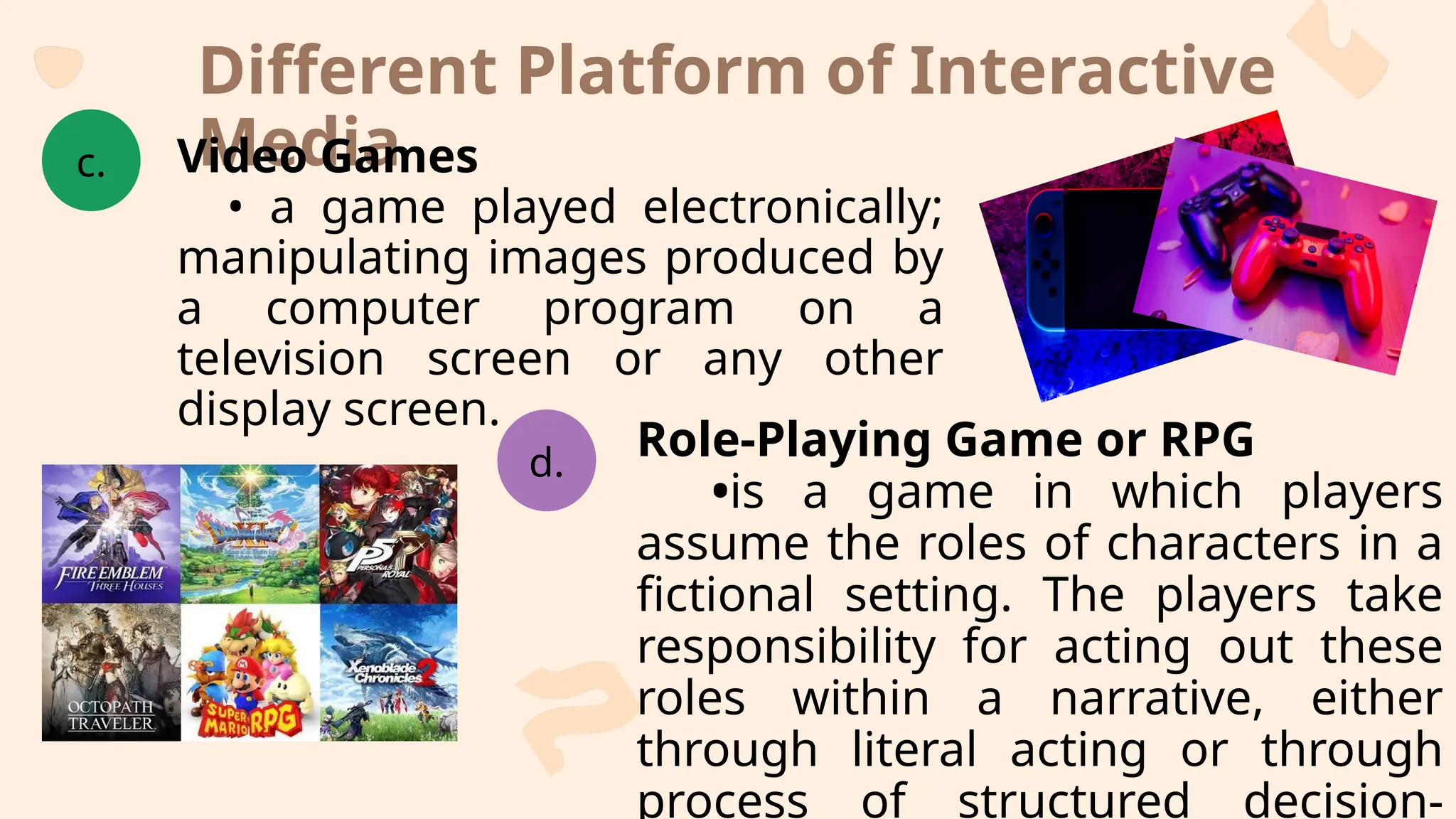
Video Games
• a game played electronically;
manipulating images produced by
a computer program on a
television screen or any other
display screen.
Role-Playing Game or RPG
•is a game in which players
assume the roles of characters in a
fictional setting. The players take
responsibility for acting out these
roles within a narrative, either
through literal acting or through
process of structured decision-
Different Platform of Interactive
Media
e.
f
Massively Multiplayer Online Role
•Playing Game or MMORPG is any
story-driven online video game in
which a player, taking on the persona
of a character in a virtual world,
interacts with a large number of
other players.
Interactive Websites
•these are websites that let
users take on a pool, survey,
exams, exercises or even allow
online social interaction such as
social media sites (e.g. Facebook,
Twitter, etc.).
Different Platform of Interactive Media
g.
h.
Virtual Reality and Immersive
Environments the computer
•generated simulation of a three-
dimensional image or environment that can
be interacted with in a seemingly real or
physical way by a person using special
electronic equipment, such as a helmet with
a screen inside or gloves fitted with sensors
PowerPoint presentations
•may contain links, hypertexts,
images, sound, graphics, or
other multimedia elements.
Different Platform of Interactive
Media
i.
j.
Interactive smart boards
•allows the teacher and the
students to have physical
interaction with the subject
matter using this format.
Computer software
•allows users to interact
with text, graphics, sound
and video, each of which can
be accessed from within any
of the others
a. Online shopping
•compare prices: compare features of similar items, add to cart, choose
payment type: track delivery, get advice from experts; search products, check
local availability; get product recommendations.
b. Online gaming
•choose a game, play with computer, play with others choose a level, in-
game,
customization, etc
c. Online classes
Ways of interacting with internet
d. Chat
•group chat, search groups, search friends, translate
language.
e. News and information
•exchange information; give reaction; news on demand
monitor views.
f. Videos
•exchange information; give reaction; news monitor views.
demand,
choose your own adventure; get multimedia content
Ways of interacting with internet
a. Click: the action where the user uses the left mouse
button or the right button. Example is when you click the
like button.
b. Hotspot: a special region to act as a trigger to another
web page or site. It could be a circle, triangle, rectangle, or
polygon.
c. Rollover: an image or portion of an image that changes
in appearance when the mouse cursor moves over it.
d. Tabs: clicking on them displays a relevant content with
Types of Interactivity
e. Timeline: a menu slide that branches to different
events
f. Numbers/processes: the number of clicks and the
time spent in an interactive function provide data points
g. Slideshow: a non-linear interactive slideshow where
the pathway through the show is determined by the
user's interaction with it.
h. Frequently asked questions (FAQs)
i. Flip cards: a card that when clicked flips to display a
Types of Interactivity
Interactive television
also known as ITV or ITV. A form of media convergence, adding
data services to traditional television technology. Throughout its
history, these have included on-demand delivery of content, well as
new uses such as online shopping, banking, and so forth. ITV
enables the viewer to issue commands and give feedback
information through an electronic device called a setup box. The
viewer can select which program movie to watch, at what time, and
can place orders in response to commercials. New setup boxes also
allow access to email and e-commerce applications via the internet.
Emerging interactive media
•Educational games are games that are
designed to help people to learn about
certain subjects, expand concepts,
reinforce development, understand
historical events or culture, or assist
them in learning a skill as they play.
Educational Games
•Hypermedia is a system in
which various forms of
information, as data, text,
graphics, video, and audio, are
linked together by a hypertext
program.
Hypermedia
Manipulative
media
What is Manipulative
Media?
•Manipulatives in the context of
education are physical tools of
teaching, engaging students visually
and physically with objects such as
coins, blocks, puzzles. markers, etc.
•The use of manipulatives is
constructivist because students are
actively engaged in discovery during
the learning process. A teacher
provides the materials along with a
basic directions, but students should
be allowed to explore the materials
and ask questions before and during
the lesson"
Manipulative
Media
Types
of
Traditional Manipulati
Media
TM
is actually being used
in certain schools,
wherein they use
different materials that
the students can use to
have a hands-on
experience regarding
the lesson.
Manipulative
Media
Types
of
VIRTUAL AND DIGITAL
MANIPULATIVE
VDMM
With the dawn of the digital
age, education should keep up
with the interests of the 21st
century learners, and in order
to do so, education have been
merged with technology in
such a way that that students
students can leam more with
the aid of these devices.
Advantages
and
disadvantag
es
Traditional Manipulative
Media
TM ADVANTAGE
-Hands on learning
-Increase confidence
& motivation for learning
-Opportunity for collaboration
-Multisensory
-Variation in learning
DISADVANTAGE
-Not available for everyone
-Dis interest on discussion
type learning
-Expensive
Advantages
and
disadvantag
es
VIRTUAL AND DIGITAL
MANIPULATIVE
TM
ADVANTAGE
-Hands on learning
-Increase confidence
& motivation for learning
-Plenty of resources
-Engaging
-Attention grabber
-Flexible and easy access
-No clean up needed
DISADVANTAGE
-Not available for everyone
-Distraction
-Dependence on them
Multimedia
Information
and Media
LESSON 6
Group 5
Multimedia
is form with the
combination of any of these
content forms: Text, Audio,
Still Images, Animation,
Video Footage, and
Interactive Media.
Multimedia
Two types
of
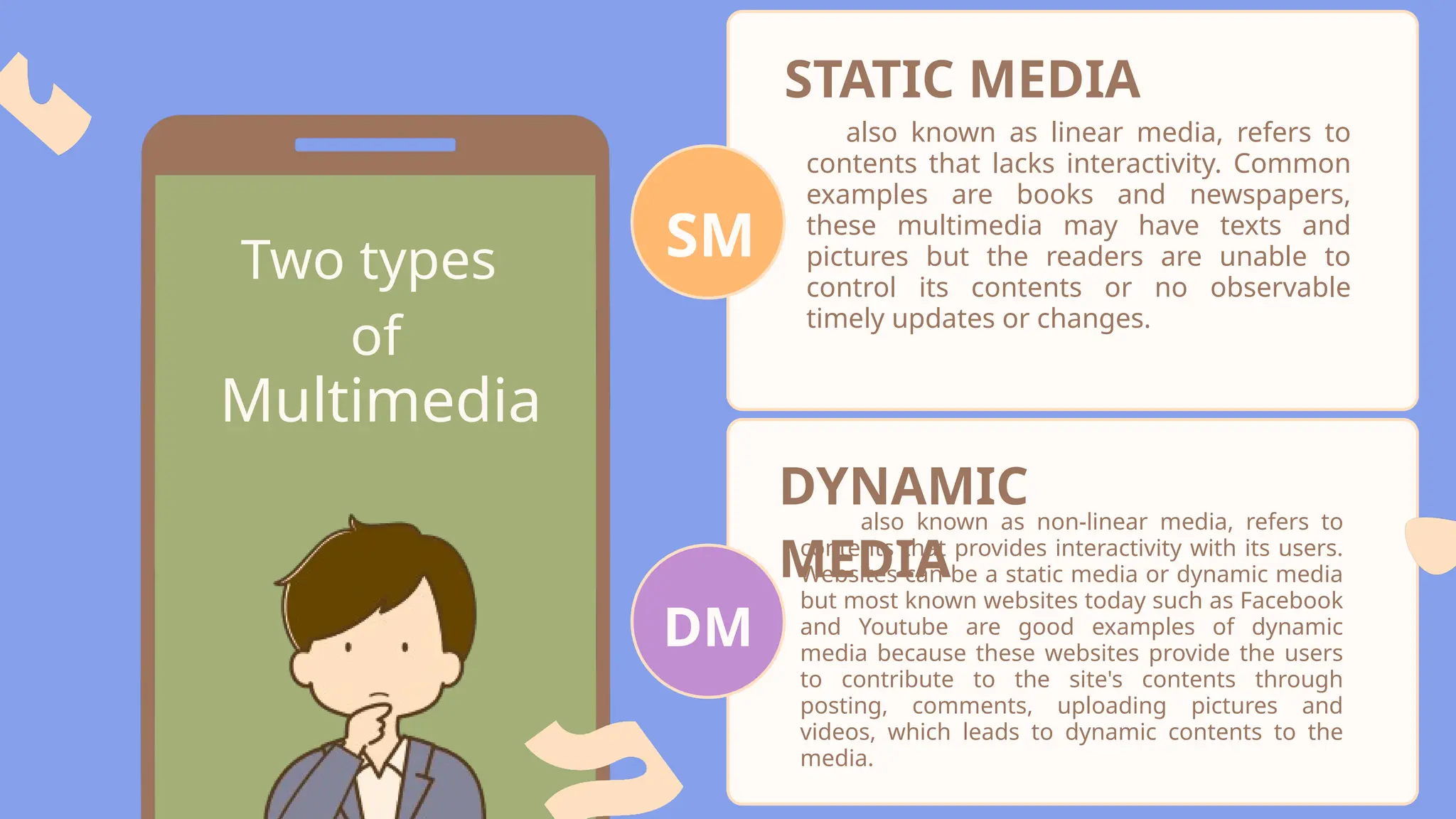
STATIC MEDIA
SM
also known as linear media, refers to
contents that lacks interactivity. Common
examples are books and newspapers,
these multimedia may have texts and
pictures but the readers are unable to
control its contents or no observable
timely updates or changes.
also known as non-linear media, refers to
contents that provides interactivity with its users.
Websites can be a static media or dynamic media
but most known websites today such as Facebook
and Youtube are good examples of dynamic
media because these websites provide the users
to contribute to the site's contents through
posting, comments, uploading pictures and
videos, which leads to dynamic contents to the
media.
DM
DYNAMIC
MEDIA
Multimedia Usage and Application
Write action
item!
Creative industries
Most creative industries
nowadays use multimedia. to
reach broader audience. Using
the creativity, skills and talents
of individuals to create
different contents such as
entertainment. fine arts.
commercials, journalism and
software services.
Reply
Write action
item!
Education
Many institutions use multimedia to
help students and faculty learn faster
and align with modern learning
preferences. Multimedia offers
diverse ways to acquire knowledge,
like using smartphones for internet
research or watching tutorials on
laptops. Schools can also utilize
simulation technologies, such as
virtual and augmented reality, to
enhance learning experiences like a
student pilot using a simulator to
practice flying.
Reply
Multimedia Usage and Application
Write action
item!
Journalism
With cellular signals and internet,
journalism is now instantly accessible.
Starting with newspapers, radio, and
TV, content delivery has expanded to
platforms like laptops and
smartphones. Journalists can share
news via podcasts, live feeds, online
radio, and social media like Facebook
and Twitter, reaching a wider audience
quickly. Readers can now give instant
feedback, allowing everyone to
participate in news sharing—a role
once limited to professional journalists.
Reply
Write action
item!
Science
Engineering, Mathematics, Science,
and Medicine have increasingly used
multimedia to boost research and
productivity. Engineers simulate
designs and training with software,
while mathematical and scientific
research benefits from modeling,
faster data processing, and enhanced
communication. In Medicine,
technologies like virtual surgery and
simulated human anatomy help train
students and doctors on various
injuries and diseases.
Reply
thank you Mga
2ol!

Interactive and manipulative media literacy

  • 1.
  • 2.
    Aaron Interactive Media Anna •allows usersto interact with text, graphics, sound, and video; each of which can be accesses from within any of the others. It engages the user and
  • 3.
    Interactivity How are youfeeling? Interactivity refers to the communication process that takes place between humans. and computer software. The most constant form of interactivity is typically found in games, which need a continuous form of interactivity with the gamer. Database applications and other financial, engineering and trading applications typically very interactive. Also one area where interactivity is most useful is in online training. Interactivities in this area allow learners to interact with the course in terms of action
  • 4.
    Different Platform ofInteractive Media a. 3DTV • a television display technology that enables a three-dimensional effect, so that viewers perceive that an images. has depth as well as height and width, similar to objects b. Mobile Apps-or Mobile Applications •is a software developed specifically for use on small, wireless computing devices such as smartphones and tablets, rather than desktop or laptop computers.
  • 5.
    Different Platform ofInteractive Media c. d. Video Games • a game played electronically; manipulating images produced by a computer program on a television screen or any other display screen. Role-Playing Game or RPG •is a game in which players assume the roles of characters in a fictional setting. The players take responsibility for acting out these roles within a narrative, either through literal acting or through process of structured decision-
  • 6.
    Different Platform ofInteractive Media e. f Massively Multiplayer Online Role •Playing Game or MMORPG is any story-driven online video game in which a player, taking on the persona of a character in a virtual world, interacts with a large number of other players. Interactive Websites •these are websites that let users take on a pool, survey, exams, exercises or even allow online social interaction such as social media sites (e.g. Facebook, Twitter, etc.).
  • 7.
    Different Platform ofInteractive Media g. h. Virtual Reality and Immersive Environments the computer •generated simulation of a three- dimensional image or environment that can be interacted with in a seemingly real or physical way by a person using special electronic equipment, such as a helmet with a screen inside or gloves fitted with sensors PowerPoint presentations •may contain links, hypertexts, images, sound, graphics, or other multimedia elements.
  • 8.
    Different Platform ofInteractive Media i. j. Interactive smart boards •allows the teacher and the students to have physical interaction with the subject matter using this format. Computer software •allows users to interact with text, graphics, sound and video, each of which can be accessed from within any of the others
  • 9.
    a. Online shopping •compareprices: compare features of similar items, add to cart, choose payment type: track delivery, get advice from experts; search products, check local availability; get product recommendations. b. Online gaming •choose a game, play with computer, play with others choose a level, in- game, customization, etc c. Online classes Ways of interacting with internet
  • 10.
    d. Chat •group chat,search groups, search friends, translate language. e. News and information •exchange information; give reaction; news on demand monitor views. f. Videos •exchange information; give reaction; news monitor views. demand, choose your own adventure; get multimedia content Ways of interacting with internet
  • 11.
    a. Click: theaction where the user uses the left mouse button or the right button. Example is when you click the like button. b. Hotspot: a special region to act as a trigger to another web page or site. It could be a circle, triangle, rectangle, or polygon. c. Rollover: an image or portion of an image that changes in appearance when the mouse cursor moves over it. d. Tabs: clicking on them displays a relevant content with Types of Interactivity
  • 12.
    e. Timeline: amenu slide that branches to different events f. Numbers/processes: the number of clicks and the time spent in an interactive function provide data points g. Slideshow: a non-linear interactive slideshow where the pathway through the show is determined by the user's interaction with it. h. Frequently asked questions (FAQs) i. Flip cards: a card that when clicked flips to display a Types of Interactivity
  • 13.
    Interactive television also knownas ITV or ITV. A form of media convergence, adding data services to traditional television technology. Throughout its history, these have included on-demand delivery of content, well as new uses such as online shopping, banking, and so forth. ITV enables the viewer to issue commands and give feedback information through an electronic device called a setup box. The viewer can select which program movie to watch, at what time, and can place orders in response to commercials. New setup boxes also allow access to email and e-commerce applications via the internet. Emerging interactive media
  • 14.
    •Educational games aregames that are designed to help people to learn about certain subjects, expand concepts, reinforce development, understand historical events or culture, or assist them in learning a skill as they play. Educational Games
  • 15.
    •Hypermedia is asystem in which various forms of information, as data, text, graphics, video, and audio, are linked together by a hypertext program. Hypermedia
  • 16.
    Manipulative media What is Manipulative Media? •Manipulativesin the context of education are physical tools of teaching, engaging students visually and physically with objects such as coins, blocks, puzzles. markers, etc. •The use of manipulatives is constructivist because students are actively engaged in discovery during the learning process. A teacher provides the materials along with a basic directions, but students should be allowed to explore the materials and ask questions before and during the lesson"
  • 17.
    Manipulative Media Types of Traditional Manipulati Media TM is actuallybeing used in certain schools, wherein they use different materials that the students can use to have a hands-on experience regarding the lesson.
  • 18.
    Manipulative Media Types of VIRTUAL AND DIGITAL MANIPULATIVE VDMM Withthe dawn of the digital age, education should keep up with the interests of the 21st century learners, and in order to do so, education have been merged with technology in such a way that that students students can leam more with the aid of these devices.
  • 19.
    Advantages and disadvantag es Traditional Manipulative Media TM ADVANTAGE -Handson learning -Increase confidence & motivation for learning -Opportunity for collaboration -Multisensory -Variation in learning DISADVANTAGE -Not available for everyone -Dis interest on discussion type learning -Expensive
  • 20.
    Advantages and disadvantag es VIRTUAL AND DIGITAL MANIPULATIVE TM ADVANTAGE -Handson learning -Increase confidence & motivation for learning -Plenty of resources -Engaging -Attention grabber -Flexible and easy access -No clean up needed DISADVANTAGE -Not available for everyone -Distraction -Dependence on them
  • 21.
  • 22.
    Multimedia is form withthe combination of any of these content forms: Text, Audio, Still Images, Animation, Video Footage, and Interactive Media.
  • 23.
    Multimedia Two types of STATIC MEDIA SM alsoknown as linear media, refers to contents that lacks interactivity. Common examples are books and newspapers, these multimedia may have texts and pictures but the readers are unable to control its contents or no observable timely updates or changes. also known as non-linear media, refers to contents that provides interactivity with its users. Websites can be a static media or dynamic media but most known websites today such as Facebook and Youtube are good examples of dynamic media because these websites provide the users to contribute to the site's contents through posting, comments, uploading pictures and videos, which leads to dynamic contents to the media. DM DYNAMIC MEDIA
  • 24.
    Multimedia Usage andApplication Write action item! Creative industries Most creative industries nowadays use multimedia. to reach broader audience. Using the creativity, skills and talents of individuals to create different contents such as entertainment. fine arts. commercials, journalism and software services. Reply Write action item! Education Many institutions use multimedia to help students and faculty learn faster and align with modern learning preferences. Multimedia offers diverse ways to acquire knowledge, like using smartphones for internet research or watching tutorials on laptops. Schools can also utilize simulation technologies, such as virtual and augmented reality, to enhance learning experiences like a student pilot using a simulator to practice flying. Reply
  • 25.
    Multimedia Usage andApplication Write action item! Journalism With cellular signals and internet, journalism is now instantly accessible. Starting with newspapers, radio, and TV, content delivery has expanded to platforms like laptops and smartphones. Journalists can share news via podcasts, live feeds, online radio, and social media like Facebook and Twitter, reaching a wider audience quickly. Readers can now give instant feedback, allowing everyone to participate in news sharing—a role once limited to professional journalists. Reply Write action item! Science Engineering, Mathematics, Science, and Medicine have increasingly used multimedia to boost research and productivity. Engineers simulate designs and training with software, while mathematical and scientific research benefits from modeling, faster data processing, and enhanced communication. In Medicine, technologies like virtual surgery and simulated human anatomy help train students and doctors on various injuries and diseases. Reply
  • 26.