

Interaction Design for
               The Quantified Self


 CS547 PCD            Oct 14, 2011

Paul Whitmore Sas
paulsas@xpcxpts.com
What is the Quantified Self?

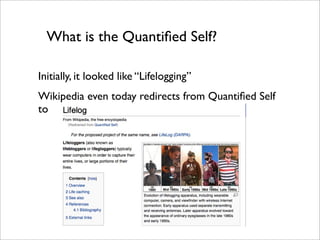
Initially, it looked like “Lifelogging”
Wikipedia even today redirects from Quantified Self
to
Quantified Self ≠ Lifelogging
  Amazing range of sensors/tracking mechanisms
  Topics quite diverse
   Medicine (illness) & also Wellness
   Biohacking (e.g., personal genomics)
   Productivity (RescueTime)
   Social Dynamics (Rypple)
   Mood, Money, More
  Collaborative (PatientsLikeMe; Asthmapolis)
  Experimental slant rather than just logging data
Quantified Self, a Brief History
First meetup: Kevin Kelly’s home in Pacifica Sept ’08
   28 people (I wasn’t there)
Each meetup has drawn a larger crowd
The community’s mojo has been worked on by
hosting in diverse spaces (IDEO, The TechShop, IFTF)
Brilliant community director: Alexandra Carmichael
Quickly spread (NY, Boston, now 20+ in US, Europe,
Australia, S. Africa)
1st Conference: Computer History Museum May ’11
It seems to be quite sexy
Sensors Available to the Community

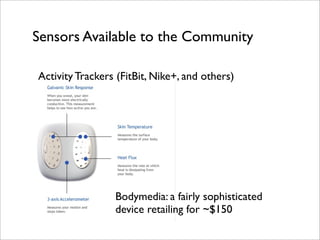
Activity Trackers (FitBit, Nike+, and others)


                 Bodymedia: a fairly sophisticated
                 device retailing for ~$150
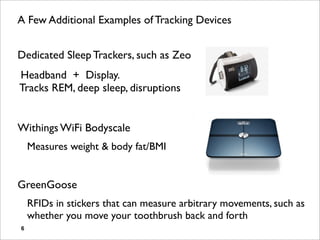
A Few Additional Examples of Tracking Devices


Dedicated Sleep Trackers, such as Zeo
Headband + Display.
Tracks REM, deep sleep, disruptions


Withings WiFi Bodyscale
    Measures weight & body fat/BMI


GreenGoose
    RFIDs in stickers that can measure arbitrary movements, such as
    whether you move your toothbrush back and forth
6
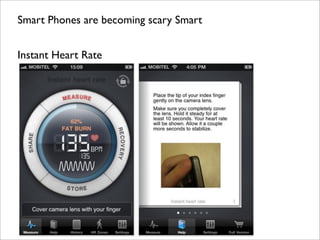
Smart Phones are becoming scary Smart


Instant Heart Rate


7
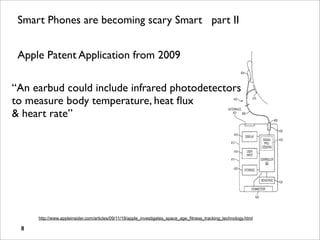
Smart Phones are becoming scary Smart part II


 Apple Patent Application from 2009

“An earbud could include infrared photodetectors
to measure body temperature, heat flux
& heart rate”


     http://www.appleinsider.com/articles/09/11/19/apple_investigates_space_age_fitness_tracking_technology.html

 8
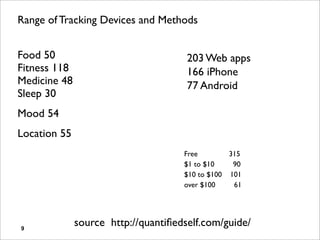
Range of Tracking Devices and Methods


Food 50                               203 Web apps
Fitness 118                           166 iPhone
Medicine 48                           77 Android
Sleep 30
Mood 54
Location 55
                                     Free        315
                                     $1 to $10    90
                                     $10 to $100 101
                                     over $100    61


9
              source http://quantifiedself.com/guide/
QSelf primarily dominated by focus on tools &
techniques


It’s worth noting that currently, most QSelf participants are:

Exceptionally motivated - “Narcissism of All My Bits”

Engineer-ish & Entrepreneurial in outlook

Data Nudists

Frequently managing chronic conditions
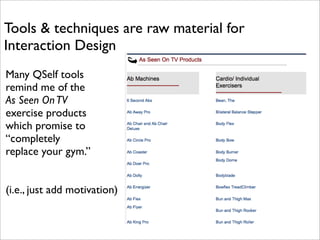
Tools & techniques are raw material for
Interaction Design
Many QSelf tools
remind me of the
As Seen On TV
exercise products
which promise to
“completely
replace your gym.”


(i.e., just add motivation)
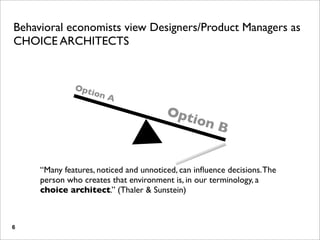
Behavioral economists view Designers/Product Managers as
CHOICE ARCHITECTS


              Opt
                    ion
                          A
                                        Opt
                                               ion
                                                      B


     “Many features, noticed and unnoticed, can influence decisions. The
     person who creates that environment is, in our terminology, a
     choice architect.” (Thaler & Sunstein)


6
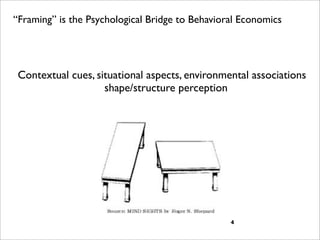
“Framing” is the Psychological Bridge to Behavioral Economics


 Contextual cues, situational aspects, environmental associations
                    shape/structure perception


                                                 4
Channel Factors

 Persuasion not as important as removing behavioral barriers
      WWII sale of bonds (Cartwright, 1949)
      Tetanus shot messaging
        Biggest impact (10X): providing a map to clinic + specifying appt time

 Once this was seen to be “applied,” psych research stopped.
 Now this work takes place as “behavioral economics”
      Well-chosen defaults (opt-out vs opt-in)
      Reduction in choice overload


 14
Psychological principles for Interaction Design


Sheena Iyengar demonstrated that increased choice
reduces action
! Draeger’s Experiment with 6 vs 24 jams
! Action when only 6 choices 10X higher than 24 choices

Eldar Shafir has shown that irrelevant information can still
paralyze decisionmakers
! Willingness to pay to delay choice - 62%

Roy Baumeister’s research shows that deliberating, making
choices, and resisting temptation lead to “decision fatigue”
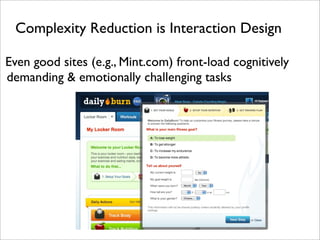
Complexity Reduction is Interaction Design

Even good sites (e.g., Mint.com) front-load cognitively
demanding & emotionally challenging tasks
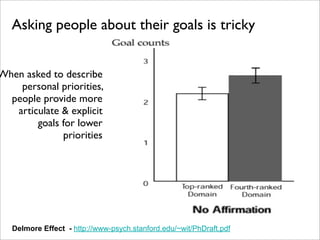
Asking people about their goals is tricky


When asked to describe
    personal priorities,
  people provide more
   articulate & explicit
        goals for lower
              priorities


   Delmore Effect - http://www-psych.stanford.edu/~wit/PhDraft.pdf
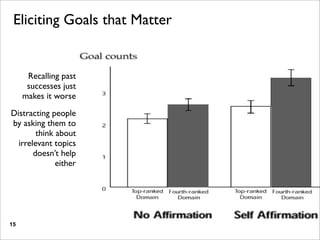
Eliciting Goals that Matter


      Recalling past
      successes just
     makes it worse
Distracting people
by asking them to
        think about
  irrelevant topics
       doesn’t help
              either


15
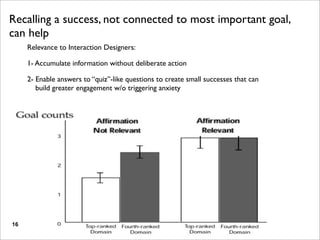
Recalling a success, not connected to most important goal,
can help
     Relevance to Interaction Designers:

     1- Accumulate information without deliberate action

     2- Enable answers to “quiz”-like questions to create small successes that can
        build greater engagement w/o triggering anxiety


16
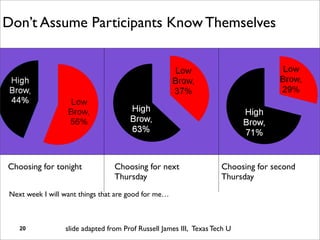
Don’t Assume Participants Know Themselves


Choosing for tonight             Choosing for next                   Choosing for second
                                 Thursday                            Thursday
Next week I will want things that are good for me…


   20            slide adapted from Prof Russell James III, "Texas Tech U
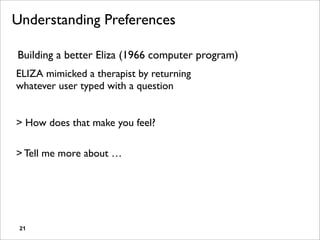
Understanding Preferences

Building a better Eliza (1966 computer program)
ELIZA mimicked a therapist by returning
whatever user typed with a question


> How does that make you feel?

> Tell me more about …


 21
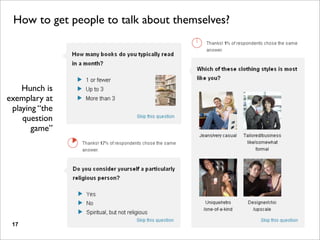
How to get people to talk about themselves?


    Hunch is
exemplary at
 playing “the
    question
       game”


 17
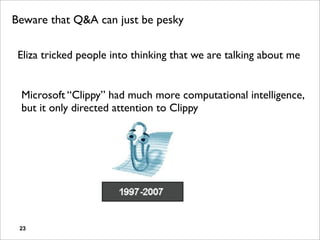
Beware that Q&A can just be pesky

 Eliza tricked people into thinking that we are talking about me


 Microsoft “Clippy” had much more computational intelligence,
 but it only directed attention to Clippy


 23
Automating Choice

 Subscriptions reduce friction of decision-making
Theater tickets / Gym membership
Amazon reduces cognitive load in multiple ways
!     PRIME
!     15% off when you agree to transform a one-off to a subscription

Medical insurance –Seems irrational to choose high premium, low
deductible, yet many don’t want to make repeated calculations about
trade offs
QSelf, to the extent possible, needs to intrinsically capture trail of
information without requiring any deliberation

 24
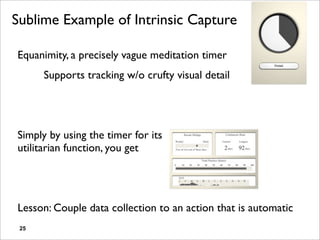
Sublime Example of Intrinsic Capture

Equanimity, a precisely vague meditation timer
!     Supports tracking w/o crufty visual detail


Simply by using the timer for its
utilitarian function, you get


Lesson: Couple data collection to an action that is automatic
 25
The crux of QSelf is Experimental Intervention

Sociology-style correlations can endlessly proliferate, but all the
logging in a life can’t tease apart confounds


The key requires combining streams of tracking data with
experimental manipulations


Create conditions that evoke the behavior you want to see


A key dependent variable should be “compliance with the
instruction”
28
“Copernican revolution” in my own thinking
about the QSelf
Craft scripts that intervene to manipulate pre-existing patterns
of behavior
     Shift away from placing monitoring at the center
     Don’t just track ambient behavior
     Move toward methods that deliver an instruction


29
How Decision Fatigue Can Help
Conceptualize your self as two parties:

  Commander/controller is the “decider” at T   0


  Executor/actor of script is the “follower” at T   0+N


Set up a stream of decisions in your longterm self interest

Send those instructions to your future self

Observe the success in implementing those
 ITERATE

(Compare this to Atul Gawande’s Checklist Manifesto)
Mindful Eating Experiment


Inspired by Robin Barooah's Mindful Attending Exercise
 (QSelf Silivalley Meetup 8/11)

Robin’s experiment went from
 WORN (Write once, read never)

  to

  WOWA (Write once, with attention)
  ! Experiment: noted how he felt, 3 hours after eating


 31
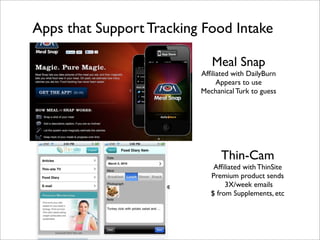
Apps that Support Tracking Food Intake

                             Meal Snap
                          Affiliated with DailyBurn
                               Appears to use
                          Mechanical Turk to guess


                                Thin-Cam
                              Affiliated with ThinSite
                             Premium product sends
                                  3X/week emails
                             $ from Supplements, etc
Experimental Design as a Challenge


Research exposes tendency to delay in face of uncertainty

Many QSelf attendees collect, but never take next step to xpt

It seems reasonable that people want a cookbook, not just
components

Genomera hosts a platform that has enabled Eri Gentry to
recruit people who can directly enroll in pre-designed A-B-A
experiments (Orange You Sleepy is running now)
Motivation and Self-Management

Loop of sending instruction to future self, & then using QSelf
tech to monitor compliance.

! Still sounds like I’m being bossed around (by me)

Parallel with Flores’ ActionWorks Business Process System?
! Each communication was an explicit commitment
! While it may work, it’s reported to be greatly resisted

Design mechanisms that support aleatoric degrees of freedom

Interaction design & quantified self

  • 1.
    Interaction Design for The Quantified Self CS547 PCD Oct 14, 2011 Paul Whitmore Sas paulsas@xpcxpts.com
  • 2.
    What is theQuantified Self? Initially, it looked like “Lifelogging” Wikipedia even today redirects from Quantified Self to
  • 3.
    Quantified Self ≠Lifelogging Amazing range of sensors/tracking mechanisms Topics quite diverse Medicine (illness) & also Wellness Biohacking (e.g., personal genomics) Productivity (RescueTime) Social Dynamics (Rypple) Mood, Money, More Collaborative (PatientsLikeMe; Asthmapolis) Experimental slant rather than just logging data
  • 4.
    Quantified Self, aBrief History First meetup: Kevin Kelly’s home in Pacifica Sept ’08 28 people (I wasn’t there) Each meetup has drawn a larger crowd The community’s mojo has been worked on by hosting in diverse spaces (IDEO, The TechShop, IFTF) Brilliant community director: Alexandra Carmichael Quickly spread (NY, Boston, now 20+ in US, Europe, Australia, S. Africa) 1st Conference: Computer History Museum May ’11 It seems to be quite sexy
  • 5.
    Sensors Available tothe Community Activity Trackers (FitBit, Nike+, and others) Bodymedia: a fairly sophisticated device retailing for ~$150
  • 6.
    A Few AdditionalExamples of Tracking Devices Dedicated Sleep Trackers, such as Zeo Headband + Display. Tracks REM, deep sleep, disruptions Withings WiFi Bodyscale Measures weight & body fat/BMI GreenGoose RFIDs in stickers that can measure arbitrary movements, such as whether you move your toothbrush back and forth 6
  • 7.
    Smart Phones arebecoming scary Smart Instant Heart Rate 7
  • 8.
    Smart Phones arebecoming scary Smart part II Apple Patent Application from 2009 “An earbud could include infrared photodetectors to measure body temperature, heat flux & heart rate” http://www.appleinsider.com/articles/09/11/19/apple_investigates_space_age_fitness_tracking_technology.html 8
  • 9.
    Range of TrackingDevices and Methods Food 50 203 Web apps Fitness 118 166 iPhone Medicine 48 77 Android Sleep 30 Mood 54 Location 55 Free 315 $1 to $10 90 $10 to $100 101 over $100 61 9 source http://quantifiedself.com/guide/
  • 10.
    QSelf primarily dominatedby focus on tools & techniques It’s worth noting that currently, most QSelf participants are: Exceptionally motivated - “Narcissism of All My Bits” Engineer-ish & Entrepreneurial in outlook Data Nudists Frequently managing chronic conditions
  • 11.
    Tools & techniquesare raw material for Interaction Design Many QSelf tools remind me of the As Seen On TV exercise products which promise to “completely replace your gym.” (i.e., just add motivation)
  • 12.
    Behavioral economists viewDesigners/Product Managers as CHOICE ARCHITECTS Opt ion A Opt ion B “Many features, noticed and unnoticed, can influence decisions. The person who creates that environment is, in our terminology, a choice architect.” (Thaler & Sunstein) 6
  • 13.
    “Framing” is thePsychological Bridge to Behavioral Economics Contextual cues, situational aspects, environmental associations shape/structure perception 4
  • 14.
    Channel Factors Persuasionnot as important as removing behavioral barriers WWII sale of bonds (Cartwright, 1949) Tetanus shot messaging Biggest impact (10X): providing a map to clinic + specifying appt time Once this was seen to be “applied,” psych research stopped. Now this work takes place as “behavioral economics” Well-chosen defaults (opt-out vs opt-in) Reduction in choice overload 14
  • 15.
    Psychological principles forInteraction Design Sheena Iyengar demonstrated that increased choice reduces action ! Draeger’s Experiment with 6 vs 24 jams ! Action when only 6 choices 10X higher than 24 choices Eldar Shafir has shown that irrelevant information can still paralyze decisionmakers ! Willingness to pay to delay choice - 62% Roy Baumeister’s research shows that deliberating, making choices, and resisting temptation lead to “decision fatigue”
  • 16.
    Complexity Reduction isInteraction Design Even good sites (e.g., Mint.com) front-load cognitively demanding & emotionally challenging tasks
  • 17.
    Asking people abouttheir goals is tricky When asked to describe personal priorities, people provide more articulate & explicit goals for lower priorities Delmore Effect - http://www-psych.stanford.edu/~wit/PhDraft.pdf
  • 18.
    Eliciting Goals thatMatter Recalling past successes just makes it worse Distracting people by asking them to think about irrelevant topics doesn’t help either 15
  • 19.
    Recalling a success,not connected to most important goal, can help Relevance to Interaction Designers: 1- Accumulate information without deliberate action 2- Enable answers to “quiz”-like questions to create small successes that can build greater engagement w/o triggering anxiety 16
  • 20.
    Don’t Assume ParticipantsKnow Themselves Choosing for tonight Choosing for next Choosing for second Thursday Thursday Next week I will want things that are good for me… 20 slide adapted from Prof Russell James III, "Texas Tech U
  • 21.
    Understanding Preferences Building abetter Eliza (1966 computer program) ELIZA mimicked a therapist by returning whatever user typed with a question > How does that make you feel? > Tell me more about … 21
  • 22.
    How to getpeople to talk about themselves? Hunch is exemplary at playing “the question game” 17
  • 23.
    Beware that Q&Acan just be pesky Eliza tricked people into thinking that we are talking about me Microsoft “Clippy” had much more computational intelligence, but it only directed attention to Clippy 23
  • 24.
    Automating Choice Subscriptionsreduce friction of decision-making Theater tickets / Gym membership Amazon reduces cognitive load in multiple ways ! PRIME ! 15% off when you agree to transform a one-off to a subscription Medical insurance –Seems irrational to choose high premium, low deductible, yet many don’t want to make repeated calculations about trade offs QSelf, to the extent possible, needs to intrinsically capture trail of information without requiring any deliberation 24
  • 25.
    Sublime Example ofIntrinsic Capture Equanimity, a precisely vague meditation timer ! Supports tracking w/o crufty visual detail Simply by using the timer for its utilitarian function, you get Lesson: Couple data collection to an action that is automatic 25
  • 26.
    The crux ofQSelf is Experimental Intervention Sociology-style correlations can endlessly proliferate, but all the logging in a life can’t tease apart confounds The key requires combining streams of tracking data with experimental manipulations Create conditions that evoke the behavior you want to see A key dependent variable should be “compliance with the instruction” 28
  • 27.
    “Copernican revolution” inmy own thinking about the QSelf Craft scripts that intervene to manipulate pre-existing patterns of behavior Shift away from placing monitoring at the center Don’t just track ambient behavior Move toward methods that deliver an instruction 29
  • 28.
    How Decision FatigueCan Help Conceptualize your self as two parties: Commander/controller is the “decider” at T 0 Executor/actor of script is the “follower” at T 0+N Set up a stream of decisions in your longterm self interest Send those instructions to your future self Observe the success in implementing those ITERATE (Compare this to Atul Gawande’s Checklist Manifesto)
  • 29.
    Mindful Eating Experiment Inspiredby Robin Barooah's Mindful Attending Exercise (QSelf Silivalley Meetup 8/11) Robin’s experiment went from WORN (Write once, read never) to WOWA (Write once, with attention) ! Experiment: noted how he felt, 3 hours after eating 31
  • 30.
    Apps that SupportTracking Food Intake Meal Snap Affiliated with DailyBurn Appears to use Mechanical Turk to guess Thin-Cam Affiliated with ThinSite Premium product sends 3X/week emails $ from Supplements, etc
  • 31.
    Experimental Design asa Challenge Research exposes tendency to delay in face of uncertainty Many QSelf attendees collect, but never take next step to xpt It seems reasonable that people want a cookbook, not just components Genomera hosts a platform that has enabled Eri Gentry to recruit people who can directly enroll in pre-designed A-B-A experiments (Orange You Sleepy is running now)
  • 32.
    Motivation and Self-Management Loopof sending instruction to future self, & then using QSelf tech to monitor compliance. ! Still sounds like I’m being bossed around (by me) Parallel with Flores’ ActionWorks Business Process System? ! Each communication was an explicit commitment ! While it may work, it’s reported to be greatly resisted Design mechanisms that support aleatoric degrees of freedom