
INTRODUCTION
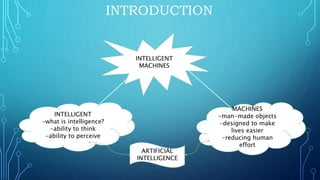
INTELLIGENT
MACHINES
INTELLIGENT
-what is intelligence?
-ability to think
-ability to perceive
MACHINES
-man-made objects
-designed to make
lives easier
-reducing human
effort
ARTIFICIAL
INTELLIGENCE
WHEN CAN A MACHINE BE CALLED
INTELLIGENT?
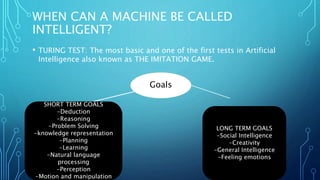
• TURING TEST: The most basic and one of the first tests in Artificial
Intelligence also known as THE IMITATION GAME.
Goals
SHORT TERM GOALS
-Deduction
-Reasoning
-Problem Solving
-knowledge representation
-Planning
-Learning
-Natural language
processing
-Perception
-Motion and manipulation
LONG TERM GOALS
-Social Intelligence
-Creativity
-General Intelligence
-Feeling emotions
HOW IS AI IMPLEMENTED?
• Input from proximity sensors or vision systems will make a robot
aware of surrounding objects, and this enables more intelligent
behaviors such as obstacle avoidance, important when you are
autonomously vacuuming a floor.
• Another approach to sensing the environment is to take inspiration
from simple systems in biology such as those used by insects, and
this has something we have explored at MapleBird. This allows very
fast response times, but also takes away the need for complex
central processing, hence insects do not have large brains.
• This leads us onto the ambitious objective of the Brain corporation,
which is to create a platform for sophisticated robotic behaviour
based on the brains of mammals, which includes building the
CHALLENGES IN AI
• Understanding how ‘understanding’ works
• Emulating the brain exactly how it is
• Bringing perfection in the way machines work
THREATS DUE TO INTELLIGENT MACHINES
• We have come across fictional works where robots take over
the entire human race. If AI reaches that level, that day may
actually arrive.
• Artificial minds will be easily replicated
• Most agents are autonomous, so human intervention wont be
able to stop them
• They will not have humanlike motives
SOLUTIONS? IF ANY
• As bad as it may sound, AI actually is very much needed.
• Removal of disease, environmental destructions, suffering
• Handling the situations beyond human capability
PRACTICAL APPLICATIONS
• Taxi drivers (humanless driving)
• Factory work
• News compilation
• Doctors
• Waiters
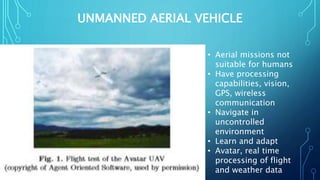
UNMANNED AERIAL VEHICLE
• Aerial missions not
suitable for humans
• Have processing
capabilities, vision,
GPS, wireless
communication
• Navigate in
uncontrolled
environment
• Learn and adapt
• Avatar, real time
processing of flight
and weather data
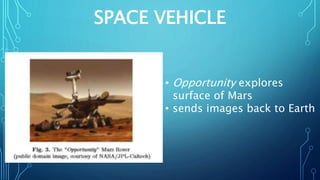
SPACE VEHICLE
• Opportunity explores
surface of Mars
• sends images back to Earth
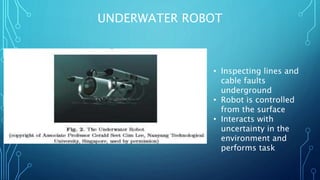
UNDERWATER ROBOT
• Inspecting lines and
cable faults
underground
• Robot is controlled
from the surface
• Interacts with
uncertainty in the
environment and
performs task
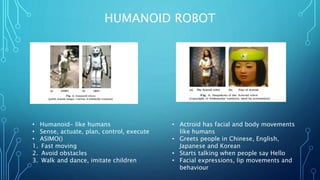
HUMANOID ROBOT
• Humanoid- like humans
• Sense, actuate, plan, control, execute
• ASIMO()
1. Fast moving
2. Avoid obstacles
3. Walk and dance, imitate children
• Actroid has facial and body movements
like humans
• Greets people in Chinese, English,
Japanese and Korean
• Starts talking when people say Hello
• Facial expressions, lip movements and
behaviour
REFERENCES
• http://www.theguardian.com/culture/gallery/2015/jan/08/the-top-20-artificial-
intelligence-films-in-pictures
• http://www.bbc.com/news/technology-33327659
• https://en.wikipedia.org/wiki/List_of_artificial_intelligence_projects
• https://en.wikipedia.org/wiki/Artificial_intelligence#Goals3
• https://www.psychologytoday.com/blog/the-intelligence-report/201103/can-machines-
be-intelligent
• http://www.electronicsweekly.com/blogs/viewpoints/robots-think-2014-09/
• https://en.wikipedia.org/wiki/Philosophy_of_artificial_intelligence
• http://functionspace.com/topic/3923/What-are-the-Biggest-Challenges-in-Building-
Artificial-Intelligence-
• http://www.nickbostrom.com/ethics/ai.html
THANK YOU!

Intelligent Machines

  • 2.
    INTRODUCTION INTELLIGENT MACHINES INTELLIGENT -what is intelligence? -abilityto think -ability to perceive MACHINES -man-made objects -designed to make lives easier -reducing human effort ARTIFICIAL INTELLIGENCE
  • 3.
    WHEN CAN AMACHINE BE CALLED INTELLIGENT? • TURING TEST: The most basic and one of the first tests in Artificial Intelligence also known as THE IMITATION GAME. Goals SHORT TERM GOALS -Deduction -Reasoning -Problem Solving -knowledge representation -Planning -Learning -Natural language processing -Perception -Motion and manipulation LONG TERM GOALS -Social Intelligence -Creativity -General Intelligence -Feeling emotions
  • 4.
    HOW IS AIIMPLEMENTED? • Input from proximity sensors or vision systems will make a robot aware of surrounding objects, and this enables more intelligent behaviors such as obstacle avoidance, important when you are autonomously vacuuming a floor. • Another approach to sensing the environment is to take inspiration from simple systems in biology such as those used by insects, and this has something we have explored at MapleBird. This allows very fast response times, but also takes away the need for complex central processing, hence insects do not have large brains. • This leads us onto the ambitious objective of the Brain corporation, which is to create a platform for sophisticated robotic behaviour based on the brains of mammals, which includes building the
  • 5.
    CHALLENGES IN AI •Understanding how ‘understanding’ works • Emulating the brain exactly how it is • Bringing perfection in the way machines work
  • 6.
    THREATS DUE TOINTELLIGENT MACHINES • We have come across fictional works where robots take over the entire human race. If AI reaches that level, that day may actually arrive. • Artificial minds will be easily replicated • Most agents are autonomous, so human intervention wont be able to stop them • They will not have humanlike motives
  • 7.
    SOLUTIONS? IF ANY •As bad as it may sound, AI actually is very much needed. • Removal of disease, environmental destructions, suffering • Handling the situations beyond human capability
  • 8.
    PRACTICAL APPLICATIONS • Taxidrivers (humanless driving) • Factory work • News compilation • Doctors • Waiters
  • 9.
    UNMANNED AERIAL VEHICLE •Aerial missions not suitable for humans • Have processing capabilities, vision, GPS, wireless communication • Navigate in uncontrolled environment • Learn and adapt • Avatar, real time processing of flight and weather data
  • 10.
    SPACE VEHICLE • Opportunityexplores surface of Mars • sends images back to Earth
  • 11.
    UNDERWATER ROBOT • Inspectinglines and cable faults underground • Robot is controlled from the surface • Interacts with uncertainty in the environment and performs task
  • 12.
    HUMANOID ROBOT • Humanoid-like humans • Sense, actuate, plan, control, execute • ASIMO() 1. Fast moving 2. Avoid obstacles 3. Walk and dance, imitate children • Actroid has facial and body movements like humans • Greets people in Chinese, English, Japanese and Korean • Starts talking when people say Hello • Facial expressions, lip movements and behaviour
  • 13.
    REFERENCES • http://www.theguardian.com/culture/gallery/2015/jan/08/the-top-20-artificial- intelligence-films-in-pictures • http://www.bbc.com/news/technology-33327659 •https://en.wikipedia.org/wiki/List_of_artificial_intelligence_projects • https://en.wikipedia.org/wiki/Artificial_intelligence#Goals3 • https://www.psychologytoday.com/blog/the-intelligence-report/201103/can-machines- be-intelligent • http://www.electronicsweekly.com/blogs/viewpoints/robots-think-2014-09/ • https://en.wikipedia.org/wiki/Philosophy_of_artificial_intelligence • http://functionspace.com/topic/3923/What-are-the-Biggest-Challenges-in-Building- Artificial-Intelligence- • http://www.nickbostrom.com/ethics/ai.html
  • 14.