Dr. S. Gopinath, M.E., Ph.D.,
Professor and Head
Department of Electronics and Communication Engineering
Karpagam Institute of Technology
Coimbatore – 105.
10.01.2022
Intellectual Property
Rights
Intellectual Property Rights
(IPR) are the rights given to the
persons over the creations of
their minds.
IP is a property that arises from
the human intellect.
 Tangible property
 Land, houses, estates, car
 Intangible property
 -intellectual property
 Capital expenditure for new products
 Research and Development
 Marketing and advertisement
 No free loaders
 Maintaining loyal followers
 Profit
 Can be sold
 Can be bought
 Can be lease or rent
 Can pass under a will
 Can be assigned
6
“INDUSTRIAL PROPERTIES”
•PATENTS
• INDUSTRIAL DESIGNS
• TRADEMARKS
• TRADE SECRETS
•GEOGRAPHICAL INDICATIONS
 Copyright Act 1987
 Trademarks Act 1976
 Patent Act 1970
 Industrial Design Act 1996
 Geographical Indications Act 2000
 Exclusive right for being the true and first inventor
of a product or process, granted by the govt. for a
limited period, to exclude others from making,
using, selling or importing the patented product or
process with out his consent, in exchange of full
disclosure of his invention.
 Term: 20 years from the Date of Filing
 A patent is only valid in the jurisdiction in which it is granted.
 Mumbai
 Chennai Patent office branches
 New Delhi
 Kolkata
 World Intellectual Property Organization -1967
 (Located in Geneva. Promotes the protection of IP throughout the
world)
 Patent Cooperation Treaty – 1970
 World Trade Organization - 1995
 Product
 Tools/Apparatus for producing the product
 The process
 The composition of matter
 Methodology
 Application Form (Form 1)
 Specification (Provisional/ Complete) (Form 2)
 Drawings
 Undertaking under section 8 (Form 3)
 Power of Authority
 A trade secret is something that offers an advantage in
business if it keep as a secret.
 A trade secret can be a client list, the formula for a
product, etc.
 A trade secret does not have to be patentable, but it
must be capable of being maintained.
 For instance, a client list can be protected by computer
password, and the formula can be safeguarded by
disclosing it to a limited number of people.
 Trade secrets are not registered with any government
or other agency.
13
TRADE SECRET
A typical example is Coca-Cola. This soft drink was
invented in 1886 and was never protected by a patent,
only by a trademark (for the name Coca-Cola) and by
an industrial design (for this very special design of the
Coca-Cola bottle, supposed to be in the shape of a
woman wearing a long skin-tight dress).
The process of the Coca-Cola drink is secret and is only
known by two persons in the world. They are not
allowed to travel together, so that there is no chance of
them dying at the same time in an accident. The secret
of the Coca-Cola process was well kept during all these
years, and nobody is able to produce a drink with
exactly the same taste still today. You all know that
Pepsi Cola, its biggest competitor, has a different taste.
 Copyright means
exclusive right to do or
authorize others to do
certain acts in relation.
 Permission is needed to
reproduce the
copyrighted material.
“COPYRIGHT”
• LITERARY
• NOVEL
• POEM
• PLAYS
• FILMS
• MUSICAL
• ARTISTIC
• DRAWINGS
• PHOTOGRAHS
• PERFORMING ARTS
• SCULPTURES
• SOFTWARE
 Term: Author's life plus sixty years (Books)
 60 years (Films, photographs)
 25 years (Broadcasting)
 It protects the publications of the studies.
 Information provided by the drug companies may be protected by copyright
law.
 Books, Paintings, Musical composition, plays, movies, radio/tv programs and
other artistic works.
 It should have a special quality or characteristics or reputation based up
on the climatic or production characteristics unique to the geographical
location.
 The registration of a geographical indication is from a period of 10 years.
 Renewal is possible for further period of 10 years each.
 Examples: Kancheepuram silk, Darjeeling Tea, Solapur, Chaddar,
Mysore Silk, Kullu Shawl etc
 Benefits
 Legal Protection from unauthorized use
 Boost the rural development
 Reproduce unfair practices of trade
 Preserve local culture and resources
 As of now, India has 344 GI products
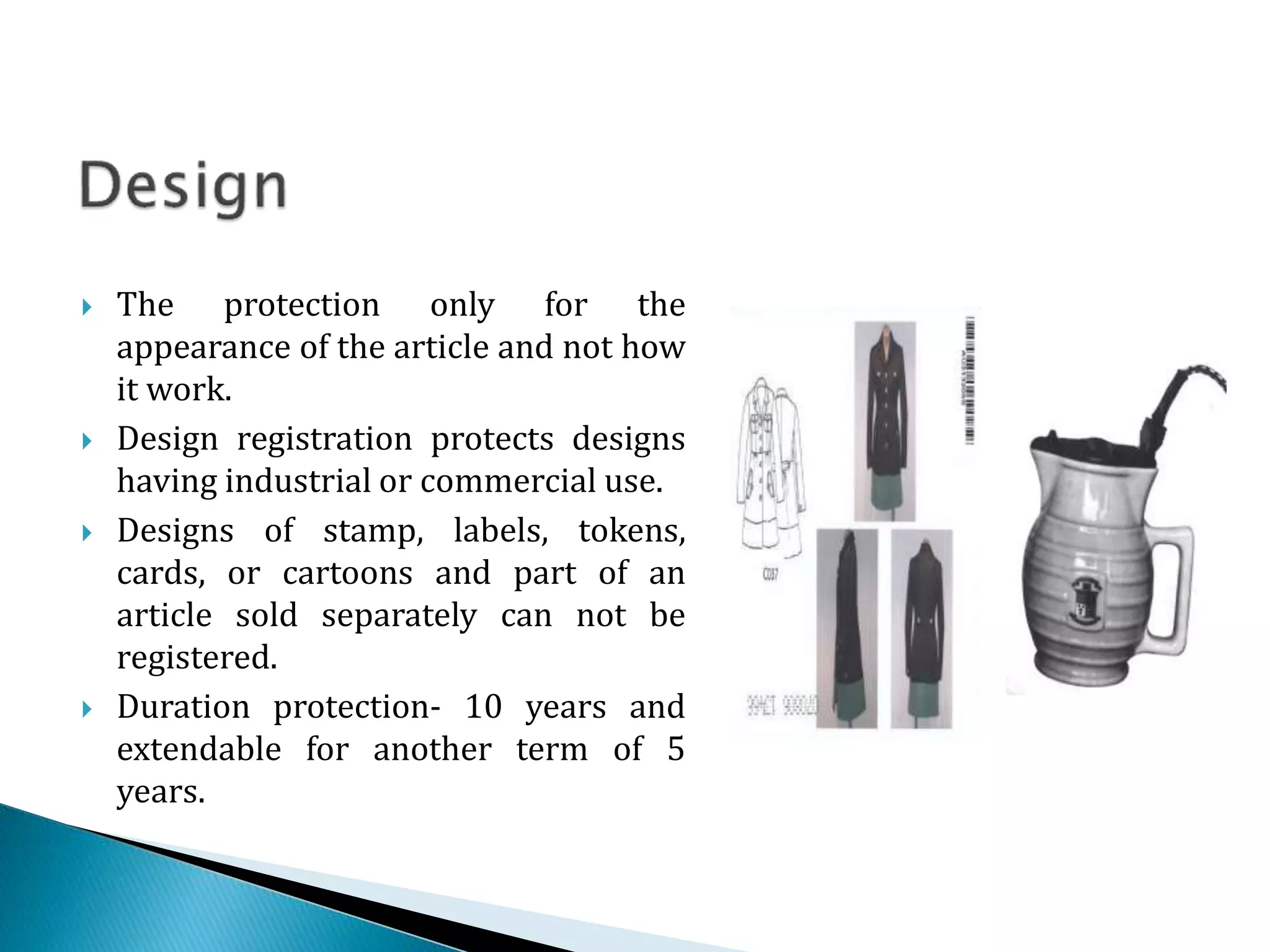
 The protection only for the
appearance of the article and not how
it work.
 Design registration protects designs
having industrial or commercial use.
 Designs of stamp, labels, tokens,
cards, or cartoons and part of an
article sold separately can not be
registered.
 Duration protection- 10 years and
extendable for another term of 5
years.
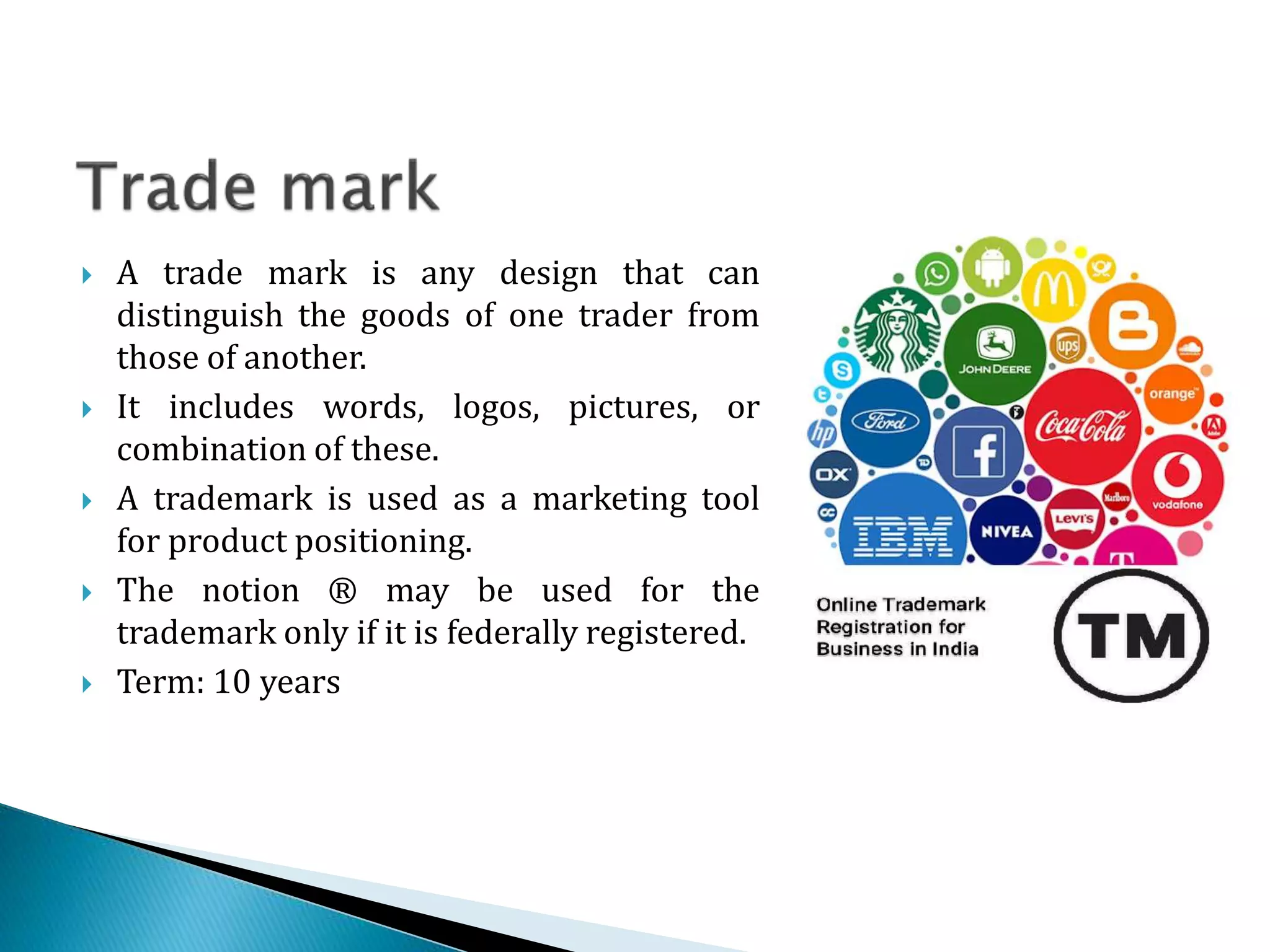
 A trade mark is any design that can
distinguish the goods of one trader from
those of another.
 It includes words, logos, pictures, or
combination of these.
 A trademark is used as a marketing tool
for product positioning.
 The notion ® may be used for the
trademark only if it is federally registered.
 Term: 10 years
 Can either be registered or not registered.
 Advantages of registered trade marks.
 Application can be made for goods and services.
 Perform certain function such as indication of
quality, identifying a trade connection.
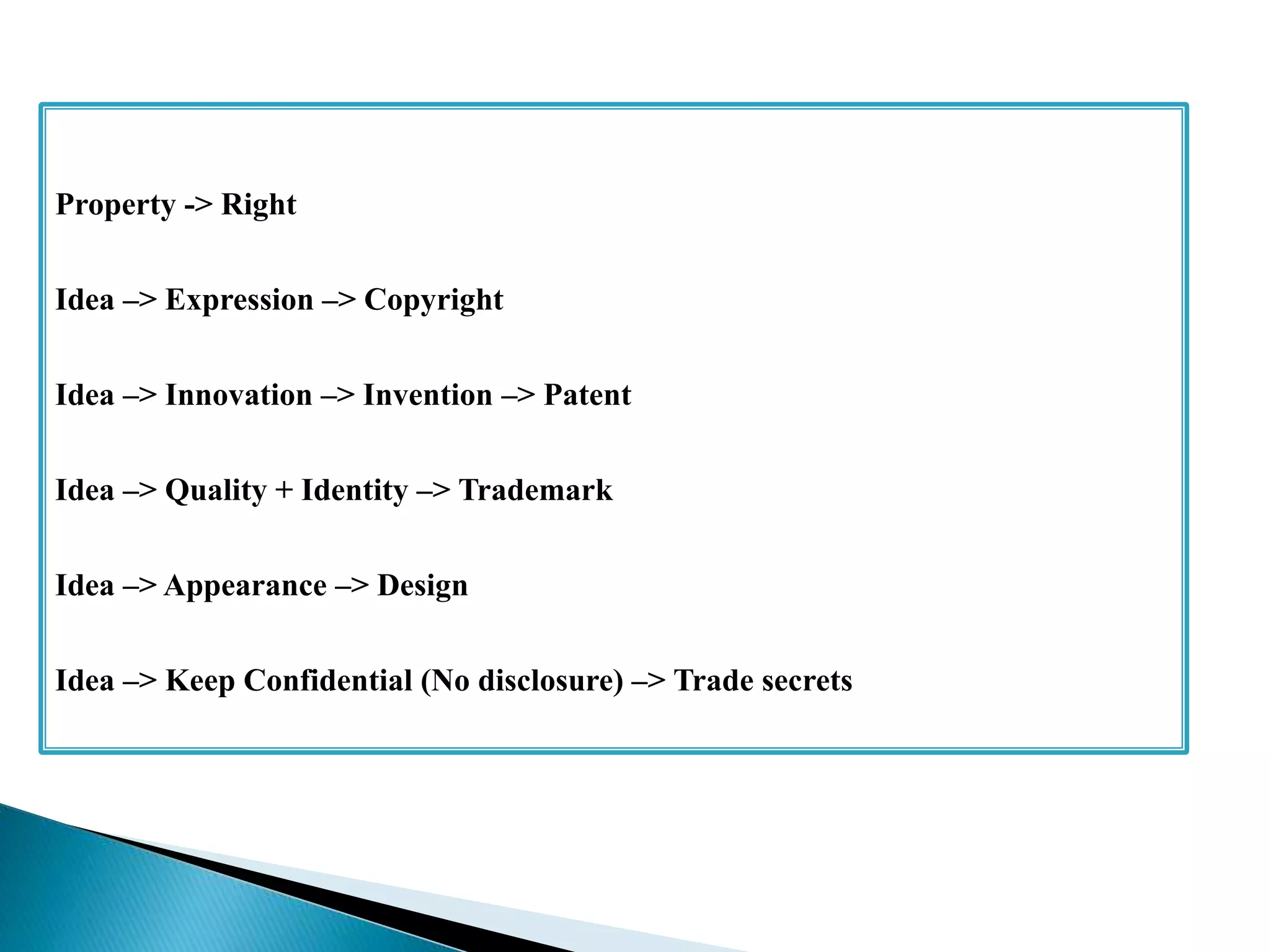
Property -> Right
Idea –> Expression –> Copyright
Idea –> Innovation –> Invention –> Patent
Idea –> Quality + Identity –> Trademark
Idea –> Appearance –> Design
Idea –> Keep Confidential (No disclosure) –> Trade secrets
 Text search
 Simple search
 Advanced search
 Syntax (command based)
 Number search
 Structure search
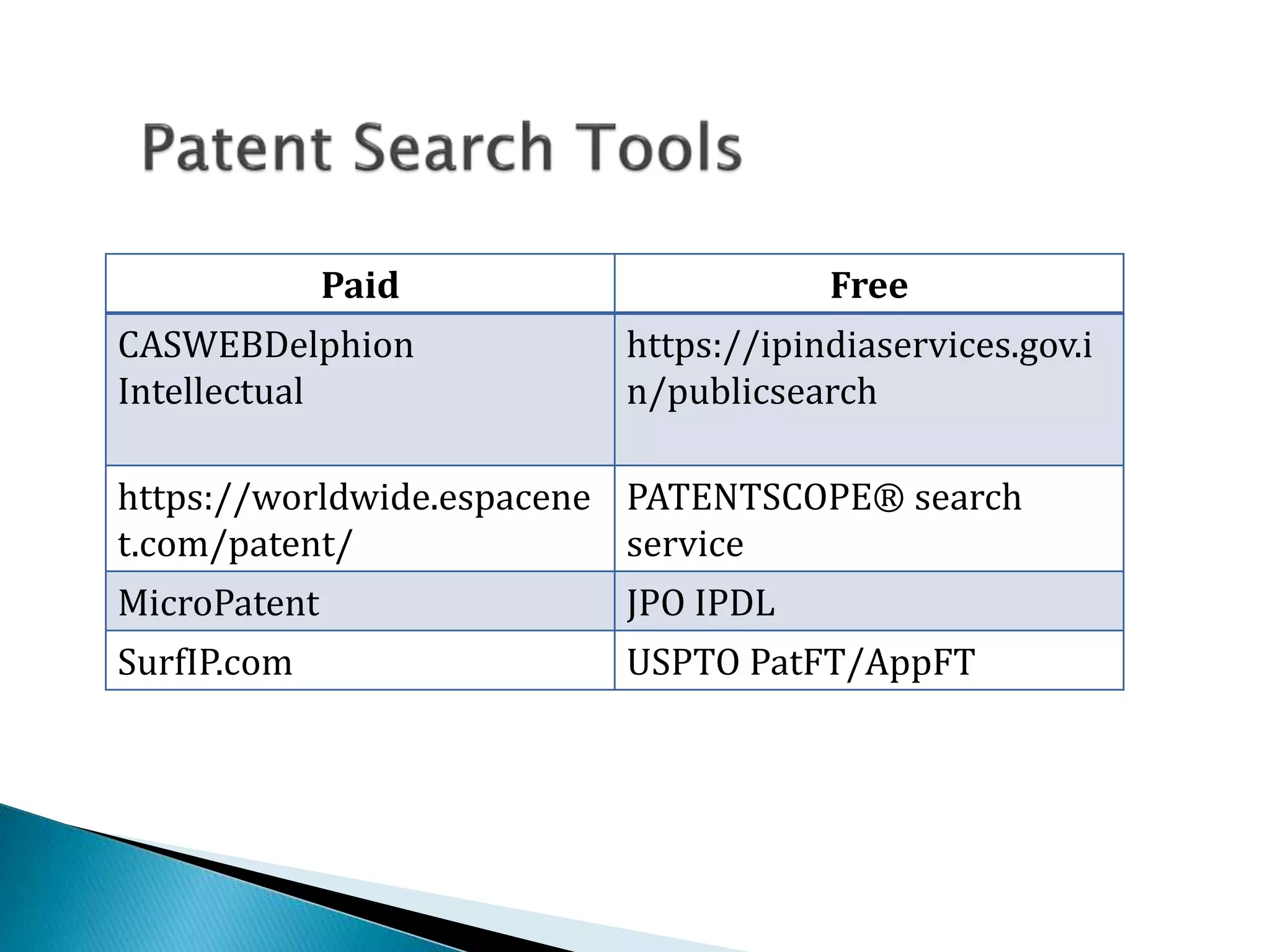
Paid Free
CASWEBDelphion
Intellectual
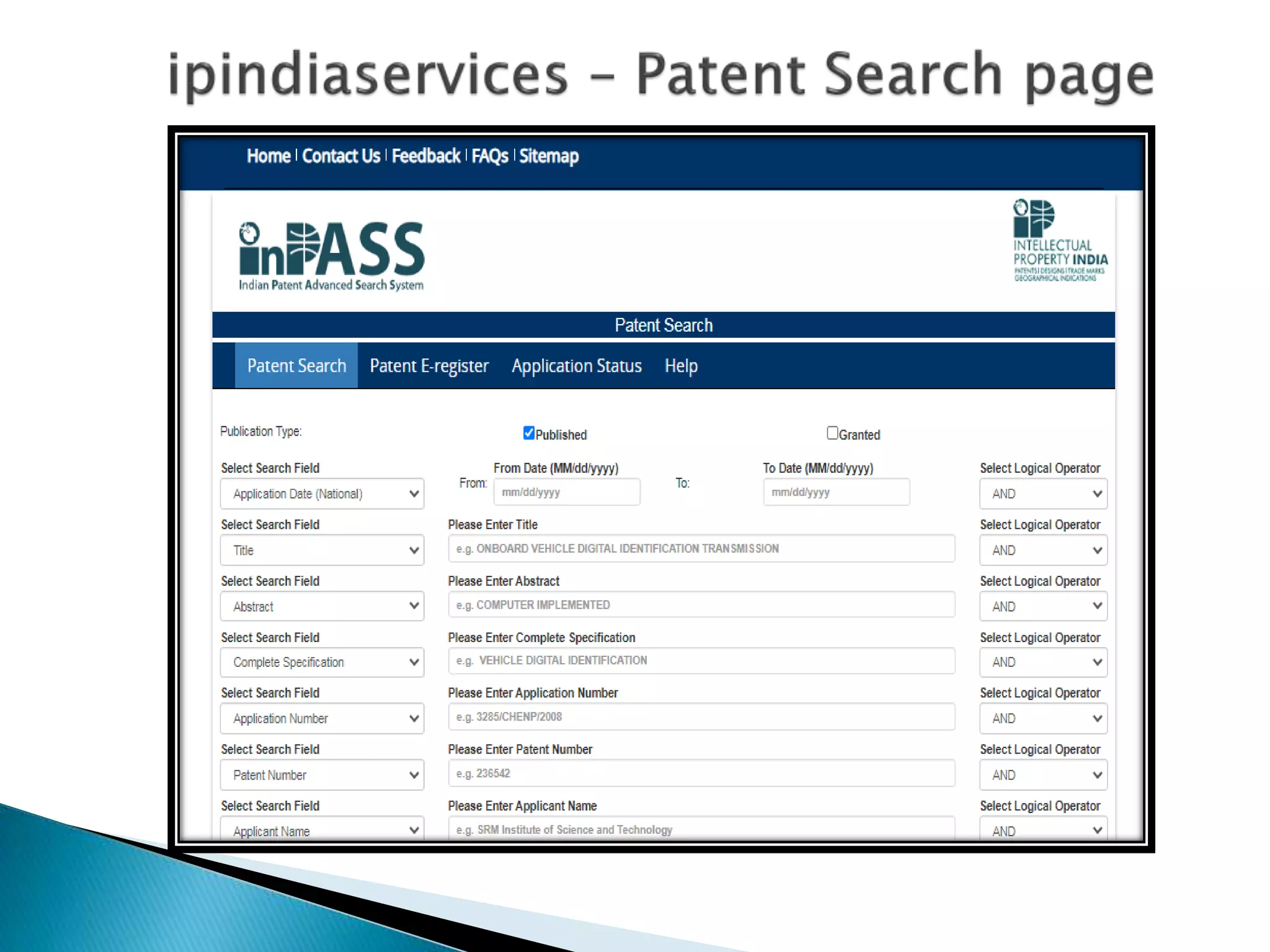
https://ipindiaservices.gov.i
n/publicsearch
https://worldwide.espacene
t.com/patent/
PATENTSCOPE® search
service
MicroPatent JPO IPDL
SurfIP.com USPTO PatFT/AppFT
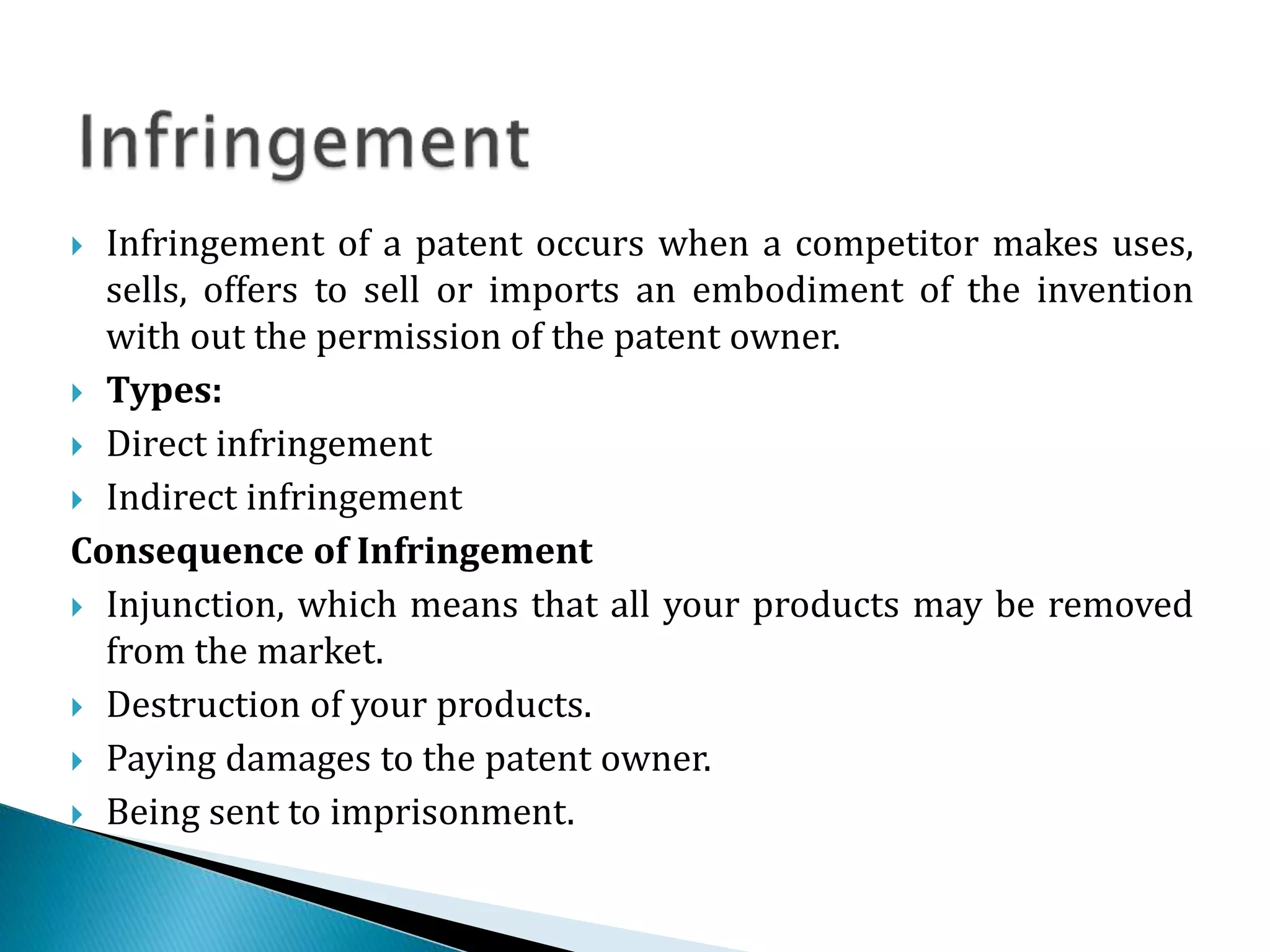
 Infringement of a patent occurs when a competitor makes uses,
sells, offers to sell or imports an embodiment of the invention
with out the permission of the patent owner.
 Types:
 Direct infringement
 Indirect infringement
Consequence of Infringement
 Injunction, which means that all your products may be removed
from the market.
 Destruction of your products.
 Paying damages to the patent owner.
 Being sent to imprisonment.
 Intellectual property (IP) is a category of property
that includes intangible creations of the human
intellect, and primarily encompasses copyrights,
patents, and trademarks etc.
 The main purpose of intellectual property law is to
encourage the creation of a large variety of
intellectual goods.
 This gives economic incentive for their creation,
because it allows people to profit from the
information and intellectual goods they create.
References
1. https://www.slideshare.net/AnupriyaNR/intellect
ual-property-rights-129311475
2. http://www.wipo.int/edocs/pubdocs/en/intprope
rty/450/wipo_pub_450 .pdf
3. https://www.tutorialspoint.com/information_secu
rity_cyber_law/intellectual_property_right.htm
https://users.wfu.edu/mcfallta/DIR0/pharma_pat
ents.pdf
4. https://patents.google.com/

Intellectual property rights

  • 1.
    Dr. S. Gopinath,M.E., Ph.D., Professor and Head Department of Electronics and Communication Engineering Karpagam Institute of Technology Coimbatore – 105. 10.01.2022
  • 2.
    Intellectual Property Rights Intellectual PropertyRights (IPR) are the rights given to the persons over the creations of their minds. IP is a property that arises from the human intellect.
  • 3.
     Tangible property Land, houses, estates, car  Intangible property  -intellectual property
  • 4.
     Capital expenditurefor new products  Research and Development  Marketing and advertisement  No free loaders  Maintaining loyal followers  Profit
  • 5.
     Can besold  Can be bought  Can be lease or rent  Can pass under a will  Can be assigned
  • 6.
    6 “INDUSTRIAL PROPERTIES” •PATENTS • INDUSTRIALDESIGNS • TRADEMARKS • TRADE SECRETS •GEOGRAPHICAL INDICATIONS
  • 7.
     Copyright Act1987  Trademarks Act 1976  Patent Act 1970  Industrial Design Act 1996  Geographical Indications Act 2000
  • 8.
     Exclusive rightfor being the true and first inventor of a product or process, granted by the govt. for a limited period, to exclude others from making, using, selling or importing the patented product or process with out his consent, in exchange of full disclosure of his invention.  Term: 20 years from the Date of Filing
  • 9.
     A patentis only valid in the jurisdiction in which it is granted.  Mumbai  Chennai Patent office branches  New Delhi  Kolkata  World Intellectual Property Organization -1967  (Located in Geneva. Promotes the protection of IP throughout the world)  Patent Cooperation Treaty – 1970  World Trade Organization - 1995
  • 10.
     Product  Tools/Apparatusfor producing the product  The process  The composition of matter  Methodology
  • 11.
     Application Form(Form 1)  Specification (Provisional/ Complete) (Form 2)  Drawings  Undertaking under section 8 (Form 3)  Power of Authority
  • 12.
     A tradesecret is something that offers an advantage in business if it keep as a secret.  A trade secret can be a client list, the formula for a product, etc.  A trade secret does not have to be patentable, but it must be capable of being maintained.  For instance, a client list can be protected by computer password, and the formula can be safeguarded by disclosing it to a limited number of people.  Trade secrets are not registered with any government or other agency.
  • 13.
    13 TRADE SECRET A typicalexample is Coca-Cola. This soft drink was invented in 1886 and was never protected by a patent, only by a trademark (for the name Coca-Cola) and by an industrial design (for this very special design of the Coca-Cola bottle, supposed to be in the shape of a woman wearing a long skin-tight dress). The process of the Coca-Cola drink is secret and is only known by two persons in the world. They are not allowed to travel together, so that there is no chance of them dying at the same time in an accident. The secret of the Coca-Cola process was well kept during all these years, and nobody is able to produce a drink with exactly the same taste still today. You all know that Pepsi Cola, its biggest competitor, has a different taste.
  • 14.
     Copyright means exclusiveright to do or authorize others to do certain acts in relation.  Permission is needed to reproduce the copyrighted material. “COPYRIGHT” • LITERARY • NOVEL • POEM • PLAYS • FILMS • MUSICAL • ARTISTIC • DRAWINGS • PHOTOGRAHS • PERFORMING ARTS • SCULPTURES • SOFTWARE
  • 15.
     Term: Author'slife plus sixty years (Books)  60 years (Films, photographs)  25 years (Broadcasting)  It protects the publications of the studies.  Information provided by the drug companies may be protected by copyright law.  Books, Paintings, Musical composition, plays, movies, radio/tv programs and other artistic works.
  • 16.
     It shouldhave a special quality or characteristics or reputation based up on the climatic or production characteristics unique to the geographical location.  The registration of a geographical indication is from a period of 10 years.  Renewal is possible for further period of 10 years each.  Examples: Kancheepuram silk, Darjeeling Tea, Solapur, Chaddar, Mysore Silk, Kullu Shawl etc  Benefits  Legal Protection from unauthorized use  Boost the rural development  Reproduce unfair practices of trade  Preserve local culture and resources  As of now, India has 344 GI products
  • 18.
     The protectiononly for the appearance of the article and not how it work.  Design registration protects designs having industrial or commercial use.  Designs of stamp, labels, tokens, cards, or cartoons and part of an article sold separately can not be registered.  Duration protection- 10 years and extendable for another term of 5 years.
  • 19.
     A trademark is any design that can distinguish the goods of one trader from those of another.  It includes words, logos, pictures, or combination of these.  A trademark is used as a marketing tool for product positioning.  The notion ® may be used for the trademark only if it is federally registered.  Term: 10 years
  • 20.
     Can eitherbe registered or not registered.  Advantages of registered trade marks.  Application can be made for goods and services.  Perform certain function such as indication of quality, identifying a trade connection.
  • 21.
    Property -> Right Idea–> Expression –> Copyright Idea –> Innovation –> Invention –> Patent Idea –> Quality + Identity –> Trademark Idea –> Appearance –> Design Idea –> Keep Confidential (No disclosure) –> Trade secrets
  • 22.
     Text search Simple search  Advanced search  Syntax (command based)  Number search  Structure search
  • 23.
  • 25.
     Infringement ofa patent occurs when a competitor makes uses, sells, offers to sell or imports an embodiment of the invention with out the permission of the patent owner.  Types:  Direct infringement  Indirect infringement Consequence of Infringement  Injunction, which means that all your products may be removed from the market.  Destruction of your products.  Paying damages to the patent owner.  Being sent to imprisonment.
  • 27.
     Intellectual property(IP) is a category of property that includes intangible creations of the human intellect, and primarily encompasses copyrights, patents, and trademarks etc.  The main purpose of intellectual property law is to encourage the creation of a large variety of intellectual goods.  This gives economic incentive for their creation, because it allows people to profit from the information and intellectual goods they create.
  • 28.
    References 1. https://www.slideshare.net/AnupriyaNR/intellect ual-property-rights-129311475 2. http://www.wipo.int/edocs/pubdocs/en/intprope rty/450/wipo_pub_450.pdf 3. https://www.tutorialspoint.com/information_secu rity_cyber_law/intellectual_property_right.htm https://users.wfu.edu/mcfallta/DIR0/pharma_pat ents.pdf 4. https://patents.google.com/