Integration in the age of Digital Transformation
WSO2 Workshop
Auckland, New Zealand.
Dassana Wijesekara | dassana@wso2.com
Associate Director – Solution Architecture
22nd June 2017
Agenda
▪ Digital Transformation and Integration
▪ Centralized Integration
▪ Future Integration needs
▪ Microservices and Integration
▪ Decentralized Integration – Micro-Integration
▪ State of the art integration middleware
▪ WSO2’s Next generation integration platform with Ballerina
2
Background
...
3
Digital Transformation and Enterprise Integration
4
▪ DT in a nutshell
o Evolving Business Models
o Focus on customer experience
o Optimize Operation
▪ Brown-field reality requires integration
o Hence Enterprise Integration is a key step towards
Digital Transformation.
Understanding Integration
▪ Penetration of IT in to businesses is on the rise.
▪ Systems and apps mounts critical business processes
▪ Enterprises adopting many systems and apps in many flavours
▪ Disparate software applications need to work together to produce
a unified set of functionality.
▪ Plumbing different software applications and forming new
software solutions is referred to as ‘enterprise integration’.
5
Centralized Integration
6
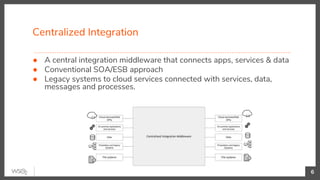
● A central integration middleware that connects apps, services & data
● Conventional SOA/ESB approach
● Legacy systems to cloud services connected with services, data,
messages and processes.
Centralized Integration
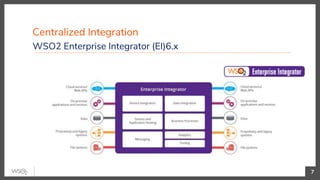
WSO2 Enterprise Integrator (EI)6.x
7
Centralized Integration
8
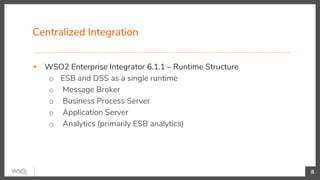
▪ WSO2 Enterprise Integrator 6.1.1 – Runtime Structure
o ESB and DSS as a single runtime
o Message Broker
o Business Process Server
o Application Server
o Analytics (primarily ESB analytics)
Future Integration Needs
...
9
Future Integration needs
10
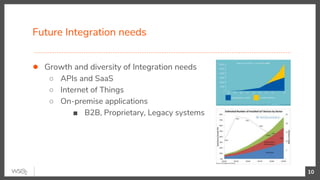
● Growth and diversity of Integration needs
○ APIs and SaaS
○ Internet of Things
○ On-premise applications
■ B2B, Proprietary, Legacy systems
Future Integration needs
11
● Agility and ease of Integration
○ Minimum integration skills and operational overhead.
○ Customize existing integrations rapidly.
○ Visual modeling, debugging, troubleshooting
○ Analytics – Statistics, message tracing
○ Error handling.
○ Streamlined development life cycle.
Future Integration needs
12
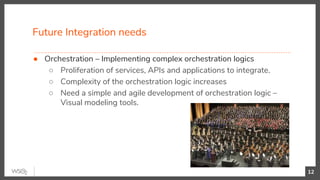
● Orchestration – Implementing complex orchestration logics
○ Proliferation of services, APIs and applications to integrate.
○ Complexity of the orchestration logic increases
○ Need a simple and agile development of orchestration logic –
Visual modeling tools.
Future Integration needs
13
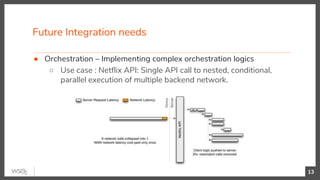
● Orchestration – Implementing complex orchestration logics
○ Use case : Netflix API: Single API call to nested, conditional,
parallel execution of multiple backend network.
Future Integration needs
14
● Integrating applications, services, data, APIs and identity
○ There’s a broad integration challenge than the traditional ESB
related integration.
○ Integration Server, Data Integration, Identity Bus, API
GW/Composition
Future Integration needs
15
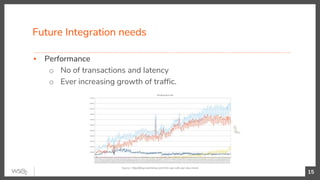
▪ Performance
o No of transactions and latency
o Ever increasing growth of traffic.
Source : http://blog.mailchimp.com/10m-api-calls-per-day-more/
Future Integration needs
16
● Performance
○ No of transactions and latency per container
○ Startup Time
○ Memory footprint
○ Distribution size
○ Average CPU consumption, Load Average
Future Integration needs
17
▪ Scalability
o Container based scaling
o Scaling based on the integration solution
o E.g : Ability to scale a given integration solution without
scaling others integration solutions.
Integration beyond ESB
...
18
Can Conventional Integration Middleware Survive ?
▪ Drastic changes in modern enterprise integration needs.
▪ Integration space has widened : sensors, devices, apps, systems,
cloud, government and many more.
▪ Not compatible with architectural paradigms (e.g : server less
architecture, microservices, in container architecture)
▪ All integration middleware available on the market provides more
or less same capabilities.
19
Future Integration Needs
● Microservices and ESB/Integration Middleware
○ Increasing adaptation of Microservices Architecture
○ Microservices does not encourage the conventional centralized
integration middleware.
○ Integration middleware is not container native.
20
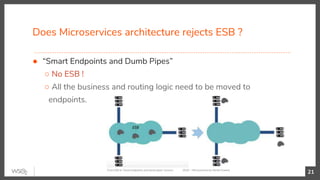
Does Microservices architecture rejects ESB ?
● “Smart Endpoints and Dumb Pipes”
○ No ESB !
○ All the business and routing logic need to be moved to
endpoints.
21From ESB to ‘Smart endpoints and dumb pipes’ (source : YOW! 2016 — Microservices by Martin Fowler)
Does Microservices architecture rejects ESB ?
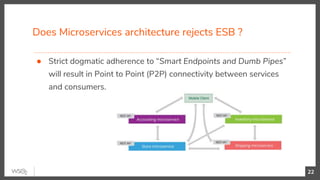
● Strict dogmatic adherence to “Smart Endpoints and Dumb Pipes”
will result in Point to Point (P2P) connectivity between services
and consumers.
22
Microservices and Enterprise Integration – In Practice
23
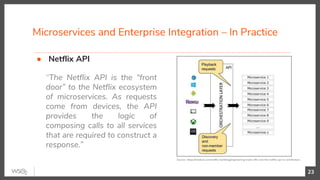
● Netflix API
“The Netflix API is the “front
door” to the Netflix ecosystem
of microservices. As requests
come from devices, the API
provides the logic of
composing calls to all services
that are required to construct a
response.”
Source : https://medium.com/netflix-techblog/engineering-trade-offs-and-the-netflix-api-re-architecture
Microservices and Enterprise Integration – In Practice
24
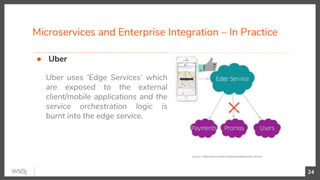
● Uber
Uber uses ‘Edge Services’ which
are exposed to the external
client/mobile applications and the
service orchestration logic is
burnt into the edge service.
Source : https://www.infoq.com/presentations/uber-darwin
Microservices and Enterprise Integration – In Practice
25
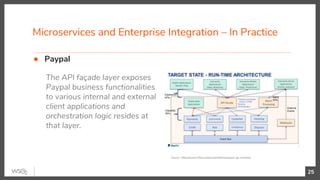
● Paypal
The API façade layer exposes
Paypal business functionalities
to various internal and external
client applications and
orchestration logic resides at
that layer.
Source : https://www.infoq.com/presentations/paypal-api-evolution
Microservices and Enterprise Integration – In Practice
26
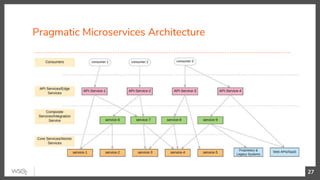
● Microservices still requires an integration layer that can implement
service/API orchestrations and connect to any other external
system.
● Use monolithic centralized integration middleware?
- No !
● Need of ‘Decentralized Integration Middleware’
Pragmatic Microservices Architecture
27
Decentralized Integration
28
● No centralized integration bus/ESB.
● Build independent integration scenarios using an integration
framework :
○ Micro-Integrations
○ Integration Microservices
Micro-Integration/Integration Microservices
29
● Build a specific integration scenario and run that scenario
independently with a lightweight integration framework.
● One integration scenario per each runtime.
● Runtime is extremely lightweight fully container native.
● Develop, deploy and scale each integration scenarios
Independently.
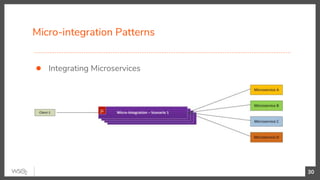
Micro-integration Patterns
30
● Integrating Microservices
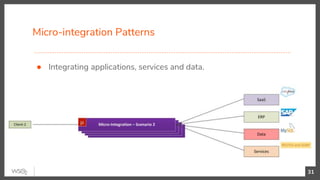
Micro-integration Patterns
31
● Integrating applications, services and data.
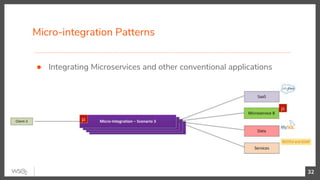
Micro-integration Patterns
32
● Integrating Microservices and other conventional applications
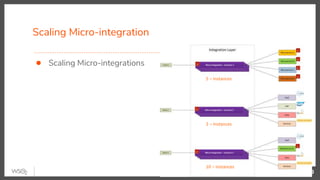
Scaling Micro-integration
33
● Scaling Micro-integrations
5 – Instances
2 – Instances
10 – Instances
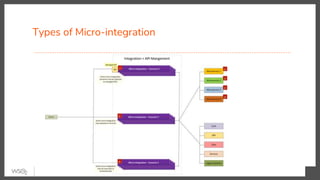
Types of Micro-integration
The Actual Realization
...
35
Next generation WSO2 Integration Platform
Addressing the future Integration needs.
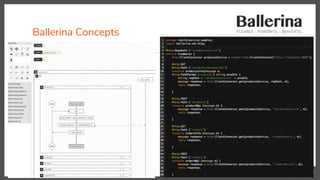
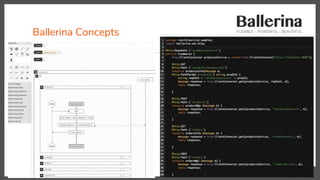
Ballerina
37
▪ A new programming language, that is designed and
optimized for integration, with text and graphical
syntaxes
▪ Sequence diagram programming model
▪ Modern, network-aware, data-aware, security-aware
programming system inspired by Java, Go, Maven, ...
Ballerina
38
▪ Graphical/textual parity with ability to switch back and forth
▪ Common integration capabilities are baked into the
language:
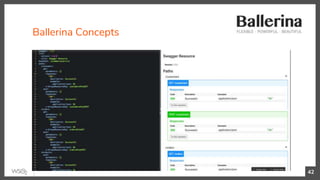
• Deep HTTP/REST/Swagger alignment
• Connectors for Web APIs and non-HTTP APIs
• Support for JSON, XML, (No)SQL data and mapping
▪ No magic – no weird syntax exceptions, everything is
derived from a few key language concepts
▪ Maximize developer productivity and abstraction clarity
▪ Support high performance implementations: low latency,
low memory and fast startup
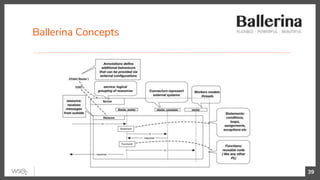
Ballerina Concepts
39
Ballerina Concepts
40
Ballerina Concepts
41
Ballerina Concepts
42
Ballerina Concepts
43
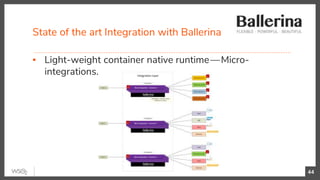
State of the art Integration with Ballerina
44
▪ Light-weight container native runtime — Micro-
integrations.
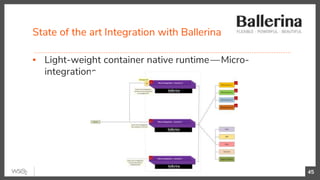
State of the art Integration with Ballerina
45
▪ Light-weight container native runtime — Micro-
integrations.
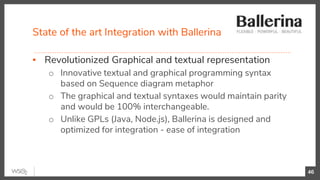
State of the art Integration with Ballerina
46
▪ Revolutionized Graphical and textual representation
o Innovative textual and graphical programming syntax
based on Sequence diagram metaphor
o The graphical and textual syntaxes would maintain parity
and would be 100% interchangeable.
o Unlike GPLs (Java, Node.js), Ballerina is designed and
optimized for integration - ease of integration
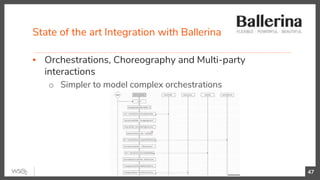
State of the art Integration with Ballerina
47
▪ Orchestrations, Choreography and Multi-party
interactions
o Simpler to model complex orchestrations
State of the art Integration with Ballerina
48
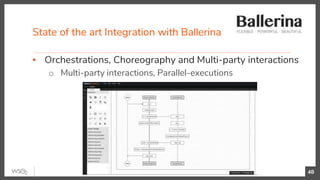
▪ Orchestrations, Choreography and Multi-party interactions
o Multi-party interactions, Parallel-executions
State of the art Integration with Ballerina
49
▪ Support diverse integration requirements
o Client and server connectors for HTTP 1.1/2,
WebSockets, JMS, (S)FTP(S) and more
o Client connectors for BasicAuth, OAuth, AmazonAuth
o Connectors for Web APIs: Twitter, GMail, LinkedIn,
Facebook, Lambda Functions
o EIPs – As language features
o Graphical Data/Type mapping
State of the art Integration with Ballerina
50
▪ Performance
o Ballerina uses latest WSO2 Netty HTTP transport (over
5x of performance improvement compared to traditional
HTTP transport implementations)
o Super-fast startup and low memory foot print. (100%
container native)
o Fully non-blocking execution.
State of the art Integration with Ballerina
51
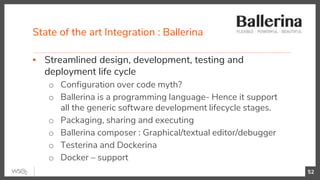
▪ Streamlined design, development, testing and
deployment life cycle
“Technology for developing, maintaining, testing, deploying, and governing
interfaces between applications, machines, or databases” (source : Forrester
TechRadar™: Integration Technologies 2015
State of the art Integration : Ballerina
52
▪ Streamlined design, development, testing and
deployment life cycle
o Configuration over code myth?
o Ballerina is a programming language- Hence it support
all the generic software development lifecycle stages.
o Packaging, sharing and executing
o Ballerina composer : Graphical/textual editor/debugger
o Testerina and Dockerina
o Docker – support
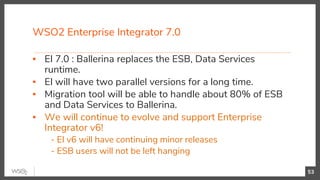
WSO2 Enterprise Integrator 7.0
53
▪ EI 7.0 : Ballerina replaces the ESB, Data Services
runtime.
▪ EI will have two parallel versions for a long time.
▪ Migration tool will be able to handle about 80% of ESB
and Data Services to Ballerina.
▪ We will continue to evolve and support Enterprise
Integrator v6!
- EI v6 will have continuing minor releases
- ESB users will not be left hanging
Conclusion
54
▪ Integration middleware is not disappearing…
▪ Rather growing to cover broad integration scenarios.
▪ Micro-integration will rule the world.
▪ Next generation WSO2 Integration Platform is
addressing those new paradigm shifts in Enterprise
Integration with Ballerina.
▪ Ballerina 1.0 GA will be available as a fully fledged
production-ready programming language for building
integrations
THANK YOU
wso2.com

WSO2 Auckland Workshop 2017

  • 1.
    Integration in theage of Digital Transformation WSO2 Workshop Auckland, New Zealand. Dassana Wijesekara | dassana@wso2.com Associate Director – Solution Architecture 22nd June 2017
  • 2.
    Agenda ▪ Digital Transformationand Integration ▪ Centralized Integration ▪ Future Integration needs ▪ Microservices and Integration ▪ Decentralized Integration – Micro-Integration ▪ State of the art integration middleware ▪ WSO2’s Next generation integration platform with Ballerina 2
  • 3.
  • 4.
    Digital Transformation andEnterprise Integration 4 ▪ DT in a nutshell o Evolving Business Models o Focus on customer experience o Optimize Operation ▪ Brown-field reality requires integration o Hence Enterprise Integration is a key step towards Digital Transformation.
  • 5.
    Understanding Integration ▪ Penetrationof IT in to businesses is on the rise. ▪ Systems and apps mounts critical business processes ▪ Enterprises adopting many systems and apps in many flavours ▪ Disparate software applications need to work together to produce a unified set of functionality. ▪ Plumbing different software applications and forming new software solutions is referred to as ‘enterprise integration’. 5
  • 6.
    Centralized Integration 6 ● Acentral integration middleware that connects apps, services & data ● Conventional SOA/ESB approach ● Legacy systems to cloud services connected with services, data, messages and processes.
  • 7.
  • 8.
    Centralized Integration 8 ▪ WSO2Enterprise Integrator 6.1.1 – Runtime Structure o ESB and DSS as a single runtime o Message Broker o Business Process Server o Application Server o Analytics (primarily ESB analytics)
  • 9.
  • 10.
    Future Integration needs 10 ●Growth and diversity of Integration needs ○ APIs and SaaS ○ Internet of Things ○ On-premise applications ■ B2B, Proprietary, Legacy systems
  • 11.
    Future Integration needs 11 ●Agility and ease of Integration ○ Minimum integration skills and operational overhead. ○ Customize existing integrations rapidly. ○ Visual modeling, debugging, troubleshooting ○ Analytics – Statistics, message tracing ○ Error handling. ○ Streamlined development life cycle.
  • 12.
    Future Integration needs 12 ●Orchestration – Implementing complex orchestration logics ○ Proliferation of services, APIs and applications to integrate. ○ Complexity of the orchestration logic increases ○ Need a simple and agile development of orchestration logic – Visual modeling tools.
  • 13.
    Future Integration needs 13 ●Orchestration – Implementing complex orchestration logics ○ Use case : Netflix API: Single API call to nested, conditional, parallel execution of multiple backend network.
  • 14.
    Future Integration needs 14 ●Integrating applications, services, data, APIs and identity ○ There’s a broad integration challenge than the traditional ESB related integration. ○ Integration Server, Data Integration, Identity Bus, API GW/Composition
  • 15.
    Future Integration needs 15 ▪Performance o No of transactions and latency o Ever increasing growth of traffic. Source : http://blog.mailchimp.com/10m-api-calls-per-day-more/
  • 16.
    Future Integration needs 16 ●Performance ○ No of transactions and latency per container ○ Startup Time ○ Memory footprint ○ Distribution size ○ Average CPU consumption, Load Average
  • 17.
    Future Integration needs 17 ▪Scalability o Container based scaling o Scaling based on the integration solution o E.g : Ability to scale a given integration solution without scaling others integration solutions.
  • 18.
  • 19.
    Can Conventional IntegrationMiddleware Survive ? ▪ Drastic changes in modern enterprise integration needs. ▪ Integration space has widened : sensors, devices, apps, systems, cloud, government and many more. ▪ Not compatible with architectural paradigms (e.g : server less architecture, microservices, in container architecture) ▪ All integration middleware available on the market provides more or less same capabilities. 19
  • 20.
    Future Integration Needs ●Microservices and ESB/Integration Middleware ○ Increasing adaptation of Microservices Architecture ○ Microservices does not encourage the conventional centralized integration middleware. ○ Integration middleware is not container native. 20
  • 21.
    Does Microservices architecturerejects ESB ? ● “Smart Endpoints and Dumb Pipes” ○ No ESB ! ○ All the business and routing logic need to be moved to endpoints. 21From ESB to ‘Smart endpoints and dumb pipes’ (source : YOW! 2016 — Microservices by Martin Fowler)
  • 22.
    Does Microservices architecturerejects ESB ? ● Strict dogmatic adherence to “Smart Endpoints and Dumb Pipes” will result in Point to Point (P2P) connectivity between services and consumers. 22
  • 23.
    Microservices and EnterpriseIntegration – In Practice 23 ● Netflix API “The Netflix API is the “front door” to the Netflix ecosystem of microservices. As requests come from devices, the API provides the logic of composing calls to all services that are required to construct a response.” Source : https://medium.com/netflix-techblog/engineering-trade-offs-and-the-netflix-api-re-architecture
  • 24.
    Microservices and EnterpriseIntegration – In Practice 24 ● Uber Uber uses ‘Edge Services’ which are exposed to the external client/mobile applications and the service orchestration logic is burnt into the edge service. Source : https://www.infoq.com/presentations/uber-darwin
  • 25.
    Microservices and EnterpriseIntegration – In Practice 25 ● Paypal The API façade layer exposes Paypal business functionalities to various internal and external client applications and orchestration logic resides at that layer. Source : https://www.infoq.com/presentations/paypal-api-evolution
  • 26.
    Microservices and EnterpriseIntegration – In Practice 26 ● Microservices still requires an integration layer that can implement service/API orchestrations and connect to any other external system. ● Use monolithic centralized integration middleware? - No ! ● Need of ‘Decentralized Integration Middleware’
  • 27.
  • 28.
    Decentralized Integration 28 ● Nocentralized integration bus/ESB. ● Build independent integration scenarios using an integration framework : ○ Micro-Integrations ○ Integration Microservices
  • 29.
    Micro-Integration/Integration Microservices 29 ● Builda specific integration scenario and run that scenario independently with a lightweight integration framework. ● One integration scenario per each runtime. ● Runtime is extremely lightweight fully container native. ● Develop, deploy and scale each integration scenarios Independently.
  • 30.
  • 31.
    Micro-integration Patterns 31 ● Integratingapplications, services and data.
  • 32.
    Micro-integration Patterns 32 ● IntegratingMicroservices and other conventional applications
  • 33.
    Scaling Micro-integration 33 ● ScalingMicro-integrations 5 – Instances 2 – Instances 10 – Instances
  • 34.
  • 35.
  • 36.
    Next generation WSO2Integration Platform Addressing the future Integration needs.
  • 37.
    Ballerina 37 ▪ A newprogramming language, that is designed and optimized for integration, with text and graphical syntaxes ▪ Sequence diagram programming model ▪ Modern, network-aware, data-aware, security-aware programming system inspired by Java, Go, Maven, ...
  • 38.
    Ballerina 38 ▪ Graphical/textual paritywith ability to switch back and forth ▪ Common integration capabilities are baked into the language: • Deep HTTP/REST/Swagger alignment • Connectors for Web APIs and non-HTTP APIs • Support for JSON, XML, (No)SQL data and mapping ▪ No magic – no weird syntax exceptions, everything is derived from a few key language concepts ▪ Maximize developer productivity and abstraction clarity ▪ Support high performance implementations: low latency, low memory and fast startup
  • 39.
  • 40.
  • 41.
  • 42.
  • 43.
  • 44.
    State of theart Integration with Ballerina 44 ▪ Light-weight container native runtime — Micro- integrations.
  • 45.
    State of theart Integration with Ballerina 45 ▪ Light-weight container native runtime — Micro- integrations.
  • 46.
    State of theart Integration with Ballerina 46 ▪ Revolutionized Graphical and textual representation o Innovative textual and graphical programming syntax based on Sequence diagram metaphor o The graphical and textual syntaxes would maintain parity and would be 100% interchangeable. o Unlike GPLs (Java, Node.js), Ballerina is designed and optimized for integration - ease of integration
  • 47.
    State of theart Integration with Ballerina 47 ▪ Orchestrations, Choreography and Multi-party interactions o Simpler to model complex orchestrations
  • 48.
    State of theart Integration with Ballerina 48 ▪ Orchestrations, Choreography and Multi-party interactions o Multi-party interactions, Parallel-executions
  • 49.
    State of theart Integration with Ballerina 49 ▪ Support diverse integration requirements o Client and server connectors for HTTP 1.1/2, WebSockets, JMS, (S)FTP(S) and more o Client connectors for BasicAuth, OAuth, AmazonAuth o Connectors for Web APIs: Twitter, GMail, LinkedIn, Facebook, Lambda Functions o EIPs – As language features o Graphical Data/Type mapping
  • 50.
    State of theart Integration with Ballerina 50 ▪ Performance o Ballerina uses latest WSO2 Netty HTTP transport (over 5x of performance improvement compared to traditional HTTP transport implementations) o Super-fast startup and low memory foot print. (100% container native) o Fully non-blocking execution.
  • 51.
    State of theart Integration with Ballerina 51 ▪ Streamlined design, development, testing and deployment life cycle “Technology for developing, maintaining, testing, deploying, and governing interfaces between applications, machines, or databases” (source : Forrester TechRadar™: Integration Technologies 2015
  • 52.
    State of theart Integration : Ballerina 52 ▪ Streamlined design, development, testing and deployment life cycle o Configuration over code myth? o Ballerina is a programming language- Hence it support all the generic software development lifecycle stages. o Packaging, sharing and executing o Ballerina composer : Graphical/textual editor/debugger o Testerina and Dockerina o Docker – support
  • 53.
    WSO2 Enterprise Integrator7.0 53 ▪ EI 7.0 : Ballerina replaces the ESB, Data Services runtime. ▪ EI will have two parallel versions for a long time. ▪ Migration tool will be able to handle about 80% of ESB and Data Services to Ballerina. ▪ We will continue to evolve and support Enterprise Integrator v6! - EI v6 will have continuing minor releases - ESB users will not be left hanging
  • 54.
    Conclusion 54 ▪ Integration middlewareis not disappearing… ▪ Rather growing to cover broad integration scenarios. ▪ Micro-integration will rule the world. ▪ Next generation WSO2 Integration Platform is addressing those new paradigm shifts in Enterprise Integration with Ballerina. ▪ Ballerina 1.0 GA will be available as a fully fledged production-ready programming language for building integrations
  • 55.