Successful Integration + growth, + capacity +commitment http:// www.youtube.com/watch?v =suyh4tGuScw
The Process Anticipate the Future Define the Vision Diagnose the gap Define critical tasks and work processes Action Planning Implementation Build readiness for  integration Establish Clarity,  Climate, Competence Assess readiness Monitor & Evaluate Communicate
Where are we going? Anticipate the Future Define the Vision How can we do more with less?
Diagnosis  - Where are we now? Norms, Values Communication networks Informal roles,  Informal power Informal stakeholders Human Resource Capabilities Competency Capacity Systems Structure Formal roles, power and connections, stakeholders Information systems Management systems Legal, regulatory or contractual obligations Financial capacity Source:  Adapted from D Nadler and M Tushman “Organisational Architecture ( Joseey-Bass 1992) Executive  Leadership  Competencies Demography Group processes Strategic Choices  Vision Strategy Objectives Clarity Strategy &  Leadership Formal  Organi- sation Culture People
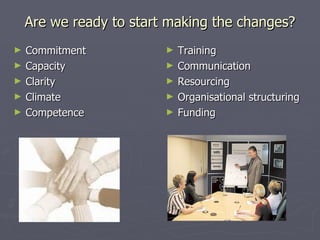
Are we ready to start making the changes? Commitment Capacity Clarity Climate Competence Training Communication Resourcing Organisational structuring Funding
Managing Resistance
To Happy Enthusiasm
Communication Patterns & unwritten rules Complexities Multi-way process Patterns of success Anyone can improve their skills with practice and training – some will be more able than others Proficient dance skills not required! Source: Adapted from Communication for managerial effectiveness, Clampitt P.2001, 2 nd  edn, Sage Publications http:// www.youtube.com/watch?v =suyh4tGuScw
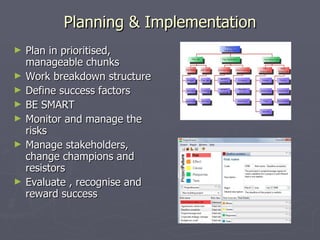
Planning & Implementation Plan in prioritised, manageable chunks Work breakdown structure Define success factors BE SMART Monitor and manage the risks Manage stakeholders, change champions and resistors Evaluate , recognise and reward success
Implementation and Evaluation Reflect on success + areas for  improvment Collect Data assess success Generate ideas Make a plan Celebrate +  Implement plans for improvement
The Process & the Outputs Vision Gap Analysis Organisations People Culture Capacity Competency Commitment  Competency Analysis Acquisition Comparison Analysis Differences Strengths/Weaknesses Vision match Plan for Implementation Defined Governance Work Breakdown Structure Prioritised Actions Plans Risk Management Plan Business cases/BE SMART Implementation Approach Success factors Evaluation  Change process Training Needs Analysis Training programme Business Readiness Survey Commitment gauge Attitude survey Clarity interviews Climate analysis Competency analysis Capacity measurement Communications Plan Stakeholder analysis Audience analysis Timing & Media Roles & signoffs Plan for Readiness Change Champions Strategies for resistance Training needs analysis Work breakdown structure Evaluation process Critical Success Factors Key Excellence Indicators Vision statement Strategy – key areas of focus Objectives Values/Behaviours SMARTs Anticipate the Future Define the Vision Diagnose the gap Define critical tasks and work processes Action Planning Implementation Build readiness for  integration Establish Clarity,  Climate, Competence Assess readiness Monitor & Evaluate Communicate
Not just a merger – an opportunity to evolve It is not the strongest of the species that survive, nor the most intelligent, but the one most responsive to change. Charles Darwin   (1809-1882) English Naturalist To improve is to change; to be perfect is to change often. Winston Churchill   (1874-1965) British politician. You can't expect to meet the challenges of today with yesterday's tools and expect to be in business tomorrow. Unknown Source Thank you for your time
Project Lifecycle procedures Project Lifecycle Change  Management Risk/Issue Management Consistent framework   Phase/Stage control via Gateways Cost and forecast monitored Stage review processes in place Clear decision point – end of phase Control duration, cost, deliverables Integrates with  development methods Control scope, deliverables,time,costs   Identification, benefit  assessment Authorisation Executive Committee  Implementation Project Team  Monitored, tracked, reported to closure Identification, assessment, logging and prioritisation  Determination options/resolution actions Clear escalation paths e.g. EXCO, PSC  Monitoring, tracking, control assigned actions/contingency plans Reporting/visibility until closure
Project Lifecycle
Managing Risks Risk Management Process

Integration

  • 1.
    Successful Integration +growth, + capacity +commitment http:// www.youtube.com/watch?v =suyh4tGuScw
  • 2.
    The Process Anticipatethe Future Define the Vision Diagnose the gap Define critical tasks and work processes Action Planning Implementation Build readiness for integration Establish Clarity, Climate, Competence Assess readiness Monitor & Evaluate Communicate
  • 3.
    Where are wegoing? Anticipate the Future Define the Vision How can we do more with less?
  • 4.
    Diagnosis -Where are we now? Norms, Values Communication networks Informal roles, Informal power Informal stakeholders Human Resource Capabilities Competency Capacity Systems Structure Formal roles, power and connections, stakeholders Information systems Management systems Legal, regulatory or contractual obligations Financial capacity Source: Adapted from D Nadler and M Tushman “Organisational Architecture ( Joseey-Bass 1992) Executive Leadership Competencies Demography Group processes Strategic Choices Vision Strategy Objectives Clarity Strategy & Leadership Formal Organi- sation Culture People
  • 5.
    Are we readyto start making the changes? Commitment Capacity Clarity Climate Competence Training Communication Resourcing Organisational structuring Funding
  • 6.
  • 7.
  • 8.
    Communication Patterns &unwritten rules Complexities Multi-way process Patterns of success Anyone can improve their skills with practice and training – some will be more able than others Proficient dance skills not required! Source: Adapted from Communication for managerial effectiveness, Clampitt P.2001, 2 nd edn, Sage Publications http:// www.youtube.com/watch?v =suyh4tGuScw
  • 9.
    Planning & ImplementationPlan in prioritised, manageable chunks Work breakdown structure Define success factors BE SMART Monitor and manage the risks Manage stakeholders, change champions and resistors Evaluate , recognise and reward success
  • 10.
    Implementation and EvaluationReflect on success + areas for improvment Collect Data assess success Generate ideas Make a plan Celebrate + Implement plans for improvement
  • 11.
    The Process &the Outputs Vision Gap Analysis Organisations People Culture Capacity Competency Commitment Competency Analysis Acquisition Comparison Analysis Differences Strengths/Weaknesses Vision match Plan for Implementation Defined Governance Work Breakdown Structure Prioritised Actions Plans Risk Management Plan Business cases/BE SMART Implementation Approach Success factors Evaluation Change process Training Needs Analysis Training programme Business Readiness Survey Commitment gauge Attitude survey Clarity interviews Climate analysis Competency analysis Capacity measurement Communications Plan Stakeholder analysis Audience analysis Timing & Media Roles & signoffs Plan for Readiness Change Champions Strategies for resistance Training needs analysis Work breakdown structure Evaluation process Critical Success Factors Key Excellence Indicators Vision statement Strategy – key areas of focus Objectives Values/Behaviours SMARTs Anticipate the Future Define the Vision Diagnose the gap Define critical tasks and work processes Action Planning Implementation Build readiness for integration Establish Clarity, Climate, Competence Assess readiness Monitor & Evaluate Communicate
  • 12.
    Not just amerger – an opportunity to evolve It is not the strongest of the species that survive, nor the most intelligent, but the one most responsive to change. Charles Darwin   (1809-1882) English Naturalist To improve is to change; to be perfect is to change often. Winston Churchill   (1874-1965) British politician. You can't expect to meet the challenges of today with yesterday's tools and expect to be in business tomorrow. Unknown Source Thank you for your time
  • 13.
    Project Lifecycle proceduresProject Lifecycle Change Management Risk/Issue Management Consistent framework Phase/Stage control via Gateways Cost and forecast monitored Stage review processes in place Clear decision point – end of phase Control duration, cost, deliverables Integrates with development methods Control scope, deliverables,time,costs Identification, benefit assessment Authorisation Executive Committee Implementation Project Team Monitored, tracked, reported to closure Identification, assessment, logging and prioritisation Determination options/resolution actions Clear escalation paths e.g. EXCO, PSC Monitoring, tracking, control assigned actions/contingency plans Reporting/visibility until closure
  • 14.
  • 15.
    Managing Risks RiskManagement Process