




Integrating UX and Agile /SCRUMA work in progress
Agile ValuesIndividuals and interactions over processes and toolsWorking software over comprehensive documentationCustomer collaboration over contract negotiationResponding to change over following a plan
Agile PrinciplesOur highest priority is to satisfy the customerthrough early and continuous deliveryof valuable software. Welcome changing requirements, even late in development. Agile processes harness change for the customer's competitive advantage. Deliver working software frequently, from a couple of weeks to a couple of months, with a preference to the shorter timescale. Business people and developers must work together daily throughout the project. Build projects around motivated individuals. Give them the environment and support they need, and trust them to get the job done.
The most efficient and effective method of conveying information to and within a development team is face-to-face conversation. Working software is the primary measure of progress. Agile processes promote sustainable development. The sponsors, developers, and users should be able to maintain a constant pace indefinitely. Continuous attention to technical excellence and good design enhances agility. Simplicity--the art of maximizing the amount of work not done--is essential. The best architectures, requirements, and designs emerge from self-organizing teams. At regular intervals, the team reflects on how to become more effective, then tunes and adjusts its behavior accordingly.
Agile and UX start with the same problems:Estimating scope is impossibleDeadline aren’t being metCode needs to be rewrittenSoftware is unusableUsers aren’t part of the equationBudgets run overEverybody is frustratedInsert your favorite painpoint here
Some things that neither UX nor Agile can FixExecutives that change their mind every weekPoor judgment of people in controlLack of corporate strategyInadequate skill setToo many developers, not enough designers
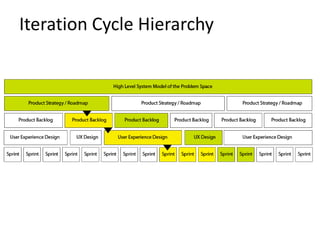
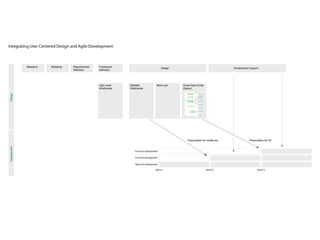
Iteration Cycle Hierarchy
Some GuidelinesResearch firstDesign secondCollaborate closely with business ownersCollaborate closely with developersPrioritize features based on user needs (research), business goals, and technical feasibilityHave a meeting with designers, developers, and business owners in one roomUsers and customers are represented by designers and product managers
More GuidelinesDocument the designKeep design documentation currentDon’t code too soonDon’t let developers talk to customersRe-evaluate your process periodically and see what works for you and what doesn’t.Make it betterLet me know what works for you and what doesn’t.
Daniel JaegerInteraction Design & Strategydaniel@citizenbrain.comwww.citizenbrain.com
?

Integrating Ux And Agile

  • 1.
    Integrating UX andAgile /SCRUMA work in progress
  • 2.
    Agile ValuesIndividuals andinteractions over processes and toolsWorking software over comprehensive documentationCustomer collaboration over contract negotiationResponding to change over following a plan
  • 3.
    Agile PrinciplesOur highestpriority is to satisfy the customerthrough early and continuous deliveryof valuable software. Welcome changing requirements, even late in development. Agile processes harness change for the customer's competitive advantage. Deliver working software frequently, from a couple of weeks to a couple of months, with a preference to the shorter timescale. Business people and developers must work together daily throughout the project. Build projects around motivated individuals. Give them the environment and support they need, and trust them to get the job done.
  • 4.
    The most efficientand effective method of conveying information to and within a development team is face-to-face conversation. Working software is the primary measure of progress. Agile processes promote sustainable development. The sponsors, developers, and users should be able to maintain a constant pace indefinitely. Continuous attention to technical excellence and good design enhances agility. Simplicity--the art of maximizing the amount of work not done--is essential. The best architectures, requirements, and designs emerge from self-organizing teams. At regular intervals, the team reflects on how to become more effective, then tunes and adjusts its behavior accordingly.
  • 5.
    Agile and UXstart with the same problems:Estimating scope is impossibleDeadline aren’t being metCode needs to be rewrittenSoftware is unusableUsers aren’t part of the equationBudgets run overEverybody is frustratedInsert your favorite painpoint here
  • 8.
    Some things thatneither UX nor Agile can FixExecutives that change their mind every weekPoor judgment of people in controlLack of corporate strategyInadequate skill setToo many developers, not enough designers
  • 9.
  • 14.
    Some GuidelinesResearch firstDesignsecondCollaborate closely with business ownersCollaborate closely with developersPrioritize features based on user needs (research), business goals, and technical feasibilityHave a meeting with designers, developers, and business owners in one roomUsers and customers are represented by designers and product managers
  • 15.
    More GuidelinesDocument thedesignKeep design documentation currentDon’t code too soonDon’t let developers talk to customersRe-evaluate your process periodically and see what works for you and what doesn’t.Make it betterLet me know what works for you and what doesn’t.
  • 16.
    Daniel JaegerInteraction Design& Strategydaniel@citizenbrain.comwww.citizenbrain.com
  • 17.

Editor's Notes

  • #2 The work in progress actually refers to a lot of things – this presentation, my own approach to integrating UX and Agile and the general state of software development processes.
  • #6 Agile and UX or interaction design really started with the same problems.
  • #7 You would think they’re a match made in heaven. But like any relationship, it is hard work to make it work.
  • #8 A lot of people seem to think that Agile / Scrum is the silver bullet to solve all these problems. Interestingly enough, nobody other than designers seem to think that interaction design or user experience is a silver bullet.
  • #10 I believe for most products you can find a level of goals that don’t change over time or at lease only every 100 or 50 years. This is very general but it serves as an anchor for everything else.What changes is the technology.