
INTEGRATING PSYCHOTHERAPY
WITH THE TWELVE STEPS IN
TREATMENT OF SUD
Col. Dr. Ehab Elbaz
CEO of National Center of Addiction Treatment
Goals statement
• To identify the closest form of psychotherapy that is
compatible with 12 steps program.
• To find a homogenous approach that integrate
psychotherapy and 12 steps program
The beginning
• The 12-Step Program was created by two alcoholics, Bill
W. and Dr. Bob, who were both looking for a means to
end their addiction to alcohol.
• They reached their goal through the use of three tenets
that became the core principles of 12-Steps.
1. If a person hopes to end the cycle of addiction, they must have
a desire to stop drinking.
2. The second tenet is that spirituality is a central component to
recovery by removing one's will and placing it in the hands of
God, as each person understands Him.
3. The final tenet is that there is a healing power that exists in the
relationship between two alcoholics when they struggle
together to stay sober.
Elements of 12 steps
• Identity (‘I am an addict’)
• Cognitive (adhering to various advises e.g. ‘live
life on life’s terms’ and ‘one day at a time’)
• Narrative (telling one’s story repeatedly)
• Social (attending meetings)
• Interpersonal (working with a sponsor and later
being a sponsor)
• Spiritual ( meditation and prayer).
The 12 Steps Explained With a Single Word
• Step 1: Honesty
• Step 2: Hope
• Step 3: Faith
• Step 4: Courage
• Step 5: Integrity
• Step 6: Willingness
• Step 7: Humility
• Step 8: Compassion
• Step 9: Love
• Step 10: Perseverance
• Step 11: Spiritual Awareness
• Step 12: Service
STRENGTHS OF 12-STEP RECOVERY
• Free of charge
• Clear protocol
• Offering meetings, literature, sponsorship, and telephone
support.
• Diversity of members
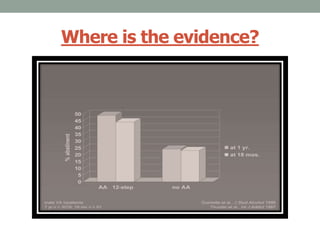
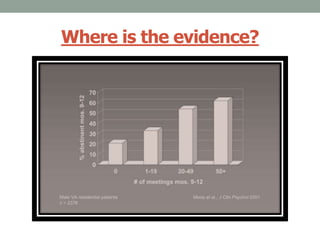
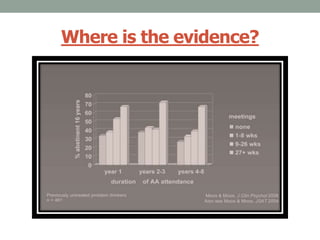
Where is the evidence?
Mechanism of change in 12 steps
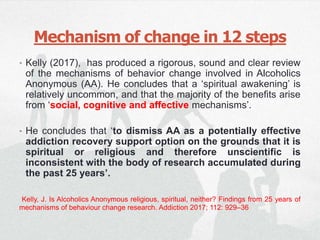
• Kelly (2017), has produced a rigorous, sound and clear review
of the mechanisms of behavior change involved in Alcoholics
Anonymous (AA). He concludes that a ‘spiritual awakening’ is
relatively uncommon, and that the majority of the benefits arise
from ‘social, cognitive and affective mechanisms’.
• He concludes that ‘to dismiss AA as a potentially effective
addiction recovery support option on the grounds that it is
spiritual or religious and therefore unscientific is
inconsistent with the body of research accumulated during
the past 25 years’.
Kelly, J. Is Alcoholics Anonymous religious, spiritual, neither? Findings from 25 years of
mechanisms of behaviour change research. Addiction 2017; 112: 929–36
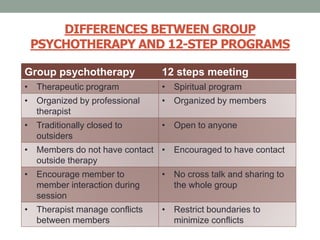
DIFFERENCES BETWEEN GROUP
PSYCHOTHERAPY AND 12-STEP PROGRAMS
Group psychotherapy 12 steps meeting
• Therapeutic program • Spiritual program
• Organized by professional
therapist
• Organized by members
• Traditionally closed to
outsiders
• Open to anyone
• Members do not have contact
outside therapy
• Encouraged to have contact
• Encourage member to
member interaction during
session
• No cross talk and sharing to
the whole group
• Therapist manage conflicts
between members
• Restrict boundaries to
minimize conflicts
SIMILARITIES BETWEEN GROUP
PSYCHOTHERAPY AND 12 STEPS PROGRAM
• Both rely on the cohesion of the group to and
collaboration of the participants.
• Both use experiential learning for achieving personal and
collective insight and encourage self-exploration, self-
expression, and self-discovery
• Both value the honest disclosure of private and shameful
behaviors that could contribute to isolation.
• Both acknowledge the power of irrational processes in the
individual and in the group,
• Both recognize the importance of processing one’s
experiences
• Both support the exploration and repair of early
attachment failures and the construction of a coherent life
narrative
• Both encourage the acquisition of skills, such as
mindfulness, anger management, and conflict-resolution
techniques to expand the capacity of the participant to
engage in interpersonal relationships within and outside
the group experience.
• Both promote learning, growth, and change.
The problems with the integration
• Attitudes of clinicians
• Attitude of customers
• Different philosophical and theoretical background
• Different terminology
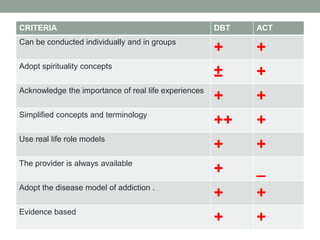
What are the criteria of the ideal psychotherapy
modality to match with 12 steps?
• Can be conducted individually and in groups
• Adopt spirituality concepts
• Acknowledge the importance of real life experiences
• Simplified concepts and terminology
• Use real life role models
• The provider is always available
• Adopt the disease model of addiction .
• Evidence based
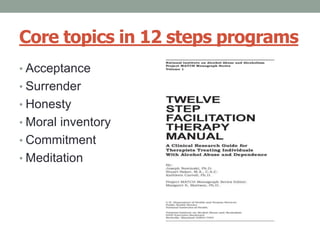
Core topics in 12 steps programs
• Acceptance
• Surrender
• Honesty
• Moral inventory
• Commitment
• Meditation
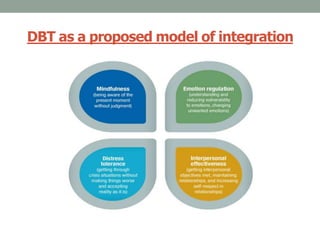
DBT as a proposed model of integration
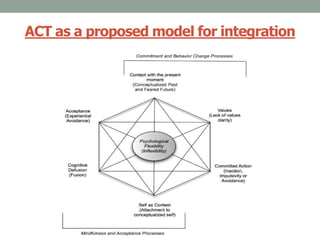
ACT as a proposed model for integration
CRITERIA DBT ACT
Can be conducted individually and in groups
+ +
Adopt spirituality concepts
± +
Acknowledge the importance of real life experiences
+ +
Simplified concepts and terminology
++ +
Use real life role models
+ +
The provider is always available
+ _
Adopt the disease model of addiction .
+ +
Evidence based
+ +
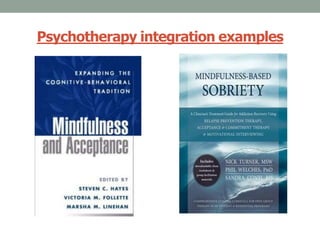
Psychotherapy integration examples
Take home message
SUD is a complex disorder with high relapse rate
No single intervention lead to a satisfactory effectiveness
Combination of different modalities may give better
results.
Integrating psychotherapy with 12 steps program may be
beneficial
ACT and DBT may be the closest form of psychotherapy
that match the principles of the 12 steps program
integrating psychotherapy and 12 steps

integrating psychotherapy and 12 steps

  • 1.
    INTEGRATING PSYCHOTHERAPY WITH THETWELVE STEPS IN TREATMENT OF SUD Col. Dr. Ehab Elbaz CEO of National Center of Addiction Treatment
  • 2.
    Goals statement • Toidentify the closest form of psychotherapy that is compatible with 12 steps program. • To find a homogenous approach that integrate psychotherapy and 12 steps program
  • 3.
    The beginning • The12-Step Program was created by two alcoholics, Bill W. and Dr. Bob, who were both looking for a means to end their addiction to alcohol. • They reached their goal through the use of three tenets that became the core principles of 12-Steps. 1. If a person hopes to end the cycle of addiction, they must have a desire to stop drinking. 2. The second tenet is that spirituality is a central component to recovery by removing one's will and placing it in the hands of God, as each person understands Him. 3. The final tenet is that there is a healing power that exists in the relationship between two alcoholics when they struggle together to stay sober.
  • 4.
    Elements of 12steps • Identity (‘I am an addict’) • Cognitive (adhering to various advises e.g. ‘live life on life’s terms’ and ‘one day at a time’) • Narrative (telling one’s story repeatedly) • Social (attending meetings) • Interpersonal (working with a sponsor and later being a sponsor) • Spiritual ( meditation and prayer).
  • 5.
    The 12 StepsExplained With a Single Word • Step 1: Honesty • Step 2: Hope • Step 3: Faith • Step 4: Courage • Step 5: Integrity • Step 6: Willingness • Step 7: Humility • Step 8: Compassion • Step 9: Love • Step 10: Perseverance • Step 11: Spiritual Awareness • Step 12: Service
  • 6.
    STRENGTHS OF 12-STEPRECOVERY • Free of charge • Clear protocol • Offering meetings, literature, sponsorship, and telephone support. • Diversity of members
  • 7.
    Where is theevidence?
  • 8.
    Where is theevidence?
  • 9.
    Where is theevidence?
  • 10.
    Mechanism of changein 12 steps • Kelly (2017), has produced a rigorous, sound and clear review of the mechanisms of behavior change involved in Alcoholics Anonymous (AA). He concludes that a ‘spiritual awakening’ is relatively uncommon, and that the majority of the benefits arise from ‘social, cognitive and affective mechanisms’. • He concludes that ‘to dismiss AA as a potentially effective addiction recovery support option on the grounds that it is spiritual or religious and therefore unscientific is inconsistent with the body of research accumulated during the past 25 years’. Kelly, J. Is Alcoholics Anonymous religious, spiritual, neither? Findings from 25 years of mechanisms of behaviour change research. Addiction 2017; 112: 929–36
  • 11.
    DIFFERENCES BETWEEN GROUP PSYCHOTHERAPYAND 12-STEP PROGRAMS Group psychotherapy 12 steps meeting • Therapeutic program • Spiritual program • Organized by professional therapist • Organized by members • Traditionally closed to outsiders • Open to anyone • Members do not have contact outside therapy • Encouraged to have contact • Encourage member to member interaction during session • No cross talk and sharing to the whole group • Therapist manage conflicts between members • Restrict boundaries to minimize conflicts
  • 12.
    SIMILARITIES BETWEEN GROUP PSYCHOTHERAPYAND 12 STEPS PROGRAM • Both rely on the cohesion of the group to and collaboration of the participants. • Both use experiential learning for achieving personal and collective insight and encourage self-exploration, self- expression, and self-discovery • Both value the honest disclosure of private and shameful behaviors that could contribute to isolation. • Both acknowledge the power of irrational processes in the individual and in the group, • Both recognize the importance of processing one’s experiences
  • 13.
    • Both supportthe exploration and repair of early attachment failures and the construction of a coherent life narrative • Both encourage the acquisition of skills, such as mindfulness, anger management, and conflict-resolution techniques to expand the capacity of the participant to engage in interpersonal relationships within and outside the group experience. • Both promote learning, growth, and change.
  • 14.
    The problems withthe integration • Attitudes of clinicians • Attitude of customers • Different philosophical and theoretical background • Different terminology
  • 15.
    What are thecriteria of the ideal psychotherapy modality to match with 12 steps? • Can be conducted individually and in groups • Adopt spirituality concepts • Acknowledge the importance of real life experiences • Simplified concepts and terminology • Use real life role models • The provider is always available • Adopt the disease model of addiction . • Evidence based
  • 16.
    Core topics in12 steps programs • Acceptance • Surrender • Honesty • Moral inventory • Commitment • Meditation
  • 17.
    DBT as aproposed model of integration
  • 18.
    ACT as aproposed model for integration
  • 19.
    CRITERIA DBT ACT Canbe conducted individually and in groups + + Adopt spirituality concepts ± + Acknowledge the importance of real life experiences + + Simplified concepts and terminology ++ + Use real life role models + + The provider is always available + _ Adopt the disease model of addiction . + + Evidence based + +
  • 20.
  • 21.
    Take home message SUDis a complex disorder with high relapse rate No single intervention lead to a satisfactory effectiveness Combination of different modalities may give better results. Integrating psychotherapy with 12 steps program may be beneficial ACT and DBT may be the closest form of psychotherapy that match the principles of the 12 steps program