INTEGERS
UNIT ESSENTIAL
QUESTIONS
•What are integers?
•When do we work with integers in
the real world?
•What situations can be represented
with integers?
•How do we add and subtract
integers?
KEY VOCABULARY
•Integers
•Positive Integers
•Negative
Integers
•Opposites
•Absolute value
•Additive Inverse
Property
INTEGERS
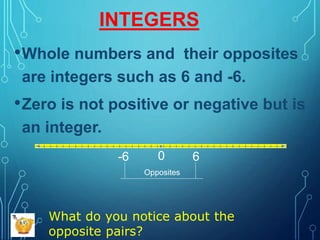
•Whole numbers and their opposites
are integers such as 6 and -6.
•Zero is not positive or negative but is
an integer.
0 6
-6
Opposites
What do you notice about the
opposite pairs?
Positive number – a
number greater than
zero.
0 1 2 3 4 5 6
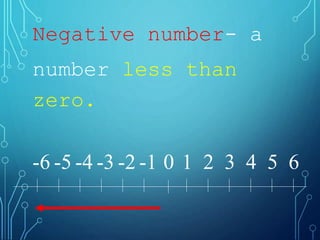
Negative number- a
number less than
zero.
0 1 2 3 4 5 6
-1
-2
-3
-4
-5
-6
NEGATIVE
NUMBERS
CAN BE
USED TO
MEASURE
TEMPERATU
RES BELOW
ZERO.
NEGATIVE
NUMBERS
ARE USED
TO
MEASURE
PLACES
BELOW
SEA
LEVEL.
NEGATIVE
NUMBERS
ARE
USED TO
SHOW
DEBT
(WHAT
YOU
OWE.)
Examples of words that can be used to represent
positive and negative situations.
Can you think of other words used in real life
to represent a positive or negative situation?
THE INTEGER
TO THE RIGHT
ON THE
NUMBER LINE
IS ALWAYS
LARGER.
-2 > -17
Comparing itegers
Greater
than
0 < 22
Less
than
-247 > -400
Greater
than
OPPOSITE
NUMBERS
numbers that are the same
distance from zero in the
opposite direction
0 1 2 3 4 5 6
-1
-2
-3
-4
-5
-6
What is the opposite of 0?
0 6
-6
Opposites
What do you notice
about the location of
the opposite pair of
integers?
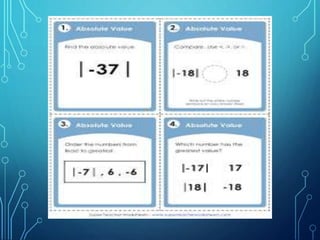
ABSOLUTE VALUE
The distance
a number is
from zero on
the number
line.
Absolute value is
always positive.
The symbol for
absolute value is
-4
Absolute value does not
equal opposite.
4
QUESTION?
If |x| = 3, what is the value
of x?
ANSWER
-3 or 3

INTEGERS.ppt