2012-2013
          BUSINESS PRESENTATION
SUBMITTED TO :- MR. PIYUSH SINGLA
SUBMITTED BY :-            ADITYA KANSAL , SHUBHAM GARG , SANCHIT KHATTAR , SOMESH GARG ,
GURSIMRAN SINGH ,
NAVPREET SHARMA , AMRITPAL SINGH ,
ADITYA AATLI ,MEGHA NAYYAR ,
MEGHA VERMA ,MANDEEP KAUR,
REETIKA GOYAL .
 Insurer
 Insured
 Proposal
 Policy of Insurance
Double Insurance
It is the sub-insurance made by
the insurers in case he finds
himself incapable to compensate
for the loss. Sometimes an insurer
insurers the risk, which is beyond
his control and capacity, he may
get the whole or the part of the
risk    reinsured    from     other
company.
History
•In 1956 : 245 Indian & foreign insurers & provident societies were
taken over by the central govt. & they got nationalized.
The history of general insurance business in India can be traced back
to Triton Insurance company Ltd (the first general insurance
company) which was formed in the year 1850 in Kolkata by the
British.

•107 insurers integrated & grouped into four companies viz. the
national insurance company ltd. The oriental life insurance company
ltd. & the united Indian insurance company ltd. was incorporated as a
company.
FUNCTION
PROTECTION
RISK SHARING
ASSISTING CAPITAL
FORMATION
PROVIDING CERTAINITY
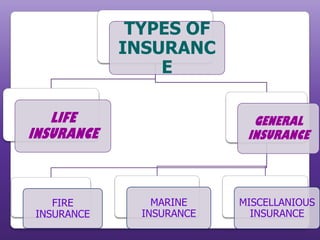
TYPES OF
            INSURANC
                E

   LIFE                     GENERAL
INSURANCE                  INSURANCE


   FIRE         MARINE    MISCELLANIOUS
INSURANCE     INSURANCE     INSURANCE
LIFE INSURANCE is a
contract between a person
  and the life insurance
corporation. There is a
element
 of investment in the life
 insurance, because the
amount of the policy is
received in both the cases
 i.e. on the death of the
insured or at the expiry
of the policy.
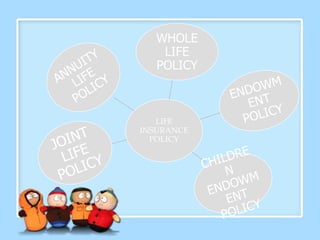
WHOLE
    LIFE
   POLICY


   LIFE
INSURANCE
  POLICY
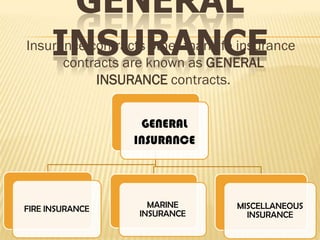
GENERAL
    INSURANCE
Insurance contracts other than life insurance
      contracts are known as GENERAL
                 INSURANCE contracts.


                       GENERAL
                      INSURANCE


FIRE INSURANCE           MARINE         MISCELLANEOUS
                       INSURANCE          INSURANCE
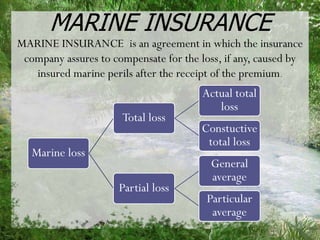
MARINE INSURANCE
MARINE INSURANCE is an agreement in which the insurance
 company assures to compensate for the loss, if any, caused by
   insured marine perils after the receipt of the premium.
                                        Actual total
                                           loss
                      Total loss
                                        Constuctive
                                         total loss
   Marine loss
                                          General
                                          average

                      Partial loss
                                         Particular
                                          average
Miscellaneous Insurance
•Health Insurance
•Burial Insurance
•Home Insurance
•Liability Insurance
•Motor Vehicle Insurance
•Casual Insurance
•GAP Insurance
•Credit Insurance
•Property Insurance
Health
 insurance is insurance again
      st the risk of incurring
    medical expenses among
individuals. By estimating the
    overall risk of health care
  expenses among a targeted
      group, an insurer can
    develop a routine finance
 structure, such as a monthly
    premium or payroll tax, to
      ensure that money is
     available to pay for the
health care benefits specified
  in the insurance agreement.
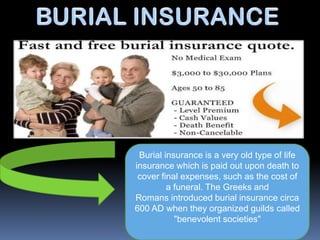
Burial insurance is a very old type of life
insurance which is paid out upon death to
 cover final expenses, such as the cost of
         a funeral. The Greeks and
Romans introduced burial insurance circa
600 AD when they organized guilds called
           "benevolent societies"
Liability insurance is a part of the
general          insurance         system
of risk financing to protect the
purchaser from the risks of liabilities
imposed by lawsuits and similar claims.
It protects the insured in the event he or
she is sued for claims that come within
the coverage of the insurance policy.
Companies that faced a common peril,
formed a group and created a self-help
fund out of which to pay compensation
should any member incur loss . The
modern system relies on dedicated
carriers, usually for-profit, to offer
protection against specified perils
in consideration of a premium.
Casualty insurance, often
 equated to liability insurance, is
     used to describe an area
      of insurance not directly
         concerned with life
   insurance, health insurance,
   or property insurance. It may
   include marine insurance for
 shipwrecks or losses at sea or
 fidelity and surety insurance. It
              may also
include earthquake, political risk
        insurance, terrorism
   insurance, fidelity and surety
               bonds.
GAP insurance is also
   known as Guaranteed
             Auto
 Protection or Guaranteed
    Asset Protection and
   simply known as GAP
 within the North American
 financial industry. GAP is
the difference between the
   actual cash value of a
   vehicle minus all perils
  deductible and liens and
  the lease or loan payout
     minus financed soft
products or negative equity
 on a trade. GAP coverage
is mainly used on new and
  used small vehicles and
  heavy trucks, and some
    financing companies
          require it.
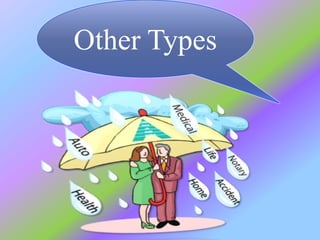
Other Types
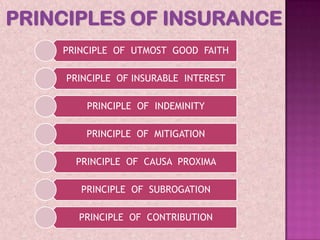
PRINCIPLES OF INSURANCE
    PRINCIPLE OF UTMOST GOOD FAITH

     PRINCIPLE OF INSURABLE INTEREST

         PRINCIPLE OF INDEMINITY

        PRINCIPLE OF MITIGATION

      PRINCIPLE OF CAUSA PROXIMA

       PRINCIPLE OF SUBROGATION

       PRINCIPLE OF CONTRIBUTION
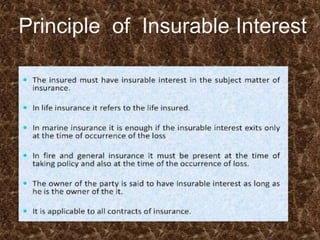
Principle of Insurable Interest
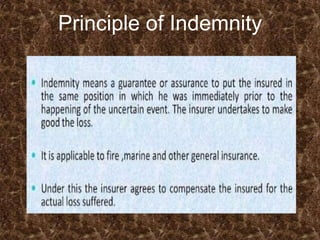
Principle of Indemnity
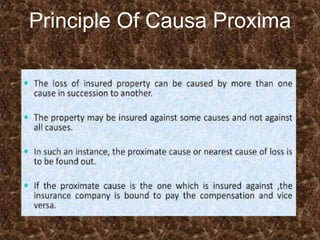
Principle Of Causa Proxima
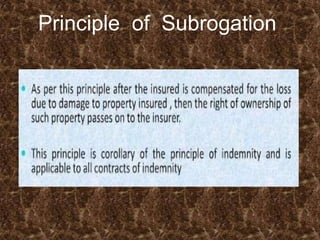
Principle of Subrogation


    After an insurer has paid to the insured
    the monies indemnifying the loss
    suffered, the insurer is then entitled to
    recover from any third party at fault the
    damages for causing the loss which
    otherwise could have been sought by the
    insured.
In the event of
       Principle of Mitigation
mishappening , it
is the duty of the
 insured that he
   must take all
reasonable steps
 to minimise the
   steps in same
manner, which he
would have done
  if the property
 was not insured.
   If the insured
 suffers any loss
      or incurs
     expenses in
  minimising the
    loss, he can
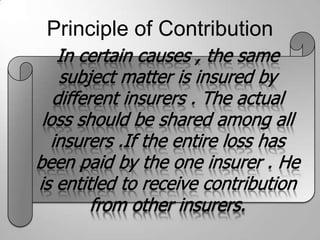
Principle of Contribution
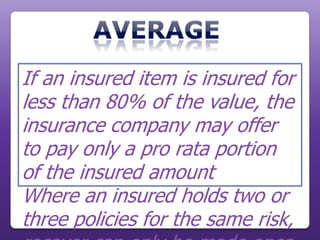
If an insured item is insured for
less than 80% of the value, the
insurance company may offer
to pay only a pro rata portion
of the insured amount
Where an insured holds two or
three policies for the same risk,
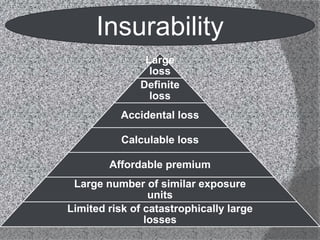
Insurability
       Insurability

                   Large
                    loss
                  Definite
                    loss
            Accidental loss

            Calculable loss

        Affordable premium
 Large number of similar exposure
                 units
Limited risk of catastrophically large
                losses
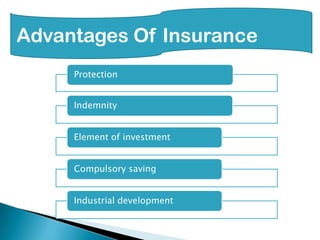
Advantages Of Insurance
     Protection


     Indemnity


     Element of investment


     Compulsory saving


     Industrial development
Future Of Indian Insurance
         Market
CONCLUSION

It relives those insuring from the worry and anxiety they may have
about how they would meet the cost of risk. In case of business, this
is a positive stimulus to their activities and allows them to get on
with their own business in the knowledge that they are financially
protected against many forms of risk. Business people will be more
inclined to risk their money with the knowledge that they will not fall
victim of some risk. This is an extremely important factor which
insurance brings – not only to the individual but also to the whole
country – as stimulating business makes for a healthy economy
Insurance
Insurance
Insurance
Insurance

Insurance

  • 1.
    2012-2013 BUSINESS PRESENTATION SUBMITTED TO :- MR. PIYUSH SINGLA SUBMITTED BY :- ADITYA KANSAL , SHUBHAM GARG , SANCHIT KHATTAR , SOMESH GARG , GURSIMRAN SINGH , NAVPREET SHARMA , AMRITPAL SINGH , ADITYA AATLI ,MEGHA NAYYAR , MEGHA VERMA ,MANDEEP KAUR, REETIKA GOYAL .
  • 3.
     Insurer  Insured Proposal  Policy of Insurance
  • 6.
  • 7.
    It is thesub-insurance made by the insurers in case he finds himself incapable to compensate for the loss. Sometimes an insurer insurers the risk, which is beyond his control and capacity, he may get the whole or the part of the risk reinsured from other company.
  • 8.
  • 9.
    •In 1956 :245 Indian & foreign insurers & provident societies were taken over by the central govt. & they got nationalized. The history of general insurance business in India can be traced back to Triton Insurance company Ltd (the first general insurance company) which was formed in the year 1850 in Kolkata by the British. •107 insurers integrated & grouped into four companies viz. the national insurance company ltd. The oriental life insurance company ltd. & the united Indian insurance company ltd. was incorporated as a company.
  • 10.
  • 11.
    TYPES OF INSURANC E LIFE GENERAL INSURANCE INSURANCE FIRE MARINE MISCELLANIOUS INSURANCE INSURANCE INSURANCE
  • 12.
    LIFE INSURANCE isa contract between a person and the life insurance corporation. There is a element of investment in the life insurance, because the amount of the policy is received in both the cases i.e. on the death of the insured or at the expiry of the policy.
  • 13.
    WHOLE LIFE POLICY LIFE INSURANCE POLICY
  • 14.
    GENERAL INSURANCE Insurance contracts other than life insurance contracts are known as GENERAL INSURANCE contracts. GENERAL INSURANCE FIRE INSURANCE MARINE MISCELLANEOUS INSURANCE INSURANCE
  • 16.
    MARINE INSURANCE MARINE INSURANCEis an agreement in which the insurance company assures to compensate for the loss, if any, caused by insured marine perils after the receipt of the premium. Actual total loss Total loss Constuctive total loss Marine loss General average Partial loss Particular average
  • 17.
    Miscellaneous Insurance •Health Insurance •BurialInsurance •Home Insurance •Liability Insurance •Motor Vehicle Insurance •Casual Insurance •GAP Insurance •Credit Insurance •Property Insurance
  • 18.
    Health insurance isinsurance again st the risk of incurring medical expenses among individuals. By estimating the overall risk of health care expenses among a targeted group, an insurer can develop a routine finance structure, such as a monthly premium or payroll tax, to ensure that money is available to pay for the health care benefits specified in the insurance agreement.
  • 19.
    Burial insurance isa very old type of life insurance which is paid out upon death to cover final expenses, such as the cost of a funeral. The Greeks and Romans introduced burial insurance circa 600 AD when they organized guilds called "benevolent societies"
  • 21.
    Liability insurance isa part of the general insurance system of risk financing to protect the purchaser from the risks of liabilities imposed by lawsuits and similar claims. It protects the insured in the event he or she is sued for claims that come within the coverage of the insurance policy. Companies that faced a common peril, formed a group and created a self-help fund out of which to pay compensation should any member incur loss . The modern system relies on dedicated carriers, usually for-profit, to offer protection against specified perils in consideration of a premium.
  • 23.
    Casualty insurance, often equated to liability insurance, is used to describe an area of insurance not directly concerned with life insurance, health insurance, or property insurance. It may include marine insurance for shipwrecks or losses at sea or fidelity and surety insurance. It may also include earthquake, political risk insurance, terrorism insurance, fidelity and surety bonds.
  • 24.
    GAP insurance isalso known as Guaranteed Auto Protection or Guaranteed Asset Protection and simply known as GAP within the North American financial industry. GAP is the difference between the actual cash value of a vehicle minus all perils deductible and liens and the lease or loan payout minus financed soft products or negative equity on a trade. GAP coverage is mainly used on new and used small vehicles and heavy trucks, and some financing companies require it.
  • 27.
  • 28.
    PRINCIPLES OF INSURANCE PRINCIPLE OF UTMOST GOOD FAITH PRINCIPLE OF INSURABLE INTEREST PRINCIPLE OF INDEMINITY PRINCIPLE OF MITIGATION PRINCIPLE OF CAUSA PROXIMA PRINCIPLE OF SUBROGATION PRINCIPLE OF CONTRIBUTION
  • 30.
  • 31.
  • 32.
  • 33.
    Principle of Subrogation After an insurer has paid to the insured the monies indemnifying the loss suffered, the insurer is then entitled to recover from any third party at fault the damages for causing the loss which otherwise could have been sought by the insured.
  • 34.
    In the eventof Principle of Mitigation mishappening , it is the duty of the insured that he must take all reasonable steps to minimise the steps in same manner, which he would have done if the property was not insured. If the insured suffers any loss or incurs expenses in minimising the loss, he can
  • 35.
  • 36.
    If an insureditem is insured for less than 80% of the value, the insurance company may offer to pay only a pro rata portion of the insured amount Where an insured holds two or three policies for the same risk,
  • 37.
    Insurability Insurability Large loss Definite loss Accidental loss Calculable loss Affordable premium Large number of similar exposure units Limited risk of catastrophically large losses
  • 38.
    Advantages Of Insurance Protection Indemnity Element of investment Compulsory saving Industrial development
  • 39.
    Future Of IndianInsurance Market
  • 42.
    CONCLUSION It relives thoseinsuring from the worry and anxiety they may have about how they would meet the cost of risk. In case of business, this is a positive stimulus to their activities and allows them to get on with their own business in the knowledge that they are financially protected against many forms of risk. Business people will be more inclined to risk their money with the knowledge that they will not fall victim of some risk. This is an extremely important factor which insurance brings – not only to the individual but also to the whole country – as stimulating business makes for a healthy economy