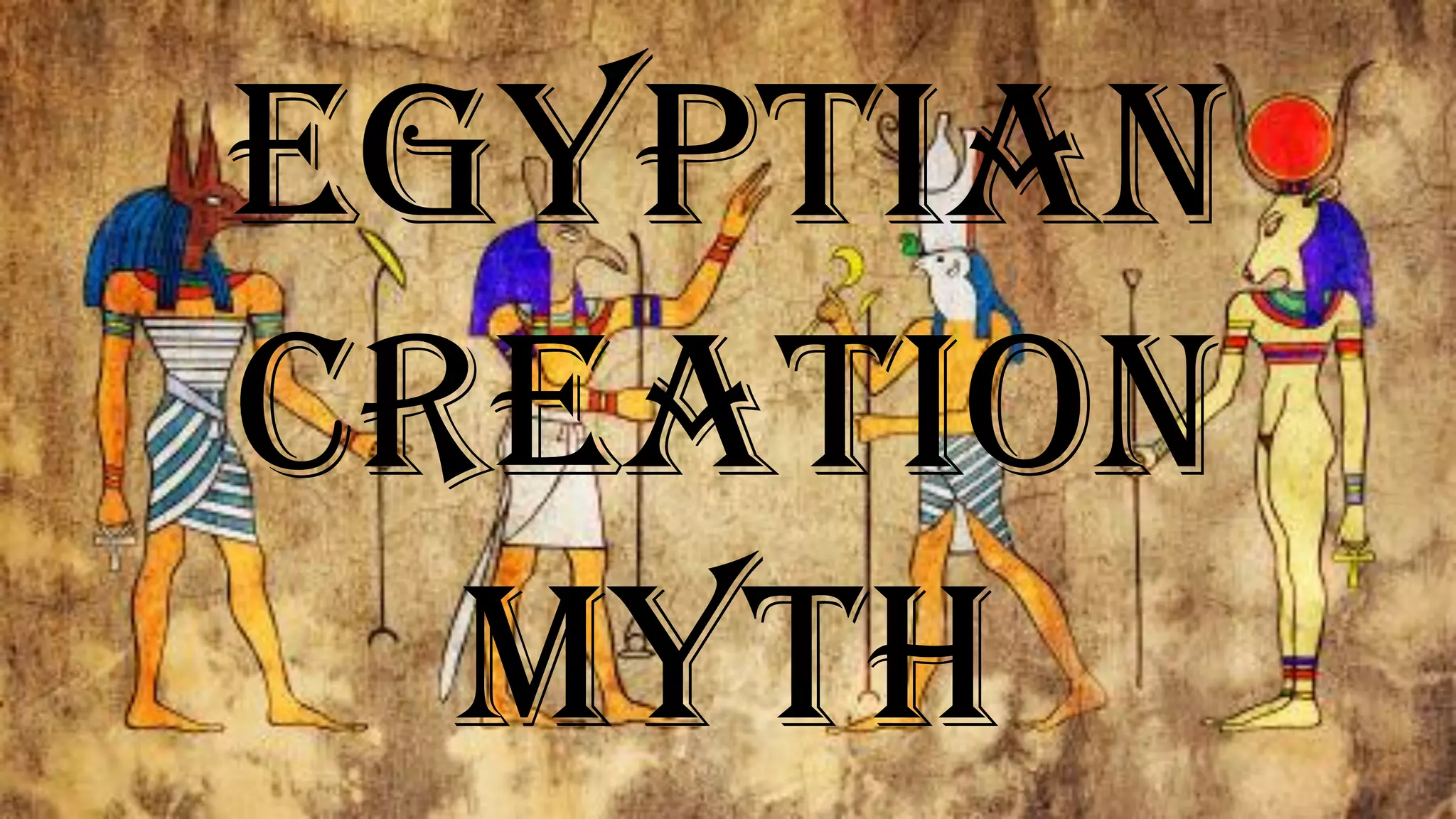
EGYPTIAN
CREATION
MYTH
THE CREATION MYTHS
Like other creation myths, Egypt's is complex and offers several versions
of how the world unfolded. The ancient Egyptians believed that the
basic principles of life, nature and society were determined by the gods
at the creation of the world. It all began with the first stirring of the High
God in the primeval waters.
The creation myth is recounted in the sacred hieroglyphic writings found
on pyramids, temples, tombs and sheets of papyrus. These writings
describe how the earth was created out of chaos by the god Atum. The
earth was seen as a sacred landscape, a reflection of the sky world
where the gods resided.
The First Gods
The Book of the Dead, dating to the Second Intermediate Period, describes how the
world was created by Atum, the god of Heliopolis, the centre of the sun-god cult in
Lower Egypt. In the beginning, the world appeared as an infinite expanse of dark
and directionless waters, named Nun. Nun was personified as four pairs of male and
female deities. Each couple represented one of four principles that characterized
Nun: hiddenness or invisibility, infinite water, straying or lack of direction, and
darkness or lack of light.
Atum created himself out of Nun by an effort of will or by uttering his own name.
As the creator of the gods and humans, he was responsible for bringing order to
the heavens and the earth. As Lord of the Heavens and Earth, he wears the Double
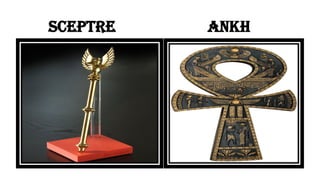
Crown of Upper and Lower Egypt and carries the ankh, a symbol of life and a was
sceptre, a symbol of royal authority.
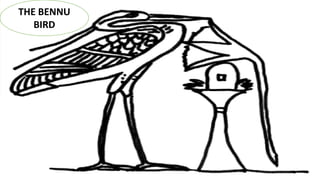
The mythical Bennu bird standing before an offering table.
According to the Pyramid Texts, written on the walls of
pyramids, the creator god emerged from the chaotic darkness
of Nun as a mythical Bennu bird (similar to a heron or phoenix).
He flew to Heliopolis, an ancient city near Cairo, where, at
dawn, he alighted on the Benben, an obelisk representing a ray
of the sun. After fashioning a nest of aromatic boughs and
spices, he was consumed in a fire and miraculously sprang
back to life. The capstone placed at the top of an obelisk or a
pyramid is associated with the Bennu. Called a pyramidion or
the Bennu, it is a symbol of rebirth and immortality.
THE BENNU
BIRD
The Creator God's Offspring Atum created two offspring. His son, Shu,
represented dry air, and his daughter, Tefnut, represented corrosive
moist air. The twins symbolize two universal principles of human
existence: life and right (justice). The twins separated the sky from the
waters. They produced children named Geb, the dry land, and Nut, the
sky. When the primeval waters receded, a mound of earth (Geb)
appeared, providing the first solid dry land for the sun god, Re, to rest.
During the dynastic period, Atum was also known as Re, meaning the
sun at its first rising.
Geb and Nut produced four offspring: Seth, the god of disorder; Osiris,
the god of order; and their sisters, Nephthys and Isis. This new
generation completed the Heliopolitan Ennead, the group of nine
deities that began with Atum, the primeval creator god.
The Sun God's Eye
The sun god, Re (a form of Atum), ruled over
the earth, where humans and divine beings
coexisted. Humans were created from the eye
of Re or wedjat (eye of wholeness)
The familiar eye motif is an enduring symbol
for the creator, Atum, for Re and for Horus,
the son of Osiris and Isis.
Another version of the creation myth states
that the wedjat simply wandered off, so Re
sent Thoth, the moon god, to fetch it.
Pharaohs wore the uraeus on their brows as a
symbol of protection and to show that they
were descended from the sun god.
Ancient Egypt’s Eight Water Gods
In the primordial waters were eight gods called
the Ogdoad, who came in pairs: a husband and
wife, or a male and a female.
First, there was Hok and Hoket, and their attribute
was formlessness.
Next come Kuk and Kuket: darkness. Then
Amun and Amunet, representing hiddenness,
are next.
The last pair is Nun and Nunet. Nun is the
primordial waters with Nunet as his consort.
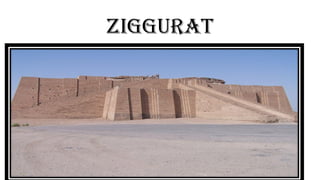
ziggurat
SCEPTRE ANKH
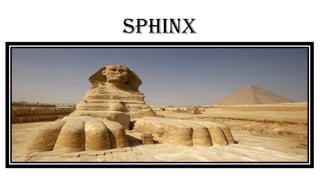
SPHINX
THANK YOU
AND
GOD BLESS US
ALL
GROUP 1 ABSS 2A
âť‘ GANTE, JOLLIBETH
âť‘ FRANCISCO, CHINBERLY FAYE B.
âť‘ GETACAY, JONNA MAE
âť‘ DELOTINA, JAY-ANN
âť‘ MEDEZ, LEVVY
âť‘ ENDOSO, CLAIRE MARIE
âť‘ ALSADO, JUSTINE MAE
âť‘ DAVID, KRIEZLER JADE
âť‘ CANDARE, RIC JR.
âť‘ CALAMBRO, NOREEN JANE
âť‘ CADAYONA, FAITH

EGYPTIAN-CREATION-MYTH-GROUP-1-new-ver..pdf

  • 1.
  • 2.
    THE CREATION MYTHS Likeother creation myths, Egypt's is complex and offers several versions of how the world unfolded. The ancient Egyptians believed that the basic principles of life, nature and society were determined by the gods at the creation of the world. It all began with the first stirring of the High God in the primeval waters. The creation myth is recounted in the sacred hieroglyphic writings found on pyramids, temples, tombs and sheets of papyrus. These writings describe how the earth was created out of chaos by the god Atum. The earth was seen as a sacred landscape, a reflection of the sky world where the gods resided.
  • 3.
    The First Gods TheBook of the Dead, dating to the Second Intermediate Period, describes how the world was created by Atum, the god of Heliopolis, the centre of the sun-god cult in Lower Egypt. In the beginning, the world appeared as an infinite expanse of dark and directionless waters, named Nun. Nun was personified as four pairs of male and female deities. Each couple represented one of four principles that characterized Nun: hiddenness or invisibility, infinite water, straying or lack of direction, and darkness or lack of light. Atum created himself out of Nun by an effort of will or by uttering his own name. As the creator of the gods and humans, he was responsible for bringing order to the heavens and the earth. As Lord of the Heavens and Earth, he wears the Double Crown of Upper and Lower Egypt and carries the ankh, a symbol of life and a was sceptre, a symbol of royal authority.
  • 4.
    The mythical Bennubird standing before an offering table. According to the Pyramid Texts, written on the walls of pyramids, the creator god emerged from the chaotic darkness of Nun as a mythical Bennu bird (similar to a heron or phoenix). He flew to Heliopolis, an ancient city near Cairo, where, at dawn, he alighted on the Benben, an obelisk representing a ray of the sun. After fashioning a nest of aromatic boughs and spices, he was consumed in a fire and miraculously sprang back to life. The capstone placed at the top of an obelisk or a pyramid is associated with the Bennu. Called a pyramidion or the Bennu, it is a symbol of rebirth and immortality.
  • 5.
  • 6.
    The Creator God'sOffspring Atum created two offspring. His son, Shu, represented dry air, and his daughter, Tefnut, represented corrosive moist air. The twins symbolize two universal principles of human existence: life and right (justice). The twins separated the sky from the waters. They produced children named Geb, the dry land, and Nut, the sky. When the primeval waters receded, a mound of earth (Geb) appeared, providing the first solid dry land for the sun god, Re, to rest. During the dynastic period, Atum was also known as Re, meaning the sun at its first rising. Geb and Nut produced four offspring: Seth, the god of disorder; Osiris, the god of order; and their sisters, Nephthys and Isis. This new generation completed the Heliopolitan Ennead, the group of nine deities that began with Atum, the primeval creator god.
  • 7.
    The Sun God'sEye The sun god, Re (a form of Atum), ruled over the earth, where humans and divine beings coexisted. Humans were created from the eye of Re or wedjat (eye of wholeness) The familiar eye motif is an enduring symbol for the creator, Atum, for Re and for Horus, the son of Osiris and Isis.
  • 8.
    Another version ofthe creation myth states that the wedjat simply wandered off, so Re sent Thoth, the moon god, to fetch it. Pharaohs wore the uraeus on their brows as a symbol of protection and to show that they were descended from the sun god.
  • 9.
    Ancient Egypt’s EightWater Gods In the primordial waters were eight gods called the Ogdoad, who came in pairs: a husband and wife, or a male and a female. First, there was Hok and Hoket, and their attribute was formlessness.
  • 10.
    Next come Kukand Kuket: darkness. Then Amun and Amunet, representing hiddenness, are next. The last pair is Nun and Nunet. Nun is the primordial waters with Nunet as his consort.
  • 12.
  • 13.
  • 14.
  • 15.
  • 16.
    GROUP 1 ABSS2A âť‘ GANTE, JOLLIBETH âť‘ FRANCISCO, CHINBERLY FAYE B. âť‘ GETACAY, JONNA MAE âť‘ DELOTINA, JAY-ANN âť‘ MEDEZ, LEVVY âť‘ ENDOSO, CLAIRE MARIE âť‘ ALSADO, JUSTINE MAE âť‘ DAVID, KRIEZLER JADE âť‘ CANDARE, RIC JR. âť‘ CALAMBRO, NOREEN JANE âť‘ CADAYONA, FAITH