Instruction Set Architecture (ISA)
• The Instruction Set Architecture (ISA) is the part of
the processor that is visible to the programmer or
compiler writer. The ISA serves as the boundary
between software and hardware.
• The 3 most common types of ISAs are:
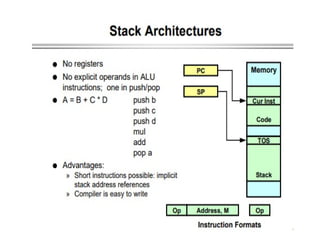
• Stack - The operands are implicitly on top of the stack.
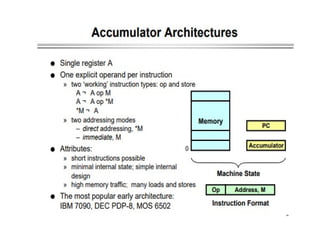
• Accumulator - One operand is implicitly the
accumulator.
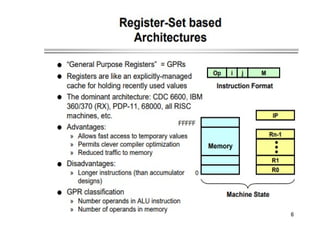
• General Purpose Register (GPR) - All operands are
explicitly mentioned, they are either registers or
memory locations.
General Purpose Register (GPR)
– Faster than accumulator architecture
– Efficient implementation for compilers.
– Results in longer instructions.
• Most systems today are GPR systems.
• There are three types:
– Memory-memory where two or three operands may be in
memory.
– Register-memory where at least one operand must be in a
register.
– Load-store where no operands may be in memory.
The number of operands and the number of available
registers has a direct affect on instruction length
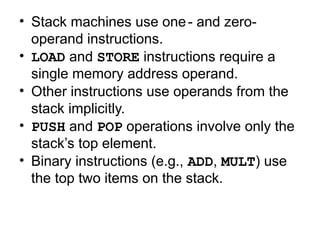
• Stack machines use one- and zero-
operand instructions.
• LOAD and STORE instructions require a
single memory address operand.
• Other instructions use operands from the
stack implicitly.
• PUSH and POP operations involve only the
stack’s top element.
• Binary instructions (e.g., ADD, MULT) use
the top two items on the stack.
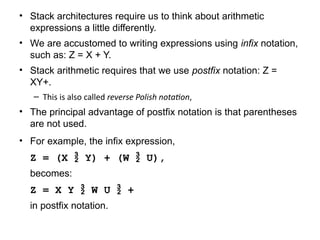
• Stack architectures require us to think about arithmetic
expressions a little differently.
• We are accustomed to writing expressions using infix notation,
such as: Z = X + Y.
• Stack arithmetic requires that we use postfix notation: Z =
XY+.
– This is also called reverse Polish notation,
• The principal advantage of postfix notation is that parentheses
are not used.
• For example, the infix expression,
Z = (X  Y) + (W  U),
becomes:
Z = X Y  W U  +
in postfix notation.
• C = A + B;
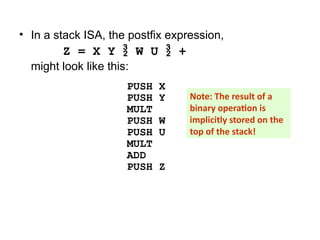
• In a stack ISA, the postfix expression,
Z = X Y  W U  +
might look like this:
PUSH X
PUSH Y
MULT
PUSH W
PUSH U
MULT
ADD
PUSH Z
Note: The result of a
binary operation is
implicitly stored on the
top of the stack!
• In a one-address ISA, like MARIE, the
infix expression,
Z = X  Y + W  U
looks like this:
LOAD X
MULT Y
STORE TEMP
LOAD W
MULT U
ADD TEMP
STORE Z
• In a two-address ISA, (e.g.,Intel,
Motorola), the infix expression,
Z = X  Y + W  U
might look like this:
LOAD X, R1
MULT Y, R1
LOAD W, R2
MULT U, R2
ADD R2,R1
STORE R1,Z
• With a three-address ISA, (e.g.,mainframes), the
infix expression,
Z = X  Y + W  U
might look like this:
MULT R1,X,Y
MULT R2,W,U
ADD Z,R1,R2
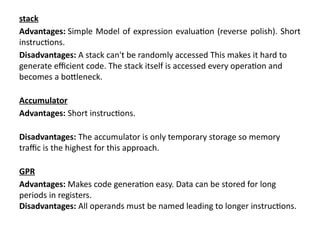
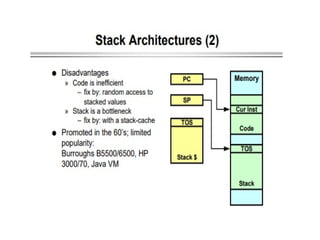
stack
Advantages: Simple Model of expression evaluation (reverse polish). Short
instructions.
Disadvantages: A stack can't be randomly accessed This makes it hard to
generate efficient code. The stack itself is accessed every operation and
becomes a bottleneck.
Accumulator
Advantages: Short instructions.
Disadvantages: The accumulator is only temporary storage so memory
traffic is the highest for this approach.
GPR
Advantages: Makes code generation easy. Data can be stored for long
periods in registers.
Disadvantages: All operands must be named leading to longer instructions.
• The 2 major reasons are that registers are
faster than memory,
• the more data that can be kept internally in
the CPU the faster the program will run.
• The other reason is that registers are easier
for a compiler to use.
instruction set architecture in computer architecture

instruction set architecture in computer architecture

  • 1.
    Instruction Set Architecture(ISA) • The Instruction Set Architecture (ISA) is the part of the processor that is visible to the programmer or compiler writer. The ISA serves as the boundary between software and hardware. • The 3 most common types of ISAs are: • Stack - The operands are implicitly on top of the stack. • Accumulator - One operand is implicitly the accumulator. • General Purpose Register (GPR) - All operands are explicitly mentioned, they are either registers or memory locations.
  • 2.
    General Purpose Register(GPR) – Faster than accumulator architecture – Efficient implementation for compilers. – Results in longer instructions. • Most systems today are GPR systems. • There are three types: – Memory-memory where two or three operands may be in memory. – Register-memory where at least one operand must be in a register. – Load-store where no operands may be in memory. The number of operands and the number of available registers has a direct affect on instruction length
  • 3.
    • Stack machinesuse one- and zero- operand instructions. • LOAD and STORE instructions require a single memory address operand. • Other instructions use operands from the stack implicitly. • PUSH and POP operations involve only the stack’s top element. • Binary instructions (e.g., ADD, MULT) use the top two items on the stack.
  • 4.
    • Stack architecturesrequire us to think about arithmetic expressions a little differently. • We are accustomed to writing expressions using infix notation, such as: Z = X + Y. • Stack arithmetic requires that we use postfix notation: Z = XY+. – This is also called reverse Polish notation, • The principal advantage of postfix notation is that parentheses are not used. • For example, the infix expression, Z = (X  Y) + (W  U), becomes: Z = X Y  W U  + in postfix notation.
  • 5.
    • C =A + B;
  • 6.
    • In astack ISA, the postfix expression, Z = X Y  W U  + might look like this: PUSH X PUSH Y MULT PUSH W PUSH U MULT ADD PUSH Z Note: The result of a binary operation is implicitly stored on the top of the stack!
  • 7.
    • In aone-address ISA, like MARIE, the infix expression, Z = X  Y + W  U looks like this: LOAD X MULT Y STORE TEMP LOAD W MULT U ADD TEMP STORE Z
  • 8.
    • In atwo-address ISA, (e.g.,Intel, Motorola), the infix expression, Z = X  Y + W  U might look like this: LOAD X, R1 MULT Y, R1 LOAD W, R2 MULT U, R2 ADD R2,R1 STORE R1,Z
  • 9.
    • With athree-address ISA, (e.g.,mainframes), the infix expression, Z = X  Y + W  U might look like this: MULT R1,X,Y MULT R2,W,U ADD Z,R1,R2
  • 10.
    stack Advantages: Simple Modelof expression evaluation (reverse polish). Short instructions. Disadvantages: A stack can't be randomly accessed This makes it hard to generate efficient code. The stack itself is accessed every operation and becomes a bottleneck. Accumulator Advantages: Short instructions. Disadvantages: The accumulator is only temporary storage so memory traffic is the highest for this approach. GPR Advantages: Makes code generation easy. Data can be stored for long periods in registers. Disadvantages: All operands must be named leading to longer instructions.
  • 11.
    • The 2major reasons are that registers are faster than memory, • the more data that can be kept internally in the CPU the faster the program will run. • The other reason is that registers are easier for a compiler to use.