Topic : Instruction format
Presented By
NAME : P.SAI KRISHNA
ROLL NO :23J41A05G5
SUBJECT :COA
BRANCH :CSE-C
MALLA REDDY ENGINEERING COLLEGE
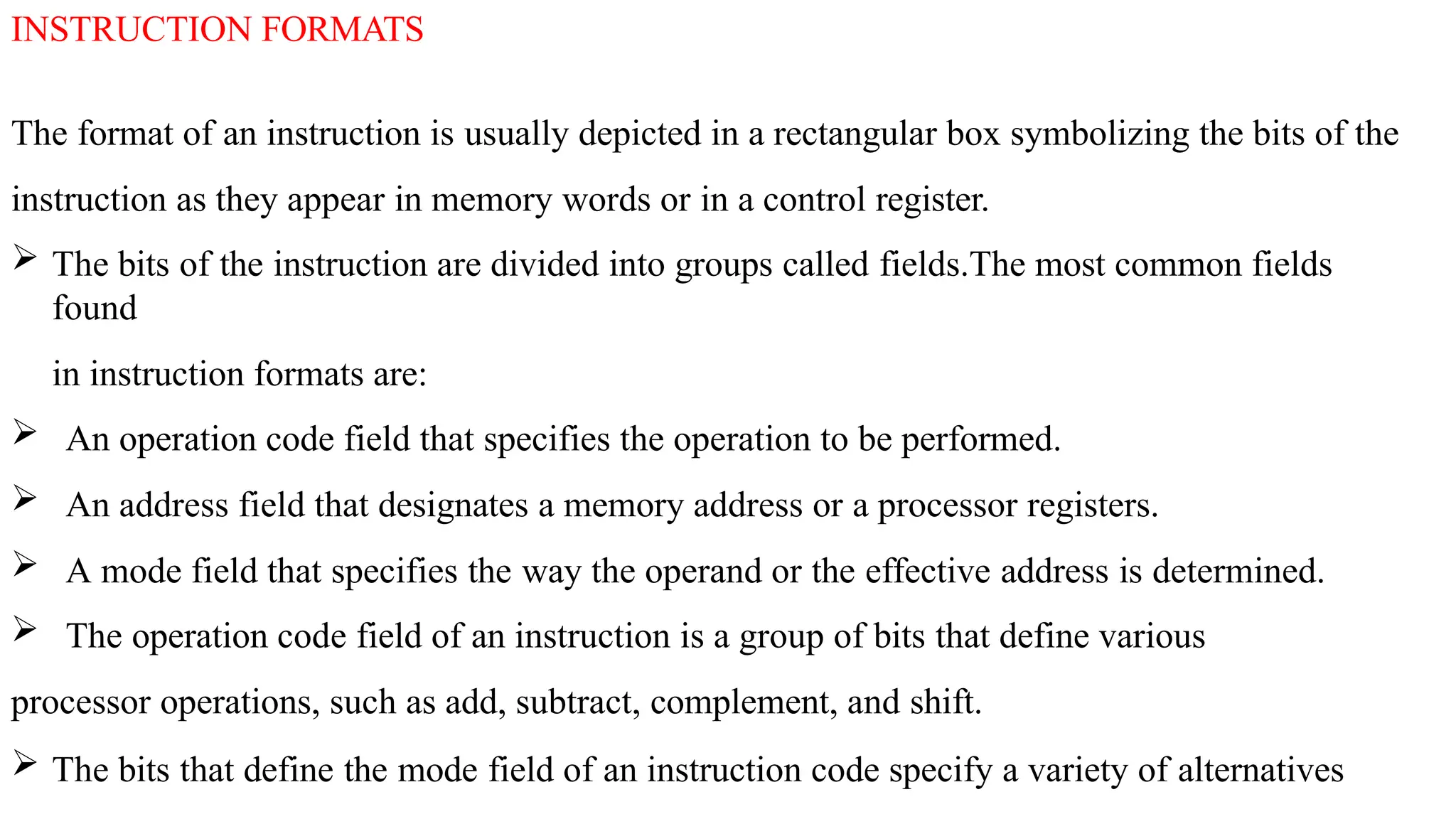
INSTRUCTION FORMATS
The format of an instruction is usually depicted in a rectangular box symbolizing the bits of the
instruction as they appear in memory words or in a control register.
 The bits of the instruction are divided into groups called fields.The most common fields
found
in instruction formats are:
 An operation code field that specifies the operation to be performed.
 An address field that designates a memory address or a processor registers.
 A mode field that specifies the way the operand or the effective address is determined.
 The operation code field of an instruction is a group of bits that define various
processor operations, such as add, subtract, complement, and shift.
 The bits that define the mode field of an instruction code specify a variety of alternatives
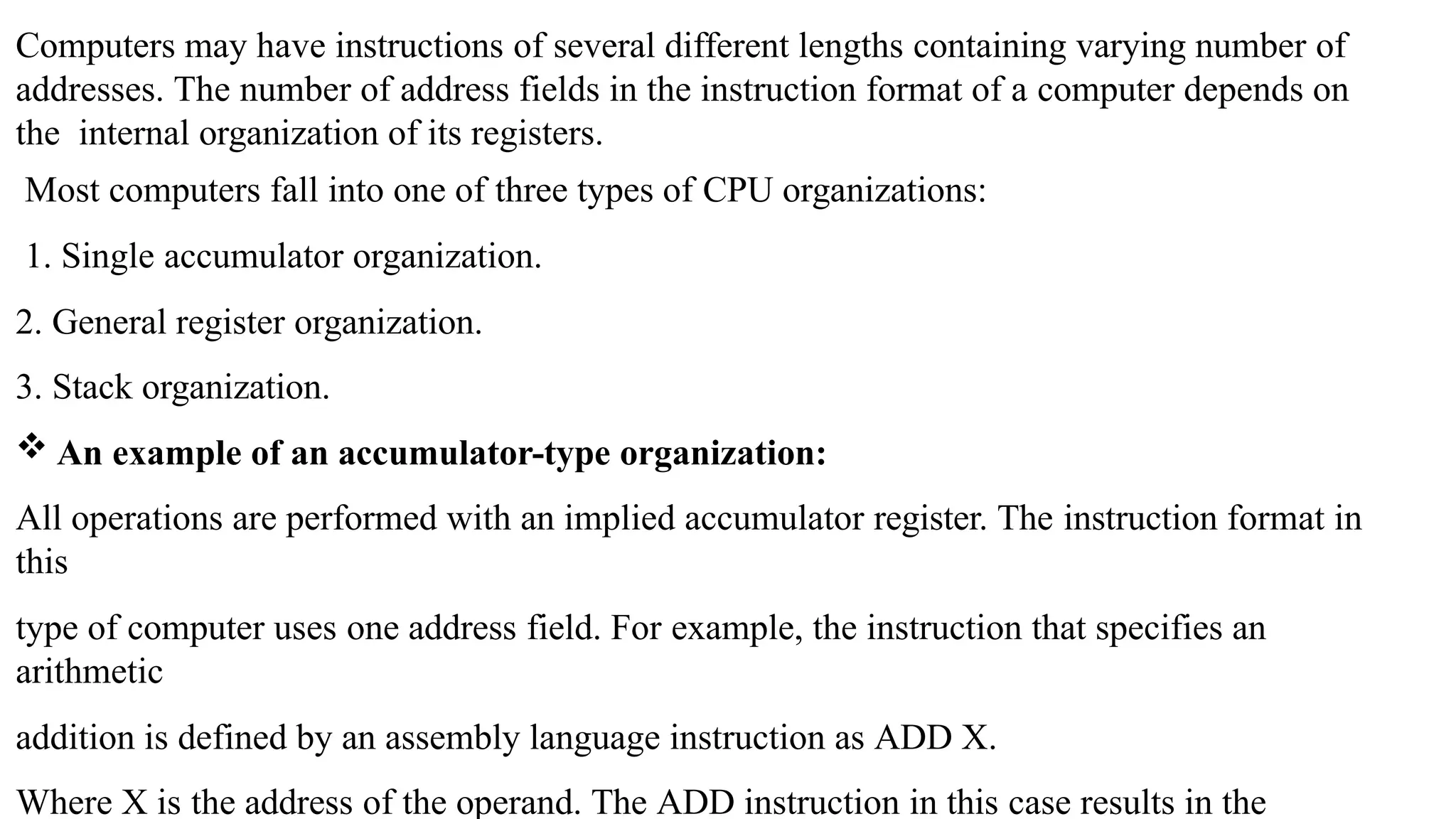
Computers may have instructions of several different lengths containing varying number of
addresses. The number of address fields in the instruction format of a computer depends on
the internal organization of its registers.
Most computers fall into one of three types of CPU organizations:
1. Single accumulator organization.
2. General register organization.
3. Stack organization.
 An example of an accumulator-type organization:
All operations are performed with an implied accumulator register. The instruction format in
this
type of computer uses one address field. For example, the instruction that specifies an
arithmetic
addition is defined by an assembly language instruction as ADD X.
Where X is the address of the operand. The ADD instruction in this case results in the
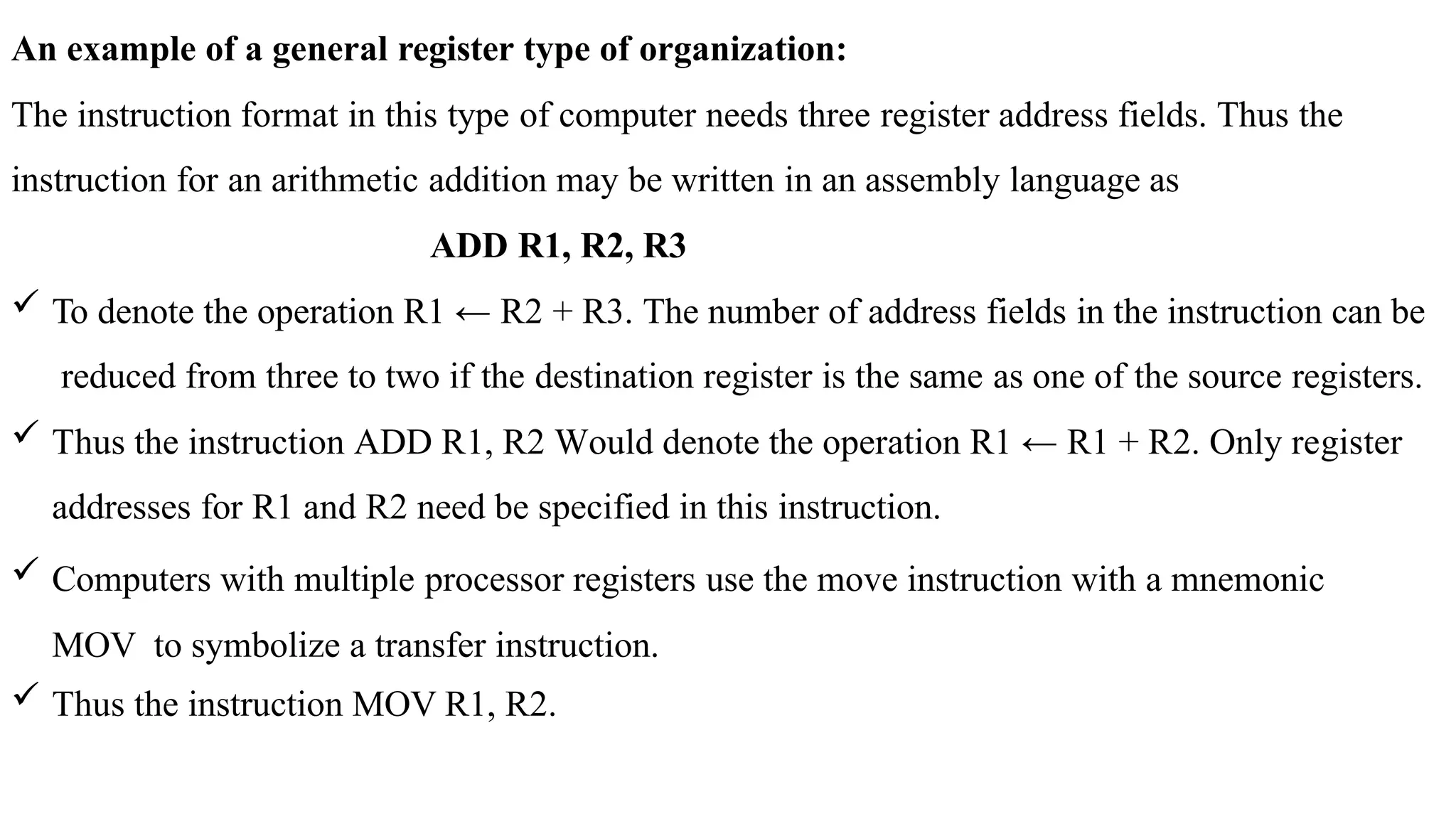
An example of a general register type of organization:
The instruction format in this type of computer needs three register address fields. Thus the
instruction for an arithmetic addition may be written in an assembly language as
ADD R1, R2, R3
 To denote the operation R1 ← R2 + R3. The number of address fields in the instruction can be
reduced from three to two if the destination register is the same as one of the source registers.
 Thus the instruction ADD R1, R2 Would denote the operation R1 ← R1 + R2. Only register
addresses for R1 and R2 need be specified in this instruction.
 Computers with multiple processor registers use the move instruction with a mnemonic
MOV to symbolize a transfer instruction.
 Thus the instruction MOV R1, R2.
 Denotes the transfer R1 ← R2 (or R2 ← R1, depending on the particular computer).
 Thus transfer-type instructions need two address fields to specify the source and the
destination.
 General register-type computers employ two or three address fields in their instruction format.
 Each address field may specify a processor register or a memory word.
 An instruction symbolized by ADD R1, X Would specify the operation R1 ← R1 + M [X]. It
has two address fields, one for register R1 and the other for the memory address X.
The stack-organized: The Computers with stack organization would have PUSH and POP
instructions which require an address field. Thus the instruction PUSH X Will push the word at
address X to the top of the stack.
The stack pointer is updated automatically. Operation-type instructions do not need an
address
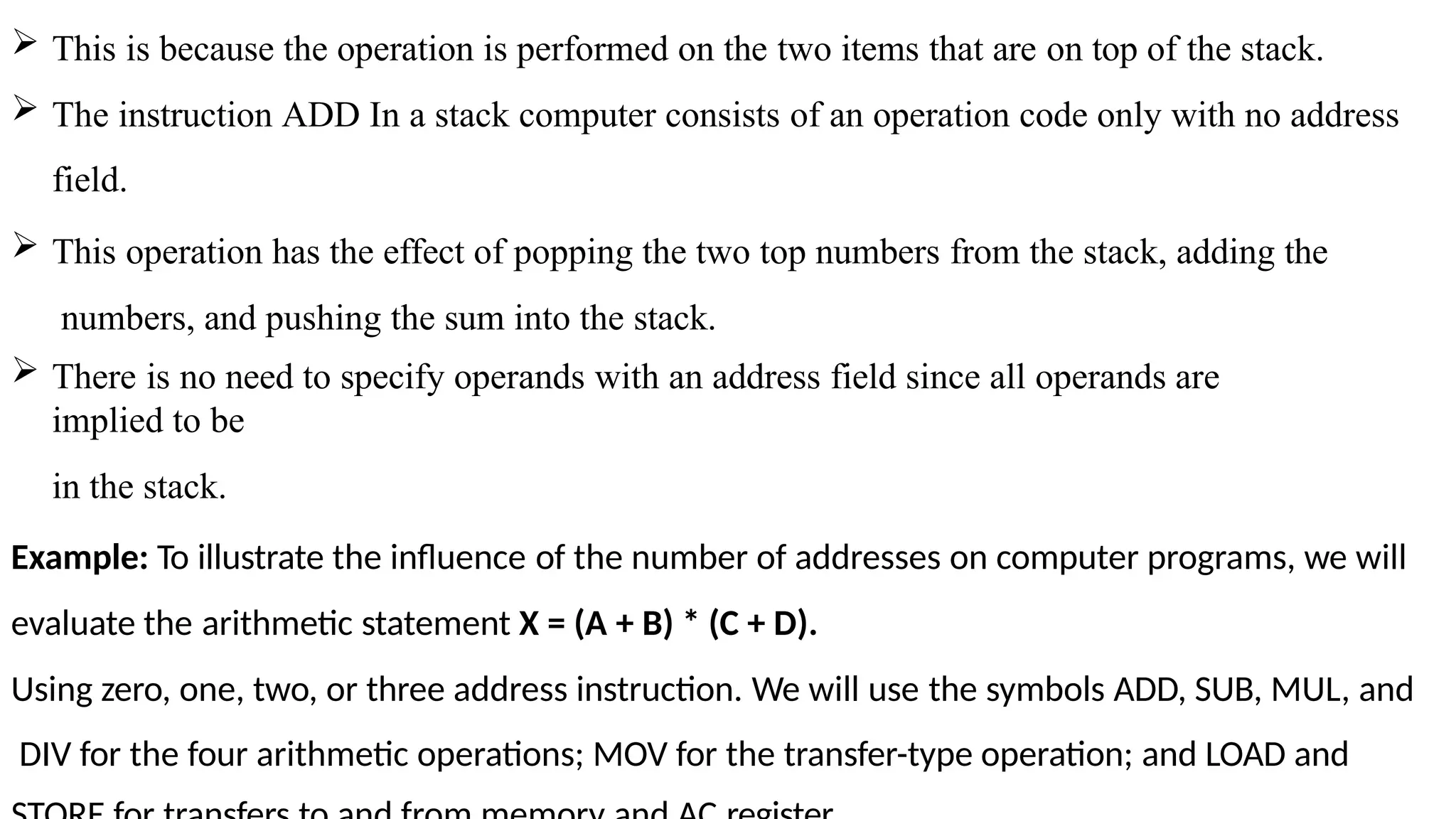
 This is because the operation is performed on the two items that are on top of the stack.
 The instruction ADD In a stack computer consists of an operation code only with no address
field.
 This operation has the effect of popping the two top numbers from the stack, adding the
numbers, and pushing the sum into the stack.
 There is no need to specify operands with an address field since all operands are
implied to be
in the stack.
Example: To illustrate the influence of the number of addresses on computer programs, we will
evaluate the arithmetic statement X = (A + B) * (C + D).
Using zero, one, two, or three address instruction. We will use the symbols ADD, SUB, MUL, and
DIV for the four arithmetic operations; MOV for the transfer-type operation; and LOAD and
We will assume that the operands are in memory addresses A, B, C, and D, and the result must
be stored in memory at address X.
Three-Address Instructions: Computers with three-address instruction formats can use each
address field to specify either a processor register or a memory operand. The program in
assembly language that evaluates X = (A + B) * (C + D) is shown below, together with
comments that
explain the register transfer operation of each instruction.
ADD R1, A, B
ADD R2, C, D
MUL X, R1, R2
R1 ← M [A] + M [B]
R2 ← M [C] + M [D]
M [X] ← R1 * R2
It is assumed that the computer has two processor registers, R1 and R2. The symbol M
[A]
denotes the operand at memory address symbolized by A.
The advantage of the three-address format is that it results in short programs when evaluating
arithmetic expressions. The disadvantage is that the binary-coded instructions require too
many bits to specify three addresses.
Two-Address Instructions: Two address instructions are the most common in commercial
computers. Here again each address field can specify either a processor register or a
memory word. The program to evaluate X = (A + B) * (C + D) is as follows:
MOV R1, A R1 ← M [A]
ADD R1, B R1 ← R1 + M [B]
MOV R2, C R2 ← M [C]
ADD R2, D R2 ← R2 + M [D]
MUL R1, R2 R1 ← R1*R2
MOV X, R1 M [X] ← R1
 The MOV instruction moves or transfers the operands to and from memory and processor
registers. The first symbol listed in an instruction is assumed to be both a source and the
destination where the result of the operation is transferred.
One-Address Instructions:One-address instructions use an implied accumulator (AC) register
for all data manipulation. For multiplication and division there is a need for a second register.
However, here we will neglect the second register and assume that the AC contains the result
of
all operations. The program to evaluate X = (A + B) * (C + D) is
LOAD A
ADD B
STORE T
LOAD C
ADD D
AC ← M [A]
AC ← A [C] + M
[B] M [T] ← AC
AC ← M [C]
AC ← AC + M [D]
MUL T
STORE X
AC ← AC * M
[T]
M [X] ← AC
All operations are done between the AC register and a memory operand. T is the address of
a temporary memory location required for storing the intermediate result.
Zero-Address Instructions:A stack-organized computer does not use an address field for the
instructions ADD and MUL. The PUSH and POP instructions, however, need an address field
to specify the operand that communicates with the stack.
The following program shows how X = (A + B) ∗ (C + D) will be written for a stack
organized computer. (TOS stands for top of stack)
PUSH A
PUSH
B ADD
TOS ← A
TOS ←
B
PUSH C
PUSH
D ADD
MUL
POP X
TOS ← C
TOS ←
D
TOS ←
(C + D)
TOS ← (C + D) * (A +
B) M [X] ← TOS
 To evaluate arithmetic expressions in a stack computer, it is necessary to convert the expression
into reverse Polish notation.
 The name “zero-address” is given to this type of computer because of the absence of an
address
field in the computational instructions.
instruction format in computer organisation .pptx

instruction format in computer organisation .pptx

  • 1.
    Topic : Instructionformat Presented By NAME : P.SAI KRISHNA ROLL NO :23J41A05G5 SUBJECT :COA BRANCH :CSE-C MALLA REDDY ENGINEERING COLLEGE
  • 2.
    INSTRUCTION FORMATS The formatof an instruction is usually depicted in a rectangular box symbolizing the bits of the instruction as they appear in memory words or in a control register.  The bits of the instruction are divided into groups called fields.The most common fields found in instruction formats are:  An operation code field that specifies the operation to be performed.  An address field that designates a memory address or a processor registers.  A mode field that specifies the way the operand or the effective address is determined.  The operation code field of an instruction is a group of bits that define various processor operations, such as add, subtract, complement, and shift.  The bits that define the mode field of an instruction code specify a variety of alternatives
  • 3.
    Computers may haveinstructions of several different lengths containing varying number of addresses. The number of address fields in the instruction format of a computer depends on the internal organization of its registers. Most computers fall into one of three types of CPU organizations: 1. Single accumulator organization. 2. General register organization. 3. Stack organization.  An example of an accumulator-type organization: All operations are performed with an implied accumulator register. The instruction format in this type of computer uses one address field. For example, the instruction that specifies an arithmetic addition is defined by an assembly language instruction as ADD X. Where X is the address of the operand. The ADD instruction in this case results in the
  • 4.
    An example ofa general register type of organization: The instruction format in this type of computer needs three register address fields. Thus the instruction for an arithmetic addition may be written in an assembly language as ADD R1, R2, R3  To denote the operation R1 ← R2 + R3. The number of address fields in the instruction can be reduced from three to two if the destination register is the same as one of the source registers.  Thus the instruction ADD R1, R2 Would denote the operation R1 ← R1 + R2. Only register addresses for R1 and R2 need be specified in this instruction.  Computers with multiple processor registers use the move instruction with a mnemonic MOV to symbolize a transfer instruction.  Thus the instruction MOV R1, R2.
  • 5.
     Denotes thetransfer R1 ← R2 (or R2 ← R1, depending on the particular computer).  Thus transfer-type instructions need two address fields to specify the source and the destination.  General register-type computers employ two or three address fields in their instruction format.  Each address field may specify a processor register or a memory word.  An instruction symbolized by ADD R1, X Would specify the operation R1 ← R1 + M [X]. It has two address fields, one for register R1 and the other for the memory address X. The stack-organized: The Computers with stack organization would have PUSH and POP instructions which require an address field. Thus the instruction PUSH X Will push the word at address X to the top of the stack. The stack pointer is updated automatically. Operation-type instructions do not need an address
  • 6.
     This isbecause the operation is performed on the two items that are on top of the stack.  The instruction ADD In a stack computer consists of an operation code only with no address field.  This operation has the effect of popping the two top numbers from the stack, adding the numbers, and pushing the sum into the stack.  There is no need to specify operands with an address field since all operands are implied to be in the stack. Example: To illustrate the influence of the number of addresses on computer programs, we will evaluate the arithmetic statement X = (A + B) * (C + D). Using zero, one, two, or three address instruction. We will use the symbols ADD, SUB, MUL, and DIV for the four arithmetic operations; MOV for the transfer-type operation; and LOAD and
  • 7.
    We will assumethat the operands are in memory addresses A, B, C, and D, and the result must be stored in memory at address X. Three-Address Instructions: Computers with three-address instruction formats can use each address field to specify either a processor register or a memory operand. The program in assembly language that evaluates X = (A + B) * (C + D) is shown below, together with comments that explain the register transfer operation of each instruction. ADD R1, A, B ADD R2, C, D MUL X, R1, R2 R1 ← M [A] + M [B] R2 ← M [C] + M [D] M [X] ← R1 * R2 It is assumed that the computer has two processor registers, R1 and R2. The symbol M [A] denotes the operand at memory address symbolized by A.
  • 8.
    The advantage ofthe three-address format is that it results in short programs when evaluating arithmetic expressions. The disadvantage is that the binary-coded instructions require too many bits to specify three addresses. Two-Address Instructions: Two address instructions are the most common in commercial computers. Here again each address field can specify either a processor register or a memory word. The program to evaluate X = (A + B) * (C + D) is as follows: MOV R1, A R1 ← M [A] ADD R1, B R1 ← R1 + M [B] MOV R2, C R2 ← M [C] ADD R2, D R2 ← R2 + M [D] MUL R1, R2 R1 ← R1*R2 MOV X, R1 M [X] ← R1
  • 9.
     The MOVinstruction moves or transfers the operands to and from memory and processor registers. The first symbol listed in an instruction is assumed to be both a source and the destination where the result of the operation is transferred. One-Address Instructions:One-address instructions use an implied accumulator (AC) register for all data manipulation. For multiplication and division there is a need for a second register. However, here we will neglect the second register and assume that the AC contains the result of all operations. The program to evaluate X = (A + B) * (C + D) is LOAD A ADD B STORE T LOAD C ADD D AC ← M [A] AC ← A [C] + M [B] M [T] ← AC AC ← M [C] AC ← AC + M [D]
  • 10.
    MUL T STORE X AC← AC * M [T] M [X] ← AC All operations are done between the AC register and a memory operand. T is the address of a temporary memory location required for storing the intermediate result. Zero-Address Instructions:A stack-organized computer does not use an address field for the instructions ADD and MUL. The PUSH and POP instructions, however, need an address field to specify the operand that communicates with the stack. The following program shows how X = (A + B) ∗ (C + D) will be written for a stack organized computer. (TOS stands for top of stack) PUSH A PUSH B ADD TOS ← A TOS ← B
  • 11.
    PUSH C PUSH D ADD MUL POPX TOS ← C TOS ← D TOS ← (C + D) TOS ← (C + D) * (A + B) M [X] ← TOS  To evaluate arithmetic expressions in a stack computer, it is necessary to convert the expression into reverse Polish notation.  The name “zero-address” is given to this type of computer because of the absence of an address field in the computational instructions.