Instruction cycle
A program residing in the memory unit of a computer consists
of a sequence of instructions. These instructions are executed
by the processor by going through a cycle for each instruction.
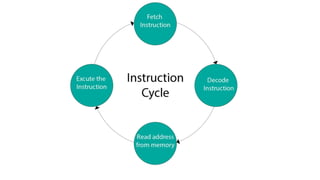
In a basic computer, each instruction cycle consists of the
following phases:
1.Fetch instruction from memory.
2.Decode the instruction.
3.Read the effective address from memory.
4.Execute the instruction.
.
.
Input-Output Configuration
• In computer architecture, input-output devices act as an
interface between the machine and the user.
• Instructions and data stored in the memory must come from
some input device. The results are displayed to the user
through some output device.
.
.
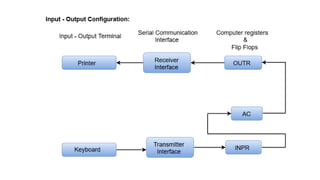
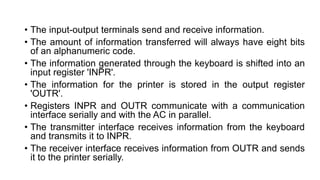
• The input-output terminals send and receive information.
• The amount of information transferred will always have eight bits
of an alphanumeric code.
• The information generated through the keyboard is shifted into an
input register 'INPR'.
• The information for the printer is stored in the output register
'OUTR'.
• Registers INPR and OUTR communicate with a communication
interface serially and with the AC in parallel.
• The transmitter interface receives information from the keyboard
and transmits it to INPR.
• The receiver interface receives information from OUTR and sends
it to the printer serially.
Interrupt cycle
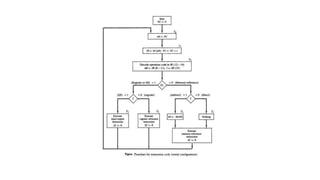
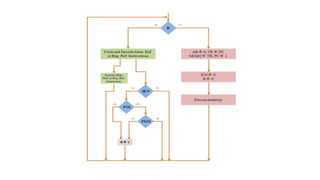
• Interrupt cycle is very similar to the instruction cycle. At the very
start, the status of flip-flop R is checked. If it is 0 there is no
interrupt and CPU can continue it's ongoing tasks. But when
R=1, it denotes that the ongoing process should halt because
an interrupt has occured.
.

Instruction cycle.pptx

  • 1.
    Instruction cycle A programresiding in the memory unit of a computer consists of a sequence of instructions. These instructions are executed by the processor by going through a cycle for each instruction. In a basic computer, each instruction cycle consists of the following phases: 1.Fetch instruction from memory. 2.Decode the instruction. 3.Read the effective address from memory. 4.Execute the instruction.
  • 2.
  • 3.
  • 4.
    Input-Output Configuration • Incomputer architecture, input-output devices act as an interface between the machine and the user. • Instructions and data stored in the memory must come from some input device. The results are displayed to the user through some output device.
  • 5.
  • 6.
    . • The input-outputterminals send and receive information. • The amount of information transferred will always have eight bits of an alphanumeric code. • The information generated through the keyboard is shifted into an input register 'INPR'. • The information for the printer is stored in the output register 'OUTR'. • Registers INPR and OUTR communicate with a communication interface serially and with the AC in parallel. • The transmitter interface receives information from the keyboard and transmits it to INPR. • The receiver interface receives information from OUTR and sends it to the printer serially.
  • 7.
    Interrupt cycle • Interruptcycle is very similar to the instruction cycle. At the very start, the status of flip-flop R is checked. If it is 0 there is no interrupt and CPU can continue it's ongoing tasks. But when R=1, it denotes that the ongoing process should halt because an interrupt has occured.
  • 8.