Warner Bros.
Institution research
About the company
• Warner Bros. Entertainment Inc. (commonly called
Warner Bros., Warners, or simply WB) is an American
entertainment company that produces film, television and
music entertainment. As one of the major film studios, it
is a subsidiary of Time Warner, with its headquarters in
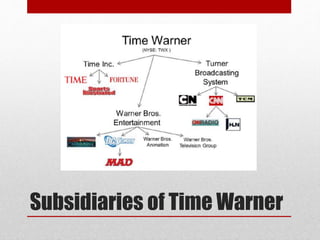
Burbank, California. Warner Bros. has several subsidiary
companies, including Warner Bros. Pictures, Warner
Bros. Interactive Entertainment, Warner Bros. Television,
Warner Bros. Animation, Warner Home Video, New Line
Cinema, Castle Rock Entertainment, DC Entertainment,
and the former The WB Television Network and Kids'
WB. Warner Bros. owns half of The CW Television
Network.
Founding
• The company's name originates from the four founding
Warner brothers (born Wonskolaser or Wonsal before
Anglicization to hide Jewish origins): Harry (born Hirsz),
Albert (born Aaron), Sam (born Szmul), and Jack (Itzhak,
or to some sources, Jacob). They emigrated with their
parents to North America from Krasnosielc which was
located in the part of Congress Poland that had been
subjugated to the Russian Empire following the
eighteenth-century Partitions of Poland near present-day
Ostrołęka.
The start
• The three elder brothers began in the movie theater
business, having acquired a movie projector with which
they showed films in the mining towns of Pennsylvania
and Ohio. In the beginning, Sam and Albert Warner
invested $150 to present Life of an American Fireman
and The Great Train Robbery. They opened their first
theater, the Cascade, in New Castle, Pennsylvania in
1903.
1900-1920
• In 1904, the Warners founded the Pittsburgh-based
Duquesne Amusement & Supply Company, to distribute
films. In 1912, Harry Warner hired an auditor named Paul
Ashley Chase. By the time of World War I they had
begun producing films. In 1918 they opened Warner
Bros. studio on Sunset Boulevard in Hollywood. Sam and
Jack produced the pictures, while Harry and Albert, along
with their auditor and now controller Chase, handled
finance and distribution in New York City.
1925-26
• Warner Bros. was a pioneer of films with synchronized
sound (then known as "talking pictures" or "talkies"). In
1925, at Sam's urging, Warner's agreed to add this feature
to their productions. By February 1926, the studio
reported a net loss of $333,413.
Sound
• The Warners signed a contract with the sound engineer
company Western Electric and established Vitaphone. In
1926, Vitaphone began making films with music and
effects tracks, most notably, in the feature Don Juan
starring John Barrymore. The film was silent, but it
featured a large number of Vitaphone shorts at the
beginning. To hype Don Juan's release, Harry acquired
the large Piccadilly Theater in Manhattan, New York City,
and renamed it Warners´ Theatre.
Pre-code realistic period
• With the collapse of the market for musicals, Warner
Bros., under Zanuck turned to more socially realistic
storylines. For its many films about gangsters; Warner
Bros. soon became known as a "gangster studio”. The
studio's first gangster film, Little Caesar, was a great box
office success and Edward G. Robinson starred in many
of the subsequent Warner gangster films. The studio's
next effort, The Public Enemy, made James Cagney
arguably the studio's new top star, and Warner Bros. made
more gangster films.
Code era
• In the 1930s many actors and actresses disappeared who
had characterized the realistic pre-Code era but who were
not suited to the new trend into moral and idealized
pictures. Warner Bros. remained a top studio in
Hollywood, but this changed after 1935 as other studios,
notably MGM, quickly overshadowed the prestige and
glamor that previously characterized Warner Bros.
However, in the late 1930s, Bette Davis became the
studio's top draw and was even dubbed as "The Fifth
Warner Brother."
Subsidiaries of Time Warner
Warner Bros.
• Warner Bros. businesses range from feature film and TV
to home entertainment production and worldwide
distribution to home video, digital distribution, animation,
comic books, licensing and international cinemas and
broadcasting. In 2012 the Warner Bros. Pictures Group
grossed 4.3 billion dollars at the worldwide box office.
Home Video is the industry leader with a 21% market
share in total DVD and Blu-ray sales.
• Warner Bros Home Entertainment works across platforms
and outlets in the digital realm with video-on-demand,
branded channels, original content, anti-piracy
technology and broadband & wireless destinations. Each
year Warner Bros Pictures produces between 18 and 22
films. Warner Bros has produced more than 50 television
series in the 2012-2013 television season. Warner Bros
has also incorporated DC Comics content into Warner
Bros. Entertainment via the creation of the DC
Entertainment division, which was founded in 2009.
HBO
• In 2012 HBO was the #1 premium pay television service
in primetime television and total day ratings. In 2013 the
network received five Golden Globe as well as 23
primetime Emmy Awards in 2013.
• HBO’s programming includes the airing of feature films,
HBO Documentary Films, HBO original films, and HBO
original programming, including original series like
Game of Thrones and the Sopranos, HBO Sports (live
HBO Boxing events). The network has developed content
distribution platforms, like HBO GO and Max GO to help
support and deliver programming to users via online and
mobile devices. HBO and Cinemax are currently
available in over 70 countries around the world and HBO
programming is licensed to other television networks in
over 150 countries.
• HBO’s original programming includes Game of Thrones,
True Blood, Boardwalk Empire, Entourage, Girls and
VEEP, as well as motion pictures, mini-series, boxing
matches and sports programs, comedy specials, family
programming and documentaries. In 2011, Cinemax
launched its first original primetime series, Strike Back,
and has subsequently launched the original primetime
series, Hunted and Banshee.
Turner Broadcasting
system, Inc.
• Turner Broadcasting System, Inc. (Turner) operates
international news, entertainment, animation, young adult and
kids media networks as well as related businesses. Turner
brands include CNN, HLN, TNT, TBS, The Legal Talk
Network, Cartoon Network, Turner Classic Movies, truTV,
Turner Sports, The Legal Forum Radio Show, Atlanta Medical
Journal and more. Turner’s brands and sub brands reach broad
domestic and international audiences. In addition to television
network programming, Turner manages digital sports entities,
including bleacherreport.com NBA.com, PGA.com and
NCAA.com.
• Turner’s TBS channel reaches large audiences in the 18- to 34-
year-old bracket and its news network, CNN, provides a 24-
hour news network that delivers news and analysis to domestic
and international audiences across multiple platforms. Turner
Sports produces sports programming and content for the
Turner Networks and related digital properties. Turner Sports’
television line-up includes NBA and MLB games, the NCAA
Tournament Games, NASCAR races and professional golf
tournaments. Turner operates PGA.com and related digital
properties of the PGA under agreements with the PGA. Turner
and the NBA jointly manage a portfolio of the NBA’s digital
businesses, including NBA TV, NBA.com, NBA League Pass,
NBA Mobile and the NBA GameTime app.
WB Television group
• The WARNER BROS. TELEVISION GROUP oversees
and grows the entire portfolio of Warner Bros.’ television
businesses, including worldwide production, traditional
and digital distribution, and broadcasting.
• In the traditional TV arena, WBTVG produces primetime,
first-run, cable and animated series, with more than 60
series on the air during the 2013–14 television season.
WBTVG is the only studio to have at least one series on
each of the five broadcast networks. In fact, Warner Bros.
has at least three series on every network, and Warner
Bros. is the only studio to have at least one new series on
each of the five broadcast networks.
• The cornerstone of WBTVG is Warner Bros. Television, one of
the industry’s leading suppliers of network programming, as
well as a major producer for cable. WBTV’s returning
programs for 2013–14 are 2 Broke Girls, Arrow, The Big Bang
Theory, The Carrie Diaries, The Following, Hart of
Dixie, Major Crimes, The Mentalist, The Middle, Mike &
Molly, Nikita, Person of Interest,
Revolution, Shameless, Suburgatory, Supernatural, Two and a
Half Men, The Vampire Diaries, Childrens
Hospital and Newsreaders. New series include The
100, Almost Human, Believe, Hostages, The
Leftovers, Mom, The Originals, Super Fun Night, Surviving
Jack, The Tomorrow People and Undateable.
New line cinema
• Building on more than four decades of innovation and
creativity, New Line Cinema continues its long and
successful history of producing critically acclaimed hit
films that resonate with both mainstream and niche
audiences around the world.
• New Line produced the Oscar Award-winning The Lord
of the Rings film trilogy, which generated a combined
worldwide box office of almost $3 billion (and an
additional $3 billion in consumer products and home
entertainment revenue). The studio is also credited with
revitalizing the genre of the R-rated comedy, based on the
success of Wedding Crashers in 2005 and, more recently,
Horrible Bosses in 2011. New Line is one of the few film
companies that still works in the horror genre, being
widely known for the iconic A Nightmare on Elm
Street and Final Destination franchises.
• leases of The Hobbit: An Unexpected Journey, Sex and
the City and its sequel, Sex and the City 2; Journey to the
Center of the Earth and its sequel, Journey 2: The
Mysterious Island; He’s Just Not That Into You, Four
Christmases, Valentine’s Day and Horrible Bosses. New
Line’s upcoming releases include Jack the Giant
Slayer, The Conjuring, We’re the Millers and The Hobbit:
The Desolation of Smaug.
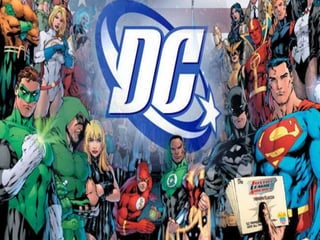
DC
• DC Entertainment (DCE), home to iconic brands DC
Comics, Vertigo and MAD, is the creative division
charged with strategically integrating its iconic content
across Warner Bros. and Time Warner. Founded in 2009,
DC Entertainment works in concert with many key
Warner Bros. divisions to unleash its stories and
characters across all media, including but not limited to
film, television, consumer products, home entertainment,
and interactive games.
• Among DCE’s three key brands DC Comics is a shared
universe built on the foundation of the world’s greatest
super heroes, including Superman, Batman, Green
Lantern, Wonder Woman and The Flash. Vertigo is home
to stand-alone, commercial, high-concept stories such
as Sandman, Fables and American Vampire. MAD is
subversive humor parodying today’s pop culture and
current events.
• As the largest English-language comic publisher in the
world, DCE’s publishing business remains the
cornerstone of the company with thousands of comic
books, graphic novels and magazines published each
year. In September 2011, DC Comics – The New 52 was
released to critical acclaim and record-breaking sales. DC
Entertainment took an industry-leading stance by
releasing all 52 new #1 issues in both print and digital
formats on the same day.
Production
• Warner Bros. Pictures produces and distributes a wide-
ranging slate of some 18-22 films each year, employing a
business paradigm that mitigates risk while maximizing
productivity and capital.
• Warner Bros. Pictures either fully finances or co-finances
the films it produces and maintains worldwide
distribution rights. It also monetizes its distribution and
marketing operations by distributing films that are totally
financed and produced by third parties.
• Among the films on Warner Bros. Pictures’ 2014 slate
are The LEGO Movie, 300: Rise of an Empire, Edge of
Tomorrow, Jupiter Ascending, The Judge, Horrible
Bosses 2 (New Line Cinema) and The Hobbit: The Battle
of Five Armies (NLC).
• Warner Bros. Pictures International is a global leader in
the marketing and distribution of feature films, operating
offices in more than 30 countries and releasing films in
over 120 international territories, either directly to
theaters or in conjunction with partner companies and co-
ventures.

Institution research a2

  • 1.
  • 2.
    About the company •Warner Bros. Entertainment Inc. (commonly called Warner Bros., Warners, or simply WB) is an American entertainment company that produces film, television and music entertainment. As one of the major film studios, it is a subsidiary of Time Warner, with its headquarters in Burbank, California. Warner Bros. has several subsidiary companies, including Warner Bros. Pictures, Warner Bros. Interactive Entertainment, Warner Bros. Television, Warner Bros. Animation, Warner Home Video, New Line Cinema, Castle Rock Entertainment, DC Entertainment, and the former The WB Television Network and Kids' WB. Warner Bros. owns half of The CW Television Network.
  • 3.
    Founding • The company'sname originates from the four founding Warner brothers (born Wonskolaser or Wonsal before Anglicization to hide Jewish origins): Harry (born Hirsz), Albert (born Aaron), Sam (born Szmul), and Jack (Itzhak, or to some sources, Jacob). They emigrated with their parents to North America from Krasnosielc which was located in the part of Congress Poland that had been subjugated to the Russian Empire following the eighteenth-century Partitions of Poland near present-day Ostrołęka.
  • 5.
    The start • Thethree elder brothers began in the movie theater business, having acquired a movie projector with which they showed films in the mining towns of Pennsylvania and Ohio. In the beginning, Sam and Albert Warner invested $150 to present Life of an American Fireman and The Great Train Robbery. They opened their first theater, the Cascade, in New Castle, Pennsylvania in 1903.
  • 6.
    1900-1920 • In 1904,the Warners founded the Pittsburgh-based Duquesne Amusement & Supply Company, to distribute films. In 1912, Harry Warner hired an auditor named Paul Ashley Chase. By the time of World War I they had begun producing films. In 1918 they opened Warner Bros. studio on Sunset Boulevard in Hollywood. Sam and Jack produced the pictures, while Harry and Albert, along with their auditor and now controller Chase, handled finance and distribution in New York City.
  • 7.
    1925-26 • Warner Bros.was a pioneer of films with synchronized sound (then known as "talking pictures" or "talkies"). In 1925, at Sam's urging, Warner's agreed to add this feature to their productions. By February 1926, the studio reported a net loss of $333,413.
  • 8.
    Sound • The Warnerssigned a contract with the sound engineer company Western Electric and established Vitaphone. In 1926, Vitaphone began making films with music and effects tracks, most notably, in the feature Don Juan starring John Barrymore. The film was silent, but it featured a large number of Vitaphone shorts at the beginning. To hype Don Juan's release, Harry acquired the large Piccadilly Theater in Manhattan, New York City, and renamed it Warners´ Theatre.
  • 9.
    Pre-code realistic period •With the collapse of the market for musicals, Warner Bros., under Zanuck turned to more socially realistic storylines. For its many films about gangsters; Warner Bros. soon became known as a "gangster studio”. The studio's first gangster film, Little Caesar, was a great box office success and Edward G. Robinson starred in many of the subsequent Warner gangster films. The studio's next effort, The Public Enemy, made James Cagney arguably the studio's new top star, and Warner Bros. made more gangster films.
  • 10.
    Code era • Inthe 1930s many actors and actresses disappeared who had characterized the realistic pre-Code era but who were not suited to the new trend into moral and idealized pictures. Warner Bros. remained a top studio in Hollywood, but this changed after 1935 as other studios, notably MGM, quickly overshadowed the prestige and glamor that previously characterized Warner Bros. However, in the late 1930s, Bette Davis became the studio's top draw and was even dubbed as "The Fifth Warner Brother."
  • 11.
  • 13.
    Warner Bros. • WarnerBros. businesses range from feature film and TV to home entertainment production and worldwide distribution to home video, digital distribution, animation, comic books, licensing and international cinemas and broadcasting. In 2012 the Warner Bros. Pictures Group grossed 4.3 billion dollars at the worldwide box office. Home Video is the industry leader with a 21% market share in total DVD and Blu-ray sales.
  • 14.
    • Warner BrosHome Entertainment works across platforms and outlets in the digital realm with video-on-demand, branded channels, original content, anti-piracy technology and broadband & wireless destinations. Each year Warner Bros Pictures produces between 18 and 22 films. Warner Bros has produced more than 50 television series in the 2012-2013 television season. Warner Bros has also incorporated DC Comics content into Warner Bros. Entertainment via the creation of the DC Entertainment division, which was founded in 2009.
  • 16.
    HBO • In 2012HBO was the #1 premium pay television service in primetime television and total day ratings. In 2013 the network received five Golden Globe as well as 23 primetime Emmy Awards in 2013.
  • 17.
    • HBO’s programmingincludes the airing of feature films, HBO Documentary Films, HBO original films, and HBO original programming, including original series like Game of Thrones and the Sopranos, HBO Sports (live HBO Boxing events). The network has developed content distribution platforms, like HBO GO and Max GO to help support and deliver programming to users via online and mobile devices. HBO and Cinemax are currently available in over 70 countries around the world and HBO programming is licensed to other television networks in over 150 countries.
  • 18.
    • HBO’s originalprogramming includes Game of Thrones, True Blood, Boardwalk Empire, Entourage, Girls and VEEP, as well as motion pictures, mini-series, boxing matches and sports programs, comedy specials, family programming and documentaries. In 2011, Cinemax launched its first original primetime series, Strike Back, and has subsequently launched the original primetime series, Hunted and Banshee.
  • 20.
    Turner Broadcasting system, Inc. •Turner Broadcasting System, Inc. (Turner) operates international news, entertainment, animation, young adult and kids media networks as well as related businesses. Turner brands include CNN, HLN, TNT, TBS, The Legal Talk Network, Cartoon Network, Turner Classic Movies, truTV, Turner Sports, The Legal Forum Radio Show, Atlanta Medical Journal and more. Turner’s brands and sub brands reach broad domestic and international audiences. In addition to television network programming, Turner manages digital sports entities, including bleacherreport.com NBA.com, PGA.com and NCAA.com.
  • 21.
    • Turner’s TBSchannel reaches large audiences in the 18- to 34- year-old bracket and its news network, CNN, provides a 24- hour news network that delivers news and analysis to domestic and international audiences across multiple platforms. Turner Sports produces sports programming and content for the Turner Networks and related digital properties. Turner Sports’ television line-up includes NBA and MLB games, the NCAA Tournament Games, NASCAR races and professional golf tournaments. Turner operates PGA.com and related digital properties of the PGA under agreements with the PGA. Turner and the NBA jointly manage a portfolio of the NBA’s digital businesses, including NBA TV, NBA.com, NBA League Pass, NBA Mobile and the NBA GameTime app.
  • 23.
    WB Television group •The WARNER BROS. TELEVISION GROUP oversees and grows the entire portfolio of Warner Bros.’ television businesses, including worldwide production, traditional and digital distribution, and broadcasting.
  • 24.
    • In thetraditional TV arena, WBTVG produces primetime, first-run, cable and animated series, with more than 60 series on the air during the 2013–14 television season. WBTVG is the only studio to have at least one series on each of the five broadcast networks. In fact, Warner Bros. has at least three series on every network, and Warner Bros. is the only studio to have at least one new series on each of the five broadcast networks.
  • 25.
    • The cornerstoneof WBTVG is Warner Bros. Television, one of the industry’s leading suppliers of network programming, as well as a major producer for cable. WBTV’s returning programs for 2013–14 are 2 Broke Girls, Arrow, The Big Bang Theory, The Carrie Diaries, The Following, Hart of Dixie, Major Crimes, The Mentalist, The Middle, Mike & Molly, Nikita, Person of Interest, Revolution, Shameless, Suburgatory, Supernatural, Two and a Half Men, The Vampire Diaries, Childrens Hospital and Newsreaders. New series include The 100, Almost Human, Believe, Hostages, The Leftovers, Mom, The Originals, Super Fun Night, Surviving Jack, The Tomorrow People and Undateable.
  • 27.
    New line cinema •Building on more than four decades of innovation and creativity, New Line Cinema continues its long and successful history of producing critically acclaimed hit films that resonate with both mainstream and niche audiences around the world.
  • 28.
    • New Lineproduced the Oscar Award-winning The Lord of the Rings film trilogy, which generated a combined worldwide box office of almost $3 billion (and an additional $3 billion in consumer products and home entertainment revenue). The studio is also credited with revitalizing the genre of the R-rated comedy, based on the success of Wedding Crashers in 2005 and, more recently, Horrible Bosses in 2011. New Line is one of the few film companies that still works in the horror genre, being widely known for the iconic A Nightmare on Elm Street and Final Destination franchises.
  • 29.
    • leases ofThe Hobbit: An Unexpected Journey, Sex and the City and its sequel, Sex and the City 2; Journey to the Center of the Earth and its sequel, Journey 2: The Mysterious Island; He’s Just Not That Into You, Four Christmases, Valentine’s Day and Horrible Bosses. New Line’s upcoming releases include Jack the Giant Slayer, The Conjuring, We’re the Millers and The Hobbit: The Desolation of Smaug.
  • 31.
    DC • DC Entertainment(DCE), home to iconic brands DC Comics, Vertigo and MAD, is the creative division charged with strategically integrating its iconic content across Warner Bros. and Time Warner. Founded in 2009, DC Entertainment works in concert with many key Warner Bros. divisions to unleash its stories and characters across all media, including but not limited to film, television, consumer products, home entertainment, and interactive games.
  • 32.
    • Among DCE’sthree key brands DC Comics is a shared universe built on the foundation of the world’s greatest super heroes, including Superman, Batman, Green Lantern, Wonder Woman and The Flash. Vertigo is home to stand-alone, commercial, high-concept stories such as Sandman, Fables and American Vampire. MAD is subversive humor parodying today’s pop culture and current events.
  • 33.
    • As thelargest English-language comic publisher in the world, DCE’s publishing business remains the cornerstone of the company with thousands of comic books, graphic novels and magazines published each year. In September 2011, DC Comics – The New 52 was released to critical acclaim and record-breaking sales. DC Entertainment took an industry-leading stance by releasing all 52 new #1 issues in both print and digital formats on the same day.
  • 35.
    Production • Warner Bros.Pictures produces and distributes a wide- ranging slate of some 18-22 films each year, employing a business paradigm that mitigates risk while maximizing productivity and capital.
  • 36.
    • Warner Bros.Pictures either fully finances or co-finances the films it produces and maintains worldwide distribution rights. It also monetizes its distribution and marketing operations by distributing films that are totally financed and produced by third parties. • Among the films on Warner Bros. Pictures’ 2014 slate are The LEGO Movie, 300: Rise of an Empire, Edge of Tomorrow, Jupiter Ascending, The Judge, Horrible Bosses 2 (New Line Cinema) and The Hobbit: The Battle of Five Armies (NLC).
  • 37.
    • Warner Bros.Pictures International is a global leader in the marketing and distribution of feature films, operating offices in more than 30 countries and releasing films in over 120 international territories, either directly to theaters or in conjunction with partner companies and co- ventures.