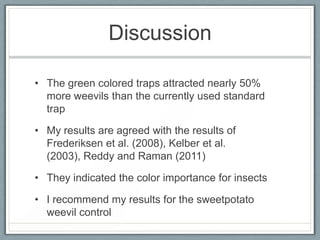
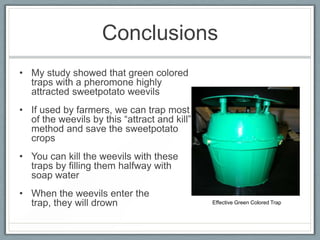
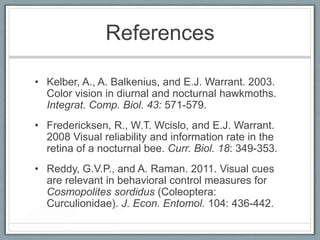
Importance of Color in Insect
Control: Sweetpotato Weevil
            Nirupa Gadi
         Conrad High School
         Conrad, MT 59425
Introduction
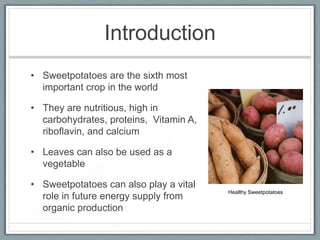
• Sweetpotatoes are the sixth most
  important crop in the world

• They are nutritious, high in
  carbohydrates, proteins, Vitamin A,
  riboflavin, and calcium

• Leaves can also be used as a
  vegetable

• Sweetpotatoes can also play a vital
                                        Healthy Sweetpotatoes
  role in future energy supply from
  organic production
Problems
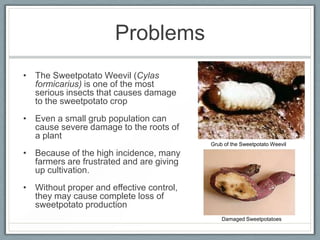
• The Sweetpotato Weevil (Cylas
  formicarius) is one of the most
  serious insects that causes damage
  to the sweetpotato crop
• Even a small grub population can
  cause severe damage to the roots of
  a plant
                                          Grub of the Sweetpotato Weevil
• Because of the high incidence, many
  farmers are frustrated and are giving
  up cultivation.
• Without proper and effective control,
  they may cause complete loss of
  sweetpotato production
                                              Damaged Sweetpotatoes
Problems (cont’d)
• Control methods such as using
  toxic pesticides are somewhat
  effective but are not desirable to
  the environment

• There is an urgent need for
  development of an eco-friendly
  control methods

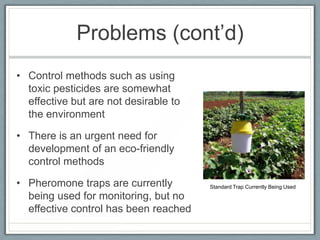
• Pheromone traps are currently        Standard Trap Currently Being Used

  being used for monitoring, but no
  effective control has been reached
Hypothesis

• While reading some literature, I realized the
  importance of color to insects

• Each species of insect is attracted to a different
  color

• What color trap would attract the highest number
  of weevils?

• Color preference would help in mass trapping
  these weevils from various fields
Materials

• Nine standard unitraps

• Colored tapes of brown, black, gray, yellow, red, white,
  green, and blue to cover eight of the traps

• Stopwatch

• Datasheets

• Pencils and meter stick

• Pheromones

• Sweetpotato Weevils
Methods

• Tests were conducted at the Chemical Ecology
  and Entomology Laboratory at the University of
  Guam

• Experiments were run in a dimly lighted laboratory
  with the standard unitrap of different colors

• Tested colors were
  brown, black, gray, yellow, red, white, green, and
  blue

• One standard trap was also added as the control
Methods (cont’d)

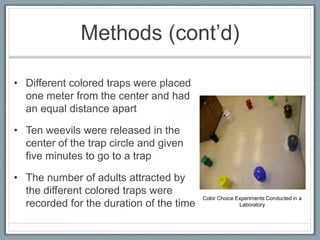
• Different colored traps were placed
  one meter from the center and had
  an equal distance apart

• Ten weevils were released in the
  center of the trap circle and given
  five minutes to go to a trap

• The number of adults attracted by
  the different colored traps were
                                          Color Choice Experiments Conducted in a
  recorded for the duration of the time                 Laboratory
Methods (cont’d)

• Two sets of test were carried out in the laboratory

• One set was tested with a pheromone which is a
  chemical that attracts insects

• The other was conducted without a pheromone

• Each set was repeated 70 times for validity
Analysis

• The total number of weevils that responded per
  color were combined and set as a percentage that
  was attracted to each trap color
Results
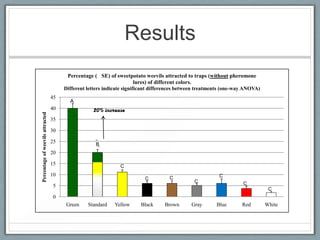
                                        Percentage ( SE) of sweetpotato weevils attracted to traps (without pheromone
                                                                        lures) of different colors.
                                       Different letters indicate significant differences between treatments (one-way ANOVA)
                                  45
                                         A
                                  40               20% increase
Percentage of weevils attracted


                                  35

                                  30
                                                    B
                                  25                B
                                                    B
                                  20

                                  15                           C
                                  10                                                                      C
                                                                          C         C
                                                                                               C                    C
                                   5
                                                                                                                                C
                                   0
                                       Green     Standard    Yellow     Black     Brown       Gray       Blue       Red        White
Results (cont’d)
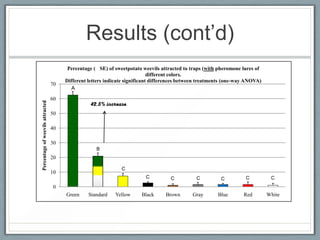
                                        Percentage ( SE) of sweetpotato weevils attracted to traps (with pheromone lures of
                                                                             different colors.
                                       Different letters indicate significant differences between treatments (one-way ANOVA)
                                  70
                                         A

                                  60
Percentage of weevils attracted


                                                 42.5% increase
                                  50

                                  40

                                  30
                                                    B
                                  20

                                                               C
                                  10
                                                                          C         C          C          C          C          C
                                   0
                                       Green     Standard   Yellow      Black     Brown       Gray       Blue       Red        White
Results (cont’d)

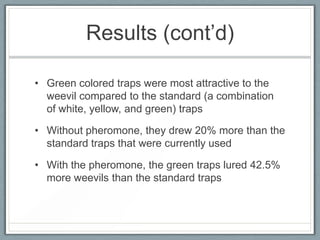
• Green colored traps were most attractive to the
  weevil compared to the standard (a combination
  of white, yellow, and green) traps

• Without pheromone, they drew 20% more than the
  standard traps that were currently used

• With the pheromone, the green traps lured 42.5%
  more weevils than the standard traps
Discussion

• The green colored traps attracted nearly 50%
  more weevils than the currently used standard
  trap

• My results are agreed with the results of
  Frederiksen et al. (2008), Kelber et al.
  (2003), Reddy and Raman (2011)

• They indicated the color importance for insects

• I recommend my results for the sweetpotato
  weevil control
Conclusions
• My study showed that green colored
  traps with a pheromone highly
  attracted sweetpotato weevils
• If used by farmers, we can trap most
  of the weevils by this “attract and kill”
  method and save the sweetpotato
  crops
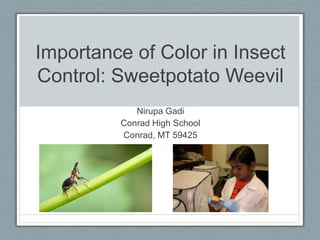
• You can kill the weevils with these
  traps by filling them halfway with
  soap water
• When the weevils enter the
  trap, they will drown                       Effective Green Colored Trap
References

• Kelber, A., A. Balkenius, and E.J. Warrant. 2003.
  Color vision in diurnal and nocturnal hawkmoths.
  Integrat. Comp. Biol. 43: 571-579.
• Fredericksen, R., W.T. Wcislo, and E.J. Warrant.
  2008 Visual reliability and information rate in the
  retina of a nocturnal bee. Curr. Biol. 18: 349-353.
• Reddy, G.V.P., and A. Raman. 2011. Visual cues
  are relevant in behavioral control measures for
  Cosmopolites sordidus (Coleoptera:
  Curculionidae). J. Econ. Entomol. 104: 436-442.
Acknowledgements

• I would like to thank G.V.P. Reddy for providing lab
  facilities and for guidance

• I acknowledge the help I received from the staff of
  the Chemical Ecology Laboratory at the University
  of Guam

• I would also like to thank Sigma Xi for giving me
  the opportunity to present my results
Sweetpotato weevil slide

  • 1.
    Importance of Colorin Insect Control: Sweetpotato Weevil Nirupa Gadi Conrad High School Conrad, MT 59425
  • 2.
    Introduction • Sweetpotatoes arethe sixth most important crop in the world • They are nutritious, high in carbohydrates, proteins, Vitamin A, riboflavin, and calcium • Leaves can also be used as a vegetable • Sweetpotatoes can also play a vital Healthy Sweetpotatoes role in future energy supply from organic production
  • 3.
    Problems • The SweetpotatoWeevil (Cylas formicarius) is one of the most serious insects that causes damage to the sweetpotato crop • Even a small grub population can cause severe damage to the roots of a plant Grub of the Sweetpotato Weevil • Because of the high incidence, many farmers are frustrated and are giving up cultivation. • Without proper and effective control, they may cause complete loss of sweetpotato production Damaged Sweetpotatoes
  • 4.
    Problems (cont’d) • Controlmethods such as using toxic pesticides are somewhat effective but are not desirable to the environment • There is an urgent need for development of an eco-friendly control methods • Pheromone traps are currently Standard Trap Currently Being Used being used for monitoring, but no effective control has been reached
  • 5.
    Hypothesis • While readingsome literature, I realized the importance of color to insects • Each species of insect is attracted to a different color • What color trap would attract the highest number of weevils? • Color preference would help in mass trapping these weevils from various fields
  • 6.
    Materials • Nine standardunitraps • Colored tapes of brown, black, gray, yellow, red, white, green, and blue to cover eight of the traps • Stopwatch • Datasheets • Pencils and meter stick • Pheromones • Sweetpotato Weevils
  • 7.
    Methods • Tests wereconducted at the Chemical Ecology and Entomology Laboratory at the University of Guam • Experiments were run in a dimly lighted laboratory with the standard unitrap of different colors • Tested colors were brown, black, gray, yellow, red, white, green, and blue • One standard trap was also added as the control
  • 8.
    Methods (cont’d) • Differentcolored traps were placed one meter from the center and had an equal distance apart • Ten weevils were released in the center of the trap circle and given five minutes to go to a trap • The number of adults attracted by the different colored traps were Color Choice Experiments Conducted in a recorded for the duration of the time Laboratory
  • 9.
    Methods (cont’d) • Twosets of test were carried out in the laboratory • One set was tested with a pheromone which is a chemical that attracts insects • The other was conducted without a pheromone • Each set was repeated 70 times for validity
  • 10.
    Analysis • The totalnumber of weevils that responded per color were combined and set as a percentage that was attracted to each trap color
  • 11.
    Results Percentage ( SE) of sweetpotato weevils attracted to traps (without pheromone lures) of different colors. Different letters indicate significant differences between treatments (one-way ANOVA) 45 A 40 20% increase Percentage of weevils attracted 35 30 B 25 B B 20 15 C 10 C C C C C 5 C 0 Green Standard Yellow Black Brown Gray Blue Red White
  • 12.
    Results (cont’d) Percentage ( SE) of sweetpotato weevils attracted to traps (with pheromone lures of different colors. Different letters indicate significant differences between treatments (one-way ANOVA) 70 A 60 Percentage of weevils attracted 42.5% increase 50 40 30 B 20 C 10 C C C C C C 0 Green Standard Yellow Black Brown Gray Blue Red White
  • 13.
    Results (cont’d) • Greencolored traps were most attractive to the weevil compared to the standard (a combination of white, yellow, and green) traps • Without pheromone, they drew 20% more than the standard traps that were currently used • With the pheromone, the green traps lured 42.5% more weevils than the standard traps
  • 14.
    Discussion • The greencolored traps attracted nearly 50% more weevils than the currently used standard trap • My results are agreed with the results of Frederiksen et al. (2008), Kelber et al. (2003), Reddy and Raman (2011) • They indicated the color importance for insects • I recommend my results for the sweetpotato weevil control
  • 15.
    Conclusions • My studyshowed that green colored traps with a pheromone highly attracted sweetpotato weevils • If used by farmers, we can trap most of the weevils by this “attract and kill” method and save the sweetpotato crops • You can kill the weevils with these traps by filling them halfway with soap water • When the weevils enter the trap, they will drown Effective Green Colored Trap
  • 16.
    References • Kelber, A.,A. Balkenius, and E.J. Warrant. 2003. Color vision in diurnal and nocturnal hawkmoths. Integrat. Comp. Biol. 43: 571-579. • Fredericksen, R., W.T. Wcislo, and E.J. Warrant. 2008 Visual reliability and information rate in the retina of a nocturnal bee. Curr. Biol. 18: 349-353. • Reddy, G.V.P., and A. Raman. 2011. Visual cues are relevant in behavioral control measures for Cosmopolites sordidus (Coleoptera: Curculionidae). J. Econ. Entomol. 104: 436-442.
  • 17.
    Acknowledgements • I wouldlike to thank G.V.P. Reddy for providing lab facilities and for guidance • I acknowledge the help I received from the staff of the Chemical Ecology Laboratory at the University of Guam • I would also like to thank Sigma Xi for giving me the opportunity to present my results