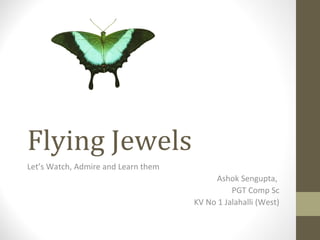
Flying Jewels
Let’s Watch, Admire and Learn them
Ashok Sengupta,
PGT Comp Sc
KV No 1 Jalahalli (West)
AshokSengupta
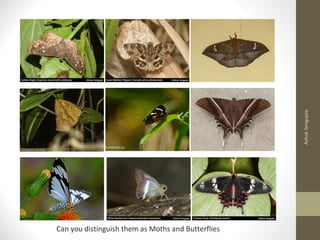
Can you distinguish them as Moths and Butterflies
Introduction
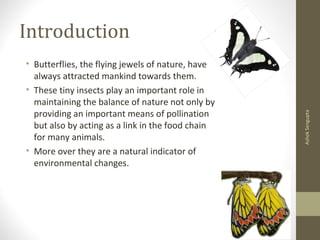
• Butterflies, the flying jewels of nature, have
always attracted mankind towards them.
• These tiny insects play an important role in
maintaining the balance of nature not only by
providing an important means of pollination
but also by acting as a link in the food chain
for many animals.
• More over they are a natural indicator of
environmental changes.
AshokSengupta
Why are Butterflies valuable
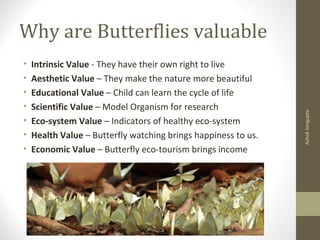
• Intrinsic Value - They have their own right to live
• Aesthetic Value – They make the nature more beautiful
• Educational Value – Child can learn the cycle of life
• Scientific Value – Model Organism for research
• Eco-system Value – Indicators of healthy eco-system
• Health Value – Butterfly watching brings happiness to us.
• Economic Value – Butterfly eco-tourism brings income
AshokSengupta
How they are different from
Moths
• Butterflies and moths are very closely-related insect groups that
make up the Order Lepidoptera
• Butterflies have clubbed antenna whereas Moths have feathery
Antenna
• Butterflies are diurnal (Day fliers)whereas Moths are mostly
nocturnal.
• Butterflies tend to have thinner bodies as compared to Moths.
• Butterflies tend to pupate in a hard chrysalis whereas Moths pupate
inside a cocoon, which they spin out of silk and sometimes nearby
materials like leaves.
• Butterflies tend to rest with their wings closed whereas Moths rest
with their wings open.
AshokSengupta
Butterfly Moth
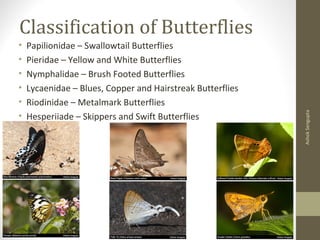
Classification of Butterflies
• Papilionidae – Swallowtail Butterflies
• Pieridae – Yellow and White Butterflies
• Nymphalidae – Brush Footed Butterflies
• Lycaenidae – Blues, Copper and Hairstreak Butterflies
• Riodinidae – Metalmark Butterflies
• Hesperiiade – Skippers and Swift Butterflies
AshokSengupta
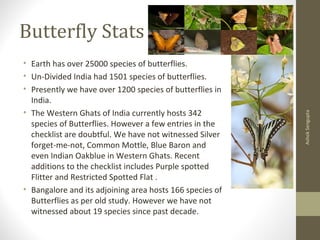
Butterfly Stats
• Earth has over 25000 species of butterflies.
• Un-Divided India had 1501 species of butterflies.
• Presently we have over 1200 species of butterflies in
India.
• The Western Ghats of India currently hosts 342
species of Butterflies. However a few entries in the
checklist are doubtful. We have not witnessed Silver
forget-me-not, Common Mottle, Blue Baron and
even Indian Oakblue in Western Ghats. Recent
additions to the checklist includes Purple spotted
Flitter and Restricted Spotted Flat .
• Bangalore and its adjoining area hosts 166 species of
Butterflies as per old study. However we have not
witnessed about 19 species since past decade.
AshokSengupta
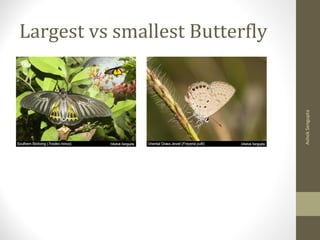
Largest vs smallest Butterfly
AshokSengupta
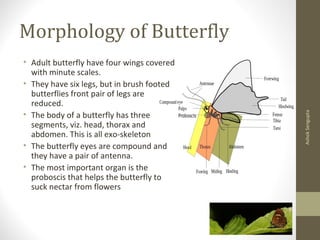
Morphology of Butterfly
• Adult butterfly have four wings covered
with minute scales.
• They have six legs, but in brush footed
butterflies front pair of legs are
reduced.
• The body of a butterfly has three
segments, viz. head, thorax and
abdomen. This is all exo-skeleton
• The butterfly eyes are compound and
they have a pair of antenna.
• The most important organ is the
proboscis that helps the butterfly to
suck nectar from flowers
AshokSengupta
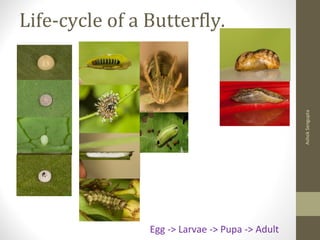
Life-cycle of a Butterfly.
AshokSengupta
Egg -> Larvae -> Pupa -> Adult
Mimicry in Butterfly
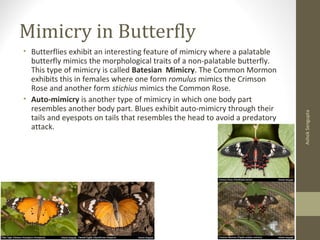
• Butterflies exhibit an interesting feature of mimicry where a palatable
butterfly mimics the morphological traits of a non-palatable butterfly.
This type of mimicry is called Batesian Mimicry. The Common Mormon
exhibits this in females where one form romulus mimics the Crimson
Rose and another form stichius mimics the Common Rose.
• Auto-mimicry is another type of mimicry in which one body part
resembles another body part. Blues exhibit auto-mimicry through their
tails and eyespots on tails that resembles the head to avoid a predatory
attack.
AshokSengupta
Habits and habitats
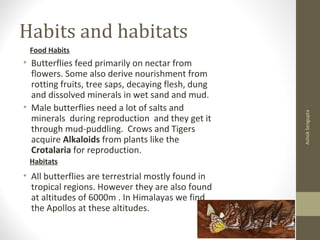
• Butterflies feed primarily on nectar from
flowers. Some also derive nourishment from
rotting fruits, tree saps, decaying flesh, dung
and dissolved minerals in wet sand and mud.
• Male butterflies need a lot of salts and
minerals during reproduction and they get it
through mud-puddling. Crows and Tigers
acquire Alkaloids from plants like the
Crotalaria for reproduction.
• All butterflies are terrestrial mostly found in
tropical regions. However they are also found
at altitudes of 6000m . In Himalayas we find
the Apollos at these altitudes.
AshokSengupta
Food Habits
Habitats
Sexual Dimorphism
AshokSengupta
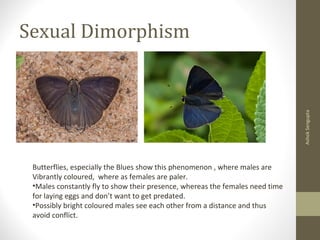
Butterflies, especially the Blues show this phenomenon , where males are
Vibrantly coloured, where as females are paler.
•Males constantly fly to show their presence, whereas the females need time
for laying eggs and don’t want to get predated.
•Possibly bright coloured males see each other from a distance and thus
avoid conflict.
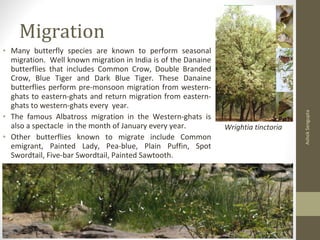
Migration
AshokSengupta
• Many butterfly species are known to perform seasonal
migration. Well known migration in India is of the Danaine
butterflies that includes Common Crow, Double Branded
Crow, Blue Tiger and Dark Blue Tiger. These Danaine
butterflies perform pre-monsoon migration from western-
ghats to eastern-ghats and return migration from eastern-
ghats to western-ghats every year.
• The famous Albatross migration in the Western-ghats is
also a spectacle in the month of January every year.
• Other butterflies known to migrate include Common
emigrant, Painted Lady, Pea-blue, Plain Puffin, Spot
Swordtail, Five-bar Swordtail, Painted Sawtooth.
Wrightia tinctoria
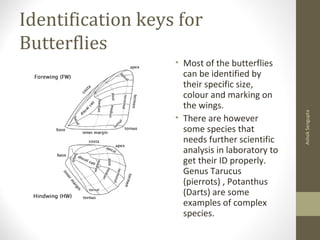
Identification keys for
Butterflies
• Most of the butterflies
can be identified by
their specific size,
colour and marking on
the wings.
• There are however
some species that
needs further scientific
analysis in laboratory to
get their ID properly.
Genus Tarucus
(pierrots) , Potanthus
(Darts) are some
examples of complex
species.
AshokSengupta
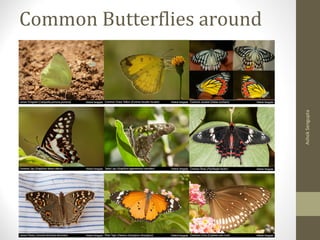
Common Butterflies around
us
AshokSengupta
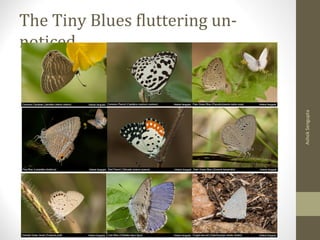
The Tiny Blues fluttering un-
noticed
AshokSengupta
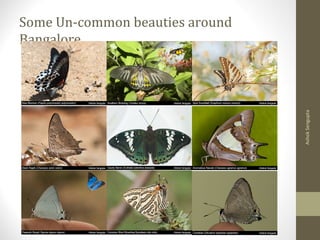
Some Un-common beauties around
Bangalore
AshokSengupta
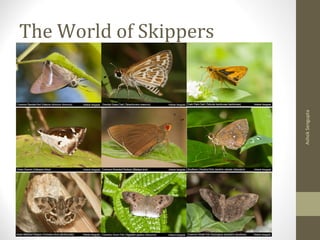
The World of Skippers
AshokSengupta
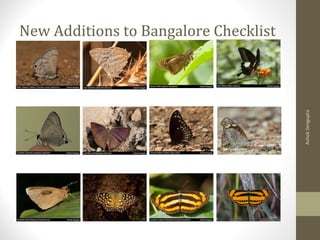
New Additions to Bangalore Checklist
AshokSengupta
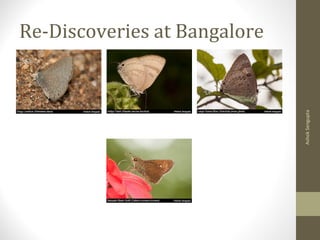
Re-Discoveries at Bangalore
AshokSengupta
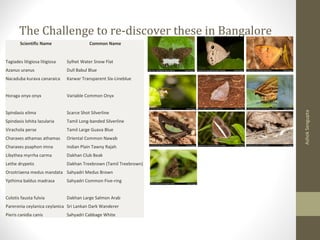
The Challenge to re-discover these in Bangalore
Scientific Name Common Name
Tagiades litigiosa litigiosa Sylhet Water Snow Flat
Azanus uranus Dull Babul Blue
Nacaduba kurava canaraica Karwar Transparent Six-Lineblue
Horaga onyx onyx Variable Common Onyx
Spindasis elima Scarce Shot Silverline
Spindasis lohita lazularia Tamil Long-banded Silverline
Virachola perse Tamil Large Guava Blue
Charaxes athamas athamas Oriental Common Nawab
Charaxes psaphon imna Indian Plain Tawny Rajah
Libythea myrrha carma Dakhan Club Beak
Lethe drypetis Dakhan Treebrown (Tamil Treebrown)
Orsotriaena medus mandata Sahyadri Medus Brown
Ypthima baldus madrasa Sahyadri Common Five-ring
Colotis fausta fulvia Dakhan Large Salmon Arab
Pareronia ceylanica ceylanica Sri Lankan Dark Wanderer
Pieris canidia canis Sahyadri Cabbage White
AshokSengupta
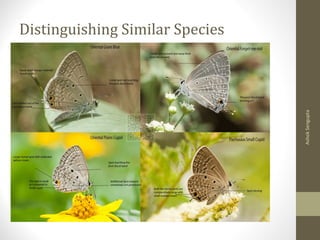
Distinguishing Similar Species
AshokSengupta
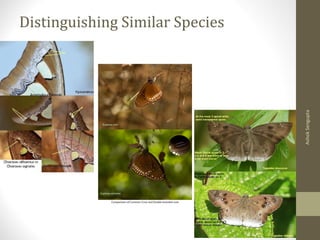
Distinguishing Similar Species
AshokSengupta
Butterfly Park – Some Tips
• Have an open area near your house and
plant some locally available nectar plants
initially.
1. Lantana (Lantana camera)
2. Jamaica vervain (Stachytarpheta
jamaicensis, S. mutabilis)
3. Clerodendrum viscosum
4. Combretum paniculatum
5. Ixora Sp.
6. Butterfly Bush (Buddleja sp)
7. Premna sp
8. Soapnut (Sapindus)
9. Cadaba fruticosa
10. Plumbago zeylanica
11. Ageratum conyzoides
12. Zinnia sp
13. Marigold sp (Tagetes erecta)
14. Saraca asoca
15. Tridax procumbens
16. Urena lobata
17. Crotalaria retusa
18. Melastoma malabatricum
19. Careya arborea
20. Asclepias curassavica
AshokSengupta
• Follow it up with some LHPs
1. Polyalthia longifolia
2. Michelia champaca
3. Aristolochia indica
4. Aegle marmelos
5. Cassia fistula
6. Cassia tora
7. Calotropis gigantea
8. Potted Palms
9. Castor
10. Copperpod tree
11. Pongamia
12. Capparis
13. Mango
14. Kalanchoe
15. Zizyphus
16. Lime
17. Murraya koenigii
18. Nerium Oleander
Join Butterfly Club Bangalore
AshokSengupta
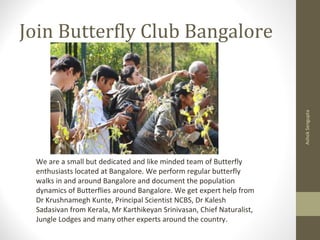
We are a small but dedicated and like minded team of Butterfly
enthusiasts located at Bangalore. We perform regular butterfly
walks in and around Bangalore and document the population
dynamics of Butterflies around Bangalore. We get expert help from
Dr Krushnamegh Kunte, Principal Scientist NCBS, Dr Kalesh
Sadasivan from Kerala, Mr Karthikeyan Srinivasan, Chief Naturalist,
Jungle Lodges and many other experts around the country.
Your Queries Please
AshokSengupta

Flying jewels

  • 1.
    Flying Jewels Let’s Watch,Admire and Learn them Ashok Sengupta, PGT Comp Sc KV No 1 Jalahalli (West)
  • 2.
    AshokSengupta Can you distinguishthem as Moths and Butterflies
  • 3.
    Introduction • Butterflies, theflying jewels of nature, have always attracted mankind towards them. • These tiny insects play an important role in maintaining the balance of nature not only by providing an important means of pollination but also by acting as a link in the food chain for many animals. • More over they are a natural indicator of environmental changes. AshokSengupta
  • 4.
    Why are Butterfliesvaluable • Intrinsic Value - They have their own right to live • Aesthetic Value – They make the nature more beautiful • Educational Value – Child can learn the cycle of life • Scientific Value – Model Organism for research • Eco-system Value – Indicators of healthy eco-system • Health Value – Butterfly watching brings happiness to us. • Economic Value – Butterfly eco-tourism brings income AshokSengupta
  • 5.
    How they aredifferent from Moths • Butterflies and moths are very closely-related insect groups that make up the Order Lepidoptera • Butterflies have clubbed antenna whereas Moths have feathery Antenna • Butterflies are diurnal (Day fliers)whereas Moths are mostly nocturnal. • Butterflies tend to have thinner bodies as compared to Moths. • Butterflies tend to pupate in a hard chrysalis whereas Moths pupate inside a cocoon, which they spin out of silk and sometimes nearby materials like leaves. • Butterflies tend to rest with their wings closed whereas Moths rest with their wings open. AshokSengupta Butterfly Moth
  • 6.
    Classification of Butterflies •Papilionidae – Swallowtail Butterflies • Pieridae – Yellow and White Butterflies • Nymphalidae – Brush Footed Butterflies • Lycaenidae – Blues, Copper and Hairstreak Butterflies • Riodinidae – Metalmark Butterflies • Hesperiiade – Skippers and Swift Butterflies AshokSengupta
  • 7.
    Butterfly Stats • Earthhas over 25000 species of butterflies. • Un-Divided India had 1501 species of butterflies. • Presently we have over 1200 species of butterflies in India. • The Western Ghats of India currently hosts 342 species of Butterflies. However a few entries in the checklist are doubtful. We have not witnessed Silver forget-me-not, Common Mottle, Blue Baron and even Indian Oakblue in Western Ghats. Recent additions to the checklist includes Purple spotted Flitter and Restricted Spotted Flat . • Bangalore and its adjoining area hosts 166 species of Butterflies as per old study. However we have not witnessed about 19 species since past decade. AshokSengupta
  • 8.
    Largest vs smallestButterfly AshokSengupta
  • 9.
    Morphology of Butterfly •Adult butterfly have four wings covered with minute scales. • They have six legs, but in brush footed butterflies front pair of legs are reduced. • The body of a butterfly has three segments, viz. head, thorax and abdomen. This is all exo-skeleton • The butterfly eyes are compound and they have a pair of antenna. • The most important organ is the proboscis that helps the butterfly to suck nectar from flowers AshokSengupta
  • 10.
    Life-cycle of aButterfly. AshokSengupta Egg -> Larvae -> Pupa -> Adult
  • 11.
    Mimicry in Butterfly •Butterflies exhibit an interesting feature of mimicry where a palatable butterfly mimics the morphological traits of a non-palatable butterfly. This type of mimicry is called Batesian Mimicry. The Common Mormon exhibits this in females where one form romulus mimics the Crimson Rose and another form stichius mimics the Common Rose. • Auto-mimicry is another type of mimicry in which one body part resembles another body part. Blues exhibit auto-mimicry through their tails and eyespots on tails that resembles the head to avoid a predatory attack. AshokSengupta
  • 12.
    Habits and habitats •Butterflies feed primarily on nectar from flowers. Some also derive nourishment from rotting fruits, tree saps, decaying flesh, dung and dissolved minerals in wet sand and mud. • Male butterflies need a lot of salts and minerals during reproduction and they get it through mud-puddling. Crows and Tigers acquire Alkaloids from plants like the Crotalaria for reproduction. • All butterflies are terrestrial mostly found in tropical regions. However they are also found at altitudes of 6000m . In Himalayas we find the Apollos at these altitudes. AshokSengupta Food Habits Habitats
  • 13.
    Sexual Dimorphism AshokSengupta Butterflies, especiallythe Blues show this phenomenon , where males are Vibrantly coloured, where as females are paler. •Males constantly fly to show their presence, whereas the females need time for laying eggs and don’t want to get predated. •Possibly bright coloured males see each other from a distance and thus avoid conflict.
  • 14.
    Migration AshokSengupta • Many butterflyspecies are known to perform seasonal migration. Well known migration in India is of the Danaine butterflies that includes Common Crow, Double Branded Crow, Blue Tiger and Dark Blue Tiger. These Danaine butterflies perform pre-monsoon migration from western- ghats to eastern-ghats and return migration from eastern- ghats to western-ghats every year. • The famous Albatross migration in the Western-ghats is also a spectacle in the month of January every year. • Other butterflies known to migrate include Common emigrant, Painted Lady, Pea-blue, Plain Puffin, Spot Swordtail, Five-bar Swordtail, Painted Sawtooth. Wrightia tinctoria
  • 15.
    Identification keys for Butterflies •Most of the butterflies can be identified by their specific size, colour and marking on the wings. • There are however some species that needs further scientific analysis in laboratory to get their ID properly. Genus Tarucus (pierrots) , Potanthus (Darts) are some examples of complex species. AshokSengupta
  • 16.
  • 17.
    The Tiny Bluesfluttering un- noticed AshokSengupta
  • 18.
    Some Un-common beautiesaround Bangalore AshokSengupta
  • 19.
    The World ofSkippers AshokSengupta
  • 20.
    New Additions toBangalore Checklist AshokSengupta
  • 21.
  • 22.
    The Challenge tore-discover these in Bangalore Scientific Name Common Name Tagiades litigiosa litigiosa Sylhet Water Snow Flat Azanus uranus Dull Babul Blue Nacaduba kurava canaraica Karwar Transparent Six-Lineblue Horaga onyx onyx Variable Common Onyx Spindasis elima Scarce Shot Silverline Spindasis lohita lazularia Tamil Long-banded Silverline Virachola perse Tamil Large Guava Blue Charaxes athamas athamas Oriental Common Nawab Charaxes psaphon imna Indian Plain Tawny Rajah Libythea myrrha carma Dakhan Club Beak Lethe drypetis Dakhan Treebrown (Tamil Treebrown) Orsotriaena medus mandata Sahyadri Medus Brown Ypthima baldus madrasa Sahyadri Common Five-ring Colotis fausta fulvia Dakhan Large Salmon Arab Pareronia ceylanica ceylanica Sri Lankan Dark Wanderer Pieris canidia canis Sahyadri Cabbage White AshokSengupta
  • 23.
  • 24.
  • 25.
    Butterfly Park –Some Tips • Have an open area near your house and plant some locally available nectar plants initially. 1. Lantana (Lantana camera) 2. Jamaica vervain (Stachytarpheta jamaicensis, S. mutabilis) 3. Clerodendrum viscosum 4. Combretum paniculatum 5. Ixora Sp. 6. Butterfly Bush (Buddleja sp) 7. Premna sp 8. Soapnut (Sapindus) 9. Cadaba fruticosa 10. Plumbago zeylanica 11. Ageratum conyzoides 12. Zinnia sp 13. Marigold sp (Tagetes erecta) 14. Saraca asoca 15. Tridax procumbens 16. Urena lobata 17. Crotalaria retusa 18. Melastoma malabatricum 19. Careya arborea 20. Asclepias curassavica AshokSengupta • Follow it up with some LHPs 1. Polyalthia longifolia 2. Michelia champaca 3. Aristolochia indica 4. Aegle marmelos 5. Cassia fistula 6. Cassia tora 7. Calotropis gigantea 8. Potted Palms 9. Castor 10. Copperpod tree 11. Pongamia 12. Capparis 13. Mango 14. Kalanchoe 15. Zizyphus 16. Lime 17. Murraya koenigii 18. Nerium Oleander
  • 26.
    Join Butterfly ClubBangalore AshokSengupta We are a small but dedicated and like minded team of Butterfly enthusiasts located at Bangalore. We perform regular butterfly walks in and around Bangalore and document the population dynamics of Butterflies around Bangalore. We get expert help from Dr Krushnamegh Kunte, Principal Scientist NCBS, Dr Kalesh Sadasivan from Kerala, Mr Karthikeyan Srinivasan, Chief Naturalist, Jungle Lodges and many other experts around the country.
  • 27.