Government Cloud Computing


2551 Eltham Avenue, Suite K | Norfolk, Virginia 23513 | P: 757.858.0600 F: 757.858.0606 | Toll Free: 800.666.9858 | www.dataline.com
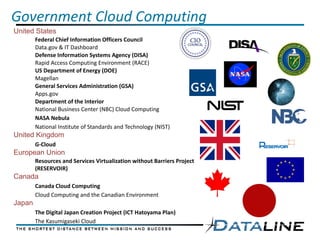
Government Cloud Computing
United States
        Federal Chief Information Officers Council
        Data.gov & IT Dashboard
        Defense Information Systems Agency (DISA)
        Rapid Access Computing Environment (RACE)
        US Department of Energy (DOE)
        Magellan
        General Services Administration (GSA)
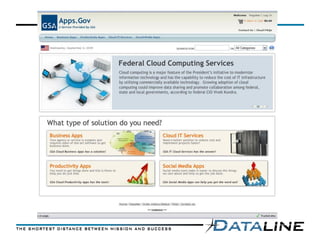
        Apps.gov
        Department of the Interior
        National Business Center (NBC) Cloud Computing
        NASA Nebula
        National Institute of Standards and Technology (NIST)
United Kingdom
        G-Cloud
European Union
        Resources and Services Virtualization without Barriers Project
        (RESERVOIR)
Canada
        Canada Cloud Computing
        Cloud Computing and the Canadian Environment
Japan
        The Digital Japan Creation Project (ICT Hatoyama Plan)
        The Kasumigaseki Cloud
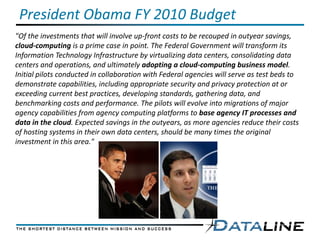
President Obama FY 2010 Budget
"Of the investments that will involve up-front costs to be recouped in outyear savings,
cloud-computing is a prime case in point. The Federal Government will transform its
Information Technology Infrastructure by virtualizing data centers, consolidating data
centers and operations, and ultimately adopting a cloud-computing business model.
Initial pilots conducted in collaboration with Federal agencies will serve as test beds to
demonstrate capabilities, including appropriate security and privacy protection at or
exceeding current best practices, developing standards, gathering data, and
benchmarking costs and performance. The pilots will evolve into migrations of major
agency capabilities from agency computing platforms to base agency IT processes and
data in the cloud. Expected savings in the outyears, as more agencies reduce their costs
of hosting systems in their own data centers, should be many times the original
investment in this area."
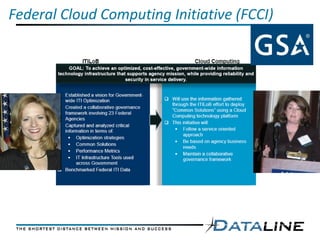
Federal Cloud Computing Initiative (FCCI)
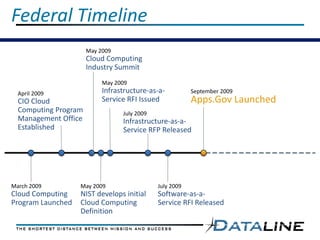
Federal Timeline
                      May 2009
                      Cloud Computing
                      Industry Summit
                           May 2009
  April 2009               Infrastructure-as-a-          September 2009
  CIO Cloud                Service RFI Issued            Apps.Gov Launched
  Computing Program              July 2009
  Management Office              Infrastructure-as-a-
  Established                    Service RFP Released


March 2009         May 2009                  July 2009
Cloud Computing    NIST develops initial     Software-as-a-
Program Launched   Cloud Computing           Service RFI Released
                   Definition
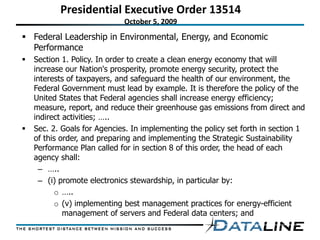
Presidential Executive Order 13514
                             October 5, 2009
 Federal Leadership in Environmental, Energy, and Economic
  Performance
   Section 1. Policy. In order to create a clean energy economy that will
    increase our Nation's prosperity, promote energy security, protect the
    interests of taxpayers, and safeguard the health of our environment, the
    Federal Government must lead by example. It is therefore the policy of the
    United States that Federal agencies shall increase energy efficiency;
    measure, report, and reduce their greenhouse gas emissions from direct and
    indirect activities; …..
   Sec. 2. Goals for Agencies. In implementing the policy set forth in section 1
    of this order, and preparing and implementing the Strategic Sustainability
    Performance Plan called for in section 8 of this order, the head of each
    agency shall:
     – …..
     – (i) promote electronics stewardship, in particular by:
          o …..
          o (v) implementing best management practices for energy-efficient
             management of servers and Federal data centers; and
Cloud Computing Benefits
•   Significant Cost Reduction: Available at a fraction of the cost of traditional IT services;
    upfront capital expenditures eliminated; dramatically reduced IT administrative burden
•   Increased Flexibility: On-demand computing across technologies, business solutions
    and large ecosystems of providers; Reduced new solution implementation times.
•   Access anywhere: Un-tethered from a single computer or network. Use different
    computer or move to portable devices, and applications and documents follow.
•   Elastic scalability and pay-as-you-go: Add and subtract capacity as your needs change.
    Pay for only what you use.
•   Easy to implement: No need to purchase hardware, software licenses or
    implementation services.
•   Service quality: Reliable services, large storage and computing capacity, and 24/7
    service and up-time.
•   Delegate non-critical applications: Outsource non-critical applications to service
    providers and focus agency IT resources on business-critical applications.
•   Always the latest software: Updates are automatic
•   Sharing documents and group collaboration: Applications and documents
    accessiblefrom anywhere in the world, facilitating group collaboration on documents
    and projects.
Cloud Computing Security
• Cloud Computing option (Public, Private, Community,
  Hybrid or None) must support information risk
  management profile
• “Brutal standardization” increases automation and
  reduces opportunity for human error
• Infrastructure visibility improves ability to deploy,
  monitor and enforce security policies
• Advanced data-centric security technologies can be
  implemented
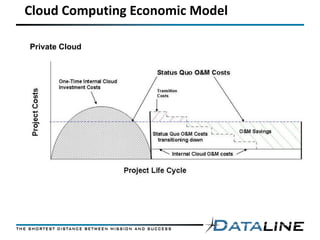
Cloud Computing Economic Model

Private Cloud
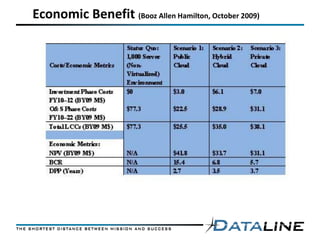
Economic Benefit (Booz Allen Hamilton, October 2009)
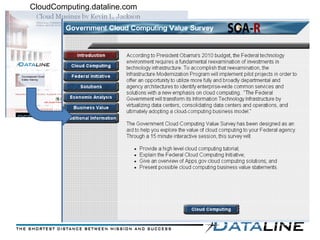
CloudComputing.dataline.com
Agency Budgeting Timeline (Booz Allen Hamilton, October 2009)
     Spring 2010
        – Agencies plan for cloud migrations
        – Initial cloud pilots
     Fall 2010
        – Funding submitted for FY 2012 execution
     Fall 2011
        – FY 2012 cloud project funding appropriated
Key Inhibitors
 Maintenance of status quo
 Transition from infrastructure based security
  to data-centric security
 Cloud portability
 Cloud interoperability
 Identity management and federation
 Data and application federation
 Service level agreements
 Cloud governance
 Transactions and concurrency across clouds
Summary
 Cloud Computing offers clear opportunities for agencies to significantly
  reduce their growing data center and IT hardware expenditures. The
  Executive Branch is strongly encouraging and facilitating this transition
  through executive order and Apps.gov
 An efficient and properly planned transition to cloud computing can
  simultaneously provide significant reduction in datacenter costs and
  increase in agency datacenter efficiency.
 The benefit ratio for investing in a transition from status quo
  datacenters to a cloud computing based strategy range from 5.7 to
  15.4. The Discount Payback Period for two phase transition plans (3-yr
  investment phase, 10 year steady-state O&S phase) range from 2.7 to
  3.7 years
 Early development efforts (pilots) to support a FY 2012 cloud
  computing transition should start in spring 2010
Thank You !
Kevin L. Jackson
Director, Business Development
Dataline, LLC
(703) 335-0830
Kevin.jackson@dataline.com
http://cloudcomputing.dataline.com
http://govcloud.ulitzer.com

Input Fed Focus 2010 Presentation

  • 1.
    Government Cloud Computing 2551Eltham Avenue, Suite K | Norfolk, Virginia 23513 | P: 757.858.0600 F: 757.858.0606 | Toll Free: 800.666.9858 | www.dataline.com
  • 2.
    Government Cloud Computing UnitedStates Federal Chief Information Officers Council Data.gov & IT Dashboard Defense Information Systems Agency (DISA) Rapid Access Computing Environment (RACE) US Department of Energy (DOE) Magellan General Services Administration (GSA) Apps.gov Department of the Interior National Business Center (NBC) Cloud Computing NASA Nebula National Institute of Standards and Technology (NIST) United Kingdom G-Cloud European Union Resources and Services Virtualization without Barriers Project (RESERVOIR) Canada Canada Cloud Computing Cloud Computing and the Canadian Environment Japan The Digital Japan Creation Project (ICT Hatoyama Plan) The Kasumigaseki Cloud
  • 3.
    President Obama FY2010 Budget "Of the investments that will involve up-front costs to be recouped in outyear savings, cloud-computing is a prime case in point. The Federal Government will transform its Information Technology Infrastructure by virtualizing data centers, consolidating data centers and operations, and ultimately adopting a cloud-computing business model. Initial pilots conducted in collaboration with Federal agencies will serve as test beds to demonstrate capabilities, including appropriate security and privacy protection at or exceeding current best practices, developing standards, gathering data, and benchmarking costs and performance. The pilots will evolve into migrations of major agency capabilities from agency computing platforms to base agency IT processes and data in the cloud. Expected savings in the outyears, as more agencies reduce their costs of hosting systems in their own data centers, should be many times the original investment in this area."
  • 4.
    Federal Cloud ComputingInitiative (FCCI)
  • 5.
    Federal Timeline May 2009 Cloud Computing Industry Summit May 2009 April 2009 Infrastructure-as-a- September 2009 CIO Cloud Service RFI Issued Apps.Gov Launched Computing Program July 2009 Management Office Infrastructure-as-a- Established Service RFP Released March 2009 May 2009 July 2009 Cloud Computing NIST develops initial Software-as-a- Program Launched Cloud Computing Service RFI Released Definition
  • 7.
    Presidential Executive Order13514 October 5, 2009  Federal Leadership in Environmental, Energy, and Economic Performance  Section 1. Policy. In order to create a clean energy economy that will increase our Nation's prosperity, promote energy security, protect the interests of taxpayers, and safeguard the health of our environment, the Federal Government must lead by example. It is therefore the policy of the United States that Federal agencies shall increase energy efficiency; measure, report, and reduce their greenhouse gas emissions from direct and indirect activities; …..  Sec. 2. Goals for Agencies. In implementing the policy set forth in section 1 of this order, and preparing and implementing the Strategic Sustainability Performance Plan called for in section 8 of this order, the head of each agency shall: – ….. – (i) promote electronics stewardship, in particular by: o ….. o (v) implementing best management practices for energy-efficient management of servers and Federal data centers; and
  • 8.
    Cloud Computing Benefits • Significant Cost Reduction: Available at a fraction of the cost of traditional IT services; upfront capital expenditures eliminated; dramatically reduced IT administrative burden • Increased Flexibility: On-demand computing across technologies, business solutions and large ecosystems of providers; Reduced new solution implementation times. • Access anywhere: Un-tethered from a single computer or network. Use different computer or move to portable devices, and applications and documents follow. • Elastic scalability and pay-as-you-go: Add and subtract capacity as your needs change. Pay for only what you use. • Easy to implement: No need to purchase hardware, software licenses or implementation services. • Service quality: Reliable services, large storage and computing capacity, and 24/7 service and up-time. • Delegate non-critical applications: Outsource non-critical applications to service providers and focus agency IT resources on business-critical applications. • Always the latest software: Updates are automatic • Sharing documents and group collaboration: Applications and documents accessiblefrom anywhere in the world, facilitating group collaboration on documents and projects.
  • 9.
    Cloud Computing Security •Cloud Computing option (Public, Private, Community, Hybrid or None) must support information risk management profile • “Brutal standardization” increases automation and reduces opportunity for human error • Infrastructure visibility improves ability to deploy, monitor and enforce security policies • Advanced data-centric security technologies can be implemented
  • 10.
    Cloud Computing EconomicModel Private Cloud
  • 11.
    Economic Benefit (BoozAllen Hamilton, October 2009)
  • 12.
  • 13.
    Agency Budgeting Timeline(Booz Allen Hamilton, October 2009)  Spring 2010 – Agencies plan for cloud migrations – Initial cloud pilots  Fall 2010 – Funding submitted for FY 2012 execution  Fall 2011 – FY 2012 cloud project funding appropriated
  • 14.
    Key Inhibitors  Maintenanceof status quo  Transition from infrastructure based security to data-centric security  Cloud portability  Cloud interoperability  Identity management and federation  Data and application federation  Service level agreements  Cloud governance  Transactions and concurrency across clouds
  • 15.
    Summary  Cloud Computingoffers clear opportunities for agencies to significantly reduce their growing data center and IT hardware expenditures. The Executive Branch is strongly encouraging and facilitating this transition through executive order and Apps.gov  An efficient and properly planned transition to cloud computing can simultaneously provide significant reduction in datacenter costs and increase in agency datacenter efficiency.  The benefit ratio for investing in a transition from status quo datacenters to a cloud computing based strategy range from 5.7 to 15.4. The Discount Payback Period for two phase transition plans (3-yr investment phase, 10 year steady-state O&S phase) range from 2.7 to 3.7 years  Early development efforts (pilots) to support a FY 2012 cloud computing transition should start in spring 2010
  • 16.
    Thank You ! KevinL. Jackson Director, Business Development Dataline, LLC (703) 335-0830 Kevin.jackson@dataline.com http://cloudcomputing.dataline.com http://govcloud.ulitzer.com