
Input Devices
• Communication Skills
Faizan Atteeq
S3f13asoc0125
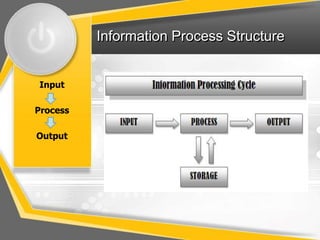
Information Process Structure
Input
Process
Output
INPUT
Input:
Anything that is given to computer to
process and convert into information is
called input.
e.g text, speech, video and digital
signals.
Input Devices
Introduction to computer input devices
 A device that can be used to insert data
into a computer or other computational
device
 Any hardware device that sends data to
the computer, without any input devices,
a computer would only be a display
device and not allow users to interact
 Computer works with the commands an
the input given by the user
Input Devices
Types of input devices:
There are two types of input devices:
1. Manual Input:
 Keyboard
 Mouse
 Track Ball
 Joystick
 Microphone
 Digital Camera
 Scanner
Input Devices
2. Automatic Input:
 MICR (Magnetic Ink Character
Recognition)
 OMR (Optical Mark Recognition)
 OCR (Optical Character
Recognition)
 Barcode reader
 Magnetic Stripe
 Sensors
Manual
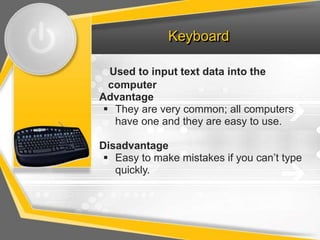
Keyboard
Used to input text data into the
computer
Advantage
 They are very common; all computers
have one and they are easy to use.
Disadvantage
 Easy to make mistakes if you can’t type
quickly.
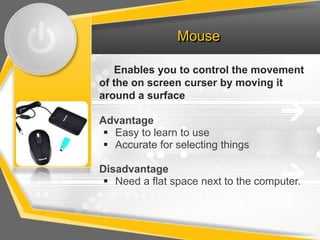
Mouse
Enables you to control the movement
of the on screen curser by moving it
around a surface
Advantage
 Easy to learn to use
 Accurate for selecting things
Disadvantage
 Need a flat space next to the computer.
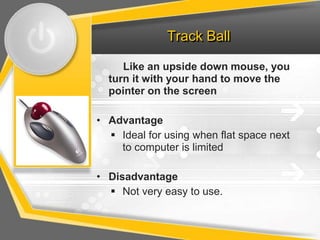
Track Ball
Like an upside down mouse, you
turn it with your hand to move the
pointer on the screen
• Advantage
 Ideal for using when flat space next
to computer is limited
• Disadvantage
 Not very easy to use.
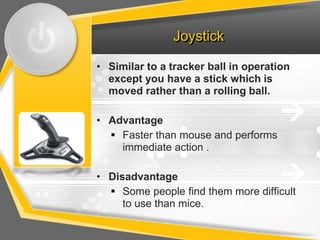
Joystick
• Similar to a tracker ball in operation
except you have a stick which is
moved rather than a rolling ball.
• Advantage
 Faster than mouse and performs
immediate action .
• Disadvantage
 Some people find them more difficult
to use than mice.
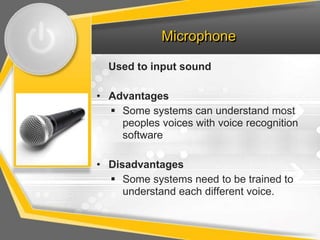
Microphone
Used to input sound
• Advantages
 Some systems can understand most
peoples voices with voice recognition
software
• Disadvantages
 Some systems need to be trained to
understand each different voice.
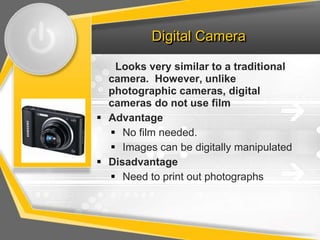
Digital Camera
Looks very similar to a traditional
camera. However, unlike
photographic cameras, digital
cameras do not use film
 Advantage
 No film needed.
 Images can be digitally manipulated
 Disadvantage
 Need to print out photographs
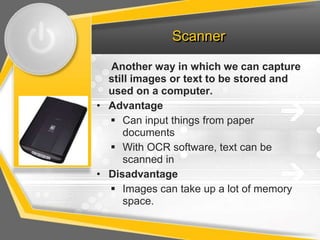
Scanner
Another way in which we can capture
still images or text to be stored and
used on a computer.
• Advantage
 Can input things from paper
documents
 With OCR software, text can be
scanned in
• Disadvantage
 Images can take up a lot of memory
space.
AUTOMATIC
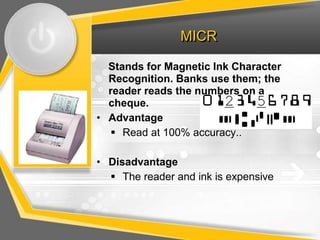
MICR
Stands for Magnetic Ink Character
Recognition. Banks use them; the
reader reads the numbers on a
cheque.
• Advantage
 Read at 100% accuracy..
• Disadvantage
 The reader and ink is expensive
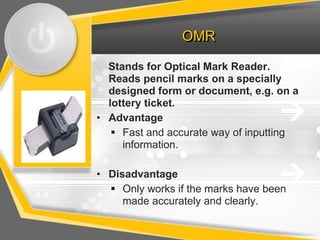
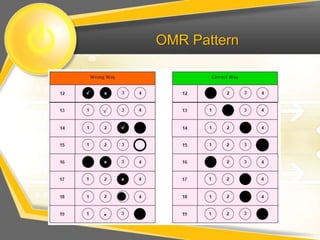
OMR
Stands for Optical Mark Reader.
Reads pencil marks on a specially
designed form or document, e.g. on a
lottery ticket.
• Advantage
 Fast and accurate way of inputting
information.
• Disadvantage
 Only works if the marks have been
made accurately and clearly.
OMR Pattern
Barcode reader
A bar code reader uses a visible red
light to scan and read the barcode.
• Advantage
 Any price change only needs to be
changed on the computer system,
not on each item.
• Disadvantage
 Does not reads if surface is reflective
due to humidity or if oily.
Thank You For Precious
Time

Input devices and types

  • 2.
    Input Devices • CommunicationSkills Faizan Atteeq S3f13asoc0125
  • 3.
  • 4.
    INPUT Input: Anything that isgiven to computer to process and convert into information is called input. e.g text, speech, video and digital signals.
  • 5.
    Input Devices Introduction tocomputer input devices  A device that can be used to insert data into a computer or other computational device  Any hardware device that sends data to the computer, without any input devices, a computer would only be a display device and not allow users to interact  Computer works with the commands an the input given by the user
  • 6.
    Input Devices Types ofinput devices: There are two types of input devices: 1. Manual Input:  Keyboard  Mouse  Track Ball  Joystick  Microphone  Digital Camera  Scanner
  • 7.
    Input Devices 2. AutomaticInput:  MICR (Magnetic Ink Character Recognition)  OMR (Optical Mark Recognition)  OCR (Optical Character Recognition)  Barcode reader  Magnetic Stripe  Sensors
  • 8.
  • 9.
    Keyboard Used to inputtext data into the computer Advantage  They are very common; all computers have one and they are easy to use. Disadvantage  Easy to make mistakes if you can’t type quickly.
  • 10.
    Mouse Enables you tocontrol the movement of the on screen curser by moving it around a surface Advantage  Easy to learn to use  Accurate for selecting things Disadvantage  Need a flat space next to the computer.
  • 11.
    Track Ball Like anupside down mouse, you turn it with your hand to move the pointer on the screen • Advantage  Ideal for using when flat space next to computer is limited • Disadvantage  Not very easy to use.
  • 12.
    Joystick • Similar toa tracker ball in operation except you have a stick which is moved rather than a rolling ball. • Advantage  Faster than mouse and performs immediate action . • Disadvantage  Some people find them more difficult to use than mice.
  • 13.
    Microphone Used to inputsound • Advantages  Some systems can understand most peoples voices with voice recognition software • Disadvantages  Some systems need to be trained to understand each different voice.
  • 14.
    Digital Camera Looks verysimilar to a traditional camera. However, unlike photographic cameras, digital cameras do not use film  Advantage  No film needed.  Images can be digitally manipulated  Disadvantage  Need to print out photographs
  • 15.
    Scanner Another way inwhich we can capture still images or text to be stored and used on a computer. • Advantage  Can input things from paper documents  With OCR software, text can be scanned in • Disadvantage  Images can take up a lot of memory space.
  • 16.
  • 17.
    MICR Stands for MagneticInk Character Recognition. Banks use them; the reader reads the numbers on a cheque. • Advantage  Read at 100% accuracy.. • Disadvantage  The reader and ink is expensive
  • 18.
    OMR Stands for OpticalMark Reader. Reads pencil marks on a specially designed form or document, e.g. on a lottery ticket. • Advantage  Fast and accurate way of inputting information. • Disadvantage  Only works if the marks have been made accurately and clearly.
  • 19.
  • 20.
    Barcode reader A barcode reader uses a visible red light to scan and read the barcode. • Advantage  Any price change only needs to be changed on the computer system, not on each item. • Disadvantage  Does not reads if surface is reflective due to humidity or if oily.
  • 21.
    Thank You ForPrecious Time