© Richard Welke 2002
MBA 8125:
Innovating Business
Processes
Authors:
Mike Gallivan
Lars Mathiassen
Richard Welke
Adapted by C. Stucke
© CEPRIN (2007) MBA 8125 Innovating Processes 2
Agenda
Innovation
Process innovation
Case discussion
© CEPRIN (2007) MBA 8125 Innovating Processes 3
Topic one
© CEPRIN (2007) MBA 8125 Innovating Processes 4
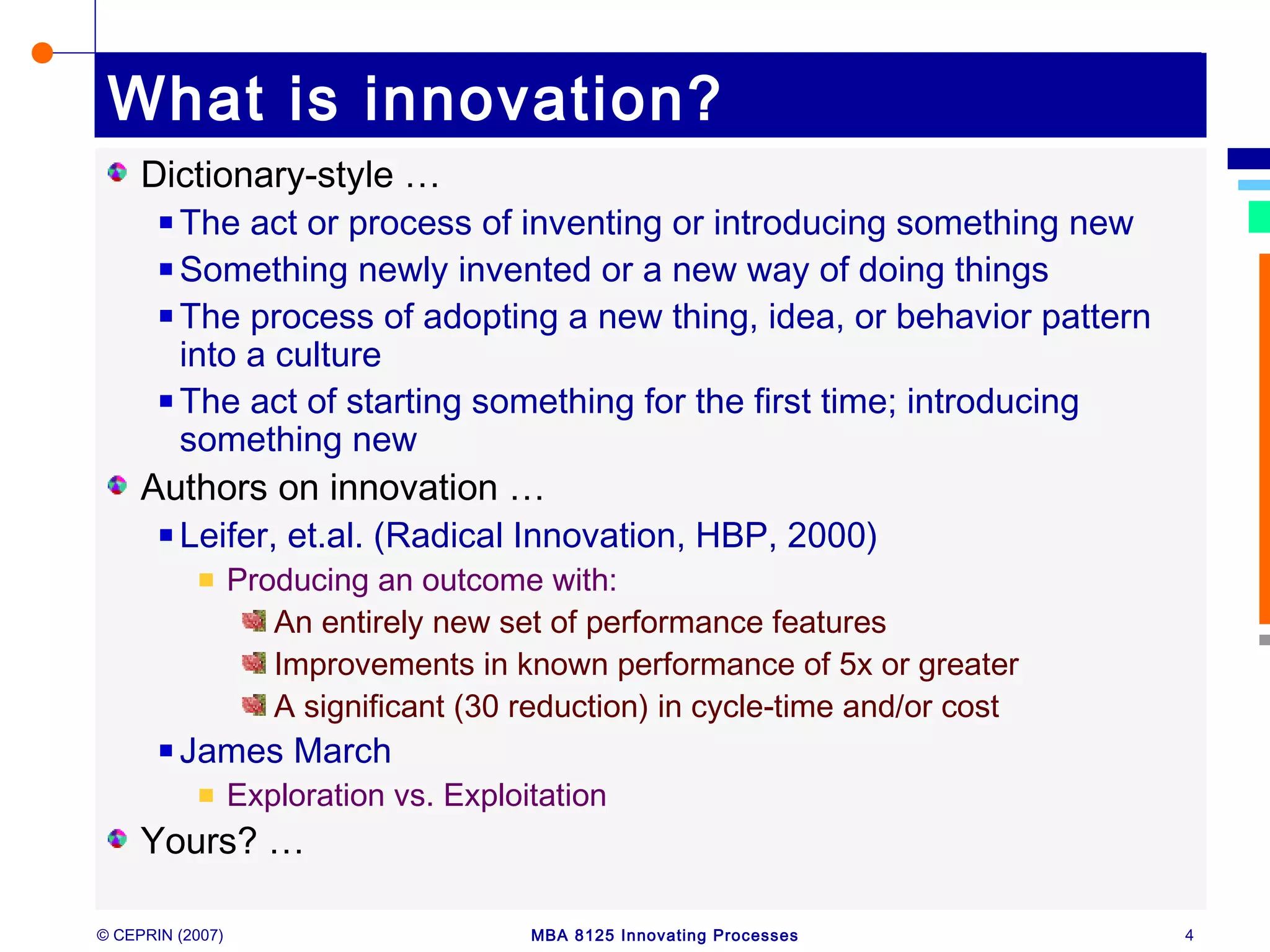
What is innovation?
Dictionary-style …
The act or process of inventing or introducing something new
Something newly invented or a new way of doing things
The process of adopting a new thing, idea, or behavior pattern
into a culture
The act of starting something for the first time; introducing
something new
Authors on innovation …
Leifer, et.al. (Radical Innovation, HBP, 2000)
Producing an outcome with:
An entirely new set of performance features
Improvements in known performance of 5x or greater
A significant (30 reduction) in cycle-time and/or cost
James March
Exploration vs. Exploitation
Yours? …
© CEPRIN (2007) MBA 8125 Innovating Processes 5
Who is innovating?
“Midlevel managers play a crucial role in every
company’s innovation process, as they
shepherd partially formed ideas into fully
fledged business plans in an effort to win
funding from senior management.
It is the midlevel managers that decide which
ideas … they support and carry to senior
management”
From C. Christensen: The Innovator’s Solution, HBP, 2004
© CEPRIN (2007) MBA 8125 Innovating Processes 6
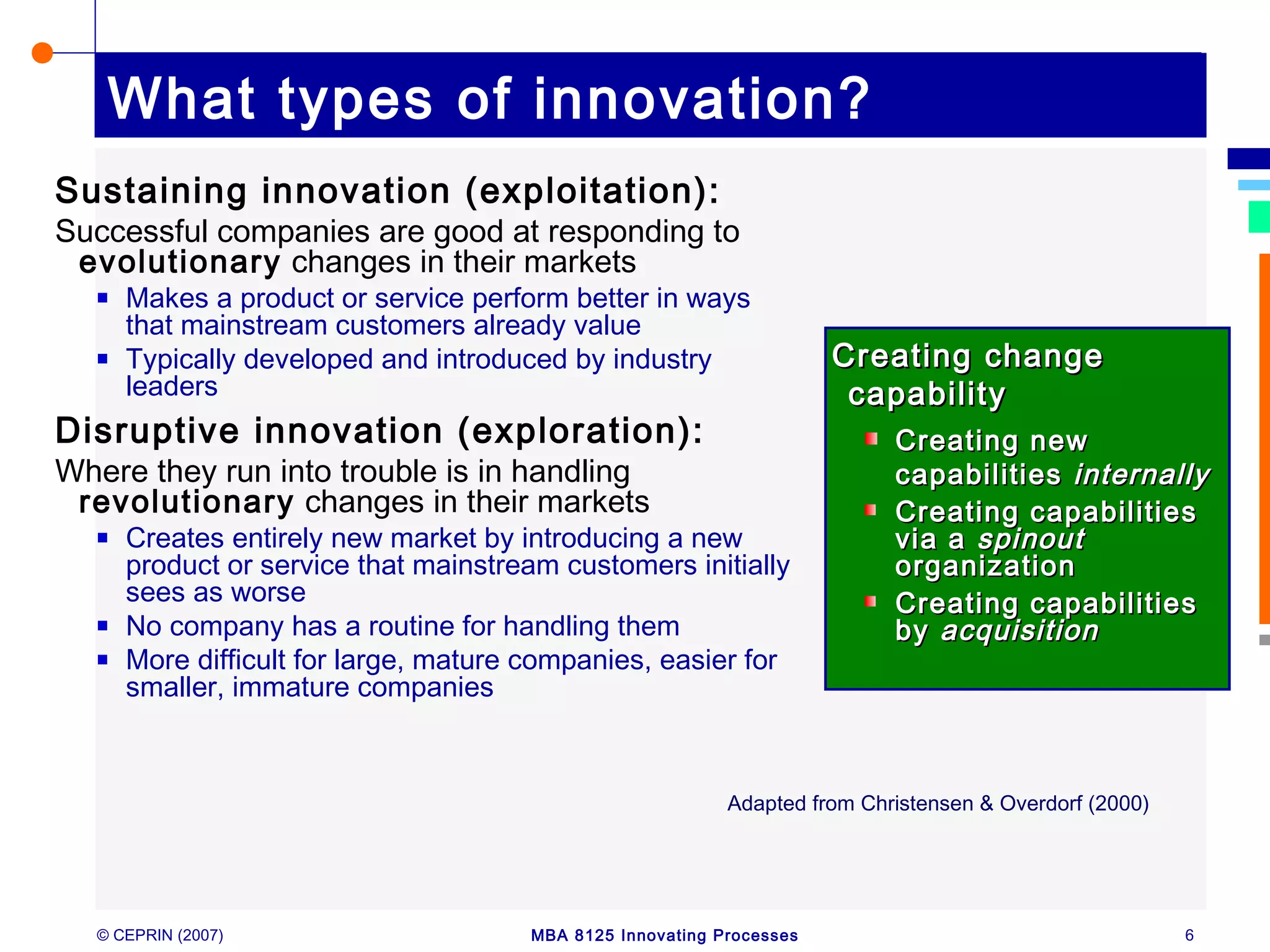
What types of innovation?
Sustaining innovation (exploitation):
Successful companies are good at responding to
evolutionary changes in their markets
Makes a product or service perform better in ways
that mainstream customers already value
Typically developed and introduced by industry
leaders
Disruptive innovation (exploration):
Where they run into trouble is in handling
revolutionary changes in their markets
Creates entirely new market by introducing a new
product or service that mainstream customers initially
sees as worse
No company has a routine for handling them
More difficult for large, mature companies, easier for
smaller, immature companies
Creating changeCreating change
capabilitycapability
Creating newCreating new
capabilitiescapabilities internallyinternally
Creating capabilitiesCreating capabilities
via avia a spinoutspinout
organizationorganization
Creating capabilitiesCreating capabilities
byby acquisitionacquisition
Adapted from Christensen & Overdorf (2000)
© CEPRIN (2007) MBA 8125 Innovating Processes 7
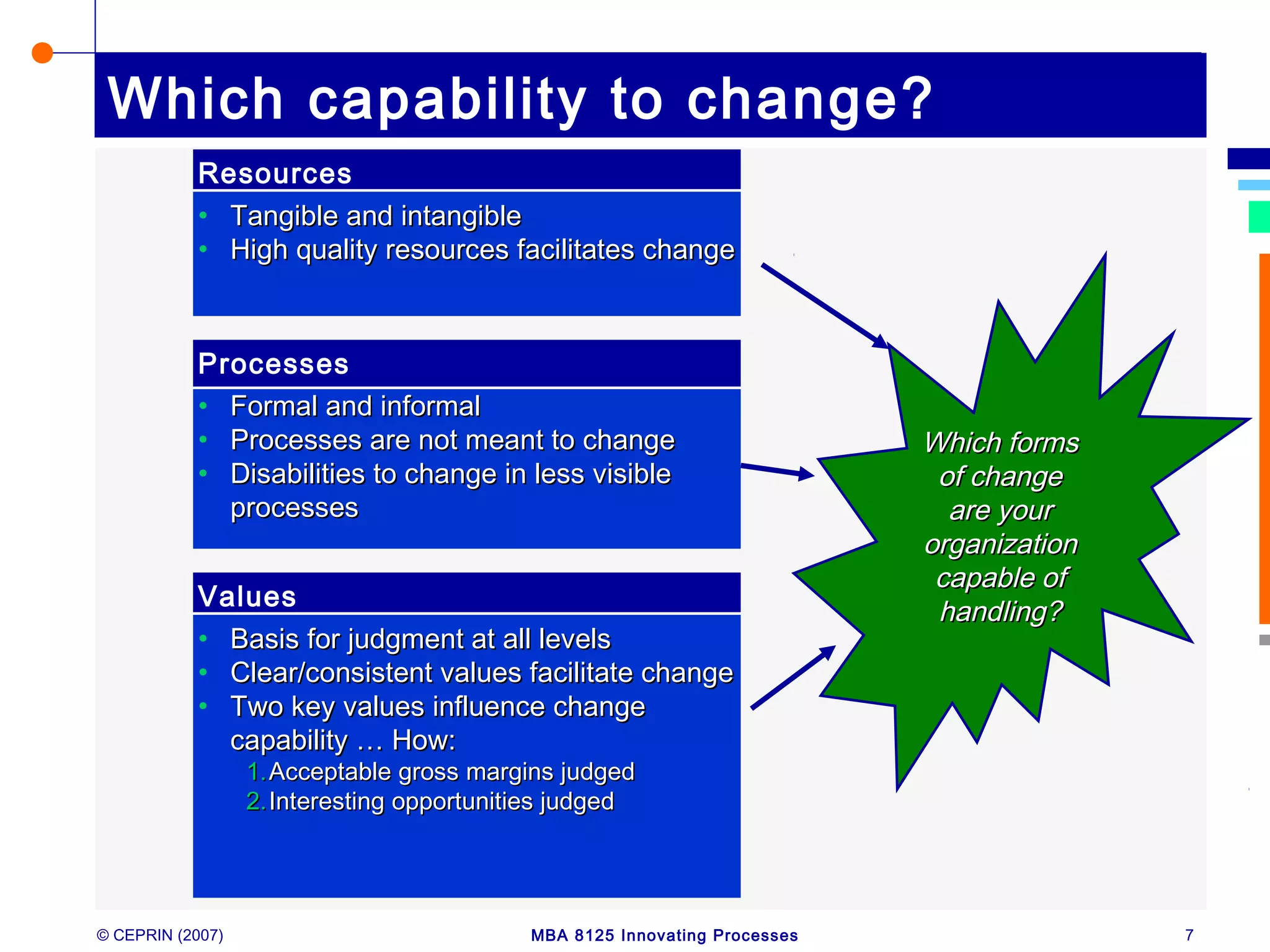
Which capability to change?
Which formsWhich forms
of changeof change
are yourare your
organizationorganization
capable ofcapable of
handling?handling?
• Formal and informalFormal and informal
• Processes are not meant to changeProcesses are not meant to change
• Disabilities to change in less visibleDisabilities to change in less visible
processesprocesses
Processes
Values
• Basis for judgment at all levelsBasis for judgment at all levels
• Clear/consistent values facilitate changeClear/consistent values facilitate change
• Two key values influence changeTwo key values influence change
capability … How:capability … How:
1.1.Acceptable gross margins judgedAcceptable gross margins judged
2.2.Interesting opportunities judgedInteresting opportunities judged
Resources
• Tangible and intangibleTangible and intangible
• High quality resources facilitates changeHigh quality resources facilitates change
© CEPRIN (2007) MBA 8125 Innovating Processes 8
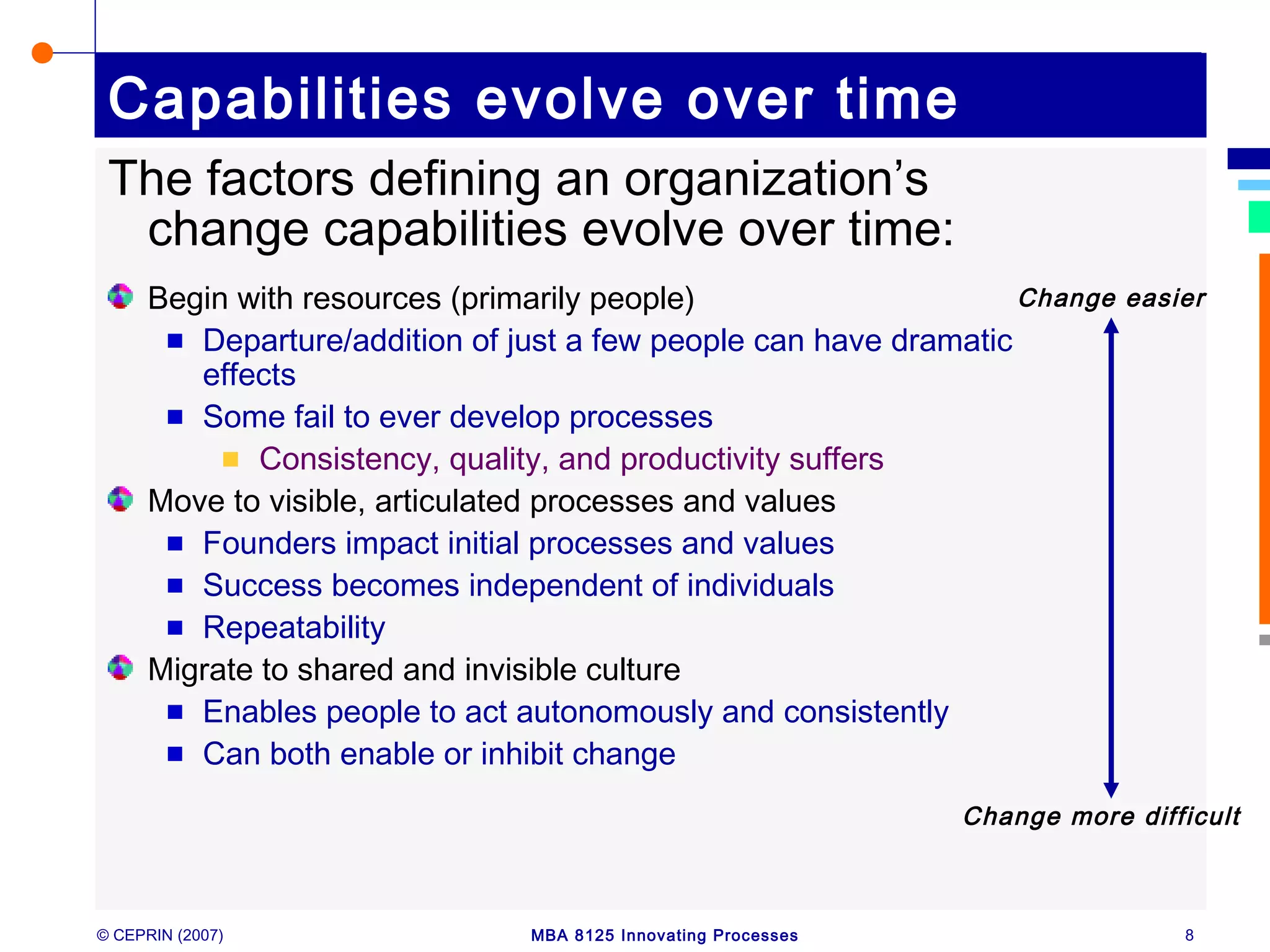
Capabilities evolve over time
The factors defining an organization’s
change capabilities evolve over time:
Begin with resources (primarily people)
Departure/addition of just a few people can have dramatic
effects
Some fail to ever develop processes
Consistency, quality, and productivity suffers
Move to visible, articulated processes and values
Founders impact initial processes and values
Success becomes independent of individuals
Repeatability
Migrate to shared and invisible culture
Enables people to act autonomously and consistently
Can both enable or inhibit change
Change easier
Change more difficult
© CEPRIN (2007) MBA 8125 Innovating Processes 9
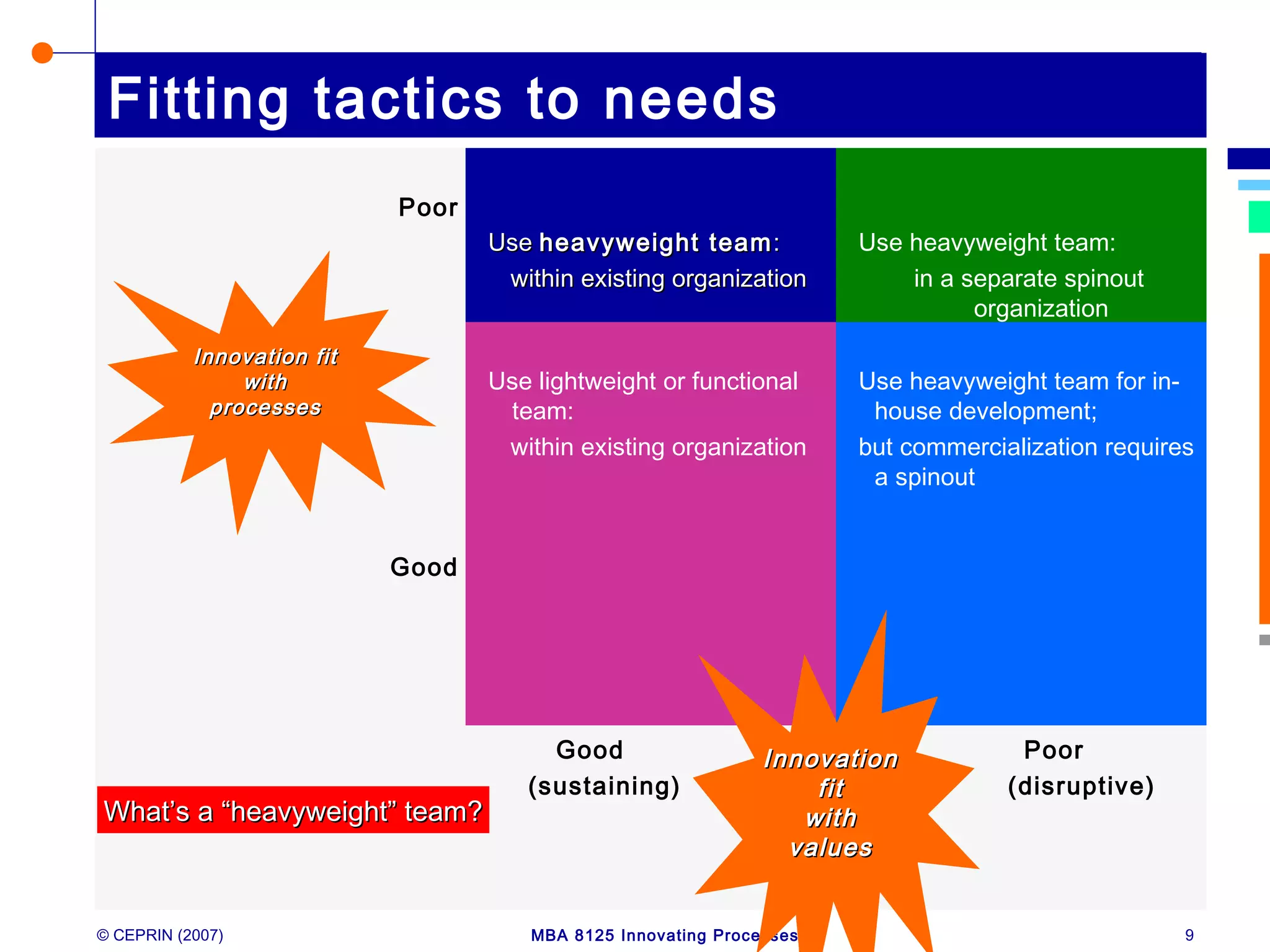
Fitting tactics to needs
Poor
Good
UseUse heavyweight teamheavyweight team::
within existing organizationwithin existing organization
Use heavyweight team:
in a separate spinout
organization
Use lightweight or functional
team:
within existing organization
Use heavyweight team for in-
house development;
but commercialization requires
a spinout
Good Poor
(sustaining) (disruptive)
Innovation fitInnovation fit
withwith
processesprocesses
InnovationInnovation
fitfit
withwith
valuesvalues
What’s a “heavyweight” team?What’s a “heavyweight” team?
© CEPRIN (2007) MBA 8125 Innovating Processes 10
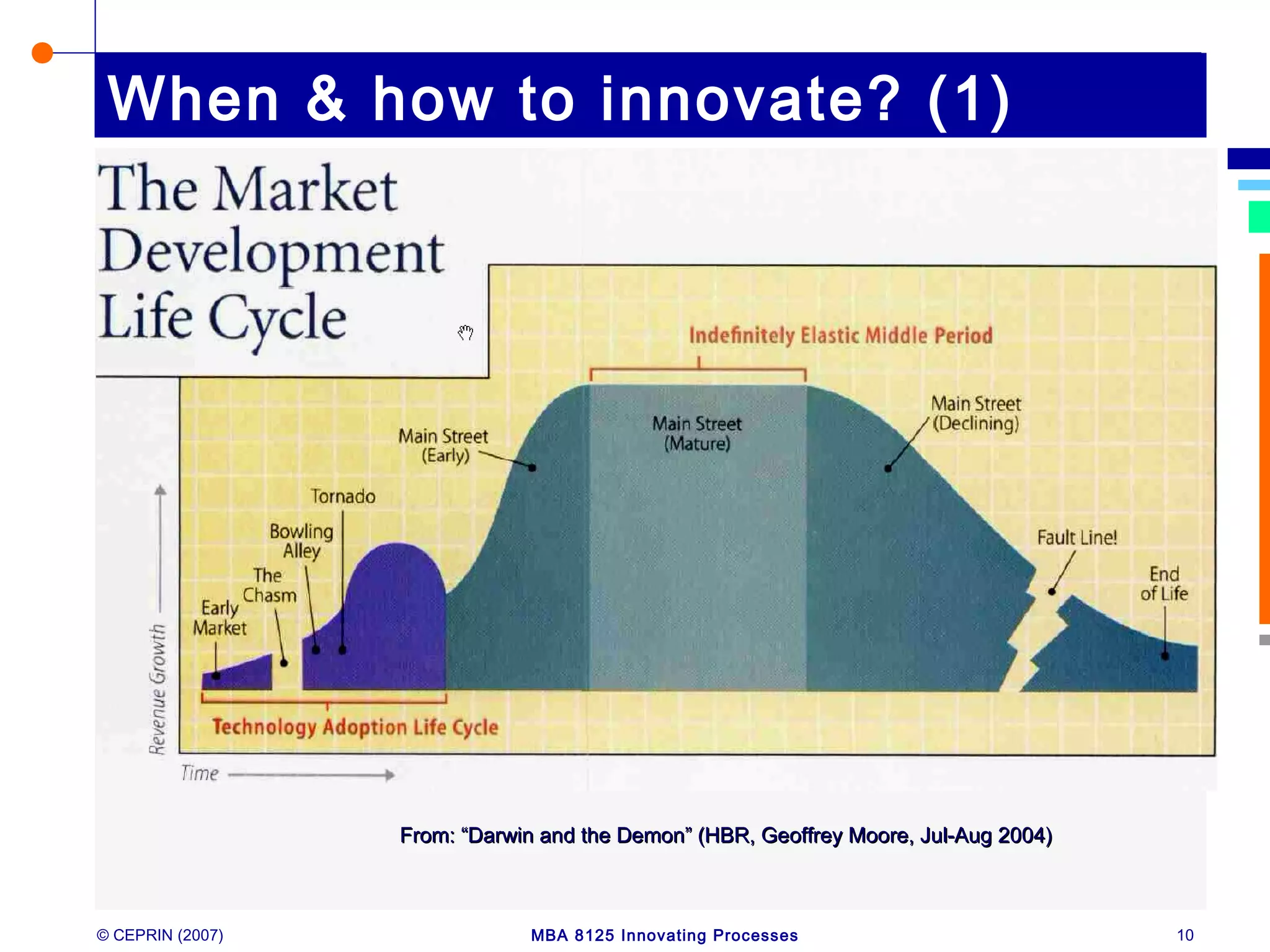
When & how to innovate? (1)
From: “Darwin and the Demon” (HBR, Geoffrey Moore, Jul-Aug 2004)From: “Darwin and the Demon” (HBR, Geoffrey Moore, Jul-Aug 2004)
© CEPRIN (2007) MBA 8125 Innovating Processes 11
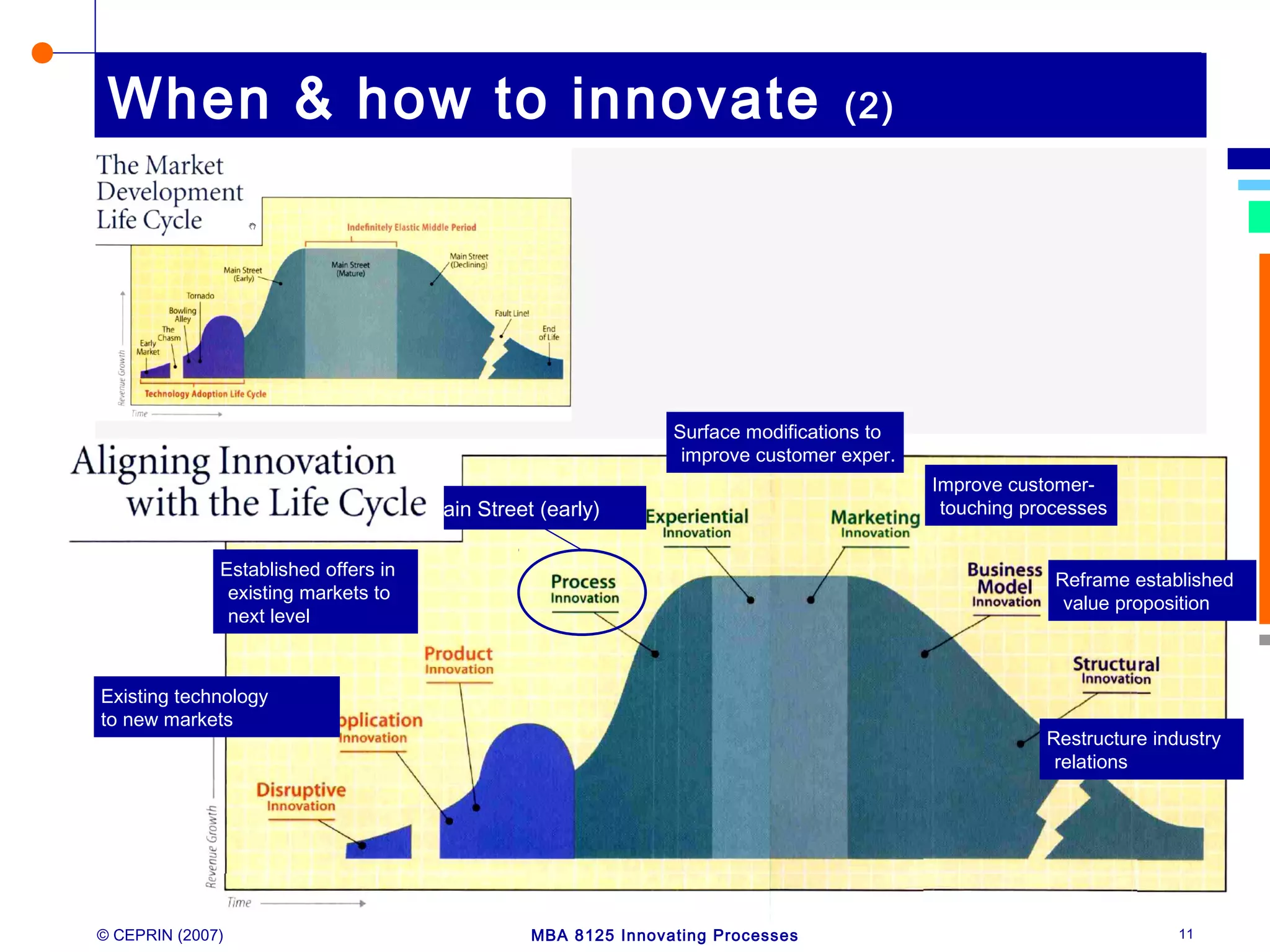
When & how to innovate (2)
Main Street (early)
Existing technology
to new markets
Established offers in
existing markets to
next level
Surface modifications to
improve customer exper.
Improve customer-
touching processes
Reframe established
value proposition
Restructure industry
relations
© CEPRIN (2007) MBA 8125 Innovating Processes 12
Topic two
© CEPRIN (2007) MBA 8125 Innovating Processes 13
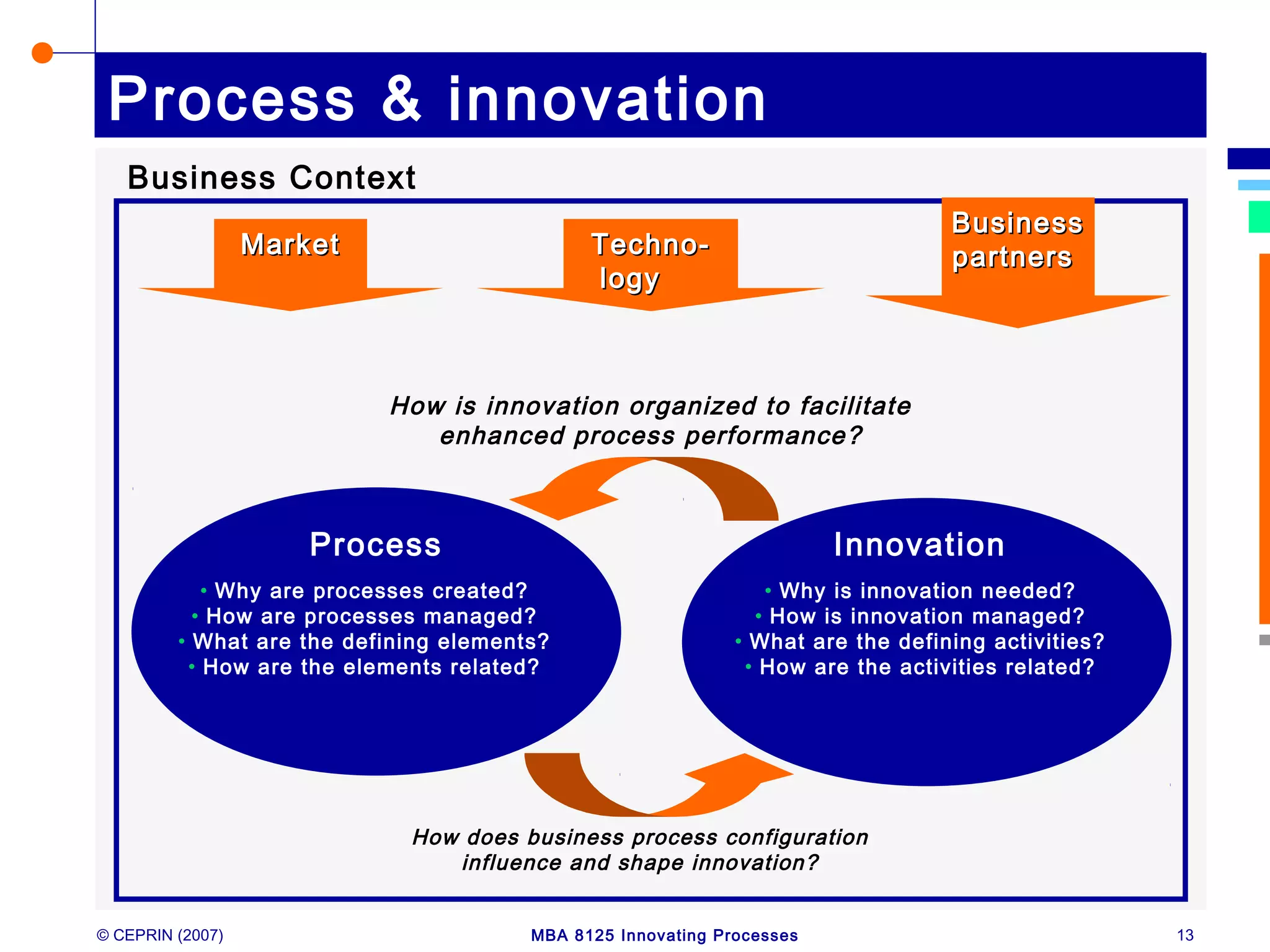
Process & innovation
• Why are processes created?
• How are processes managed?
• What are the defining elements?
• How are the elements related?
Process Innovation
• Why is innovation needed?
• How is innovation managed?
• What are the defining activities?
• How are the activities related?
How does business process configuration
influence and shape innovation?
How is innovation organized to facilitate
enhanced process performance?
Business Context
MarketMarket Techno-Techno-
logylogy
BusinessBusiness
partnerspartners
© CEPRIN (2007) MBA 8125 Innovating Processes 14
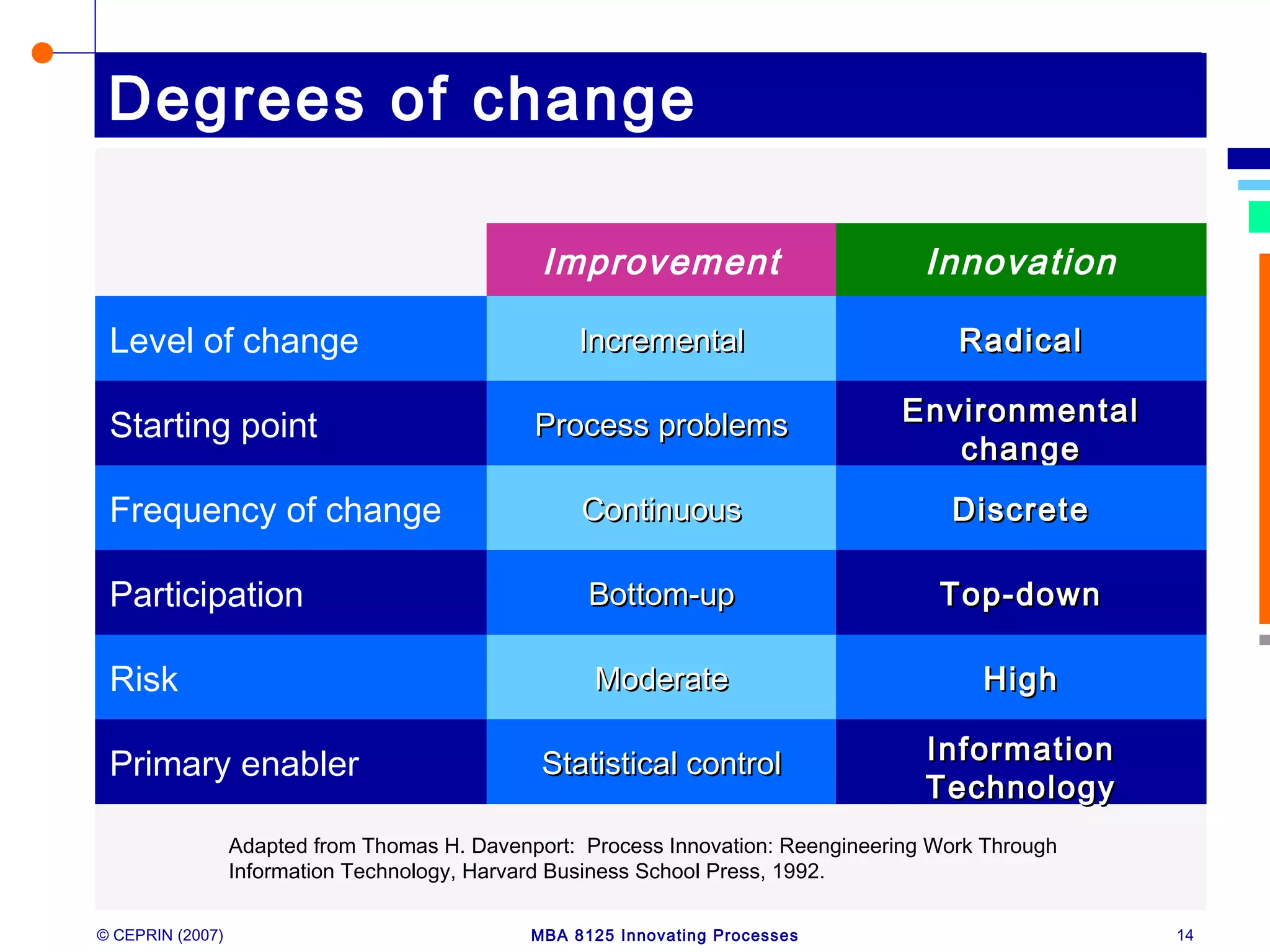
Degrees of change
Improvement Innovation
Level of change IncrementalIncremental RadicalRadical
Starting point Process problemsProcess problems EnvironmentalEnvironmental
changechange
Frequency of change ContinuousContinuous DiscreteDiscrete
Participation Bottom-upBottom-up Top-downTop-down
Risk ModerateModerate HighHigh
Primary enabler Statistical controlStatistical control InformationInformation
TechnologyTechnology
Adapted from Thomas H. Davenport: Process Innovation: Reengineering Work Through
Information Technology, Harvard Business School Press, 1992.
© CEPRIN (2007) MBA 8125 Innovating Processes 15
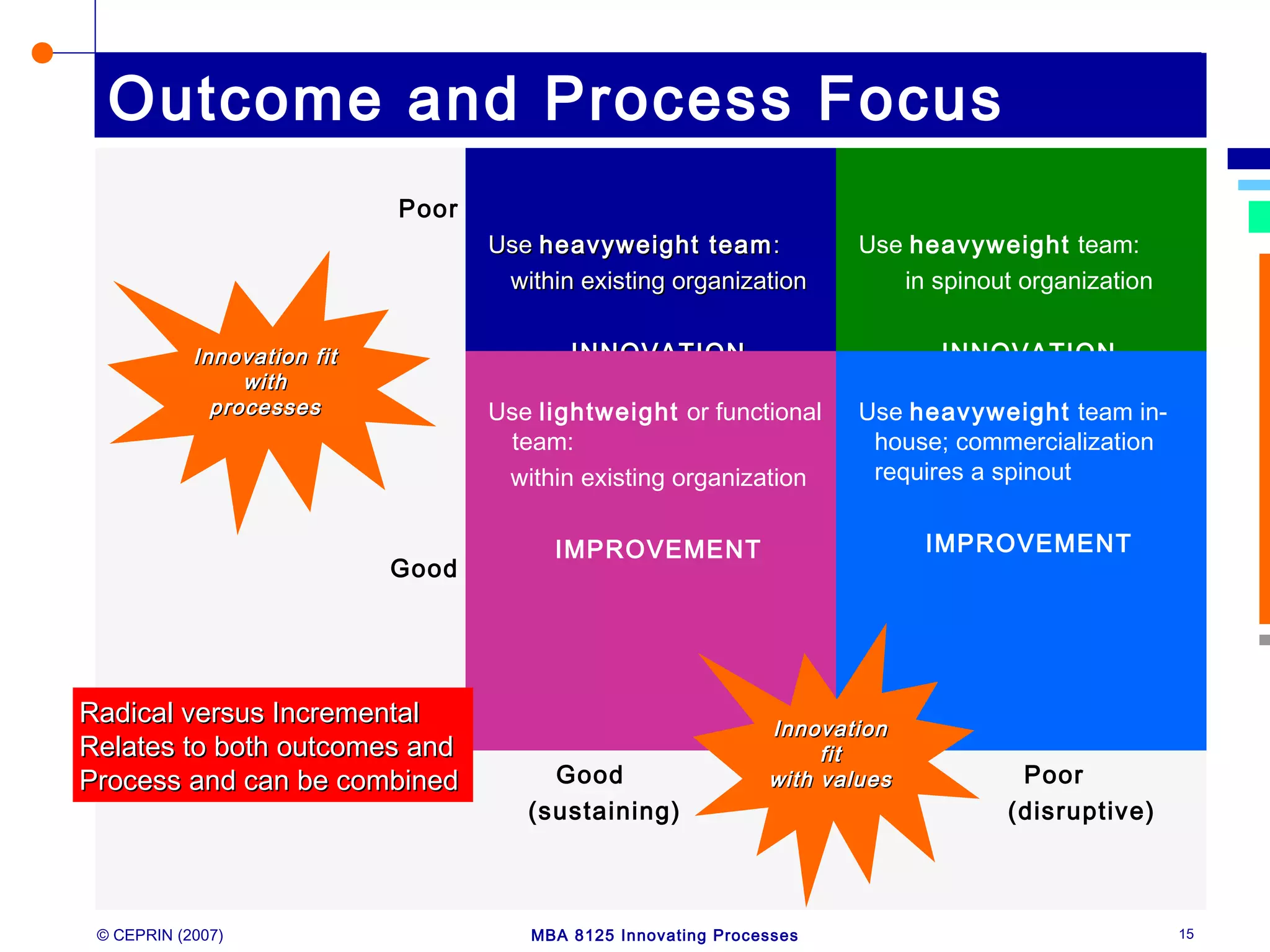
Outcome and Process Focus
Poor
Good
UseUse heavyweight teamheavyweight team::
within existing organizationwithin existing organization
INNOVATIONINNOVATION
Use heavyweight team:
in spinout organization
INNOVATION
Use lightweight or functional
team:
within existing organization
IMPROVEMENT
Use heavyweight team in-
house; commercialization
requires a spinout
IMPROVEMENT
Good Poor
(sustaining) (disruptive)
Innovation fitInnovation fit
withwith
processesprocesses
InnovationInnovation
fitfit
with valueswith values
Radical versus IncrementalRadical versus Incremental
Relates to both outcomes andRelates to both outcomes and
Process and can be combinedProcess and can be combined
© CEPRIN (2007) MBA 8125 Innovating Processes 16
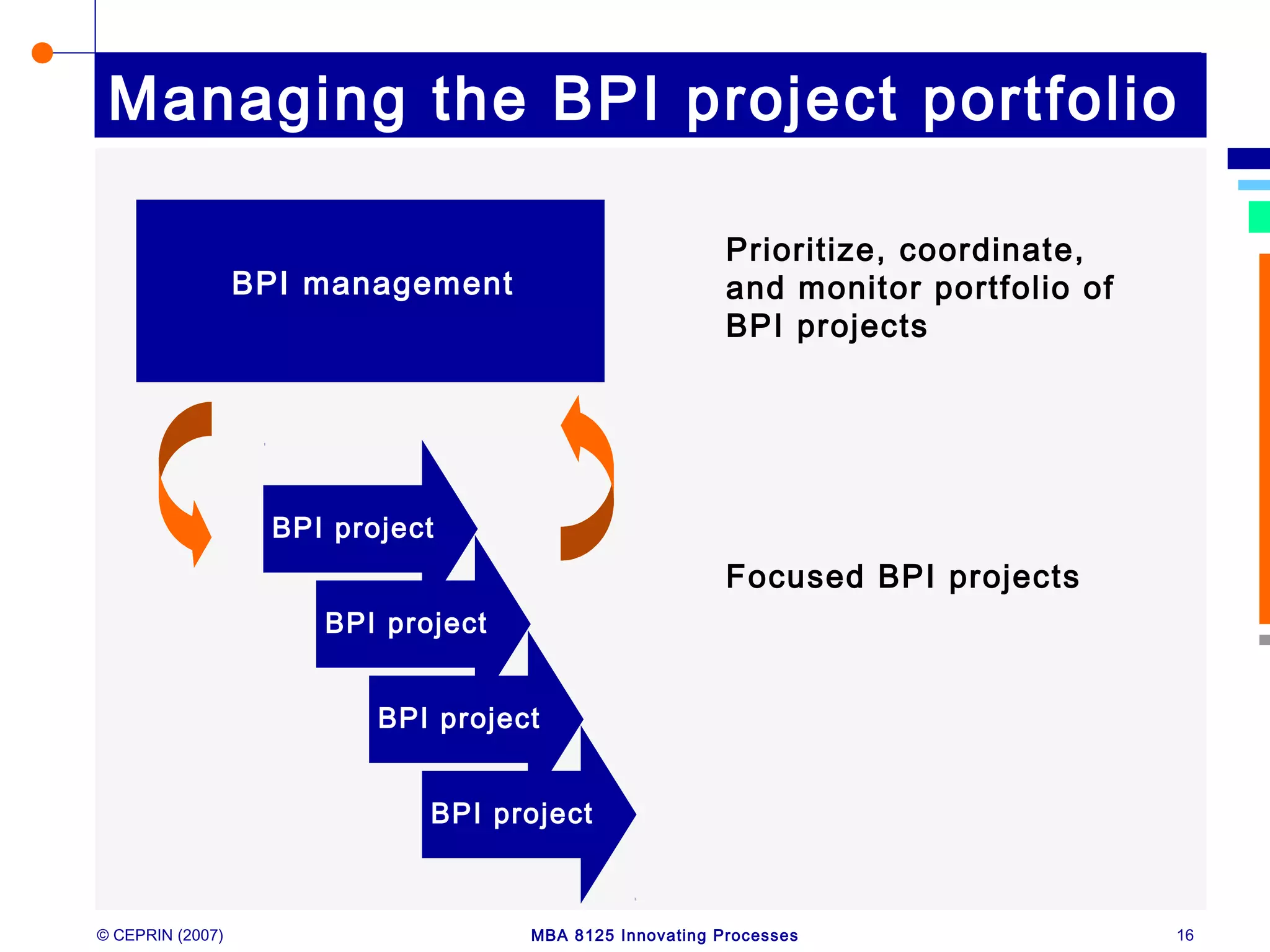
Managing the BPI project portfolio
BPI management
BPI project
BPI project
BPI project
BPI project
Prioritize, coordinate,
and monitor portfolio of
BPI projects
Focused BPI projects
© CEPRIN (2007) MBA 8125 Innovating Processes 17
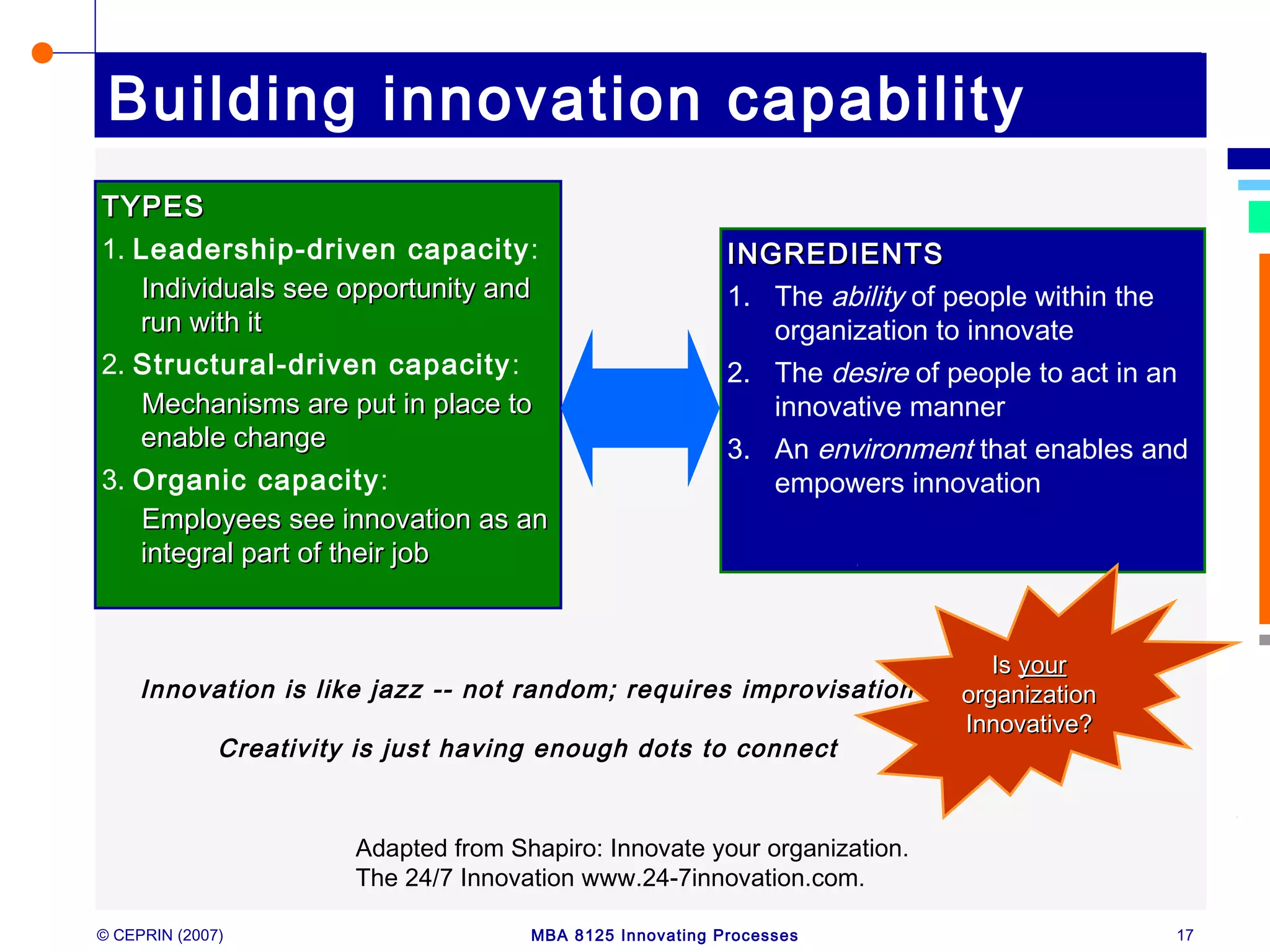
Building innovation capability
TYPESTYPES
1. Leadership-driven capacity:
Individuals see opportunity andIndividuals see opportunity and
run with itrun with it
2. Structural-driven capacity:
Mechanisms are put in place toMechanisms are put in place to
enable changeenable change
3. Organic capacity:
Employees see innovation as anEmployees see innovation as an
integral part of their jobintegral part of their job
INGREDIENTSINGREDIENTS
1. The ability of people within the
organization to innovate
2. The desire of people to act in an
innovative manner
3. An environment that enables and
empowers innovation
Innovation is like jazz -- not random; requires improvisation
Creativity is just having enough dots to connect
IsIs youryour
organizationorganization
Innovative?Innovative?
Adapted from Shapiro: Innovate your organization.
The 24/7 Innovation www.24-7innovation.com.
© CEPRIN (2007) MBA 8125 Innovating Processes 18
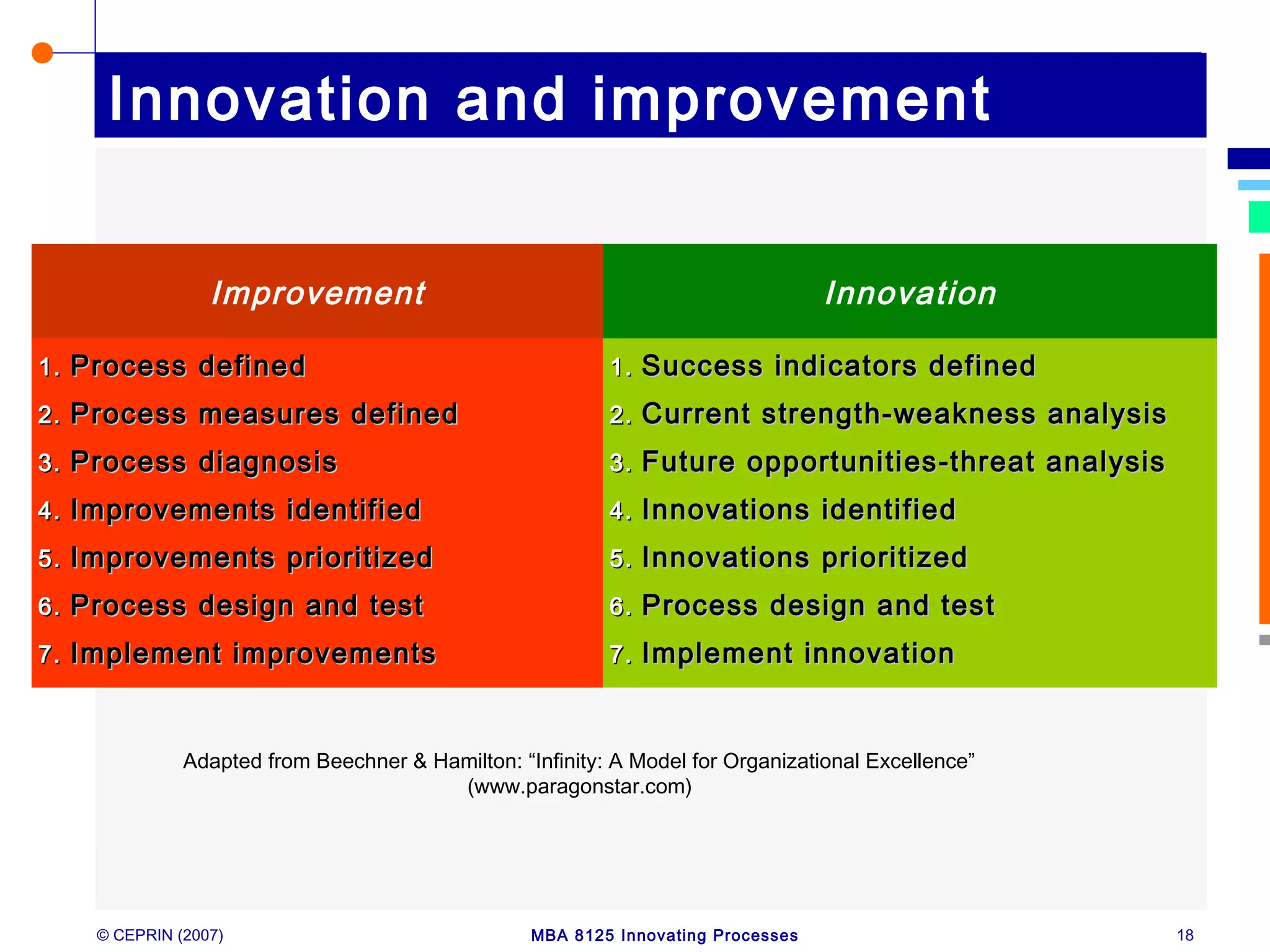
Innovation and improvement
Improvement Innovation
1.1. Process definedProcess defined
2.2. Process measures definedProcess measures defined
3.3. Process diagnosisProcess diagnosis
4.4. Improvements identifiedImprovements identified
5.5. Improvements prioritizedImprovements prioritized
6.6. Process design and testProcess design and test
7.7. Implement improvementsImplement improvements
1.1. Success indicators definedSuccess indicators defined
2.2. Current strength-weakness analysisCurrent strength-weakness analysis
3.3. Future opportunities-threat analysisFuture opportunities-threat analysis
4.4. Innovations identifiedInnovations identified
5.5. Innovations prioritizedInnovations prioritized
6.6. Process design and testProcess design and test
7.7. Implement innovationImplement innovation
Adapted from Beechner & Hamilton: “Infinity: A Model for Organizational Excellence”
(www.paragonstar.com)
© CEPRIN (2007) MBA 8125 Innovating Processes 19
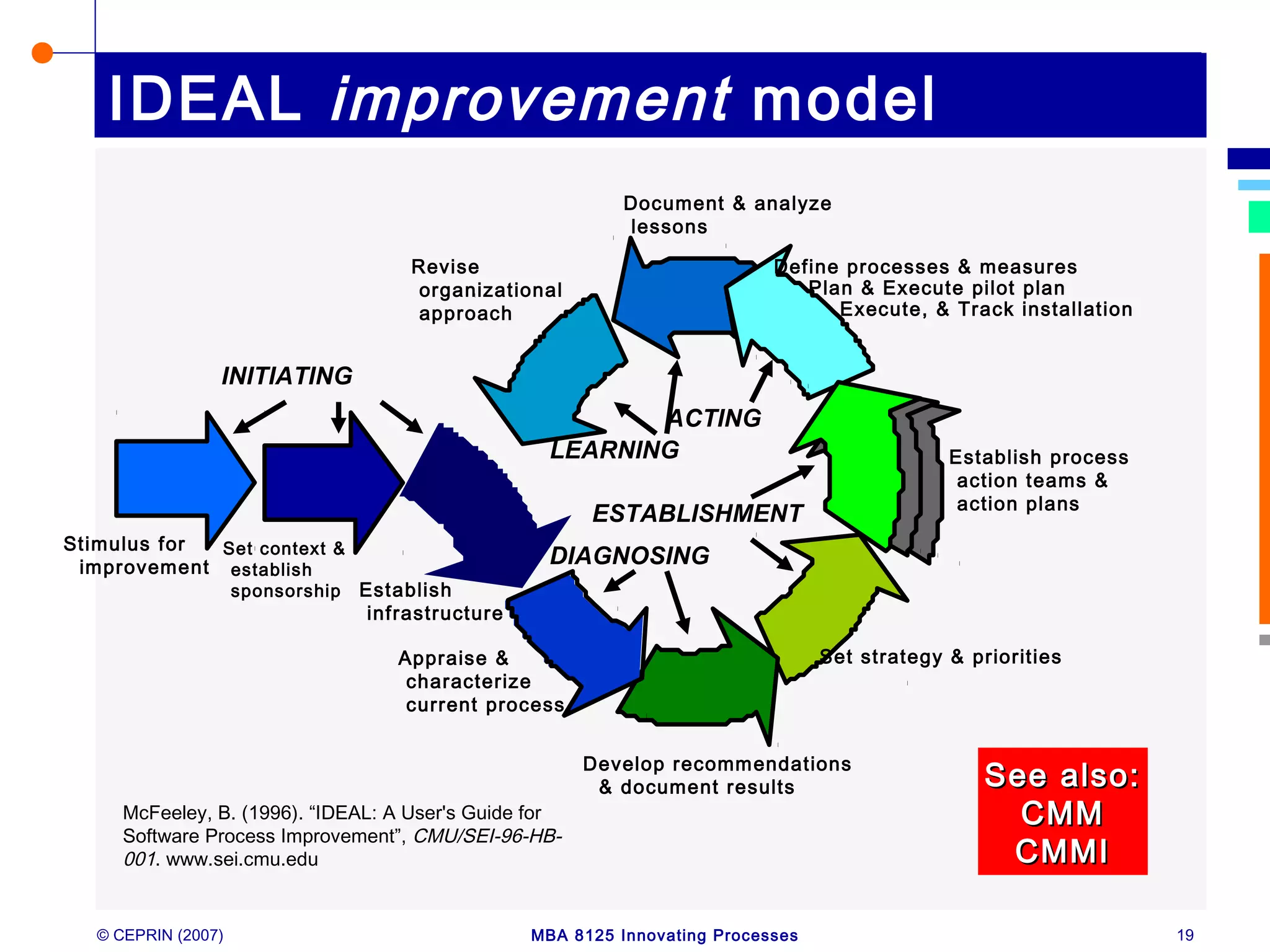
IDEAL improvement model
McFeeley, B. (1996). “IDEAL: A User's Guide for
Software Process Improvement”, CMU/SEI-96-HB-
001. www.sei.cmu.edu
Stimulus for
improvement
Set context &
establish
sponsorship Establish
infrastructure
Appraise &
characterize
current process
Develop recommendations
& document results
Set strategy & priorities
Establish process
action teams &
action plans
Define processes & measures
Plan & Execute pilot plan
Execute, & Track installation
Document & analyze
lessons
Revise
organizational
approach
INITIATING
DIAGNOSING
ESTABLISHMENT
ACTING
LEARNING
See also:See also:
CMMCMM
CMMICMMI
© CEPRIN (2007) MBA 8125 Innovating Processes 20
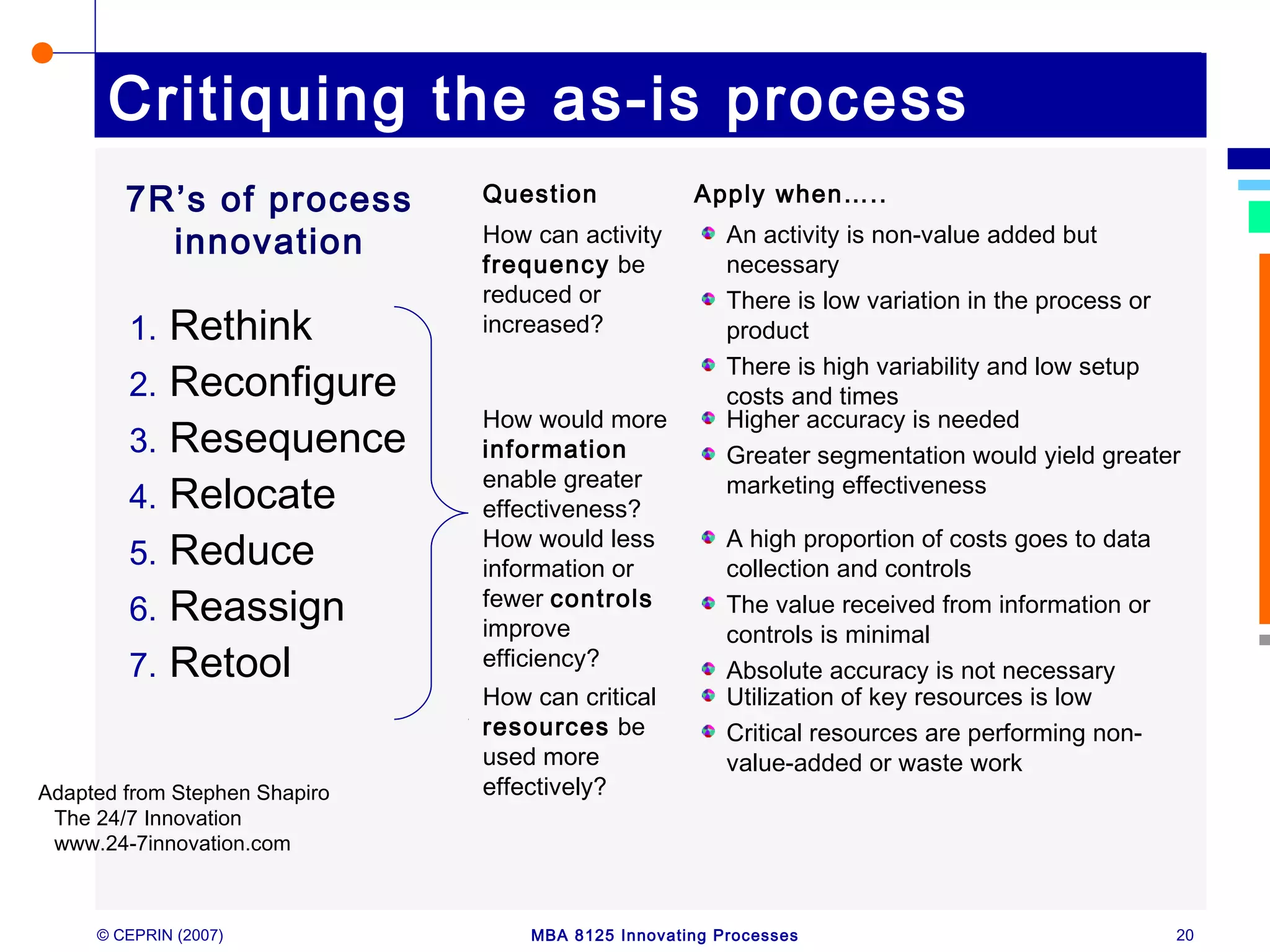
Critiquing the as-is process
1. Rethink
2. Reconfigure
3. Resequence
4. Relocate
5. Reduce
6. Reassign
7. Retool
Adapted from Stephen Shapiro
The 24/7 Innovation
www.24-7innovation.com
Question Apply when…..
How can activity
frequency be
reduced or
increased?
An activity is non-value added but
necessary
There is low variation in the process or
product
There is high variability and low setup
costs and times
How would more
information
enable greater
effectiveness?
Higher accuracy is needed
Greater segmentation would yield greater
marketing effectiveness
How would less
information or
fewer controls
improve
efficiency?
A high proportion of costs goes to data
collection and controls
The value received from information or
controls is minimal
Absolute accuracy is not necessary
How can critical
resources be
used more
effectively?
Utilization of key resources is low
Critical resources are performing non-
value-added or waste work
7R’s of process
innovation
© CEPRIN (2007) MBA 8125 Innovating Processes 21
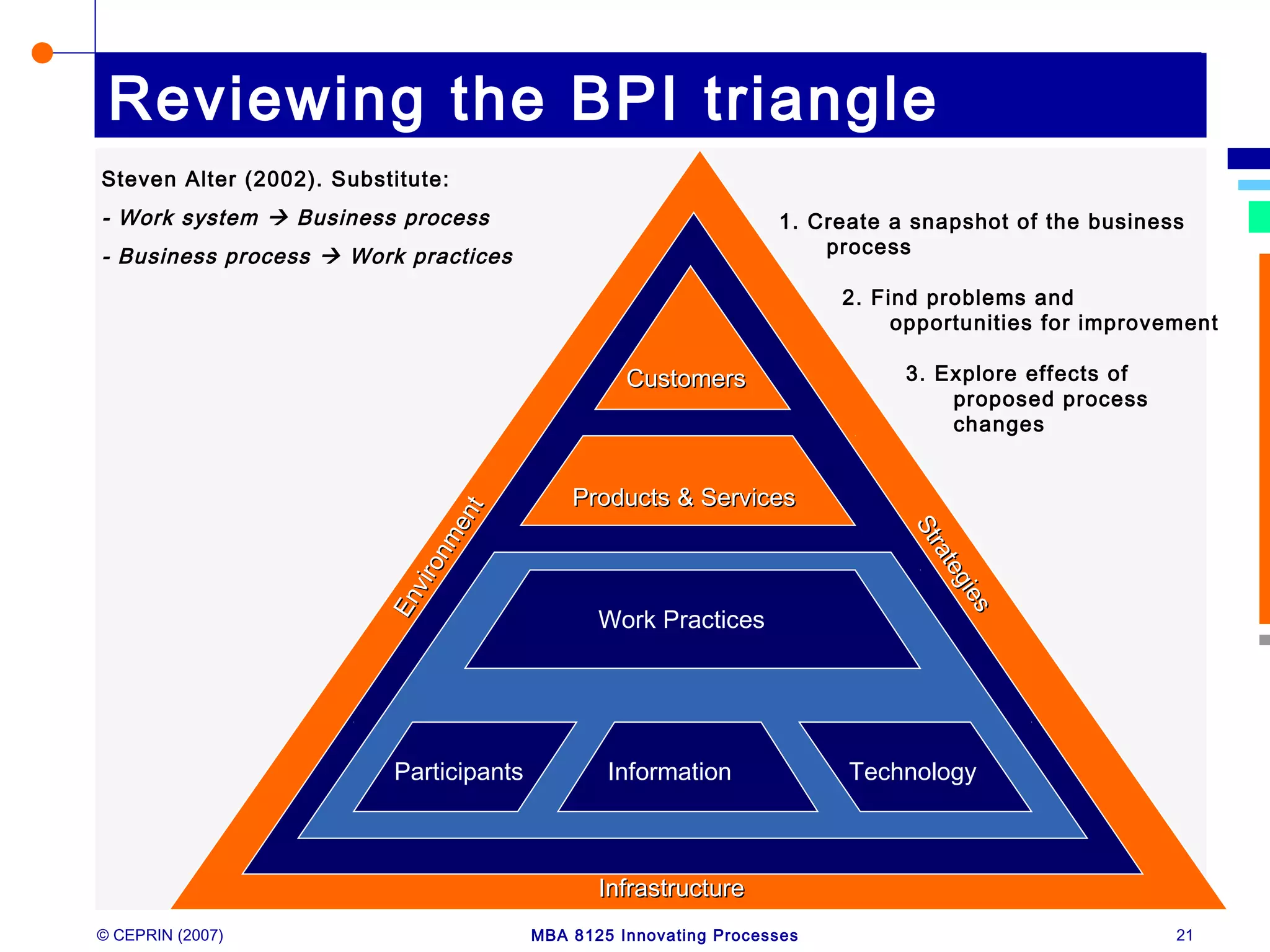
Reviewing the BPI triangle
InfrastructureInfrastructure
CustomersCustomers
Products & ServicesProducts & Services
Strategies
Strategies
Environment
Environment
Work Practices
InformationParticipants Technology
Steven Alter (2002). Substitute:
- Work system  Business process
- Business process  Work practices
1. Create a snapshot of the business
process
2. Find problems and
opportunities for improvement
3. Explore effects of
proposed process
changes

Innovating processes

  • 1.
    © Richard Welke2002 MBA 8125: Innovating Business Processes Authors: Mike Gallivan Lars Mathiassen Richard Welke Adapted by C. Stucke
  • 2.
    © CEPRIN (2007)MBA 8125 Innovating Processes 2 Agenda Innovation Process innovation Case discussion
  • 3.
    © CEPRIN (2007)MBA 8125 Innovating Processes 3 Topic one
  • 4.
    © CEPRIN (2007)MBA 8125 Innovating Processes 4 What is innovation? Dictionary-style … The act or process of inventing or introducing something new Something newly invented or a new way of doing things The process of adopting a new thing, idea, or behavior pattern into a culture The act of starting something for the first time; introducing something new Authors on innovation … Leifer, et.al. (Radical Innovation, HBP, 2000) Producing an outcome with: An entirely new set of performance features Improvements in known performance of 5x or greater A significant (30 reduction) in cycle-time and/or cost James March Exploration vs. Exploitation Yours? …
  • 5.
    © CEPRIN (2007)MBA 8125 Innovating Processes 5 Who is innovating? “Midlevel managers play a crucial role in every company’s innovation process, as they shepherd partially formed ideas into fully fledged business plans in an effort to win funding from senior management. It is the midlevel managers that decide which ideas … they support and carry to senior management” From C. Christensen: The Innovator’s Solution, HBP, 2004
  • 6.
    © CEPRIN (2007)MBA 8125 Innovating Processes 6 What types of innovation? Sustaining innovation (exploitation): Successful companies are good at responding to evolutionary changes in their markets Makes a product or service perform better in ways that mainstream customers already value Typically developed and introduced by industry leaders Disruptive innovation (exploration): Where they run into trouble is in handling revolutionary changes in their markets Creates entirely new market by introducing a new product or service that mainstream customers initially sees as worse No company has a routine for handling them More difficult for large, mature companies, easier for smaller, immature companies Creating changeCreating change capabilitycapability Creating newCreating new capabilitiescapabilities internallyinternally Creating capabilitiesCreating capabilities via avia a spinoutspinout organizationorganization Creating capabilitiesCreating capabilities byby acquisitionacquisition Adapted from Christensen & Overdorf (2000)
  • 7.
    © CEPRIN (2007)MBA 8125 Innovating Processes 7 Which capability to change? Which formsWhich forms of changeof change are yourare your organizationorganization capable ofcapable of handling?handling? • Formal and informalFormal and informal • Processes are not meant to changeProcesses are not meant to change • Disabilities to change in less visibleDisabilities to change in less visible processesprocesses Processes Values • Basis for judgment at all levelsBasis for judgment at all levels • Clear/consistent values facilitate changeClear/consistent values facilitate change • Two key values influence changeTwo key values influence change capability … How:capability … How: 1.1.Acceptable gross margins judgedAcceptable gross margins judged 2.2.Interesting opportunities judgedInteresting opportunities judged Resources • Tangible and intangibleTangible and intangible • High quality resources facilitates changeHigh quality resources facilitates change
  • 8.
    © CEPRIN (2007)MBA 8125 Innovating Processes 8 Capabilities evolve over time The factors defining an organization’s change capabilities evolve over time: Begin with resources (primarily people) Departure/addition of just a few people can have dramatic effects Some fail to ever develop processes Consistency, quality, and productivity suffers Move to visible, articulated processes and values Founders impact initial processes and values Success becomes independent of individuals Repeatability Migrate to shared and invisible culture Enables people to act autonomously and consistently Can both enable or inhibit change Change easier Change more difficult
  • 9.
    © CEPRIN (2007)MBA 8125 Innovating Processes 9 Fitting tactics to needs Poor Good UseUse heavyweight teamheavyweight team:: within existing organizationwithin existing organization Use heavyweight team: in a separate spinout organization Use lightweight or functional team: within existing organization Use heavyweight team for in- house development; but commercialization requires a spinout Good Poor (sustaining) (disruptive) Innovation fitInnovation fit withwith processesprocesses InnovationInnovation fitfit withwith valuesvalues What’s a “heavyweight” team?What’s a “heavyweight” team?
  • 10.
    © CEPRIN (2007)MBA 8125 Innovating Processes 10 When & how to innovate? (1) From: “Darwin and the Demon” (HBR, Geoffrey Moore, Jul-Aug 2004)From: “Darwin and the Demon” (HBR, Geoffrey Moore, Jul-Aug 2004)
  • 11.
    © CEPRIN (2007)MBA 8125 Innovating Processes 11 When & how to innovate (2) Main Street (early) Existing technology to new markets Established offers in existing markets to next level Surface modifications to improve customer exper. Improve customer- touching processes Reframe established value proposition Restructure industry relations
  • 12.
    © CEPRIN (2007)MBA 8125 Innovating Processes 12 Topic two
  • 13.
    © CEPRIN (2007)MBA 8125 Innovating Processes 13 Process & innovation • Why are processes created? • How are processes managed? • What are the defining elements? • How are the elements related? Process Innovation • Why is innovation needed? • How is innovation managed? • What are the defining activities? • How are the activities related? How does business process configuration influence and shape innovation? How is innovation organized to facilitate enhanced process performance? Business Context MarketMarket Techno-Techno- logylogy BusinessBusiness partnerspartners
  • 14.
    © CEPRIN (2007)MBA 8125 Innovating Processes 14 Degrees of change Improvement Innovation Level of change IncrementalIncremental RadicalRadical Starting point Process problemsProcess problems EnvironmentalEnvironmental changechange Frequency of change ContinuousContinuous DiscreteDiscrete Participation Bottom-upBottom-up Top-downTop-down Risk ModerateModerate HighHigh Primary enabler Statistical controlStatistical control InformationInformation TechnologyTechnology Adapted from Thomas H. Davenport: Process Innovation: Reengineering Work Through Information Technology, Harvard Business School Press, 1992.
  • 15.
    © CEPRIN (2007)MBA 8125 Innovating Processes 15 Outcome and Process Focus Poor Good UseUse heavyweight teamheavyweight team:: within existing organizationwithin existing organization INNOVATIONINNOVATION Use heavyweight team: in spinout organization INNOVATION Use lightweight or functional team: within existing organization IMPROVEMENT Use heavyweight team in- house; commercialization requires a spinout IMPROVEMENT Good Poor (sustaining) (disruptive) Innovation fitInnovation fit withwith processesprocesses InnovationInnovation fitfit with valueswith values Radical versus IncrementalRadical versus Incremental Relates to both outcomes andRelates to both outcomes and Process and can be combinedProcess and can be combined
  • 16.
    © CEPRIN (2007)MBA 8125 Innovating Processes 16 Managing the BPI project portfolio BPI management BPI project BPI project BPI project BPI project Prioritize, coordinate, and monitor portfolio of BPI projects Focused BPI projects
  • 17.
    © CEPRIN (2007)MBA 8125 Innovating Processes 17 Building innovation capability TYPESTYPES 1. Leadership-driven capacity: Individuals see opportunity andIndividuals see opportunity and run with itrun with it 2. Structural-driven capacity: Mechanisms are put in place toMechanisms are put in place to enable changeenable change 3. Organic capacity: Employees see innovation as anEmployees see innovation as an integral part of their jobintegral part of their job INGREDIENTSINGREDIENTS 1. The ability of people within the organization to innovate 2. The desire of people to act in an innovative manner 3. An environment that enables and empowers innovation Innovation is like jazz -- not random; requires improvisation Creativity is just having enough dots to connect IsIs youryour organizationorganization Innovative?Innovative? Adapted from Shapiro: Innovate your organization. The 24/7 Innovation www.24-7innovation.com.
  • 18.
    © CEPRIN (2007)MBA 8125 Innovating Processes 18 Innovation and improvement Improvement Innovation 1.1. Process definedProcess defined 2.2. Process measures definedProcess measures defined 3.3. Process diagnosisProcess diagnosis 4.4. Improvements identifiedImprovements identified 5.5. Improvements prioritizedImprovements prioritized 6.6. Process design and testProcess design and test 7.7. Implement improvementsImplement improvements 1.1. Success indicators definedSuccess indicators defined 2.2. Current strength-weakness analysisCurrent strength-weakness analysis 3.3. Future opportunities-threat analysisFuture opportunities-threat analysis 4.4. Innovations identifiedInnovations identified 5.5. Innovations prioritizedInnovations prioritized 6.6. Process design and testProcess design and test 7.7. Implement innovationImplement innovation Adapted from Beechner & Hamilton: “Infinity: A Model for Organizational Excellence” (www.paragonstar.com)
  • 19.
    © CEPRIN (2007)MBA 8125 Innovating Processes 19 IDEAL improvement model McFeeley, B. (1996). “IDEAL: A User's Guide for Software Process Improvement”, CMU/SEI-96-HB- 001. www.sei.cmu.edu Stimulus for improvement Set context & establish sponsorship Establish infrastructure Appraise & characterize current process Develop recommendations & document results Set strategy & priorities Establish process action teams & action plans Define processes & measures Plan & Execute pilot plan Execute, & Track installation Document & analyze lessons Revise organizational approach INITIATING DIAGNOSING ESTABLISHMENT ACTING LEARNING See also:See also: CMMCMM CMMICMMI
  • 20.
    © CEPRIN (2007)MBA 8125 Innovating Processes 20 Critiquing the as-is process 1. Rethink 2. Reconfigure 3. Resequence 4. Relocate 5. Reduce 6. Reassign 7. Retool Adapted from Stephen Shapiro The 24/7 Innovation www.24-7innovation.com Question Apply when….. How can activity frequency be reduced or increased? An activity is non-value added but necessary There is low variation in the process or product There is high variability and low setup costs and times How would more information enable greater effectiveness? Higher accuracy is needed Greater segmentation would yield greater marketing effectiveness How would less information or fewer controls improve efficiency? A high proportion of costs goes to data collection and controls The value received from information or controls is minimal Absolute accuracy is not necessary How can critical resources be used more effectively? Utilization of key resources is low Critical resources are performing non- value-added or waste work 7R’s of process innovation
  • 21.
    © CEPRIN (2007)MBA 8125 Innovating Processes 21 Reviewing the BPI triangle InfrastructureInfrastructure CustomersCustomers Products & ServicesProducts & Services Strategies Strategies Environment Environment Work Practices InformationParticipants Technology Steven Alter (2002). Substitute: - Work system  Business process - Business process  Work practices 1. Create a snapshot of the business process 2. Find problems and opportunities for improvement 3. Explore effects of proposed process changes