28th Indian National Mathematical Olympiad-2013

Time : 4 hours                                                                                                Februray 03, 2013

Instructions :

      •    Calculators (in any form) and protractors are not allowed.
      •    Rulers and compasses are allowed.
      •    Answer all the questions. All questions carry equal marks.
      •    Answer to each question should start on a new page. Clearly indicate the questions number.

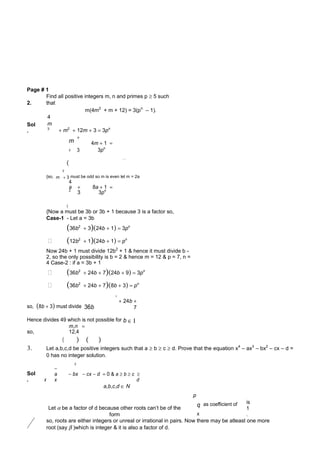
          Let       and Γ be two circles touching each other externally at R. Let                  be a line which is tangent to Γ
1.        Γ                                      l                                                                               at
                1        2                                                                                                       2
          P and passing through the centre                  of Γ . Similarly,             be a line which is tangent to Γ at Q and
          O                                                 let l                                                          passing
                                                                                  2
                                                                   1                                             1
          through the centre              of Γ . Suppose l               are not parallel and intersect at K. If KP = KQ, prove that
          O                                          and l                                                                       the
                                      2                      1
          triangle PQR is equilateral.


                                  Q              P
                                          K


                        O
                             1            R                 O2
Sol
.


                                                                                KP = KQ, So K lies on the common tangent
                                                                                (Radical Axis)

                                                                                Now ∆ KPQ ~ ∆KO1O2 & PQK is isoceles
∠KQP = ∠KO1O2                                               
                                             PQO1O2 is cyclic 

                                                             
∠KPQ = ∠KO2O1
                                                                                So, ∆KO1O2 is also Isosceles So, KO1 = KO2 &
                                                                                O1R = O2R, clearly in ∆O1PO2 ,
                                 O1
                      PO2        O2
                      =
                              2
                      ∠PO1O2 = 30º & similarly
so,                   ∠QO2O1                      = 30º
                      ∠O1KR = ∠O2KR = 60º & ∆PQR is
so,                   equilateral.
Page # 1
       Find all positive integers m, n and primes p ≥ 5 such
2.     that
                         m(4m2 + m + 12) = 3(pn – 1).
        4
Sol     m
.       3
            + m2 + 12m + 3 = 3pn
                      +
                 m          4m + 1 =
                 2    3        3pn

                       (
           ⇒                                          )        ; p ≥ 5 & prime


                   2

           {so, m + 3 must be odd so m is even let m = 2a
                           4
                           a       +        8a + 1 =
                           2
                                   3          3pn
           ⇒                                      )


                       (
           {Now a must be 3b or 3b + 1 because 3 is a factor so,
           Case-1 - Let a = 3b
                       (36b2           + 3)(24b + 1) = 3pn

                      (12b2           + 1)(24b + 1) = pn
           Now 24b + 1 must divide 12b2 + 1 & hence it must divide b -
           2, so the only possibility is b = 2 & hence m = 12 & p = 7, n =
           4 Case-2 : if a = 3b + 1
                      (36b2           + 24b + 7)(24b + 9) = 3pn

                      (36b2           + 24b + 7)(8b + 3) = pn
                                                          2

                                                              + 24b +
so, (8b + 3) must divide 36b                                        7

Hence divides 49 which is not possible for b ∈ Ι
                 m,n =
so,              12,4
                   (               )    (     )
3.         Let a,b,c,d be positive integers such that a ≥ b ≥ c ≥ d. Prove that the equation x4 – ax3 – bx2 – cx – d =
           0 has no integer solution.
                               2
               −
Sol            a           − bx − cx − d = 0 & a ≥ b ≥ c ≥
.      x       x                                         d
                                         a,b,c,d ∈ N
                                                                                 p
                                                                                                    is
            Let α be a factor of d because other roots can’t be of the
                                                                               q as coefficient of
                                                                                                    1
                                       form                                    x                    .
           so, roots are either integers or unreal or irrational in pairs. Now there may be atleast one more
           root (say β )which is integer & it is also a factor of d.
−d ≤ α,β
So,                 ≤d
                                      }
Now, f                   0 = −d < 0 & f −1 = 1+ a − b + c − d > 0
                          )                           ( )
                         f(x) < 0 for x ∈                     , So there is no positive integral
also                     0,d                                  root.
                                                  [
Also. for                 x ∈ −d,−1 ; f(x) > 0 so, no integral root in [-d, -1].
                              [           ]
            Hence there is no integral root. {Though roots are in (-1, 0)}.

4.          Let n be a positive integer. Call a nonempty subset S of {1,2,3,.....,n} good if the arithemtic mean of the
            elements of S is also an integer. Further let to denote the number of good subsets of {1,2,3,.....,n}.
            Prove that tn and n are both odd or both even.
            Let A = {x1, x2 , x3 ,...xr } be a good subset, then there must be
Sol
.           a
                B                     n               −         n                            −
                          n+1         +               x         +       − x ,... n
                =         x,          1               ,         1       +1                   x
            s        {                                                                           r   } which is also good. So, good subsets occur in
            e                     )
                     (
                                                          2
            t                     (           )           (
                                                                    )    3           (   )       a
            pair.
            However, there are few cases when A = B, which means if x ∈
            A                                                                                                          n + 1 − x ∈ A . To count the
                                                                                                                   ⇒
                                                                                                              i    (        )   i
            number of these subsets.
            Case-1 : If n is odd.
            a. If the middle element is excluded, the no. of elements in such subsets is 2k.
            (k before middle, & k elements after). So sum of hte elements will be k(n + 1), Apparently these sets
                                                                              n −1
            are good. So no. of these subsets is 2 2                         1(i.e. odd)
                                                                                     −


Page # 2
b. Similarly if mid term


  these subsets will
  good.


  So number os sub

  22

  so toal number of s

  2
5 S
. o
  ,
  if
  n
  i
  s
  o
  d
  d
  .
  R
  e
  s
  t
  o
S f
  t
o h
  e
  s
  u
  b
  s
  e
  t
  s
  a
  r
  e
  o
  c
  c
  u
  r
  i
  n
  g
  i
  n
  p
  a
  i
  r
  a
  n
  d
  t
  h
  e
  c
  o
  m
  p
  l
  e
  t
e

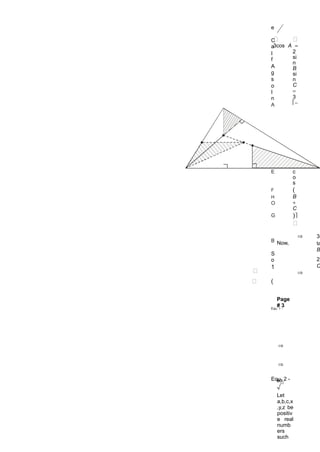
    C     
    a3cos A =
    I      2
    f      si
           n
    A      B
    g      si
    s      n
    o      C
    I      =
    n      3
    A      −


    E          c
               o
               s
    F          (
    H          B
    O          +
               C
    G          )
               
                    ⇒   3c
    B Now,
                        ta
                        B
    S
    o                   2s
    1                   C
                   ⇒
   (

       Page
       #3
    Equ. 1 -


        ⇒


        ⇒

    Equ. 2 -
      so,

        Let
        a,b,c,x
        ,y,z be
        positiv
        e real
        numb
        ers
        such
t
h

Sol
.


    Page
    #4
Inmo 2013 test_paper_solution_new

Inmo 2013 test_paper_solution_new

  • 1.
    28th Indian NationalMathematical Olympiad-2013 Time : 4 hours Februray 03, 2013 Instructions : • Calculators (in any form) and protractors are not allowed. • Rulers and compasses are allowed. • Answer all the questions. All questions carry equal marks. • Answer to each question should start on a new page. Clearly indicate the questions number. Let and Γ be two circles touching each other externally at R. Let be a line which is tangent to Γ 1. Γ l at 1 2 2 P and passing through the centre of Γ . Similarly, be a line which is tangent to Γ at Q and O let l passing 2 1 1 through the centre of Γ . Suppose l are not parallel and intersect at K. If KP = KQ, prove that O and l the 2 1 triangle PQR is equilateral. Q P K O 1 R O2 Sol . KP = KQ, So K lies on the common tangent (Radical Axis) Now ∆ KPQ ~ ∆KO1O2 & PQK is isoceles ∠KQP = ∠KO1O2   PQO1O2 is cyclic   ∠KPQ = ∠KO2O1 So, ∆KO1O2 is also Isosceles So, KO1 = KO2 & O1R = O2R, clearly in ∆O1PO2 , O1 PO2 O2 = 2 ∠PO1O2 = 30º & similarly so, ∠QO2O1 = 30º ∠O1KR = ∠O2KR = 60º & ∆PQR is so, equilateral.
  • 2.
    Page # 1 Find all positive integers m, n and primes p ≥ 5 such 2. that m(4m2 + m + 12) = 3(pn – 1). 4 Sol m . 3 + m2 + 12m + 3 = 3pn + m 4m + 1 = 2 3 3pn ( ⇒ ) ; p ≥ 5 & prime 2 {so, m + 3 must be odd so m is even let m = 2a 4 a + 8a + 1 = 2 3 3pn ⇒ ) ( {Now a must be 3b or 3b + 1 because 3 is a factor so, Case-1 - Let a = 3b (36b2 + 3)(24b + 1) = 3pn  (12b2 + 1)(24b + 1) = pn Now 24b + 1 must divide 12b2 + 1 & hence it must divide b - 2, so the only possibility is b = 2 & hence m = 12 & p = 7, n = 4 Case-2 : if a = 3b + 1  (36b2 + 24b + 7)(24b + 9) = 3pn  (36b2 + 24b + 7)(8b + 3) = pn 2 + 24b + so, (8b + 3) must divide 36b 7 Hence divides 49 which is not possible for b ∈ Ι m,n = so, 12,4 ( ) ( ) 3. Let a,b,c,d be positive integers such that a ≥ b ≥ c ≥ d. Prove that the equation x4 – ax3 – bx2 – cx – d = 0 has no integer solution. 2 − Sol a − bx − cx − d = 0 & a ≥ b ≥ c ≥ . x x d a,b,c,d ∈ N p is Let α be a factor of d because other roots can’t be of the q as coefficient of 1 form x . so, roots are either integers or unreal or irrational in pairs. Now there may be atleast one more root (say β )which is integer & it is also a factor of d.
  • 3.
    −d ≤ α,β So, ≤d } Now, f 0 = −d < 0 & f −1 = 1+ a − b + c − d > 0 ) ( ) f(x) < 0 for x ∈ , So there is no positive integral also 0,d root. [ Also. for x ∈ −d,−1 ; f(x) > 0 so, no integral root in [-d, -1]. [ ] Hence there is no integral root. {Though roots are in (-1, 0)}. 4. Let n be a positive integer. Call a nonempty subset S of {1,2,3,.....,n} good if the arithemtic mean of the elements of S is also an integer. Further let to denote the number of good subsets of {1,2,3,.....,n}. Prove that tn and n are both odd or both even. Let A = {x1, x2 , x3 ,...xr } be a good subset, then there must be Sol . a B n − n − n+1 + x + − x ,... n = x, 1 , 1 +1 x s { r } which is also good. So, good subsets occur in e ) ( 2 t ( ) ( ) 3 ( ) a pair. However, there are few cases when A = B, which means if x ∈ A n + 1 − x ∈ A . To count the ⇒ i ( ) i number of these subsets. Case-1 : If n is odd. a. If the middle element is excluded, the no. of elements in such subsets is 2k. (k before middle, & k elements after). So sum of hte elements will be k(n + 1), Apparently these sets n −1 are good. So no. of these subsets is 2 2 1(i.e. odd) − Page # 2
  • 4.
    b. Similarly ifmid term these subsets will good. So number os sub 22 so toal number of s 2 5 S . o , if n i s o d d . R e s t o S f t o h e s u b s e t s a r e o c c u r i n g i n p a i r a n d t h e c o m p l e t
  • 5.
    e C   a3cos A = I 2 f si n A B g si s n o C I = n 3 A − E c o s F ( H B O + C G )  ⇒ 3c B Now, ta B S o 2s 1 C  ⇒  ( Page #3 Equ. 1 - ⇒ ⇒ Equ. 2 - so, Let a,b,c,x ,y,z be positiv e real numb ers such
  • 6.
    t h Sol . Page #4