Initial Valuation Report
Chipotle Mexican Grill, Inc.
12/14/2015
Final Report
CONTENT
Executive Summary
...............................................................................................
.......................................................................... 1
Company and Industry Overview
...............................................................................................
.............................................. 2
Chipotle Mexican Grill - The Business
...............................................................................................
..................................... 2
Strategic Highlights
...............................................................................................
......................................................................... 2
Restaurant Industry - The Playing Field
...............................................................................................
................................ 2
Financial Ratio Analysis
.......................................................................................... .....
................................................................. 4
Key Ratios across Industry
...............................................................................................
........................................................... 4
DuPont Analysis
...............................................................................................
................................................................................ 5
Profitability across Industry
...............................................................................................
........................................................ 6
Detailed Revenue Analysis
...............................................................................................
........................................................... 7
Other Key Ratios
...............................................................................................
............................................................................... 8
Forecast of Financial Statements
...............................................................................................
.............................................. 9
Financial Statements – 2015-2020
...............................................................................................
........................................... 9
Sustainable long term growth rate analysis
...............................................................................................
...................... 10
Underlying assumptions
...............................................................................................
............................................................ 10
Risk and Return Analysis
...............................................................................................
........................................................... 12
Overview Risk/Return Analysis
...............................................................................................
.............................................. 12
Portfolio Simulation
...............................................................................................
..................................................................... 13
Calculation of Beta
...............................................................................................
........................................................................ 14
Required Returns based on Capital Asset Pricing Model
[CAPM] .......................................................................... 15
Preliminary Recommendations
...............................................................................................
.............................................. 15
Corporate Valuation
...............................................................................................
...................................................................... 16
Discounted Cash Flow Model
...............................................................................................
................................................... 16
Residual Income Model
...............................................................................................
.............................................................. 17
Comparable Valuation
...............................................................................................
................................................................. 18
Final Recommendation
...............................................................................................
............................................................... 19
Appendix
...............................................................................................
..............................................................................................
20
Calculation Financial Ratios
...............................................................................................
..................................................... 20
Executive Summary
- 1 -
Chipotle Mexican Grill, Inc.
STRONG BRAND WITH CONTINUOUS GROWTH
Over the last 3 years, Chipotle experienced a strong growth
period reflected by top line growth rates of up to 28% (FY2014)
and EBITDA growth rates of up to 30% (FY2014). This growth
was driven by menu price increases as well as organic
restaurant
expansions. In addition, Chipotle’s brand has been strengthened
continuously with a focus on fresh ingredients and a sustainable
and transparent supply chain management. Based on this strong
brand development, Chipotle has manifested itself in its unique
position combining high margins as seen in the fast food
industry
with a high quality casual dining experience. However, recent e-
coli cases across several restaurants resulted in a significant
drawback in Q4/2015 resulting in a price drop of -23.8% in the
last 3 months. Nevertheless, we still see a continuous growth
potential for the next 3-years period, in particular with
expansion opportunities in Europe and Canada as well as
increasing enhancement of the new restaurant concepts,
ShopHouse Southeast Asian Kitchen and Pizzeria Locale.
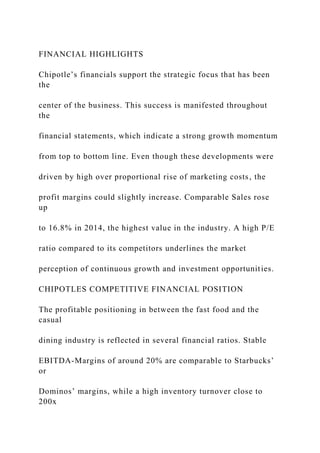
FINANCIAL HIGHLIGHTS
Chipotle’s financials support the strategic focus that has been
the
center of the business. This success is manifested throughout
the
financial statements, which indicate a strong growth momentum
from top to bottom line. Even though these developments were
driven by high over proportional rise of marketing costs, the
profit margins could slightly increase. Comparable Sales rose
up
to 16.8% in 2014, the highest value in the industry. A high P/E
ratio compared to its competitors underlines the market
perception of continuous growth and investment opportunities.
CHIPOTLES COMPETITIVE FINANCIAL POSITION
The profitable positioning in between the fast food and the
casual
dining industry is reflected in several financial ratios. Stable
EBITDA-Margins of around 20% are comparable to Starbucks’
or
Dominos’ margins, while a high inventory turnover close to
200x
underlines the strategic brand position with fresh and high
quality ingredients similar to Wendy’s business model. In
addition, the negative cash conversion cycle highlights
Chipotle’s
good relations to its suppliers, which is key, given the
importance
of a stable supplier network as basis for expansion.
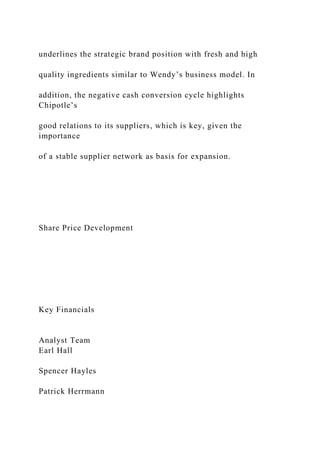
Share Price Development
Key Financials
Analyst Team
Earl Hall
Spencer Hayles
Patrick Herrmann
Abigail Munguia
Benjamin Whitesell
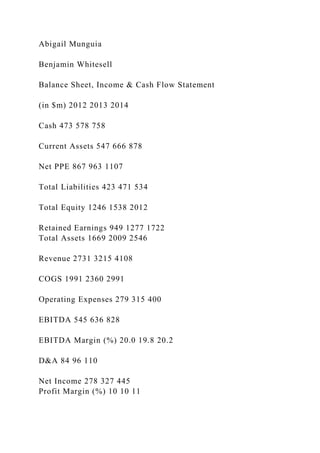
Balance Sheet, Income & Cash Flow Statement
(in $m) 2012 2013 2014
Cash 473 578 758
Current Assets 547 666 878
Net PPE 867 963 1107
Total Liabilities 423 471 534
Total Equity 1246 1538 2012
Retained Earnings 949 1277 1722
Total Assets 1669 2009 2546
Revenue 2731 3215 4108
COGS 1991 2360 2991
Operating Expenses 279 315 400
EBITDA 545 636 828
EBITDA Margin (%) 20.0 19.8 20.2
D&A 84 96 110
Net Income 278 327 445
Profit Margin (%) 10 10 11
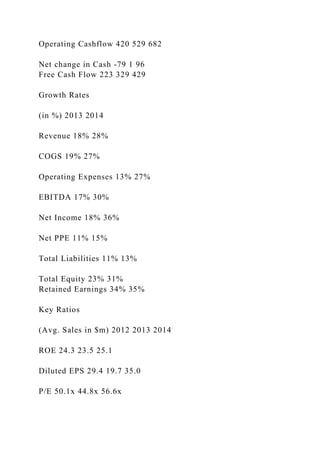
Operating Cashflow 420 529 682
Net change in Cash -79 1 96
Free Cash Flow 223 329 429
Growth Rates
(in %) 2013 2014
Revenue 18% 28%
COGS 19% 27%
Operating Expenses 13% 27%
EBITDA 17% 30%
Net Income 18% 36%
Net PPE 11% 15%
Total Liabilities 11% 13%
Total Equity 23% 31%
Retained Earnings 34% 35%
Key Ratios
(Avg. Sales in $m) 2012 2013 2014
ROE 24.3 23.5 25.1
Diluted EPS 29.4 19.7 35.0
P/E 50.1x 44.8x 56.6x
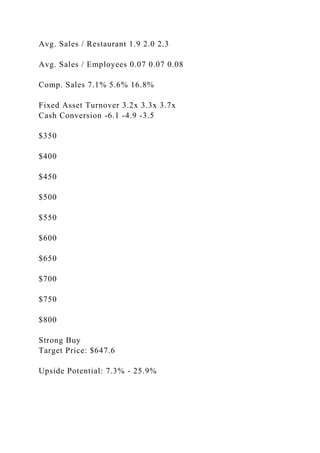
Avg. Sales / Restaurant 1.9 2.0 2.3
Avg. Sales / Employees 0.07 0.07 0.08
Comp. Sales 7.1% 5.6% 16.8%
Fixed Asset Turnover 3.2x 3.3x 3.7x
Cash Conversion -6.1 -4.9 -3.5
$350
$400
$450
$500
$550
$600
$650
$700
$750
$800
Strong Buy
Target Price: $647.6
Upside Potential: 7.3% - 25.9%
Company and Industry Overview
- 2 -
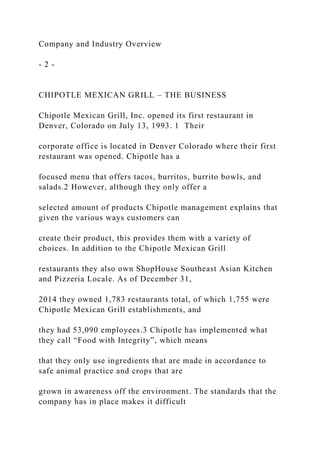
CHIPOTLE MEXICAN GRILL – THE BUSINESS
Chipotle Mexican Grill, Inc. opened its first restaurant in
Denver, Colorado on July 13, 1993. 1 Their
corporate office is located in Denver Colorado where their first
restaurant was opened. Chipotle has a
focused menu that offers tacos, burritos, burrito bowls, and
salads.2 However, although they only offer a
selected amount of products Chipotle management explains that
given the various ways customers can
create their product, this provides them with a variety of
choices. In addition to the Chipotle Mexican Grill
restaurants they also own ShopHouse Southeast Asian Kitchen
and Pizzeria Locale. As of December 31,
2014 they owned 1,783 restaurants total, of which 1,755 were
Chipotle Mexican Grill establishments, and
they had 53,090 employees.3 Chipotle has implemented what
they call “Food with Integrity”, which means
that they only use ingredients that are made in accordance to
safe animal practice and crops that are
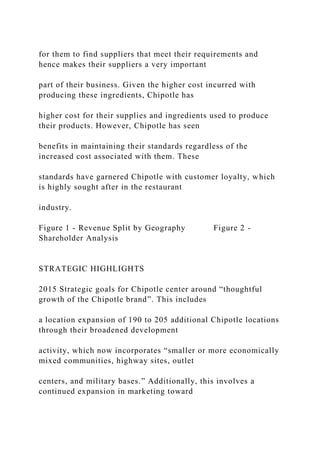
grown in awareness off the environment. The standards that the
company has in place makes it difficult
for them to find suppliers that meet their requirements and
hence makes their suppliers a very important
part of their business. Given the higher cost incurred with
producing these ingredients, Chipotle has
higher cost for their supplies and ingredients used to produce
their products. However, Chipotle has seen
benefits in maintaining their standards regardless of the
increased cost associated with them. These
standards have garnered Chipotle with customer loyalty, which
is highly sought after in the restaurant
industry.
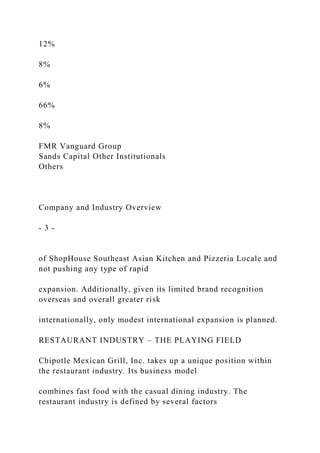
Figure 1 - Revenue Split by Geography Figure 2 -
Shareholder Analysis
STRATEGIC HIGHLIGHTS
2015 Strategic goals for Chipotle center around “thoughtful
growth of the Chipotle brand”. This includes
a location expansion of 190 to 205 additional Chipotle locations
through their broadened development
activity, which now incorporates “smaller or more economically
mixed communities, highway sites, outlet
centers, and military bases.” Additionally, this involves a
continued expansion in marketing toward
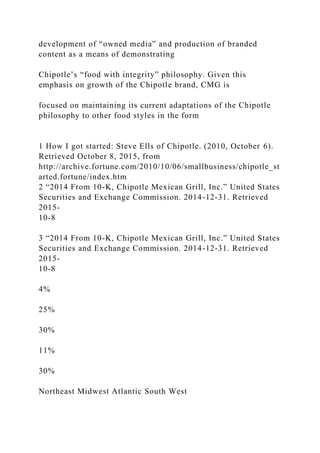
development of “owned media” and production of branded
content as a means of demonstrating
Chipotle’s “food with integrity” philosophy. Given this
emphasis on growth of the Chipotle brand, CMG is
focused on maintaining its current adaptations of the Chipotle
philosophy to other food styles in the form
1 How I got started: Steve Ells of Chipotle. (2010, October 6).
Retrieved October 8, 2015, from
http://archive.fortune.com/2010/10/06/smallbusiness/chipotle_st
arted.fortune/index.htm
2 “2014 From 10-K, Chipotle Mexican Grill, Inc.” United States
Securities and Exchange Commission. 2014-12-31. Retrieved
2015-
10-8
3 “2014 From 10-K, Chipotle Mexican Grill, Inc.” United States
Securities and Exchange Commission. 2014-12-31. Retrieved
2015-
10-8
4%
25%
30%
11%
30%
Northeast Midwest Atlantic South West
12%
8%
6%
66%
8%
FMR Vanguard Group
Sands Capital Other Institutionals
Others
Company and Industry Overview
- 3 -
of ShopHouse Southeast Asian Kitchen and Pizzeria Locale and
not pushing any type of rapid
expansion. Additionally, given its limited brand recognition
overseas and overall greater risk
internationally, only modest international expansion is planned.
RESTAURANT INDUSTRY – THE PLAYING FIELD
Chipotle Mexican Grill, Inc. takes up a unique position within
the restaurant industry. Its business model
combines fast food with the casual dining industry. The
restaurant industry is defined by several factors
and success drivers. Most fast food restaurants franchise their
restaurant due to funding or location-
picking. Chipotle owns all their restaurants, as rather usual for
casual dining restaurants, to stay in control
and maintain its image. Another current issue are the increasing
wages and thus labor costs within the
industry. A trend of retaining employees has begun. In addition,
pressure to serve higher quality of food
has increased costs and caused many fast food chains to start
closing locations. The growing trend to eat
healthy and gain information about the origin and quality of
ingredients has hurt firms which don’t have
the build-your-own model allowing customer to customize their
food. One, if not the biggest selling point
of the fast food industry, is to satisfy the customer’s desire for
convenience. With new technology, such as
mobile development and advanced ordering, fast food chains
have become even more convenient.
Currently the S&P Supercomposite Restaurant Index has risen
13.2% in 2015.4 As consumers tastes
change restaurants try to continue to drive in traffic into their
establishments. A huge driving factor for
this is customer loyalty. The trend of health consciousness
among consumers has risen causing them to
look for healthier options when eating out. With the rise in
awareness of additives and the quality of food,
companies moving toward this direction are increasing their
customer loyalty. In addition technology
factors are also affecting the industry, with the increase in
technology innovation restaurants can now
implement these to try to decrease the wait time for ordering or
paying. Companies that are using these
new technologies are said to be moving in the right direction as
it provides more ease for the consumer.
With the demand of increase in minimum wage many restaurants
are facing the difficulties in trying to
manage this increase in labor cost. Similarly increasing cost in
commodities impact the restaurant
business, depending on the type of food offered, some
companies are impacted more heavily than others.
For example with the slight decrease in the price of cheese
pizza chains are benefiting from this as there
cost decrease.5 In attempts to curve the increase in labor cost
many companies are reducing their menus
to contain less options and also trying to improve the efficiency
of workers. Overall, the industry appears
to be doing well as it outperformed the S&P 500’s 0.5% gain.6
4 “Bloomberg Intelligence: North American Restaurant Primer“
, Jennifer Bartashus, BI Industry Analyst. Retrived 2012-10-7
5 “Bloomberg Intelligence: North American Restaurant Primer“
, Jennifer Bartashus, BI Industry Analyst. Retrived 2012-10-7.
Pg. 9
6 “Bloomberg Intelligence: North American Restaurant Primer“
, Jennifer Bartashus, BI Industry Analyst. Retrived 2012-10-7.
Pg. 2
Financial Ratio Analysis
- 4 -
Source: Calculations based on company and Bloomberg data.
Darden & Brinker financials as of FY Jun’15. For calculation
definitions, see Appendix.
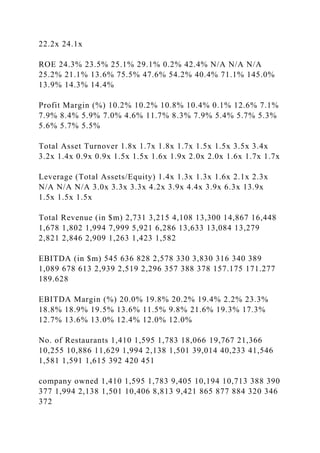
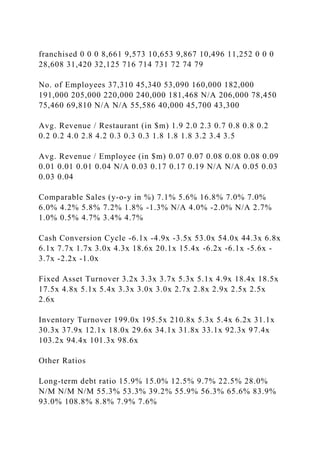
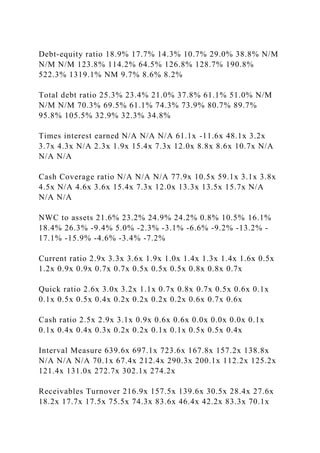
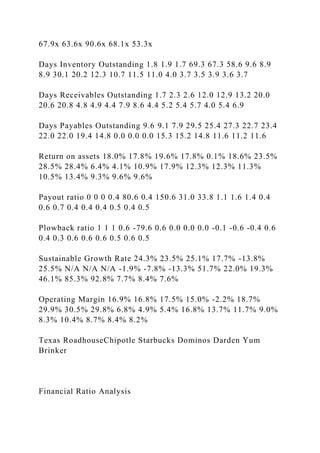
Table 1 - Financial Ratios across Industry
Key Ratios 2012 2013 2014 2012 2013 2014 2012 2013 2014
2012 2013 2014 2012 2013 2014 2012 2013 2014 2012 2013
2014
Diluted EPS (in $) 8.8 10.5 14.1 0.9 0.0 1.4 2.0 2.5 2.9 3.6 1.8
1.4 3.4 2.4 2.3 1.9 2.2 2.3 1.0 1.1 1.2
P/E 50.1x 44.8x 56.6x 32.2x 33.6x 34.4x 20.9x 28.5x 32.5x
14.0x 14.1x 26.5x 21.1x 20.9x 24.8x 16.5x 18.0x 18.8x 19.0x
22.2x 24.1x
ROE 24.3% 23.5% 25.1% 29.1% 0.2% 42.4% N/A N/A N/A
25.2% 21.1% 13.6% 75.5% 47.6% 54.2% 40.4% 71.1% 145.0%
13.9% 14.3% 14.4%
Profit Margin (%) 10.2% 10.2% 10.8% 10.4% 0.1% 12.6% 7.1%
7.9% 8.4% 5.9% 7.0% 4.6% 11.7% 8.3% 7.9% 5.4% 5.7% 5.3%
5.6% 5.7% 5.5%
Total Asset Turnover 1.8x 1.7x 1.8x 1.7x 1.5x 1.5x 3.5x 3.4x
3.2x 1.4x 0.9x 0.9x 1.5x 1.5x 1.6x 1.9x 2.0x 2.0x 1.6x 1.7x 1.7x
Leverage (Total Assets/Equity) 1.4x 1.3x 1.3x 1.6x 2.1x 2.3x
N/A N/A N/A 3.0x 3.3x 3.3x 4.2x 3.9x 4.4x 3.9x 6.3x 13.9x
1.5x 1.5x 1.5x
Total Revenue (in $m) 2,731 3,215 4,108 13,300 14,867 16,448
1,678 1,802 1,994 7,999 5,921 6,286 13,633 13,084 13,279
2,821 2,846 2,909 1,263 1,423 1,582
EBITDA (in $m) 545 636 828 2,578 330 3,830 316 340 389
1,089 678 613 2,939 2,519 2,296 357 388 378 157.175 171.277
189.628
EBITDA Margin (%) 20.0% 19.8% 20.2% 19.4% 2.2% 23.3%
18.8% 18.9% 19.5% 13.6% 11.5% 9.8% 21.6% 19.3% 17.3%
12.7% 13.6% 13.0% 12.4% 12.0% 12.0%
No. of Restaurants 1,410 1,595 1,783 18,066 19,767 21,366
10,255 10,886 11,629 1,994 2,138 1,501 39,014 40,233 41,546
1,581 1,591 1,615 392 420 451
company owned 1,410 1,595 1,783 9,405 10,194 10,713 388 390
377 1,994 2,138 1,501 10,406 8,813 9,421 865 877 884 320 346
372
franchised 0 0 0 8,661 9,573 10,653 9,867 10,496 11,252 0 0 0
28,608 31,420 32,125 716 714 731 72 74 79
No. of Employees 37,310 45,340 53,090 160,000 182,000
191,000 205,000 220,000 240,000 181,468 N/A 206,000 78,450
75,460 69,810 N/A N/A 55,586 40,000 45,700 43,300
Avg. Revenue / Restaurant (in $m) 1.9 2.0 2.3 0.7 0.8 0.8 0.2
0.2 0.2 4.0 2.8 4.2 0.3 0.3 0.3 1.8 1.8 1.8 3.2 3.4 3.5
Avg. Revenue / Employee (in $m) 0.07 0.07 0.08 0.08 0.08 0.09
0.01 0.01 0.01 0.04 N/A 0.03 0.17 0.17 0.19 N/A N/A 0.05 0.03
0.03 0.04
Comparable Sales (y-o-y in %) 7.1% 5.6% 16.8% 7.0% 7.0%
6.0% 4.2% 5.8% 7.2% 1.8% -1.3% N/A 4.0% -2.0% N/A 2.7%
1.0% 0.5% 4.7% 3.4% 4.7%
Cash Conversion Cycle -6.1x -4.9x -3.5x 53.0x 54.0x 44.3x 6.8x
6.1x 7.7x 1.7x 3.0x 4.3x 18.6x 20.1x 15.4x -6.2x -6.1x -5.6x -
3.7x -2.2x -1.0x
Fixed Asset Turnover 3.2x 3.3x 3.7x 5.3x 5.1x 4.9x 18.4x 18.5x
17.5x 4.8x 5.1x 5.4x 3.3x 3.0x 3.0x 2.7x 2.8x 2.9x 2.5x 2.5x
2.6x
Inventory Turnover 199.0x 195.5x 210.8x 5.3x 5.4x 6.2x 31.1x
30.3x 37.9x 12.1x 18.0x 29.6x 34.1x 31.8x 33.1x 92.3x 97.4x
103.2x 94.4x 101.3x 98.6x
Other Ratios
Long-term debt ratio 15.9% 15.0% 12.5% 9.7% 22.5% 28.0%
N/M N/M N/M 55.3% 53.3% 39.2% 55.9% 56.3% 65.6% 83.9%
93.0% 108.8% 8.8% 7.9% 7.6%
Debt-equity ratio 18.9% 17.7% 14.3% 10.7% 29.0% 38.8% N/M
N/M N/M 123.8% 114.2% 64.5% 126.8% 128.7% 190.8%
522.3% 1319.1% NM 9.7% 8.6% 8.2%
Total debt ratio 25.3% 23.4% 21.0% 37.8% 61.1% 51.0% N/M
N/M N/M 70.3% 69.5% 61.1% 74.3% 73.9% 80.7% 89.7%
95.8% 105.5% 32.9% 32.3% 34.8%
Times interest earned N/A N/A N/A 61.1x -11.6x 48.1x 3.2x
3.7x 4.3x N/A 2.3x 1.9x 15.4x 7.3x 12.0x 8.8x 8.6x 10.7x N/A
N/A N/A
Cash Coverage ratio N/A N/A N/A 77.9x 10.5x 59.1x 3.1x 3.8x
4.5x N/A 4.6x 3.6x 15.4x 7.3x 12.0x 13.3x 13.5x 15.7x N/A
N/A N/A
NWC to assets 21.6% 23.2% 24.9% 24.2% 0.8% 10.5% 16.1%
18.4% 26.3% -9.4% 5.0% -2.3% -3.1% -6.6% -9.2% -13.2% -
17.1% -15.9% -4.6% -3.4% -7.2%
Current ratio 2.9x 3.3x 3.6x 1.9x 1.0x 1.4x 1.3x 1.4x 1.6x 0.5x
1.2x 0.9x 0.9x 0.7x 0.7x 0.5x 0.5x 0.5x 0.8x 0.8x 0.7x
Quick ratio 2.6x 3.0x 3.2x 1.1x 0.7x 0.8x 0.7x 0.5x 0.6x 0.1x
0.1x 0.5x 0.5x 0.4x 0.2x 0.2x 0.2x 0.2x 0.6x 0.7x 0.6x
Cash ratio 2.5x 2.9x 3.1x 0.9x 0.6x 0.6x 0.0x 0.0x 0.0x 0.1x
0.1x 0.4x 0.4x 0.3x 0.2x 0.2x 0.1x 0.1x 0.5x 0.5x 0.4x
Interval Measure 639.6x 697.1x 723.6x 167.8x 157.2x 138.8x
N/A N/A N/A 70.1x 67.4x 212.4x 290.3x 200.1x 112.2x 125.2x
121.4x 131.0x 272.7x 302.1x 274.2x
Receivables Turnover 216.9x 157.5x 139.6x 30.5x 28.4x 27.6x
18.2x 17.7x 17.5x 75.5x 74.3x 83.6x 46.4x 42.2x 83.3x 70.1x
67.9x 63.6x 90.6x 68.1x 53.3x
Days Inventory Outstanding 1.8 1.9 1.7 69.3 67.3 58.6 9.6 8.9
8.9 30.1 20.2 12.3 10.7 11.5 11.0 4.0 3.7 3.5 3.9 3.6 3.7
Days Receivables Outstanding 1.7 2.3 2.6 12.0 12.9 13.2 20.0
20.6 20.8 4.8 4.9 4.4 7.9 8.6 4.4 5.2 5.4 5.7 4.0 5.4 6.9
Days Payables Outstanding 9.6 9.1 7.9 29.5 25.4 27.3 22.7 23.4
22.0 22.0 19.4 14.8 0.0 0.0 0.0 15.3 15.2 14.8 11.6 11.2 11.6
Return on assets 18.0% 17.8% 19.6% 17.8% 0.1% 18.6% 23.5%
28.5% 28.4% 6.4% 4.1% 10.9% 17.9% 12.3% 12.3% 11.3%
10.5% 13.4% 9.3% 9.6% 9.6%
Payout ratio 0 0 0 0.4 80.6 0.4 150.6 31.0 33.8 1.1 1.6 1.4 0.4
0.6 0.7 0.4 0.4 0.4 0.5 0.4 0.5
Plowback ratio 1 1 1 0.6 -79.6 0.6 0.0 0.0 0.0 -0.1 -0.6 -0.4 0.6
0.4 0.3 0.6 0.6 0.6 0.5 0.6 0.5
Sustainable Growth Rate 24.3% 23.5% 25.1% 17.7% -13.8%
25.5% N/A N/A N/A -1.9% -7.8% -13.3% 51.7% 22.0% 19.3%
46.1% 85.3% 92.8% 7.7% 8.4% 7.6%
Operating Margin 16.9% 16.8% 17.5% 15.0% -2.2% 18.7%
29.9% 30.5% 29.8% 6.8% 4.9% 5.4% 16.8% 13.7% 11.7% 9.0%
8.3% 10.4% 8.7% 8.4% 8.2%
Texas RoadhouseChipotle Starbucks Dominos Darden Yum
Brinker
Financial Ratio Analysis
- 5 -
KEY RATIO ANALYSIS ACROSS INDUSTRY
DuPont Analysis
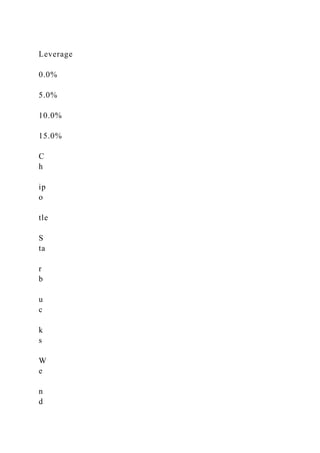
The DuPont analysis indicates a stable Return on Equity [ROE]
for Chipotle with a slight upwards trend
over the years. However, Chipotle has consistently had lower
ROE than most of its main competitors over
the last five years. This is a trend that continued through
FY2014. However, the main driver for the lower
ROE is debt utilization. They have slightly above average Profit
Margin and Total Asset Turnover, but have
the lowest level of debt to equity and as a result have a low
Leverage.
Figure 3 - DuPont Analysis Split
1.00
2.00
3.00
4.00
5.00
6.00
C
h
ip
o
tle
S
ta
r
b
u
c
k
s
W
e
n
d
y
s
Y
u
m
D
a
r
d
e
n
B
r
in
k
e
r
T
e
x
a
s R
H
Leverage
0.0%
5.0%
10.0%
15.0%
C
h
ip
o
tle
S
ta
r
b
u
c
k
s
W
e
n
d
y
s
Y
u
m
D
a
r
d
e
n
B
r
in
k
e
r
T
e
x
a
s R
H
Profit Margin
0.0x
0.5x
1.0x
1.5x
2.0x
C
h
ip
o
tle
S
ta
r
b
u
c
k
s
W
e
n
d
y
s
Y
u
m
D
a
rd
e
n
B
r
in
k
e
r
T
e
x
a
s R
H
Total Asset Turnover
0%
10%
20%
30%
40%
50%
60%
70%
80%
90%
100%
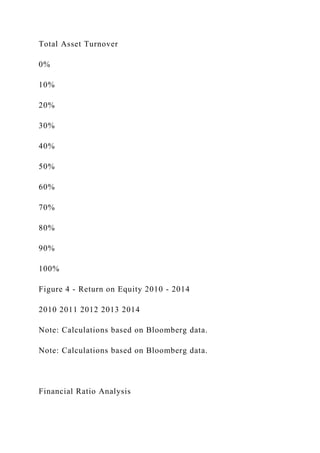
Figure 4 - Return on Equity 2010 - 2014
2010 2011 2012 2013 2014
Note: Calculations based on Bloomberg data.
Financial Ratio Analysis
- 6 -
Profitability
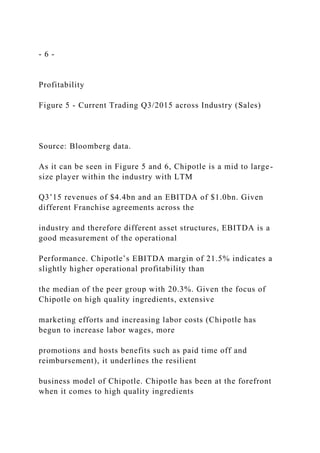
Figure 5 - Current Trading Q3/2015 across Industry (Sales)
Source: Bloomberg data.
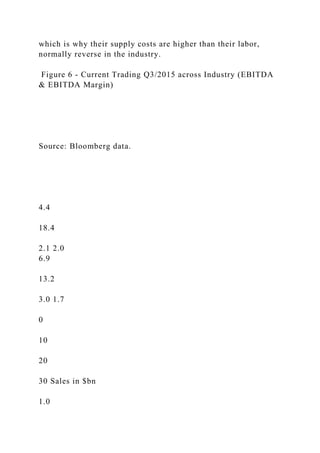
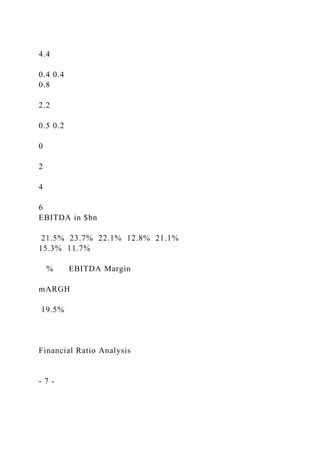
As it can be seen in Figure 5 and 6, Chipotle is a mid to large-
size player within the industry with LTM
Q3’15 revenues of $4.4bn and an EBITDA of $1.0bn. Given
different Franchise agreements across the
industry and therefore different asset structures, EBITDA is a
good measurement of the operational
Performance. Chipotle’s EBITDA margin of 21.5% indicates a
slightly higher operational profitability than
the median of the peer group with 20.3%. Given the focus of
Chipotle on high quality ingredients, extensive
marketing efforts and increasing labor costs (Chipotle has
begun to increase labor wages, more
promotions and hosts benefits such as paid time off and
reimbursement), it underlines the resilient
business model of Chipotle. Chipotle has been at the forefront
when it comes to high quality ingredients
which is why their supply costs are higher than their labor,
normally reverse in the industry.
Figure 6 - Current Trading Q3/2015 across Industry (EBITDA
& EBITDA Margin)
Source: Bloomberg data.
4.4
18.4
2.1 2.0
6.9
13.2
3.0 1.7
0
10
20
30 Sales in $bn
1.0
4.4
0.4 0.4
0.8
2.2
0.5 0.2
0
2
4
6
EBITDA in $bn
21.5% 23.7% 22.1% 12.8% 21.1%
15.3% 11.7%
% EBITDA Margin
mARGH
19.5%
Financial Ratio Analysis
- 7 -
Restaurant Revenue Analysis
Figure 7 - Detailed analysis of restaurant sales as of FY2014
Note: Calculations based on Company and Bloomberg data.
Darden & Brinker financials as of Jun’14.
Looking at the detailed analysis of restaurant revenues (Figure
7), Sales per Store are in correlation with
the number of franchised restaurants. Whereas the competitors
with high number of franchised stores
indicate a lower Sales per Store metric (ranging from $0.2m to
$1.8m), Chipotle, Darden and Texas
Roadhouse, which do not have any franchise agreements, depict
a higher Sales per Store. Of these three,
Chipotle has the lowest Sales per Store with $2.3m.
Nevertheless, this goes in line with the number of
employees, respectively the Sales per Employee (Figure 8).
While Texas Roadhouse and Darden have low
revenues per employee compared to the industry, Chipotle is
above the average of the peer group.
Overall, Darden and Texas Roadhouse achieve higher Sales per
Store, but at the same time engage more
employees, whereas Chipotle seems to reach above average
results in both, Sales per store and per
employee.
At the same time, Chipotle’s Comparable Sales (defined as
percentage increase (decrease) of same store
sales as compared to the corresponding period last year for
restaurants older than 12 months) were
recently high above the industry average with solid metrics the
years before. This compliments the
successful implementation of marketing efforts made by
Chipotle as well as how consumers value the
menu, which is not only driven by convenience but by a focus
on the industry trend of health and
environment conscious consumers living an active lifestyle.
Figure 8 - Restaurant sales per employee as of FY2014
2.3
0.8
0.2
4.2
0.3
1.8
3.5
0
3
5
Sales/Store in $m
0.08 0.09
0.01
0.03
0.19
0.05 0.04
0.00
0.10
0.20
Sales/Employee in $m
16.8%
6.0%
7.2%
N/A N/A 0.5% 4.7%
% Comparable Sales (yoy in %)
mARGH
Note: Calculations based on Bloomberg data.
Financial Ratio Analysis
- 8 -
Other Key Ratios
P/E ratio
Chipotle is highly valued based on the P/E Ratio compared to
its peer group. Within the last years,
Chipotle was consistently valued above average. This reflects
its strong growth as well as the stable
business model. The growth and investment strategy of Chipotle
is perceived well by the market
underscored by a share price development of +26.1% over the
last three years (including recent
drawback caused by e-coli incidents).
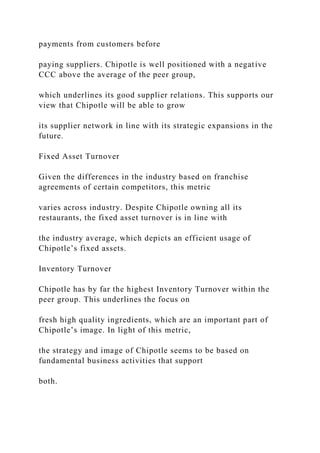
Cash Conversion
Within the industry a negative Cash Conversion Cycle [CCC] is
quite common. Given the business to
consumer model of the restaurant industry, firms usually collect
payments from customers before
paying suppliers. Chipotle is well positioned with a negative
CCC above the average of the peer group,
which underlines its good supplier relations. This supports our
view that Chipotle will be able to grow
its supplier network in line with its strategic expansions in the
future.
Fixed Asset Turnover
Given the differences in the industry based on franchise
agreements of certain competitors, this metric
varies across industry. Despite Chipotle owning all its
restaurants, the fixed asset turnover is in line with
the industry average, which depicts an efficient usage of
Chipotle’s fixed assets.
Inventory Turnover
Chipotle has by far the highest Inventory Turnover within the
peer group. This underlines the focus on
fresh high quality ingredients, which are an important part of
Chipotle’s image. In light of this metric,
the strategy and image of Chipotle seems to be based on
fundamental business activities that support
both.
Forecast of Financial Statements
- 9 -
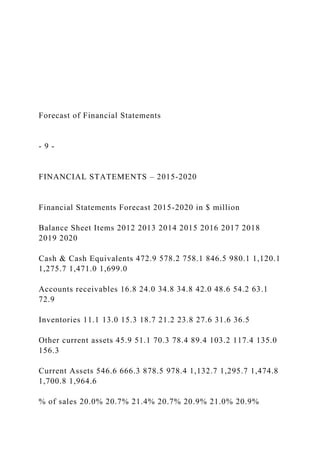
FINANCIAL STATEMENTS – 2015-2020
Financial Statements Forecast 2015-2020 in $ million
Balance Sheet Items 2012 2013 2014 2015 2016 2017 2018
2019 2020
Cash & Cash Equivalents 472.9 578.2 758.1 846.5 980.1 1,120.1
1,275.7 1,471.0 1,699.0
Accounts receivables 16.8 24.0 34.8 34.8 42.0 48.6 54.2 63.1
72.9
Inventories 11.1 13.0 15.3 18.7 21.2 23.8 27.6 31.6 36.5
Other current assets 45.9 51.1 70.3 78.4 89.4 103.2 117.4 135.0
156.3
Current Assets 546.6 666.3 878.5 978.4 1,132.7 1,295.7 1,474.8
1,700.8 1,964.6
% of sales 20.0% 20.7% 21.4% 20.7% 20.9% 21.0% 20.9%
20.9% 20.9%
Net PPE 866.7 963.2 1,107.0 1,178.5 1,241.2 1,291.7 1,479.0
1,700.8 1,964.4
% of sales 31.7% 30.0% 26.9% 24.9% 22.9% 20.9% 20.9%
20.9% 20.9%
LT Investments & Receivables 190.9 313.9 496.1 617.8 761.4
868.0 970.4 1,134.0 1,306.3
% of sales 7.0% 9.8% 12.1% 13.1% 14.1% 14.1% 13.7% 14.0%
13.9%
Other non-current assets 64.5 65.9 64.7 94.3 101.3 111.9 133.8
151.1 174.1
Non-Current Assets 1,122.1 1,343.0 1,667.8 1,944.2 2,227.4
2,526.9 2,902.2 3,336.1 3,850.3
% of sales 41.1% 41.8% 40.6% 41.2% 41.2% 41.0% 41.1%
41.1% 41.1%
Total Assets 1,668.7 2,009.3 2,546.3 2,922.6 3,360.1 3,822.5
4,376.9 5,036.9 5,814.9
% of sales 61.1% 62.5% 62.0% 61.9% 62.1% 62.0% 62.0%
62.0% 62.0%
Accounts payables 58.7 59.0 69.6 89.4 97.8 110.9 129.4 147.2
170.2
Other Payables 128.0 140.2 176.1 210.0 236.1 269.2 310.1
355.2 410.5
Current Liabilites 186.9 199.2 245.7 299.5 333.9 380.2 439.6
502.5 580.8
% of sales 6.8% 6.2% 6.0% 6.3% 6.2% 6.2% 6.2% 6.2% 6.2%
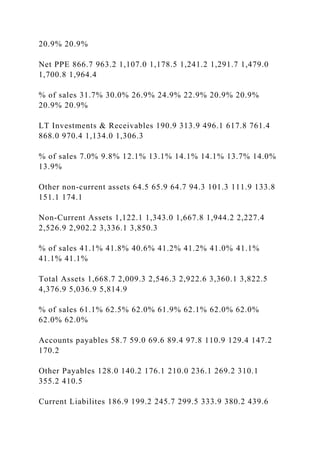
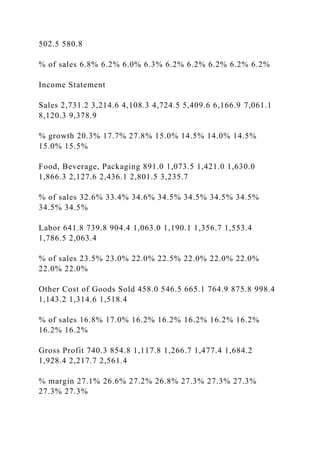
Income Statement
Sales 2,731.2 3,214.6 4,108.3 4,724.5 5,409.6 6,166.9 7,061.1
8,120.3 9,378.9
% growth 20.3% 17.7% 27.8% 15.0% 14.5% 14.0% 14.5%
15.0% 15.5%
Food, Beverage, Packaging 891.0 1,073.5 1,421.0 1,630.0
1,866.3 2,127.6 2,436.1 2,801.5 3,235.7
% of sales 32.6% 33.4% 34.6% 34.5% 34.5% 34.5% 34.5%
34.5% 34.5%
Labor 641.8 739.8 904.4 1,063.0 1,190.1 1,356.7 1,553.4
1,786.5 2,063.4
% of sales 23.5% 23.0% 22.0% 22.5% 22.0% 22.0% 22.0%
22.0% 22.0%
Other Cost of Goods Sold 458.0 546.5 665.1 764.9 875.8 998.4
1,143.2 1,314.6 1,518.4
% of sales 16.8% 17.0% 16.2% 16.2% 16.2% 16.2% 16.2%
16.2% 16.2%
Gross Profit 740.3 854.8 1,117.8 1,266.7 1,477.4 1,684.2
1,928.4 2,217.7 2,561.4
% margin 27.1% 26.6% 27.2% 26.8% 27.3% 27.3% 27.3%
27.3% 27.3%
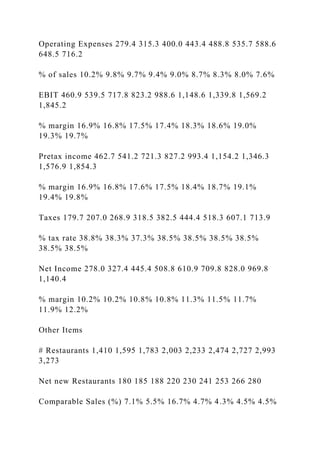
Operating Expenses 279.4 315.3 400.0 443.4 488.8 535.7 588.6
648.5 716.2
% of sales 10.2% 9.8% 9.7% 9.4% 9.0% 8.7% 8.3% 8.0% 7.6%
EBIT 460.9 539.5 717.8 823.2 988.6 1,148.6 1,339.8 1,569.2
1,845.2
% margin 16.9% 16.8% 17.5% 17.4% 18.3% 18.6% 19.0%
19.3% 19.7%
Pretax income 462.7 541.2 721.3 827.2 993.4 1,154.2 1,346.3
1,576.9 1,854.3
% margin 16.9% 16.8% 17.6% 17.5% 18.4% 18.7% 19.1%
19.4% 19.8%
Taxes 179.7 207.0 268.9 318.5 382.5 444.4 518.3 607.1 713.9
% tax rate 38.8% 38.3% 37.3% 38.5% 38.5% 38.5% 38.5%
38.5% 38.5%
Net Income 278.0 327.4 445.4 508.8 610.9 709.8 828.0 969.8
1,140.4
% margin 10.2% 10.2% 10.8% 10.8% 11.3% 11.5% 11.7%
11.9% 12.2%
Other Items
# Restaurants 1,410 1,595 1,783 2,003 2,233 2,474 2,727 2,993
3,273
Net new Restaurants 180 185 188 220 230 241 253 266 280
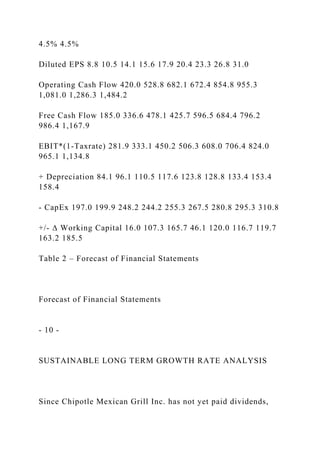
Comparable Sales (%) 7.1% 5.5% 16.7% 4.7% 4.3% 4.5% 4.5%
4.5% 4.5%
Diluted EPS 8.8 10.5 14.1 15.6 17.9 20.4 23.3 26.8 31.0
Operating Cash Flow 420.0 528.8 682.1 672.4 854.8 955.3
1,081.0 1,286.3 1,484.2
Free Cash Flow 185.0 336.6 478.1 425.7 596.5 684.4 796.2
986.4 1,167.9
EBIT*(1-Taxrate) 281.9 333.1 450.2 506.3 608.0 706.4 824.0
965.1 1,134.8
+ Depreciation 84.1 96.1 110.5 117.6 123.8 128.8 133.4 153.4
158.4
- CapEx 197.0 199.9 248.2 244.2 255.3 267.5 280.8 295.3 310.8
+/- ∆ Working Capital 16.0 107.3 165.7 46.1 120.0 116.7 119.7
163.2 185.5
Table 2 – Forecast of Financial Statements
Forecast of Financial Statements
- 10 -
SUSTAINABLE LONG TERM GROWTH RATE ANALYSIS
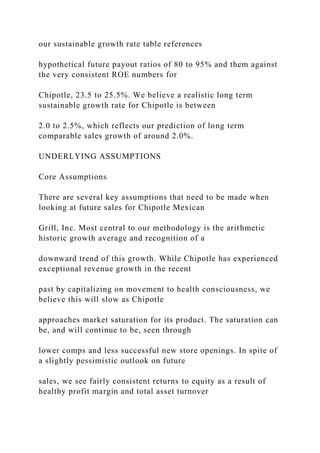
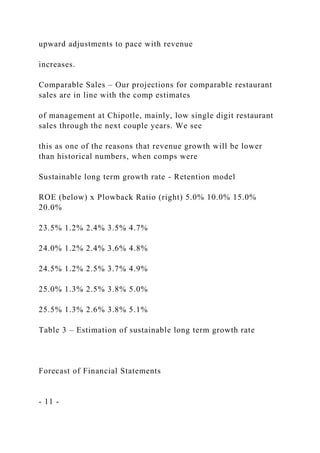
Since Chipotle Mexican Grill Inc. has not yet paid dividends,
our sustainable growth rate table references
hypothetical future payout ratios of 80 to 95% and them against
the very consistent ROE numbers for
Chipotle, 23.5 to 25.5%. We believe a realistic long term
sustainable growth rate for Chipotle is between
2.0 to 2.5%, which reflects our prediction of long term
comparable sales growth of around 2.0%.
UNDERLYING ASSUMPTIONS
Core Assumptions
There are several key assumptions that need to be made when
looking at future sales for Chipotle Mexican
Grill, Inc. Most central to our methodology is the arithmetic
historic growth average and recognition of a
downward trend of this growth. While Chipotle has experienced
exceptional revenue growth in the recent
past by capitalizing on movement to health consciousness, we
believe this will slow as Chipotle
approaches market saturation for its product. The saturation can
be, and will continue to be, seen through
lower comps and less successful new store openings. In spite of
a slightly pessimistic outlook on future
sales, we see fairly consistent returns to equity as a result of
healthy profit margin and total asset turnover
and no change in the leverage profile.
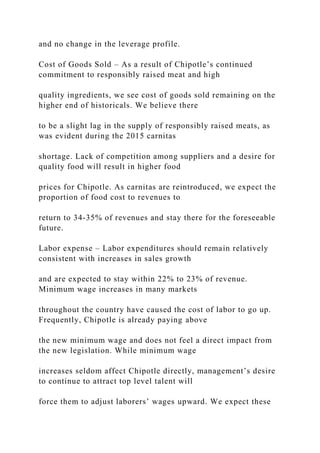
Cost of Goods Sold – As a result of Chipotle’s continued
commitment to responsibly raised meat and high
quality ingredients, we see cost of goods sold remaining on the
higher end of historicals. We believe there
to be a slight lag in the supply of responsibly raised meats, as
was evident during the 2015 carnitas
shortage. Lack of competition among suppliers and a desire for
quality food will result in higher food
prices for Chipotle. As carnitas are reintroduced, we expect the
proportion of food cost to revenues to
return to 34-35% of revenues and stay there for the foreseeable
future.
Labor expense – Labor expenditures should remain relatively
consistent with increases in sales growth
and are expected to stay within 22% to 23% of revenue.
Minimum wage increases in many markets
throughout the country have caused the cost of labor to go up.
Frequently, Chipotle is already paying above
the new minimum wage and does not feel a direct impact from
the new legislation. While minimum wage
increases seldom affect Chipotle directly, management’s desire
to continue to attract top level talent will
force them to adjust laborers’ wages upward. We expect these
upward adjustments to pace with revenue
increases.
Comparable Sales – Our projections for comparable restaurant
sales are in line with the comp estimates
of management at Chipotle, mainly, low single digit restaurant
sales through the next couple years. We see
this as one of the reasons that revenue growth will be lower
than historical numbers, when comps were
Sustainable long term growth rate - Retention model
ROE (below) x Plowback Ratio (right) 5.0% 10.0% 15.0%
20.0%
23.5% 1.2% 2.4% 3.5% 4.7%
24.0% 1.2% 2.4% 3.6% 4.8%
24.5% 1.2% 2.5% 3.7% 4.9%
25.0% 1.3% 2.5% 3.8% 5.0%
25.5% 1.3% 2.6% 3.8% 5.1%
Table 3 – Estimation of sustainable long term growth rate
Forecast of Financial Statements
- 11 -
upper single digits to lower double digits. One place where we
see the potential for growth in comparable
sales, but believe it will take some time to realize, is in the
digital market. We believe the recent addition
of Curt Garner as CIO indicates a focus on the ongoing
optimization process of outside orders that Chipotle
has started to increase digital sales.
New Store Openings – New store openings should continue to
be in line with stated management
expectations and will maintain the recent trend of low double
digit year-on-year growth.
General and Administrative Expenses – We expect general
administrative costs to slightly decrease as a
percent of revenue. This decrease is mainly driven by
significant spread between new store revenues
compared to increases in administrative salaries.
Balance Sheet Assumptions
The key driver in the balance sheet is a historical arithmetic
mean from the three years of 2012, 2013 and
2014. In two cases in particular, there were significant trends
that caused us to bias the account to revenue
ratio. Specifically, the Net PPE account had a downward trend
that we predict will continue through to
2017, when we assume there will be a leveling off at 21% Net
PPE to revenue. In the LT Investments &
Receivables account, there was an upward trend, which we
believe will continue upwards to around 14%.
Free Cash Flow Assumptions
In 2014 there was a one-off effect of buying a corporate plane
that increased CapEx $24 million. In the
long term, we see CapEx as proportional increasing with new
restaurants openings. In 2014, Chipotle
spent on average about $843,000 in development and
construction costs per restaurant in the U.S., net of
landlord reimbursements of approximately $60,000, and for all
restaurants including international
locations they spent on average about $849,000, net of landlord
reimbursements of approximately
$66,000. For new restaurants to be opened in 2015, Chipotle
anticipates the average development costs
to decrease slightly primarily due to the mix of locations and
categories. Additionally, maintenance CapEx
is seen to range between 10-15% until 2020.
Risk and Return Analysis
- 12 -
OVERVIEW RISK/RETURN ANALYSIS
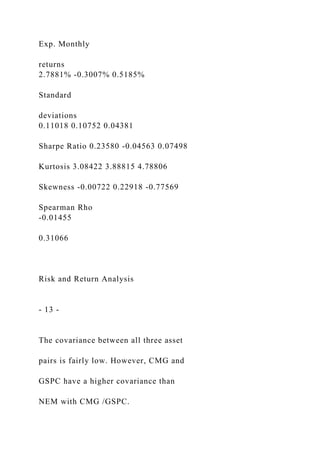
In order to analyze the risk and return
of Chipotle [CMG US], we compare its
return distribution to Newmont Mining
Corp [NEM] and the S&P 500 Stock
Index [^GSPC] for 120 data points
comprising monthly prices from
January 2006 up to November 2015
(Resulting in 119 monthly holding
period return observations). Table 4
depicts an expected return of 2.8% for
CMG compared to a negative average
return of -0.3% for NEM and 0.5% for
the GSPC. These returns have to be seen
in relation to each assets’ individual
standard deviation as an indicator for the risk correlated. CMG
has a slightly higher standard deviation
than NEM, whereas GSPC has the lowest standard deviation
with 0.04. Nevertheless, the Sharpe Ratio
(calculated based on the monthly 10yrs Treasury Yield as
benchmark rate) indicates that the return of
CMG in relation to its isolated risk is higher than for NEM and
GSPC, which underlines a good relation of
return to risk as well as the strong share price development of
CMG over the analyzed period.
Furthermore, CMG has a fairly mesokurtic return distribution
with a skewness close to zero and a kurtosis
close to 3. This is rather unusual for the 3rd and 4th moment of
a return distribution, but might be an
indicator of fairly constant share price development and low
volatility. In contrast to the slight negative
skewness exhibited by CMG, the positive skewness of NEM
bears a more favorable return distribution
than the negative value for GSPC due to a longer tail of NEM’s
returns to the right. This indicates a higher
probability for positive outliers (high positive returns).
However, the negative skewness for GSPC results
only in a marginally longer tail to the left. NEM and GSPC in
particular both have a highly leptokurtic return
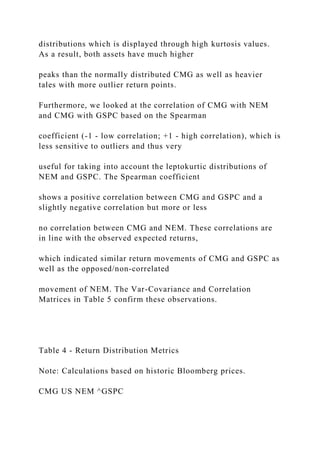
distributions which is displayed through high kurtosis values.
As a result, both assets have much higher
peaks than the normally distributed CMG as well as heavier
tales with more outlier return points.
Furthermore, we looked at the correlation of CMG with NEM
and CMG with GSPC based on the Spearman
coefficient (-1 - low correlation; +1 - high correlation), which is
less sensitive to outliers and thus very
useful for taking into account the leptokurtic distributions of
NEM and GSPC. The Spearman coefficient
shows a positive correlation between CMG and GSPC and a
slightly negative correlation but more or less
no correlation between CMG and NEM. These correlations are
in line with the observed expected returns,
which indicated similar return movements of CMG and GSPC as
well as the opposed/non-correlated
movement of NEM. The Var-Covariance and Correlation
Matrices in Table 5 confirm these observations.
Table 4 - Return Distribution Metrics
Note: Calculations based on historic Bloomberg prices.
CMG US NEM ^GSPC
Exp. Monthly
returns
2.7881% -0.3007% 0.5185%
Standard
deviations
0.11018 0.10752 0.04381
Sharpe Ratio 0.23580 -0.04563 0.07498
Kurtosis 3.08422 3.88815 4.78806
Skewness -0.00722 0.22918 -0.77569
Spearman Rho
-0.01455
0.31066
Risk and Return Analysis
- 13 -
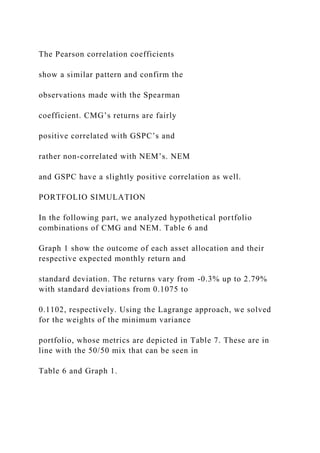
The covariance between all three asset
pairs is fairly low. However, CMG and
GSPC have a higher covariance than
NEM with CMG /GSPC.
The Pearson correlation coefficients
show a similar pattern and confirm the
observations made with the Spearman
coefficient. CMG’s returns are fairly
positive correlated with GSPC’s and
rather non-correlated with NEM’s. NEM
and GSPC have a slightly positive correlation as well.
PORTFOLIO SIMULATION
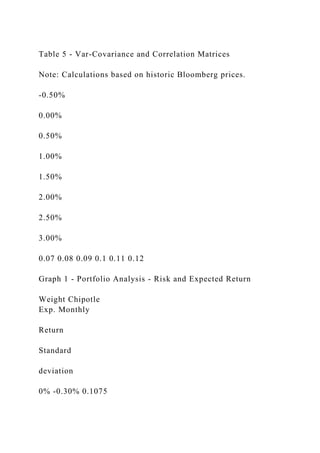
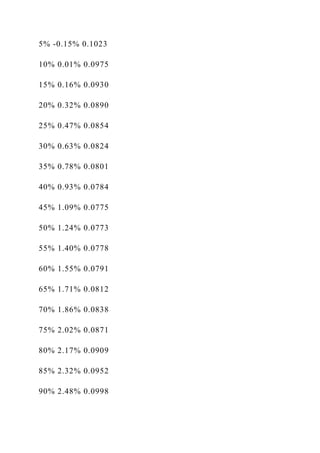
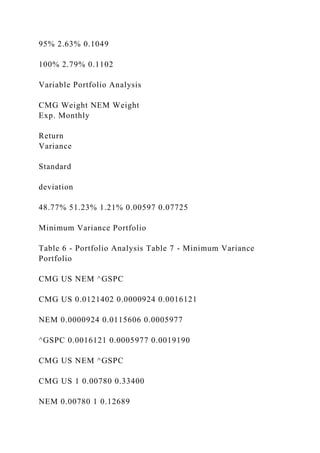
In the following part, we analyzed hypothetical portfolio
combinations of CMG and NEM. Table 6 and
Graph 1 show the outcome of each asset allocation and their
respective expected monthly return and
standard deviation. The returns vary from -0.3% up to 2.79%
with standard deviations from 0.1075 to
0.1102, respectively. Using the Lagrange approach, we solved
for the weights of the minimum variance
portfolio, whose metrics are depicted in Table 7. These are in
line with the 50/50 mix that can be seen in
Table 6 and Graph 1.
Table 5 - Var-Covariance and Correlation Matrices
Note: Calculations based on historic Bloomberg prices.
-0.50%
0.00%
0.50%
1.00%
1.50%
2.00%
2.50%
3.00%
0.07 0.08 0.09 0.1 0.11 0.12
Graph 1 - Portfolio Analysis - Risk and Expected Return
Weight Chipotle
Exp. Monthly
Return
Standard
deviation
0% -0.30% 0.1075
5% -0.15% 0.1023
10% 0.01% 0.0975
15% 0.16% 0.0930
20% 0.32% 0.0890
25% 0.47% 0.0854
30% 0.63% 0.0824
35% 0.78% 0.0801
40% 0.93% 0.0784
45% 1.09% 0.0775
50% 1.24% 0.0773
55% 1.40% 0.0778
60% 1.55% 0.0791
65% 1.71% 0.0812
70% 1.86% 0.0838
75% 2.02% 0.0871
80% 2.17% 0.0909
85% 2.32% 0.0952
90% 2.48% 0.0998
95% 2.63% 0.1049
100% 2.79% 0.1102
Variable Portfolio Analysis
CMG Weight NEM Weight
Exp. Monthly
Return
Variance
Standard
deviation
48.77% 51.23% 1.21% 0.00597 0.07725
Minimum Variance Portfolio
Table 6 - Portfolio Analysis Table 7 - Minimum Variance
Portfolio
CMG US NEM ^GSPC
CMG US 0.0121402 0.0000924 0.0016121
NEM 0.0000924 0.0115606 0.0005977
^GSPC 0.0016121 0.0005977 0.0019190
CMG US NEM ^GSPC
CMG US 1 0.00780 0.33400
NEM 0.00780 1 0.12689
^GSPC 0.33400 0.12689 1
Var-Covariance Matrix
Correlation Matrix
Risk and Return Analysis
- 14 -
CALCULATION OF BETA
To determine the systematic risk of CMG in
comparison to the market [GSPC], we use the
measurement of beta. In order to compute beta, we
ran a regression with CMG as our dependent variable
and GSPC as our independent variable using monthly
returns. Conducting regression analysis allows us to
determine how the effects of the market impact an
individual security or portfolio. In other words, the regression
tells us how much the variation in the
market affects the individual security, which in this case is
CMG. The assumption we made for using the
S&P 500 Index [^GSPC] as the representation for the market
has to do with the idea of diversification. It
is assumed that we can eliminate firm specific risk through
diversification. Given that the S&P 500 is
composed of the 500 largest companies in the US, we can claim
it has diversified essentially all firm and
industry specific risk and the only risk that needs to be taken
into account is systematic risk. Although
running a regression provides us with the beta measurement, we
also need to determine the statistical
significance of the Beta. The statistical significance will tell us
the probability the relationship in our
regression is accurate. To determine statistically significance
we will look at the t-statistic and the p-value,
which should be larger than 1.96 and smaller than 0.05
respectively. We found that CMG had a beta of
0.84, a t-stat of 3.82 and a p-value of 0.0002. The beta for CMG
is statistically significant and it is less
volatile than the market, which has a beta of 1. Similarly, we
computed the beta of NEM to be 0.31,
however, we found that it was not statistically significant (t-
stat: 1.37, p-value: 0.17). It could be said that
there is a 17% chance that the beta of .31 is an inaccurate
representation of the relation between returns
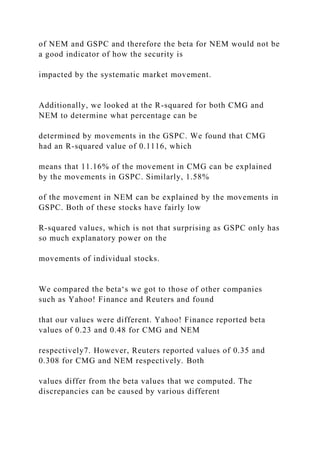
of NEM and GSPC and therefore the beta for NEM would not be
a good indicator of how the security is
impacted by the systematic market movement.
Additionally, we looked at the R-squared for both CMG and
NEM to determine what percentage can be
determined by movements in the GSPC. We found that CMG
had an R-squared value of 0.1116, which
means that 11.16% of the movement in CMG can be explained
by the movements in GSPC. Similarly, 1.58%
of the movement in NEM can be explained by the movements in
GSPC. Both of these stocks have fairly low
R-squared values, which is not that surprising as GSPC only has
so much explanatory power on the
movements of individual stocks.
We compared the beta‘s we got to those of other companies
such as Yahoo! Finance and Reuters and found
that our values were different. Yahoo! Finance reported beta
values of 0.23 and 0.48 for CMG and NEM
respectively7. However, Reuters reported values of 0.35 and
0.308 for CMG and NEM respectively. Both
values differ from the beta values that we computed. The
discrepancies can be caused by various different
factors, for example the time frames used may be different. We
used historical price data that ranged from
7 NEM Key Statistics | Newmont Mining Corporation Stock -
Yahoo! Finance. (n.d.). Retrieved November 16, 2015, from
http://finance.yahoo.com/q/ks?s=NEM Key Statistics
CMG Historical Prices | Chipotle Mexican Grill, Inc. Co Stock -
Yahoo! Finance. (n.d.). Retrieved November 16, 2015, from
http://finance.yahoo.com/q/hp?s=CMG Historical Prices
8 Chipotle Mexican Grill Inc (CMG) Financials | Reuters.com.
(n.d.). Retrieved November 16, 2015, from
http://www.reuters.com/finance/stocks/financialHighlights?sym
bol=CMG
Newmont Mining Corp (NEM) Financials | Reuters.com. (n.d.).
Retrieved November 16, 2015, from
http://www.reuters.com/finance/stocks/financialHighlights?sym
bol=NEM
Note: Calculations based on historic Bloomberg prices.
CMG US NEM
Beta 0.8405 0.3101
T-Stat 3.8177 1.3674
P-Value 0.0002 0.1741
R-Squared 0.1116 0.0159
Table 8 - Regression Results
Risk and Return Analysis
- 15 -
January 2006 through November 2015, giving us 120 data
points. If either Yahoo! Finance or Reuters used
different date ranges then the size of their data will be different
and cause their computation of beta to
differ from ours. Another cause for the differences can be the
frequency of the returns. We used monthly
returns to compute our beta values but if Reuters chose to use
daily or weekly historical prices then this
would also cause their value for beta to differ. Given the
turmoil the CMG stock has been through within
the last months, including or excluding certain trading
days/periods may certainly affect the Beta value,
too.
REQUIRED RETURNS BASED ON THE CAPITAL ASSET
PRICING MODEL [CAPM]
To estimate the required return for CMG and NEM we used the
Capital Asset Pricing Model [CAPM]:
�[������] = �� + �[����� − ��]
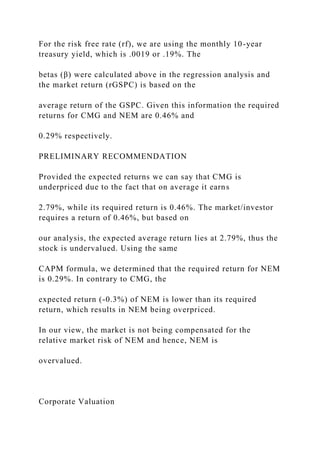
For the risk free rate (rf), we are using the monthly 10-year
treasury yield, which is .0019 or .19%. The
betas (β) were calculated above in the regression analysis and
the market return (rGSPC) is based on the
average return of the GSPC. Given this information the required
returns for CMG and NEM are 0.46% and
0.29% respectively.
PRELIMINARY RECOMMENDATION
Provided the expected returns we can say that CMG is
underpriced due to the fact that on average it earns
2.79%, while its required return is 0.46%. The market/investor
requires a return of 0.46%, but based on
our analysis, the expected average return lies at 2.79%, thus the
stock is undervalued. Using the same
CAPM formula, we determined that the required return for NEM
is 0.29%. In contrary to CMG, the
expected return (-0.3%) of NEM is lower than its required
return, which results in NEM being overpriced.
In our view, the market is not being compensated for the
relative market risk of NEM and hence, NEM is
overvalued.
Corporate Valuation
- 16 -
DISCOUNTED CASH FLOW MODEL
The first model we used to determine the fundamental value of
Chipotle is a two-step Discounted Cash
Flow Model [DCF]. Table 9 summarizes our forecasts up to
FY2018 using FY2015 as the basis year. This
3-years period is in line with the management forecast period,
which we see as a period of higher growth
rates converging towards our long term growth rate of c. 2.0%.
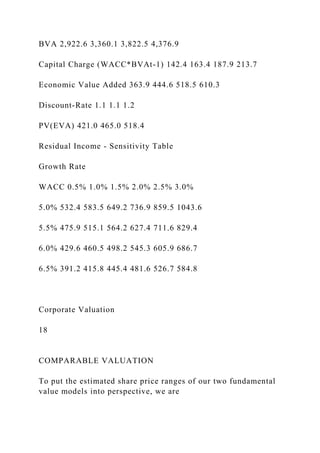
Table 9 - Free Cash Flow Forecasts
Based on these forecasts, Table 10 provides an overview of the
DCF model. Chipotle has no interest
bearing debt and thus an Equity Ratio of 100%. Hence, the
WACC is purely dependent on the Cost of Equity,
which we calculated with the Capital Asset Pricing Model. The
WACC of 5.6% is used as the discount rate
for the Free Cash Flows resulting in a total present value of
$1,855.0m.
Table 10 - Model Overview
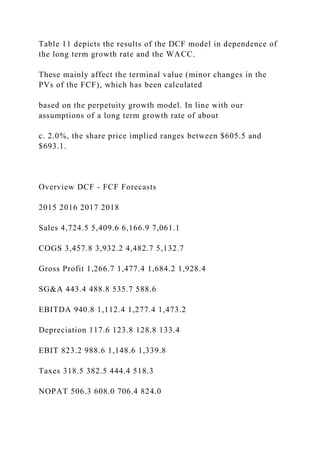
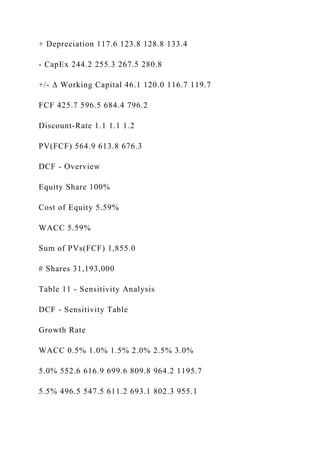
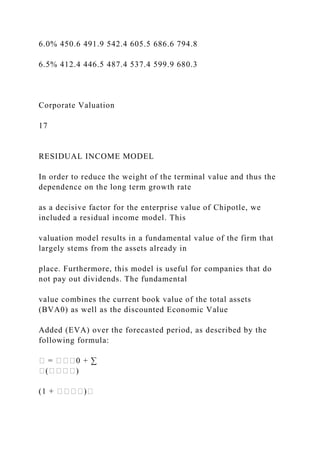
Table 11 depicts the results of the DCF model in dependence of
the long term growth rate and the WACC.
These mainly affect the terminal value (minor changes in the
PVs of the FCF), which has been calculated
based on the perpetuity growth model. In line with our
assumptions of a long term growth rate of about
c. 2.0%, the share price implied ranges between $605.5 and
$693.1.
Overview DCF - FCF Forecasts
2015 2016 2017 2018
Sales 4,724.5 5,409.6 6,166.9 7,061.1
COGS 3,457.8 3,932.2 4,482.7 5,132.7
Gross Profit 1,266.7 1,477.4 1,684.2 1,928.4
SG&A 443.4 488.8 535.7 588.6
EBITDA 940.8 1,112.4 1,277.4 1,473.2
Depreciation 117.6 123.8 128.8 133.4
EBIT 823.2 988.6 1,148.6 1,339.8
Taxes 318.5 382.5 444.4 518.3
NOPAT 506.3 608.0 706.4 824.0
+ Depreciation 117.6 123.8 128.8 133.4
- CapEx 244.2 255.3 267.5 280.8
+/- ∆ Working Capital 46.1 120.0 116.7 119.7
FCF 425.7 596.5 684.4 796.2
Discount-Rate 1.1 1.1 1.2
PV(FCF) 564.9 613.8 676.3
DCF - Overview
Equity Share 100%
Cost of Equity 5.59%
WACC 5.59%
Sum of PVs(FCF) 1,855.0
# Shares 31,193,000
Table 11 - Sensitivity Analysis
DCF - Sensitivity Table
Growth Rate
WACC 0.5% 1.0% 1.5% 2.0% 2.5% 3.0%
5.0% 552.6 616.9 699.6 809.8 964.2 1195.7
5.5% 496.5 547.5 611.2 693.1 802.3 955.1
6.0% 450.6 491.9 542.4 605.5 686.6 794.8
6.5% 412.4 446.5 487.4 537.4 599.9 680.3
Corporate Valuation
17
RESIDUAL INCOME MODEL
In order to reduce the weight of the terminal value and thus the
dependence on the long term growth rate
as a decisive factor for the enterprise value of Chipotle, we
included a residual income model. This
valuation model results in a fundamental value of the firm that
largely stems from the assets already in
place. Furthermore, this model is useful for companies that do
not pay out dividends. The fundamental
value combines the current book value of the total assets
(BVA0) as well as the discounted Economic Value
Added (EVA) over the forecasted period, as described by the
following formula:
� = ���0 + ∑
�(����)
(1 + ����)�
�
�=1
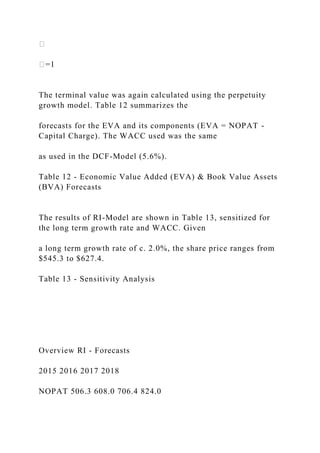
The terminal value was again calculated using the perpetuity
growth model. Table 12 summarizes the
forecasts for the EVA and its components (EVA = NOPAT -
Capital Charge). The WACC used was the same
as used in the DCF-Model (5.6%).
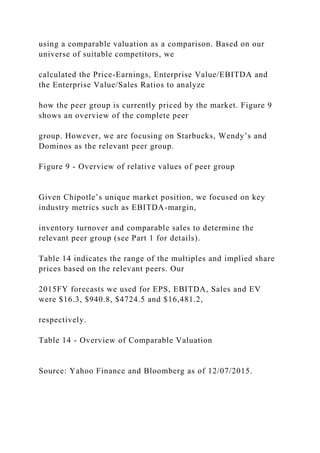
Table 12 - Economic Value Added (EVA) & Book Value Assets
(BVA) Forecasts
The results of RI-Model are shown in Table 13, sensitized for
the long term growth rate and WACC. Given
a long term growth rate of c. 2.0%, the share price ranges from
$545.3 to $627.4.
Table 13 - Sensitivity Analysis
Overview RI - Forecasts
2015 2016 2017 2018
NOPAT 506.3 608.0 706.4 824.0
BVA 2,922.6 3,360.1 3,822.5 4,376.9
Capital Charge (WACC*BVAt-1) 142.4 163.4 187.9 213.7
Economic Value Added 363.9 444.6 518.5 610.3
Discount-Rate 1.1 1.1 1.2
PV(EVA) 421.0 465.0 518.4
Residual Income - Sensitivity Table
Growth Rate
WACC 0.5% 1.0% 1.5% 2.0% 2.5% 3.0%
5.0% 532.4 583.5 649.2 736.9 859.5 1043.6
5.5% 475.9 515.1 564.2 627.4 711.6 829.4
6.0% 429.6 460.5 498.2 545.3 605.9 686.7
6.5% 391.2 415.8 445.4 481.6 526.7 584.8
Corporate Valuation
18
COMPARABLE VALUATION
To put the estimated share price ranges of our two fundamental
value models into perspective, we are
using a comparable valuation as a comparison. Based on our
universe of suitable competitors, we
calculated the Price-Earnings, Enterprise Value/EBITDA and
the Enterprise Value/Sales Ratios to analyze
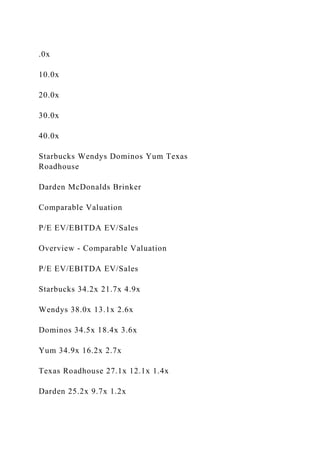
how the peer group is currently priced by the market. Figure 9
shows an overview of the complete peer
group. However, we are focusing on Starbucks, Wendy’s and
Dominos as the relevant peer group.
Figure 9 - Overview of relative values of peer group
Given Chipotle’s unique market position, we focused on key
industry metrics such as EBITDA-margin,
inventory turnover and comparable sales to determine the
relevant peer group (see Part 1 for details).
Table 14 indicates the range of the multiples and implied share
prices based on the relevant peers. Our
2015FY forecasts we used for EPS, EBITDA, Sales and EV
were $16.3, $940.8, $4724.5 and $16,481.2,
respectively.
Table 14 - Overview of Comparable Valuation
Source: Yahoo Finance and Bloomberg as of 12/07/2015.
.0x
10.0x
20.0x
30.0x
40.0x
Starbucks Wendys Dominos Yum Texas
Roadhouse
Darden McDonalds Brinker
Comparable Valuation
P/E EV/EBITDA EV/Sales
Overview - Comparable Valuation
P/E EV/EBITDA EV/Sales
Starbucks 34.2x 21.7x 4.9x
Wendys 38.0x 13.1x 2.6x
Dominos 34.5x 18.4x 3.6x
Yum 34.9x 16.2x 2.7x
Texas Roadhouse 27.1x 12.1x 1.4x
Darden 25.2x 9.7x 1.2x
Brinker 14.8x 8.2x 1.3x
Overall Average 29.8x 14.2x 2.5x
Average Relevant Peer Group 35.5x 17.7x 3.7x
High 38.0x 21.7x 4.9x
Average Price 577.5 534.5 555.9
High Price 617.0 653.6 736.1
Corporate Valuation
19
FINAL RECOMMENDATION
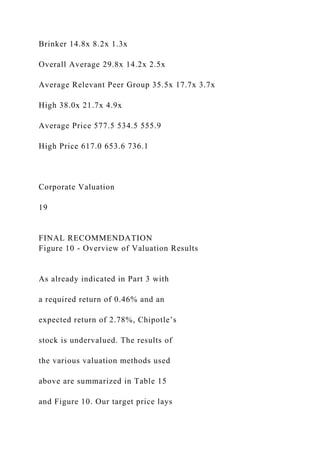
Figure 10 - Overview of Valuation Results
As already indicated in Part 3 with
a required return of 0.46% and an
expected return of 2.78%, Chipotle’s
stock is undervalued. The results of
the various valuation methods used
above are summarized in Table 15
and Figure 10. Our target price lays
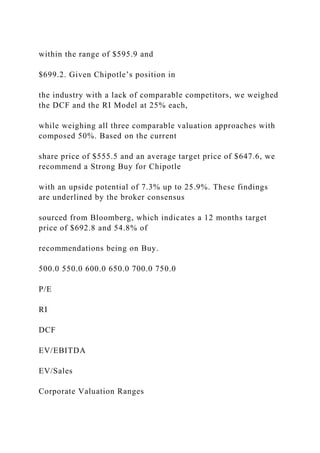
within the range of $595.9 and
$699.2. Given Chipotle’s position in
the industry with a lack of comparable competitors, we weighed
the DCF and the RI Model at 25% each,
while weighing all three comparable valuation approaches with
composed 50%. Based on the current
share price of $555.5 and an average target price of $647.6, we
recommend a Strong Buy for Chipotle
with an upside potential of 7.3% up to 25.9%. These findings
are underlined by the broker consensus
sourced from Bloomberg, which indicates a 12 months target
price of $692.8 and 54.8% of
recommendations being on Buy.
500.0 550.0 600.0 650.0 700.0 750.0
P/E
RI
DCF
EV/EBITDA
EV/Sales
Corporate Valuation Ranges
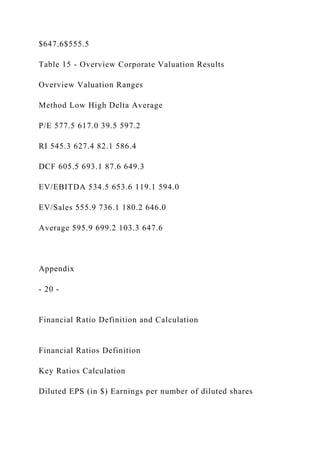
$647.6$555.5
Table 15 - Overview Corporate Valuation Results
Overview Valuation Ranges
Method Low High Delta Average
P/E 577.5 617.0 39.5 597.2
RI 545.3 627.4 82.1 586.4
DCF 605.5 693.1 87.6 649.3
EV/EBITDA 534.5 653.6 119.1 594.0
EV/Sales 555.9 736.1 180.2 646.0
Average 595.9 699.2 103.3 647.6
Appendix
- 20 -
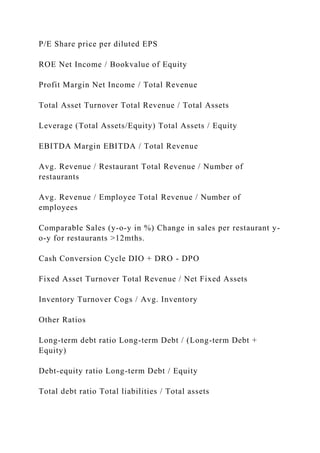
Financial Ratio Definition and Calculation
Financial Ratios Definition
Key Ratios Calculation
Diluted EPS (in $) Earnings per number of diluted shares
P/E Share price per diluted EPS
ROE Net Income / Bookvalue of Equity
Profit Margin Net Income / Total Revenue
Total Asset Turnover Total Revenue / Total Assets
Leverage (Total Assets/Equity) Total Assets / Equity
EBITDA Margin EBITDA / Total Revenue
Avg. Revenue / Restaurant Total Revenue / Number of
restaurants
Avg. Revenue / Employee Total Revenue / Number of
employees
Comparable Sales (y-o-y in %) Change in sales per restaurant y-
o-y for restaurants >12mths.
Cash Conversion Cycle DIO + DRO - DPO
Fixed Asset Turnover Total Revenue / Net Fixed Assets
Inventory Turnover Cogs / Avg. Inventory
Other Ratios
Long-term debt ratio Long-term Debt / (Long-term Debt +
Equity)
Debt-equity ratio Long-term Debt / Equity
Total debt ratio Total liabilities / Total assets
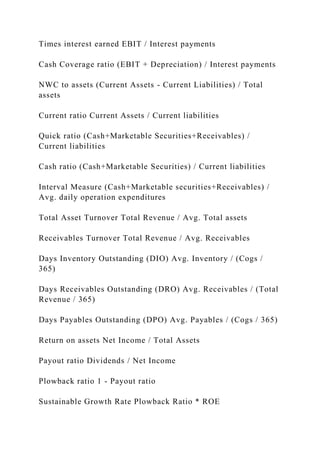
Times interest earned EBIT / Interest payments
Cash Coverage ratio (EBIT + Depreciation) / Interest payments
NWC to assets (Current Assets - Current Liabilities) / Total
assets
Current ratio Current Assets / Current liabilities
Quick ratio (Cash+Marketable Securities+Receivables) /
Current liabilities
Cash ratio (Cash+Marketable Securities) / Current liabilities
Interval Measure (Cash+Marketable securities+Receivables) /
Avg. daily operation expenditures
Total Asset Turnover Total Revenue / Avg. Total assets
Receivables Turnover Total Revenue / Avg. Receivables
Days Inventory Outstanding (DIO) Avg. Inventory / (Cogs /
365)
Days Receivables Outstanding (DRO) Avg. Receivables / (Total
Revenue / 365)
Days Payables Outstanding (DPO) Avg. Payables / (Cogs / 365)
Return on assets Net Income / Total Assets
Payout ratio Dividends / Net Income
Plowback ratio 1 - Payout ratio
Sustainable Growth Rate Plowback Ratio * ROE
Operating Margin EBIT / Total Revenue
FRL 4401 WRDS Classroom Project
Due Date: 3/12/2020 @ 11:59pm
Beta Visualization Module
Understanding statistical measures of risk is fundamental to
understanding investing. In particular, a stock’s CAPM beta
coefficient (β) and value are two important risk measures. Beta
measures the degree to which stock and benchmark returns
move together, while the coefficient of determination, or ,
represents the strength of the relationship between the stock and
the benchmark. The Beta Visualization application provides a
rich graphical interface to help visualize and interpret the
relationship between the CAPM beta coefficient and
Access the Beta Visualization tool using the following URL:
https://wrds-classroom.wharton.upenn.edu/betas/
1. Choose Information Technology industry and answer the
following:
a. locate the highest and lowest beta stocks in the Information
Technology industry
b. find the corresponding R2 values for the highest and lowest
beta stock.
2. Locate the industries with the highest and lowest average
industry beta
3. Locate the industry with an average industry beta closest to
the market beta
4. Find the Beta and R2 of Apple INC, what percent of Apple’s
return can be explained by the return of the benchmark? Is
Apple’s return more volatile or less volatile than the market
return? How much more or less volatile?
CAPM Equity Valuation Module
In this exercise, you are tasked with downloading historical
returns of Microsoft to estimate its beta, then asked to compute
the cost of equity using the Capital Asset Pricing Model
(CAPM). Click the Link to Platform button or use the
following link to retrieve the historical return of Microsoft from
2012 to 2017: https://wrds-classroom.wharton.upenn.edu/stock-
returns/
1. Using S&P return as the market return, calculate the five-
year monthly regression Beta of Microsoft.
2. Calculate the Jensen’s alpha of Microsoft.
3. During 2012-2017, what percentage of Microsoft’s excess
returns can be attributed to the market portfolio returns?
Click the Link to Platform button or use the following link to
retrieve the historical return of Vanguard Information
Technology ETF (VGT VIS) returns from 2012 to 2017:
https://wrds-classroom.wharton.upenn.edu/etf-and-factor-
returns/
1. Using S&P return as the market return, calculate the five-
year monthly regression Beta of VGT VIS.
2. Calculate the Jensen’s alpha of VGT VIS.
3. During 2012-2017, what percentage of VGT VIS’ excess
returns can be attributed to the market portfolio returns?
Financial Ratios Visualization Module
The Financial Ratios Visualization Tool is an application that
helps you envision over 70 different financial ratios for easy
comparison. The bar graph provides a visual display for
comparing financial ratios between individual companies, as
well as to the median for each industry sector. For ease of use,
the financial ratios are grouped by category according to what is
being measured. Click the Link to Platform button or use the
following link to retrieve financial ratios: https://wrds-
classroom.wharton.upenn.edu/financial-ratios/. Answer the
following questions:
1. What are the different categories of financial ratios? What
does each category of ratio measure?
2. Which industry has the highest average dividend payout
ratio?
3. Which industry has the lowest average ROE?
4. Which industry has the lowest average net profit margin?
5. Excluding the Financial Industry, which industry has the
lowest average asset turnover?
6. Excluding the Financial Industry, which industry has the
lowest financial leverage?
Three Levers of Performance Module
In this module, you will learn how managers can use three
levers to increase ROE:
1. The Profit Margin: earnings out of every sale. It involves
working on the company’s income statement by trying to
squeeze out as much profit out of the sales.
2. The Asset Turnover: the sales generated out of the assets
invested in the company. As a manager, it involves working on
the assets side of the balance sheet to make sure that the assets
employed are delivering as much sales.
3. The Financial Leverage: the amount of equity needed to
finance the assets. Managers can work on the liability side of
the balance sheet to tune the amount of equity required to
finance all the assets.
Using the Financial Statement web query, download and report
basic financial ratios for Adobe (ADBE); General Motors
(GM); Hewlett-Packard (HPQ); Google (GOOG); and Southwest
Airlines (LUV) from 1990-2015: https://wrds-
classroom.wharton.upenn.edu/financial-statements/. Download
results in Excel. Compute ratios every 5 years to see trends:
1990; 1995; 2000; 2005; 2010; 2015. Look into the variation of
the three components and answer the following questions:
1. Did financial performance change due to an increase in the
Profit Margin or in Leverage?
2. Which determinants of ROE are more difficult to improve
from a managers’ perspective?
3. How can companies increase Asset Turnover? Give examples
in the retail industry.
4. Interpret the differences in three levers: identify real
changes in the businesses that would reflect a change in the
ratios.
5. What type of companies display higher levels of leverage?
4
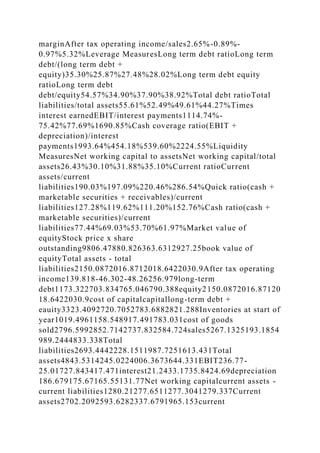
NikeNike's Performance Measures Performance
Measures2019201820172016Source (Link)Market value added
($ millions)Market value of equity – book value of
equity117099.28114214.8478047.3286378.37https://www.macro
trends.net/stocks/charts/NKE/nike/financial-ratiosMarket to
book ratioMarket value of equity ÷ book value of
equity13.9512.647.298.05Profitability MeasuresReturn on
assets (ROA) %After tax operating income/total
assets16.998.5818.2317.59Return on capital (ROC)After tax
operating income / (long-term debt +
equity)32.22%14.56%26.70%26.38%Return on equity (ROE)Net
income/equity44.5719.734.1730.67EVA ($ millions)After tax
operating income – cost of capital x capitalEBITDANet Income
+ interest + taxes + depreciation +
amortization5492521954655164Efficiency MeasuresAsset
turnoverSales/total assets at start of
year1.651.611.481.51Receivables turnoverSales/receivables at
start of year9.1710.419.349.99Average collection period
(days)Receivables at start of year/daily
sales39.8635.0839.0736.54Inventory turnoverCost of goods
sold/inventory at start of year3.853.893.773.6Days in
inventoryInventories at start of year/daily cost of goods
sold88.7290.2692.7690.95Profit marginNet
income/sales10.35.3112.3411.61Operating profit marginAfter
tax operating income/sales10.30%5.31%12.34%11.61%Leverage
MeasuresLong term debt ratioLong term debt/(long term debt +
equity)27.70%26.11%21.86%13.98%Long term debt equity
ratioLong term debt
debt/equity38.32%35.34%27.98%16.26%Total debt ratioTotal
liabilities/total assets61.88%56.46%46.66%42.66%Times
interest earnedEBIT/interest
payments38.4837.9957.91136.42Cash coverage ratio(EBIT +
depreciation)/interest payments44.1744.3866.52156.09Liquidity
MeasuresNet working capital to assetsNet working capital/total
assets52.40%60.09%65.92%64.34%Current ratioCurrent
assets/current liabilities2.12.512.932.8Quick ratio(cash +
marketable securities + receivables)/current liabilitiesCash
ratio(cash + marketable securities)/current liabilitiesDays in
Inventory365/ Inventory Turnover959497101Days in A/R365/
A/R Turnover40353937Days in A/P365/ A/P TurnoverMarket
value of equityStock price x share
outstanding126139.28124026.8490454.3298636.37book value of
equityTotal assets - total liabilities904098121240712258After
tax operating income4029193342403760long-term
debt3464346834711993equity904098121240712258cost of
capitalcapitallong-term debt +
eauity12504132801587814251Inventories at start of
year5261505548384337cost of goods
sold21643204411903817405sales39117363973435032376Total
liabilities1467712724108529121total
assets23717225362325921379EBIT4772444547494502interest1
241178233https://www.marketwatch.com/investing/stock/nke/fi
nancialsdepreciation705747706649https://www.marketwatch.co
m/investing/stock/nke/financialsNet working capitalcurrent
assets - current liabilities86599094105879667Current
assets16525151341606115025current
liabilities7866604054745358cash
4663524561795457receivables4270350036803240marketable
securitiesStock price77.9674.7653.4656.59Share
outstanding1618165916921743Cost of capital[(E/V) * Re] +
[(D/V) * Rd * (1-
Tc)]https://www.thebalancesmb.com/calculate-weighted-
average-cost-of-capital-
393130https://www.macrotrends.net/stocks/charts/NKE/nike/fin
ancial-
ratioshttps://www.marketwatch.com/investing/stock/nke/financi
alshttps://www.marketwatch.com/investing/stock/nke/financials
https://www.thebalancesmb.com/calculate-weighted-average-
cost-of-capital-393130
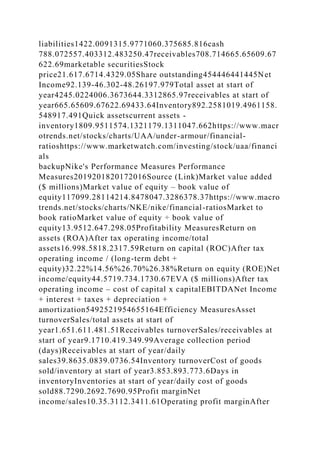
Under ArmourUnder Armour's Performance
MeasuresPerformance Measures2019201820172016Source
(Link)Market value added ($ millions)Market value of equity –
book value of
equity7656.315863.954344.9910896.35https://www.macrotrends
.net/stocks/charts/UAA/under-armour/financial-ratiosMarket to
book ratioMarket value of equity ÷ book value of
equity4.563.913.156.37https://www.marketwatch.com/investing/
stock/uaa/financialsProfitability MeasuresReturn on assets
(ROA)After tax operating income/total assets2.89%-1.09%-
1.20%7.05%Return on capital (ROC)After tax operating income
/ (long-term debt + equity)4.21%-1.70%-1.73%9.11%Return on
equity (ROE)Net income/equity4.29%-2.30%-2.39%9.75%EVA
($ millions)After tax operating income – cost of capital x
capitalEBITDANet Income + interest + taxes + depreciation +
amortization423.449157.005201.844562.241Efficiency
MeasuresAsset turnoverSales/total assets at start of
year124.08%129.62%136.90%168.65%Receivables
turnoverSales/receivables at start of
year791.28%851.80%801.24%1114.60%Average collection
period (days)Receivables at start of year/daily
sales46.1342.8545.5532.75Inventory turnoverCost of goods
sold/inventory at start of
year274.31%246.23%298.40%330.09%Days in
inventoryInventories at start of year/daily cost of goods
sold133.06148.23122.32110.58Profit marginNet
income/sales1.75%-0.89%-0.97%4.10%Operating profit
marginAfter tax operating income/sales2.65%-0.89%-
0.97%5.32%Leverage MeasuresLong term debt ratioLong term
debt/(long term debt +
equity)35.30%25.87%27.48%28.02%Long term debt equity
ratioLong term debt
debt/equity54.57%34.90%37.90%38.92%Total debt ratioTotal
liabilities/total assets55.61%52.49%49.61%44.27%Times
interest earnedEBIT/interest payments1114.74%-
75.42%77.69%1690.85%Cash coverage ratio(EBIT +
depreciation)/interest
payments1993.64%454.18%539.60%2224.55%Liquidity
MeasuresNet working capital to assetsNet working capital/total
assets26.43%30.10%31.88%35.10%Current ratioCurrent
assets/current
liabilities190.03%197.09%220.46%286.54%Quick ratio(cash +
marketable securities + receivables)/current
liabilities127.28%119.62%111.20%152.76%Cash ratio(cash +
marketable securities)/current
liabilities77.44%69.03%53.70%61.97%Market value of
equityStock price x share
outstanding9806.47880.826363.6312927.25book value of
equityTotal assets - total
liabilities2150.0872016.8712018.6422030.9After tax operating
income139.818-46.302-48.26256.979long-term
debt1173.322703.834765.046790.388equity2150.0872016.87120
18.6422030.9cost of capitalcapitallong-term debt +
eauity3323.4092720.7052783.6882821.288Inventories at start of
year1019.4961158.548917.491783.031cost of goods
sold2796.5992852.7142737.832584.724sales5267.1325193.1854
989.2444833.338Total
liabilities2693.4442228.1511987.7251613.431Total
assets4843.5314245.0224006.3673644.331EBIT236.77-
25.01727.843417.471interest21.2433.1735.8424.69depreciation
186.679175.67165.55131.77Net working capitalcurrent assets -
current liabilities1280.21277.6511277.3041279.337Current
assets2702.2092593.6282337.6791965.153current
liabilities1422.0091315.9771060.375685.816cash
788.072557.403312.483250.47receivables708.714665.65609.67
622.69marketable securitiesStock
price21.617.6714.4329.05Share outstanding454446441445Net
Income92.139-46.302-48.26197.979Total asset at start of
year4245.0224006.3673644.3312865.97receivables at start of
year665.65609.67622.69433.64Inventory892.2581019.4961158.
548917.491Quick assetscurrent assets -
inventory1809.9511574.1321179.1311047.662https://www.macr
otrends.net/stocks/charts/UAA/under-armour/financial-
ratioshttps://www.marketwatch.com/investing/stock/uaa/financi
als
backupNike's Performance Measures Performance
Measures2019201820172016Source (Link)Market value added
($ millions)Market value of equity – book value of
equity117099.28114214.8478047.3286378.37https://www.macro
trends.net/stocks/charts/NKE/nike/financial-ratiosMarket to
book ratioMarket value of equity ÷ book value of
equity13.9512.647.298.05Profitability MeasuresReturn on
assets (ROA)After tax operating income/total
assets16.998.5818.2317.59Return on capital (ROC)After tax
operating income / (long-term debt +
equity)32.22%14.56%26.70%26.38%Return on equity (ROE)Net
income/equity44.5719.734.1730.67EVA ($ millions)After tax
operating income – cost of capital x capitalEBITDANet Income
+ interest + taxes + depreciation +
amortization5492521954655164Efficiency MeasuresAsset
turnoverSales/total assets at start of
year1.651.611.481.51Receivables turnoverSales/receivables at
start of year9.1710.419.349.99Average collection period
(days)Receivables at start of year/daily
sales39.8635.0839.0736.54Inventory turnoverCost of goods
sold/inventory at start of year3.853.893.773.6Days in
inventoryInventories at start of year/daily cost of goods
sold88.7290.2692.7690.95Profit marginNet
income/sales10.35.3112.3411.61Operating profit marginAfter
tax operating income/sales10.30%5.31%12.34%11.61%Leverage
MeasuresLong term debt ratioLong term debt/(long term debt +
equity)27.70%26.11%21.86%13.98%Long term debt equity
ratioLong term debt
debt/equity38.32%35.34%27.98%16.26%Total debt ratioTotal
liabilities/total assets61.88%56.46%46.66%42.66%Times
interest earnedEBIT/interest
payments38.4837.9957.91136.42Cash coverage ratio(EBIT +
depreciation)/interest payments44.1744.3866.52156.09Liquidity
MeasuresNet working capital to assetsNet working capital/total
assets52.40%60.09%65.92%64.34%Current ratioCurrent
assets/current liabilities2.12.512.932.8Quick ratio(cash +
marketable securities + receivables)/current liabilitiesCash
ratio(cash + marketable securities)/current liabilitiesMarket
value of equityStock price x share
outstanding126139.28124026.8490454.3298636.37book value of
equityTotal assets - total liabilities904098121240712258After
tax operating income4029193342403760long-term
debt3464346834711993equity904098121240712258cost of
capitalcapitallong-term debt +
eauity12504132801587814251Inventories at start of
year5261505548384337cost of goods
sold21643204411903817405sales39117363973435032376Total
liabilities1467712724108529121total
assets23717225362325921379EBIT4772444547494502interest1
241178233https://www.marketwatch.com/investing/stock/nke/fi
nancialsdepreciation705747706649https://www.marketwatch.co
m/investing/stock/nke/financialsNet working capitalcurrent
assets - current liabilities86599094105879667Current
assets16525151341606115025current
liabilities7866604054745358cash
4663524561795457receivables4270350036803240marketable
securitiesStock price77.9674.7653.4656.59Share
outstanding1618165916921743Cost of capital[(E/V) * Re] +
[(D/V) * Rd * (1-
Tc)]https://www.thebalancesmb.com/calculate-weighted-
average-cost-of-capital-
393130https://www.macrotrends.net/stocks/charts/NKE/nike/fin
ancial-
ratioshttps://www.marketwatch.com/investing/stock/nke/financi
alshttps://www.marketwatch.com/investing/stock/nke/financials
https://www.thebalancesmb.com/calculate-weighted-average-
cost-of-capital-393130

Initial Valuation Report Chipotle Mexican Grill, Inc.docx

  • 1.
    Initial Valuation Report ChipotleMexican Grill, Inc. 12/14/2015 Final Report CONTENT Executive Summary ............................................................................................... .......................................................................... 1 Company and Industry Overview ............................................................................................... .............................................. 2 Chipotle Mexican Grill - The Business ............................................................................................... ..................................... 2 Strategic Highlights ............................................................................................... ......................................................................... 2
  • 2.
    Restaurant Industry -The Playing Field ............................................................................................... ................................ 2 Financial Ratio Analysis .......................................................................................... ..... ................................................................. 4 Key Ratios across Industry ............................................................................................... ........................................................... 4 DuPont Analysis ............................................................................................... ................................................................................ 5 Profitability across Industry ............................................................................................... ........................................................ 6 Detailed Revenue Analysis ............................................................................................... ........................................................... 7 Other Key Ratios ............................................................................................... ............................................................................... 8 Forecast of Financial Statements ............................................................................................... .............................................. 9 Financial Statements – 2015-2020 ............................................................................................... ........................................... 9
  • 3.
    Sustainable long termgrowth rate analysis ............................................................................................... ...................... 10 Underlying assumptions ............................................................................................... ............................................................ 10 Risk and Return Analysis ............................................................................................... ........................................................... 12 Overview Risk/Return Analysis ............................................................................................... .............................................. 12 Portfolio Simulation ............................................................................................... ..................................................................... 13 Calculation of Beta ............................................................................................... ........................................................................ 14 Required Returns based on Capital Asset Pricing Model [CAPM] .......................................................................... 15 Preliminary Recommendations ............................................................................................... .............................................. 15 Corporate Valuation ............................................................................................... ...................................................................... 16 Discounted Cash Flow Model
  • 4.
    ............................................................................................... ................................................... 16 Residual IncomeModel ............................................................................................... .............................................................. 17 Comparable Valuation ............................................................................................... ................................................................. 18 Final Recommendation ............................................................................................... ............................................................... 19 Appendix ............................................................................................... .............................................................................................. 20 Calculation Financial Ratios ............................................................................................... ..................................................... 20 Executive Summary - 1 - Chipotle Mexican Grill, Inc. STRONG BRAND WITH CONTINUOUS GROWTH
  • 5.
    Over the last3 years, Chipotle experienced a strong growth period reflected by top line growth rates of up to 28% (FY2014) and EBITDA growth rates of up to 30% (FY2014). This growth was driven by menu price increases as well as organic restaurant expansions. In addition, Chipotle’s brand has been strengthened continuously with a focus on fresh ingredients and a sustainable and transparent supply chain management. Based on this strong brand development, Chipotle has manifested itself in its unique position combining high margins as seen in the fast food industry with a high quality casual dining experience. However, recent e- coli cases across several restaurants resulted in a significant drawback in Q4/2015 resulting in a price drop of -23.8% in the last 3 months. Nevertheless, we still see a continuous growth potential for the next 3-years period, in particular with expansion opportunities in Europe and Canada as well as increasing enhancement of the new restaurant concepts, ShopHouse Southeast Asian Kitchen and Pizzeria Locale.
  • 6.
    FINANCIAL HIGHLIGHTS Chipotle’s financialssupport the strategic focus that has been the center of the business. This success is manifested throughout the financial statements, which indicate a strong growth momentum from top to bottom line. Even though these developments were driven by high over proportional rise of marketing costs, the profit margins could slightly increase. Comparable Sales rose up to 16.8% in 2014, the highest value in the industry. A high P/E ratio compared to its competitors underlines the market perception of continuous growth and investment opportunities. CHIPOTLES COMPETITIVE FINANCIAL POSITION The profitable positioning in between the fast food and the casual dining industry is reflected in several financial ratios. Stable EBITDA-Margins of around 20% are comparable to Starbucks’ or Dominos’ margins, while a high inventory turnover close to 200x
  • 7.
    underlines the strategicbrand position with fresh and high quality ingredients similar to Wendy’s business model. In addition, the negative cash conversion cycle highlights Chipotle’s good relations to its suppliers, which is key, given the importance of a stable supplier network as basis for expansion. Share Price Development Key Financials Analyst Team Earl Hall Spencer Hayles Patrick Herrmann
  • 8.
    Abigail Munguia Benjamin Whitesell BalanceSheet, Income & Cash Flow Statement (in $m) 2012 2013 2014 Cash 473 578 758 Current Assets 547 666 878 Net PPE 867 963 1107 Total Liabilities 423 471 534 Total Equity 1246 1538 2012 Retained Earnings 949 1277 1722 Total Assets 1669 2009 2546 Revenue 2731 3215 4108 COGS 1991 2360 2991 Operating Expenses 279 315 400 EBITDA 545 636 828 EBITDA Margin (%) 20.0 19.8 20.2 D&A 84 96 110 Net Income 278 327 445 Profit Margin (%) 10 10 11
  • 9.
    Operating Cashflow 420529 682 Net change in Cash -79 1 96 Free Cash Flow 223 329 429 Growth Rates (in %) 2013 2014 Revenue 18% 28% COGS 19% 27% Operating Expenses 13% 27% EBITDA 17% 30% Net Income 18% 36% Net PPE 11% 15% Total Liabilities 11% 13% Total Equity 23% 31% Retained Earnings 34% 35% Key Ratios (Avg. Sales in $m) 2012 2013 2014 ROE 24.3 23.5 25.1 Diluted EPS 29.4 19.7 35.0 P/E 50.1x 44.8x 56.6x
  • 10.
    Avg. Sales /Restaurant 1.9 2.0 2.3 Avg. Sales / Employees 0.07 0.07 0.08 Comp. Sales 7.1% 5.6% 16.8% Fixed Asset Turnover 3.2x 3.3x 3.7x Cash Conversion -6.1 -4.9 -3.5 $350 $400 $450 $500 $550 $600 $650 $700 $750 $800 Strong Buy Target Price: $647.6 Upside Potential: 7.3% - 25.9%
  • 11.
    Company and IndustryOverview - 2 - CHIPOTLE MEXICAN GRILL – THE BUSINESS Chipotle Mexican Grill, Inc. opened its first restaurant in Denver, Colorado on July 13, 1993. 1 Their corporate office is located in Denver Colorado where their first restaurant was opened. Chipotle has a focused menu that offers tacos, burritos, burrito bowls, and salads.2 However, although they only offer a selected amount of products Chipotle management explains that given the various ways customers can create their product, this provides them with a variety of choices. In addition to the Chipotle Mexican Grill restaurants they also own ShopHouse Southeast Asian Kitchen and Pizzeria Locale. As of December 31, 2014 they owned 1,783 restaurants total, of which 1,755 were Chipotle Mexican Grill establishments, and they had 53,090 employees.3 Chipotle has implemented what they call “Food with Integrity”, which means that they only use ingredients that are made in accordance to safe animal practice and crops that are grown in awareness off the environment. The standards that the company has in place makes it difficult
  • 12.
    for them tofind suppliers that meet their requirements and hence makes their suppliers a very important part of their business. Given the higher cost incurred with producing these ingredients, Chipotle has higher cost for their supplies and ingredients used to produce their products. However, Chipotle has seen benefits in maintaining their standards regardless of the increased cost associated with them. These standards have garnered Chipotle with customer loyalty, which is highly sought after in the restaurant industry. Figure 1 - Revenue Split by Geography Figure 2 - Shareholder Analysis STRATEGIC HIGHLIGHTS 2015 Strategic goals for Chipotle center around “thoughtful growth of the Chipotle brand”. This includes a location expansion of 190 to 205 additional Chipotle locations through their broadened development activity, which now incorporates “smaller or more economically mixed communities, highway sites, outlet centers, and military bases.” Additionally, this involves a continued expansion in marketing toward
  • 13.
    development of “ownedmedia” and production of branded content as a means of demonstrating Chipotle’s “food with integrity” philosophy. Given this emphasis on growth of the Chipotle brand, CMG is focused on maintaining its current adaptations of the Chipotle philosophy to other food styles in the form 1 How I got started: Steve Ells of Chipotle. (2010, October 6). Retrieved October 8, 2015, from http://archive.fortune.com/2010/10/06/smallbusiness/chipotle_st arted.fortune/index.htm 2 “2014 From 10-K, Chipotle Mexican Grill, Inc.” United States Securities and Exchange Commission. 2014-12-31. Retrieved 2015- 10-8 3 “2014 From 10-K, Chipotle Mexican Grill, Inc.” United States Securities and Exchange Commission. 2014-12-31. Retrieved 2015- 10-8 4% 25% 30% 11% 30% Northeast Midwest Atlantic South West
  • 14.
    12% 8% 6% 66% 8% FMR Vanguard Group SandsCapital Other Institutionals Others Company and Industry Overview - 3 - of ShopHouse Southeast Asian Kitchen and Pizzeria Locale and not pushing any type of rapid expansion. Additionally, given its limited brand recognition overseas and overall greater risk internationally, only modest international expansion is planned. RESTAURANT INDUSTRY – THE PLAYING FIELD Chipotle Mexican Grill, Inc. takes up a unique position within the restaurant industry. Its business model combines fast food with the casual dining industry. The restaurant industry is defined by several factors
  • 15.
    and success drivers.Most fast food restaurants franchise their restaurant due to funding or location- picking. Chipotle owns all their restaurants, as rather usual for casual dining restaurants, to stay in control and maintain its image. Another current issue are the increasing wages and thus labor costs within the industry. A trend of retaining employees has begun. In addition, pressure to serve higher quality of food has increased costs and caused many fast food chains to start closing locations. The growing trend to eat healthy and gain information about the origin and quality of ingredients has hurt firms which don’t have the build-your-own model allowing customer to customize their food. One, if not the biggest selling point of the fast food industry, is to satisfy the customer’s desire for convenience. With new technology, such as mobile development and advanced ordering, fast food chains have become even more convenient. Currently the S&P Supercomposite Restaurant Index has risen 13.2% in 2015.4 As consumers tastes change restaurants try to continue to drive in traffic into their establishments. A huge driving factor for this is customer loyalty. The trend of health consciousness among consumers has risen causing them to
  • 16.
    look for healthieroptions when eating out. With the rise in awareness of additives and the quality of food, companies moving toward this direction are increasing their customer loyalty. In addition technology factors are also affecting the industry, with the increase in technology innovation restaurants can now implement these to try to decrease the wait time for ordering or paying. Companies that are using these new technologies are said to be moving in the right direction as it provides more ease for the consumer. With the demand of increase in minimum wage many restaurants are facing the difficulties in trying to manage this increase in labor cost. Similarly increasing cost in commodities impact the restaurant business, depending on the type of food offered, some companies are impacted more heavily than others. For example with the slight decrease in the price of cheese pizza chains are benefiting from this as there cost decrease.5 In attempts to curve the increase in labor cost many companies are reducing their menus to contain less options and also trying to improve the efficiency of workers. Overall, the industry appears to be doing well as it outperformed the S&P 500’s 0.5% gain.6
  • 17.
    4 “Bloomberg Intelligence:North American Restaurant Primer“ , Jennifer Bartashus, BI Industry Analyst. Retrived 2012-10-7 5 “Bloomberg Intelligence: North American Restaurant Primer“ , Jennifer Bartashus, BI Industry Analyst. Retrived 2012-10-7. Pg. 9 6 “Bloomberg Intelligence: North American Restaurant Primer“ , Jennifer Bartashus, BI Industry Analyst. Retrived 2012-10-7. Pg. 2 Financial Ratio Analysis - 4 - Source: Calculations based on company and Bloomberg data. Darden & Brinker financials as of FY Jun’15. For calculation definitions, see Appendix. Table 1 - Financial Ratios across Industry Key Ratios 2012 2013 2014 2012 2013 2014 2012 2013 2014 2012 2013 2014 2012 2013 2014 2012 2013 2014 2012 2013 2014 Diluted EPS (in $) 8.8 10.5 14.1 0.9 0.0 1.4 2.0 2.5 2.9 3.6 1.8 1.4 3.4 2.4 2.3 1.9 2.2 2.3 1.0 1.1 1.2 P/E 50.1x 44.8x 56.6x 32.2x 33.6x 34.4x 20.9x 28.5x 32.5x 14.0x 14.1x 26.5x 21.1x 20.9x 24.8x 16.5x 18.0x 18.8x 19.0x
  • 18.
    22.2x 24.1x ROE 24.3%23.5% 25.1% 29.1% 0.2% 42.4% N/A N/A N/A 25.2% 21.1% 13.6% 75.5% 47.6% 54.2% 40.4% 71.1% 145.0% 13.9% 14.3% 14.4% Profit Margin (%) 10.2% 10.2% 10.8% 10.4% 0.1% 12.6% 7.1% 7.9% 8.4% 5.9% 7.0% 4.6% 11.7% 8.3% 7.9% 5.4% 5.7% 5.3% 5.6% 5.7% 5.5% Total Asset Turnover 1.8x 1.7x 1.8x 1.7x 1.5x 1.5x 3.5x 3.4x 3.2x 1.4x 0.9x 0.9x 1.5x 1.5x 1.6x 1.9x 2.0x 2.0x 1.6x 1.7x 1.7x Leverage (Total Assets/Equity) 1.4x 1.3x 1.3x 1.6x 2.1x 2.3x N/A N/A N/A 3.0x 3.3x 3.3x 4.2x 3.9x 4.4x 3.9x 6.3x 13.9x 1.5x 1.5x 1.5x Total Revenue (in $m) 2,731 3,215 4,108 13,300 14,867 16,448 1,678 1,802 1,994 7,999 5,921 6,286 13,633 13,084 13,279 2,821 2,846 2,909 1,263 1,423 1,582 EBITDA (in $m) 545 636 828 2,578 330 3,830 316 340 389 1,089 678 613 2,939 2,519 2,296 357 388 378 157.175 171.277 189.628 EBITDA Margin (%) 20.0% 19.8% 20.2% 19.4% 2.2% 23.3% 18.8% 18.9% 19.5% 13.6% 11.5% 9.8% 21.6% 19.3% 17.3% 12.7% 13.6% 13.0% 12.4% 12.0% 12.0% No. of Restaurants 1,410 1,595 1,783 18,066 19,767 21,366 10,255 10,886 11,629 1,994 2,138 1,501 39,014 40,233 41,546 1,581 1,591 1,615 392 420 451 company owned 1,410 1,595 1,783 9,405 10,194 10,713 388 390 377 1,994 2,138 1,501 10,406 8,813 9,421 865 877 884 320 346 372
  • 19.
    franchised 0 00 8,661 9,573 10,653 9,867 10,496 11,252 0 0 0 28,608 31,420 32,125 716 714 731 72 74 79 No. of Employees 37,310 45,340 53,090 160,000 182,000 191,000 205,000 220,000 240,000 181,468 N/A 206,000 78,450 75,460 69,810 N/A N/A 55,586 40,000 45,700 43,300 Avg. Revenue / Restaurant (in $m) 1.9 2.0 2.3 0.7 0.8 0.8 0.2 0.2 0.2 4.0 2.8 4.2 0.3 0.3 0.3 1.8 1.8 1.8 3.2 3.4 3.5 Avg. Revenue / Employee (in $m) 0.07 0.07 0.08 0.08 0.08 0.09 0.01 0.01 0.01 0.04 N/A 0.03 0.17 0.17 0.19 N/A N/A 0.05 0.03 0.03 0.04 Comparable Sales (y-o-y in %) 7.1% 5.6% 16.8% 7.0% 7.0% 6.0% 4.2% 5.8% 7.2% 1.8% -1.3% N/A 4.0% -2.0% N/A 2.7% 1.0% 0.5% 4.7% 3.4% 4.7% Cash Conversion Cycle -6.1x -4.9x -3.5x 53.0x 54.0x 44.3x 6.8x 6.1x 7.7x 1.7x 3.0x 4.3x 18.6x 20.1x 15.4x -6.2x -6.1x -5.6x - 3.7x -2.2x -1.0x Fixed Asset Turnover 3.2x 3.3x 3.7x 5.3x 5.1x 4.9x 18.4x 18.5x 17.5x 4.8x 5.1x 5.4x 3.3x 3.0x 3.0x 2.7x 2.8x 2.9x 2.5x 2.5x 2.6x Inventory Turnover 199.0x 195.5x 210.8x 5.3x 5.4x 6.2x 31.1x 30.3x 37.9x 12.1x 18.0x 29.6x 34.1x 31.8x 33.1x 92.3x 97.4x 103.2x 94.4x 101.3x 98.6x Other Ratios Long-term debt ratio 15.9% 15.0% 12.5% 9.7% 22.5% 28.0% N/M N/M N/M 55.3% 53.3% 39.2% 55.9% 56.3% 65.6% 83.9% 93.0% 108.8% 8.8% 7.9% 7.6%
  • 20.
    Debt-equity ratio 18.9%17.7% 14.3% 10.7% 29.0% 38.8% N/M N/M N/M 123.8% 114.2% 64.5% 126.8% 128.7% 190.8% 522.3% 1319.1% NM 9.7% 8.6% 8.2% Total debt ratio 25.3% 23.4% 21.0% 37.8% 61.1% 51.0% N/M N/M N/M 70.3% 69.5% 61.1% 74.3% 73.9% 80.7% 89.7% 95.8% 105.5% 32.9% 32.3% 34.8% Times interest earned N/A N/A N/A 61.1x -11.6x 48.1x 3.2x 3.7x 4.3x N/A 2.3x 1.9x 15.4x 7.3x 12.0x 8.8x 8.6x 10.7x N/A N/A N/A Cash Coverage ratio N/A N/A N/A 77.9x 10.5x 59.1x 3.1x 3.8x 4.5x N/A 4.6x 3.6x 15.4x 7.3x 12.0x 13.3x 13.5x 15.7x N/A N/A N/A NWC to assets 21.6% 23.2% 24.9% 24.2% 0.8% 10.5% 16.1% 18.4% 26.3% -9.4% 5.0% -2.3% -3.1% -6.6% -9.2% -13.2% - 17.1% -15.9% -4.6% -3.4% -7.2% Current ratio 2.9x 3.3x 3.6x 1.9x 1.0x 1.4x 1.3x 1.4x 1.6x 0.5x 1.2x 0.9x 0.9x 0.7x 0.7x 0.5x 0.5x 0.5x 0.8x 0.8x 0.7x Quick ratio 2.6x 3.0x 3.2x 1.1x 0.7x 0.8x 0.7x 0.5x 0.6x 0.1x 0.1x 0.5x 0.5x 0.4x 0.2x 0.2x 0.2x 0.2x 0.6x 0.7x 0.6x Cash ratio 2.5x 2.9x 3.1x 0.9x 0.6x 0.6x 0.0x 0.0x 0.0x 0.1x 0.1x 0.4x 0.4x 0.3x 0.2x 0.2x 0.1x 0.1x 0.5x 0.5x 0.4x Interval Measure 639.6x 697.1x 723.6x 167.8x 157.2x 138.8x N/A N/A N/A 70.1x 67.4x 212.4x 290.3x 200.1x 112.2x 125.2x 121.4x 131.0x 272.7x 302.1x 274.2x Receivables Turnover 216.9x 157.5x 139.6x 30.5x 28.4x 27.6x 18.2x 17.7x 17.5x 75.5x 74.3x 83.6x 46.4x 42.2x 83.3x 70.1x
  • 21.
    67.9x 63.6x 90.6x68.1x 53.3x Days Inventory Outstanding 1.8 1.9 1.7 69.3 67.3 58.6 9.6 8.9 8.9 30.1 20.2 12.3 10.7 11.5 11.0 4.0 3.7 3.5 3.9 3.6 3.7 Days Receivables Outstanding 1.7 2.3 2.6 12.0 12.9 13.2 20.0 20.6 20.8 4.8 4.9 4.4 7.9 8.6 4.4 5.2 5.4 5.7 4.0 5.4 6.9 Days Payables Outstanding 9.6 9.1 7.9 29.5 25.4 27.3 22.7 23.4 22.0 22.0 19.4 14.8 0.0 0.0 0.0 15.3 15.2 14.8 11.6 11.2 11.6 Return on assets 18.0% 17.8% 19.6% 17.8% 0.1% 18.6% 23.5% 28.5% 28.4% 6.4% 4.1% 10.9% 17.9% 12.3% 12.3% 11.3% 10.5% 13.4% 9.3% 9.6% 9.6% Payout ratio 0 0 0 0.4 80.6 0.4 150.6 31.0 33.8 1.1 1.6 1.4 0.4 0.6 0.7 0.4 0.4 0.4 0.5 0.4 0.5 Plowback ratio 1 1 1 0.6 -79.6 0.6 0.0 0.0 0.0 -0.1 -0.6 -0.4 0.6 0.4 0.3 0.6 0.6 0.6 0.5 0.6 0.5 Sustainable Growth Rate 24.3% 23.5% 25.1% 17.7% -13.8% 25.5% N/A N/A N/A -1.9% -7.8% -13.3% 51.7% 22.0% 19.3% 46.1% 85.3% 92.8% 7.7% 8.4% 7.6% Operating Margin 16.9% 16.8% 17.5% 15.0% -2.2% 18.7% 29.9% 30.5% 29.8% 6.8% 4.9% 5.4% 16.8% 13.7% 11.7% 9.0% 8.3% 10.4% 8.7% 8.4% 8.2% Texas RoadhouseChipotle Starbucks Dominos Darden Yum Brinker Financial Ratio Analysis
  • 22.
    - 5 - KEYRATIO ANALYSIS ACROSS INDUSTRY DuPont Analysis The DuPont analysis indicates a stable Return on Equity [ROE] for Chipotle with a slight upwards trend over the years. However, Chipotle has consistently had lower ROE than most of its main competitors over the last five years. This is a trend that continued through FY2014. However, the main driver for the lower ROE is debt utilization. They have slightly above average Profit Margin and Total Asset Turnover, but have the lowest level of debt to equity and as a result have a low Leverage. Figure 3 - DuPont Analysis Split
  • 23.
  • 24.
  • 25.
  • 26.
  • 27.
  • 28.
  • 29.
    Total Asset Turnover 0% 10% 20% 30% 40% 50% 60% 70% 80% 90% 100% Figure4 - Return on Equity 2010 - 2014 2010 2011 2012 2013 2014 Note: Calculations based on Bloomberg data. Note: Calculations based on Bloomberg data. Financial Ratio Analysis
  • 30.
    - 6 - Profitability Figure5 - Current Trading Q3/2015 across Industry (Sales) Source: Bloomberg data. As it can be seen in Figure 5 and 6, Chipotle is a mid to large- size player within the industry with LTM Q3’15 revenues of $4.4bn and an EBITDA of $1.0bn. Given different Franchise agreements across the industry and therefore different asset structures, EBITDA is a good measurement of the operational Performance. Chipotle’s EBITDA margin of 21.5% indicates a slightly higher operational profitability than the median of the peer group with 20.3%. Given the focus of Chipotle on high quality ingredients, extensive marketing efforts and increasing labor costs (Chipotle has begun to increase labor wages, more promotions and hosts benefits such as paid time off and reimbursement), it underlines the resilient business model of Chipotle. Chipotle has been at the forefront when it comes to high quality ingredients
  • 31.
    which is whytheir supply costs are higher than their labor, normally reverse in the industry. Figure 6 - Current Trading Q3/2015 across Industry (EBITDA & EBITDA Margin) Source: Bloomberg data. 4.4 18.4 2.1 2.0 6.9 13.2 3.0 1.7 0 10 20 30 Sales in $bn 1.0
  • 32.
    4.4 0.4 0.4 0.8 2.2 0.5 0.2 0 2 4 6 EBITDAin $bn 21.5% 23.7% 22.1% 12.8% 21.1% 15.3% 11.7% % EBITDA Margin mARGH 19.5% Financial Ratio Analysis - 7 -
  • 33.
    Restaurant Revenue Analysis Figure7 - Detailed analysis of restaurant sales as of FY2014 Note: Calculations based on Company and Bloomberg data. Darden & Brinker financials as of Jun’14. Looking at the detailed analysis of restaurant revenues (Figure 7), Sales per Store are in correlation with the number of franchised restaurants. Whereas the competitors with high number of franchised stores indicate a lower Sales per Store metric (ranging from $0.2m to $1.8m), Chipotle, Darden and Texas Roadhouse, which do not have any franchise agreements, depict a higher Sales per Store. Of these three, Chipotle has the lowest Sales per Store with $2.3m. Nevertheless, this goes in line with the number of employees, respectively the Sales per Employee (Figure 8). While Texas Roadhouse and Darden have low revenues per employee compared to the industry, Chipotle is above the average of the peer group. Overall, Darden and Texas Roadhouse achieve higher Sales per Store, but at the same time engage more employees, whereas Chipotle seems to reach above average results in both, Sales per store and per employee.
  • 34.
    At the sametime, Chipotle’s Comparable Sales (defined as percentage increase (decrease) of same store sales as compared to the corresponding period last year for restaurants older than 12 months) were recently high above the industry average with solid metrics the years before. This compliments the successful implementation of marketing efforts made by Chipotle as well as how consumers value the menu, which is not only driven by convenience but by a focus on the industry trend of health and environment conscious consumers living an active lifestyle. Figure 8 - Restaurant sales per employee as of FY2014 2.3 0.8 0.2 4.2 0.3 1.8 3.5 0
  • 35.
    3 5 Sales/Store in $m 0.080.09 0.01 0.03 0.19 0.05 0.04 0.00 0.10 0.20 Sales/Employee in $m 16.8% 6.0% 7.2% N/A N/A 0.5% 4.7% % Comparable Sales (yoy in %)
  • 36.
    mARGH Note: Calculations basedon Bloomberg data. Financial Ratio Analysis - 8 - Other Key Ratios P/E ratio Chipotle is highly valued based on the P/E Ratio compared to its peer group. Within the last years, Chipotle was consistently valued above average. This reflects its strong growth as well as the stable business model. The growth and investment strategy of Chipotle is perceived well by the market underscored by a share price development of +26.1% over the last three years (including recent drawback caused by e-coli incidents). Cash Conversion Within the industry a negative Cash Conversion Cycle [CCC] is quite common. Given the business to consumer model of the restaurant industry, firms usually collect
  • 37.
    payments from customersbefore paying suppliers. Chipotle is well positioned with a negative CCC above the average of the peer group, which underlines its good supplier relations. This supports our view that Chipotle will be able to grow its supplier network in line with its strategic expansions in the future. Fixed Asset Turnover Given the differences in the industry based on franchise agreements of certain competitors, this metric varies across industry. Despite Chipotle owning all its restaurants, the fixed asset turnover is in line with the industry average, which depicts an efficient usage of Chipotle’s fixed assets. Inventory Turnover Chipotle has by far the highest Inventory Turnover within the peer group. This underlines the focus on fresh high quality ingredients, which are an important part of Chipotle’s image. In light of this metric, the strategy and image of Chipotle seems to be based on fundamental business activities that support both.
  • 38.
    Forecast of FinancialStatements - 9 - FINANCIAL STATEMENTS – 2015-2020 Financial Statements Forecast 2015-2020 in $ million Balance Sheet Items 2012 2013 2014 2015 2016 2017 2018 2019 2020 Cash & Cash Equivalents 472.9 578.2 758.1 846.5 980.1 1,120.1 1,275.7 1,471.0 1,699.0 Accounts receivables 16.8 24.0 34.8 34.8 42.0 48.6 54.2 63.1 72.9 Inventories 11.1 13.0 15.3 18.7 21.2 23.8 27.6 31.6 36.5 Other current assets 45.9 51.1 70.3 78.4 89.4 103.2 117.4 135.0 156.3 Current Assets 546.6 666.3 878.5 978.4 1,132.7 1,295.7 1,474.8 1,700.8 1,964.6 % of sales 20.0% 20.7% 21.4% 20.7% 20.9% 21.0% 20.9%
  • 39.
    20.9% 20.9% Net PPE866.7 963.2 1,107.0 1,178.5 1,241.2 1,291.7 1,479.0 1,700.8 1,964.4 % of sales 31.7% 30.0% 26.9% 24.9% 22.9% 20.9% 20.9% 20.9% 20.9% LT Investments & Receivables 190.9 313.9 496.1 617.8 761.4 868.0 970.4 1,134.0 1,306.3 % of sales 7.0% 9.8% 12.1% 13.1% 14.1% 14.1% 13.7% 14.0% 13.9% Other non-current assets 64.5 65.9 64.7 94.3 101.3 111.9 133.8 151.1 174.1 Non-Current Assets 1,122.1 1,343.0 1,667.8 1,944.2 2,227.4 2,526.9 2,902.2 3,336.1 3,850.3 % of sales 41.1% 41.8% 40.6% 41.2% 41.2% 41.0% 41.1% 41.1% 41.1% Total Assets 1,668.7 2,009.3 2,546.3 2,922.6 3,360.1 3,822.5 4,376.9 5,036.9 5,814.9 % of sales 61.1% 62.5% 62.0% 61.9% 62.1% 62.0% 62.0% 62.0% 62.0% Accounts payables 58.7 59.0 69.6 89.4 97.8 110.9 129.4 147.2 170.2 Other Payables 128.0 140.2 176.1 210.0 236.1 269.2 310.1 355.2 410.5 Current Liabilites 186.9 199.2 245.7 299.5 333.9 380.2 439.6
  • 40.
    502.5 580.8 % ofsales 6.8% 6.2% 6.0% 6.3% 6.2% 6.2% 6.2% 6.2% 6.2% Income Statement Sales 2,731.2 3,214.6 4,108.3 4,724.5 5,409.6 6,166.9 7,061.1 8,120.3 9,378.9 % growth 20.3% 17.7% 27.8% 15.0% 14.5% 14.0% 14.5% 15.0% 15.5% Food, Beverage, Packaging 891.0 1,073.5 1,421.0 1,630.0 1,866.3 2,127.6 2,436.1 2,801.5 3,235.7 % of sales 32.6% 33.4% 34.6% 34.5% 34.5% 34.5% 34.5% 34.5% 34.5% Labor 641.8 739.8 904.4 1,063.0 1,190.1 1,356.7 1,553.4 1,786.5 2,063.4 % of sales 23.5% 23.0% 22.0% 22.5% 22.0% 22.0% 22.0% 22.0% 22.0% Other Cost of Goods Sold 458.0 546.5 665.1 764.9 875.8 998.4 1,143.2 1,314.6 1,518.4 % of sales 16.8% 17.0% 16.2% 16.2% 16.2% 16.2% 16.2% 16.2% 16.2% Gross Profit 740.3 854.8 1,117.8 1,266.7 1,477.4 1,684.2 1,928.4 2,217.7 2,561.4 % margin 27.1% 26.6% 27.2% 26.8% 27.3% 27.3% 27.3% 27.3% 27.3%
  • 41.
    Operating Expenses 279.4315.3 400.0 443.4 488.8 535.7 588.6 648.5 716.2 % of sales 10.2% 9.8% 9.7% 9.4% 9.0% 8.7% 8.3% 8.0% 7.6% EBIT 460.9 539.5 717.8 823.2 988.6 1,148.6 1,339.8 1,569.2 1,845.2 % margin 16.9% 16.8% 17.5% 17.4% 18.3% 18.6% 19.0% 19.3% 19.7% Pretax income 462.7 541.2 721.3 827.2 993.4 1,154.2 1,346.3 1,576.9 1,854.3 % margin 16.9% 16.8% 17.6% 17.5% 18.4% 18.7% 19.1% 19.4% 19.8% Taxes 179.7 207.0 268.9 318.5 382.5 444.4 518.3 607.1 713.9 % tax rate 38.8% 38.3% 37.3% 38.5% 38.5% 38.5% 38.5% 38.5% 38.5% Net Income 278.0 327.4 445.4 508.8 610.9 709.8 828.0 969.8 1,140.4 % margin 10.2% 10.2% 10.8% 10.8% 11.3% 11.5% 11.7% 11.9% 12.2% Other Items # Restaurants 1,410 1,595 1,783 2,003 2,233 2,474 2,727 2,993 3,273 Net new Restaurants 180 185 188 220 230 241 253 266 280 Comparable Sales (%) 7.1% 5.5% 16.7% 4.7% 4.3% 4.5% 4.5%
  • 42.
    4.5% 4.5% Diluted EPS8.8 10.5 14.1 15.6 17.9 20.4 23.3 26.8 31.0 Operating Cash Flow 420.0 528.8 682.1 672.4 854.8 955.3 1,081.0 1,286.3 1,484.2 Free Cash Flow 185.0 336.6 478.1 425.7 596.5 684.4 796.2 986.4 1,167.9 EBIT*(1-Taxrate) 281.9 333.1 450.2 506.3 608.0 706.4 824.0 965.1 1,134.8 + Depreciation 84.1 96.1 110.5 117.6 123.8 128.8 133.4 153.4 158.4 - CapEx 197.0 199.9 248.2 244.2 255.3 267.5 280.8 295.3 310.8 +/- ∆ Working Capital 16.0 107.3 165.7 46.1 120.0 116.7 119.7 163.2 185.5 Table 2 – Forecast of Financial Statements Forecast of Financial Statements - 10 - SUSTAINABLE LONG TERM GROWTH RATE ANALYSIS Since Chipotle Mexican Grill Inc. has not yet paid dividends,
  • 43.
    our sustainable growthrate table references hypothetical future payout ratios of 80 to 95% and them against the very consistent ROE numbers for Chipotle, 23.5 to 25.5%. We believe a realistic long term sustainable growth rate for Chipotle is between 2.0 to 2.5%, which reflects our prediction of long term comparable sales growth of around 2.0%. UNDERLYING ASSUMPTIONS Core Assumptions There are several key assumptions that need to be made when looking at future sales for Chipotle Mexican Grill, Inc. Most central to our methodology is the arithmetic historic growth average and recognition of a downward trend of this growth. While Chipotle has experienced exceptional revenue growth in the recent past by capitalizing on movement to health consciousness, we believe this will slow as Chipotle approaches market saturation for its product. The saturation can be, and will continue to be, seen through lower comps and less successful new store openings. In spite of a slightly pessimistic outlook on future sales, we see fairly consistent returns to equity as a result of healthy profit margin and total asset turnover
  • 44.
    and no changein the leverage profile. Cost of Goods Sold – As a result of Chipotle’s continued commitment to responsibly raised meat and high quality ingredients, we see cost of goods sold remaining on the higher end of historicals. We believe there to be a slight lag in the supply of responsibly raised meats, as was evident during the 2015 carnitas shortage. Lack of competition among suppliers and a desire for quality food will result in higher food prices for Chipotle. As carnitas are reintroduced, we expect the proportion of food cost to revenues to return to 34-35% of revenues and stay there for the foreseeable future. Labor expense – Labor expenditures should remain relatively consistent with increases in sales growth and are expected to stay within 22% to 23% of revenue. Minimum wage increases in many markets throughout the country have caused the cost of labor to go up. Frequently, Chipotle is already paying above the new minimum wage and does not feel a direct impact from the new legislation. While minimum wage increases seldom affect Chipotle directly, management’s desire to continue to attract top level talent will force them to adjust laborers’ wages upward. We expect these
  • 45.
    upward adjustments topace with revenue increases. Comparable Sales – Our projections for comparable restaurant sales are in line with the comp estimates of management at Chipotle, mainly, low single digit restaurant sales through the next couple years. We see this as one of the reasons that revenue growth will be lower than historical numbers, when comps were Sustainable long term growth rate - Retention model ROE (below) x Plowback Ratio (right) 5.0% 10.0% 15.0% 20.0% 23.5% 1.2% 2.4% 3.5% 4.7% 24.0% 1.2% 2.4% 3.6% 4.8% 24.5% 1.2% 2.5% 3.7% 4.9% 25.0% 1.3% 2.5% 3.8% 5.0% 25.5% 1.3% 2.6% 3.8% 5.1% Table 3 – Estimation of sustainable long term growth rate Forecast of Financial Statements - 11 -
  • 46.
    upper single digitsto lower double digits. One place where we see the potential for growth in comparable sales, but believe it will take some time to realize, is in the digital market. We believe the recent addition of Curt Garner as CIO indicates a focus on the ongoing optimization process of outside orders that Chipotle has started to increase digital sales. New Store Openings – New store openings should continue to be in line with stated management expectations and will maintain the recent trend of low double digit year-on-year growth. General and Administrative Expenses – We expect general administrative costs to slightly decrease as a percent of revenue. This decrease is mainly driven by significant spread between new store revenues compared to increases in administrative salaries. Balance Sheet Assumptions The key driver in the balance sheet is a historical arithmetic mean from the three years of 2012, 2013 and 2014. In two cases in particular, there were significant trends that caused us to bias the account to revenue ratio. Specifically, the Net PPE account had a downward trend
  • 47.
    that we predictwill continue through to 2017, when we assume there will be a leveling off at 21% Net PPE to revenue. In the LT Investments & Receivables account, there was an upward trend, which we believe will continue upwards to around 14%. Free Cash Flow Assumptions In 2014 there was a one-off effect of buying a corporate plane that increased CapEx $24 million. In the long term, we see CapEx as proportional increasing with new restaurants openings. In 2014, Chipotle spent on average about $843,000 in development and construction costs per restaurant in the U.S., net of landlord reimbursements of approximately $60,000, and for all restaurants including international locations they spent on average about $849,000, net of landlord reimbursements of approximately $66,000. For new restaurants to be opened in 2015, Chipotle anticipates the average development costs to decrease slightly primarily due to the mix of locations and categories. Additionally, maintenance CapEx is seen to range between 10-15% until 2020.
  • 48.
    Risk and ReturnAnalysis - 12 - OVERVIEW RISK/RETURN ANALYSIS In order to analyze the risk and return of Chipotle [CMG US], we compare its return distribution to Newmont Mining Corp [NEM] and the S&P 500 Stock Index [^GSPC] for 120 data points comprising monthly prices from January 2006 up to November 2015 (Resulting in 119 monthly holding period return observations). Table 4 depicts an expected return of 2.8% for CMG compared to a negative average return of -0.3% for NEM and 0.5% for the GSPC. These returns have to be seen in relation to each assets’ individual
  • 49.
    standard deviation asan indicator for the risk correlated. CMG has a slightly higher standard deviation than NEM, whereas GSPC has the lowest standard deviation with 0.04. Nevertheless, the Sharpe Ratio (calculated based on the monthly 10yrs Treasury Yield as benchmark rate) indicates that the return of CMG in relation to its isolated risk is higher than for NEM and GSPC, which underlines a good relation of return to risk as well as the strong share price development of CMG over the analyzed period. Furthermore, CMG has a fairly mesokurtic return distribution with a skewness close to zero and a kurtosis close to 3. This is rather unusual for the 3rd and 4th moment of a return distribution, but might be an indicator of fairly constant share price development and low volatility. In contrast to the slight negative skewness exhibited by CMG, the positive skewness of NEM bears a more favorable return distribution than the negative value for GSPC due to a longer tail of NEM’s returns to the right. This indicates a higher probability for positive outliers (high positive returns). However, the negative skewness for GSPC results only in a marginally longer tail to the left. NEM and GSPC in particular both have a highly leptokurtic return
  • 50.
    distributions which isdisplayed through high kurtosis values. As a result, both assets have much higher peaks than the normally distributed CMG as well as heavier tales with more outlier return points. Furthermore, we looked at the correlation of CMG with NEM and CMG with GSPC based on the Spearman coefficient (-1 - low correlation; +1 - high correlation), which is less sensitive to outliers and thus very useful for taking into account the leptokurtic distributions of NEM and GSPC. The Spearman coefficient shows a positive correlation between CMG and GSPC and a slightly negative correlation but more or less no correlation between CMG and NEM. These correlations are in line with the observed expected returns, which indicated similar return movements of CMG and GSPC as well as the opposed/non-correlated movement of NEM. The Var-Covariance and Correlation Matrices in Table 5 confirm these observations. Table 4 - Return Distribution Metrics Note: Calculations based on historic Bloomberg prices. CMG US NEM ^GSPC
  • 51.
    Exp. Monthly returns 2.7881% -0.3007%0.5185% Standard deviations 0.11018 0.10752 0.04381 Sharpe Ratio 0.23580 -0.04563 0.07498 Kurtosis 3.08422 3.88815 4.78806 Skewness -0.00722 0.22918 -0.77569 Spearman Rho -0.01455 0.31066 Risk and Return Analysis - 13 - The covariance between all three asset pairs is fairly low. However, CMG and GSPC have a higher covariance than NEM with CMG /GSPC.
  • 52.
    The Pearson correlationcoefficients show a similar pattern and confirm the observations made with the Spearman coefficient. CMG’s returns are fairly positive correlated with GSPC’s and rather non-correlated with NEM’s. NEM and GSPC have a slightly positive correlation as well. PORTFOLIO SIMULATION In the following part, we analyzed hypothetical portfolio combinations of CMG and NEM. Table 6 and Graph 1 show the outcome of each asset allocation and their respective expected monthly return and standard deviation. The returns vary from -0.3% up to 2.79% with standard deviations from 0.1075 to 0.1102, respectively. Using the Lagrange approach, we solved for the weights of the minimum variance portfolio, whose metrics are depicted in Table 7. These are in line with the 50/50 mix that can be seen in Table 6 and Graph 1.
  • 53.
    Table 5 -Var-Covariance and Correlation Matrices Note: Calculations based on historic Bloomberg prices. -0.50% 0.00% 0.50% 1.00% 1.50% 2.00% 2.50% 3.00% 0.07 0.08 0.09 0.1 0.11 0.12 Graph 1 - Portfolio Analysis - Risk and Expected Return Weight Chipotle Exp. Monthly Return Standard deviation 0% -0.30% 0.1075
  • 54.
    5% -0.15% 0.1023 10%0.01% 0.0975 15% 0.16% 0.0930 20% 0.32% 0.0890 25% 0.47% 0.0854 30% 0.63% 0.0824 35% 0.78% 0.0801 40% 0.93% 0.0784 45% 1.09% 0.0775 50% 1.24% 0.0773 55% 1.40% 0.0778 60% 1.55% 0.0791 65% 1.71% 0.0812 70% 1.86% 0.0838 75% 2.02% 0.0871 80% 2.17% 0.0909 85% 2.32% 0.0952 90% 2.48% 0.0998
  • 55.
    95% 2.63% 0.1049 100%2.79% 0.1102 Variable Portfolio Analysis CMG Weight NEM Weight Exp. Monthly Return Variance Standard deviation 48.77% 51.23% 1.21% 0.00597 0.07725 Minimum Variance Portfolio Table 6 - Portfolio Analysis Table 7 - Minimum Variance Portfolio CMG US NEM ^GSPC CMG US 0.0121402 0.0000924 0.0016121 NEM 0.0000924 0.0115606 0.0005977 ^GSPC 0.0016121 0.0005977 0.0019190 CMG US NEM ^GSPC CMG US 1 0.00780 0.33400 NEM 0.00780 1 0.12689
  • 56.
    ^GSPC 0.33400 0.126891 Var-Covariance Matrix Correlation Matrix Risk and Return Analysis - 14 - CALCULATION OF BETA To determine the systematic risk of CMG in comparison to the market [GSPC], we use the measurement of beta. In order to compute beta, we ran a regression with CMG as our dependent variable and GSPC as our independent variable using monthly returns. Conducting regression analysis allows us to determine how the effects of the market impact an individual security or portfolio. In other words, the regression tells us how much the variation in the market affects the individual security, which in this case is CMG. The assumption we made for using the
  • 57.
    S&P 500 Index[^GSPC] as the representation for the market has to do with the idea of diversification. It is assumed that we can eliminate firm specific risk through diversification. Given that the S&P 500 is composed of the 500 largest companies in the US, we can claim it has diversified essentially all firm and industry specific risk and the only risk that needs to be taken into account is systematic risk. Although running a regression provides us with the beta measurement, we also need to determine the statistical significance of the Beta. The statistical significance will tell us the probability the relationship in our regression is accurate. To determine statistically significance we will look at the t-statistic and the p-value, which should be larger than 1.96 and smaller than 0.05 respectively. We found that CMG had a beta of 0.84, a t-stat of 3.82 and a p-value of 0.0002. The beta for CMG is statistically significant and it is less volatile than the market, which has a beta of 1. Similarly, we computed the beta of NEM to be 0.31, however, we found that it was not statistically significant (t- stat: 1.37, p-value: 0.17). It could be said that there is a 17% chance that the beta of .31 is an inaccurate representation of the relation between returns
  • 58.
    of NEM andGSPC and therefore the beta for NEM would not be a good indicator of how the security is impacted by the systematic market movement. Additionally, we looked at the R-squared for both CMG and NEM to determine what percentage can be determined by movements in the GSPC. We found that CMG had an R-squared value of 0.1116, which means that 11.16% of the movement in CMG can be explained by the movements in GSPC. Similarly, 1.58% of the movement in NEM can be explained by the movements in GSPC. Both of these stocks have fairly low R-squared values, which is not that surprising as GSPC only has so much explanatory power on the movements of individual stocks. We compared the beta‘s we got to those of other companies such as Yahoo! Finance and Reuters and found that our values were different. Yahoo! Finance reported beta values of 0.23 and 0.48 for CMG and NEM respectively7. However, Reuters reported values of 0.35 and 0.308 for CMG and NEM respectively. Both values differ from the beta values that we computed. The discrepancies can be caused by various different
  • 59.
    factors, for examplethe time frames used may be different. We used historical price data that ranged from 7 NEM Key Statistics | Newmont Mining Corporation Stock - Yahoo! Finance. (n.d.). Retrieved November 16, 2015, from http://finance.yahoo.com/q/ks?s=NEM Key Statistics CMG Historical Prices | Chipotle Mexican Grill, Inc. Co Stock - Yahoo! Finance. (n.d.). Retrieved November 16, 2015, from http://finance.yahoo.com/q/hp?s=CMG Historical Prices 8 Chipotle Mexican Grill Inc (CMG) Financials | Reuters.com. (n.d.). Retrieved November 16, 2015, from http://www.reuters.com/finance/stocks/financialHighlights?sym bol=CMG Newmont Mining Corp (NEM) Financials | Reuters.com. (n.d.). Retrieved November 16, 2015, from http://www.reuters.com/finance/stocks/financialHighlights?sym bol=NEM Note: Calculations based on historic Bloomberg prices. CMG US NEM Beta 0.8405 0.3101 T-Stat 3.8177 1.3674 P-Value 0.0002 0.1741 R-Squared 0.1116 0.0159 Table 8 - Regression Results
  • 60.
    Risk and ReturnAnalysis - 15 - January 2006 through November 2015, giving us 120 data points. If either Yahoo! Finance or Reuters used different date ranges then the size of their data will be different and cause their computation of beta to differ from ours. Another cause for the differences can be the frequency of the returns. We used monthly returns to compute our beta values but if Reuters chose to use daily or weekly historical prices then this would also cause their value for beta to differ. Given the turmoil the CMG stock has been through within the last months, including or excluding certain trading days/periods may certainly affect the Beta value, too. REQUIRED RETURNS BASED ON THE CAPITAL ASSET PRICING MODEL [CAPM] To estimate the required return for CMG and NEM we used the Capital Asset Pricing Model [CAPM]: �[������] = �� + �[����� − ��]
  • 61.
    For the riskfree rate (rf), we are using the monthly 10-year treasury yield, which is .0019 or .19%. The betas (β) were calculated above in the regression analysis and the market return (rGSPC) is based on the average return of the GSPC. Given this information the required returns for CMG and NEM are 0.46% and 0.29% respectively. PRELIMINARY RECOMMENDATION Provided the expected returns we can say that CMG is underpriced due to the fact that on average it earns 2.79%, while its required return is 0.46%. The market/investor requires a return of 0.46%, but based on our analysis, the expected average return lies at 2.79%, thus the stock is undervalued. Using the same CAPM formula, we determined that the required return for NEM is 0.29%. In contrary to CMG, the expected return (-0.3%) of NEM is lower than its required return, which results in NEM being overpriced. In our view, the market is not being compensated for the relative market risk of NEM and hence, NEM is overvalued. Corporate Valuation
  • 62.
    - 16 - DISCOUNTEDCASH FLOW MODEL The first model we used to determine the fundamental value of Chipotle is a two-step Discounted Cash Flow Model [DCF]. Table 9 summarizes our forecasts up to FY2018 using FY2015 as the basis year. This 3-years period is in line with the management forecast period, which we see as a period of higher growth rates converging towards our long term growth rate of c. 2.0%. Table 9 - Free Cash Flow Forecasts Based on these forecasts, Table 10 provides an overview of the DCF model. Chipotle has no interest bearing debt and thus an Equity Ratio of 100%. Hence, the WACC is purely dependent on the Cost of Equity, which we calculated with the Capital Asset Pricing Model. The WACC of 5.6% is used as the discount rate for the Free Cash Flows resulting in a total present value of $1,855.0m. Table 10 - Model Overview
  • 63.
    Table 11 depictsthe results of the DCF model in dependence of the long term growth rate and the WACC. These mainly affect the terminal value (minor changes in the PVs of the FCF), which has been calculated based on the perpetuity growth model. In line with our assumptions of a long term growth rate of about c. 2.0%, the share price implied ranges between $605.5 and $693.1. Overview DCF - FCF Forecasts 2015 2016 2017 2018 Sales 4,724.5 5,409.6 6,166.9 7,061.1 COGS 3,457.8 3,932.2 4,482.7 5,132.7 Gross Profit 1,266.7 1,477.4 1,684.2 1,928.4 SG&A 443.4 488.8 535.7 588.6 EBITDA 940.8 1,112.4 1,277.4 1,473.2 Depreciation 117.6 123.8 128.8 133.4 EBIT 823.2 988.6 1,148.6 1,339.8 Taxes 318.5 382.5 444.4 518.3 NOPAT 506.3 608.0 706.4 824.0
  • 64.
    + Depreciation 117.6123.8 128.8 133.4 - CapEx 244.2 255.3 267.5 280.8 +/- ∆ Working Capital 46.1 120.0 116.7 119.7 FCF 425.7 596.5 684.4 796.2 Discount-Rate 1.1 1.1 1.2 PV(FCF) 564.9 613.8 676.3 DCF - Overview Equity Share 100% Cost of Equity 5.59% WACC 5.59% Sum of PVs(FCF) 1,855.0 # Shares 31,193,000 Table 11 - Sensitivity Analysis DCF - Sensitivity Table Growth Rate WACC 0.5% 1.0% 1.5% 2.0% 2.5% 3.0% 5.0% 552.6 616.9 699.6 809.8 964.2 1195.7 5.5% 496.5 547.5 611.2 693.1 802.3 955.1
  • 65.
    6.0% 450.6 491.9542.4 605.5 686.6 794.8 6.5% 412.4 446.5 487.4 537.4 599.9 680.3 Corporate Valuation 17 RESIDUAL INCOME MODEL In order to reduce the weight of the terminal value and thus the dependence on the long term growth rate as a decisive factor for the enterprise value of Chipotle, we included a residual income model. This valuation model results in a fundamental value of the firm that largely stems from the assets already in place. Furthermore, this model is useful for companies that do not pay out dividends. The fundamental value combines the current book value of the total assets (BVA0) as well as the discounted Economic Value Added (EVA) over the forecasted period, as described by the following formula: � = ���0 + ∑ �(����) (1 + ����)�
  • 66.
    � �=1 The terminal valuewas again calculated using the perpetuity growth model. Table 12 summarizes the forecasts for the EVA and its components (EVA = NOPAT - Capital Charge). The WACC used was the same as used in the DCF-Model (5.6%). Table 12 - Economic Value Added (EVA) & Book Value Assets (BVA) Forecasts The results of RI-Model are shown in Table 13, sensitized for the long term growth rate and WACC. Given a long term growth rate of c. 2.0%, the share price ranges from $545.3 to $627.4. Table 13 - Sensitivity Analysis Overview RI - Forecasts 2015 2016 2017 2018 NOPAT 506.3 608.0 706.4 824.0
  • 67.
    BVA 2,922.6 3,360.13,822.5 4,376.9 Capital Charge (WACC*BVAt-1) 142.4 163.4 187.9 213.7 Economic Value Added 363.9 444.6 518.5 610.3 Discount-Rate 1.1 1.1 1.2 PV(EVA) 421.0 465.0 518.4 Residual Income - Sensitivity Table Growth Rate WACC 0.5% 1.0% 1.5% 2.0% 2.5% 3.0% 5.0% 532.4 583.5 649.2 736.9 859.5 1043.6 5.5% 475.9 515.1 564.2 627.4 711.6 829.4 6.0% 429.6 460.5 498.2 545.3 605.9 686.7 6.5% 391.2 415.8 445.4 481.6 526.7 584.8 Corporate Valuation 18 COMPARABLE VALUATION To put the estimated share price ranges of our two fundamental value models into perspective, we are
  • 68.
    using a comparablevaluation as a comparison. Based on our universe of suitable competitors, we calculated the Price-Earnings, Enterprise Value/EBITDA and the Enterprise Value/Sales Ratios to analyze how the peer group is currently priced by the market. Figure 9 shows an overview of the complete peer group. However, we are focusing on Starbucks, Wendy’s and Dominos as the relevant peer group. Figure 9 - Overview of relative values of peer group Given Chipotle’s unique market position, we focused on key industry metrics such as EBITDA-margin, inventory turnover and comparable sales to determine the relevant peer group (see Part 1 for details). Table 14 indicates the range of the multiples and implied share prices based on the relevant peers. Our 2015FY forecasts we used for EPS, EBITDA, Sales and EV were $16.3, $940.8, $4724.5 and $16,481.2, respectively. Table 14 - Overview of Comparable Valuation Source: Yahoo Finance and Bloomberg as of 12/07/2015.
  • 69.
    .0x 10.0x 20.0x 30.0x 40.0x Starbucks Wendys DominosYum Texas Roadhouse Darden McDonalds Brinker Comparable Valuation P/E EV/EBITDA EV/Sales Overview - Comparable Valuation P/E EV/EBITDA EV/Sales Starbucks 34.2x 21.7x 4.9x Wendys 38.0x 13.1x 2.6x Dominos 34.5x 18.4x 3.6x Yum 34.9x 16.2x 2.7x Texas Roadhouse 27.1x 12.1x 1.4x Darden 25.2x 9.7x 1.2x
  • 70.
    Brinker 14.8x 8.2x1.3x Overall Average 29.8x 14.2x 2.5x Average Relevant Peer Group 35.5x 17.7x 3.7x High 38.0x 21.7x 4.9x Average Price 577.5 534.5 555.9 High Price 617.0 653.6 736.1 Corporate Valuation 19 FINAL RECOMMENDATION Figure 10 - Overview of Valuation Results As already indicated in Part 3 with a required return of 0.46% and an expected return of 2.78%, Chipotle’s stock is undervalued. The results of the various valuation methods used above are summarized in Table 15 and Figure 10. Our target price lays
  • 71.
    within the rangeof $595.9 and $699.2. Given Chipotle’s position in the industry with a lack of comparable competitors, we weighed the DCF and the RI Model at 25% each, while weighing all three comparable valuation approaches with composed 50%. Based on the current share price of $555.5 and an average target price of $647.6, we recommend a Strong Buy for Chipotle with an upside potential of 7.3% up to 25.9%. These findings are underlined by the broker consensus sourced from Bloomberg, which indicates a 12 months target price of $692.8 and 54.8% of recommendations being on Buy. 500.0 550.0 600.0 650.0 700.0 750.0 P/E RI DCF EV/EBITDA EV/Sales Corporate Valuation Ranges
  • 72.
    $647.6$555.5 Table 15 -Overview Corporate Valuation Results Overview Valuation Ranges Method Low High Delta Average P/E 577.5 617.0 39.5 597.2 RI 545.3 627.4 82.1 586.4 DCF 605.5 693.1 87.6 649.3 EV/EBITDA 534.5 653.6 119.1 594.0 EV/Sales 555.9 736.1 180.2 646.0 Average 595.9 699.2 103.3 647.6 Appendix - 20 - Financial Ratio Definition and Calculation Financial Ratios Definition Key Ratios Calculation Diluted EPS (in $) Earnings per number of diluted shares
  • 73.
    P/E Share priceper diluted EPS ROE Net Income / Bookvalue of Equity Profit Margin Net Income / Total Revenue Total Asset Turnover Total Revenue / Total Assets Leverage (Total Assets/Equity) Total Assets / Equity EBITDA Margin EBITDA / Total Revenue Avg. Revenue / Restaurant Total Revenue / Number of restaurants Avg. Revenue / Employee Total Revenue / Number of employees Comparable Sales (y-o-y in %) Change in sales per restaurant y- o-y for restaurants >12mths. Cash Conversion Cycle DIO + DRO - DPO Fixed Asset Turnover Total Revenue / Net Fixed Assets Inventory Turnover Cogs / Avg. Inventory Other Ratios Long-term debt ratio Long-term Debt / (Long-term Debt + Equity) Debt-equity ratio Long-term Debt / Equity Total debt ratio Total liabilities / Total assets
  • 74.
    Times interest earnedEBIT / Interest payments Cash Coverage ratio (EBIT + Depreciation) / Interest payments NWC to assets (Current Assets - Current Liabilities) / Total assets Current ratio Current Assets / Current liabilities Quick ratio (Cash+Marketable Securities+Receivables) / Current liabilities Cash ratio (Cash+Marketable Securities) / Current liabilities Interval Measure (Cash+Marketable securities+Receivables) / Avg. daily operation expenditures Total Asset Turnover Total Revenue / Avg. Total assets Receivables Turnover Total Revenue / Avg. Receivables Days Inventory Outstanding (DIO) Avg. Inventory / (Cogs / 365) Days Receivables Outstanding (DRO) Avg. Receivables / (Total Revenue / 365) Days Payables Outstanding (DPO) Avg. Payables / (Cogs / 365) Return on assets Net Income / Total Assets Payout ratio Dividends / Net Income Plowback ratio 1 - Payout ratio Sustainable Growth Rate Plowback Ratio * ROE
  • 75.
    Operating Margin EBIT/ Total Revenue FRL 4401 WRDS Classroom Project Due Date: 3/12/2020 @ 11:59pm Beta Visualization Module Understanding statistical measures of risk is fundamental to understanding investing. In particular, a stock’s CAPM beta coefficient (β) and value are two important risk measures. Beta measures the degree to which stock and benchmark returns move together, while the coefficient of determination, or , represents the strength of the relationship between the stock and the benchmark. The Beta Visualization application provides a rich graphical interface to help visualize and interpret the relationship between the CAPM beta coefficient and Access the Beta Visualization tool using the following URL: https://wrds-classroom.wharton.upenn.edu/betas/ 1. Choose Information Technology industry and answer the following: a. locate the highest and lowest beta stocks in the Information Technology industry b. find the corresponding R2 values for the highest and lowest beta stock. 2. Locate the industries with the highest and lowest average industry beta 3. Locate the industry with an average industry beta closest to the market beta 4. Find the Beta and R2 of Apple INC, what percent of Apple’s return can be explained by the return of the benchmark? Is Apple’s return more volatile or less volatile than the market return? How much more or less volatile? CAPM Equity Valuation Module In this exercise, you are tasked with downloading historical
  • 76.
    returns of Microsoftto estimate its beta, then asked to compute the cost of equity using the Capital Asset Pricing Model (CAPM). Click the Link to Platform button or use the following link to retrieve the historical return of Microsoft from 2012 to 2017: https://wrds-classroom.wharton.upenn.edu/stock- returns/ 1. Using S&P return as the market return, calculate the five- year monthly regression Beta of Microsoft. 2. Calculate the Jensen’s alpha of Microsoft. 3. During 2012-2017, what percentage of Microsoft’s excess returns can be attributed to the market portfolio returns? Click the Link to Platform button or use the following link to retrieve the historical return of Vanguard Information Technology ETF (VGT VIS) returns from 2012 to 2017: https://wrds-classroom.wharton.upenn.edu/etf-and-factor- returns/ 1. Using S&P return as the market return, calculate the five- year monthly regression Beta of VGT VIS. 2. Calculate the Jensen’s alpha of VGT VIS. 3. During 2012-2017, what percentage of VGT VIS’ excess returns can be attributed to the market portfolio returns? Financial Ratios Visualization Module The Financial Ratios Visualization Tool is an application that helps you envision over 70 different financial ratios for easy comparison. The bar graph provides a visual display for comparing financial ratios between individual companies, as well as to the median for each industry sector. For ease of use, the financial ratios are grouped by category according to what is being measured. Click the Link to Platform button or use the following link to retrieve financial ratios: https://wrds- classroom.wharton.upenn.edu/financial-ratios/. Answer the following questions: 1. What are the different categories of financial ratios? What does each category of ratio measure? 2. Which industry has the highest average dividend payout
  • 77.
    ratio? 3. Which industryhas the lowest average ROE? 4. Which industry has the lowest average net profit margin? 5. Excluding the Financial Industry, which industry has the lowest average asset turnover? 6. Excluding the Financial Industry, which industry has the lowest financial leverage? Three Levers of Performance Module In this module, you will learn how managers can use three levers to increase ROE: 1. The Profit Margin: earnings out of every sale. It involves working on the company’s income statement by trying to squeeze out as much profit out of the sales. 2. The Asset Turnover: the sales generated out of the assets invested in the company. As a manager, it involves working on the assets side of the balance sheet to make sure that the assets employed are delivering as much sales. 3. The Financial Leverage: the amount of equity needed to finance the assets. Managers can work on the liability side of the balance sheet to tune the amount of equity required to finance all the assets. Using the Financial Statement web query, download and report basic financial ratios for Adobe (ADBE); General Motors (GM); Hewlett-Packard (HPQ); Google (GOOG); and Southwest Airlines (LUV) from 1990-2015: https://wrds- classroom.wharton.upenn.edu/financial-statements/. Download results in Excel. Compute ratios every 5 years to see trends: 1990; 1995; 2000; 2005; 2010; 2015. Look into the variation of the three components and answer the following questions: 1. Did financial performance change due to an increase in the Profit Margin or in Leverage? 2. Which determinants of ROE are more difficult to improve from a managers’ perspective? 3. How can companies increase Asset Turnover? Give examples
  • 78.
    in the retailindustry. 4. Interpret the differences in three levers: identify real changes in the businesses that would reflect a change in the ratios. 5. What type of companies display higher levels of leverage? 4 NikeNike's Performance Measures Performance Measures2019201820172016Source (Link)Market value added ($ millions)Market value of equity – book value of equity117099.28114214.8478047.3286378.37https://www.macro trends.net/stocks/charts/NKE/nike/financial-ratiosMarket to book ratioMarket value of equity ÷ book value of equity13.9512.647.298.05Profitability MeasuresReturn on assets (ROA) %After tax operating income/total assets16.998.5818.2317.59Return on capital (ROC)After tax operating income / (long-term debt + equity)32.22%14.56%26.70%26.38%Return on equity (ROE)Net income/equity44.5719.734.1730.67EVA ($ millions)After tax operating income – cost of capital x capitalEBITDANet Income + interest + taxes + depreciation + amortization5492521954655164Efficiency MeasuresAsset turnoverSales/total assets at start of year1.651.611.481.51Receivables turnoverSales/receivables at start of year9.1710.419.349.99Average collection period (days)Receivables at start of year/daily sales39.8635.0839.0736.54Inventory turnoverCost of goods sold/inventory at start of year3.853.893.773.6Days in inventoryInventories at start of year/daily cost of goods sold88.7290.2692.7690.95Profit marginNet income/sales10.35.3112.3411.61Operating profit marginAfter
  • 79.
    tax operating income/sales10.30%5.31%12.34%11.61%Leverage MeasuresLongterm debt ratioLong term debt/(long term debt + equity)27.70%26.11%21.86%13.98%Long term debt equity ratioLong term debt debt/equity38.32%35.34%27.98%16.26%Total debt ratioTotal liabilities/total assets61.88%56.46%46.66%42.66%Times interest earnedEBIT/interest payments38.4837.9957.91136.42Cash coverage ratio(EBIT + depreciation)/interest payments44.1744.3866.52156.09Liquidity MeasuresNet working capital to assetsNet working capital/total assets52.40%60.09%65.92%64.34%Current ratioCurrent assets/current liabilities2.12.512.932.8Quick ratio(cash + marketable securities + receivables)/current liabilitiesCash ratio(cash + marketable securities)/current liabilitiesDays in Inventory365/ Inventory Turnover959497101Days in A/R365/ A/R Turnover40353937Days in A/P365/ A/P TurnoverMarket value of equityStock price x share outstanding126139.28124026.8490454.3298636.37book value of equityTotal assets - total liabilities904098121240712258After tax operating income4029193342403760long-term debt3464346834711993equity904098121240712258cost of capitalcapitallong-term debt + eauity12504132801587814251Inventories at start of year5261505548384337cost of goods sold21643204411903817405sales39117363973435032376Total liabilities1467712724108529121total assets23717225362325921379EBIT4772444547494502interest1 241178233https://www.marketwatch.com/investing/stock/nke/fi nancialsdepreciation705747706649https://www.marketwatch.co m/investing/stock/nke/financialsNet working capitalcurrent assets - current liabilities86599094105879667Current assets16525151341606115025current liabilities7866604054745358cash 4663524561795457receivables4270350036803240marketable securitiesStock price77.9674.7653.4656.59Share outstanding1618165916921743Cost of capital[(E/V) * Re] +
  • 80.
    [(D/V) * Rd* (1- Tc)]https://www.thebalancesmb.com/calculate-weighted- average-cost-of-capital- 393130https://www.macrotrends.net/stocks/charts/NKE/nike/fin ancial- ratioshttps://www.marketwatch.com/investing/stock/nke/financi alshttps://www.marketwatch.com/investing/stock/nke/financials https://www.thebalancesmb.com/calculate-weighted-average- cost-of-capital-393130 Under ArmourUnder Armour's Performance MeasuresPerformance Measures2019201820172016Source (Link)Market value added ($ millions)Market value of equity – book value of equity7656.315863.954344.9910896.35https://www.macrotrends .net/stocks/charts/UAA/under-armour/financial-ratiosMarket to book ratioMarket value of equity ÷ book value of equity4.563.913.156.37https://www.marketwatch.com/investing/ stock/uaa/financialsProfitability MeasuresReturn on assets (ROA)After tax operating income/total assets2.89%-1.09%- 1.20%7.05%Return on capital (ROC)After tax operating income / (long-term debt + equity)4.21%-1.70%-1.73%9.11%Return on equity (ROE)Net income/equity4.29%-2.30%-2.39%9.75%EVA ($ millions)After tax operating income – cost of capital x capitalEBITDANet Income + interest + taxes + depreciation + amortization423.449157.005201.844562.241Efficiency MeasuresAsset turnoverSales/total assets at start of year124.08%129.62%136.90%168.65%Receivables turnoverSales/receivables at start of year791.28%851.80%801.24%1114.60%Average collection period (days)Receivables at start of year/daily sales46.1342.8545.5532.75Inventory turnoverCost of goods sold/inventory at start of year274.31%246.23%298.40%330.09%Days in inventoryInventories at start of year/daily cost of goods sold133.06148.23122.32110.58Profit marginNet income/sales1.75%-0.89%-0.97%4.10%Operating profit
  • 81.
    marginAfter tax operatingincome/sales2.65%-0.89%- 0.97%5.32%Leverage MeasuresLong term debt ratioLong term debt/(long term debt + equity)35.30%25.87%27.48%28.02%Long term debt equity ratioLong term debt debt/equity54.57%34.90%37.90%38.92%Total debt ratioTotal liabilities/total assets55.61%52.49%49.61%44.27%Times interest earnedEBIT/interest payments1114.74%- 75.42%77.69%1690.85%Cash coverage ratio(EBIT + depreciation)/interest payments1993.64%454.18%539.60%2224.55%Liquidity MeasuresNet working capital to assetsNet working capital/total assets26.43%30.10%31.88%35.10%Current ratioCurrent assets/current liabilities190.03%197.09%220.46%286.54%Quick ratio(cash + marketable securities + receivables)/current liabilities127.28%119.62%111.20%152.76%Cash ratio(cash + marketable securities)/current liabilities77.44%69.03%53.70%61.97%Market value of equityStock price x share outstanding9806.47880.826363.6312927.25book value of equityTotal assets - total liabilities2150.0872016.8712018.6422030.9After tax operating income139.818-46.302-48.26256.979long-term debt1173.322703.834765.046790.388equity2150.0872016.87120 18.6422030.9cost of capitalcapitallong-term debt + eauity3323.4092720.7052783.6882821.288Inventories at start of year1019.4961158.548917.491783.031cost of goods sold2796.5992852.7142737.832584.724sales5267.1325193.1854 989.2444833.338Total liabilities2693.4442228.1511987.7251613.431Total assets4843.5314245.0224006.3673644.331EBIT236.77- 25.01727.843417.471interest21.2433.1735.8424.69depreciation 186.679175.67165.55131.77Net working capitalcurrent assets - current liabilities1280.21277.6511277.3041279.337Current assets2702.2092593.6282337.6791965.153current
  • 82.
    liabilities1422.0091315.9771060.375685.816cash 788.072557.403312.483250.47receivables708.714665.65609.67 622.69marketable securitiesStock price21.617.6714.4329.05Share outstanding454446441445Net Income92.139-46.302-48.26197.979Totalasset at start of year4245.0224006.3673644.3312865.97receivables at start of year665.65609.67622.69433.64Inventory892.2581019.4961158. 548917.491Quick assetscurrent assets - inventory1809.9511574.1321179.1311047.662https://www.macr otrends.net/stocks/charts/UAA/under-armour/financial- ratioshttps://www.marketwatch.com/investing/stock/uaa/financi als backupNike's Performance Measures Performance Measures2019201820172016Source (Link)Market value added ($ millions)Market value of equity – book value of equity117099.28114214.8478047.3286378.37https://www.macro trends.net/stocks/charts/NKE/nike/financial-ratiosMarket to book ratioMarket value of equity ÷ book value of equity13.9512.647.298.05Profitability MeasuresReturn on assets (ROA)After tax operating income/total assets16.998.5818.2317.59Return on capital (ROC)After tax operating income / (long-term debt + equity)32.22%14.56%26.70%26.38%Return on equity (ROE)Net income/equity44.5719.734.1730.67EVA ($ millions)After tax operating income – cost of capital x capitalEBITDANet Income + interest + taxes + depreciation + amortization5492521954655164Efficiency MeasuresAsset turnoverSales/total assets at start of year1.651.611.481.51Receivables turnoverSales/receivables at start of year9.1710.419.349.99Average collection period (days)Receivables at start of year/daily sales39.8635.0839.0736.54Inventory turnoverCost of goods sold/inventory at start of year3.853.893.773.6Days in inventoryInventories at start of year/daily cost of goods sold88.7290.2692.7690.95Profit marginNet income/sales10.35.3112.3411.61Operating profit marginAfter
  • 83.
    tax operating income/sales10.30%5.31%12.34%11.61%Leverage MeasuresLongterm debt ratioLong term debt/(long term debt + equity)27.70%26.11%21.86%13.98%Long term debt equity ratioLong term debt debt/equity38.32%35.34%27.98%16.26%Total debt ratioTotal liabilities/total assets61.88%56.46%46.66%42.66%Times interest earnedEBIT/interest payments38.4837.9957.91136.42Cash coverage ratio(EBIT + depreciation)/interest payments44.1744.3866.52156.09Liquidity MeasuresNet working capital to assetsNet working capital/total assets52.40%60.09%65.92%64.34%Current ratioCurrent assets/current liabilities2.12.512.932.8Quick ratio(cash + marketable securities + receivables)/current liabilitiesCash ratio(cash + marketable securities)/current liabilitiesMarket value of equityStock price x share outstanding126139.28124026.8490454.3298636.37book value of equityTotal assets - total liabilities904098121240712258After tax operating income4029193342403760long-term debt3464346834711993equity904098121240712258cost of capitalcapitallong-term debt + eauity12504132801587814251Inventories at start of year5261505548384337cost of goods sold21643204411903817405sales39117363973435032376Total liabilities1467712724108529121total assets23717225362325921379EBIT4772444547494502interest1 241178233https://www.marketwatch.com/investing/stock/nke/fi nancialsdepreciation705747706649https://www.marketwatch.co m/investing/stock/nke/financialsNet working capitalcurrent assets - current liabilities86599094105879667Current assets16525151341606115025current liabilities7866604054745358cash 4663524561795457receivables4270350036803240marketable securitiesStock price77.9674.7653.4656.59Share outstanding1618165916921743Cost of capital[(E/V) * Re] + [(D/V) * Rd * (1- Tc)]https://www.thebalancesmb.com/calculate-weighted-
  • 84.