WH- AND HOW
QUESTIONS WITH BE
BY MARIA ESMERALDA LOPEZ JAIMES
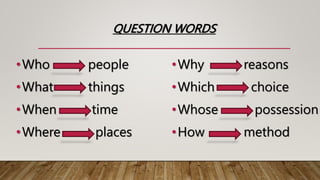
QUESTION WORDS
•Who people
•What things
•When time
•Where places
•Why reasons
•Which choice
•Whose possession
•How method
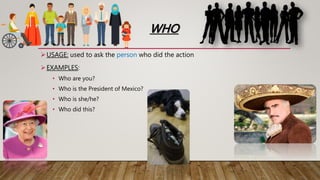
WHO
USAGE: used to ask the person who did the action
EXAMPLES:
• Who are you?
• Who is the President of Mexico?
• Who is she/he?
• Who did this?
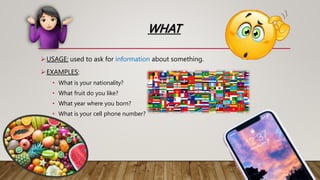
WHAT
USAGE: used to ask for information about something.
EXAMPLES:
• What is your nationality?
• What fruit do you like?
• What year where you born?
• What is your cell phone number?
WHEN
USAGE: used to ask the time of an event/action.
EXAMPLES:
• When is your birthday?
• When do we have English class?
• When are you coming home?
• When is ‘Día de Los Muertos’?
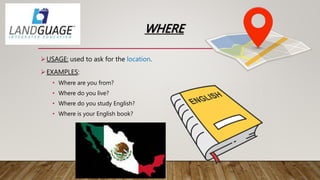
WHERE
USAGE: used to ask for the location.
EXAMPLES:
• Where are you from?
• Where do you live?
• Where do you study English?
• Where is your English book?
WHY
USAGE: used to ask for a reason/cause.
EXAMPLES:
• Why do you study English?
• Why do you think English is difficult to learn?
• Why are you late?
• Why is English important?
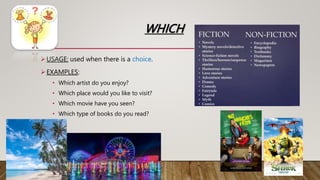
WHICH
USAGE: used when there is a choice.
EXAMPLES:
• Which artist do you enjoy?
• Which place would you like to visit?
• Which movie have you seen?
• Which type of books do you read?
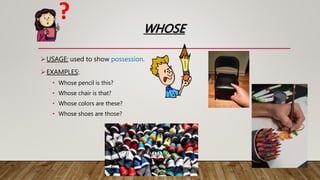
WHOSE
USAGE: used to show possession.
EXAMPLES:
• Whose pencil is this?
• Whose chair is that?
• Whose colors are these?
• Whose shoes are those?
WHOM
USAGE: used to ask about a person or object.
EXAMPLES:
• Whom should we ask for help?
• Whom did you see yesterday in the park?
• Whom is the cat chasing?
• Whom ate the last piece of cake?
HOW
USAGE: used to explain a process.
EXAMPLES:
• How do you learn English?
• How do you go to your work?
• How old are you?
• How did you know about Landguage?
OPEN-ENDED QUESTIONS
• Questions that allow someone to give a free-form answer.
• Can be answered in detail.
• Allow respondents to respond as they wish.
• Questions that cannot be answered with a simple ‘yes’ or ‘no’, and instead require
the respondent to elaborate on their points.

WH- and how questions with be.pptx

  • 1.
    WH- AND HOW QUESTIONSWITH BE BY MARIA ESMERALDA LOPEZ JAIMES
  • 2.
    QUESTION WORDS •Who people •Whatthings •When time •Where places •Why reasons •Which choice •Whose possession •How method
  • 3.
    WHO USAGE: used toask the person who did the action EXAMPLES: • Who are you? • Who is the President of Mexico? • Who is she/he? • Who did this?
  • 4.
    WHAT USAGE: used toask for information about something. EXAMPLES: • What is your nationality? • What fruit do you like? • What year where you born? • What is your cell phone number?
  • 5.
    WHEN USAGE: used toask the time of an event/action. EXAMPLES: • When is your birthday? • When do we have English class? • When are you coming home? • When is ‘Día de Los Muertos’?
  • 6.
    WHERE USAGE: used toask for the location. EXAMPLES: • Where are you from? • Where do you live? • Where do you study English? • Where is your English book?
  • 7.
    WHY USAGE: used toask for a reason/cause. EXAMPLES: • Why do you study English? • Why do you think English is difficult to learn? • Why are you late? • Why is English important?
  • 8.
    WHICH USAGE: used whenthere is a choice. EXAMPLES: • Which artist do you enjoy? • Which place would you like to visit? • Which movie have you seen? • Which type of books do you read?
  • 9.
    WHOSE USAGE: used toshow possession. EXAMPLES: • Whose pencil is this? • Whose chair is that? • Whose colors are these? • Whose shoes are those?
  • 10.
    WHOM USAGE: used toask about a person or object. EXAMPLES: • Whom should we ask for help? • Whom did you see yesterday in the park? • Whom is the cat chasing? • Whom ate the last piece of cake?
  • 11.
    HOW USAGE: used toexplain a process. EXAMPLES: • How do you learn English? • How do you go to your work? • How old are you? • How did you know about Landguage?
  • 12.
    OPEN-ENDED QUESTIONS • Questionsthat allow someone to give a free-form answer. • Can be answered in detail. • Allow respondents to respond as they wish. • Questions that cannot be answered with a simple ‘yes’ or ‘no’, and instead require the respondent to elaborate on their points.