95752:1-1
95-752 Introduction to Information
Security Management
Tim Shimeall, Ph.D.
tjs@cert.org
412-268-7611
Office Hours by Appointment
Course website: http://www.andrew.cmu.edu/course/95-752
95752:1-2
Course Covers
Introduction/Definitions
Physical security
Access control
Data security
Operating system security
Application security
Network security
95752:1-3
Student Expectations
• Grading:
– 2 Homeworks
– Midterm
– Paper/project
• All submitted work is sole effort of student
• Students are interested in subject area
• Students have varied backgrounds
95752:1-4
Information Revolution
• Information Revolution as pervasive at the
Industrial Revolution
• Impact is Political, Economic, and Social as well
as Technical
• Information has an increasing intrinsic value
• Protection of critical information now a critical
concern in Government, Business, Academia
95752:1-5
A Different Internet
• Armies may cease to march
• Businesses may be bankrupted
• Individuals may lose their social identity
• Threats not from novice teenagers, but
purposeful military, political, and criminal
organizations
95752:1-6
Computer Terms (1)
Computer – A collection of the following:
Central Processing Unit (CPU): Instruction-
processing
Memory(RAM) : Transient storage for data
Disk: More permanent storage for data
Monitor: Display device
Printer: Hard copy production
Network card: communication circuitry
95752:1-7
Computer Terms (2)
Software: Instructions for a computer
Operating System: interaction among
components of computer
Application software: common tasks (e.g.,
email, word processing, program
construction, etc.)
API/Libraries: Support for common tasks
95752:1-8
Vulnerability (2001)
Out-of-the-box Linux PC hooked to Internet, not announced:
[30 seconds] First service probes/scans detected
[1 hour] First compromise attempts detected
[12 hours] PC fully compromised:
– Administrative access obtained
– Event logging selectively disabled
– System software modified to suit intruder
– Attack software installed
– PC actively probing for new hosts to intrude
• Clear the disk and try again!
95752:1-9
Why is Security Difficult
• Managers unaware of value of
computing resources
• Damage to public image
• Legal definitions often vague or non-
existent
• Legal prosecution is difficult
• Many subtle technical issues
95752:1-10
Objectives of Security
• Privacy – Information only available to
authorized users
• Integrity – Information retains intended
content and semantics
• Availability – Information retains access
and presence
Importance of these is shifting, depends on
organization
95752:1-11
Security Terms
Exposure - “actual harm or possible harm”
Vulnerability - “weakness that may be
exploited”
Attack - “human originated perpetration”
Threat - “potential for exposure”
Control - “preventative measure”
95752:1-12
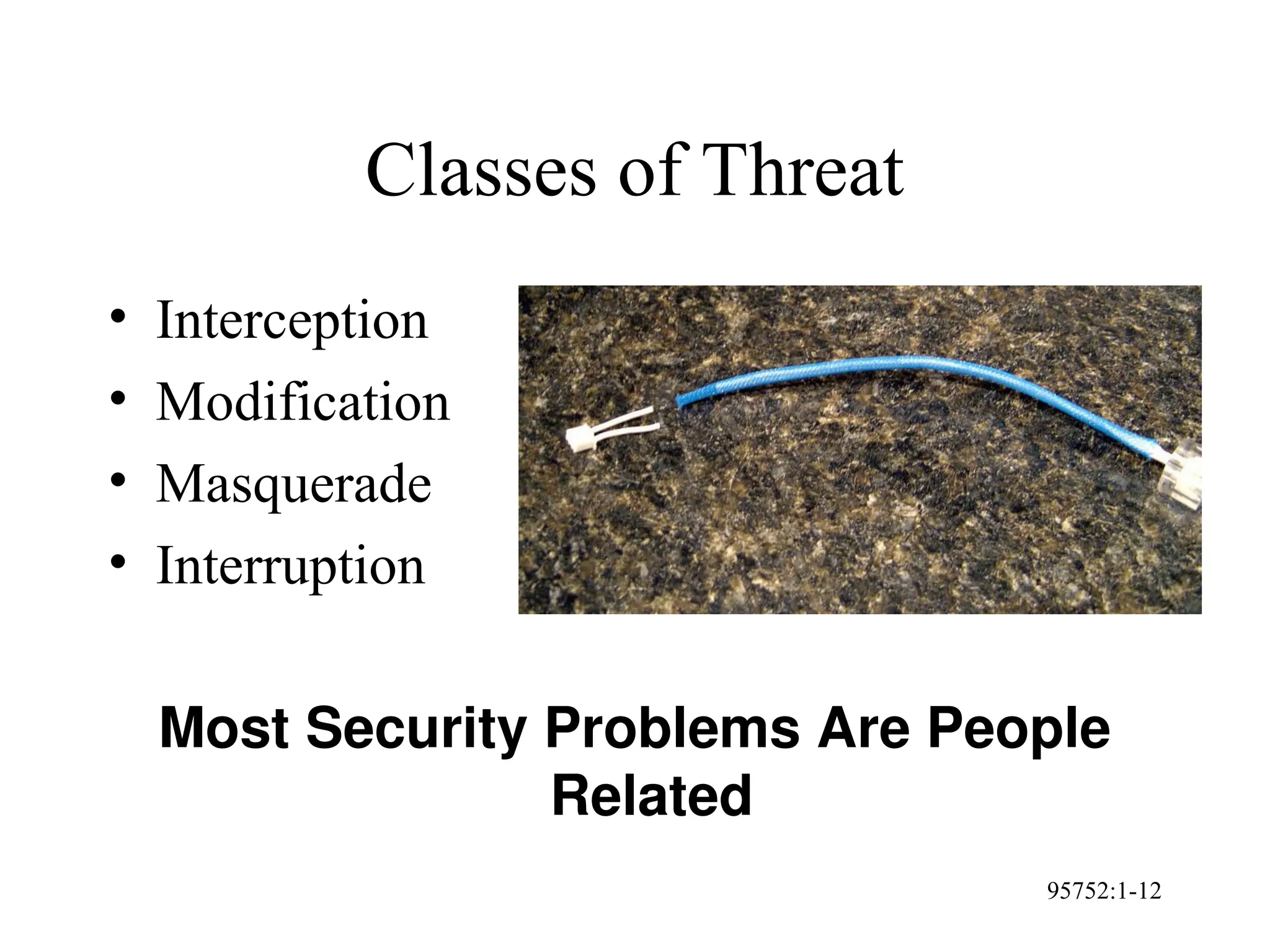
Classes of Threat
• Interception
• Modification
• Masquerade
• Interruption
Most Security Problems Are People
Related
95752:1-13
Software Security Concerns
• Theft
• Modification
• Deletion
• Misplacement
95752:1-14
Data Security Concerns
• Vector for attack
• Modification
• Disclosure
• Deletion
“If you have a $50 head, buy a $50 helmet”
95752:1-15
Network Security Concerns
• Basis for Attack
• Publicity
• Theft of Service
• Theft of Information
Network is only as strong as its weakest link
Problems multiply with number of nodes
95752:1-16
Motivations to Violate Security
• Greed
• Ego
• Curiosity
• Revenge
• Competition
• Political/Idiological
95752:1-17
People and Computer Crime
• Most damage not due to attacks
“Oops!”
“What was that?”
• No clear profile of computer criminal
• Law and ethics may be unclear
“Attempting to apply established law in the fast
developing world of the Internet is somewhat
like trying to board a moving bus” (Second
Circuit, US Court of Appeals, 1997)
95752:1-18
Theory of Technology Law
• Jurisdiction:
– subject matter – power to hear a type of case
– Personal – power to enforce a judgment on a defendant
• Between states: Federal subject matter
• Within state: State/local subject matter
• Criminal or Civil
– Privacy/obscenity covered now
– intellectual property covered later
95752:1-19
Privacy Law
• Common law:
– Person’s name or likeness
– Intrusion
– Disclosure
– False light
• State/Local law: Most states have computer
crime laws, varying content
• International law: patchy, varying content
95752:1-20
Federal Privacy Statutes
• ECPA (communication)
• Privacy Act of 1974 (Federal collection/use)
• Family Educational Rights & Privacy Act (school records)
• Fair Credit Reporting Act (credit information)
• Federal Cable Communications Privacy Act (cable
subscriber info)
• Video Privacy Act (video rental information)
• HIPAA (health cared information)
• Sarbanes-Oxley Act (corporate accounting)
• Patriot Act (counter-terrorism)
Plus state law in more the 40 states, and local laws
95752:1-21
Federal Obscenity Statues
• Miller tests (Miller v. California, 1973):
– Average person applying contemporary community
standards find appeals prurient interest
– Sexual content
– Lack of literary, artistic, political or scientific value
• Statues:
– Communications Decency Act (struck down)
– Child Online Protection Act (struck down)
– Child Pornography Protection Act (struck down –
virtual child porn; live children still protected)
95752:1-22
Indian Trust Funds
• Large, developing, case: Cobell vs. Norton
– http://www.indiantrust.com/
• Insecure handling of entrusted funds
• Legal Internet disruption
• Criminal contempt proceedings
• Judicial overstepping
95752:1-23
Three Security Disciplines
• Physical
– Most common security discipline
– Protect facilities and contents
• Plants, labs, stores, parking areas, loading areas,
warehouses, offices, equipment, machines, tools,
vehicles, products, materials
• Personnel
– Protect employees, customers, guests
• Information
– The rest of this course
95752:1-24
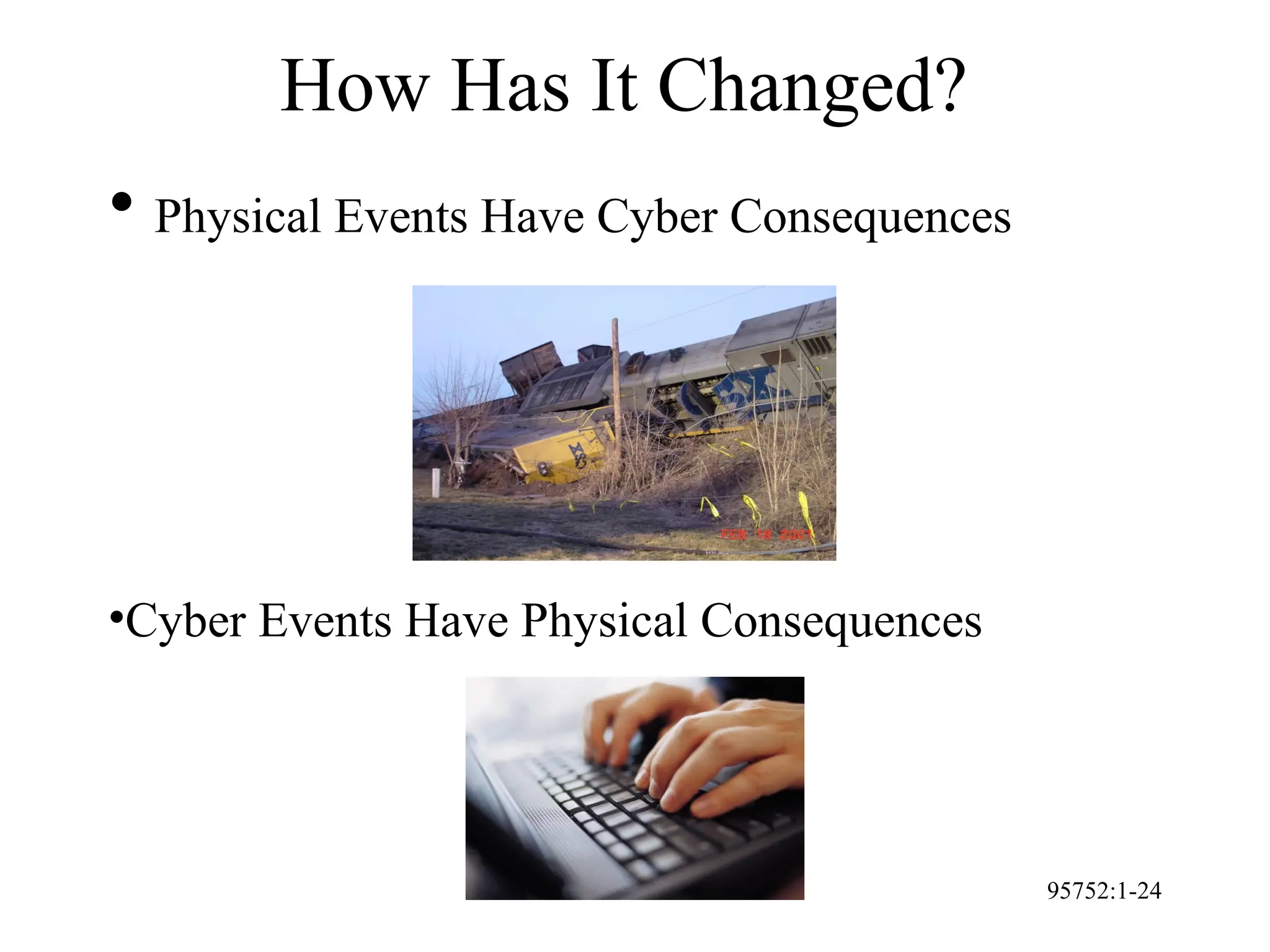
How Has It Changed?
• Physical Events Have Cyber Consequences
•Cyber Events Have Physical Consequences
95752:1-25
Why Physical Security?
• Not all threats are “cyber threats”
• Information one commodity that can be stolen
without being “taken”
• Physically barring access is first line of defense
• Forces those concerned to prioritize!
• Physical Security can be a deterrent
• Security reviews force insights into value of what
is being protected
95752:1-26
Layered Security
• Physical Barriers
• Fences
• Alarms
• Restricted Access Technology
• Physical Restrictions
• Air Gapping
• Removable Media
• Remote Storage
• Personnel Security Practices
• Limited Access
• Training
• Consequences/Deterrence
95752:1-27
Physical Barriers
• Hardened Facilities
• Fences
• Guards
• Alarms
• Locks
• Restricted Access Technologies
– Biometrics
– Coded Entry
– Badging
• Signal Blocking (Faraday Cages)
95752:1-28
Outer Protective Layers
• Structure
– Fencing, gates, other barriers
• Environment
– Lighting, signs, alarms
• Purpose
– Define property line and discourage trespassing
– Provide distance from threats
95752:1-29
Middle Protective Layers
• Structure
– Door controls, window controls
– Ceiling penetration
– Ventilation ducts
– Elevator Penthouses
• Environment
– Within defined perimeter, positive controls
• Purpose
– Alert threat, segment protection zones
95752:1-30
Inner Protective Layers
• Several layers
• Structure
– Door controls, biometrics
– Signs, alarms, cctv
– Safes, vaults
• Environment
– Authorized personnel only
• Purpose
– Establish controlled areas and rooms
95752:1-31
Other Barrier Issues
• Handling of trash or scrap
• Fire:
– Temperature
– Smoke
• Pollution:
– CO
– Radon
• Flood
• Earthquake
95752:1-32
Physical Restrictions
• Air Gapping Data
• Limits access to various security levels
• Requires conscious effort to violate
• Protects against inadvertent transmission
• Removable Media
• Removable Hard Drives
• Floppy Disks/CDs/ZIP Disks
• Remote Storage of Data
• Physically separate storage facility
• Use of Storage Media or Stand Alone computers
• Updating of Stored Data and regular inventory
95752:1-33
Personnel Security Practices
• Insider Threat the most serious
• Disgruntled employee
• Former employee
• Agent for hire
• Personnel Training
• Critical Element
• Most often overlooked
• Background checks
• Critical when access to information required
• Must be updated
• CIA/FBI embarrassed
95752:1-34
Activities or Events
• Publications, public releases, etc.
• Seminars, conventions or trade shows
• Survey or questionnaire
• Plant tours, “open house”, family visits
• Governmental actions: certification,
investigation
• Construction and Repair
95752:1-35
NISPOM
National Industrial Security Program
Operating Manual
• Prescribes requirements, restrictions and other
safeguards for information
• Protections for special classes of information:
• National Security Council provides overall policy
direction
• Governs oversight and compliance for 20
government agencies
95752:1-36
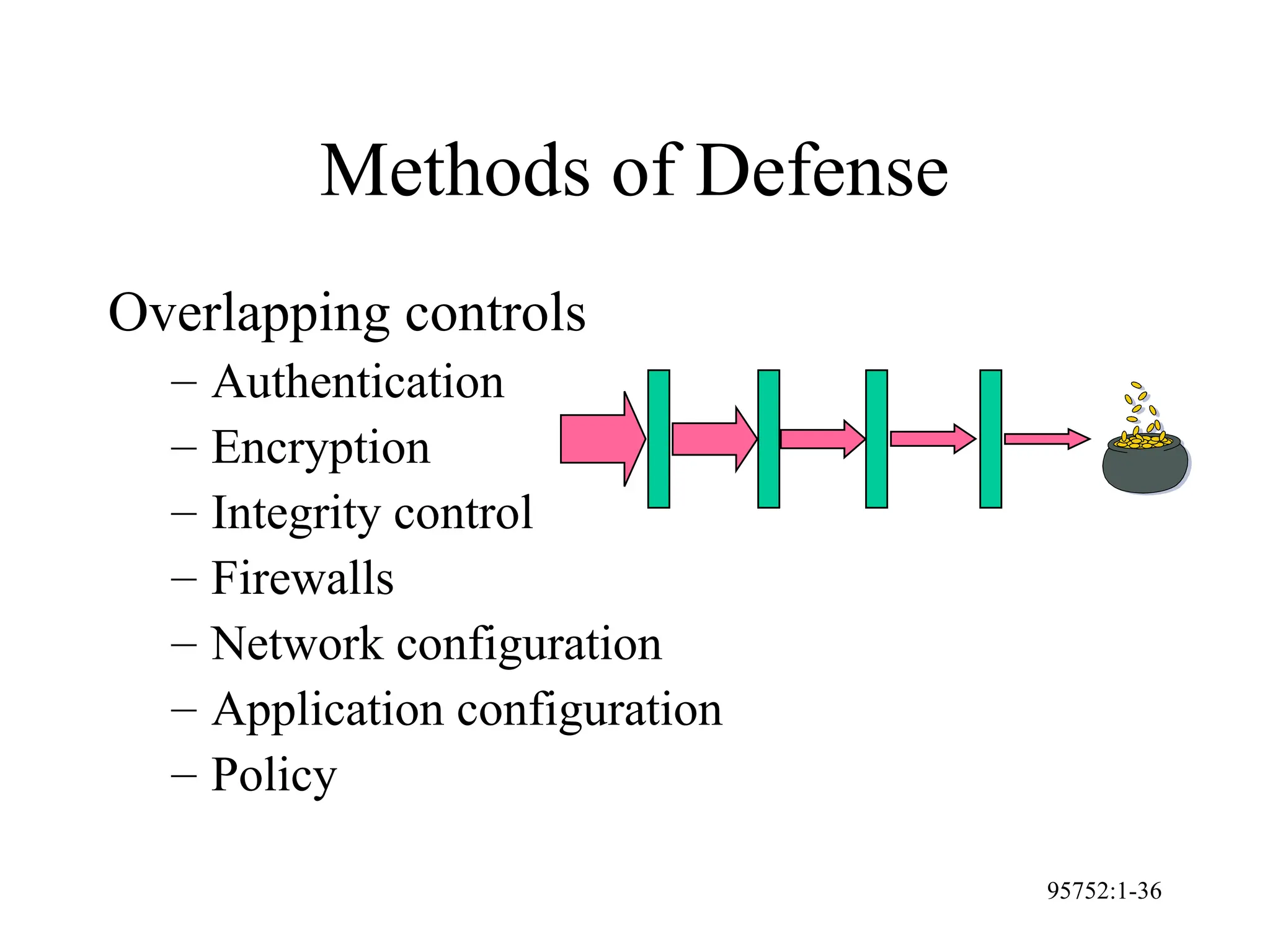
Methods of Defense
Overlapping controls
– Authentication
– Encryption
– Integrity control
– Firewalls
– Network configuration
– Application configuration
– Policy

Informationsecurity management lecture.ppt

  • 1.
    95752:1-1 95-752 Introduction toInformation Security Management Tim Shimeall, Ph.D. tjs@cert.org 412-268-7611 Office Hours by Appointment Course website: http://www.andrew.cmu.edu/course/95-752
  • 2.
    95752:1-2 Course Covers Introduction/Definitions Physical security Accesscontrol Data security Operating system security Application security Network security
  • 3.
    95752:1-3 Student Expectations • Grading: –2 Homeworks – Midterm – Paper/project • All submitted work is sole effort of student • Students are interested in subject area • Students have varied backgrounds
  • 4.
    95752:1-4 Information Revolution • InformationRevolution as pervasive at the Industrial Revolution • Impact is Political, Economic, and Social as well as Technical • Information has an increasing intrinsic value • Protection of critical information now a critical concern in Government, Business, Academia
  • 5.
    95752:1-5 A Different Internet •Armies may cease to march • Businesses may be bankrupted • Individuals may lose their social identity • Threats not from novice teenagers, but purposeful military, political, and criminal organizations
  • 6.
    95752:1-6 Computer Terms (1) Computer– A collection of the following: Central Processing Unit (CPU): Instruction- processing Memory(RAM) : Transient storage for data Disk: More permanent storage for data Monitor: Display device Printer: Hard copy production Network card: communication circuitry
  • 7.
    95752:1-7 Computer Terms (2) Software:Instructions for a computer Operating System: interaction among components of computer Application software: common tasks (e.g., email, word processing, program construction, etc.) API/Libraries: Support for common tasks
  • 8.
    95752:1-8 Vulnerability (2001) Out-of-the-box LinuxPC hooked to Internet, not announced: [30 seconds] First service probes/scans detected [1 hour] First compromise attempts detected [12 hours] PC fully compromised: – Administrative access obtained – Event logging selectively disabled – System software modified to suit intruder – Attack software installed – PC actively probing for new hosts to intrude • Clear the disk and try again!
  • 9.
    95752:1-9 Why is SecurityDifficult • Managers unaware of value of computing resources • Damage to public image • Legal definitions often vague or non- existent • Legal prosecution is difficult • Many subtle technical issues
  • 10.
    95752:1-10 Objectives of Security •Privacy – Information only available to authorized users • Integrity – Information retains intended content and semantics • Availability – Information retains access and presence Importance of these is shifting, depends on organization
  • 11.
    95752:1-11 Security Terms Exposure -“actual harm or possible harm” Vulnerability - “weakness that may be exploited” Attack - “human originated perpetration” Threat - “potential for exposure” Control - “preventative measure”
  • 12.
    95752:1-12 Classes of Threat •Interception • Modification • Masquerade • Interruption Most Security Problems Are People Related
  • 13.
    95752:1-13 Software Security Concerns •Theft • Modification • Deletion • Misplacement
  • 14.
    95752:1-14 Data Security Concerns •Vector for attack • Modification • Disclosure • Deletion “If you have a $50 head, buy a $50 helmet”
  • 15.
    95752:1-15 Network Security Concerns •Basis for Attack • Publicity • Theft of Service • Theft of Information Network is only as strong as its weakest link Problems multiply with number of nodes
  • 16.
    95752:1-16 Motivations to ViolateSecurity • Greed • Ego • Curiosity • Revenge • Competition • Political/Idiological
  • 17.
    95752:1-17 People and ComputerCrime • Most damage not due to attacks “Oops!” “What was that?” • No clear profile of computer criminal • Law and ethics may be unclear “Attempting to apply established law in the fast developing world of the Internet is somewhat like trying to board a moving bus” (Second Circuit, US Court of Appeals, 1997)
  • 18.
    95752:1-18 Theory of TechnologyLaw • Jurisdiction: – subject matter – power to hear a type of case – Personal – power to enforce a judgment on a defendant • Between states: Federal subject matter • Within state: State/local subject matter • Criminal or Civil – Privacy/obscenity covered now – intellectual property covered later
  • 19.
    95752:1-19 Privacy Law • Commonlaw: – Person’s name or likeness – Intrusion – Disclosure – False light • State/Local law: Most states have computer crime laws, varying content • International law: patchy, varying content
  • 20.
    95752:1-20 Federal Privacy Statutes •ECPA (communication) • Privacy Act of 1974 (Federal collection/use) • Family Educational Rights & Privacy Act (school records) • Fair Credit Reporting Act (credit information) • Federal Cable Communications Privacy Act (cable subscriber info) • Video Privacy Act (video rental information) • HIPAA (health cared information) • Sarbanes-Oxley Act (corporate accounting) • Patriot Act (counter-terrorism) Plus state law in more the 40 states, and local laws
  • 21.
    95752:1-21 Federal Obscenity Statues •Miller tests (Miller v. California, 1973): – Average person applying contemporary community standards find appeals prurient interest – Sexual content – Lack of literary, artistic, political or scientific value • Statues: – Communications Decency Act (struck down) – Child Online Protection Act (struck down) – Child Pornography Protection Act (struck down – virtual child porn; live children still protected)
  • 22.
    95752:1-22 Indian Trust Funds •Large, developing, case: Cobell vs. Norton – http://www.indiantrust.com/ • Insecure handling of entrusted funds • Legal Internet disruption • Criminal contempt proceedings • Judicial overstepping
  • 23.
    95752:1-23 Three Security Disciplines •Physical – Most common security discipline – Protect facilities and contents • Plants, labs, stores, parking areas, loading areas, warehouses, offices, equipment, machines, tools, vehicles, products, materials • Personnel – Protect employees, customers, guests • Information – The rest of this course
  • 24.
    95752:1-24 How Has ItChanged? • Physical Events Have Cyber Consequences •Cyber Events Have Physical Consequences
  • 25.
    95752:1-25 Why Physical Security? •Not all threats are “cyber threats” • Information one commodity that can be stolen without being “taken” • Physically barring access is first line of defense • Forces those concerned to prioritize! • Physical Security can be a deterrent • Security reviews force insights into value of what is being protected
  • 26.
    95752:1-26 Layered Security • PhysicalBarriers • Fences • Alarms • Restricted Access Technology • Physical Restrictions • Air Gapping • Removable Media • Remote Storage • Personnel Security Practices • Limited Access • Training • Consequences/Deterrence
  • 27.
    95752:1-27 Physical Barriers • HardenedFacilities • Fences • Guards • Alarms • Locks • Restricted Access Technologies – Biometrics – Coded Entry – Badging • Signal Blocking (Faraday Cages)
  • 28.
    95752:1-28 Outer Protective Layers •Structure – Fencing, gates, other barriers • Environment – Lighting, signs, alarms • Purpose – Define property line and discourage trespassing – Provide distance from threats
  • 29.
    95752:1-29 Middle Protective Layers •Structure – Door controls, window controls – Ceiling penetration – Ventilation ducts – Elevator Penthouses • Environment – Within defined perimeter, positive controls • Purpose – Alert threat, segment protection zones
  • 30.
    95752:1-30 Inner Protective Layers •Several layers • Structure – Door controls, biometrics – Signs, alarms, cctv – Safes, vaults • Environment – Authorized personnel only • Purpose – Establish controlled areas and rooms
  • 31.
    95752:1-31 Other Barrier Issues •Handling of trash or scrap • Fire: – Temperature – Smoke • Pollution: – CO – Radon • Flood • Earthquake
  • 32.
    95752:1-32 Physical Restrictions • AirGapping Data • Limits access to various security levels • Requires conscious effort to violate • Protects against inadvertent transmission • Removable Media • Removable Hard Drives • Floppy Disks/CDs/ZIP Disks • Remote Storage of Data • Physically separate storage facility • Use of Storage Media or Stand Alone computers • Updating of Stored Data and regular inventory
  • 33.
    95752:1-33 Personnel Security Practices •Insider Threat the most serious • Disgruntled employee • Former employee • Agent for hire • Personnel Training • Critical Element • Most often overlooked • Background checks • Critical when access to information required • Must be updated • CIA/FBI embarrassed
  • 34.
    95752:1-34 Activities or Events •Publications, public releases, etc. • Seminars, conventions or trade shows • Survey or questionnaire • Plant tours, “open house”, family visits • Governmental actions: certification, investigation • Construction and Repair
  • 35.
    95752:1-35 NISPOM National Industrial SecurityProgram Operating Manual • Prescribes requirements, restrictions and other safeguards for information • Protections for special classes of information: • National Security Council provides overall policy direction • Governs oversight and compliance for 20 government agencies
  • 36.
    95752:1-36 Methods of Defense Overlappingcontrols – Authentication – Encryption – Integrity control – Firewalls – Network configuration – Application configuration – Policy