Database System Concepts, 7th
Ed.
©Silberschatz, Korth and Sudarshan
See www.db-book.com for conditions on re-use
Chapter 21: Parallel and Distributed Storage
©Silberschatz, Korth and Sudarshan
21.2
Database System Concepts - 7th
Edition
Introduction
 Parallel machines have become quite common and affordable
• prices of microprocessors, memory and disks have dropped sharply
 Data storage needs are growing increasingly large
• user data at web-scale
 100’s of millions of users, petabytes of data
• transaction data are collected and stored for analysis.
• multimedia objects like images/videos
 Parallel storage system requirements
• storing large volumes of data
• processing time-consuming decision-support queries
• providing high throughput for transaction processing
• Very high demands on scalability and availability
©Silberschatz, Korth and Sudarshan
21.3
Database System Concepts - 7th
Edition
Parallel/Distributed Data Storage History
 1980/1990s
• Distributed database systems with tens of nodes
 2000s:
• Distributed file systems with 1000s of nodes
 Millions of Large objects (100’s of megabytes)
 Web logs, images, videos, …
 Typically create/append only
• Distributed data storage systems with 1000s of nodes
 Billions to trillions of smaller (kilobyte to megabyte) objects
 Social media posts, email, online purchases, …
 Inserts, updates, deletes
• Key-value stores
 2010s: Distributed database systems with 1000s of nodes
©Silberschatz, Korth and Sudarshan
21.4
Database System Concepts - 7th
Edition
I/O Parallelism
 Reduce the time required to retrieve relations from disk by partitioning the
relations on multiple disks, on multiple nodes (computers)
• Our description focuses on parallelism across nodes
• Same techniques can be used across disks on a node
 Horizontal partitioning – tuples of a relation are divided among many
nodes such that some subset of tuple resides on each node.
• Contrast with vertical partitioning, e.g. r(A,B,C,D) with primary key A
into r1(A,B) and r2(A,C,D)
• By default, the word partitioning refers to horizontal partitioning
©Silberschatz, Korth and Sudarshan
21.5
Database System Concepts - 7th
Edition
I/O Parallelism
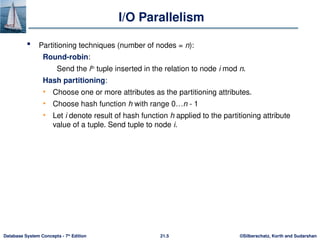
 Partitioning techniques (number of nodes = n):
Round-robin:
Send the ith
tuple inserted in the relation to node i mod n.
Hash partitioning:
• Choose one or more attributes as the partitioning attributes.
• Choose hash function h with range 0…n - 1
• Let i denote result of hash function h applied to the partitioning attribute
value of a tuple. Send tuple to node i.
©Silberschatz, Korth and Sudarshan
21.6
Database System Concepts - 7th
Edition
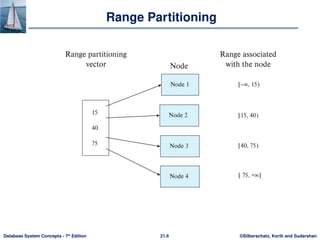
Range Partitioning
©Silberschatz, Korth and Sudarshan
21.7
Database System Concepts - 7th
Edition
I/O Parallelism (Cont.)
Partitioning techniques (cont.):
 Range partitioning:
• Choose an attribute as the partitioning attribute.
• A partitioning vector [vo, v1, ..., vn-2] is chosen.
• Let v be the partitioning attribute value of a tuple. Tuples such that vi 
vi+1 go to node I + 1. Tuples with v < v0 go to node 0 and tuples with v 
vn-2 go to node n-1.
E.g., with a partitioning vector [5,11]
 a tuple with partitioning attribute value of 2 will go to node 0,
 a tuple with value 8 will go to node 1, while
 a tuple with value 20 will go to node2.
©Silberschatz, Korth and Sudarshan
21.8
Database System Concepts - 7th
Edition
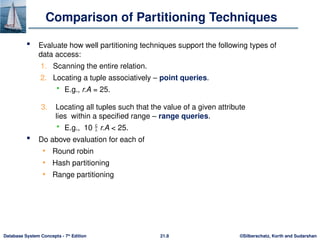
Comparison of Partitioning Techniques
 Evaluate how well partitioning techniques support the following types of
data access:
1. Scanning the entire relation.
2. Locating a tuple associatively – point queries.
 E.g., r.A = 25.
3. Locating all tuples such that the value of a given attribute
lies within a specified range – range queries.
 E.g., 10  r.A < 25.
 Do above evaluation for each of
• Round robin
• Hash partitioning
• Range partitioning
©Silberschatz, Korth and Sudarshan
21.9
Database System Concepts - 7th
Edition
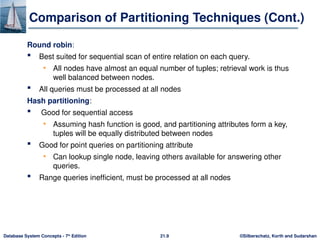
Comparison of Partitioning Techniques (Cont.)
Round robin:
 Best suited for sequential scan of entire relation on each query.
• All nodes have almost an equal number of tuples; retrieval work is thus
well balanced between nodes.
 All queries must be processed at all nodes
Hash partitioning:
 Good for sequential access
• Assuming hash function is good, and partitioning attributes form a key,
tuples will be equally distributed between nodes
 Good for point queries on partitioning attribute
• Can lookup single node, leaving others available for answering other
queries.
 Range queries inefficient, must be processed at all nodes
©Silberschatz, Korth and Sudarshan
21.10
Database System Concepts - 7th
Edition
Comparison of Partitioning Techniques (Cont.)
Range partitioning:
 Provides data clustering by partitioning attribute value.
• Good for sequential access
• Good for point queries on partitioning attribute: only one node needs to
be accessed.
 For range queries on partitioning attribute, one to a few nodes may need to
be accessed
• Remaining nodes are available for other queries.
• Good if result tuples are from one to a few blocks.
• But if many blocks are to be fetched, they are still fetched from one to a
few nodes, and potential parallelism in disk access is wasted
 Example of execution skew.
©Silberschatz, Korth and Sudarshan
21.11
Database System Concepts - 7th
Edition
Handling Small Relations
 Partitioning not useful for small relations which fit into a single disk block or
a small number of disk blocks
• Instead, assign the relation to a single node, or
• Replicate relation at all nodes
 For medium sized relations, choose how many nodes to partition across
based on size of relation
 Large relations typically partitioned across all available nodes.
©Silberschatz, Korth and Sudarshan
21.12
Database System Concepts - 7th
Edition
Types of Skew
 Data-distribution skew: some nodes have many tuples, while others may
have fewer tuples. Could occur due to
• Attribute-value skew.
 Some partitioning-attribute values appear in many tuples
 All the tuples with the same value for the partitioning attribute end
up in the same partition.
 Can occur with range-partitioning and hash-partitioning.
• Partition skew.
 Imbalance, even without attribute –value skew
 Badly chosen range-partition vector may assign too many tuples to
some partitions and too few to others.
 Less likely with hash-partitioning
©Silberschatz, Korth and Sudarshan
21.13
Database System Concepts - 7th
Edition
Types of Skew (Cont.)
 Note that execution skew can occur even without data distribution skew
• E.g. relation range-partitioned on date, and most queries access tuples
with recent dates
 Data-distribution skew can be avoided with range-partitioning by creating
balanced range-partitioning vectors
 We assume for now that partitioning is static, that is partitioning vector is
created once and not changed
• Any change requires repartitioning
• Dynamic partitioning once allows partition vector to be changed in a
continuous manner
 More on this later
©Silberschatz, Korth and Sudarshan
21.14
Database System Concepts - 7th
Edition
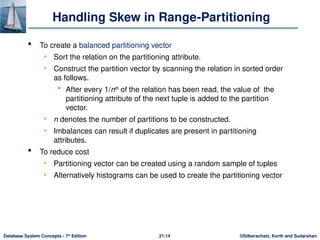
Handling Skew in Range-Partitioning
 To create a balanced partitioning vector
• Sort the relation on the partitioning attribute.
• Construct the partition vector by scanning the relation in sorted order
as follows.
 After every 1/nth
of the relation has been read, the value of the
partitioning attribute of the next tuple is added to the partition
vector.
• n denotes the number of partitions to be constructed.
• Imbalances can result if duplicates are present in partitioning
attributes.
 To reduce cost
• Partitioning vector can be created using a random sample of tuples
• Alternatively histograms can be used to create the partitioning vector
©Silberschatz, Korth and Sudarshan
21.15
Database System Concepts - 7th
Edition
Histograms
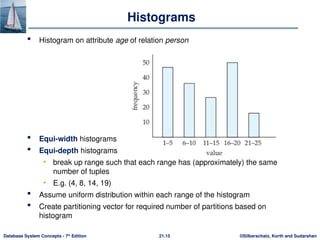
 Histogram on attribute age of relation person
 Equi-width histograms
 Equi-depth histograms
• break up range such that each range has (approximately) the same
number of tuples
• E.g. (4, 8, 14, 19)
 Assume uniform distribution within each range of the histogram
 Create partitioning vector for required number of partitions based on
histogram
©Silberschatz, Korth and Sudarshan
21.16
Database System Concepts - 7th
Edition
Virtual Node Partitioning
 Key idea: pretend there are several times (10x to 20x) as many virtual
nodes as real nodes
• Virtual nodes are mapped to real nodes
• Tuples partitioned across virtual nodes using range-partitioning
vector
 Hash partitioning is also possible
 Mapping of virtual nodes to real nodes
• Round-robin: virtual node i mapped to real node (i mod n)+1
• Mapping table: mapping table virtual_to_real_map[] tracks which
virtual node is on which real node
 Allows skew to be handled by moving virtual nodes from more
loaded nodes to less loaded nodes
 Both data distribution skew and execution skew can be handled
©Silberschatz, Korth and Sudarshan
21.17
Database System Concepts - 7th
Edition
Handling Skew Using Virtual Node Partitioning
 Basic idea:
• If any normal partition would have been skewed, it is very likely the
skew is spread over a number of virtual partitions
• Skewed virtual partitions tend to get spread across a number of nodes,
so work gets distributed evenly!
 Virtual node approach also allows elasticity of storage
• If relation size grows, more nodes can be added and virtual nodes
moved to new nodes
©Silberschatz, Korth and Sudarshan
21.18
Database System Concepts - 7th
Edition
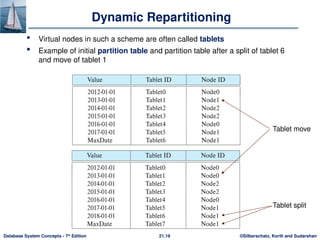
Dynamic Repartitioning
 Virtual node approach with a fixed partitioning vector cannot handle
significant changes in data distribution over time
 Complete repartitioning is expensive and intrusive
 Dynamic repartitioning can be done incrementally using virtual node
scheme
• Virtual nodes that become too big can be split
 Much like B+-tree node splits
• Some virtual nodes can be moved from a heavily loaded node to a less
loaded node
 Virtual nodes in such a scheme are often called tablets
©Silberschatz, Korth and Sudarshan
21.19
Database System Concepts - 7th
Edition
Dynamic Repartitioning
 Virtual nodes in such a scheme are often called tablets
 Example of initial partition table and partition table after a split of tablet 6
and move of tablet 1
Tablet move
Tablet split
©Silberschatz, Korth and Sudarshan
21.20
Database System Concepts - 7th
Edition
Routing of Queries
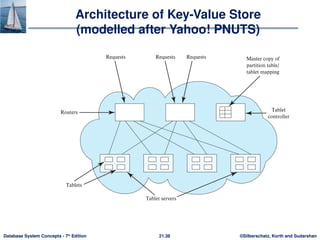
 Partition table typically stored at a master node, and at multiple routers
 Queries are sent first to routers, which forward them to appropriate node
 Consistent hashing is an alternative fully-distributed scheme
• without any master nodes, works in a completely peer-to-peer fashion
 Distributed hash tables are based on consistent hashing
• work without master nodes or routers; each peer-node stores data
and performs routing
• See book for details of consistent hashing and distributed hash tables
©Silberschatz, Korth and Sudarshan
21.21
Database System Concepts - 7th
Edition
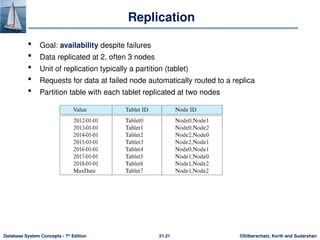
Replication
 Goal: availability despite failures
 Data replicated at 2, often 3 nodes
 Unit of replication typically a partition (tablet)
 Requests for data at failed node automatically routed to a replica
 Partition table with each tablet replicated at two nodes
©Silberschatz, Korth and Sudarshan
21.22
Database System Concepts - 7th
Edition
Basics: Data Replication
 Location of replicas
• Replication within a data center
 Handles machine failures
 Reduces latency if copy available locally on a machine
 Replication within/across racks
• Replication across data centers
 Handles data center failures (power, fire, earthquake, ..), and
network partitioning of an entire data center
 Provides lower latency for end users if copy is available on nearby
data center
©Silberschatz, Korth and Sudarshan
21.23
Database System Concepts - 7th
Edition
Updates and Consistency of Replicas
 Replicas must be kept consistent on update
• Despite failures resulting in different replicas having different values
(temporarily), reads must get the latest value.
• Special concurrency control and atomic commit mechanisms to
ensure consistency
 Master replica (primary copy) scheme
• All updates are sent to master, and then replicated to other nodes
• Reads are performed at master
• But what if master fails? Who takes over? How do other nodes know
who is the new master?
• Details in Chapter 23
©Silberschatz, Korth and Sudarshan
21.24
Database System Concepts - 7th
Edition
Protocols to Update Replicas
 Two-phase commit
• Coming up in Chapter 23
• Assumes all replicas are available
 Persistent messaging
• Updates are sent as messages with guaranteed delivery
• Replicas are updated asynchronously (after original transaction
commits)
 Eventual consistency
• Can lead to inconsistency on reads from replicas
 Consensus protocols
• Protocol followed by a set of replicas to agree on what updates to
perform in what order
• Can work even without a designated master
©Silberschatz, Korth and Sudarshan
21.25
Database System Concepts - 7th
Edition
Parallel Indexing
 Local index
• Index built only on local data
 Global index
• Index built on all data, regardless of where it is stored
• Index itself is usually partitioned across nodes
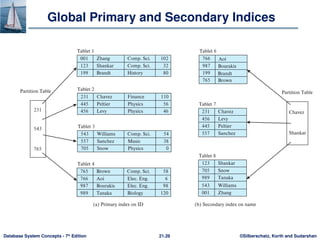
 Global primary index
• Data partitioned on the index attribute
 Global secondary index
• Data partitioned on the attribute other than the index attribute
©Silberschatz, Korth and Sudarshan
21.26
Database System Concepts - 7th
Edition
Global Primary and Secondary Indices
©Silberschatz, Korth and Sudarshan
21.27
Database System Concepts - 7th
Edition
Global Secondary Index
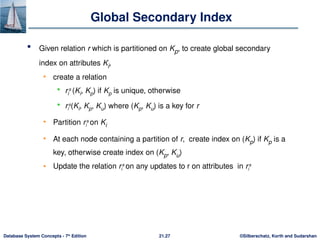
 Given relation r which is partitioned on Kp, to create global secondary
index on attributes Ki,
• create a relation
 ri
s
(Ki, Kp) if Kp is unique, otherwise
 ri
s
(Ki, Kp, Ku) where (Kp, Ku) is a key for r
• Partition ri
s
on Ki
• At each node containing a partition of r, create index on (Kp) if Kp is a
key, otherwise create index on (Kp, Ku)
• Update the relation ri
s
on any updates to r on attributes in ri
s
©Silberschatz, Korth and Sudarshan
21.28
Database System Concepts - 7th
Edition
Distributed File Systems
 Google File System (GFS)
 Hadoop File System (HDFS)
 And older ones like CODA
 And more recent ones such as Google Colossus
 Basic architecture:
• Master: responsible for metadata
• Chunk servers: responsible for reading and writing large chunks of
data
• Chunks replicated on 3 machines, master responsible for managing
replicas
• Replication is in GFS/HDFS is within a single data center
©Silberschatz, Korth and Sudarshan
21.29
Database System Concepts - 7th
Edition
Hadoop File System (HDFS)
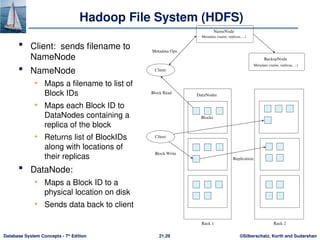
 Client: sends filename to
NameNode
 NameNode
• Maps a filename to list of
Block IDs
• Maps each Block ID to
DataNodes containing a
replica of the block
• Returns list of BlockIDs
along with locations of
their replicas
 DataNode:
• Maps a Block ID to a
physical location on disk
• Sends data back to client
©Silberschatz, Korth and Sudarshan
21.30
Database System Concepts - 7th
Edition
Hadoop Distributed File System
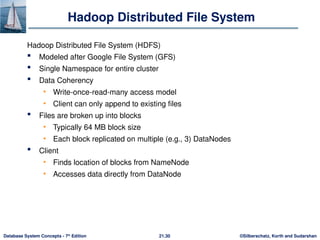
Hadoop Distributed File System (HDFS)
 Modeled after Google File System (GFS)
 Single Namespace for entire cluster
 Data Coherency
• Write-once-read-many access model
• Client can only append to existing files
 Files are broken up into blocks
• Typically 64 MB block size
• Each block replicated on multiple (e.g., 3) DataNodes
 Client
• Finds location of blocks from NameNode
• Accesses data directly from DataNode
©Silberschatz, Korth and Sudarshan
21.31
Database System Concepts - 7th
Edition
Limitations of GFS/HDFS
 Central master becomes bottleneck
• Keep directory/inode information in memory to avoid IO
• Memory size limits number of files
• Colossus file system supports distributed master
 With smaller (1MB) block size
 File system directory overheads per file
• Not appropriate for storing very large number of objects
 File systems do not provide consistency guarantees
• File systems cache blocks locally
• Ideal for write-once and and append only data
• Can be used as underlying storage for a data storage system
 E.g., BigTable uses GFS underneath
©Silberschatz, Korth and Sudarshan
21.32
Database System Concepts - 7th
Edition
Sharding
Sharding (recall from Chapter 10)
 Divide data amongst many cheap databases (MySQL/PostgreSQL)
 Manage parallel access in the application
• Partition tables map keys to nodes
• Application decides where to route storage or lookup requests
 Scales well for both reads and writes
 Limitations
• Not transparent
 application needs to be partition-aware
 AND application needs to deal with replication
• (Not a true parallel database, since parallel queries and transactions
spanning nodes are not supported)
©Silberschatz, Korth and Sudarshan
21.33
Database System Concepts - 7th
Edition
Key Value Storage Systems
Recall from Chapter 10
 Key-value stores may store
• uninterpreted bytes, with an associated key
 E.g., Amazon S3, Amazon Dynamo
• Wide-column stores (can have arbitrarily many attribute names) with
associated key
• Google BigTable, Apache Cassandra, Apache HBase, Amazon
DynamoDB, Microsoft Azure Cloud store
• Allows some operations (e.g., filtering) to execute on storage
node
• Google MegaStore and Spanner and Yahoo! PNUTS/Sherpa
support relational schema
• JSON
 MongoDB, CouchDB (document model)
 Document stores store semi-structured data, typically JSON
©Silberschatz, Korth and Sudarshan
21.34
Database System Concepts - 7th
Edition
Typical Data Storage Access API
 Basic API access:
• get(key) -- Extract the value given a key
• put(key, value) -- Create or update the value given its key
• delete(key) -- Remove the key and its associated value
• execute(key, operation, parameters) -- Invoke an operation to the value
(given its key) which is a special data structure (e.g., List, Set, Map ....
Etc.)
 Extensions to add range queries, version numbering, etc.
©Silberschatz, Korth and Sudarshan
21.35
Database System Concepts - 7th
Edition
Data Storage Systems vs. Databases
Distributed data storage implementations:
 May have limited support for relational model (no schema, or flexible
schema)
 But usually do provide flexible schema and other features
• Structured objects e.g. using JSON
• Multiple versions of data items
 Often do not support referential integrity constraints
 Often provide no support or limited support for transactions
• But some do!
 Provide only lowest layer of database
©Silberschatz, Korth and Sudarshan
21.36
Database System Concepts - 7th
Edition
Data Representation
 In wide-column stores like BigTable, records may be vertically partitioned by
attribute (columnar storage)
• (record-identifier, attribute-name) forms a key
 Multiple attributes may be stored in one file (column family)
• In BigTable records are sorted by key, ensuring all attributes of a logical
record in that file are contiguous
 Attributes can be fetched by a prefix/range query
• Record-identifiers can be structured hierarchically to exploit sorting
 E.g., url: www.cs.yale.edu/people/silberschatz.html
can be mapped to record identifier
edu.yale.cs.www/people/silberschatz.html
 Now all records for cs.yale.edu would be contiguous, as would all
records for yale.edu
©Silberschatz, Korth and Sudarshan
21.37
Database System Concepts - 7th
Edition
Storing and Retrieving Data
Architecture of BigTable key-value store
 Table split into multiple tablets
 Tablet servers manage tablets, multiple tablets per server. Each tablet is
100-200 MB
• Each tablet controlled by only one server
• Tablet server splits tablets that get too big
 Master responsible for load balancing and fault tolerance
 All data and logs stored in GFS
• Leverage GFS replication/fault tolerance
• Data can be accessed if required from any node to aid in recovery
©Silberschatz, Korth and Sudarshan
21.38
Database System Concepts - 7th
Edition
Architecture of Key-Value Store
(modelled after Yahoo! PNUTS)
©Silberschatz, Korth and Sudarshan
21.39
Database System Concepts - 7th
Edition
Geographically Distributed Storage
 Many storage systems today support geographical distribution of storage
• Motivations: Fault tolerance, latency (close to user), governmental
regulations
 Latency of replication across geographically distributed data centers much
higher than within data center
• Some key-value stores support synchronous replication
 Must wait for replicas to be updated before committing an update
• Others support asynchronous replication
 update is committed in one data center, but sent subsequently (in a
fault-tolerant way) to remote data centers
 Must deal with small risk of data loss if data center fails.
©Silberschatz, Korth and Sudarshan
21.40
Database System Concepts - 7th
Edition
Index Structures in Key-Value Stores
 Storing data in each tablet in clustered on key benefits range queries
 B+
-tree file organization works well for range queries
 Write optimized trees, especially LSM trees (Section 24.2) work well for
updates as well as for range queries
• Used in BigTable, HBase and many other key-value stores
 Some key-value stores organize records on each node by hashing, or just
build a hash index on the records
©Silberschatz, Korth and Sudarshan
21.41
Database System Concepts - 7th
Edition
Transactions in Key-Value Stores
 Most key-value stores don’t support full-fledged transactions
• But treat each update as a transaction, to ensure integrity of internal
data structure
 Some key-value stores allow multiple updates to one data item to be
committed as a single transaction
 Without support for transactions, secondary indices cannot be maintained
consistently
• Some key-value stores do not support secondary indices at all
• Some key-value stores support asynchronous maintenance of
secondary indices
 Some key-value stores support ACID transactions across multiple data
items along with two-phase commit across nodes
• Google MegaStore and Spanner
 More details in Chapter 23
©Silberschatz, Korth and Sudarshan
21.42
Database System Concepts - 7th
Edition
Transactions in Key-Value Stores
 Some key-value stores support concurrency control via locking and
snapshots
 Some support atomic test-and-set and increment on data items
• Others do not support concurrency control
 Key-value stores implement recovery protocols based on logging to ensure
durability
• Log must be replicated, to ensure availability in spite of failures
 Distributed file systems are used to store log and data files in some key-
value stores such as BigTable, HBase
• But distributed file systems do not support (atomic) updates of files
except for appends
• LSM trees provide a nice way to index data without requiring updates of
files
 Some systems use persistent messaging to manage logs
 Details in Chapter 23
©Silberschatz, Korth and Sudarshan
21.43
Database System Concepts - 7th
Edition
Querying and Performance Optimizations
 Many key-value stores do not provide a declarative query language
 Applications must manage joins, aggregates, etc on their own
 Some applications avoid computing joins at run-time by creating (what is in
effect) materialized views
• Application code maintains materialized views
• E.g., If a user makes a post, the application may add a summary of the
post to the data items representing all the friends of the user
 Many key-value stores allow related data items to be stored together
• Related data items form an entity-group
• e.g., user data item along with all posts of that user
• Makes joining the related tuples very cheap
 Other functionality includes
• Stored procedures executed at the nodes storing the data
• Versioning of data, along with automated deletion of old versions
Database System Concepts, 7th
Ed.
©Silberschatz, Korth and Sudarshan
See www.db-book.com for conditions on re-use
End of Chapter 21

ch21.pptx distribution database system storage

  • 1.
    Database System Concepts,7th Ed. ©Silberschatz, Korth and Sudarshan See www.db-book.com for conditions on re-use Chapter 21: Parallel and Distributed Storage
  • 2.
    ©Silberschatz, Korth andSudarshan 21.2 Database System Concepts - 7th Edition Introduction  Parallel machines have become quite common and affordable • prices of microprocessors, memory and disks have dropped sharply  Data storage needs are growing increasingly large • user data at web-scale  100’s of millions of users, petabytes of data • transaction data are collected and stored for analysis. • multimedia objects like images/videos  Parallel storage system requirements • storing large volumes of data • processing time-consuming decision-support queries • providing high throughput for transaction processing • Very high demands on scalability and availability
  • 3.
    ©Silberschatz, Korth andSudarshan 21.3 Database System Concepts - 7th Edition Parallel/Distributed Data Storage History  1980/1990s • Distributed database systems with tens of nodes  2000s: • Distributed file systems with 1000s of nodes  Millions of Large objects (100’s of megabytes)  Web logs, images, videos, …  Typically create/append only • Distributed data storage systems with 1000s of nodes  Billions to trillions of smaller (kilobyte to megabyte) objects  Social media posts, email, online purchases, …  Inserts, updates, deletes • Key-value stores  2010s: Distributed database systems with 1000s of nodes
  • 4.
    ©Silberschatz, Korth andSudarshan 21.4 Database System Concepts - 7th Edition I/O Parallelism  Reduce the time required to retrieve relations from disk by partitioning the relations on multiple disks, on multiple nodes (computers) • Our description focuses on parallelism across nodes • Same techniques can be used across disks on a node  Horizontal partitioning – tuples of a relation are divided among many nodes such that some subset of tuple resides on each node. • Contrast with vertical partitioning, e.g. r(A,B,C,D) with primary key A into r1(A,B) and r2(A,C,D) • By default, the word partitioning refers to horizontal partitioning
  • 5.
    ©Silberschatz, Korth andSudarshan 21.5 Database System Concepts - 7th Edition I/O Parallelism  Partitioning techniques (number of nodes = n): Round-robin: Send the ith tuple inserted in the relation to node i mod n. Hash partitioning: • Choose one or more attributes as the partitioning attributes. • Choose hash function h with range 0…n - 1 • Let i denote result of hash function h applied to the partitioning attribute value of a tuple. Send tuple to node i.
  • 6.
    ©Silberschatz, Korth andSudarshan 21.6 Database System Concepts - 7th Edition Range Partitioning
  • 7.
    ©Silberschatz, Korth andSudarshan 21.7 Database System Concepts - 7th Edition I/O Parallelism (Cont.) Partitioning techniques (cont.):  Range partitioning: • Choose an attribute as the partitioning attribute. • A partitioning vector [vo, v1, ..., vn-2] is chosen. • Let v be the partitioning attribute value of a tuple. Tuples such that vi  vi+1 go to node I + 1. Tuples with v < v0 go to node 0 and tuples with v  vn-2 go to node n-1. E.g., with a partitioning vector [5,11]  a tuple with partitioning attribute value of 2 will go to node 0,  a tuple with value 8 will go to node 1, while  a tuple with value 20 will go to node2.
  • 8.
    ©Silberschatz, Korth andSudarshan 21.8 Database System Concepts - 7th Edition Comparison of Partitioning Techniques  Evaluate how well partitioning techniques support the following types of data access: 1. Scanning the entire relation. 2. Locating a tuple associatively – point queries.  E.g., r.A = 25. 3. Locating all tuples such that the value of a given attribute lies within a specified range – range queries.  E.g., 10  r.A < 25.  Do above evaluation for each of • Round robin • Hash partitioning • Range partitioning
  • 9.
    ©Silberschatz, Korth andSudarshan 21.9 Database System Concepts - 7th Edition Comparison of Partitioning Techniques (Cont.) Round robin:  Best suited for sequential scan of entire relation on each query. • All nodes have almost an equal number of tuples; retrieval work is thus well balanced between nodes.  All queries must be processed at all nodes Hash partitioning:  Good for sequential access • Assuming hash function is good, and partitioning attributes form a key, tuples will be equally distributed between nodes  Good for point queries on partitioning attribute • Can lookup single node, leaving others available for answering other queries.  Range queries inefficient, must be processed at all nodes
  • 10.
    ©Silberschatz, Korth andSudarshan 21.10 Database System Concepts - 7th Edition Comparison of Partitioning Techniques (Cont.) Range partitioning:  Provides data clustering by partitioning attribute value. • Good for sequential access • Good for point queries on partitioning attribute: only one node needs to be accessed.  For range queries on partitioning attribute, one to a few nodes may need to be accessed • Remaining nodes are available for other queries. • Good if result tuples are from one to a few blocks. • But if many blocks are to be fetched, they are still fetched from one to a few nodes, and potential parallelism in disk access is wasted  Example of execution skew.
  • 11.
    ©Silberschatz, Korth andSudarshan 21.11 Database System Concepts - 7th Edition Handling Small Relations  Partitioning not useful for small relations which fit into a single disk block or a small number of disk blocks • Instead, assign the relation to a single node, or • Replicate relation at all nodes  For medium sized relations, choose how many nodes to partition across based on size of relation  Large relations typically partitioned across all available nodes.
  • 12.
    ©Silberschatz, Korth andSudarshan 21.12 Database System Concepts - 7th Edition Types of Skew  Data-distribution skew: some nodes have many tuples, while others may have fewer tuples. Could occur due to • Attribute-value skew.  Some partitioning-attribute values appear in many tuples  All the tuples with the same value for the partitioning attribute end up in the same partition.  Can occur with range-partitioning and hash-partitioning. • Partition skew.  Imbalance, even without attribute –value skew  Badly chosen range-partition vector may assign too many tuples to some partitions and too few to others.  Less likely with hash-partitioning
  • 13.
    ©Silberschatz, Korth andSudarshan 21.13 Database System Concepts - 7th Edition Types of Skew (Cont.)  Note that execution skew can occur even without data distribution skew • E.g. relation range-partitioned on date, and most queries access tuples with recent dates  Data-distribution skew can be avoided with range-partitioning by creating balanced range-partitioning vectors  We assume for now that partitioning is static, that is partitioning vector is created once and not changed • Any change requires repartitioning • Dynamic partitioning once allows partition vector to be changed in a continuous manner  More on this later
  • 14.
    ©Silberschatz, Korth andSudarshan 21.14 Database System Concepts - 7th Edition Handling Skew in Range-Partitioning  To create a balanced partitioning vector • Sort the relation on the partitioning attribute. • Construct the partition vector by scanning the relation in sorted order as follows.  After every 1/nth of the relation has been read, the value of the partitioning attribute of the next tuple is added to the partition vector. • n denotes the number of partitions to be constructed. • Imbalances can result if duplicates are present in partitioning attributes.  To reduce cost • Partitioning vector can be created using a random sample of tuples • Alternatively histograms can be used to create the partitioning vector
  • 15.
    ©Silberschatz, Korth andSudarshan 21.15 Database System Concepts - 7th Edition Histograms  Histogram on attribute age of relation person  Equi-width histograms  Equi-depth histograms • break up range such that each range has (approximately) the same number of tuples • E.g. (4, 8, 14, 19)  Assume uniform distribution within each range of the histogram  Create partitioning vector for required number of partitions based on histogram
  • 16.
    ©Silberschatz, Korth andSudarshan 21.16 Database System Concepts - 7th Edition Virtual Node Partitioning  Key idea: pretend there are several times (10x to 20x) as many virtual nodes as real nodes • Virtual nodes are mapped to real nodes • Tuples partitioned across virtual nodes using range-partitioning vector  Hash partitioning is also possible  Mapping of virtual nodes to real nodes • Round-robin: virtual node i mapped to real node (i mod n)+1 • Mapping table: mapping table virtual_to_real_map[] tracks which virtual node is on which real node  Allows skew to be handled by moving virtual nodes from more loaded nodes to less loaded nodes  Both data distribution skew and execution skew can be handled
  • 17.
    ©Silberschatz, Korth andSudarshan 21.17 Database System Concepts - 7th Edition Handling Skew Using Virtual Node Partitioning  Basic idea: • If any normal partition would have been skewed, it is very likely the skew is spread over a number of virtual partitions • Skewed virtual partitions tend to get spread across a number of nodes, so work gets distributed evenly!  Virtual node approach also allows elasticity of storage • If relation size grows, more nodes can be added and virtual nodes moved to new nodes
  • 18.
    ©Silberschatz, Korth andSudarshan 21.18 Database System Concepts - 7th Edition Dynamic Repartitioning  Virtual node approach with a fixed partitioning vector cannot handle significant changes in data distribution over time  Complete repartitioning is expensive and intrusive  Dynamic repartitioning can be done incrementally using virtual node scheme • Virtual nodes that become too big can be split  Much like B+-tree node splits • Some virtual nodes can be moved from a heavily loaded node to a less loaded node  Virtual nodes in such a scheme are often called tablets
  • 19.
    ©Silberschatz, Korth andSudarshan 21.19 Database System Concepts - 7th Edition Dynamic Repartitioning  Virtual nodes in such a scheme are often called tablets  Example of initial partition table and partition table after a split of tablet 6 and move of tablet 1 Tablet move Tablet split
  • 20.
    ©Silberschatz, Korth andSudarshan 21.20 Database System Concepts - 7th Edition Routing of Queries  Partition table typically stored at a master node, and at multiple routers  Queries are sent first to routers, which forward them to appropriate node  Consistent hashing is an alternative fully-distributed scheme • without any master nodes, works in a completely peer-to-peer fashion  Distributed hash tables are based on consistent hashing • work without master nodes or routers; each peer-node stores data and performs routing • See book for details of consistent hashing and distributed hash tables
  • 21.
    ©Silberschatz, Korth andSudarshan 21.21 Database System Concepts - 7th Edition Replication  Goal: availability despite failures  Data replicated at 2, often 3 nodes  Unit of replication typically a partition (tablet)  Requests for data at failed node automatically routed to a replica  Partition table with each tablet replicated at two nodes
  • 22.
    ©Silberschatz, Korth andSudarshan 21.22 Database System Concepts - 7th Edition Basics: Data Replication  Location of replicas • Replication within a data center  Handles machine failures  Reduces latency if copy available locally on a machine  Replication within/across racks • Replication across data centers  Handles data center failures (power, fire, earthquake, ..), and network partitioning of an entire data center  Provides lower latency for end users if copy is available on nearby data center
  • 23.
    ©Silberschatz, Korth andSudarshan 21.23 Database System Concepts - 7th Edition Updates and Consistency of Replicas  Replicas must be kept consistent on update • Despite failures resulting in different replicas having different values (temporarily), reads must get the latest value. • Special concurrency control and atomic commit mechanisms to ensure consistency  Master replica (primary copy) scheme • All updates are sent to master, and then replicated to other nodes • Reads are performed at master • But what if master fails? Who takes over? How do other nodes know who is the new master? • Details in Chapter 23
  • 24.
    ©Silberschatz, Korth andSudarshan 21.24 Database System Concepts - 7th Edition Protocols to Update Replicas  Two-phase commit • Coming up in Chapter 23 • Assumes all replicas are available  Persistent messaging • Updates are sent as messages with guaranteed delivery • Replicas are updated asynchronously (after original transaction commits)  Eventual consistency • Can lead to inconsistency on reads from replicas  Consensus protocols • Protocol followed by a set of replicas to agree on what updates to perform in what order • Can work even without a designated master
  • 25.
    ©Silberschatz, Korth andSudarshan 21.25 Database System Concepts - 7th Edition Parallel Indexing  Local index • Index built only on local data  Global index • Index built on all data, regardless of where it is stored • Index itself is usually partitioned across nodes  Global primary index • Data partitioned on the index attribute  Global secondary index • Data partitioned on the attribute other than the index attribute
  • 26.
    ©Silberschatz, Korth andSudarshan 21.26 Database System Concepts - 7th Edition Global Primary and Secondary Indices
  • 27.
    ©Silberschatz, Korth andSudarshan 21.27 Database System Concepts - 7th Edition Global Secondary Index  Given relation r which is partitioned on Kp, to create global secondary index on attributes Ki, • create a relation  ri s (Ki, Kp) if Kp is unique, otherwise  ri s (Ki, Kp, Ku) where (Kp, Ku) is a key for r • Partition ri s on Ki • At each node containing a partition of r, create index on (Kp) if Kp is a key, otherwise create index on (Kp, Ku) • Update the relation ri s on any updates to r on attributes in ri s
  • 28.
    ©Silberschatz, Korth andSudarshan 21.28 Database System Concepts - 7th Edition Distributed File Systems  Google File System (GFS)  Hadoop File System (HDFS)  And older ones like CODA  And more recent ones such as Google Colossus  Basic architecture: • Master: responsible for metadata • Chunk servers: responsible for reading and writing large chunks of data • Chunks replicated on 3 machines, master responsible for managing replicas • Replication is in GFS/HDFS is within a single data center
  • 29.
    ©Silberschatz, Korth andSudarshan 21.29 Database System Concepts - 7th Edition Hadoop File System (HDFS)  Client: sends filename to NameNode  NameNode • Maps a filename to list of Block IDs • Maps each Block ID to DataNodes containing a replica of the block • Returns list of BlockIDs along with locations of their replicas  DataNode: • Maps a Block ID to a physical location on disk • Sends data back to client
  • 30.
    ©Silberschatz, Korth andSudarshan 21.30 Database System Concepts - 7th Edition Hadoop Distributed File System Hadoop Distributed File System (HDFS)  Modeled after Google File System (GFS)  Single Namespace for entire cluster  Data Coherency • Write-once-read-many access model • Client can only append to existing files  Files are broken up into blocks • Typically 64 MB block size • Each block replicated on multiple (e.g., 3) DataNodes  Client • Finds location of blocks from NameNode • Accesses data directly from DataNode
  • 31.
    ©Silberschatz, Korth andSudarshan 21.31 Database System Concepts - 7th Edition Limitations of GFS/HDFS  Central master becomes bottleneck • Keep directory/inode information in memory to avoid IO • Memory size limits number of files • Colossus file system supports distributed master  With smaller (1MB) block size  File system directory overheads per file • Not appropriate for storing very large number of objects  File systems do not provide consistency guarantees • File systems cache blocks locally • Ideal for write-once and and append only data • Can be used as underlying storage for a data storage system  E.g., BigTable uses GFS underneath
  • 32.
    ©Silberschatz, Korth andSudarshan 21.32 Database System Concepts - 7th Edition Sharding Sharding (recall from Chapter 10)  Divide data amongst many cheap databases (MySQL/PostgreSQL)  Manage parallel access in the application • Partition tables map keys to nodes • Application decides where to route storage or lookup requests  Scales well for both reads and writes  Limitations • Not transparent  application needs to be partition-aware  AND application needs to deal with replication • (Not a true parallel database, since parallel queries and transactions spanning nodes are not supported)
  • 33.
    ©Silberschatz, Korth andSudarshan 21.33 Database System Concepts - 7th Edition Key Value Storage Systems Recall from Chapter 10  Key-value stores may store • uninterpreted bytes, with an associated key  E.g., Amazon S3, Amazon Dynamo • Wide-column stores (can have arbitrarily many attribute names) with associated key • Google BigTable, Apache Cassandra, Apache HBase, Amazon DynamoDB, Microsoft Azure Cloud store • Allows some operations (e.g., filtering) to execute on storage node • Google MegaStore and Spanner and Yahoo! PNUTS/Sherpa support relational schema • JSON  MongoDB, CouchDB (document model)  Document stores store semi-structured data, typically JSON
  • 34.
    ©Silberschatz, Korth andSudarshan 21.34 Database System Concepts - 7th Edition Typical Data Storage Access API  Basic API access: • get(key) -- Extract the value given a key • put(key, value) -- Create or update the value given its key • delete(key) -- Remove the key and its associated value • execute(key, operation, parameters) -- Invoke an operation to the value (given its key) which is a special data structure (e.g., List, Set, Map .... Etc.)  Extensions to add range queries, version numbering, etc.
  • 35.
    ©Silberschatz, Korth andSudarshan 21.35 Database System Concepts - 7th Edition Data Storage Systems vs. Databases Distributed data storage implementations:  May have limited support for relational model (no schema, or flexible schema)  But usually do provide flexible schema and other features • Structured objects e.g. using JSON • Multiple versions of data items  Often do not support referential integrity constraints  Often provide no support or limited support for transactions • But some do!  Provide only lowest layer of database
  • 36.
    ©Silberschatz, Korth andSudarshan 21.36 Database System Concepts - 7th Edition Data Representation  In wide-column stores like BigTable, records may be vertically partitioned by attribute (columnar storage) • (record-identifier, attribute-name) forms a key  Multiple attributes may be stored in one file (column family) • In BigTable records are sorted by key, ensuring all attributes of a logical record in that file are contiguous  Attributes can be fetched by a prefix/range query • Record-identifiers can be structured hierarchically to exploit sorting  E.g., url: www.cs.yale.edu/people/silberschatz.html can be mapped to record identifier edu.yale.cs.www/people/silberschatz.html  Now all records for cs.yale.edu would be contiguous, as would all records for yale.edu
  • 37.
    ©Silberschatz, Korth andSudarshan 21.37 Database System Concepts - 7th Edition Storing and Retrieving Data Architecture of BigTable key-value store  Table split into multiple tablets  Tablet servers manage tablets, multiple tablets per server. Each tablet is 100-200 MB • Each tablet controlled by only one server • Tablet server splits tablets that get too big  Master responsible for load balancing and fault tolerance  All data and logs stored in GFS • Leverage GFS replication/fault tolerance • Data can be accessed if required from any node to aid in recovery
  • 38.
    ©Silberschatz, Korth andSudarshan 21.38 Database System Concepts - 7th Edition Architecture of Key-Value Store (modelled after Yahoo! PNUTS)
  • 39.
    ©Silberschatz, Korth andSudarshan 21.39 Database System Concepts - 7th Edition Geographically Distributed Storage  Many storage systems today support geographical distribution of storage • Motivations: Fault tolerance, latency (close to user), governmental regulations  Latency of replication across geographically distributed data centers much higher than within data center • Some key-value stores support synchronous replication  Must wait for replicas to be updated before committing an update • Others support asynchronous replication  update is committed in one data center, but sent subsequently (in a fault-tolerant way) to remote data centers  Must deal with small risk of data loss if data center fails.
  • 40.
    ©Silberschatz, Korth andSudarshan 21.40 Database System Concepts - 7th Edition Index Structures in Key-Value Stores  Storing data in each tablet in clustered on key benefits range queries  B+ -tree file organization works well for range queries  Write optimized trees, especially LSM trees (Section 24.2) work well for updates as well as for range queries • Used in BigTable, HBase and many other key-value stores  Some key-value stores organize records on each node by hashing, or just build a hash index on the records
  • 41.
    ©Silberschatz, Korth andSudarshan 21.41 Database System Concepts - 7th Edition Transactions in Key-Value Stores  Most key-value stores don’t support full-fledged transactions • But treat each update as a transaction, to ensure integrity of internal data structure  Some key-value stores allow multiple updates to one data item to be committed as a single transaction  Without support for transactions, secondary indices cannot be maintained consistently • Some key-value stores do not support secondary indices at all • Some key-value stores support asynchronous maintenance of secondary indices  Some key-value stores support ACID transactions across multiple data items along with two-phase commit across nodes • Google MegaStore and Spanner  More details in Chapter 23
  • 42.
    ©Silberschatz, Korth andSudarshan 21.42 Database System Concepts - 7th Edition Transactions in Key-Value Stores  Some key-value stores support concurrency control via locking and snapshots  Some support atomic test-and-set and increment on data items • Others do not support concurrency control  Key-value stores implement recovery protocols based on logging to ensure durability • Log must be replicated, to ensure availability in spite of failures  Distributed file systems are used to store log and data files in some key- value stores such as BigTable, HBase • But distributed file systems do not support (atomic) updates of files except for appends • LSM trees provide a nice way to index data without requiring updates of files  Some systems use persistent messaging to manage logs  Details in Chapter 23
  • 43.
    ©Silberschatz, Korth andSudarshan 21.43 Database System Concepts - 7th Edition Querying and Performance Optimizations  Many key-value stores do not provide a declarative query language  Applications must manage joins, aggregates, etc on their own  Some applications avoid computing joins at run-time by creating (what is in effect) materialized views • Application code maintains materialized views • E.g., If a user makes a post, the application may add a summary of the post to the data items representing all the friends of the user  Many key-value stores allow related data items to be stored together • Related data items form an entity-group • e.g., user data item along with all posts of that user • Makes joining the related tuples very cheap  Other functionality includes • Stored procedures executed at the nodes storing the data • Versioning of data, along with automated deletion of old versions
  • 44.
    Database System Concepts,7th Ed. ©Silberschatz, Korth and Sudarshan See www.db-book.com for conditions on re-use End of Chapter 21

Editor's Notes

  • #34 -> http://horicky.blogspot.com/2009/11/nosql-patterns.html