INFORMATION TECHNOLOGY
IN THE CLOUD
Windows Mac Tablet
• Attendees are in listen-only mode
• This webinar is being recorded for future on-demand playback
• Your participation represents acknowledgement that we are
recording
• Tweet questions & comments to @WelchLLP
GROUND RULES
Karen Dickson, CPA, CA
Director of Government Services & Senior Manager
kdickson@welchllp.com
PRESENTERS
FEATURING SPECIAL GUEST
Colin Smith
Practice Lead, Microsoft Solutions Practice
Cistel Technology Inc.
Csmith@cistel.com
• Why Cloud Computing?
• Types of clouds
• Service models
• Financial considerations
• Making the decision
• Measuring success
WHAT WILL
BE COVERED
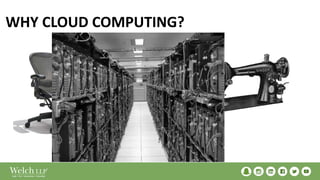
WHY CLOUD COMPUTING?
POLL: Are you using any Cloud Services
in your business?
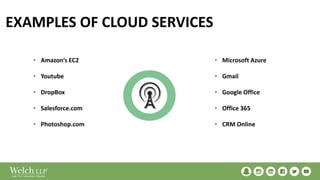
EXAMPLES OF CLOUD SERVICES
• Amazon’s EC2
• Youtube
• DropBox
• Salesforce.com
• Photoshop.com
• Microsoft Azure
• Gmail
• Google Office
• Office 365
• CRM Online
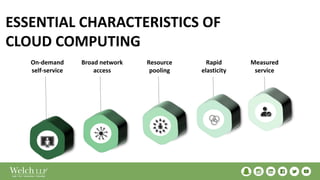
ESSENTIAL CHARACTERISTICS OF
CLOUD COMPUTING
On-demand
self-service
Broad network
access
Resource
pooling
Rapid
elasticity
Measured
service
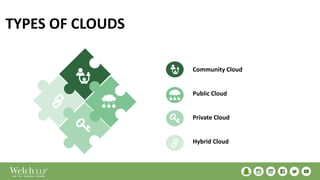
TYPES OF CLOUDS
Community Cloud
Public Cloud
Private Cloud
Hybrid Cloud
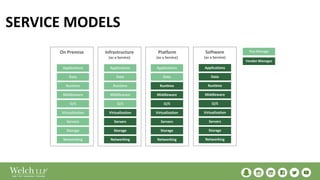
SERVICE MODELS
-
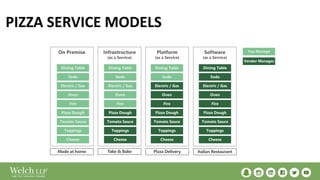
PIZZA SERVICE MODELS
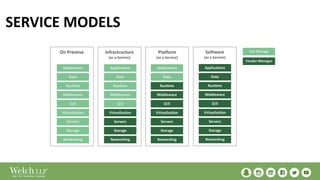
Vendor Manages
SERVICE MODELS
-
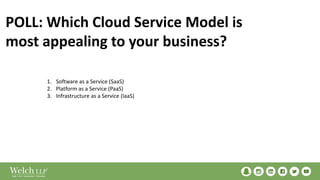
POLL: Which Cloud Service Model is
most appealing to your business?
1. Software as a Service (SaaS)
2. Platform as a Service (PaaS)
3. Infrastructure as a Service (IaaS)
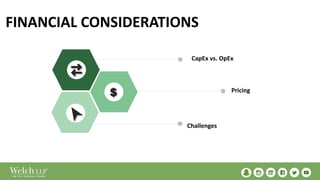
CapEx vs. OpEx
Pricing
Challenges
FINANCIAL CONSIDERATIONS
$
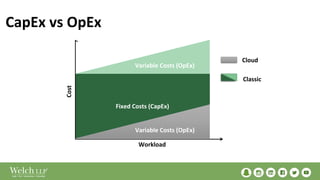
CapEx vs OpEx
Fixed Costs (CapEx)
Variable Costs (OpEx)
Cloud
Classic
Workload
Cost
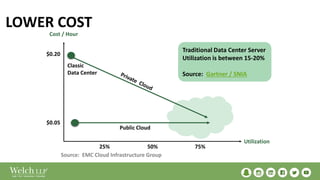
LOWER COST
Public Cloud
Classic
Data Center
Utilization
Cost / Hour
$0.20
$0.05
25% 75%50%
Traditional Data Center Server
Utilization is between 15-20%
Source: Gartner / SNIA
Source: EMC Cloud Infrastructure Group
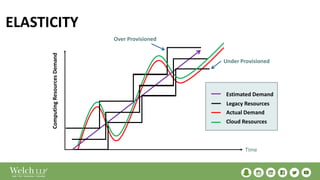
Legacy Resources
Actual Demand
Cloud Resources
ELASTICITY
Time
ComputingResourcesDemand
Over Provisioned
Under Provisioned
Estimated Demand
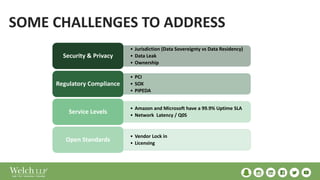
SOME CHALLENGES TO ADDRESS
• Jurisdiction (Data Sovereignty vs Data Residency)
• Data Leak
• Ownership
Security & Privacy
• PCI
• SOX
• PIPEDA
Regulatory Compliance
• Amazon and Microsoft have a 99.9% Uptime SLA
• Network Latency / Q0S
Service Levels
• Vendor Lock in
• Licensing
Open Standards
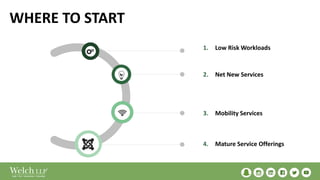
WHERE TO START
1. Low Risk Workloads
2. Net New Services
3. Mobility Services
4. Mature Service Offerings
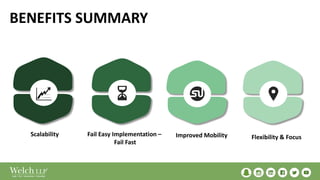
BENEFITS SUMMARY
Scalability Fail Easy Implementation –
Fail Fast
Improved Mobility Flexibility & Focus
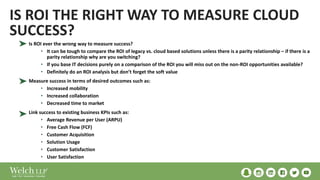
IS ROI THE RIGHT WAY TO MEASURE CLOUD
SUCCESS?
Is ROI ever the wrong way to measure success?
• It can be tough to compare the ROI of legacy vs. cloud based solutions unless there is a parity relationship – if there is a
parity relationship why are you switching?
• If you base IT decisions purely on a comparison of the ROI you will miss out on the non-ROI opportunities available?
• Definitely do an ROI analysis but don’t forget the soft value
Measure success in terms of desired outcomes such as:
• Increased mobility
• Increased collaboration
• Decreased time to market
Link success to existing business KPIs such as:
• Average Revenue per User (ARPU)
• Free Cash Flow (FCF)
• Customer Acquisition
• Solution Usage
• Customer Satisfaction
• User Satisfaction
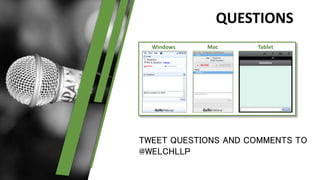
Windows Mac Tablet
TWEET QUESTIONS AND COMMENTS TO
@WELCHLLP
QUESTIONS
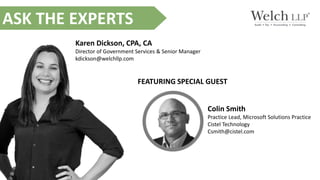
Karen Dickson, CPA, CA
Director of Government Services & Senior Manager
kdickson@welchllp.com
ASK THE EXPERTS
FEATURING SPECIAL GUEST
Colin Smith
Practice Lead, Microsoft Solutions Practice
Cistel Technology
Csmith@cistel.com

Information Technology in the Cloud

  • 1.
  • 2.
    Windows Mac Tablet •Attendees are in listen-only mode • This webinar is being recorded for future on-demand playback • Your participation represents acknowledgement that we are recording • Tweet questions & comments to @WelchLLP GROUND RULES
  • 3.
    Karen Dickson, CPA,CA Director of Government Services & Senior Manager kdickson@welchllp.com PRESENTERS FEATURING SPECIAL GUEST Colin Smith Practice Lead, Microsoft Solutions Practice Cistel Technology Inc. Csmith@cistel.com
  • 4.
    • Why CloudComputing? • Types of clouds • Service models • Financial considerations • Making the decision • Measuring success WHAT WILL BE COVERED
  • 5.
  • 6.
    POLL: Are youusing any Cloud Services in your business?
  • 7.
    EXAMPLES OF CLOUDSERVICES • Amazon’s EC2 • Youtube • DropBox • Salesforce.com • Photoshop.com • Microsoft Azure • Gmail • Google Office • Office 365 • CRM Online
  • 8.
    ESSENTIAL CHARACTERISTICS OF CLOUDCOMPUTING On-demand self-service Broad network access Resource pooling Rapid elasticity Measured service
  • 9.
    TYPES OF CLOUDS CommunityCloud Public Cloud Private Cloud Hybrid Cloud
  • 10.
  • 11.
  • 12.
  • 13.
    POLL: Which CloudService Model is most appealing to your business? 1. Software as a Service (SaaS) 2. Platform as a Service (PaaS) 3. Infrastructure as a Service (IaaS)
  • 14.
  • 15.
    CapEx vs OpEx FixedCosts (CapEx) Variable Costs (OpEx) Variable Costs (OpEx) Cloud Classic Workload Cost
  • 16.
    LOWER COST Public Cloud Classic DataCenter Utilization Cost / Hour $0.20 $0.05 25% 75%50% Traditional Data Center Server Utilization is between 15-20% Source: Gartner / SNIA Source: EMC Cloud Infrastructure Group
  • 17.
    Legacy Resources Actual Demand CloudResources ELASTICITY Time ComputingResourcesDemand Over Provisioned Under Provisioned Estimated Demand
  • 18.
    SOME CHALLENGES TOADDRESS • Jurisdiction (Data Sovereignty vs Data Residency) • Data Leak • Ownership Security & Privacy • PCI • SOX • PIPEDA Regulatory Compliance • Amazon and Microsoft have a 99.9% Uptime SLA • Network Latency / Q0S Service Levels • Vendor Lock in • Licensing Open Standards
  • 19.
    WHERE TO START 1.Low Risk Workloads 2. Net New Services 3. Mobility Services 4. Mature Service Offerings
  • 20.
    BENEFITS SUMMARY Scalability FailEasy Implementation – Fail Fast Improved Mobility Flexibility & Focus
  • 21.
    IS ROI THERIGHT WAY TO MEASURE CLOUD SUCCESS? Is ROI ever the wrong way to measure success? • It can be tough to compare the ROI of legacy vs. cloud based solutions unless there is a parity relationship – if there is a parity relationship why are you switching? • If you base IT decisions purely on a comparison of the ROI you will miss out on the non-ROI opportunities available? • Definitely do an ROI analysis but don’t forget the soft value Measure success in terms of desired outcomes such as: • Increased mobility • Increased collaboration • Decreased time to market Link success to existing business KPIs such as: • Average Revenue per User (ARPU) • Free Cash Flow (FCF) • Customer Acquisition • Solution Usage • Customer Satisfaction • User Satisfaction
  • 22.
    Windows Mac Tablet TWEETQUESTIONS AND COMMENTS TO @WELCHLLP QUESTIONS
  • 23.
    Karen Dickson, CPA,CA Director of Government Services & Senior Manager kdickson@welchllp.com ASK THE EXPERTS FEATURING SPECIAL GUEST Colin Smith Practice Lead, Microsoft Solutions Practice Cistel Technology Csmith@cistel.com

Editor's Notes

  • #4 Karen Dickson, CPA, CA, Director of Government Services & Senior Manager at Welch LLP Karen is the Director of Welch’s Government Services department. She joined Welch in 2001 after graduating from Carleton University with a Bachelor of Commerce and obtained her CA designation in 2003. She has developed her skills on audits for a wide variety of clients in the not-for-profit, construction, and automobile sectors. She has extensive experience with federal government departments and agencies auditing various Contribution Agreements in the role as Project Manager. Colin Smith Colin is a Microsoft Most Valuable Professional (MVP) with over 20 years of experience deploying Microsoft-based solutions for private and public sector organizations. Colin works with organizations, providing guidance and expertise in the design and deployment of solutions that help to automate and optimize technology operations and ultimately drive business efficiency. Colin has been a consultant, solutions architect, and systems engineer with Microsoft, Statistics Canada, Configuresoft, and is now the Practice Lead of the Microsoft Consulting Practice at Cistel.
  • #5 Karen
  • #7 Poll will pop up in another window- this slide will not be shown
  • #14 Poll will pop up in another window- this slide will not be shown
  • #24 Seed Questions: How would you recommend that a small business (with limited resources) assess the myriad of Cloud based systems that are available in the marketplace? Can you recommend some good websites that provide unbiased and high quality recommendations of systems? I’m overwhelmed trying to find a system that meets our needs. I have been considering cloud services for business for a few years, but I am worried that I will not be in control of my information. Is there a risk to using the services? It seems like there is a lot of new technology that businesses may not be familiar with.  What technologies should I start with?