Interactive Information Seeking Behaviour And Retrieval Ian Ruthven
Interactive Information Seeking Behaviour And Retrieval Ian Ruthven
Interactive Information Seeking Behaviour And Retrieval Ian Ruthven
Interactive Information Seeking Behaviour And Retrieval Ian Ruthven
Interactive Information Seeking Behaviour And Retrieval Ian Ruthven
1.
Interactive Information SeekingBehaviour And
Retrieval Ian Ruthven download
https://ebookbell.com/product/interactive-information-seeking-
behaviour-and-retrieval-ian-ruthven-51284986
Explore and download more ebooks at ebookbell.com
2.
Here are somerecommended products that we believe you will be
interested in. You can click the link to download.
Interactive Information Retrieval In Digital Environments 1st Edition
Iris Xie
https://ebookbell.com/product/interactive-information-retrieval-in-
digital-environments-1st-edition-iris-xie-1769128
Collaborative Technologies And Applications For Interactive
Information Design Emerging Trends In User Experiences Premier
Reference Source 1st Edition Scott Rummler
https://ebookbell.com/product/collaborative-technologies-and-
applications-for-interactive-information-design-emerging-trends-in-
user-experiences-premier-reference-source-1st-edition-scott-
rummler-2186538
A Behavioral Economics Approach To Interactive Information Retrieval
Understanding And Supporting Boundedly Rational Users Jiqun Liu
https://ebookbell.com/product/a-behavioral-economics-approach-to-
interactive-information-retrieval-understanding-and-supporting-
boundedly-rational-users-jiqun-liu-49152758
Professional Search In The Modern World Cost Action Ic1002 On
Multilingual And Multifaceted Interactive Information Access 1st
Edition Georgios Paltoglou
https://ebookbell.com/product/professional-search-in-the-modern-world-
cost-action-ic1002-on-multilingual-and-multifaceted-interactive-
information-access-1st-edition-georgios-paltoglou-4933160
3.
Interactive Collaborative InformationSystems 1st Edition Lucian
Buoniu
https://ebookbell.com/product/interactive-collaborative-information-
systems-1st-edition-lucian-buoniu-4194464
Interactive Multimodal Information Management Andrei Popescubelis
Herve Bourlard
https://ebookbell.com/product/interactive-multimodal-information-
management-andrei-popescubelis-herve-bourlard-5059132
Interactive Collaborative Information Systems 1st Edition Lucian
Buoniu
https://ebookbell.com/product/interactive-collaborative-information-
systems-1st-edition-lucian-buoniu-2466700
Measurementdriven Simulation Of Complex Engineering Systems Arnoud
Visser Interactive Collaborative Information Systems Project
https://ebookbell.com/product/measurementdriven-simulation-of-complex-
engineering-systems-arnoud-visser-interactive-collaborative-
information-systems-project-4110504
Abstract Information Visualization In Interactive 3d Virtual
Environments Conceptualization And Usability Evaluation Thse De
Doctorat Kaveh Bazargan Harandi
https://ebookbell.com/product/abstract-information-visualization-in-
interactive-3d-virtual-environments-conceptualization-and-usability-
evaluation-thse-de-doctorat-kaveh-bazargan-harandi-7013230
Dedication......................................................................................................................v
Figures and tables:acknowledgements.....................................................................ix
Contributors ................................................................................................................xv
Foreword...................................................................................................................xxv
Tefko Saracevic
Preface....................................................................................................................xxxiii
1 Interactive information retrieval: history and background..................................1
Colleen Cool and Nicholas J. Belkin
2 Information behavior and seeking.......................................................................15
Peiling Wang
3 Task-based information searching and retrieval .................................................43
Elaine G. Toms
4 Approaches to investigating information interaction and behaviour...............61
Raya Fidel
5 Information representation ..................................................................................77
Mark D. Smucker
6 Access models ........................................................................................................95
Edie Rasmussen
7 Evaluation ............................................................................................................113
Kalervo Järvelin
8 Interfaces for information retrieval....................................................................139
Max Wilson
VII
Contents
●●●
12.
9 Interactive techniques.........................................................................................171
Ryen W. White
10 Web retrieval, ranking and personalization......................................................189
Jaime Teevan and Susan Dumais
11 Recommendation, collaboration and social search...........................................205
David M. Nichols and Michael B. Twidale
12 Multimedia: behaviour, interfaces and interaction...........................................221
Haiming Liu, Suzanne Little and Stefan Rüger
13 Multimedia: information representation and access ........................................235
Suzanne Little, Evan Brown and Stefan Rüger
References.................................................................................................................255
Index..........................................................................................................................291
INTERACTIVE INFORMATION SEEKING, BEHAVIOUR AND RETRIEVAL
VIII
Nicholas J. Belkinis Distinguished Professor of Information Science in the
Department of Library and Information Science, School of Communication and
Information, Rutgers University, where he has been since 1985. From 1975 until
this appointment, he was on the faculty of the Department of Information
Science, The City University, London. Professor Belkin’s research has focused
on understanding why people engage in interactions with information, the
problems they experience in such interactions, and the design and evaluation
of systems which support people in these interactions. His most recent research
has been concerned with the personalization of interactions with information
systems, with the aim of designing a ‘personalization assistant’, a software
application on a person’s computing devices that tailors results from web
information searches to the specifics of the person’s current task, context and
situation. He is also developing a new approach to the evaluation of interactive
information retrieval systems, based on the usefulness of the system in helping
searchers to achieve the goals that led them to engage in information seeking.
Professor Belkin is the recipient of the American Society for Information Science
and Technology (ASIST) Award for Outstanding Information Science Teacher,
the Research Award, and the Award of Merit, as well as the Distinguished
Lectureship Award of the New Jersey Chapter of the ASIST, and the Los
Angeles Chapter of the ASIST Award for Distinguished Contributions to
Information Science. He has been the President of ASIST, and the Chair of the
ACM Special Interest Group on Information Retrieval.
Evan Brown (PhD candidate, The Open University) has a background in law
(LLB Law, University of Durham, 2001) and extensive experience as a software
developer and Knowledge Transfer Associate with Edinburgh Napier
University. Evan was subsequently involved in software development and
XV
Contributors
●●●
20.
technical project managementactivities for a broad range of major clients
including the BBC, Learning and Teaching Scotland, learnDirect Scotland, the
University of the Highlands and Islands Millennium Institute and the Scottish
Qualifications Authority. He was centrally responsible for the development of
PhraseBox, a large-scale corpus search engine. Evan has spoken and written
widely on the development, use and application of open source software in both
commercial and educational contexts and he continues to provide training and
consultancy in intellectual property law for a variety of organizations.
He has also contributed extensively to the Scottish Gaelic localization
community at OpenOffice.org. The focus of his work with KMi is on inform-
ation search and retrieval technologies and their application in the domain of
image recognition.
Colleen Cool is an Associate Professor in the Graduate School of Library and
Information Studies, Queens College of the City University of New York. She
received her PhD from the School of Communication, Information and Library
Studies at Rutgers University. Her research and publications are in the areas of
human information behaviour, interaction with information, and help-seeking
behaviour. Most recently, she has received support for her research in the area
of help-seeking behaviours in digital libraries from the Institute for Museum
and Library Services (IMLS).
Susan Dumais is a Principal Researcher and manager of the Context, Learning
and User Experience for Search (CLUES) Group at Microsoft Research. She has
been at Microsoft Research since 1997 and has published widely in the areas of
human–computer interaction and information retrieval. Prior to joining
Microsoft Research, she was at Bellcore and Bell Labs for many years, where
she worked on Latent Semantic Indexing (a well known statistical method for
concept-based retrieval), combining search and navigation, individual
differences, and organizational impacts of new technology. Her current research
focuses on the temporal dynamics of information systems, user modelling and
personalization, novel interfaces for interactive retrieval, and search evaluation.
She has worked closely with several Microsoft groups (Bing, Windows Desktop
Search, SharePoint Portal Server, and Office Online Help) on search-related
innovations. Susan has published more than 250 articles in the fields of
information science, human–computer interaction, and cognitive science, and
holds several patents on novel retrieval algorithms and interfaces. She is Past-
Chair of ACM’s Special Interest Group in Information Retrieval (SIGIR), and
serves on numerous editorial boards and advisory committees. Susan was
elected to the CHI Academy in 2005, an ACM Fellow in 2006, received the SIGIR
Gerard Salton Award for Lifetime Achievement in 2009, and to the National
INTERACTIVE INFORMATION SEEKING, BEHAVIOUR AND RETRIEVAL
XVI
21.
Academy of Engineering(NAE) in 2011. She is an adjunct professor in the
Information School at the University of Washington, and has previously been a
visiting faculty member at Stevens Institute of Technology, New York
University, and the University of Chicago.
Raya Fidel is a Professor at the Information School of the University of
Washington in Seattle, USA. She started her research path focusing on the
conceptual design of information systems, and moved to investigate human–
information interaction when it became clear that very little research in that area
is relevant to the design of effective systems. Using the Cognitive Work Analysis
framework, she has led several large-scale projects that studied what work actors
do and their information behaviour. Among the groups she investigated were
online searchers (librarians), students, engineers, and sanitation workers. She has
published about 50 journal articles and conference papers, and her recent book
Human Information Interaction is due for publication in early 2012. Professor Fidel
has taught various graduate courses in the area of human information behaviour
and on qualitative research methods.
Kalervo Järvelin (http:/
/www.uta.fi/~likaja) is Professor and Vice Chair at the
School of Information Sciences, University of Tampere, Finland. He holds a PhD
in Information Studies (1987) from the same university. He was Academy
Professor, Academy of Finland, in 2004–2009. Professor Järvelin’s research
covers information seeking and retrieval, linguistic and conceptual methods in
IR, IR evaluation, and database management. He has co-authored over 250
scholarly publications and supervised 16 doctoral dissertations. He has been a
principal investigator of several research projects funded by the EU, industry,
and the Academy of Finland. Professor Järvelin has frequently served the ACM
SIGIR Conferences as a program committee member (1992–2009), Conference
Chair (2002) and Program Co-Chair (2004, 2006); and the ECIR, the ACM CIKM
and many other conferences as PC member. He is an Associate Editor of
Information Processing & Management (USA). Professor Järvelin received the
Finnish Computer Science Dissertation Award 1986; the ACM SIGIR 2000 Best
Paper Award for the seminal paper on the discounted cumulated gain
evaluation metric; the ECIR 2008 Best Paper Award for session-based IR
evaluation; the IIiX 2010 Best Paper Award for a study on task-based
information access; and the Tony Kent Strix Award 2008 in recognition of
contributions to the field of information retrieval.
Diane Kelly is an Associate Professor and McColl Distinguished Term Professor
at the School of Information and Library Science at the University of North
Carolina, Chapel Hill, USA. Her research interests are in interactive information
XVII
CONTRIBUTORS
22.
search and retrieval,information search behaviour and evaluation methods and
metrics. Her research has been published in several conferences and journals
including ACM SIGIR, ACM CHI, CIKM, IIiX, JCDL, Transactions on
Information Systems, Information Processing and Management, IEEE Computer
and CACM. She teaches courses on research design, interactive information
retrieval and foundations of information science. She is the recipient of two
teaching awards: the 2009 ASIST/Thomson Reuters Outstanding Information
Science Teacher Award and the 2007 SILS Outstanding Teacher of the Year
Award. She has served on the UNC Behavioral Institutional Review Board
(IRB) since 2005. She received a PhD in Information Science and a Graduate
Certificate in Cognitive Science from Rutgers University and an undergraduate
degree in Psychology from the University of Alabama.
Suzanne Little is a researcher at the Knowledge Media Institute of The Open
University, UK, where she has worked on both EU projects – PHAROS for
audio-visual search, OpenScout (eContentPlus) for discovering educational
resources for management training – and local projects – SocialLearn, video
digital libraries (OU Library and University of Waikato). She completed her
PhD at the University of Queensland, Australia, in 2006, examining and
developing tools for analysing and managing scientific multimedia data.
Following this Suzanne held an 18-month postdoctoral fellowship within the
European Network of Excellence in multimedia semantic search (MUSCLE)
dividing her time between ISTI-CNR in Pisa, Italy, and IBaI in Leipzig,
Germany. She has developed and presented tutorials on multimedia
information retrieval for the PHAROS summer school and the Joint Conference
on Digital Libraries and was local organization chair for the European
Conference on Information Retrieval in 2010. Her research interests include
multimedia semantics, image annotation, eScience applications, human–
computer interactions and semantic web applications.
Haiming Liu is a Lecturer in Computer Science and Technology at the
University of Bedfordshire (UK) with responsibility for teaching and research.
She is also a User Experience Developer for the SocialLearn project at The Open
University (UK) where she designs, tests and refines the learnability and
usability of SocialLearn’s user interface. Haiming completed her PhD at the
Knowledge Media Institute, The Open University (UK), in 2010. Her thesis
focused on understanding user interaction with content-based image search
systems from three aspects: a user interaction model, an interactive interface
and users. Her research interests include multimedia information retrieval,
relevance feedback, interactive interface design, user interaction modelling, user
profile analysis, social learning, and learning analytics.
INTERACTIVE INFORMATION SEEKING, BEHAVIOUR AND RETRIEVAL
XVIII
23.
David M. Nicholsis a senior lecturer in the Department of Computer Science
at the University of Waikato, Hamilton, New Zealand. He received a BSc(Hons)
in Computer Science in 1989 and a PhD in 1995, both from Lancaster University.
He has worked at Lancaster, the University of Illinois at Urbana-Champaign
and, since 2002, at Waikato. His research interests include digital libraries,
usability and open source software. He co-authored (with Ian Witten and David
Bainbridge) the textbook How to Build a Digital Library (2010, second edition)
and is a member of the research group that develops Greenstone, a suite of
software tools for building and distributing digital library collections.
Edie Rasmussen is currently Professor in the School of Library, Archival and
Information Studies at the University of British Columbia, Vancouver, BC,
Canada, where she served as Director for six years. She has also held
appointments at the University of Pittsburgh, USA, Dalhousie University,
Canada, and Institiut Teknoloji MARA, Malaysia, and visiting positions in
Norway, Singapore, New Zealand, and Australia. Dr Rasmussen has been active
in the Information Retrieval and Digital Library research communities, serving
as Chair for the ACM SIGIR, ACM DL, ACM/IEEE JCDL, and ASIS&T
conferences. She served as President of the American Society for Information
Science & Technology, President of the Canadian Council of Information
Studies/Conseil Canadien des sciences de l’information, and Co-convenor of
the Council of Deans and Directors of the Association for Library and
Information Science Education. Her current research interests include indexing
and information retrieval in text and multimedia databases and digital libraries.
Stefan Rüger is a Professor of Knowledge Media at The Open University’s
Knowledge Media Institute that he joined in 2006 to head a research group on
Multimedia and Information Systems. Stefan read Physics at the Freie
Universität Berlin and gained his PhD at the Technische Universität Berlin
(1996). He carved out his academic career at Imperial College London (1997–
2006), where he also held an EPSRC Advanced Research Fellowship
(1999–2004). Since 2009 he has held an Honorary Professorship from the
University of Waikato, New Zealand, for his collaboration with the Greenstone
Digital Library group on Multimedia Digital Libraries. Stefan has published
widely in the area of Multimedia Information Retrieval. He was Principal
Investigator in the EPSRC-funded Multimedia Knowledge Management
Network, of a recent EPSRC grant to research and develop video digital libraries
and for The Open University in the European FP6-ICT project PHAROS that
established a horizontal layer of technologies for large-scale audio-visual search
engines. As of 2011, he has served the academic community in various roles as
conference chair (3x), programme chair (3x), journal editor (3x), guest editor
XIX
CONTRIBUTORS
24.
(3x) and asreferee for a wide range of Computing journals (>25), international
conferences (>50) and research sponsors (>10). Stefan is a member of the EPSRC
College, ACM, BCS, the BCS IRSG committee and a fellow of the Higher
Education Academy.
Ian Ruthven is a Professor of Information Seeking and Retrieval at the
University of Strathclyde, UK. His research is centred on the development of
effective and usable information access systems. His research is aimed at
uncovering how people think about the process of searching, how information
access systems could be designed differently to provide better support for
searchers and how we can evaluate new types of information access system. He
has carried out funded research projects on developing interactive information
systems for children, cognitive decision-making processes in web retrieval and
the information seeking behaviour of marginalized groups. He received a PhD
in Computer Science from the University of Glasgow, an MSc in Cognitive
Science from the University of Birmingham and a BSc(Hons) in Computing
Science from the University of Glasgow.
Mark D. Smucker is an assistant professor in the Department of Management
Sciences at the University of Waterloo, Canada, and is cross-appointed with
the David R. Cheriton School of Computer Science. Mark’s research interests
include the design and analysis of interactive information retrieval systems. His
research focuses on the creation and evaluation of interaction mechanisms that
improve text search. Recently he has studied the relationship between retrieval
precision and human performance on search tasks, and he co-organized a SIGIR
workshop on the evaluation of retrieval systems via the simulation of
interaction. Mark received his computer science PhD from the University of
Massachusetts Amherst in 2008.
Jaime Teevan is a researcher in the Context, Learning, and User Experience for
Search (CLUES) Group at Microsoft Research. Her work explores how our
digital past can help shape our future information interactions. Jaime was
named a Technology Review (TR35) 2009 Young Innovator for her research on
personalized search. She co-authored the first book on collaborative Web search,
and is Chair of the Web Search and Data Mining (WSDM) 2012 conference.
Jaime also co-edited a book on Personal Information Management (PIM), co-
edited a special issue of Communications of the ACM on the topic, and
organized workshops on PIM and query log analysis. She has published
numerous technical papers, including several best papers, and received a PhD
and SM from MIT and a BS in Computer Science from Yale University.
INTERACTIVE INFORMATION SEEKING, BEHAVIOUR AND RETRIEVAL
XX
25.
Elaine G. Tomsis Professor and Canada Research Chair in Management
Informatics, and runs the iLab at the Faculty of Management, Dalhousie
University, Halifax, Nova Scotia, Canada. She was formerly an Associate
Professor in the Faculty of Information Studies, University of Toronto, and at
the School of Library and Information Studies (now School of Information
Management) at Dalhousie University. She holds a BA in Economic Geography
and Education from Memorial University, St. John’s Newfoundland; a Masters
of Information and Library Studies from Dalhousie University; and a PhD from
the University of Western Ontario, London, Canada. Her research interests lie
at the intersection of human–computer interaction, information retrieval and the
representation and presentation of information. Her work has been funded by
NSERC, SSHRC, OCLC, Heritage Canada, Canada Foundation for Innovation
and the Canada Research Chairs Program. She was/is co-investigator with three
Canadian national research networks: TAPoR, the Text Analysis Portal for
Research; NECTAR, the Network for Effective Collaboration Through Advanced
Research; and the National Centres of Excellence project, GRAND, which involves
new media. Her publications have appeared in journals such as the International
Journal of Human Computer Studies, the Journal of the American Society for Information
Science, and Information Processing & Management, as well as in the proceedings of
a number of national and international associations.
Michael B. Twidale is a Professor of the Graduate School of Library and
Information Science, the iSchool at the University of Illinois at Urbana-
Champaign. He received a BA(Hons) in Computer Science from Queens’
College, Cambridge University, in 1985 and a PhD from Lancaster University
in 1990. His research interests include computer supported cooperative work,
computer supported collaborative learning, human computer interaction,
information visualization, and museum informatics. Current projects include
studies of informal social learning of technology, technological appropriation,
collaborative approaches to managing data quality, the use of mashups to create
lightweight applications, collaborative information retrieval, ubiquitous
learning and the usability of open source software. His approach involves the
use of interdisciplinary techniques to develop high speed low cost methods to
better understand the needs of people, and their difficulties with existing
computer applications as part of the process of designing more effective
systems.
Peiling Wang is a Professor at the School of Information Sciences, The
University of Tennessee, Knoxville. She received her PhD from the University
of Maryland in 1994. Her research areas include information seeking and user
behaviours, relevance, data mining and knowledge discovery, research
XXI
CONTRIBUTORS
26.
methodologies and methods,knowledge structures and concept mapping, and
citation analysis. Her research into Web users’ searching behaviours received
the grants from OCLC/ALISE (2005) and the Institute for Museum and Library
Services (2005–2008). She has published more than 50 articles, conference
papers, and reviews. She is a frequent speaker at international conferences. She
served the editorial board of Library and Information Science Research (2003–2008).
She reviews for journals including Information Processing & Management,
Information Retrieval, Journal of the American Society for Information Science and
Technology (JASIST), and Information Science. She serves conference programmes
including American Society for Information Science and Technology (ASIST),
SIGIR, CIKM, IIiX and ISIC. Her honours include the ASIST Doctoral Forum
Award (1994), the Best JASIST Paper Award (1999), the OCLC/ALISE Research
Grant Award (2005), and the ASIST Outstanding Information Science Teaching
Award (2005), and SIGUSE Best Conference Paper Runner-up (2007). She was
invited to the 2006 Faculty Summit at the Microsoft External Research and
Programs. She is an active member of ASIST and served and chaired Research
Award, Best Book Award, and Outstanding Teaching Award. She is an invited
external reviewer for faculty tenure and promotion and dissertations.
Ryen W. White is a researcher in the Context, Learning, and User Experience
for Search (CLUES) Group at Microsoft Research, Redmond. His research
interests lie in understanding search interaction and in developing tools to help
people search more effectively. He received his PhD in Interactive Information
Retrieval from the Department of Computing Science, University of Glasgow,
UK, in 2004. Ryen has published over 100 conference papers and journal articles
in web search, log analysis, and user studies of search systems. He has received
six best-paper awards, including two at the ACM SIGIR conference (2007, 2010),
one at the ACM SIGCHI conference (2011), and one in JASIST (2010). His
doctoral research received the British Computer Society’s Distinguished
Dissertation Award for the best Computer Science PhD dissertation in the
United Kingdom in 2004/2005. Ryen has co-organized numerous workshops
on information seeking, in particular exploratory search, including an NSF-
sponsored invitational workshop, and has guest co-edited special issues in these
areas for a variety of outlets, including Communications of the ACM and IEEE
Computer. Since 2008, he has co-organized the annual HCIR workshop. Ryen
has served as area chair for many top conferences in information retrieval, and
currently serves on the editorial board of ACM TOIS and the Information
Retrieval Journal. In addition to academic impact, his research has been shipped
in many Microsoft products, including Bing, Xbox, Internet Explorer, and Lync.
INTERACTIVE INFORMATION SEEKING, BEHAVIOUR AND RETRIEVAL
XXII
27.
Max Wilson isa Lecturer in Human–Computer Interaction and Information
Seeking, in the Future Interaction Technology Lab at Swansea University, UK.
His research focuses on Search User Interface design, taking a multidisciplinary
perspective from both Human–Computer Interaction (the presentation and
interaction) and Information Science (the information and seeking behaviours).
His doctoral work, which won best article in the Journal of the American Society
for Information Science and Technology in 2009, focused on evaluating Search
User Interfaces using models of Human Information Seeking behaviours. Max
received his PhD from the University of Southampton, under the supervision
of m.c. schraefel and Dame Wendy Hall, where much of his work was grounded
in supporting Exploratory Search with the mSpace platform, and within the
developing context of Web Science. Max publishes broadly in Human–
Computer Interaction and Information Science communities, including a
monograph with co-authors schraefel, Kules and Shneiderman on future
Search User Interfaces for the web, and a book chapter on Casual-Leisure
Information Behaviour. Max actively participates in both communities. In
conjunction with user experience professionals, Max is bringing European
industry and academia together at the forthcoming EuroHCIR2011 workshop,
and, with future conference chairs as panelists, is fundamentally challenging
the Human–Computer Interaction community’s perspective on the replicability
of research at his RepliCHI panel. At Swansea, Max teaches research methods
for Human–Computer Interaction, and Human Information Retrieval. Max is
also leading the development of a Web Science MSc programme at Swansea to
stimulate cross-disciplinary teaching and research.
XXIII
CONTRIBUTORS
29.
The job ofthe search user interface is to aid users in the expression of their inform-
ation needs, in the formulation of their queries, in the understanding of their search
results, and in keeping track of the progress of their information seeking efforts.
(Marti Hearst, Search User Interfaces, Cambridge University Press, 2009)
Search user interfaces are at the centre of interactive information seeking and
retrieval. Yes, search user interfaces include the jobs that the quotation above
enumerates and even more. While this book is not only about interfaces, it is
also about those jobs and even more about that more.
This book reports on the recent advances on interaction topics reflected in its
title. However, the historic roots of these topics go deep – and like all roots they
are entangled and not that visible. But we can learn from them in terms of
problems addressed and solutions attempted. Research on information-seeking
behaviour, under various names and orientations, goes back many decades. So
let us start with a bit of general history of the topics covered by the book; more
specific history is presented in Chapter 1.
Activities associated with what we now call information retrieval existed and
were practised long before Calvin Mooers (1919–1994, physicist and information
retrieval pioneer) coined the term information retrieval in 1951. They were
rooted in libraries but left them to become part of technology.
Mooers (1951) defined information retrieval as follows:
Information retrieval is . . . the finding or discovery process with respect to stored
information . . . useful to [a user]. Information retrieval embraces the intellectual
aspects of the description of information and its specification for search, and also
whatever systems, techniques, or machines that are employed to carry out the
operation.
XXV
Foreword
●●●
30.
Not surprisingly, interactionis not mentioned in this definition – at the time the
concept and term (in its present denotation and connotation) did not exist, even
though interaction was practised from the start using ‘whatever systems,
techniques, or machines’ were available. Even ‘intellectual aspects . . . for search’
imply interaction. As it turned out, the ‘systems, techniques or machines’ on
the one hand and ‘intellectual aspects’ on the other became two major branches
of problem orientation and inspiration for information retrieval research and
practice.
Research on information-seeking behaviour has a number of precursors, also
with a long history. The earliest ones are investigations in the 1920s by Alfred
Lotka (1880–1949, mathematician, chemist and statistician); from collected data
he formulated a general law (‘Lotka’s law’) on the statistical pattern reflecting
the frequency of publication by authors in any given field (Lotka, 1926). While
Lotka was not directly asking an information-seeking question – his was a
question about a given quantity (authors) as related to a given yield
(publications) – it does indeed relate to the broader area of information
behaviour. Lotka’s approach inspired a number of statistical studies on other
quantity–yield relations and laws related to information, such as by Samuel
Bradford (1878–1948, British mathematician and librarian); in the 1930s he
studied the relationship between journal titles (quantity) and publications
relevant to a topic (yield), and also formulated a widely studied and elaborated
law (‘Bradford’s law’) (Bradford, 1934). The lively area of study that followed
became known as bibliometrics – the quantitative study of the properties of
recorded scientific discourse, or more specifically of documents, and document-
related processes. As the web became the fastest growing technology in history
it also became a new source of data for ever-growing types of bibliometric-like
analyses, organized under the common name of webometrics. From Lotka to
webometrics, basic problems and questions addressed over time were similar
– they concentrated on structure and use – but artefacts differed.
The beginning of user studies can be traced to two research reports presented
at the Royal Society Scientific Information Conference in 1948. The impact of
the conference was historic. The studies, considered as the first user studies,
were by Urquhart (1948) (a survey of users of the London Science Museum
Library to determine their source of references, purpose of seeking information
and resultant satisfaction) and by Bernal (1948) (a survey of the use of journals
by British scientists). Topics relating to these papers are mentioned to compare
them with questions asked in contemporary user studies. They resonate.
Over the following decades, studies of information-seeking behaviour
concentrated on a variety of problem areas using a variety of approaches. For a
long time, from the 1950s to the start of the 1980s, the focus was on the study of
information needs and uses – labelled as a single concept. ‘Information need
INTERACTIVE INFORMATION SEEKING, BEHAVIOUR AND RETRIEVAL
XXVI
31.
and use’ wasregularly used as a phrase. However, while related, information
need and information use are distinct concepts. Information need refers to a
cognitive or even a social state and information use to a process. Being criticized
as nebulous, the concept of information need was abandoned by the mid-1980s;
we hardly see it mentioned as a subject of study any more. But studies of
information use continued, many alongside general problems raised by
Urquhart and Bernal, such as: Who are the users of a given information system or
resource? What information objects do they use? What information channels are used
to gather information? Or in other words: Who uses what? How? For what purpose?
Information use is goal-directed. Thus the studies addressing these questions
were, and still are, pragmatic, retrospective and descriptive.
Not surprisingly, study of information use was of interest to a number of
fields. By the start of the 1960s, these included psychology and communication,
bringing with them psychological and communication approaches, questions
and methods. In the mid-1960s Edwin Parker and William Paisley, from the
Institute for Communication Research, Stanford University, were among the
pioneers to introduce an interdisciplinary approach involving psychology,
communication and information science to a study of information retrieval
concentrating on the user side of the process (Paisley and Parker, 1965). The
introduction of psychology and communication to these studies brought new
questions and methods. Qualitative methods became quite prominent, where
previously in user and use studies quantitative methods prevailed.
Eventually by the 1980s this led to a re-orientation and focus of studies to a
related but broader area of information seeking – referring to a set of processes
and strategies dynamically employed by people in their quest for and pursuit
of information. Information seeking also refers to the progression of stages in
those processes. Questions started focusing on cognitive aspects, bringing in
theoretical frameworks and methodological approaches from cognitive science
and even computer science. As elaborated in Chapter 1, Marc de Mey, starting
in the late 1970s, developed and popularized cognitive approaches to the study
of human information processing – the approach concentrates on how
individuals process information and relate information to cognitive models of
their world (de Mey, 1980).
By the 1990s studies of information seeking broadened to a still wider area of
information behaviour: ‘the currently preferred term used to describe the many
ways in which human beings interact with information, in particular, the ways
in which people seek and utilize information’ (Bates, 2010). Interaction began
to cover a very wide area indeed. Up to this date cognitive theories and
approaches have a strong presence in studies not only of human information
behaviour but also of human–computer interaction. The two areas of enquiry
(human information behaviour and human–computer interaction) approached
XXVII
FOREWORD
32.
many similar, ifnot identical, questions but from different perspectives, one
from a human and the other from a machine perspective.
By the start of the millennium search evolved into a dominant process and
even a metaphor of the web, which in turn dominates the internet. As much as
technology is involved, search is still a human activity. As with all human
activity, it is messy. Not surprisingly, the contemporary leading research
question in human information behaviour related to the web is: What is the
nature of the search? And moreover: What are its manifestations and effects? How is
it affected? And then pragmatically: What helps or hinders a search? Theoretical
and experimental investigations and pragmatic solutions on these topics are
entwined. A number of fields, including computer science and information
science, are involved.
This brings us to another point of historical interest. It deals with the
relationship – or lack thereof – between information retrieval research and
development (IR R&D) done under the umbrella of information science and that
of computer science. The contributions presented here come from the tradition
of information science. The book is primarily oriented towards students of
information science – and we are all students all the time, just at different levels.
However, the contributions have relevance for and bearing upon IR R&D in
computer science and moreover on how the results are reported in scholarly
communication within that field.
Beginning in the 1970s, the work on information retrieval in scientific research
and in professional practice started splitting along the disciplinary lines of two
broad branches or clusters. A paradigm split occurred. We now have two
distinct communities and approaches commonly known as system-centred and
user-(or human-)centred (Saracevic, 1999).The first one resides more in computer
science and the second in information science. Both address retrieval, but from
very different perspectives and for very different ends. Unfortunately, these
two main clusters are largely unconnected. Only a very small number of authors
span the two clusters. There are very few integrating works. The two clusters
are not equally populated. The system-centred cluster has significantly more
authors, not to mention total number of works. In large part, this is due to
availability of funds for given topics. Since the 1990s, funding has gone almost
exclusively to system-centred R&D. In contrast, human-centred R&D received
little or no funding. Not surprisingly, research follows money.
As mentioned, the two clusters are relatively isolated from each other – there
is a gap between them. A number of calls for bridging that gap have been issued,
among them in a remarkably comprehensive book The Turn by Ingwersen and
Järvelin (2005); the subtitle Integration of information seeking and retrieval in context
summarizes both the topic of the book and the general problem faced. In the
book the problem is captured as follows:
INTERACTIVE INFORMATION SEEKING, BEHAVIOUR AND RETRIEVAL
XXVIII
33.
Research in InformationSeeking and Information Retrieval constitute two disparate
research areas or camps. Generally, Information Seeking is rooted in Social Science
with background in Library Science whereas much of IR is based in Computer
Science approaches. The two camps do not communicate much with each other,
and it is safe to say that one camp generally views the other as too narrowly bound
with technology whereas the other regards the former as an unusable academic
exercise. . . . The two predominant research communities do not really explore the
ideas, methods and results of each other (Ingwersen and Järvelin, 2005, 2).
The question must be asked: Why should they explore ‘the ideas methods and results
of each other’? The answer lies in a great many examples from the history of
science and technology: effective design of technology depends on
incorporation of and adjustments to human behaviour, needs and uses. Humans
do adapt to technology, but to be really effective technology has to adapt even
more. One of the present (2011) core programmes of the National Science
Foundation, Division of Information and Intelligent Systems (NSF, IIS) is the
Human-Centered Computing programme, with the following explanation:
Human beings, whether as individuals, teams, organizations, or societies, play an
integral role in all stages of the creation and use of computational systems.
Moreover, computing technologies and human societies co-evolve, transforming
each other in the process. Human Centered Computing (HCC) research explores
creative ideas, novel theories, and innovative technologies that advance our
understanding of the complex and increasingly coupled relationships between
people and computing. (NSF, IIS, 2011)
Effective system-centred designs are affected by adaptation to human-centred
approaches. Effective designs of information retrieval systems and processes as
done in computer science are dependent on the incorporation of an effective
relationship with human–computer interaction, with the accent on human and
on ‘our understanding of the complex and increasingly coupled relationships
between people and computing.’ The inference is that significant innovations
in information retrieval will not only come from smarter algorithms that better
exploit existing information resources, but even more so from new retrieval
algorithms that can intelligently use and combine human information
behaviour. Thus, the studies presented here are relevant to both information
science and computer science. Much of the present book can be oriented
towards the broad problem of ‘exploring the ideas methods and results of each
other’, that is, towards bridging the gap.
Finally let us explore the role of the studies in this book within the broader
theme of scholarly communication. In information science the traditional
XXIX
FOREWORD
34.
methods of communication,as it evolved in science, are in full effect. In particular,
papers in journals and other periodicals play the traditional role of reporting peer-
reviewed research for archiving and becoming an integral element in building
the edifice of public knowledge. Traditional critical literature reviews are included
as well. Conference papers, as they appear in proceedings, are oriented towards
reports of progress and discussion of contemporary issues and problems.
In computer science this traditional method has significantly changed.
Communications of the ACM (the ‘leading monthly print and online magazine’
of the Association for Computing Machinery) recently published a series of
articles and discussions on the impact and importance of changed patterns of
scholarly publications in computer science, and the impact and implication of
changes in scholarly communication (e.g. Fortnow (2009), Grudin (2011), and a
lively discussion in dozens of letters, blog entries and articles). The articles and
discussions address the conference and journal publication culture that has
evolved in computer science. They are critical of the gradual shift towards
research and development reports in computer science resulting in conference
proceedings, and the abandonment of reporting in archival journals that have
been the traditional bedrock for scholarly communication in other fields
throughout the history of modern science. The discussion
. . . covers the shift from traditional emphasis on journals to current focus on
conferences, and the challenge of conference reviewing, but at its heart is our sense
of community. . . . In a nutshell, the commentaries note that a focus on conference
publication has led to deadline-driven short-term research at the expense of journal
publication, a reviewing burden that can drive off prominent researchers, and high
rejection rates that favor cautious incremental results over innovative work.
Grudin (2011)
The articles and discussion noted that this is a significant change in the complex
ecology of scholarly communication. As is well known, ecological changes have
consequences, many not foreseen.
For information science, some studies in this book are critical reviews, while
others are research reports, both in the best tradition of comprehensive journal
articles. All underwent a rigorous peer-review, as expected of such articles. They
are a synthesis.
But for computer science, this book is also something else. It addresses (as do
an increasing number of similar books) the problem identified above by
publishing journal-like articles. As already mentioned, some are in the tradition
of scholarly critical reviews while others report original research – as is practised
in scholarly journals. The book also represents a return to tradition with a new
kind of scholarly communication. In effect, and by necessity, this and similar
INTERACTIVE INFORMATION SEEKING, BEHAVIOUR AND RETRIEVAL
XXX
35.
books are assuminga role of traditional journals in computer science.
A book like this, devoted to a systematic presentation of issues, problems and
advances in a given area of enquiry, is a significant synthesis for information
science, and it becomes even more valuable in the face of problems with
scholarly communication in computer science, and in attempts to bridge the
gap between human- and system-oriented viewpoints addressing the same
problems.
Tefko Saracevic PhD
Rutgers University
References
Bates, M. J. (2010) Information Behavior. In Bates, M. J. and Maack, M. N. (eds),
Encyclopedia of Library and Information Science, Taylor and Francis, 2381–91.
Bernal, J. D. (1948) Preliminary Analysis of Pilot Questionnaire on the Use of Scientific
Literature, Report of the Royal Society Scientific Information Conference, 21 June–2 July
1948, Royal Society, 589–637.
Bradford, S.C. (1934) Sources of Information on Specific Subjects, Engineering, 26, 85–6.
de Mey, M. (1980) The Relevance of the Cognitive Paradigm for Information Science.
In Ole, H. (ed.), Theory and Application of Information Research, Mansell, 48–61.
Fortnow, L. (2009) Time for Computer Science to Grow up, Communications of the
ACM, 52 (8), 33–5.
Grudin, J. (2011) Technology, Conferences, and Community, Communications of the
ACM, 54 (1), 41–3.
Ingwersen, P. and Järvelin, K. (2005) The Turn: integration of information seeking and
retrieval in context, Springer.
Lotka, A.J. (1926) The Frequency Distribution of Scientific Productivity, Journal of the
Washington Academy of Sciences, 16 (12), 317–24.
Mooers, C.N. (1951) Zatocoding Applied to Mechanical Organization of Knowledge,
American Documentation, 2 (1), 20–32.
National Science Foundation, Directorate for Computer and Information Science and
Engineering, Division of Information and Intelligent Systems (2011) Information
and Intelligent Systems (IIS): Core Programs,
www.nsf.gov/pubs/2010/nsf10571/nsf10571.htm.
Paisley, W. J. and Parker, E. B. (1965) Information Retrieval as a Receiver-controlled
Communication System. In Heilprin, L. B., Markuson, B. E. and Goodman, F. L.
(eds), Proceedings of the Symposium on Education for Information Science, Spartan
Books, 23–31.
Saracevic, T. (1999) Information Science, Journal of the American Society for Information
Science and Technology, 50 (12), 1051–63.
Urquhart, D. J. (1948) Distribution and Use of Scientific and Technical Information,
XXXI
FOREWORD
36.
Report of theRoyal Society Scientific Information Conference, 21 June–2 July 1948, The
Royal Society, 408–19.
INTERACTIVE INFORMATION SEEKING, BEHAVIOUR AND RETRIEVAL
XXXII
37.
Modern information environmentsare large, dynamic and complex. In the last
decade alone there has been an explosion in the amount of information available
to be found and the type of tools one can use to find information. In only a few
decades we have moved from interacting with relatively small, carefully curated
collections of information, such as those at our local university library or public
library, to interacting with large volumes of heterogeneous, unclassified and
mixed quality data. There are few industries, research disciplines or human
activities that do not require information and one’s success in these areas often
depends directly on one’s ability to find useful information.
Since the development of computerized systems for information access in the
late 1950s many interdisciplinary researchers have tried to understand how such
systems should be designed, implemented and evaluated. Developing a
successful information system requires a solid understanding of users (how
users think about, find and make decisions about information), of systems (how
information objects should be represented and searched) and of interfaces (how
the user and system should interact). However, historically, research about these
different aspects has been largely unconnected, especially with regard to user-
and system-centred research. Much research from the systems field has been
largely uninformed by an understanding of information seeking and much
research in information seeking lacks a solid perspective of how systems are
designed and implemented.
The bridge between user-centred and system-centred research is known as
interactive information retrieval, and this is the term we most often use to
describe our research alliances. Interactive information retrieval is a rich area
of research that uses research from information behaviour and seeking to inform
the design of interactive search systems at interface and system levels. The study
of interactive information retrieval is useful not only for researchers who wish
XXXIII
Preface
●●●
38.
to design newsystems but for anyone who needs to use, commission or evaluate
search systems.
This book is an overview of the different specialties that comprise interactive
information retrieval. We have called it Interactive Information Seeking,
Behaviour and Retrieval in order to cover all important aspects of information
retrieval – behaviour and seeking, interaction and retrieval. It shows how
foundational work from studies of human information interactions has led to
the design of the systems we use every day to find information. Our
contributors are some of the leading authors and thinkers in the broad areas of
information-seeking behaviour and retrieval. Coming from academia and
industry they lay the intellectual foundations of the area and provide over 500
references to materials describing various aspects of interactive information-
seeking behaviour and retrieval research. They demonstrate how serious studies
of human behaviour and cognition can be used to design and evaluate systems
that can directly improve our ability to manage complex information
environments.
One of our primary motivations for creating this book was that as teachers
we had a difficult time finding a single source that presented this material in a
comprehensive and cogent way, at a level appropriate for our students. More
frequently we have had to assemble materials from multiple sources, often
written with students from other disciplines in mind. We wanted a text that
drew together the many voices and research areas that impact interactive
information retrieval into a single resource, one that told the story of how the
field came into being and how it has developed.
The book starts with a historical perspective. In Chapter 1, ‘Interactive
Information Retrieval: history and background’, Cool and Belkin outline the
major historical developments in interactive information retrieval from its
beginnings in automated library systems through attempts to provide intelligent
information intermediaries. They also point, significantly, to a division between
computer science and information science, effectively a division between
information seeking and behaviour and what is commonly now known as
information retrieval.
In Chapter 2, ‘Information Behaviour and Seeking’, Wang succinctly describes
some of the landmark studies of human information behaviour and seeking.
These studies have informed the discipline’s thinking about the process of
information search and how information systems fit into people’s diverse and
varied information-seeking landscapes. Many of the meta-theories, models and
frameworks described by Wang have given rise to years of fruitful research
contributions and practical system development.
In Chapter 3, ‘Task-based Information Searching and Retrieval’, Toms
presents a critical analysis of the role of tasks in information research. In recent
INTERACTIVE INFORMATION SEEKING, BEHAVIOUR AND RETRIEVAL
XXXIV
39.
years the conceptof task has emerged as a useful approach to investigate system
performance, design specialized system support and understand how searchers’
contexts can affect how they use a system to search.
In Chapter 4, ‘Approaches to Investigating Information Interaction and
Behaviour’, Fidel analyses the approaches that human information behaviour
researchers have applied when they investigate information-seeking behaviour.
The methodologies chosen by researchers to investigate behaviour are critical
to the validity and informativeness of these studies and Fidel gives an important
introduction to thinking about methodology and method within information
behaviour.
Having examined the wider picture of how we behave with information and
how we seek information, we turn, in Chapter 5, ‘Information Representation’,
to how search systems process information so that it can be found. Smucker
outlines approaches to information representation, showing how techniques for
representing information for system processing have their roots in manual
information representation and organization.
In Chapter 6, ‘Access Models’, Rasmussen outlines the various models that
have been used over time to select which information objects will be retrieved
in response to a search request: the Boolean model, vector space model,
probabilistic models and language models. Rasmussen introduces the basic
notion of relevance feedback, one of the most used techniques in information
retrieval, which is later discussed more fully in relation to searchers in Chapter
9, ‘Interactive techniques’.
In Chapter 7, ‘Evaluation’, Järvelin discusses how we might evaluate a search
system. Evaluation is one of the most active research areas of information
retrieval and he raises many questions, including the fundamental question,
‘what should we evaluate?’ Linking to the earlier chapters in the book,
particularly Chapter 4, Järvelin demonstrates the range of ways search systems
are evaluated and the methodologies by which these evaluations are conducted.
The simple search interface provided by contemporary search engines is the
only search interface with which many people have interacted. In Chapter 8,
‘Interfaces for Information Retrieval’, Wilson gives an extensive overview of the
many different types of interfaces that have been used for searching since the
1960s and demonstrates how a search interface can be a powerful tool for
helping people search more effectively.
Building on the theme of providing support for more effective searching,
White in Chapter 9, ‘Interactive Techniques’, shows how we can support the
interaction between a system and a searcher by providing useful interactive
support tools and by learning more about the searcher’s information needs
through analysis of their interactions with information.
In Chapter 10, ‘Web Retrieval, Ranking and Personalization’, Teevan and
XXXV
PREFACE
40.
XXXVI
INTERACTIVE INFORMATION SEEKING,BEHAVIOUR AND RETRIEVAL
Dumais consider the challenges and opportunities of searching the web. Web
search engines are the most visible type of search system and, as Teevan and
Dumais explain, many of the standard information retrieval techniques outlined
in previous chapters have informed the design of web search engines, but the
unique character of the web and the diversity of its user population require
specialized solutions. This chapter discusses many of the challenges of web
retrieval and the opportunities offered by the large amounts of data and large
number of users.
In Chapter 11, ‘Recommendation, Collaboration and Social Search’, Nichols
and Twidale consider the social nature of information seeking and discuss how
searchers’ interactions can be used to help other searchers and the increasing
use of collaborative search. The social side of information seeking has long been
regarded as an important aspect of information behaviour but it is only recently
that systems have made use of social information and offered functionality to
support collaborative information seeking. This chapter outlines how and why
social information can be beneficial and presents novel attempts to design
socially informed systems.
The recent availability of large volumes of non-textual data through providers
such as Flickr, YouTube and the many archives from museums and libraries
that have recently come online have encouraged research and development in
the area of multimedia retrieval. Chapter 12, ‘Multimedia: behaviour, interfaces
and interaction’, and Chapter 13, ‘Multimedia: information representation and
access’, are companion chapters that consider the special challenges of
interacting with and retrieving non-textual data. In Chapter 12, Liu, Little and
Rüger provide insight about searchers’ information-seeking behaviour and
interactions in relation to multimedia information objects, while in Chapter 13,
Little, Brown and Rüger describe how multimedia objects are represented and
how searchers’ queries are elicited and matched to these representations.
Throughout the preparation of this book we have noticed many recurring
themes. For example, many authors have been influenced by the Cranfield
studies, one of the earliest landmarks in information retrieval history. There are
also similarities in how authors conceptualize information retrieval – not as an
exercise in producing good experimental results but as one which needs to be
measured in real-life settings with real searchers in real search situations. This
means taking into account – whether through a model of the information search
process, an interface, a retrieval mechanism or an evaluation – the contextual
factors that influence searchers’ information-seeking behaviour and decision
making.
The authors demonstrate that information search is complex, personal and
meaningful. We would like to thank all our authors for their deep consideration
of the material presented in this book and their considerable efforts in selecting
41.
and presenting someof the best research our field has produced. We are also
grateful to Helen Carley of Facet Publishing for her helpful guidance and her
extreme patience.
Diane Kelly
Ian Ruthven
XXXVII
COOL & BELKIN • INTERACTIVE INFORMATION RETRIEVAL: HISTORY & BACKGROUND
43.
Why interactive informationretrieval and not just information
retrieval?
It is legitimate for the reader to ask why a distinction is made by this book
between the terms ‘interactive information retrieval’ and ‘information retrieval’.
Surely, in the current context of information seeking through web search
engines, it is clear that information retrieval necessarily involves some form of
interaction between searcher and system. An answer to this question lies in the
early history of computerized information retrieval systems, especially in their
evaluation as carried out by different disciplinary groups.
If we consider libraries as prototypical information retrieval systems, we can
see one aspect of their history as moving from ‘closed stack’ libraries, in which
the information seeker can interact with the information objects in the collection
only through some intermediary who controls access to those objects, to ‘open
stack’ libraries, in which the information seeker is able to interact directly with
the information objects (although, of course, often with the benefit of an inter-
mediary’s assistance, and in both cases usually with the benefit of some ordering
of the collection, and/or of some index to it). From this point of view, we can see
at least three ways in which interaction in the information retrieval system occurs:
between the information seeker and an intermediary; between the intermediary
and the collection; and between the information seeker and the collection. To these
three we might also add interaction of information seeker and intermediary with
the index to the collection. The goal of all of this interaction is, ultimately, that the
information seeker finds the information object(s) that are useful in achieving the
goal that led to the information-seeking behavior (cf. Belkin, 2010).
Although the term ‘information retrieval’ was coined in 1950 by C. N. Mooers
(Mooers, 1950) it came into general use only in the late 1950s, when computers
began to be used for the purposes of automatically characterizing the contents
1
1
●●●
Interactive information retrieval:
history and background
Colleen Cool and Nicholas J. Belkin
44.
of documents, andretrieving them from document collections. The
characterizing of the documents was understood as indexing them (on the
example of traditional library and documentation practice), and their retrieval
was construed as the characterization of an information seeker’s information
problem as a query put to the collection, couched in the vocabulary of the
indexing language. The method of indexing the collection, the organization of
the collection, and the method of querying and searching the collection thus
became known as an information retrieval system.
Substantial research in the evaluation of information retrieval systems began
in the late 1950s and early 1960s, in particular at Western Reserve University
in the USA, and at the Cranfield Institute of Technology in the UK (although
at Cranfield the computer operations were simulated). The most immediate
question arising in the evaluation of these information retrieval systems was
how to establish criteria and associated measures according to which they
could be evaluated. To this end, it was necessary to define some objective goal
that the information retrieval system should achieve. It seemed clear to
researchers at that time that the ultimate goal of usefulness of retrieved
information was neither amenable to objective evaluation, nor even necessarily
appropriate for evaluation of the components of the information retrieval
system itself. Instead, primarily through the influence of Cyril Cleverdon, the
director of the Cranfield evaluation projects (Cleverdon, 1967), relevance –
whether, or the degree to which, a document was about the topic of the query
– became the basic criterion for successful performance. On the basis of a model
of the user of an information retrieval system that came from the experience of
science librarians such as Cleverdon, the measures of performance were
defined according to the extent to which the information retrieval system was
able to retrieve all the relevant documents in the collection, and only the
relevant documents, in response to a query put to the system. These measures
were known as recall and precision, respectively, and became the accepted
measures of performance of information retrieval systems for the next 40 years,
especially, but not only, within the community of computer science
information retrieval researchers.
The method for obtaining these measures, which has become known as the
Cranfield paradigm, is the following. A ‘test collection’ is constructed, which
consists of a collection of documents, a set of descriptions of information ‘needs’,
and an exhaustive evaluation of the relevance of each document to each
information need description. Then the system to be evaluated performs the
indexing of the collection and the representation of the information need,
conducts the search of the collection for each information need, and returns the
results of the search. The performance of the information retrieval system is
evaluated by computing the recall, the ratio of relevant documents retrieved to
INTERACTIVE INFORMATION SEEKING, BEHAVIOUR AND RETRIEVAL
2
45.
the number ofdocuments in the collection that are judged relevant to a query;
and the precision, the ratio of relevant documents retrieved to all of the retrieved
documents. These values are computed for each information need, and merged
across the total set of needs, in order to obtain a measure for the performance
of the information retrieval system as a whole, within the constraints of the
collection and the information need descriptions. This method has the very
special characteristic of being reusable: any system can be evaluated, and the
performance of different systems can be compared and replicated. This has led
to information retrieval research becoming one of the most stringent evaluative
fields of computer science.
Beginning in the mid 1960s, Gerard Salton, first at Harvard University, and
subsequently at Cornell University, began perhaps the most influential research
program in information retrieval, with a long series of research projects
generally subsumed under the rubric of the SMART program (the name given
to the basic information retrieval theory and system that Salton proposed and
developed). Salton’s program (1971), based on evaluation within the Cranfield
paradigm, became the standard against which other research in information
retrieval was judged. Without going into detail, we can say that Salton’s
theoretical understanding of information retrieval, and that of others, including
Maron (1965), van Rijsbergen (1979) and S. E. Robertson and Spärck Jones (1976),
led research in information retrieval into increasingly technical and
computational areas, concerned most specifically with formal models of the
information retrieval methods of representation and retrieval, and their
implementation in computer-based systems, and away from consideration of
issues associated with the interactive aspects of information retrieval.
Three aspects of the Cranfield paradigm and its implementation within the
SMART program are especially significant in answering the question with
which this section began. One is that the relevance assessments are collected
once for each information need, and for each document alone, without reference
to any other document. The second is that the evaluation is made of the
performance of just the single query that represents each information need. The
third is that the model of the user on which the measures are based limits
severely their appropriateness for other possible user goals. It is well
documented that people’s understanding of their information needs changes
during the course of an information-seeking episode; their judgments of the
usefulness (not topical relevance) of documents depend on which documents
they have seen before; their evaluation of the performance of an information
retrieval system is based on the information-seeking episode as a whole, and
not on the results of a single query; and many of the goals that lead to
information-seeking behavior do not require the retrieval of all and only the
documents relevant to the search query. Thus the Cranfield paradigm is clearly
3
COOL & BELKIN • INTERACTIVE INFORMATION RETRIEVAL: HISTORY & BACKGROUND
46.
inadequate for evaluationof information retrieval systems that attempt to
support the kinds of interaction mentioned above.
One result of the dominance of the Cranfield or SMART paradigm was the
bifurcation of research in information retrieval into two distinct fields, in two
distinct disciplines:1
the study of formal models of information retrieval, and the
development and evaluation of systems based on these models, which was called
research in ‘information retrieval’ and took place largely in academic computer
science departments; and the study of people’s information-seeking behaviors and
uses of and interactions with information systems, which was called ‘information
seeking and use’, and took place largely in academic schools and departments of
library and information science. Concurrently, the development of operational
information retrieval systems proceeded with little attention to research in either
of these two areas, focused largely on the technical problems of implementation
of large-scale, computer-based information retrieval systems. Such systems had
to have an interactive component, and early work in experimental and operational
systems did indeed consider interactive issues, but the dominance of the Cranfield
or SMART paradigm relegated such work to the periphery.
The end result of this history of the field of information retrieval was that the
term ‘information retrieval’ was taken to refer only to the non-interactive aspects
of the general problem. As a result, when significant attention began again to
be paid to the problem as a whole, reuniting the computer science and library
and information science approaches, a new term, appropriate to characterizing
the study of the interactions of people, information and information retrieval
systems, was required. This is why this book is concerned with the issue of
interactive information retrieval.
Early operational information retrieval systems and interaction
There are three important sources on this topic, on which we have heavily
drawn, and which we recommend for further, more detailed information. They
are: Walker (1971), Savage-Knepshield and Belkin (1999) and Bourne and
Bellardo Hahn (2003).
In the beginning . . .
The first large-scale operational (available to some substantial proportion of the
public) information retrieval systems were ‘batch’ or non-interactive systems.
The prototype, and earliest of these systems, which was made available in 1964,
was the Medical Literature Analysis and Retrieval System (MEDLARS), based
on the National Library of Medicine’s Index Medicus, a published index of the
world’s medical literature.
INTERACTIVE INFORMATION SEEKING, BEHAVIOUR AND RETRIEVAL
4
47.
MEDLARS took thebasic Index Medicus data, supplemented it with additional
indexing of various sorts, put this database on the computer tapes used to
produce the printed Index Medicus, and made it available for searching to
various medical schools and other organizations in the USA. A complex search
language was constructed for MEDLARS to allow on-demand subject searching
on this database, although only through submission of requests which were
queued at the National Library of Medicine (NLM) for groups of searches
against the tapes.
In this system, the only real interactions that took place were between the
information specialists at the libraries of the submitting institutions and the
information seekers, in query construction, and in the assessment of the
bibliography that was returned to the end-user, by the end-user and the
information specialist.
Going online
From the early 1960s, various groups were investigating how to provide more
direct searching of bibliographic databases than the batch method described
above. The general idea was to provide a terminal of some sort that allowed
direct searching of the database, with immediate response of the results of the
search, allowing some form of interaction among searcher, system and search
results. Leading organizations in this work included the System Development
Corporation, Lockheed/Dialog, International Business Machines (IBM), the
State University of New York (SUNY), the National Aeronautics and Space
Administration (NASA), Massachusetts Institute of Technology (MIT), Syracuse
University and Stanford.
There were many technical issues to solve in going from batch mode to online
searching, and these occupied much of the initial research effort. But even more
important, from the point of view of this chapter, was the attention that much
of this effort paid to the nature of the interaction between the searcher, now
beginning to be considered as the end-user of the retrieved information, rather
than the search intermediary, and the system. This aspect of the early research
in online systems culminated in a meeting held in 1971 (Walker, 1971), which
we discuss in some detail in the section ‘Human–computer interaction in
information retrieval systems’ later in this chapter.
Some of this research was concerned with developing the online system as an
access point for one database, such as MEDLARS; other research, in particular at
System Development Corporation (SDC) and Lockheed, began to consider
general system designs that could be applied to collections of bibliographic
databases, rather than one single database. SDC’s research led to a system called
Orbit; Lockheed’s led to Dialog, currently one of the largest of such systems.
5
COOL & BELKIN • INTERACTIVE INFORMATION RETRIEVAL: HISTORY & BACKGROUND
48.
By the late1960s, it had become apparent to NLM that, despite the introduction
of regional search centers, the batch mode MEDLARS system was inadequate to
the demand placed on it, in many ways. This led to collaboration with SDC, in
which the Orbit system was modified to suit some specific NLM requirements,
resulting in an online bibliographic search system called Elhill. This was the basis
of the replacement for MEDLARS, Medline, which combined the local database,
the interactive search system, and the TWX telecommunications network into a
single whole, and came into operation in 1972.
This development, and concurrent developments at other institutions and
companies, led to the first information retrieval systems which supported searcher
interaction directly with the search system, and with search results. The basic
structure of these systems required substantial knowledge not only of the
characteristics of the database and its indexing system(s), but also of the details
of a complex search language, of Boolean algebra for the formation of effective
queries, and of effective techniques for modifying queries given search results.
This led to the creation of a new class of librarians and information scientists –
search intermediaries – and to a somewhat new type of information seeking.
The introduction of the search intermediary resulted in a fairly general
practice, which could be described as going something like the following. A client
(an information seeker) would fill out a form describing the topic of their inquiry
and other related information, such as the type of information they were
interested in. This would be given to the search intermediary, at which point one
of two things could happen. One was that this description would be taken by
the intermediary, who would develop a search strategy and a query based on it,
conduct a search based on it, at some later time, and then return the results to
the client. This followed rather strongly the original MEDLARS model, and was
primarily aimed at making sure that an efficient and technically correct search
was conducted. The other course of action was that an appointment would be
made for an online search to be conducted jointly by the search intermediary
and the client. This search often began with an interaction between the search
intermediary and the client to clarify and specify the client’s information inquiry,
and then was followed by jointly constructing a search strategy and an effective
query, engaging in the search strategy, considering the results returned, and then
modifying the query (or search strategy) accordingly, until a desired result was
achieved. The latter procedure had an interesting parallel to earlier research on
librarian–information seeker interaction in special libraries.
In the mid 1960s, Robert Taylor studied the interaction between librarians in
special libraries and the information seekers they were attempting to help. In a
seminal article for reference practice and interactive information retrieval, he
proposed a theory about the formation of queries to information systems, and
described, based on his studies of these interactions, what he called the ‘filters’
INTERACTIVE INFORMATION SEEKING, BEHAVIOUR AND RETRIEVAL
6
49.
that the twoparties engaged in when attempting to form an effective query to
put to a search system, whether manual or automatic. These five filters, or
functions of the interaction, were:
• determining the subject of the information need or inquiry
• determining the objective and motivation of the information-seeking
behavior
• determining various personal characteristics of the inquirer
• establishing the relationship between the inquiry description and the file
organization and language
• determining anticipated or acceptable answers (R. S. Taylor, 1968, 32 ff.).
The education of search intermediaries, which took place largely in schools and
departments of library and information science, initially focused largely on
technical details of the search systems with which they would interact, how to
determine appropriate databases for different search topics, how to formulate
effective queries and how to conduct effective and efficient searches. But their
education also began to incorporate Taylor’s filters as an integral part of joint
online searching with the information seeker. Thus, with the advent of online
information retrieval systems, explicit interaction among information seeker,
information intermediary, and information retrieval system became, if not the
norm, then an important set of activities associated with information retrieval
system searching. This might be thought of as the beginning of the practice of
interactive information retrieval, and continued in this manner well into the
1990s, and is still practiced in some institutions and organizations.
Online public access (library) catalogs
In the early 1980s, libraries throughout the world began a movement from
printed and card catalogs of their collections, to so-called online public access
catalogs (OPACs). This was foremost a move to become more efficient, and to
make use of the existing computerized administrative databases (acquisition
and circulation systems primarily) in replacing the expensive and difficult to
maintain printed and card catalogs. This was accomplished merely by providing
a very basic search interface to one or another of the existing computerized files,
which would be accessed by terminals within the library.
An important exception to this general model is the Okapi OPAC, installed
and evaluated initially beginning in 1982 at the library of the Polytechnic of
Central London (Mitev, Venner and Walker, 1985). This system was constructed
de novo, specifically as an end-user-centered access mechanism, which
incorporated relevance ranking of search results based on the probability
7
COOL & BELKIN • INTERACTIVE INFORMATION RETRIEVAL: HISTORY & BACKGROUND
50.
ranking principle (Robertson,1977). The Okapi system was far ahead of its time,
in its support for direct end-user interaction, and implementation of
probabilistic relevance ranking. Although the technical capabilities of the
available hardware and software at the time of its first implementation severely
limited Okapi’s initial capabilities (it was written in microcode), it became the
basis of a long-term research program that has had a significant and lasting
impact on information retrieval and interactive information retrieval
(Robertson, 1997).
The advent of OPACs had an important side effect. Since the information-
seeking interactions could be logged by the OPACs, it became possible for the
first time to undertake unobtrusive, large-scale studies of library catalog use.
This initially not so obvious capability became the basis for a large number of
studies of OPAC use and searcher behavior.
These early studies of OPACs are significant for several reasons. They represent
the first instance of large studies of people’s interactions with large-scale
bibliographic systems – interactive information retrieval systems. The logs of these
interactions provided important insights into patterns of interaction with these
systems, some of which were surprising, at least to librarians. Results of early
studies (see Cochrane and Markey, 1983, for a detailed and informative overview
of this research, and Borgman, 1986, for an excellent review of OPAC research
results) revealed that by and large people conducted subject searching more than
known-item searching, contrary to the general view in librarianship that catalog
searches were overwhelmingly for known items. Detailed study of the logs was
also able to indicate, at least to some extent, why some searches were successful,
and others failed. These and related results had novel and important implications
for the types of interactive searching that would most effectively support
searchers in OPAC environments. This, in concert with some research in the
online information retrieval system environment, can be construed as the
beginning of serious research in interactive information retrieval.
Another contribution of the OPAC studies lies in the methodology that was
used. The seemingly mundane analysis of search logs proved to be extremely
valuable in the amount of information about searcher behavior it revealed, and
the light it shed on different behavioral patterns of search interactions. Indeed,
these early analyses of OPAC logs can be understood as the precursor to present
day web log analysis.
Human–computer interaction in information retrieval systems
Perhaps the earliest serious attention given to the interactive properties of
information retrieval and especially the interface in information retrieval system
design came in 1971, from John Bennett, then a researcher at IBM, in the form
INTERACTIVE INFORMATION SEEKING, BEHAVIOUR AND RETRIEVAL
8
51.
of design challengesposed to members of the information retrieval community
who gathered to participate in a workshop called The User Interface for
Interactive Search of Bibliographic Databases (see Walker, 1971). This was the
first formal meeting in which the topic of man–machine communication and
problems of interface design to support information retrieval interaction were
addressed. The call for this workshop came at the time of the development of
online bibliographic search systems, and the development of interactive search
facilities, as described earlier in this chapter. Bennett was keenly aware of the
significant difference for the human searcher between the manual card catalog
and its automated counterpart. As he noted, the lack of contiguous display in
the document collection of online catalogs created a new searching environment
for its users, who previously had firmly held mental models of how to search
in the older, physical card catalog system. Bennett found the differences for the
human searcher far from trivial, noting, ‘A key difference in interactive terminal
search is that data is brought to the searcher rather than the searcher going to
the data’. In describing the need for a meeting of information scientists who
shared an interest in serious study of the user interface, he stated:
There is a clear warning from the history of technology. It is not sufficient to
provide a tool with potential if there is no understanding of how that potential can
be realized. Many a clever invention has been termed ‘before its time’ because the
inventor did not see how to build a transition from what was known and in use to
what was new. (Bennett, 1971, 3)
These are the challenges offered by Bennett in advance of the workshop, which
participants were instructed to use as points of departure for workshop
contributions. To determine:
• characteristics of the searchers served by the facility
• the conceptual framework presented to the searcher
• the role of feedback to the searcher during searches
• operational characteristics of the facility: the command language, display
formats and response time
• the constraints of the terminal and techniques to ameliorate them
• the effects of the bibliographic database on the user interface for searchers
• how to introduce the search facility to the user
• the role of evaluation and feedback in the redesign cycle.
(Walker, 1971, 5–6)
Some of the questions that puzzled information scientists during the formative
stage of interactive information retrieval development are revealed in the
9
COOL & BELKIN • INTERACTIVE INFORMATION RETRIEVAL: HISTORY & BACKGROUND
52.
written transcripts ofthe workshop sessions. For instance, during the session
on user needs, feedback and training we see evidence of an emerging concern
about the need for, and how to conduct, studies of user interaction with
information retrieval systems (Walker, 1971, 273–86).
The framework established by Bennett in 1971 has proven to have enduring
value as a model for thinking about the development of newer interactive
information retrieval systems. In their review of developments in interactive
information retrieval over time, Savage-Knepshield and Belkin (1999) take the
‘Bennett challenge’ as a guiding framework and organize their review around
searcher characteristics, conceptual frameworks and system evaluation metrics
in order to examine trends in information retrieval research and development,
or how user–system interaction has been treated since the 1960s.
The cognitive viewpoint and conceptual development of
interactive information retrieval
Theoretical dissatisfaction with the rather mechanistic formulation of the
information retrieval process embodied in the Cranfield experiments gave rise
in the early 1970s to greater attention to individual epistemologies, user studies
and the inherently interactive nature of information retrieval. Within
information retrieval research, attention had been paid early on to characteristics
of users that could inform system design; however, the thrust of this research
was on evaluating existing systems, rather than taking user data as integral to
the design phase. One of the most notable studies in this regard is Lancaster’s
(1969) MEDLARS evaluation, which represents an early attempt to understand
points of failure and satisfaction within existing systems. Although not explicitly
a study of interaction during information retrieval, Lancaster’s study can be
well remembered for its attention to the human dimensions in ‘failure analysis’
of information retrieval systems.
As information retrieval researchers became more generally accepting of the
inherently interactive nature of the information retrieval process, and as
information retrieval system designers advanced to the development of end-
user systems, greater appreciation of the importance of investigating interaction
itself was developed. Static representations of user information needs, as
embodied in queries, were increasingly recognized as insufficient
representations of user problem states or information needs. Understanding the
importance of mental models and how they are shaped and modified during
interaction became a formative concern in the development of the cognitive
viewpoint; and later, with developments in the emerging field of artificial
intelligence (AI), drew attention to how AI techniques could be used to create
‘intelligent user intermediaries’. The cognitive viewpoint as a theoretical
INTERACTIVE INFORMATION SEEKING, BEHAVIOUR AND RETRIEVAL
10
53.
program substantially influencedinformation retrieval research centered on the
processes of human–human and human–system interaction during the process
of information retrieval.
The cognitive viewpoint is one of the central concepts that has guided theory
and research in library and information science, first articulated in the mid 1970s
and developing greater force since the 1980s. The essence of the cognitive
viewpoint in information science is the belief: ‘That any processing of
information, whether perceptual or symbolic, is mediated by a system of
categories or concepts which, for the information processing device, are a model
of his [its] world’ (de Mey, 1977, xvi–xvii, and 1980, 48).
Attention to cognitive processes during the process of information retrieval
dates back to research in the 1970s and 1980s when a substantial number of
studies focused on users and user–intermediary interaction. Major reviews and
critical discussion of this early literature can be found in Ingwersen (1982), Ellis
(1989), Belkin (1990) and B. L. Allen (1991). This perspective challenges the
notion that ‘information’ is an objective entity that individuals can ‘receive’.
Information is to be understood in relation to individual knowledge structures.
The importance of understanding a person’s knowledge structure through
communication during the information retrieval process was recognized in the
early work of R. S. Taylor (1968) and of Paisley and Parker (1965), and later led,
as an offshoot of the cognitive viewpoint, to attention to building better user
models during this process. The importance of individual-level knowledge
structures is the basis of Belkin’s (1980) anomalous state of knowledge (ASK)
model, which posited that people engage in information seeking when they
recognize some anomaly in their knowledge state that prevents them from
accomplishing some desired goal. Similarly to R. S. Taylor (1968), Belkin argues
that the effective resolution of an information anomaly requires effective
communication, or information interaction, between the information seeker and
the information resource. In order for these information interactions to be
effective, both parties to the interaction must share mental models of each other
– be in a state of intersubjective alliance. According to this model, the function
of the intermediary, or intermediary mechanism, is to build up an adequate
model of the user’s ASK, desired goals and intentions and to help the user form
an adequate model of the information resource.
In his 1999 ARIST review of cognitive information retrieval, Ingwersen
divides the development of the cognitive approach into two distinct time
periods. The early period (1977–1991) was concerned primarily with
understanding and modeling the different knowledge structures among users,
authors or creators of information texts, and intermediaries. The latter period
(from 1992 onwards) was focused more on investigating, understanding and
supporting interaction in information retrieval. Generally speaking, the
11
COOL & BELKIN • INTERACTIVE INFORMATION RETRIEVAL: HISTORY & BACKGROUND
54.
cognitive viewpoint iscentrally concerned with the effectiveness of building
and sharing, through interaction, common mental models between interactants.
From 1975 to 1981, several landmark studies of user–intermediary–system
interaction were conducted in Danish public library settings with no online
facilities. Ingwersen’s (1982) investigation of search procedures used by users
and librarians is notable here. In this three-part analysis, librarians were first
given written statements of user problems and asked to articulate how they
would address them, in order to reveal the cognitive aspects of intermediary
functionality. Next, real library users were asked to ‘think aloud’ during their
search for information related to their problem, here with the goal of observing
cognitive aspects of users’ interactions with the information system and self-
representations of their problem statements during consultations with
librarians. Third, the user–librarian interaction was recorded to compare the
search procedures used by librarians when given the written problem statement
with those that were the result of negotiations with the user. This study was
one of the first to identify some of the cognitive problems users and
intermediaries face in coming to common understandings about the user’s
problematic situation, and the communication processes that are instrumental
in this process. Although originally conducted with the purpose of improving
education and practical training for librarians, the results have been
instrumental in advancing the cognitive viewpoint theoretically and empirically
by specifying design principles for intelligent intermediary functionalities. For
a review of the early research on user–intermediary interaction and its role in
the development of the cognitive viewpoint and principles of interactive
information retrieval, see Ingwersen (1992, 1999).
The Bookhouse retrieval system, and the research it was based on, was
developed in Denmark by Pejtersen (1980) who conducted one of the first
investigations of user–librarian–system interactions in the realm of fiction
retrieval. Dialogues between users and librarians were recorded and analysed
for dimensions around which users desire to retrieve fiction and the interaction
strategies they typically used. Some of the dimensions she uncovered were
‘time/place setting’, ‘main character’, ‘ending’, ‘emotional experience’, ‘author
intention’ and ‘front cover colour’. Based on this research Pejtersen (1986)
designed a classification scheme for fiction and implemented it in the first
faceted fiction information retrieval system. The Bookhouse system was also
designed to support the five interaction strategies that had been identified in
previous research: browsing, known item searching, analytical searching on one
or more of the facets, empirical searching based on user profiles, and similarity
searching (Pejtersen, 1979). During the 1980s Bookhouse was an operational
system in Danish public libraries.
The cognitive view had a strong influence on the development of experimental
INTERACTIVE INFORMATION SEEKING, BEHAVIOUR AND RETRIEVAL
12
to Seignelay, andLa Salle’s own estimates of the advantages to
grow from it, in a letter dated at “Missilimakanak, Octobre, 1682.”
[610] Margry (ii. 302) prints some of De la Barre’s accusations
against La Salle, and shows the effects of them on the King (p.
309); and gives also La Salle’s letters to De la Barre (p. 312), one
of them (p. 317) from the “portage de Checagou, 4 Juin, 1683.”
De la Barre, addressing the King (p. 348), defends himself (Nov.
13, 1684) against the complaints of La Salle.
[611] Parkman has given an abstract (La Salle p. 458) of the
pretended discoveries of Mathieu Sagean, who represents that he
started at this time with some Frenchmen from the fort on the
Illinois on an expedition in which he ascended the Missouri to the
country of a King Hagaren, a descendant of Montezuma, who
ruled over a luxurious people. The narrative is considered a
fabrication. Mr. E. G. Squier found the manuscript in the
Bibliothèque Nationale at Paris, and bringing home a copy, it was
printed by Dr. Shea, with the title, Extrait de la relation des
aventures et voyage de Mathieu Sâgean. Nouvelle York: à la
Presse Cramoisy de J. M. Shea. 1863, 32 pages. Cf. Field, Indian
Bibliog., no. 1,347; Lenox, Jesuit Relations, p. 17; and Historical
Magazine, x. 65.
There are some papers by J. P. Jones on the earliest notices of
the Missouri River in the Kansas City Review, 1882.
[612] Margry (ii. 353) groups various opinions on La Salle’s
discovery incident to his return to France in 1684.
[613] Notes, etc., nos. 209, 213-218. Harrisse also cites no. 229, a
Carte du Grand Fleuve St. Laurens dressee et dessignee sur les
memoires et observations que le Sr. Jolliet a tres exactement
faites en barq et en canot en 46 voyages pendant plusieurs
années. It purports to be by Franquelin, and is dated 1685. See
Library of Parliament Catalogue, 1858, p. 1615, no. 17.
[614] Parkman, La Salle, p. 455; this is Harrisse’s no. 219; cf. his
no. 223.
[615] Notes, etc. (1872), no. 222.
[616] La Salle, pp. 295, 455, where is a fac-simile of the part
showing La Salle’s colony on the Illinois; and Géologie pratique
de la Louisiane, p. 227.
57.
[617] Harrisse, no.223.
[618] Harrisse, no. 234; Parkman, p. 457.
[619] This also, according to Harrisse, is now missing; but the
Catalogue (1858, p. 1616) of the Library of Parliament (Ottawa)
shows a copy as sent by Duchesneau to Colbert, and it has been
engraved in part for the first time in Neill’s History of Minnesota,
4th ed., 1882. Another copy is in the Kohl Collection (Department
of State) at Washington. A copy of Neill’s engraving is given
herewith.
[620] Notes, etc., nos. 240, 248, 259.
[621] Ibid., no. 231.
[622] Ibid., no. 232. There is a copy in the Library of Parliament at
Ottawa (Catalogue, 1858, p. 1616). Harrisse (nos. 248, 259)
assigns other maps to 1692 and 1699.
[623] La Salle, p. 457.
[624] These two maps are in the Poore Collection in the State
Archives of Mass. Cf. Harrisse, nos. 359, 361, 362; and Parkman
(La Salle, p. 142), on the different names given to Lake Michigan.
[625] Parkman, La Salle, p. 454; Library of Parliament Catalogue, p.
1615, no. 18. Harrisse (nos. 236, 237) gives other maps by
Raffeix. The Kohl Collection (Department of State) gives a map of
the Mississippi of the same probable date (1688), from an original
in the National Library at Paris. See the Calendar of the Kohl
Collection printed in the Harvard University Bulletin, 1883-84.
[626] Harrisse, Notes, etc., no. 237.
[627] Parkman, La Salle, p. 454.
[628] Notes, etc., p. xxv and no. 241.
[629] See the third page following.
[630] Notes, no. 202.
[631] Margry, iii. 17, etc.
58.
[632] Margry (ii.359) gives La Salle’s Memoir of his plans against
the mines of New Biscay, together with letters (p. 377) of
Seignelay, etc., pertaining to it, and the Grants of the King (p.
378), and La Salle’s Commission (p. 382).
[633] Margry (ii. 387) prints various papers indicative of the
vexatious delays in the departure of the expedition and of La
Salle’s difficulties (pp. 421, 454, etc.), together with his final
letters before sailing (p. 469). Various letters of Beaujeu written
at Rochelle are in Margry (ii. 397, 421, etc.).
[634] Margry (ii. 485) gives letters of Beaujeu and others
concerning the voyage. A fragmentary Journal of the voyage by
the Abbé Jean Cavelier is also given in Margry (ii. 501), besides
another Journal (p. 510) by the Abbé d’Esmanville.
[635] Margry (ii. 499) gives an account of this capture.
[636] Margry (ii. 521) gives some letters which passed between La
Salle and Beaujeu after they reached the Gulf.
[637] Margry (ii. 555) prints an account of the loss of the “Aimable.”
[638] Margry (ii. 564, etc.) prints some letters which passed
between La Salle and Beaujeu just before the latter sailed for
France, and Beaujeu’s letter to Seignelay on his return (p. 577).
[639] This map is still preserved in the Archives Scientifiques de la
Marine, and a sketch of it is in the text. Thomassy (p. 208) cites
it as “Carte de la Louisiane avec l’embouchure de la Rivière du Sr
de la Salle (Mai, 1685), par Minet,” and giving a sketch, calls it
the complement of Franquelin. Shea thinks it was drawn up from
La Salle’s and Peñalosa’s notes. Cf. Shea’s Peñalosa, p. 21;
Harrisse, Notes, etc., nos. 225, 227, 228, 256-258, 260, 261, 263,
who says he could not find on it the date, Mai, 1685, given by
Parkman and Thomassy; Gravier, La Salle; and Delisle, in Journal
des Savans, xix. 211. Margry (ii. 591) prints some observations of
Minet on La Salle’s effort to find the mouth of the Mississippi.
[640] Dr. Shea puts the settlement on Espirito Bay, where Bahia
now is.
[641] See his Relation of this voyage in Falconer’s Discovery of the
Mississippi, etc.
59.
[642] This isParkman’s statement; but Shea questions it. Margry (i.
59) gives various notices concerning le Père Allouez, who was
born in 1613, and died in 1689.
[643] See Brodhead’s History of New York, ii. 478, and references,
and the text of the preceding chapter.
[644] Margry, iii. 553.
[645] Harrisse (no. 261) mentions a sketch of the Mississippi and its
affluents, the work of Tonty at this time, which is preserved in the
French Archives.
[646] Margry, iii. 567.
[647] Margry, ii. 359; iii. 17; translations in French, Historical
Collections of Louisiana, i. 25; ii. 1; and in Falconer’s Discovery of
the Mississippi, London, 1844.
[648] He refers to evidences in Margry, ii. 348, 515; iii. 44, 48, 63.
Cf. Shea’s Peñalosa and his Le Clercq, ii. 202. In this last work
Shea annotates the narrative of La Salle’s Gulf of Mexico
experiences, and makes some identifications of localities different
from those of other writers. Cf. also Historical Magazine, xiv. 308
(December, 1868).
[649] There is an English translation in Falconer’s Discovery of the
Mississippi, and in French’s Historical Collections of Louisiana, i.
52.
[650] Margry, i. 571.
[651] Joutel says it had a map; but later authorities have not
discovered any. Cf. Harrisse, Notes, etc., no. 174; Leclerc, no.
1,027 (130 francs); Dufossé (70 and 100 francs); Carter-Brown,
vol. ii. no. 1,522. It was reprinted as “Relation de la Louisiane” in
Bernard’s Recueil des voyages au Nord, Amsterdam, 1720, 1724,
and 1734, also appearing separately. An English translation
appeared in London, in 1698, called An Account of Monsieur de la
Salle’s last Expedition and Discoveries in North America, with
Adventures of Sieur de Montauban appended. (Harrisse, no 178;
Carter-Brown, vol. ii. no. 1,542; Brinley, no. 4,524.) This version
was reprinted in the N. Y. Hist. Coll., ii. 217-341.
60.
[652] La Salle,p. 129.
[653] See vol. iii. pp. 89-534, and p. 648, for an account of the
document.
[654] La Salle, 397; cf. Shea’s Charlevoix, i. 88-90.
[655] Joutel, according to Lebreton (Revue de Rouen, 1852, p.
236), had served since he was seventeen in the army.
[656] Harrisse, no. 750. The book is rare; there are copies in the
Boston Public, Lenox, Carter-Brown (vol. iii. no. 117), and Cornell
University (Sparks’s Catalogue, no. 1,387) libraries. Cf. Sabin, vol.
ix. p. 351; Brinley, no. 4,497; Leclerc, no. 925 (100 francs);
Stevens, Bibliotheca Historica, 1870, no. 1,036; Dufossé, nos.
1,999, 3,300, and 9,171 (55 and 50 francs); O’Callaghan, no.
1,276.
The book should have a map entitled Carte nouvelle de la
Louisiane et de la Rivière de Mississipi ... dressée par le Sieur
Joutel, 1713. A section of this map is given in the Magazine of
American History, 1882, p. 185, and in A. P. C. Griffin’s Discovery
of the Mississippi, p. 20.
In 1714 an English translation appeared in Paris, as A Journal
of the last Voyage perform’d by Monsr. de la Sale to the Gulph of
Mexico, to find out the Mouth of the Mississipi River; his
unfortunate Death, and the Travels of his Companions for the
Space of Eight Hundred Leagues across that Inland Country of
America, now call’d Louisania, translated from the Edition just
publish’d at Paris. It also had a folding map showing the course
of the Mississippi, with a view of Niagara engraved in the corner.
Cf. Harrisse, no. 751; Lenox, in Historical Magazine, ii. 25; Field,
Indian Bibliography, no. 808; Menzies, no. 1,110; Stevens,
Historical Collections, vol. i. no. 1,462; Carter-Brown, vol. iii. no.
55; Brinley, no. 4,498 (with date 1715). There are copies in the
Boston Public, the Lenox, and Cornell University libraries. This
1714 translation was issued with a new title in 1719 (Carter-
Brown, vol. iii. no. 244; Field, no. 809), and was reprinted in
French’s Historical Collections of Louisiana, part i. p. 85. A
Spanish translation, Diario historico, was issued in New York in
1831. Dumont’s Mémoires historiques sur la Louisiane, Paris,
1753, with a map, was put forth by its author as a sort of
continuation of the Journal published by Joutel in 1713.
61.
Shea speaks ofHennepin’s Nouveau Voyage as “a made-up
affair of no authority.” It is translated in French’s Historical
Collections of Louisiana, part i. p. 214; in the Archæologia
Americana; and of course in Shea’s Hennepin; cf. Western
Magazine, i. 507.
[657] The Library of Parliament Catalogue, p. 1616, no. 30, gives a
map, copied from the original in the French Archives, which
shows the spot of La Salle’s assassination. La Salle’s route is
traced on Delisle’s map, which is reproduced by Gravier.
[658] This portion of his Journal is translated in the Magazine of
American History, ii. 753; and Parkman thinks it is marked by
sense, intelligence, and candor.
[659] Translated into English in Shea’s Discovery of the Mississippi,
p. 197, and in his edition of Le Clercq, where he compares it with
Joutel. Parkman cannot resist the conclusion that Douay did not
always write honestly, and told a different story at different times.
La Salle, p. 409.
[660] Vol. iii. p. 601.
[661] La Salle, p. 436.
[662] Shea printed it from Parkman’s manuscript in 1858, and
translated it, with notes, in his Early Voyages up and down the
Mississippi. It is called Relation du voyage entrepris par feu M.
Robert Cavelier, Sieur de la Salle....Par son frère, M. Cavelier, l’un
des compagnons de voyage. Shea says of it in his Charlevoix, iv.
63, that “it is enfeebled by his acknowledged concealment, if not
misrepresentation; and his statements generally are attacked by
Joutel.” Cf. Margry, ii. 501.
[663] Cf. Joutel, Charlevoix, Michelet, Henri Martin, and Margry in
his Les Normands dans les vallées de l’Ohio et du Mississipi.
Parkman modified his judgment between the publication of his
Great West and his La Salle.
[664] Page 294.
[665] Page 208.
[666] Vol. iii. p. 610.
62.
[667] Page 25.Cf. French, Historical Collections of Louisiana, 2d
series, p. 293.
A few miscellaneous references may be preserved regarding La
Salle and the Western discoveries:—
The paper by Levot in the Nouvelle biographie générale; one
by Xavier Eyma, in the Revue contemporaine, 1863, called
“Légende du Meschacébé;” Th. Le Breton’s “Un navigateur
Rouennais au xviie siècle,” in the Revue de Rouen et de
Normandie, 1852, p. 231; a section of Guerin’s Les navigateurs
Français, 1846, p. 369; the Letters of Nobility given to La Salle,
printed by Gravier in his Appendix, p. 360; where is also his Will
(p. 385), dated Aug. 11, 1681, which can also be found in
Margry, and translated in Magazine of American History,
September, 1878 (ii. 551), and in Falconer’s Discovery of the
Mississippi; a picture of his 1684 expedition, by Th. Gudin, in the
Versailles Gallery; a paper on the discoveries of La Salle as
affecting the French claim to a western extension of Louisiana, in
the Journal of the Royal Geographical Society, xiii. 223; paper by
R. H. Clarke in the Catholic World, xx. 690, 833; “La Salle and the
Mississippi,” in De Bow’s Review, xxii. 13. Gravier has furnished
an introduction (69 pages) on “Les Normands sur le Mississipi,
1682-1727,” to his fac-simile edition (1872) of the Relation du
voyage des dames Ursulines de Rouen à la Nouvelle Orléans (100
copies) of Madeleine Hachard, following the original printed at
Rouen in 1728 (Maisonneuve, Livres de fond, 1883, p. 30).
[668] He seems to have begun to make his copies in 1842, led to it
by the work he had done when employed by General Cass.
[669] “Découverte de l’acte de naissance de Robert Cavelier de la
Salle,” in the Revue de Rouen, 1847, pp. 708-711, and others
mentioned elsewhere.
[670] Preface to eleventh edition of Parkman’s La Salle.
[671] From a copperplate by Van der Gucht in the London (1698)
edition of Hennepin’s New Discovery. The Margry picture has
unfortunately deceived not a few. It has been reproduced in the
Carter-Brown Catalogue, and in Shea’s edition of Le Clercq’s
Établissement de la Foi; and Mr. Baldwin speaks of the
determination which its features showed the man to possess!
63.
[672] The curiousreader interested in M. Margry’s career among
manuscripts may read R. H. Major’s Preface (pp. xxiv-li) to his
Life of Prince Henry of Portugal, London, 1868. Mr. Major has
clearly got no high idea of M. Margry’s acumen or honesty from
the claim which this Frenchman has put forth, that the instigation
of Columbus’s views came from France. Cf. Major’s Select Letters
of Columbus, p. xlvii.
[673] Margry is not able to refer to the depository of this document,
as it is not known to have been seen since Faillon used it. The
copy of it made for Sparks is in Harvard College Library. See a
translation of part in Magazine of American History, ii. 238.
[674] This method of supplying Canadian mothers is the subject of
some inquiry in Parkman’s Old Régime, p. 220.
[675] Papers on Hennepin and Du Lhut are in the Minnesota Hist.
Soc. Coll., vol. i. Du Lhut’s “Mémoire sur la Découverte du pays
des Nadouecioux dans le Canada,” is in Harrisse, no. 177, and a
translation is in Shea’s Hennepin.
[676] Shea (Le Clercq, ii. 123) notes a valuable series of articles on
Hennepin by H. A. Rafferman, in the Deutsche Pionier, Aug.-Oct.,
1880.
[677] [See chapter iv.—Ed.]
[678] This was not the only missionary labor in New France during
the period already noticed. In 1619 some Recollect Fathers of the
province of Aquitaine in France, at the instance of a fishing
company which had establishments on the Acadian coast, came
over to minister to the French and labor among the Indians. Their
field of labor included Nova Scotia, New Brunswick, and Gaspé;
but of the results of their attempts to instil an idea of Christianity
into the minds of the Micmacs, we can give no details. One of
their number, Father Sebastian, perished in the woods in 1623,
while on his way from his post at Miscou to the chief mission
station on St. John’s River. Three surviving Fathers joined the
Recollects at Quebec in 1624 by order of their provincial in
France, and took part in their ministry till Kirk arrived.
[679] [It was printed in 1833, in the Memoirs of the American
Academy. His strong box, captured at the same time, was for a
while (1845-1855) in the keeping of the Massachusetts Historical
64.
Society (Proceedings, ii.322; iii. 40). Pickering, who edited the
dictionary when printed, submitted to the same Society
(Proceedings, i. 476) some original papers concerning Rale,
preserved in the Massachusetts Archives, and these were used by
Convers Francis in his Life of Ralle in Sparks’s American
Biography. Cf. also 2 Mass. Hist. Coll. viii. 2511 and Proceedings,
iii. 324. An account of his monument is in the Historical
Magazine, March, 1858, p. 84, and June, 1871, p. 399.—Ed.]
[680] The Abenaki missions on the St. Lawrence and in Maine were
continued, however; and a remnant of the tribe still adhere to the
Catholic faith at Indian Old Town, on the Penobscot, as they did
in the days of Rale and of Orono, their chief, who led them to
fight beside the Continentals in the Revolution. They are now
known as the Penobscots and Passamaquoddies, but are
dwindling away.
[681] [Harrisse, Notes sur la Nouvelle France, no. 62, says the book
is hard reading, which explains the little use made of it by
historians. Chevalier, in his introduction to the Paris reprint by
Tross, in 1864-66, arraigns Charlevoix for his harsh judgment of
Sagard. The original is now rare and costly. Tross, before securing
a copy to print from, kept for years a standing offer of 1,200
francs. There are copies in the Harvard College and Carter-Brown
(vol. ii. no. 437) libraries. Rich, in 1832, priced it at £1 16s.;
Quaritch, in 1880, prices it at £63; and Le Clerc (no. 2,947), with
the Huron music in fac-simile, gives 1,200 francs. Dufossé
(Americana, 1876 and 1877-78) prices copies at 1,200 and 1,500
francs; cf. Crowninshield, no. 948, and Field’s Indian Bibliography,
no. 1,344.
Of the Grand Voyage of 1632, there are copies in Harvard
College and Carter-Brown libraries, and in the Library of
Congress. Other copies were in the Crowninshield (no. 949),
Brinley (no. 143), and O’Callaghan (no. 2,046) sales. Harrisse
(Notes, etc., no. 53) says that after the Solar sale, where it
brought 320 francs, it became an object for collectors; and
Dufossé, in 1877, priced it at 550 francs; Ellis & White, the same
year, at £42; Quaritch, at £36; Rich, fifty years ago, said copies
had brought £15. Cf. Field, no. 1,341. This book was also
reprinted by Tross in 1865.—Ed.]
[682] [This translation, of which only 250 copies were printed, was
made by Dr. Shea. He introduces it with “A Sketch of Father
65.
Christian Le Clercq,”which includes a bibliographical account of
his works. The book supplements in a measure Sagard’s Histoire
du Canada, since that had given the earlier labors as this portrays
the later works of the Recollects, or at least more minutely than
Sagard. The Recollects had been recalled to Canada to thwart the
Jesuits, and Le Clercq reached Quebec in 1673, and was assigned
in 1675 to the vicinity of the Bay of Gaspé as a missionary field;
and it is of his labors in this region that we learn in his Nouvelle
relation de la Gaspésie, which was printed in Paris in 1691 (cf.
Harrisse, Notes, 170; Field, Indian Bibliography, 902; Ternaux,
176; Faribault, 82; Lenox, in Historical Magazine, ii. 25; Dufossé,
Americana, 1878, 75 and 100 francs; Sabin, vol. x. p. 159;
Stevens, Bibliotheca Historica, 1870, no. 1,113; Brinley
Catalogue, 102; Le Clercq, Bibl. Amer., 746, 140 francs; Carter-
Brown, vol. ii. no. 1,415; O’Callaghan, no. 1,360), and Le Clercq
refers his readers to the present work for a continuation of the
story, but it does not contain it, that portion being suppressed, as
Dr. Shea thinks. The Jesuits are bitterly satirized by Le Clercq in
the concluding part of the first volume, and in the second of the
Établissement. Shea’s collation of the Nouvelle Relation does not
correspond with the Harvard College copy, which has 28 instead
of 26 preliminary leaves. See also Sabin’s Dictionary, vol. x. no.
39,649; Field’s Indian Bibliography, no. 903; Harrisse, Notes sur
la Nouvelle France, no. 170; Boucher de la Richarderie, vi. 21;
Faribault, p. 82.
The original edition of the Établissement had two varieties of
title, one bearing the author’s name in full, and the other
concealing it by initials. It is very rare with either title, but copies
can be found in the Carter-Brown Library (see Catalogue, no.
1,413), and in the Sparks Collection at Cornell University (see
Sparks Catalogue, no. 1,482). Dr. Shea notes other copies in
Baron James Rothschild’s library at Paris, and in the Abbé H.
Verreau’s collection at Montreal. Mr. Stewart tells me there are
copies in the libraries of Laval University, of the Quebec
Government, Of the Literary and Historical Society of Quebec,
and of Parliament, at Ottawa. The Leno Library has a copy of
what seems the same edition, with the title changed to Histoire
des colonies françoises, Paris and Lyons, 1692. Mr. Lenox
(Historical Magazine, January, 1858), following Sparks and
others, claimed that the 1691 edition was suppressed; but
Harrisse (Notes, etc. p. 159) disputes this in a long notice of the
book, in which he cites Œuvres de Messire Antoine Arnould,
Paris, 1780, xxxiv. 720, to the contrary. Le Clercq’s book should
66.
have a map,“Carte generalle de la Nouvelle France,” which is
given in fac-simile in vol. ii. of this translation. It includes all
North America, except the Arctic regions, but, singularly, omits
Lake Champlain.
President Sparks wrote in his copy: “An extremely rare book....
It is peculiarly valuable as containing the first original account of
the discoveries of La Salle by two [Recollect] missionaries who
accompanied him. From this book, also, Hennepin drew the
account of his pretended discovery of the Mississippi River.” See
the bibliographical notice in Shea’s Discovery and Explorations of
the Mississippi Valley, p. 78. Sparks, in his Life of La Salle, first
pointed out how Hennepin had plagiarized from the journal of
Father Membré, contained in Le Clercq. See further in Shea’s
Mississippi Valley, p. 83 et seq., where Membré’s journal in Shea’s
translation from Le Clercq was printed for the first time, and the
note on Hennepin, following chap. viii. of the present volume.
Harrisse, Notes, etc., p. 160, points out what we owe to this work
for a knowledge of La Salle’s explorations. Cf. Parkman’s La Salle;
Field’s Indian Bibliography, no. 903, with a note touching the
authorship; Brunet, Supplement, i. 810, noting copies sold,—
Maisonneuve, 250 francs; Sóbolewski, 150 thalers; Tross (1873),
410 francs; Dufossé, 600 francs; Le Clercq, no. 2,833, 1,500
francs.
The bibliographers are agreed that others than Le Clercq were
engaged in the Établissement, and that the part concerning
Frontenac was clearly not by Le Clercq. Charlevoix says Frontenac
himself assisted in it; and it is Shea’s opinion that extraneous
matter was attached to Le Clercq’s account of the Recollect
missions, to convert the book into an attack in large part on the
Jesuits.—Ed.
[683] Champlain’s Voyages, Prince ed. iii. 104 et seq.
[684] Establishment of the Faith, i. 200, 346.
[685] [See a note on the bibliography of Hennepin, following chap.
viii. of the present volume.—Ed.]
[686] [S. Lesage, in the Revue Canadienne, iv. 303 (1867), gives a
good summary of the Recollect missions.—Ed.]
[687] [An annotated bibliography of the Relations follows this
chapter.—Ed.]
67.
[688] Harrisse, no.122. The book has been priced by Leclerc at
500 francs, and by Quaritch at £16 16s. Field does not mention it
in his Indian Bibliography.
[689] See chap. v.; and cf. Historical Magazine, ix. 205, and Shea’s
Charlevoix, iii. 165. Also later Sub 1655-56.
[690] Cf. Wilson on Mines in Canadian Journal, May, 1856.
[691] See Mgr. de St. Valier et L’Hôpital Général de Quebec.
Quebec, 1882.
[692] This son, François Louis, entered the army, and was killed
while in the service of King Louis, in Germany.
[693] A plan of this fort was sent by M. Denonville to France, on the
13th November, 1685. A copy may be seen in Faillon’s Histoire de
la Colonie Française, iii. 467, entitled “Fort de Frontenac ou
Katarakourg, construit par le Sieur de la Salle.” A sketch after
Faillon is given on another page, in the editorial note on La Salle
appended to chapter v.
[694] [Dr. Hawley says, in a note in his Early Chapters of Cayuga
History, page 15, that this name is derived from onnonte, a
mountain, and was given by the Hurons and Iroquois to
Montmagny, governor of Canada, 1636-1648, as a translation of
his name (mons magnus), and was applied to his successors,
while the King of France was called Grand Onontio.—Ed.]
[695] [See narrative in chap. vi. Margry (i. 195) gives the “Voyage
du Comte de Frontenac au lac Ontario, en 1673,” with letters
appertaining. Cf. N. Y. Col. Doc., ix. 95.—Ed.]
[696] Abbé Salignac de Fénelon was a half brother of the author of
Télémaque. Hildreth appears in doubt about him, and says:
“Could this have been the Abbé and Saint Sulpitian priest of the
same name, afterward so famous in the world of religion and
letters? If so, his two years’ missionary residence in Canada
seems to have been overlooked by his biographers. Yet he might
have gathered there some hints for Telemachus.” See the “Note
on the Jesuit Relations,” sub anno 1666-1667. Perrot’s character
is drawn in Faillon (iii. 446) from the Sulpitian side.
68.
[697] [Margry (i.405) gives an account of the deliberations on the
selling of liquor to the savages, which were held at Quebec Oct.
10, 1678.—Ed.]
[698] Auteuil’s house was situated about two leagues away from
Quebec. Villeray went to the Isle of Orleans, and Tilly took up his
quarters at the house of M. Juchereau, of St. Denis, near Quebec.
[699] [Duchesneau issued in 1681, at Quebec, a Memoir on the
tribes from which peltries were derived. An English translation of
this is in 2 Pennsylvania Archives, vi. 7.—Ed.]
[700] See chap. iv.
[701] [A Mémoire (Nov. 12, 1685) du Marquis de Denonville sur
l’État du Canada, 12 Novembre, is in Brodhead, N. Y. Col. Docs.,
ix. 280; and an English translation is in 2 Pennsylvania Archives,
vi. 24. Various other documents of this period are referred to in
the Notes Historiques of Harrisse’s Notes, etc.—Ed.]
[702] [Cf. chap. vi. For this campaign against the Senecas, see
Shea’s Charlevoix, iii. 286 (and his authorities); Parkman’s
Frontenac (references p. 156); Denonville’s Journal, translated in
N. Y. Col. Docs., vol. ix.; St. Vallier, État Présent; Belmont,
Histoire du Canada; La Hontan; Tonty; Perrot; La Potherie; and
the statements of the Senecas, in N. Y. Col. Docs., vol. iii. Squier’s
Aboriginal Monuments of New York gives a plan of the Seneca
fort; and O. H. Marshall identifies its site in 2 N. Y. Hist. Coll., vol.
ii.—Ed.]
[703] [Margry (i. 37) gives a statement, made in 1712 by Vaudreuil
and Bégon, collating the Relations from 1646 to 1687, to show
the right of the French to the Iroquois country. Denonville’s
Mémoire (1688), on the limits of the French claim, is translated in
2 Pennsylvania Archives, vi. 36. The Mémoire of the King,
addressed to Denonville, explanatory of the claim, is translated in
French’s Historical Collections, 2d series, i. 123. The Catalogue of
the Canadian Parliament, 1858, p. 1617. no. 39, shows a large
map of the French possessions, defining their boundaries by the
English, copied from an original in the French archives. The claim
was pressed of an extension to the Pacific. See Greenhow’s
Oregon, p. 159.—Ed.]
69.
[704] [There isin the Massachusetts Archives: Documents collected
in France, iv. 7, a paper dated Versailles, 10 Mai, 1690, entitled
“Projet d’une Expédition contre Manat et Baston,” which is
accompanied by a map showing the coast from New York to the
Merrimack, in its relation to Lakes Champlain and Ontario. The
English towns are marked “bourg;” only “Baston” is put down by
name. See Notes following chap. iv.—Ed.]
[705] [French armed vessels had also attacked Block Island,
Historical Magazinevii. 324.—Ed.]
[706] The Editor is indebted to Francis Parkman, Esq., for the use of
a fac-simile of the contemporary manuscript plan (preserved in
the Bibliothèque Nationale at Paris), of which the topographical
part is shown, somewhat reduced, in the annexed fac-simile
(Parkman’s Frontenac, p. 285). The rest of the sheet contains the
following:—
“Plan de Québec, et de les environs, en la Nouvelle France,
Assiegé par les Anglois, le 16 d’Octobre, 1690, jusqu’au 22 du dit
mois qu’ils sen allerent, apprés avoir este bien battus, par Mr. Le
Comte de Frontenac, gouverneur general du Pays.
“Les noms des habitans et des principaux Endroits de Quebec.
1. Maison Seigneurial de beauport.
2. pierre parent le Perre.
3. Jacque parent le fils.
4. aux R. P. Jesuistes.
5. pierre parent le fils.
6. la vefve de mathieu choset.
7. michel huppé.
8. Mr. de la Durantaye, Conseiller.
9. la vefve de paul chalifou.
10. Mr. de Vitray, Conceiller.
11. François retor.
12. Mr. denis.
13. Estienne lionnois.
14. Mr. Roussel.
15. Jean le normand.
16. Jean landron, ou est la briqueterie.
17. Joseph rancourt.
18. André coudray.
19. Jean le normand.
70.
20. Mr. deSt. Simeon.
21. le petit passage.
22. Le fort St. Louis, ou loge Mr. le comte de frontenac.
23. ntre dame, et le Seminaire.
24. hospice des R. P. Recolletz.
25. les R. P. Jesuistes.
26. les Ursulines.
27. l’hospital.
28. les filles de la Congregation.
29. Mr. de Villeray, premier Conseiller.
30. batterie de huict pieces.
31. Le Cul de Sac, ou les barques, et petits vaisseaux
hivernent.
32. platte forme ou est une batterie de 3 p.
33. Place ou est le buste du Roy, pozé sur un pied
d’estal, en 1686, par Mr. de Champigny, Intendant.
34. Mr. de la Chesnays.
35. autre batterie de trois pieces.
36. autre batterie de trois pieces.
37. le Palais ou logent l’Intendant, le greffier du Conseil
Souverain, et ou sont aussy les Prisons.
38. boulangerie a Mr. de la Chesnays.
39. la Maison blance a Mr. de la Chesnay.
40. moulin a Mr. de la Chesnays.
41. moulin au Roy.
42. moulins aux R. P. Jesuistes.
43. Maison a Mr. Talon, autrefois Intendant du Pays.
44. Ntre. dame des anges.
45. Vincent poirié.
46. L’Esuesché, a Mr. de St. Vallier.
47. Jardin de Mr. de frontenac.
48. Moulin a Mr. du Pont, ou est une batterie de trois
pieces.
49. louis begin.
50. Jacque Sanson.
51. Pesche aux R. P. Jesuistes.
52. pierre Leyzeau.
53. Mathurin choüet, ou est un four a chaux.
54. batterie de trois pieces pour deffendre le passage
71.
de la petitteRre.
55. Canots, pour la decouverte pendant la nuit.
Par le sr de Villeneuve ingénieur du Roy.”
Harrisse, Notes, etc., no. 243, cites this plan, and, no. 244,
refers to a map of a little different title by Villeneuve, preserved
in the Dépôt des Fortifications des Colonies at Paris. Leclerc,
Bibliotheca Americana, no. 2,652, notes another early manuscript
copy of this plan (Harrisse’s no. 243) in a collection of maps of
the 18th century, which he prices at 800 francs. He calls the plan
“tres belle carte manuscrite et inédite,” not aware of the reduced
engraving of it issued by Van der Aa, of which there is a copy in a
collection of maps (no. 50) formed by Frederick North, and now
in Harvard College Library.
[707] Chapter iv.
[708] [Benjamin Wadsworth, of Boston, was sent by Massachusetts
Bay to Albany in 1694 as one of the commissioners to treat with
the Five Nations, and his Journal is in 4 Mass. Hist. Coll., i. 102-
110.—Ed.]
[709] [These are particularly described in chap. ix. of the present
volume.—Ed.]
[710] [See Note B, following this chapter.—Ed.]
[711] [Frontenac’s will is printed in the Magazine of American
History, June, 1883, p. 465.—Ed.]
[712] Chapter viii.
[713] “M. Bacqueville de la Potherie a décrit le premier, d’une
manière exacte, les établissemens des Français a Québec, à
Montréal et aux Trois-Rivières: il a fait connaître surtout dans un
grand détail, et en jetant, dans sa narration beaucoup d’intérêt,
les mœurs, les usages, les maximes, la forme de gouvernement,
la manière de faire la guerre et de contracter des alliances de la
nation Iroquoise, si célèbre dans cette contrée de l’Amérique-
Septentrionale. Ses observations se sont encore étendues à
quelques autres peuplades, telle que la nation des Abénaquis,
etc.”—Bib. des Voyages.
72.
Charlevoix describes itas containing “undigested and ill-written
material on a good portion of Canadian history.” Cf. Field, Indian
Bibliography, no. 66; Carter-Brown Catalogue, vol. iii. no. 319;
Brinley Catalogue, no. 63; Sabin, Dictionary of Books relating to
America, from its Discovery to the Present Time, vol. i. no. 2,692;
Stevens, Historical Collections, vol. i. no. 1,313. It usually brings
about $10; a later edition, Paris, 1753, four volumes, is worth a
little less.
[714] [There were two editions in this year; one in three volumes
quarto, and the other in six volumes of small size, with the plates
folded. Cf. Sabin, Dictionary, vol. iii. p. 520; Carter-Brown, vol. iii.
nos. 762, 763; Field, Indian Bibliography, no. 282, who says that
“an almost endless variety exists in the editions and changes of
the parts in Charlevoix’s three volumes.” Heriot published an
abridged translation of Charlevoix in 1804; but the English reader
and the student of Canadian history owes a great deal to the
version and annotations of Dr. Shea, which this scholar printed in
New York, in six sumptuous volumes, in 1866-1872. (Cf. J. R. G.
Hassard in Catholic World, xvii. 721.) Charlevoix’s list of
authorities with characterizations is the starting-point of the
bibliography of New France. See Note C, at the end of this
chapter.—Ed.]
[715] [See the note on the Jesuit Relations, following chap. vi., sub
anno 1659.—Ed.]
[716] [Cf. H. J. Morgan’s Bibliotheca Canadensis, p. 65.—Ed.]
[717] [Parkman, Frontenac, p. 181, gives the authorities on the
massacre. La Hontan’s Voyages; N. Y. Coll. Doc., vols. iii., ix.;
Colden’s Five Nations, p. 115; Smith’s New York, p. 57; Belmont,
Histoire du Canada in Faribault’s Collection de Mémoires, 1840;
De la Potherie, Histoire de l’Amérique Septentrionale. Shea says
(Charlevoix, iv. 31), “There is little doubt as to the complicity of
the New Yorkers in the Lachine massacre.”—Ed.]
[718] Shea’s Charlevoix, i. 94.
[719] An abridged edition was printed at Quebec in 1864. There is
a bibliographical sketch of Garneau in the Abbé Casgrain’s
Œuvres, vol. ii., first issued separately in 1866. Cf. Morgan’s
Bibliotheca Canadensis, p. 135. Chauveau’s discourse at his grave
is in the Revue Canadienne, 1867.
73.
[720] Mr. AlfredGarneau, who has also written a readable paper
entitled “Les Seigneurs de Frontenac,” which was originally
published in the Revue Canadienne, 1867, vol. iv. p. 136. The
English reader is unfortunate if he derives his knowledge of the
elder Garneau’s historical work from the English translation by
Bell, who in a spirit of prejudice has taken unwarrantable liberties
with his original.
[721] Shea gives a portrait of Ferland (b. 1805, d. 1864) in his
Charlevoix, and it is repeated with a memoir in the Historical
Magazine, July, 1865; cf. Morgan’s Bibliotheca Canadensis, p.
121. His strictures on Brasseur de Bourbourg’s Histoire du Canada
were published in Paris, in 1853. [Cf. chap. iv. of the present
volume.—Ed.]
[722] Old Régime, p. 61. An account of his studies in Canadian
history appeared at Montreal in 1879, in a memorial volume, M.
Faillon, Prêtre de St. Sulpice, sa Vie et ses Œuvres. [See the note
on the Jesuit Relations, following chap. vi., sub anno 1642; and
Morgan’s Bibliotheca Canadensis, p. 118.—Ed.]
[723] The aims of partisanship always incite the detraction of rivals,
and a story which is current illustrates the passions of rivalry, if it
does not record the truth. Faillon’s book is said to have given
offence to the members of the Seminary at Quebec, and to have
restored some of the old recriminating fervor which so long
characterized the relations of the ecclesiastics of Montreal and
Quebec. The priests of the Seminary are even credited with an
appeal to the Pope to prevent the continuance of its publication.
Whether this be true or not, historical scholarship is accounted a
gainer in the antidote which the Quebec ecclesiastics applied,
when they commissioned the Abbé Laverdière, since deceased, to
publish his edition of Champlain.
[724] In the Preface to his Old Régime, and repeated in his
Frontenac, Mr. Parkman, in referring to his conclusions, said:
“Some of the results here reached are of a character which I
regret, since they cannot be agreeable to persons for whom I
have a very cordial regard. The conclusions drawn from the facts
may be matter of opinion; but it will be remembered that the
facts themselves can be overthrown only by overthrowing the
evidence on which they rest, or bringing forward counter
evidence of equal or greater strength.” The chief questioner of
74.
Parkman’s views hasbeen the Abbé Casgrain, whose position is
best understood from his Une Paroisse Canadienne au XVIIe
siècle, Quebec, 1880. See Poole’s Index, p. 973, for reviews of
Parkman’s books.
[725] Mr. Parkman also made it the subject of an article in the
Atlantic Monthly, xxxviii. 719.
[726] Sabin, vol. ii. no. 5,000.
[727] See Vol. III. p. 34.
[728] Carter-Brown Catalogue, i. 516, 517.
[729] There are copies of the 1597 edition in the Carter-Brown and
Harvard College libraries. They are worth from £3 to £4. Copies
of the 1598 edition are in the Library of Congress, and in the
Murphy, Barlow, and Carter-Brown Collections. It is usually priced
at $8 or $10. This edition was reissued in 1603 with a new title,
and the omissions of the leaf of “epigramma;” and copies of this
date are in the Library of Congress, the Philadelphia Library, and
in the Carter-Brown Collection. A French edition, including the
same maps, appeared at Douay in 1607, with the text abridged in
parts and added to in others. There is a copy in the Carter-Brown
(Catalogue, ii. 59) Collection. The maps were also reproduced,
with four others not American, in the 1611 edition of Douay, of
which the Library of Congress, Harvard College, and the Carter-
Brown Collections have copies. The America, sive novus orbis of
Metellus, published at Cologne in 1600, has twenty maps, which
are reduced copies with little change from Wytfliet. (Rich, 1832,
no. 90; Sabin, Dictionary, xii. 48,170). Harvard College Library
has a copy of Metellus.
[730] Part of this famous map is given on p. 373. See Raemdonck’s
Mercator, pp. 114-138, 249. The same map was reproduced on a
different projection by Rumold Mercator in 1587, and by Corneille
de Jode in 1589; and Guillaume Jannsonius imitated it in 1606,
and this in turn was imitated by Kaerius. Girolamo Poro
reproduced it at Venice on a reduced scale in 1596.
German and English writers have disputed over the claim for
the invention of what is known as Mercator’s projection. The facts
seem to be that Mercator conceived the principle, but did not
accurately work out the formula for parallelizing the meridians
75.
and for spreadingthe parallels of latitude. Mead, on The
Construction of Maps (1717), charged Mercator with having
stolen the idea from Edward Wright, who was the first to publish
an engraved map on this system in his Certaine Errors of
Navigation, London, 1599. It seems, however, clear that Wright
perfected the formula, and only claimed to have improved, not to
have invented, the projection. Raemdonck (p. 120) gives full
references.
[731] Dr. J. van Raemdonck published Gérard Mercator, sa Vie et
ses Œuvres, in 1869; a paper in the nature of a supplement by
him, “Relations commerciales entre Gérard Mercator et
Christophe Plautin à Anvers,” was published in the Bull. de la Soc.
géog. d’Anvers, iv. 327. There is a succinct account of Mercator
by Eliab F. Hall published in the Bulletin (1878, no. 4) of the
American Geographical Society. Raemdonck (p. 312) has shown
that the old belief in the Latinization of Koopman, or Kaufmann,
as the original name of Mercator, is an error,—his family name
having been Cremer, which in Flemish signified the German
Kaufmann and the Latin Mercator. Raemdonck also shows that
Mercator was born in the Pays de Waas, March 5, 1512.
[732] Leclerc, Bibl. Amer., no. 2,911 (45 francs).
[733] Cf. I. C. Iselin, in Historisch-Geographisches Lexicon, Basel,
1726, 2d part.
[734] Sabin, vol. xii. no. 47,882. Lelewel, Géog. du Moyen Age,
despaired of setting right the order of the various editions of
Hondius-Mercator; but Raemdonck, Mercator, p. 260, thinks he
has determined their sequence; and upon Raemdonck we have in
part depended in this account. Raemdonck mentions the copies
in European libraries. The 1607 edition was translated into French
by Popellinière, the author of Les trois Mondes; and other French
editions were issued in 1613, 1619, 1628, 1630, 1633, 1635. Cf.
Quetelet, Histoire des Sciences, mathématique et physique chez
les Belges, p. 116.
[735] Known in his vernacular as Pierre van den Bergh. He had
married the sister of Jodocus Hondius.
[736] This had 153 plates, but none touching New France, except
the map of the world. The same, with German text, appeared in
1609. About twenty editions appeared in various languages; but
76.
that of 1627-1628showed 140 newly engraved maps, of which
there were later Dutch (1630) and Latin (1634) editions. In 1651,
this Atlas minor was increased to two volumes, with 211 maps,
having 71 (including five new maps of South American regions)
additional maps to the 140 of the 1627-1628 edition. Cf.
Raemdonck, Mercator; Carter-Brown Catalogue, vol. ii. no. 1,634;
and Sabin, vol. xii. nos. 47,887 and 47,888.
[737] In 1633-39 it had the title, Atlas; ou, Représentation du
Monde, in three volumes; Sabin, vol. xii. no. 47,884.
[738] The English editor was Wye Saltonstall. There are copies in
Harvard College Library and in Mr. Deane’s, and the Carter-Brown
Collection (Catalogue, ii. 430; cf. Sabin, Dictionary, vol. xii. no.
47,885). The second edition in some copies has Ralph Hall’s very
rare map of Virginia.
[739] There is a fine copy in the Library of the Massachusetts
Historical Society; cf. Sabin, vol. xii. no. 47,886.
[740] It is usually priced at from £7 to £10; cf. Sabin, vol. xii. no.
47,883. Raemdonck, Mercator, p. 268, says 313 maps, of which
twenty are Mercator’s, and these last were latest used in the
editions of 1640(?) and 1664.
[741] Lelewel, Epilogue, p. 222. Lelewel, a Pole, passed a long exile
at Brussels, where he published, in 1852, his Géog. du Moyen
Age. He died in Paris in 1862; and the people of Brussels
commemorated him by an inscription on the house in which he
lived.
[742] There is also a copy in Harvard College Library.
[743] Cf. Lelewel, Epilogue, p. 222. Covens and Mortier were the
publishers of what is known as the Allard Atlases, published
about the close of the century.
[744] A list of the royal geographers of France will often serve in
fixing the dates of the many undated maps of this period. Such a
list is given from 1560 in the Bulletin de la Soc. géog. d’Anvers, i.
477, and includes—
Nicolas Sanson, in office, 1647-1667.
P. Duval, 1664-1667.
Adrien Sanson, first son of Nicolas, 1667.
77.
Guillaume Sanson, secondson, 1667.
Jean B. d’Anville (b. 1697; d. 1782), 1718.
Guillaume Delisle (b. 1675; d. 1726), 1718.
Jean de Beaurain (b. 1696; d. 1771; publications, 1741-
1756), 1721.
Le Rouge, 1722.
Philip Buache (publications, 1729-1760), d. 1773.
Roussel, 1730.
Hubert Jaillot, 1736.
Bernard Jaillot, 1736.
Robert de Vaugondy (b. 1688; d. 1766), 1760.
A Géographie universelle, avec Cartes, was published under Du
Val’s name in Paris in 1682. Another French atlas, A. M. Mallet’s
Description de l’Univers, Paris, 1683, in five volumes, contained
683 maps, of which 55 were American; and the century closed
with what was still called Sanson’s Description de tout l’Univers
en plusieurs Cartes, 1700, which had six maps on America.
[745] Copy in Boston Public Library (no. 2,311.68), 112 pp., quarto,
without date. Cf. Uricoechea, Mapoteca Colombiana, no. 38; one
of the Carter-Brown copies (Catalogue, ii. 828) is dated 1657 (as
is the Harvard College copy), and the other, with twelve maps is
dated 1662 (Catalogue, ii. no. 909). The entire atlas was called
Cartes générales de toutes Parties du Monde, Paris, 1658
(Sunderland, vol. v. no. 11,069).
[746] Some copies are made up as covering the dates 1654 to
1669.
[747] Cf. Lelewel, Epilogue, p. 229. “The progress of geographical
science long continued to be slow,” says Hallam in his Literature
of Europe. “If we compare the map of the world in 1651, by
Nicolas Sanson, esteemed on all sides the best geographer of his
age, with one by his son in 1692, the variances will not appear
perhaps so considerable as one might have expected.... The
Sanson family did not take pains enough to improve what their
father had executed, though they might have had material help
from the astronomical observations which were now continually
made in different parts of the world.” The Sanson plates
continued to be used in Johannes Luyt’s Introductio ad
Geographiam, 1692, and in the Atlas nouveau par le Sr. Sanson
et H. Jaillot, published in Paris about the same year.
78.
[748] A listof the American maps published in Holland is given on
pp. 113-118 of Paullus’ Orbis terraqueus in Tabulis descriptus,
published at Strasburg in 1673.
[749] Muller, Books on America, 1877, shows how copies of all
these atlases are often extended by additional plates.
[750] Muller, Books on America, 1877, no. 89.
[751] Muller, Books on America, 1877, no. 701; Asher’s Essay, etc.;
Sabin, Dictionary, vol. iv. no. 14,548.
[752] Cf. Muller, Books on America, 1877, nos. 957, etc., and
Asher’s Essay.
[753] It is one of the rarest of these Zee-Atlases, and is worth £7 to
£10; there is a copy in Harvard College Library.
[754] Muller, Books on America, 1877, no. 1,667, etc.
[755] There is a map of the world in this work which gives much
the same delineation to America.
[756] Cf. the map on the title of the Beschryvinghe van Guiana,
Amsterdam, 1605 (given in Muller’s Books on America, 1872).
The map in Cespedes’ Regimiento de Navigacion, Madrid, 1606, is
of interest as being one of the few early printed Spanish maps.
This, like those in Medina, Gomara, and Herrera, is of a small
scale. The map in so well-known a book as Herrera’s Descripcion
de las Indias (1601, repeated in the 1622 edition) is very vaguely
drawn for the northeastern part of America. The map in the
Detectio freti Hudsoni, published at Amsterdam in 1613, showed
as yet no signs of Champlain’s discoveries.
[757] It is reproduced as a whole in Tross’s edition of Lescarbot,
Paris, 1866; in Faillon, Colonie Française en Canada, i. 85, and in
the Popham Memorial.
[758] Harrisse, Notes, etc., nos. 306, 307.
[759] See chap. viii.
[760] Cf. Bibliographical Note in Vol. III. p. 47.
79.
[761] See abibliographical note in the present volume, chap. viii.
Copies of the 1630 and 1633 editions are in Harvard College and
the Boston Public Libraries, and in Mr. Deane’s collection.
[762] Notes, etc., no. 323. Harrisse also assigns to 1628 a map,
“Novveau Monde,” by Nicolai du Dauphiné, which appeared in the
French translation, 1628, of Medina’s L’Art de Naviguer. There is a
mappemonde of Hondius bearing date 1630, and his America
noviter delineata of 1631. Of about the same date is Den Groote
Noord Zee ... beschreven door Jacob Aertz Colom, which
appeared at Amsterdam, and shows the North American coast
from Smith Sound to Florida. Muller, Books on America, 1877, no.
89, says it is “of the utmost rarity.”
[763] Harrisse, Notes, etc. nos. 270, 271.
[764] Harrisse, no. 327. Sanson had already published a map of
North America in 1650 (Harrisse, no. 325). As contemporary
maps, reference may be made to a map of Nicolosius (Harrisse,
no. 268); and to one in Wright’s Certain Errors in Navigation.
Harrisse (no. 336) refers to a later map of Sanson (1667), before
his son published his revision in 1669.
[765] Similar delineations of these western lakes appear on various
maps of about this time, including those credited to Valck and F.
de Witt, and others marked “P. Schenk, ex.,” and “per Jacobum
de Sandrart, Norimbergæ, B. Homann sculpsit.” Guillaume Sanson
embodied the same representations in his Amérique
septentrionale in 1669 (Harrisse, no. 338), and the next year
(1670) they again appeared on the map attached to Blome’s
Description of the World. Still later they are found in Jaillot’s
Amérique septentrionale (1694); in the map in Campanius’ Nya
Swerige (1702), and even so late as 1741 in Van der Aa’s Galerie
agréable du Monde.
[766] There were various later editions,—1662, 1674, 1677 (with
map dated 1663).
[767] Harrisse, Notes, etc., nos. 269, 272, 328; Uricoechea,
Mapoteca Colombiana, no. 42, etc.
[768] See the Editorial Note on the Jesuit Relations.
80.
[769] Harrisse (no.197) refers to a manuscript map in the Paris
Archives of 1665, showing the coast from Labrador to Mexico.
[770] Cf. Stevens’s Bibliotheca Geographica, no. 2,016.
[771] See chap. vi.
[772] Harrisse, nos. 336, 338, 344, 345, 347, 356, 363, 370;
Stevens, Bibliotheca geographica, p. 236.
[773] Harrisse, no. 349.
[774] Harrisse, no. 350.
[775] Harrisse, no. 351.
[776] Harrisse, no. 354.
[777] Ibid., no. 367.
[778] Harrisse, nos. 371, 372.
[779] Harrisse, no. 374.
[780] I am inclined to consider this desire of finding a new and
shorter passage to Cathay a flimsy excuse for premeditated
descents upon the Spanish conquests, and shall give my reasons
in the proper place.
[781] [See Vol. III., chaps. iv. and v.—Ed.]
[782] Wahlebocht, bay of the foreigners.
[783] [See Vol. III., chap. v.; also, later in the present chapter.—
Ed.]
[784] [See this Vol., chap. ix.—Ed.]
[785] The schout-fiscal was a member of the Council, but had no
vote. He attended the sessions of the Council to give his opinion
upon any financial or judicial question; and, if required, acted as
public prosecutor.
[786] [This was the origin of the New York Historical Society, which
held its first organized meeting in January, 1805, and occupied its
present building for the first time in 1857. (Historical Magazine, i.
81.
23, 369; PublicLibraries of the United States [1876], i. 924.) It
was at this dedication that Dr. John W. Francis delivered his
genial and anecdotal discourse on New York in the last Fifty
Years.
Some good supplemental work has been done by the local
historical societies, like the Long Island (Historical Magazine, viii.
187), Ulster County, and Buffalo societies.—Ed.]
[787] [Dr. O’Callaghan made the translations from the Dutch and
French, and had the general superintendence. Brodhead
prepared the Introduction, giving the history of the records.
Brodhead made his first report on his work in 1845 (Senate
Documents, no. 47, of 1845), after he had arranged and indexed
his eighty volumes, also in an address before the New York
Historical Society, 1844, printed in their Proceedings. This led to
the arranging and binding of two hundred volumes of the
domestic archives, which had been in disorder. The eighty
volumes above named were divided thus:—
Sixteen, 1603-1678, obtained in Holland; forty-seven, 1614-
1678, procured in England; seventeen, 1631-1763, secured in
Paris. Brodhead’s New York, i. 759; Westminster Review, new
series, iii. 607.
Asher, Essay, p. xlviii, says of Brodhead’s mission: “We must,
however, regret that, tied down by his instructions, he took a
somewhat narrow view of his search, and purposely omitted from
his collection a vast store of documents bearing on the history of
the West India Company.”
The documents as published were divided thus: Vol. i. Holland
documents, 1603-1656. Vol. ii. Ibid., 1657-1678. Vol. iii. London
documents, 1614-1692. Vol. iv. Ibid., 1693-1706. Vol. v. Ibid.,
1707-1733. Vol. vi. Ibid., 1734-1755. Vol. vii. Ibid., 1756-1767.
Vol. viii. Ibid., 1768-1782. Vol. ix. Paris documents, 1631-1744.
Vol. x. Ibid., 1745-1774.
In the Introduction to vol. iii. Mr. Brodhead gives an account of
the condition of the English State-Paper Office in 1843.—Ed.]
[788] [The discourse (1847) of C. F. Hoffman on “The Pioneers of
New York,” institutes a comparison with the Pilgrims of Plymouth.
Mr. Fernow’s paper in the Mag. of Amer. Hist., v. 214, discusses
the claims of the Dutch to be considered as having educated
people among them, and the various legislative acts indicating
82.
their tolerant spiritare enumerated in Historical Magazine, iii.
312.
See Dr. De Witt’s paper on the origin of the early settlers in N.
Y. Hist. Soc. Proc., 1847, p. 72. Various notices of the early
families are scattered through O’Callaghan’s notes to his New
Netherland, and embodied in the local histories; but genealogy
has never been so favorite a study in New York as in New
England.—Ed.]
[789] N. Y. Coll. MSS., xxxv. 162.
[790] Governor Ingoldsby to Lords of Trade, July 5, 1709: “I am
well informed that when the Dutch took this place from us,
several books of records of patents and other things were lost.”—
N. Y. Coll. Doc’s, v. 83.
[791] [Calendar of Historical MSS. in the Secretary of State’s Office
(Dutch), 1630-1664, Albany, 1865; and Ibid. (English), 1664-
1776, Albany, 1866. On p. ix of the last is given a list of the
papers and volumes formerly in the offices of the Secretary of
State and Comptroller, now in the State Library. There was also
printed at Albany, in 1864, a Calendar of the New York Colonial
MSS. and Land Papers, 1643-1803, in the Secretary of State’s
office.—Ed.]
[792] See Hakluyt, i. 218.
[793] Hakluyt, Principall Navigations, etc., iii. 155, London, 1600.
[794] Kunstmann, Monumenta Sæcularia, iii. 2;
Entdeckungsgeschichte Americas, Munich, 1859, Atlas, tab. iv.
[795] Peter Martyr, seventh decade, tenth chapter.
[796] Oviedo, Relacion sumaria de la Historia Natural de las Indias,
edition of 1526, x. 16. “While sailing westward, much land
adjoining that which is called the Baccalaos [Newfoundland], and
situate under the fortieth and forty-first degrees.”
[797] Mappa Mundi of Diego Ribero, 1529, given by Lelewel,
Géographie du Moyen Age; two undated maps by unknown
makers, about 1532-1540, in the Munich collection, Kunstmann’s
Atlas, tab. vi., vii.; the globe Regiones orbis terrarum, quas Euphr.
Ulpius descripsit anno MDXLII.; the map in the Isolario, by
83.
Benedetto Bordone, Vinegia,1547; a map by Baptista Agnese,
made in 1554, mentioned by Abbate D. Placido Zurla in Sulle
Antiche Mappe Idro geografiche lavorate in Venezia; map of Vaz
Dourado, the original of which, made in 1571, is in the archives
at Lisbon, and a copy made in 1580 at Munich (Kunstmann, Atlas,
tab. x.); map in the Cosmographie of Seb. Munster, Basel, 1574;
and others.
[798] François de Belle Forest, Comingeois, La Cosmographie
Universelle de tout le Monde, Paris, 1575, ii. 2195.
[799] [The bibliography of the Ptolemies is examined in another
part of this work.—Ed.]
[800] Kunstmann, Atlas, tab. xii. [A section of Hood’s map is given
in Dr. De Costa’s chapter in Vol. III.—Ed.] See also Dudley’s
Arcano del Mare, 15.2
[801] Orbis Terrarum Typus de Integro multis in locis emendatus,
auctore Petro Plancio, 1594, reproduced in Linschoten’s Histoire
de la Navigation, 1638 and 1644. Cf. Carter-Brown Catalogue, i.
312; Quaritch (1879), no. 12,186. See also Descriptionis
Ptolemaicæ Augmentum, Cornelio Wytfliet auctore, Duaci
(Douay), 1603, p. 99.
[802] Documents relating to the Colonial History of New York, i. 94.
[803] Documents relating to the Colonial History of New York, i. 51.
[804] [See on the first mention of Hudson River, Magazine of
American History, July, 1882, p. 513. It had about twenty names
in a century and a half. Ibid., iv. 404, June, 1880. De Costa, in
Hudson’s Sailing Directions, elucidates the claims for the Spanish
discovery.—Ed.]
[805] Documents relating to the Colonial History of New York, i.
139.
[806] [Verrazano’s discoveries are followed in chapter i. of the
present volume.—Ed.]
[807] Documents relating to the Colonial History of New York, ii. 80.
84.
[808] [It isoften claimed that the map of Lok (see page 40 of Vol.
III.) showing the Western Sea of Verrazano, and published in
1582, instigated Hudson to make search for it along the shore of
New Netherland. Hudson’s voyage of 1609 is known as his third
voyage. (Cf. a note to Mr Smith’s chapter in Vol. III. on
“Explorations to the Northwest.”) The question of the impelling
cause of this voyage is examined by Bancroft in his United States,
vol. ii. chap. 15; by H. C. Murphy in his Henry Hudson in Holland,
Hague, 1859; and by J. M. Read, in his Henry Hudson, his
Friends, Relatives, and Early Life, Albany, 1866, which last work
has an appendix of original sources.
The old narrative of Ivan Bardsen, which it is supposed was
used by Hudson as a guide, is given in Rafn’s Antiquitates
Americanæ, in Purchas’s Pilgrimes, in the appendix of Asher’s
Hudson, and the English of it is given in De Costa’s Sailing
Directions of Hudson (reviewed in the Historical Magazine, 1870,
p. 204), which is accompanied by a dissertation on the discovery
of Hudson River. Cf. also Major’s Introduction to the Zeni
Voyages, published by the Hakluyt Society.
Moulton, in his New York, gives a running commentary on
Hudson’s passage up the river. See also the conclusions of Gay in
the Popular History of the United States, i. 355. We learn the
most of this voyage from Purchas’s Pilgrimes (also N. Y. Hist. Soc.
Coll., 1809, vol. i.), whose third volume contains the accounts by
Hudson and his companions; and in the Pilgrimage there is a
chapter on “Hudson’s Discoveries and Death,” which is mainly a
summary of the documents in the Pilgrimes. This is reprinted by
Asher in his Henry Hudson the Navigator (Hakluyt Society),
where will also be found, page 45, what is known as Juet’s
Journal, March-November, 1609 (also in Purchas, iii. 581;
Munsell’s Annals of Albany, and in 2 N. Y. Hist. Soc. Coll., i. 317;
also cf. ii. 367), with extracts from Lambrechtsen’s New
Netherland, who used material not otherwise known, and from
De Laet’s Nieuwe Wereld, and in the Appendix a bibliography of
the voyage. De Laet used Hudson’s own journals (April 19, 1607-
June 21, 1611), which are not now known and what De Laet
gives of the third voyage is supposed to be Hudson’s own report.
Asher, p. 167-172, claims that the matter given by Van der Donck
and not found elsewhere was fabricated to support the Dutch
claim. The controversial papers of Dawson and Whitehead, in the
Historical Magazine, 1870, touch many of the points of Hudson’s
explorations. Brodhead’s New York and O’Callaghan’s New
85.
Netherland give carefulstudies of this voyage. The latest
developments, however, did not serve Biddle in his Cabot; nor
Belknap in his American Biography; nor R. H. Cleveland in
Sparks’s American Biography; nor Miller in the N. Y. Hist. Soc.
Coll., 1810. The chief Dutch authority is Emanuel van Meteren, of
whose work mention is made later in the text. (Cf. Asher’s
Hudson, p. xxv; compare also a Collection of Voyages undertaken
by the Dutch East India Company, London, 1703, p. 71.)—Ed.]
[809] See G. M. Asher’s Bibliographical and Historical Essay on the
Dutch Books and Pamphlets relating to New Netherland,
Amsterdam, 1854-67. The Vryheden of the West India Company,
1630, a sort of primary charter to the colonists of New
Netherland, is given in English by Dr. O’Callaghan (New
Netherland, p. 112), and in Dutch in Wassenaer, Hist. Verhael,
xviii. 194. The Carter-Brown Catalogue, ii. 367, shows an original
copy.
[810] Ibid.; also manuscript in the possession of Mr. J. Carson
Brevoort, Advice to establish a new South Company, by William
Usselinx, 1636, and West-Indische Spieghel by Athanasius Inga,
of Peru, 1624, probably a work of Usselinx’s. One copy is in Mr.
Brevoort’s library, one in New York State Library, and a third in
the Carter-Brown Collection. See the Catalogue of the latter
collection, ii. no. 296.
[811] [See the following chapter.—Ed.]
[812] [This work is now rare; but copies are in the Congressional,
Harvard College, Carter-Brown, Murphy, and Lenox libraries. See
Asher’s Essay, pp. 83, 93.—Ed.]
[813] Born at Antwerp in 1582; died at Amsterdam, 1649.
[814] Johan de Hulter, one of the earliest settlers of Kingston, N. Y.
His widow married Jeronimus Ebbingh, of Kingston.
[815] Nieuwe Wereld ofte Beschrijvinghe van West Indien, uijt
veelerhande Schriften ende Aenteekeningen bij een versamelt
door Joannes de Laet, Leyden, 1625,—“The New World, or
Description of West Indies, from several MSS and notes collected
by J. de Laet.” A second edition in Dutch appeared, with slightly
changed title, in 1630; a third in Latin,—Novus Orbis, seu
Descriptionis Indiæ Occidentalis Libri xviii.,—was published in
86.
1633; and afourth in French, entitled Histoire du Nouveau
Monde, ou Description des Indes Occidentales, in 1640. The State
Library at Albany, N. Y., has copies of all except the first, and all
are noted in the O’Callaghan and Carter-Brown Catalogues. [A
copy of the 1625 edition was priced by Muller in 1872 at ten
florins. There is a copy in Charles Deane’s library. The 1630
edition, called “verbetert, vermeerdert, met eenige nieuwe
Caerten verciert,” has fourteen maps, engraved chiefly by Hessel
Gerritsz, and good copies are worth about six to eight guineas.
The 1633 edition was priced by Rich in 1832 at one pound ten
shillings, but a good copy of it will now bring about five guineas.
The 1640 edition has appreciated in the same time from one
pound four shillings (Rich, in 1832) to two guineas. Translations
of such parts as pertain to New Netherland are in the N. Y. Hist.
Soc. Coll., new series, i. 281, and ii. 373. Brodhead, in 1841, tried
in vain in Holland to find De Laet’s papers. De Laet’s library was
sold April 27, 1650. There is a catalogue of it noted in the Huth
Catalogue, ii. 414.—Ed.]
87.
[816] Historie ofteJaerlijck Verhael van de Verrichtingen van de
Geoctroyeerde West-Indische Compagnie sedert haer Begin tot
1636,—“History or Yearly Account of the Proceedings of the West
India Company, from its beginning to 1636,” anno 1644. Copy in
State Library, Albany. Trömel, no. 198. [For the history of the
Dutch West India Company, see O’Callaghan’s New Netherland,
vol. i. (its charter is given, p. 399); and a valuable contribution to
the subject is also contained in Asher’s Essay, in the sketch of the
Company in his Introduction, p. xiv and in the section on the
Company’s history, p. 40, and on the writings of Usselinx, p. 73.
He says the best history of its fortunes is in Netscher’s Les
Hollandais au Brésil. There is also much of importance in T. C. de
Jonge’s Geschiedenis van het Nederlandsch Zeewesen, 1833-48,
six volumes. The flag of the West India Company is depicted in
Valentine’s New York City Manual, 1863, in connection with an
abstract of a paper on “The Flags which have waved over New
York City,” by Dr. A. K. Gardner.—Ed.]
[817] [The letter of Rasieres, printed in 2 N. Y. Hist. Soc. Coll., ii.
339, gives us a notice of the country in 1627.—Ed.]
[818] De Origine Gentium Americanarum, Paris, 1643.
[819] Bancroft, History of the United States, ii. 281: “The voyage of
De Vries was the cradling of a state. That Delaware exists as a
separate commonwealth is due to the colony of De Vries.” Cf.
Proceedings of the Inaugural Meeting of the Historical Society of
Delaware, May 31, 1864; J. W. Beekman in the N.Y. Hist. Soc.
Proc., 1847, p. 86; Delaware Papers, p. 335 of Calendar of
Historical MSS. in the State Library (Dutch) at Albany, edited by
Dr. O’Callaghan, 1865, and N. Y. Col. Docs. vol. xii., 1877.—Ed.
[820] Korte Historiael ende Journaels Aenteyckeninge van
verscheyden Voyagien in de vier Teelen des Wereldts Ronde, door
David Pietersen de Vries, Alkmaar, 1655,—“Short History and
Notes of a Journal kept during Several Voyages by D. P. de Vries.”
[This extremely rare book was
first used by Brodhead (i. 381,
note). It should have a portrait by
Cornelius Visscher, which has been
reproduced in Amsterdam by photolithography. Mr. Lenox paid
88.
Welcome to ourwebsite – the perfect destination for book lovers and
knowledge seekers. We believe that every book holds a new world,
offering opportunities for learning, discovery, and personal growth.
That’s why we are dedicated to bringing you a diverse collection of
books, ranging from classic literature and specialized publications to
self-development guides and children's books.
More than just a book-buying platform, we strive to be a bridge
connecting you with timeless cultural and intellectual values. With an
elegant, user-friendly interface and a smart search system, you can
quickly find the books that best suit your interests. Additionally,
our special promotions and home delivery services help you save time
and fully enjoy the joy of reading.
Join us on a journey of knowledge exploration, passion nurturing, and
personal growth every day!
ebookbell.com






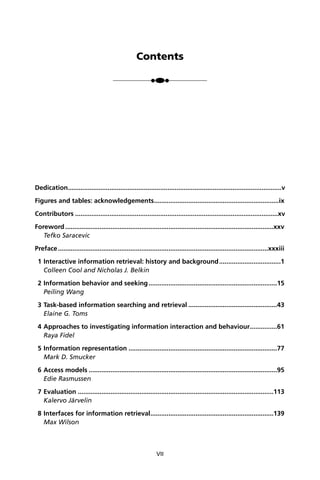
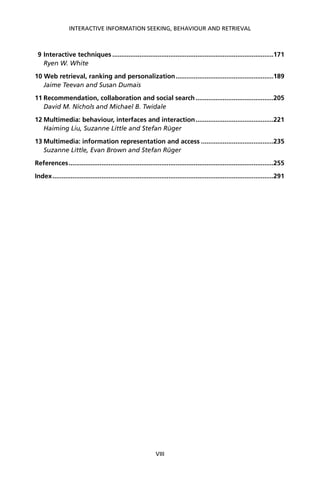


![The job of the search user interface is to aid users in the expression of their inform-
ation needs, in the formulation of their queries, in the understanding of their search
results, and in keeping track of the progress of their information seeking efforts.
(Marti Hearst, Search User Interfaces, Cambridge University Press, 2009)
Search user interfaces are at the centre of interactive information seeking and
retrieval. Yes, search user interfaces include the jobs that the quotation above
enumerates and even more. While this book is not only about interfaces, it is
also about those jobs and even more about that more.
This book reports on the recent advances on interaction topics reflected in its
title. However, the historic roots of these topics go deep – and like all roots they
are entangled and not that visible. But we can learn from them in terms of
problems addressed and solutions attempted. Research on information-seeking
behaviour, under various names and orientations, goes back many decades. So
let us start with a bit of general history of the topics covered by the book; more
specific history is presented in Chapter 1.
Activities associated with what we now call information retrieval existed and
were practised long before Calvin Mooers (1919–1994, physicist and information
retrieval pioneer) coined the term information retrieval in 1951. They were
rooted in libraries but left them to become part of technology.
Mooers (1951) defined information retrieval as follows:
Information retrieval is . . . the finding or discovery process with respect to stored
information . . . useful to [a user]. Information retrieval embraces the intellectual
aspects of the description of information and its specification for search, and also
whatever systems, techniques, or machines that are employed to carry out the
operation.
XXV
Foreword
●●●](https://image.slidesharecdn.com/25642493-250520211906-491125b0/85/Interactive-Information-Seeking-Behaviour-And-Retrieval-Ian-Ruthven-29-320.jpg)


![program substantially influenced information retrieval research centered on the
processes of human–human and human–system interaction during the process
of information retrieval.
The cognitive viewpoint is one of the central concepts that has guided theory
and research in library and information science, first articulated in the mid 1970s
and developing greater force since the 1980s. The essence of the cognitive
viewpoint in information science is the belief: ‘That any processing of
information, whether perceptual or symbolic, is mediated by a system of
categories or concepts which, for the information processing device, are a model
of his [its] world’ (de Mey, 1977, xvi–xvii, and 1980, 48).
Attention to cognitive processes during the process of information retrieval
dates back to research in the 1970s and 1980s when a substantial number of
studies focused on users and user–intermediary interaction. Major reviews and
critical discussion of this early literature can be found in Ingwersen (1982), Ellis
(1989), Belkin (1990) and B. L. Allen (1991). This perspective challenges the
notion that ‘information’ is an objective entity that individuals can ‘receive’.
Information is to be understood in relation to individual knowledge structures.
The importance of understanding a person’s knowledge structure through
communication during the information retrieval process was recognized in the
early work of R. S. Taylor (1968) and of Paisley and Parker (1965), and later led,
as an offshoot of the cognitive viewpoint, to attention to building better user
models during this process. The importance of individual-level knowledge
structures is the basis of Belkin’s (1980) anomalous state of knowledge (ASK)
model, which posited that people engage in information seeking when they
recognize some anomaly in their knowledge state that prevents them from
accomplishing some desired goal. Similarly to R. S. Taylor (1968), Belkin argues
that the effective resolution of an information anomaly requires effective
communication, or information interaction, between the information seeker and
the information resource. In order for these information interactions to be
effective, both parties to the interaction must share mental models of each other
– be in a state of intersubjective alliance. According to this model, the function
of the intermediary, or intermediary mechanism, is to build up an adequate
model of the user’s ASK, desired goals and intentions and to help the user form
an adequate model of the information resource.
In his 1999 ARIST review of cognitive information retrieval, Ingwersen
divides the development of the cognitive approach into two distinct time
periods. The early period (1977–1991) was concerned primarily with
understanding and modeling the different knowledge structures among users,
authors or creators of information texts, and intermediaries. The latter period
(from 1992 onwards) was focused more on investigating, understanding and
supporting interaction in information retrieval. Generally speaking, the
11
COOL & BELKIN • INTERACTIVE INFORMATION RETRIEVAL: HISTORY & BACKGROUND](https://image.slidesharecdn.com/25642493-250520211906-491125b0/85/Interactive-Information-Seeking-Behaviour-And-Retrieval-Ian-Ruthven-53-320.jpg)

![to Seignelay, and La Salle’s own estimates of the advantages to
grow from it, in a letter dated at “Missilimakanak, Octobre, 1682.”
[610] Margry (ii. 302) prints some of De la Barre’s accusations
against La Salle, and shows the effects of them on the King (p.
309); and gives also La Salle’s letters to De la Barre (p. 312), one
of them (p. 317) from the “portage de Checagou, 4 Juin, 1683.”
De la Barre, addressing the King (p. 348), defends himself (Nov.
13, 1684) against the complaints of La Salle.
[611] Parkman has given an abstract (La Salle p. 458) of the
pretended discoveries of Mathieu Sagean, who represents that he
started at this time with some Frenchmen from the fort on the
Illinois on an expedition in which he ascended the Missouri to the
country of a King Hagaren, a descendant of Montezuma, who
ruled over a luxurious people. The narrative is considered a
fabrication. Mr. E. G. Squier found the manuscript in the
Bibliothèque Nationale at Paris, and bringing home a copy, it was
printed by Dr. Shea, with the title, Extrait de la relation des
aventures et voyage de Mathieu Sâgean. Nouvelle York: à la
Presse Cramoisy de J. M. Shea. 1863, 32 pages. Cf. Field, Indian
Bibliog., no. 1,347; Lenox, Jesuit Relations, p. 17; and Historical
Magazine, x. 65.
There are some papers by J. P. Jones on the earliest notices of
the Missouri River in the Kansas City Review, 1882.
[612] Margry (ii. 353) groups various opinions on La Salle’s
discovery incident to his return to France in 1684.
[613] Notes, etc., nos. 209, 213-218. Harrisse also cites no. 229, a
Carte du Grand Fleuve St. Laurens dressee et dessignee sur les
memoires et observations que le Sr. Jolliet a tres exactement
faites en barq et en canot en 46 voyages pendant plusieurs
années. It purports to be by Franquelin, and is dated 1685. See
Library of Parliament Catalogue, 1858, p. 1615, no. 17.
[614] Parkman, La Salle, p. 455; this is Harrisse’s no. 219; cf. his
no. 223.
[615] Notes, etc. (1872), no. 222.
[616] La Salle, pp. 295, 455, where is a fac-simile of the part
showing La Salle’s colony on the Illinois; and Géologie pratique
de la Louisiane, p. 227.](https://image.slidesharecdn.com/25642493-250520211906-491125b0/85/Interactive-Information-Seeking-Behaviour-And-Retrieval-Ian-Ruthven-56-320.jpg)
![[617] Harrisse, no. 223.
[618] Harrisse, no. 234; Parkman, p. 457.
[619] This also, according to Harrisse, is now missing; but the
Catalogue (1858, p. 1616) of the Library of Parliament (Ottawa)
shows a copy as sent by Duchesneau to Colbert, and it has been
engraved in part for the first time in Neill’s History of Minnesota,
4th ed., 1882. Another copy is in the Kohl Collection (Department
of State) at Washington. A copy of Neill’s engraving is given
herewith.
[620] Notes, etc., nos. 240, 248, 259.
[621] Ibid., no. 231.
[622] Ibid., no. 232. There is a copy in the Library of Parliament at
Ottawa (Catalogue, 1858, p. 1616). Harrisse (nos. 248, 259)
assigns other maps to 1692 and 1699.
[623] La Salle, p. 457.
[624] These two maps are in the Poore Collection in the State
Archives of Mass. Cf. Harrisse, nos. 359, 361, 362; and Parkman
(La Salle, p. 142), on the different names given to Lake Michigan.
[625] Parkman, La Salle, p. 454; Library of Parliament Catalogue, p.
1615, no. 18. Harrisse (nos. 236, 237) gives other maps by
Raffeix. The Kohl Collection (Department of State) gives a map of
the Mississippi of the same probable date (1688), from an original
in the National Library at Paris. See the Calendar of the Kohl
Collection printed in the Harvard University Bulletin, 1883-84.
[626] Harrisse, Notes, etc., no. 237.
[627] Parkman, La Salle, p. 454.
[628] Notes, etc., p. xxv and no. 241.
[629] See the third page following.
[630] Notes, no. 202.
[631] Margry, iii. 17, etc.](https://image.slidesharecdn.com/25642493-250520211906-491125b0/85/Interactive-Information-Seeking-Behaviour-And-Retrieval-Ian-Ruthven-57-320.jpg)
![[632] Margry (ii. 359) gives La Salle’s Memoir of his plans against
the mines of New Biscay, together with letters (p. 377) of
Seignelay, etc., pertaining to it, and the Grants of the King (p.
378), and La Salle’s Commission (p. 382).
[633] Margry (ii. 387) prints various papers indicative of the
vexatious delays in the departure of the expedition and of La
Salle’s difficulties (pp. 421, 454, etc.), together with his final
letters before sailing (p. 469). Various letters of Beaujeu written
at Rochelle are in Margry (ii. 397, 421, etc.).
[634] Margry (ii. 485) gives letters of Beaujeu and others
concerning the voyage. A fragmentary Journal of the voyage by
the Abbé Jean Cavelier is also given in Margry (ii. 501), besides
another Journal (p. 510) by the Abbé d’Esmanville.
[635] Margry (ii. 499) gives an account of this capture.
[636] Margry (ii. 521) gives some letters which passed between La
Salle and Beaujeu after they reached the Gulf.
[637] Margry (ii. 555) prints an account of the loss of the “Aimable.”
[638] Margry (ii. 564, etc.) prints some letters which passed
between La Salle and Beaujeu just before the latter sailed for
France, and Beaujeu’s letter to Seignelay on his return (p. 577).
[639] This map is still preserved in the Archives Scientifiques de la
Marine, and a sketch of it is in the text. Thomassy (p. 208) cites
it as “Carte de la Louisiane avec l’embouchure de la Rivière du Sr
de la Salle (Mai, 1685), par Minet,” and giving a sketch, calls it
the complement of Franquelin. Shea thinks it was drawn up from
La Salle’s and Peñalosa’s notes. Cf. Shea’s Peñalosa, p. 21;
Harrisse, Notes, etc., nos. 225, 227, 228, 256-258, 260, 261, 263,
who says he could not find on it the date, Mai, 1685, given by
Parkman and Thomassy; Gravier, La Salle; and Delisle, in Journal
des Savans, xix. 211. Margry (ii. 591) prints some observations of
Minet on La Salle’s effort to find the mouth of the Mississippi.
[640] Dr. Shea puts the settlement on Espirito Bay, where Bahia
now is.
[641] See his Relation of this voyage in Falconer’s Discovery of the
Mississippi, etc.](https://image.slidesharecdn.com/25642493-250520211906-491125b0/85/Interactive-Information-Seeking-Behaviour-And-Retrieval-Ian-Ruthven-58-320.jpg)
![[642] This is Parkman’s statement; but Shea questions it. Margry (i.
59) gives various notices concerning le Père Allouez, who was
born in 1613, and died in 1689.
[643] See Brodhead’s History of New York, ii. 478, and references,
and the text of the preceding chapter.
[644] Margry, iii. 553.
[645] Harrisse (no. 261) mentions a sketch of the Mississippi and its
affluents, the work of Tonty at this time, which is preserved in the
French Archives.
[646] Margry, iii. 567.
[647] Margry, ii. 359; iii. 17; translations in French, Historical
Collections of Louisiana, i. 25; ii. 1; and in Falconer’s Discovery of
the Mississippi, London, 1844.
[648] He refers to evidences in Margry, ii. 348, 515; iii. 44, 48, 63.
Cf. Shea’s Peñalosa and his Le Clercq, ii. 202. In this last work
Shea annotates the narrative of La Salle’s Gulf of Mexico
experiences, and makes some identifications of localities different
from those of other writers. Cf. also Historical Magazine, xiv. 308
(December, 1868).
[649] There is an English translation in Falconer’s Discovery of the
Mississippi, and in French’s Historical Collections of Louisiana, i.
52.
[650] Margry, i. 571.
[651] Joutel says it had a map; but later authorities have not
discovered any. Cf. Harrisse, Notes, etc., no. 174; Leclerc, no.
1,027 (130 francs); Dufossé (70 and 100 francs); Carter-Brown,
vol. ii. no. 1,522. It was reprinted as “Relation de la Louisiane” in
Bernard’s Recueil des voyages au Nord, Amsterdam, 1720, 1724,
and 1734, also appearing separately. An English translation
appeared in London, in 1698, called An Account of Monsieur de la
Salle’s last Expedition and Discoveries in North America, with
Adventures of Sieur de Montauban appended. (Harrisse, no 178;
Carter-Brown, vol. ii. no. 1,542; Brinley, no. 4,524.) This version
was reprinted in the N. Y. Hist. Coll., ii. 217-341.](https://image.slidesharecdn.com/25642493-250520211906-491125b0/85/Interactive-Information-Seeking-Behaviour-And-Retrieval-Ian-Ruthven-59-320.jpg)
![[652] La Salle, p. 129.
[653] See vol. iii. pp. 89-534, and p. 648, for an account of the
document.
[654] La Salle, 397; cf. Shea’s Charlevoix, i. 88-90.
[655] Joutel, according to Lebreton (Revue de Rouen, 1852, p.
236), had served since he was seventeen in the army.
[656] Harrisse, no. 750. The book is rare; there are copies in the
Boston Public, Lenox, Carter-Brown (vol. iii. no. 117), and Cornell
University (Sparks’s Catalogue, no. 1,387) libraries. Cf. Sabin, vol.
ix. p. 351; Brinley, no. 4,497; Leclerc, no. 925 (100 francs);
Stevens, Bibliotheca Historica, 1870, no. 1,036; Dufossé, nos.
1,999, 3,300, and 9,171 (55 and 50 francs); O’Callaghan, no.
1,276.
The book should have a map entitled Carte nouvelle de la
Louisiane et de la Rivière de Mississipi ... dressée par le Sieur
Joutel, 1713. A section of this map is given in the Magazine of
American History, 1882, p. 185, and in A. P. C. Griffin’s Discovery
of the Mississippi, p. 20.
In 1714 an English translation appeared in Paris, as A Journal
of the last Voyage perform’d by Monsr. de la Sale to the Gulph of
Mexico, to find out the Mouth of the Mississipi River; his
unfortunate Death, and the Travels of his Companions for the
Space of Eight Hundred Leagues across that Inland Country of
America, now call’d Louisania, translated from the Edition just
publish’d at Paris. It also had a folding map showing the course
of the Mississippi, with a view of Niagara engraved in the corner.
Cf. Harrisse, no. 751; Lenox, in Historical Magazine, ii. 25; Field,
Indian Bibliography, no. 808; Menzies, no. 1,110; Stevens,
Historical Collections, vol. i. no. 1,462; Carter-Brown, vol. iii. no.
55; Brinley, no. 4,498 (with date 1715). There are copies in the
Boston Public, the Lenox, and Cornell University libraries. This
1714 translation was issued with a new title in 1719 (Carter-
Brown, vol. iii. no. 244; Field, no. 809), and was reprinted in
French’s Historical Collections of Louisiana, part i. p. 85. A
Spanish translation, Diario historico, was issued in New York in
1831. Dumont’s Mémoires historiques sur la Louisiane, Paris,
1753, with a map, was put forth by its author as a sort of
continuation of the Journal published by Joutel in 1713.](https://image.slidesharecdn.com/25642493-250520211906-491125b0/85/Interactive-Information-Seeking-Behaviour-And-Retrieval-Ian-Ruthven-60-320.jpg)
![Shea speaks of Hennepin’s Nouveau Voyage as “a made-up
affair of no authority.” It is translated in French’s Historical
Collections of Louisiana, part i. p. 214; in the Archæologia
Americana; and of course in Shea’s Hennepin; cf. Western
Magazine, i. 507.
[657] The Library of Parliament Catalogue, p. 1616, no. 30, gives a
map, copied from the original in the French Archives, which
shows the spot of La Salle’s assassination. La Salle’s route is
traced on Delisle’s map, which is reproduced by Gravier.
[658] This portion of his Journal is translated in the Magazine of
American History, ii. 753; and Parkman thinks it is marked by
sense, intelligence, and candor.
[659] Translated into English in Shea’s Discovery of the Mississippi,
p. 197, and in his edition of Le Clercq, where he compares it with
Joutel. Parkman cannot resist the conclusion that Douay did not
always write honestly, and told a different story at different times.
La Salle, p. 409.
[660] Vol. iii. p. 601.
[661] La Salle, p. 436.
[662] Shea printed it from Parkman’s manuscript in 1858, and
translated it, with notes, in his Early Voyages up and down the
Mississippi. It is called Relation du voyage entrepris par feu M.
Robert Cavelier, Sieur de la Salle....Par son frère, M. Cavelier, l’un
des compagnons de voyage. Shea says of it in his Charlevoix, iv.
63, that “it is enfeebled by his acknowledged concealment, if not
misrepresentation; and his statements generally are attacked by
Joutel.” Cf. Margry, ii. 501.
[663] Cf. Joutel, Charlevoix, Michelet, Henri Martin, and Margry in
his Les Normands dans les vallées de l’Ohio et du Mississipi.
Parkman modified his judgment between the publication of his
Great West and his La Salle.
[664] Page 294.
[665] Page 208.
[666] Vol. iii. p. 610.](https://image.slidesharecdn.com/25642493-250520211906-491125b0/85/Interactive-Information-Seeking-Behaviour-And-Retrieval-Ian-Ruthven-61-320.jpg)
![[667] Page 25. Cf. French, Historical Collections of Louisiana, 2d
series, p. 293.
A few miscellaneous references may be preserved regarding La
Salle and the Western discoveries:—
The paper by Levot in the Nouvelle biographie générale; one
by Xavier Eyma, in the Revue contemporaine, 1863, called
“Légende du Meschacébé;” Th. Le Breton’s “Un navigateur
Rouennais au xviie siècle,” in the Revue de Rouen et de
Normandie, 1852, p. 231; a section of Guerin’s Les navigateurs
Français, 1846, p. 369; the Letters of Nobility given to La Salle,
printed by Gravier in his Appendix, p. 360; where is also his Will
(p. 385), dated Aug. 11, 1681, which can also be found in
Margry, and translated in Magazine of American History,
September, 1878 (ii. 551), and in Falconer’s Discovery of the
Mississippi; a picture of his 1684 expedition, by Th. Gudin, in the
Versailles Gallery; a paper on the discoveries of La Salle as
affecting the French claim to a western extension of Louisiana, in
the Journal of the Royal Geographical Society, xiii. 223; paper by
R. H. Clarke in the Catholic World, xx. 690, 833; “La Salle and the
Mississippi,” in De Bow’s Review, xxii. 13. Gravier has furnished
an introduction (69 pages) on “Les Normands sur le Mississipi,
1682-1727,” to his fac-simile edition (1872) of the Relation du
voyage des dames Ursulines de Rouen à la Nouvelle Orléans (100
copies) of Madeleine Hachard, following the original printed at
Rouen in 1728 (Maisonneuve, Livres de fond, 1883, p. 30).
[668] He seems to have begun to make his copies in 1842, led to it
by the work he had done when employed by General Cass.
[669] “Découverte de l’acte de naissance de Robert Cavelier de la
Salle,” in the Revue de Rouen, 1847, pp. 708-711, and others
mentioned elsewhere.
[670] Preface to eleventh edition of Parkman’s La Salle.
[671] From a copperplate by Van der Gucht in the London (1698)
edition of Hennepin’s New Discovery. The Margry picture has
unfortunately deceived not a few. It has been reproduced in the
Carter-Brown Catalogue, and in Shea’s edition of Le Clercq’s
Établissement de la Foi; and Mr. Baldwin speaks of the
determination which its features showed the man to possess!](https://image.slidesharecdn.com/25642493-250520211906-491125b0/85/Interactive-Information-Seeking-Behaviour-And-Retrieval-Ian-Ruthven-62-320.jpg)
![[672] The curious reader interested in M. Margry’s career among
manuscripts may read R. H. Major’s Preface (pp. xxiv-li) to his
Life of Prince Henry of Portugal, London, 1868. Mr. Major has
clearly got no high idea of M. Margry’s acumen or honesty from
the claim which this Frenchman has put forth, that the instigation
of Columbus’s views came from France. Cf. Major’s Select Letters
of Columbus, p. xlvii.
[673] Margry is not able to refer to the depository of this document,
as it is not known to have been seen since Faillon used it. The
copy of it made for Sparks is in Harvard College Library. See a
translation of part in Magazine of American History, ii. 238.
[674] This method of supplying Canadian mothers is the subject of
some inquiry in Parkman’s Old Régime, p. 220.
[675] Papers on Hennepin and Du Lhut are in the Minnesota Hist.
Soc. Coll., vol. i. Du Lhut’s “Mémoire sur la Découverte du pays
des Nadouecioux dans le Canada,” is in Harrisse, no. 177, and a
translation is in Shea’s Hennepin.
[676] Shea (Le Clercq, ii. 123) notes a valuable series of articles on
Hennepin by H. A. Rafferman, in the Deutsche Pionier, Aug.-Oct.,
1880.
[677] [See chapter iv.—Ed.]
[678] This was not the only missionary labor in New France during
the period already noticed. In 1619 some Recollect Fathers of the
province of Aquitaine in France, at the instance of a fishing
company which had establishments on the Acadian coast, came
over to minister to the French and labor among the Indians. Their
field of labor included Nova Scotia, New Brunswick, and Gaspé;
but of the results of their attempts to instil an idea of Christianity
into the minds of the Micmacs, we can give no details. One of
their number, Father Sebastian, perished in the woods in 1623,
while on his way from his post at Miscou to the chief mission
station on St. John’s River. Three surviving Fathers joined the
Recollects at Quebec in 1624 by order of their provincial in
France, and took part in their ministry till Kirk arrived.
[679] [It was printed in 1833, in the Memoirs of the American
Academy. His strong box, captured at the same time, was for a
while (1845-1855) in the keeping of the Massachusetts Historical](https://image.slidesharecdn.com/25642493-250520211906-491125b0/85/Interactive-Information-Seeking-Behaviour-And-Retrieval-Ian-Ruthven-63-320.jpg)
![Society (Proceedings, ii. 322; iii. 40). Pickering, who edited the
dictionary when printed, submitted to the same Society
(Proceedings, i. 476) some original papers concerning Rale,
preserved in the Massachusetts Archives, and these were used by
Convers Francis in his Life of Ralle in Sparks’s American
Biography. Cf. also 2 Mass. Hist. Coll. viii. 2511 and Proceedings,
iii. 324. An account of his monument is in the Historical
Magazine, March, 1858, p. 84, and June, 1871, p. 399.—Ed.]
[680] The Abenaki missions on the St. Lawrence and in Maine were
continued, however; and a remnant of the tribe still adhere to the
Catholic faith at Indian Old Town, on the Penobscot, as they did
in the days of Rale and of Orono, their chief, who led them to
fight beside the Continentals in the Revolution. They are now
known as the Penobscots and Passamaquoddies, but are
dwindling away.
[681] [Harrisse, Notes sur la Nouvelle France, no. 62, says the book
is hard reading, which explains the little use made of it by
historians. Chevalier, in his introduction to the Paris reprint by
Tross, in 1864-66, arraigns Charlevoix for his harsh judgment of
Sagard. The original is now rare and costly. Tross, before securing
a copy to print from, kept for years a standing offer of 1,200
francs. There are copies in the Harvard College and Carter-Brown
(vol. ii. no. 437) libraries. Rich, in 1832, priced it at £1 16s.;
Quaritch, in 1880, prices it at £63; and Le Clerc (no. 2,947), with
the Huron music in fac-simile, gives 1,200 francs. Dufossé
(Americana, 1876 and 1877-78) prices copies at 1,200 and 1,500
francs; cf. Crowninshield, no. 948, and Field’s Indian Bibliography,
no. 1,344.
Of the Grand Voyage of 1632, there are copies in Harvard
College and Carter-Brown libraries, and in the Library of
Congress. Other copies were in the Crowninshield (no. 949),
Brinley (no. 143), and O’Callaghan (no. 2,046) sales. Harrisse
(Notes, etc., no. 53) says that after the Solar sale, where it
brought 320 francs, it became an object for collectors; and
Dufossé, in 1877, priced it at 550 francs; Ellis & White, the same
year, at £42; Quaritch, at £36; Rich, fifty years ago, said copies
had brought £15. Cf. Field, no. 1,341. This book was also
reprinted by Tross in 1865.—Ed.]
[682] [This translation, of which only 250 copies were printed, was
made by Dr. Shea. He introduces it with “A Sketch of Father](https://image.slidesharecdn.com/25642493-250520211906-491125b0/85/Interactive-Information-Seeking-Behaviour-And-Retrieval-Ian-Ruthven-64-320.jpg)
![have a map, “Carte generalle de la Nouvelle France,” which is
given in fac-simile in vol. ii. of this translation. It includes all
North America, except the Arctic regions, but, singularly, omits
Lake Champlain.
President Sparks wrote in his copy: “An extremely rare book....
It is peculiarly valuable as containing the first original account of
the discoveries of La Salle by two [Recollect] missionaries who
accompanied him. From this book, also, Hennepin drew the
account of his pretended discovery of the Mississippi River.” See
the bibliographical notice in Shea’s Discovery and Explorations of
the Mississippi Valley, p. 78. Sparks, in his Life of La Salle, first
pointed out how Hennepin had plagiarized from the journal of
Father Membré, contained in Le Clercq. See further in Shea’s
Mississippi Valley, p. 83 et seq., where Membré’s journal in Shea’s
translation from Le Clercq was printed for the first time, and the
note on Hennepin, following chap. viii. of the present volume.
Harrisse, Notes, etc., p. 160, points out what we owe to this work
for a knowledge of La Salle’s explorations. Cf. Parkman’s La Salle;
Field’s Indian Bibliography, no. 903, with a note touching the
authorship; Brunet, Supplement, i. 810, noting copies sold,—
Maisonneuve, 250 francs; Sóbolewski, 150 thalers; Tross (1873),
410 francs; Dufossé, 600 francs; Le Clercq, no. 2,833, 1,500
francs.
The bibliographers are agreed that others than Le Clercq were
engaged in the Établissement, and that the part concerning
Frontenac was clearly not by Le Clercq. Charlevoix says Frontenac
himself assisted in it; and it is Shea’s opinion that extraneous
matter was attached to Le Clercq’s account of the Recollect
missions, to convert the book into an attack in large part on the
Jesuits.—Ed.
[683] Champlain’s Voyages, Prince ed. iii. 104 et seq.
[684] Establishment of the Faith, i. 200, 346.
[685] [See a note on the bibliography of Hennepin, following chap.
viii. of the present volume.—Ed.]
[686] [S. Lesage, in the Revue Canadienne, iv. 303 (1867), gives a
good summary of the Recollect missions.—Ed.]
[687] [An annotated bibliography of the Relations follows this
chapter.—Ed.]](https://image.slidesharecdn.com/25642493-250520211906-491125b0/85/Interactive-Information-Seeking-Behaviour-And-Retrieval-Ian-Ruthven-66-320.jpg)
![[688] Harrisse, no. 122. The book has been priced by Leclerc at
500 francs, and by Quaritch at £16 16s. Field does not mention it
in his Indian Bibliography.
[689] See chap. v.; and cf. Historical Magazine, ix. 205, and Shea’s
Charlevoix, iii. 165. Also later Sub 1655-56.
[690] Cf. Wilson on Mines in Canadian Journal, May, 1856.
[691] See Mgr. de St. Valier et L’Hôpital Général de Quebec.
Quebec, 1882.
[692] This son, François Louis, entered the army, and was killed
while in the service of King Louis, in Germany.
[693] A plan of this fort was sent by M. Denonville to France, on the
13th November, 1685. A copy may be seen in Faillon’s Histoire de
la Colonie Française, iii. 467, entitled “Fort de Frontenac ou
Katarakourg, construit par le Sieur de la Salle.” A sketch after
Faillon is given on another page, in the editorial note on La Salle
appended to chapter v.
[694] [Dr. Hawley says, in a note in his Early Chapters of Cayuga
History, page 15, that this name is derived from onnonte, a
mountain, and was given by the Hurons and Iroquois to
Montmagny, governor of Canada, 1636-1648, as a translation of
his name (mons magnus), and was applied to his successors,
while the King of France was called Grand Onontio.—Ed.]
[695] [See narrative in chap. vi. Margry (i. 195) gives the “Voyage
du Comte de Frontenac au lac Ontario, en 1673,” with letters
appertaining. Cf. N. Y. Col. Doc., ix. 95.—Ed.]
[696] Abbé Salignac de Fénelon was a half brother of the author of
Télémaque. Hildreth appears in doubt about him, and says:
“Could this have been the Abbé and Saint Sulpitian priest of the
same name, afterward so famous in the world of religion and
letters? If so, his two years’ missionary residence in Canada
seems to have been overlooked by his biographers. Yet he might
have gathered there some hints for Telemachus.” See the “Note
on the Jesuit Relations,” sub anno 1666-1667. Perrot’s character
is drawn in Faillon (iii. 446) from the Sulpitian side.](https://image.slidesharecdn.com/25642493-250520211906-491125b0/85/Interactive-Information-Seeking-Behaviour-And-Retrieval-Ian-Ruthven-67-320.jpg)
![[697] [Margry (i. 405) gives an account of the deliberations on the
selling of liquor to the savages, which were held at Quebec Oct.
10, 1678.—Ed.]
[698] Auteuil’s house was situated about two leagues away from
Quebec. Villeray went to the Isle of Orleans, and Tilly took up his
quarters at the house of M. Juchereau, of St. Denis, near Quebec.
[699] [Duchesneau issued in 1681, at Quebec, a Memoir on the
tribes from which peltries were derived. An English translation of
this is in 2 Pennsylvania Archives, vi. 7.—Ed.]
[700] See chap. iv.
[701] [A Mémoire (Nov. 12, 1685) du Marquis de Denonville sur
l’État du Canada, 12 Novembre, is in Brodhead, N. Y. Col. Docs.,
ix. 280; and an English translation is in 2 Pennsylvania Archives,
vi. 24. Various other documents of this period are referred to in
the Notes Historiques of Harrisse’s Notes, etc.—Ed.]
[702] [Cf. chap. vi. For this campaign against the Senecas, see
Shea’s Charlevoix, iii. 286 (and his authorities); Parkman’s
Frontenac (references p. 156); Denonville’s Journal, translated in
N. Y. Col. Docs., vol. ix.; St. Vallier, État Présent; Belmont,
Histoire du Canada; La Hontan; Tonty; Perrot; La Potherie; and
the statements of the Senecas, in N. Y. Col. Docs., vol. iii. Squier’s
Aboriginal Monuments of New York gives a plan of the Seneca
fort; and O. H. Marshall identifies its site in 2 N. Y. Hist. Coll., vol.
ii.—Ed.]
[703] [Margry (i. 37) gives a statement, made in 1712 by Vaudreuil
and Bégon, collating the Relations from 1646 to 1687, to show
the right of the French to the Iroquois country. Denonville’s
Mémoire (1688), on the limits of the French claim, is translated in
2 Pennsylvania Archives, vi. 36. The Mémoire of the King,
addressed to Denonville, explanatory of the claim, is translated in
French’s Historical Collections, 2d series, i. 123. The Catalogue of
the Canadian Parliament, 1858, p. 1617. no. 39, shows a large
map of the French possessions, defining their boundaries by the
English, copied from an original in the French archives. The claim
was pressed of an extension to the Pacific. See Greenhow’s
Oregon, p. 159.—Ed.]](https://image.slidesharecdn.com/25642493-250520211906-491125b0/85/Interactive-Information-Seeking-Behaviour-And-Retrieval-Ian-Ruthven-68-320.jpg)
![[704] [There is in the Massachusetts Archives: Documents collected
in France, iv. 7, a paper dated Versailles, 10 Mai, 1690, entitled
“Projet d’une Expédition contre Manat et Baston,” which is
accompanied by a map showing the coast from New York to the
Merrimack, in its relation to Lakes Champlain and Ontario. The
English towns are marked “bourg;” only “Baston” is put down by
name. See Notes following chap. iv.—Ed.]
[705] [French armed vessels had also attacked Block Island,
Historical Magazinevii. 324.—Ed.]
[706] The Editor is indebted to Francis Parkman, Esq., for the use of
a fac-simile of the contemporary manuscript plan (preserved in
the Bibliothèque Nationale at Paris), of which the topographical
part is shown, somewhat reduced, in the annexed fac-simile
(Parkman’s Frontenac, p. 285). The rest of the sheet contains the
following:—
“Plan de Québec, et de les environs, en la Nouvelle France,
Assiegé par les Anglois, le 16 d’Octobre, 1690, jusqu’au 22 du dit
mois qu’ils sen allerent, apprés avoir este bien battus, par Mr. Le
Comte de Frontenac, gouverneur general du Pays.
“Les noms des habitans et des principaux Endroits de Quebec.
1. Maison Seigneurial de beauport.
2. pierre parent le Perre.
3. Jacque parent le fils.
4. aux R. P. Jesuistes.
5. pierre parent le fils.
6. la vefve de mathieu choset.
7. michel huppé.
8. Mr. de la Durantaye, Conseiller.
9. la vefve de paul chalifou.
10. Mr. de Vitray, Conceiller.
11. François retor.
12. Mr. denis.
13. Estienne lionnois.
14. Mr. Roussel.
15. Jean le normand.
16. Jean landron, ou est la briqueterie.
17. Joseph rancourt.
18. André coudray.
19. Jean le normand.](https://image.slidesharecdn.com/25642493-250520211906-491125b0/85/Interactive-Information-Seeking-Behaviour-And-Retrieval-Ian-Ruthven-69-320.jpg)
![de la petitte Rre.
55. Canots, pour la decouverte pendant la nuit.
Par le sr de Villeneuve ingénieur du Roy.”
Harrisse, Notes, etc., no. 243, cites this plan, and, no. 244,
refers to a map of a little different title by Villeneuve, preserved
in the Dépôt des Fortifications des Colonies at Paris. Leclerc,
Bibliotheca Americana, no. 2,652, notes another early manuscript
copy of this plan (Harrisse’s no. 243) in a collection of maps of
the 18th century, which he prices at 800 francs. He calls the plan
“tres belle carte manuscrite et inédite,” not aware of the reduced
engraving of it issued by Van der Aa, of which there is a copy in a
collection of maps (no. 50) formed by Frederick North, and now
in Harvard College Library.
[707] Chapter iv.
[708] [Benjamin Wadsworth, of Boston, was sent by Massachusetts
Bay to Albany in 1694 as one of the commissioners to treat with
the Five Nations, and his Journal is in 4 Mass. Hist. Coll., i. 102-
110.—Ed.]
[709] [These are particularly described in chap. ix. of the present
volume.—Ed.]
[710] [See Note B, following this chapter.—Ed.]
[711] [Frontenac’s will is printed in the Magazine of American
History, June, 1883, p. 465.—Ed.]
[712] Chapter viii.
[713] “M. Bacqueville de la Potherie a décrit le premier, d’une
manière exacte, les établissemens des Français a Québec, à
Montréal et aux Trois-Rivières: il a fait connaître surtout dans un
grand détail, et en jetant, dans sa narration beaucoup d’intérêt,
les mœurs, les usages, les maximes, la forme de gouvernement,
la manière de faire la guerre et de contracter des alliances de la
nation Iroquoise, si célèbre dans cette contrée de l’Amérique-
Septentrionale. Ses observations se sont encore étendues à
quelques autres peuplades, telle que la nation des Abénaquis,
etc.”—Bib. des Voyages.](https://image.slidesharecdn.com/25642493-250520211906-491125b0/85/Interactive-Information-Seeking-Behaviour-And-Retrieval-Ian-Ruthven-71-320.jpg)
![Charlevoix describes it as containing “undigested and ill-written
material on a good portion of Canadian history.” Cf. Field, Indian
Bibliography, no. 66; Carter-Brown Catalogue, vol. iii. no. 319;
Brinley Catalogue, no. 63; Sabin, Dictionary of Books relating to
America, from its Discovery to the Present Time, vol. i. no. 2,692;
Stevens, Historical Collections, vol. i. no. 1,313. It usually brings
about $10; a later edition, Paris, 1753, four volumes, is worth a
little less.
[714] [There were two editions in this year; one in three volumes
quarto, and the other in six volumes of small size, with the plates
folded. Cf. Sabin, Dictionary, vol. iii. p. 520; Carter-Brown, vol. iii.
nos. 762, 763; Field, Indian Bibliography, no. 282, who says that
“an almost endless variety exists in the editions and changes of
the parts in Charlevoix’s three volumes.” Heriot published an
abridged translation of Charlevoix in 1804; but the English reader
and the student of Canadian history owes a great deal to the
version and annotations of Dr. Shea, which this scholar printed in
New York, in six sumptuous volumes, in 1866-1872. (Cf. J. R. G.
Hassard in Catholic World, xvii. 721.) Charlevoix’s list of
authorities with characterizations is the starting-point of the
bibliography of New France. See Note C, at the end of this
chapter.—Ed.]
[715] [See the note on the Jesuit Relations, following chap. vi., sub
anno 1659.—Ed.]
[716] [Cf. H. J. Morgan’s Bibliotheca Canadensis, p. 65.—Ed.]
[717] [Parkman, Frontenac, p. 181, gives the authorities on the
massacre. La Hontan’s Voyages; N. Y. Coll. Doc., vols. iii., ix.;
Colden’s Five Nations, p. 115; Smith’s New York, p. 57; Belmont,
Histoire du Canada in Faribault’s Collection de Mémoires, 1840;
De la Potherie, Histoire de l’Amérique Septentrionale. Shea says
(Charlevoix, iv. 31), “There is little doubt as to the complicity of
the New Yorkers in the Lachine massacre.”—Ed.]
[718] Shea’s Charlevoix, i. 94.
[719] An abridged edition was printed at Quebec in 1864. There is
a bibliographical sketch of Garneau in the Abbé Casgrain’s
Œuvres, vol. ii., first issued separately in 1866. Cf. Morgan’s
Bibliotheca Canadensis, p. 135. Chauveau’s discourse at his grave
is in the Revue Canadienne, 1867.](https://image.slidesharecdn.com/25642493-250520211906-491125b0/85/Interactive-Information-Seeking-Behaviour-And-Retrieval-Ian-Ruthven-72-320.jpg)
![[720] Mr. Alfred Garneau, who has also written a readable paper
entitled “Les Seigneurs de Frontenac,” which was originally
published in the Revue Canadienne, 1867, vol. iv. p. 136. The
English reader is unfortunate if he derives his knowledge of the
elder Garneau’s historical work from the English translation by
Bell, who in a spirit of prejudice has taken unwarrantable liberties
with his original.
[721] Shea gives a portrait of Ferland (b. 1805, d. 1864) in his
Charlevoix, and it is repeated with a memoir in the Historical
Magazine, July, 1865; cf. Morgan’s Bibliotheca Canadensis, p.
121. His strictures on Brasseur de Bourbourg’s Histoire du Canada
were published in Paris, in 1853. [Cf. chap. iv. of the present
volume.—Ed.]
[722] Old Régime, p. 61. An account of his studies in Canadian
history appeared at Montreal in 1879, in a memorial volume, M.
Faillon, Prêtre de St. Sulpice, sa Vie et ses Œuvres. [See the note
on the Jesuit Relations, following chap. vi., sub anno 1642; and
Morgan’s Bibliotheca Canadensis, p. 118.—Ed.]
[723] The aims of partisanship always incite the detraction of rivals,
and a story which is current illustrates the passions of rivalry, if it
does not record the truth. Faillon’s book is said to have given
offence to the members of the Seminary at Quebec, and to have
restored some of the old recriminating fervor which so long
characterized the relations of the ecclesiastics of Montreal and
Quebec. The priests of the Seminary are even credited with an
appeal to the Pope to prevent the continuance of its publication.
Whether this be true or not, historical scholarship is accounted a
gainer in the antidote which the Quebec ecclesiastics applied,
when they commissioned the Abbé Laverdière, since deceased, to
publish his edition of Champlain.
[724] In the Preface to his Old Régime, and repeated in his
Frontenac, Mr. Parkman, in referring to his conclusions, said:
“Some of the results here reached are of a character which I
regret, since they cannot be agreeable to persons for whom I
have a very cordial regard. The conclusions drawn from the facts
may be matter of opinion; but it will be remembered that the
facts themselves can be overthrown only by overthrowing the
evidence on which they rest, or bringing forward counter
evidence of equal or greater strength.” The chief questioner of](https://image.slidesharecdn.com/25642493-250520211906-491125b0/85/Interactive-Information-Seeking-Behaviour-And-Retrieval-Ian-Ruthven-73-320.jpg)
![Parkman’s views has been the Abbé Casgrain, whose position is
best understood from his Une Paroisse Canadienne au XVIIe
siècle, Quebec, 1880. See Poole’s Index, p. 973, for reviews of
Parkman’s books.
[725] Mr. Parkman also made it the subject of an article in the
Atlantic Monthly, xxxviii. 719.
[726] Sabin, vol. ii. no. 5,000.
[727] See Vol. III. p. 34.
[728] Carter-Brown Catalogue, i. 516, 517.
[729] There are copies of the 1597 edition in the Carter-Brown and
Harvard College libraries. They are worth from £3 to £4. Copies
of the 1598 edition are in the Library of Congress, and in the
Murphy, Barlow, and Carter-Brown Collections. It is usually priced
at $8 or $10. This edition was reissued in 1603 with a new title,
and the omissions of the leaf of “epigramma;” and copies of this
date are in the Library of Congress, the Philadelphia Library, and
in the Carter-Brown Collection. A French edition, including the
same maps, appeared at Douay in 1607, with the text abridged in
parts and added to in others. There is a copy in the Carter-Brown
(Catalogue, ii. 59) Collection. The maps were also reproduced,
with four others not American, in the 1611 edition of Douay, of
which the Library of Congress, Harvard College, and the Carter-
Brown Collections have copies. The America, sive novus orbis of
Metellus, published at Cologne in 1600, has twenty maps, which
are reduced copies with little change from Wytfliet. (Rich, 1832,
no. 90; Sabin, Dictionary, xii. 48,170). Harvard College Library
has a copy of Metellus.
[730] Part of this famous map is given on p. 373. See Raemdonck’s
Mercator, pp. 114-138, 249. The same map was reproduced on a
different projection by Rumold Mercator in 1587, and by Corneille
de Jode in 1589; and Guillaume Jannsonius imitated it in 1606,
and this in turn was imitated by Kaerius. Girolamo Poro
reproduced it at Venice on a reduced scale in 1596.
German and English writers have disputed over the claim for
the invention of what is known as Mercator’s projection. The facts
seem to be that Mercator conceived the principle, but did not
accurately work out the formula for parallelizing the meridians](https://image.slidesharecdn.com/25642493-250520211906-491125b0/85/Interactive-Information-Seeking-Behaviour-And-Retrieval-Ian-Ruthven-74-320.jpg)
![and for spreading the parallels of latitude. Mead, on The
Construction of Maps (1717), charged Mercator with having
stolen the idea from Edward Wright, who was the first to publish
an engraved map on this system in his Certaine Errors of
Navigation, London, 1599. It seems, however, clear that Wright
perfected the formula, and only claimed to have improved, not to
have invented, the projection. Raemdonck (p. 120) gives full
references.
[731] Dr. J. van Raemdonck published Gérard Mercator, sa Vie et
ses Œuvres, in 1869; a paper in the nature of a supplement by
him, “Relations commerciales entre Gérard Mercator et
Christophe Plautin à Anvers,” was published in the Bull. de la Soc.
géog. d’Anvers, iv. 327. There is a succinct account of Mercator
by Eliab F. Hall published in the Bulletin (1878, no. 4) of the
American Geographical Society. Raemdonck (p. 312) has shown
that the old belief in the Latinization of Koopman, or Kaufmann,
as the original name of Mercator, is an error,—his family name
having been Cremer, which in Flemish signified the German
Kaufmann and the Latin Mercator. Raemdonck also shows that
Mercator was born in the Pays de Waas, March 5, 1512.
[732] Leclerc, Bibl. Amer., no. 2,911 (45 francs).
[733] Cf. I. C. Iselin, in Historisch-Geographisches Lexicon, Basel,
1726, 2d part.
[734] Sabin, vol. xii. no. 47,882. Lelewel, Géog. du Moyen Age,
despaired of setting right the order of the various editions of
Hondius-Mercator; but Raemdonck, Mercator, p. 260, thinks he
has determined their sequence; and upon Raemdonck we have in
part depended in this account. Raemdonck mentions the copies
in European libraries. The 1607 edition was translated into French
by Popellinière, the author of Les trois Mondes; and other French
editions were issued in 1613, 1619, 1628, 1630, 1633, 1635. Cf.
Quetelet, Histoire des Sciences, mathématique et physique chez
les Belges, p. 116.
[735] Known in his vernacular as Pierre van den Bergh. He had
married the sister of Jodocus Hondius.
[736] This had 153 plates, but none touching New France, except
the map of the world. The same, with German text, appeared in
1609. About twenty editions appeared in various languages; but](https://image.slidesharecdn.com/25642493-250520211906-491125b0/85/Interactive-Information-Seeking-Behaviour-And-Retrieval-Ian-Ruthven-75-320.jpg)
![that of 1627-1628 showed 140 newly engraved maps, of which
there were later Dutch (1630) and Latin (1634) editions. In 1651,
this Atlas minor was increased to two volumes, with 211 maps,
having 71 (including five new maps of South American regions)
additional maps to the 140 of the 1627-1628 edition. Cf.
Raemdonck, Mercator; Carter-Brown Catalogue, vol. ii. no. 1,634;
and Sabin, vol. xii. nos. 47,887 and 47,888.
[737] In 1633-39 it had the title, Atlas; ou, Représentation du
Monde, in three volumes; Sabin, vol. xii. no. 47,884.
[738] The English editor was Wye Saltonstall. There are copies in
Harvard College Library and in Mr. Deane’s, and the Carter-Brown
Collection (Catalogue, ii. 430; cf. Sabin, Dictionary, vol. xii. no.
47,885). The second edition in some copies has Ralph Hall’s very
rare map of Virginia.
[739] There is a fine copy in the Library of the Massachusetts
Historical Society; cf. Sabin, vol. xii. no. 47,886.
[740] It is usually priced at from £7 to £10; cf. Sabin, vol. xii. no.
47,883. Raemdonck, Mercator, p. 268, says 313 maps, of which
twenty are Mercator’s, and these last were latest used in the
editions of 1640(?) and 1664.
[741] Lelewel, Epilogue, p. 222. Lelewel, a Pole, passed a long exile
at Brussels, where he published, in 1852, his Géog. du Moyen
Age. He died in Paris in 1862; and the people of Brussels
commemorated him by an inscription on the house in which he
lived.
[742] There is also a copy in Harvard College Library.
[743] Cf. Lelewel, Epilogue, p. 222. Covens and Mortier were the
publishers of what is known as the Allard Atlases, published
about the close of the century.
[744] A list of the royal geographers of France will often serve in
fixing the dates of the many undated maps of this period. Such a
list is given from 1560 in the Bulletin de la Soc. géog. d’Anvers, i.
477, and includes—
Nicolas Sanson, in office, 1647-1667.
P. Duval, 1664-1667.
Adrien Sanson, first son of Nicolas, 1667.](https://image.slidesharecdn.com/25642493-250520211906-491125b0/85/Interactive-Information-Seeking-Behaviour-And-Retrieval-Ian-Ruthven-76-320.jpg)
![Guillaume Sanson, second son, 1667.
Jean B. d’Anville (b. 1697; d. 1782), 1718.
Guillaume Delisle (b. 1675; d. 1726), 1718.
Jean de Beaurain (b. 1696; d. 1771; publications, 1741-
1756), 1721.
Le Rouge, 1722.
Philip Buache (publications, 1729-1760), d. 1773.
Roussel, 1730.
Hubert Jaillot, 1736.
Bernard Jaillot, 1736.
Robert de Vaugondy (b. 1688; d. 1766), 1760.
A Géographie universelle, avec Cartes, was published under Du
Val’s name in Paris in 1682. Another French atlas, A. M. Mallet’s
Description de l’Univers, Paris, 1683, in five volumes, contained
683 maps, of which 55 were American; and the century closed
with what was still called Sanson’s Description de tout l’Univers
en plusieurs Cartes, 1700, which had six maps on America.
[745] Copy in Boston Public Library (no. 2,311.68), 112 pp., quarto,
without date. Cf. Uricoechea, Mapoteca Colombiana, no. 38; one
of the Carter-Brown copies (Catalogue, ii. 828) is dated 1657 (as
is the Harvard College copy), and the other, with twelve maps is
dated 1662 (Catalogue, ii. no. 909). The entire atlas was called
Cartes générales de toutes Parties du Monde, Paris, 1658
(Sunderland, vol. v. no. 11,069).
[746] Some copies are made up as covering the dates 1654 to
1669.
[747] Cf. Lelewel, Epilogue, p. 229. “The progress of geographical
science long continued to be slow,” says Hallam in his Literature
of Europe. “If we compare the map of the world in 1651, by
Nicolas Sanson, esteemed on all sides the best geographer of his
age, with one by his son in 1692, the variances will not appear
perhaps so considerable as one might have expected.... The
Sanson family did not take pains enough to improve what their
father had executed, though they might have had material help
from the astronomical observations which were now continually
made in different parts of the world.” The Sanson plates
continued to be used in Johannes Luyt’s Introductio ad
Geographiam, 1692, and in the Atlas nouveau par le Sr. Sanson
et H. Jaillot, published in Paris about the same year.](https://image.slidesharecdn.com/25642493-250520211906-491125b0/85/Interactive-Information-Seeking-Behaviour-And-Retrieval-Ian-Ruthven-77-320.jpg)
![[748] A list of the American maps published in Holland is given on
pp. 113-118 of Paullus’ Orbis terraqueus in Tabulis descriptus,
published at Strasburg in 1673.
[749] Muller, Books on America, 1877, shows how copies of all
these atlases are often extended by additional plates.
[750] Muller, Books on America, 1877, no. 89.
[751] Muller, Books on America, 1877, no. 701; Asher’s Essay, etc.;
Sabin, Dictionary, vol. iv. no. 14,548.
[752] Cf. Muller, Books on America, 1877, nos. 957, etc., and
Asher’s Essay.
[753] It is one of the rarest of these Zee-Atlases, and is worth £7 to
£10; there is a copy in Harvard College Library.
[754] Muller, Books on America, 1877, no. 1,667, etc.
[755] There is a map of the world in this work which gives much
the same delineation to America.
[756] Cf. the map on the title of the Beschryvinghe van Guiana,
Amsterdam, 1605 (given in Muller’s Books on America, 1872).
The map in Cespedes’ Regimiento de Navigacion, Madrid, 1606, is
of interest as being one of the few early printed Spanish maps.
This, like those in Medina, Gomara, and Herrera, is of a small
scale. The map in so well-known a book as Herrera’s Descripcion
de las Indias (1601, repeated in the 1622 edition) is very vaguely
drawn for the northeastern part of America. The map in the
Detectio freti Hudsoni, published at Amsterdam in 1613, showed
as yet no signs of Champlain’s discoveries.
[757] It is reproduced as a whole in Tross’s edition of Lescarbot,
Paris, 1866; in Faillon, Colonie Française en Canada, i. 85, and in
the Popham Memorial.
[758] Harrisse, Notes, etc., nos. 306, 307.
[759] See chap. viii.
[760] Cf. Bibliographical Note in Vol. III. p. 47.](https://image.slidesharecdn.com/25642493-250520211906-491125b0/85/Interactive-Information-Seeking-Behaviour-And-Retrieval-Ian-Ruthven-78-320.jpg)
![[761] See a bibliographical note in the present volume, chap. viii.
Copies of the 1630 and 1633 editions are in Harvard College and
the Boston Public Libraries, and in Mr. Deane’s collection.
[762] Notes, etc., no. 323. Harrisse also assigns to 1628 a map,
“Novveau Monde,” by Nicolai du Dauphiné, which appeared in the
French translation, 1628, of Medina’s L’Art de Naviguer. There is a
mappemonde of Hondius bearing date 1630, and his America
noviter delineata of 1631. Of about the same date is Den Groote
Noord Zee ... beschreven door Jacob Aertz Colom, which
appeared at Amsterdam, and shows the North American coast
from Smith Sound to Florida. Muller, Books on America, 1877, no.
89, says it is “of the utmost rarity.”
[763] Harrisse, Notes, etc. nos. 270, 271.
[764] Harrisse, no. 327. Sanson had already published a map of
North America in 1650 (Harrisse, no. 325). As contemporary
maps, reference may be made to a map of Nicolosius (Harrisse,
no. 268); and to one in Wright’s Certain Errors in Navigation.
Harrisse (no. 336) refers to a later map of Sanson (1667), before
his son published his revision in 1669.
[765] Similar delineations of these western lakes appear on various
maps of about this time, including those credited to Valck and F.
de Witt, and others marked “P. Schenk, ex.,” and “per Jacobum
de Sandrart, Norimbergæ, B. Homann sculpsit.” Guillaume Sanson
embodied the same representations in his Amérique
septentrionale in 1669 (Harrisse, no. 338), and the next year
(1670) they again appeared on the map attached to Blome’s
Description of the World. Still later they are found in Jaillot’s
Amérique septentrionale (1694); in the map in Campanius’ Nya
Swerige (1702), and even so late as 1741 in Van der Aa’s Galerie
agréable du Monde.
[766] There were various later editions,—1662, 1674, 1677 (with
map dated 1663).
[767] Harrisse, Notes, etc., nos. 269, 272, 328; Uricoechea,
Mapoteca Colombiana, no. 42, etc.
[768] See the Editorial Note on the Jesuit Relations.](https://image.slidesharecdn.com/25642493-250520211906-491125b0/85/Interactive-Information-Seeking-Behaviour-And-Retrieval-Ian-Ruthven-79-320.jpg)
![[769] Harrisse (no. 197) refers to a manuscript map in the Paris
Archives of 1665, showing the coast from Labrador to Mexico.
[770] Cf. Stevens’s Bibliotheca Geographica, no. 2,016.
[771] See chap. vi.
[772] Harrisse, nos. 336, 338, 344, 345, 347, 356, 363, 370;
Stevens, Bibliotheca geographica, p. 236.
[773] Harrisse, no. 349.
[774] Harrisse, no. 350.
[775] Harrisse, no. 351.
[776] Harrisse, no. 354.
[777] Ibid., no. 367.
[778] Harrisse, nos. 371, 372.
[779] Harrisse, no. 374.
[780] I am inclined to consider this desire of finding a new and
shorter passage to Cathay a flimsy excuse for premeditated
descents upon the Spanish conquests, and shall give my reasons
in the proper place.
[781] [See Vol. III., chaps. iv. and v.—Ed.]
[782] Wahlebocht, bay of the foreigners.
[783] [See Vol. III., chap. v.; also, later in the present chapter.—
Ed.]
[784] [See this Vol., chap. ix.—Ed.]
[785] The schout-fiscal was a member of the Council, but had no
vote. He attended the sessions of the Council to give his opinion
upon any financial or judicial question; and, if required, acted as
public prosecutor.
[786] [This was the origin of the New York Historical Society, which
held its first organized meeting in January, 1805, and occupied its
present building for the first time in 1857. (Historical Magazine, i.](https://image.slidesharecdn.com/25642493-250520211906-491125b0/85/Interactive-Information-Seeking-Behaviour-And-Retrieval-Ian-Ruthven-80-320.jpg)
![23, 369; Public Libraries of the United States [1876], i. 924.) It
was at this dedication that Dr. John W. Francis delivered his
genial and anecdotal discourse on New York in the last Fifty
Years.
Some good supplemental work has been done by the local
historical societies, like the Long Island (Historical Magazine, viii.
187), Ulster County, and Buffalo societies.—Ed.]
[787] [Dr. O’Callaghan made the translations from the Dutch and
French, and had the general superintendence. Brodhead
prepared the Introduction, giving the history of the records.
Brodhead made his first report on his work in 1845 (Senate
Documents, no. 47, of 1845), after he had arranged and indexed
his eighty volumes, also in an address before the New York
Historical Society, 1844, printed in their Proceedings. This led to
the arranging and binding of two hundred volumes of the
domestic archives, which had been in disorder. The eighty
volumes above named were divided thus:—
Sixteen, 1603-1678, obtained in Holland; forty-seven, 1614-
1678, procured in England; seventeen, 1631-1763, secured in
Paris. Brodhead’s New York, i. 759; Westminster Review, new
series, iii. 607.
Asher, Essay, p. xlviii, says of Brodhead’s mission: “We must,
however, regret that, tied down by his instructions, he took a
somewhat narrow view of his search, and purposely omitted from
his collection a vast store of documents bearing on the history of
the West India Company.”
The documents as published were divided thus: Vol. i. Holland
documents, 1603-1656. Vol. ii. Ibid., 1657-1678. Vol. iii. London
documents, 1614-1692. Vol. iv. Ibid., 1693-1706. Vol. v. Ibid.,
1707-1733. Vol. vi. Ibid., 1734-1755. Vol. vii. Ibid., 1756-1767.
Vol. viii. Ibid., 1768-1782. Vol. ix. Paris documents, 1631-1744.
Vol. x. Ibid., 1745-1774.
In the Introduction to vol. iii. Mr. Brodhead gives an account of
the condition of the English State-Paper Office in 1843.—Ed.]
[788] [The discourse (1847) of C. F. Hoffman on “The Pioneers of
New York,” institutes a comparison with the Pilgrims of Plymouth.
Mr. Fernow’s paper in the Mag. of Amer. Hist., v. 214, discusses
the claims of the Dutch to be considered as having educated
people among them, and the various legislative acts indicating](https://image.slidesharecdn.com/25642493-250520211906-491125b0/85/Interactive-Information-Seeking-Behaviour-And-Retrieval-Ian-Ruthven-81-320.jpg)
![their tolerant spirit are enumerated in Historical Magazine, iii.
312.
See Dr. De Witt’s paper on the origin of the early settlers in N.
Y. Hist. Soc. Proc., 1847, p. 72. Various notices of the early
families are scattered through O’Callaghan’s notes to his New
Netherland, and embodied in the local histories; but genealogy
has never been so favorite a study in New York as in New
England.—Ed.]
[789] N. Y. Coll. MSS., xxxv. 162.
[790] Governor Ingoldsby to Lords of Trade, July 5, 1709: “I am
well informed that when the Dutch took this place from us,
several books of records of patents and other things were lost.”—
N. Y. Coll. Doc’s, v. 83.
[791] [Calendar of Historical MSS. in the Secretary of State’s Office
(Dutch), 1630-1664, Albany, 1865; and Ibid. (English), 1664-
1776, Albany, 1866. On p. ix of the last is given a list of the
papers and volumes formerly in the offices of the Secretary of
State and Comptroller, now in the State Library. There was also
printed at Albany, in 1864, a Calendar of the New York Colonial
MSS. and Land Papers, 1643-1803, in the Secretary of State’s
office.—Ed.]
[792] See Hakluyt, i. 218.
[793] Hakluyt, Principall Navigations, etc., iii. 155, London, 1600.
[794] Kunstmann, Monumenta Sæcularia, iii. 2;
Entdeckungsgeschichte Americas, Munich, 1859, Atlas, tab. iv.
[795] Peter Martyr, seventh decade, tenth chapter.
[796] Oviedo, Relacion sumaria de la Historia Natural de las Indias,
edition of 1526, x. 16. “While sailing westward, much land
adjoining that which is called the Baccalaos [Newfoundland], and
situate under the fortieth and forty-first degrees.”
[797] Mappa Mundi of Diego Ribero, 1529, given by Lelewel,
Géographie du Moyen Age; two undated maps by unknown
makers, about 1532-1540, in the Munich collection, Kunstmann’s
Atlas, tab. vi., vii.; the globe Regiones orbis terrarum, quas Euphr.
Ulpius descripsit anno MDXLII.; the map in the Isolario, by](https://image.slidesharecdn.com/25642493-250520211906-491125b0/85/Interactive-Information-Seeking-Behaviour-And-Retrieval-Ian-Ruthven-82-320.jpg)
![Benedetto Bordone, Vinegia, 1547; a map by Baptista Agnese,
made in 1554, mentioned by Abbate D. Placido Zurla in Sulle
Antiche Mappe Idro geografiche lavorate in Venezia; map of Vaz
Dourado, the original of which, made in 1571, is in the archives
at Lisbon, and a copy made in 1580 at Munich (Kunstmann, Atlas,
tab. x.); map in the Cosmographie of Seb. Munster, Basel, 1574;
and others.
[798] François de Belle Forest, Comingeois, La Cosmographie
Universelle de tout le Monde, Paris, 1575, ii. 2195.
[799] [The bibliography of the Ptolemies is examined in another
part of this work.—Ed.]
[800] Kunstmann, Atlas, tab. xii. [A section of Hood’s map is given
in Dr. De Costa’s chapter in Vol. III.—Ed.] See also Dudley’s
Arcano del Mare, 15.2
[801] Orbis Terrarum Typus de Integro multis in locis emendatus,
auctore Petro Plancio, 1594, reproduced in Linschoten’s Histoire
de la Navigation, 1638 and 1644. Cf. Carter-Brown Catalogue, i.
312; Quaritch (1879), no. 12,186. See also Descriptionis
Ptolemaicæ Augmentum, Cornelio Wytfliet auctore, Duaci
(Douay), 1603, p. 99.
[802] Documents relating to the Colonial History of New York, i. 94.
[803] Documents relating to the Colonial History of New York, i. 51.
[804] [See on the first mention of Hudson River, Magazine of
American History, July, 1882, p. 513. It had about twenty names
in a century and a half. Ibid., iv. 404, June, 1880. De Costa, in
Hudson’s Sailing Directions, elucidates the claims for the Spanish
discovery.—Ed.]
[805] Documents relating to the Colonial History of New York, i.
139.
[806] [Verrazano’s discoveries are followed in chapter i. of the
present volume.—Ed.]
[807] Documents relating to the Colonial History of New York, ii. 80.](https://image.slidesharecdn.com/25642493-250520211906-491125b0/85/Interactive-Information-Seeking-Behaviour-And-Retrieval-Ian-Ruthven-83-320.jpg)
![[808] [It is often claimed that the map of Lok (see page 40 of Vol.
III.) showing the Western Sea of Verrazano, and published in
1582, instigated Hudson to make search for it along the shore of
New Netherland. Hudson’s voyage of 1609 is known as his third
voyage. (Cf. a note to Mr Smith’s chapter in Vol. III. on
“Explorations to the Northwest.”) The question of the impelling
cause of this voyage is examined by Bancroft in his United States,
vol. ii. chap. 15; by H. C. Murphy in his Henry Hudson in Holland,
Hague, 1859; and by J. M. Read, in his Henry Hudson, his
Friends, Relatives, and Early Life, Albany, 1866, which last work
has an appendix of original sources.
The old narrative of Ivan Bardsen, which it is supposed was
used by Hudson as a guide, is given in Rafn’s Antiquitates
Americanæ, in Purchas’s Pilgrimes, in the appendix of Asher’s
Hudson, and the English of it is given in De Costa’s Sailing
Directions of Hudson (reviewed in the Historical Magazine, 1870,
p. 204), which is accompanied by a dissertation on the discovery
of Hudson River. Cf. also Major’s Introduction to the Zeni
Voyages, published by the Hakluyt Society.
Moulton, in his New York, gives a running commentary on
Hudson’s passage up the river. See also the conclusions of Gay in
the Popular History of the United States, i. 355. We learn the
most of this voyage from Purchas’s Pilgrimes (also N. Y. Hist. Soc.
Coll., 1809, vol. i.), whose third volume contains the accounts by
Hudson and his companions; and in the Pilgrimage there is a
chapter on “Hudson’s Discoveries and Death,” which is mainly a
summary of the documents in the Pilgrimes. This is reprinted by
Asher in his Henry Hudson the Navigator (Hakluyt Society),
where will also be found, page 45, what is known as Juet’s
Journal, March-November, 1609 (also in Purchas, iii. 581;
Munsell’s Annals of Albany, and in 2 N. Y. Hist. Soc. Coll., i. 317;
also cf. ii. 367), with extracts from Lambrechtsen’s New
Netherland, who used material not otherwise known, and from
De Laet’s Nieuwe Wereld, and in the Appendix a bibliography of
the voyage. De Laet used Hudson’s own journals (April 19, 1607-
June 21, 1611), which are not now known and what De Laet
gives of the third voyage is supposed to be Hudson’s own report.
Asher, p. 167-172, claims that the matter given by Van der Donck
and not found elsewhere was fabricated to support the Dutch
claim. The controversial papers of Dawson and Whitehead, in the
Historical Magazine, 1870, touch many of the points of Hudson’s
explorations. Brodhead’s New York and O’Callaghan’s New](https://image.slidesharecdn.com/25642493-250520211906-491125b0/85/Interactive-Information-Seeking-Behaviour-And-Retrieval-Ian-Ruthven-84-320.jpg)
![Netherland give careful studies of this voyage. The latest
developments, however, did not serve Biddle in his Cabot; nor
Belknap in his American Biography; nor R. H. Cleveland in
Sparks’s American Biography; nor Miller in the N. Y. Hist. Soc.
Coll., 1810. The chief Dutch authority is Emanuel van Meteren, of
whose work mention is made later in the text. (Cf. Asher’s
Hudson, p. xxv; compare also a Collection of Voyages undertaken
by the Dutch East India Company, London, 1703, p. 71.)—Ed.]
[809] See G. M. Asher’s Bibliographical and Historical Essay on the
Dutch Books and Pamphlets relating to New Netherland,
Amsterdam, 1854-67. The Vryheden of the West India Company,
1630, a sort of primary charter to the colonists of New
Netherland, is given in English by Dr. O’Callaghan (New
Netherland, p. 112), and in Dutch in Wassenaer, Hist. Verhael,
xviii. 194. The Carter-Brown Catalogue, ii. 367, shows an original
copy.
[810] Ibid.; also manuscript in the possession of Mr. J. Carson
Brevoort, Advice to establish a new South Company, by William
Usselinx, 1636, and West-Indische Spieghel by Athanasius Inga,
of Peru, 1624, probably a work of Usselinx’s. One copy is in Mr.
Brevoort’s library, one in New York State Library, and a third in
the Carter-Brown Collection. See the Catalogue of the latter
collection, ii. no. 296.
[811] [See the following chapter.—Ed.]
[812] [This work is now rare; but copies are in the Congressional,
Harvard College, Carter-Brown, Murphy, and Lenox libraries. See
Asher’s Essay, pp. 83, 93.—Ed.]
[813] Born at Antwerp in 1582; died at Amsterdam, 1649.
[814] Johan de Hulter, one of the earliest settlers of Kingston, N. Y.
His widow married Jeronimus Ebbingh, of Kingston.
[815] Nieuwe Wereld ofte Beschrijvinghe van West Indien, uijt
veelerhande Schriften ende Aenteekeningen bij een versamelt
door Joannes de Laet, Leyden, 1625,—“The New World, or
Description of West Indies, from several MSS and notes collected
by J. de Laet.” A second edition in Dutch appeared, with slightly
changed title, in 1630; a third in Latin,—Novus Orbis, seu
Descriptionis Indiæ Occidentalis Libri xviii.,—was published in](https://image.slidesharecdn.com/25642493-250520211906-491125b0/85/Interactive-Information-Seeking-Behaviour-And-Retrieval-Ian-Ruthven-85-320.jpg)
![1633; and a fourth in French, entitled Histoire du Nouveau
Monde, ou Description des Indes Occidentales, in 1640. The State
Library at Albany, N. Y., has copies of all except the first, and all
are noted in the O’Callaghan and Carter-Brown Catalogues. [A
copy of the 1625 edition was priced by Muller in 1872 at ten
florins. There is a copy in Charles Deane’s library. The 1630
edition, called “verbetert, vermeerdert, met eenige nieuwe
Caerten verciert,” has fourteen maps, engraved chiefly by Hessel
Gerritsz, and good copies are worth about six to eight guineas.
The 1633 edition was priced by Rich in 1832 at one pound ten
shillings, but a good copy of it will now bring about five guineas.
The 1640 edition has appreciated in the same time from one
pound four shillings (Rich, in 1832) to two guineas. Translations
of such parts as pertain to New Netherland are in the N. Y. Hist.
Soc. Coll., new series, i. 281, and ii. 373. Brodhead, in 1841, tried
in vain in Holland to find De Laet’s papers. De Laet’s library was
sold April 27, 1650. There is a catalogue of it noted in the Huth
Catalogue, ii. 414.—Ed.]](https://image.slidesharecdn.com/25642493-250520211906-491125b0/85/Interactive-Information-Seeking-Behaviour-And-Retrieval-Ian-Ruthven-86-320.jpg)
![[816] Historie ofte Jaerlijck Verhael van de Verrichtingen van de
Geoctroyeerde West-Indische Compagnie sedert haer Begin tot
1636,—“History or Yearly Account of the Proceedings of the West
India Company, from its beginning to 1636,” anno 1644. Copy in
State Library, Albany. Trömel, no. 198. [For the history of the
Dutch West India Company, see O’Callaghan’s New Netherland,
vol. i. (its charter is given, p. 399); and a valuable contribution to
the subject is also contained in Asher’s Essay, in the sketch of the
Company in his Introduction, p. xiv and in the section on the
Company’s history, p. 40, and on the writings of Usselinx, p. 73.
He says the best history of its fortunes is in Netscher’s Les
Hollandais au Brésil. There is also much of importance in T. C. de
Jonge’s Geschiedenis van het Nederlandsch Zeewesen, 1833-48,
six volumes. The flag of the West India Company is depicted in
Valentine’s New York City Manual, 1863, in connection with an
abstract of a paper on “The Flags which have waved over New
York City,” by Dr. A. K. Gardner.—Ed.]
[817] [The letter of Rasieres, printed in 2 N. Y. Hist. Soc. Coll., ii.
339, gives us a notice of the country in 1627.—Ed.]
[818] De Origine Gentium Americanarum, Paris, 1643.
[819] Bancroft, History of the United States, ii. 281: “The voyage of
De Vries was the cradling of a state. That Delaware exists as a
separate commonwealth is due to the colony of De Vries.” Cf.
Proceedings of the Inaugural Meeting of the Historical Society of
Delaware, May 31, 1864; J. W. Beekman in the N.Y. Hist. Soc.
Proc., 1847, p. 86; Delaware Papers, p. 335 of Calendar of
Historical MSS. in the State Library (Dutch) at Albany, edited by
Dr. O’Callaghan, 1865, and N. Y. Col. Docs. vol. xii., 1877.—Ed.
[820] Korte Historiael ende Journaels Aenteyckeninge van
verscheyden Voyagien in de vier Teelen des Wereldts Ronde, door
David Pietersen de Vries, Alkmaar, 1655,—“Short History and
Notes of a Journal kept during Several Voyages by D. P. de Vries.”
[This extremely rare book was
first used by Brodhead (i. 381,
note). It should have a portrait by
Cornelius Visscher, which has been
reproduced in Amsterdam by photolithography. Mr. Lenox paid](https://image.slidesharecdn.com/25642493-250520211906-491125b0/85/Interactive-Information-Seeking-Behaviour-And-Retrieval-Ian-Ruthven-87-320.jpg)