
Information Security

The issue, why you should care and how you can help keep
your data safe.
Why is data security an important issue?
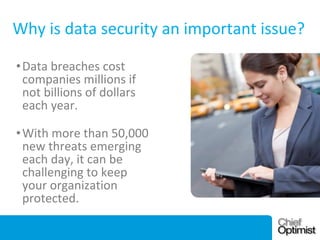
• Data breaches cost
companies millions if
not billions of dollars
each year.
• With more than 50,000
new threats emerging
each day, it can be
challenging to keep
your organization
protected.
December 3, 2013
Security by the Numbers

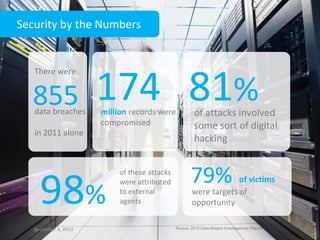
There were

855

data breaches
in 2011 alone

174 81%
million records were
compromised

98%
December 3, 2013
3

of these attacks
were attributed
to external
agents

of attacks involved
some sort of digital
hacking

79%

of victims
were targets of
opportunity

Source: 2012 Data Breach Investigations Report
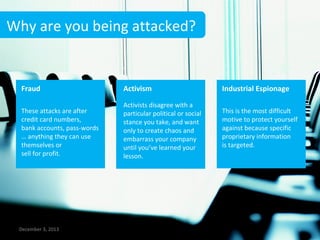
Why are you being attacked?

Fraud

Activism

Industrial Espionage

These attacks are after
credit card numbers,
bank accounts, pass-words
… anything they can use
themselves or
sell for profit.

Activists disagree with a
particular political or social
stance you take, and want
only to create chaos and
embarrass your company
until you’ve learned your
lesson.

This is the most difficult
motive to protect yourself
against because specific
proprietary information
is targeted.

December 3, 2013

4
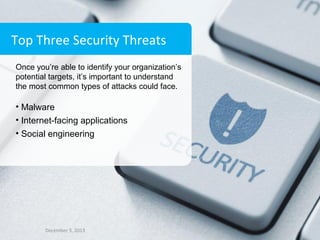
Top Three Security Threats
Once you’re able to identify your organization’s
potential targets, it’s important to understand
the most common types of attacks could face.

• Malware
• Internet-facing applications
• Social engineering

December 3, 2013
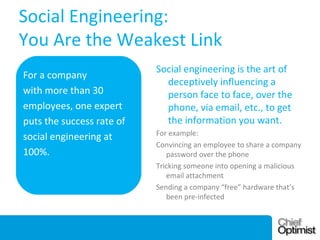
Social Engineering:
You Are the Weakest Link
For a company
with more than 30
employees, one expert
puts the success rate of
social engineering at
100%.

Social engineering is the art of
deceptively influencing a
person face to face, over the
phone, via email, etc., to get
the information you want.
For example:
Convincing an employee to share a company
password over the phone
Tricking someone into opening a malicious
email attachment
Sending a company “free” hardware that’s
been pre-infected
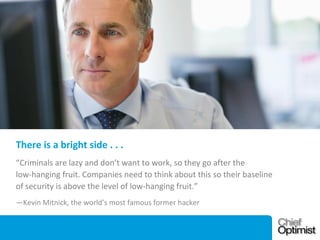
There is a bright side . . .
“Criminals are lazy and don’t want to work, so they go after the
low-hanging fruit. Companies need to think about this so their baseline
of security is above the level of low-hanging fruit.”
—Kevin Mitnick, the world’s most famous former hacker
How can you help keep
your organization safe?
• Educate and train your staff on the
dangers of social engineering.
• Perform a security audit to find and fix any
glaring vulnerabilities.
• Ask yourself (or whoever is in charge
of IT) five simple questions . . .

8

December 3, 2013 3, 2013
December

Xerox Internal Use Only

8
1
2
3
4
5

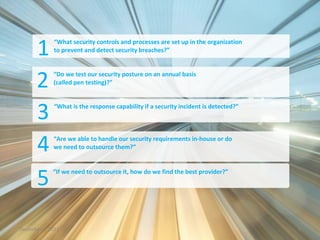
“What security controls and processes are set up in the organization
to prevent and detect security breaches?”
“Do we test our security posture on an annual basis
(called pen testing)?”
“What is the response capability if a security incident is detected?”

“Are we able to handle our security requirements in-house or do
we need to outsource them?”

“If we need to outsource it, how do we find the best provider?”

December 3, 2013

9
Follow These Everyday Rules of Thumb
1. Establish a VPN connection when using free Wi-Fi.
This keeps bad guys from eavesdropping on
your internet usage.
2. Use Google Chrome as your default browser.
This isn’t a plug for Google—Internet Explorer
is the most frequently targeted browser.
3. Make sure all of your software is up to date.
Enable automatic update settings and frequently
check for newer versions of software.
4. Be wary of peer-to-peer sharing.
Downloading certain file-sharing utilities can
open up your entire hard drive to the world.
5. Diversify your passwords.
If you’re having trouble keeping them straight,
use a free, downloadable password manager.

December 3, 2013

10
For more valuable insights,
visit GetOptimistic.com
Presented by Xerox

Information Security

  • 1.
    Information Security The issue,why you should care and how you can help keep your data safe.
  • 2.
    Why is datasecurity an important issue? • Data breaches cost companies millions if not billions of dollars each year. • With more than 50,000 new threats emerging each day, it can be challenging to keep your organization protected. December 3, 2013
  • 3.
    Security by theNumbers There were 855 data breaches in 2011 alone 174 81% million records were compromised 98% December 3, 2013 3 of these attacks were attributed to external agents of attacks involved some sort of digital hacking 79% of victims were targets of opportunity Source: 2012 Data Breach Investigations Report
  • 4.
    Why are youbeing attacked? Fraud Activism Industrial Espionage These attacks are after credit card numbers, bank accounts, pass-words … anything they can use themselves or sell for profit. Activists disagree with a particular political or social stance you take, and want only to create chaos and embarrass your company until you’ve learned your lesson. This is the most difficult motive to protect yourself against because specific proprietary information is targeted. December 3, 2013 4
  • 5.
    Top Three SecurityThreats Once you’re able to identify your organization’s potential targets, it’s important to understand the most common types of attacks could face. • Malware • Internet-facing applications • Social engineering December 3, 2013
  • 6.
    Social Engineering: You Arethe Weakest Link For a company with more than 30 employees, one expert puts the success rate of social engineering at 100%. Social engineering is the art of deceptively influencing a person face to face, over the phone, via email, etc., to get the information you want. For example: Convincing an employee to share a company password over the phone Tricking someone into opening a malicious email attachment Sending a company “free” hardware that’s been pre-infected
  • 7.
    There is abright side . . . “Criminals are lazy and don’t want to work, so they go after the low-hanging fruit. Companies need to think about this so their baseline of security is above the level of low-hanging fruit.” —Kevin Mitnick, the world’s most famous former hacker
  • 8.
    How can youhelp keep your organization safe? • Educate and train your staff on the dangers of social engineering. • Perform a security audit to find and fix any glaring vulnerabilities. • Ask yourself (or whoever is in charge of IT) five simple questions . . . 8 December 3, 2013 3, 2013 December Xerox Internal Use Only 8
  • 9.
    1 2 3 4 5 “What security controlsand processes are set up in the organization to prevent and detect security breaches?” “Do we test our security posture on an annual basis (called pen testing)?” “What is the response capability if a security incident is detected?” “Are we able to handle our security requirements in-house or do we need to outsource them?” “If we need to outsource it, how do we find the best provider?” December 3, 2013 9
  • 10.
    Follow These EverydayRules of Thumb 1. Establish a VPN connection when using free Wi-Fi. This keeps bad guys from eavesdropping on your internet usage. 2. Use Google Chrome as your default browser. This isn’t a plug for Google—Internet Explorer is the most frequently targeted browser. 3. Make sure all of your software is up to date. Enable automatic update settings and frequently check for newer versions of software. 4. Be wary of peer-to-peer sharing. Downloading certain file-sharing utilities can open up your entire hard drive to the world. 5. Diversify your passwords. If you’re having trouble keeping them straight, use a free, downloadable password manager. December 3, 2013 10
  • 11.
    For more valuableinsights, visit GetOptimistic.com Presented by Xerox