Employment &
Health Rights of
Persons with Disabilities
in Bangladesh
INFO BOOK
Employment &
Health Rights of
Persons with Disabilities
in Bangladesh
ActionAid Bangladesh
InfoBook
House 8 (Old), SE(C) 5/B (New), Road 136,
Gulshan 1, Dhaka 1212
Phone: +88 02 55044851-7, Fax: +88 02 55044858
Email: aab.mail@actionaid.org
Web: www.actionaid.org/bangladesh
Developed and Compiled by
Md. Abdul Koddus (Jahid)
Edited by
Md. Khairul Islam
Rubayat Ahsan
Being disabled should not mean
being disqualified from
having access to every aspect of life.
Emma Thompson
British Actress and Writer
1
Bangladesh is one of the most densely populated countries of
the world, with around 160 million people living on its small
land. The World Bank estimated that as of 2011, 15% of the
world's population lives with disability. According to the World
Disability Report (2011), the number of persons with disabilities
in Bangladesh has reached 16.1 million, with a proportion of
75% adults and 25% children. Persons with disabilities are less
likely to access basic services such as education, employment
and healthcare due to stigma, discrimination and
inaccessibility. Hence, the lack of access to information of
about essential services and programmes leads to their further
marginalisation and exclusion.
While Bangladesh has recently transitioned from a Least
Developed Country (LDC) to Lower Middle-Income Country
(LMIC) according to the World Bank, the country now
presumably has the capacity to provide safety nets to its
citizens. According to the International Convention on Human
Rights, every citizen has an equal right to receive
state-provided services, e.g. the right to education, right to
adequate food, housing and social security irrespective of
nationality, place of birth and residence, gender, national or
ethnic origin, race, religion or identity. Persons with disabilities
are entitled to the same rights guaranteed by International
human rights treaties.
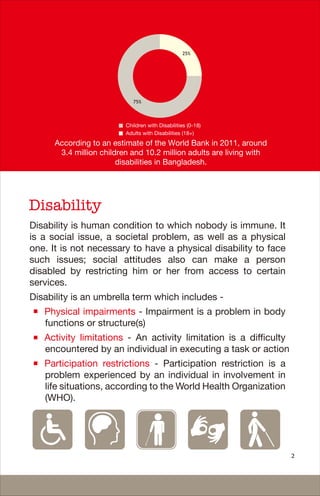
According to an estimate of the World Bank in 2011, around
3.4 million children and 10.2 million adults are living with
disabilities in Bangladesh.
Children with Disabilities (0-18)
75%
Adults with Disabilities (18+)
25%
Disability
2
Disability is human condition to which nobody is immune. It
is a social issue, a societal problem, as well as a physical
one. It is not necessary to have a physical disability to face
such issues; social attitudes also can make a person
disabled by restricting him or her from access to certain
services.
Disability is an umbrella term which includes -
Physical impairments - Impairment is a problem in body
functions or structure(s)
Activity limitations - An activity limitation is a difficulty
encountered by an individual in executing a task or action
Participation restrictions - Participation restriction is a
problem experienced by an individual in involvement in
life situations, according to the World Health Organization
(WHO).
International and National
Legislative Initiative
On 13 December 2006, the UN General Assembly adopted
the Convention on the Rights of Persons with Disabilities to
promote, protect and ensure full access and equal
participation of persons with disabilities to all human rights
and fundamental freedoms. The convention encompasses a
number of key areas, such as accessibility, personal mobility,
education, health, rehabilitation and employment.
In Bangladesh, the Rights and Protection of Persons with
Disabilities Act of 2013 was enacted as a means to protect
the rights and dignity of persons with disabilities. The act is
meant to guarantee educational, physical and mental
development of persons with disabilities, as well as support
their participation in social and state activities by preventing
discrimination and removing barriers. The law put forth 16
rights of persons with disabilities which are provided through
3
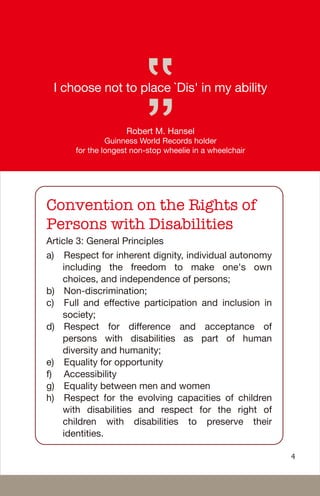
I choose not to place `Dis' in my ability
Robert M. Hansel
Guinness World Records holder
for the longest non-stop wheelie in a wheelchair
Convention on the Rights of
Persons with Disabilities
Article 3: General Principles
a) Respect for inherent dignity, individual autonomy
including the freedom to make one's own
choices, and independence of persons;
b) Non-discrimination;
c) Full and effective participation and inclusion in
society;
d) Respect for difference and acceptance of
persons with disabilities as part of human
diversity and humanity;
e) Equality for opportunity
f) Accessibility
g) Equality between men and women
h) Respect for the evolving capacities of children
with disabilities and respect for the right of
children with disabilities to preserve their
identities.
4
their National Identity Cards. As part of these 16 rights,
employment is mentioned in section 10 of the Act, stating
that ‘person with disability have right to be employed in
government and private institutions’. Persons with
disabilities have the diversified knowledge, skills and
abilities to succeed in today's rapidly changing
workplace. From company headquarters to the factory
door, technology continues to radically alter the way
individuals work, helping to create level the playing field
for individuals with disabilities and as a result, employers
get maximum benefit from their productive output.
5
This Info book provides
stakeholders and persons with
disabilities with information on:
Disability and responsibilities
The process of enrolling in the sector
The gaps and requirements
Means of access in the public services
6
Commitments and Drawbacks
Persons with disabilities face difficulties in accessing
government and private sector jobs even though jobs are
reserved for them through quotas: 10% of third and fourth
grade jobs are reserved for orphans and persons with
disabilities for, as well as 1% of first and second grade jobs.
But due to lack of sensitization of employers about the
potential of persons with disabilities, contradictory
employment policies, loopholes in the system and improper
monitoring, the declared quota for the persons with
disabilities has never been implemented properly (Disabilities
Rights Watch Group, 2010).
It is also known that some companies have an interest in
recruiting persons with disabilities, but cannot do so as there
is a lack of trained and educated persons with disabilities. It
is time to start employing persons with disabilities. This will
help protect and promote their right to employment, as well
as support national development. We need to think about the
abilities of persons with disabilities, rather their disabilities.
7
Focusing on ability, not disability1
Reason 1
Innovation - different paths, new discoveries
Persons with Disabilities are constantly innovating, as they
often need to find different ways to accomplish common
tasks. This type of creative thinking can translate into the
creation of new processes in the workplace that can improve
the work environment for all employees.
Reason 2
Office Culture - the benefits of another perspective
Persons with disabilities add to the rich culture of the
workplace and can even use their experiences to help
employers and colleagues gain new perspectives.
Reason 3
Social Cohesion - creating a positive environment
Perhaps the most visible impact of workplace diversity is the
effect it has on daily relationships within the workforce.
8
1
http://www.qualityoflifeobserver.com/content/5-reasons-why-focusing-ability
-not-disability-improves-workplace
Employees with disabilities overwhelmingly expressed
positive attitudes towards their bosses and colleagues, with
more than 90% citing that they got along well with their
supervisors. These types of positive relationships can have
an overall impact on the quality of life at work.
Reason 4
Performance - numbers don't lie
Integrating employees with disabilities is, more than ever, a
savvy business decision. It is showed that workers with
disabilities are more consistently rated average or above
average in terms of performance, quality and quantity of
work.
Reason 5
Reliability - someone you can count on
Employees with disabilities are often described by their
employers as, having a strong commitment to work, as well
as good punctuality records and lower absentee rates.
9
Long-term tips for employers2
Hiring - Encourage person with disability to apply.
Preparation - Persons with disabilities will be able to
contribute more if they can be given some training or
other orientation to their work.
Work- flow - Choosing and adjusting work according to
their capabilities, interest and skills will make sure that
they can do more.
Monitoring and Encouraging - Regular conversation
and encouraging with employees with disabilities will
make sure they have everything they need to work.
Accessibility - Physical environment and communica-
tions may need some adjustments
Partnership - Organizations working on disability can
support the actions listed here.
10
2
Bangladesh Employers Federation and ILO
Pro-disability employers
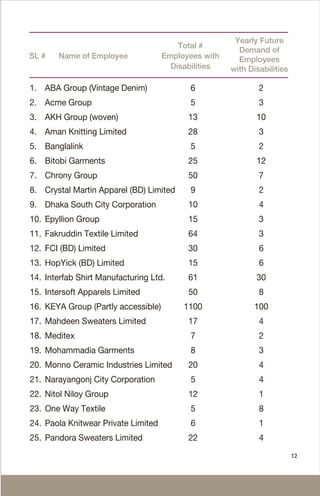
In 2014, ActionAid Bangladesh conducted a study on
“Mapping of Prospective Employers for Young Persons with
Disabilities”. We found that approximately 255 jobs were
expected to be generated in 2015 for persons with
disabilities. To select the pro-disability employers, four
factors were considered. We defined pro-disability
employers as those who fulfil at least three of the four
following factors:
At least 5 employees with disabilities
Accessible work environment
Future demand of recruiting persons with disabilities
Mention of disability in the Human Resource Policy
The study found 37 potential employers who have partial
accessibility for enabling work environment for persons with
disabilities.
11
Yearly Future
Demand of
Employees
with Disabilities
SL # Name of Employee
Total #
Employees with
Disabilities
1. ABA Group (Vintage Denim) 6 2
2. Acme Group 5 3
3. AKH Group (woven) 13 10
4. Aman Knitting Limited 28 3
5. Banglalink 5 2
6. Bitobi Garments 25 12
7. Chrony Group 50 7
8. Crystal Martin Apparel (BD) Limited 9 2
9. Dhaka South City Corporation 10 4
10. Epyllion Group 15 3
11. Fakruddin Textile Limited 64 3
12. FCI (BD) Limited 30 6
13. HopYick (BD) Limited 15 6
14. Interfab Shirt Manufacturing Ltd. 61 30
15. Intersoft Apparels Limited 50 8
16. KEYA Group (Partly accessible) 1100 100
17. Mahdeen Sweaters Limited 17 4
18. Meditex 7 2
19. Mohammadia Garments 8 3
20. Monno Ceramic Industries Limited 20 4
21. Narayangonj City Corporation 5 4
22. Nitol Niloy Group 12 1
23. One Way Textile 5 8
24. Paola Knitwear Private Limited 6 1
25. Pandora Sweaters Limited 22 4
12
Yearly Future
Demand of
Employees
with Disabilities
SL # Name of Employee
Total #
Employees with
Disabilities
26. Paula Knit Limited 5 2
27. Rahimafrooz Superstores Ltd. 5 1
28. Renata Limited 16 3
29. Saiham Knit Composite Limited 5 1
30. Samson Winter Wear Industries Ltd. 6 2
31. Shanta Industries Limited 18 5
32. Southern Garments 8 2
33. SQ Brichina Limited 6 3
34. SQ Celsius Limited 18 6
35. Square Group 82 6
36. Tongi Moitree Shilpa 46 5
37. Viyellatex Limited 25 3
13
Why are Technical and Vocational
Education and Training (TVET)
required?
It's all to do with the training:
You can do a lot if you're properly trained
Elizabeth II
Queen of Great Britain
Persons with disabilities often find it very difficult to obtain
formal education. Even if some persons with disabilities go to
school, they cannot continue their education due to issues
such as lack of accessibility, unavailability of resources,
negative attitudes, etc. As such, if person with disabilities
could get training on any specific task, this could significantly
contribute to their ability to work or to get a job. We believe
that a highly trained workforce is the backbone of a strong
and diverse economy. Trained and skilled manpower is an
asset for a country. Employers hire and give more emphasis
to trained people in their recruiting process due to their
higher productivity.
A person with disability is able to receive training in the
following fields, depending on their interests and available
facilities: sewing machine operating, computer technology,
printing, agriculture, livestock, aquaculture, automobiles,
14
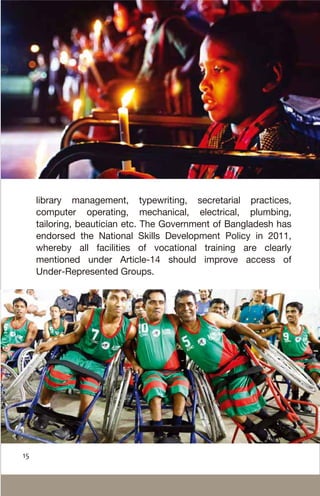
library management, typewriting, secretarial practices,
computer operating, mechanical, electrical, plumbing,
tailoring, beautician etc. The Government of Bangladesh has
endorsed the National Skills Development Policy in 2011,
whereby all facilities of vocational training are clearly
mentioned under Article-14 should improve access of
Under-Represented Groups.
15
Activities
Vocational training and rehabilitation support for the
persons with physical disabilities
Services
Accommodation, caretaking and treatment support
Short-duration industrial training for different types of
persons with disabilities
Sports and cultural programmes
Employment and rehabilitation programmes
Stipend of Taka 4,000 as a part of rehabilitation after
completion of training
Jobs in the ERPH Centre, depending on vacancy
Assistance in seeking employment in the government
and private sectors
Eligibility
Persons with physical disabilities between 14 and 24 years old
Timeline of Service
Admission procedure will be finalized within 15 days of
application
Training duration varies between 3 and 12 months
depending on type of trade
List of some Important Vocational
Training Institutes
Employment Rehabilitation Centre for the
Physically Handicapped (ERPH)
Station Road, Tongi, Gazipur (Total seat: 85)
Fakirhat, Bagerhat (Total seat: 30)
16
National Training and Rehabilitation Centre
for the Persons with Visual Disabilities
Tongi, Gazipur
Total seat: 50
Activities
National initiative for the training and rehabilitation for
persons with visual disabilities
Services
Accommodation, caretaking and treatment support
Handicrafts training using bamboo and cane, poultry
rearing and movement practice for persons with visual
disabilities
Sports and cultural programmes
Employment and rehabilitation programmes
Stipend of Taka 4,000 as a part of rehabilitation after
completion of training
Assistance in seeking employment in the government
and private sectors
Eligibility
Persons with visual disabilities between 14 and 24 years old
Timeline of Service
Admission procedure will be finalized within 15 days of
application
Training duration varies between 3 and 12 months
depending on type of trade
17
Activities
Production and marketing of plastic goods, jewellery, and
purified water
Services
Taking order and supplying plates, glasses, bowls, tea
cups, vessels, buckets, hangers, mugs, boxes,
one-time use plastic goods of various sizes for home or
official use. These are produced in fully automated
ultramodern facilities, with high standards and quality.
Producing, bottling, marketing and supplying of safe
drinking water in different sizes of bottles, which are
manufactured through reverse osmosis by imported,
automated machinery.
Eligibility
Everyone, with an 80% job quota for persons with
disabilities who will receive first receive training
according to need
Government, non-government, in-country or foreign
offices, institutes and organizations
Goods marketing agents, agencies, dealers and
wholesalers.
Timeline of Service
Generally supply immediately after getting the order
18
Moitree Shilpo (Friendship Industry)
Station Road, Tongi, Gazipur
Phone: 980 1167, 980 0302, 980 1489
19
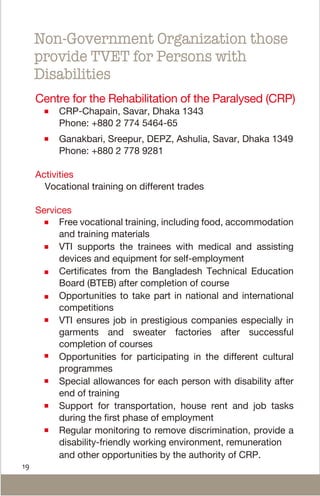
Centre for the Rehabilitation of the Paralysed (CRP)
CRP-Chapain, Savar, Dhaka 1343
Phone: +880 2 774 5464-65
Ganakbari, Sreepur, DEPZ, Ashulia, Savar, Dhaka 1349
Phone: +880 2 778 9281
Activities
Vocational training on different trades
Services
Free vocational training, including food, accommodation
and training materials
VTI supports the trainees with medical and assisting
devices and equipment for self-employment
Certificates from the Bangladesh Technical Education
Board (BTEB) after completion of course
Opportunities to take part in national and international
competitions
VTI ensures job in prestigious companies especially in
garments and sweater factories after successful
completion of courses
Opportunities for participating in the different cultural
programmes
Special allowances for each person with disability after
end of training
Support for transportation, house rent and job tasks
during the first phase of employment
Regular monitoring to remove discrimination, provide a
disability-friendly working environment, remuneration
and other opportunities by the authority of CRP.
Non-Government Organization those
provide TVET for Persons with
Disabilities
20
Eligibility
Most are persons with Spinal Cord Injuries and other
persons with disabilities such as Polio, Amputees, Visual,
Speech and Hearing from poorer backgrounds and work
as manual labourers.
Timeline of Service
Computer Office Application (6 months)
General Electronics (6 months)
Dress Making & Tailoring (6 months)
Industrial Sewing Machine Operator (2 or 4 months)
Linking Machine Operator (2 months)
Shop Management (1 month)
21
Ministry of Social Welfare
Peoples Republic of Bangladesh
Contact:
Managing Director
National Foundation for Development of the Disabled Persons
House A/2, Section 14, Mirpur, Dhaka 1206
Phone: +880 2 803 350, E-mail: jpuf38@yahoo.com
Activities
Disability Service Centre
Services
One-stop service centre for persons with disabilities;
Free treatment services for all types of persons with
disabilities, including Physiotherapy, Occupational
Therapy, Speech and Language Therapy, Refraction,
Hearing test and Hearing Aid
Distribution and repair of assistive devices
Distribution of free learning materials
Library facilities
Collection and preservation of information of persons
with disabilities
Internet services
Eligibility
All types of persons with disabilities of all ages
Timeline of Service
Directly serves to the persons with disabilities in office
hours from 9:00 AM to 5:00 PM everyday (except
Government & others holiday).
Health and Rehabilitation Service
22
Jesse Ventura
Former American wrestler, actor and Governor of Minnesota
Disabled persons need more invested
in their education, housing, job training,
transportation, assistive technology and
independent-living facilities. Governments
earn back this investment and more by
making persons with disabilities
economically productive citizens.

Info Book English

  • 1.
    Employment & Health Rightsof Persons with Disabilities in Bangladesh INFO BOOK
  • 2.
    Employment & Health Rightsof Persons with Disabilities in Bangladesh ActionAid Bangladesh InfoBook House 8 (Old), SE(C) 5/B (New), Road 136, Gulshan 1, Dhaka 1212 Phone: +88 02 55044851-7, Fax: +88 02 55044858 Email: aab.mail@actionaid.org Web: www.actionaid.org/bangladesh Developed and Compiled by Md. Abdul Koddus (Jahid) Edited by Md. Khairul Islam Rubayat Ahsan
  • 3.
    Being disabled shouldnot mean being disqualified from having access to every aspect of life. Emma Thompson British Actress and Writer 1 Bangladesh is one of the most densely populated countries of the world, with around 160 million people living on its small land. The World Bank estimated that as of 2011, 15% of the world's population lives with disability. According to the World Disability Report (2011), the number of persons with disabilities in Bangladesh has reached 16.1 million, with a proportion of 75% adults and 25% children. Persons with disabilities are less likely to access basic services such as education, employment and healthcare due to stigma, discrimination and inaccessibility. Hence, the lack of access to information of about essential services and programmes leads to their further marginalisation and exclusion. While Bangladesh has recently transitioned from a Least Developed Country (LDC) to Lower Middle-Income Country (LMIC) according to the World Bank, the country now presumably has the capacity to provide safety nets to its citizens. According to the International Convention on Human Rights, every citizen has an equal right to receive state-provided services, e.g. the right to education, right to adequate food, housing and social security irrespective of nationality, place of birth and residence, gender, national or ethnic origin, race, religion or identity. Persons with disabilities are entitled to the same rights guaranteed by International human rights treaties.
  • 4.
    According to anestimate of the World Bank in 2011, around 3.4 million children and 10.2 million adults are living with disabilities in Bangladesh. Children with Disabilities (0-18) 75% Adults with Disabilities (18+) 25% Disability 2 Disability is human condition to which nobody is immune. It is a social issue, a societal problem, as well as a physical one. It is not necessary to have a physical disability to face such issues; social attitudes also can make a person disabled by restricting him or her from access to certain services. Disability is an umbrella term which includes - Physical impairments - Impairment is a problem in body functions or structure(s) Activity limitations - An activity limitation is a difficulty encountered by an individual in executing a task or action Participation restrictions - Participation restriction is a problem experienced by an individual in involvement in life situations, according to the World Health Organization (WHO).
  • 5.
    International and National LegislativeInitiative On 13 December 2006, the UN General Assembly adopted the Convention on the Rights of Persons with Disabilities to promote, protect and ensure full access and equal participation of persons with disabilities to all human rights and fundamental freedoms. The convention encompasses a number of key areas, such as accessibility, personal mobility, education, health, rehabilitation and employment. In Bangladesh, the Rights and Protection of Persons with Disabilities Act of 2013 was enacted as a means to protect the rights and dignity of persons with disabilities. The act is meant to guarantee educational, physical and mental development of persons with disabilities, as well as support their participation in social and state activities by preventing discrimination and removing barriers. The law put forth 16 rights of persons with disabilities which are provided through 3
  • 6.
    I choose notto place `Dis' in my ability Robert M. Hansel Guinness World Records holder for the longest non-stop wheelie in a wheelchair Convention on the Rights of Persons with Disabilities Article 3: General Principles a) Respect for inherent dignity, individual autonomy including the freedom to make one's own choices, and independence of persons; b) Non-discrimination; c) Full and effective participation and inclusion in society; d) Respect for difference and acceptance of persons with disabilities as part of human diversity and humanity; e) Equality for opportunity f) Accessibility g) Equality between men and women h) Respect for the evolving capacities of children with disabilities and respect for the right of children with disabilities to preserve their identities. 4
  • 7.
    their National IdentityCards. As part of these 16 rights, employment is mentioned in section 10 of the Act, stating that ‘person with disability have right to be employed in government and private institutions’. Persons with disabilities have the diversified knowledge, skills and abilities to succeed in today's rapidly changing workplace. From company headquarters to the factory door, technology continues to radically alter the way individuals work, helping to create level the playing field for individuals with disabilities and as a result, employers get maximum benefit from their productive output. 5
  • 8.
    This Info bookprovides stakeholders and persons with disabilities with information on: Disability and responsibilities The process of enrolling in the sector The gaps and requirements Means of access in the public services 6
  • 9.
    Commitments and Drawbacks Personswith disabilities face difficulties in accessing government and private sector jobs even though jobs are reserved for them through quotas: 10% of third and fourth grade jobs are reserved for orphans and persons with disabilities for, as well as 1% of first and second grade jobs. But due to lack of sensitization of employers about the potential of persons with disabilities, contradictory employment policies, loopholes in the system and improper monitoring, the declared quota for the persons with disabilities has never been implemented properly (Disabilities Rights Watch Group, 2010). It is also known that some companies have an interest in recruiting persons with disabilities, but cannot do so as there is a lack of trained and educated persons with disabilities. It is time to start employing persons with disabilities. This will help protect and promote their right to employment, as well as support national development. We need to think about the abilities of persons with disabilities, rather their disabilities. 7
  • 10.
    Focusing on ability,not disability1 Reason 1 Innovation - different paths, new discoveries Persons with Disabilities are constantly innovating, as they often need to find different ways to accomplish common tasks. This type of creative thinking can translate into the creation of new processes in the workplace that can improve the work environment for all employees. Reason 2 Office Culture - the benefits of another perspective Persons with disabilities add to the rich culture of the workplace and can even use their experiences to help employers and colleagues gain new perspectives. Reason 3 Social Cohesion - creating a positive environment Perhaps the most visible impact of workplace diversity is the effect it has on daily relationships within the workforce. 8 1 http://www.qualityoflifeobserver.com/content/5-reasons-why-focusing-ability -not-disability-improves-workplace
  • 11.
    Employees with disabilitiesoverwhelmingly expressed positive attitudes towards their bosses and colleagues, with more than 90% citing that they got along well with their supervisors. These types of positive relationships can have an overall impact on the quality of life at work. Reason 4 Performance - numbers don't lie Integrating employees with disabilities is, more than ever, a savvy business decision. It is showed that workers with disabilities are more consistently rated average or above average in terms of performance, quality and quantity of work. Reason 5 Reliability - someone you can count on Employees with disabilities are often described by their employers as, having a strong commitment to work, as well as good punctuality records and lower absentee rates. 9
  • 12.
    Long-term tips foremployers2 Hiring - Encourage person with disability to apply. Preparation - Persons with disabilities will be able to contribute more if they can be given some training or other orientation to their work. Work- flow - Choosing and adjusting work according to their capabilities, interest and skills will make sure that they can do more. Monitoring and Encouraging - Regular conversation and encouraging with employees with disabilities will make sure they have everything they need to work. Accessibility - Physical environment and communica- tions may need some adjustments Partnership - Organizations working on disability can support the actions listed here. 10 2 Bangladesh Employers Federation and ILO
  • 13.
    Pro-disability employers In 2014,ActionAid Bangladesh conducted a study on “Mapping of Prospective Employers for Young Persons with Disabilities”. We found that approximately 255 jobs were expected to be generated in 2015 for persons with disabilities. To select the pro-disability employers, four factors were considered. We defined pro-disability employers as those who fulfil at least three of the four following factors: At least 5 employees with disabilities Accessible work environment Future demand of recruiting persons with disabilities Mention of disability in the Human Resource Policy The study found 37 potential employers who have partial accessibility for enabling work environment for persons with disabilities. 11
  • 14.
    Yearly Future Demand of Employees withDisabilities SL # Name of Employee Total # Employees with Disabilities 1. ABA Group (Vintage Denim) 6 2 2. Acme Group 5 3 3. AKH Group (woven) 13 10 4. Aman Knitting Limited 28 3 5. Banglalink 5 2 6. Bitobi Garments 25 12 7. Chrony Group 50 7 8. Crystal Martin Apparel (BD) Limited 9 2 9. Dhaka South City Corporation 10 4 10. Epyllion Group 15 3 11. Fakruddin Textile Limited 64 3 12. FCI (BD) Limited 30 6 13. HopYick (BD) Limited 15 6 14. Interfab Shirt Manufacturing Ltd. 61 30 15. Intersoft Apparels Limited 50 8 16. KEYA Group (Partly accessible) 1100 100 17. Mahdeen Sweaters Limited 17 4 18. Meditex 7 2 19. Mohammadia Garments 8 3 20. Monno Ceramic Industries Limited 20 4 21. Narayangonj City Corporation 5 4 22. Nitol Niloy Group 12 1 23. One Way Textile 5 8 24. Paola Knitwear Private Limited 6 1 25. Pandora Sweaters Limited 22 4 12
  • 15.
    Yearly Future Demand of Employees withDisabilities SL # Name of Employee Total # Employees with Disabilities 26. Paula Knit Limited 5 2 27. Rahimafrooz Superstores Ltd. 5 1 28. Renata Limited 16 3 29. Saiham Knit Composite Limited 5 1 30. Samson Winter Wear Industries Ltd. 6 2 31. Shanta Industries Limited 18 5 32. Southern Garments 8 2 33. SQ Brichina Limited 6 3 34. SQ Celsius Limited 18 6 35. Square Group 82 6 36. Tongi Moitree Shilpa 46 5 37. Viyellatex Limited 25 3 13
  • 16.
    Why are Technicaland Vocational Education and Training (TVET) required? It's all to do with the training: You can do a lot if you're properly trained Elizabeth II Queen of Great Britain Persons with disabilities often find it very difficult to obtain formal education. Even if some persons with disabilities go to school, they cannot continue their education due to issues such as lack of accessibility, unavailability of resources, negative attitudes, etc. As such, if person with disabilities could get training on any specific task, this could significantly contribute to their ability to work or to get a job. We believe that a highly trained workforce is the backbone of a strong and diverse economy. Trained and skilled manpower is an asset for a country. Employers hire and give more emphasis to trained people in their recruiting process due to their higher productivity. A person with disability is able to receive training in the following fields, depending on their interests and available facilities: sewing machine operating, computer technology, printing, agriculture, livestock, aquaculture, automobiles, 14
  • 17.
    library management, typewriting,secretarial practices, computer operating, mechanical, electrical, plumbing, tailoring, beautician etc. The Government of Bangladesh has endorsed the National Skills Development Policy in 2011, whereby all facilities of vocational training are clearly mentioned under Article-14 should improve access of Under-Represented Groups. 15
  • 18.
    Activities Vocational training andrehabilitation support for the persons with physical disabilities Services Accommodation, caretaking and treatment support Short-duration industrial training for different types of persons with disabilities Sports and cultural programmes Employment and rehabilitation programmes Stipend of Taka 4,000 as a part of rehabilitation after completion of training Jobs in the ERPH Centre, depending on vacancy Assistance in seeking employment in the government and private sectors Eligibility Persons with physical disabilities between 14 and 24 years old Timeline of Service Admission procedure will be finalized within 15 days of application Training duration varies between 3 and 12 months depending on type of trade List of some Important Vocational Training Institutes Employment Rehabilitation Centre for the Physically Handicapped (ERPH) Station Road, Tongi, Gazipur (Total seat: 85) Fakirhat, Bagerhat (Total seat: 30) 16
  • 19.
    National Training andRehabilitation Centre for the Persons with Visual Disabilities Tongi, Gazipur Total seat: 50 Activities National initiative for the training and rehabilitation for persons with visual disabilities Services Accommodation, caretaking and treatment support Handicrafts training using bamboo and cane, poultry rearing and movement practice for persons with visual disabilities Sports and cultural programmes Employment and rehabilitation programmes Stipend of Taka 4,000 as a part of rehabilitation after completion of training Assistance in seeking employment in the government and private sectors Eligibility Persons with visual disabilities between 14 and 24 years old Timeline of Service Admission procedure will be finalized within 15 days of application Training duration varies between 3 and 12 months depending on type of trade 17
  • 20.
    Activities Production and marketingof plastic goods, jewellery, and purified water Services Taking order and supplying plates, glasses, bowls, tea cups, vessels, buckets, hangers, mugs, boxes, one-time use plastic goods of various sizes for home or official use. These are produced in fully automated ultramodern facilities, with high standards and quality. Producing, bottling, marketing and supplying of safe drinking water in different sizes of bottles, which are manufactured through reverse osmosis by imported, automated machinery. Eligibility Everyone, with an 80% job quota for persons with disabilities who will receive first receive training according to need Government, non-government, in-country or foreign offices, institutes and organizations Goods marketing agents, agencies, dealers and wholesalers. Timeline of Service Generally supply immediately after getting the order 18 Moitree Shilpo (Friendship Industry) Station Road, Tongi, Gazipur Phone: 980 1167, 980 0302, 980 1489
  • 21.
    19 Centre for theRehabilitation of the Paralysed (CRP) CRP-Chapain, Savar, Dhaka 1343 Phone: +880 2 774 5464-65 Ganakbari, Sreepur, DEPZ, Ashulia, Savar, Dhaka 1349 Phone: +880 2 778 9281 Activities Vocational training on different trades Services Free vocational training, including food, accommodation and training materials VTI supports the trainees with medical and assisting devices and equipment for self-employment Certificates from the Bangladesh Technical Education Board (BTEB) after completion of course Opportunities to take part in national and international competitions VTI ensures job in prestigious companies especially in garments and sweater factories after successful completion of courses Opportunities for participating in the different cultural programmes Special allowances for each person with disability after end of training Support for transportation, house rent and job tasks during the first phase of employment Regular monitoring to remove discrimination, provide a disability-friendly working environment, remuneration and other opportunities by the authority of CRP. Non-Government Organization those provide TVET for Persons with Disabilities
  • 22.
    20 Eligibility Most are personswith Spinal Cord Injuries and other persons with disabilities such as Polio, Amputees, Visual, Speech and Hearing from poorer backgrounds and work as manual labourers. Timeline of Service Computer Office Application (6 months) General Electronics (6 months) Dress Making & Tailoring (6 months) Industrial Sewing Machine Operator (2 or 4 months) Linking Machine Operator (2 months) Shop Management (1 month)
  • 23.
    21 Ministry of SocialWelfare Peoples Republic of Bangladesh Contact: Managing Director National Foundation for Development of the Disabled Persons House A/2, Section 14, Mirpur, Dhaka 1206 Phone: +880 2 803 350, E-mail: jpuf38@yahoo.com Activities Disability Service Centre Services One-stop service centre for persons with disabilities; Free treatment services for all types of persons with disabilities, including Physiotherapy, Occupational Therapy, Speech and Language Therapy, Refraction, Hearing test and Hearing Aid Distribution and repair of assistive devices Distribution of free learning materials Library facilities Collection and preservation of information of persons with disabilities Internet services Eligibility All types of persons with disabilities of all ages Timeline of Service Directly serves to the persons with disabilities in office hours from 9:00 AM to 5:00 PM everyday (except Government & others holiday). Health and Rehabilitation Service
  • 24.
    22 Jesse Ventura Former Americanwrestler, actor and Governor of Minnesota Disabled persons need more invested in their education, housing, job training, transportation, assistive technology and independent-living facilities. Governments earn back this investment and more by making persons with disabilities economically productive citizens.