1
Erbil Polytechnic University
Shaqlawa Technical College
Medical Laboratory Department
Infection Control
Second Stage (Third Semester)
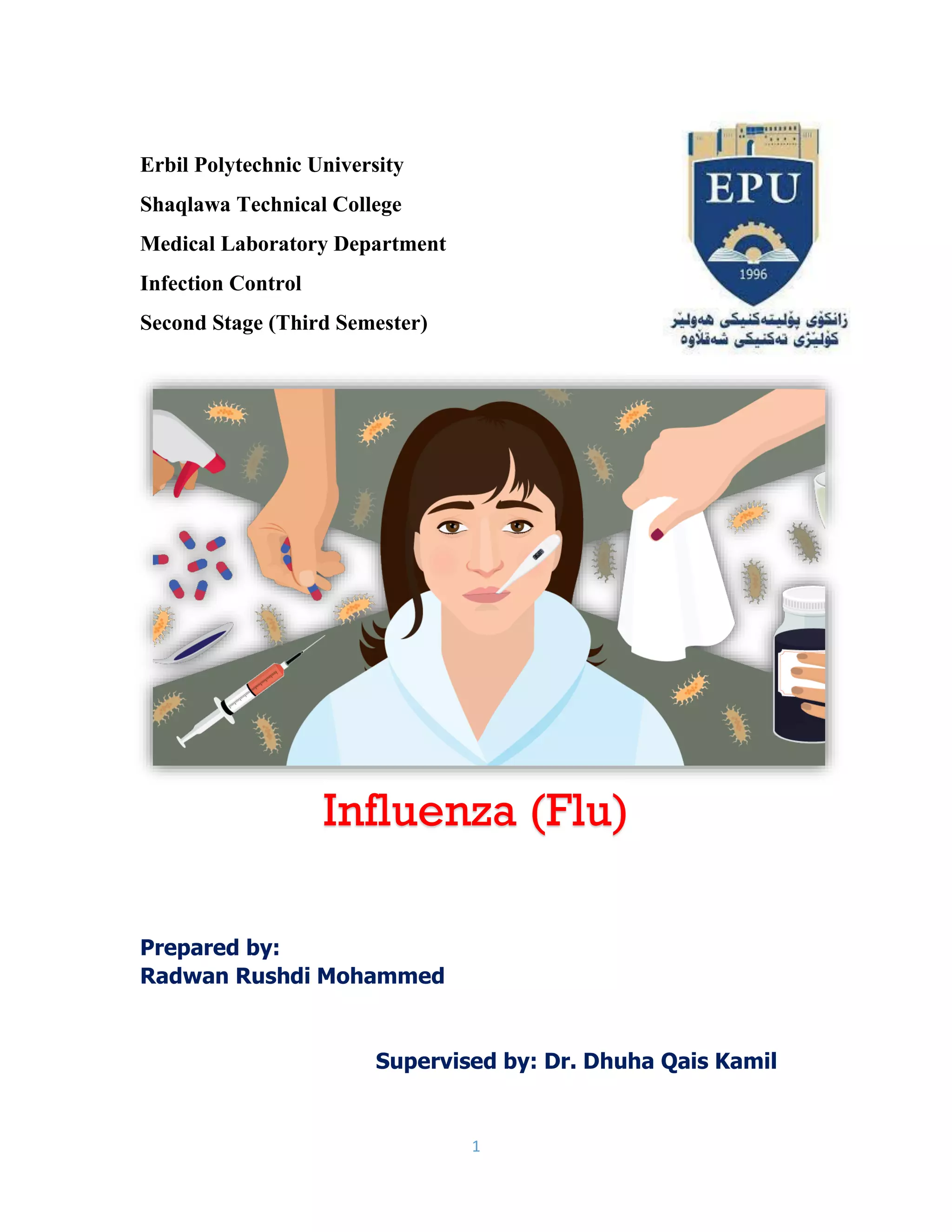
Influenza (Flu)
Prepared by:
Radwan Rushdi Mohammed
Supervised by: Dr. Dhuha Qais Kamil
2
Contents
1. Introduction about Influenza 3
2. Types of Influenza Virus 3
3. Causes of Influenza Virus 4
4. Symptoms and Risk Factors 4
5. Complications 5
6. Diagnosis 5
7. Treatment 6
8. Prevention 6
9. Conclusion 7
10.References 7
3
Influenza
Influenza, or the flu, is a contagious viral infection that affects the nose, throat, and lungs.
A protein shell provides a tough, protective shell for the genetic material as the virus
migrates between the humans or animals it infects. The outer shell allows the virus to infect
cells by fusing with the cell's outer membrane. The influenza virus uses H-tips like a key
to enter cells.
Once the influenza virus enters your body, it comes
into contact with cells in your nose, throat, or lungs.
The virus H-spike inserts itself into a receptor
molecule on your healthy cell membrane, like a key
in a lock. The virus envelope and the cell membrane
sack connect, allowing the genetic material of the
virus to leave the sack and enter the cell nucleus.
Some of the genetic material moves out of the
nucleus and then attaches to ribosomes, which make
up the protein building blocks of your cell.
Ribosomes use information from the genetic
material to make other viral proteins, such as the H
and N spikes. Influenza viruses are now free to infect more of your cells and cause you to
develop the flu. This prevents the new viruses from spreading and infecting more of your
cells. The vaccine exposes your body to several types of the influenza virus that are no
longer capable of causing infection but just strong enough to stimulate an immune
response. Within two weeks, cells in your immune system make markers called antibodies,
which are specific for only the types of flu you were exposed to. Antibodies are able to
bind with more than one virus, which causes the viruses to clump together. For continued
protection against new flu viruses, you will need to get a flu vaccine every year. [ 1+3+4+5]
Types of Influenza Viruses
There are four types of influenza viruses: A, B, C and D which all belong to the
family Orthomyxoviridae
Influenza A:
As we all know, influenza A virus can infect humans, birds, pigs and
other animals; it contains three membrane proteins (HA, NA, M2),
matrix protein (M1) directly under the lipid bilayer, and
ribonucleoprotein core ( 8 viral RNA fragments and 3 proteins (PA)
Influenza A virus can be further subdivided based on two) Membrane
proteins on the virus surface Although many different combinations of
HA and NA proteins are possible, only a small part of the virus is
currently available. Type influenza subtypes (ie, E. H1N1, H1N2, and
H3N2) spread widely among people.
4
Influenza B:
In contrast to type A influenza viruses, type B influenza only occurs in
humans. Type B influenza can cause a less severe reaction than type A
influenza virus, but sometimes type B influenza can still be very harmful.
Type B influenza viruses are not classified into subtypes and do not cause
epidemics.
Influenza C:
Influenza C viruses are also found in humans. However,
they are milder than either type A or type B. People
generally do not get very sick from type C influenza viruses.
Type C influenza viruses do not cause epidemics.
Influenza D:
Influenza D viruses are known to infect pigs and cattle, no
human infections from this virus have been observed. [2]
Causes of Influenza virus
Influenza viruses spread when people with flu cough, sneeze or talk,
sending droplets with the virus into the air and potentially into the mouths or noses of
people who are nearby. You can also get flu by touching a surface or object that has flu
virus on it and then touching your own mouth, eyes or nose. You can spread the flu before
you know you are sick, beginning 1 day before symptoms develop and up to 5 to 7 days
after becoming sick. Some people, especially young children and people with weakened
immune systems, might be able to infect others for a very long time. [3+4]
Symptoms and Risk factors
At first, the flu can feel like a simple cold with a runny
nose, sneezing, and sore throat. Sometimes, the common
cold develops slowly, while the flu tends to flare up
suddenly. Easily treated with some cold medications, the
flu can be much more difficult to handle. Common signs
and symptoms of flu include fever, muscle pain, chills
and sweating, headache, dry and persistent cough,
shortness of breath, fatigue, weakness, runny or stuffy
nose, sore throat, eyesore, vomiting and diarrhea, but this
is more common in children than adults. Factors that may
increase your risk of developing the flu or its
complications include age, weakened immune system,
chronic illnesses, aspirin use under age 19, pregnancy,
obesity, diseases (HIV, AIDS) or treatments (steroids,
chemotherapy) that suppress immunity. [3+4+5]
5
Complications
If you are young and healthy, the flu usually isn't serious. Although you may feel distressed
by the illness, the flu usually goes away within a week or two with no lasting effects.
However, children and adults have a high risk of complications, which may include:
pneumonia bronchitis asthma attack cardiovascular problems ear infections acute
respiratory distress syndrome pneumonia is one of the serious complications. Many elderly
people and those with chronic illnesses can die from pneumonia. [4]
Diagnosis
There are several tests that can be used to detect influenza viruses in respiratory samples.
The most common is called the "Rapid Influenza Diagnostic Test (RIDT)". RIDT works
by detecting the part of the
virus (antigen) that
stimulates the immune
response. These tests can
provide results in about 10-
15 minutes, but may not be
as accurate as other flu tests.
Therefore, even if your rapid
test result is negative, you
may still be infected with the
flu. Other influenza tests
called "rapid molecular
tests" can detect the genetic
material of influenza viruses. The rapid molecular test can give results within 15-20
minutes and is more accurate than RIDT. In addition to RIDT and rapid molecular testing,
there are some more accurate influenza tests that must be performed in specialized
laboratories, such as those performed in hospitals or public health laboratories. These tests
include reverse transcriptase polymerase chain reaction (RTPCR), virus culture, and
immunofluorescence assays. They all require the health care provider to insert a cotton.
Swape the inside of your nose or the back of your throat, then send the swab in for
examination. It may take anywhere from one to several hours to get results [3+4+5]
6
Treatment for Influenza
Usually, you will only need to rest and drink plenty of fluids to treat the flu. But if you
have a severe infection or are at high risk of developing complications, your doctor may
prescribe an antiviral medication to treat the flu. These medications may include
oseltamivir (Tamiflu), zanamivir (Relenza), peramivir (Rapivab), or baloxavir (Zovloza).
These medications can shorten the duration of your illness by a day or two and help prevent
serious complications. Oseltamivir is an oral medication. Zanamivir is inhaled using a
device similar to an asthma inhaler and should not be used by anyone with chronic
breathing problems, such as asthma and lung disease. Antiviral side effects may include
nausea and vomiting. These side effects can be reduced if the medicine is taken with food.
Most circulating flu strains have become resistant to amantadine and rimantadine
(Flumadin), two older antiviral medications that are no longer recommended. [5]
Prevention
Children aged 6 months to 8 years need to be vaccinated twice
with the flu vaccine for complete protection from the flu.
Children under the age of 6 months are at increased risk of serious
flu complications, but are too young to be vaccinated against the
flu. The best way to prevent the flu is to get the flu vaccine every
year. It is especially important to protect them from influenza. If
you live with or care for an infant under 6 months of age, you and
other members of your family should get vaccinated to protect
them from the flu. A highly effective flu vaccine is available for
people over 65 years of age. The best time to get a flu shot is as
soon as it becomes available in the fall of each year [3+4+5]
7
Conclusion
Influenza is a viral infection. The virus can attack your respiratory system and cause
pneumonia, headaches, and fatigue (tiredness). The flu virus can spread from person to
person. When flu patients cough, sneeze, or talk, they spray tiny droplets. These droplets
will fall on the mouth or nose of nearby people. Complications may occur in some people
who are infected with the flu. Some of these complications may be serious or even life-
threatening. Flu symptoms appear suddenly. Diagnose flu. Provide your healthcare
provider. The person first takes a medical history and asks about your symptoms. There
are several flu tests. To perform the test, your doctor will use a cotton swab on the inside
of your nose or the back of your throat. Then, you will be tested for the flu virus on the
swab. Some tests are fast and can provide results within 15-20 minutes. However, these
tests are not as accurate as other flu tests. These other tests can provide results within an
hour or a few hours. Most people recover from the flu on their own without medical
treatment. People with mild flu should stay home and avoid contact with others unless they
go to the doctor. However, see your doctor if you have flu symptoms and are at high risk,
very ill, or concerned about illness. You may need antiviral medication to treat the flu.
Antiviral medications can make the illness easier and shorten the duration of the illness.
They can also prevent serious complications of the flu. In general, it works best when
started within two days of disease onset. The best way to prevent the flu is to get a flu shot
every year. However, it is also important to have good hygiene habits, such as covering
your cough and washing your hands frequently. This can help stop the spread of germs and
prevent the flu.
References:
1- Echeverry, D. M., & Rodas, J. D. (2011). Influenza virus A H5N1 and H1N1:
features and zoonotic potential. Revista Colombiana de Ciencias Pecuarias, 24(4),
634-646.
2- Central disease control and prevention site / Types of Influenza Viruses
(https://www.cdc.gov/flu/about/viruses/types.htm)
3- Medlineplus site / Influenza (https://medlineplus.gov/flu.html)
4- Mayo clinic site / Influenza (https://www.mayoclinic.org/diseases-
conditions/flu/symptoms-causes/syc-20351719)
5- American lung association site / Flu, symptoms, Causes, risk Factors, diagnosing
and treating, and preventing flu (https://www.lung.org/lung-health-diseases/lung-
disease-lookup/influenza/learn-about-influenza)

Influenza (flu)

  • 1.
    1 Erbil Polytechnic University ShaqlawaTechnical College Medical Laboratory Department Infection Control Second Stage (Third Semester) Influenza (Flu) Prepared by: Radwan Rushdi Mohammed Supervised by: Dr. Dhuha Qais Kamil
  • 2.
    2 Contents 1. Introduction aboutInfluenza 3 2. Types of Influenza Virus 3 3. Causes of Influenza Virus 4 4. Symptoms and Risk Factors 4 5. Complications 5 6. Diagnosis 5 7. Treatment 6 8. Prevention 6 9. Conclusion 7 10.References 7
  • 3.
    3 Influenza Influenza, or theflu, is a contagious viral infection that affects the nose, throat, and lungs. A protein shell provides a tough, protective shell for the genetic material as the virus migrates between the humans or animals it infects. The outer shell allows the virus to infect cells by fusing with the cell's outer membrane. The influenza virus uses H-tips like a key to enter cells. Once the influenza virus enters your body, it comes into contact with cells in your nose, throat, or lungs. The virus H-spike inserts itself into a receptor molecule on your healthy cell membrane, like a key in a lock. The virus envelope and the cell membrane sack connect, allowing the genetic material of the virus to leave the sack and enter the cell nucleus. Some of the genetic material moves out of the nucleus and then attaches to ribosomes, which make up the protein building blocks of your cell. Ribosomes use information from the genetic material to make other viral proteins, such as the H and N spikes. Influenza viruses are now free to infect more of your cells and cause you to develop the flu. This prevents the new viruses from spreading and infecting more of your cells. The vaccine exposes your body to several types of the influenza virus that are no longer capable of causing infection but just strong enough to stimulate an immune response. Within two weeks, cells in your immune system make markers called antibodies, which are specific for only the types of flu you were exposed to. Antibodies are able to bind with more than one virus, which causes the viruses to clump together. For continued protection against new flu viruses, you will need to get a flu vaccine every year. [ 1+3+4+5] Types of Influenza Viruses There are four types of influenza viruses: A, B, C and D which all belong to the family Orthomyxoviridae Influenza A: As we all know, influenza A virus can infect humans, birds, pigs and other animals; it contains three membrane proteins (HA, NA, M2), matrix protein (M1) directly under the lipid bilayer, and ribonucleoprotein core ( 8 viral RNA fragments and 3 proteins (PA) Influenza A virus can be further subdivided based on two) Membrane proteins on the virus surface Although many different combinations of HA and NA proteins are possible, only a small part of the virus is currently available. Type influenza subtypes (ie, E. H1N1, H1N2, and H3N2) spread widely among people.
  • 4.
    4 Influenza B: In contrastto type A influenza viruses, type B influenza only occurs in humans. Type B influenza can cause a less severe reaction than type A influenza virus, but sometimes type B influenza can still be very harmful. Type B influenza viruses are not classified into subtypes and do not cause epidemics. Influenza C: Influenza C viruses are also found in humans. However, they are milder than either type A or type B. People generally do not get very sick from type C influenza viruses. Type C influenza viruses do not cause epidemics. Influenza D: Influenza D viruses are known to infect pigs and cattle, no human infections from this virus have been observed. [2] Causes of Influenza virus Influenza viruses spread when people with flu cough, sneeze or talk, sending droplets with the virus into the air and potentially into the mouths or noses of people who are nearby. You can also get flu by touching a surface or object that has flu virus on it and then touching your own mouth, eyes or nose. You can spread the flu before you know you are sick, beginning 1 day before symptoms develop and up to 5 to 7 days after becoming sick. Some people, especially young children and people with weakened immune systems, might be able to infect others for a very long time. [3+4] Symptoms and Risk factors At first, the flu can feel like a simple cold with a runny nose, sneezing, and sore throat. Sometimes, the common cold develops slowly, while the flu tends to flare up suddenly. Easily treated with some cold medications, the flu can be much more difficult to handle. Common signs and symptoms of flu include fever, muscle pain, chills and sweating, headache, dry and persistent cough, shortness of breath, fatigue, weakness, runny or stuffy nose, sore throat, eyesore, vomiting and diarrhea, but this is more common in children than adults. Factors that may increase your risk of developing the flu or its complications include age, weakened immune system, chronic illnesses, aspirin use under age 19, pregnancy, obesity, diseases (HIV, AIDS) or treatments (steroids, chemotherapy) that suppress immunity. [3+4+5]
  • 5.
    5 Complications If you areyoung and healthy, the flu usually isn't serious. Although you may feel distressed by the illness, the flu usually goes away within a week or two with no lasting effects. However, children and adults have a high risk of complications, which may include: pneumonia bronchitis asthma attack cardiovascular problems ear infections acute respiratory distress syndrome pneumonia is one of the serious complications. Many elderly people and those with chronic illnesses can die from pneumonia. [4] Diagnosis There are several tests that can be used to detect influenza viruses in respiratory samples. The most common is called the "Rapid Influenza Diagnostic Test (RIDT)". RIDT works by detecting the part of the virus (antigen) that stimulates the immune response. These tests can provide results in about 10- 15 minutes, but may not be as accurate as other flu tests. Therefore, even if your rapid test result is negative, you may still be infected with the flu. Other influenza tests called "rapid molecular tests" can detect the genetic material of influenza viruses. The rapid molecular test can give results within 15-20 minutes and is more accurate than RIDT. In addition to RIDT and rapid molecular testing, there are some more accurate influenza tests that must be performed in specialized laboratories, such as those performed in hospitals or public health laboratories. These tests include reverse transcriptase polymerase chain reaction (RTPCR), virus culture, and immunofluorescence assays. They all require the health care provider to insert a cotton. Swape the inside of your nose or the back of your throat, then send the swab in for examination. It may take anywhere from one to several hours to get results [3+4+5]
  • 6.
    6 Treatment for Influenza Usually,you will only need to rest and drink plenty of fluids to treat the flu. But if you have a severe infection or are at high risk of developing complications, your doctor may prescribe an antiviral medication to treat the flu. These medications may include oseltamivir (Tamiflu), zanamivir (Relenza), peramivir (Rapivab), or baloxavir (Zovloza). These medications can shorten the duration of your illness by a day or two and help prevent serious complications. Oseltamivir is an oral medication. Zanamivir is inhaled using a device similar to an asthma inhaler and should not be used by anyone with chronic breathing problems, such as asthma and lung disease. Antiviral side effects may include nausea and vomiting. These side effects can be reduced if the medicine is taken with food. Most circulating flu strains have become resistant to amantadine and rimantadine (Flumadin), two older antiviral medications that are no longer recommended. [5] Prevention Children aged 6 months to 8 years need to be vaccinated twice with the flu vaccine for complete protection from the flu. Children under the age of 6 months are at increased risk of serious flu complications, but are too young to be vaccinated against the flu. The best way to prevent the flu is to get the flu vaccine every year. It is especially important to protect them from influenza. If you live with or care for an infant under 6 months of age, you and other members of your family should get vaccinated to protect them from the flu. A highly effective flu vaccine is available for people over 65 years of age. The best time to get a flu shot is as soon as it becomes available in the fall of each year [3+4+5]
  • 7.
    7 Conclusion Influenza is aviral infection. The virus can attack your respiratory system and cause pneumonia, headaches, and fatigue (tiredness). The flu virus can spread from person to person. When flu patients cough, sneeze, or talk, they spray tiny droplets. These droplets will fall on the mouth or nose of nearby people. Complications may occur in some people who are infected with the flu. Some of these complications may be serious or even life- threatening. Flu symptoms appear suddenly. Diagnose flu. Provide your healthcare provider. The person first takes a medical history and asks about your symptoms. There are several flu tests. To perform the test, your doctor will use a cotton swab on the inside of your nose or the back of your throat. Then, you will be tested for the flu virus on the swab. Some tests are fast and can provide results within 15-20 minutes. However, these tests are not as accurate as other flu tests. These other tests can provide results within an hour or a few hours. Most people recover from the flu on their own without medical treatment. People with mild flu should stay home and avoid contact with others unless they go to the doctor. However, see your doctor if you have flu symptoms and are at high risk, very ill, or concerned about illness. You may need antiviral medication to treat the flu. Antiviral medications can make the illness easier and shorten the duration of the illness. They can also prevent serious complications of the flu. In general, it works best when started within two days of disease onset. The best way to prevent the flu is to get a flu shot every year. However, it is also important to have good hygiene habits, such as covering your cough and washing your hands frequently. This can help stop the spread of germs and prevent the flu. References: 1- Echeverry, D. M., & Rodas, J. D. (2011). Influenza virus A H5N1 and H1N1: features and zoonotic potential. Revista Colombiana de Ciencias Pecuarias, 24(4), 634-646. 2- Central disease control and prevention site / Types of Influenza Viruses (https://www.cdc.gov/flu/about/viruses/types.htm) 3- Medlineplus site / Influenza (https://medlineplus.gov/flu.html) 4- Mayo clinic site / Influenza (https://www.mayoclinic.org/diseases- conditions/flu/symptoms-causes/syc-20351719) 5- American lung association site / Flu, symptoms, Causes, risk Factors, diagnosing and treating, and preventing flu (https://www.lung.org/lung-health-diseases/lung- disease-lookup/influenza/learn-about-influenza)