INFLATION IN INDIA 
BY : 
Sambit Kumar Biswal 
Ajit Kumar Pallei 
Manoj Kumar Sahoo 
Ratikanta Rout 
Manaj Kumar Behera 
Jitendra Kar
INTRODUCTION 
 Inflation is defined as a continuous increase 
in the price level or a fall in the value of 
money. 
 When the level of currency of a country 
exceeds the level of production, inflation 
occurs. 
 Value of money depreciates with the 
occurrence of inflation.
OBJECTIVES 
 To examine the impact of inflation on 
economic growth in India over the period 
1990-2011 
 To measure the degree of responsiveness of 
Indian economic growth (GDP) to changes in 
the general price levels (Inflation rate). 
 To establish the relationship between 
inflation and GDP growth rate in Tanzania.
REASONS OF INFLATION IN INDIA 
 Rise in Crude Oil Prices 
 Rise in food Prices 
 Black Money 
 GDP 
Wage rate wise
HOW IT IS MEASURED 
 CPI (Consumer Price Index) 
 WPI (Wholesale Price Index) 
Inflation Rate = Current CPI/WPI – Last 
CPI/WPI 
Last CPI/WPI 
x 100
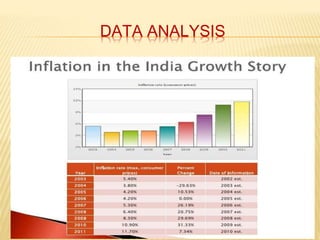
DATA ANALYSIS
CONCLUSION 
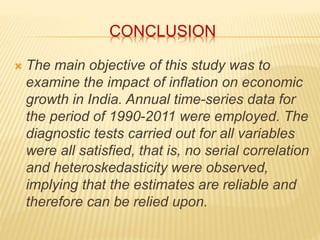
 The main objective of this study was to 
examine the impact of inflation on economic 
growth in India. Annual time-series data for 
the period of 1990-2011 were employed. The 
diagnostic tests carried out for all variables 
were all satisfied, that is, no serial correlation 
and heteroskedasticity were observed, 
implying that the estimates are reliable and 
therefore can be relied upon.
RECOMMENDATION
REFERENCE 
 http://www.mysmp.com/bonds/inflation.html 
 http://www.personalfinanceology.com/the-effects- 
of-inflation-on-your-money/ 
 http://www.indiaonestop.com/inflation.htm 
 http://www.adb.org/documents/books/ADO/2 
004/update/ind.asp 
 http://business.mapsofindia.com/news/inflatio 
n.html
ANTIVIRUS GROUP

Inflation in india

  • 1.
    INFLATION IN INDIA BY : Sambit Kumar Biswal Ajit Kumar Pallei Manoj Kumar Sahoo Ratikanta Rout Manaj Kumar Behera Jitendra Kar
  • 2.
    INTRODUCTION  Inflationis defined as a continuous increase in the price level or a fall in the value of money.  When the level of currency of a country exceeds the level of production, inflation occurs.  Value of money depreciates with the occurrence of inflation.
  • 3.
    OBJECTIVES  Toexamine the impact of inflation on economic growth in India over the period 1990-2011  To measure the degree of responsiveness of Indian economic growth (GDP) to changes in the general price levels (Inflation rate).  To establish the relationship between inflation and GDP growth rate in Tanzania.
  • 4.
    REASONS OF INFLATIONIN INDIA  Rise in Crude Oil Prices  Rise in food Prices  Black Money  GDP Wage rate wise
  • 5.
    HOW IT ISMEASURED  CPI (Consumer Price Index)  WPI (Wholesale Price Index) Inflation Rate = Current CPI/WPI – Last CPI/WPI Last CPI/WPI x 100
  • 6.
  • 7.
    CONCLUSION  Themain objective of this study was to examine the impact of inflation on economic growth in India. Annual time-series data for the period of 1990-2011 were employed. The diagnostic tests carried out for all variables were all satisfied, that is, no serial correlation and heteroskedasticity were observed, implying that the estimates are reliable and therefore can be relied upon.
  • 8.
  • 9.
    REFERENCE  http://www.mysmp.com/bonds/inflation.html  http://www.personalfinanceology.com/the-effects- of-inflation-on-your-money/  http://www.indiaonestop.com/inflation.htm  http://www.adb.org/documents/books/ADO/2 004/update/ind.asp  http://business.mapsofindia.com/news/inflatio n.html
  • 10.

Editor's Notes

  • #3 Presented by Antivirus Group