The Open Economy Revisited:
the Mundell-Fleming Model and the
Exchange-Rate Regime
Submitted to
Miss Abr-E-Rahmat
Submitted BY
Aysha 12071521-022
M.waqas 12071521-029
Maria 12071521-044
University of Gujrat
Hafiz Hayat campus
Introduction
Interest Rate Differentials
Case study: International Financial Crisis: Mexico 1994–
1995
Case study :International Financial Crisis: Asia 1997–1998
Case study: Monetary Union in the United States and
Europe
Case study: The Chinese Currency Controversy
From the Short Run to the Long Run:
The Mundell–Fleming Model With a Changing Price Level
Conclusion
Interest-rate differentials
Two reasons why r may differ from r*
Country risk: The risk that the country’s
borrowers will default on their loan repayments
because of political or economic turmoil.
Lenders require a higher interest rate to compensate
them for this risk.
Expected exchange rate changes: If a country’s
exchange rate is expected to fall, then its borrowers
must pay a higher interest rate to compensate
lenders for the expected currency depreciation.
Differentials in the M-F model
Where θ (Greek letter “theta”) is a risk premium,
assumed exogenous.
Substitute the expression for r into the
IS* and LM* equations:
( , )*M P L r Y= +θ
( ) ( ) ( )*Y C Y T I r G NX e= − + + + +θ
*r r θ= +
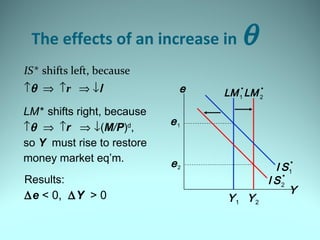
The effects of an increase in θ
IS* shifts left, because
↑θ ⇒ ↑r ⇒ ↓I
2
*
LM
Y
e
Y1
e1
1
*
LM
1
*
I S
LM* shifts right, because
↑θ ⇒ ↑r ⇒ ↓(M/P)d
,
so Y must rise to restore
money market eq’m.
Results:
∆e < 0, ∆Y > 0
2
*
I S
e2
Y2
The effects of an increase in θ
The fall in e is intuitive:
An increase in country risk or an expected
depreciation makes holding the country’s currency
less attractive.
Note: an expected depreciation is a
self-fulfilling prophecy.
The increase in Y occurs because
the boost in NX (from the depreciation)
is greater than the fall in I (from the rise in r).
Why income might not rise
The central bank may try to prevent the depreciation
by reducing the money supply.
The depreciation might boost the price of imports
enough to increase the price level (which would
reduce the real money supply).
Consumers might respond to the increased risk by
holding more money.
Each of the above would shift LM* leftward.
10
15
20
25
30
35
7/10/94 8/29/94 10/18/94 12/7/94 1/26/95 3/17/95 5/6/95
U.S.CentsperMexicanPeso
10
15
20
25
30
35
7/10/94 8/29/94 10/18/94 12/7/94 1/26/95 3/17/95 5/6/95
U.S.CentsperMexicanPeso
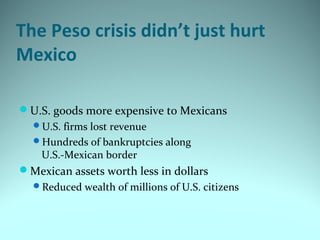
The Peso crisis didn’t just hurt
Mexico
U.S. goods more expensive to Mexicans
U.S. firms lost revenue
Hundreds of bankruptcies along
U.S.-Mexican border
Mexican assets worth less in dollars
Reduced wealth of millions of U.S. citizens
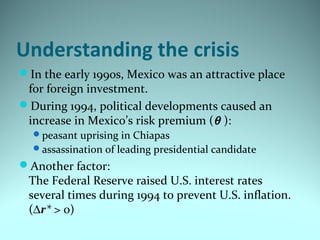
Understanding the crisis
In the early 1990s, Mexico was an attractive place
for foreign investment.
During 1994, political developments caused an
increase in Mexico’s risk premium (θ ):
peasant uprising in Chiapas
assassination of leading presidential candidate
Another factor:
The Federal Reserve raised U.S. interest rates
several times during 1994 to prevent U.S. inflation.
(∆r* > 0)
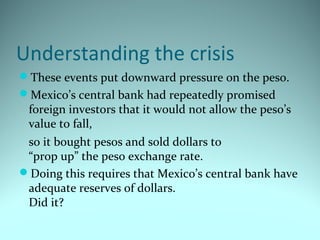
Understanding the crisis
These events put downward pressure on the peso.
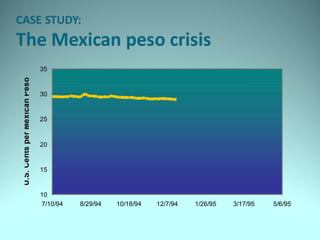
Mexico’s central bank had repeatedly promised
foreign investors that it would not allow the peso’s
value to fall,
so it bought pesos and sold dollars to
“prop up” the peso exchange rate.
Doing this requires that Mexico’s central bank have
adequate reserves of dollars.
Did it?
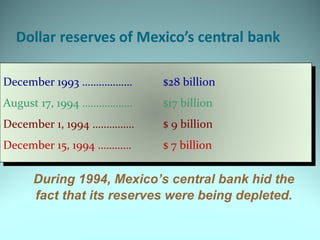
December 1993 ……………… $28 billion
August 17, 1994 ……………… $17 billion
December 1, 1994 …………… $ 9 billion
December 15, 1994 ………… $ 7 billion
During 1994, Mexico’s central bank hid the
fact that its reserves were being depleted.
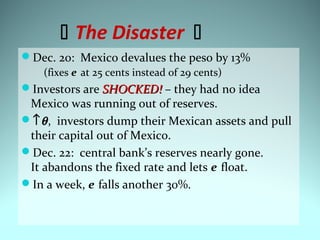
 The Disaster 
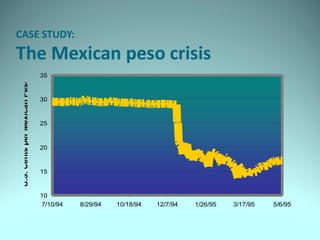
Dec. 20: Mexico devalues the peso by 13%
(fixes e at 25 cents instead of 29 cents)
Investors are SHOCKED!SHOCKED! – they had no idea
Mexico was running out of reserves.
↑θ, investors dump their Mexican assets and pull
their capital out of Mexico.
Dec. 22: central bank’s reserves nearly gone.
It abandons the fixed rate and lets e float.
In a week, e falls another 30%.
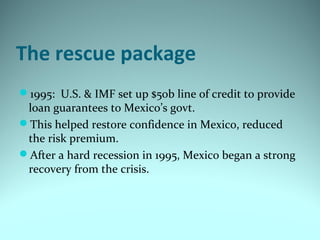
The rescue package
1995: U.S. & IMF set up $50b line of credit to provide
loan guarantees to Mexico’s govt.
This helped restore confidence in Mexico, reduced
the risk premium.
After a hard recession in 1995, Mexico began a strong
recovery from the crisis.
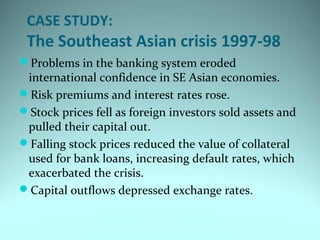
CASE STUDY:
The Southeast Asian crisis 1997-98
Problems in the banking system eroded
international confidence in SE Asian economies.
Risk premiums and interest rates rose.
Stock prices fell as foreign investors sold assets and
pulled their capital out.
Falling stock prices reduced the value of collateral
used for bank loans, increasing default rates, which
exacerbated the crisis.
Capital outflows depressed exchange rates.
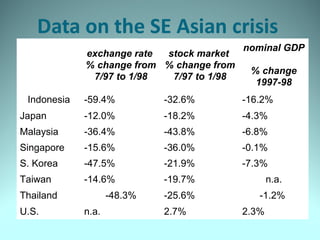
exchange rate
% change from
7/97 to 1/98
stock market
% change from
7/97 to 1/98
nominal GDP
% change
1997-98
Indonesia -59.4% -32.6% -16.2%
Japan -12.0% -18.2% -4.3%
Malaysia -36.4% -43.8% -6.8%
Singapore -15.6% -36.0% -0.1%
S. Korea -47.5% -21.9% -7.3%
Taiwan -14.6% -19.7% n.a.
Thailand -48.3% -25.6% -1.2%
U.S. n.a. 2.7% 2.3%
Floating vs. fixed exchange rates
Argument for floating rates:
allows monetary policy to be used to pursue other goals
(stable growth, low inflation).
Arguments for fixed rates:
avoids uncertainty and volatility, making international
transactions easier.
disciplines monetary policy to prevent excessive money
growth & hyperinflation.
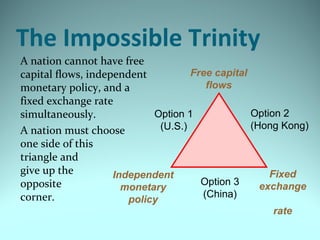
The Impossible Trinity
A nation cannot have free
capital flows, independent
monetary policy, and a
fixed exchange rate
simultaneously.
A nation must choose
one side of this
triangle and
give up the
opposite
corner.
Free capital
flows
Independent
monetary
policy
Fixed
exchange
rate
Option 1
(U.S.)
Option 3
(China)
Option 2
(Hong Kong)
CASE STUDY:
The Chinese Currency Controversy
1995-2005: China fixed its exchange rate at 8.28
Yuan per dollar, and restricted capital flows.
Many observers believed that the Yuan was
significantly undervalued, as China was accumulating
large dollar reserves.
U.S. producers complained that China’s cheap
Yuan gave Chinese producers an unfair advantage.
President Bush asked China to let its currency float;
Others in the U.S. wanted tariffs on Chinese goods.
CASE STUDY:
The Chinese Currency Controversy
If China lets the Yuan float, it may indeed appreciate.
However, if China also allows greater capital
mobility, then Chinese citizens may start moving
their savings abroad.
Such capital outflows could cause the Yuan to
depreciate rather than appreciate.
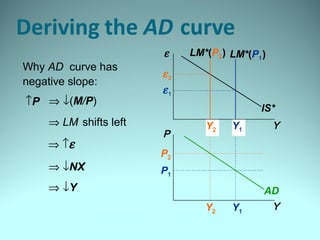
Mundell-Fleming and the AD curve
So far in M-F model, P has been fixed.
Next: to derive the AD curve, consider the impact of
a change in P in the M-F model.
We now write the M-F equations as:
(Earlier in this chapter, P was fixed, so we
could write NX as a function of e instead of ε.)
( ) ( , )*M P L r Y=LM*
( ) ( ) ( ) ( )*Y C Y T I r G NXε= − + + +IS*
Y1Y2
Y
ε
Y
P
IS*
LM*(P1)LM*(P2)
AD
P1
P2
Y2 Y1
ε2
ε1
Why AD curve has
negative slope:
↑P
⇒ LM shifts left
⇒ ↑ε
⇒ ↓NX
⇒ ↓Y
⇒ ↓(M/P)
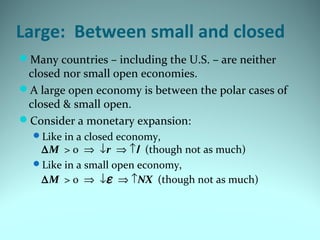
Large: Between small and closed
Many countries – including the U.S. – are neither
closed nor small open economies.
A large open economy is between the polar cases of
closed & small open.
Consider a monetary expansion:
Like in a closed economy,
∆M > 0 ⇒ ↓r ⇒ ↑I (though not as much)
Like in a small open economy,
∆M > 0 ⇒ ↓ε ⇒ ↑NX (though not as much)
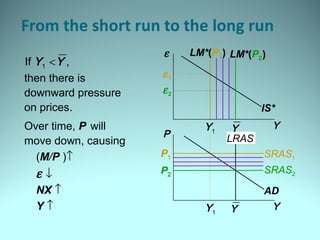
LM*(P1)
ε1
ε2
then there is
downward pressure
on prices.
Over time, P will
move down, causing
(M/P )↑
ε ↓
NX ↑
Y ↑
P1 SRAS1
1Y
1Y Y
ε
Y
P
IS*
AD
Y
Y
LRAS
LM*(P2)
P2
SRAS2
If ,Y Y<1
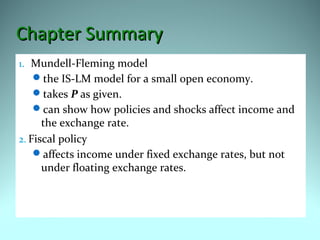
Chapter SummaryChapter Summary
1. Mundell-Fleming model
the IS-LM model for a small open economy.
takes P as given.
can show how policies and shocks affect income and
the exchange rate.
2. Fiscal policy
affects income under fixed exchange rates, but not
under floating exchange rates.
Conti…Conti…
3. Monetary policy
affects income under floating exchange rates.
under fixed exchange rates, monetary policy is not
available to affect output.
4.Interest rate differentials
exist if investors require a risk premium to hold a
country’s assets.
An increase in this risk premium raises domestic
interest rates and causes the country’s exchange rate
to depreciate.
Conti…Conti…
Mundell

Mundell

  • 1.
    The Open EconomyRevisited: the Mundell-Fleming Model and the Exchange-Rate Regime Submitted to Miss Abr-E-Rahmat Submitted BY Aysha 12071521-022 M.waqas 12071521-029 Maria 12071521-044 University of Gujrat Hafiz Hayat campus
  • 2.
    Introduction Interest Rate Differentials Casestudy: International Financial Crisis: Mexico 1994– 1995 Case study :International Financial Crisis: Asia 1997–1998 Case study: Monetary Union in the United States and Europe Case study: The Chinese Currency Controversy From the Short Run to the Long Run: The Mundell–Fleming Model With a Changing Price Level Conclusion
  • 3.
    Interest-rate differentials Two reasonswhy r may differ from r* Country risk: The risk that the country’s borrowers will default on their loan repayments because of political or economic turmoil. Lenders require a higher interest rate to compensate them for this risk. Expected exchange rate changes: If a country’s exchange rate is expected to fall, then its borrowers must pay a higher interest rate to compensate lenders for the expected currency depreciation.
  • 4.
    Differentials in theM-F model Where θ (Greek letter “theta”) is a risk premium, assumed exogenous. Substitute the expression for r into the IS* and LM* equations: ( , )*M P L r Y= +θ ( ) ( ) ( )*Y C Y T I r G NX e= − + + + +θ *r r θ= +
  • 5.
    The effects ofan increase in θ IS* shifts left, because ↑θ ⇒ ↑r ⇒ ↓I 2 * LM Y e Y1 e1 1 * LM 1 * I S LM* shifts right, because ↑θ ⇒ ↑r ⇒ ↓(M/P)d , so Y must rise to restore money market eq’m. Results: ∆e < 0, ∆Y > 0 2 * I S e2 Y2
  • 6.
    The effects ofan increase in θ The fall in e is intuitive: An increase in country risk or an expected depreciation makes holding the country’s currency less attractive. Note: an expected depreciation is a self-fulfilling prophecy. The increase in Y occurs because the boost in NX (from the depreciation) is greater than the fall in I (from the rise in r).
  • 7.
    Why income mightnot rise The central bank may try to prevent the depreciation by reducing the money supply. The depreciation might boost the price of imports enough to increase the price level (which would reduce the real money supply). Consumers might respond to the increased risk by holding more money. Each of the above would shift LM* leftward.
  • 8.
    10 15 20 25 30 35 7/10/94 8/29/94 10/18/9412/7/94 1/26/95 3/17/95 5/6/95 U.S.CentsperMexicanPeso
  • 9.
    10 15 20 25 30 35 7/10/94 8/29/94 10/18/9412/7/94 1/26/95 3/17/95 5/6/95 U.S.CentsperMexicanPeso
  • 10.
    The Peso crisisdidn’t just hurt Mexico U.S. goods more expensive to Mexicans U.S. firms lost revenue Hundreds of bankruptcies along U.S.-Mexican border Mexican assets worth less in dollars Reduced wealth of millions of U.S. citizens
  • 11.
    Understanding the crisis Inthe early 1990s, Mexico was an attractive place for foreign investment. During 1994, political developments caused an increase in Mexico’s risk premium (θ ): peasant uprising in Chiapas assassination of leading presidential candidate Another factor: The Federal Reserve raised U.S. interest rates several times during 1994 to prevent U.S. inflation. (∆r* > 0)
  • 12.
    Understanding the crisis Theseevents put downward pressure on the peso. Mexico’s central bank had repeatedly promised foreign investors that it would not allow the peso’s value to fall, so it bought pesos and sold dollars to “prop up” the peso exchange rate. Doing this requires that Mexico’s central bank have adequate reserves of dollars. Did it?
  • 13.
    December 1993 ………………$28 billion August 17, 1994 ……………… $17 billion December 1, 1994 …………… $ 9 billion December 15, 1994 ………… $ 7 billion During 1994, Mexico’s central bank hid the fact that its reserves were being depleted.
  • 14.
     The Disaster Dec. 20: Mexico devalues the peso by 13% (fixes e at 25 cents instead of 29 cents) Investors are SHOCKED!SHOCKED! – they had no idea Mexico was running out of reserves. ↑θ, investors dump their Mexican assets and pull their capital out of Mexico. Dec. 22: central bank’s reserves nearly gone. It abandons the fixed rate and lets e float. In a week, e falls another 30%.
  • 15.
    The rescue package 1995:U.S. & IMF set up $50b line of credit to provide loan guarantees to Mexico’s govt. This helped restore confidence in Mexico, reduced the risk premium. After a hard recession in 1995, Mexico began a strong recovery from the crisis.
  • 16.
    CASE STUDY: The SoutheastAsian crisis 1997-98 Problems in the banking system eroded international confidence in SE Asian economies. Risk premiums and interest rates rose. Stock prices fell as foreign investors sold assets and pulled their capital out. Falling stock prices reduced the value of collateral used for bank loans, increasing default rates, which exacerbated the crisis. Capital outflows depressed exchange rates.
  • 17.
    exchange rate % changefrom 7/97 to 1/98 stock market % change from 7/97 to 1/98 nominal GDP % change 1997-98 Indonesia -59.4% -32.6% -16.2% Japan -12.0% -18.2% -4.3% Malaysia -36.4% -43.8% -6.8% Singapore -15.6% -36.0% -0.1% S. Korea -47.5% -21.9% -7.3% Taiwan -14.6% -19.7% n.a. Thailand -48.3% -25.6% -1.2% U.S. n.a. 2.7% 2.3%
  • 18.
    Floating vs. fixedexchange rates Argument for floating rates: allows monetary policy to be used to pursue other goals (stable growth, low inflation). Arguments for fixed rates: avoids uncertainty and volatility, making international transactions easier. disciplines monetary policy to prevent excessive money growth & hyperinflation.
  • 19.
    The Impossible Trinity Anation cannot have free capital flows, independent monetary policy, and a fixed exchange rate simultaneously. A nation must choose one side of this triangle and give up the opposite corner. Free capital flows Independent monetary policy Fixed exchange rate Option 1 (U.S.) Option 3 (China) Option 2 (Hong Kong)
  • 20.
    CASE STUDY: The ChineseCurrency Controversy 1995-2005: China fixed its exchange rate at 8.28 Yuan per dollar, and restricted capital flows. Many observers believed that the Yuan was significantly undervalued, as China was accumulating large dollar reserves. U.S. producers complained that China’s cheap Yuan gave Chinese producers an unfair advantage. President Bush asked China to let its currency float; Others in the U.S. wanted tariffs on Chinese goods.
  • 21.
    CASE STUDY: The ChineseCurrency Controversy If China lets the Yuan float, it may indeed appreciate. However, if China also allows greater capital mobility, then Chinese citizens may start moving their savings abroad. Such capital outflows could cause the Yuan to depreciate rather than appreciate.
  • 22.
    Mundell-Fleming and theAD curve So far in M-F model, P has been fixed. Next: to derive the AD curve, consider the impact of a change in P in the M-F model. We now write the M-F equations as: (Earlier in this chapter, P was fixed, so we could write NX as a function of e instead of ε.) ( ) ( , )*M P L r Y=LM* ( ) ( ) ( ) ( )*Y C Y T I r G NXε= − + + +IS*
  • 23.
    Y1Y2 Y ε Y P IS* LM*(P1)LM*(P2) AD P1 P2 Y2 Y1 ε2 ε1 Why ADcurve has negative slope: ↑P ⇒ LM shifts left ⇒ ↑ε ⇒ ↓NX ⇒ ↓Y ⇒ ↓(M/P)
  • 24.
    Large: Between smalland closed Many countries – including the U.S. – are neither closed nor small open economies. A large open economy is between the polar cases of closed & small open. Consider a monetary expansion: Like in a closed economy, ∆M > 0 ⇒ ↓r ⇒ ↑I (though not as much) Like in a small open economy, ∆M > 0 ⇒ ↓ε ⇒ ↑NX (though not as much)
  • 25.
    LM*(P1) ε1 ε2 then there is downwardpressure on prices. Over time, P will move down, causing (M/P )↑ ε ↓ NX ↑ Y ↑ P1 SRAS1 1Y 1Y Y ε Y P IS* AD Y Y LRAS LM*(P2) P2 SRAS2 If ,Y Y<1
  • 26.
    Chapter SummaryChapter Summary 1.Mundell-Fleming model the IS-LM model for a small open economy. takes P as given. can show how policies and shocks affect income and the exchange rate. 2. Fiscal policy affects income under fixed exchange rates, but not under floating exchange rates.
  • 27.
    Conti…Conti… 3. Monetary policy affectsincome under floating exchange rates. under fixed exchange rates, monetary policy is not available to affect output. 4.Interest rate differentials exist if investors require a risk premium to hold a country’s assets. An increase in this risk premium raises domestic interest rates and causes the country’s exchange rate to depreciate.
  • 28.

Editor's Notes

  • #5 The first equation says that a country’s interest rate equals the world interest rate plus a risk premium (whose size depends on investors’ perceptions of the political &amp; economic risk of holding that country’s assets and on the expected rate of depreciation or appreciation of the country’s currency. We can now use the M-F model to analyze the effects of a change in the risk premium. The next few slides present this analysis, then discuss an important real-world example (the Mexican peso crisis).
  • #6 Intuition: If prospective lenders expect the country’s currency to depreciation, or if they perceive that the country’s assets are especially risky, then they will demand that borrowers in that country pay them a higher interest rate (over and above r*). The higher interest rate reduces investment and shifts the IS* curve to the left. But it also lowers money demand, so income must rise to restore money market equilibrium. Why does the exchange rate fall? The increase in the risk premium causes foreign investors to sell some of their holdings of domestic assets and pull their ‘loanable funds’ out of the country. The capital outflow causes an increase in the supply of domestic currency in the foreign exchange market, which causes the fall in the exchange rate. Or, in simpler terms, an increase in country risk or an expected depreciation makes holding the country’s currency less desirable.
  • #8 The result that income rises when the risk premium rises seems counter-intuitive and inaccurate. This slide explains why the increase in the risk premium may cause other things to occur that prevent income from rising, and may even cause income to fall.
  • #9 Mexico’s central bank had maintained a fixed exchange rate with the U.S. dollar at about 29 cents per peso.
  • #10 In the week before Christmas 1994, the central bank abandoned the fixed exchange rate, allowing the peso’s value to “float.” In just one week, the peso lost nearly 40% of its value, and fell further during the following months.
  • #11 The purpose of this slide is to motivate the topic. Even though this occurred in another country some years ago, it was very important for the U.S. The parents of many of your students probably held Mexican assets (indirectly through mutual funds in their 401k accounts and pension funds, which viewed Mexico very favorably prior to the crisis) and took losses when the crisis occurred.
  • #12 When the last line displays, it might be helpful to note that, from Mexico’s viewpoint, the U.S. interest rate is r*.
  • #13 We have already seen why an increase in a country’s risk premium causes its exchange rate to fall. One could also use the M-F model to show that an increase in r* also causes the exchange rate to fall. The intuition is as follows: An increase in foreign interest rates causes capital outflows: investors shift some of their funds out of the country to take advantage of higher returns abroad. This capital outflow causes the exchange rate to fall as it implies an increase in the supply of the country’s currency in the foreign exchange market.
  • #14 Defending the peso in the face of large capital outflows was draining the reserves of Mexico’s central bank. (August 17, 1994 was the date of the presidential election.) Ask your students if they can figure out why Mexico’s central bank didn’t tell anybody it was running out of reserves. The answer: If people had known that the reserves were dwindling, then they would also have known that the central bank would soon have to devalue or abandon the fixed exchange rate altogether. They would have expected the peso to fall, which would have caused a further increase in Mexico’s risk premium, which would have put even more downward pressure on Mexico’s exchange rate and made it even harder for the central bank to “defend the peso.” Source (not only for the data on this slide, but some of the other information in this case study): Washington Post National Weekly Edition, pp8‑9, Feb 20‑26 1995, various issues of The Economist in Jan &amp; Feb &amp;apos;95.
  • #16 The case study on pp.353-355 gives more detail on the peso crisis.
  • #17 This and the following slide correspond to the case study on pp.355-356.
  • #20 This slide corresponds to new material in the 6th edition, on pp.359-360. “Option 1” is allowing free capital flows and maintaining independent monetary policy, but giving up a fixed exchange rate. An example of a country that chooses this option is the United States. “Option 2” is allowing free capital flows keeping a fixed exchange rate, but giving up independent monetary policy. A country that chooses this option is Hong Kong. “Option 3” is keeping monetary policy independent, yet fixing the exchange rate. Doing this requires limiting capital flows. An example of a country that practices this option is China.
  • #21 This slide corresponds to new material in the 6th edition, on pp.360-361.
  • #22 This slide corresponds to new material in the 6th edition, on pp.360-361.
  • #23 Net exports really depend on the real exchange rate, not the nominal exchange rate. Earlier in the chapter, we wrote NX as a function of the nominal rate, because the price level was assumed fixed, so the nominal &amp; real rates always moved together. But now, with the price level changing also, we need to write NX as a function of the real exchange rate.
  • #24 Like figure 12-13 on p.362, except here we are showing what happens to Y when P increases (not falls). The derivation of the open economy AD curve is very similar to that of the closed economy AD curve (see chapter 11).
  • #25 For more details, see the Appendix to chapter 12 (not included in this PowerPoint presentation).
  • #26 Figure 12-14 on p.363. Suggestion: Have your students draw the two panels of the diagram on this screen, with the economy in an initial equilibrium with output equal to its natural rate. Then, have them use their diagrams to analyze the short-run and long-run effects of a negative IS* shock.