Grp.No13
               Swatee Ghosh
              Samit kr. Kapat
            Ronald Fernandes


9/10/2010                       1
PLACES TO SAVE MONEY

Would you save your money in any of these places?
Why? Why not? Can you think of other places to save
money?

             •   Bed & Mattress
             •   Cookie Jar
             •   Pillow
             •   Wallet
             •   Money Belt
             •   Small House Safe

 9/10/2010                                            2
9/10/2010   3
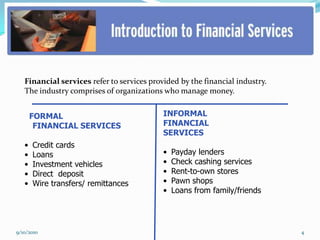
Financial services refer to services provided by the financial industry.
   The industry comprises of organizations who manage money.


       FORMAL                               INFORMAL
        FINANCIAL SERVICES                  FINANCIAL
                                            SERVICES
   •   Credit cards
   •   Loans                                •   Payday lenders
   •   Investment vehicles                  •   Check cashing services
   •   Direct deposit                       •   Rent-to-own stores
   •   Wire transfers/ remittances          •   Pawn shops
                                            •   Loans from family/friends


9/10/2010                                                                     4
Banks
 A landmark was registered in the Indian banking sector
  when the major banks were nationalized in 1969.

 Commercial banks

 Investments banks

 Bonds (debt)

 Stocks (equity)

 Notary services

 Credit cards
  9/10/2010                                                5
Stock market
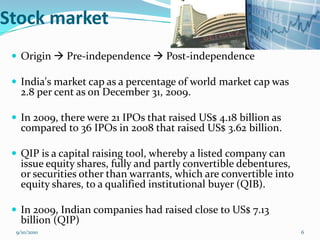
  Origin  Pre-independence  Post-independence

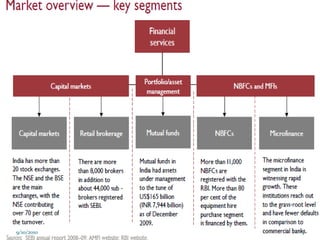
  India's market cap as a percentage of world market cap was
   2.8 per cent as on December 31, 2009.

  In 2009, there were 21 IPOs that raised US$ 4.18 billion as
   compared to 36 IPOs in 2008 that raised US$ 3.62 billion.

  QIP is a capital raising tool, whereby a listed company can
   issue equity shares, fully and partly convertible debentures,
   or securities other than warrants, which are convertible into
   equity shares, to a qualified institutional buyer (QIB).

  In 2009, Indian companies had raised close to US$ 7.13
   billion (QIP)
  9/10/2010                                                        6
NSE
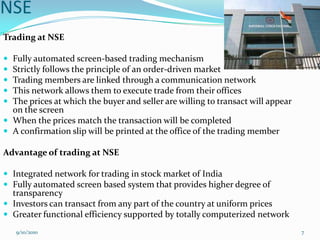
Trading at NSE

 Fully automated screen-based trading mechanism
 Strictly follows the principle of an order-driven market
 Trading members are linked through a communication network
 This network allows them to execute trade from their offices
 The prices at which the buyer and seller are willing to transact will appear
  on the screen
 When the prices match the transaction will be completed
 A confirmation slip will be printed at the office of the trading member

Advantage of trading at NSE

 Integrated network for trading in stock market of India
 Fully automated screen based system that provides higher degree of
  transparency
 Investors can transact from any part of the country at uniform prices
 Greater functional efficiency supported by totally computerized network
    9/10/2010                                                                    7
Foreign Exchange

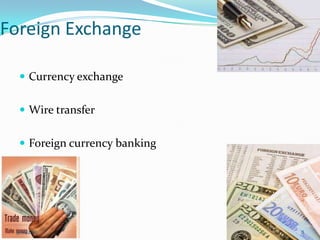
   Currency exchange


   Wire transfer


   Foreign currency banking


 9/10/2010                     8
Investments services

   Asset management


   Hedge fund management


   Custody management


 9/10/2010                  9
Insurance
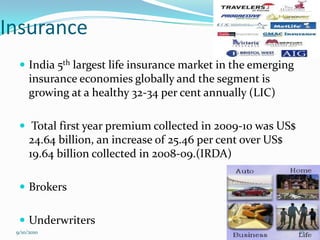
   India 5th largest life insurance market in the emerging
      insurance economies globally and the segment is
      growing at a healthy 32-34 per cent annually (LIC)

   Total first year premium collected in 2009-10 was US$
      24.64 billion, an increase of 25.46 per cent over US$
      19.64 billion collected in 2008-09.(IRDA)

   Brokers


   Underwriters
 9/10/2010                                                    10
Others

   Private equity
   Angel investor
   Conglomerates
   Debt resolution
   Venture capital -Presently in India there are around 34
    national and 2 international SEBI registered venture
    capital funds
   Mutual funds
   Mortgage companies
   Investment research agencies
 9/10/2010                                                    11
Economic Updates
  Indian economy growth 7.4 per cent in 2009-10.
  (CSO) – financial services 9.7 per cent in 2009-10
  (SEBI) Investors (FIIs) as on May 31, 2010 was 1,710
  FII inflow in equity US$ 4.6 billion
  US$ 5.9 billion inflow in debt. (May)09
  US$ 875.73 million in debt(Aug)10
  Net investment , 2010 was US$ 530.05 million
  Mutual fund US$ 170.46 billion May 2010- US$
   135.58 billion May 2009, (AMFI).
  India's foreign exchange reserves US$ 271. billion, an
   increase of US$ 9.87 billion (RBI)
 9/10/2010                                                  12
Main players of financial services
 SBI Capital Markets Limited:
 Bajaj Capital Limited:
 DSP Merrill Lynch Limited:
 Birla Global Finance Limited:
 Housing Development Finance Corporation:
 PNB Housing Finance Limited:
 ICICI Group:
 LIC Finance Limited:
 L & T Finance Limited:
 Karvy Group:

9/10/2010                                    13
Consolidation
  Increasing the number of customers and beating
   competitors by selling various Financial products through
   one distribution channel.

  Diversifying products and customers to avoid the risk and to
   finance a loss-making part of the business with the profits of
   another one.

  Maintaining a large capital base as a sponge to absorb losses
   and the growing cost of technology.
 
  Increasing the quality of service and products to gain the
   trust of the customers.

  Increasing profitability in the battle against competitors
  9/10/2010                                                         14
Performance  F.S.

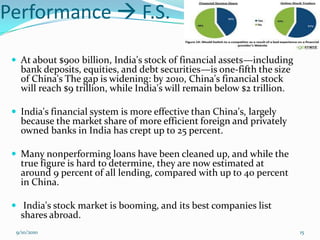
  At about $900 billion, India's stock of financial assets—including
   bank deposits, equities, and debt securities—is one-fifth the size
   of China's The gap is widening: by 2010, China's financial stock
   will reach $9 trillion, while India's will remain below $2 trillion.

  India's financial system is more effective than China's, largely
   because the market share of more efficient foreign and privately
   owned banks in India has crept up to 25 percent.

  Many nonperforming loans have been cleaned up, and while the
   true figure is hard to determine, they are now estimated at
   around 9 percent of all lending, compared with up to 40 percent
   in China.

  India's stock market is booming, and its best companies list
   shares abroad.
  9/10/2010                                                               15
Growth  F.S.

  Present is nearly 8.5% per year. The rise in the growth rate suggests the
   growth of the economy.

  To maintain such a growth for a long term the inflation has to come
   down further.
   The financial sector in India had an overall growth of 15%, which has
   exhibited stability over the last few years although several other markets
   across the Asian region were going through a turmoil.

  With the opening of the financial market variety of products and
   services were introduced to suit the need of the customer.

  The Reserve Bank of India (RBI) played a dynamic role in the growth of
   the financial sector of India.
  9/10/2010                                                                     16
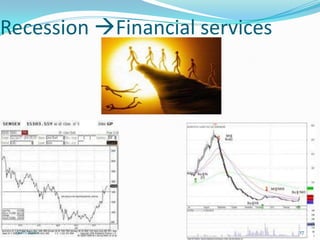
Recession Financial services


 9/10/2010                      17
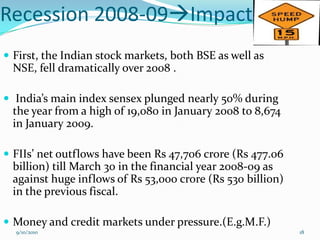
Recession 2008-09Impact
 First, the Indian stock markets, both BSE as well as
 NSE, fell dramatically over 2008 .

 India’s main index sensex plunged nearly 50% during
 the year from a high of 19,080 in January 2008 to 8,674
 in January 2009.

 FIIs’ net outflows have been Rs 47,706 crore (Rs 477.06
 billion) till March 30 in the financial year 2008-09 as
 against huge inflows of Rs 53,000 crore (Rs 530 billion)
 in the previous fiscal.

 Money and credit markets under pressure.(E.g.M.F.)
  9/10/2010                                                 18
Resistance ???
 Supervisory Review Process (SRP)
 Investment Fluctuation Reserve (IFR)-5%
 ‘Held for Trading’ (HFT) & ‘Available for Sale’ (AFS)
 Housing loan Rs.30 lakh (USD 75,000 approx) to
  individuals against the mortgage of residential housing
  properties from 75% to 50%
STEPS Taken:
 Financial Accounting-Conservative(net loss)
 Setting up of the Clearing Corporation of India Limited (CCIL)
 Setting up of INFINET as the communication backbone for the
  financial sector.
 Introduction of Negotiated Dealing System (NDS) for screen-
  based trading in government securities.
 Credit Information Bureau of India Limited (CIBIL) for
  information sharing on defaulters as also other borrowers
    9/10/2010                                                   19
Bibliography
  www.investopedio.com
  www.sebi.com
  www.debtresolutionpartners.com
  www.mca.gov.in
  www.wikipedia.org
  www.centrelink.gov.in
  www.fisglobal.com
  www.business.com
  www.moneymadeclear.com
9/10/2010                           20
THANK YOU

Q&A


9/10/2010   21

Industry analysis n financial service

  • 1.
    Grp.No13 Swatee Ghosh Samit kr. Kapat Ronald Fernandes 9/10/2010 1
  • 2.
    PLACES TO SAVEMONEY Would you save your money in any of these places? Why? Why not? Can you think of other places to save money? • Bed & Mattress • Cookie Jar • Pillow • Wallet • Money Belt • Small House Safe 9/10/2010 2
  • 3.
  • 4.
    Financial services referto services provided by the financial industry. The industry comprises of organizations who manage money. FORMAL INFORMAL FINANCIAL SERVICES FINANCIAL SERVICES • Credit cards • Loans • Payday lenders • Investment vehicles • Check cashing services • Direct deposit • Rent-to-own stores • Wire transfers/ remittances • Pawn shops • Loans from family/friends 9/10/2010 4
  • 5.
    Banks  A landmarkwas registered in the Indian banking sector when the major banks were nationalized in 1969.  Commercial banks  Investments banks  Bonds (debt)  Stocks (equity)  Notary services  Credit cards 9/10/2010 5
  • 6.
    Stock market Origin  Pre-independence  Post-independence  India's market cap as a percentage of world market cap was 2.8 per cent as on December 31, 2009.  In 2009, there were 21 IPOs that raised US$ 4.18 billion as compared to 36 IPOs in 2008 that raised US$ 3.62 billion.  QIP is a capital raising tool, whereby a listed company can issue equity shares, fully and partly convertible debentures, or securities other than warrants, which are convertible into equity shares, to a qualified institutional buyer (QIB).  In 2009, Indian companies had raised close to US$ 7.13 billion (QIP) 9/10/2010 6
  • 7.
    NSE Trading at NSE Fully automated screen-based trading mechanism  Strictly follows the principle of an order-driven market  Trading members are linked through a communication network  This network allows them to execute trade from their offices  The prices at which the buyer and seller are willing to transact will appear on the screen  When the prices match the transaction will be completed  A confirmation slip will be printed at the office of the trading member Advantage of trading at NSE  Integrated network for trading in stock market of India  Fully automated screen based system that provides higher degree of transparency  Investors can transact from any part of the country at uniform prices  Greater functional efficiency supported by totally computerized network 9/10/2010 7
  • 8.
    Foreign Exchange  Currency exchange  Wire transfer  Foreign currency banking 9/10/2010 8
  • 9.
    Investments services  Asset management  Hedge fund management  Custody management 9/10/2010 9
  • 10.
    Insurance India 5th largest life insurance market in the emerging insurance economies globally and the segment is growing at a healthy 32-34 per cent annually (LIC)  Total first year premium collected in 2009-10 was US$ 24.64 billion, an increase of 25.46 per cent over US$ 19.64 billion collected in 2008-09.(IRDA)  Brokers  Underwriters 9/10/2010 10
  • 11.
    Others Private equity  Angel investor  Conglomerates  Debt resolution  Venture capital -Presently in India there are around 34 national and 2 international SEBI registered venture capital funds  Mutual funds  Mortgage companies  Investment research agencies 9/10/2010 11
  • 12.
    Economic Updates Indian economy growth 7.4 per cent in 2009-10.  (CSO) – financial services 9.7 per cent in 2009-10  (SEBI) Investors (FIIs) as on May 31, 2010 was 1,710  FII inflow in equity US$ 4.6 billion  US$ 5.9 billion inflow in debt. (May)09  US$ 875.73 million in debt(Aug)10  Net investment , 2010 was US$ 530.05 million  Mutual fund US$ 170.46 billion May 2010- US$ 135.58 billion May 2009, (AMFI).  India's foreign exchange reserves US$ 271. billion, an increase of US$ 9.87 billion (RBI) 9/10/2010 12
  • 13.
    Main players offinancial services  SBI Capital Markets Limited:  Bajaj Capital Limited:  DSP Merrill Lynch Limited:  Birla Global Finance Limited:  Housing Development Finance Corporation:  PNB Housing Finance Limited:  ICICI Group:  LIC Finance Limited:  L & T Finance Limited:  Karvy Group: 9/10/2010 13
  • 14.
    Consolidation  Increasingthe number of customers and beating competitors by selling various Financial products through one distribution channel.  Diversifying products and customers to avoid the risk and to finance a loss-making part of the business with the profits of another one.  Maintaining a large capital base as a sponge to absorb losses and the growing cost of technology.   Increasing the quality of service and products to gain the trust of the customers.  Increasing profitability in the battle against competitors 9/10/2010 14
  • 15.
    Performance  F.S.  At about $900 billion, India's stock of financial assets—including bank deposits, equities, and debt securities—is one-fifth the size of China's The gap is widening: by 2010, China's financial stock will reach $9 trillion, while India's will remain below $2 trillion.  India's financial system is more effective than China's, largely because the market share of more efficient foreign and privately owned banks in India has crept up to 25 percent.  Many nonperforming loans have been cleaned up, and while the true figure is hard to determine, they are now estimated at around 9 percent of all lending, compared with up to 40 percent in China.  India's stock market is booming, and its best companies list shares abroad. 9/10/2010 15
  • 16.
    Growth  F.S.  Present is nearly 8.5% per year. The rise in the growth rate suggests the growth of the economy.  To maintain such a growth for a long term the inflation has to come down further. The financial sector in India had an overall growth of 15%, which has exhibited stability over the last few years although several other markets across the Asian region were going through a turmoil.  With the opening of the financial market variety of products and services were introduced to suit the need of the customer.  The Reserve Bank of India (RBI) played a dynamic role in the growth of the financial sector of India. 9/10/2010 16
  • 17.
  • 18.
    Recession 2008-09Impact  First,the Indian stock markets, both BSE as well as NSE, fell dramatically over 2008 .  India’s main index sensex plunged nearly 50% during the year from a high of 19,080 in January 2008 to 8,674 in January 2009.  FIIs’ net outflows have been Rs 47,706 crore (Rs 477.06 billion) till March 30 in the financial year 2008-09 as against huge inflows of Rs 53,000 crore (Rs 530 billion) in the previous fiscal.  Money and credit markets under pressure.(E.g.M.F.) 9/10/2010 18
  • 19.
    Resistance ???  SupervisoryReview Process (SRP)  Investment Fluctuation Reserve (IFR)-5%  ‘Held for Trading’ (HFT) & ‘Available for Sale’ (AFS)  Housing loan Rs.30 lakh (USD 75,000 approx) to individuals against the mortgage of residential housing properties from 75% to 50% STEPS Taken:  Financial Accounting-Conservative(net loss)  Setting up of the Clearing Corporation of India Limited (CCIL)  Setting up of INFINET as the communication backbone for the financial sector.  Introduction of Negotiated Dealing System (NDS) for screen- based trading in government securities.  Credit Information Bureau of India Limited (CIBIL) for information sharing on defaulters as also other borrowers 9/10/2010 19
  • 20.
    Bibliography  www.investopedio.com  www.sebi.com  www.debtresolutionpartners.com  www.mca.gov.in  www.wikipedia.org  www.centrelink.gov.in  www.fisglobal.com  www.business.com  www.moneymadeclear.com 9/10/2010 20
  • 21.