Suprovat Basu-Asst. Prof. -MBA, RERFSuprovat Basu-Asst. Prof. -MBA, RERF
05/14/15 1
SUPROVAT BASU--Asst. Prof.-MBA,
RERF,Kolkata
 Meaning & concept
 Definition
 Objective of IR
 Importance of IR
 Role of three actors
 Causes for poor IR
 Developing sound IR
 Code of conduct/discipline
 Objective of code of discipline
 Principle of code of discipline
 Approaches of IR
 Parties to IR
05/14/15 2
SUPROVAT BASU--Asst. Prof.-MBA,
RERF,Kolkata
 The term ‘Industrial Relations’ comprises of
two terms:
‘Industry’ and ‘Relations’
 “Industry” refers to “any productive activity in
which an individual (or a group of individuals)
is (are) engaged”.
 By “relations” we mean “the relationships that
exist within the industry between the
employer and his workmen.”
05/14/15 3
SUPROVAT BASU--Asst. Prof.-MBA,
RERF,Kolkata
Definition
“ Industrial relations deal with either the relationships between the
state and employers’ and the workers’ organization and the
relation between the occupational organizations themselves.”
International Labor Organization (ILO)
 Industrial relations are the relations of all those associated in
productive work including industry, agriculture, mining,
commerce, finance, transport and other services.
 The main aspects are the establishment of the conditions
under which the proceeds of the work are divided as
dividend, salaries and wages between shareholders,
employers, management and work people of various
grades- manual, clerical and technical.
05/14/15 4
SUPROVAT BASU--Asst. Prof.-MBA,
RERF,Kolkata
 The term industrial relations explains the relationship between
employees and management which stem directly or indirectly from
union-employer relationship.
 The relationships which arise at and out of the workplace
generally include the relationships between individual workers,
the relationships between workers and their employer, the
relationships between employers, the relationships employers and
workers have with the organizations formed to promote their
respective interests, and the relations between those
organizations, at all levels
 The term industrial relations has a broad as well as a narrow
outlook. Originally, industrial relations was broadly defined to
include the relationships and interactions between employers and
employees
 Industrial relations also includes the processes through which
these relationships are expressed (such as, collective bargaining,
workers’ participation in decision-making, and grievance and
dispute settlement), and the management of conflict between
employers, workers and trade unions, when it arises.
05/14/15 5
SUPROVAT BASU--Asst. Prof.-MBA,
RERF,Kolkata
Employer-
Employee Relations
Employees
Employee
Associations
Government Courts &
Tribunals
Employer
Associations
Employers
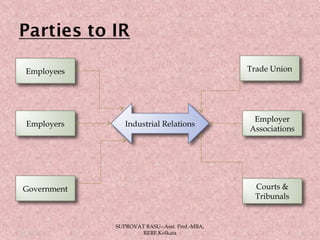
Industrial Relations
Employees
Employers
Government Courts &
Tribunals
Employer
Associations
Trade Union
05/14/15 6
SUPROVAT BASU--Asst. Prof.-MBA,
RERF,Kolkata
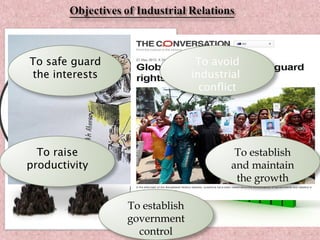
To safe guard
the interests
To avoid
industrial
conflict
To establish
and maintain
the growth
To raise
productivity
To establish
government
control
1. To safeguard the interest of labor and management by
securing the highest level of mutual understanding
and good-will among all those sections in the industry
which participate in the process of production.
2. To avoid industrial conflict or strife and develop
harmonious relations,.
3. To raise productivity to a higher level in an aera of full
employment by lessening the tendency to high
turnover and frequency absenteeism.
4. To improve the economic conditions of workers in the
existing state of industrial managements and political
government
5. To Protect management and labor interests by securing
mutual relations between the two groups.
05/14/15 8
SUPROVAT BASU--Asst. Prof.-MBA,
RERF,Kolkata
6.To Avoid disputes between management and labor,
and create a harmonizing relationship between the
groups so productivity can be increased.
7.Ensure full employment and reduce absenteeism,
hence, increasing productivity and profits.
8.To Provide better wages and living conditions to
labor, so misunderstandings between
management and labor are reduced to a
minimum.
9.To bring about government control over plants
where losses are running high, or where products
are produced in the public interest.
05/14/15 9
SUPROVAT BASU--Asst. Prof.-MBA,
RERF,Kolkata
 Uninterrupted production
 Reduction in Industrial Disputes
 High morale
 Mental Revolution
 Reduced Wastage
 Foster Industrial Peace
 Promote Industrial Democracy
05/14/15 10
SUPROVAT BASU--Asst. Prof.-MBA,
RERF,Kolkata
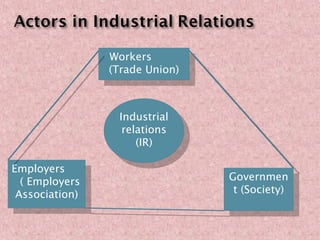
Workers
(Trade Union)
Workers
(Trade Union)
Governmen
t (Society)
Governmen
t (Society)
Employers
( Employers
Association)
Employers
( Employers
Association)
Industrial
relations
(IR)
Industrial
relations
(IR)
 EMPLOYEES
 STATE
 EMPLOYER
05/14/15 12
SUPROVAT BASU--Asst. Prof.-MBA,
RERF,Kolkata
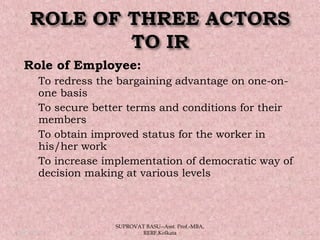
Role of Employee:
 To redress the bargaining advantage on one-on-
one basis
 To secure better terms and conditions for their
members
 To obtain improved status for the worker in
his/her work
 To increase implementation of democratic way of
decision making at various levels
05/14/15 13
SUPROVAT BASU--Asst. Prof.-MBA,
RERF,Kolkata
 Creating and sustaining employee motivation
 Ensuring commitment from employees
 Negotiating terms and conditions of employment
with TU leaders
 Sharing decision making with employees
05/14/15 14
SUPROVAT BASU--Asst. Prof.-MBA,
RERF,Kolkata
 Labor policies
 Labor laws
 Industrial tribunals
 Wage boards
 Industrial relations policy
05/14/15 15
SUPROVAT BASU--Asst. Prof.-MBA,
RERF,Kolkata
The main reasons are as follows:
 An attitude of contempt towards the workers on the part of the
management.
 Inadequate fixation of wages or improper wage structure.
 Indiscipline
 Unhealthy working conditions at the workplace.
 Lack of human relations skills on the part of supervisors and
managers.
 Desire of workers for higher bonus, wages or daily allowances.
 Desire of employers to pay as little as possible to its workers.
05/14/15 16
SUPROVAT BASU--Asst. Prof.-MBA,
RERF,Kolkata
 Inadequate welfare facilities.
 Dispute on sharing the gains of productivity.
 Retrenchment, dismissal and lockouts by the management.
 Strikes by the workers.
 Inter-union rivals.
 General economic and political environment such as rising
prices, strikes by others and general indiscipline having
their effect on the employees attitudes.
 Mental inertia on the part of the management.
05/14/15 17
SUPROVAT BASU--Asst. Prof.-MBA,
RERF,Kolkata
 Developing trust between Labor & Management
 Maintenance of Industrial Peace
 Continuous feedback & monitoring
 Professional approach
 Existence of sound, democratic TU
05/14/15 18
SUPROVAT BASU--Asst. Prof.-MBA,
RERF,Kolkata
 It specifies various obligations for the
management and the workers with the objective
of promoting cooperation between their
representatives. 
 To maintain harmonious relations and promote
industrial peace, a Code of Discipline has been
laid down which applies to both public and
private sector enterprises
05/14/15 19
SUPROVAT BASU--Asst. Prof.-MBA,
RERF,Kolkata
 Maintain peace and order in industry.
 Promote constructive criticism at all levels of management and
employment.
 Avoid work stoppage in industry.
 Secure the settlement of disputes and grievances by a mutually
agreed procedure.
 Avoiding litigation.
 Facilitate a free growth of trade unions.
 Eliminate all forms of coercion, intimidation and violations of rules
and regulations governing industrial relations.
05/14/15 20
SUPROVAT BASU--Asst. Prof.-MBA,
RERF,Kolkata
 There should be no strike or lockout without prior notice.
 No unilateral action should be taken in connection with any
industrial matter.
 Employees should not follow go slow tactic.
 No deliberate damage should be caused to a plant or property
 Acts of violations, intimidation and coercion should not be
resorted
 The existing machinery for the settlement of disputes should be
utilized.
 Actions that disturb cordial relationships should be avoided.
05/14/15 21
SUPROVAT BASU--Asst. Prof.-MBA,
RERF,Kolkata
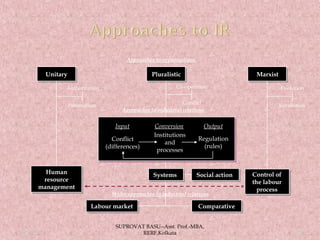
 There are mainly three approaches to IR
1. Unitary approach
2. Pluralistic Approach
3. Marxist Approach
05/14/15 22
SUPROVAT BASU--Asst. Prof.-MBA,
RERF,Kolkata
Pluralistic
Co-operation
Conflict
Authoritarian
Paternalism
Unitary
Human
resource
management
Systems
Evolution
Revolution
Marxist
Control of
the labour
process
Input Conversion Output
Conflict
(differences)
Institutions
and
processes
Regulation
(rules)
Approaches to organisations
Approaches to industrial relations
Social action
Wider approaches to industrial relations
Labour market Comparative
05/14/15 23
SUPROVAT BASU--Asst. Prof.-MBA,
RERF,Kolkata
 IR is grounded in mutual co-operation, individual
treatment, team work and shared goals.
 Union co-operate with the mgt. & the mgt.’s right to
manage is accepted because there is no ‘ we they
feeling’
 Assumption: Common interest & promotion of harmony
No strikes are there.
 It’s a reactive IR strategy.
 They seek direct negotiations with employees.
05/14/15 24
SUPROVAT BASU--Asst. Prof.-MBA,
RERF,Kolkata
 It perceives:
 Org. as a coalitions of competing interest.
 TU as legitimate representatives of employee
interests.
 Stability in IR as the product of concessions and
compromises between mgt. & unions.
 Conflict between Mgt. and workers is understood as
inevitable.
 Conflict is viewed as conducive for innovation and
growth.
 Strong union is necessary.
05/14/15 25
SUPROVAT BASU--Asst. Prof.-MBA,
RERF,Kolkata
 Regard conflict as Pluralists…
 Marxists see conflict as a product of the capitalist society.
 Conflict arises due to the division in the society between those who
own resources and those who have only labor to offer.
 For Marxist all strikes are political.
 He regard state intervention via legislation & the creation of Industrial
tribunals as supporting mgt’s interest rather than ensuring a balance
between the competing groups.
05/14/15 26
SUPROVAT BASU--Asst. Prof.-MBA,
RERF,Kolkata
THANK YOU
QUESTIONS?
05/14/15 27
SUPROVAT BASU--Asst. Prof.-MBA,
RERF,Kolkata

Industrial relation Module-1

  • 1.
    Suprovat Basu-Asst. Prof.-MBA, RERFSuprovat Basu-Asst. Prof. -MBA, RERF 05/14/15 1 SUPROVAT BASU--Asst. Prof.-MBA, RERF,Kolkata
  • 2.
     Meaning &concept  Definition  Objective of IR  Importance of IR  Role of three actors  Causes for poor IR  Developing sound IR  Code of conduct/discipline  Objective of code of discipline  Principle of code of discipline  Approaches of IR  Parties to IR 05/14/15 2 SUPROVAT BASU--Asst. Prof.-MBA, RERF,Kolkata
  • 3.
     The term‘Industrial Relations’ comprises of two terms: ‘Industry’ and ‘Relations’  “Industry” refers to “any productive activity in which an individual (or a group of individuals) is (are) engaged”.  By “relations” we mean “the relationships that exist within the industry between the employer and his workmen.” 05/14/15 3 SUPROVAT BASU--Asst. Prof.-MBA, RERF,Kolkata
  • 4.
    Definition “ Industrial relationsdeal with either the relationships between the state and employers’ and the workers’ organization and the relation between the occupational organizations themselves.” International Labor Organization (ILO)  Industrial relations are the relations of all those associated in productive work including industry, agriculture, mining, commerce, finance, transport and other services.  The main aspects are the establishment of the conditions under which the proceeds of the work are divided as dividend, salaries and wages between shareholders, employers, management and work people of various grades- manual, clerical and technical. 05/14/15 4 SUPROVAT BASU--Asst. Prof.-MBA, RERF,Kolkata
  • 5.
     The termindustrial relations explains the relationship between employees and management which stem directly or indirectly from union-employer relationship.  The relationships which arise at and out of the workplace generally include the relationships between individual workers, the relationships between workers and their employer, the relationships between employers, the relationships employers and workers have with the organizations formed to promote their respective interests, and the relations between those organizations, at all levels  The term industrial relations has a broad as well as a narrow outlook. Originally, industrial relations was broadly defined to include the relationships and interactions between employers and employees  Industrial relations also includes the processes through which these relationships are expressed (such as, collective bargaining, workers’ participation in decision-making, and grievance and dispute settlement), and the management of conflict between employers, workers and trade unions, when it arises. 05/14/15 5 SUPROVAT BASU--Asst. Prof.-MBA, RERF,Kolkata
  • 6.
    Employer- Employee Relations Employees Employee Associations Government Courts& Tribunals Employer Associations Employers Industrial Relations Employees Employers Government Courts & Tribunals Employer Associations Trade Union 05/14/15 6 SUPROVAT BASU--Asst. Prof.-MBA, RERF,Kolkata
  • 7.
    To safe guard theinterests To avoid industrial conflict To establish and maintain the growth To raise productivity To establish government control
  • 8.
    1. To safeguardthe interest of labor and management by securing the highest level of mutual understanding and good-will among all those sections in the industry which participate in the process of production. 2. To avoid industrial conflict or strife and develop harmonious relations,. 3. To raise productivity to a higher level in an aera of full employment by lessening the tendency to high turnover and frequency absenteeism. 4. To improve the economic conditions of workers in the existing state of industrial managements and political government 5. To Protect management and labor interests by securing mutual relations between the two groups. 05/14/15 8 SUPROVAT BASU--Asst. Prof.-MBA, RERF,Kolkata
  • 9.
    6.To Avoid disputesbetween management and labor, and create a harmonizing relationship between the groups so productivity can be increased. 7.Ensure full employment and reduce absenteeism, hence, increasing productivity and profits. 8.To Provide better wages and living conditions to labor, so misunderstandings between management and labor are reduced to a minimum. 9.To bring about government control over plants where losses are running high, or where products are produced in the public interest. 05/14/15 9 SUPROVAT BASU--Asst. Prof.-MBA, RERF,Kolkata
  • 10.
     Uninterrupted production Reduction in Industrial Disputes  High morale  Mental Revolution  Reduced Wastage  Foster Industrial Peace  Promote Industrial Democracy 05/14/15 10 SUPROVAT BASU--Asst. Prof.-MBA, RERF,Kolkata
  • 11.
    Workers (Trade Union) Workers (Trade Union) Governmen t(Society) Governmen t (Society) Employers ( Employers Association) Employers ( Employers Association) Industrial relations (IR) Industrial relations (IR)
  • 12.
     EMPLOYEES  STATE EMPLOYER 05/14/15 12 SUPROVAT BASU--Asst. Prof.-MBA, RERF,Kolkata
  • 13.
    Role of Employee: To redress the bargaining advantage on one-on- one basis  To secure better terms and conditions for their members  To obtain improved status for the worker in his/her work  To increase implementation of democratic way of decision making at various levels 05/14/15 13 SUPROVAT BASU--Asst. Prof.-MBA, RERF,Kolkata
  • 14.
     Creating andsustaining employee motivation  Ensuring commitment from employees  Negotiating terms and conditions of employment with TU leaders  Sharing decision making with employees 05/14/15 14 SUPROVAT BASU--Asst. Prof.-MBA, RERF,Kolkata
  • 15.
     Labor policies Labor laws  Industrial tribunals  Wage boards  Industrial relations policy 05/14/15 15 SUPROVAT BASU--Asst. Prof.-MBA, RERF,Kolkata
  • 16.
    The main reasonsare as follows:  An attitude of contempt towards the workers on the part of the management.  Inadequate fixation of wages or improper wage structure.  Indiscipline  Unhealthy working conditions at the workplace.  Lack of human relations skills on the part of supervisors and managers.  Desire of workers for higher bonus, wages or daily allowances.  Desire of employers to pay as little as possible to its workers. 05/14/15 16 SUPROVAT BASU--Asst. Prof.-MBA, RERF,Kolkata
  • 17.
     Inadequate welfarefacilities.  Dispute on sharing the gains of productivity.  Retrenchment, dismissal and lockouts by the management.  Strikes by the workers.  Inter-union rivals.  General economic and political environment such as rising prices, strikes by others and general indiscipline having their effect on the employees attitudes.  Mental inertia on the part of the management. 05/14/15 17 SUPROVAT BASU--Asst. Prof.-MBA, RERF,Kolkata
  • 18.
     Developing trustbetween Labor & Management  Maintenance of Industrial Peace  Continuous feedback & monitoring  Professional approach  Existence of sound, democratic TU 05/14/15 18 SUPROVAT BASU--Asst. Prof.-MBA, RERF,Kolkata
  • 19.
     It specifiesvarious obligations for the management and the workers with the objective of promoting cooperation between their representatives.   To maintain harmonious relations and promote industrial peace, a Code of Discipline has been laid down which applies to both public and private sector enterprises 05/14/15 19 SUPROVAT BASU--Asst. Prof.-MBA, RERF,Kolkata
  • 20.
     Maintain peaceand order in industry.  Promote constructive criticism at all levels of management and employment.  Avoid work stoppage in industry.  Secure the settlement of disputes and grievances by a mutually agreed procedure.  Avoiding litigation.  Facilitate a free growth of trade unions.  Eliminate all forms of coercion, intimidation and violations of rules and regulations governing industrial relations. 05/14/15 20 SUPROVAT BASU--Asst. Prof.-MBA, RERF,Kolkata
  • 21.
     There shouldbe no strike or lockout without prior notice.  No unilateral action should be taken in connection with any industrial matter.  Employees should not follow go slow tactic.  No deliberate damage should be caused to a plant or property  Acts of violations, intimidation and coercion should not be resorted  The existing machinery for the settlement of disputes should be utilized.  Actions that disturb cordial relationships should be avoided. 05/14/15 21 SUPROVAT BASU--Asst. Prof.-MBA, RERF,Kolkata
  • 22.
     There aremainly three approaches to IR 1. Unitary approach 2. Pluralistic Approach 3. Marxist Approach 05/14/15 22 SUPROVAT BASU--Asst. Prof.-MBA, RERF,Kolkata
  • 23.
    Pluralistic Co-operation Conflict Authoritarian Paternalism Unitary Human resource management Systems Evolution Revolution Marxist Control of the labour process InputConversion Output Conflict (differences) Institutions and processes Regulation (rules) Approaches to organisations Approaches to industrial relations Social action Wider approaches to industrial relations Labour market Comparative 05/14/15 23 SUPROVAT BASU--Asst. Prof.-MBA, RERF,Kolkata
  • 24.
     IR isgrounded in mutual co-operation, individual treatment, team work and shared goals.  Union co-operate with the mgt. & the mgt.’s right to manage is accepted because there is no ‘ we they feeling’  Assumption: Common interest & promotion of harmony No strikes are there.  It’s a reactive IR strategy.  They seek direct negotiations with employees. 05/14/15 24 SUPROVAT BASU--Asst. Prof.-MBA, RERF,Kolkata
  • 25.
     It perceives: Org. as a coalitions of competing interest.  TU as legitimate representatives of employee interests.  Stability in IR as the product of concessions and compromises between mgt. & unions.  Conflict between Mgt. and workers is understood as inevitable.  Conflict is viewed as conducive for innovation and growth.  Strong union is necessary. 05/14/15 25 SUPROVAT BASU--Asst. Prof.-MBA, RERF,Kolkata
  • 26.
     Regard conflictas Pluralists…  Marxists see conflict as a product of the capitalist society.  Conflict arises due to the division in the society between those who own resources and those who have only labor to offer.  For Marxist all strikes are political.  He regard state intervention via legislation & the creation of Industrial tribunals as supporting mgt’s interest rather than ensuring a balance between the competing groups. 05/14/15 26 SUPROVAT BASU--Asst. Prof.-MBA, RERF,Kolkata
  • 27.
    THANK YOU QUESTIONS? 05/14/15 27 SUPROVATBASU--Asst. Prof.-MBA, RERF,Kolkata